
1 Samuel 15:35

Hebrew (Westminster Leningrad Codex) 1 Samuel 15:35 appears in the Hebrew Old Testament. The text above is from the Westminster Leningrad Codex. Each word links to its Strong’s number, a concise gloss, and parsing drawn from the Open Scriptures Hebrew Bible morphology. Click any word for its full Brown-Driver-Briggs (BDB) entry.
Download image
Cite this verse

1 Samuel 15:35 (World English Bible). Public Domain. Lemma interlinear Bible study tool, https://lemma.gebible.app/v/1-samuel/15/35.

Show BibTeX & RIS
BibTeX
RIS
English Translation
Samuel came no more to see Saul until the day of his death; for Samuel mourned for Saul: and Yahweh repented that he had made Saul king over Israel.
World English Bible · Public Domain
Download a study sheet

One document with this verse’s original text, its word-by-word gloss line, the meaning frame, cross-references with their text, attributed commentary, and full source and license credits — printable, and it pastes into notes with its structure intact.

This verse Autodidact and up

Study sheet (.html) Plain text (.txt)

A passage Seminary Student

Up to 50 verses in one chapter. A passage sheet keeps up to 6 commentary sources and 12 cross-references per verse, in the order this page ranks them, and says so on the sheet whenever that leaves anything out. Ask for a single verse and you get the Autodidact verse sheet above.

Everything on this page stays free to read, with no account — the sheet is a download of what is already on screen, not access to it.

Want to remove ads? Support Godless Engineer
Compare translations 3

The same verse in 3 English versions, stacked beneath the original-language interlinear above. Click any original word for its lexicon entry.

Each is an independent rendering of the whole verse — the interlinear is not word-aligned to these translations.

Highlighted words mark where these versions differ — a whole-verse word diff, not a word-by-word alignment.

  • World English Bible Public Domain
    Samuel came no more to see Saul until the day of his death; for Samuel mourned for Saul: and Yahweh repented that he had made Saul king over Israel.
  • King James Version Public Domain
    And Samuel came no more to see Saul until the day of his death: nevertheless Samuel mourned for Saul: and the LORD repented that he had made Saul king over Israel.
  • unfoldingWord Literal Text CC BY-SA 4.0
    And Samuel did not resume to see Saul up to the day of his death, but Samuel mourned for Saul. And Yahweh regretted that he had made Saul reign over Israel.

unfoldingWord Literal Text — © unfoldingWord, licensed CC BY-SA 4.0. Word-aligned USFM3 via Door43 (git.door43.org/unfoldingWord/en_ult).

Versions to compare (up to 4)

3 of 4 selected

Show all 18 translations

Every available English version of this verse, each an independent rendering of the whole verse.

  • World English Bible Public Domain
    Samuel came no more to see Saul until the day of his death; for Samuel mourned for Saul: and Yahweh repented that he had made Saul king over Israel.
  • Berean Standard Bible Public Domain
    And to the day of his death, Samuel never again visited Saul. Samuel mourned for Saul, and the LORD regretted that He had made Saul king over Israel.
  • Majority Standard Bible Public Domain
    And to the day of his death, Samuel never again visited Saul. Samuel mourned for Saul, and the LORD regretted that He had made Saul king over Israel.
  • King James Version Public Domain
    And Samuel came no more to see Saul until the day of his death: nevertheless Samuel mourned for Saul: and the LORD repented that he had made Saul king over Israel.
  • American Standard Version (1901) Public Domain
    And Samuel came no more to see Saul until the day of his death; for Samuel mourned for Saul: and Jehovah repented that he had made Saul king over Israel.
  • Revised Version (1885) Public Domain
    And Samuel came no more to see Saul until the day of his death; for Samuel mourned for Saul: and the LORD repented that he had made Saul king over Israel.
  • Geneva Bible (1599) Public Domain
    And Samuel came no more to see Saul vntill the day of his death: but Samuel mourned for Saul, and the Lord repented that hee made Saul King ouer Israel.
  • Douay-Rheims (1899) Public Domain
    And Samuel saw Saul no more till the day of his death: nevertheless Samuel mourned for Saul, because the Lord repented that he had made him king over Israel.
  • Young's Literal Translation Public Domain
    And Samuel hath not added to see Saul till the day of his death, for Samuel mourned for Saul, and Jehovah repented that He had caused Saul to reign over Israel.
  • Literal Standard Version CC BY-SA 4.0
    And Samuel has not added to see Saul until the day of his death, for Samuel mourned for Saul, and YHWH regretted that He had caused Saul to reign over Israel.
  • Unlocked Literal Bible CC BY-SA 4.0
    Samuel did not see Saul until the day of his death, for he mourned for Saul. Yahweh was grieved that he had made Saul king over Israel.
  • unfoldingWord Literal Text CC BY-SA 4.0
    And Samuel did not resume to see Saul up to the day of his death, but Samuel mourned for Saul. And Yahweh regretted that he had made Saul reign over Israel.
  • Darby Bible Public Domain
    And Samuel saw Saul no more until the day of his death; for Samuel mourned over Saul; and Jehovah repented that he had made Saul king over Israel.
  • World Messianic Bible Public Domain
    Samuel came no more to see Saul until the day of his death, but Samuel mourned for Saul. The LORD grieved that he had made Saul king over Israel.
  • Webster's Bible Public Domain
    And Samuel came no more to see Saul until the day of his death: nevertheless Samuel mourned for Saul: and the LORD repented that he had made Saul king over Israel.
  • Free Bible Version CC BY-SA 4.0
    Until the day of his death, Samuel never visited Saul again. Samuel mourned over Saul, and the Lord regretted he had made Saul the king of Israel.
  • Bible in Basic English Public Domain
    And Samuel never saw Saul again till the day of his death; but Samuel was sorrowing for Saul: and it was no longer the Lord's pleasure for Saul to be king over Israel.
  • JPS Tanakh (1917) Public Domain
    And Samuel never beheld Saul again until the day of his death; for Samuel mourned for Saul; and the LORD repented that He had made Saul king over Israel.

Literal Standard Version (2020), Covenant Press — licensed CC BY-SA 4.0. Text via the HelloAO Bible API (eBible.org). Unlocked Literal Bible (unfoldingWord) — licensed CC BY-SA 4.0. Text via the HelloAO Bible API (eBible.org). unfoldingWord Literal Text — © unfoldingWord, licensed CC BY-SA 4.0. Word-aligned USFM3 via Door43 (git.door43.org/unfoldingWord/en_ult). Free Bible Version, Dr. Jonathan Gallagher — licensed CC BY-SA 4.0. Text via the HelloAO Bible API (eBible.org).

Word by word

More ways to search: Search by grammar → Find every occurrence → Compare this word →

Practice this passage: Drill this verse → Learn its vocabulary →

הִתְאַבֵּ֥ל
ʼâbal
H56
“to mourn”
Verb, Hithpael, Perfect, 3rd Person, Masculine, Singular
Part of Speech
Verb
Stem
Hithpael
Form
Perfect
Person
3rd Person
Gender
Masculine
Number
Singular
Full BDB Definition

Origin: a primitive root

TWOT: 6

to mourn, lament - (Qal) to mourn, lament - of humans - of inanimate objects (figuratively) - of gates - of land - (Hiphil) - to mourn, cause to mourn (figuratively) - (Hithpael) - to mourn - play the mourner
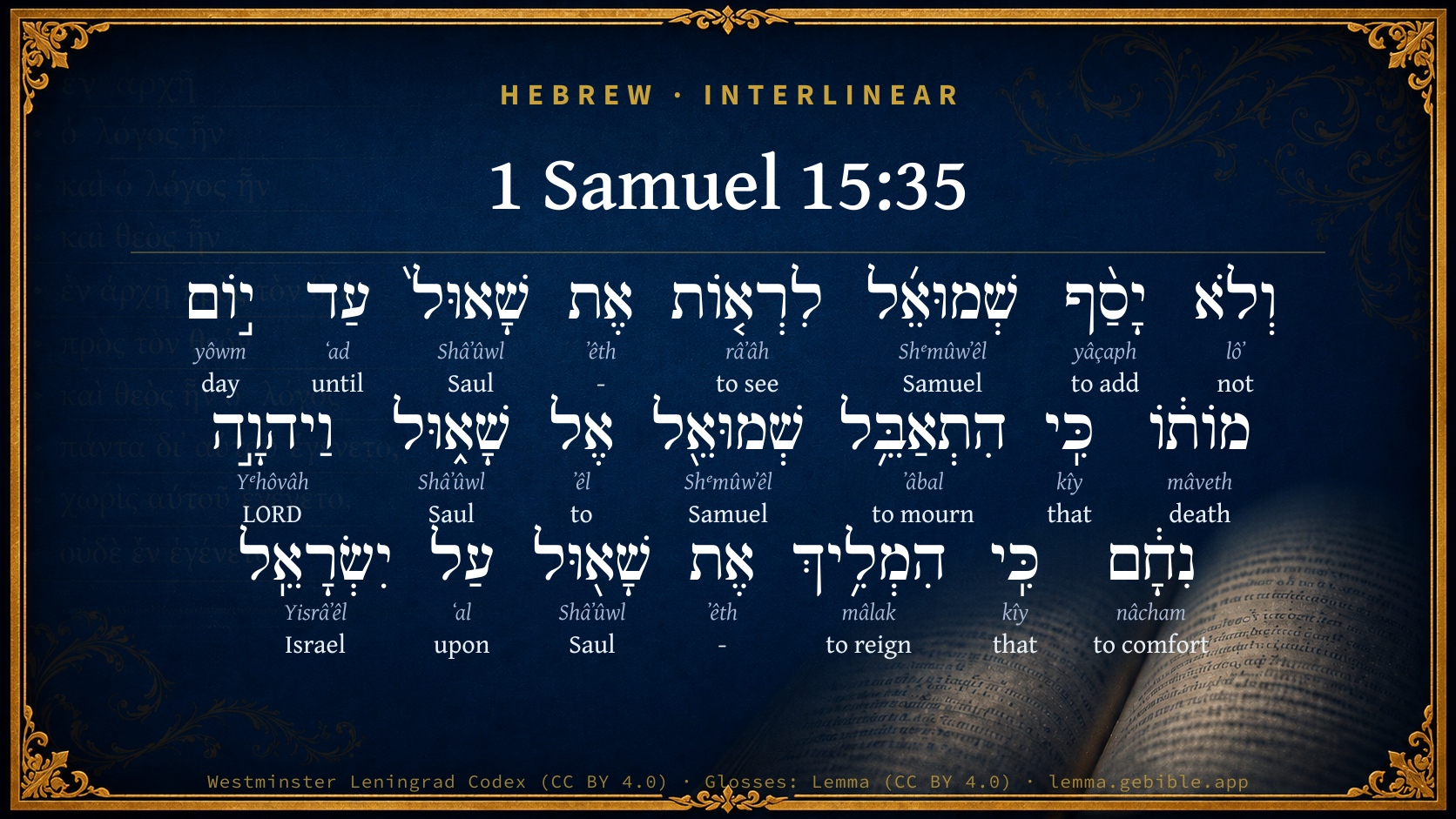
  1. וְלֹא lôʼ H3808 “and · not” Conjunction + Particle, Negative
  2. יָסַ֨ף yâçaph H3254 “to add” Verb, Qal, Perfect, 3rd Person, Masculine, Singular
  3. שְׁמוּאֵ֜ל Shᵉmûwʼêl H8050 “Samuel” Noun, Proper
  4. לִרְא֤וֹת râʼâh H7200 “to see” Preposition + Verb, Qal, Infinitive Construct
  5. אֶת ʼêth H853 “-” Particle, Direct Object
  6. שָׁאוּל֙ Shâʼûwl H7586 “Saul” Noun, Proper
  7. עַד ʻad H5704 “until” Preposition
  8. י֣וֹם yôwm H3117 “day of” Noun, Common, Masculine, Singular, Construct
  9. מוֹת֔וֹ mâveth H4194 “death · his” Noun, Common, Masculine, Singular, Construct + Suffix, Personal, 3rd Person, Masculine, Singular
  10. כִּֽי kîy H3588 “that” Conjunction
  11. שְׁמוּאֵ֖ל Shᵉmûwʼêl H8050 “Samuel” Noun, Proper
  12. אֶל ʼêl H413 “to” Preposition
  13. שָׁא֑וּל Shâʼûwl H7586 “Saul” Noun, Proper
  14. וַיהוָ֣ה Yᵉhôvâh H3068 “and · LORD” Conjunction + Noun, Proper
  15. נִחָ֔ם nâcham H5162 “to comfort” Verb, Niphal, Perfect, 3rd Person, Masculine, Singular
  16. כִּֽי kîy H3588 “that” Conjunction
  17. הִמְלִ֥יךְ mâlak H4427 “to reign” Verb, Hiphil, Perfect, 3rd Person, Masculine, Singular
  18. אֶת ʼêth H853 “-” Particle, Direct Object
  19. שָׁא֖וּל Shâʼûwl H7586 “Saul” Noun, Proper
  20. עַל ʻal H5921 “upon” Preposition
  21. יִשְׂרָאֵֽל Yisrâʼêl H3478 “Israel” Noun, Proper

About this verse

These counts appear in no published source. They are computed here, from the morphology-tagged text and Lemma’s own curated glosses. What Lemma adds →

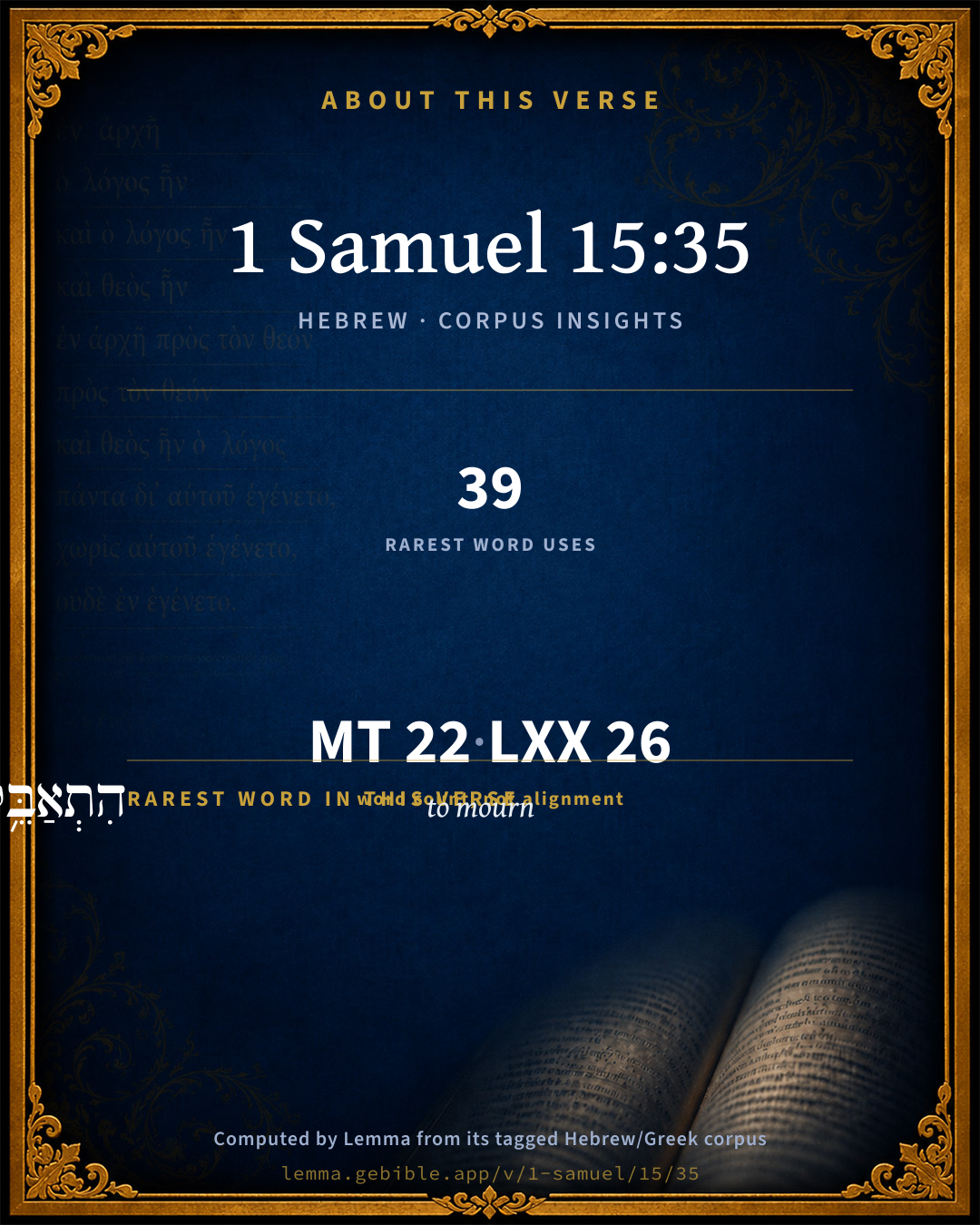
22
words
17
distinct lemmas
Historical
section

Shared distinctive vocabulary

הִתְאַבֵּ֥ל to mourn H56 occurs in 38 verses of the Hebrew Bible. Also found in:

Grammatical profile

  • 5 verbs
  • 9 nouns
  • 3 prepositions
  • 2 conjunctions
  • 3 particles

Verb forms

  • יָסַ֨ף Qal · Perfect
  • לִרְא֤וֹת Qal · Infinitive Construct
  • הִתְאַבֵּ֥ל Hithpael · Perfect
  • נִחָ֔ם Niphal · Perfect
  • הִמְלִ֥יךְ Hiphil · Perfect

Repetition

Words recur within this verse — often emphatic in Hebrew:

  • שָׁאוּל֙ Saul H7586 ×3
  • שְׁמוּאֵ֜ל Samuel H8050 ×2
  • כִּֽי that H3588 ×2

Hebrew & Septuagint length

In English translation the verse runs 29 words from the Hebrew and 30 from the Septuagint (LXX English) — closely comparable.

A rough comparison of the two English renderings, which tokenize alike — not a word-level alignment.

Word counts can differ between the Hebrew and the Greek without any difference in meaning — e.g. the Hebrew direct-object marker אֵת has no separate Greek word, and Greek often adds the article ὁ.

In the original languages it is 22 Hebrew tokens and 26 Greek tokens — but the two are counted differently (Hebrew bundles its prefixes and suffixes into one token; the Greek is in lemma form), so that isn’t a like-for-like length.

Cross-references

9

Topical passages linked to 1 Samuel 15:35 in the Treasury of Scripture Knowledge — connected by theme and wording, ordered by reader-vote popularity; previews shown in the World English Bible.

  • 1 Samuel 15:11 It repents me that I have set up Saul to be king; for he is turned back from following me, and has not performed my commandments. Samuel was angry; and he cried to Yahweh all night.
  • 1 Samuel 19:24 He also stripped off his clothes, and he also prophesied before Samuel, and lay down naked all that day and all that night. Therefore they say, "Is Saul also among the prophets?"
  • 1 Samuel 16:1 Yahweh said to Samuel, How long will you mourn for Saul, seeing I have rejected him from being king over Israel? fill your horn with oil, and go: I will send you to Jesse the Bethlehemite; for I have provided me a king among his sons.
  • Jeremiah 9:1–2 Oh that my head were waters, and my eyes a spring of tears, that I might weep day and night for the slain of the daughter of my people!
  • Genesis 6:6 Yahweh was sorry that he had made man on the earth, and it grieved him in his heart.
  • Psalms 119:136 Streams of tears run down my eyes, Because they don't observe your law.
  • Psalms 119:158 I look at the faithless with loathing, Because they don't observe your word.
  • Romans 9:2–3 that I have great sorrow and unceasing pain in my heart.
  • Philippians 3:18 For many walk, of whom I told you often, and now tell you even weeping, as the enemies of the cross of Christ,

Cross-references courtesy of OpenBible.info (CC BY 4.0).

Hebrew and Greek witnesses Masoretic Hebrew ↔ Greek Septuagint

The same verse in the two great witnesses to the Old Testament, shown verse-for-verse.

These are two independent witnesses, not word-aligned to each other, and the Septuagint is shown in lemma (dictionary) form.

Hebrew 1 Samuel 15:35 Masoretic · Westminster Leningrad Codex

וְלֹא יָסַ֨ף שְׁמוּאֵ֜ל לִרְא֤וֹת אֶת שָׁאוּל֙ עַד י֣וֹם מוֹת֔וֹ כִּֽי הִתְאַבֵּ֥ל שְׁמוּאֵ֖ל אֶל שָׁא֑וּל וַיהוָ֣ה נִחָ֔ם כִּֽי הִמְלִ֥יךְ אֶת שָׁא֖וּל עַל יִשְׂרָאֵֽל

Samuel came no more to see Saul until the day of his death; for Samuel mourned for Saul: and Yahweh repented that he had made Saul king over Israel.

World English Bible · Public Domain

Greek LXX 1 Samuel 15:35 Septuagint · lemma form

καί οὐ προςτίθημι σαμουηλ ἔτι ὁράω ὁ σαούλ ἕως ἡμέρα θάνατος αὐτός ὅτι πενθέω σαμουηλ ἐπί σαούλ καί κύριος μεταμελέω ὅτι βασιλεύω ὁ σαούλ ἐπί ἰσραήλ

And Samuel did not see Saul again till the day of his death, for Samuel mourned after Saul, and the Lord repented that he had made Saul king over Israel.

LXX2012 (modern English Septuagint) · Public Domain

Hebrew: Westminster Leningrad Codex (CC BY 4.0). Greek: Septuagint (public domain); English from LXX2012 (modern English Septuagint) (Public Domain). How the Septuagint differs from the Hebrew →

Targum (Aramaic paraphrase)

1

The Targum is the ancient Jewish Aramaic paraphrase of the Hebrew Scriptures — an interpretive translation, not the Hebrew text itself. Onkelos (literal) and Pseudo-Jonathan (expansive) render the Torah, and Jonathan the Prophets. Coverage is partial: where no permissively-licensed English translation exists for a verse, only the Aramaic is shown. This is verse-level text, not a word-by-word alignment to the Hebrew.

  1. Targum Jonathan Prophets (Joshua–Malachi)
    וְלָא אוֹסִיף שְׁמוּאֵל לְמֶחֱזֵי יַת שָׁאוּל עַד יוֹם מוֹתֵיהּ אֲרֵי אִתְאַבֵּל שְׁמוּאֵל אֶל שָׁאוּל וַיָי תַּב בְּמֵימְרֵיהּ אֲרֵי אַמְלִיךְ יַת שָׁאוּל עַל יִשְׂרָאֵל:

    (no public-domain English translation for this verse)

    Targum Jonathan — Aramaic: “Mikraot Gedolot” (public domain). English: “Sefaria Community Translation” (CC0 1.0 (public-domain dedication)); “London "Chaldee Paraphrase," 1871” (public domain). Text via Sefaria.

Commentary

Notes on 1 Samuel 15:35 from classic Christian and Jewish commentators (each source and its license shown beneath its notes). The classic Christian expositions comment on the surrounding passage and are grouped to its opening verse, so a note may address several verses; the Jewish commentaries on the Tanakh (Rashi and others) are per-verse, so they appear only where the commentator wrote on this verse.

Lemma curates 59 commentaries, every one of them public domain or Creative Commons licensed, each selected and text-cleaned for this edition rather than reprinted as found. About our sources →

Trapp's Complete Commentary

John Trapp

1Sa 15:35 And Samuel came no more to see Saul until the day of his death: nevertheless Samuel mourned for Saul: and the LORD repented that he had made Saul king over Israel.

Ver. 35. And Samuel came no more,] viz., To visit him, and assist him.

Samuel mourned for Saul.] For the hardness of his heart, and the hazard of his soul.

John Trapp, A Commentary or Exposition upon All the Books of the Old and New Testament (1647–1656) — public domain. Text from a community e-Sword module.

The Biblical Illustrator

Joseph S. Exell

1Sa_15:35

Samuel came no more to see Saul until the day of his death.

Samuels withdrawal from Saul

Very few bad persons are without some redeeming quality, as it is called; and redeeming qualities are usually precisely of that kind by which we are most fascinated. The redeeming qualities of a wicked man are, however, the very things which should cause us most to fear for these with whom he comes in contact.

1. Few--very few, avoid falling into the error of mistaking what are symptoms of possible good in the future for tokens of real good at the present time, and from at least occasionally thinking that their deliberately formed opinion of the entire character was after all incorrect, and that the persons in whom these good qualities are so clearly observable cannot be wicked at all. These, of course, will think and speak of the redeeming qualities, not as redeeming qualities, but as the main features of the character, and try to persuade themselves that it is for the sake of these they continue intimacies which their consciences tell them require in some way to be defended.

2. Besides this proneness to self-deceit, which in greater or less force lurks in the best of us, there are two other causes which expose us to the danger of being injured by the redeeming qualities of godless men. One is the fact that there are undoubtedly blemishes in the characters of very good men.

3. The other source of danger is this. The very best of men are known to entertain an affection for bad men. From this it is argued that the men are not bad. Samuel had an affection for Saul. Saul had many redeeming qualities--qualities calculated to make him exceedingly popular. Nor was this all. He had a good deal about him to be liked, and Samuel did like him. A good man, then, may have an affection for a bad man, without being at all mistaken as to his character; nay, even after he had been, as in the case before us, the very persons who had himself pronounced the Divine condemnation. We must not, then, be led astray as to the real characters of those whom we should otherwise feel bound to regard as dangerous by the mere fact that they have awakened an affection in those whom we justly reverence. Had we known no more than that there was a King of Israel named Saul, and that the holy Samuel mourned exceeding for him on his losing the kingdom, we should, I think, have taken for granted that Saul was a good man, and yet you see we should have been wrong.

4. This discontinuance of personal intercourse with Saul shows us also the limits of a good mans companionship with a bad man. So long as there is any reasonable hope of his redeeming qualities becoming so developed as to constitute the main features, instead of the exceptional points of his character--so long as the influence imperceptibly exercised by early companionship seems likely to be instrumental in bringing about this change, just so long familiar intercourse with one whose grave faults we perceive may be continued without breach of duty towards God: but so soon as that time has gone by--so soon as these hopes seem unreasonable, then, although the regard still linger, the familiar acquaintance must be abandoned. Every case will, of course, have its peculiarities calling for especial consideration. But still there are certain classes of cases in which we may reasonably suppose that our associating with bad men will be unlikely to benefit them, in which the probabilities are so much against it that we had better not make the attempt, in which we had better not so much look to the possibility of our improving another as to that of his injuring us, in which the foremost thought in our minds should be, Evil communications corrupt good manners. Generally speaking, a good and a bad man cannot be much together without either being, however little or imperceptibly, changed by the other. Nor should it be forgotten that the companionship of a good man may be a positive injury to a bad man. He may deceive himself into the belief that his faults are not so great or dangerous as they really are, by the reflection that a good man and a sensible man would not like him if he were not in the main good also. Universally, on persons of about our own age and our own social position, who are obviously and ostentatiously opposing themselves to the precepts of the Gospel, our constant companionship is not likely to produce a good effect, except we be more than ordinarily religious and firm ourselves. Of all the instances you ever knew in which a woman entertained that wildest of notions that she would be able, after marriage, to reform the man over whom her influence was powerless before it--of all such instances--and there are numbers of them, how many are the successes you can recall? In how many do you know the result to have been intense and irremediable misery? No, there are those whose age or weight of character enables them without danger or misrepresentation to attempt the reformation of the wicked by being, to some extent, in their society. There are those who, perhaps, to both these qualifications have superadded the incentive of personal liking. Samuel was one of this sort, yet even to him the time came when ha, the old man, the good man, the minister of God, the man with a strong, affection towards Saul, felt it his duty to see him no more. (J. C. Coghlan, D. D.)

Separation of Samuel and Saul

It was a final parting: Samuel came no more to see Saul until the day of his death. They had now nothing in common. Their views and principles were widely dissimilar. They sought not the same ends, and they used very different means. Samuel so closely followed the will and way of God that he could not have fellowship with a throne of iniquity. A lifetimes godliness had made Samuel very jealous of the glory of God. He would not compromise his principles for the sake of keeping the favour of a king; and lest he should be understood as approving of Sauls procedure be absented himself altogether from his court. His absence would be a constant reproof of Sauls wilful esteems significant token that he deemed his policy ungodly. There are circumstances in the history of the believer, and even of the Church when separation from those with whom there have been union and fellowship becomes a duty. When any one finds that by his station or character he is likely to influence others, if he openly unites with those whose policy he disapproves, he is bound to separate. When any one discovers that he cannot, without countenancing the sin of others, continue in their fellowship he is bound to withdraw. When any one learns that his soul is imperilled by remaining with the ungodly, he must separate. The sacrifice of the dearest ties, the richest gains, and the most cherished associations, must be made, when duty to Christ demands it. Our Lord has laid down the law of a Christian in such circumstances in the plainest terms: If any man will come after Me, let him deny himself, and take up his cross daily, and follow Me, etc. You may be associated in relationships that forbid your separation. The law of Christ does not demand the believer to break up his nuptial tie, or his filial ties; but it demands his faithful witness bearing at home. There must be no compromise with truth--with Christ--to please any friend. The world is not to be met half-way. We are not to conciliate by compromise. In the sixteenth century, separation from Rome became the duty of all enlightened souls who protested against the errors and crimes of Modern Babylon. Samuel went away in sorrow. He mourned for Saul. He did not part with him because his heart was steeled against him, or because of any unkindly feeling towards him personally, he yearned after the king with all the affection of a broken-hearted parent. Samuel mourned for Saul, for he pitied the people. Saul was a king according to their mind, and it was to be feared that they would approve of his infatuated policy, and thus turn away from God. Perhaps this had an influence upon his determination to separate from Saul, that all Israel might see that he was no more a party to their monarchs ways. When so good a man as Samuel retired from fellowship with Saul, they might perhaps reflect upon their own safety. But people are blind, and require long discipline to correct their sins and reform their ways. (R. Steel.)

.

The Biblical Illustrator, edited by Joseph S. Exell (c. 1880s–1900s) — public domain. Text from a community e-Sword module.

Joseph Benson's Commentary

1Sa 15:35. Samuel came no more to see Saul — That is, to visit him, in token of respect or friendship; or, to seek counsel from God for him. Otherwise he did see him afterward, 1Sa 19:24. Though indeed it was not Samuel that came thither with a design to see Saul, but Saul went thither to see Samuel, and that accidentally. Nevertheless Samuel mourned for Saul — For his impenitence and rejection. He still had so much love to him, or to his country, as to lament the sad condition into which he was fallen.

Joseph Benson's Commentary on the Old and New Testaments (1811–1818) — public domain. Text from a community e-Sword module.

Tyndale Open Study Notes

Tyndale Open Resources

15:35 The verb phrase mourned constantly is usually used for grieving over someone’s death. Although Saul was still living, his royalty was coming to an end. Samuel might have been grieving out of personal attachment to Saul, a sense of failure, or concern that Israel’s condition would be worse. • the Lord was sorry: See “God’s Change of Mind” Theme Note.

Tyndale Open Study Notes — © Tyndale Open Resources, licensed CC BY-SA 4.0. Text via the HelloAO Bible API.

Geneva Bible (1599)

Geneva Bible translators

As verse 11.

Though Saul came where Samuel was, 1 Sam. 19:22.

Geneva Bible (1599) marginal notes — public domain. Text via Bolls.life.

Adam Clarke's Commentary

Verse 35. And Samuel came no more to see Saul] But we read, 1Sa 19:22-24, that Saul went to see Samuel at Naioth, but this does not affect what is said here. From this time Samuel had no connection with Saul; he never more acknowledged him as king; he mourned and prayed for him, and continued to perform his prophetic functions at Ramah, and at Naioth, superintending the school of the prophets in that place.

Adam Clarke's Commentary on the Bible (1810–1826) — public domain. Text from a community e-Sword/MySword module.

Ellicott's Commentary for English Readers

(35) Came no more to see Saul . . .—Once more the old friends met together in life (see 1Sa_19:24), but the interview on this occasion was not of Samuel’s seeking; nor does it appear then that any communication passed between them. When next the seer and the king spoke together, the seer belonged to another and a different world. “After this, Samuel came no more to him, bearing messages and commands, and giving him counsel and guidance from God. Saul’s kingship, though still one de facto, yet from this time lost its theocratic relation. God’s ambassador was recalled from him; the intercourse of the God of Israel with Saul through His Spirit came to an end, because Saul, sinking step by step away from God, had, by continued disobedience and increasing impenitence, given up communion with God.”—Lange.

Nevertheless Samuel mourned for Saul.—The old seer, who had known Saul from the days of his splendid youthful promise, had indeed good reason to mourn. He, no doubt, loved him much, and regarded him as his own adopted child. On Saul he had built up all his hopes for the future of the Israel he loved so well. There was besides so much that was great and noble in the character of that first Hebrew king: he was the bravest of the brave, a tried and skilful general, possessed too of many of those high gifts which belong to men like Saul and David, and which enable them to be the saviours and regenerators of their country. This first great king only lacked one thing: true faith in that God who loved Israel with a peculiar love. Saul through his chequered career never really leaned on the Arm of the Mighty One of Jacob. No doubt, too, Samuel already perceived in the brilliant but headstrong king the first beginning of that terrible malady which over-shadowed the meridian and clouded the latter years of Saul—signs of that dread visitant, insanity, were, no doubt, visible to Samuel when the old man began to mourn for Saul.

A Bible Commentary for English Readers, edited by Charles John Ellicott (1878–1897) — public domain. Text from a community e-Sword module.

Albert Barnes' Notes on the Bible

Samuel came no more ... - In the sense of visiting or conversing on public affairs.

Albert Barnes' Notes on the Bible (1834–1885) — public domain. Text from a community e-Sword/MySword module.

Haydock's Catholic Bible Commentary

Saw Saul no more till the day of his death. That is, he went no more to see him: he visited him no more. (Challoner) --- He looked upon him as one who had lost the right to the kingdom, though he was suffered for a time to hold the reins of government, as a lieutenant to David. He might afterwards see Saul passing, but never to visit him, (Salien) or to consult with him about the affairs of state; (Menochius) nor perhaps did he even see him, when Saul came to Najoth, chap. xix. 19, 24. His spirit came to announce destruction to Saul, the night preceding the death of that unfortunate king, chap. xxxviii. (Haydock) --- Repented. God is said, improperly, to repent when he alters what he had appointed. (St. Ambrose de Noe, chap. iv.) (Worthington)

George Leo Haydock (1774–1849), Haydock's Catholic Family Bible and Commentary, 1859 edition — public domain. Excludes Psalms (Douay-Rheims chapter numbering differs from Protestant) and Deuterocanonical books (Catholic canon only).

Matthew Poole's English Annotations

To see Saul, i.e. to visit him, either in token of respect or friendship; or to seek counsel from God for him, or to give counsel to him. Seeing is put for visiting here, and 2Ki 8:29. Otherwise he did see him afterwards, 1Sa 19:24. Though indeed it was not Samuel that came thither with design to see Saul, which is implied in the phrase here; but Saul went thither to see Samuel, and that accidentally.

Samuel mourned for Saul; partly for Saul’s sake, whose sad condition he lamented; and partly for Israel’s sake, whose estate he feared might by this means be doubtful and dangerous.

Matthew Poole's English Annotations on the Holy Bible (1683–1685) — public domain. Text from a community e-Sword/MySword module.

Whedon's Commentary on the Bible

Daniel D. Whedon

35. Samuel came no more to see Saul — At a later time, when in pursuit of David, Saul came before Samuel, (1Sa_19:24,) but we do not find that Samuel had any intercourse with him. So this interview at Gilgal was the last the prophet had with the disobedient king.

Daniel D. Whedon (gen. ed.), Commentary on the Old and New Testaments (1874–1909) — public domain. Text from a community e-Sword module.

The Pulpit Commentary

Samuel came no more to see Saul. The friendly intercourse which had previously existed was now broken off, and though they met, (1Sa_19:24) it was neither in an amicable manner, nor was their interview of Samuel"s seeking. But the words have a higher meaning than the mere seeing or meeting one with the other. They involve the cessation of that relation in which Samuel and Saul had previously stood to one another as respectively the prophet and king of the same Jehovah Saul was no longer the representative of Jehovah, and consequently Samuel no more came to him, bearing messages and commands, and giving him counsel and guidance from God. Nevertheless Samuel mourned for Saul. There was so much in him that was good and admirable, and he had wrought such brave services in delivering Israel from its many enemies, that Samuel loved him. Now he saw all his high qualities perverted, the man fallen, his powers of usefulness destroyed. Already, too, there was probably the beginning of that darkening of Saul"s intellect which filled so many of his future years with melancholy, bursting out from time to time into fits of madness. All this would end in the expulsion of himself and his dynasty from the throne, for Jehovah repented that he had made Saul king over Israel. See on ver. 11

Ver. 35. (RAMAH.)

Samuel a man of sorrows.

Samuel mourned for Saul." There are many kinds of sorrow in the world. One is natural, such as is felt by men in temporal affliction. Another is spiritual, such as is felt by a penitent for his sin. A third is sympathetic, benevolent, Divine, such as is felt by a godly man over the ungodly. "I beheld the transgressors, and was grieved." Of this last Samuel had experience throughout his life, (1Sa_3:15 1Sa_4:11 1Sa_7:2 1Sa_8:3, 1Sa_8:6) and more especially at the persistent transgression and irrevocable rejection of Saul. Observe of such sorrow, that

I IT IS OCCASIONED BY A DEPLORABLE SIGHT. Look at it. A soul

1. Failing to fulfil the purpose for which it was made, and "coming short ofthe glory of God.

2. Falling into degradation, misery, and woe. A ruined temple! Awandering star!. (Jud_1:13) A discrowned monarch! A despairing spirit! Oh, what a contrast between what it might have been and what it is here and will be hereafter!

3. Inciting others to pursue the same path.

II IT IS AN EVIDENCE OF EXALTED PIETY, inasmuch as it shows

1. Genuine zeal for the honour of God, whose law is "made void," whosegoodness is despised, and whose claims are trampled in the dust.

2. Tender compassion toward men. "Charity to the soul is the soul ofcharity.

3. Intense sympathy with the noblest of men, with the Son of God, andwith the eternal Father himself. "I have great heaviness and continual sorrow in my heart," etc.. (Rom_9:1-3) "O that thou hadst known,". (Luk_19:42) "O that thou hadst hearkened to my commandments!". (Isa_48:18)

III IT IS SOMETIMES IMPROPERLY INDULGED, (1Sa_16:1) as

1. When it is mingled with feelings of personal disappointment andmortification, and of dissatisfaction with the ways of God.

2. When it is allowed to become a prolonged and all-absorbing emotion, tothe exclusion of those considerations and feelings by which it ought to be modified and regulated.

3. When it produces despondency and fear, (1Sa_16:2) weakens faith, and hinders exertion.

IV ITS IMPROPER INDULGENCE IS DIVINELY CORRECTED. By means of

1. Gentle rebuke, indicating that it is useless, unreasonable, andreprehensible.

2. Clear and deep conviction of the over-ruling purpose of God, andunreserved submission to it. At that time Jesus answered and said, I thank thee, O Father," etc.. (Mat_11:25)

3. Renewed, benevolent, and hopeful activity. D.

The Pulpit Commentary (1880–1919), ed. H.D.M. Spence-Jones & Joseph S. Exell — public domain. Text from a community e-Sword module.

John Wesley's Explanatory Notes

To see Saul - That is, to visit him, in token of respect or friendship: or, to seek counsel from God for him. Otherwise he did see him chap. xix, 24. Though indeed it was not Samuel that came thither with design to see Saul, but Saul went thither to see Samuel, and that accidentally.

John Wesley, Explanatory Notes Upon the Whole Bible (1754–1765) — public domain. Text via the GEBible commentary corpus.

Lesson kit

Teaching starters — assembled from the data on this page, not authored interpretation. Every prompt links to the verse data it draws on. Edit before teaching.

1 Samuel, in the Historical, opens this verse with 22 words (17 distinct Hebrew lemmas). Its most distinctive word is ʼâbal (“to mourn”). A historical commentator’s framing appears above. Read the whole chapter for the surrounding context.

Discussion questions

  1. The word ʼâbal carries the sense “to mourn.” How does it shape the verse?
  2. Genesis 37:34 shares the word «to mourn» with this verse. How do the two illuminate each other?
  3. “Saul” occurs 3× in this one verse. What is the effect of the repetition?
  4. These translations render this verse differently; the difference is in the English rendering, not the original. What questions does that raise?
  5. The verb «יָסַ֨ף» is Qal Perfect. How does its form color the action?
  6. Reading how Trapp's Complete Commentary and The Biblical Illustrator read this verse, where do the two commentators agree and where do they part?

Things to notice

Reading settings

Reading text

Shown beneath each verse's original-language words.

Old Testament
Old Testament edition

Read the OT as the Masoretic Hebrew (MT) or the Greek Septuagint (LXX).

English shown for the Greek Septuagint (in the Hebrew ↔ Greek comparison).

Comparing translations? Open the Compare panel on any verse page to stack up to four side by side.