
Ezekiel 36:12

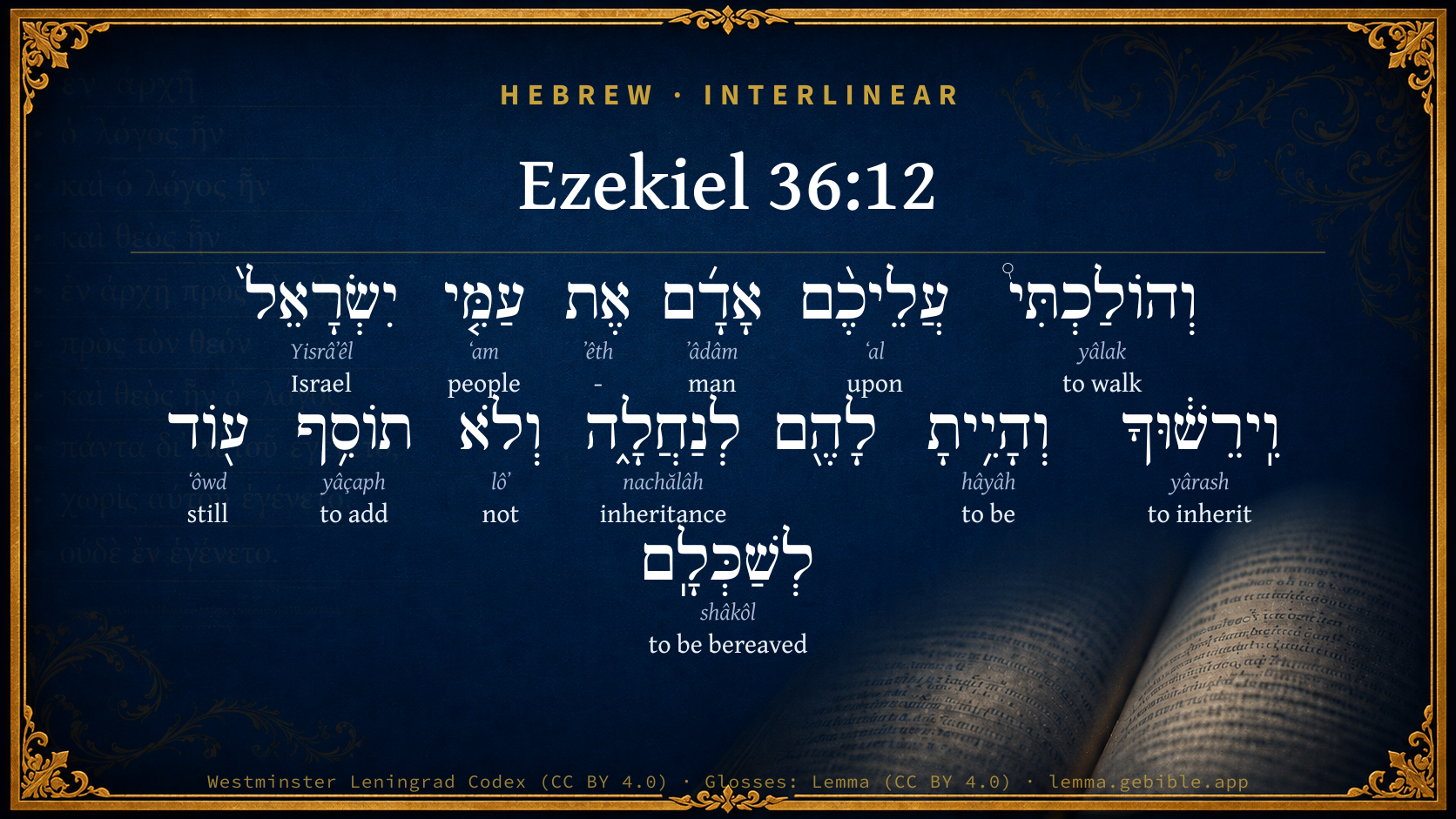
Hebrew (Westminster Leningrad Codex) Ezekiel 36:12 appears in the Hebrew Old Testament. The text above is from the Westminster Leningrad Codex. Each word links to its Strong’s number, a concise gloss, and parsing drawn from the Open Scriptures Hebrew Bible morphology. Click any word for its full Brown-Driver-Briggs (BDB) entry.
Download image
Cite this verse

Ezekiel 36:12 (World English Bible). Public Domain. Lemma interlinear Bible study tool, https://lemma.gebible.app/v/ezekiel/36/12.

Show BibTeX & RIS
BibTeX
RIS
English Translation
Yes, I will cause men to walk on you, even my people Israel; and they shall possess you, and you shall be their inheritance, and you shall no more henceforth bereave them of children.
World English Bible · Public Domain
Download a study sheet

One document with this verse’s original text, its word-by-word gloss line, the meaning frame, cross-references with their text, attributed commentary, and full source and license credits — printable, and it pastes into notes with its structure intact.

This verse Autodidact and up

Study sheet (.html) Plain text (.txt)

A passage Seminary Student

Up to 50 verses in one chapter. A passage sheet keeps up to 6 commentary sources and 12 cross-references per verse, in the order this page ranks them, and says so on the sheet whenever that leaves anything out. Ask for a single verse and you get the Autodidact verse sheet above.

Everything on this page stays free to read, with no account — the sheet is a download of what is already on screen, not access to it.

Want to remove ads? Support Godless Engineer
Compare translations 3

The same verse in 3 English versions, stacked beneath the original-language interlinear above. Click any original word for its lexicon entry.

Each is an independent rendering of the whole verse — the interlinear is not word-aligned to these translations.

Highlighted words mark where these versions differ — a whole-verse word diff, not a word-by-word alignment.

  • World English Bible Public Domain
    Yes, I will cause men to walk on you, even my people Israel; and they shall possess you, and you shall be their inheritance, and you shall no more henceforth bereave them of children.
  • King James Version Public Domain
    Yea, I will cause men to walk upon you, even my people Israel; and they shall possess thee, and thou shalt be their inheritance, and thou shalt no more henceforth bereave them of men.
  • unfoldingWord Literal Text CC BY-SA 4.0
    I will bring men, my people Israel, to walk on you. They will possess you, and you will be their inheritance, and you will no longer cause their children to die.

unfoldingWord Literal Text — © unfoldingWord, licensed CC BY-SA 4.0. Word-aligned USFM3 via Door43 (git.door43.org/unfoldingWord/en_ult).

Versions to compare (up to 4)

3 of 4 selected

Show all 18 translations

Every available English version of this verse, each an independent rendering of the whole verse.

  • World English Bible Public Domain
    Yes, I will cause men to walk on you, even my people Israel; and they shall possess you, and you shall be their inheritance, and you shall no more henceforth bereave them of children.
  • Berean Standard Bible Public Domain
    Yes, I will cause My people Israel to walk upon you; they will possess you, and you will be their inheritance, and you will no longer deprive them of their children.
  • Majority Standard Bible Public Domain
    Yes, I will cause My people Israel to walk upon you; they will possess you, and you will be their inheritance, and you will no longer deprive them of their children.
  • King James Version Public Domain
    Yea, I will cause men to walk upon you, even my people Israel; and they shall possess thee, and thou shalt be their inheritance, and thou shalt no more henceforth bereave them of men.
  • American Standard Version (1901) Public Domain
    Yea, I will cause men to walk upon you, even my people Israel; and they shall possess thee, and thou shalt be their inheritance, and thou shalt no more henceforth bereave them of children.
  • Revised Version (1885) Public Domain
    Yea, I will cause men to walk upon you, even my people Israel; and they shall possess thee, and thou shalt be their inheritance, and thou shalt no more henceforth bereave them of children.
  • Geneva Bible (1599) Public Domain
    Yea, I wil cause men to walke vpon you, euen my people Israel, and they shall possesse you, and ye shalbe their inheritance, and ye shall no more henceforth depriue them of men.
  • Douay-Rheims (1899) Public Domain
    And I will bring men upon you, my people Israel, and they shall possess thee for their inheritance: and thou shalt be their inheritance, and shalt no more henceforth be without them.
  • Young's Literal Translation Public Domain
    And I have caused man to walk over you, -- My people Israel, And they possess thee, and thou hast been to them for an inheritance, And thou dost add no more to bereave them.
  • Literal Standard Version CC BY-SA 4.0
    And I have caused man to walk over you—My people Israel, || And they possess you, and you have been their inheritance, || And you no longer add to bereave them.
  • Unlocked Literal Bible CC BY-SA 4.0
    I will bring men, my people Israel, to walk on you. They will possess you, and you will be their inheritance, and you will no longer cause their children to die.
  • unfoldingWord Literal Text CC BY-SA 4.0
    I will bring men, my people Israel, to walk on you. They will possess you, and you will be their inheritance, and you will no longer cause their children to die.
  • Darby Bible Public Domain
    And I will cause men to walk upon you, even my people Israel; and they shall possess thee, and thou shalt be their inheritance, and thou shalt no more henceforth bereave them of children.
  • World Messianic Bible Public Domain
    Yes, I will cause men to walk on you, even my people Israel. They will possess you, and you will be their inheritance, and you will never again bereave them of their children.”
  • Webster's Bible Public Domain
    Yes, I will cause men to walk upon you, even my people Israel; and they shall possess thee, and thou shalt be their inheritance, and thou shalt no more henceforth bereave them of men.
  • Free Bible Version CC BY-SA 4.0
    You mountains, I will have my people Israel walk on you again. You will be theirs; you will belong to them, and you will no longer rob your nation of their children.
  • Bible in Basic English Public Domain
    Yes, I will have you walked on by the feet of men, even my people Israel; they will have you for a heritage and you will be theirs, and never again will you take their children from them.
  • JPS Tanakh (1917) Public Domain
    Yea, I will cause men to walk upon you, even my people Israel, and they shall possess thee, and thou shalt be their inheritance; and thou shalt no more henceforth bereave them of children.

Literal Standard Version (2020), Covenant Press — licensed CC BY-SA 4.0. Text via the HelloAO Bible API (eBible.org). Unlocked Literal Bible (unfoldingWord) — licensed CC BY-SA 4.0. Text via the HelloAO Bible API (eBible.org). unfoldingWord Literal Text — © unfoldingWord, licensed CC BY-SA 4.0. Word-aligned USFM3 via Door43 (git.door43.org/unfoldingWord/en_ult). Free Bible Version, Dr. Jonathan Gallagher — licensed CC BY-SA 4.0. Text via the HelloAO Bible API (eBible.org).

Word by word

More ways to search: Search by grammar → Find every occurrence → Compare this word →

Practice this passage: Drill this verse → Learn its vocabulary →

לְשַׁכְּלָֽם
shâkôl
H7921
“to be bereaved · them”
Preposition + Verb, Piel, Infinitive Construct + Suffix, Personal, 3rd Person, Masculine, Plural
Part of Speech
Preposition + Verb
Stem
Piel
Form
Infinitive Construct
Full BDB Definition

Origin: a primitive root

TWOT: 2385

to be bereaved, make childless, miscarry - (Qal) to be bereaved - (Piel) - to make childless - to cause barrenness, show barrenness or abortion - to miscarry - (Hiphil) miscarrying (participle)
  1. וְהוֹלַכְתִּי֩ yâlak H3212 “and · to walk” Conjunction + Verb, Hiphil, Sequential Perfect, 1st Person, Common, Singular
  2. עֲלֵיכֶ֨ם ʻal H5921 “upon · you” Preposition + Suffix, Personal, 2nd Person, Masculine, Plural
  3. אָדָ֜ם ʼâdâm H120 “man” Noun, Common, Masculine, Singular, Absolute
  4. אֶת ʼêth H853 “-” Particle, Direct Object
  5. עַמִּ֤י ʻam H5971 “people · my” Noun, Common, Masculine, Singular, Construct + Suffix, Personal, 1st Person, Common, Singular
  6. יִשְׂרָאֵל֙ Yisrâʼêl H3478 “Israel” Noun, Proper
  7. וִֽירֵשׁ֔וּךָ yârash H3423 “and · to inherit · you” Conjunction + Verb, Qal, Sequential Perfect, 3rd Person, Common, Plural + Suffix, Personal, 2nd Person, Masculine, Singular
  8. וְהָיִ֥יתָ hâyâh H1961 “and · to be” Conjunction + Verb, Qal, Sequential Perfect, 2nd Person, Masculine, Singular
  9. לְנַחֲלָ֑ה nachălâh H5159 “to/for · inheritance” Preposition + Noun, Common, Feminine, Singular, Absolute
  10. וְלֹא lôʼ H3808 “and · not” Conjunction + Particle, Negative
  11. תוֹסִ֥ף yâçaph H3254 “to add” Verb, Hiphil, Imperfect, 2nd Person, Masculine, Singular
  12. ע֖וֹד ʻôwd H5750 “still” Adverb

About this verse

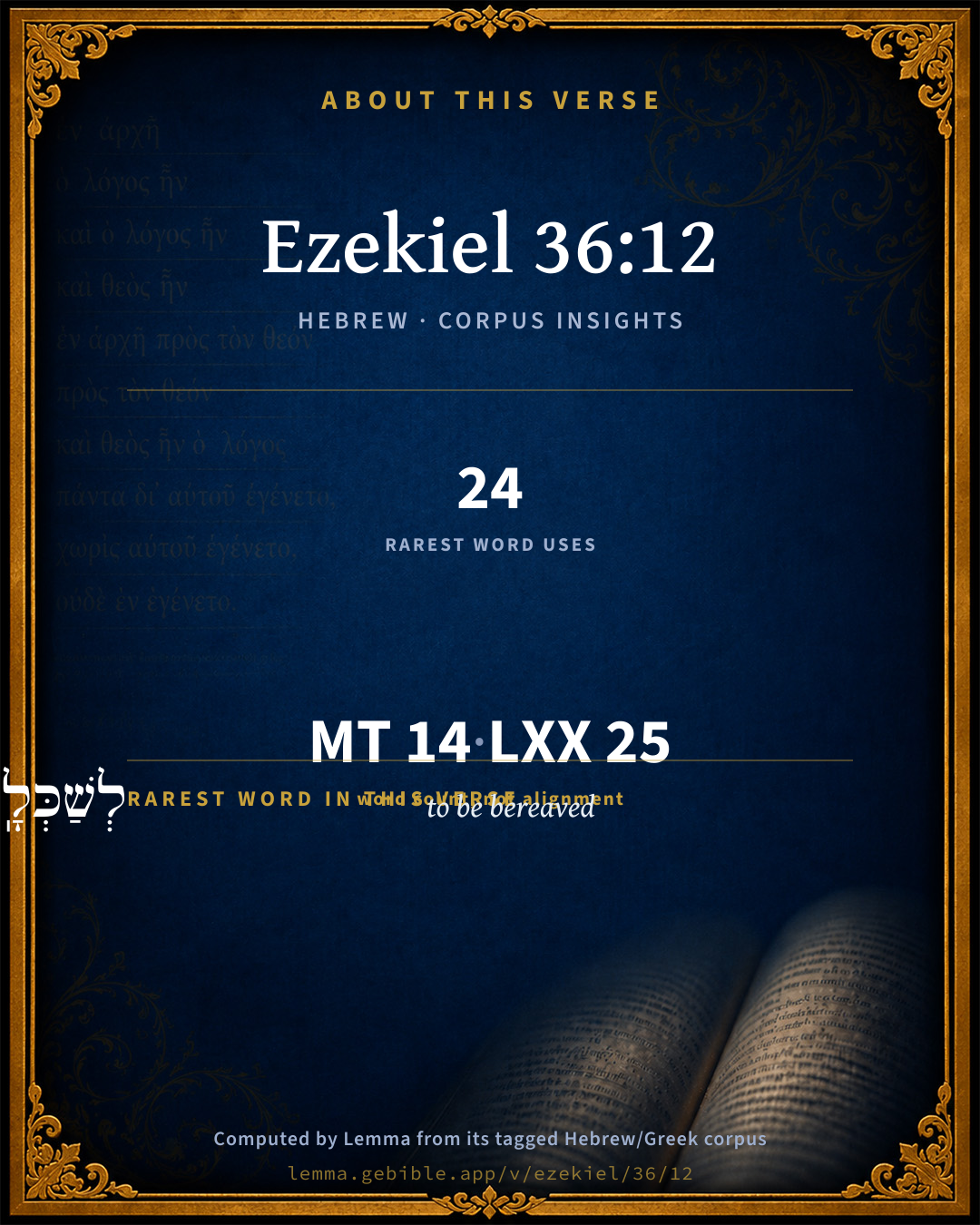
These counts appear in no published source. They are computed here, from the morphology-tagged text and Lemma’s own curated glosses. What Lemma adds →

14
words
13
distinct lemmas
Prophets
section

Notable vocabulary

The rarest word here is לְשַׁכְּלָֽם to be bereaved H7921 — appearing just 24 times in the whole Hebrew Bible.

Shared distinctive vocabulary

לְשַׁכְּלָֽם to be bereaved H7921 occurs in 22 verses of the Hebrew Bible. Also found in:

Grammatical profile

  • 5 verbs
  • 4 nouns
  • 2 prepositions
  • 1 adverb
  • 2 particles

Verb forms

  • וְהוֹלַכְתִּי֩ Hiphil · Sequential Perfect
  • וִֽירֵשׁ֔וּךָ Qal · Sequential Perfect
  • וְהָיִ֥יתָ Qal · Sequential Perfect
  • תוֹסִ֥ף Hiphil · Imperfect
  • לְשַׁכְּלָֽם Piel · Infinitive Construct

Hebrew & Septuagint length

In English translation the verse runs 34 words from the Hebrew and 34 from the Septuagint (LXX English) — the same length.

A rough comparison of the two English renderings, which tokenize alike — not a word-level alignment.

Word counts can differ between the Hebrew and the Greek without any difference in meaning — e.g. the Hebrew direct-object marker אֵת has no separate Greek word, and Greek often adds the article ὁ.

In the original languages it is 14 Hebrew tokens and 25 Greek tokens — but the two are counted differently (Hebrew bundles its prefixes and suffixes into one token; the Greek is in lemma form), so that isn’t a like-for-like length.

Cross-references

7

Topical passages linked to Ezekiel 36:12 in the Treasury of Scripture Knowledge — connected by theme and wording, ordered by reader-vote popularity; previews shown in the World English Bible.

  • Jeremiah 15:7 I have winnowed them with a fan in the gates of the land; I have bereaved [them] of children, I have destroyed my people; they didn't return from their ways.
  • Numbers 13:32 They brought up an evil report of the land which they had spied out to the children of Israel, saying, The land, through which we have gone to spy it out, is a land that eats up the inhabitants of it; and all the people who we saw in it are men of great stature.
  • Jeremiah 32:44 Men shall buy fields for money, and subscribe the deeds, and seal them, and call witnesses, in the land of Benjamin, and in the places about Jerusalem, and in the cities of Judah, and in the cities of the hill-country, and in the cities of the lowland, and in the cities of the South: for I will cause their captivity to return, says Yahweh.
  • Ezekiel 36:13 Thus says the Lord Yahweh: Because they say to you, You [land] are a devourer of men, and have been a bereaver of your nation;
  • Ezekiel 47:14 You shall inherit it, one as well as another; for I swore to give it to your fathers: and this land shall fall to you for inheritance.
  • Obadiah 1:17–21 But in Mount Zion, there will be those who escape, and it will be holy. The house of Jacob will possess their possessions.
  • Jeremiah 32:15 For thus says Yahweh of Hosts, the God of Israel: Houses and fields and vineyards shall yet again be bought in this land.

Cross-references courtesy of OpenBible.info (CC BY 4.0).

Hebrew and Greek witnesses Masoretic Hebrew ↔ Greek Septuagint

The same verse in the two great witnesses to the Old Testament, shown verse-for-verse.

These are two independent witnesses, not word-aligned to each other, and the Septuagint is shown in lemma (dictionary) form.

Hebrew Ezekiel 36:12 Masoretic · Westminster Leningrad Codex

וְהוֹלַכְתִּי֩ עֲלֵיכֶ֨ם אָדָ֜ם אֶת עַמִּ֤י יִשְׂרָאֵל֙ וִֽירֵשׁ֔וּךָ וְהָיִ֥יתָ לָהֶ֖ם לְנַחֲלָ֑ה וְלֹא תוֹסִ֥ף ע֖וֹד לְשַׁכְּלָֽם

Yes, I will cause men to walk on you, even my people Israel; and they shall possess you, and you shall be their inheritance, and you shall no more henceforth bereave them of children.

World English Bible · Public Domain

Greek LXX Ezekiel 36:12 Septuagint · lemma form

καί γεννάω ἐπί σύ ἄνθρωπος ὁ λαός ἐγώ ἰσραήλ καί κληρονομέω σύ καί εἰμί αὐτός εἰς κατάσχεσις καί οὐ μή προςτίθημι ἔτι ἀτεκνόω ἀπό αὐτός

And I will increase men upon you, even my people Israel; and they shall inherit you, and you⌃ shall be to them for a possession; and you⌃ shall no more be bereaved of them.

LXX2012 (modern English Septuagint) · Public Domain

Hebrew: Westminster Leningrad Codex (CC BY 4.0). Greek: Septuagint (public domain); English from LXX2012 (modern English Septuagint) (Public Domain). How the Septuagint differs from the Hebrew →

Targum (Aramaic paraphrase)

1

The Targum is the ancient Jewish Aramaic paraphrase of the Hebrew Scriptures — an interpretive translation, not the Hebrew text itself. Onkelos (literal) and Pseudo-Jonathan (expansive) render the Torah, and Jonathan the Prophets. Coverage is partial: where no permissively-licensed English translation exists for a verse, only the Aramaic is shown. This is verse-level text, not a word-by-word alignment to the Hebrew.

  1. Targum Jonathan Prophets (Joshua–Malachi)
    וְאַסְגֵי עֲלֵיכוֹן אֱנָשָׁא יַת עַמִי יִשְׂרָאֵל וְיַחְסְנוּנָךְ וּתְהֵי לְהוֹן לְאַחְסָנָא וְלָא תוֹסִיף עוֹד לְתַכְּלוּתְהוֹן:

    (no public-domain English translation for this verse)

    Targum Jonathan — Aramaic: “Mikraot Gedolot” (public domain). English: “Sefaria Community Translation” (CC0 1.0 (public-domain dedication)); “London "Chaldee Paraphrase," 1871” (public domain). Text via Sefaria.

Commentary

Notes on Ezekiel 36:12 from classic Christian and Jewish commentators (each source and its license shown beneath its notes). The classic Christian expositions comment on the surrounding passage and are grouped to its opening verse, so a note may address several verses; the Jewish commentaries on the Tanakh (Rashi and others) are per-verse, so they appear only where the commentator wrote on this verse.

Lemma curates 59 commentaries, every one of them public domain or Creative Commons licensed, each selected and text-cleaned for this edition rather than reprinted as found. About our sources →

Trapp's Complete Commentary

John Trapp

Eze 36:12 Yea, I will cause men to walk upon you, [even] my people Israel; and they shall possess thee, and thou shalt be their inheritance, and thou shalt no more henceforth bereave them [of men].

Ver. 12. Thou shalt be their inheritance.] Yea, a type and pledge of that heavenly inheritance. {1Pe 1:4 Rev 21:1-10; Rev 21:22-27; Rev 22:1-5}

And thou shalt no more henceforth bereave them.] Provoke God to bereave them.

John Trapp, A Commentary or Exposition upon All the Books of the Old and New Testament (1647–1656) — public domain. Text from a community e-Sword module.

Tyndale Open Study Notes

Tyndale Open Resources

36:12-13 God had intended for the land to provide abundantly for his people and their offspring; instead, it had robbed them of their children and devoured its own people. This was the direct result of Israel’s failure to keep the terms of the covenant, which led to the Lord’s judgment being imposed upon them with catastrophic results for them and their children (see 5:17). Now that the people were being transformed, they would receive the covenant blessing of a fruitful land.

Tyndale Open Study Notes — © Tyndale Open Resources, licensed CC BY-SA 4.0. Text via the HelloAO Bible API.

Geneva Bible (1599)

Geneva Bible translators

Or, thee.

That is, upon the mountains of Jerusalem.

Geneva Bible (1599) marginal notes — public domain. Text via Bolls.life.

Jamieson, Fausset & Brown

Robert Jamieson, A. R. Fausset & David Brown

to walk upon you--O mountains of Israel (Eze 36:8)!

thee . . . thou--change from plural to singular: O hill of Zion, singled out from the other mountains of Israel (Eze 34:26); or land.

thou shall no more . . . bereave them of men--Thou shalt no more provoke God to bereave them of children (so the ellipsis ought to be supplied, as Ezekiel probably alludes to Jer 15:7, "I will bereave them of children").

Jamieson, Fausset & Brown — Commentary Critical and Explanatory on the Whole Bible (1871) — public domain (CC PDM 1.0). Text via the HelloAO Bible API.

The Cambridge Bible for Schools and Colleges

gen. ed. J. J. S. Perowne

12. bereave them of men] Properly the term means to bereave of children, here it is used generally, to bereave the people, i.e. destroy its members, Jer_15:7.

The Cambridge Bible for Schools and Colleges (gen. ed. J. J. S. Perowne; Cambridge University Press, 1878–1918) — public domain. Text from a community e-Sword module.

John Gill's Exposition

Yea, I will cause men to walk upon you,.... And not beasts, as during the captivity; and that without fear of wild beasts, or any enemy; and not as travellers upon them, but as inhabitants of them; who shall walk to and fro upon them, as the owners of them, and doing their proper business there:

even my people Israel; and them only: some read it, "with my people Israel" (i); as if other men, Gentiles called by grace, should dwell with the Jews at this time, particularly at their restoration in the latter day; which may be true, and, which seems to be the sense of the whole sixtieth chapter of Isaiah's prophecy:

and they shall possess thee, and thou shall be their inheritance; that is, thou mountain; a change of number, meaning everyone of the mountains, even the whole land of Canaan, which was given to the Israelites for an inheritance; and was typical of the eternal inheritance in heaven:

and thou shall no more henceforth bereave them; of men, or of children; or be no more the cause of their being childless, or of bereaving them of men; sins committed on the mountains being the cause of provoking the Lord to bereave them; or men should be no more killed upon them, as they had been.

(i) "cum populo meo Israele", Junius & Tremcellius.

John Gill's Exposition of the Whole Bible (1746–1763) — public domain (CC PDM 1.0). Text via the HelloAO Bible API.

Haydock's Catholic Bible Commentary

Them. Antiochus and the Romans laid waste the country; (Calmet) and Adrian would not allow the Jews to come near Jerusalem. (St. Jerome) (Eusebius, [History of the Church] iv. 6.) --- The people were not indeed removed together, as they had been. But all this is verified only in the Church, which in the midst of persecutions always subsists. Theodoret thinks these promises were conditional with respect to the Jews.

George Leo Haydock (1774–1849), Haydock's Catholic Family Bible and Commentary, 1859 edition — public domain. Excludes Psalms (Douay-Rheims chapter numbering differs from Protestant) and Deuterocanonical books (Catholic canon only).

Matthew Poole's English Annotations

For years past since your captivity wild devouring beasts ranged up and down, but now, instead of such, men shall walk up and down in the mountains of Israel; I will take away the beasts from off you, and bring men upon you.

My people Israel; a people that are mine by covenant, whom I will own, my Israel.

They shall possess thee; Edom boasted he would possess you, O mountains; not Edom, or heathens, but your own ancient dwellers shall possess you, even Abraham’s seed.

Their inheritance, for perpetuity, as inheritances are.

Thou, O land of Canaan.

Bereave them; consume and destroy thine inhabitants.

Matthew Poole's English Annotations on the Holy Bible (1683–1685) — public domain. Text from a community e-Sword/MySword module.

John Wesley's Explanatory Notes

And thou - O land of Canaan. Bereave - Consume thine inhabitants.

John Wesley, Explanatory Notes Upon the Whole Bible (1754–1765) — public domain. Text via the GEBible commentary corpus.

Rashi

Rabbi Shlomo Yitzchaki (Rashi)

to be bereaved of them to drive your inhabitants from your midst. This is called שִּׁיכּוּל, bereavement.

Rashi on the Tanakh — English translations: “The Judaica Press complete Tanach with Rashi, translated by A. J. Rosenberg” (CC BY 4.0); “Pentateuch with Rashi's commentary by M. Rosenbaum and A.M. Silbermann, 1929-1934” (public domain); “The Metsudah Tanach series, Lakewood, N.J” (CC BY 4.0); and “The Book of Joshua, Metsudah Publications, 1997” (CC BY 4.0). Text via Sefaria.

Lesson kit

Teaching starters — assembled from the data on this page, not authored interpretation. Every prompt links to the verse data it draws on. Edit before teaching.

Ezekiel, in the Prophets, opens this verse with 14 words (13 distinct Hebrew lemmas). Its most distinctive word is shâkôl (“to be bereaved”). A historical commentator’s framing appears above. Read the whole chapter for the surrounding context.

Discussion questions

  1. What does “to be bereaved” (shâkôl) contribute to the verse as a whole?
  2. How does Genesis 27:45, which shares the word «to be bereaved», read alongside this verse?
  3. These translations render this verse differently. What is at stake in choosing one wording over another?
  4. «וְהוֹלַכְתִּי֩» is a Hiphil Sequential Perfect verb. How does that grammatical form shape the action described?
  5. Compare how Trapp's Complete Commentary and Tyndale Open Study Notes read this verse. Where do they agree or differ?

Things to notice

Reading settings

Reading text

Shown beneath each verse's original-language words.

Old Testament
Old Testament edition

Read the OT as the Masoretic Hebrew (MT) or the Greek Septuagint (LXX).

English shown for the Greek Septuagint (in the Hebrew ↔ Greek comparison).

Comparing translations? Open the Compare panel on any verse page to stack up to four side by side.