
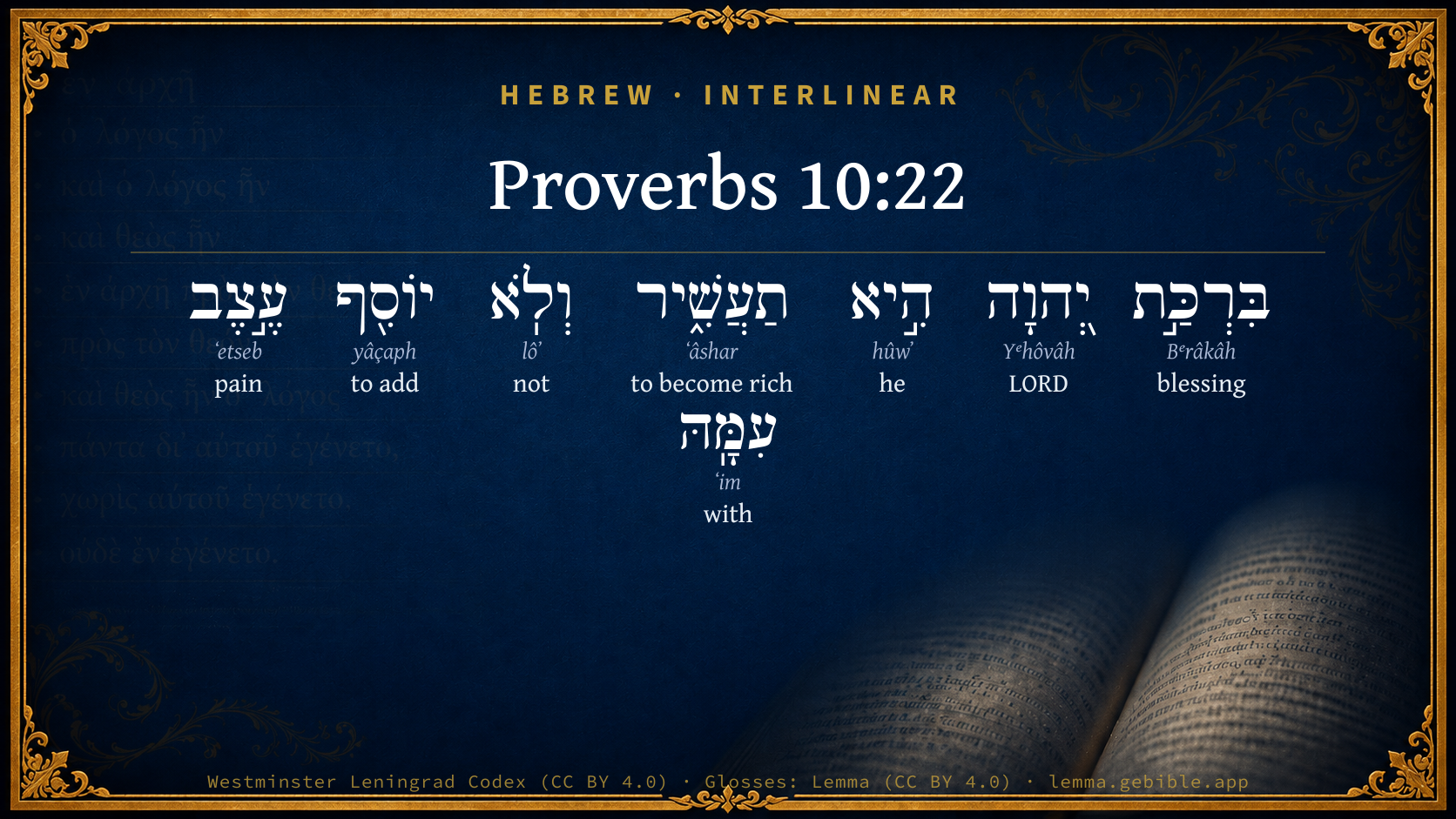
Proverbs 10:22

Hebrew (Westminster Leningrad Codex) Proverbs 10:22 appears in the Hebrew Old Testament. The text above is from the Westminster Leningrad Codex. Each word links to its Strong’s number, a concise gloss, and parsing drawn from the Open Scriptures Hebrew Bible morphology. Click any word for its full Brown-Driver-Briggs (BDB) entry.
Download image
Cite this verse

Proverbs 10:22 (World English Bible). Public Domain. Lemma interlinear Bible study tool, https://lemma.gebible.app/v/proverbs/10/22.

Show BibTeX & RIS
BibTeX
RIS
English Translation
Yahweh's blessing brings wealth, And he adds no trouble to it.
World English Bible · Public Domain
Download a study sheet

One document with this verse’s original text, its word-by-word gloss line, the meaning frame, cross-references with their text, attributed commentary, and full source and license credits — printable, and it pastes into notes with its structure intact.

This verse Autodidact and up

Study sheet (.html) Plain text (.txt)

A passage Seminary Student

Up to 50 verses in one chapter. A passage sheet keeps up to 6 commentary sources and 12 cross-references per verse, in the order this page ranks them, and says so on the sheet whenever that leaves anything out. Ask for a single verse and you get the Autodidact verse sheet above.

Everything on this page stays free to read, with no account — the sheet is a download of what is already on screen, not access to it.

Want to remove ads? Support Godless Engineer
Compare translations 3

The same verse in 3 English versions, stacked beneath the original-language interlinear above. Click any original word for its lexicon entry.

Each is an independent rendering of the whole verse — the interlinear is not word-aligned to these translations.

Highlighted words mark where these versions differ — a whole-verse word diff, not a word-by-word alignment.

  • World English Bible Public Domain
    Yahweh's blessing brings wealth, And he adds no trouble to it.
  • King James Version Public Domain
    The blessing of the LORD, it maketh rich, and he addeth no sorrow with it.
  • unfoldingWord Literal Text CC BY-SA 4.0
    The blessing of Yahweh, it causes riches, and striving does not add with it.

unfoldingWord Literal Text — © unfoldingWord, licensed CC BY-SA 4.0. Word-aligned USFM3 via Door43 (git.door43.org/unfoldingWord/en_ult).

Versions to compare (up to 4)

3 of 4 selected

Show all 18 translations

Every available English version of this verse, each an independent rendering of the whole verse.

  • World English Bible Public Domain
    Yahweh's blessing brings wealth, And he adds no trouble to it.
  • Berean Standard Bible Public Domain
    The blessing of the LORD enriches, and He adds no sorrow to it.
  • Majority Standard Bible Public Domain
    The blessing of the LORD enriches, and He adds no sorrow to it.
  • King James Version Public Domain
    The blessing of the LORD, it maketh rich, and he addeth no sorrow with it.
  • American Standard Version (1901) Public Domain
    The blessing of Jehovah, it maketh rich; And he addeth no sorrow therewith.
  • Revised Version (1885) Public Domain
    The blessing of the LORD, it maketh rich, and he addeth no sorrow therewith.
  • Geneva Bible (1599) Public Domain
    The blessing of the Lord, it maketh riche, and he doeth adde no sorowes with it.
  • Douay-Rheims (1899) Public Domain
    The blessing of the Lord maketh men rich: neither shall affliction be joined to them.
  • Young's Literal Translation Public Domain
    The blessing of Jehovah -- it maketh rich, And He addeth no grief with it.
  • Literal Standard Version CC BY-SA 4.0
    The blessing of YHWH—it makes rich, || And He adds no grief with it.
  • Unlocked Literal Bible CC BY-SA 4.0
    The good gifts of Yahweh bring wealth and he adds no pain to it.
  • unfoldingWord Literal Text CC BY-SA 4.0
    The blessing of Yahweh, it causes riches, and striving does not add with it.
  • Darby Bible Public Domain
    The blessing of Jehovah, it maketh rich, and he addeth no sorrow to it.
  • World Messianic Bible Public Domain
    The LORD’s blessing brings wealth, and he adds no trouble to it.
  • Webster's Bible Public Domain
    The blessing of the LORD, it maketh rich, and he addeth no sorrow with it.
  • Free Bible Version CC BY-SA 4.0
    The Lord's blessing makes you rich, and he doesn't add any sadness to accompany it.
  • Bible in Basic English Public Domain
    The blessing of the Lord gives wealth: hard work makes it no greater.
  • JPS Tanakh (1917) Public Domain
    The blessing of the LORD, it maketh rich, and toil addeth nothing thereto.

Literal Standard Version (2020), Covenant Press — licensed CC BY-SA 4.0. Text via the HelloAO Bible API (eBible.org). Unlocked Literal Bible (unfoldingWord) — licensed CC BY-SA 4.0. Text via the HelloAO Bible API (eBible.org). unfoldingWord Literal Text — © unfoldingWord, licensed CC BY-SA 4.0. Word-aligned USFM3 via Door43 (git.door43.org/unfoldingWord/en_ult). Free Bible Version, Dr. Jonathan Gallagher — licensed CC BY-SA 4.0. Text via the HelloAO Bible API (eBible.org).

Word by word

More ways to search: Search by grammar → Find every occurrence → Compare this word →

Practice this passage: Drill this verse → Learn its vocabulary →

About this verse

These counts appear in no published source. They are computed here, from the morphology-tagged text and Lemma’s own curated glosses. What Lemma adds →

8
words
8
distinct lemmas
Wisdom
section

Notable vocabulary

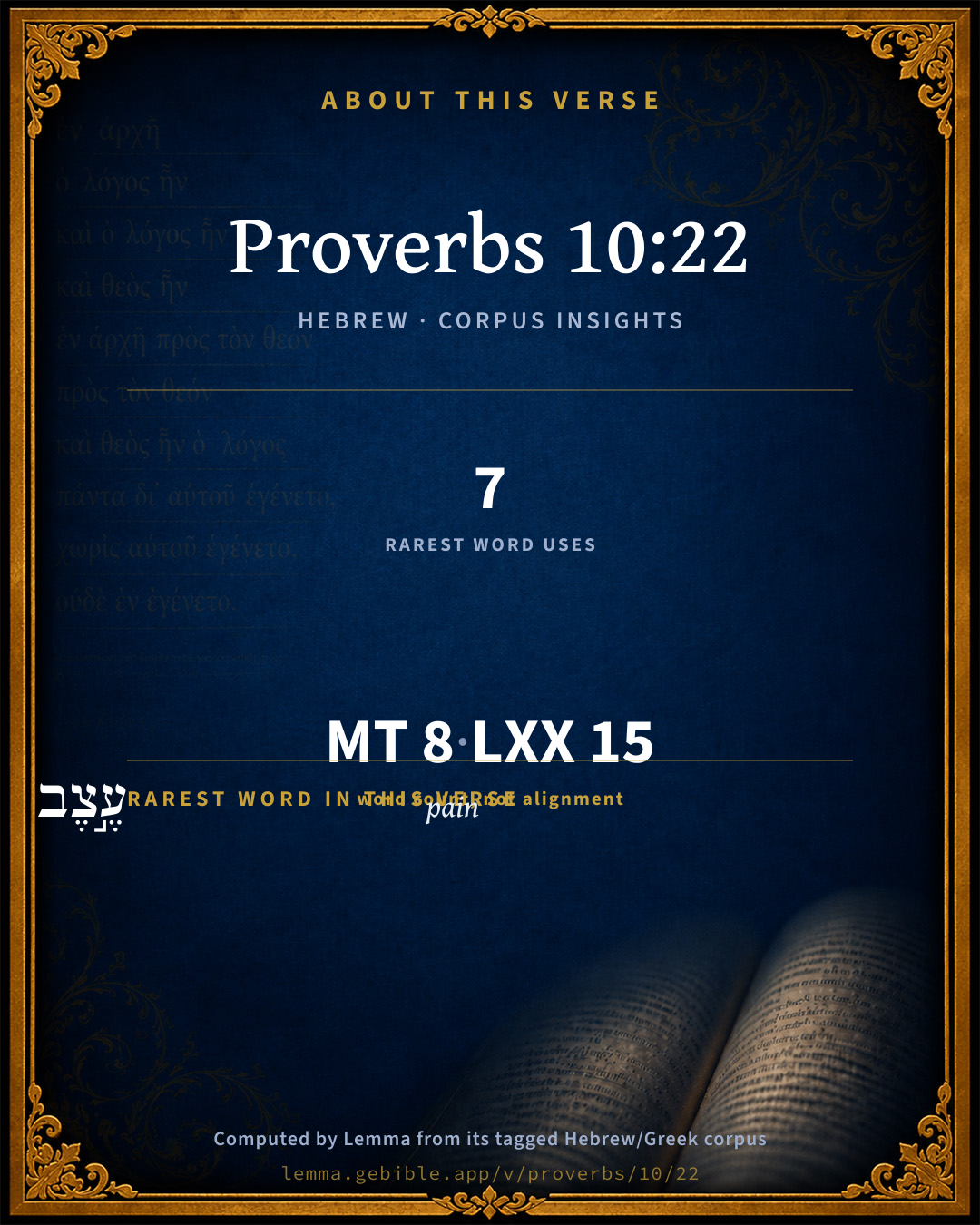
The rarest word here is עֶ֣צֶב pain H6089 — appearing just 7 times in the whole Hebrew Bible.

Shared distinctive vocabulary

עֶ֣צֶב pain H6089 occurs in 7 verses of the Hebrew Bible. Also found in:

Grammatical profile

  • 2 verbs
  • 3 nouns
  • 1 pronoun
  • 1 preposition
  • 1 particle

Verb forms

  • תַעֲשִׁ֑יר Hiphil · Imperfect
  • יוֹסִ֖ף Hiphil · Imperfect

Hebrew & Septuagint length

In English translation the verse runs 11 words from the Hebrew and 25 from the Septuagint (LXX English) — the Septuagint runs noticeably longer here. See the side-by-side →

A rough comparison of the two English renderings, which tokenize alike — not a word-level alignment.

Word counts can differ between the Hebrew and the Greek without any difference in meaning — e.g. the Hebrew direct-object marker אֵת has no separate Greek word, and Greek often adds the article ὁ.

In the original languages it is 8 Hebrew tokens and 15 Greek tokens — but the two are counted differently (Hebrew bundles its prefixes and suffixes into one token; the Greek is in lemma form), so that isn’t a like-for-like length.

Cross-references

20

Topical passages linked to Proverbs 10:22 in the Treasury of Scripture Knowledge — connected by theme and wording, ordered by reader-vote popularity; previews shown in the World English Bible.

  • Psalms 107:38 He blesses them also, so that they are multiplied greatly. He doesn't allow their cattle to decrease.
  • Genesis 26:12 Isaac sowed in that land, and reaped in the same year one hundred times what he planted. Yahweh blessed him.
  • 1 Samuel 2:7–8 Yahweh makes poor, and makes rich: He brings low, he also lifts up.
  • Genesis 24:35 Yahweh has blessed my master greatly. He has become great. He has given him flocks and herds, silver and gold, men-servants and maid-servants, and camels and donkeys.
  • Genesis 12:2 I will make of you a great nation. I will bless you, and make your name great. You will be a blessing.
  • Deuteronomy 8:17–18 and [lest] you say in your heart, My power and the might of my hand has gotten me this wealth.
  • Psalms 37:22 For such as are blessed by him shall inherit the land. Those who are cursed by him shall be cut off.
  • Psalms 113:7–8 He raises up the poor out of the dust. Lifts up the needy from the ash heap;
  • Proverbs 20:21 An inheritance quickly gained at the beginning, Won't be blessed in the end.
  • Genesis 13:2 Abram was very rich in cattle, in silver, and in gold.
  • Proverbs 28:22 A stingy man hurries after riches, And doesn't know that poverty waits for him.
  • 2 Kings 5:26–27 He said to him, Didn't my heart go with you, when the man turned from his chariot to meet you? Is it a time to receive money, and to receive garments, and olive groves and vineyards, and sheep and oxen, and men-servants and maid-servants?
  • Zechariah 5:4 I will cause it to go out," says Yahweh of Hosts, "and it will enter into the house of the thief, and into the house of him who swears falsely by my name; and it will remain in the midst of his house, and will destroy it with its timber and its stones."
  • Genesis 14:23 that I will not take a thread nor a shoe-latchet nor anything that is yours, lest you should say, 'I have made Abram rich.'
  • Job 27:8–23 For what is the hope of the godless, when he is cut off, When God takes away his life?
  • Joshua 7:1–26 But the children of Israel committed a trespass in the devoted thing; for Achan, the son of Carmi, the son of Zabdi, the son of Zerah, of the tribe of Judah, took of the devoted thing: and the anger of Yahweh was kindled against the children of Israel.
  • James 5:1–5 Come now, you rich, weep and howl for your miseries that are coming on you.
  • Joshua 6:18 But as for you, only keep yourselves from the devoted thing, lest when you have devoted it, you take of the devoted thing; so would you make the camp of Israel accursed, and trouble it.
  • 1 Kings 21:19 You shall speak to him, saying, Thus says Yahweh, Have you killed and also taken possession? You shall speak to him, saying, Thus says Yahweh, In the place where dogs licked the blood of Naboth shall dogs lick your blood, even yours.
  • Habakkuk 2:6–12 Won't all these take up a parable against him, and a taunting proverb against him, and say, 'Woe to him who increases that which is not his, and who enriches himself by extortion! How long?'

Cross-references courtesy of OpenBible.info (CC BY 4.0).

Hebrew and Greek witnesses Masoretic Hebrew ↔ Greek Septuagint

The same verse in the two great witnesses to the Old Testament, shown verse-for-verse.

Here the Septuagint runs noticeably longer than the Hebrew — LXX2012 (modern English Septuagint) 25 words vs World English Bible 11. A rough length comparison of the two English translations, not a word-level alignment — read both below.

These are two independent witnesses, not word-aligned to each other, and the Septuagint is shown in lemma (dictionary) form.

Hebrew Proverbs 10:22 Masoretic · Westminster Leningrad Codex

בִּרְכַּ֣ת יְ֭הוָה הִ֣יא תַעֲשִׁ֑יר וְלֹֽא יוֹסִ֖ף עֶ֣צֶב עִמָּֽהּ

Yahweh's blessing brings wealth, And he adds no trouble to it.

World English Bible · Public Domain

Greek LXX Proverbs 10:22 Septuagint · lemma form

εὐλογία κύριος ἐπί κεφαλή δίκαιος οὗτος πλουτίζω καί οὐ μή προςτίθημι αὐτός λύπη ἐν καρδία

The blessing of the Lord is upon the head of the righteous; it enriches him, and grief of heart shall not be added to it.

LXX2012 (modern English Septuagint) · Public Domain

On this verse, The Pulpit Commentary discusses the Septuagint’s reading. Read the note in Commentary ↓

Hebrew: Westminster Leningrad Codex (CC BY 4.0). Greek: Septuagint (public domain); English from LXX2012 (modern English Septuagint) (Public Domain). How the Septuagint differs from the Hebrew →

Commentary

Notes on Proverbs 10:22 from classic Christian and Jewish commentators (each source and its license shown beneath its notes). The classic Christian expositions comment on the surrounding passage and are grouped to its opening verse, so a note may address several verses; the Jewish commentaries on the Tanakh (Rashi and others) are per-verse, so they appear only where the commentator wrote on this verse.

Lemma curates 59 commentaries, every one of them public domain or Creative Commons licensed, each selected and text-cleaned for this edition rather than reprinted as found. About our sources →

Trapp's Complete Commentary

John Trapp

Pro 10:22 The blessing of the LORD, it maketh rich, and he addeth no sorrow with it.

Ver. 22. The blessing of the Lord it maketh rich.] As is to be seen in the examples of the patriarchs, Abraham, Isaac, Jacob, and others. Whereas there is a curse upon unlawful practices, though men be industrious, as in Jehoiachim. {Jer 22:30} And all our policies without prayer are but arena sine calce - sand without lime; they will not hold together.

And he addeth no sorrow with it.] Those three vultures shall be driven away that constantly feed on the wealthy worldling’s heart - care in getting, fear in keeping, grief in losing the things of this life. God giveth to his, wealth without woe, store without sore, gold without guilt, one little drop whereof troubleth the whole sea of all outward comforts. Richard III had a whole kingdom at command, and yet could not rest in his bed for disquietment of mind. Polydor Virgil thus writes of his dream that night before Besworth Field, that he thought all the devils in hell pulled and haled him in most hideous and ugly shapes, and concludes of it at last: ‘I do not think it was so much his dream as his evil conscience that bred those terrors.’

John Trapp, A Commentary or Exposition upon All the Books of the Old and New Testament (1647–1656) — public domain. Text from a community e-Sword module.

The Biblical Illustrator

Joseph S. Exell

Pro_10:22

The blessing of the Lord, it maketh rich, and He addeth no sorrow with it.

Riches in Gods blessing

I. Gods blessing gives material wealth. The silver and the gold are His, and He gives them to whomsoever He will. He who rules in the highest, reaches down to the minutest concerns of this world, and controls them all.

II. Gods blessing makes rich His blessing is riches, although the wealth of the world should all flee away. There are two ways of acquiring wealth. Some people grow rich without Gods blessing, and some grow rich by it. The god of this world gives riches to his subjects sometimes, when neither giver nor getter own the supremacy of the Almighty; and God Himself gives riches to some who are His children. Wherein lies the difference, since both the godly and the godless have gotten wealth? It lies here: God addeth no sorrow with it, but that other lord does. Sorrow is sure to come with ill-gotten wealth. It lies like a burning spark on the conscience, which will not out all the rich mans days. Sometimes the wealth is scattered by public judgments. Sometimes it becomes the source of family strife. There are many arrows of judgment in the Almightys quiver. If you take God into your counsels, and so grow rich, there will be no bitterness infused into your gains. A human soul is so made that it cannot safely have riches next it. If they come into direct contact, they will clasp it too closely; if they remain, they wither the souls life away; and if they are violently wrenched off, they tear the souls life asunder. Whether, therefore, you keep them or lose them, if you clasp them to your soul with nothing more spiritual between, they will become its destroyer. Certain tortures that savages have invented and applied to the human bodies bear an analogy to the process by which his money makes the miser miserable, alike when it abides with him and when it departs. They wrap the body of the living victim all round in a thick impermeable plaster, and then set him free. If the covering remains all the pores of the body are clogged, the processes of nature are impeded, and the life pines away; if it is torn off, it tears the skin with it,--the pain is sooner over, but it is more severe. Thus the soul of a thorough worldling is either choked by wealth possessed, or torn by wealth taken away. Out of that dread dilemma he cannot wriggle. The laws of God have shut him in. The Maker of the soul is its portion. He made it for Himself. When riches are clasped closest to the heart, He is slighted and dishonoured. If you be Christians, if you have put on Christ, great riches may come and go; you will not be clogged while you have them; you will not be naked when they leave. But if the wealth be the first and inner wrapping of the soul, how shall that soul ever get into contact with the Saviour, that life from its fountain may flow into the dead? It is easy for a Christian to be rich, but hard for a rich man to become a Christian. (W. Arnot, D.D.)

New hopes for a new year

Whatever may be your ideas of your own powers and resources--whatever may be the confidence that you put in man, or the trust that you repose in princes--you may be quite sure of this, that it is only the blessing of the Lord that maketh rich, and that addeth no sorrow. The blessings of God are not marred or mixed with evil. Paraphrase the text thus--All that God gives to do us good really secures our good without any admixture of evil. Two facts in connection with the Divine blessing.

I. It enriches. Some Divine gifts are granted in displeasure. It is possible to connect sorrow with that which God intends ultimately to prove a blessing. Sometimes the blessing of the Lord is material and temporal wealth, as in the case of Abraham and of Job. Much wealth is, alas! gotten by vanity and dishonesty--by treachery and falsehood and over-reaching, and by that indefinable sin, but that exceedingly common sin, covetousness. Sorrow was added in the case of Lots wealth; but then Lot added the sorrow. There was no sorrow with the portion of Abraham. More frequently the blessing is not wealth, but food convenient for us. I know the great number of the poor, but there is a far greater number of persons not poor. Our attention is often directed to the poverty which exists, but I think we do not sufficiently look at the competency which exists. Where poverty is permitted, how often do you see godliness with contentment. You cannot always say of riches, Godliness with riches is great gain. The blessing of the Lord turns every possession into wealth. Children, when blessed by God, are a heritage from the Lord. Friends, when blessed by God, are as so many ministers and servants and priests of God to us. Money, when blessed by God, instead of being the root of all evil, is the source and means of much good. Honour and reputation, when blessed by God, instead of being traps and snares and stumbling blocks, are an exalted position upon which light may shine for the good of others, and the glory of our Father in heaven. Some things wrapped up in the blessing of the Lord are of priceless value. He who has the blessing of salvation is rich indeed. To acquire good things is to prevent all misgiving as to the right of possession. Temporal prosperity, if chosen for you by your Father in heaven, is not only a condition in which you may lawfully be found, but one in which you may feel secure and safe. In this state there is no suspicion as to the power of keeping what we have, and there is no alloy in the use or enjoyment. Providence over both material and spiritual things is fully co-operative with a man whose position is created by the blessing of the Lord. He can look his fellow-men in the face concerning his prosperity--even his temporal prosperity--and can speak of all he has without bringing a blush upon his cheek. Then try to get Gods blessing upon everything--body, soul, and spirit; upon the husband, upon the wife, and upon the children, upon your means of livelihood, upon your property, upon your friendships and connections, and upon all your pursuits. (Samuel Martin.)

The Biblical Illustrator, edited by Joseph S. Exell (c. 1880s–1900s) — public domain. Text from a community e-Sword module.

Joseph Benson's Commentary

Pro 10:22. The blessing of the Lord maketh rich — Riches are not gotten merely by wisdom or diligence, but also, and especially, by God’s favour and blessing; and addeth no sorrow with it — Namely, with that blessing which gives riches, but adds content and comfort with them, which is a singular gift and blessing of God: whereas the riches which wicked men gain are attended with the divine curse, with many discontents, tormenting cares, and fears, with horrors of conscience, and with the just dread of being called to an account by God, and punished for the misemployment and abuse of them.

Joseph Benson's Commentary on the Old and New Testaments (1811–1818) — public domain. Text from a community e-Sword module.

The Preacher's Complete Homiletical Commentary

Joseph S. Exell (gen. ed.)

CRITICAL NOTES.—

Pro_10:22. Delitzsch and Zöckler read the second clause, “and labour addeth nothing thereto,” i.e., “God’s blessing is in itself all in all, and makes rich without any effort.” Stuart and Miller translate as the authorised version, and the former understands it to signify that “sorrow shall not necessarily increase by riches when it is Jehovah Himself who bestows them.”

MAIN HOMILETICS OF Pro_10:22

THE SOURCE OF TRUE RICHES

This proverb cannot be understood to assert that a man needs nothing but God’s blessing to make him a wealthy man in the ordinary sense of the word, because we know there are many cases in which men would never have been rich if they had not toiled hard to obtain riches. Industry has been joined to the blessing of the Lord, and so they have become rich. God’s favour does not generally make a man rich except he works; it is presumptuous sin to expect God to make us rich without honest toil. But the lesson to be learnt is evidently this—that diligence cannot command riches, that God must be taken into account in all our efforts to make money, that the “race is not” always “to the swift, nor the battle to the strong, neither yet bread to the wise, nor yet riches to men of understanding” (Ecc_9:11), even when the runners and the warriors are men after God’s own heart. Placing the words beside our experience, we learn—

I. That when a good man gains riches through hard toil, it is by reason of the Divine blessing on his labour. There are among us many possessors of vast wealth who have risen early and sat up late, and eaten the bread of carefulness, but have acknowledged that, after all, it was the blessing of the Lord that had made them rich. They can point to others equally diligent, and, in some respects, superior to themselves, who have fallen in the race and have died comparatively poor. Such examples are admonitions not to trust to one’s own wisdom or effort to the exclusion of the will of God. Jacob worked hard for his riches for twenty years; “in the day the drought consumed him, and the frost by night—and the sleep departed from his eyes.” But he declares that his wealth was a gift from the God of his fathers—“I am not worthy of the least of all the mercies, and of all the truth which thou hast showed unto thy servant, for with my staff I have passed over this Jordan, and now I am become two bands (Gen_31:40; Gen_32:10). A good man cannot use unlawful means of getting rich, therefore he may enjoy the amount of success which follows his efforts as a token of Divine favour.

II. That when men inherit, or become possessed of wealth for which they have not laboured, it is by the blessing of the Lord. The riches of Solomon were bestowed upon him without so much as the expression of a desire on his part, and were a token of the Divine approval. “Because.… thou hast asked for thyself understanding to discern judgment.… I have also given thee that which thou hast not asked, both riches and honour” (1Ki_3:11-13). Looked upon as God’s gift, wealth will be rightly used, and will be the blessing that it was intended to be.

III. That there is a moral truth contained here which has nothing to do with material riches or poverty. Solomon has, over and over again, directed his hearers to riches which are far more precious than silver or gold (see chap. Pro_3:14-15; Pro_8:11-19; also Homiletics and Comments of those verses). The blessing of the Lord is itself wealth.

1. Because it enriches us with Divine knowledge (1Co_1:5). Solomon’s knowledge was a higher kind of wealth than all his gold and precious stones, how much more a knowledge of Him whom to know is “life eternal” (Joh_17:3).

2. Because by means of it men obtain a Divine character (2Pe_1:2-4). This wealth men can claim as theirs in other worlds beside the one upon which they now live; this is their perpetual untransferable property.

IV. That when sorrow comes to men who have been enriched by God, it springs from some other source than the riches. The text does not apply in any sense to ill-gotten gain; that is dealt with elsewhere (chap. Pro_1:19; Pro_15:27). It refers only to that which a man may lawfully call his own.

1. But this may be the occasion of sorrow. Solomon’s great wealth was the occasion of sorrow, insomuch as he used it for sinful purposes, but this sorrow was added by himself and not by God. The misuse of riches, or of any other gift of God, will be followed by a penalty which will bring sorrow; but this is man’s work, and not God’s.

2. Or sorrow may spring from another, and an independent source. Sorrow in one form or another is the lot of fallen man. The incarnate Son of God was a “Man of sorrows.” God-given and sanctified sorrow is often a token of greater Divine favour than temporal prosperity (chap. Pro_3:12). But there is no necessary connection between wealth and sorrow.

OUTLINES AND SUGGESTIVE COMMENTS

Pro_10:22. The sluggard looks for prosperity without diligence; the practical atheist from diligence alone; the sound-hearted Christian from the blessing of God in the exercise of diligence. This wise combination keeps him in an active habit; humble, and dependent upon God (Joh_6:27). For, “except the Lord build the house, they labour in vain that build it” (Psa_127:1).… He addeth at least no sorrow but what turns to a blessing. Accumulation of riches may be the accumulation of sorrows. Lot’s covetous choice was fraught with bitterness.… Gehazi was laden with his bags, but the plague of leprosy was upon him.—Bridges.

There is no sorrow added to them which is not a blessing, and, being a blessing, it cannot well be said to be sorrow. Now thus the verse may be understood as well of temporal as of spiritual riches; for it is the blessing of God, with which sorrow cannot stand.… It is God’s blessing alone which, being true riches, doth truly make rich. Other things esteemed in the world may be added together in great heaps of plenty; but, having sorrow added with them, they cannot be that weal of man which truly makes wealth. It is the blessing of God which, taking away sorrow, giveth true riches unto man. And, therefore, when Job wisheth “that he were as in the mouths past”—the months of his plenty and prosperity—it is with this addition, “as in the days when God preserved me.” He desireth God’s blessing with the things of this world, or else he careth not for them. For that it is, as St. Gregory speaketh, which so bestoweth the help of earthly glory, as that thereby it exalteth much more in heavenly happiness.—Jermin.

Those three vultures shall be driven away that constantly feed on the wealthy worldling’s heart—care in getting, fear in keeping, grief in losing the things of this life. God giveth to His, wealth without woe, store without sore, gold without guilt, one little drop whereof troubleth the whole sea of outward comforts.—Trapp.

The truth here is twofold. The cord, as it lies, seems single, but when you begin to handle it, you find it divides easily into two. It means that God’s blessing gives material wealth, and also that they are rich who have that blessing, although they get nothing more.… It is a common practice to constitute firms for trade, and exhibit their titles to the public with a single name “and company.” … Reverently take the All-seeing into your commercial company and counsels. If you cast Him out, there is no saying, there is no imagining, whom you may take in.… One peculiar excellence of the riches made in a company from whose councils God is not excluded, is, that the wealth will not hurt its possessors, whether it abide with them or fly away. A human soul is so made that it cannot safely have riches next it. If they come into direct contact with it, they will clasp it too closely; if they remain, they wither the soul’s life away; if they are violently wrenched off, they tear the soul’s life asunder. Whether, therefore, you keep or lose them, if you clasp them to your soul with nothing spiritual between, they will become its destroyer.—Arnot.

The Preacher's Complete Homiletical Commentary (gen. ed. Joseph S. Exell; Funk & Wagnalls, c. 1892) — public domain (pre-1929). A full-Bible homiletical/sermon-outline anthology covering 65 of 66 books (2 John is absent from the source module). Text from a community e-Sword module.

Geneva Bible (1599)

Geneva Bible translators

Meaning, that all worldly things bring care, and sorrow, whereas they that feel the blessings of God, have none.

Geneva Bible (1599) marginal notes — public domain. Text via Bolls.life.

Matthew Henry's Commentary

Worldly wealth is that which most men have their hearts very much upon, but they generally mistake both in the nature of the thing they desire and in the way by which they hope to obtain it; we are therefore told here, 1. What that wealth is which is indeed desirable, not having abundance only, but having it and no sorrow with it, no disquieting care to get and keep it, no vexation of spirit in the enjoyment of it, no tormenting grief for the loss of it, no guilt contracted by the abuse of it - to have it and to have a heart to take the comfort of it, to do good with it and to serve God with joyfulness and gladness of heart in the use of it. 2. Whence this desirable wealth is to be expected, not by making ourselves drudges to the world (Psa 127:2), but by the blessing of God. It is this that makes rich and adds no sorrow; what comes from the love of God has the grace of God for its companion, to preserve the soul from those turbulent lusts and passions of which, otherwise, the increase of riches if commonly the incentive. He had said (Pro 10:4), The hand of the diligent makes rich, as a means; but here he ascribes it to the blessing of the Lord; but that blessing is upon the hand of the diligent. It is thus in spiritual riches. Diligence in getting them is our duty, but God's blessing and grace must have all the glory of that which is acquired, Deu 8:17, Deu 8:18.

Matthew Henry's Commentary on the Whole Bible (1708–1710) — public domain (CC PDM 1.0). Text via the HelloAO Bible API.

Jamieson, Fausset & Brown

Robert Jamieson, A. R. Fausset & David Brown

it maketh, &c.--"it" is emphatic. Riches from God are without the sorrow of ill-gotten wealth (compare Ecc 2:21-23; Ti1 6:9-10, Ti1 6:17).

Jamieson, Fausset & Brown — Commentary Critical and Explanatory on the Whole Bible (1871) — public domain (CC PDM 1.0). Text via the HelloAO Bible API.

Adam Clarke's Commentary

Verse 22. The blessing of the Lord, it maketh rich] Whatever we receive in the way of providence, has God's blessing in it, and will do us good. Cares, troubles, and difficulties come with all property not acquired in this way; but God's blessing gives simple enjoyment, and levies no tax upon the comfort.

Adam Clarke's Commentary on the Bible (1810–1826) — public domain. Text from a community e-Sword/MySword module.

Ellicott's Commentary for English Readers

(22) And he addeth no sorrow with it—whereas riches without God’s blessing bring only trouble with them. Or the passage may mean, “And labour adds nothing thereto.” (Comp. Psa_127:2. where God is said to give to His beloved while they sleep all that others toil early and late for in vain.)

A Bible Commentary for English Readers, edited by Charles John Ellicott (1878–1897) — public domain. Text from a community e-Sword module.

The Cambridge Bible for Schools and Colleges

gen. ed. J. J. S. Perowne

22. addeth no sorrow] It is without alloy, free from the drawbacks and anxieties which attach to earthly riches. Or, with Maur. and R.V. marg., toil, or anxiety, addeth nothing thereto. Comp. Mat_6:25-34; Psa_127:2.

The Cambridge Bible for Schools and Colleges (gen. ed. J. J. S. Perowne; Cambridge University Press, 1878–1918) — public domain. Text from a community e-Sword module.

John Gill's Exposition

The blessing of the Lord, it maketh rich,.... In the diligent use of means; see Pro 10:4; riches are from the Lord, and should be acknowledged as such, and not attributed to the industry, diligence, sagacity, and merit of men; but should be looked upon as had through the blessing of the Lord upon the labours of men; and when they come this way they come as a blessing, and with one: it may be understood of being made rich in a spiritual sense; it is the blessing, good will, and favour of God, that makes men rich in Christ; that bestows upon them his unsearchable riches; that enriches them with all spiritual blessings in him; that makes them rich in faith and in good works, and with the riches of grace and of glory;

and he addeth no sorrow with it; no sorrow goes along with the blessing, but what is a blessing itself, as one observes; riches enjoyed through the blessing of God are not attended with that sorrow in getting, keeping, and losing them, as the riches of wicked men unlawfully gotten are; see Ti1 6:9; for as the good man comes by them easily, without any anxious care and sinful solicitude, he seeking the kingdom of God and his righteousness, all these things are added to him, over and above, without much thought about them, or expectation of them, Mat 6:33; so it is with great delight, pleasure, and cheerfulness, he enjoys them, and readily communicates them to others; while the wicked man is full of anxiety, distress, and sorrow; see Ecc 5:12. This is eminently true of spiritual riches; there is no sorrow attending them; the fruit and effect of them are peace, joy, and comfort.

John Gill's Exposition of the Whole Bible (1746–1763) — public domain (CC PDM 1.0). Text via the HelloAO Bible API.

Matthew Poole's English Annotations

Riches are not got by wisdom or diligence, but only by God’s favour and blessing.

He addeth no sorrow with it, i.e. with that blessing which gives riches, but gives them content and comfort in their riches, which is a singular gift and blessing of God, of which see Ecc 2:24,26; 3:13; 5:18,19; whereas the riches which wicked men get are attended with God’s curse, with many discontents, with tormenting cares and fears, with horrors of conscience, and with the just dread of a sad account to God for them.

Matthew Poole's English Annotations on the Holy Bible (1683–1685) — public domain. Text from a community e-Sword/MySword module.

Whedon's Commentary on the Bible

Daniel D. Whedon

22. It maketh rich — No man can conquer by his toil alone. Wealth, when the Lord bestows it and it is rightly used, does not necessarily bring or increase sorrow.

Daniel D. Whedon (gen. ed.), Commentary on the Old and New Testaments (1874–1909) — public domain. Text from a community e-Sword module.

The Pulpit Commentary

The blessing of the Lord. The Septuagint adds, "upon the head of the righteous," as in Ver. 6. Not chance and luck, not even industry and labour, but God giveth the increase. (Ecc_5:18, Ecc_5:19) He addeth no sorrow with it; i.e. with the Blessing. In acquiring and in using wealth thus blessed, the good man is contented and happy, while unsanctified fiches bring only trouble and vexation. But this seems rather feeble, and it is better to render, "And a man"s own labor addeth nothing thereto." A man"s own work must not be regarded as an equal cause of prosperity with the favour of God. This sentiment is in accordance with Psa_127:1, Psa_127:2, "Except the Lord build the house, their labour is but lost that build it so he giveth unto his beloved in sleep what others vainly labour for God giveth to the righteous without toil. The rendering of the clause, "Trouble is of no avail without it," is scarcely warranted by the wording of the text.

Vers. 22-25. Life seekers.

Leasing says of the Old Testament, as an elementary book of childlike wisdom, that "its style is now plain and simple, now poetic, full of tautologies, but such as exercise the penetration of the mind, while they seem now to say something fresh, yet say the same; now seem to say the same, and at bottom signify, or may signify, something different." The Proverbs are the constant illustration of the Law.

I THE BLESSING OF JEHOVAH INDISPENSABLE; ALL TROUBLE VAIN WITHOUT IT. (Ver. 22) We adopt the rendering, "Trouble is of no avail without it." His blessing is all in all. The thought thus yielded is a beautiful one, identical with that in Psalm 127. Jehovah gives bread to his beloved while they sleep and take no "anxious thought" about it. The thought was familiar to the ancient mind, and has been wrought up in parable and fable. The counterpart is that the blessing of God is not given to the idle; that "God loves to be helped;" that "Heaven helps those who help themselves." The opposite faults are indolence and over-anxiety.

II THE TRUTH AND THE FALSE SOURCE OF CHEERFULNESS. (Ver. 23) The fool makes mirth out of mischief. He takes delight in seeing the image of his restless and mischievous activity everywhere. The man of principle, on the contrary, draws his serene cheerfulness from faith in the Divine law of things the sense that he is reconciled to it, and that good must ever flow from it.

III THE FEARFUL AND THE HOPEFUL TEMPERS TRACED TO THEIR SIGNIFICANCE. (Ver. 24) There is a timidity bred of an evil conscience a buoyant expectation of the future bred of a good conscience. Both are creative in their effect on the imagination, and thus men dwell with shapes of gloom or radiant forms of fancy. Both are prophetic, and tend to realize themselves. This is a profound truth. For imagination in turn influences the will, and we reap the guilty fears or the pure hopes our habits Bowed.

IV THE RESULTS OF TRIAL AND TROUBLE. (Ver. 25) The storm sweeps by and overturns the hollow and untrue; while they who are based on the righteousness of God remain unmoved. (comp. Mat_7:24, seqq.) We do not know a man"s principles nor whether he has any, until the time of suffering. Theory is one thing, fact another; it is not the statement of the engineer, but the trial of winter"s floods that must prove the soundness of the bridge. We have to learn the truth of life in theory first; but we do not make it our own until it is put to the test of experience. Experience throws us back upon the truth of the theory, enriches our conception of it, and should enable us to teach it with the greater confidence to others. J.

Divine enrichment.

There is no inconsistency in the teaching of the text with that of ver. 4. For God blesses us by means of our own efforts and energy; indeed, we are more truly and fully enriched of God when his blessing comes to us as the consequence of our faith and labour.

I THE OBJECTS AT WHICH WE AIM. Those without which we are apt to consider ourselves poor. They are these:

1. Material substance, or (as we commonly put it to ourselves) money.

2. Honour. A good measure of regard, duly and clearly paid by our fellows.

3. Power. The holding of a position in which we are able to decide and to direct.

4. Learning, or unusual sagacity; that intellectual superiority which enables us to lead or to command.

II THE CONDITION UNDER WHICH THESE MAY BE REGARDED AS THE BLESSING OF GOD. This is when we can truly say that there is "no sorrow," i.e. no real cause for regret that we have come to possess and to enjoy them. But when is this?

1. When they have been acquired without any mason for self-reproach justly, purely, honourably.

2. When we have not lost as much as we have gained by their acquisition. We may lose so much in time, or in health and energy, or in wise and elevating friendship, or in the opportunity for worship and service, that the balance in the sight of heavenly wisdom may be against us.

3. When they do not become a heavy burden which we can ill bear. This they often do become. Frequently wealth becomes more of a burden than a blessing to its possessor. He would be a much lighter-hearted and less care-encumbered man if he had not so much substance to dispose of and to preserve. And so of power and influence.

4. When they do not become a snare to us, leading us into pride, or into a selfish separateness and unneighbourliness, or into a guilty self-indulgence, or into "an unenlightened and unchristian disdain of the common people," or into an overweening and fatal miscalculation of our own power and importance, or into a deadening and suicidal worldliness. These great evils may not mean present "sorrow," as we ordinarily understand that term. But they are such evils as our Divine Father sees with Divine regret; they are such as our heavenly Friend would fain deliver us from; and when riches of any kind end in them, they cannot be said to be the result of his blessing. Moreover, they all lead on and down, sooner or later, to grievous ends,; those who yield to them are on their way to "pierce themselves through with many sorrows". (1Ti_6:10) Hence

III THE PROFOUND WISDOM OF MODERATION in all human and earthly ambitions. Who shall say how much of riches he can stand? Who can tell where that point is to be found, on the other side of which is spiritual peril and ultimate "sorrow" of the worst kind? "Give me neither poverty nor riches" is the wish and the prayer of the wise and reverent. C.

The Pulpit Commentary (1880–1919), ed. H.D.M. Spence-Jones & Joseph S. Exell — public domain. Text from a community e-Sword module.

Keil & Delitzsch

C. F. Keil & F. Delitzsch

21 The lips of the righteous edify many;

But fools die through want of understanding.

Keil & Delitzsch — Biblical Commentary on the Old Testament (1861–1891) — public domain (CC PDM 1.0). Text via the HelloAO Bible API. (Old Testament only.)

Bridges on Proverbs

Charles Bridges

We have been told (Pro 10:4 ), that the hand of the diligent — here we see that the blessing of the LORD — maketh rich. Both are consistent. The one marks the primary, the other the instrumental and subordinate, cause. Neither will be effective without the other. The sluggard looks for prosperity without diligence; the practical atheist from diligence alone; the sound-hearted Christian from the blessing of God in the exercise of diligence. This wise combination keeps him in an active habit; humble, and dependent on God. (Joh 6:27 .) For "except the LORD build the house, they labour in vain that build it. The race is not to the swift, nor the battle to the strong." (Psa 127:1 . Ecc 9:11 .) The rich then may receive their portion (Ecc 2:24-26 ; Ecc 3:13 ; Ecc 5:18-20 ) as the blessing of the LORD (Gen 24:35 ; Gen 26:12 . 1Ch 29:14 . Deu 8:17-18 ); carefully using it as a talent for his service (Luk 19:13 ), and for the good of their fellow-creatures. (1Ti 6:17-18 .) The poor may enjoy the same enriching blessing in the "gain of godly contentment." (1Ti 6:6 .) Their cottage is a palace, as the habitation of the King of kings; and neither life nor death, neither time nor eternity, can separate them from their God. (Rom 8:38-39 .)

The blessing of the LORD moreover hath this prerogative. He addeth no sorrow with it; at least no sorrow, but what turns to a blessing. Accumulation of riches may be the accumulation of sorrows. (Pro 20:21 ; Pro 28:22 . 1Ti 6:9-10 .) Lot’s covetous choice was fraught with bitterness. (Gen 13:10-11 ; Gen 14:12 ; Gen 19:15 . 2Pe 2:8 .) Ahab wore a crown, and "lay sick on his bed" in discontent. (1Ki 21:4 .) Gehazi was laden with his bags; but the plague of leprosy was on him. (2Ki 5:27 .) Haman’s mortification was the canker in his boasted glory. (Est 5:13 .) The rich youth’s rejection of Christ was the source of present — must we not fear? — everlasting sorrow. (Luk 18:23 .) The worldling’s recompense for his daily toil is "eating the bread of sorrows. So" — mark the striking contrast — "he giveth his beloved sleep." (Psa 127:2 . Ecc 2:26 ; Ecc 5:12 .) Happy portion of the children of God! They "know both how to be abased, and they know how to abound." (Php 4:12 .) "All things are theirs." (1Co 3:21 .) "Thy blessing is upon thy people." (Psa 3:8 .)

Charles Bridges, An Exposition of the Book of Proverbs (1846) — public domain. Text from a community e-Sword module.

Kretzmann's Popular Commentary

Paul E. Kretzmann

v. 22. The blessing of the Lord, by which He gives prosperity and wealth, it maketh rich, for in this case there is no taint of ill-gotten wealth, and He addeth no sorrow with it, rather, "and not does labor add beside it," that is, all anxious worrying and striving for this world’s goods will not bring true prosperity and happiness, Psa 127:2; Mat 6:25-34.

Paul E. Kretzmann, Popular Commentary of the Bible (1921–1924) — public domain. Text from a community e-Sword module.

unfoldingWord translationNotes

Door43 World Missions Community

Wickedness is a game a fool plays

A game is an activity people do for pleasure. AT: "Fools find pleasure in wickedness" (See: Metaphor)

translationWords

good

gift

Yahweh

evil

fool

wise

unfoldingWord translationNotes — © Distant Shores Media and the Door43 World Missions Community, licensed CC BY-SA 4.0. Source: git.door43.org/Door43/en_tn.

Rashi

Rabbi Shlomo Yitzchaki (Rashi)

The blessing of the Lord will bring riches, etc. One need not toil to gain wealth, for it is enough with the blessing that He blesses him.

Rashi on the Tanakh — English translations: “The Judaica Press complete Tanach with Rashi, translated by A. J. Rosenberg” (CC BY 4.0); “Pentateuch with Rashi's commentary by M. Rosenbaum and A.M. Silbermann, 1929-1934” (public domain); “The Metsudah Tanach series, Lakewood, N.J” (CC BY 4.0); and “The Book of Joshua, Metsudah Publications, 1997” (CC BY 4.0). Text via Sefaria.

Lesson kit

Teaching starters — assembled from the data on this page, not authored interpretation. Every prompt links to the verse data it draws on. Edit before teaching.

Proverbs, in the Wisdom, opens this verse with 8 words (8 distinct Hebrew lemmas). Its most distinctive word is ʻetseb (“pain”). The Greek Septuagint runs longer here. A historical commentator’s framing appears above. Read the whole chapter for the surrounding context.

Discussion questions

  1. The word ʻetseb carries the sense “pain.” How does it shape the verse?
  2. Genesis 3:16 shares the word «pain» with this verse. How do the two illuminate each other?
  3. Compared with the Hebrew, the Septuagint runs longer here. What questions does that raise?
  4. These translations render this verse differently; the difference is in the English rendering, not the original. What questions does that raise?
  5. The verb «תַעֲשִׁ֑יר» is Hiphil Imperfect. How does its form color the action?
  6. Reading how Trapp's Complete Commentary and The Biblical Illustrator read this verse, where do the two commentators agree and where do they part?

Things to notice

Reading settings

Reading text

Shown beneath each verse's original-language words.

Old Testament
Old Testament edition

Read the OT as the Masoretic Hebrew (MT) or the Greek Septuagint (LXX).

English shown for the Greek Septuagint (in the Hebrew ↔ Greek comparison).

Comparing translations? Open the Compare panel on any verse page to stack up to four side by side.