
Numbers 36:3

Hebrew (Westminster Leningrad Codex) Numbers 36:3 appears in the Hebrew Old Testament. The text above is from the Westminster Leningrad Codex. Each word links to its Strong’s number, a concise gloss, and parsing drawn from the Open Scriptures Hebrew Bible morphology. Click any word for its full Brown-Driver-Briggs (BDB) entry.
Download image
Cite this verse

Numbers 36:3 (World English Bible). Public Domain. Lemma interlinear Bible study tool, https://lemma.gebible.app/v/numbers/36/3.

Show BibTeX & RIS
BibTeX
RIS
English Translation
If they be married to any of the sons of the [other] tribes of the children of Israel, then will their inheritance be taken away from the inheritance of our fathers, and will be added to the inheritance of the tribe whereunto they shall belong: so will it be taken away from the lot of our inheritance.
World English Bible · Public Domain
Download a study sheet

One document with this verse’s original text, its word-by-word gloss line, the meaning frame, cross-references with their text, attributed commentary, and full source and license credits — printable, and it pastes into notes with its structure intact.

This verse Autodidact and up

Study sheet (.html) Plain text (.txt)

A passage Seminary Student

Up to 50 verses in one chapter. A passage sheet keeps up to 6 commentary sources and 12 cross-references per verse, in the order this page ranks them, and says so on the sheet whenever that leaves anything out. Ask for a single verse and you get the Autodidact verse sheet above.

Everything on this page stays free to read, with no account — the sheet is a download of what is already on screen, not access to it.

Want to remove ads? Support Godless Engineer
Compare translations 3

The same verse in 3 English versions, stacked beneath the original-language interlinear above. Click any original word for its lexicon entry.

Each is an independent rendering of the whole verse — the interlinear is not word-aligned to these translations.

Highlighted words mark where these versions differ — a whole-verse word diff, not a word-by-word alignment.

  • World English Bible Public Domain
    If they be married to any of the sons of the [other] tribes of the children of Israel, then will their inheritance be taken away from the inheritance of our fathers, and will be added to the inheritance of the tribe whereunto they shall belong: so will it be taken away from the lot of our inheritance.
  • King James Version Public Domain
    And if they be married to any of the sons of the other tribes of the children of Israel, then shall their inheritance be taken from the inheritance of our fathers, and shall be put to the inheritance of the tribe whereunto they are received: so shall it be taken from the lot of our inheritance.
  • unfoldingWord Literal Text CC BY-SA 4.0
    And they will become wives for one from the sons of the tribes of the sons of Israel, and their inheritance will be withdrawn from the inheritance of our fathers, and it will be added onto the inheritance of the tribe that they belong to, and it will be withdrawn from the lot of our inheritance.

unfoldingWord Literal Text — © unfoldingWord, licensed CC BY-SA 4.0. Word-aligned USFM3 via Door43 (git.door43.org/unfoldingWord/en_ult).

Versions to compare (up to 4)

3 of 4 selected

Show all 18 translations

Every available English version of this verse, each an independent rendering of the whole verse.

  • World English Bible Public Domain
    If they be married to any of the sons of the [other] tribes of the children of Israel, then will their inheritance be taken away from the inheritance of our fathers, and will be added to the inheritance of the tribe whereunto they shall belong: so will it be taken away from the lot of our inheritance.
  • Berean Standard Bible Public Domain
    But if they marry any of the men from the other tribes of Israel, their inheritance will be withdrawn from the portion of our fathers and added to the tribe into which they marry. So our allotted inheritance would be taken away.
  • Majority Standard Bible Public Domain
    But if they marry any of the men from the other tribes of Israel, their inheritance will be withdrawn from the portion of our fathers and added to the tribe into which they marry. So our allotted inheritance would be taken away.
  • King James Version Public Domain
    And if they be married to any of the sons of the other tribes of the children of Israel, then shall their inheritance be taken from the inheritance of our fathers, and shall be put to the inheritance of the tribe whereunto they are received: so shall it be taken from the lot of our inheritance.
  • American Standard Version (1901) Public Domain
    And if they be married to any of the sons of the `other' tribes of the children of Israel, then will their inheritance be taken away from the inheritance of our fathers, and will be added to the inheritance of the tribe whereunto they shall belong: so will it be taken away from the lot of our inheritance.
  • Revised Version (1885) Public Domain
    And if they be married to any of the sons of the other tribes of the children of Israel, then shall their inheritance be taken away from the inheritance of our fathers, and shall be added to the inheritance of the tribe whereunto they shall belong: so shall it be taken away from the lot of our inheritance.
  • Geneva Bible (1599) Public Domain
    If they bee married to any of the sonnes of the other tribes of the children of Israel, then shall their inheritance be taken away from the inheritance of our fathers, and shalbe put vnto the inheritance of the tribe whereof they shalbe: so shall it be taken away from the lot of our inheritance.
  • Douay-Rheims (1899) Public Domain
    Now if men of another tribe take them to wives, their possession will follow them, and being transferred to another tribe, will be a diminishing of our inheritance.
  • Young's Literal Translation Public Domain
    `And -- they have been to one of the sons of the `other' tribes of the sons of Israel for wives, and their inheritance hath been withdrawn from the inheritance of our fathers, and hath been added to the inheritance of the tribe which is theirs, and from the lot of our inheritance it is withdrawn,
  • Literal Standard Version CC BY-SA 4.0
    Now [if] they have been [given] to one from the sons of the [other] tribes of the sons of Israel for wives, and their inheritance has been withdrawn from the inheritance of our fathers, and has been added to the inheritance of the tribe which is theirs, and it is withdrawn from the lot of our inheritance,
  • Unlocked Literal Bible CC BY-SA 4.0
    But if his daughters marry men in another tribe of the people of Israel, then their share of land will be removed from our ancestor's share. It will be added to the share of the tribes that they join. In that case, it will be removed from the assigned share of our inheritance.
  • unfoldingWord Literal Text CC BY-SA 4.0
    And they will become wives for one from the sons of the tribes of the sons of Israel, and their inheritance will be withdrawn from the inheritance of our fathers, and it will be added onto the inheritance of the tribe that they belong to, and it will be withdrawn from the lot of our inheritance.
  • Darby Bible Public Domain
    Now if they be married to any of the sons of the [other] tribes of the children of Israel, then shall their inheritance be taken from the inheritance of our fathers, and shall be added to the inheritance of the tribe to which they shall belong; and it shall be taken from the lot of our inheritance.
  • World Messianic Bible Public Domain
    If they are married to any of the sons of the other tribes of the children of Israel, then their inheritance will be taken away from the inheritance of our fathers, and will be added to the inheritance of the tribe to which they shall belong. So it will be taken away from the lot of our inheritance.
  • Webster's Bible Public Domain
    And if they shall be married to any of the sons of the other tribes of the children of Israel, then will their inheritance be taken from the inheritance of our fathers, and will be put to the inheritance of the tribe into which they are received: so it will be taken from the lot of our inheritance.
  • Free Bible Version CC BY-SA 4.0
    However, if they marry men from the other tribes of Israel, their allocation would be taken away from our fathers' share and added to the tribe of the men they marry. That part of our allocation would be lost to us.
  • Bible in Basic English Public Domain
    Now if they get married to any of the sons of other tribes of the children of Israel, then their property will be taken away from the heritage of our fathers, and become part of the heritage of the tribe into which they get married: and their heritage will be taken away from the heritage of our tribe.
  • JPS Tanakh (1917) Public Domain
    And if they be married to any of the sons of the other tribes of the children of Israel, then will their inheritance be taken away from the inheritance of our fathers, and will be added to the inheritance of the tribe whereunto they shall belong; so will it be taken away from the lot of our inheritance.

Literal Standard Version (2020), Covenant Press — licensed CC BY-SA 4.0. Text via the HelloAO Bible API (eBible.org). Unlocked Literal Bible (unfoldingWord) — licensed CC BY-SA 4.0. Text via the HelloAO Bible API (eBible.org). unfoldingWord Literal Text — © unfoldingWord, licensed CC BY-SA 4.0. Word-aligned USFM3 via Door43 (git.door43.org/unfoldingWord/en_ult). Free Bible Version, Dr. Jonathan Gallagher — licensed CC BY-SA 4.0. Text via the HelloAO Bible API (eBible.org).

Word by word

More ways to search: Search by grammar → Find every occurrence → Compare this word →

Practice this passage: Drill this verse → Learn its vocabulary →

וְנִגְרְעָ֤ה
gâraʻ
H1639
“and · to diminish”
Conjunction + Verb, Niphal, Sequential Perfect, 3rd Person, Feminine, Singular
Part of Speech
Conjunction + Verb
Stem
Niphal
Form
Sequential Perfect
Person
3rd Person
Gender
Feminine
Number
Singular
Full BDB Definition

Origin: a primitive root

TWOT: 384

to diminish, restrain, withdraw, abate, keep back, do away, take from, clip - (Qal) - to diminish - to restrain - to withdraw - (Niphal) - to be withdrawn - to be restrained - (Piel) to withdraw, draw up
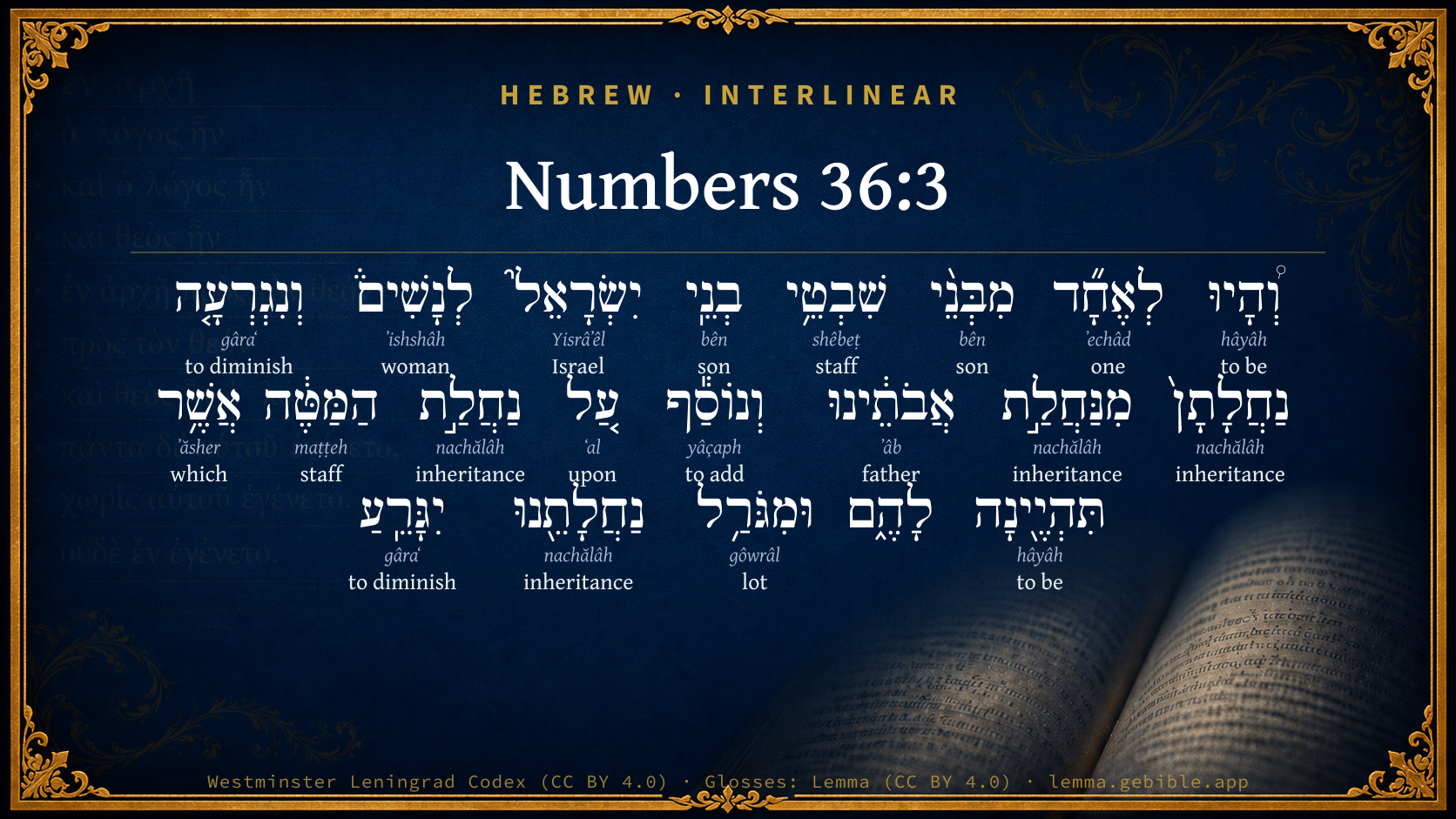
  1. וְ֠הָיוּ hâyâh H1961 “and · to be” Conjunction + Verb, Qal, Perfect, 3rd Person, Common, Plural
  2. לְאֶחָ֞ד ʼechâd H259 “to/for · one” Preposition + Adjective, Cardinal number, Masculine, Singular, Absolute
  3. מִבְּנֵ֨י bên H1121 “from · sons of” Preposition + Noun, Common, Masculine, Plural, Construct
  4. שִׁבְטֵ֥י shêbeṭ H7626 “staffs of” Noun, Common, Masculine, Plural, Construct
  5. בְנֵֽי bên H1121 “sons of” Noun, Common, Masculine, Plural, Construct
  6. יִשְׂרָאֵל֮ Yisrâʼêl H3478 “Israel” Noun, Proper
  7. לְנָשִׁים֒ ʼishshâh H802 “to/for · women” Preposition + Noun, Common, Feminine, Plural, Absolute
  8. נַחֲלָתָן֙ nachălâh H5159 “inheritance · their” Noun, Common, Feminine, Singular, Construct + Suffix, Personal, 3rd Person, Feminine, Plural
  9. מִנַּחֲלַ֣ת nachălâh H5159 “from · inheritance of” Preposition + Noun, Common, Feminine, Singular, Construct
  10. אֲבֹתֵ֔ינוּ ʼâb H1 “fathers · our” Noun, Common, Masculine, Plural, Construct + Suffix, Personal, 1st Person, Common, Plural
  11. וְנוֹסַ֕ף yâçaph H3254 “and · to add” Conjunction + Verb, Niphal, Sequential Perfect, 3rd Person, Masculine, Singular
  12. עַ֚ל ʻal H5921 “upon” Preposition
  13. נַחֲלַ֣ת nachălâh H5159 “inheritance of” Noun, Common, Feminine, Singular, Construct
  14. הַמַּטֶּ֔ה maṭṭeh H4294 “the · staff” Particle, Definite Article + Noun, Common, Masculine, Singular, Absolute
  15. אֲשֶׁ֥ר ʼăsher H834 “which” Particle, Relative
  16. תִּהְיֶ֖ינָה hâyâh H1961 “to be” Verb, Qal, Imperfect, 3rd Person, Feminine, Plural
  17. וּמִגֹּרַ֥ל gôwrâl H1486 “and · from · lot of” Conjunction + Preposition + Noun, Common, Masculine, Singular, Construct
  18. נַחֲלָתֵ֖נוּ nachălâh H5159 “inheritance · our” Noun, Common, Feminine, Singular, Construct + Suffix, Personal, 1st Person, Common, Plural
  19. יִגָּרֵֽעַ gâraʻ H1639 “to diminish” Verb, Niphal, Imperfect, 3rd Person, Masculine, Singular

About this verse

These counts appear in no published source. They are computed here, from the morphology-tagged text and Lemma’s own curated glosses. What Lemma adds →

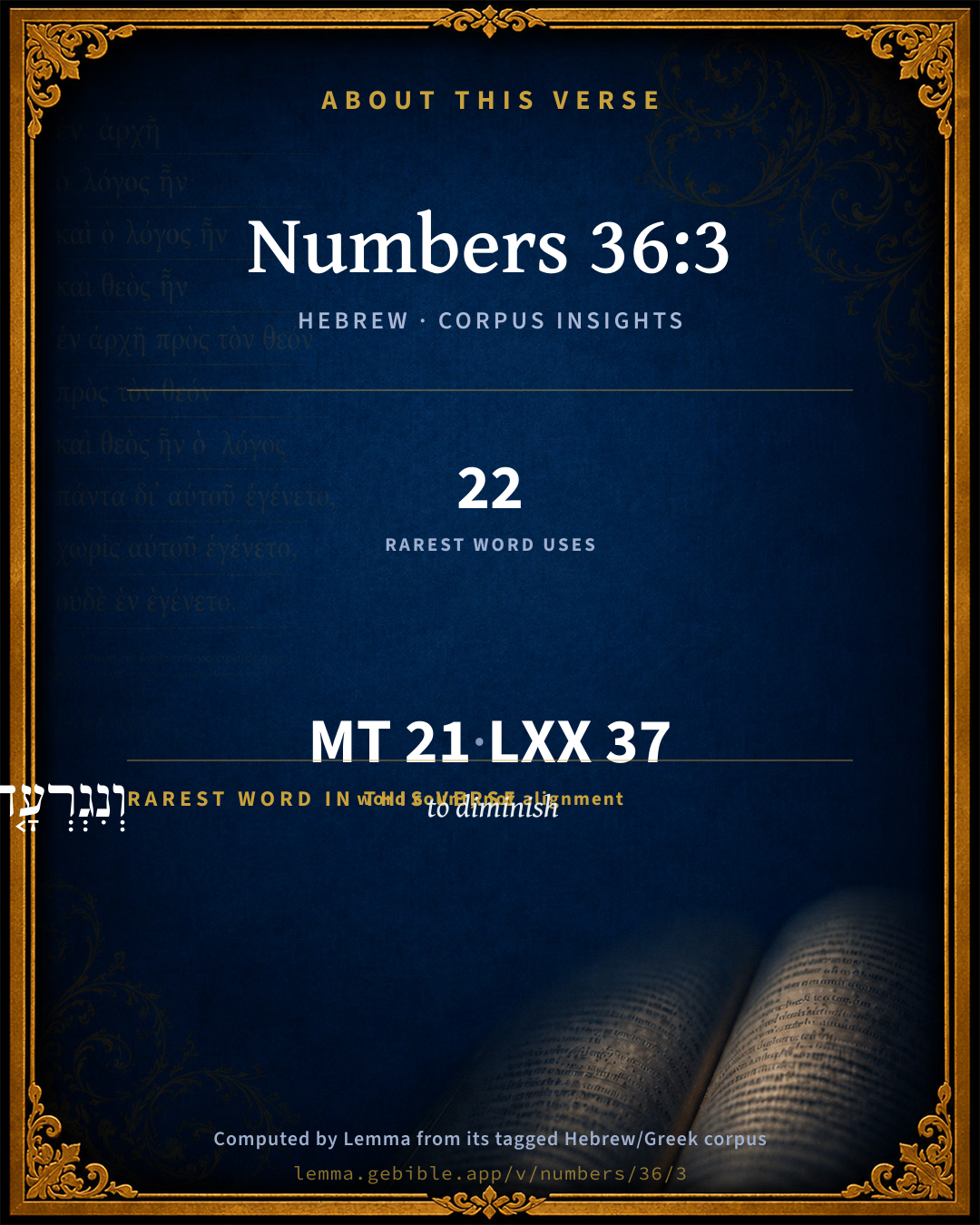
21
words
14
distinct lemmas
Pentateuch
section

Notable vocabulary

The rarest word here is וְנִגְרְעָ֤ה to diminish H1639 — appearing just 22 times in the whole Hebrew Bible.

Shared distinctive vocabulary

וְנִגְרְעָ֤ה to diminish H1639 occurs in 21 verses of the Hebrew Bible. Also found in:

Grammatical profile

  • 5 verbs
  • 12 nouns
  • 1 adjective
  • 2 prepositions
  • 1 particle

Verb forms

  • וְ֠הָיוּ Qal · Perfect
  • וְנִגְרְעָ֤ה Niphal · Sequential Perfect
  • וְנוֹסַ֕ף Niphal · Sequential Perfect
  • תִּהְיֶ֖ינָה Qal · Imperfect
  • יִגָּרֵֽעַ Niphal · Imperfect

Repetition

Words recur within this verse — often emphatic in Hebrew:

  • נַחֲלָתָן֙ inheritance H5159 ×4
  • וְ֠הָיוּ to be H1961 ×2
  • מִבְּנֵ֨י son H1121 ×2
  • וְנִגְרְעָ֤ה to diminish H1639 ×2

Hebrew & Septuagint length

In English translation the verse runs 57 words from the Hebrew and 55 from the Septuagint (LXX English) — closely comparable.

A rough comparison of the two English renderings, which tokenize alike — not a word-level alignment.

Word counts can differ between the Hebrew and the Greek without any difference in meaning — e.g. the Hebrew direct-object marker אֵת has no separate Greek word, and Greek often adds the article ὁ.

In the original languages it is 21 Hebrew tokens and 37 Greek tokens — but the two are counted differently (Hebrew bundles its prefixes and suffixes into one token; the Greek is in lemma form), so that isn’t a like-for-like length.

Hebrew and Greek witnesses Masoretic Hebrew ↔ Greek Septuagint

The same verse in the two great witnesses to the Old Testament, shown verse-for-verse.

These are two independent witnesses, not word-aligned to each other, and the Septuagint is shown in lemma (dictionary) form.

Hebrew Numbers 36:3 Masoretic · Westminster Leningrad Codex

וְ֠הָיוּ לְאֶחָ֞ד מִבְּנֵ֨י שִׁבְטֵ֥י בְנֵֽי יִשְׂרָאֵל֮ לְנָשִׁים֒ וְנִגְרְעָ֤ה נַחֲלָתָן֙ מִנַּחֲלַ֣ת אֲבֹתֵ֔ינוּ וְנוֹסַ֕ף עַ֚ל נַחֲלַ֣ת הַמַּטֶּ֔ה אֲשֶׁ֥ר תִּהְיֶ֖ינָה לָהֶ֑ם וּמִגֹּרַ֥ל נַחֲלָתֵ֖נוּ יִגָּרֵֽעַ

If they be married to any of the sons of the [other] tribes of the children of Israel, then will their inheritance be taken away from the inheritance of our fathers, and will be added to the inheritance of the tribe whereunto they shall belong: so will it be taken away from the lot of our inheritance.

World English Bible · Public Domain

Greek LXX Numbers 36:3 Septuagint · lemma form

καί εἰμί εἷς ὁ φυλή υἱός ἰσραήλ γυνή καί ἀποαἱρέω ὁ κλῆρος αὐτός ἐκ ὁ κατάσχεσις ὁ πατήρ ἐγώ καί προςτίθημι εἰς κληρονομία ὁ φυλή ὅς ἄν γίγνομαι γυνή καί ἐκ ὁ κλῆρος ὁ κληρονομία ἐγώ ἀποαἱρέω

And they will become wives in one of the tribes of the children of Israel; so their inheritance shall be taken away from the possession of our fathers, and shall be added to the inheritance of the tribe into which the women shall marry, and shall be taken away from the portion of our inheritance.

LXX2012 (modern English Septuagint) · Public Domain

Hebrew: Westminster Leningrad Codex (CC BY 4.0). Greek: Septuagint (public domain); English from LXX2012 (modern English Septuagint) (Public Domain). How the Septuagint differs from the Hebrew →

Targum (Aramaic paraphrase)

2

The Targum is the ancient Jewish Aramaic paraphrase of the Hebrew Scriptures — an interpretive translation, not the Hebrew text itself. Onkelos (literal) and Pseudo-Jonathan (expansive) render the Torah, and Jonathan the Prophets. Coverage is partial: where no permissively-licensed English translation exists for a verse, only the Aramaic is shown. This is verse-level text, not a word-by-word alignment to the Hebrew.

  1. Targum Onkelos Torah (Genesis–Deuteronomy)
    וִיהֶוְיַן לְחַד מִבְּנֵי שִׁבְטַיָא דִבְנֵי יִשְׂרָאֵל לִנְשִׁין וְתִתְמְנַע אַחֲסַנְתְּהוֹן מֵאַחֲסָנַת אֲבְהָתָנָא וְתִתּוֹסַף עַל אַחֲסָנַת שִׁבְטַיָא דִיֶהֶוְיָן לְהוֹן וּמֵעֲדַב אַחֲסַנְתָּנָא יִתְמְנָע

    (no public-domain English translation for this verse)

    Targum Onkelos — Aramaic: “Onkelos Genesis” (public domain); “Onkelos Exodus” (public domain); “Onkelos Leviticus” (public domain); “Onkelos Numbers” (public domain); “Onkelos Deuteronomy” (public domain). English: “Sefaria Community Translation” (CC0 1.0 (public-domain dedication)); “J.W. Etheridge. The Targums of Onkelos and Jonathan Ben Uzziel on the Pentateuch. London: Longmans, Green, 1862” (public domain). Text via Sefaria.

  2. Targum Pseudo-Jonathan Torah (Genesis–Deuteronomy)
    וַהֲוָאָה לְחַד מִבְּנֵי שִׁבְטַיָא דִבְנֵי יִשְרָאֵל לִנְשִׁין וְתִתְמְנַע אַחְסַנְתְּהוֹן מֵאַחְסָנַת אַבְהָתָנָא וְתִיתוֹסַף עַל אַחְסָנַת שִׁבְטַיָא דְיֶהֱוְיָן לְהוֹן וּמִן עֲדַב אַחְסַנְתָּנָא יִתְמְנַע

    But if these marry into any of the tribes of the children of Israel, their inheritance will be withdrawn from that of our fathers, and will be added to the inheritance of the tribe which will have become theirs, and our lot will be diminished.

    Targum Pseudo-Jonathan — Aramaic: “Targum Jonathan on Genesis” (public domain); “Targum Jonathan on Exodus” (public domain); “Targum Jonathan on Leviticus” (public domain); “Targum Jonathan on Numbers” (public domain); “Targum Jonathan on Deuteronomy” (public domain). English: “The Targum of Jonathan ben Uzziel, trans. J. W. Etheridge, London, 1862” (public domain). Text via Sefaria.

Commentary

Notes on Numbers 36:3 from classic Christian and Jewish commentators (each source and its license shown beneath its notes). The classic Christian expositions comment on the surrounding passage and are grouped to its opening verse, so a note may address several verses; the Jewish commentaries on the Tanakh (Rashi and others) are per-verse, so they appear only where the commentator wrote on this verse.

Lemma curates 59 commentaries, every one of them public domain or Creative Commons licensed, each selected and text-cleaned for this edition rather than reprinted as found. About our sources →

John Gill's Exposition

And if they be married to any of the sons of the other tribes of the children of Israel,.... Which was not an unreasonable supposition, and perhaps was judged very probable and likely, if some method was not taken to prevent it; which they might conclude from the application of some young men of the other tribes unto them:

then shall their inheritance be taken from the inheritance of our fathers, and shall be put to the inheritance of the tribe whereunto they are received; for the inheritance given unto them would of course, the above being the case, descend to their sons, and whose fathers being of other tribes, it would be fixed there:

so shall it be taken from the lot of our inheritance; which gave them some concern; for though this was no personal injury to them, nor any detriment to their families and estates, yet, as it was a lessening of their tribe, they were uneasy at it; and the rather they might be, since half their tribe was to settle on that side Jordan, where they now were: and now all this, the suit of the daughters of Zelophehad for their father's inheritance, which was granted them, the address of young men to them as heiresses, the concern of the heads of the tribe of Manasseh on this account; all this, I say, being before they entered into the land, or it was conquered by them, or divided to them by inheritance, show their strong faith and assurance that they should possess it.

John Gill's Exposition of the Whole Bible (1746–1763) — public domain (CC PDM 1.0). Text via the HelloAO Bible API.

Matthew Poole's English Annotations

For their inheritance will pass to their children, who will be of another tribe by their father’s side, which alone is considered in this place.

Matthew Poole's English Annotations on the Holy Bible (1683–1685) — public domain. Text from a community e-Sword/MySword module.

The Pulpit Commentary

Whereunto they are received. Literally, as in the margin, "unto whom ( referring to the men of the tribe) they shall be."

The Pulpit Commentary (1880–1919), ed. H.D.M. Spence-Jones & Joseph S. Exell — public domain. Text from a community e-Sword module.

unfoldingWord translationNotes

Door43 World Missions Community

will be removed from our ancestor's share

This can be stated in active form. AT: "will no longer belong to our ancestor's share" (See: Active or Passive)

It will be added

This can be stated in active form. AT: "It will belong to" (See: Active or Passive)

it will be removed from the assigned share of our inheritance

This can be stated in active form. AT: "it will no longer be a part of our inheritance" (See: Active or Passive)

the year of Jubilee of the people

This refers to a celebration which happens once every fifty years. In this celebration, all land that someone sold or traded must return to the original owner. (See: Assumed Knowledge and Implicit Information)

their share will be joined

This can be stated in active form. AT: "their share will belong" (See: Active or Passive)

their share will be taken away from the share of our ancestors' tribe

This can be stated in active form. AT: "they will take our tribe's share of the land" (See: Active or Passive)

translationWords

tribe

inherit

unfoldingWord translationNotes — © Distant Shores Media and the Door43 World Missions Community, licensed CC BY-SA 4.0. Source: git.door43.org/Door43/en_tn.

Rashi

Rabbi Shlomo Yitzchaki (Rashi)

ונוסף על נחלת המטה AND IF THEY BECOME WIVES TO ANY SONS OF THE OTHER TRIBES … THEN WILL THEIR INHERITANCE] BE ADDED TO THE INHERITANCE OF THE TRIBE [WHEREUNTO THEY SHALL BELONG] — for her son will be her heir and the son reckons his pedigree after his father’s tribe.

Rashi on the Tanakh — English translations: “The Judaica Press complete Tanach with Rashi, translated by A. J. Rosenberg” (CC BY 4.0); “Pentateuch with Rashi's commentary by M. Rosenbaum and A.M. Silbermann, 1929-1934” (public domain); “The Metsudah Tanach series, Lakewood, N.J” (CC BY 4.0); and “The Book of Joshua, Metsudah Publications, 1997” (CC BY 4.0). Text via Sefaria.

Lesson kit

Teaching starters — assembled from the data on this page, not authored interpretation. Every prompt links to the verse data it draws on. Edit before teaching.

Numbers, in the Pentateuch, opens this verse with 21 words (14 distinct Hebrew lemmas). Its most distinctive word is gâraʻ (“to diminish”). A historical commentator’s framing appears above. Read the whole chapter for the surrounding context.

Discussion questions

  1. How does “to diminish” (gâraʻ) shape what this verse is saying?
  2. Exodus 5:8 shares the word «to diminish» with this verse. How do the two illuminate each other?
  3. “inheritance” occurs 4× in this one verse. What is the effect of the repetition?
  4. These translations render this verse differently; the difference is in the English rendering, not the original. What questions does that raise?
  5. The verb «וְ֠הָיוּ» is Qal Perfect. How does its form color the action?
  6. Reading how John Gill's Exposition and Matthew Poole's English Annotations read this verse, where do the two commentators agree and where do they part?

Things to notice

Reading settings

Reading text

Shown beneath each verse's original-language words.

Old Testament
Old Testament edition

Read the OT as the Masoretic Hebrew (MT) or the Greek Septuagint (LXX).

English shown for the Greek Septuagint (in the Hebrew ↔ Greek comparison).

Comparing translations? Open the Compare panel on any verse page to stack up to four side by side.