Lamentations 4:16

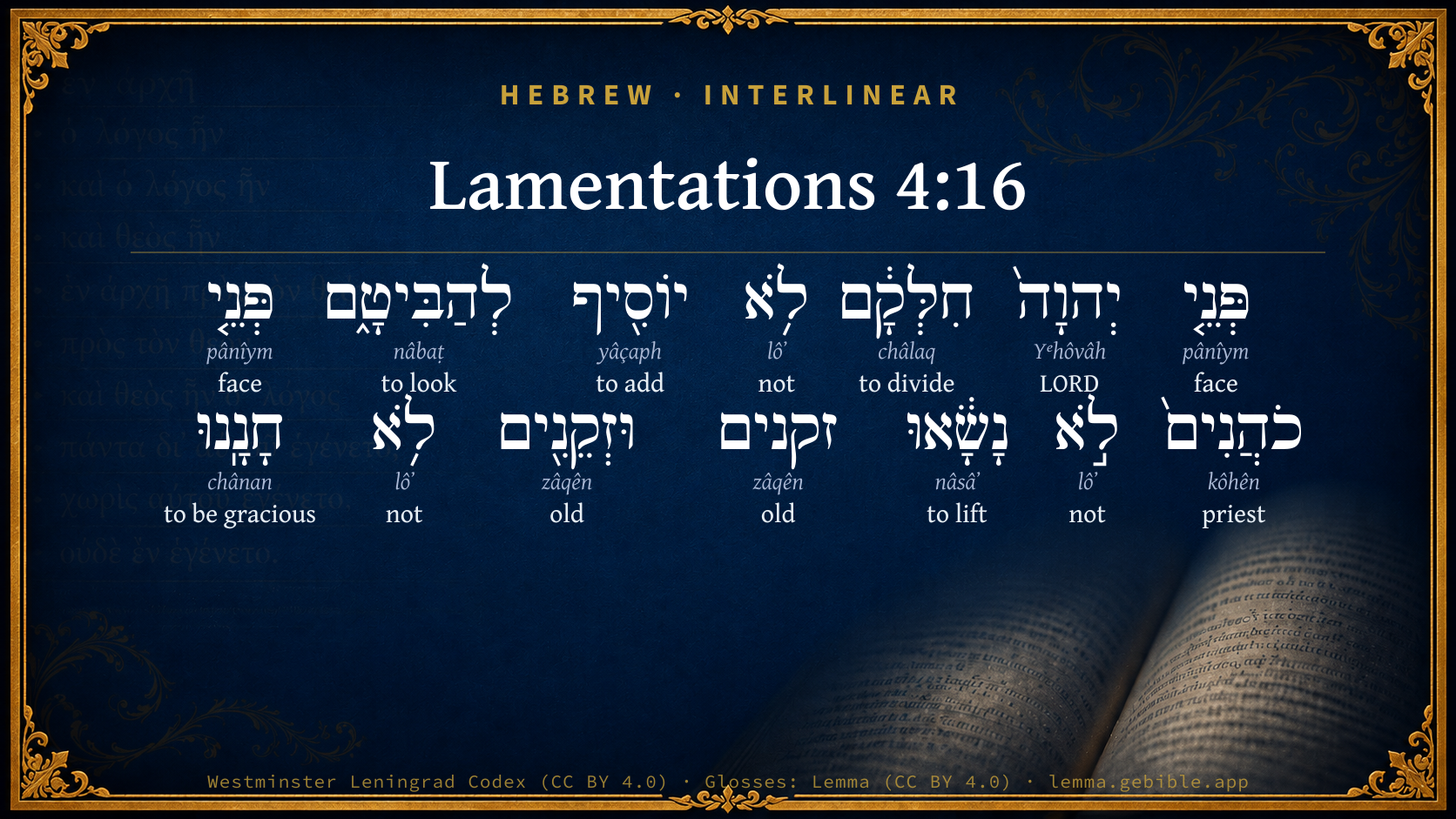
Hebrew (Westminster Leningrad Codex) Lamentations 4:16 appears in the Hebrew Old Testament. The text above is from the Westminster Leningrad Codex. Each word links to its Strong’s number, a concise gloss, and parsing drawn from the Open Scriptures Hebrew Bible morphology. Click any word for its full Brown-Driver-Briggs (BDB) entry.
Download image
Cite this verse

Lamentations 4:16 (World English Bible). Public Domain. Lemma interlinear Bible study tool, https://lemma.gebible.app/v/lamentations/4/16.

Show BibTeX & RIS
BibTeX
RIS
English Translation
The anger of Yahweh has scattered them; he will no more regard them: They didn't respect the persons of the priests, they didn't favor the elders.
World English Bible · Public Domain
Download a study sheet

One document with this verse’s original text, its word-by-word gloss line, the meaning frame, cross-references with their text, attributed commentary, and full source and license credits — printable, and it pastes into notes with its structure intact.

This verse Autodidact and up

Study sheet (.html) Plain text (.txt)

A passage Seminary Student

Up to 50 verses in one chapter. A passage sheet keeps up to 6 commentary sources and 12 cross-references per verse, in the order this page ranks them, and says so on the sheet whenever that leaves anything out. Ask for a single verse and you get the Autodidact verse sheet above.

Everything on this page stays free to read, with no account — the sheet is a download of what is already on screen, not access to it.

Want to remove ads? Support Godless Engineer
Compare translations 3

The same verse in 3 English versions, stacked beneath the original-language interlinear above. Click any original word for its lexicon entry.

Each is an independent rendering of the whole verse — the interlinear is not word-aligned to these translations.

Highlighted words mark where these versions differ — a whole-verse word diff, not a word-by-word alignment.

  • World English Bible Public Domain
    The anger of Yahweh has scattered them; he will no more regard them: They didn't respect the persons of the priests, they didn't favor the elders.
  • King James Version Public Domain
    The anger of the LORD hath divided them; he will no more regard them: they respected not the persons of the priests, they favoured not the elders.
  • unfoldingWord Literal Text CC BY-SA 4.0
    The face of Yahweh divided them; he will not continue to look at them. The face of the priests they did not lift up, and the elders they did not show grace. PE

unfoldingWord Literal Text — © unfoldingWord, licensed CC BY-SA 4.0. Word-aligned USFM3 via Door43 (git.door43.org/unfoldingWord/en_ult).

Versions to compare (up to 4)

3 of 4 selected

Show all 18 translations

Every available English version of this verse, each an independent rendering of the whole verse.

  • World English Bible Public Domain
    The anger of Yahweh has scattered them; he will no more regard them: They didn't respect the persons of the priests, they didn't favor the elders.
  • Berean Standard Bible Public Domain
    The presence of the LORD has scattered them; He regards them no more. The priests are shown no honor; the elders find no favor.
  • Majority Standard Bible Public Domain
    The presence of the LORD has scattered them; He regards them no more. The priests are shown no honor; the elders find no favor.
  • King James Version Public Domain
    The anger of the LORD hath divided them; he will no more regard them: they respected not the persons of the priests, they favoured not the elders.
  • American Standard Version (1901) Public Domain
    The anger of Jehovah hath scattered them; he will no more regard them: They respected not the persons of the priests, they favored not the elders.
  • Revised Version (1885) Public Domain
    The anger of the LORD hath divided them; he will no more regard them: they respected not the persons of the priests, they favoured not the elders.
  • Geneva Bible (1599) Public Domain
    The anger of the Lord hath scattered them, he will no more regard them: they reuerenced not the face of the Priestes, nor had compassion of the Elders.
  • Douay-Rheims (1899) Public Domain
    Phe. The face of the Lord hath divided them, he will no more regard them: they respected not the persons of the priests, neither had they pity on the ancient.
  • Young's Literal Translation Public Domain
    The face of Jehovah hath divided them, He doth not add to behold them, The face of priests they have not lifted up, Elders they have not favoured.
  • Literal Standard Version CC BY-SA 4.0
    The face of YHWH has divided them, || He does not add to behold them, || They have not lifted up the face of priests, || They have not favored [the] old and elderly.
  • Unlocked Literal Bible CC BY-SA 4.0
    Yahweh himself scattered them; he does not watch over them anymore. They do not honor the priests, and they did not show any favor to the elders.
  • unfoldingWord Literal Text CC BY-SA 4.0
    The face of Yahweh divided them; he will not continue to look at them. The face of the priests they did not lift up, and the elders they did not show grace. PE
  • Darby Bible Public Domain
    The face of Jehovah hath divided them; he will no more regard them. They respected not the persons of the priests, they favoured not the aged.
  • World Messianic Bible Public Domain
    The LORD’s anger has scattered them. He will not pay attention to them any more. They didn’t respect the persons of the priests. They didn’t favor the elders.
  • Webster's Bible Public Domain
    The anger of the LORD hath divided them; he will no more regard them: they respected not the persons of the priests, they favored not the elders.
  • Free Bible Version CC BY-SA 4.0
    The Lord himself has scattered them; he doesn't bother with them anymore. Nobody respects the priests, and nobody admires the leaders.
  • Bible in Basic English Public Domain
    The face of the Lord has sent them in all directions; he will no longer take care of them: they had no respect for the priests, they gave no honour to the old men.
  • JPS Tanakh (1917) Public Domain
    The anger of the LORD hath divided them; He will no more regard them; they respected not the persons of the priests, they were not gracious unto the elders.

Literal Standard Version (2020), Covenant Press — licensed CC BY-SA 4.0. Text via the HelloAO Bible API (eBible.org). Unlocked Literal Bible (unfoldingWord) — licensed CC BY-SA 4.0. Text via the HelloAO Bible API (eBible.org). unfoldingWord Literal Text — © unfoldingWord, licensed CC BY-SA 4.0. Word-aligned USFM3 via Door43 (git.door43.org/unfoldingWord/en_ult). Free Bible Version, Dr. Jonathan Gallagher — licensed CC BY-SA 4.0. Text via the HelloAO Bible API (eBible.org).

Word by word

More ways to search: Search by grammar → Find every occurrence → Compare this word →

Practice this passage: Drill this verse → Learn its vocabulary →

חִלְּקָ֔ם
châlaq
H2505
“to divide · them”
Verb, Piel, Perfect, 3rd Person, Masculine, Singular + Suffix, Personal, 3rd Person, Masculine, Plural
Part of Speech
Verb
Stem
Piel
Form
Perfect
Person
3rd Person
Gender
Masculine
Number
Singular
Full BDB Definition

Origin: a primitive root

TWOT: 669

to divide, share, plunder, allot, apportion, assign - (Qal) - to divide, apportion - to assign, distribute - to assign, impart - to share - to divide up, plunder - (Niphal) - to divide oneself - to be divided - to assign, distribute - (Piel) - to divide, apportion - to assign, distribute - to scatter - (Pual) to be divided - (Hiphil) to receive a portion or part - (Hithpael) to divide among themselves - to be smooth, slippery, deceitful - (Qal) to be smooth, slippery - (Hiphil) - to be smooth - to flatter
  1. פְּנֵ֤י pânîym H6440 “face(s) of” Noun, Common, Both, Plural, Construct
  2. יְהוָה֙ Yᵉhôvâh H3068 “LORD” Noun, Proper
  3. לֹ֥א lôʼ H3808 “not” Particle, Negative
  4. יוֹסִ֖יף yâçaph H3254 “to add” Verb, Hiphil, Imperfect, 3rd Person, Masculine, Singular
  5. לְהַבִּיטָ֑ם nâbaṭ H5027 “to look · them” Preposition + Verb, Hiphil, Infinitive Construct + Suffix, Personal, 3rd Person, Masculine, Plural
  6. פְּנֵ֤י pânîym H6440 “face(s) of” Noun, Common, Both, Plural, Construct
  7. כֹהֲנִים֙ kôhên H3548 “priests” Noun, Common, Masculine, Plural, Absolute
  8. לֹ֣א lôʼ H3808 “not” Particle, Negative
  9. נָשָׂ֔אוּ nâsâʼ H5375 “to lift” Verb, Qal, Perfect, 3rd Person, Common, Plural
  10. זקנים zâqên H2205 “old” Adjective, Adjective, Masculine, Plural, Absolute
  11. וּזְקֵנִ֖ים zâqên H2205 “and · old” Conjunction + Adjective, Adjective, Masculine, Plural, Absolute
  12. לֹ֥א lôʼ H3808 “not” Particle, Negative
  13. חָנָֽנוּ chânan H2603 “to be gracious” Verb, Qal, Perfect, 3rd Person, Common, Plural

About this verse

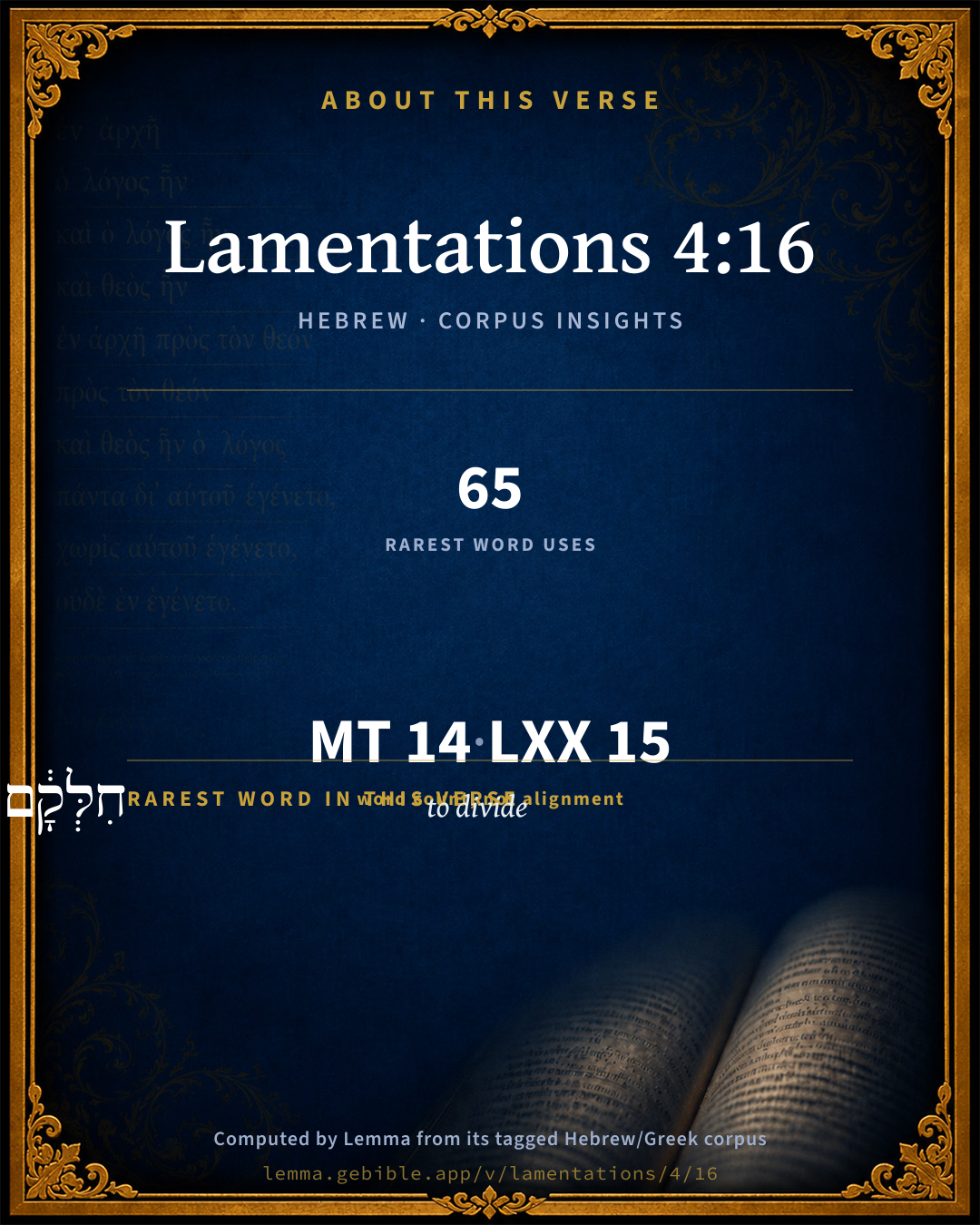
These counts appear in no published source. They are computed here, from the morphology-tagged text and Lemma’s own curated glosses. What Lemma adds →

14
words
10
distinct lemmas
Prophets
section

Grammatical profile

  • 5 verbs
  • 4 nouns
  • 2 adjectives
  • 3 particles

Verb forms

  • חִלְּקָ֔ם Piel · Perfect
  • יוֹסִ֖יף Hiphil · Imperfect
  • לְהַבִּיטָ֑ם Hiphil · Infinitive Construct
  • נָשָׂ֔אוּ Qal · Perfect
  • חָנָֽנוּ Qal · Perfect

Repetition

Words recur within this verse — often emphatic in Hebrew:

  • פְּנֵ֤י face H6440 ×2
  • זקנים old H2205 ×2
  • לֹ֥א not H3808 ×3

Hebrew & Septuagint length

In English translation the verse runs 26 words from the Hebrew and 30 from the Septuagint (LXX English) — closely comparable.

A rough comparison of the two English renderings, which tokenize alike — not a word-level alignment.

Word counts can differ between the Hebrew and the Greek without any difference in meaning — e.g. the Hebrew direct-object marker אֵת has no separate Greek word, and Greek often adds the article ὁ.

In the original languages it is 14 Hebrew tokens and 15 Greek tokens — but the two are counted differently (Hebrew bundles its prefixes and suffixes into one token; the Greek is in lemma form), so that isn’t a like-for-like length.

Cross-references

13

Topical passages linked to Lamentations 4:16 in the Treasury of Scripture Knowledge — connected by theme and wording, ordered by reader-vote popularity; previews shown in the World English Bible.

  • Isaiah 9:14–16 Therefore Yahweh will cut off from Israel head and tail, palm-branch and rush, in one day.
  • Lamentations 5:12 Princes were hanged up by their hand: The faces of elders were not honored.
  • Deuteronomy 32:26 I said, I would scatter them afar, I would make the memory of them to cease from among men;
  • Deuteronomy 28:25 Yahweh will cause you to be struck before your enemies; you shall go out one way against them, and shall flee seven ways before them: and you shall be tossed back and forth among all the kingdoms of the earth.
  • Deuteronomy 28:64–65 Yahweh will scatter you among all peoples, from the one end of the earth even to the other end of the earth; and there you shall serve other gods, which you have not known, you nor your fathers, even wood and stone.
  • Jeremiah 24:9 I will even give them up to be tossed back and forth among all the kingdoms of the earth for evil; to be a reproach and a proverb, a taunt and a curse, in all places where I shall drive them.
  • Hebrews 8:9 Not according to the covenant that I made with their fathers, In the day that I took them by the hand to lead them out of the land of Egypt; For they didn't continue in my covenant, And I disregarded them," says the Lord.
  • Genesis 49:7 Cursed be their anger, for it was fierce; And their wrath, for it was cruel. I will divide them in Jacob, Scatter them in Israel.
  • Leviticus 26:33–39 I will scatter you among the nations, and I will draw out the sword after you: and your land will be a desolation, and your cities shall be a waste.
  • 2 Kings 25:18–21 The captain of the guard took Seraiah the chief priest, and Zephaniah the second priest, and the three keepers of the threshold:
  • 2 Chronicles 36:17 Therefore he brought on them the king of the Chaldeans, who killed their young men with the sword in the house of their sanctuary, and had no compassion on young man or virgin, old man or gray-headed: he gave them all into his hand.
  • Psalms 106:44 Nevertheless he regarded their distress, When he heard their cry.
  • Jeremiah 15:4 I will cause them to be tossed back and forth among all the kingdoms of the earth, because of Manasseh, the son of Hezekiah, king of Judah, for that which he did in Jerusalem.

Cross-references courtesy of OpenBible.info (CC BY 4.0).

Hebrew and Greek witnesses Masoretic Hebrew ↔ Greek Septuagint

The same verse in the two great witnesses to the Old Testament, shown verse-for-verse.

These are two independent witnesses, not word-aligned to each other, and the Septuagint is shown in lemma (dictionary) form.

Hebrew Lamentations 4:16 Masoretic · Westminster Leningrad Codex

פְּנֵ֤י יְהוָה֙ חִלְּקָ֔ם לֹ֥א יוֹסִ֖יף לְהַבִּיטָ֑ם פְּנֵ֤י כֹהֲנִים֙ לֹ֣א נָשָׂ֔אוּ זקנים וּזְקֵנִ֖ים לֹ֥א חָנָֽנוּ

The anger of Yahweh has scattered them; he will no more regard them: They didn't respect the persons of the priests, they didn't favor the elders.

World English Bible · Public Domain

Greek LXX Lamentations 4:16 Septuagint · lemma form

πρόσωπον κύριος μερίς αὐτός οὐ προςτίθημι ἐπιβλέπω αὐτός πρόσωπον ἱερεύς οὐ λαμβάνω πρεσβύτης οὐ ἐλεέω

AIN. The presence of the Lord was their portion; but he will not again look upon them: they regarded not the person of the priests, they pitied not the prophets.

LXX2012 (modern English Septuagint) · Public Domain

On this verse, The Cambridge Bible for Schools and Colleges discusses the Septuagint’s reading. Read the note in Commentary ↓

Hebrew: Westminster Leningrad Codex (CC BY 4.0). Greek: Septuagint (public domain); English from LXX2012 (modern English Septuagint) (Public Domain). How the Septuagint differs from the Hebrew →

Commentary

Notes on Lamentations 4:16 from classic Christian and Jewish commentators (each source and its license shown beneath its notes). The classic Christian expositions comment on the surrounding passage and are grouped to its opening verse, so a note may address several verses; the Jewish commentaries on the Tanakh (Rashi and others) are per-verse, so they appear only where the commentator wrote on this verse.

Lemma curates 59 commentaries, every one of them public domain or Creative Commons licensed, each selected and text-cleaned for this edition rather than reprinted as found. About our sources →

Jamieson, Fausset & Brown

Robert Jamieson, A. R. Fausset & David Brown

Ain and Pe are here transposed (Lam 4:16-17), as in Lam 2:16-17; Lam 3:46-51.

anger--literally, "face"; it is the countenance which, by its expression, manifests anger (Psa 34:16). GESENIUS translates, "the person of Jehovah"; Jehovah present; Jehovah Himself (Exo 33:14; Sa2 17:11).

divided--dispersed the Jews.

they respected not . . . priests--This is the language of the Gentiles. "The Jews have no hope of a return: for they respected not even good priests" (Ch2 24:19-22) [GROTIUS]. MAURER explains it, "They (the victorious foe) regard not the (Jewish) priests when imploring their pity" (Lam 5:12). The evident antithesis to "As for us" (Lam 4:17) and the language of "the heathen" at the close of Lam 4:15, of which Lam 4:16 is the continuation, favor the former view.

Jamieson, Fausset & Brown — Commentary Critical and Explanatory on the Whole Bible (1871) — public domain (CC PDM 1.0). Text via the HelloAO Bible API.

Trapp's Complete Commentary

John Trapp

Lam 4:16 The anger of the LORD hath divided them; he will no more regard them: they respected not the persons of the priests, they favoured not the elders.

Ver. 16. The anger of the Lord hath divided them.] Say the heathen still concerning the wicked Jews; continuatur enim hic instituta mimesis.

He will no more regard them.] Heb., Look after them - scil., Facie blenda ac benevola, in mercy; he hath utterly rejected them. For what reason?

They respected not the persons of the priests.] But vilely entreated them. See 2Ch 36:16. Sacerdotes apud omnes gentes sunt venerabiles ob ministerium.

John Trapp, A Commentary or Exposition upon All the Books of the Old and New Testament (1647–1656) — public domain. Text from a community e-Sword module.

Geneva Bible (1599)

Geneva Bible translators

Or, face.

That is, the enemies.

Geneva Bible (1599) marginal notes — public domain. Text via Bolls.life.

John Calvin's Commentaries

He explains himself by saying, that they had been scattered from the face of Jehovah. He had said, that they had fled into foreign lands, and that they believed their exile to be perpetual; he now assigns the reason that God had thus banished them. But he had promised by Moses, that though they were dispersed through the four quarters of the world, he would yet be propitious to them, so as to gather them when dispersed, as it is said in the Psalms, “He will gather the dispersed of Israel.” (Deuteronomy 30:4; Psalm 147:2.) And we know that the time of exile had been prefixed; for the Prophet had often testified that God would at length become a deliverer to his people, so as to stretch forth again his hand, and draw them forth from Chaldea as he did from Egypt: how then does he say, that they had been scattered from the face of Jehovah, and then, that they had been so rejected, that he would not favor them hereafter with his paternal countenance? the obvious answer is this, that the Prophet here regards only the extremely dispersed state of the people. For though the promise of God as to their return was certain and clear, yet, when any one cast his eyes on the state of things at that time, he could have hoped no such thing; for the desolation, the ground of despair, was immense: no name had remained for the people, the priesthood had been extinguished, the royal dignity had been degraded, the city also and the Temple had been completely overthrown. As, then, there was nothing remaining as to the nation and the place, and also as to God’s worship, how could they do otherwise than despond?

Then the Prophet, viewing the desolation, says, that nothing else could be concluded, but that the Jews would be perpetually exiles, and that all the ways were closed up, to prevent them to return to their country, and also that the eyes of God were shut, so as never to look on them. We now, then, perceive what he means by saying, that they were scattered from the face of Jehovah, so that he should no longer look on them. And this mode of speaking is often found in Scripture; for, on the one hand, it; sets before us the wrath of God, which brings death; and then on the other, it sustains us, or when we are fallen it raises us up, by setting before us the favor of God even in death itself.

The Prophet, then, considers now no other thing than the dreadful calamity which was sufficient to sink the minds of all into the lowest abyss of despair.

He then adds, that they respected not the face of the priests, and shewed no pity to the elders. Some think that the reason is given why God had so severely punished the people, even because they had despised the aged and the priests; but this is a forced view. I, then, have no doubt but that the Prophet here intimates, that the Jews had been treated reproachfully, so that there had been no account made of the aged, and no respect shewn to the priests. It is, indeed, true, that Daniel was held in great repute; but he speaks here of the priests who had impiously despised all sound doctrine; and he speaks of the aged who were in authority when the kingdom was yet standing. He then says that they had been, as it were, trodden under feet. He hence concludes, that, all hope of restoration was taken away from the Jews, if they only considered their extreme calamity. He afterwards adds, —

John Calvin's Commentaries (1540-1563) — public domain. Text from the Calvin Translation Society English edition (1840s-50s) via the Christian Classics Ethereal Library (ccel.org). Calvin's coverage is partial (roughly two-thirds of the Bible); uncommented books and verses are honest gaps, never fabricated. The 19th-century editor's footnotes and remarks are omitted so the notes are faithfully Calvin's own voice.

Ellicott's Commentary for English Readers

(16) The anger of the Lord.—Literally, the face, as the symbol of wrath.

They respected not.—The subject of the verbs has to be supplied. The enemies, or the heathen, or men in general, ceased to feel any reverence for the fugitive priests and elders.

A Bible Commentary for English Readers, edited by Charles John Ellicott (1878–1897) — public domain. Text from a community e-Sword module.

The Cambridge Bible for Schools and Colleges

gen. ed. J. J. S. Perowne

16. hath divided them] hath scattered them (among the nations).

they] men, as in the previous v.

elders] with LXX read prophets, which is more in harmony with the preceding context. Pe. suggests that “elders” may have been substituted through the influence of Lam_5:12.

The Cambridge Bible for Schools and Colleges (gen. ed. J. J. S. Perowne; Cambridge University Press, 1878–1918) — public domain. Text from a community e-Sword module.

John Gill's Exposition

The anger of the Lord hath divided them,.... Or, "the face of the Lord" (f); the anger that appeared in his face, in the dispensation of his providence, removed them out of their own land, and dispersed them among several countries and nations of the world, and as they now are: these are not the words of the Heathens continued, but of the prophet:

he will no more regard them; or, "he will not add to look on them" (g), with a look of love, but continue his anger and resentment:

they respect not the persons of the priests, they favour not the elders; which is to be considered either as the sin of the false prophets and priests before described, which was the cause of their punishment; that they east great contempt on the true prophets of the Lord, as Jeremiah and others, and showed no regard to the elders of the people, or those godly magistrates; who would have corrected and restrained them: or else this is said of the nations among whom they were dispersed, as the Targum; who would pay no respect to their characters as priests, or show any pity to them on account of their age.

(f) "facies Domini", V. L. Montanus, Piscator. (g) "non addet aspicere eos", Montanus.

John Gill's Exposition of the Whole Bible (1746–1763) — public domain (CC PDM 1.0). Text via the HelloAO Bible API.

Albert Barnes' Notes on the Bible

Literally, The countenance of Yahweh hath scattered them, has driven these outlawed priests here and there, “and He will no more regard them” with favor.

Albert Barnes' Notes on the Bible (1834–1885) — public domain. Text from a community e-Sword/MySword module.

Haydock's Catholic Bible Commentary

They, the Jews; or rather the prophet thus describes the Chaldeans, chap. v. 12., and Deuteronomy xxviii. 50.

George Leo Haydock (1774–1849), Haydock's Catholic Family Bible and Commentary, 1859 edition — public domain. Excludes Psalms (Douay-Rheims chapter numbering differs from Protestant) and Deuterocanonical books (Catholic canon only).

Matthew Poole's English Annotations

These words seem to be the language of their enemies triumphing over them, as discerning that their God was provoked against them, and would have no more regard or respect unto them; and that they had misused his prophets, which agreeth with 2Ch 36:16. But others rather think these latter words (if not the former also) are the prophet’s words, expressive of the cause of their miseries, viz. the Lord’s anger, who had divided them, &c., and the effect of it, their enemies having no regard to the most grave and venerable persons amongst them.

Matthew Poole's English Annotations on the Holy Bible (1683–1685) — public domain. Text from a community e-Sword/MySword module.

Whedon's Commentary on the Bible

Daniel D. Whedon

16. The anger, etc. — Better, the face of Jehovah hath scattered them.

Daniel D. Whedon (gen. ed.), Commentary on the Old and New Testaments (1874–1909) — public domain. Text from a community e-Sword module.

The Pulpit Commentary

Hath divided them; i.e. hath scattered them, like "I will divide them in Jacob". (Gen_49:7)

The Pulpit Commentary (1880–1919), ed. H.D.M. Spence-Jones & Joseph S. Exell — public domain. Text from a community e-Sword module.

John Wesley's Explanatory Notes

The anger - These words seem to be the language of their enemies triumphing over them. They - Their enemies had no regard to the most venerable persons among them.

John Wesley, Explanatory Notes Upon the Whole Bible (1754–1765) — public domain. Text via the GEBible commentary corpus.

unfoldingWord translationNotes

Door43 World Missions Community

scattered them

"scattered the prophets and priests"

he does not watch over them anymore

Here "watch over them" represents being concerned about them and helping them. AT: "he does not care about them anymore" (See: Metonymy)

translationWords

Yahweh

watch

honor

favor

elder

unfoldingWord translationNotes — © Distant Shores Media and the Door43 World Missions Community, licensed CC BY-SA 4.0. Source: git.door43.org/Door43/en_tn.

Rashi

Rabbi Shlomo Yitzchaki (Rashi)

The anger of the Lord divided them Heb. פְּנֵי, lit. the face of. The angry face of the Holy One, blessed be He, divided them and dispersed them among the heathens, because they did not respect the presence of the priests when they were in their [state of] tranquility.

Rashi on the Tanakh — English translations: “The Judaica Press complete Tanach with Rashi, translated by A. J. Rosenberg” (CC BY 4.0); “Pentateuch with Rashi's commentary by M. Rosenbaum and A.M. Silbermann, 1929-1934” (public domain); “The Metsudah Tanach series, Lakewood, N.J” (CC BY 4.0); and “The Book of Joshua, Metsudah Publications, 1997” (CC BY 4.0). Text via Sefaria.

Lesson kit

Teaching starters — assembled from the data on this page, not authored interpretation. Every prompt links to the verse data it draws on. Edit before teaching.

Lamentations, in the Prophets, opens this verse with 14 words (10 distinct Hebrew lemmas). Its most distinctive word is châlaq (“to divide”). A historical commentator’s framing appears above. Read the whole chapter for the surrounding context.

Discussion questions

  1. How does “to divide” (châlaq) shape what this verse is saying?
  2. Isaiah 9:14–16 shares this passage’s theme. How do the two illuminate each other?
  3. “face” occurs 2× in this one verse. What is the effect of the repetition?
  4. These translations render this verse differently. What is at stake in choosing one wording over another?
  5. The verb «חִלְּקָ֔ם» is Piel Perfect. How does its form color the action?
  6. Reading how Jamieson, Fausset & Brown and Trapp's Complete Commentary read this verse, where do the two commentators agree and where do they part?

Things to notice

Reading settings

Reading text

Shown beneath each verse's original-language words.

Old Testament
Old Testament edition

Read the OT as the Masoretic Hebrew (MT) or the Greek Septuagint (LXX).

English shown for the Greek Septuagint (in the Hebrew ↔ Greek comparison).

Comparing translations? Open the Compare panel on any verse page to stack up to four side by side.