
Genesis 30:24

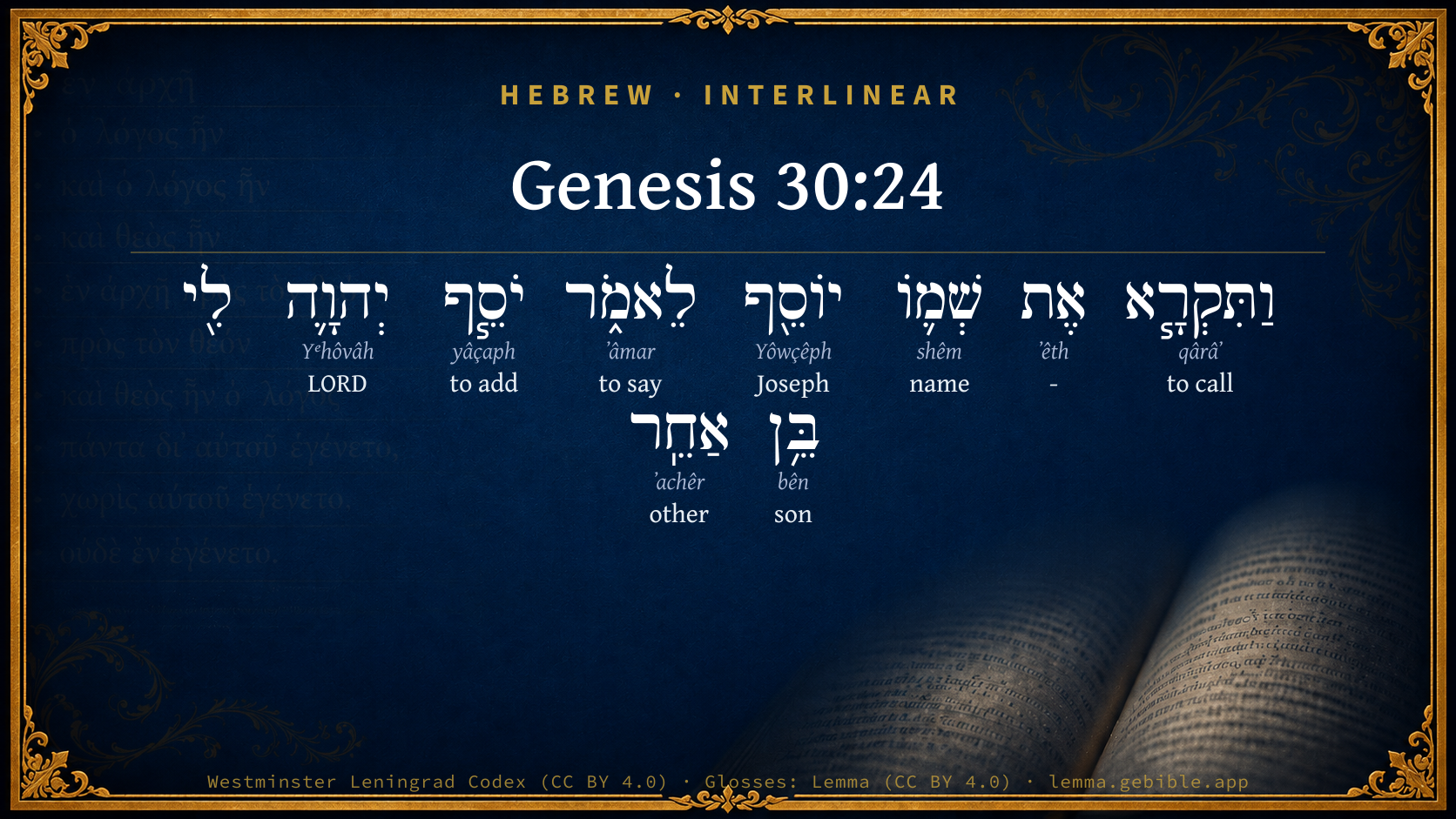
Hebrew (Westminster Leningrad Codex) Genesis 30:24 appears in the Hebrew Old Testament. The text above is from the Westminster Leningrad Codex. Each word links to its Strong’s number, a concise gloss, and parsing drawn from the Open Scriptures Hebrew Bible morphology. Click any word for its full Brown-Driver-Briggs (BDB) entry.
Download image
Cite this verse

Genesis 30:24 (World English Bible). Public Domain. Lemma interlinear Bible study tool, https://lemma.gebible.app/v/genesis/30/24.

Show BibTeX & RIS
BibTeX
RIS
English Translation
She named him Joseph, saying, "May Yahweh add another son to me."
World English Bible · Public Domain
Highlights
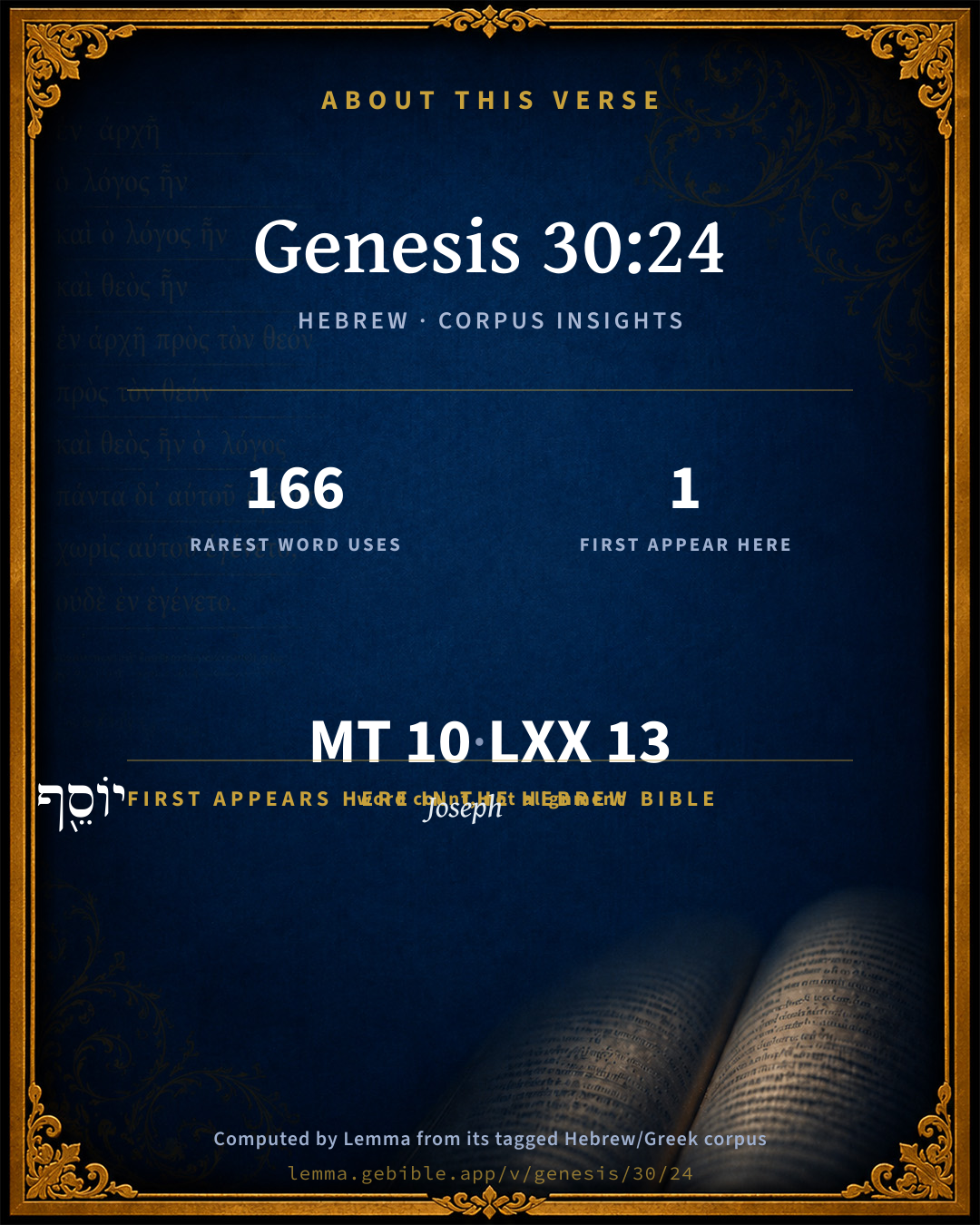
  • 1 first appearance in the Hebrew Bible
Full analysis ↓
Download a study sheet

One document with this verse’s original text, its word-by-word gloss line, the meaning frame, cross-references with their text, attributed commentary, and full source and license credits — printable, and it pastes into notes with its structure intact.

This verse Autodidact and up

Study sheet (.html) Plain text (.txt)

A passage Seminary Student

Up to 50 verses in one chapter. A passage sheet keeps up to 6 commentary sources and 12 cross-references per verse, in the order this page ranks them, and says so on the sheet whenever that leaves anything out. Ask for a single verse and you get the Autodidact verse sheet above.

Everything on this page stays free to read, with no account — the sheet is a download of what is already on screen, not access to it.

Want to remove ads? Support Godless Engineer
Compare translations 3

The same verse in 3 English versions, stacked beneath the original-language interlinear above. Click any original word for its lexicon entry.

Each is an independent rendering of the whole verse — the interlinear is not word-aligned to these translations.

Highlighted words mark where these versions differ — a whole-verse word diff, not a word-by-word alignment.

  • World English Bible Public Domain
    She named him Joseph, saying, "May Yahweh add another son to me."
  • King James Version Public Domain
    And she called his name Joseph; and said, The LORD shall add to me another son.
  • unfoldingWord Literal Text CC BY-SA 4.0
    And she called his name Joseph, saying, “May Yahweh add another son to me.” Jacob Becomes Very Rich Working for Laban 30:25-43

unfoldingWord Literal Text — © unfoldingWord, licensed CC BY-SA 4.0. Word-aligned USFM3 via Door43 (git.door43.org/unfoldingWord/en_ult).

Versions to compare (up to 4)

3 of 4 selected

Show all 18 translations

Every available English version of this verse, each an independent rendering of the whole verse.

  • World English Bible Public Domain
    She named him Joseph, saying, "May Yahweh add another son to me."
  • Berean Standard Bible Public Domain
    She named him Joseph, and said, “May the LORD add to me another son.”
  • Majority Standard Bible Public Domain
    She named him Joseph, and said, “May the LORD add to me another son.”
  • King James Version Public Domain
    And she called his name Joseph; and said, The LORD shall add to me another son.
  • American Standard Version (1901) Public Domain
    and she called his name Joseph, saying, Jehovah add to me another son.
  • Revised Version (1885) Public Domain
    and she called his name Joseph, saying, The LORD add to me another son.
  • Geneva Bible (1599) Public Domain
    And shee called his name Ioseph, saying, The Lord wil giue me yet another sonne.
  • Douay-Rheims (1899) Public Domain
    And she called his name Joseph, saying: The Lord give me also another son.
  • Young's Literal Translation Public Domain
    and she calleth his name Joseph, saying, `Jehovah is adding to me another son.'
  • Literal Standard Version CC BY-SA 4.0
    and she calls his name Joseph, saying, “YHWH is adding to me another son.”
  • Unlocked Literal Bible CC BY-SA 4.0
    She called his name Joseph, saying, “Yahweh has added to me another son.”
  • unfoldingWord Literal Text CC BY-SA 4.0
    And she called his name Joseph, saying, “May Yahweh add another son to me.” Jacob Becomes Very Rich Working for Laban 30:25-43
  • Darby Bible Public Domain
    And she called his name Joseph; and said, Jehovah will add to me another son.
  • World Messianic Bible Public Domain
    She named him Joseph, saying, “May the LORD add another son to me.”
  • Webster's Bible Public Domain
    And she called his name Joseph; and said, The LORD will add to me another son.
  • Free Bible Version CC BY-SA 4.0
    She named him Joseph, saying, “May the Lord give me an additional son.”
  • Bible in Basic English Public Domain
    And she gave him the name Joseph, saying, May the Lord give me another son.
  • JPS Tanakh (1917) Public Domain
    And she called his name Joseph, saying: 'The LORD add to me another son.'

Literal Standard Version (2020), Covenant Press — licensed CC BY-SA 4.0. Text via the HelloAO Bible API (eBible.org). Unlocked Literal Bible (unfoldingWord) — licensed CC BY-SA 4.0. Text via the HelloAO Bible API (eBible.org). unfoldingWord Literal Text — © unfoldingWord, licensed CC BY-SA 4.0. Word-aligned USFM3 via Door43 (git.door43.org/unfoldingWord/en_ult). Free Bible Version, Dr. Jonathan Gallagher — licensed CC BY-SA 4.0. Text via the HelloAO Bible API (eBible.org).

Word by word

More ways to search: Search by grammar → Find every occurrence → Compare this word →

Practice this passage: Drill this verse → Learn its vocabulary →

About this verse

These counts appear in no published source. They are computed here, from the morphology-tagged text and Lemma’s own curated glosses. What Lemma adds →

10
words
9
distinct lemmas
Pentateuch
section

First appearance in Scripture

This word makes its first canonical appearance in the Hebrew Bible here:

  • יוֹסֵ֖ף Joseph H3130

Grammatical profile

  • 3 verbs
  • 4 nouns
  • 1 adjective
  • 1 preposition
  • 1 particle

Verb forms

  • וַתִּקְרָ֧א Qal · Sequential Imperfect
  • לֵאמֹ֑ר Qal · Infinitive Construct
  • יֹסֵ֧ף Hiphil · Imperfect

Hebrew & Septuagint length

In English translation the verse runs 12 words from the Hebrew and 14 from the Septuagint (LXX English) — closely comparable.

A rough comparison of the two English renderings, which tokenize alike — not a word-level alignment.

Word counts can differ between the Hebrew and the Greek without any difference in meaning — e.g. the Hebrew direct-object marker אֵת has no separate Greek word, and Greek often adds the article ὁ.

In the original languages it is 10 Hebrew tokens and 13 Greek tokens — but the two are counted differently (Hebrew bundles its prefixes and suffixes into one token; the Greek is in lemma form), so that isn’t a like-for-like length.

Cross-references

13

Topical passages linked to Genesis 30:24 in the Treasury of Scripture Knowledge — connected by theme and wording, ordered by reader-vote popularity; previews shown in the World English Bible.

  • Genesis 35:24 The sons of Rachel: Joseph and Benjamin.
  • Genesis 49:22–26 "Joseph is a fruitful vine, A fruitful vine by a spring; His branches run over the wall.
  • Genesis 37:2 This is the history of the generations of Jacob. Joseph, being seventeen years old, was feeding the flock with his brothers. He was a boy with the sons of Bilhah and Zilpah, his father's wives. Joseph brought an evil report of them to their father.
  • Revelation 7:8 Of the tribe of Zebulun twelve thousand, Of the tribe of Joseph twelve thousand, Of the tribe of Benjamin were sealed twelve thousand.
  • Genesis 35:17–18 It happened that, when she was in hard labor, that the midwife said to her, "Don't be afraid, for now you will have another son."
  • Genesis 39:1–23 Joseph was brought down to Egypt. Potiphar, an officer of Pharaoh's, the captain of the guard, an Egyptian, bought him from the hand of the Ishmaelites that had brought him down there.
  • Genesis 42:6 Joseph was the governor over the land. It was he who sold to all the people of the land. Joseph's brothers came, and bowed themselves down to him with their faces to the earth.
  • Deuteronomy 33:13–17 Of Joseph he said, Blessed of Yahweh be his land, For the precious things of the heavens, for the dew, For the deep that couches beneath,
  • Hebrews 11:21–22 By faith, Jacob, when he was dying, blessed each of the sons of Joseph, and worshiped, leaning on the top of his staff.
  • Genesis 37:4 His brothers saw that their father loved him more than all his brothers, and they hated him, and couldn't speak peaceably to him.
  • Genesis 48:1–22 It happened after these things, that someone said to Joseph, "Behold, your father is sick." He took with him his two sons, Manasseh and Ephraim.
  • Ezekiel 37:16 You, son of man, take one stick, and write on it, For Judah, and for the children of Israel his companions: then take another stick, and write on it, For Joseph, the stick of Ephraim, and [for] all the house of Israel his companions:
  • Acts 7:9–15 "The patriarchs, moved with jealousy against Joseph, sold him into Egypt. God was with him,

Cross-references courtesy of OpenBible.info (CC BY 4.0).

Hebrew and Greek witnesses Masoretic Hebrew ↔ Greek Septuagint

The same verse in the two great witnesses to the Old Testament, shown verse-for-verse.

These are two independent witnesses, not word-aligned to each other, and the Septuagint is shown in lemma (dictionary) form.

Hebrew Genesis 30:24 Masoretic · Westminster Leningrad Codex

וַתִּקְרָ֧א אֶת שְׁמ֛וֹ יוֹסֵ֖ף לֵאמֹ֑ר יֹסֵ֧ף יְהוָ֛ה לִ֖י בֵּ֥ן אַחֵֽר

She named him Joseph, saying, "May Yahweh add another son to me."

World English Bible · Public Domain

Greek LXX Genesis 30:24 Septuagint · lemma form

καί καλέω ὁ ὄνομα αὐτός ιωσηφ λέγω προςτίθημι ὁ θεός ἐγώ υἱός ἕτερος

And she called his name Joseph, saying, Let God add to me another son.

LXX2012 (modern English Septuagint) · Public Domain

Hebrew: Westminster Leningrad Codex (CC BY 4.0). Greek: Septuagint (public domain); English from LXX2012 (modern English Septuagint) (Public Domain). How the Septuagint differs from the Hebrew →

Targum (Aramaic paraphrase)

2

The Targum is the ancient Jewish Aramaic paraphrase of the Hebrew Scriptures — an interpretive translation, not the Hebrew text itself. Onkelos (literal) and Pseudo-Jonathan (expansive) render the Torah, and Jonathan the Prophets. Coverage is partial: where no permissively-licensed English translation exists for a verse, only the Aramaic is shown. This is verse-level text, not a word-by-word alignment to the Hebrew.

  1. Targum Onkelos Torah (Genesis–Deuteronomy)
    וּקְרַת יָת שְׁמֵהּ יוֹסֵף לְמֵימָר יוֹסֵף יְיָ לִי בַּר אָחֳרָן

    (no public-domain English translation for this verse)

    Targum Onkelos — Aramaic: “Onkelos Genesis” (public domain); “Onkelos Exodus” (public domain); “Onkelos Leviticus” (public domain); “Onkelos Numbers” (public domain); “Onkelos Deuteronomy” (public domain). English: “Sefaria Community Translation” (CC0 1.0 (public-domain dedication)); “J.W. Etheridge. The Targums of Onkelos and Jonathan Ben Uzziel on the Pentateuch. London: Longmans, Green, 1862” (public domain). Text via Sefaria.

  2. Targum Pseudo-Jonathan Torah (Genesis–Deuteronomy)
    וּקְרַת יַת שְׁמֵיהּ יוֹסֵף לְמֵימָר יוֹסִיף יְיָ לִי עַל דֵין בַּר אוֹחֲרָן

    And she called his name Joseph, saying, The Lord will add me yet another son to this one.

    Targum Pseudo-Jonathan — Aramaic: “Targum Jonathan on Genesis” (public domain); “Targum Jonathan on Exodus” (public domain); “Targum Jonathan on Leviticus” (public domain); “Targum Jonathan on Numbers” (public domain); “Targum Jonathan on Deuteronomy” (public domain). English: “The Targum of Jonathan ben Uzziel, trans. J. W. Etheridge, London, 1862” (public domain). Text via Sefaria.

Commentary

Notes on Genesis 30:24 from classic Christian and Jewish commentators (each source and its license shown beneath its notes). The classic Christian expositions comment on the surrounding passage and are grouped to its opening verse, so a note may address several verses; the Jewish commentaries on the Tanakh (Rashi and others) are per-verse, so they appear only where the commentator wrote on this verse.

Lemma curates 59 commentaries, every one of them public domain or Creative Commons licensed, each selected and text-cleaned for this edition rather than reprinted as found. About our sources →

Trapp's Complete Commentary

John Trapp

Gen 30:24 And she called his name Joseph; and said, The LORD shall add to me another son.

Ver. 24. The Lord shall add to me another son.] A sweet and sure way of argumentation. God, that hath thus and thus done me good, will not be wanting to me in anything that may be conducive to mine eternal comfort; but "will perfect that which concerneth me". {Psa 138:8} Qui ad vituli hortatur esum, quid tandem mihi negaturus est? {a}

{a} Bernard.

John Trapp, A Commentary or Exposition upon All the Books of the Old and New Testament (1647–1656) — public domain. Text from a community e-Sword module.

Adam Clarke's Commentary

Verse 24. She called his name Joseph] יוסף Yoseph, adding, or he who adds; thereby prophetically declaring that God would add unto her another son, which was accomplished in the birth of Benjamin, Ge 35:18.

Adam Clarke's Commentary on the Bible (1810–1826) — public domain. Text from a community e-Sword/MySword module.

The Cambridge Bible for Schools and Colleges

gen. ed. J. J. S. Perowne

24. add] Heb. jôsêph. This clause gives another etymology of the name Joseph from yâsaph, “he hath added.” These two traditional interpretations of the name are taken, the one from E, the other from J narrative. According to E, the name means âsaph Elohim, “God hath taken away”; according to J, it means yôsêph Jehovah, “may Jehovah add.” This name is very possibly to be read in the list of Thothmes III (No. 78) as Joseph-el (Ysp’r); see p. 273. Similarly Yašupili appears in documents of Hammurabi’s time as a proper name.

The Cambridge Bible for Schools and Colleges (gen. ed. J. J. S. Perowne; Cambridge University Press, 1878–1918) — public domain. Text from a community e-Sword module.

John Gill's Exposition

And Laban said unto him, I pray thee, if I have found favour in thine eyes, tarry,.... One would think he could not expect to have much from him, by his treatment of him; but he craftily cajoles him in this fawning, flattering way, in order to gain a point, and begs of him, in a very humble and suppliant manner, if he had any love for him, that he would not depart from him, but stay with him, which he should take as a great favour; for he could not insist upon it, as bound in duty, or as a point of justice:

for I have learned by experience; by the observations made in the fourteen years past:

that the Lord hath blessed me for thy sake: Laban had so much religion as to ascribe the blessings, the good things he had, to the Lord, as the author and giver of them; and so much honour, or however, thought it was more his interest to own it, that it was for Jacob's sake that he was thus blessed: the word translated is used sometimes of divination, and the Targums of Jonathan and Jerusalem render it, "I have used divinations"; and according to Jarchi and Aben Ezra, Laban was a diviner and soothsayer; and by the teraphim he had in his house, Gen 31:19; he divined, and knew thereby that he was blessed for the sake of Jacob; but, as Schmidt observes, it is not credible that the devil should give so famous a testimony to Laban of Jehovah and Jacob.

John Gill's Exposition of the Whole Bible (1746–1763) — public domain (CC PDM 1.0). Text via the HelloAO Bible API.

Haydock's Catholic Bible Commentary

Joseph. In imposing this name, Rachel looks both to the past and to the future; thanking God for taking away (asop) her reproach, and begging that He would add (isop or Joseph) the blessing of another son, as he really did, though it occasioned her death: so little do we know what we ask for! Joseph means one "adding or increasing," chap. xlix. 22. (Haydock) --- He was born when the 14 years of service were over; being a most glorious figure of Jesus Christ, who came to redeem us from slavery. (Du Hamel)

George Leo Haydock (1774–1849), Haydock's Catholic Family Bible and Commentary, 1859 edition — public domain. Excludes Psalms (Douay-Rheims chapter numbering differs from Protestant) and Deuterocanonical books (Catholic canon only).

Whedon's Commentary on the Bible

Daniel D. Whedon

24. Joseph — Which means adding, for she herewith expresses her faith that Jehovah will add to her another son. There seems also to be a play upon the word אסŠ, hath taken away, used in the preceding verse. Thus the name takes on a twofold significance. Elohim has taken away her reproach, and Jehovah will add another son. While this faith showed a nobler spirit than she had manifested before, it also showed an impatience and ambition, which issued in sorrow and death, when the other son was added. See Gen_35:18.

The dates of the birth of the above-named children of Jacob are not given, though Gen_30:25 shows that on the birth of Joseph, Jacob had served out his fourteen years. Here, then, eleven children appear to have been born unto him in seven years, and yet during that period Leah for a time left bearing, (Gen_29:35.) All this, however, may be readily understood as follows. Dinah was born “afterwards,” (Gen_30:21;) so she may be set aside from the seven years; and nothing necessarily hinders our supposing Zebulun, Leah’s sixth son, to have been born after Joseph. Leah probably bore the four sons named in Gen_29:32-35, in rapid succession within the first four years after marriage. Then she left off bearing for two years, which would be noticeable after having borne four sons so quickly. Meanwhile, and probably before the birth of Judah, Leah’s fourth son, Rachel sought children by Bilhah, and during the fourth and fifth years the children of both the hand-maids were born. At the beginning of the seventh year Leah may have borne Issachar, and Zebulun at its close, or very soon after. So there is nothing improbable in the narrative of the eleven children being born in seven years.

Daniel D. Whedon (gen. ed.), Commentary on the Old and New Testaments (1874–1909) — public domain. Text from a community e-Sword module.

Rashi

Rabbi Shlomo Yitzchaki (Rashi)

יסף ה' לי בן אחר THE ETERNAL WILL ADD TO ME ANOTHER SON — She knew prophetically that Jacob would rear only twelve tribes. She therefore prayed: “May it be God’s will that the tribe which he is yet destined to rear may issue from me”. For this reason she prayed only for one other son (Genesis Rabbah 72:6).

Rashi on the Tanakh — English translations: “The Judaica Press complete Tanach with Rashi, translated by A. J. Rosenberg” (CC BY 4.0); “Pentateuch with Rashi's commentary by M. Rosenbaum and A.M. Silbermann, 1929-1934” (public domain); “The Metsudah Tanach series, Lakewood, N.J” (CC BY 4.0); and “The Book of Joshua, Metsudah Publications, 1997” (CC BY 4.0). Text via Sefaria.

Radak

Rabbi David Kimhi (Radak)

ותקרא...בן אחר. Rachel meant that she hoped for at least one more son.

Radak on the Tanakh — English translations: “Sefaria Community Translation” (CC0 1.0 (public-domain dedication)); “Eliyahu Munk, HaChut Hameshulash” (CC BY 4.0); “Rabbi Mike Feuer, Jerusalem Anthology” (CC BY 4.0); and “R. David Kimhi on the first book of Psalms, Translated by R.G. Finch, London, 1919” (public domain). Text via Sefaria.

Lesson kit

Teaching starters — assembled from the data on this page, not authored interpretation. Every prompt links to the verse data it draws on. Edit before teaching.

Genesis, in the Pentateuch, opens this verse with 10 words (9 distinct Hebrew lemmas). Its most distinctive word is ʼachêr (“other”). A historical commentator’s framing appears above. Read the whole chapter for the surrounding context.

Discussion questions

  1. The word ʼachêr carries the sense “other.” How does it shape the verse?
  2. This is the first place “Joseph” appears in Scripture (first appears here). What does its debut here establish?
  3. How does Genesis 35:24, which shares this passage’s theme, read alongside this verse?
  4. The translations on this page render this verse differently — a whole-verse word diff, not a word-by-word alignment. What might account for the different wordings?
  5. «וַתִּקְרָ֧א» is a Qal Sequential Imperfect verb. How does that grammatical form shape the action described?
  6. Compare how Trapp's Complete Commentary and Adam Clarke's Commentary read this verse. Where do they agree or differ?

Things to notice

Reading settings

Reading text

Shown beneath each verse's original-language words.

Old Testament
Old Testament edition

Read the OT as the Masoretic Hebrew (MT) or the Greek Septuagint (LXX).

English shown for the Greek Septuagint (in the Hebrew ↔ Greek comparison).

Comparing translations? Open the Compare panel on any verse page to stack up to four side by side.