

Lamentations 4:15

Hebrew (Westminster Leningrad Codex) Lamentations 4:15 appears in the Hebrew Old Testament. The text above is from the Westminster Leningrad Codex. Each word links to its Strong’s number, a concise gloss, and parsing drawn from the Open Scriptures Hebrew Bible morphology. Click any word for its full Brown-Driver-Briggs (BDB) entry.
Download image
Cite this verse

Lamentations 4:15 (World English Bible). Public Domain. Lemma interlinear Bible study tool, https://lemma.gebible.app/v/lamentations/4/15.

Show BibTeX & RIS
BibTeX
RIS
English Translation
Depart you, they cried to them, Unclean! depart, depart, don't touch! When they fled away and wandered, men said among the nations, They shall no more sojourn [here].
World English Bible · Public Domain
Download a study sheet

One document with this verse’s original text, its word-by-word gloss line, the meaning frame, cross-references with their text, attributed commentary, and full source and license credits — printable, and it pastes into notes with its structure intact.

This verse Autodidact and up

Study sheet (.html) Plain text (.txt)

A passage Seminary Student

Up to 50 verses in one chapter. A passage sheet keeps up to 6 commentary sources and 12 cross-references per verse, in the order this page ranks them, and says so on the sheet whenever that leaves anything out. Ask for a single verse and you get the Autodidact verse sheet above.

Everything on this page stays free to read, with no account — the sheet is a download of what is already on screen, not access to it.

Want to remove ads? Support Godless Engineer
Compare translations 3

The same verse in 3 English versions, stacked beneath the original-language interlinear above. Click any original word for its lexicon entry.

Each is an independent rendering of the whole verse — the interlinear is not word-aligned to these translations.

Highlighted words mark where these versions differ — a whole-verse word diff, not a word-by-word alignment.

  • World English Bible Public Domain
    Depart you, they cried to them, Unclean! depart, depart, don't touch! When they fled away and wandered, men said among the nations, They shall no more sojourn [here].
  • King James Version Public Domain
    They cried unto them, Depart ye; it is unclean; depart, depart, touch not: when they fled away and wandered, they said among the heathen, They shall no more sojourn there.
  • unfoldingWord Literal Text CC BY-SA 4.0
    “Turn aside! Unclean!” they called to them. “Turn aside! Turn aside! Do not touch!” For they fled, and they also wandered. They said among the nations, “They shall not continue to sojourn.” AYIN

unfoldingWord Literal Text — © unfoldingWord, licensed CC BY-SA 4.0. Word-aligned USFM3 via Door43 (git.door43.org/unfoldingWord/en_ult).

Versions to compare (up to 4)

3 of 4 selected

Show all 18 translations

Every available English version of this verse, each an independent rendering of the whole verse.

  • World English Bible Public Domain
    Depart you, they cried to them, Unclean! depart, depart, don't touch! When they fled away and wandered, men said among the nations, They shall no more sojourn [here].
  • Berean Standard Bible Public Domain
    “Go away! Unclean!” men shouted at them. “Away, away! Do not touch us!” So they fled and wandered. Among the nations it was said, “They can stay here no longer.”
  • Majority Standard Bible Public Domain
    “Go away! Unclean!” men shouted at them. “Away, away! Do not touch us!” So they fled and wandered. Among the nations it was said, “They can stay here no longer.”
  • King James Version Public Domain
    They cried unto them, Depart ye; it is unclean; depart, depart, touch not: when they fled away and wandered, they said among the heathen, They shall no more sojourn there.
  • American Standard Version (1901) Public Domain
    Depart ye, they cried unto them, Unclean! depart, depart, touch not! When they fled away and wandered, men said among the nations, They shall no more sojourn `here'.
  • Revised Version (1885) Public Domain
    Depart ye, they cried unto them, Unclean! depart, depart, touch not: when they fled away and wandered, men said among the nations, They shall no more sojourn here.
  • Geneva Bible (1599) Public Domain
    But they cried vnto them, Depart, ye polluted, depart, depart, touch not: therefore they fled away, and wandered: they haue sayd among the heathen, They shall no more dwell there.
  • Douay-Rheims (1899) Public Domain
    Samech. Depart you that are defiled, they cried out to them: Depart, get ye hence, touch not: for they quarrelled, and being removed, they said among the Gentiles: He will no more dwell among them.
  • Young's Literal Translation Public Domain
    `Turn aside -- unclean,' they called to them, `Turn aside, turn aside, touch not,' For they fled -- yea, they have wandered, They have said among nations: `They do not add to sojourn.'
  • Literal Standard Version CC BY-SA 4.0
    “Turn aside—unclean,” they called to them, || “Turn aside, turn aside, do not touch,” || For they fled—indeed, they have wandered, || They have said among nations: “They do not add to sojourn.”
  • Unlocked Literal Bible CC BY-SA 4.0
    “Away! Unclean!” people cried at them. “Away! Away! Do not touch!” So they wandered about; people said among the nations, “They can stay here no longer.”
  • unfoldingWord Literal Text CC BY-SA 4.0
    “Turn aside! Unclean!” they called to them. “Turn aside! Turn aside! Do not touch!” For they fled, and they also wandered. They said among the nations, “They shall not continue to sojourn.” AYIN
  • Darby Bible Public Domain
    They cried unto them, Depart! Unclean! Depart! depart, touch not! When they fled away, and wandered about, it was said among the nations, They shall no more sojourn [there].
  • World Messianic Bible Public Domain
    “Go away!” they cried to them. “Unclean! Go away! Go away! Don’t touch! When they fled away and wandered, men said among the nations, “They can’t live here any more.”
  • Webster's Bible Public Domain
    They cried to them, Depart ye; it is unclean; depart, depart, touch not: when they fled away and wandered, they said among the heathen, They shall no more sojourn there.
  • Free Bible Version CC BY-SA 4.0
    “Go away! You're unclean!” people would shout at them, “Go away, go away! Don't touch us!” So they ran away and wandered from country to country, but the people there told them, “You can't stay here!”
  • Bible in Basic English Public Domain
    Away! unclean! they were crying out to them, Away! away! let there be no touching: when they went away in flight and wandering, men said among the nations, There is no further resting-place for them.
  • JPS Tanakh (1917) Public Domain
    'Depart ye! unclean!' men cried unto them, 'Depart, depart, touch not'; yea, they fled away and wandered; men said among the nations: 'They shall no more sojourn here.'

Literal Standard Version (2020), Covenant Press — licensed CC BY-SA 4.0. Text via the HelloAO Bible API (eBible.org). Unlocked Literal Bible (unfoldingWord) — licensed CC BY-SA 4.0. Text via the HelloAO Bible API (eBible.org). unfoldingWord Literal Text — © unfoldingWord, licensed CC BY-SA 4.0. Word-aligned USFM3 via Door43 (git.door43.org/unfoldingWord/en_ult). Free Bible Version, Dr. Jonathan Gallagher — licensed CC BY-SA 4.0. Text via the HelloAO Bible API (eBible.org).

Word by word

More ways to search: Search by grammar → Find every occurrence → Compare this word →

Practice this passage: Drill this verse → Learn its vocabulary →

נָצ֖וּ
nûwts
H5132
“to fly”
Verb, Qal, Perfect, 3rd Person, Common, Plural
Part of Speech
Verb
Stem
Qal
Form
Perfect
Person
3rd Person
Gender
Common
Number
Plural
Full BDB Definition

Origin: a primitive root

TWOT: 1399

(Qal) to fly, flee - (Hiphil) to bloom, blossom
  1. ס֣וּרוּ çûwr H5493 “turn aside” Verb, Qal, Imperative, 2nd Person, Masculine, Plural
  2. טָמֵ֞א ṭâmêʼ H2931 “unclean” Adjective, Adjective, Masculine, Singular, Absolute
  3. קָ֣רְאוּ qârâʼ H7121 “to call” Verb, Qal, Perfect, 3rd Person, Common, Plural
  4. ס֤וּרוּ çûwr H5493 “turn aside” Verb, Qal, Imperative, 2nd Person, Masculine, Plural
  5. ס֨וּרוּ֙ çûwr H5493 “turn aside” Verb, Qal, Imperative, 2nd Person, Masculine, Plural
  6. אַל ʼal H408 “not” Particle, Negative
  7. תִּגָּ֔עוּ nâgaʻ H5060 “to touch” Verb, Qal, Jussive, 2nd Person, Masculine, Plural
  8. כִּ֥י kîy H3588 “that” Conjunction
  9. גַּם gam H1571 “also” Particle, Accusative
  10. נָ֑עוּ nûwaʻ H5128 “to shake” Verb, Qal, Perfect, 3rd Person, Common, Plural
  11. אָֽמְרוּ֙ ʼâmar H559 “to say” Verb, Qal, Perfect, 3rd Person, Common, Plural
  12. בַּגּוֹיִ֔ם gôwy H1471 “in/at the · nations” Preposition, Determined + Noun, Common, Masculine, Plural, Absolute
  13. לֹ֥א lôʼ H3808 “not” Particle, Negative
  14. יוֹסִ֖יפוּ yâçaph H3254 “to add” Verb, Hiphil, Imperfect, 3rd Person, Masculine, Plural
  15. לָגֽוּר gûwr H1481 “to sojourn” Preposition + Verb, Qal, Infinitive Construct

About this verse

These counts appear in no published source. They are computed here, from the morphology-tagged text and Lemma’s own curated glosses. What Lemma adds →

17
words
14
distinct lemmas
Prophets
section

Notable vocabulary

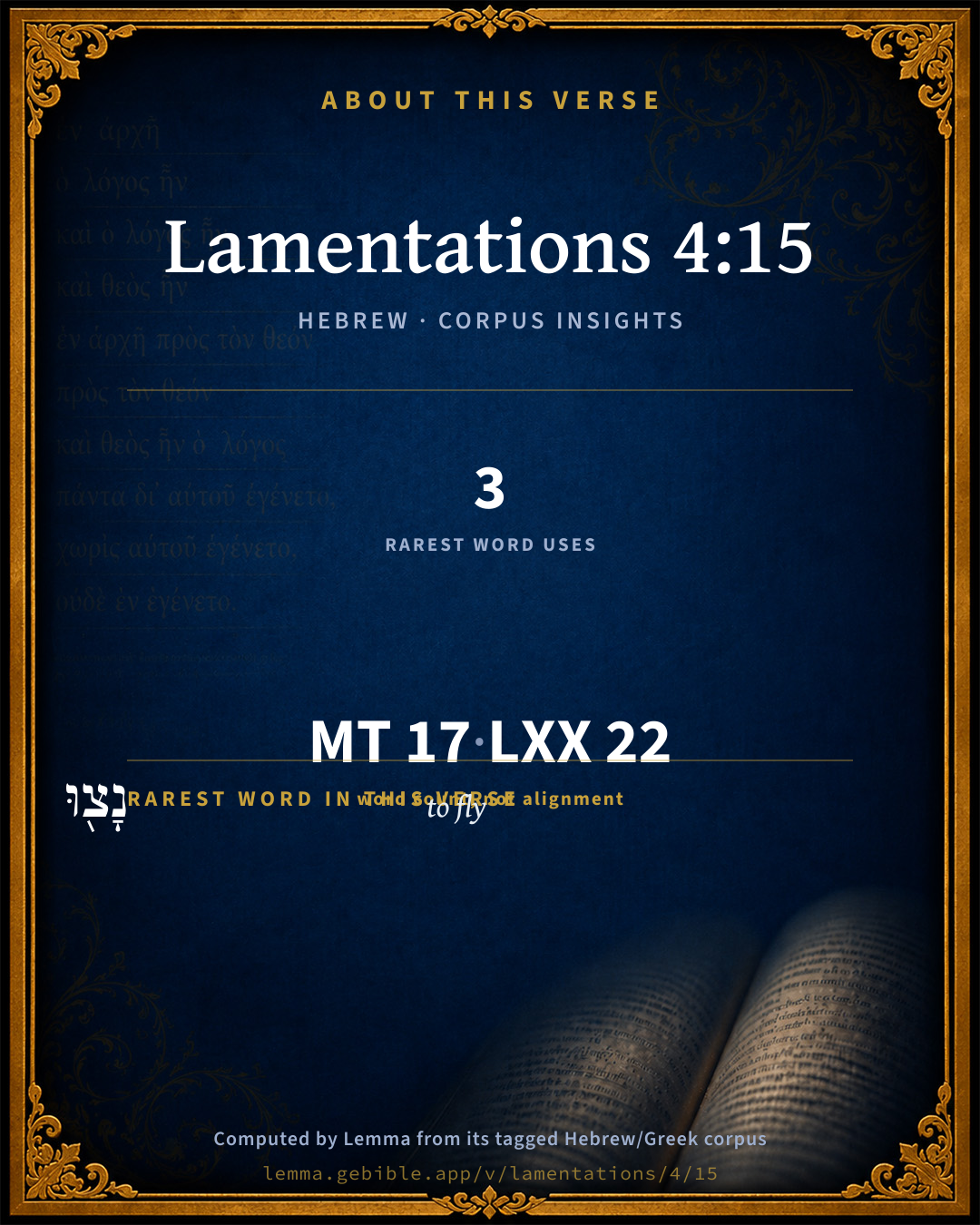
The rarest word here is נָצ֖וּ to fly H5132 — appearing just 3 times in the whole Hebrew Bible.

Shared distinctive vocabulary

נָצ֖וּ to fly H5132 occurs in 3 verses of the Hebrew Bible. Also found in:

Grammatical profile

  • 10 verbs
  • 1 noun
  • 1 adjective
  • 1 preposition
  • 1 conjunction
  • 3 particles

Verb forms

  • ס֣וּרוּ Qal · Imperative
  • קָ֣רְאוּ Qal · Perfect
  • ס֤וּרוּ Qal · Imperative
  • ס֨וּרוּ֙ Qal · Imperative
  • תִּגָּ֔עוּ Qal · Jussive
  • נָצ֖וּ Qal · Perfect
  • נָ֑עוּ Qal · Perfect
  • אָֽמְרוּ֙ Qal · Perfect
  • יוֹסִ֖יפוּ Hiphil · Imperfect
  • לָגֽוּר Qal · Infinitive Construct

Repetition

A word recurs within this verse — often emphatic in Hebrew:

  • ס֣וּרוּ to turn aside H5493 ×3

Hebrew & Septuagint length

In English translation the verse runs 28 words from the Hebrew and 34 from the Septuagint (LXX English) — closely comparable.

A rough comparison of the two English renderings, which tokenize alike — not a word-level alignment.

Word counts can differ between the Hebrew and the Greek without any difference in meaning — e.g. the Hebrew direct-object marker אֵת has no separate Greek word, and Greek often adds the article ὁ.

In the original languages it is 17 Hebrew tokens and 22 Greek tokens — but the two are counted differently (Hebrew bundles its prefixes and suffixes into one token; the Greek is in lemma form), so that isn’t a like-for-like length.

Cross-references

1

Topical passages linked to Lamentations 4:15 in the Treasury of Scripture Knowledge — connected by theme and wording, ordered by reader-vote popularity; previews shown in the World English Bible.

  • Leviticus 13:45–46 "The leper in whom the plague is shall wear torn clothes, and the hair of his head shall hang loose. He shall cover his upper lip, and shall cry, 'Unclean! Unclean!'

Cross-references courtesy of OpenBible.info (CC BY 4.0).

Hebrew and Greek witnesses Masoretic Hebrew ↔ Greek Septuagint

The same verse in the two great witnesses to the Old Testament, shown verse-for-verse.

These are two independent witnesses, not word-aligned to each other, and the Septuagint is shown in lemma (dictionary) form.

Hebrew Lamentations 4:15 Masoretic · Westminster Leningrad Codex

ס֣וּרוּ טָמֵ֞א קָ֣רְאוּ לָ֗מוֹ ס֤וּרוּ ס֨וּרוּ֙ אַל תִּגָּ֔עוּ כִּ֥י נָצ֖וּ גַּם נָ֑עוּ אָֽמְרוּ֙ בַּגּוֹיִ֔ם לֹ֥א יוֹסִ֖יפוּ לָגֽוּר

Depart you, they cried to them, Unclean! depart, depart, don't touch! When they fled away and wandered, men said among the nations, They shall no more sojourn [here].

World English Bible · Public Domain

Greek LXX Lamentations 4:15 Septuagint · lemma form

ἀποἵστημι ἀκάθαρτος καλέω αὐτός ἀποἵστημι ἀποἵστημι μή ἅπτομαι ὅτι ἀναἅπτω καί γέ σαλεύω εἶπον ἐν ὁ ἔθνος οὐ μή προςθέω ὁ παραοἰκέω

SAMECH. Depart you⌃ from the unclean ones: call you⌃ them: depart, depart, touch them not: for they are on fire, yes, they stagger: say you⌃ among the nations, They shall no more sojourn there.

LXX2012 (modern English Septuagint) · Public Domain

Hebrew: Westminster Leningrad Codex (CC BY 4.0). Greek: Septuagint (public domain); English from LXX2012 (modern English Septuagint) (Public Domain). How the Septuagint differs from the Hebrew →

Commentary

Notes on Lamentations 4:15 from classic Christian and Jewish commentators (each source and its license shown beneath its notes). The classic Christian expositions comment on the surrounding passage and are grouped to its opening verse, so a note may address several verses; the Jewish commentaries on the Tanakh (Rashi and others) are per-verse, so they appear only where the commentator wrote on this verse.

Lemma curates 59 commentaries, every one of them public domain or Creative Commons licensed, each selected and text-cleaned for this edition rather than reprinted as found. About our sources →

Trapp's Complete Commentary

John Trapp

Lam 4:15 They cried unto them, Depart ye; [it is] unclean; depart, depart, touch not: when they fled away and wandered, they said among the heathen, They shall no more sojourn [there].

Ver. 15. They cried unto them.] The enemies in a mockery said aloud unto the Jews.

Depart ye; it is unclean; depart, depart.] Mimesis {a} - q.d., You that are so pure, and (as people say profanely among us), so Pope holy, that none must come near you, but get away as far and as fast as they can, as if they were lepers, &c.

They said among the heathen.] The blind Ethnics, beholding the Jews’ wickedness, have judged that it was impossible God should suffer them any longer to live in his good land, since they would not live by his good laws.

{a} A figure of speech, whereby the supposed words or actions of another are imitated

John Trapp, A Commentary or Exposition upon All the Books of the Old and New Testament (1647–1656) — public domain. Text from a community e-Sword module.

Tyndale Open Study Notes

Tyndale Open Resources

4:15 It appears that these leaders fled from Jerusalem as refugees to other lands.

Tyndale Open Study Notes — © Tyndale Open Resources, licensed CC BY-SA 4.0. Text via the HelloAO Bible API.

Jamieson, Fausset & Brown

Robert Jamieson, A. R. Fausset & David Brown

They . . . them--"They," that is, "men" (Lam 4:14). Even the very Gentiles, regarded as unclean by the Jews, who were ordered most religiously to avoid all defilements, cried unto the latter, "depart," as being unclean: so universal was the defilement of the city by blood.

wandered--As the false prophets and their followers had "wandered" blind with infatuated and idolatrous crime in the city (Lam 4:14), so they must now "wander" among the heathen in blind consternation with calamity.

they said--that is, the Gentiles said: it was said among the heathen, "The Jews shall no more sojourn in their own land" [GROTIUS]; or, wheresoever they go in their wandering exile, "they shall not stay long" [LUDOVICUS DE DIEU], (Deu 28:65).

Jamieson, Fausset & Brown — Commentary Critical and Explanatory on the Whole Bible (1871) — public domain (CC PDM 1.0). Text via the HelloAO Bible API.

Adam Clarke's Commentary

Verse 15. When they fled away] These priests and prophets were so bad, that the very heathen did not like to permit them to sojourn among them. The prophet now resumes the history of the siege.

Adam Clarke's Commentary on the Bible (1810–1826) — public domain. Text from a community e-Sword/MySword module.

John Calvin's Commentaries

The Prophet confirms the former verse, as I have said, even that no part of the city was free from filth, because they cried everywhere, “Depart, depart — unclean!” That what is said may be more evident to us, we must notice that the Prophet alludes (which also has not been perceived) to Leviticus 13:45. For it is said there of the lepers, whose disease was incurable, that they were to go with rent garments, with a bare head, with covered lips, and cry, “Unclean, unclean, טמא טמא יקרא thema, thema, ikora. God, then, would have the leprous to be driven from the assembly; and hence came into use the exclamation, Unclean, unclean, טמא טמא, thema, thema. But here the Prophet says, “Depart, depart — unclean סורו סורו טמא, suru suru thema; which is substantially the same as commanded in the law. Now the Prophet speaks metaphorically when he says, that the city was infected with uncleanness, as though lepers were everywhere. We hence see how all these things agree together, “They cried, Depart ye — unclean; depart ye, depart;” that is, no one can move a foot from his house, or go forth in public, but some uncleanness will appear to him, so that it might be rightly exclaimed, Unclean, depart ye, depart The Prophet, after having thus spoken, Depart ye, come not nigh says, they have fled. It is a striking allusion to the exile of the people, as though he had said, that they were driven afar off by their defilements. As then they were removed to a distant land, he says that this happened through their own fault; how so? because they could no longer endure these defilement’s of their sins; they had so contaminated the holy city, that it was foetid through their filth. As, then, the city Jerusalem was so polluted, the citizens, he says, at length fled away: and thus exile proceeded from themselves, that is, the cause of exile was their filth, because they contaminated the city. They have fled, he says, and have also wandered; that is, so great was their haste, that they kept not the right way, but turned here and there, as they usually do who hasten with trembling. For when any one travels, and his mind composed, he attends to the road that he may not go astray; but he who trembles, or is filled with fear, forgets the way, and wanders from the right course. So, then, our Prophet now says, that the Jews fled and also wandered; for he uses the particle גם, gam, also; they also wandered, he says, even through that trepidation by which they were smitten.

They have said among the nations, They shall not return to dwell; that is, they are scattered and driven among various nations without hope of returning.

We now see what the Prophet meant to show, even that the Jews had no reason to complain of their exile, because they had so infected the holy city with their vices, that they were hence driven by their own filth; this is one thing: and, then, that so great was the mass of their evils, that they were seized with fear; and thus they did not keep on the right way, but turned into devious paths and met darkness; and, in the last place, he adds, as a continuation of what he had said, that there was no hope of a return.

John Calvin's Commentaries (1540-1563) — public domain. Text from the Calvin Translation Society English edition (1840s-50s) via the Christian Classics Ethereal Library (ccel.org). Calvin's coverage is partial (roughly two-thirds of the Bible); uncommented books and verses are honest gaps, never fabricated. The 19th-century editor's footnotes and remarks are omitted so the notes are faithfully Calvin's own voice.

Ellicott's Commentary for English Readers

(15) They cried unto them—i.e., these, as they passed, cried to the blood-stained priests. The cry “unclean” was that uttered by the leper as a warning to those he met (Lev_13:45). Here it comes from those whom they meet, and who start back in their fear of defilement.

When they fled away.—The words seem to refer to some lost facts, like those suggested by Lam_4:14 : the murderers fleeing from their own countrymen, and finding themselves equally abhorred among the heathen.

A Bible Commentary for English Readers, edited by Charles John Ellicott (1878–1897) — public domain. Text from a community e-Sword module.

The Cambridge Bible for Schools and Colleges

gen. ed. J. J. S. Perowne

15. Those who met these blood-stained priests and prophets in the street abhorred them, and warned them off with the cry which the leper was himself to raise, Unclean, unclean! (Lev_13:45). Theirs was a moral leprosy. The v., as it stands, is too long from the metrical point of view and so probably includes one or more glosses. Moreover the Heb. for “fled away” occurs here only. By the change of a consonant we get the root rendered (R.V.) “wanderer” in Gen_4:12. “The fate of Cain falls upon those who were guilty of his sin.” Pe.

When] perhaps as mg. Yea.

they fled away and wandered, etc.] when they fled away, then they wandered. Abroad also men would have none of them.

The Cambridge Bible for Schools and Colleges (gen. ed. J. J. S. Perowne; Cambridge University Press, 1878–1918) — public domain. Text from a community e-Sword module.

John Gill's Exposition

They cried unto them, depart ye, it is unclean,.... Or, O ye "unclean" (e); that is, the people said so to the priests, being polluted with blood; they abhorred them, did not care they should come nigh them, but bid them keep at distance; they that cleansed others of leprosy were treated as leprous persons themselves, and proclaimed unclean, and shunned as such: and, to show their vehement abhorrence of them, repeated the words,

depart, depart, touch not: that is, touch us not; they who had used to say; to others, stand by yourselves, we are more holy than you, being the Lord's priests and prophets, are treated after the same manner themselves:

when they fled away, and wandered; fled from the city, and wandered among the nations; or when they were swiftly carried away captives, and became vagabonds in other countries:

they said among the Heathens, they shall no more sojourn there; being among the Heathens, they took notice of them as very wicked men, and said concerning them, now they are carried out of their own land, they shall never return there any more, and dwell in Jerusalem, and officiate in the temple, as they had formerly done.

(e) "immunde", Montanus; "immundi", Strigelius. "gens polluta", Vatablus; "discedite polluti", Gataker.

John Gill's Exposition of the Whole Bible (1746–1763) — public domain (CC PDM 1.0). Text via the HelloAO Bible API.

Albert Barnes' Notes on the Bible

Men cried to these priests, “Away! Unclean! Away! Away! Touch not.” “Unclean” was the cry of the leper whenever he appeared in public: here it is the warning shout of those who meet the murderers.

When they fled away and wandered - These priests fled away from the city, but with uncertain steps, not knowing where to find refuge. They find themselves abhorred abroad as well as at home.

It is quite possible that this verse records a real occurrence, if not during the siege, at all events during the last years of Zedekiah’s reign.

Albert Barnes' Notes on the Bible (1834–1885) — public domain. Text from a community e-Sword/MySword module.

Haydock's Catholic Bible Commentary

Depart. They were not ashamed to speak thus to others, or the citizens address the priests contaminated with blood. Even the Chaldeans looked upon the Jews with abhorrence, as an abandoned people. --- For they. Hebrew, "but they understood not, and wandered about. They, (Calmet) the Gentiles, said." (Haydock)

George Leo Haydock (1774–1849), Haydock's Catholic Family Bible and Commentary, 1859 edition — public domain. Excludes Psalms (Douay-Rheims chapter numbering differs from Protestant) and Deuterocanonical books (Catholic canon only).

Matthew Poole's English Annotations

The various application of the pronoun they by interpreters makes them aa much divided in the sense of this as of the former verse. Either the Jews that made conscience of keeping to the law against touching dead bodies cried to the other Jews to leave the city as themselves did, the city being now so full of dead bodies that they could not stay in it without polluting themselves; or the priests called to them to that purpose; or their enemies spake in that language to them. For their enemies had resolved they should not stay in Jerusalem.

Matthew Poole's English Annotations on the Holy Bible (1683–1685) — public domain. Text from a community e-Sword/MySword module.

Whedon's Commentary on the Bible

Daniel D. Whedon

15. And so the people call out to them in the streets as to lepers.

Depart ye — “Distance!”

Unclean — Even among the heathen they are cast out and abhorred, for when they betake themselves thither it is only to meet the declaration, They shall no more sojourn there.

Daniel D. Whedon (gen. ed.), Commentary on the Old and New Testaments (1874–1909) — public domain. Text from a community e-Sword module.

The Pulpit Commentary

They cried unto them, etc. As they leave the city they are pursued by the maledictions of those whom they have oppressed. It is unclean. The cry with which the leper was directed to warn off passengers, lest they should become infected. (Lev_13:45) There may be an allusion to this, but, though commonly accepted, the view is not certain, as the" leper" in the present case is not the person who raises the cry, but those who meet him. When they fled away and wandered. The clause is difficult. If the text is correct, Keil"s explanation may perhaps pass, "When they fled away, (there) also they wandered," alluding to the "wandering" ascribed to them with a somewhat different shade of meaning in the preceding verso. In any case there ought to be a fuller stop than a comma after "touch not," which words close the first of the two parallel lines of which the verse consists. But very probably "when" (Hebrew, ki) is an intrusion, and we should begin the second line thus: "They fled, they also wandered about." They said among the heathen, etc. Even in their place of exile they found no rest. (comp. Deu_28:65) This is better than understanding "the heathen" (literally, the nations) to mean "the Chaldean army," and the place of sojourn prohibited to be Jerusalem.

Contamination.

So horrible is the condition of Jerusalem after the siege that men regard the holy city as an unclean place, like a haunt of lepers or an abode of. the dead. They cry, "Go aside! Unclean! Go aside! go aside!" as they would to one who incautiously approached too near to one of these banned spots. The dread of contamination is a natural testimony to the instinct for purity; but it is often sadly perverted, for while no feeling should be more related to truth and fact, it happens that no feeling is more subject to artificial, conventional regulations. We need to inquire what are the true causes of contamination and how real contamination may be avoided.

I WHAT ARE THE TRUE CAUSES OF CONTAMINATION? It is uncleanness that defiles. The primitive notion of uncleanness is connected with material things the dirt that soils a garment, etc. Then disease which is loathsome and offensive, and death with its attendant corruption, are felt to be defiling. But to the soul true defilement can only come from what is morally impure. As Christ teaches, it is internal not external. (Luk_11:38-40) Jerusalem, when in her prosperity she abandoned herself to idolatry and immorality, was more unclean than when she lay in ashes a charnel house of slaughtered citizens. Yet no man cried, "Unclean!" in the prosperous times. The degradation was thought to be defiling, while the sin which led to it was connived at. This mistake is common in various forms. The criminal with the brand of punishment upon him is shunned, while the far more vicious man who has contrived to keep himself safe is courted. Parents fear the corruption of manners which their children may contract by mingling with social inferiors, and yet permit them to mix with far more corrupt society if only the rank of it be higher than their own. Many people lock with contempt on certain kinds of honest business, who will engage in pursuits of very questionable morality without compunction. Thus some regard trade as degrading and betting as gentlemanly. They would be ashamed to be connected with a shop; they have no shame in their connection with the turf. We want a healthier conscience, that will declare no honest pursuit to be dishonourable and no immoral one to be respectable simply because patronized by rank and fashion.

II HOW IS REAL CONTAMINATION TO BE AVOIDED? Granted that we know what things are defiling and can distinguish them from the objects of conventional ostracism; how are we to behave ourselves in regard to the unclean things? We are to avoid contact with them. But here a difficult question arises. As Christians we are to be the salt of the earth. It is our mission to purify the impure. But if we shun it, how can we change it? If we neglect politics because we see politicians to be acting dishonourably, and business because we wish to avoid tricks of trade, and society because we must escape the corrupting influences of unwholesome amusements and scandalous conversation, shall we not be handing over politics, business, and society to the unchecked influence of evil? The answer to this question seems to be that the departure must be in spirit and from the spirit of those things that are degrading. We are not to flee bodily. We may do so in vain. For the corruption of the world may pursue the hermit to his cell and torment his mind with evil imaginations in the desert. But if we forsake all sympathy with the unclean our soul cannot be touched by it. Thus Christ ate and drank with publicans and sinners and passed through their foul atmosphere without defilement. Especially if the object is to do good we may be sure that the consciousness of a mission and the cleansing influence of Christian charity will prevent contamination. Thus a pure minded Christian woman is able to go into the haunts of vice on an errand of mercy and return scatheless as the snowdrop that lifts its head from the impure soil.

The Pulpit Commentary (1880–1919), ed. H.D.M. Spence-Jones & Joseph S. Exell — public domain. Text from a community e-Sword module.

John Wesley's Explanatory Notes

Touch not - The Jews that made conscience of keeping the law against touching dead bodies, cried to the other Jews to leave the city as themselves did, the city being now so full of dead bodies that they could not stay in it without polluting themselves.

John Wesley, Explanatory Notes Upon the Whole Bible (1754–1765) — public domain. Text via the GEBible commentary corpus.

Rashi

Rabbi Shlomo Yitzchaki (Rashi)

Depart from us, you unclean ones, who are sullied with blood.

for they are foul Heb. נָצוּ, an expression of foulness and filth, like (Lev. 1:16): “its crop, בְּנֹצָתָה,” which is translated by the Targum as בְּאוּכְלֵיה. So did Menahem associate it (not found in our editions of Machbereth).

even slipping They slipped in the blood.

Rashi on the Tanakh — English translations: “The Judaica Press complete Tanach with Rashi, translated by A. J. Rosenberg” (CC BY 4.0); “Pentateuch with Rashi's commentary by M. Rosenbaum and A.M. Silbermann, 1929-1934” (public domain); “The Metsudah Tanach series, Lakewood, N.J” (CC BY 4.0); and “The Book of Joshua, Metsudah Publications, 1997” (CC BY 4.0). Text via Sefaria.

Lesson kit

Teaching starters — assembled from the data on this page, not authored interpretation. Every prompt links to the verse data it draws on. Edit before teaching.

Lamentations, in the Prophets, opens this verse with 17 words (14 distinct Hebrew lemmas). Its most distinctive word is nûwts (“to fly”). A historical commentator’s framing appears above. Read the whole chapter for the surrounding context.

Discussion questions

  1. What does “to fly” (nûwts) contribute to the verse as a whole?
  2. How does Song of Solomon 6:11, which shares the word «to fly», read alongside this verse?
  3. What does the repetition of “to turn aside” (3× in this one verse) do in this verse?
  4. These translations render this verse differently; the difference is in the English rendering, not the original. What questions does that raise?
  5. «ס֣וּרוּ» is a Qal Imperative verb. How does that grammatical form shape the action described?
  6. Compare how Trapp's Complete Commentary and Tyndale Open Study Notes read this verse. Where do they agree or differ?

Things to notice

Reading settings

Reading text

Shown beneath each verse's original-language words.

Old Testament
Old Testament edition

Read the OT as the Masoretic Hebrew (MT) or the Greek Septuagint (LXX).

English shown for the Greek Septuagint (in the Hebrew ↔ Greek comparison).

Comparing translations? Open the Compare panel on any verse page to stack up to four side by side.