
Hosea 9:15

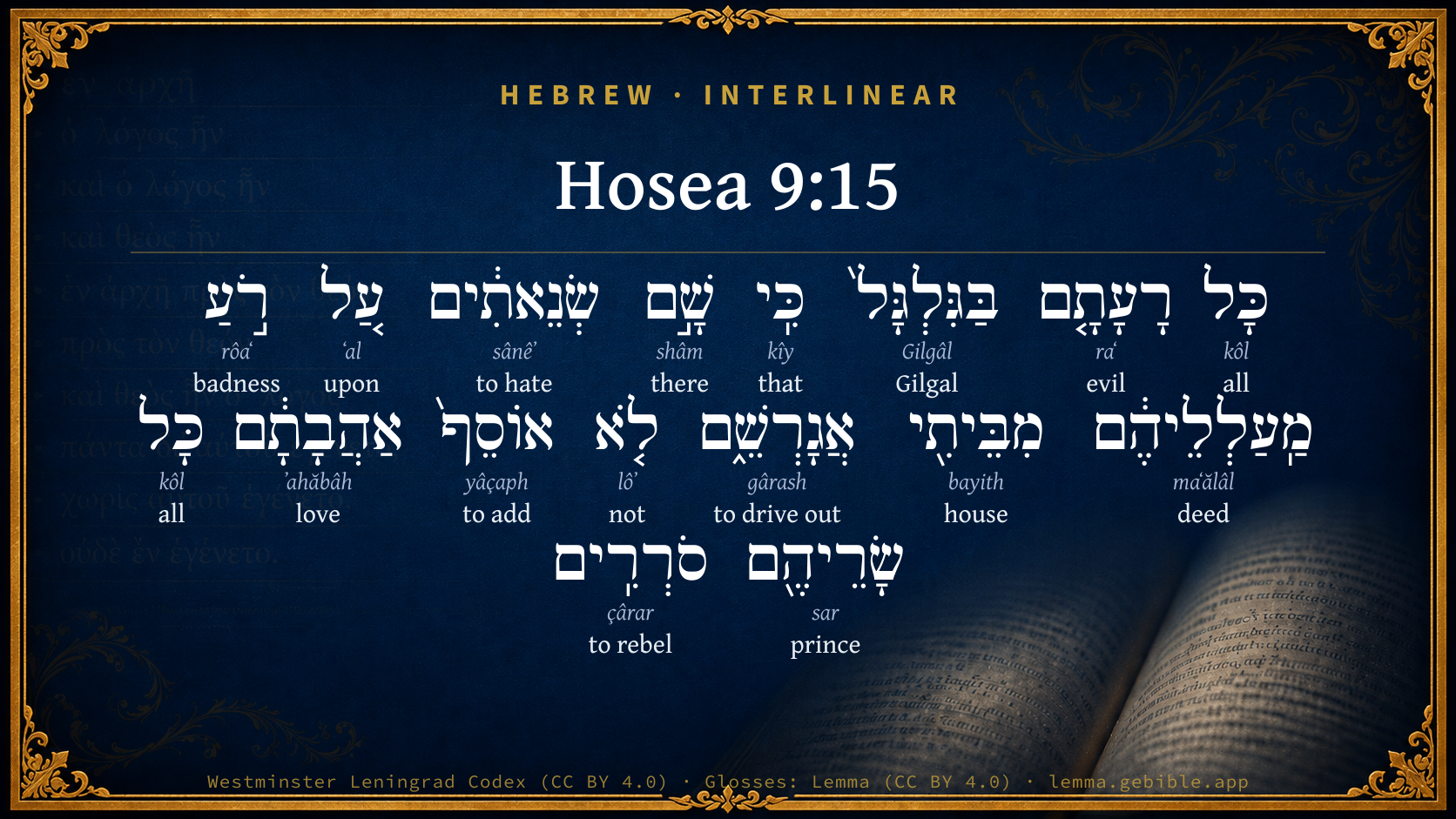
Hebrew (Westminster Leningrad Codex) Hosea 9:15 appears in the Hebrew Old Testament. The text above is from the Westminster Leningrad Codex. Each word links to its Strong’s number, a concise gloss, and parsing drawn from the Open Scriptures Hebrew Bible morphology. Click any word for its full Brown-Driver-Briggs (BDB) entry.
Download image
Cite this verse

Hosea 9:15 (World English Bible). Public Domain. Lemma interlinear Bible study tool, https://lemma.gebible.app/v/hosea/9/15.

Show BibTeX & RIS
BibTeX
RIS
English Translation
"All their wickedness is in Gilgal; For there I hated them. Because of the wickedness of their deeds I will drive them out of my house! I will love them no more. All their princes are rebels.
World English Bible · Public Domain
Download a study sheet

One document with this verse’s original text, its word-by-word gloss line, the meaning frame, cross-references with their text, attributed commentary, and full source and license credits — printable, and it pastes into notes with its structure intact.

This verse Autodidact and up

Study sheet (.html) Plain text (.txt)

A passage Seminary Student

Up to 50 verses in one chapter. A passage sheet keeps up to 6 commentary sources and 12 cross-references per verse, in the order this page ranks them, and says so on the sheet whenever that leaves anything out. Ask for a single verse and you get the Autodidact verse sheet above.

Everything on this page stays free to read, with no account — the sheet is a download of what is already on screen, not access to it.

Want to remove ads? Support Godless Engineer
Compare translations 3

The same verse in 3 English versions, stacked beneath the original-language interlinear above. Click any original word for its lexicon entry.

Each is an independent rendering of the whole verse — the interlinear is not word-aligned to these translations.

Highlighted words mark where these versions differ — a whole-verse word diff, not a word-by-word alignment.

  • World English Bible Public Domain
    "All their wickedness is in Gilgal; For there I hated them. Because of the wickedness of their deeds I will drive them out of my house! I will love them no more. All their princes are rebels.
  • King James Version Public Domain
    All their wickedness is in Gilgal: for there I hated them: for the wickedness of their doings I will drive them out of mine house, I will love them no more: all their princes are revolters.
  • unfoldingWord Literal Text CC BY-SA 4.0
    All their evil in Gilgal, for there I hated them. Because of the evil of their deeds, I will drive them out of my house. I will not continue loving them; all their princes rebels.

unfoldingWord Literal Text — © unfoldingWord, licensed CC BY-SA 4.0. Word-aligned USFM3 via Door43 (git.door43.org/unfoldingWord/en_ult).

Versions to compare (up to 4)

3 of 4 selected

Show all 18 translations

Every available English version of this verse, each an independent rendering of the whole verse.

  • World English Bible Public Domain
    "All their wickedness is in Gilgal; For there I hated them. Because of the wickedness of their deeds I will drive them out of my house! I will love them no more. All their princes are rebels.
  • Berean Standard Bible Public Domain
    All their evil appears at Gilgal, for there I hated them. I will drive them from My house for the wickedness of their deeds. I will no longer love them; all their leaders are rebellious.
  • Majority Standard Bible Public Domain
    All their evil appears at Gilgal, for there I hated them. I will drive them from My house for the wickedness of their deeds. I will no longer love them; all their leaders are rebellious.
  • King James Version Public Domain
    All their wickedness is in Gilgal: for there I hated them: for the wickedness of their doings I will drive them out of mine house, I will love them no more: all their princes are revolters.
  • American Standard Version (1901) Public Domain
    All their wickedness is in Gilgal; for there I hated them: because of the wickedness of their doings I will drive them out of my house; I will love them no more; all their princes are revolters.
  • Revised Version (1885) Public Domain
    All their wickedness is in Gilgal; for there I hated them: because of the wickedness of their doings I will drive them out of mine house: I will love them no more; all their princes are revolters.
  • Geneva Bible (1599) Public Domain
    All their wickednesse is in Gilgal: for there doe I hate them: for the wickednesse of their inuentions, I will cast them out of mine House: I will loue them no more: all their princes are rebels.
  • Douay-Rheims (1899) Public Domain
    All their wickedness is in Galgal, for there I hated them: for the wickedness of their devices I will cast them forth out of my house: I will love them no more, all their princes are revolters.
  • Young's Literal Translation Public Domain
    All their evil `is' in Gilgal, Surely there I have hated them, Because of the evil of their doings, Out of My house I do drive them, I add not to love them, all their heads `are' apostates.
  • Literal Standard Version CC BY-SA 4.0
    All their evil [is] in Gilgal, || Surely there I have hated them, || Because of the evil of their doings, || Out of My house I drive them, || I no longer love them, || All their heads [are] apostates.
  • Unlocked Literal Bible CC BY-SA 4.0
    “Because of all their wickedness in Gilgal, that is where I began to hate them. Because of their sinful deeds, I will drive them out of my house. I will love them no more; all their officials are rebels.
  • unfoldingWord Literal Text CC BY-SA 4.0
    All their evil in Gilgal, for there I hated them. Because of the evil of their deeds, I will drive them out of my house. I will not continue loving them; all their princes rebels.
  • Darby Bible Public Domain
    All their wickedness is in Gilgal; for there I hated them: because of the wickedness of their doings, I will drive them out of my house, I will love them no more: all their princes are rebellious.
  • World Messianic Bible Public Domain
    “All their wickedness is in Gilgal; for there I hated them. Because of the wickedness of their deeds, I will drive them out of my house! I will love them no more. All their princes are rebels.
  • Webster's Bible Public Domain
    All their wickedness is in Gilgal: for there I hated them: for the wickedness of their doings I will drive them out of my house, I will love them no more: all their princes are revolters.
  • Free Bible Version CC BY-SA 4.0
    All of their evil began at Gilgal, and that's where I began to hate them. I will drive them out of my house because of their wickedness. I will love them no longer; all their leaders are rebels.
  • Bible in Basic English Public Domain
    All their evil-doing is in Gilgal; there I had hate for them; because of their evil-doing I will send them out of my house; they will no longer be dear to me; all their rulers are uncontrolled.
  • JPS Tanakh (1917) Public Domain
    All their wickedness is in Gilgal, for there I hated them; because of the wickedness of their doings I will drive them out of My house; I will love them no more, all their princes are rebellious.

Literal Standard Version (2020), Covenant Press — licensed CC BY-SA 4.0. Text via the HelloAO Bible API (eBible.org). Unlocked Literal Bible (unfoldingWord) — licensed CC BY-SA 4.0. Text via the HelloAO Bible API (eBible.org). unfoldingWord Literal Text — © unfoldingWord, licensed CC BY-SA 4.0. Word-aligned USFM3 via Door43 (git.door43.org/unfoldingWord/en_ult). Free Bible Version, Dr. Jonathan Gallagher — licensed CC BY-SA 4.0. Text via the HelloAO Bible API (eBible.org).

Word by word

More ways to search: Search by grammar → Find every occurrence → Compare this word →

Practice this passage: Drill this verse → Learn its vocabulary →

סֹרְרִֽים
çârar
H5637
“rebelling”
Verb, Qal, Participle Active, Masculine, Plural, Absolute
Part of Speech
Verb
Stem
Qal
Form
Participle Active
Gender
Masculine
Number
Plural
State
Absolute
Full BDB Definition

Origin: a primitive root

TWOT: 1549

to rebel, be stubborn, be rebellious, be refractory - (Qal) - to be stubborn - stubborn, rebel (substantive)
  1. כָּל kôl H3605 “all of” Noun, Common, Masculine, Singular, Construct
  2. רָעָתָ֤ם raʻ H7451 “evil · their” Noun, Common, Feminine, Singular, Construct + Suffix, Personal, 3rd Person, Masculine, Plural
  3. בַּגִּלְגָּל֙ Gilgâl H1537 “in/at the · Gilgal” Preposition, Determined + Noun, Proper
  4. כִּֽי kîy H3588 “that” Conjunction
  5. שָׁ֣ם shâm H8033 “there” Adverb
  6. שְׂנֵאתִ֔ים sânêʼ H8130 “to hate · them” Verb, Qal, Perfect, 1st Person, Common, Singular + Suffix, Personal, 3rd Person, Masculine, Plural
  7. עַ֚ל ʻal H5921 “upon” Preposition
  8. רֹ֣עַ rôaʻ H7455 “badness of” Noun, Common, Masculine, Singular, Construct
  9. מַֽעַלְלֵיהֶ֔ם maʻălâl H4611 “deeds · their” Noun, Common, Masculine, Plural, Construct + Suffix, Personal, 3rd Person, Masculine, Plural
  10. מִבֵּיתִ֖י bayith H1004 “from · house · my” Preposition + Noun, Common, Masculine, Singular, Construct + Suffix, Personal, 1st Person, Common, Singular
  11. אֲגָרְשֵׁ֑ם gârash H1644 “to drive out · them” Verb, Piel, Imperfect, 1st Person, Common, Singular + Suffix, Personal, 3rd Person, Masculine, Plural
  12. לֹ֤א lôʼ H3808 “not” Particle, Negative
  13. אוֹסֵף֙ yâçaph H3254 “to add” Verb, Hiphil, Cohortative, 1st Person, Common, Singular
  14. אַהֲבָתָ֔ם ʼahăbâh H160 “love · them” Verb, Qal, Infinitive Construct + Suffix, Personal, 3rd Person, Masculine, Plural
  15. כָּל kôl H3605 “all of” Noun, Common, Masculine, Singular, Construct
  16. שָׂרֵיהֶ֖ם sar H8269 “princes · their” Noun, Common, Masculine, Plural, Construct + Suffix, Personal, 3rd Person, Masculine, Plural

About this verse

These counts appear in no published source. They are computed here, from the morphology-tagged text and Lemma’s own curated glosses. What Lemma adds →

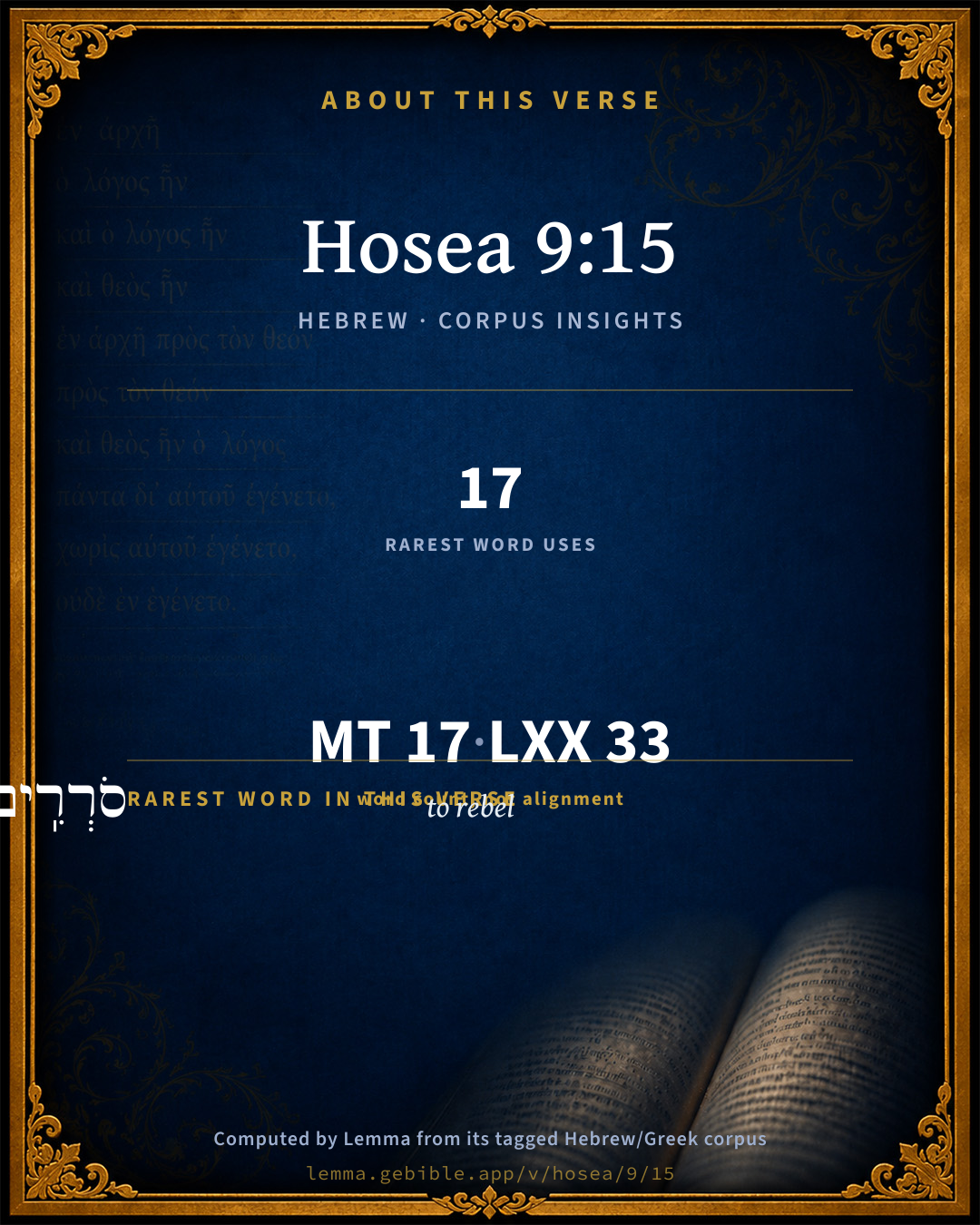
17
words
16
distinct lemmas
Prophets
section

Notable vocabulary

The rarest word here is סֹרְרִֽים to rebel H5637 — appearing just 17 times in the whole Hebrew Bible.

Shared distinctive vocabulary

סֹרְרִֽים to rebel H5637 occurs in 16 verses of the Hebrew Bible. Also found in:

Grammatical profile

  • 5 verbs
  • 8 nouns
  • 1 preposition
  • 1 conjunction
  • 1 adverb
  • 1 particle

Verb forms

  • שְׂנֵאתִ֔ים Qal · Perfect
  • אֲגָרְשֵׁ֑ם Piel · Imperfect
  • אוֹסֵף֙ Hiphil · Cohortative
  • אַהֲבָתָ֔ם Qal · Infinitive Construct
  • סֹרְרִֽים Qal · Participle Active

Repetition

A word recurs within this verse — often emphatic in Hebrew:

Hebrew & Septuagint length

In English translation the verse runs 37 words from the Hebrew and 38 from the Septuagint (LXX English) — closely comparable.

A rough comparison of the two English renderings, which tokenize alike — not a word-level alignment.

Word counts can differ between the Hebrew and the Greek without any difference in meaning — e.g. the Hebrew direct-object marker אֵת has no separate Greek word, and Greek often adds the article ὁ.

In the original languages it is 17 Hebrew tokens and 33 Greek tokens — but the two are counted differently (Hebrew bundles its prefixes and suffixes into one token; the Greek is in lemma form), so that isn’t a like-for-like length.

Cross-references

35

Topical passages linked to Hosea 9:15 in the Treasury of Scripture Knowledge — connected by theme and wording, ordered by reader-vote popularity; previews shown in the World English Bible.

  • Isaiah 1:23 Your princes are rebellious, and companions of thieves. Everyone loves bribes, and follows after rewards. They don't judge the fatherless, Neither does the cause of the widow come to them.
  • Hosea 4:15 "Though you, Israel, play the prostitute, Yet don't let Judah offend; And don't come to Gilgal, Neither go up to Beth Aven, Nor swear, 'As Yahweh lives.'
  • 1 Samuel 7:16 He went from year to year in circuit to Bethel and Gilgal, and Mizpah; and he judged Israel in all those places.
  • Hosea 12:11 If Gilead is wicked, Surely they are worthless. In Gilgal they sacrifice bulls. Indeed, their altars are like heaps in the furrows of the field.
  • Amos 5:5 But don't seek Bethel, Nor enter into Gilgal, And don't pass to Beersheba: For Gilgal shall surely go into captivity, And Bethel shall come to nothing.
  • Joshua 4:19–24 The people came up out of the Jordan on the tenth day of the first month, and encamped in Gilgal, on the east border of Jericho.
  • Micah 6:5 My people, remember now what Balak king of Moab devised, And what Balaam the son of Beor answered him from Shittim to Gilgal, That you may know the righteous acts of Yahweh."
  • Zephaniah 3:3 Her princes in the midst of her are roaring lions. Her judges are evening wolves. They leave nothing until the next day.
  • Leviticus 26:30 I will destroy your high places, and cut down your incense altars, and cast your dead bodies upon the bodies of your idols; and my soul will abhor you.
  • Joshua 5:2–9 At that time Yahweh said to Joshua, Make you flint knives, and circumcise again the children of Israel the second time.
  • Joshua 10:43 Joshua returned, and all Israel with him, to the camp to Gilgal.
  • 1 Kings 9:7–9 then will I cut off Israel out of the land which I have given them; and this house, which I have made holy for my name, will I cast out of my sight; and Israel shall be a proverb and a byword among all peoples.
  • 2 Kings 17:17–20 They caused their sons and their daughters to pass through the fire, and used divination and enchantments, and sold themselves to do that which was evil in the sight of Yahweh, to provoke him to anger.
  • Psalms 78:60 So that he forsook the tent of Shiloh, The tent which he placed among men;
  • Jeremiah 3:8 I saw, when, for this very cause that backsliding Israel had committed adultery, I had put her away and given her a bill of divorce, yet treacherous Judah, her sister, didn't fear; but she also went and played the prostitute.
  • Jeremiah 5:5 I will get me to the great men, and will speak to them; for they know the way of Yahweh, and the law of their God. But these with one accord have broken the yoke, and burst the bonds.
  • Jeremiah 11:15 What has my beloved to do in my house, seeing she has worked lewdness [with] many, and the holy flesh is passed from you? when you do evil, then you rejoice.
  • Jeremiah 33:24–26 Don't you consider what this people has spoken, saying, The two families which Yahweh did choose, he has cast them off? thus do they despise my people, that they should be no more a nation before them.
  • Ezekiel 22:27 Her princes in the midst of it are like wolves ravening the prey, to shed blood, [and] to destroy souls, that they may get dishonest gain.
  • Ezekiel 23:18 So she uncovered her prostitution, and uncovered her nakedness: then my soul was alienated from her, like as my soul was alienated from her sister.
  • Hosea 1:6 She conceived again, and bore a daughter. Then he said to him, "Call her name Lo-Ruhamah; for I will no longer have mercy on the house of Israel, that I should in any way pardon them.
  • Hosea 1:9 He said, "Call his name Lo-Ammi; for you are not my people, and I will not be yours.
  • Hosea 3:4 For the children of Israel shall abide many days without king, and without prince, and without sacrifice, and without sacred stone, and without ephod or idols.
  • Hosea 4:9 It will be, like people, like priest; And I will punish them for their ways, And will repay them for their deeds.
  • Hosea 5:1–2 "Listen to this, you priests! Listen, house of Israel, And give ear, house of the king! For the judgment is against you; For you have been a snare at Mizpah, And a net spread on Tabor.
  • Hosea 7:2 They don't consider in their hearts that I remember all their wickedness. Now their own deeds have engulfed them. They are before my face.
  • Hosea 9:3 They won't dwell in Yahweh's land; But Ephraim will return to Egypt, And they will eat unclean food in Assyria.
  • Hosea 9:17 My God will cast them away, because they did not listen to him; And they will be wanderers among the nations.
  • Amos 4:4 "Go to Bethel, and sin; To Gilgal, and sin more. Bring your sacrifices every morning, Your tithes every three days,
  • Amos 5:27 Therefore will I cause you to go into captivity beyond Damascus," says Yahweh, whose name is the God of hosts.
  • Micah 3:11 Her leaders judge for bribes, And her priests teach for a price, And her prophets of it tell forturnes for money: Yet they lean on Yahweh, and say, Isn't Yahweh in the midst of us? No disaster will come on us.
  • Zechariah 11:8 I cut off the three shepherds in one month; for my soul was weary of them, and their soul also loathed me.
  • Acts 4:5–7 It happened in the morning, that their rulers, elders, and scribes were gathered together in Jerusalem.
  • Acts 4:27 For truly, in this city against your holy servant, Jesus, whom you anointed, both Herod and Pontius Pilate, with the Gentiles and the people of Israel, were gathered together
  • Acts 5:21 When they heard this, they entered into the temple about daybreak, and taught. But the high priest came, and those who were with him, and called the council together, and all the senate of the children of Israel, and sent to the prison to have them brought.

Cross-references courtesy of OpenBible.info (CC BY 4.0).

Hebrew and Greek witnesses Masoretic Hebrew ↔ Greek Septuagint

The same verse in the two great witnesses to the Old Testament, shown verse-for-verse.

These are two independent witnesses, not word-aligned to each other, and the Septuagint is shown in lemma (dictionary) form.

Hebrew Hosea 9:15 Masoretic · Westminster Leningrad Codex

כָּל רָעָתָ֤ם בַּגִּלְגָּל֙ כִּֽי שָׁ֣ם שְׂנֵאתִ֔ים עַ֚ל רֹ֣עַ מַֽעַלְלֵיהֶ֔ם מִבֵּיתִ֖י אֲגָרְשֵׁ֑ם לֹ֤א אוֹסֵף֙ אַהֲבָתָ֔ם כָּל שָׂרֵיהֶ֖ם סֹרְרִֽים

"All their wickedness is in Gilgal; For there I hated them. Because of the wickedness of their deeds I will drive them out of my house! I will love them no more. All their princes are rebels.

World English Bible · Public Domain

Greek LXX Hosea 9:15 Septuagint · lemma form

πᾶς ὁ κακία αὐτός εἰς γαλγαλ ὅτι ἐκεῖ αὐτός μισέω διά ὁ κακία ὁ ἐπιτήδευμα αὐτός ἐκ ὁ οἶκος ἐγώ ἐκβάλλω αὐτός οὐ μή προςτίθημι ὁ ἀγαπάω αὐτός πᾶς ὁ ἄρχων αὐτός ἀπειθέω

All their wickedness is in Galgal: for there I hated them: because of the wickedness of their practices, I will cast them out of my house, I will not love them any more: all their princes are disobedient.

LXX2012 (modern English Septuagint) · Public Domain

On this verse, Joseph Benson's Commentary discusses the Septuagint’s reading. Read the note in Commentary ↓

Hebrew: Westminster Leningrad Codex (CC BY 4.0). Greek: Septuagint (public domain); English from LXX2012 (modern English Septuagint) (Public Domain). How the Septuagint differs from the Hebrew →

Targum (Aramaic paraphrase)

1

The Targum is the ancient Jewish Aramaic paraphrase of the Hebrew Scriptures — an interpretive translation, not the Hebrew text itself. Onkelos (literal) and Pseudo-Jonathan (expansive) render the Torah, and Jonathan the Prophets. Coverage is partial: where no permissively-licensed English translation exists for a verse, only the Aramaic is shown. This is verse-level text, not a word-by-word alignment to the Hebrew.

  1. Targum Jonathan Prophets (Joshua–Malachi)
    כָּל בִּישָׁתְהוֹן גַלְיָן קָדָמַי בְּגִלְגְלָא אֲרֵי תַמָן רְחִיקְתִּינוּן עַל בִּישׁוּת עוֹבָדֵיהוֹן מִבֵּית מַקְדְשִׁי אֲתָרִיכִינוּן לָא אוֹסִיף לְרָחָמָא עֲלֵיהוֹן וּדְכָל רַבְרְבֵיהוֹן מָרְדִין:

    (no public-domain English translation for this verse)

    Targum Jonathan — Aramaic: “Mikraot Gedolot” (public domain). English: “Sefaria Community Translation” (CC0 1.0 (public-domain dedication)); “London "Chaldee Paraphrase," 1871” (public domain). Text via Sefaria.

Commentary

Notes on Hosea 9:15 from classic Christian and Jewish commentators (each source and its license shown beneath its notes). The classic Christian expositions comment on the surrounding passage and are grouped to its opening verse, so a note may address several verses; the Jewish commentaries on the Tanakh (Rashi and others) are per-verse, so they appear only where the commentator wrote on this verse.

Lemma curates 59 commentaries, every one of them public domain or Creative Commons licensed, each selected and text-cleaned for this edition rather than reprinted as found. About our sources →

Trapp's Complete Commentary

John Trapp

Hos 9:15 All their wickedness [is] in Gilgal: for there I hated them: for the wickedness of their doings I will drive them out of mine house, I will love them no more: all their princes [are] revolters.

Ver. 15. All their wickedness is in Gilgal] We have had the prophet’s prayer: follows now the Lord’s answer in this and the following verse, where we have the former threats repeated, to show that God was unchangeably resolved upon their ruin; and that, first, for their idolatry, secondly, for their other vile practices, thirdly, for the apostasy of their princes: all this here. Their idolatry was the worse, because committed at Gilgal, where God had done much for their forefathers; {See Trapp on "Hos 4:15"} The quality of the place adds much to the greatness of the sin, "In the land of uprightness they will deal unjustly," Isa 26:10, "the faithful city is become a harlot," Isa 1:21; Isa 5:7, he looked for judgment, but behold a scab. The devil desireth to set himself up in such places as have been formerly eminent for God’s sincere service, as Gilgal once was, 1Sa 10:8; 1Sa 11:15; for the ark of the covenant was there, which these idolaters had not. So in the holy land (as they still call it), which is possessed by Mahometans and Papists: so Wittenberg, where Luther first began to reform, is now deformed by divers errors and heresies, as Polanus observeth. Wilkinson against the Familists reports the like of Colchester in Essex.

For there I hated them] Angry I was with them before, and grieved for their other misdoings; but their idolatry hath enraged me with a holy hatred of them, and that there, where I showed greatest love to their forefathers. God thinks the worse of such places wherein idolaters rest and roost; like as he thinks the better of the towns and houses where his faithful servants inhabit, as Isa 49:16, their walls are ever before him.

For the wickedness of their doings, I will drive them out] Revenge and expulsion is the next effect of hatred. There is a great deal of other wicked doings where idolatry (that wickedness with a witness, as it is herd styled) is set up. Surely of this abominable thing we may well say, as St James doth of discord, "Where envying and strife is, there is confusion and every evll work," Jas 3:16. But God will not endure such doings in his house: David would not in his, Psa 101:7. Solomon entertained Jeroboam into his house and service, because he saw the young man was suitable for the work, 1Ki 11:28, but he proved a mischief to and against his house. Many today scruple not to entertain and harbour such as are serviceable, though otherwise their religion be either a Popish puppet and calf worship, or a flat irreligion. These have little of God in them.

I will drive them out of mine house, saith he, I will love them no more] A fearful sentence, like that Jer 16:13, I will show them no favour: this was worse to them than their captivity there threatened. Ephraim had a great deal of outward peace and prosperity, but love they had none; because none of those graces that flow from election and accompany salvation. These are God’s love tokens, that all must court. But oh! take heed (saith one) if thou addest any more to thy wickednesses, lest that this dreadful sentence be pronounced in heaven against thee, I will love thee no more, Heb. I will add no more to love thee.

All their princes are revolters] Col sarehem sorerim, an elegance past the capability of translation. The princes were all rebellious and refractory, uncounsellable, unpersuadable (απειθουντες, as the Seventy render it), like that king of Scotland that would seldom ask counsel, but never follow any; so wedded he was to his own will. (Dan. Hist. of Eng. fol. 207). Elati superbia volebant superiores esse verbo, saith Luther upon this text. Jeroboam-like they would stretch out their hand against a prophet, 1Ki 13:4, that should cry against their altars, and deal plainly with them, as Hosea here doth; testifying to their faces that they were all apostates, and made Israel sin. Princes should be the lord keepers of both tables of the law; as it was written upon the sword of Charles the Great ( Decem praeceptorum custos Caxolus); but when they are naught, as here, the people take after them. Principis vita censura est et cynosura.

John Trapp, A Commentary or Exposition upon All the Books of the Old and New Testament (1647–1656) — public domain. Text from a community e-Sword module.

The Biblical Illustrator

Joseph S. Exell

Hos_9:15

All their wickedness is in Gilgal: for there I hated them.

Punishment proportional to privilege

Translated into modern life, the prophets plea would read thus. All their wickedness is in the house of God; all their wickedness is after coming from the table of the Lord, or after receiving some faithful letter, or after their own painful convictions and sorrowful confession, or after their repeated resolutions and vows. This helps us to realise how a Jew would feel who heard the prophet make this reproach.

1. At Gilgal the covenant of circumcision was renewed for the second time since they came out of Egypt. What circumcision was to the Jew, religious instruction is to us: circumcision was Gods seal to the Jews that He would cleanse them from taint of Egyptian idolatry.

2. At Gilgal they celebrated the passover for the first time after they came out of Egypt. The Lords supper is our passover.

3. It was at Gilgal that God Himself appeared in a most remarkable manner to assure the people of Israel that He would be their deliverer. The captains of the Lords host came. Observe Joshuas momentary surprise, courage, reverence.

Notice the communication.

1. Beginning life in humble circumstances may be a Gilgal to us.

2. So may a season of affliction be. Or

3. The loss of a dear friend. But the wickedness of Gilgal may be taken away. (W. G. Barrett.)

The Biblical Illustrator, edited by Joseph S. Exell (c. 1880s–1900s) — public domain. Text from a community e-Sword module.

Joseph Benson's Commentary

Hos 9:15-17. All their wickedness is in Gilgal — Gilgal is notorious, and has been so of old, for the wickedness of its inhabitants. There I hated them — There of old (or therefore) they were an abomination to me. “The first great offence of the Israelites, after their entrance into the Holy Land, was committed while they were encamped in Gilgal; namely, the sacrilegious peculation of Achan, (Joshua 7.,) and to this, it seems, these words allude. There, says God, of old, was my quarrel with them.” It must be observed further here, that “Gilgal was the place where the armies of Israel, upon their entering Canaan, first encamped; where Joshua set up the twelve stones, taken by God’s command out of the midst of Jordan, in memorial of the miraculous passage through the river. There the first passover was kept, and the fruits of the promised land first enjoyed. There the captain of the Lord’s host appeared to Joshua. There the rite of circumcision, which had been omitted during the forty years of the wandering of the people in the wilderness, was renewed. And, in the days of the prophet Samuel, Gilgal appears to have been an approved place of worship and burnt-offering. But, in later times, it appears from Hosea, and his cotemporary, Amos, that it became a place of great resort for idolatrous purposes. And these are the wickednesses in Gilgal, of which the prophet here speaks.” — Horsley. I will drive them out of my house —

That is, I will no longer consider them as my family, my children, and my servants. All their princes are revolters — All their chief men, their rulers and magistrates, have revolted from me and my commands; either by worshipping false gods, or by likening me to images of their own forming, and by worshipping me under the emblems of them. Ephraim is smitten, &c. — Or rather, shall be smitten, namely, with barrenness; for that is the punishment which is here chiefly mentioned. Bishop Horsley renders the clause, Ephraim is blighted; their root is dried up, they shall produce no fruit: or, according to the construction and rendering of the Syriac, Ephraim is smitten at the root, he is dried up; so that he shall bear no fruit; which is also, in substance, the version of the LXX. Yea, though they bring forth — And if any should bring forth; yet will I slay the beloved fruit, &c. — I will soon take away the children, whose birth afforded them great joy and satisfaction, and in whom they placed their delight. My God will cast them away — The prophet here calls Jehovah his God; as much as to say he would no longer be the God of the Israelites in general, and no more own them for his people, but leave them to wander and be dispersed among the other nations. They were afterward called by the name of the Διασπορα, or dispersed among the Gentiles.

Joseph Benson's Commentary on the Old and New Testaments (1811–1818) — public domain. Text from a community e-Sword module.

The Preacher's Complete Homiletical Commentary

Joseph S. Exell (gen. ed.)

CRITICAL NOTES.—

Hos_9:15. Gilgal] where they rejected God and chose a king (1Sa_8:7; cf. 1Sa_11:14-15). Hated] Punished their sin (Mal_1:3).

Hos_9:16. Smitten] Under the image of a tree, repeats the sentence of God. Smitten from above, by blasting and mildew (Amo_4:9). Root] withered, and fruit impossible. Though] Before they are entirely dead, fruit may appear, yet will I slay the beloved (lit. the desires) fruit of their bodies.

Hos_9:17. My God] not theirs; supporting my authority and directing my course. Will cast] Lit. despises them, and banishes them among the nations (Deu_28:65), a monument of his anger and a warning to all people (Rom_11:20-21).

HOMILETICS

GREAT WICKEDNESS AND GREAT PUNISHMENT.—Hos_9:15-17

In the last part of this chapter God accuses Israel of idolatry, condemns their princes for abetting it, and threatens to cast them off for ever, for “the wickedness of their doings.” Notice—

I. Their great wickedness. The expressions indicate—

1. Their wickedness began with forgetfulness of God. “They did not hearken unto him.” They rebelled against God, would not do what he commanded, nor abstain from what he forbade. God makes himself known by judgment and mercy; but men disregard his voice, and pursue their ends.

2. Their wickedness was encouraged by their rulers. “All their princes are revolters.” Political power had no check upon the general corruption. Not one rebuked offence, recalled to virtue, or warned of danger. All had departed, were alienated in heart and mind from God. Judges turned aside, and persisted in sinful ways. Princes committed “the sin of Jeroboam, who made Israel to sin.” “He who knows how to dissemble knows how to reign,” is the saying of many. But the words of Louis IX. of France are more becoming a prince. “If truth be banished from all the rest of the world, it ought to be found in the breast of princes.”

3. Their wickedness was malicious in its design. “The wickedness of their doings.” Their sins were not infirmities, but presumptuous, daring evils; not common sins, but the wickedness of their wicked works, the essence of wickedness which excited the anger of God. All sins are evils; but some are “presumptuous sins,” sins of greater rebellion and mischief than others. Sins against light and truth, against Divine warnings, and in religious privileges are more wicked than others. Men sin from choice, with eagerness, deliberation, and design. “God overthroweth the wicked for their wickedness.”

4. Their wickedness was corrupt in its practice. Gilgal was the centre and scene of their corrupt practices. Here God gave their ancestors the first-fruits of Canaan, renewed his covenant with them, and rolled away their reproach. The service and sanctuary of God once made the place holy. Now it is a place of idolatry, chosen as a pretext to cover their sin and to make it acceptable to the people. The nature of the place adds to the guilt of the sin. Sins in England are worse than sins in heathen lands, and sins in the house of God are more abominable than sins in the world. Provocations turn God’s former loving-kindness into anger, and the place of sanctity may become the place of rejection. “In the land of uprightness they will deal unjustly” (Isa_26:10); “the faithful city is become an harlot” (Isa_1:21).

II. Great punishment. Great must be that wickedness which provokes God to hate and reject his people. The judgments were national, and involved every individual in the loss of outward privileges and position.

1. Exclusion from the house of God. “I will drive them out of mine house.” He will drive them from the privileges of his house, and drive them out of his land (ch. Hos_8:1). God will disinherit them, and they shall never be restored to the kingdom. God deprives sinful nations of their prestige and position, removes their candlestick for their ingratitude, and rejects them for their wickedness. Unfaithful professors will be driven from his house and robbed of the means of grace.

2. Smitten by the judgments of God. “Ephraim is smitten, their root is dried up, they shall bear no fruit.” Their national prosperity was smitten, by visitation from God, by blasting and mildew (Amo_4:9). If a tree be cut down it may sometimes sprout again (Job_14:7); but there was not hope for Ephraim. Root and branch should wither away and die. Nations have flourishing trade, and nobility grand mottoes; but God can destroy their prosperity, pluck them up by their roots, and leave them without power to revive, inwardly or outwardly. He can overturn a people as easily as men uproot a tree. “Utrecht planted me, Louvain watered me, and Cæsar gave the increase,” was the inscription on the gates of the college, built by Pope Adrian. But to reprove his folly, some one wrote underneath, “Here God did nothing.” We cannot flourish without God. God shall destroy thee for ever; he shall take thee away, and pluck thee out of thy dwelling-place, and root thee out of the land of the living.

3. Rejected in the providence of God. “My God will cast them away.” This is the climax—hated, forsaken, and cast away. They became objects of aversion to God, and “wanderers among the nations” of the earth. (a.) They were divorced from God. “I will love them no more.” They were not any longer his people, and shared not his love. God put the spouse out of his house (b.) They were forsaken of God. They first forsook him, and he forsook them. Cain was a fugitive and a vagabond in the earth. If God scatters his own elect, because they did not hearken unto him, what impunity can any Christian nation or individual professor have, if they neglect Divine warnings, and do not bring forth fruits according to their high calling? “If ye transgress, I will scatter you abroad among the nations” (Neh_1:8). “And among these nations thou shalt find no ease, neither shall the sole of thy foot have rest: but the Lord shall give thee there a trembling heart, and failing of eyes, and sorrow of mind” (Deu_28:65).

HOMILETIC HINTS AND OUTLINES

Hos_9:15. The great wickedness—idolatry.

1. Turning places of worship and renown into scenes of corruption.

2. Masking present error under the garb of former custom. Plato was reproving a boy for playing at some foolish game on one occasion. “Thou reprovest me,” said the youth, “for a very little thing.” “But custom,” replied Plato, “is not a little thing.” Bad custom, consolidated into habit, becomes a tyrant and a curse.

3. Originating God’s anger, and

4. Terminating in man’s rejection. “Bind not one sin upon another, for in one thou shalt not be unpunished” (Sir_7:8). “Wherewithal a man sinneth, by the same shall he be punished” (Wis_9:16).

Hos_9:16. Men, Churches, and nations like trees.

1. Planted and intended to flourish, watered and cared for by God.

2. Sin brings judgments which smite the root and wither the branches. It corrupts and cuts off the offspring. It leaves men to mourn with Edmund Burke at the loss of his only son: “The storm has gone over me, and I am like one of those old oaks which the hurricane scatters around me. I am stripped of all my honours; I am torn up by the roots; I lie prostrate on the earth.” Men give themselves deadly wounds. Professors are cursed as the fig-tree, smitten as the vine, and beaten to the ground. “For the Lord shall smite Israel, as a reed is shaken in the water,” &c. (1Ki_14:15).

ILLUSTRATIONS TO CHAPTER 9

Hos_9:13; Hos_9:16. Root. Any number of depraved units cannot form a great nation. The people may seem to be highly civilized, and yet be ready to fall to pieces at the first touch of adversity. Without integrity of individual character they can have no real strength, cohesion, or soundness. They may be rich, polite, and artistic, and yet hovering on the brink of ruin. If living for themselves only, and with no end but pleasure, each little self his own little god, such a nation is doomed, and its decay is inevitable [Smiles].

This is the state of man: To day he puts forth

The tender leaves of hope, to-morrow blossoms,

And bears his blushing honours thick upon him:

The third day comes a frost, a killing frost;

And,—when he thinks, good easy man, full surely

His greatness is a ripening,—nips his root,

And then he falls, as I do [Shakespeare].

The Preacher's Complete Homiletical Commentary (gen. ed. Joseph S. Exell; Funk & Wagnalls, c. 1892) — public domain (pre-1929). A full-Bible homiletical/sermon-outline anthology covering 65 of 66 books (2 John is absent from the source module). Text from a community e-Sword module.

Keil & Delitzsch

C. F. Keil & F. Delitzsch

The Lord thereupon replies in Hos 9:15 : "All their wickedness is at Gilgal; for there I took them into hatred: for the evil of their doings will I drive them out of my house, and not love them any more; all their princes are rebellions." How far all the wickedness of Ephraim was concentrated at Gilgal it is impossible to determine more precisely, since we have no historical accounts of the idolatrous worship practised there (see at Hos 4:15). That Gilgal was the scene of horrible human sacrifices, as Hitzig observes at Hos 12:12, cannot be proved from Hos 13:2. שׂנא is used here in an inchoative sense, viz., to conceive hatred. On account of their wickedness they should be expelled from the house, i.e., the congregation of Jehovah (see at Hos 8:1). The expression "I will drive them out of my house" (mibbēthı̄ 'ăgâreshēm) may be explained from Gen 21:10, where Sarah requests Abraham to drive (gârash) Hagar her maid out of the house along with her son, that the son of the maid may not inherit with Isaac, and where God commands the patriarch to carry out Sarah's will. The expulsion of Israel from the house of the Lord is separation from the fellowship of the covenant nation and its blessings, and is really equivalent to loving it no longer. There is a play upon words in the last clause שׂריהם סוררים.

Keil & Delitzsch — Biblical Commentary on the Old Testament (1861–1891) — public domain (CC PDM 1.0). Text via the HelloAO Bible API. (Old Testament only.)

Tyndale Open Study Notes

Tyndale Open Resources

9:15 All their wickedness began at Gilgal: Gilgal was the base camp for Joshua’s army (Josh 5:10; 10:6, 43) and the place where Saul was made king (1 Sam 11:15). Saul also disobeyed God and was rejected as king at Gilgal (1 Sam 13:8-15; 15:10-23). Israel’s leaders, including its first king, had led the nation away from their true king, the Lord. • I will love them no more: Although a different Hebrew word is used here, the prophetic judgment reflects the name of Hosea’s daughter (Hos 1:6).

Tyndale Open Study Notes — © Tyndale Open Resources, licensed CC BY-SA 4.0. Text via the HelloAO Bible API.

Geneva Bible (1599)

Geneva Bible translators

The chief cause of their destruction is that they commit idolatry, and corrupt my Religion in Gilgal.

Geneva Bible (1599) marginal notes — public domain. Text via Bolls.life.

Jamieson, Fausset & Brown

Robert Jamieson, A. R. Fausset & David Brown

All their wickedness--that is, their chief guilt.

Gilgal--(see on Hos 4:15). This was the scene of their first contumacy in rejecting God and choosing a king (Sa1 11:14-15; compare Sa1 8:7), and of their subsequent idolatry.

there I hated them--not with the human passion, but holy hatred of their sin, which required punishment to be inflicted on themselves (compare Mal 1:3).

out of mine house--as in Hos 8:1 : out of the land holy unto ME. Or, as "love" is mentioned immediately after, the reference may be to the Hebrew mode of divorce, the husband (God) putting the wife (Israel) out of the house.

princes . . . revolters--"Sarim . . . Sorerim" (Hebrew), a play on similar sounds.

Jamieson, Fausset & Brown — Commentary Critical and Explanatory on the Whole Bible (1871) — public domain (CC PDM 1.0). Text via the HelloAO Bible API.

Adam Clarke's Commentary

Verse 15. All their wickedness is in Gilgal] though we are not directly informed of the fact, yet we have reason to believe they had been guilty of some scandalous practices of idolatry in Gilgal. See Ho 4:15.

For there I hated them] And therefore he determined, "for the wickedness of their doings, to drive them out of his house," so that they should cease to be a part of the heavenly family, either as sons or servants; for he would "love them no more," and bear with them no longer.

Adam Clarke's Commentary on the Bible (1810–1826) — public domain. Text from a community e-Sword/MySword module.

John Calvin's Commentaries

He says first, that all their evil was in Gilgal; though they thought that they had the best pretence for offering there their sacrifices to God’s honour, because it had been from old times a sacred place. He had said before that they had multiplied to themselves altars to sin, and by these to give way to sins; he now repeats the same in other words, All their evil, he says, is in Gilgal; as though he said, “They indeed obtrude on me their sacrifices, which they offer in Gilgal, and think that they avail to excuse all their wickedness. I might, perhaps, forgive them, if they were given to plunder and cruelty, and were perfidious and fraudulent, provided pure worship had continued among them, and religion had not been so entirely adulterated; but as they have changed whatever I commanded in my law, and turned this celebrated place to be the seat of the basest impiety, so that it is become, as it were, a brothel, where religion is prostituted, it is hence evident, that the whole of their wickedness is in Gilgal.”

It is certain that the people were also addicted to other crimes; but the word כל, cal, all, is to be taken for what is chief or principal. The Prophet speaks comparatively, not simply; as though he had said, that this corruption of offering sacrifices at Gilgal was more abominable in the sight of God than adulteries, or plunder, or frauds, or unjust violence, or any crime that prevailed among them. Their whole evil then was at Gilgal. But why the Prophet speaks thus, I have lately explained; and that is because superstitious men put forth their own devices, when God reproves them, “O! we have still many exercises of religion.” They bring forward these by way of compensation. But the Lord shows that he is far more grievously offended with these superstitions, with which hypocrites cover themselves as with a shield, than with a life void of every appearance of religion: for “these,” he says, “I conceived a hatred against them, on account of the wickedness of their works.”

Here again the Prophet condemns what men think to be their special holiness. Who indeed can persuade hypocrites that their fictitious modes of worship are the greatest abominations? Nay, they even extol and imagine themselves to be like angels, and, as it were, cover all their wickedness with these disguises; as we see to be the case with the Papists who think, that when they obtrude on God their many masses and other devised forms, every sort of wickedness is redeemed. Since then hypocrites are thus wont to put on a disguise before God, and at the same time flatter themselves, the Prophet here declares that they are the more hated by God for this very wickedness, of daring to corrupt and adulterate his pure worship.

He then adds, I will eject them from my house When God threatens to eject Israel from his house, it is the same as though he said, “I will wholly cast you away;” as when one cuts off a withered branch from a tree, or a diseased member from the body. It is indeed certain that the Israelites were then like bastards; for they were not worthy of any account or station in the Church, inasmuch as they had a strange temple and profane sacrifices; but as circumcision, and the priesthood in name, still remained among them, they boasted themselves to be the children of Abraham, and a holy people; hence the Prophet denounces here such a destruction, that it might appear that they in vain gloried in these superior distinctions, for God would expunge them from his catalogue. We now understand the design of the Prophet: but we shall, to-morrow, notice the remaining portion.

John Calvin's Commentaries (1540-1563) — public domain. Text from the Calvin Translation Society English edition (1840s-50s) via the Christian Classics Ethereal Library (ccel.org). Calvin's coverage is partial (roughly two-thirds of the Bible); uncommented books and verses are honest gaps, never fabricated. The 19th-century editor's footnotes and remarks are omitted so the notes are faithfully Calvin's own voice.

Ellicott's Commentary for English Readers

(15) Gilgal.—On Gilgal as a seat of idolatrous worship, see Hos_4:15. “My house” here, and in Hos_8:1 (“Jehovah’s house”), is interpreted by Wünsche and Nowack, with considerable show of reason, to mean the “holy land,” Canaan. This interpretation is confirmed by the use of the Assyrian word Bîtu, corresponding to the Hebrew bêth “house.” The term seems to have blended the conception of a people and the territory they occupied. (See Schrader, Keilinschriften und das alte Testament, p. 540, where the examples are cited Bît-Am-ma-na “Ammon,” Bît-A-di-ni, “Beth-Eden.”) Similarly, Egypt is called in Exo_20:2, “the house of slaves.” We are reminded by the word “house” of the domestic episode (Hosea 1-3): Ephraim, like an adulterous wife, is turned out of house and home (comp. Hos_3:4), and is no longer Jehovah’s people (Hos_1:9).

A Bible Commentary for English Readers, edited by Charles John Ellicott (1878–1897) — public domain. Text from a community e-Sword module.

The Cambridge Bible for Schools and Colleges

gen. ed. J. J. S. Perowne

15. All their wickedness is in Gilgal, &c.] The dangerous attractiveness of Gilgal has been mentioned already (Hos_4:15): the corruption of the northern kingdom had its focus there. At Gilgal, then, Jehovah has learned to ‘hate’ His unnatural children (comp. Hos_11:1) so much that He must drive them out of His House (i.e. the Holy Land, as Hos_8:1).

all their princes are revolters] Those who should be the leaders in cheerful subordination to the revealed will of God, are the foremost in transgression. The same paronomasia as in Isa_1:23—as if he had said, they are not sârîm but sôrerîm.

15, 16. Continuation of the speech of Jehovah, which had been interrupted at Hos_9:13.

The Cambridge Bible for Schools and Colleges (gen. ed. J. J. S. Perowne; Cambridge University Press, 1878–1918) — public domain. Text from a community e-Sword module.

John Gill's Exposition

Ephraim is smitten,.... The people of the ten tribes, the kingdom of Israel, who had been like a tree planted in a pleasant place, Hos 9:13; and were in very flourishing circumstances in the times of Jeroboam the second; but now were like a tree smitten with thunder and lightning, or hail stones, and beat to pieces; or with the heat of the sun, or with blasting winds, or by worms; as in the succeeding reigns, by the judgments of God upon them; by civil wars, conspiracies, and murders among themselves; and by the exactions of Pul and depredations of Tiglathpileser kings of Assyria; and quickly would be smitten again; the present being put for the future, because of the certainty of it, as usual in prophetic writings; or be utterly destroyed by Shalmaneser, and be no more a kingdom:

their root is dried up; like the root of a tree that has no sap and moisture in it, and can communicate none to the body and branches of the tree, which in course must die. This may be understood of their king, princes, nobles, and chief men, the support and strength of the nations; and of parents and heads of families, cut off by one judgment or another:

they shall bear no fruit; as a tree thus smitten, and its root dried up, cannot; so neither, this being their case, there would be none to beget, nor any to bear children, and bring them forth; called the fruit of the womb, in allusion to the fruit of trees:

yea, though they bring forth; though some of them should be spared, women with their husbands, and should procreate children:

yet will I slay even the beloved fruit of their womb; their children they should bring forth, on whom their affections were strongly set; and the rather, as they were but few, and from whom they had raised expectations of building up their families; even these the Lord would stay, or suffer to be slain, either by the sword of the enemy, or by famine, or by pestilence, or by some disease or another; so that there should be no hope of a future posterity, at least of no great number of them.

John Gill's Exposition of the Whole Bible (1746–1763) — public domain (CC PDM 1.0). Text via the HelloAO Bible API.

Albert Barnes' Notes on the Bible

All their wickedness is in Gilgal - “Gilgal,” having been the scene of so many of God’s mercies, had been, on that very ground, chosen as a popular scene for idol-worship (see the note above at Hos 4:15). And doubtless, Ephraim still deceived himself, and thought that his idolatrous worship, in a place once so hallowed, would still be acceptable with God. “There, where God of old was propitious, He would be so still, and whatever they did, should, even for the place’s sake, be accepted; the hallowed place would necessarily sanctify it.” In answer to such thoughts, God says, “all their wickedness,” the very chief and sum, the head from which the rest flowed, their desertion of God Himself, whatever they hoped or imagined, all their “wickedness is” there.

For there I hated them - “There, in the very place where heretofore I shewed such great tokens of love to, and by My gracious presence with, them, “even there I have hated them” and now hate them.” “He saith not, there was I angry, or displeased with them, but in a word betokening the greatest indignation, “I hated them.” Great must needs be that wickedness which provoked the Father of mercies to so great displeasure as to say, that He “hated them;” and severe must needs be those judgments which are as effects of hatred and utter aversation of them, in Him.”

For the wickedness of their doings - The sin of Israel was no common sin, not a sin of ignorance, but against the full light. Each word betokens evil. The word “doings” expresses “great bold doings.” It was “the wickedness of their wicked works,” a deeper depth of wickedness in their wickedness, an essence of wickedness, for which, God saith, “I will drive them out of My house,” i. e., as before, out of His whole land (see the note above at Hos 8:1).

I will love them no more - So He saith, in the beginning; “I will have no more mercy upon the house of Israel, but I will utterly take them away” Hos 1:6. : “This was a national judgment, and so involved the whole of them, as to their outward condition, which they enjoyed as members of that nation, and making up one beady politic. It did not respect the spiritual condition of single persons, and their relation, in this respect, to God.” As individuals, they were, “not cut off from God’s favor and tokens of His love, nor from the power of becoming members of Christ, whenever any of them should come to Him. It only struck them forever out of that “house of the Lord” from which they were then driven,” or from hopes that that kingdom should be restored, which God said, He would cause to cease.

All their princes are revolters - Their case then was utterly hopeless. No one of their kings “departed from the sin of Jeroboam who made Israel to sin.” The political power which should protect goodness, became the fountain of corruption. : “None is there, to rebuke them that offend, to recall, those that err; no one who, by his own goodness, and virtue, pacifying God, can turn away His wrath, as there was in the time of Moses.” : “Askest thou, why God cast them out of His house, why they were not received in the Church or the house of God? He saith to them, because they “are all revolters, departers,” i. e., because, before they were cast out visibly in the body, they departed in mind, were far away in heart, and therefore were cast out in the body also, and lost, what alone they loved, the temporal advantages of the house of God.”

Albert Barnes' Notes on the Bible (1834–1885) — public domain. Text from a community e-Sword/MySword module.

Haydock's Catholic Bible Commentary

Galgal: "heaped together." (Haydock) --- When they erected profane altars here, I could spare them no longer. (Calmet) --- No more, so as to suffer them to pass unpunished. (Haydock) --- He afterwards restored them to favour, chap. i. 10., and ii. 14. (Calmet) --- At Galgal they rejected the Lord’s spiritual and temporal dominion. (Menochius)

George Leo Haydock (1774–1849), Haydock's Catholic Family Bible and Commentary, 1859 edition — public domain. Excludes Psalms (Douay-Rheims chapter numbering differs from Protestant) and Deuterocanonical books (Catholic canon only).

Matthew Poole's English Annotations

All; the chief, or sum, or beginning:

Gilgal is not to be understood exclusive to other places, for every city was full, there was all kind of sin elsewhere.

Their wickedness, in rejecting God and his government. Here Saul was made king, and Samuel was rejected. Here they begun to turn the remarkable blessings God gave them in this place into a superstitious and hypocritical veneration of the place, and began their will-worship and idolatries. If all the impiety of Ephraim may be reduced to their horrible degeneracy and corruption in state and church, here it began, and so all was here.

Gilgal; where Israel first pitched their tents after they passed over Jordan: see Hos 4:15.

There I hated them; as there they began to sin so notoriously, there also I began to show that I hated them for the wickedness of their doings; for the continued wickedness which from their first beginning there they have propagated to other places, and increased daily, and with obstinacy.

I will drive them out; as men thrust out of their houses one that is altogether unworthy to dwell longer with them.

Of mine house; by a synecdoche, the house for land; or, out of their house, which though theirs for use, was yet God’s propriety; and when God casts Ephraim out of his house, he sends him into captivity.

I will love them no more; I will cease to express any more love to thee; it is a meiosis, I will add no more love to them, i.e. I will add to hate them and punish them, I will leave them in the hand and under the fury of their enemies in a strange land.

All their princes, their kings and rulers, both civil and ecclesiastical,

are revolters; are and have been idolaters ever since the division in Jeroboam son of Nebat, not one of their kings but were idolaters, and obstinate and perverse in it also.

Matthew Poole's English Annotations on the Holy Bible (1683–1685) — public domain. Text from a community e-Sword/MySword module.

The Pulpit Commentary

Vers. 15-17. After the interruption by the excited question of the prophet in ver. 14, the terrible storm of denunciation sweeps on to the end of the chapter. All their wickedness is in Gilgal: for there I hated them; or, there I conceived hatred against them, the verb being used in an inchoative sense. Gilgal had been the scene of many mercies; there the rite of circumcision, the seal of the Abrahamic covenant, after its omission dining the sojourn in the wilderness, was renewed; there the Passover, also intermitted from its second observance at Sinai, was kept; there the twelve memorial stones had been set up; there the Captain of the host of the Lord had appeared to Joshua, reassuring him of Divine protection; there the tabernacle had stood before its removal to Shiloh; yet that very place a place of such blessing and solemn covenanting-had become the scene of idolatry and iniquity. The wickedness of Israel had been concentrated there as in a focus; there Israel"s rejection of the theocracy in its spiritual form had taken place; there that first-plague"s pot of ruin had been contracted; there the calf-worship had been developed; there the form of civil government had been shaped according to their own erring fancy, and their mode of religious worship had been corrupted. Thus Gilgal had become the center of all their sin; but the scene of mercy became the source of wrath, for there God"s fatherly love was turned by Israel"s wickedness into hatred.

For the wickedness of their doings I will drive them out of my house, I will love them no more. They were driven out like Hagar out of the house of the patriarch, that Ishmael might not inherit with Isaac; like an unfaithful wife divorced and driven out of the house of the husband whom she has dishonored; or like an undutiful and disobedient son whom his father has disinherited. Further, God disowns the rebellious son, and acknowledges the paternal relationship no longer. The princes of Israel had become rebellions and stubborn: by an impressive Hebrew paronomasia, their sarim, rulers, had become sorerim, revolters. Ephraim is smitten, their root is dried up, they shall bear no fruit. Ephraim is a pleasant plant, but a worm has smitten the root and it has withered; Ephraim is a goodly tree, hut the lightning of heaven has scorched and dried it up; there may be leafage for a time, but no fruitage ever. Yea, though they bring forth, yet will I slay the beloved fruit of their womb. The desires margin, dear delights, or, darlings perish, and so the figure is now dropped, and the fact is seen in all its severe and stern reality, while the dread denunciation of vers. 11 and 12 is repeated and emphasized. My God will cast them away, because they did not hearken unto him; and they shall be wanderers among the nations. The prophet submits his will to the Divine will, and acquiesces in the disposals of his providence, and in his own proper person predicts Israel"s coming doom. He fills up the outline of the dark picture by stating the cause of their rejection. He specifies at the same time the character of rejection, namely, dispersion among the nations, like birds driven from their nest, for so the term nodedim denotes.

The Pulpit Commentary (1880–1919), ed. H.D.M. Spence-Jones & Joseph S. Exell — public domain. Text from a community e-Sword module.

John Wesley's Explanatory Notes

All their wickedness - The chief or beginning. There I hated them - As there they began to sin so notoriously, there I began to shew that I hated them.

John Wesley, Explanatory Notes Upon the Whole Bible (1754–1765) — public domain. Text via the GEBible commentary corpus.

unfoldingWord translationNotes

Door43 World Missions Community

General Information:

Yahweh is speaking.

I will drive them out of my house

Yahweh is stating that he will force Israel out of his land, the land of Canaan. Here "my house" represents Canaan. (See: Metonymy)

their officials

the men who serve the king

translationWords

evil

Gilgal

sin

works

cast out

house

love

rebel

unfoldingWord translationNotes — © Distant Shores Media and the Door43 World Missions Community, licensed CC BY-SA 4.0. Source: git.door43.org/Door43/en_tn.

Rashi

Rabbi Shlomo Yitzchaki (Rashi)

All their evil is in Gilgal There they worshipped idols to a great extent (on high places absent in mss.). Since the mishkan was there first, the prophets of Baal would tell them that was a choice site, and it belonged to the kings of Israel.

I will not continue to love them Heb. לֹא אוֹסֵף אַהֲבָתָם, lit. I will not continue their love.

Rashi on the Tanakh — English translations: “The Judaica Press complete Tanach with Rashi, translated by A. J. Rosenberg” (CC BY 4.0); “Pentateuch with Rashi's commentary by M. Rosenbaum and A.M. Silbermann, 1929-1934” (public domain); “The Metsudah Tanach series, Lakewood, N.J” (CC BY 4.0); and “The Book of Joshua, Metsudah Publications, 1997” (CC BY 4.0). Text via Sefaria.

Lesson kit

Teaching starters — assembled from the data on this page, not authored interpretation. Every prompt links to the verse data it draws on. Edit before teaching.

Hosea, in the Prophets, opens this verse with 17 words (16 distinct Hebrew lemmas). Its most distinctive word is çârar (“to rebel”). A historical commentator’s framing appears above. Read the whole chapter for the surrounding context.

Discussion questions

  1. How does “to rebel” (çârar) shape what this verse is saying?
  2. How does Deuteronomy 21:18, which shares the word «to rebel», read alongside this verse?
  3. What does the repetition of “all” (2× in this one verse) do in this verse?
  4. These translations render this verse differently. What is at stake in choosing one wording over another?
  5. «שְׂנֵאתִ֔ים» is a Qal Perfect verb. How does that grammatical form shape the action described?
  6. Compare how Trapp's Complete Commentary and The Biblical Illustrator read this verse. Where do they agree or differ?

Things to notice

Reading settings

Reading text

Shown beneath each verse's original-language words.

Old Testament
Old Testament edition

Read the OT as the Masoretic Hebrew (MT) or the Greek Septuagint (LXX).

English shown for the Greek Septuagint (in the Hebrew ↔ Greek comparison).

Comparing translations? Open the Compare panel on any verse page to stack up to four side by side.