Numbers 32:15

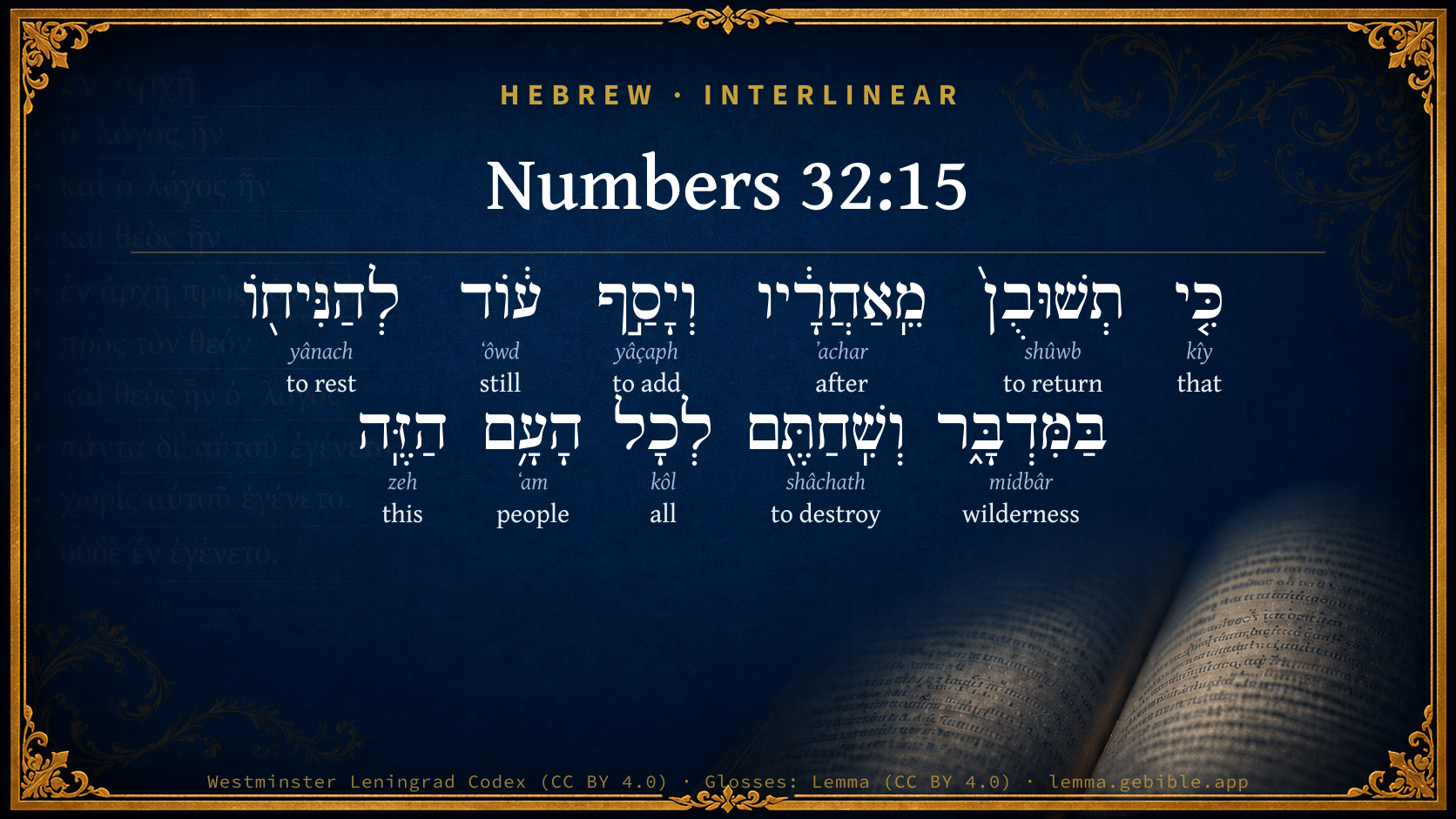
Hebrew (Westminster Leningrad Codex) Numbers 32:15 appears in the Hebrew Old Testament. The text above is from the Westminster Leningrad Codex. Each word links to its Strong’s number, a concise gloss, and parsing drawn from the Open Scriptures Hebrew Bible morphology. Click any word for its full Brown-Driver-Briggs (BDB) entry.
Download image
Cite this verse

Numbers 32:15 (World English Bible). Public Domain. Lemma interlinear Bible study tool, https://lemma.gebible.app/v/numbers/32/15.

Show BibTeX & RIS
BibTeX
RIS
English Translation
For if you turn away from after him, he will yet again leave them in the wilderness; and you will destroy all this people.
World English Bible · Public Domain
Download a study sheet

One document with this verse’s original text, its word-by-word gloss line, the meaning frame, cross-references with their text, attributed commentary, and full source and license credits — printable, and it pastes into notes with its structure intact.

This verse Autodidact and up

Study sheet (.html) Plain text (.txt)

A passage Seminary Student

Up to 50 verses in one chapter. A passage sheet keeps up to 6 commentary sources and 12 cross-references per verse, in the order this page ranks them, and says so on the sheet whenever that leaves anything out. Ask for a single verse and you get the Autodidact verse sheet above.

Everything on this page stays free to read, with no account — the sheet is a download of what is already on screen, not access to it.

Want to remove ads? Support Godless Engineer
Compare translations 3

The same verse in 3 English versions, stacked beneath the original-language interlinear above. Click any original word for its lexicon entry.

Each is an independent rendering of the whole verse — the interlinear is not word-aligned to these translations.

Highlighted words mark where these versions differ — a whole-verse word diff, not a word-by-word alignment.

  • World English Bible Public Domain
    For if you turn away from after him, he will yet again leave them in the wilderness; and you will destroy all this people.
  • King James Version Public Domain
    For if ye turn away from after him, he will yet again leave them in the wilderness; and ye shall destroy all this people.
  • unfoldingWord Literal Text CC BY-SA 4.0
    If you turn from after him, then he will yet again leave him in the wilderness, and you will have destroyed all this people.”

unfoldingWord Literal Text — © unfoldingWord, licensed CC BY-SA 4.0. Word-aligned USFM3 via Door43 (git.door43.org/unfoldingWord/en_ult).

Versions to compare (up to 4)

3 of 4 selected

Show all 18 translations

Every available English version of this verse, each an independent rendering of the whole verse.

  • World English Bible Public Domain
    For if you turn away from after him, he will yet again leave them in the wilderness; and you will destroy all this people.
  • Berean Standard Bible Public Domain
    For if you turn away from following Him, He will once again leave this people in the wilderness, and you will be the cause of their destruction.”
  • Majority Standard Bible Public Domain
    For if you turn away from following Him, He will once again leave this people in the wilderness, and you will be the cause of their destruction.”
  • King James Version Public Domain
    For if ye turn away from after him, he will yet again leave them in the wilderness; and ye shall destroy all this people.
  • American Standard Version (1901) Public Domain
    For if ye turn away from after him, he will yet again leave them in the wilderness; and ye will destroy all this people.
  • Revised Version (1885) Public Domain
    For if ye turn away from after him, he will yet again leave them in the wilderness; and ye shall destroy all this people.
  • Geneva Bible (1599) Public Domain
    For if ye turne away from following him, he will yet againe leaue the people in the wildernesse, and ye shall destroy all this folke.
  • Douay-Rheims (1899) Public Domain
    For if you will not follow him, he will leave the people in the wilderness, end you shall be the cause of the destruction of all.
  • Young's Literal Translation Public Domain
    when ye turn back from after Him, then He hath added yet to leave him in the wilderness, and ye have done corruptly to all this people.'
  • Literal Standard Version CC BY-SA 4.0
    when you turn back from after Him, then He has added yet to leave him in the wilderness, and you have done corruptly to all this people.”
  • Unlocked Literal Bible CC BY-SA 4.0
    If you turn away from following him, he will again leave Israel in the wilderness and you will have destroyed all this people.”
  • unfoldingWord Literal Text CC BY-SA 4.0
    If you turn from after him, then he will yet again leave him in the wilderness, and you will have destroyed all this people.”
  • Darby Bible Public Domain
    If ye turn away from after him, he will yet again leave them in the wilderness; and ye shall destroy all this people.
  • World Messianic Bible Public Domain
    For if you turn away from after him, he will yet again leave them in the wilderness; and you will destroy all these people.”
  • Webster's Bible Public Domain
    For if ye turn away from after him, he will yet again leave them in the wilderness; and he will destroy all this people.
  • Free Bible Version CC BY-SA 4.0
    If you give up following him, he will abandon these people in the desert once again, and their deaths will be your fault!”
  • Bible in Basic English Public Domain
    For if you are turned away from him, he will send them wandering again in the waste land; and you will be the cause of the destruction of all this people.
  • JPS Tanakh (1917) Public Domain
    For if ye turn away from after Him, He will yet again leave them in the wilderness; and so ye will destroy all this people.'

Literal Standard Version (2020), Covenant Press — licensed CC BY-SA 4.0. Text via the HelloAO Bible API (eBible.org). Unlocked Literal Bible (unfoldingWord) — licensed CC BY-SA 4.0. Text via the HelloAO Bible API (eBible.org). unfoldingWord Literal Text — © unfoldingWord, licensed CC BY-SA 4.0. Word-aligned USFM3 via Door43 (git.door43.org/unfoldingWord/en_ult). Free Bible Version, Dr. Jonathan Gallagher — licensed CC BY-SA 4.0. Text via the HelloAO Bible API (eBible.org).

Word by word

More ways to search: Search by grammar → Find every occurrence → Compare this word →

Practice this passage: Drill this verse → Learn its vocabulary →

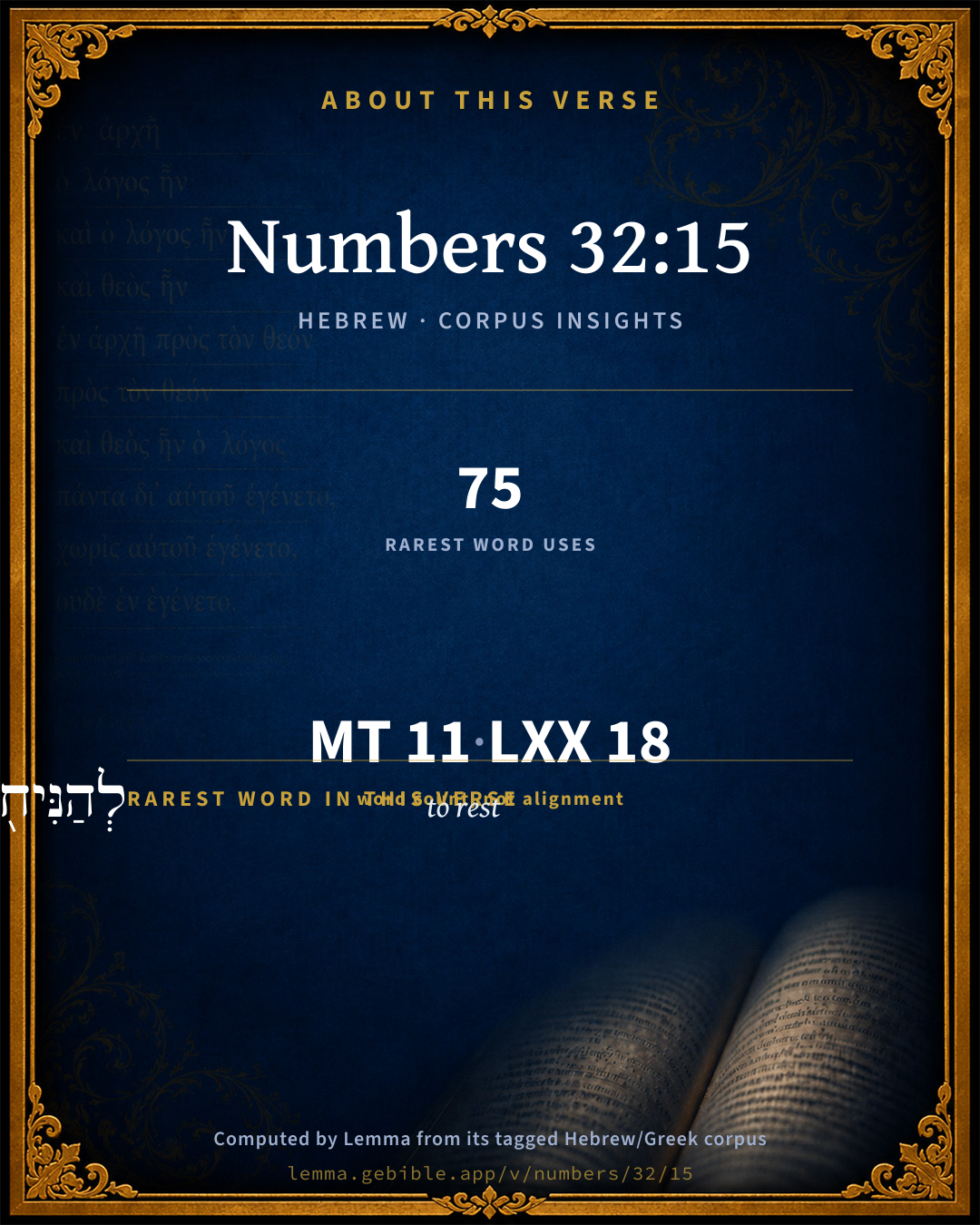
לְהַנִּיח֖וֹ
yânach
H3240
“to rest · him”
Preposition + Verb, Hiphil, Infinitive Construct + Suffix, Personal, 3rd Person, Masculine, Singular
Part of Speech
Preposition + Verb
Stem
Hiphil
Form
Infinitive Construct
Full BDB Definition

Origin: a primitive root

TWOT: 1323

to rest - (Qal) - to rest, settle down and remain - to repose, have rest, be quiet - (Hiphil) - to cause to rest, give rest to, make quiet - to cause to rest, cause to alight, set down - to lay or set down, deposit, let lie, place - to let remain, leave - to leave, depart from - to abandon - to permit - (Hophal) - to obtain rest, be granted rest - to be left, be placed - open space (substantive)
  1. כִּ֤י kîy H3588 “that” Conjunction
  2. תְשׁוּבֻן֙ shûwb H7725 “to return” Verb, Qal, Imperfect, 2nd Person, Masculine, Plural + Suffix, n
  3. מֵֽאַחֲרָ֔יו ʼachar H310 “from · after · him” Preposition + Preposition + Suffix, Personal, 3rd Person, Masculine, Singular
  4. וְיָסַ֣ף yâçaph H3254 “and · to add” Conjunction + Verb, Qal, Sequential Perfect, 3rd Person, Masculine, Singular
  5. ע֔וֹד ʻôwd H5750 “still” Adverb
  6. בַּמִּדְבָּ֑ר midbâr H4057 “in/at the · wilderness” Preposition, Determined + Noun, Common, Masculine, Singular, Absolute
  7. וְשִֽׁחַתֶּ֖ם shâchath H7843 “and · to destroy” Conjunction + Verb, Piel, Sequential Perfect, 2nd Person, Masculine, Plural
  8. לְכָל kôl H3605 “to/for · all of” Preposition + Noun, Common, Masculine, Singular, Construct
  9. הָעָ֥ם ʻam H5971 “the · people” Particle, Definite Article + Noun, Common, Masculine, Singular, Absolute
  10. הַזֶּֽה zeh H2088 “the · this” Particle, Definite Article + Pronoun, Demonstrative, Masculine, Singular

About this verse

These counts appear in no published source. They are computed here, from the morphology-tagged text and Lemma’s own curated glosses. What Lemma adds →

11
words
11
distinct lemmas
Pentateuch
section

Grammatical profile

  • 4 verbs
  • 3 nouns
  • 1 pronoun
  • 1 preposition
  • 1 conjunction
  • 1 adverb

Verb forms

  • תְשׁוּבֻן֙ Qal · Imperfect
  • וְיָסַ֣ף Qal · Sequential Perfect
  • לְהַנִּיח֖וֹ Hiphil · Infinitive Construct
  • וְשִֽׁחַתֶּ֖ם Piel · Sequential Perfect

Hebrew & Septuagint length

In English translation the verse runs 24 words from the Hebrew and 24 from the Septuagint (LXX English) — the same length.

A rough comparison of the two English renderings, which tokenize alike — not a word-level alignment.

Word counts can differ between the Hebrew and the Greek without any difference in meaning — e.g. the Hebrew direct-object marker אֵת has no separate Greek word, and Greek often adds the article ὁ.

In the original languages it is 11 Hebrew tokens and 18 Greek tokens — but the two are counted differently (Hebrew bundles its prefixes and suffixes into one token; the Greek is in lemma form), so that isn’t a like-for-like length.

Cross-references

12

Topical passages linked to Numbers 32:15 in the Treasury of Scripture Knowledge — connected by theme and wording, ordered by reader-vote popularity; previews shown in the World English Bible.

  • 2 Chronicles 15:2 and he went out to meet Asa, and said to him, Hear you me, Asa, and all Judah and Benjamin: Yahweh is with you, while you are with him; and if you seek him, he will be found of you; but if you forsake him, he will forsake you.
  • 1 Corinthians 8:11–12 And through your knowledge, he who is weak perishes, the brother for whose sake Christ died.
  • Leviticus 26:14–18 "'But if you will not listen to me, and will not do all these commandments;
  • Numbers 14:30–35 surely you shall not come into the land, concerning which I swore that I would make you dwell therein, save Caleb the son of Jephunneh, and Joshua the son of Nun.
  • Deuteronomy 28:15–68 But it shall come to pass, if you will not listen to the voice of Yahweh your God, to observe to do all his commandments and his statutes which I command you this day, that all these curses shall come on you, and overtake you.
  • Deuteronomy 30:17–19 But if your heart turn away, and you will not hear, but shall be drawn away, and worship other gods, and serve them;
  • Joshua 22:16–18 Thus says the whole congregation of Yahweh, What trespass is this that you have committed against the God of Israel, to turn away this day from following Yahweh, in that you have built you an altar, to rebel this day against Yahweh?
  • 2 Chronicles 7:19–22 But if you turn away, and forsake my statutes and my commandments which I have set before you, and shall go and serve other gods, and worship them;
  • Matthew 18:7 "Woe to the world because of occasions of stumbling! For it must be that the occasions come, but woe to that person through whom the occasion comes!
  • Romans 14:15 Yet if because of food your brother is grieved, you walk no longer in love. Don't destroy with your food him for whom Christ died.
  • Romans 14:20–21 Don't overthrow God's work for food's sake. All things indeed are clean, however it is evil for that man who creates a stumbling block by eating.
  • Jeremiah 38:23 They shall bring out all your wives and your children to the Chaldeans; and you shall not escape out of their hand, but shall be taken by the hand of the king of Babylon: and you shall cause this city to be burned with fire.

Cross-references courtesy of OpenBible.info (CC BY 4.0).

Hebrew and Greek witnesses Masoretic Hebrew ↔ Greek Septuagint

The same verse in the two great witnesses to the Old Testament, shown verse-for-verse.

These are two independent witnesses, not word-aligned to each other, and the Septuagint is shown in lemma (dictionary) form.

Hebrew Numbers 32:15 Masoretic · Westminster Leningrad Codex

כִּ֤י תְשׁוּבֻן֙ מֵֽאַחֲרָ֔יו וְיָסַ֣ף ע֔וֹד לְהַנִּיח֖וֹ בַּמִּדְבָּ֑ר וְשִֽׁחַתֶּ֖ם לְכָל הָעָ֥ם הַזֶּֽה

For if you turn away from after him, he will yet again leave them in the wilderness; and you will destroy all this people.

World English Bible · Public Domain

Greek LXX Numbers 32:15 Septuagint · lemma form

ὅτι ἀποστρέφω ἀπό αὐτός προςτίθημι ἔτι καταλείπω αὐτός ἐν ὁ ἔρημος καί ἀνομέω εἰς ὅλος ὁ συναγωγή οὗτος

For you⌃ will turn away from him to desert him yet once more in the wilderness, and you⌃ will sin against this whole congregation.

LXX2012 (modern English Septuagint) · Public Domain

On this verse, Haydock's Catholic Bible Commentary discusses the Septuagint’s reading. Read the note in Commentary ↓

Hebrew: Westminster Leningrad Codex (CC BY 4.0). Greek: Septuagint (public domain); English from LXX2012 (modern English Septuagint) (Public Domain). How the Septuagint differs from the Hebrew →

Targum (Aramaic paraphrase)

2

The Targum is the ancient Jewish Aramaic paraphrase of the Hebrew Scriptures — an interpretive translation, not the Hebrew text itself. Onkelos (literal) and Pseudo-Jonathan (expansive) render the Torah, and Jonathan the Prophets. Coverage is partial: where no permissively-licensed English translation exists for a verse, only the Aramaic is shown. This is verse-level text, not a word-by-word alignment to the Hebrew.

  1. Targum Onkelos Torah (Genesis–Deuteronomy)
    אֲרֵי תְתוּבוּן מִבָּתַר דַחַלְתֵּיהּ וְיוֹסִיף עוֹד לְאַחֲרוּתְהוֹן בְּמַדְבְּרָא וּתְחַבְּלוּן לְכָל עַמָא הָדֵין

    (no public-domain English translation for this verse)

    Targum Onkelos — Aramaic: “Onkelos Genesis” (public domain); “Onkelos Exodus” (public domain); “Onkelos Leviticus” (public domain); “Onkelos Numbers” (public domain); “Onkelos Deuteronomy” (public domain). English: “Sefaria Community Translation” (CC0 1.0 (public-domain dedication)); “J.W. Etheridge. The Targums of Onkelos and Jonathan Ben Uzziel on the Pentateuch. London: Longmans, Green, 1862” (public domain). Text via Sefaria.

  2. Targum Pseudo-Jonathan Torah (Genesis–Deuteronomy)
    אֲרוּם תְּתוּבוּן מִבָּתַר דַחַלְתֵּיהּ וְיוֹסֵף תּוּב לְאוֹחֲרוֹתֵיהוֹן בְּמַדְבְּרָא וּתְחַבְּלוּן לְכָל עַמָא הָדֵין

    For if you go back from fearing Him, He will still make them abide in the wilderness, and so will you destroy all this people.

    Targum Pseudo-Jonathan — Aramaic: “Targum Jonathan on Genesis” (public domain); “Targum Jonathan on Exodus” (public domain); “Targum Jonathan on Leviticus” (public domain); “Targum Jonathan on Numbers” (public domain); “Targum Jonathan on Deuteronomy” (public domain). English: “The Targum of Jonathan ben Uzziel, trans. J. W. Etheridge, London, 1862” (public domain). Text via Sefaria.

Commentary

Notes on Numbers 32:15 from classic Christian and Jewish commentators (each source and its license shown beneath its notes). The classic Christian expositions comment on the surrounding passage and are grouped to its opening verse, so a note may address several verses; the Jewish commentaries on the Tanakh (Rashi and others) are per-verse, so they appear only where the commentator wrote on this verse.

Lemma curates 59 commentaries, every one of them public domain or Creative Commons licensed, each selected and text-cleaned for this edition rather than reprinted as found. About our sources →

Joseph Benson's Commentary

Num 32:15. Ye shall destroy all this people — Who, being moved by your counsel and example, will refuse to go over Jordan and possess the land of Canaan. Thus all who rest satisfied with visible and temporal things, and evidently show by their conduct that they prefer earth to heaven, not only stop short themselves of the rest that remaineth for the people of God, but greatly discourage others in their journey thither, and lay stumbling-blocks in their way. Reader! Arise, depart, this is not thy rest, because it is polluted; it will destroy thee with a sore destruction.

Joseph Benson's Commentary on the Old and New Testaments (1811–1818) — public domain. Text from a community e-Sword module.

Geneva Bible (1599)

Geneva Bible translators

By your occasion.

Geneva Bible (1599) marginal notes — public domain. Text via Bolls.life.

John Gill's Exposition

And they came near unto him,.... The heads of the tribes of Gad and Reuben came a little nearer to Moses, having something more to say unto him, in order to explain their meaning, and in doing which they used some degree of freedom and boldness with him, see Gen 44:18.

and said, we will build sheepfolds here for our cattle, and cities for our little ones not build new ones, but repair the old ones; for there were cities enough in the country, as before named, and no doubt sheepfolds too, as the land was a place of cattle, but those were through the war broken down and demolished, and needed repairing; and this they proposed to do, and leave their children and their cattle to the care of their servants, under the protection of the divine Providence, and did not mean for the present to take up their abode here.

John Gill's Exposition of the Whole Bible (1746–1763) — public domain (CC PDM 1.0). Text via the HelloAO Bible API.

Haydock's Catholic Bible Commentary

Of all. Hebrew, "if, or because you will not follow after him. He will stop them in the desert, and you will destroy all the people." Septuagint, "because you will turn away from him, to abandon him again in the desert, and you will sin against all this congregation." God had decreed that all should go together to the conquest of the promised land; so that, if these children of Ruben and of Gad should refuse to comply, Moses was afraid that all might be ruined. Perceiving that his discourse turned on this subject, they approached with greater confidence, and shewed their readiness to fight for their brethren. Upon which Moses was satisfied. (Haydock)

George Leo Haydock (1774–1849), Haydock's Catholic Family Bible and Commentary, 1859 edition — public domain. Excludes Psalms (Douay-Rheims chapter numbering differs from Protestant) and Deuterocanonical books (Catholic canon only).

Matthew Poole's English Annotations

Who being moved by your counsel and example, will refuse to go over Jordan, and to possess the land of Canaan.

Matthew Poole's English Annotations on the Holy Bible (1683–1685) — public domain. Text from a community e-Sword/MySword module.

Whedon's Commentary on the Bible

Daniel D. Whedon

15. If ye turn away — If ye draw back behind him, that is, omit the fulfilling of God’s will. Heb_2:3; Heb_10:30, notes.

Daniel D. Whedon (gen. ed.), Commentary on the Old and New Testaments (1874–1909) — public domain. Text from a community e-Sword module.

The Pulpit Commentary

He will yet again leave them in the wilderness. Properly speaking, Israel had already emerged from the wilderness; but until they had fairly made good their possession of Canaan, their desert wanderings could not be considered at an end.

The Pulpit Commentary (1880–1919), ed. H.D.M. Spence-Jones & Joseph S. Exell — public domain. Text from a community e-Sword module.

John Wesley's Explanatory Notes

All this people - Who being moved by your counsel and example, will refuse to go over Jordan.

John Wesley, Explanatory Notes Upon the Whole Bible (1754–1765) — public domain. Text via the GEBible commentary corpus.

Keil & Delitzsch

C. F. Keil & F. Delitzsch

"If ye draw back behind Him," i.e., resist the fulfilment of the will of God, to bring Israel to Canaan, "He will leave it (Israel) still longer in the desert, and ye prepare destruction for all this nation."

Keil & Delitzsch — Biblical Commentary on the Old Testament (1861–1891) — public domain (CC PDM 1.0). Text via the HelloAO Bible API. (Old Testament only.)

Lesson kit

Teaching starters — assembled from the data on this page, not authored interpretation. Every prompt links to the verse data it draws on. Edit before teaching.

Numbers, in the Pentateuch, opens this verse with 11 words (11 distinct Hebrew lemmas). Its most distinctive word is yânach (“to rest”). A historical commentator’s framing appears above. Read the whole chapter for the surrounding context.

Discussion questions

  1. The word yânach carries the sense “to rest.” How does it shape the verse?
  2. How does 2 Chronicles 15:2, which shares this passage’s theme, read alongside this verse?
  3. The translations on this page render this verse differently — a whole-verse word diff, not a word-by-word alignment. What might account for the different wordings?
  4. «תְשׁוּבֻן֙» is a Qal Imperfect verb. How does that grammatical form shape the action described?
  5. Compare how Joseph Benson's Commentary and Geneva Bible (1599) read this verse. Where do they agree or differ?

Things to notice

Reading settings

Reading text

Shown beneath each verse's original-language words.

Old Testament
Old Testament edition

Read the OT as the Masoretic Hebrew (MT) or the Greek Septuagint (LXX).

English shown for the Greek Septuagint (in the Hebrew ↔ Greek comparison).

Comparing translations? Open the Compare panel on any verse page to stack up to four side by side.