2 Kings 6:31

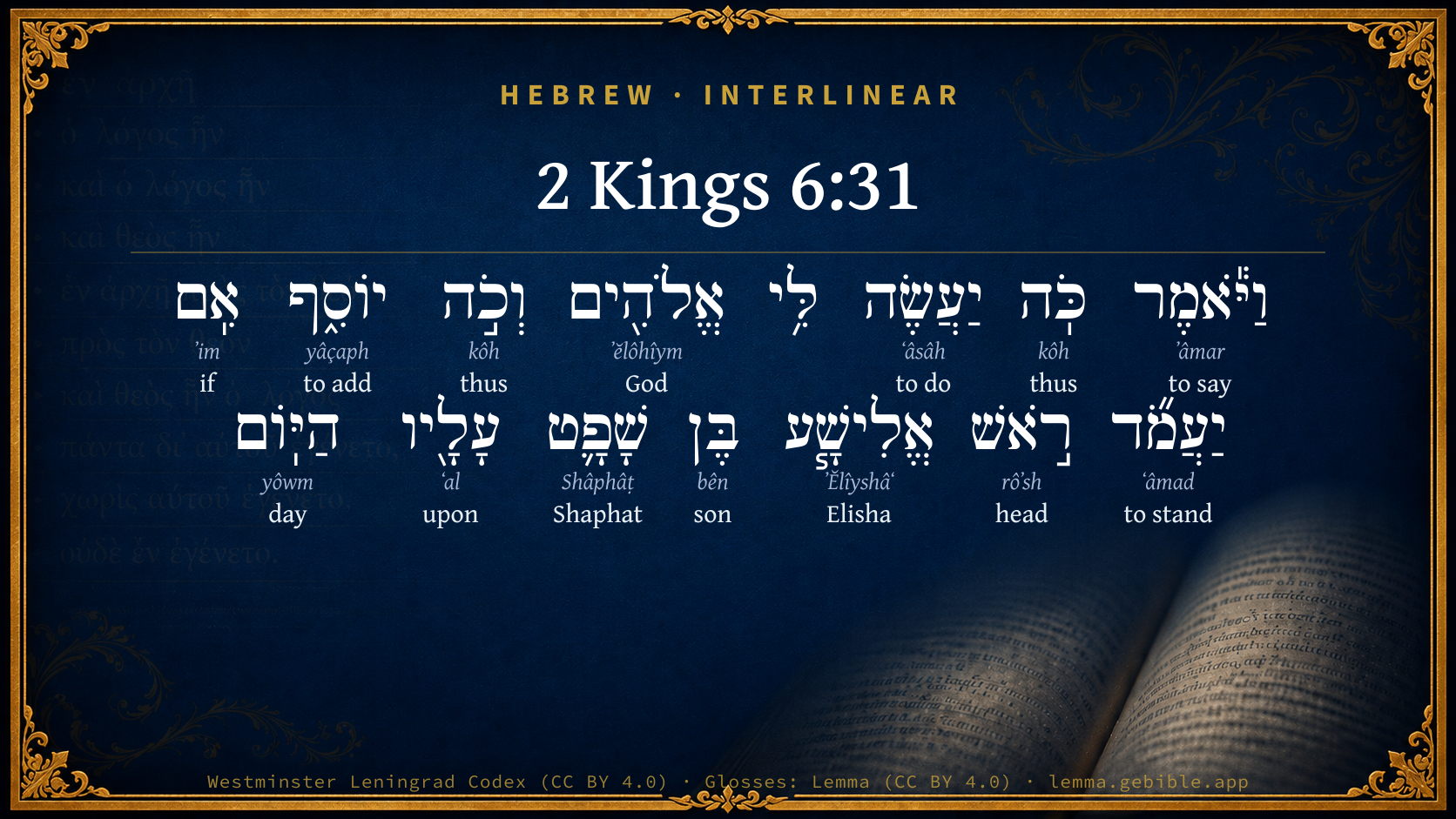
Hebrew (Westminster Leningrad Codex) 2 Kings 6:31 appears in the Hebrew Old Testament. The text above is from the Westminster Leningrad Codex. Each word links to its Strong’s number, a concise gloss, and parsing drawn from the Open Scriptures Hebrew Bible morphology. Click any word for its full Brown-Driver-Briggs (BDB) entry.
Download image
Cite this verse

2 Kings 6:31 (World English Bible). Public Domain. Lemma interlinear Bible study tool, https://lemma.gebible.app/v/2-kings/6/31.

Show BibTeX & RIS
BibTeX
RIS
English Translation
Then he said, God do so to me, and more also, if the head of Elisha the son of Shaphat shall stand on him this day.
World English Bible · Public Domain
Download a study sheet

One document with this verse’s original text, its word-by-word gloss line, the meaning frame, cross-references with their text, attributed commentary, and full source and license credits — printable, and it pastes into notes with its structure intact.

This verse Autodidact and up

Study sheet (.html) Plain text (.txt)

A passage Seminary Student

Up to 50 verses in one chapter. A passage sheet keeps up to 6 commentary sources and 12 cross-references per verse, in the order this page ranks them, and says so on the sheet whenever that leaves anything out. Ask for a single verse and you get the Autodidact verse sheet above.

Everything on this page stays free to read, with no account — the sheet is a download of what is already on screen, not access to it.

Want to remove ads? Support Godless Engineer
Compare translations 3

The same verse in 3 English versions, stacked beneath the original-language interlinear above. Click any original word for its lexicon entry.

Each is an independent rendering of the whole verse — the interlinear is not word-aligned to these translations.

Highlighted words mark where these versions differ — a whole-verse word diff, not a word-by-word alignment.

  • World English Bible Public Domain
    Then he said, God do so to me, and more also, if the head of Elisha the son of Shaphat shall stand on him this day.
  • King James Version Public Domain
    Then he said, God do so and more also to me, if the head of Elisha the son of Shaphat shall stand on him this day.
  • unfoldingWord Literal Text CC BY-SA 4.0
    And he said, “Thus may God do to me, and thus may he add, if the head of Elisha, the son of Shaphat, remains on him today.”

unfoldingWord Literal Text — © unfoldingWord, licensed CC BY-SA 4.0. Word-aligned USFM3 via Door43 (git.door43.org/unfoldingWord/en_ult).

Versions to compare (up to 4)

3 of 4 selected

Show all 18 translations

Every available English version of this verse, each an independent rendering of the whole verse.

  • World English Bible Public Domain
    Then he said, God do so to me, and more also, if the head of Elisha the son of Shaphat shall stand on him this day.
  • Berean Standard Bible Public Domain
    He announced, “May God punish me, and ever so severely, if the head of Elisha son of Shaphat remains on his shoulders through this day!”
  • Majority Standard Bible Public Domain
    He announced, “May God punish me, and ever so severely, if the head of Elisha son of Shaphat remains on his shoulders through this day!”
  • King James Version Public Domain
    Then he said, God do so and more also to me, if the head of Elisha the son of Shaphat shall stand on him this day.
  • American Standard Version (1901) Public Domain
    Then he said, God do so to me, and more also, if the head of Elisha the son of Shaphat shall stand on him this day.
  • Revised Version (1885) Public Domain
    Then he said, God do so to me, and more also, if the head of Elisha the son of Shaphat shall stand on him this day.
  • Geneva Bible (1599) Public Domain
    And he saide, God doe so to me and more also, if the head of Elisha the sonne of Shaphat shall stande on him this day.
  • Douay-Rheims (1899) Public Domain
    And the king said: May God do so and so to me, and may he add more, if the head of Eliseus the son of Saphat shall stand on him this day.
  • Young's Literal Translation Public Domain
    And he saith, `Thus doth God do to me, and thus He doth add -- if it remain -- the head of Elisha son of Shaphat -- upon him this day.'
  • Literal Standard Version CC BY-SA 4.0
    And he says, “Thus God does to me and thus He adds, if the head of Elisha son of Shaphat remains on him this day.”
  • Unlocked Literal Bible CC BY-SA 4.0
    Then he said, “May God do so to me, and more also, if the head of Elisha son of Shaphat remains on him today.”
  • unfoldingWord Literal Text CC BY-SA 4.0
    And he said, “Thus may God do to me, and thus may he add, if the head of Elisha, the son of Shaphat, remains on him today.”
  • Darby Bible Public Domain
    And he said, God do so, and more also to me, if the head of Elisha the son of Shaphat shall remain on him this day!
  • World Messianic Bible Public Domain
    Then he said, “God do so to me, and more also, if the head of Elisha the son of Shaphat stays on him today.”
  • Webster's Bible Public Domain
    Then he said, God do so and more also to me, if the head of Elisha the son of Shaphat shall stand on him this day.
  • Free Bible Version CC BY-SA 4.0
    “May God punish me very severely if the head of Elisha, son of Shaphat, remains on his shoulders today!” he declared.
  • Bible in Basic English Public Domain
    Then he said, May God's punishment come on me if Elisha, the son of Shaphat, keeps his head on his body after this day.
  • JPS Tanakh (1917) Public Domain
    Then he said: 'God do so to me, and more also, if the head of Elisha the son of Shaphat shall stand on him this day.'

Literal Standard Version (2020), Covenant Press — licensed CC BY-SA 4.0. Text via the HelloAO Bible API (eBible.org). Unlocked Literal Bible (unfoldingWord) — licensed CC BY-SA 4.0. Text via the HelloAO Bible API (eBible.org). unfoldingWord Literal Text — © unfoldingWord, licensed CC BY-SA 4.0. Word-aligned USFM3 via Door43 (git.door43.org/unfoldingWord/en_ult). Free Bible Version, Dr. Jonathan Gallagher — licensed CC BY-SA 4.0. Text via the HelloAO Bible API (eBible.org).

Word by word

More ways to search: Search by grammar → Find every occurrence → Compare this word →

Practice this passage: Drill this verse → Learn its vocabulary →

שָׁפָ֛ט
Shâphâṭ
H8202
“Shaphat”
Noun, Proper
Part of Speech
Noun
Type
Proper
Full BDB Definition

Origin: from H8199

TWOT: None

Shaphat = "judged" or " he hath judged" - son of Hori and the prince of Simeon chosen to spy out the promised land - father of the prophet Elisha - a Judaite, son of Shemaiah and descendant of Zerubbabel in the royal line of Judah - a chief of the tribe of Gad - son of Adlai and chief herdsman for David over the herds in the valleys
  1. וַיֹּ֕אמֶר ʼâmar H559 “and · to say” Conjunction + Verb, Qal, Sequential Imperfect, 3rd Person, Masculine, Singular
  2. כֹּֽה kôh H3541 “thus” Adverb
  3. יַעֲשֶׂה ʻâsâh H6213 “to do” Verb, Qal, Jussive, 3rd Person, Masculine, Singular
  4. אֱלֹהִ֖ים ʼĕlôhîym H430 “God(s)” Noun, Common, Masculine, Plural, Absolute
  5. וְכֹ֣ה kôh H3541 “and · thus” Conjunction + Adverb
  6. יוֹסִ֑ף yâçaph H3254 “to add” Verb, Hiphil, Jussive, 3rd Person, Masculine, Singular
  7. אִֽם ʼim H518 “if” Conjunction
  8. יַעֲמֹ֞ד ʻâmad H5975 “to stand” Verb, Qal, Imperfect, 3rd Person, Masculine, Singular
  9. רֹ֣אשׁ rôʼsh H7218 “head of” Noun, Common, Masculine, Singular, Construct
  10. אֱלִישָׁ֧ע ʼĔlîyshâʻ H477 “Elisha” Noun, Proper
  11. בֶּן bên H1121 “son of” Noun, Common, Masculine, Singular, Construct
  12. עָלָ֖יו ʻal H5921 “upon · him” Preposition + Suffix, Personal, 3rd Person, Masculine, Singular
  13. הַיּֽוֹם yôwm H3117 “the · day” Particle, Definite Article + Noun, Common, Masculine, Singular, Absolute

About this verse

These counts appear in no published source. They are computed here, from the morphology-tagged text and Lemma’s own curated glosses. What Lemma adds →

15
words
13
distinct lemmas
Historical
section

Notable vocabulary

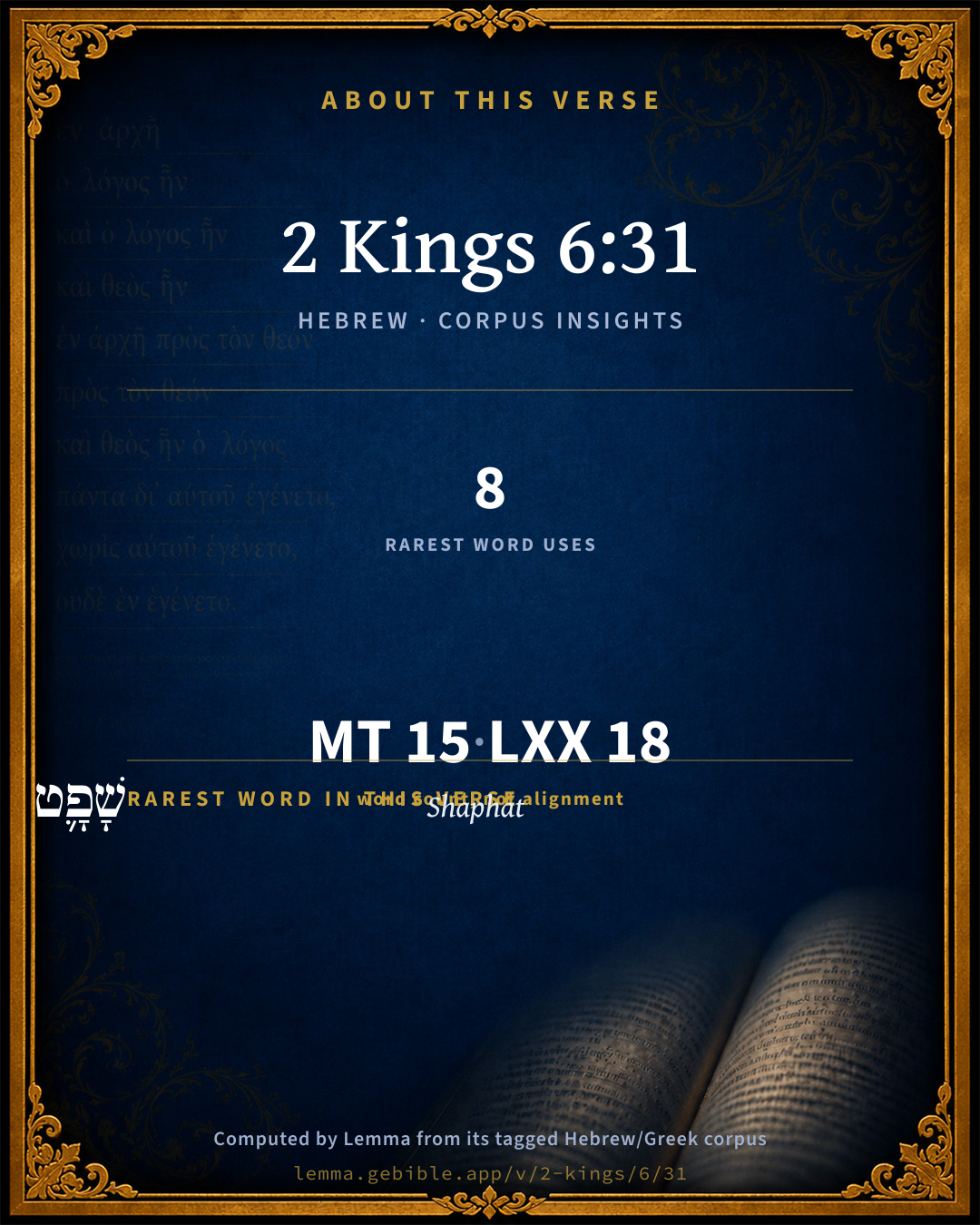
The rarest word here is שָׁפָ֛ט Shaphat H8202 — appearing just 8 times in the whole Hebrew Bible.

Shared distinctive vocabulary

שָׁפָ֛ט Shaphat H8202 occurs in 8 verses of the Hebrew Bible. Also found in:

Grammatical profile

  • 4 verbs
  • 6 nouns
  • 2 prepositions
  • 1 conjunction
  • 2 adverbs

Verb forms

  • וַיֹּ֕אמֶר Qal · Sequential Imperfect
  • יַעֲשֶׂה Qal · Jussive
  • יוֹסִ֑ף Hiphil · Jussive
  • יַעֲמֹ֞ד Qal · Imperfect

Repetition

A word recurs within this verse — often emphatic in Hebrew:

  • כֹּֽה thus H3541 ×2

Hebrew & Septuagint length

In English translation the verse runs 26 words from the Hebrew and 22 from the Septuagint (LXX English) — closely comparable.

A rough comparison of the two English renderings, which tokenize alike — not a word-level alignment.

Word counts can differ between the Hebrew and the Greek without any difference in meaning — e.g. the Hebrew direct-object marker אֵת has no separate Greek word, and Greek often adds the article ὁ.

In the original languages it is 15 Hebrew tokens and 18 Greek tokens — but the two are counted differently (Hebrew bundles its prefixes and suffixes into one token; the Greek is in lemma form), so that isn’t a like-for-like length.

Cross-references

15

Topical passages linked to 2 Kings 6:31 in the Treasury of Scripture Knowledge — connected by theme and wording, ordered by reader-vote popularity; previews shown in the World English Bible.

  • Ruth 1:17 where you die, will I die, and there will I be buried: Yahweh do so to me, and more also, if anything but death part you and me."
  • 1 Kings 19:2 Then Jezebel send a messenger to Elijah, saying, So let the gods do to me, and more also, if I don't make your life as the life of one of them by tomorrow about this time.
  • 1 Samuel 3:17 He said, "What is the thing that [Yahweh] has spoken to you? Please don't hide it from me. God do so to you, and more also, if you hide anything from me of all the things that he spoke to you."
  • 1 Samuel 14:44 Saul said, God do so and more also; for you shall surely die, Jonathan.
  • 1 Samuel 25:22 God do so to the enemies of David, and more also, if I leave of all that belongs to him by the morning light so much as one man-child.
  • 2 Samuel 3:9 God do so to Abner, and more also, if, as Yahweh has sworn to David, I don't do even so to him;
  • 2 Samuel 3:35 All the people came to cause David to eat bread while it was yet day; but David swore, saying, God do so to me, and more also, if I taste bread, or anything else, until the sun be down.
  • 2 Samuel 19:13 Say you to Amasa, Aren't you my bone and my flesh? God do so to me, and more also, if you aren't captain of the host before me continually in the room of Joab.
  • 1 Kings 2:23 Then king Solomon swore by Yahweh, saying, God do so to me, and more also, if Adonijah has not spoken this word against his own life.
  • 1 Kings 18:17 It happened, when Ahab saw Elijah, that Ahab said to him, Is it you, you troubler of Israel?
  • 1 Kings 22:8 The king of Israel said to Jehoshaphat, there is yet one man by whom we may inquire of Yahweh, Micaiah the son of Imlah: but I hate him; for he does not prophesy good concerning me, but evil. Jehoshaphat said, "Don't let the king say so."
  • Jeremiah 37:15–16 The princes were angry with Jeremiah, and struck him, and put him in prison in the house of Jonathan the scribe; for they had made that the prison.
  • Jeremiah 38:4 Then the princes said to the king, Let this man, we pray you, be put to death; because he weakens the hands of the men of war who remain in this city, and the hands of all the people, in speaking such words to them: for this man doesn't seek the welfare of this people, but the hurt.
  • John 11:50 nor do you consider that it is advantageous for us that one man should die for the people, and that the whole nation not perish."
  • Acts 23:12–13 When it was day, some of the Jews banded together, and bound themselves under a curse, saying that they would neither eat nor drink until they had killed Paul.

Cross-references courtesy of OpenBible.info (CC BY 4.0).

Hebrew and Greek witnesses Masoretic Hebrew ↔ Greek Septuagint

The same verse in the two great witnesses to the Old Testament, shown verse-for-verse.

These are two independent witnesses, not word-aligned to each other, and the Septuagint is shown in lemma (dictionary) form.

Hebrew 2 Kings 6:31 Masoretic · Westminster Leningrad Codex

וַיֹּ֕אמֶר כֹּֽה יַעֲשֶׂה לִּ֥י אֱלֹהִ֖ים וְכֹ֣ה יוֹסִ֑ף אִֽם יַעֲמֹ֞ד רֹ֣אשׁ אֱלִישָׁ֧ע בֶּן שָׁפָ֛ט עָלָ֖יו הַיּֽוֹם

Then he said, God do so to me, and more also, if the head of Elisha the son of Shaphat shall stand on him this day.

World English Bible · Public Domain

Greek LXX 2 Kings 6:31 Septuagint · lemma form

καί εἶπον ὅδε ποιέω ἐγώ ὁ θεός καί ὅδε προςτίθημι εἰ ἵστημι ὁ κεφαλή ελισαιε ἐπί αὐτός σήμερον

And he said, God do so to me and more also, if the head of Elisaie shall stand upon him this day.

LXX2012 (modern English Septuagint) · Public Domain

Hebrew: Westminster Leningrad Codex (CC BY 4.0). Greek: Septuagint (public domain); English from LXX2012 (modern English Septuagint) (Public Domain). How the Septuagint differs from the Hebrew →

Targum (Aramaic paraphrase)

1

The Targum is the ancient Jewish Aramaic paraphrase of the Hebrew Scriptures — an interpretive translation, not the Hebrew text itself. Onkelos (literal) and Pseudo-Jonathan (expansive) render the Torah, and Jonathan the Prophets. Coverage is partial: where no permissively-licensed English translation exists for a verse, only the Aramaic is shown. This is verse-level text, not a word-by-word alignment to the Hebrew.

  1. Targum Jonathan Prophets (Joshua–Malachi)
    וַאֲמַר כְּדֵין יַעְבֵּיד לִי יְיָ וּכְדֵין יוֹסִיף אִם יִתְקַיָם רֵישָׁא דֶאֱלִישָׁע בַּר שָׁפָט עֲלוֹהִי יוֹמָא דֵין:

    (no public-domain English translation for this verse)

    Targum Jonathan — Aramaic: “Mikraot Gedolot” (public domain). English: “Sefaria Community Translation” (CC0 1.0 (public-domain dedication)); “London "Chaldee Paraphrase," 1871” (public domain). Text via Sefaria.

Commentary

Notes on 2 Kings 6:31 from classic Christian and Jewish commentators (each source and its license shown beneath its notes). The classic Christian expositions comment on the surrounding passage and are grouped to its opening verse, so a note may address several verses; the Jewish commentaries on the Tanakh (Rashi and others) are per-verse, so they appear only where the commentator wrote on this verse.

Lemma curates 59 commentaries, every one of them public domain or Creative Commons licensed, each selected and text-cleaned for this edition rather than reprinted as found. About our sources →

Trapp's Complete Commentary

John Trapp

2Ki 6:31 Then he said, God do so and more also to me, if the head of Elisha the son of Shaphat shall stand on him this day.

Ver. 31. If the head of Elisha.] Who had only threatened these evils, not caused them, and perhaps refused to pray for a removal. The false prophets also might now stir up the king to slay the Lord’s prophet.

John Trapp, A Commentary or Exposition upon All the Books of the Old and New Testament (1647–1656) — public domain. Text from a community e-Sword module.

Joseph Benson's Commentary

2Ki 6:31. If the head of Elisha shall stand on him this day — If I do not this day take his head and his life. This wretched and partial prince overlooks his own great and various sins, and, among the rest, his obstinate adherence to the worship of the calves, and his conniving at the idolatries and witchcrafts of his mother Jezebel, (2Ki 9:22,) and the wickedness of the people, which were the true and proper causes of this and all their calamities; and he lays the blame of all upon Elisha, either supposing that he who had the spirit of Elijah resting upon him had brought this famine on the land by his prayers, as Elijah had formerly done, or because he had encouraged them to withstand the Syrians by promising them help from God.

Joseph Benson's Commentary on the Old and New Testaments (1811–1818) — public domain. Text from a community e-Sword module.

Tyndale Open Study Notes

Tyndale Open Resources

6:31 separate Elisha’s head from his shoulders: Decapitation of one’s enemy was frequent (10:6-8; 1 Sam 17:51; 31:9; 2 Sam 4:7-8, 12; 20:22; Matt 14:11) in the ancient Near East. Joram reasoned that the situation stemmed from Elisha’s earlier sparing of Ben-hadad’s troops (2 Kgs 6:22-23). Moreover, Ben-hadad had been after Elisha (6:13), so the prophet’s presence had endangered the whole city.

Tyndale Open Study Notes — © Tyndale Open Resources, licensed CC BY-SA 4.0. Text via the HelloAO Bible API.

Adam Clarke's Commentary

Verse 31. If the head of Elisha - shall stand on him] Either he attributed these calamities to the prophet, or else he thought he could remove them, and yet would not. The miserable king was driven to desperation.

Adam Clarke's Commentary on the Bible (1810–1826) — public domain. Text from a community e-Sword/MySword module.

Ellicott's Commentary for English Readers

(31) Then he said.—And he (i.e., the king), said.

God do so . . . to me.—Literally, So may God do to me, and so may he add: a common form of oath. (Comp. Rth_1:17; 1Sa_3:17; 1Ki_2:23.)

If the head of Elisha . . . this day.—The king’s horror at the woman’s dreadful story is succeeded by indignation against Elisha, who had probably counselled an unyielding resistance to the foe, in the steadfast faith that Jehovah would help His own; and who, prophet though he was, and endued with miraculous powers, had yet brought no help in this hour of urgent need. (Comp. with the oath that of Jezebel against Elijah, 1Ki_19:2.)

A Bible Commentary for English Readers, edited by Charles John Ellicott (1878–1897) — public domain. Text from a community e-Sword module.

The Cambridge Bible for Schools and Colleges

gen. ed. J. J. S. Perowne

31. if the head of Elisha … shall stand on him this day] We must suppose that Elisha had not been wanting in admonitions to both king and people during this terrible siege, and the anger of Jehoram was great because the prophet, who had wrought so mightily in the war with Moab, and on many another occasion which the king would know of, had done nothing to save the nation in this great calamity. This is the explanation of Josephus (Ant. IX. 4. 4) and the feeling is what was to be expected in a son of Jezebel.

The Cambridge Bible for Schools and Colleges (gen. ed. J. J. S. Perowne; Cambridge University Press, 1878–1918) — public domain. Text from a community e-Sword module.

John Gill's Exposition

And while he yet talked with them,.... Elisha with the elders:

behold, the messenger came down unto him; sent by the king:

and he said; either the messenger in the king's name, or rather the king, who was at his heels, and came to the door before the messenger was let in, who was detained; and therefore it is most probable the king went in first; for that was the intention of Elisha in holding the messenger, not to save his own life, but that the king, who was following, might hear what he had to say; and whom he advised to wait for the Lord, and his appearance, for deliverance: in answer to which he said:

behold, this evil is of the Lord, what should I wait for the Lord any longer? this calamity is from him, and he is determined upon the ruin of my people, and there is no hope; this he said as despairing, and so resolving to hold out the siege no longer.

Next: 2 Kings Chapter 7

John Gill's Exposition of the Whole Bible (1746–1763) — public domain (CC PDM 1.0). Text via the HelloAO Bible API.

Albert Barnes' Notes on the Bible

God do so ... - Jehoram uses almost the very words of his wicked mother, when she sought the life of Elijah (marginal reference).

The head of Elisha - Beheading was not an ordinary Jewish punishment. The Law did not sanction it. But in Assyria, Babylonia, and generally through the East, it was the most conmon form of capital punishment. It is not quite clear why Elisha was to be punished. Perhaps Jehoram argued from his other miracles that he could give deliverance from the present peril, if he liked.

Albert Barnes' Notes on the Bible (1834–1885) — public domain. Text from a community e-Sword/MySword module.

Haydock's Catholic Bible Commentary

Day. This was said in a fit of sudden passion, which may give us reason to conclude that the repentance was insincere, or of short duration. (Haydock) --- The king supposed that he Eliseus could remedy the evil: but God was not moved by his prayers to grant such a favour, till all were convinced that human aid was fruitless. (Calmet) --- The prophet might have answered Joram in the words of Elias, 3 Kings xviii. 18. (Menochius) --- Probably he had dissuaded the king from making peace. (Tirinus)

George Leo Haydock (1774–1849), Haydock's Catholic Family Bible and Commentary, 1859 edition — public domain. Excludes Psalms (Douay-Rheims chapter numbering differs from Protestant) and Deuterocanonical books (Catholic canon only).

Matthew Poole's English Annotations

If I do not this day take his head and life. This wretched and partial prince overlooks his own great and various sins, and, amongst others, his obstinate cleaving to the idolatry of the calves, and the whoredoms and witchcrafts of his mother Jezebel, 2Ki 9:22, and the wickedness of his people, which was the true and proper cause of this and all their calamities; and lays the blame of all upon Elisha; either supposing that he who had the spirit of Elijah resting upon him, had brought this famine by his prayers, as Elijah had formerly done, 1Ki 17:1; or because he had encouraged them to withstand tim Syrians, by promising them help from God in due time; or because he would not, by his intercession to God and the working of a miracle, deliver them from these calamities, as he easily could have done. But he did not consider that the prophets could not work what miracles and when they pleased, but only as far as God saw fit, whose time was not yet come; otherwise it was Elisha’s interest as well as theirs to be freed from this distress.

Matthew Poole's English Annotations on the Holy Bible (1683–1685) — public domain. Text from a community e-Sword/MySword module.

Whedon's Commentary on the Bible

Daniel D. Whedon

31. If the head of Elisha — In his desperation he imagines that the prophet is the cause of the nation’s woe, or, at least, that he has power to remove the woe, and will not. “Jehoram,” says Wordsworth, “had sackcloth on his loins, but not on his heart. He mourned for the famine, but not for its cause, namely, his own sins and the sins of the people; and instead of being penitent towards God, he is furious against God’s prophet.”

Daniel D. Whedon (gen. ed.), Commentary on the Old and New Testaments (1874–1909) — public domain. Text from a community e-Sword module.

The Pulpit Commentary

Then he said, God do so and more also to me, if the head of Elisha the son of Shaphat shall stand on himi.e. "continue on himthis day. The form of oath was a common one. (comp. 1Sa_3:17 1Sa_25:22; 2Sa_19:13; 1Ki_2:23 1Ki_19:2, etc.) It was an imprecation of evil on one"s self, if one did, or if one failed to do, a certain thing. Why Jehoram should have considered Elisha as responsible for all the horrors of the siege is not apparent; but perhaps he supposed that it was in Elisha"s power to work a miracle of any kind at any moment that he liked. If so, he misunderstood the nature of the miraculous gift. In threatening to behead Elisha, he is not making himself an executor of the Law, which nowhere sanctioned that mode of punishment, but assuming the arbitrary power of the other Oriental monarchs of his time, who regarded themselves as absolute masters of the lives and liberties of their subjects. Beheading was common in Egypt, in Babylonia, and in Assyria.

The Pulpit Commentary (1880–1919), ed. H.D.M. Spence-Jones & Joseph S. Exell — public domain. Text from a community e-Sword module.

John Wesley's Explanatory Notes

God do so, &c. - Because he had encouraged them to withstand the Syrians, by promising them help from God.

John Wesley, Explanatory Notes Upon the Whole Bible (1754–1765) — public domain. Text via the GEBible commentary corpus.

Rashi

Rabbi Shlomo Yitzchaki (Rashi)

If the head of Elisha son of Shophot stands. For he is able to beg for mercy.

Rashi on the Tanakh — English translations: “The Judaica Press complete Tanach with Rashi, translated by A. J. Rosenberg” (CC BY 4.0); “Pentateuch with Rashi's commentary by M. Rosenbaum and A.M. Silbermann, 1929-1934” (public domain); “The Metsudah Tanach series, Lakewood, N.J” (CC BY 4.0); and “The Book of Joshua, Metsudah Publications, 1997” (CC BY 4.0). Text via Sefaria.

Lesson kit

Teaching starters — assembled from the data on this page, not authored interpretation. Every prompt links to the verse data it draws on. Edit before teaching.

2 Kings, in the Historical, opens this verse with 15 words (13 distinct Hebrew lemmas). Its most distinctive word is Shâphâṭ (“Shaphat”). A historical commentator’s framing appears above. Read the whole chapter for the surrounding context.

Discussion questions

  1. How does “Shaphat” (Shâphâṭ) shape what this verse is saying?
  2. Numbers 13:5 shares the word «Shaphat» with this verse. How do the two illuminate each other?
  3. “thus” occurs 2× in this one verse. What is the effect of the repetition?
  4. The translations on this page render this verse differently — a whole-verse word diff, not a word-by-word alignment. What might account for the different wordings?
  5. The verb «וַיֹּ֕אמֶר» is Qal Sequential Imperfect. How does its form color the action?
  6. Reading how Trapp's Complete Commentary and Joseph Benson's Commentary read this verse, where do the two commentators agree and where do they part?

Things to notice

Reading settings

Reading text

Shown beneath each verse's original-language words.

Old Testament
Old Testament edition

Read the OT as the Masoretic Hebrew (MT) or the Greek Septuagint (LXX).

English shown for the Greek Septuagint (in the Hebrew ↔ Greek comparison).

Comparing translations? Open the Compare panel on any verse page to stack up to four side by side.