Numbers 22:19

Hebrew (Westminster Leningrad Codex) Numbers 22:19 appears in the Hebrew Old Testament. The text above is from the Westminster Leningrad Codex. Each word links to its Strong’s number, a concise gloss, and parsing drawn from the Open Scriptures Hebrew Bible morphology. Click any word for its full Brown-Driver-Briggs (BDB) entry.
Download image
Cite this verse

Numbers 22:19 (World English Bible). Public Domain. Lemma interlinear Bible study tool, https://lemma.gebible.app/v/numbers/22/19.

Show BibTeX & RIS
BibTeX
RIS
English Translation
Now therefore, please wait also here this night, that I may know what Yahweh will speak to me more.
World English Bible · Public Domain
Download a study sheet

One document with this verse’s original text, its word-by-word gloss line, the meaning frame, cross-references with their text, attributed commentary, and full source and license credits — printable, and it pastes into notes with its structure intact.

This verse Autodidact and up

Study sheet (.html) Plain text (.txt)

A passage Seminary Student

Up to 50 verses in one chapter. A passage sheet keeps up to 6 commentary sources and 12 cross-references per verse, in the order this page ranks them, and says so on the sheet whenever that leaves anything out. Ask for a single verse and you get the Autodidact verse sheet above.

Everything on this page stays free to read, with no account — the sheet is a download of what is already on screen, not access to it.

Want to remove ads? Support Godless Engineer
Compare translations 3

The same verse in 3 English versions, stacked beneath the original-language interlinear above. Click any original word for its lexicon entry.

Each is an independent rendering of the whole verse — the interlinear is not word-aligned to these translations.

Highlighted words mark where these versions differ — a whole-verse word diff, not a word-by-word alignment.

  • World English Bible Public Domain
    Now therefore, please wait also here this night, that I may know what Yahweh will speak to me more.
  • King James Version Public Domain
    Now therefore, I pray you, tarry ye also here this night, that I may know what the LORD will say unto me more.
  • unfoldingWord Literal Text CC BY-SA 4.0
    And now, please, you also stay in this tonight, and let me know what Yahweh will add to speak with me.”

unfoldingWord Literal Text — © unfoldingWord, licensed CC BY-SA 4.0. Word-aligned USFM3 via Door43 (git.door43.org/unfoldingWord/en_ult).

Versions to compare (up to 4)

3 of 4 selected

Show all 18 translations

Every available English version of this verse, each an independent rendering of the whole verse.

  • World English Bible Public Domain
    Now therefore, please wait also here this night, that I may know what Yahweh will speak to me more.
  • Berean Standard Bible Public Domain
    So now, please stay here overnight as the others did, that I may find out what else the LORD has to tell me.”
  • Majority Standard Bible Public Domain
    So now, please stay here overnight as the others did, that I may find out what else the LORD has to tell me.”
  • King James Version Public Domain
    Now therefore, I pray you, tarry ye also here this night, that I may know what the LORD will say unto me more.
  • American Standard Version (1901) Public Domain
    Now therefore, I pray you, tarry ye also here this night, that I may know what Jehovah will speak unto me more.
  • Revised Version (1885) Public Domain
    Now therefore, I pray you, tarry ye also here this night, that I may know what the LORD will speak unto me more.
  • Geneva Bible (1599) Public Domain
    But nowe, I pray you, tary here this night, that I may wit, what the Lord will say vnto mee more.
  • Douay-Rheims (1899) Public Domain
    I pray you to stay here this night also, that I may know what the Lord will answer me once more.
  • Young's Literal Translation Public Domain
    and, now, abide, I pray you, in this `place', you also, to-night; and I know what Jehovah is adding to speak with me.'
  • Literal Standard Version CC BY-SA 4.0
    and now, please abide in this [place], you also, tonight, then I know what YHWH is adding to speak with me.”
  • Unlocked Literal Bible CC BY-SA 4.0
    Now then, please wait here tonight too, so that I may learn anything further that Yahweh says to me.”
  • unfoldingWord Literal Text CC BY-SA 4.0
    And now, please, you also stay in this tonight, and let me know what Yahweh will add to speak with me.”
  • Darby Bible Public Domain
    And now, I pray you, abide ye also here this night, and I shall know what Jehovah will say to me further.
  • World Messianic Bible Public Domain
    Now therefore please stay here tonight as well, that I may know what else the LORD will speak to me.”
  • Webster's Bible Public Domain
    Now therefore, I pray you, tarry ye also here this night, that I may know what the LORD will say to me more.
  • Free Bible Version CC BY-SA 4.0
    Now you should also stay the night so I can see if the Lord has anything else to tell me.”
  • Bible in Basic English Public Domain
    So take your rest here this night, till I have knowledge what more the Lord has to say to me.
  • JPS Tanakh (1917) Public Domain
    Now therefore, I pray you, tarry ye also here this night, that I may know what the LORD will speak unto me more.'

Literal Standard Version (2020), Covenant Press — licensed CC BY-SA 4.0. Text via the HelloAO Bible API (eBible.org). Unlocked Literal Bible (unfoldingWord) — licensed CC BY-SA 4.0. Text via the HelloAO Bible API (eBible.org). unfoldingWord Literal Text — © unfoldingWord, licensed CC BY-SA 4.0. Word-aligned USFM3 via Door43 (git.door43.org/unfoldingWord/en_ult). Free Bible Version, Dr. Jonathan Gallagher — licensed CC BY-SA 4.0. Text via the HelloAO Bible API (eBible.org).

Word by word

More ways to search: Search by grammar → Find every occurrence → Compare this word →

Practice this passage: Drill this verse → Learn its vocabulary →

יֹּסֵ֥ף
yâçaph
H3254
“to add”
Verb, Hiphil, Imperfect, 3rd Person, Masculine, Singular
Part of Speech
Verb
Stem
Hiphil
Form
Imperfect
Person
3rd Person
Gender
Masculine
Number
Singular
Full BDB Definition

Origin: a primitive root

TWOT: 876

to add, increase, do again - (Qal) to add, increase, do again - (Niphal) - to join, join oneself to - to be joined, be added to - (Hiphil) - to cause to add, increase - to do more, do again
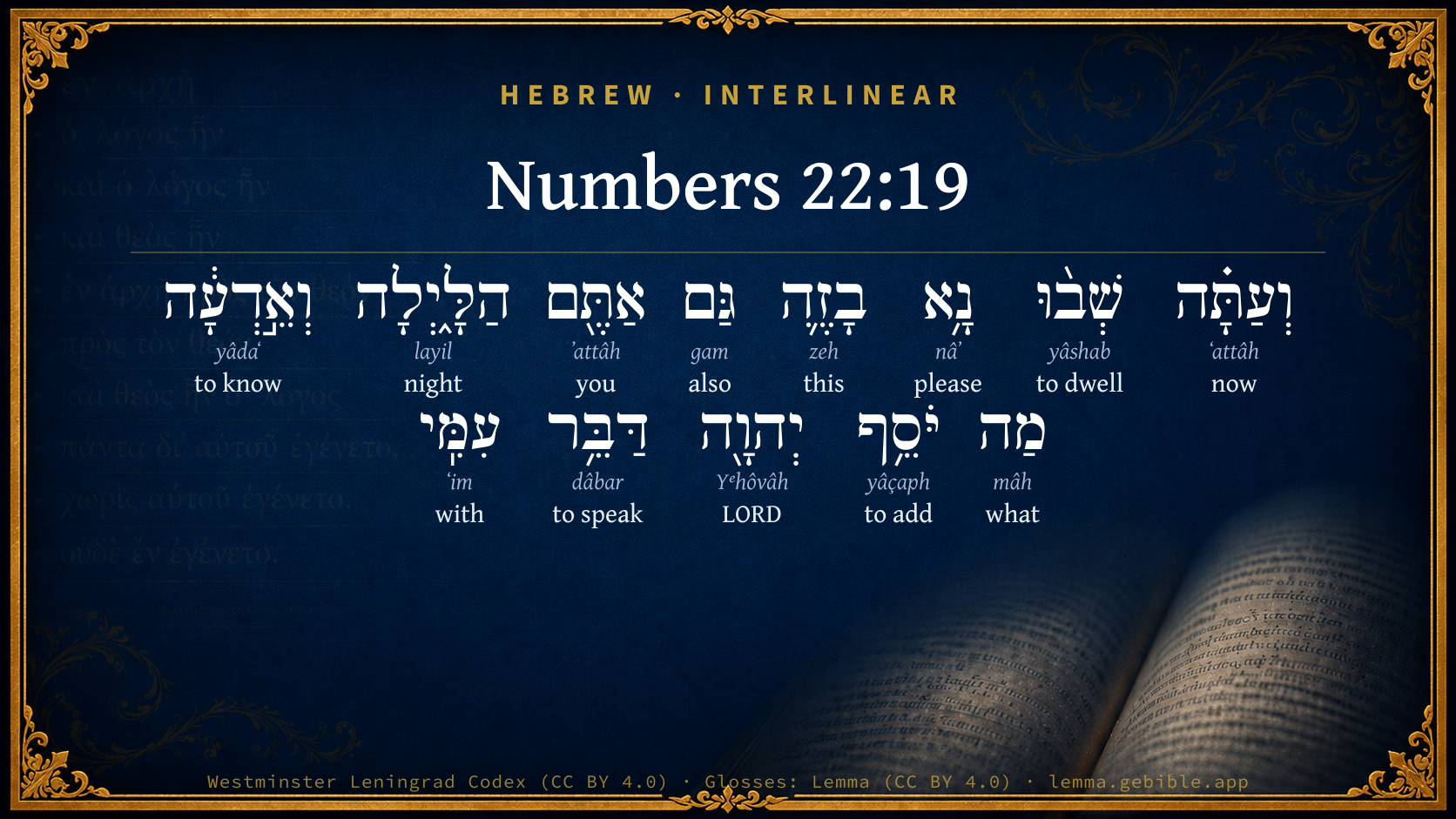
  1. וְעַתָּ֗ה ʻattâh H6258 “and · now” Conjunction + Adverb
  2. שְׁב֨וּ yâshab H3427 “dwell” Verb, Qal, Imperative, 2nd Person, Masculine, Plural
  3. נָ֥א nâʼ H4994 “please” Particle, Exhortation
  4. בָזֶ֛ה zeh H2088 “in/at · this” Preposition + Pronoun, Demonstrative, Masculine, Singular
  5. גַּם gam H1571 “also” Particle, Accusative
  6. אַתֶּ֖ם ʼattâh H859 “you” Pronoun, Personal, 2nd Person, Masculine, Plural
  7. הַלָּ֑יְלָה layil H3915 “the · night” Particle, Definite Article + Noun, Common, Masculine, Singular, Absolute
  8. וְאֵ֣דְעָ֔ה yâdaʻ H3045 “and · to know” Conjunction + Verb, Qal, Cohortative, 1st Person, Common, Singular
  9. מַה mâh H4100 “what” Particle, Interrogative
  10. יְהוָ֖ה Yᵉhôvâh H3068 “LORD” Noun, Proper
  11. דַּבֵּ֥ר dâbar H1696 “to speak” Verb, Piel, Infinitive Construct
  12. עִמִּֽי ʻim H5973 “with · me” Preposition + Suffix, Personal, 1st Person, Common, Singular

About this verse

These counts appear in no published source. They are computed here, from the morphology-tagged text and Lemma’s own curated glosses. What Lemma adds →

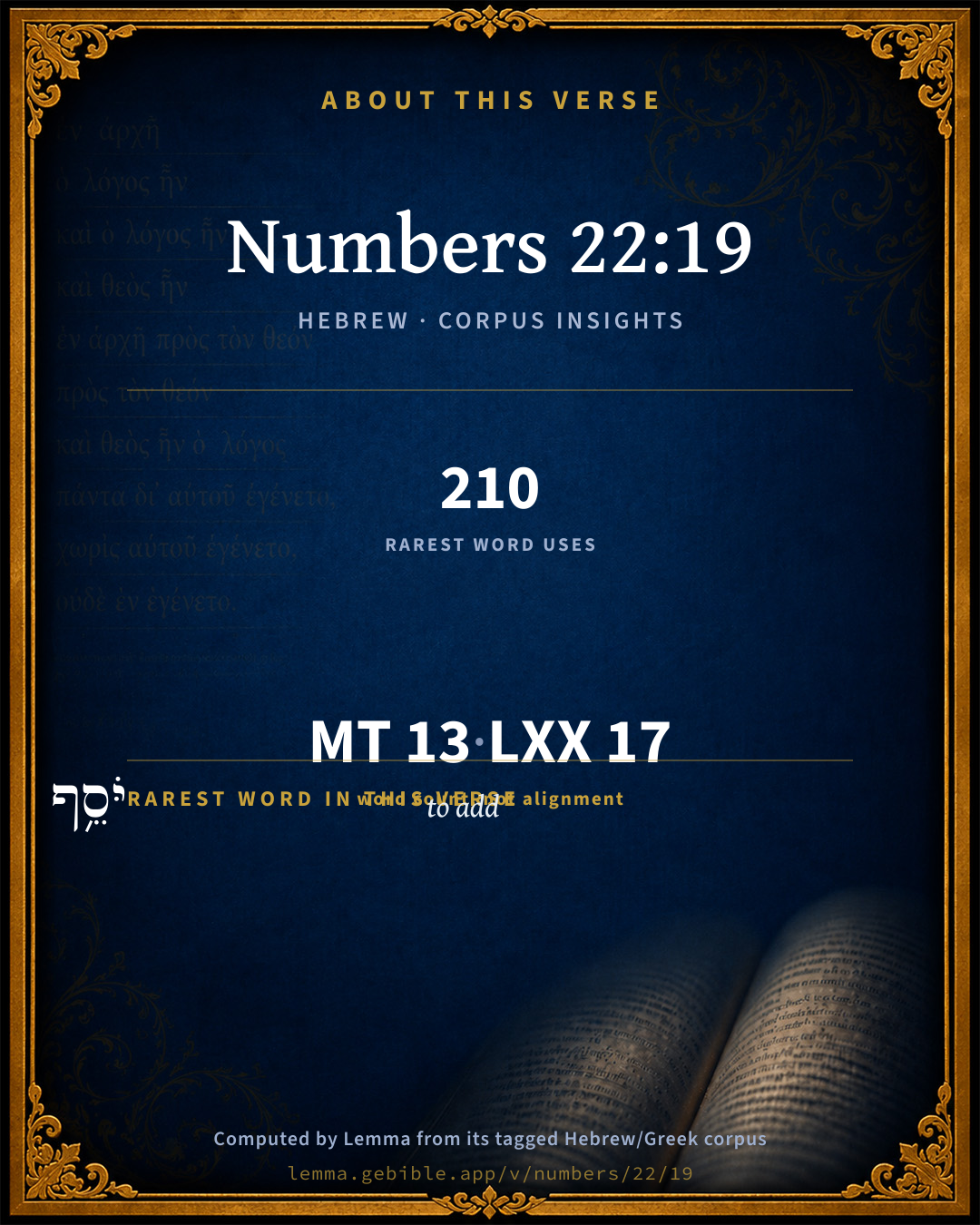
13
words
13
distinct lemmas
Pentateuch
section

Grammatical profile

  • 4 verbs
  • 2 nouns
  • 2 pronouns
  • 1 preposition
  • 1 adverb
  • 3 particles

Verb forms

  • שְׁב֨וּ Qal · Imperative
  • וְאֵ֣דְעָ֔ה Qal · Cohortative
  • יֹּסֵ֥ף Hiphil · Imperfect
  • דַּבֵּ֥ר Piel · Infinitive Construct

Hebrew & Septuagint length

In English translation the verse runs 19 words from the Hebrew and 21 from the Septuagint (LXX English) — closely comparable.

A rough comparison of the two English renderings, which tokenize alike — not a word-level alignment.

Word counts can differ between the Hebrew and the Greek without any difference in meaning — e.g. the Hebrew direct-object marker אֵת has no separate Greek word, and Greek often adds the article ὁ.

In the original languages it is 13 Hebrew tokens and 17 Greek tokens — but the two are counted differently (Hebrew bundles its prefixes and suffixes into one token; the Greek is in lemma form), so that isn’t a like-for-like length.

Cross-references

5

Topical passages linked to Numbers 22:19 in the Treasury of Scripture Knowledge — connected by theme and wording, ordered by reader-vote popularity; previews shown in the World English Bible.

  • Jude 1:11 Woe to them! For they went in the way of Cain, and ran riotously in the error of Balaam for hire, and perished in Korah's rebellion.
  • 1 Timothy 6:9–10 But those who are determined to be rich fall into a temptation and a snare and many foolish and harmful lusts, such as drown men in ruin and destruction.
  • 2 Peter 2:3 In covetousness they will exploit you with deceptive words: whose sentence now from of old doesn't linger, and their destruction will not slumber.
  • 2 Peter 2:15 forsaking the right way, they went astray, having followed the way of Balaam the son of Beor, who loved the wages of wrong-doing;
  • Numbers 22:7–8 The elders of Moab and the elders of Midian departed with the rewards of divination in their hand; and they came to Balaam, and spoke to him the words of Balak.

Cross-references courtesy of OpenBible.info (CC BY 4.0).

Hebrew and Greek witnesses Masoretic Hebrew ↔ Greek Septuagint

The same verse in the two great witnesses to the Old Testament, shown verse-for-verse.

These are two independent witnesses, not word-aligned to each other, and the Septuagint is shown in lemma (dictionary) form.

Hebrew Numbers 22:19 Masoretic · Westminster Leningrad Codex

וְעַתָּ֗ה שְׁב֨וּ נָ֥א בָזֶ֛ה גַּם אַתֶּ֖ם הַלָּ֑יְלָה וְאֵ֣דְעָ֔ה מַה יֹּסֵ֥ף יְהוָ֖ה דַּבֵּ֥ר עִמִּֽי

Now therefore, please wait also here this night, that I may know what Yahweh will speak to me more.

World English Bible · Public Domain

Greek LXX Numbers 22:19 Septuagint · lemma form

καί νῦν ὑπομένω αὐτοῦ καί σύ ὁ νύξ οὗτος καί γιγνώσκω τίς προςτίθημι κύριος λαλέω πρός ἐγώ

And now do you⌃ also wait here this night, and I shall know what the Lord will yet say to me.

LXX2012 (modern English Septuagint) · Public Domain

Hebrew: Westminster Leningrad Codex (CC BY 4.0). Greek: Septuagint (public domain); English from LXX2012 (modern English Septuagint) (Public Domain). How the Septuagint differs from the Hebrew →

Targum (Aramaic paraphrase)

2

The Targum is the ancient Jewish Aramaic paraphrase of the Hebrew Scriptures — an interpretive translation, not the Hebrew text itself. Onkelos (literal) and Pseudo-Jonathan (expansive) render the Torah, and Jonathan the Prophets. Coverage is partial: where no permissively-licensed English translation exists for a verse, only the Aramaic is shown. This is verse-level text, not a word-by-word alignment to the Hebrew.

  1. Targum Onkelos Torah (Genesis–Deuteronomy)
    וּכְעַן אוֹרִיכוּ כְעַן הָכָא אַף אַתּוּן בְּלֵילְיָא וְאִדַע מָה יוֹסֵף יְיָ לְמַלָלָא עִמִי

    (no public-domain English translation for this verse)

    Targum Onkelos — Aramaic: “Onkelos Genesis” (public domain); “Onkelos Exodus” (public domain); “Onkelos Leviticus” (public domain); “Onkelos Numbers” (public domain); “Onkelos Deuteronomy” (public domain). English: “Sefaria Community Translation” (CC0 1.0 (public-domain dedication)); “J.W. Etheridge. The Targums of Onkelos and Jonathan Ben Uzziel on the Pentateuch. London: Longmans, Green, 1862” (public domain). Text via Sefaria.

  2. Targum Pseudo-Jonathan Torah (Genesis–Deuteronomy)
    וּכְדוּן אַסְחָרוּ בְּבָעוּ הָכָא אוּף אַתּוּן בְּלֵילְיָא וְאִינְדַע מַה יוֹסִיף מֵימְרָא דַיְיָ לְמַלָלָא עִמִי

    But I entreat you to remain here this night also, that I may know what the Word of the Lord may yet speak with me.

    Targum Pseudo-Jonathan — Aramaic: “Targum Jonathan on Genesis” (public domain); “Targum Jonathan on Exodus” (public domain); “Targum Jonathan on Leviticus” (public domain); “Targum Jonathan on Numbers” (public domain); “Targum Jonathan on Deuteronomy” (public domain). English: “The Targum of Jonathan ben Uzziel, trans. J. W. Etheridge, London, 1862” (public domain). Text via Sefaria.

Commentary

Notes on Numbers 22:19 from classic Christian and Jewish commentators (each source and its license shown beneath its notes). The classic Christian expositions comment on the surrounding passage and are grouped to its opening verse, so a note may address several verses; the Jewish commentaries on the Tanakh (Rashi and others) are per-verse, so they appear only where the commentator wrote on this verse.

Lemma curates 59 commentaries, every one of them public domain or Creative Commons licensed, each selected and text-cleaned for this edition rather than reprinted as found. About our sources →

Trapp's Complete Commentary

John Trapp

Num 22:19 Now therefore, I pray you, tarry ye also here this night, that I may know what the LORD will say unto me more.

Ver. 19. Tarry also now this night, &c.] Very loath he was to forego so fat a morsel. His mouth even watered, his fingers itched to be dealing with Balak. He therefore detains the messengers, and will try again what may be done for them.

John Trapp, A Commentary or Exposition upon All the Books of the Old and New Testament (1647–1656) — public domain. Text from a community e-Sword module.

Joseph Benson's Commentary

Num 22:19. Tarry ye also this night — “Here,” says Bishop Butler, p. 123 of his Sermons at the Rolls, “the iniquity of his heart begins to disclose itself. An honest man would, without hesitation, have repeated his former answer, that he could not be guilty of so infamous a prostitution of the sacred character with which he was invested, as, in the name of a prophet, to curse those whom he knew to be blessed: but instead of this he desires the princes of Moab to tarry that night with him also; and, for the sake of the reward, deliberates whether, by some means or other, he might not be able to obtain leave to curse Israel.”

Joseph Benson's Commentary on the Old and New Testaments (1811–1818) — public domain. Text from a community e-Sword module.

Tyndale Open Study Notes

Tyndale Open Resources

22:19-20 Balaam agreed to inquire about the Lord’s wishes one more time. God allowed him to accompany Balak’s representatives but admonished him to do exactly what God commanded (cp. 22:35).

Tyndale Open Study Notes — © Tyndale Open Resources, licensed CC BY-SA 4.0. Text via the HelloAO Bible API.

Geneva Bible (1599)

Geneva Bible translators

Because he tempted God to require him contrary to his commandment, his petition was granted, but it turned to his own condemnation.

Geneva Bible (1599) marginal notes — public domain. Text via Bolls.life.

Jamieson, Fausset & Brown

Robert Jamieson, A. R. Fausset & David Brown

tarry ye also here this night, that I may know what the Lord will say unto me more--The divine will, as formerly declared, not being according to his desires, he hoped by a second request to bend it, as he had already bent his own conscience, to his ruling passions of pride and covetousness. The permission granted to Balaam is in accordance with the ordinary procedure of Providence. God often gives up men to follow the impulse of their own lusts; but there is no approval in thus leaving them to act at the prompting of their own wicked hearts (Jos 13:27).

Jamieson, Fausset & Brown — Commentary Critical and Explanatory on the Whole Bible (1871) — public domain (CC PDM 1.0). Text via the HelloAO Bible API.

Adam Clarke's Commentary

Verse 19. What the Lord will say unto me more.] He did not know but God might make a farther discovery of his will to him, and therefore he might very innocently seek farther information.

Adam Clarke's Commentary on the Bible (1810–1826) — public domain. Text from a community e-Sword/MySword module.

Ellicott's Commentary for English Readers

(19) Tarry ye also here this night.—Balaam knew that God was “not a man, that he should lie; neither the son of man, that he should repent” (Num_23:19); and yet he indulged the vain expectation that he might be allowed to curse those whom God had declared to be blessed.

A Bible Commentary for English Readers, edited by Charles John Ellicott (1878–1897) — public domain. Text from a community e-Sword module.

The Cambridge Bible for Schools and Colleges

gen. ed. J. J. S. Perowne

19. Balaam had learnt (Num_22:12) that Israel was a people on whom God’s blessing rested. It was therefore impossible for him to go and curse them. But when Balak’s more splendid retinue of princes travelled all the way to Mesopotamia to beg him again to come, he asked God again whether he might go, not to curse but to deliver a divine message whatever it might prove to be. And on his arrival he immediately told Balak that this was the purpose for which he had come (Num_22:38).

The Cambridge Bible for Schools and Colleges (gen. ed. J. J. S. Perowne; Cambridge University Press, 1878–1918) — public domain. Text from a community e-Sword module.

John Gill's Exposition

And God's anger was kindled because he went,.... Though he had given him leave to go; but then it was upon condition that the princes called him to go with them, whereas he went without their call, and did not wait for it; and besides, he did not acquaint them, as he did not the messengers before, of what God had said, that he should not curse Israel, nor say anything contrary to this his will, which, had he told them, they would not have taken him with them; moreover, he went with an intention, with a good will to curse Israel, which must be displeasing to God, who knew his heart; so the Targum of Jonathan,"and the anger of the Lord was strong, because he went to curse them;''likewise, though he had a permission to go, it was in an angry manner, and was not agreeable to the Lord he should go, and therefore should not have gone notwithstanding; or, at least, he might expect some marks of the divine displeasure; so Jarchi observes, he saw that the thing was evil in the eyes of the Lord, or displeasing to him, and yet he desired it; just as the people of Israel, when the Lord bid them go up and possess the land, which case Aben Ezra instances in; they desired persons might be sent before hand to spy out the land, which, though permitted, they smarted for it: for not whatsoever God permits is well pleasing to him; besides, the words may be rendered (h), "when he went", or, "as he was going"; and so not a reason of the Lord's anger, but expresses when it was kindled or broke forth:

and the angel of the Lord stood in the way for an adversary against him; that this was not a created angel, one of the ministering spirits, but the eternal one, the angel of Jehovah's presence, appears from Num 22:35 that went before the people of Israel in the wilderness, not only to guide but to guard and protect them; and who was an adversary to their adversaries, and at all times stood up for their help and assistance against all those that hated and opposed them: Jarchi calls him an angel of mercy, who would have restrained Balaam from sinning, that he might not sin and perish, and so was rather a friend than an adversary, had he attended to him:

now he was riding upon his ass, and his two servants were with him; who, the Targum of Jonathan says, were Jannes and Jambres, the magicians of Egypt, of whom see Ti2 3:8 these only were with him, the princes of Midian on some account or another being separated from him.

(h) "quum iret", Noldius, p. 403.

John Gill's Exposition of the Whole Bible (1746–1763) — public domain (CC PDM 1.0). Text via the HelloAO Bible API.

Albert Barnes' Notes on the Bible

Ye also - i. e., as the other envoys before you. Had Balaam possessed a sincere spirit of obedience, he would have found in the first instructions Num 22:12 a final decision upon the matter. His hypocritical importunity with God when the fresh messengers came from Balak demonstrates his aversion to God’s declared will.

Albert Barnes' Notes on the Bible (1834–1885) — public domain. Text from a community e-Sword/MySword module.

Haydock's Catholic Bible Commentary

To stay. His desiring them to stay, after he had been fully informed already that it was not God’s will he should go, came from the inclination he had to gratify Balac for the sake of worldly gain. And this perverse disposition God punished by permitting him to go, (though not to curse the people, as he would willingly have done) and suffering him to fall still deeper and deeper into sin, till he came at last to give that abominable counsel against the people of God, which ended in his own destruction. So sad a thing it is to indulge a passion for money. (Challoner) (St. Augustine, q. 48.) --- Philo (de vita, Mos. i) thinks that Balaam feigned this leave of God, ver. 22. (Calmet)

George Leo Haydock (1774–1849), Haydock's Catholic Family Bible and Commentary, 1859 edition — public domain. Excludes Psalms (Douay-Rheims chapter numbering differs from Protestant) and Deuterocanonical books (Catholic canon only).

Matthew Poole's English Annotations

Possibly he may change his mind, or yield to my renewed suit. Thus he sought to make God and his conscience stoop to the service of his pride and covetousness, which was abominable.

Matthew Poole's English Annotations on the Holy Bible (1683–1685) — public domain. Text from a community e-Sword/MySword module.

Whedon's Commentary on the Bible

Daniel D. Whedon

19. What the Lord will say unto me more — The more desired by Balaam was evidently a different communication, permitting him to go. In this he shows that he rests not in God’s will plainly revealed before. His safety lay in a perfect conformity of his desires to that will by the entire consecration of his soul to Jehovah, so that he could have no joy but in pleasing him. Balaam tempted God by this second consultation, prompted by a dissatisfaction with the prohibition already uttered. Gal_1:8, note.

Daniel D. Whedon (gen. ed.), Commentary on the Old and New Testaments (1874–1909) — public domain. Text from a community e-Sword module.

Rashi

Rabbi Shlomo Yitzchaki (Rashi)

גם אתם [ABIDE] ALSO YE [HERE] — His mouth tripped him up (unwittingly he spoke the truth): you also in the end will go away disappointed as the former princes (Midrash Tanchuma, Balak 6).

מה יסף WHAT MORE [THE LORD WILL SAY TO ME] — He certainly will not change His words from a blessing to a curse: I only hope that he will not add a further blessing. — He here prophesied that He would in the end give them a further blessing by his agency (Midrash Tanchuma, Balak 6).

Rashi on the Tanakh — English translations: “The Judaica Press complete Tanach with Rashi, translated by A. J. Rosenberg” (CC BY 4.0); “Pentateuch with Rashi's commentary by M. Rosenbaum and A.M. Silbermann, 1929-1934” (public domain); “The Metsudah Tanach series, Lakewood, N.J” (CC BY 4.0); and “The Book of Joshua, Metsudah Publications, 1997” (CC BY 4.0). Text via Sefaria.

Lesson kit

Teaching starters — assembled from the data on this page, not authored interpretation. Every prompt links to the verse data it draws on. Edit before teaching.

Numbers, in the Pentateuch, opens this verse with 13 words (13 distinct Hebrew lemmas). Its most distinctive word is yâçaph (“to add”). A historical commentator’s framing appears above. Read the whole chapter for the surrounding context.

Discussion questions

  1. What does “to add” (yâçaph) contribute to the verse as a whole?
  2. Jude 1:11 shares this passage’s theme. How do the two illuminate each other?
  3. The translations on this page render this verse differently — a whole-verse word diff, not a word-by-word alignment. What might account for the different wordings?
  4. The verb «שְׁב֨וּ» is Qal Imperative. How does its form color the action?
  5. Reading how Trapp's Complete Commentary and Joseph Benson's Commentary read this verse, where do the two commentators agree and where do they part?

Things to notice

Reading settings

Reading text

Shown beneath each verse's original-language words.

Old Testament
Old Testament edition

Read the OT as the Masoretic Hebrew (MT) or the Greek Septuagint (LXX).

English shown for the Greek Septuagint (in the Hebrew ↔ Greek comparison).

Comparing translations? Open the Compare panel on any verse page to stack up to four side by side.