
2 Samuel 12:8

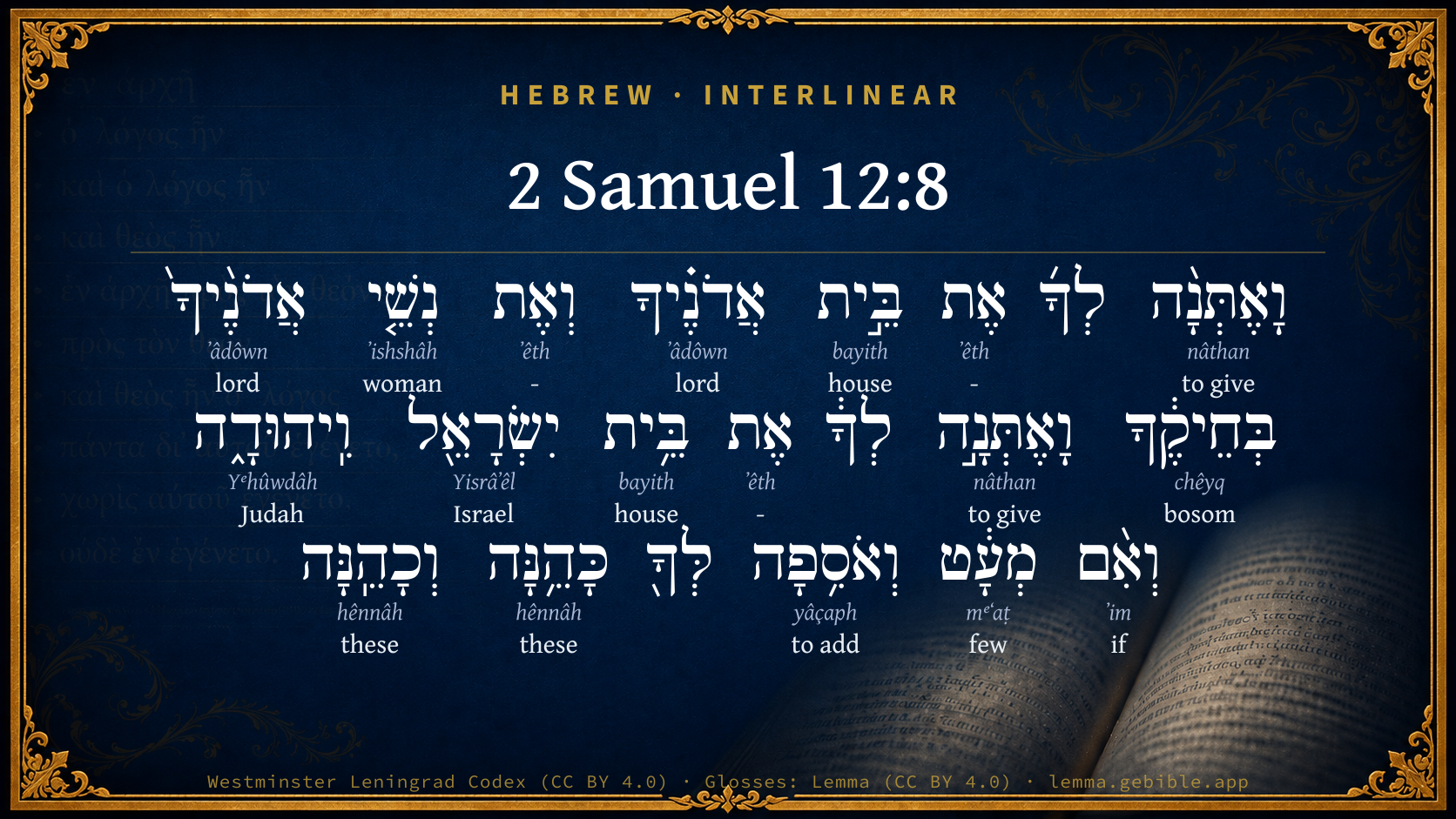
Hebrew (Westminster Leningrad Codex) 2 Samuel 12:8 appears in the Hebrew Old Testament. The text above is from the Westminster Leningrad Codex. Each word links to its Strong’s number, a concise gloss, and parsing drawn from the Open Scriptures Hebrew Bible morphology. Click any word for its full Brown-Driver-Briggs (BDB) entry.
Download image
Cite this verse

2 Samuel 12:8 (World English Bible). Public Domain. Lemma interlinear Bible study tool, https://lemma.gebible.app/v/2-samuel/12/8.

Show BibTeX & RIS
BibTeX
RIS
English Translation
I gave you your master's house, and your master's wives into your bosom, and gave you the house of Israel and of Judah; and if that would have been too little, I would have added to you many more such things.
World English Bible · Public Domain
Download a study sheet

One document with this verse’s original text, its word-by-word gloss line, the meaning frame, cross-references with their text, attributed commentary, and full source and license credits — printable, and it pastes into notes with its structure intact.

This verse Autodidact and up

Study sheet (.html) Plain text (.txt)

A passage Seminary Student

Up to 50 verses in one chapter. A passage sheet keeps up to 6 commentary sources and 12 cross-references per verse, in the order this page ranks them, and says so on the sheet whenever that leaves anything out. Ask for a single verse and you get the Autodidact verse sheet above.

Everything on this page stays free to read, with no account — the sheet is a download of what is already on screen, not access to it.

Want to remove ads? Support Godless Engineer
Compare translations 3

The same verse in 3 English versions, stacked beneath the original-language interlinear above. Click any original word for its lexicon entry.

Each is an independent rendering of the whole verse — the interlinear is not word-aligned to these translations.

Highlighted words mark where these versions differ — a whole-verse word diff, not a word-by-word alignment.

  • World English Bible Public Domain
    I gave you your master's house, and your master's wives into your bosom, and gave you the house of Israel and of Judah; and if that would have been too little, I would have added to you many more such things.
  • King James Version Public Domain
    And I gave thee thy master's house, and thy master's wives into thy bosom, and gave thee the house of Israel and of Judah; and if that had been too little, I would moreover have given unto thee such and such things.
  • unfoldingWord Literal Text CC BY-SA 4.0
    And I gave to you the house of your master, and the wives of your master into your lap, and I gave to you the house of Israel and Judah. And if little, then I would have added to you like them and like them.

unfoldingWord Literal Text — © unfoldingWord, licensed CC BY-SA 4.0. Word-aligned USFM3 via Door43 (git.door43.org/unfoldingWord/en_ult).

Versions to compare (up to 4)

3 of 4 selected

Show all 18 translations

Every available English version of this verse, each an independent rendering of the whole verse.

  • World English Bible Public Domain
    I gave you your master's house, and your master's wives into your bosom, and gave you the house of Israel and of Judah; and if that would have been too little, I would have added to you many more such things.
  • Berean Standard Bible Public Domain
    I gave your master’s house to you and your master’s wives into your arms. I gave you the house of Israel and Judah, and if that was not enough, I would have given you even more.
  • Majority Standard Bible Public Domain
    I gave your master’s house to you and your master’s wives into your arms. I gave you the house of Israel and Judah, and if that was not enough, I would have given you even more.
  • King James Version Public Domain
    And I gave thee thy master's house, and thy master's wives into thy bosom, and gave thee the house of Israel and of Judah; and if that had been too little, I would moreover have given unto thee such and such things.
  • American Standard Version (1901) Public Domain
    and I gave thee thy master's house, and thy master's wives into thy bosom, and gave thee the house of Israel and of Judah; and if that had been too little, I would have added unto thee such and such things.
  • Revised Version (1885) Public Domain
    and I gave thee thy master’s house, and thy master’s wives into thy bosom, and gave thee the house of Israel and of Judah; and if that had been too little, I would have added unto thee such and such things.
  • Geneva Bible (1599) Public Domain
    And gaue thee thy lordes house, and thy lords wiues into thy bosome, and gaue thee the house of Israel, and of Iudah, and would moreouer (if that had bene too litle) haue giuen thee such and such things.
  • Douay-Rheims (1899) Public Domain
    And gave thee thy master's house and thy master's wives into thy bosom, and gave thee the house of Israel and Juda: and if these things be little, I shall add far greater things unto thee.
  • Young's Literal Translation Public Domain
    and I give to thee the house of thy lord, and the wives of thy lord, into thy bosom, and I give to thee the house of Israel and of Judah; and if little, then I add to thee such and such `things'.
  • Literal Standard Version CC BY-SA 4.0
    and I give to you the house of your lord, and the wives of your lord, into your bosom, and I give the house of Israel and Judah to you; and if [that is] too little, then I add such and such [things] to you.
  • Unlocked Literal Bible CC BY-SA 4.0
    I gave you your master's house, and your master's wives into your arms. I also gave you the house of Israel and Judah. But if that had been too little, I would have given you many other things in addition.
  • unfoldingWord Literal Text CC BY-SA 4.0
    And I gave to you the house of your master, and the wives of your master into your lap, and I gave to you the house of Israel and Judah. And if little, then I would have added to you like them and like them.
  • Darby Bible Public Domain
    and I gave thee thy master's house, and thy master's wives into thy bosom, and gave thee the house of Israel and of Judah; and if [that] had been too little, I would moreover have given unto thee such and such things.
  • World Messianic Bible Public Domain
    I gave you your master’s house and your master’s wives into your bosom, and gave you the house of Israel and of Judah; and if that would have been too little, I would have added to you many more such things.
  • Webster's Bible Public Domain
    And I gave thee thy master's house, and thy master's wives into thy bosom, and gave thee the house of Israel and of Judah; and if that had been too little, I would moreover have given to thee such and such things.
  • Free Bible Version CC BY-SA 4.0
    I gave your master's house to you and placed your master's wives in your lap. I gave you the kingdom of Israel and Judah, and if that hadn't been enough, I would have given you so much more.
  • Bible in Basic English Public Domain
    I gave you your master's daughter and your master's wives for yourself, and I gave you the daughters of Israel and Judah; and if that had not been enough, I would have given you such and such things.
  • JPS Tanakh (1917) Public Domain
    and I gave thee thy master's house, and thy master's wives into thy bosom, and gave thee the house of Israel and of Judah; and if that were too little, then would I add unto thee so much more.

Literal Standard Version (2020), Covenant Press — licensed CC BY-SA 4.0. Text via the HelloAO Bible API (eBible.org). Unlocked Literal Bible (unfoldingWord) — licensed CC BY-SA 4.0. Text via the HelloAO Bible API (eBible.org). unfoldingWord Literal Text — © unfoldingWord, licensed CC BY-SA 4.0. Word-aligned USFM3 via Door43 (git.door43.org/unfoldingWord/en_ult). Free Bible Version, Dr. Jonathan Gallagher — licensed CC BY-SA 4.0. Text via the HelloAO Bible API (eBible.org).

Word by word

More ways to search: Search by grammar → Find every occurrence → Compare this word →

Practice this passage: Drill this verse → Learn its vocabulary →

בְּחֵיקֶ֔ךָ
chêyq
H2436
“in/at · bosom · your”
Preposition + Noun, Common, Masculine, Singular, Construct + Suffix, Personal, 2nd Person, Masculine, Singular
Part of Speech
Preposition + Noun
Type
Common
Gender
Masculine
Number
Singular
State
Construct
Full BDB Definition

Origin: from an unused root, apparently meaning to inclose

TWOT: 629a

bosom, hollow, bottom, midst
  1. וָאֶתְּנָ֨ה nâthan H5414 “and · to give” Conjunction + Verb, Qal, Sequential Imperfect, 1st Person, Common, Singular + Suffix, h
  2. אֶת ʼêth H853 “-” Particle, Direct Object
  3. בֵּ֣ית bayith H1004 “house of” Noun, Common, Masculine, Singular, Construct
  4. אֲדֹנֶ֗יךָ ʼâdôwn H113 “lords · your” Noun, Common, Masculine, Plural, Construct + Suffix, Personal, 2nd Person, Masculine, Singular
  5. וְאֶת ʼêth H853 “and · -” Conjunction + Particle, Direct Object
  6. נְשֵׁ֤י ʼishshâh H802 “women of” Noun, Common, Feminine, Plural, Construct
  7. אֲדֹנֶ֨יךָ֙ ʼâdôwn H113 “lords · your” Noun, Common, Masculine, Plural, Construct + Suffix, Personal, 2nd Person, Masculine, Singular
  8. וָאֶתְּנָ֣ה nâthan H5414 “and · to give” Conjunction + Verb, Qal, Sequential Imperfect, 1st Person, Common, Singular + Suffix, h
  9. אֶת ʼêth H853 “-” Particle, Direct Object
  10. בֵּ֥ית bayith H1004 “house of” Noun, Common, Masculine, Singular, Construct
  11. יִשְׂרָאֵ֖ל Yisrâʼêl H3478 “Israel” Noun, Proper
  12. וִֽיהוּדָ֑ה Yᵉhûwdâh H3063 “and · Judah” Conjunction + Noun, Proper
  13. וְאִ֨ם ʼim H518 “and · if” Conjunction + Conjunction
  14. מְעָ֔ט mᵉʻaṭ H4592 “few” Noun, Common, Masculine, Singular, Absolute
  15. וְאֹסִ֥פָה yâçaph H3254 “and · to add” Conjunction + Verb, Hiphil, Cohortative, 1st Person, Common, Singular
  16. כָּהֵ֥נָּה hênnâh H2007 “like/as · these” Preposition + Pronoun, Personal, 3rd Person, Feminine, Singular
  17. וְכָהֵֽנָּה hênnâh H2007 “and · like/as · these” Conjunction + Preposition + Pronoun, Personal, 3rd Person, Feminine, Plural

About this verse

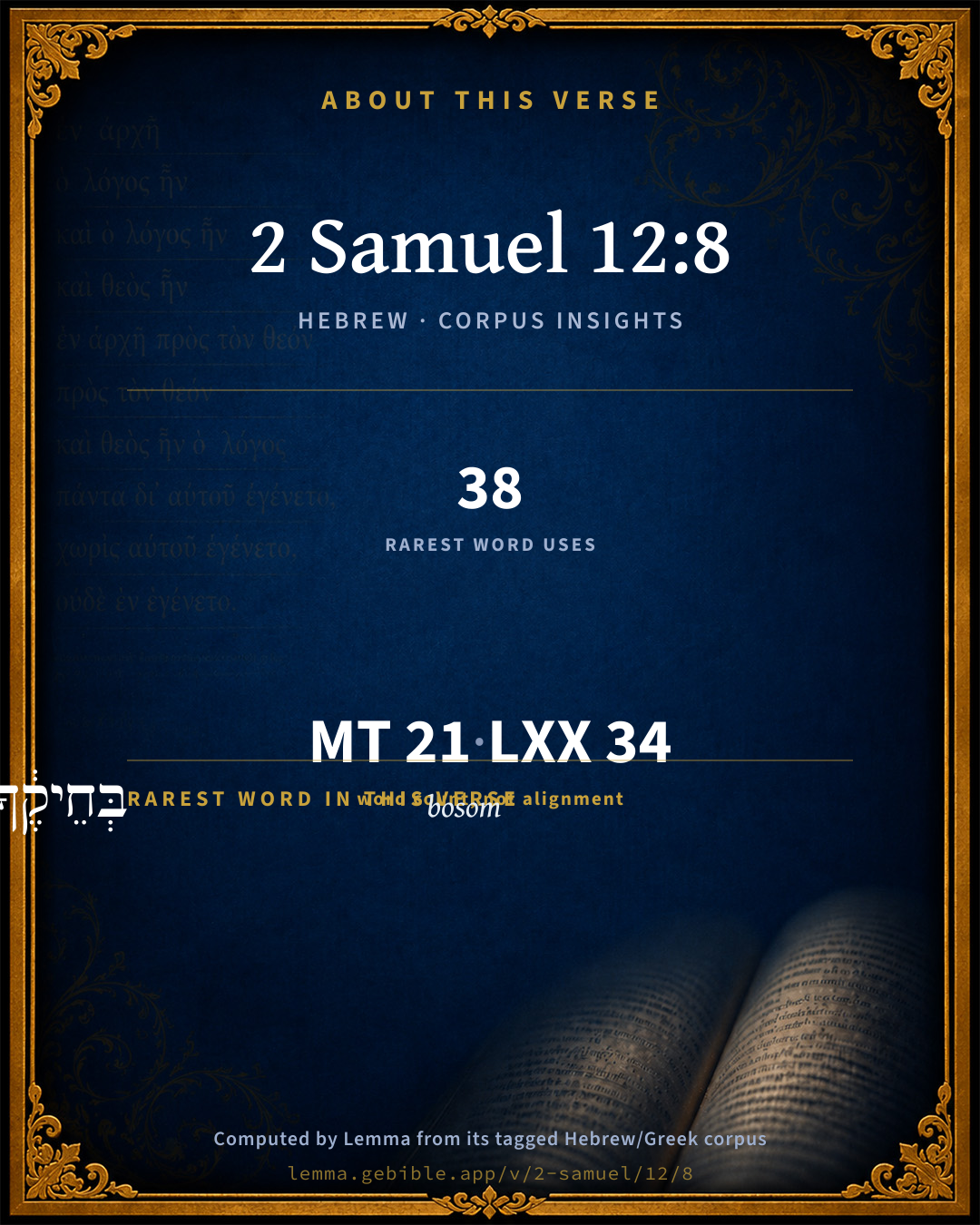
These counts appear in no published source. They are computed here, from the morphology-tagged text and Lemma’s own curated glosses. What Lemma adds →

21
words
12
distinct lemmas
Historical
section

Shared distinctive vocabulary

בְּחֵיקֶ֔ךָ bosom H2436 occurs in 34 verses of the Hebrew Bible. Also found in:

Grammatical profile

  • 3 verbs
  • 9 nouns
  • 2 pronouns
  • 3 prepositions
  • 1 conjunction
  • 3 particles

Verb forms

  • וָאֶתְּנָ֨ה Qal · Sequential Imperfect
  • וָאֶתְּנָ֣ה Qal · Sequential Imperfect
  • וְאֹסִ֥פָה Hiphil · Cohortative

Repetition

Words recur within this verse — often emphatic in Hebrew:

  • וָאֶתְּנָ֨ה to give H5414 ×2
  • בֵּ֣ית house H1004 ×2
  • אֲדֹנֶ֗יךָ lord H113 ×2
  • כָּהֵ֥נָּה these H2007 ×2

Hebrew & Septuagint length

In English translation the verse runs 41 words from the Hebrew and 42 from the Septuagint (LXX English) — closely comparable.

A rough comparison of the two English renderings, which tokenize alike — not a word-level alignment.

Word counts can differ between the Hebrew and the Greek without any difference in meaning — e.g. the Hebrew direct-object marker אֵת has no separate Greek word, and Greek often adds the article ὁ.

In the original languages it is 21 Hebrew tokens and 34 Greek tokens — but the two are counted differently (Hebrew bundles its prefixes and suffixes into one token; the Greek is in lemma form), so that isn’t a like-for-like length.

Cross-references

10

Topical passages linked to 2 Samuel 12:8 in the Treasury of Scripture Knowledge — connected by theme and wording, ordered by reader-vote popularity; previews shown in the World English Bible.

  • Psalms 84:11 For Yahweh God is a sun and a shield. Yahweh will give grace and glory. He withholds no good thing from those who walk blamelessly.
  • 2 Samuel 9:7 David said to him, "Don't be afraid of him; for I will surely show you kindness for Jonathan your father's sake, and will restore you all the land of Saul your father; and you shall eat bread at my table continually."
  • Romans 8:32 He who didn't spare his own Son, but delivered him up for us all, how would he not also with him freely give us all things?
  • 2 Samuel 2:4 The men of Judah came, and there they anointed David king over the house of Judah. They told David, saying, The men of Jabesh Gilead were those who buried Saul.
  • 2 Samuel 5:5 In Hebron he reigned over Judah seven years and six months; and in Jerusalem he reigned thirty-three years over all Israel and Judah.
  • 2 Samuel 7:19 This was yet a small thing in your eyes, Lord Yahweh; but you have spoken also of your servant's house for a great while to come; and this [too] after the manner of men, Lord Yahweh!
  • 2 Samuel 12:11 This is what Yahweh says: 'Behold, I will raise up evil against you out of your own house; and I will take your wives before your eyes, and give them to your neighbor, and he will lie with your wives in the sight of this sun.
  • 1 Samuel 15:19 Why then didn't you obey the voice of Yahweh, but flew on the spoil, and did that which was evil in the sight of Yahweh?"
  • 1 Kings 2:22 King Solomon answered his mother, Why do you ask Abishag the Shunammite for Adonijah? ask for him the kingdom also; for he is my elder brother; even for him, and for Abiathar the priest, and for Joab the son of Zeruiah.
  • Psalms 86:15 But you, Lord, are a merciful and gracious God, Slow to anger, and abundant in loving kindness and truth.

Cross-references courtesy of OpenBible.info (CC BY 4.0).

Hebrew and Greek witnesses Masoretic Hebrew ↔ Greek Septuagint

The same verse in the two great witnesses to the Old Testament, shown verse-for-verse.

These are two independent witnesses, not word-aligned to each other, and the Septuagint is shown in lemma (dictionary) form.

Hebrew 2 Samuel 12:8 Masoretic · Westminster Leningrad Codex

וָאֶתְּנָ֨ה לְךָ֜ אֶת בֵּ֣ית אֲדֹנֶ֗יךָ וְאֶת נְשֵׁ֤י אֲדֹנֶ֨יךָ֙ בְּחֵיקֶ֔ךָ וָאֶתְּנָ֣ה לְךָ֔ אֶת בֵּ֥ית יִשְׂרָאֵ֖ל וִֽיהוּדָ֑ה וְאִ֨ם מְעָ֔ט וְאֹסִ֥פָה לְּךָ֖ כָּהֵ֥נָּה וְכָהֵֽנָּה

I gave you your master's house, and your master's wives into your bosom, and gave you the house of Israel and of Judah; and if that would have been too little, I would have added to you many more such things.

World English Bible · Public Domain

Greek LXX 2 Samuel 12:8 Septuagint · lemma form

καί δίδωμι σύ ὁ οἶκος ὁ κύριος σύ καί ὁ γυνή ὁ κύριος σύ ἐν ὁ κόλπος σύ καί δίδωμι σύ ὁ οἶκος ἰσραήλ καί ιουδα καί εἰ μικρός εἰμί προςτίθημι σύ κατά οὗτος

and I gave you the house of your lord, and the wives of your lord into your bosom, and I gave to you the house of Israel and Juda; and if that had been little, I would have given you yet more.

LXX2012 (modern English Septuagint) · Public Domain

On this verse, Haydock's Catholic Bible Commentary discusses the Septuagint’s reading. Read the note in Commentary ↓

Hebrew: Westminster Leningrad Codex (CC BY 4.0). Greek: Septuagint (public domain); English from LXX2012 (modern English Septuagint) (Public Domain). How the Septuagint differs from the Hebrew →

Targum (Aramaic paraphrase)

1

The Targum is the ancient Jewish Aramaic paraphrase of the Hebrew Scriptures — an interpretive translation, not the Hebrew text itself. Onkelos (literal) and Pseudo-Jonathan (expansive) render the Torah, and Jonathan the Prophets. Coverage is partial: where no permissively-licensed English translation exists for a verse, only the Aramaic is shown. This is verse-level text, not a word-by-word alignment to the Hebrew.

  1. Targum Jonathan Prophets (Joshua–Malachi)
    וִיהָבֵית לָךְ יַת בֵּית רִבּוֹנָךְ וְיַת נְשֵׁי רִבּוֹנָךְ בְּחֵיקָךְ וִיהָבֵית לָךְ יַת בֵּית יִשְׂרָאֵל וִיהוּדָה וְאִם זְעֵיר וְאוֹסִיף לָךְ כְּאִלֵין וּכְאִלֵין:

    (no public-domain English translation for this verse)

    Targum Jonathan — Aramaic: “Mikraot Gedolot” (public domain). English: “Sefaria Community Translation” (CC0 1.0 (public-domain dedication)); “London "Chaldee Paraphrase," 1871” (public domain). Text via Sefaria.

Commentary

Notes on 2 Samuel 12:8 from classic Christian and Jewish commentators (each source and its license shown beneath its notes). The classic Christian expositions comment on the surrounding passage and are grouped to its opening verse, so a note may address several verses; the Jewish commentaries on the Tanakh (Rashi and others) are per-verse, so they appear only where the commentator wrote on this verse.

Lemma curates 59 commentaries, every one of them public domain or Creative Commons licensed, each selected and text-cleaned for this edition rather than reprinted as found. About our sources →

Trapp's Complete Commentary

John Trapp

2Sa 12:8 And I gave thee thy master’s house, and thy master’s wives into thy bosom, and gave thee the house of Israel and of Judah; and if [that had been] too little, I would moreover have given unto thee such and such things.

Ver. 8. And I gave thee thy master’s house.] What! to hire thee hereby to be thus wicked? Shouldst thou again, after such deliverances and benefices, break my commandments, {Ezr 9:13-14} kick against my bowels, fight against me with mine own weapons, &c.

And thy master’s wives into thy bosom.] That is, Into thy subjection: for David could never have married the wives of Saul, since that had been incest: though some think that he might lawfully have married any of them save Michal’s mother; but yet never actually did, because they were too old.

And gave thee the house of Israel.] Qui exprobat reposcit. If God upbraid any man, it is a sign of great anger, and of a danger that he will ere long take his own again and be gone. {Hos 2:2-3}

John Trapp, A Commentary or Exposition upon All the Books of the Old and New Testament (1647–1656) — public domain. Text from a community e-Sword module.

Joseph Benson's Commentary

2Sa 12:8. I gave thee thy master’s house — All that pertained to him as a king, which came, of course, to David, as his successor. Thy master’s wives into thy bosom — For the wives of a king went along with his lands and goods unto his successor, it being unlawful for the widow of a king to be wife to any but a king, as appears by the story of Adonijah. The expression in the text, however, does not necessarily signify that David married any of them; nor have we any proof that he did. Indeed, it is doubtful whether he could consistently with the law of God. See Lev 18:8; Lev 18:15. The meaning seems only to be, that God put them into David’s power, together with Saul’s house and other property. And gave thee the house of Israel — Dominion over the twelve tribes. And if that had been too little, &c. — He needed but have asked, and God would have given him all he could have reasonably desired.

Joseph Benson's Commentary on the Old and New Testaments (1811–1818) — public domain. Text from a community e-Sword module.

Tyndale Open Study Notes

Tyndale Open Resources

12:8 His wives were probably the concubines of Saul’s harem (cp. 3:7). The phrase could refer to Saul’s wife Ahinoam, although David probably married a different woman with the same name (cp. 1 Sam 14:50; 25:43).

Tyndale Open Study Notes — © Tyndale Open Resources, licensed CC BY-SA 4.0. Text via the HelloAO Bible API.

Geneva Bible (1599)

Geneva Bible translators

For David succeeded Saul in his kingdom.

The Jews understand this of Eglah and Michal, or of Rizpah and Michal.

That is, greater things than these: for God’s love and benefits increase toward his, if by their ingratitude they stay him not.

Geneva Bible (1599) marginal notes — public domain. Text via Bolls.life.

Jamieson, Fausset & Brown

Robert Jamieson, A. R. Fausset & David Brown

I gave thee thy master's house, and thy master's wives--The phraseology means nothing more than that God in His providence had given David, as king of Israel, everything that was Saul's. The history furnishes conclusive evidence that he never actually married any of the wives of Saul. But the harem of the preceding king belongs, according to Oriental notions, as a part of the regalia to his successor.

Jamieson, Fausset & Brown — Commentary Critical and Explanatory on the Whole Bible (1871) — public domain (CC PDM 1.0). Text via the HelloAO Bible API.

Adam Clarke's Commentary

Verse 8. Thy master's wives into thy bosom] Perhaps this means no more than that he had given him absolute power over every thing possessed by Saul; and as it was the custom for the new king to succeed even to the wives and concubines, the whole harem of the deceased king, so it was in this case; and the possession of the wives was a sure proof that he had got all regal rights. But could David, as the son-in-law of Saul, take the wives of his father-in-law? However, we find delicacy was seldom consulted in these cases; and Absalom lay with his own father's wives in the most public manner, to show that he had seized on the kingdom, because the wives of the preceding belonged to the succeeding king, and to none other.

Adam Clarke's Commentary on the Bible (1810–1826) — public domain. Text from a community e-Sword/MySword module.

Ellicott's Commentary for English Readers

(8) Thy master’s wives.—In 2Sa_12:7-8 the prophet enumerates the chief favours and blessings shown to David, and these are so brought out as to show not only his base ingratitude, but also the unreasonableness of this particular sin. We are told of only one wife of Saul (1Sa_14:50) and of one concubine (2Sa_3:7) who was taken by Abner. If he had others, David certainly could not have taken them until more than seven and a half years after Saul’s death. The prophet refers to the Oriental custom that the new king had a right to the harem of his predecessor.

A Bible Commentary for English Readers, edited by Charles John Ellicott (1878–1897) — public domain. Text from a community e-Sword module.

The Cambridge Bible for Schools and Colleges

gen. ed. J. J. S. Perowne

8. thy master’s house] His household and property. Cp. ch. 2Sa_9:7. thy master’s wives] It was lawful for the King, and for him only, to marry his predecessor’s wives. See note on ch. 2Sa_3:7. That David actually married any of Saul’s wives does not appear. Only one wife (1Sa_14:50) and one concubine (2Sa_3:7) of Saul’s are mentioned.

The Cambridge Bible for Schools and Colleges (gen. ed. J. J. S. Perowne; Cambridge University Press, 1878–1918) — public domain. Text from a community e-Sword module.

John Gill's Exposition

Wherefore hast thou despised the commandment of the Lord, to do evil in his sight?.... The commandment referred to is the law of God, particularly the sixth and seventh precepts of it, Exo 20:13; which David had shown no regard unto, and by his breaking them had slighted and despised them:

thou hast killed Uriah the Hittite with the sword; and so had despised and broken the sixth command, Exo 20:13; for though he had not taken away his life with his own hand, he had plotted and contrived it, and had given orders to put him in such a position as would issue in it:

and hast taken his wife to be thy wife; after he had defiled her, being another man's wife, and had taken such unlawful methods to make her his wife, whereby he had despised and broken both the sixth and the seventh commands, Exo 20:13,

and hast slain him with the sword of the children of Ammon; though he had not put him to death with his own sword, he had done that which was as bad or worse in some respects, he had exposed him to the sword of the Ammonites, by which it was taken away; and not his only, but that of some of the Israelites also, which gave that uncircumcised people reason to triumph over the children of Israel, and even to blaspheme the God of Israel.

John Gill's Exposition of the Whole Bible (1746–1763) — public domain (CC PDM 1.0). Text via the HelloAO Bible API.

Albert Barnes' Notes on the Bible

And thy master’s wives ... - According to Eastern custom, the royal harem was a part of the royal inheritance. The prophets spoke in such matters according to the received opinions of their day, and not always according to the abstract rule of right. (Compare Mat 19:4-9.)

Albert Barnes' Notes on the Bible (1834–1885) — public domain. Text from a community e-Sword/MySword module.

Haydock's Catholic Bible Commentary

Wives. We know of none that David married. But, as king, he enjoyed alone that privilege. (Grotius) (Chap. ii. 7., and xvi. 21.) --- Unto thee. Hebrew, "I would have given thee such and such." (Calmet) --- Septuagint, "I will moreover give thee like unto these;" a continuation of prosperity. (Haydock) --- This singular love, which God was still disposed to manifest unto David, touched his heart with peculiar force. (Salien)

George Leo Haydock (1774–1849), Haydock's Catholic Family Bible and Commentary, 1859 edition — public domain. Excludes Psalms (Douay-Rheims chapter numbering differs from Protestant) and Deuterocanonical books (Catholic canon only).

Matthew Poole's English Annotations

Thy master’s wives, or, women, as that word is elsewhere used; as Num 31:18. And though we read not a word of God’s giving, or of David’s taking, any of Saul’s wives into his bosom; or, which is all one, into his bed; yet (which I think to be aimed at here) it might be according to the manner of that time, that the wives and concubines of the precedent king belonged to the successor, to be at least at his dispose. And to pretend to them, was interpreted little less than pretending to the crown; which made it fatal to Adonijah to ask Abishag, 1Ki 2:23; and to Abner to be suspected for Rizpah, 2Sa 3:8. And Absalom, usurping the crown, usurped the concubines also; which is looked on as a crime unpardonable, 2Sa 16:21. Nor would this have been reckoned amongst the mercies and blessings which God here is said to give him, and which are opposed to that which he sinfully took. But we do read, that Merab, Saul’s daughter, was given to him for his wife by Saul’s promise, and consequently by God’s grant; though afterwards Saul perfidiously gave her to another man; and that Michal, the other daughter, was actually given to him, 1Sa 18. And it is very possible that some other of David’s wives were nearly related to the house of Saul; whereby David might design to enlarge and strengthen his interest in the kingdom; although there is no absolute necessity of restraining this to Saul, seeing the word is plural, masters, and may belong to others also, who sometimes were owned by David as his masters, lords, or superiors, such as Nabal was, and some others not elsewhere named might be, whose houses and wives, or, at least, women, God might give to David. Such and such things; such other things as thou hadst wanted, or in reason desired.

Matthew Poole's English Annotations on the Holy Bible (1683–1685) — public domain. Text from a community e-Sword/MySword module.

Whedon's Commentary on the Bible

Daniel D. Whedon

8. Thy master’s wives — In the East, when the king died or was superseded by another, his successor received his wives and concubines together with the kingdom. Hence for Absalom to go in unto his father’s concubines in the sight of all Israel (2Sa_16:21-22) was to be a proof to Israel that he had taken possession of all the prerogatives of the kingdom. Thus David had succeeded Saul in all the rights of the kingdom, though we have no record of his touching any of his wives or concubines.

Such and such things — Literally, according to these and according to those; that is, whatsoever thou mightest have desired.

Daniel D. Whedon (gen. ed.), Commentary on the Old and New Testaments (1874–1909) — public domain. Text from a community e-Sword module.

The Pulpit Commentary

I gave thy master"s wives into thy bosom. These words probably mean that, as the whole possessions of his predecessor belonged, by Oriental custom, to the next occupant of the throne, David might have claimed the entire household and the wives both of Saul and Ishbosbeth as his own, though apparently he had not done so. As far as we know, Saul had but one wife (1Sa_14:50) and one concubine, Rizpah. (2Sa_3:7) Of Ishbosheth"s family arrangements we know little, but his harem, if he had one, would become the property of David. But independently of this, the permission of polygamy had made it possible for him to take any of the daughters of Israel and Judah to wife, and he had freely availed himself of this licence. Yet, not content, he had lusted after a married woman, and had got rid of her husband by murder, meanly using the sword of the Ammonites to accomplish his own criminal purpose. The word used in this clause, and rendered "thou hast slain him," is a very strong one, and literally means "thou hast murdered him," though the sword was that of the enemy.

The Pulpit Commentary (1880–1919), ed. H.D.M. Spence-Jones & Joseph S. Exell — public domain. Text from a community e-Sword module.

Rashi

Rabbi Shlomo Yitzchaki (Rashi)

Your master's woman. Michal, the daughter of Shaul.

I will add on. I would add on for you.

Rashi on the Tanakh — English translations: “The Judaica Press complete Tanach with Rashi, translated by A. J. Rosenberg” (CC BY 4.0); “Pentateuch with Rashi's commentary by M. Rosenbaum and A.M. Silbermann, 1929-1934” (public domain); “The Metsudah Tanach series, Lakewood, N.J” (CC BY 4.0); and “The Book of Joshua, Metsudah Publications, 1997” (CC BY 4.0). Text via Sefaria.

Lesson kit

Teaching starters — assembled from the data on this page, not authored interpretation. Every prompt links to the verse data it draws on. Edit before teaching.

2 Samuel, in the Historical, opens this verse with 21 words (12 distinct Hebrew lemmas). Its most distinctive word is chêyq (“bosom”). A historical commentator’s framing appears above. Read the whole chapter for the surrounding context.

Discussion questions

  1. How does “bosom” (chêyq) shape what this verse is saying?
  2. Genesis 16:5 shares the word «bosom» with this verse. How do the two illuminate each other?
  3. “to give” occurs 2× in this one verse. What is the effect of the repetition?
  4. The translations on this page render this verse differently — a whole-verse word diff, not a word-by-word alignment. What might account for the different wordings?
  5. The verb «וָאֶתְּנָ֨ה» is Qal Sequential Imperfect. How does its form color the action?
  6. Reading how Trapp's Complete Commentary and Joseph Benson's Commentary read this verse, where do the two commentators agree and where do they part?

Things to notice

Reading settings

Reading text

Shown beneath each verse's original-language words.

Old Testament
Old Testament edition

Read the OT as the Masoretic Hebrew (MT) or the Greek Septuagint (LXX).

English shown for the Greek Septuagint (in the Hebrew ↔ Greek comparison).

Comparing translations? Open the Compare panel on any verse page to stack up to four side by side.