
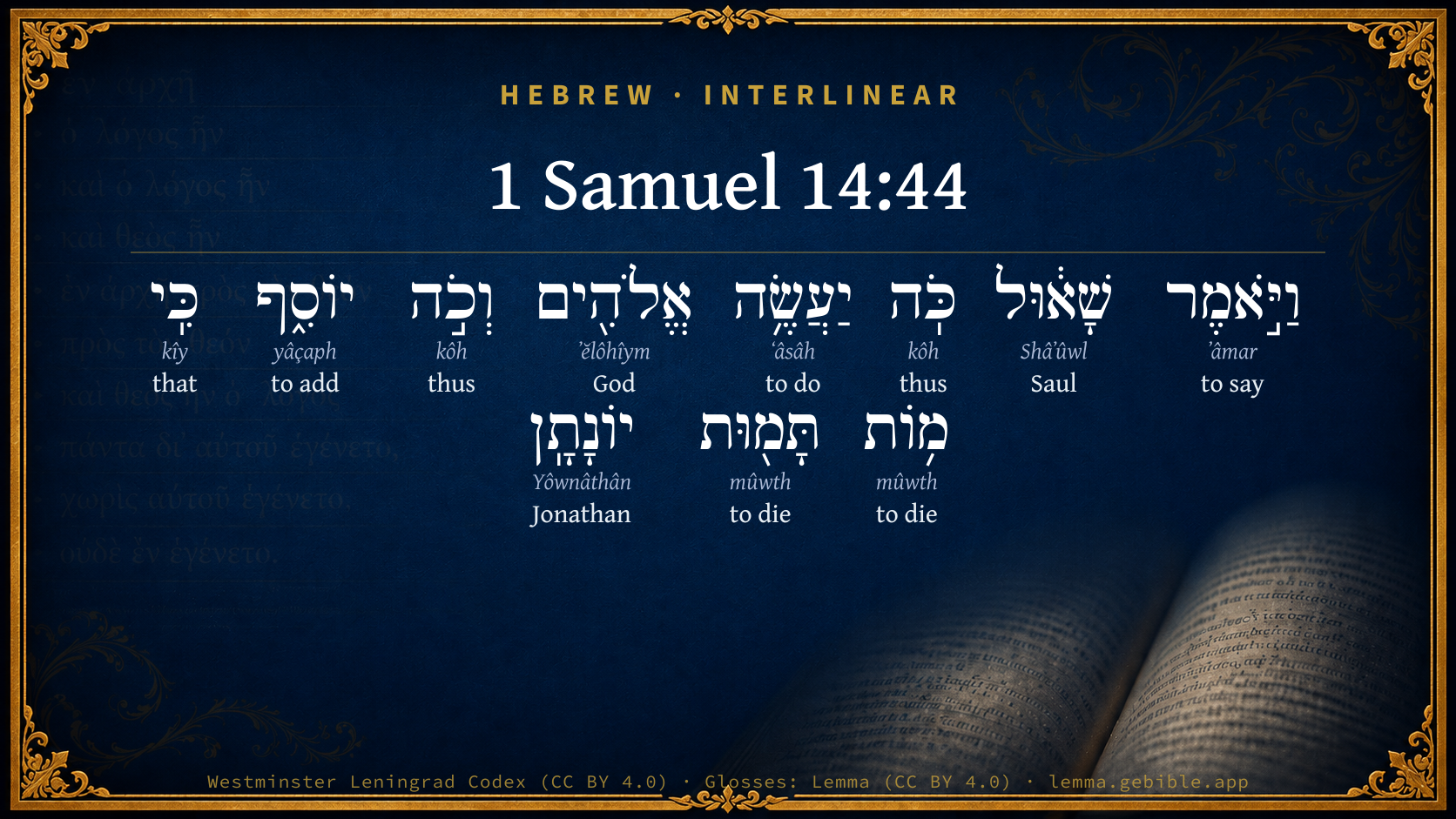
1 Samuel 14:44

Hebrew (Westminster Leningrad Codex) 1 Samuel 14:44 appears in the Hebrew Old Testament. The text above is from the Westminster Leningrad Codex. Each word links to its Strong’s number, a concise gloss, and parsing drawn from the Open Scriptures Hebrew Bible morphology. Click any word for its full Brown-Driver-Briggs (BDB) entry.
Download image
Cite this verse

1 Samuel 14:44 (World English Bible). Public Domain. Lemma interlinear Bible study tool, https://lemma.gebible.app/v/1-samuel/14/44.

Show BibTeX & RIS
BibTeX
RIS
English Translation
Saul said, God do so and more also; for you shall surely die, Jonathan.
World English Bible · Public Domain
Download a study sheet

One document with this verse’s original text, its word-by-word gloss line, the meaning frame, cross-references with their text, attributed commentary, and full source and license credits — printable, and it pastes into notes with its structure intact.

This verse Autodidact and up

Study sheet (.html) Plain text (.txt)

A passage Seminary Student

Up to 50 verses in one chapter. A passage sheet keeps up to 6 commentary sources and 12 cross-references per verse, in the order this page ranks them, and says so on the sheet whenever that leaves anything out. Ask for a single verse and you get the Autodidact verse sheet above.

Everything on this page stays free to read, with no account — the sheet is a download of what is already on screen, not access to it.

Want to remove ads? Support Godless Engineer
Compare translations 3

The same verse in 3 English versions, stacked beneath the original-language interlinear above. Click any original word for its lexicon entry.

Each is an independent rendering of the whole verse — the interlinear is not word-aligned to these translations.

Highlighted words mark where these versions differ — a whole-verse word diff, not a word-by-word alignment.

  • World English Bible Public Domain
    Saul said, God do so and more also; for you shall surely die, Jonathan.
  • King James Version Public Domain
    And Saul answered, God do so and more also: for thou shalt surely die, Jonathan.
  • unfoldingWord Literal Text CC BY-SA 4.0
    And Saul said, “May God do thus, and may he add thus, for dying, you shall die, Jonathan.”

unfoldingWord Literal Text — © unfoldingWord, licensed CC BY-SA 4.0. Word-aligned USFM3 via Door43 (git.door43.org/unfoldingWord/en_ult).

Versions to compare (up to 4)

3 of 4 selected

Show all 18 translations

Every available English version of this verse, each an independent rendering of the whole verse.

  • World English Bible Public Domain
    Saul said, God do so and more also; for you shall surely die, Jonathan.
  • Berean Standard Bible Public Domain
    And Saul declared, “May God punish me, and ever so severely, if you, Jonathan, do not surely die!”
  • Majority Standard Bible Public Domain
    And Saul declared, “May God punish me, and ever so severely, if you, Jonathan, do not surely die!”
  • King James Version Public Domain
    And Saul answered, God do so and more also: for thou shalt surely die, Jonathan.
  • American Standard Version (1901) Public Domain
    And Saul said, God do so and more also; for thou shalt surely die, Jonathan.
  • Revised Version (1885) Public Domain
    And Saul said, God do so and more also: for thou shalt surely die, Jonathan.
  • Geneva Bible (1599) Public Domain
    Againe Saul answered, God doe so and more also, vnlesse thou die the death, Ionathan.
  • Douay-Rheims (1899) Public Domain
    And Saul said: May God do so and so to me, and add still more: for dying thou shalt die, O Jonathan.
  • Young's Literal Translation Public Domain
    And Saul saith, `Thus doth God do, and thus doth He add, for thou dost certainly die, Jonathan.'
  • Literal Standard Version CC BY-SA 4.0
    And Saul says, “Thus God does, and thus does He add, for you certainly die, Jonathan.”
  • Unlocked Literal Bible CC BY-SA 4.0
    Saul said, “God do so and more also to me, if you do not die, Jonathan.”
  • unfoldingWord Literal Text CC BY-SA 4.0
    And Saul said, “May God do thus, and may he add thus, for dying, you shall die, Jonathan.”
  • Darby Bible Public Domain
    And Saul said, God do so [to me] and more also; thou shalt certainly die, Jonathan.
  • World Messianic Bible Public Domain
    Saul said, “God do so and more also; for you shall surely die, Jonathan.”
  • Webster's Bible Public Domain
    And Saul answered, God do so, and more also: for thou shalt surely die, Jonathan.
  • Free Bible Version CC BY-SA 4.0
    Saul said, “May God punish me very severely if you do not die, Jonathan!”
  • Bible in Basic English Public Domain
    And Saul said, May God's punishment be on me if death is not your fate, Jonathan.
  • JPS Tanakh (1917) Public Domain
    And Saul said: 'God do so and more also; thou shalt surely die, Jonathan.'

Literal Standard Version (2020), Covenant Press — licensed CC BY-SA 4.0. Text via the HelloAO Bible API (eBible.org). Unlocked Literal Bible (unfoldingWord) — licensed CC BY-SA 4.0. Text via the HelloAO Bible API (eBible.org). unfoldingWord Literal Text — © unfoldingWord, licensed CC BY-SA 4.0. Word-aligned USFM3 via Door43 (git.door43.org/unfoldingWord/en_ult). Free Bible Version, Dr. Jonathan Gallagher — licensed CC BY-SA 4.0. Text via the HelloAO Bible API (eBible.org).

Word by word

More ways to search: Search by grammar → Find every occurrence → Compare this word →

Practice this passage: Drill this verse → Learn its vocabulary →

יוֹנָתָֽן
Yôwnâthân
H3129
“Jonathan”
Noun, Proper
Part of Speech
Noun
Type
Proper
Full BDB Definition

Origin: a form of H3083

TWOT: None

Jonathan or Jehonathan = "Jehovah has given" - a son of king Saul and a friend of David - a son of the high priest Abiathar and the last descendant of Eli of whom we hear - one of David's mighty warriors - a Levite and father of Zechariah, a priest who blew the trumpet at the dedication of the wall - a son of Kareah and a brother of Johanan; a Judaite captain after the fall of Jerusalem - another Judaite - father of Ebed in the time of Ezra - son of Asahel in the time of Ezra - a priest of the family of Melicu in the time of Nehemiah - son of Joiada and his successor to the high priesthood in the time of Nehemiah
  1. וַיֹּ֣אמֶר ʼâmar H559 “and · to say” Conjunction + Verb, Qal, Sequential Imperfect, 3rd Person, Masculine, Singular
  2. שָׁא֔וּל Shâʼûwl H7586 “Saul” Noun, Proper
  3. כֹּֽה kôh H3541 “thus” Adverb
  4. יַעֲשֶׂ֥ה ʻâsâh H6213 “to do” Verb, Qal, Jussive, 3rd Person, Masculine, Singular
  5. אֱלֹהִ֖ים ʼĕlôhîym H430 “God(s)” Noun, Common, Masculine, Plural, Absolute
  6. וְכֹ֣ה kôh H3541 “and · thus” Conjunction + Adverb
  7. יוֹסִ֑ף yâçaph H3254 “to add” Verb, Hiphil, Jussive, 3rd Person, Masculine, Singular
  8. כִּֽי kîy H3588 “that” Conjunction
  9. מ֥וֹת mûwth H4191 “to die” Verb, Qal, Infinitive Absolute
  10. תָּמ֖וּת mûwth H4191 “to die” Verb, Qal, Imperfect, 2nd Person, Masculine, Singular

About this verse

These counts appear in no published source. They are computed here, from the morphology-tagged text and Lemma’s own curated glosses. What Lemma adds →

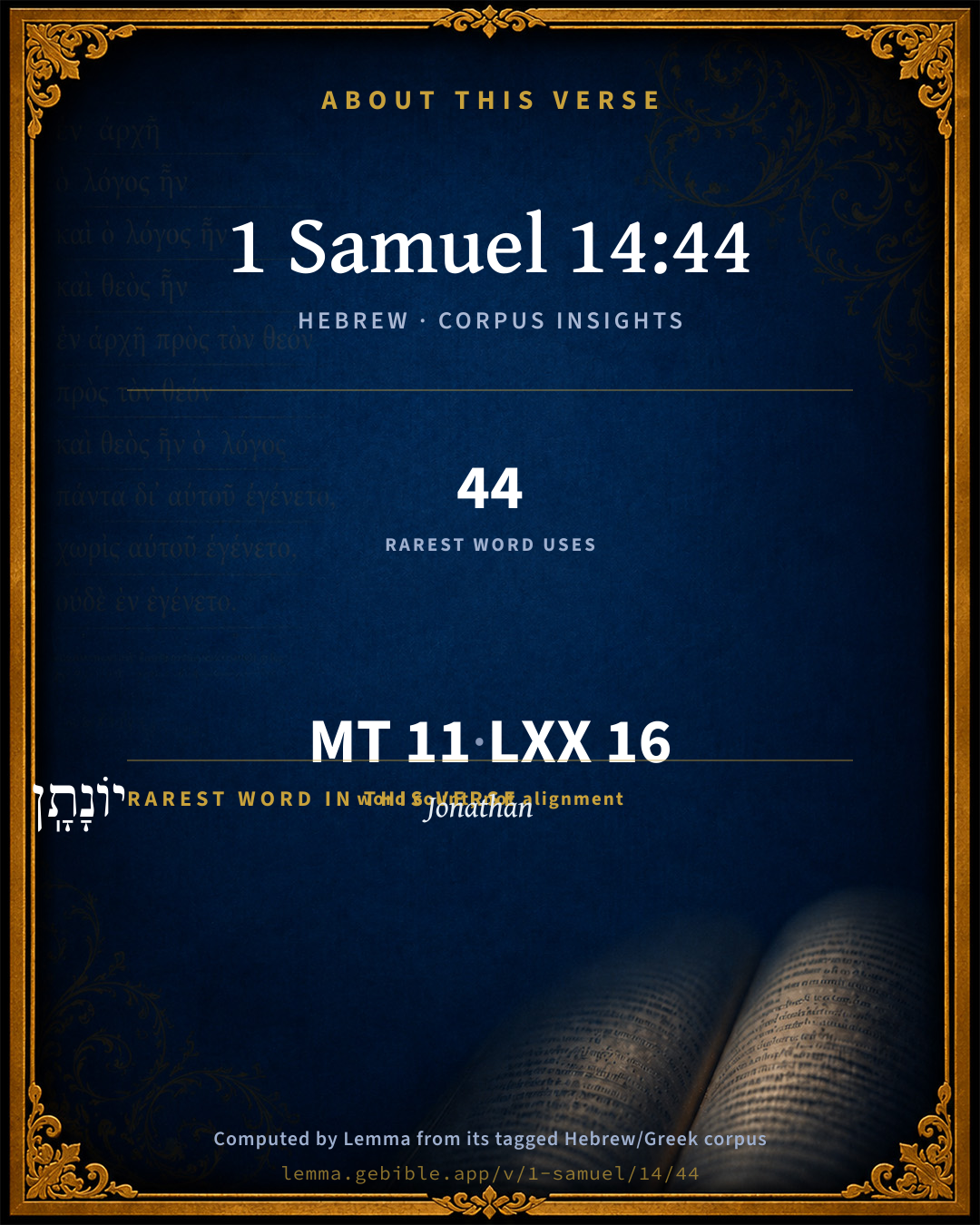
11
words
9
distinct lemmas
Historical
section

Shared distinctive vocabulary

יוֹנָתָֽן Jonathan H3129 occurs in 36 verses of the Hebrew Bible. Also found in:

Grammatical profile

  • 5 verbs
  • 3 nouns
  • 1 conjunction
  • 2 adverbs

Verb forms

  • וַיֹּ֣אמֶר Qal · Sequential Imperfect
  • יַעֲשֶׂ֥ה Qal · Jussive
  • יוֹסִ֑ף Hiphil · Jussive
  • מ֥וֹת Qal · Infinitive Absolute
  • תָּמ֖וּת Qal · Imperfect

Repetition

Words recur within this verse — often emphatic in Hebrew:

  • כֹּֽה thus H3541 ×2
  • מ֥וֹת to die H4191 ×2

Hebrew & Septuagint length

In English translation the verse runs 14 words from the Hebrew and 18 from the Septuagint (LXX English) — closely comparable.

A rough comparison of the two English renderings, which tokenize alike — not a word-level alignment.

Word counts can differ between the Hebrew and the Greek without any difference in meaning — e.g. the Hebrew direct-object marker אֵת has no separate Greek word, and Greek often adds the article ὁ.

In the original languages it is 11 Hebrew tokens and 16 Greek tokens — but the two are counted differently (Hebrew bundles its prefixes and suffixes into one token; the Greek is in lemma form), so that isn’t a like-for-like length.

Cross-references

9

Topical passages linked to 1 Samuel 14:44 in the Treasury of Scripture Knowledge — connected by theme and wording, ordered by reader-vote popularity; previews shown in the World English Bible.

  • Ruth 1:17 where you die, will I die, and there will I be buried: Yahweh do so to me, and more also, if anything but death part you and me."
  • 1 Samuel 14:39 For, as Yahweh lives, who saves Israel, though it be in Jonathan my son, he shall surely die. But there was not a man among all the people who answered him.
  • 1 Samuel 25:22 God do so to the enemies of David, and more also, if I leave of all that belongs to him by the morning light so much as one man-child.
  • Genesis 38:24 It happened about three months later, that it was told Judah, saying, "Tamar, your daughter-in-law, has played the prostitute; and moreover, behold, she is with child by prostitution." Judah said, "Bring her forth, and let her be burnt."
  • 2 Samuel 3:9 God do so to Abner, and more also, if, as Yahweh has sworn to David, I don't do even so to him;
  • 2 Samuel 12:5 David's anger was greatly kindled against the man, and he said to Nathan, "As Yahweh lives, the man who has done this is worthy to die!
  • 2 Samuel 12:31 He brought forth the people who were therein, and put them under saws, and under harrows of iron, and under axes of iron, and made them pass through the brick kiln: and thus did he to all the cities of the children of Ammon. David and all the people returned to Jerusalem.
  • 2 Samuel 19:13 Say you to Amasa, Aren't you my bone and my flesh? God do so to me, and more also, if you aren't captain of the host before me continually in the room of Joab.
  • Proverbs 25:16 Have you found honey? Eat as much as is sufficient for you, Lest you eat too much, and vomit it.

Cross-references courtesy of OpenBible.info (CC BY 4.0).

Hebrew and Greek witnesses Masoretic Hebrew ↔ Greek Septuagint

The same verse in the two great witnesses to the Old Testament, shown verse-for-verse.

These are two independent witnesses, not word-aligned to each other, and the Septuagint is shown in lemma (dictionary) form.

Hebrew 1 Samuel 14:44 Masoretic · Westminster Leningrad Codex

וַיֹּ֣אמֶר שָׁא֔וּל כֹּֽה יַעֲשֶׂ֥ה אֱלֹהִ֖ים וְכֹ֣ה יוֹסִ֑ף כִּֽי מ֥וֹת תָּמ֖וּת יוֹנָתָֽן

Saul said, God do so and more also; for you shall surely die, Jonathan.

World English Bible · Public Domain

Greek LXX 1 Samuel 14:44 Septuagint · lemma form

καί εἶπον αὐτός σαούλ ὅδε ποιέω ἐγώ ὁ θεός καί ὅδε προςτίθημι ὅτι θάνατος ἀποθνήσκω σήμερον

And Saul said to him, God do so to me, and more also, you shall surely die today.

LXX2012 (modern English Septuagint) · Public Domain

Hebrew: Westminster Leningrad Codex (CC BY 4.0). Greek: Septuagint (public domain); English from LXX2012 (modern English Septuagint) (Public Domain). How the Septuagint differs from the Hebrew →

Targum (Aramaic paraphrase)

1

The Targum is the ancient Jewish Aramaic paraphrase of the Hebrew Scriptures — an interpretive translation, not the Hebrew text itself. Onkelos (literal) and Pseudo-Jonathan (expansive) render the Torah, and Jonathan the Prophets. Coverage is partial: where no permissively-licensed English translation exists for a verse, only the Aramaic is shown. This is verse-level text, not a word-by-word alignment to the Hebrew.

  1. Targum Jonathan Prophets (Joshua–Malachi)
    וַאֲמַר שָׁאוּל כְּדֵין יַעֲבֵיד לִי יְיָ וּכְדֵין יוֹסִיף אֲרֵי מְמַת תְּמוּת יוֹנָתָן:

    (no public-domain English translation for this verse)

    Targum Jonathan — Aramaic: “Mikraot Gedolot” (public domain). English: “Sefaria Community Translation” (CC0 1.0 (public-domain dedication)); “London "Chaldee Paraphrase," 1871” (public domain). Text via Sefaria.

Commentary

Notes on 1 Samuel 14:44 from classic Christian and Jewish commentators (each source and its license shown beneath its notes). The classic Christian expositions comment on the surrounding passage and are grouped to its opening verse, so a note may address several verses; the Jewish commentaries on the Tanakh (Rashi and others) are per-verse, so they appear only where the commentator wrote on this verse.

Lemma curates 59 commentaries, every one of them public domain or Creative Commons licensed, each selected and text-cleaned for this edition rather than reprinted as found. About our sources →

Trapp's Complete Commentary

John Trapp

1Sa 14:44 And Saul answered, God do so and more also: for thou shalt surely die, Jonathan.

Ver. 44. And Saul answered, God do so and more also.] It appeareth that Saul was a great swearer. Et rationem maiorem habebat iurameuti quam iuris, &c. {a}

Thou shalt surely die, Jonathan.] This was sharp law; as was afterwards that of Manlius the Roman, who condemned his own son to death for slaying an enemy without his command: whereupon sharp and severe commands were usually called Manliana, saith Gellius. {b} But what an abhorred cruelty was that of Philip, king of Spain, who delivered up his eldest son Charles to be murdered by the cruel Inquisition, because he seemed to favour the reformed religion!

{a} Jun.

{b} Lib. ix., cap. 13. Jerome. Catin.

John Trapp, A Commentary or Exposition upon All the Books of the Old and New Testament (1647–1656) — public domain. Text from a community e-Sword module.

Joseph Benson's Commentary

1Sa 14:44-45. Thou shalt surely die, Jonathan — This again was most rashly spoken. Saul, however, seems to have been influenced by a real fear of God, and certainly is to be commended for having a greater regard to his oath than to his kindred and natural affection. The people said, Shall Jonathan die? — Hitherto they had expressed themselves in a way that manifested their obedience to Saul, and acquiesced in what seemed good to him. But now that Jonathan is in danger, Saul’s word is no longer a law to them; but with the utmost zeal they oppose the execution of his sentence. Who hath wrought this great salvation in Israel — Shall that life be sacrificed which was so bravely exposed for the public service, and to which we owe our lives and triumphs? No, we will never stand by and see him thus treated whom God has delighted to honour. As the Lord liveth, there shall not one hair of his head fall to the ground — Saul had sworn that he should die; but they oppose their oath to his, and swear he shall not die. They did not rescue him by violence, but by reason and resolution. And Josephus says, “They offered prayers to God that he would forgive Jonathan’s sin,” and that he might be loosed from the curse. He hath wrought with God this day — It is plain the blessing and favour of God have been with him. It has been in concurrence with God that he has wrought this salvation. And God is so far from being offended with Jonathan, that he hath graciously owned him in the great services of this day. We may suppose Saul had not so perfectly forgot the relation of a father, but that he was willing enough to have Jonathan rescued, and well pleased to have that done which yet he would not do himself; and he that knows the heart of a father, knows not how to blame him.

It may be edifying to the reader, and therefore not improper to copy here, the following important observations of a late but anonymous writer, on the foregoing verses: “It may, at first sight, appear strange that the Divine Providence should so order things, by giving no answer to the high-priest, and causing the lots so to fall, that Jonathan, who appears entirely guiltless, should be brought into imminent danger of his life. If we consider this only in respect to Jonathan, it does indeed appear unaccountable; but if we take in his father Saul, it will appear to have been an act of divine wisdom. It is manifest, as well from the unnecessary and unprofitable oath that Saul here exacted from the people, as from many other passages of his life, that Saul was of a hasty, precipitate temper. What better lesson then could God give to him, and to all of such hasty, precipitate tempers, than to bring him into the grievous strait of either breaking a solemn oath or putting his own son to death? That this was the main intention of all that happened on this occasion appears evident, in that God inspired the people with such a courage and love for Jonathan, that they would not, upon any terms, permit even a hair of his head to fall to the ground. For we cannot suppose, if God had intended to punish Jonathan, as guilty of any crime, that the disposition of the people could have prevented his purposes, though they did those of Saul, which had no foundation in justice.”

Joseph Benson's Commentary on the Old and New Testaments (1811–1818) — public domain. Text from a community e-Sword module.

Adam Clarke's Commentary

Verse 44. And Saul answered - thou shalt surely die, Jonathan.] To save thy rash oath! So must John Baptist's head be taken off at the desire of an impure woman, because a Herod had sworn to give her whatever she might request! Unfeeling brute! However, the king was JUDGE. But what said the people, who were the JURY?

Adam Clarke's Commentary on the Bible (1810–1826) — public domain. Text from a community e-Sword/MySword module.

John Gill's Exposition

And Saul answered, God do so and more also,.... A form of an oath imprecating evils upon him more and greater than he chose to mention, see the like form in Rut 1:17, though Abarbinel thinks this is not the form of an oath, but an asseveration of a curse that would befall him; as that God would not answer him when he inquired of him, and that he would add to do so again and again, if he died not:

for thou shall surely die, Jonathan; such words from a father must be very striking to a son, and argue a want of paternal affection in Saul, that could call his son by his name, and deliver such a speech unto him in so strong a manner.

John Gill's Exposition of the Whole Bible (1746–1763) — public domain (CC PDM 1.0). Text via the HelloAO Bible API.

Haydock's Catholic Bible Commentary

Die. We may here admire the respect which the ancients had for an oath, without seeking for any modification; and the blindness of Saul, who condemns his son with as much haste as he had pronounced the curse, thinking thus to honour God. The thing surely required some deliberation, and he ought to have consulted the Lord about it. The action of Jonathan was not criminal, and the former silence of God did not prove that he deserved death. (Calmet) --- If it had, the people would never have been able to have rescued him, no more than the unhappy Achan, Josue vii. (Haydock) --- If Saul had been more enlightened, and more humble, he would have concluded that God was displeased at him, and not at Jonathan. (Calmet) --- Yet Cajetan and Serarius find fault with the latter. (Menochius)

George Leo Haydock (1774–1849), Haydock's Catholic Family Bible and Commentary, 1859 edition — public domain. Excludes Psalms (Douay-Rheims chapter numbering differs from Protestant) and Deuterocanonical books (Catholic canon only).

Matthew Poole's English Annotations

From this and other like expressions of Saul’s, some gather that he was exceeding prone to the vice of swearing and cursing.

Thou shalt surely die: strange perverseness! He who was so indulgent as to spare wicked Agag, 1Sa 15, is now so severe as to destroy his own worthy son: he that could easily dispense with God’s righteous and reasonable command, will not bear the violation of his own rash and foolish command; because his own authority and power is concerned in this, and only God’s in the other.

Matthew Poole's English Annotations on the Holy Bible (1683–1685) — public domain. Text from a community e-Sword/MySword module.

The Pulpit Commentary

God do so, etc. Again Saul takes an oath to put Jonathan to death, supposing himself bound by his former words. But he must have been pained beyond measure at the miserable consequences of his rashness, and have bitterly reproached himself for thus twice marring the happiness of the day by unhallowed oaths. Jonathan"s trespass, committed unwittingly, required nothing more than a trespass offering for its expiation, nor did the silence of the Urim and Thummim imply any fault in him. The fault lay in Saul having imposed an oath upon the army; that oath had been broken, and a formal expiation must be made. But Saul was by nature a despot, and could endure nothing that seemed even for the moment to stand in his way.

The Pulpit Commentary (1880–1919), ed. H.D.M. Spence-Jones & Joseph S. Exell — public domain. Text from a community e-Sword module.

John Wesley's Explanatory Notes

For thou,&c. - We have no proof, that Saul did not act in this whole affair from a real fear of God.

John Wesley, Explanatory Notes Upon the Whole Bible (1754–1765) — public domain. Text via the GEBible commentary corpus.

Lesson kit

Teaching starters — assembled from the data on this page, not authored interpretation. Every prompt links to the verse data it draws on. Edit before teaching.

1 Samuel, in the Historical, opens this verse with 11 words (9 distinct Hebrew lemmas). Its most distinctive word is Yôwnâthân (“Jonathan”). A historical commentator’s framing appears above. Read the whole chapter for the surrounding context.

Discussion questions

  1. How does “Jonathan” (Yôwnâthân) shape what this verse is saying?
  2. How does Judges 18:30, which shares the word «Jonathan», read alongside this verse?
  3. What does the repetition of “thus” (2× in this one verse) do in this verse?
  4. The translations on this page render this verse differently — a whole-verse word diff, not a word-by-word alignment. What might account for the different wordings?
  5. «וַיֹּ֣אמֶר» is a Qal Sequential Imperfect verb. How does that grammatical form shape the action described?
  6. Compare how Trapp's Complete Commentary and Joseph Benson's Commentary read this verse. Where do they agree or differ?

Things to notice

Reading settings

Reading text

Shown beneath each verse's original-language words.

Old Testament
Old Testament edition

Read the OT as the Masoretic Hebrew (MT) or the Greek Septuagint (LXX).

English shown for the Greek Septuagint (in the Hebrew ↔ Greek comparison).

Comparing translations? Open the Compare panel on any verse page to stack up to four side by side.