
1 Chronicles 17:9

Hebrew (Westminster Leningrad Codex) 1 Chronicles 17:9 appears in the Hebrew Old Testament. The text above is from the Westminster Leningrad Codex. Each word links to its Strong’s number, a concise gloss, and parsing drawn from the Open Scriptures Hebrew Bible morphology. Click any word for its full Brown-Driver-Briggs (BDB) entry.
Download image
Cite this verse

1 Chronicles 17:9 (World English Bible). Public Domain. Lemma interlinear Bible study tool, https://lemma.gebible.app/v/1-chronicles/17/9.

Show BibTeX & RIS
BibTeX
RIS
English Translation
I will appoint a place for my people Israel, and will plant them, that they may dwell in their own place, and be moved no more; neither shall the children of wickedness waste them any more, as at the first,
World English Bible · Public Domain
Download a study sheet

One document with this verse’s original text, its word-by-word gloss line, the meaning frame, cross-references with their text, attributed commentary, and full source and license credits — printable, and it pastes into notes with its structure intact.

This verse Autodidact and up

Study sheet (.html) Plain text (.txt)

A passage Seminary Student

Up to 50 verses in one chapter. A passage sheet keeps up to 6 commentary sources and 12 cross-references per verse, in the order this page ranks them, and says so on the sheet whenever that leaves anything out. Ask for a single verse and you get the Autodidact verse sheet above.

Everything on this page stays free to read, with no account — the sheet is a download of what is already on screen, not access to it.

Want to remove ads? Support Godless Engineer
Compare translations 3

The same verse in 3 English versions, stacked beneath the original-language interlinear above. Click any original word for its lexicon entry.

Each is an independent rendering of the whole verse — the interlinear is not word-aligned to these translations.

Highlighted words mark where these versions differ — a whole-verse word diff, not a word-by-word alignment.

  • World English Bible Public Domain
    I will appoint a place for my people Israel, and will plant them, that they may dwell in their own place, and be moved no more; neither shall the children of wickedness waste them any more, as at the first,
  • King James Version Public Domain
    Also I will ordain a place for my people Israel, and will plant them, and they shall dwell in their place, and shall be moved no more; neither shall the children of wickedness waste them any more, as at the beginning,
  • unfoldingWord Literal Text CC BY-SA 4.0
    And I have established a place for my people Israel, and I will plant him that he may dwell under him, and he will not tremble anymore. And the sons of wickedness will not continue to afflict him as at the first,

unfoldingWord Literal Text — © unfoldingWord, licensed CC BY-SA 4.0. Word-aligned USFM3 via Door43 (git.door43.org/unfoldingWord/en_ult).

Versions to compare (up to 4)

3 of 4 selected

Show all 18 translations

Every available English version of this verse, each an independent rendering of the whole verse.

  • World English Bible Public Domain
    I will appoint a place for my people Israel, and will plant them, that they may dwell in their own place, and be moved no more; neither shall the children of wickedness waste them any more, as at the first,
  • Berean Standard Bible Public Domain
    And I will provide a place for My people Israel and will plant them so that they may dwell in a place of their own and be disturbed no more. No longer will the sons of wickedness oppress them as they did at the beginning
  • Majority Standard Bible Public Domain
    And I will provide a place for My people Israel and will plant them so that they may dwell in a place of their own and be disturbed no more. No longer will the sons of wickedness oppress them as they did at the beginning
  • King James Version Public Domain
    Also I will ordain a place for my people Israel, and will plant them, and they shall dwell in their place, and shall be moved no more; neither shall the children of wickedness waste them any more, as at the beginning,
  • American Standard Version (1901) Public Domain
    And I will appoint a place for my people Israel, and will plant them, that they may dwell in their own place, and be moved no more; neither shall the children of wickedness waste them any more, as at the first,
  • Revised Version (1885) Public Domain
    And I will appoint a place for my people Israel, and will plant them, that they may dwell in their own place, and be moved no more; neither shall the children of wickedness waste them any more, as at the first,
  • Geneva Bible (1599) Public Domain
    (Also I will appoynt a place for my people Israel, and will plant it, that they may dwell in their place, and moue no more: neither shall the wicked people vexe them any more, as at the beginning,
  • Douay-Rheims (1899) Public Domain
    And I have given a place to my people Israel: they shall be planted, and shall dwell therein, and shall be moved no more, neither shall the children of iniquity waste them, as at the beginning,
  • Young's Literal Translation Public Domain
    `And I have prepared a place for My people Israel, and planted it, and it hath dwelt in its place, and is not troubled any more, and the sons of perverseness add not to wear it out as at first,
  • Literal Standard Version CC BY-SA 4.0
    And I have prepared a place for My people Israel, and planted it, and it has dwelt in its place, and is not troubled anymore, and the sons of perverseness do not add to wear it out as at first,
  • Unlocked Literal Bible CC BY-SA 4.0
    I will appoint a place for my people Israel and will plant them there, so that they may live in their own place and be troubled no more. No longer will wicked people oppress them, as they did before,
  • unfoldingWord Literal Text CC BY-SA 4.0
    And I have established a place for my people Israel, and I will plant him that he may dwell under him, and he will not tremble anymore. And the sons of wickedness will not continue to afflict him as at the first,
  • Darby Bible Public Domain
    And I will appoint a place for my people Israel, and will plant them, that they may dwell in a place of their own, and be disturbed no more; neither shall the sons of wickedness waste them any more, as formerly,
  • World Messianic Bible Public Domain
    I will appoint a place for my people Israel, and will plant them, that they may dwell in their own place, and be moved no more. The children of wickedness will not waste them any more, as at the first,
  • Webster's Bible Public Domain
    Also I will ordain a place for my people Israel, and will plant them, and they shall dwell in their place, and shall be moved no more; neither shall the children of wickedness waste them any more, as at the beginning.
  • Free Bible Version CC BY-SA 4.0
    I will choose a place for my people Israel. I will settle them there and they won't be disturbed anymore. Evil people won't persecute them as they used to,
  • Bible in Basic English Public Domain
    And I will make a resting-place for my people Israel, planting them there, so that they may be in the place which is theirs and never again be moved; and never again will they be made waste by evil men, as they were at first,
  • JPS Tanakh (1917) Public Domain
    And I will appoint a place for My people Israel, and will plant them, that they may dwell in their own place, and be disquieted no more; neither shall the children of wickedness waste them any more, as at the first,

Literal Standard Version (2020), Covenant Press — licensed CC BY-SA 4.0. Text via the HelloAO Bible API (eBible.org). Unlocked Literal Bible (unfoldingWord) — licensed CC BY-SA 4.0. Text via the HelloAO Bible API (eBible.org). unfoldingWord Literal Text — © unfoldingWord, licensed CC BY-SA 4.0. Word-aligned USFM3 via Door43 (git.door43.org/unfoldingWord/en_ult). Free Bible Version, Dr. Jonathan Gallagher — licensed CC BY-SA 4.0. Text via the HelloAO Bible API (eBible.org).

Word by word

More ways to search: Search by grammar → Find every occurrence → Compare this word →

Practice this passage: Drill this verse → Learn its vocabulary →

לְבַלֹּת֔וֹ
bâlâh
H1086
“to wear out · him”
Preposition + Verb, Piel, Infinitive Construct + Suffix, Personal, 3rd Person, Masculine, Singular
Part of Speech
Preposition + Verb
Stem
Piel
Form
Infinitive Construct
Full BDB Definition

Origin: a primitive root

TWOT: 246

to wear out, become old - (Qal) to wear out - (Piel) - to wear out - to wear out by use, use up completely - to enjoy, use to the full
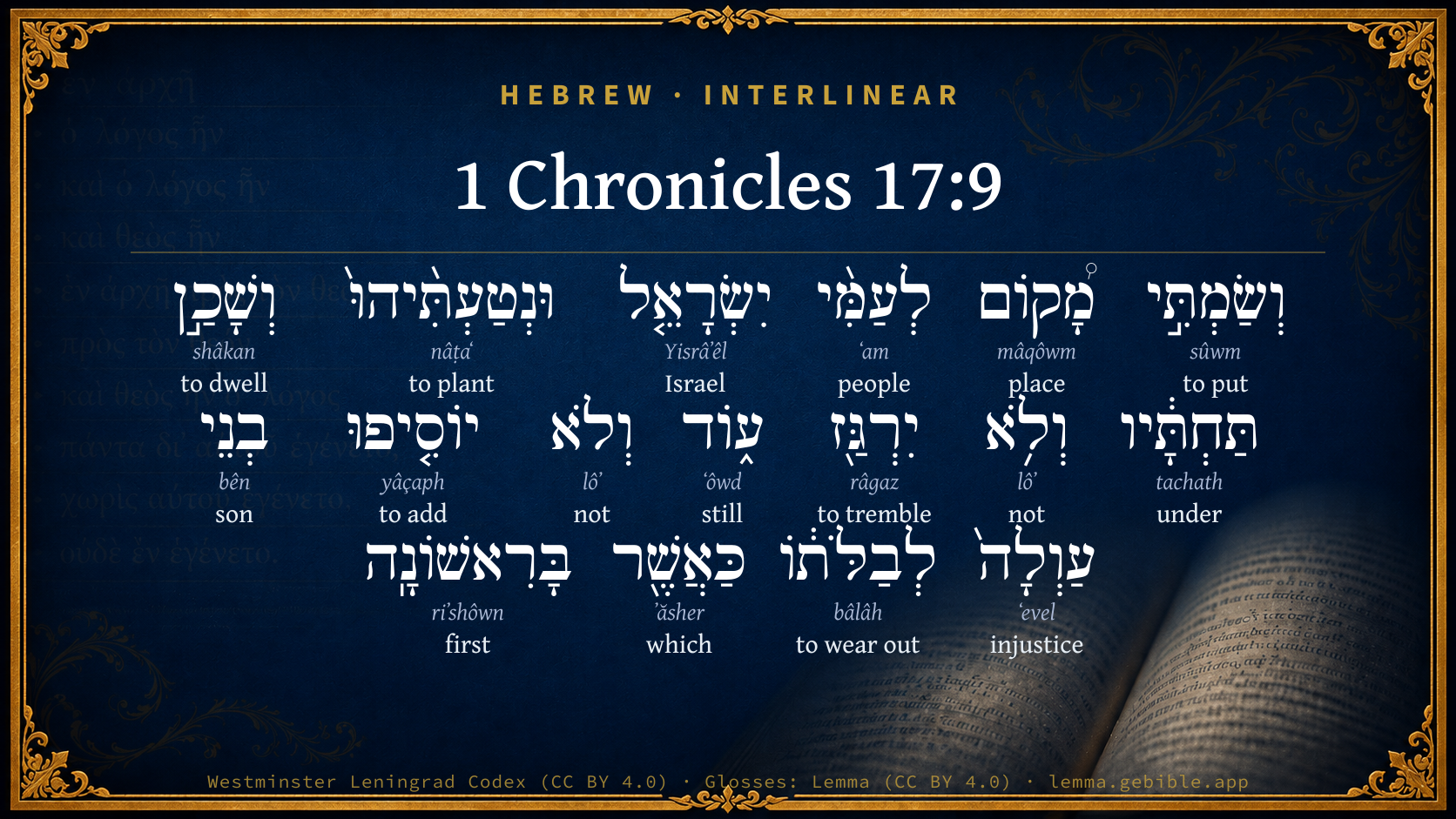
  1. וְשַׂמְתִּ֣י sûwm H7760 “and · to put” Conjunction + Verb, Qal, Sequential Perfect, 1st Person, Common, Singular
  2. מָ֠קוֹם mâqôwm H4725 “place” Noun, Common, Masculine, Singular, Absolute
  3. לְעַמִּ֨י ʻam H5971 “to/for · people · my” Preposition + Noun, Common, Masculine, Singular, Construct + Suffix, Personal, 1st Person, Common, Singular
  4. יִשְׂרָאֵ֤ל Yisrâʼêl H3478 “Israel” Noun, Proper
  5. וּנְטַעְתִּ֨יהוּ֙ nâṭaʻ H5193 “and · to plant · him” Conjunction + Verb, Qal, Sequential Perfect, 1st Person, Common, Singular + Suffix, Personal, 3rd Person, Masculine, Singular
  6. וְשָׁכַ֣ן shâkan H7931 “and · to dwell” Conjunction + Verb, Qal, Sequential Perfect, 3rd Person, Masculine, Singular
  7. תַּחְתָּ֔יו tachath H8478 “under · him” Preposition + Suffix, Personal, 3rd Person, Masculine, Singular
  8. וְלֹ֥א lôʼ H3808 “and · not” Conjunction + Particle, Negative
  9. יִרְגַּ֖ז râgaz H7264 “to tremble” Verb, Qal, Imperfect, 3rd Person, Masculine, Singular
  10. ע֑וֹד ʻôwd H5750 “still” Adverb
  11. וְלֹא lôʼ H3808 “and · not” Conjunction + Particle, Negative
  12. יוֹסִ֤יפוּ yâçaph H3254 “to add” Verb, Hiphil, Imperfect, 3rd Person, Masculine, Plural
  13. בְנֵי bên H1121 “sons of” Noun, Common, Masculine, Plural, Construct
  14. עַוְלָה֙ ʻevel H5766 “injustice” Noun, Common, Both, Singular, Absolute
  15. כַּאֲשֶׁ֖ר ʼăsher H834 “like/as · which” Preposition + Particle, Relative
  16. בָּרִאשׁוֹנָֽה riʼshôwn H7223 “in/at the · first” Preposition, Determined + Adjective, Adjective, Feminine, Singular, Absolute

About this verse

These counts appear in no published source. They are computed here, from the morphology-tagged text and Lemma’s own curated glosses. What Lemma adds →

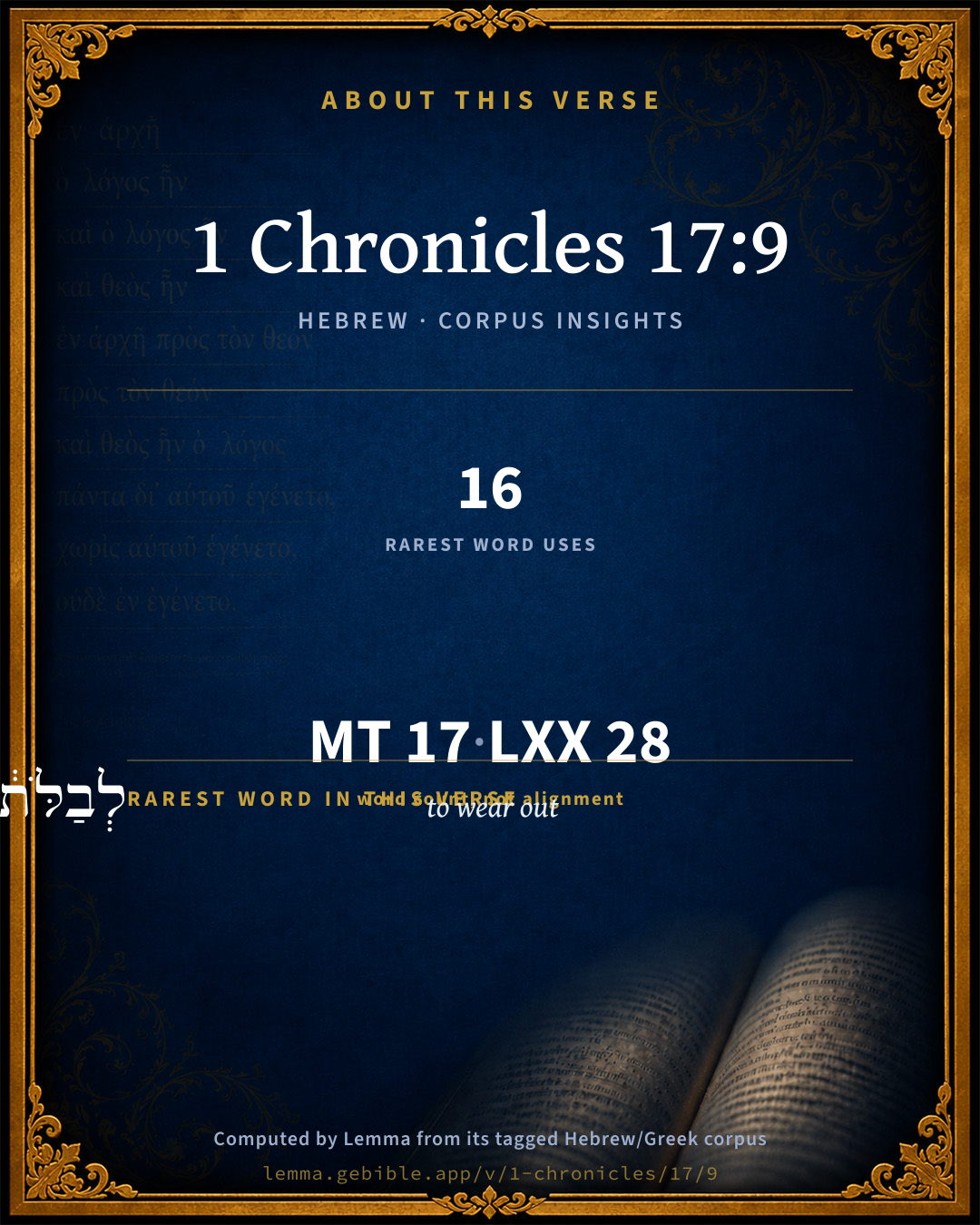
17
words
16
distinct lemmas
Historical
section

Notable vocabulary

The rarest word here is לְבַלֹּת֔וֹ to wear out H1086 — appearing just 16 times in the whole Hebrew Bible.

Shared distinctive vocabulary

לְבַלֹּת֔וֹ to wear out H1086 occurs in 15 verses of the Hebrew Bible. Also found in:

Grammatical profile

  • 6 verbs
  • 5 nouns
  • 1 adjective
  • 1 preposition
  • 1 adverb
  • 3 particles

Verb forms

  • וְשַׂמְתִּ֣י Qal · Sequential Perfect
  • וּנְטַעְתִּ֨יהוּ֙ Qal · Sequential Perfect
  • וְשָׁכַ֣ן Qal · Sequential Perfect
  • יִרְגַּ֖ז Qal · Imperfect
  • יוֹסִ֤יפוּ Hiphil · Imperfect
  • לְבַלֹּת֔וֹ Piel · Infinitive Construct

Repetition

A word recurs within this verse — often emphatic in Hebrew:

  • וְלֹ֥א not H3808 ×2

Hebrew & Septuagint length

In English translation the verse runs 40 words from the Hebrew and 41 from the Septuagint (LXX English) — closely comparable.

A rough comparison of the two English renderings, which tokenize alike — not a word-level alignment.

Word counts can differ between the Hebrew and the Greek without any difference in meaning — e.g. the Hebrew direct-object marker אֵת has no separate Greek word, and Greek often adds the article ὁ.

In the original languages it is 17 Hebrew tokens and 28 Greek tokens — but the two are counted differently (Hebrew bundles its prefixes and suffixes into one token; the Greek is in lemma form), so that isn’t a like-for-like length.

Cross-references

19

Topical passages linked to 1 Chronicles 17:9 in the Treasury of Scripture Knowledge — connected by theme and wording, ordered by reader-vote popularity; previews shown in the World English Bible.

  • Ezekiel 36:14–15 therefore you shall devour men no more, neither bereave your nation any more, says the Lord Yahweh;
  • Revelation 21:4 He will wipe away from them every tear from their eyes. Death will be no more; neither will there be mourning, nor crying, nor pain, any more. The first things have passed away."
  • Exodus 1:13–14 The Egyptians ruthlessly made the children of Israel serve,
  • Exodus 2:23 It happened in the course of those many days, that the king of Egypt died, and the children of Israel sighed because of the bondage, and they cried, and their cry came up to God because of the bondage.
  • Psalms 44:2 You drove out the nations with your hand, But you planted them. You afflicted the peoples, But you spread them abroad.
  • Ezekiel 28:4 by your wisdom and by your understanding you have gotten you riches, and have gotten gold and silver into your treasures;
  • Amos 9:15 I will plant them on their land, And they will no more be plucked up out of their land which I have given them," says Yahweh your God.
  • Ephesians 5:6 Let no one deceive you with empty words. For because of these things, the wrath of God comes on the children of disobedience.
  • Psalms 92:13 They are planted in Yahweh's house. They will flourish in our God's courts.
  • Isaiah 49:17 Your children make haste; your destroyers and those who made you waste shall go forth from you.
  • Isaiah 60:18 Violence shall no more be heard in your land, desolation nor destruction within your borders; but you shall call your walls Salvation, and your gates Praise.
  • Isaiah 61:3 to appoint to those who mourn in Zion, to give to them a garland for ashes, the oil of joy for mourning, the garment of praise for the spirit of heaviness; that they may be called trees of righteousness, the planting of Yahweh, that he may be glorified.
  • Jeremiah 24:6 For I will set my eyes on them for good, and I will bring them again to this land: and I will build them, and not pull them down; and I will plant them, and not pluck them up.
  • Jeremiah 31:3–12 Yahweh appeared of old to me, [saying], Yes, I have loved you with an everlasting love: therefore with loving kindness have I drawn you.
  • Jeremiah 32:41 Yes, I will rejoice over them to do them good, and I will plant them in this land assuredly with my whole heart and with my whole soul.
  • Ezekiel 34:13 I will bring them out from the peoples, and gather them from the countries, and will bring them into their own land; and I will feed them on the mountains of Israel, by the watercourses, and in all the inhabited places of the country.
  • Ezekiel 37:25 They shall dwell in the land that I have given to Jacob my servant, in which your fathers lived; and they shall dwell therein, they, and their children, and their children's children, forever: and David my servant shall be their prince for ever.
  • Ephesians 2:2–3 in which you once walked according to the course of this world, according to the prince of the powers of the air, the spirit who now works in the children of disobedience;
  • Psalms 89:22 No enemy will tax him. No wicked man will oppress him.

Cross-references courtesy of OpenBible.info (CC BY 4.0).

Hebrew and Greek witnesses Masoretic Hebrew ↔ Greek Septuagint

The same verse in the two great witnesses to the Old Testament, shown verse-for-verse.

These are two independent witnesses, not word-aligned to each other, and the Septuagint is shown in lemma (dictionary) form.

Hebrew 1 Chronicles 17:9 Masoretic · Westminster Leningrad Codex

וְשַׂמְתִּ֣י מָ֠קוֹם לְעַמִּ֨י יִשְׂרָאֵ֤ל וּנְטַעְתִּ֨יהוּ֙ וְשָׁכַ֣ן תַּחְתָּ֔יו וְלֹ֥א יִרְגַּ֖ז ע֑וֹד וְלֹא יוֹסִ֤יפוּ בְנֵי עַוְלָה֙ לְבַלֹּת֔וֹ כַּאֲשֶׁ֖ר בָּרִאשׁוֹנָֽה

I will appoint a place for my people Israel, and will plant them, that they may dwell in their own place, and be moved no more; neither shall the children of wickedness waste them any more, as at the first,

World English Bible · Public Domain

Greek LXX 1 Chronicles 17:9 Septuagint · lemma form

καί τίθημι τόπος ὁ λαός ἐγώ ἰσραήλ καί καταφυτεύω αὐτός καί κατασκηνόω κατά ἑαυτοῦ καί οὐ μεριμνάω ἔτι καί οὐ προςτίθημι ἀδικία ὁ ταπεινόω αὐτός καθώς ἀπό ἀρχή

And I will appoint a place for my people Israel, and I will plant him, and he shall dwell by himself, and shall no longer be anxious; and the son of iniquity shall no longer afflict him, as at the beginning,

LXX2012 (modern English Septuagint) · Public Domain

Hebrew: Westminster Leningrad Codex (CC BY 4.0). Greek: Septuagint (public domain); English from LXX2012 (modern English Septuagint) (Public Domain). How the Septuagint differs from the Hebrew →

Commentary

Notes on 1 Chronicles 17:9 from classic Christian and Jewish commentators (each source and its license shown beneath its notes). The classic Christian expositions comment on the surrounding passage and are grouped to its opening verse, so a note may address several verses; the Jewish commentaries on the Tanakh (Rashi and others) are per-verse, so they appear only where the commentator wrote on this verse.

Lemma curates 59 commentaries, every one of them public domain or Creative Commons licensed, each selected and text-cleaned for this edition rather than reprinted as found. About our sources →

Geneva Bible (1599)

Geneva Bible translators

Or, consume.

Make them sure that they shall not remove.

Hebrew, sons of iniquity.

Geneva Bible (1599) marginal notes — public domain. Text via Bolls.life.

Jamieson, Fausset & Brown

Robert Jamieson, A. R. Fausset & David Brown

at the beginning, and since the time that I commanded judges--that is, including the whole period from Joshua to Saul.

I tell thee that the Lord will build thee an house--This was the language of Nathan himself, who was specially directed to assure David, not only of personal blessing and prosperity, but of a continuous line of royal descendants.

Jamieson, Fausset & Brown — Commentary Critical and Explanatory on the Whole Bible (1871) — public domain (CC PDM 1.0). Text via the HelloAO Bible API.

Adam Clarke's Commentary

Verse 9. Neither shall the children of wickedness] They shall no more be brought into servitude as they were in the time they sojourned in Egypt. This is what is here referred to.

Adam Clarke's Commentary on the Bible (1810–1826) — public domain. Text from a community e-Sword/MySword module.

Ellicott's Commentary for English Readers

(9) I will ordain a place for my people Israel, and will plant them.—Comp. Exo_15:17; Psa_44:2-3. Although Israel had effected a settlement in Canaan, the history seems to show that down to the times of David the tribal boundaries were subject to great fluctuation, and the inroads of surrounding peoples made their tenure very uncertain.

Them . . . they . . . their.—Heb., him . . . he . . . his; Israel, the subject, being singular.

In their place.—In his own stead, or fixed habitation. (Comp. homestead, farmstead.)

Shall be moved.—Shall be troubled, or disturbed.

Children of wickedness.—Sons of wickedness, i.e., wicked men; like “sons of Belial” (worthlessness).

Waste them.—An Aramaic usage of the verb. Samuel, “afflict them,” which seems original. (Comp. Gen_15:13.)

As at the beginning.—Referring to the bondage in Egypt.

A Bible Commentary for English Readers, edited by Charles John Ellicott (1878–1897) — public domain. Text from a community e-Sword module.

The Cambridge Bible for Schools and Colleges

gen. ed. J. J. S. Perowne

9. Also I will ordain … and they shall dwell in their place, and shall be moved … as at the beginning] R.V. And I will appoint … that they may dwell in their own place, and be moved … as at the first.

waste them] Sam. afflict them.

The Cambridge Bible for Schools and Colleges (gen. ed. J. J. S. Perowne; Cambridge University Press, 1878–1918) — public domain. Text from a community e-Sword module.

Haydock's Catholic Bible Commentary

A place permanent and secure, while I have had no fixed abode. (Calmet) --- No more, for a long time: and unless they provoke me by their crimes, as they did afterwards, and were exposed to more severe chastisements. Constant rest is not always expedient. (Tirinus)

George Leo Haydock (1774–1849), Haydock's Catholic Family Bible and Commentary, 1859 edition — public domain. Excludes Psalms (Douay-Rheims chapter numbering differs from Protestant) and Deuterocanonical books (Catholic canon only).

Matthew Poole's English Annotations

The children of wickedness; such as are devoted and wholly given up to wickedness; elsewhere called children of Belial.

Matthew Poole's English Annotations on the Holy Bible (1683–1685) — public domain. Text from a community e-Sword/MySword module.

The Pulpit Commentary

All the verbs of this verse are in the same tense as those of the foregoing verse, which are correctly translated. For an expression similar to the last clause of the verse, Neither shall the children of wickedness waste them any more, may be found in Psa_89:22.

The Pulpit Commentary (1880–1919), ed. H.D.M. Spence-Jones & Joseph S. Exell — public domain. Text from a community e-Sword module.

unfoldingWord translationNotes

Door43 World Missions Community

Connecting Statement:

God continues describing his promises to King David through the prophet Nathan.

General Information:

The words "your" and "you" in these verses refer to David.

I will appoint a place

"I will choose a place"

will plant them there

God causing the people to live in the land permanently and securely is spoken of as if he would plant them in the land. AT: "I will settle them there" (See: Metaphor)

be troubled no more

This can be stated in active form. AT: "no one will ever trouble them" (See: Active or Passive)

from the days

Here "days" represents a longer period of time. AT: "from the time" (See: Metonymy)

I commanded judges

After the people of Israel entered the land of Canaan and before they had kings to rule them, God appointed leaders called "judges" to lead them in times of trouble.

to be over my people Israel

To be in authority is referred to as being over someone. AT: "to rule my people Israel" (See: Idiom)

subdue

make a person or animal unable to attack

build you a house

Here the metonym "house" refers to David's ancestors continuing on as the rulers of Israel. In 1 Chronicles 17:4 God told David he would not be the one to build a house for Yahweh. There "house" represented a temple. If your language has a word that can express both ideas, use it here and in 1Ch 17:4. (See: Metonymy)

translationWords

appoint

trouble

evil

oppress

command

judge, judges

house

unfoldingWord translationNotes — © Distant Shores Media and the Door43 World Missions Community, licensed CC BY-SA 4.0. Source: git.door43.org/Door43/en_tn.

Rashi

Rabbi Shlomo Yitzchaki (Rashi)

And I shall appoint a place for My people Israel, and they will dwell in their own place, etc. not as it was in the days of Saul, when Saul was slain and Israel fled, and the Philistines settled in their place.

and the wicked people will no longer afflict them - Heb. לְבַלְּתוֹ like לְעַנּוֹתוֹ (II Sam. 7:10).

Rashi on the Tanakh — English translations: “The Judaica Press complete Tanach with Rashi, translated by A. J. Rosenberg” (CC BY 4.0); “Pentateuch with Rashi's commentary by M. Rosenbaum and A.M. Silbermann, 1929-1934” (public domain); “The Metsudah Tanach series, Lakewood, N.J” (CC BY 4.0); and “The Book of Joshua, Metsudah Publications, 1997” (CC BY 4.0). Text via Sefaria.

Lesson kit

Teaching starters — assembled from the data on this page, not authored interpretation. Every prompt links to the verse data it draws on. Edit before teaching.

1 Chronicles, in the Historical, opens this verse with 17 words (16 distinct Hebrew lemmas). Its most distinctive word is bâlâh (“to wear out”). A historical commentator’s framing appears above. Read the whole chapter for the surrounding context.

Discussion questions

  1. What does “to wear out” (bâlâh) contribute to the verse as a whole?
  2. Genesis 18:12 shares the word «to wear out» with this verse. How do the two illuminate each other?
  3. “not” occurs 2× in this one verse. What is the effect of the repetition?
  4. These translations render this verse differently. What is at stake in choosing one wording over another?
  5. The verb «וְשַׂמְתִּ֣י» is Qal Sequential Perfect. How does its form color the action?
  6. Reading how Geneva Bible (1599) and Jamieson, Fausset & Brown read this verse, where do the two commentators agree and where do they part?

Things to notice

Reading settings

Reading text

Shown beneath each verse's original-language words.

Old Testament
Old Testament edition

Read the OT as the Masoretic Hebrew (MT) or the Greek Septuagint (LXX).

English shown for the Greek Septuagint (in the Hebrew ↔ Greek comparison).

Comparing translations? Open the Compare panel on any verse page to stack up to four side by side.