
Zephaniah 3:11

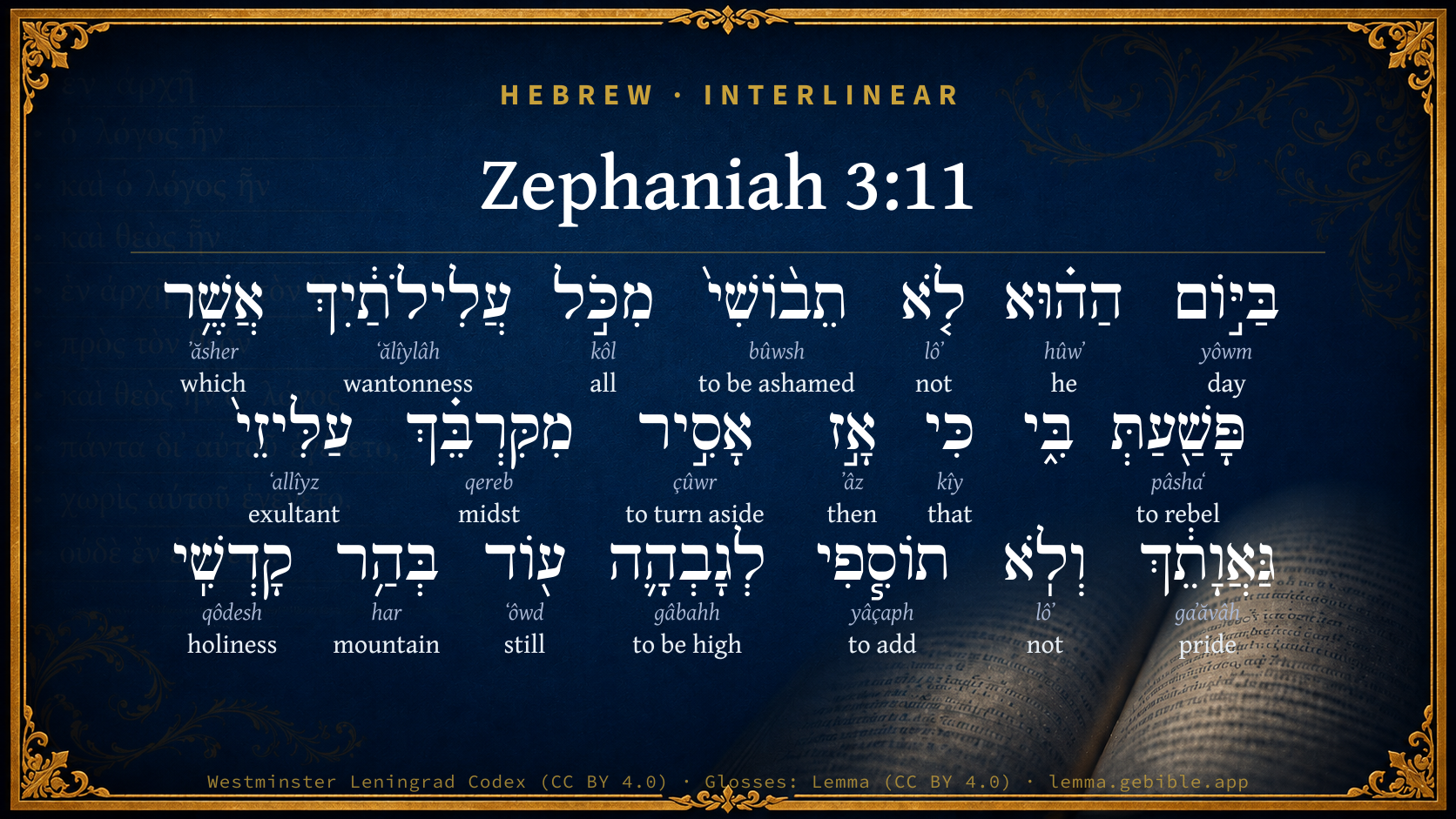
Hebrew (Westminster Leningrad Codex) Zephaniah 3:11 appears in the Hebrew Old Testament. The text above is from the Westminster Leningrad Codex. Each word links to its Strong’s number, a concise gloss, and parsing drawn from the Open Scriptures Hebrew Bible morphology. Click any word for its full Brown-Driver-Briggs (BDB) entry.
Download image
Cite this verse

Zephaniah 3:11 (World English Bible). Public Domain. Lemma interlinear Bible study tool, https://lemma.gebible.app/v/zephaniah/3/11.

Show BibTeX & RIS
BibTeX
RIS
English Translation
In that day you will not be disappointed for all your doings, in which you have transgressed against me; for then I will take away out of the midst of you your proudly exulting ones, and you will no more be haughty in my holy mountain.
World English Bible · Public Domain
Download a study sheet

One document with this verse’s original text, its word-by-word gloss line, the meaning frame, cross-references with their text, attributed commentary, and full source and license credits — printable, and it pastes into notes with its structure intact.

This verse Autodidact and up

Study sheet (.html) Plain text (.txt)

A passage Seminary Student

Up to 50 verses in one chapter. A passage sheet keeps up to 6 commentary sources and 12 cross-references per verse, in the order this page ranks them, and says so on the sheet whenever that leaves anything out. Ask for a single verse and you get the Autodidact verse sheet above.

Everything on this page stays free to read, with no account — the sheet is a download of what is already on screen, not access to it.

Want to remove ads? Support Godless Engineer
Compare translations 3

The same verse in 3 English versions, stacked beneath the original-language interlinear above. Click any original word for its lexicon entry.

Each is an independent rendering of the whole verse — the interlinear is not word-aligned to these translations.

Highlighted words mark where these versions differ — a whole-verse word diff, not a word-by-word alignment.

  • World English Bible Public Domain
    In that day you will not be disappointed for all your doings, in which you have transgressed against me; for then I will take away out of the midst of you your proudly exulting ones, and you will no more be haughty in my holy mountain.
  • King James Version Public Domain
    In that day shalt thou not be ashamed for all thy doings, wherein thou hast transgressed against me: for then I will take away out of the midst of thee them that rejoice in thy pride, and thou shalt no more be haughty because of my holy mountain.
  • unfoldingWord Literal Text CC BY-SA 4.0
    On that day you will not feel shame from all of your deeds which you transgressed against me, for then I will remove from your midst the exultant of your pride, and you will not continue still to be haughty on my holy mountain.

unfoldingWord Literal Text — © unfoldingWord, licensed CC BY-SA 4.0. Word-aligned USFM3 via Door43 (git.door43.org/unfoldingWord/en_ult).

Versions to compare (up to 4)

3 of 4 selected

Show all 18 translations

Every available English version of this verse, each an independent rendering of the whole verse.

  • World English Bible Public Domain
    In that day you will not be disappointed for all your doings, in which you have transgressed against me; for then I will take away out of the midst of you your proudly exulting ones, and you will no more be haughty in my holy mountain.
  • Berean Standard Bible Public Domain
    On that day you will not be put to shame for any of the deeds by which you have transgressed against Me. For then I will remove from among you those who rejoice in their pride, and you will never again be haughty on My holy mountain.
  • Majority Standard Bible Public Domain
    On that day you will not be put to shame for any of the deeds by which you have transgressed against Me. For then I will remove from among you those who rejoice in their pride, and you will never again be haughty on My holy mountain.
  • King James Version Public Domain
    In that day shalt thou not be ashamed for all thy doings, wherein thou hast transgressed against me: for then I will take away out of the midst of thee them that rejoice in thy pride, and thou shalt no more be haughty because of my holy mountain.
  • American Standard Version (1901) Public Domain
    In that day shalt thou not be put to shame for all thy doings, wherein thou hast transgressed against me; for then I will take away out of the midst of thee thy proudly exulting ones, and thou shalt no more be haughty in my holy mountain.
  • Revised Version (1885) Public Domain
    In that day shalt thou not be ashamed for all thy doings, wherein thou hast transgressed against me: for then I will take away out of the midst of thee thy proudly exulting ones, and thou shalt no more be haughty in my holy mountain.
  • Geneva Bible (1599) Public Domain
    In that day shalt thou not be ashamed for all thy workes, wherein thou hast transgressed against mee: for then I will take away out of the middes of thee them that reioyce of thy pride, and thou shalt no more be proude of mine holy Mountaine.
  • Douay-Rheims (1899) Public Domain
    In that day thou shalt not be ashamed for all thy doings, wherein thou hast transgressed against me: for then I will take away out of the midst of thee thy proud boasters, and thou shalt no more be lifted up because of my holy mountain.
  • Young's Literal Translation Public Domain
    In that day thou art not ashamed because of any of thine actions, Wherewith thou hast transgressed against Me, For then do I turn aside from thy midst The exulting ones of thine excellency, And thou dost add no more to be haughty, In My holy mountain.
  • Literal Standard Version CC BY-SA 4.0
    In that day you are not ashamed because of any of your actions, || With which you have transgressed against Me, || For then I turn aside from your midst || The exulting ones of your excellence, || And you are to be haughty no longer, || In My holy mountain.
  • Unlocked Literal Bible CC BY-SA 4.0
    In that day you will not be put to shame for all your deeds that you committed against me, since at that time I will remove from among you those who celebrated your pride, and because you will no longer act arrogantly on my holy mountain.
  • unfoldingWord Literal Text CC BY-SA 4.0
    On that day you will not feel shame from all of your deeds which you transgressed against me, for then I will remove from your midst the exultant of your pride, and you will not continue still to be haughty on my holy mountain.
  • Darby Bible Public Domain
    In that day thou shalt not be ashamed for all thy doings wherein thou hast transgressed against me; for then I will take away out of the midst of thee them that exult in thy pride, and thou shalt no more be haughty because of my holy mountain.
  • World Messianic Bible Public Domain
    In that day you will not be disappointed for all your doings in which you have transgressed against me; for then I will take away out from among you your proudly exulting ones, and you will no more be arrogant in my holy mountain.
  • Webster's Bible Public Domain
    In that day shalt thou not be ashamed for all thy doings, in which thou hast transgressed against me: for then I will take away out of the midst of thee them that rejoice in thy pride, and thou shalt no more be haughty because of my holy mountain.
  • Free Bible Version CC BY-SA 4.0
    On that day you won't be ashamed because of what you did in rebelling against me, for I will remove from among you those who are proud and boastful. Never again will you be conceited on my holy mountain.
  • Bible in Basic English Public Domain
    In that day you will have no shame on account of all the things in which you did evil against me: for then I will take away from among you those who were lifted up in pride, and you will no longer be lifted up with pride in my holy mountain.
  • JPS Tanakh (1917) Public Domain
    In that day shalt thou not be ashamed for all thy doings, wherein thou hast transgressed against Me; for then I will take away out of the midst of thee thy proudly exulting ones, and thou shalt no more be haughty in My holy mountain.

Literal Standard Version (2020), Covenant Press — licensed CC BY-SA 4.0. Text via the HelloAO Bible API (eBible.org). Unlocked Literal Bible (unfoldingWord) — licensed CC BY-SA 4.0. Text via the HelloAO Bible API (eBible.org). unfoldingWord Literal Text — © unfoldingWord, licensed CC BY-SA 4.0. Word-aligned USFM3 via Door43 (git.door43.org/unfoldingWord/en_ult). Free Bible Version, Dr. Jonathan Gallagher — licensed CC BY-SA 4.0. Text via the HelloAO Bible API (eBible.org).

Word by word

More ways to search: Search by grammar → Find every occurrence → Compare this word →

Practice this passage: Drill this verse → Learn its vocabulary →

עַלִּיזֵי֙
ʻallîyz
H5947
“exultant of”
Adjective, Adjective, Masculine, Plural, Construct
Part of Speech
Adjective
Type
Adjective
Gender
Masculine
Number
Plural
State
Construct
Full BDB Definition

Origin: from H5937

TWOT: 1625b

exultant, jubilant
  1. בַּיּ֣וֹם yôwm H3117 “in/at the · day” Preposition, Determined + Noun, Common, Masculine, Singular, Absolute
  2. הַה֗וּא hûwʼ H1931 “the · he” Particle, Definite Article + Pronoun, Personal, 3rd Person, Masculine, Singular
  3. לֹ֤א lôʼ H3808 “not” Particle, Negative
  4. תֵב֨וֹשִׁי֙ bûwsh H954 “to be ashamed” Verb, Qal, Imperfect, 2nd Person, Feminine, Singular
  5. מִכֹּ֣ל kôl H3605 “from · all of” Preposition + Noun, Common, Masculine, Singular, Construct
  6. עֲלִילֹתַ֔יִךְ ʻălîylâh H5949 “deeds · your” Noun, Common, Feminine, Plural, Construct + Suffix, Personal, 2nd Person, Feminine, Singular
  7. אֲשֶׁ֥ר ʼăsher H834 “which” Particle, Relative
  8. פָּשַׁ֖עַתְּ pâshaʻ H6586 “to rebel” Verb, Qal, Perfect, 2nd Person, Feminine, Singular
  9. כִּי kîy H3588 “that” Conjunction
  10. אָ֣ז ʼâz H227 “then” Adverb
  11. אָסִ֣יר çûwr H5493 “to turn aside” Verb, Hiphil, Imperfect, 1st Person, Common, Singular
  12. מִקִּרְבֵּ֗ךְ qereb H7130 “from · midst · your” Preposition + Noun, Common, Masculine, Singular, Construct + Suffix, Personal, 2nd Person, Feminine, Singular
  13. גַּאֲוָתֵ֔ךְ gaʼăvâh H1346 “pride · your” Noun, Common, Feminine, Singular, Construct + Suffix, Personal, 2nd Person, Feminine, Singular
  14. וְלֹֽא lôʼ H3808 “and · not” Conjunction + Particle, Negative
  15. תוֹסִ֧פִי yâçaph H3254 “to add” Verb, Hiphil, Imperfect, 2nd Person, Feminine, Singular
  16. לְגָבְהָ֛ה gâbahh H1361 “to be high” Preposition + Verb, Qal, Infinitive Construct
  17. ע֖וֹד ʻôwd H5750 “still” Adverb
  18. בְּהַ֥ר har H2022 “in/at · mountain of” Preposition + Noun, Common, Masculine, Singular, Construct
  19. קָדְשִֽׁי qôdesh H6944 “holiness · my” Noun, Common, Masculine, Singular, Construct + Suffix, Personal, 1st Person, Common, Singular

About this verse

These counts appear in no published source. They are computed here, from the morphology-tagged text and Lemma’s own curated glosses. What Lemma adds →

21
words
19
distinct lemmas
Prophets
section

Notable vocabulary

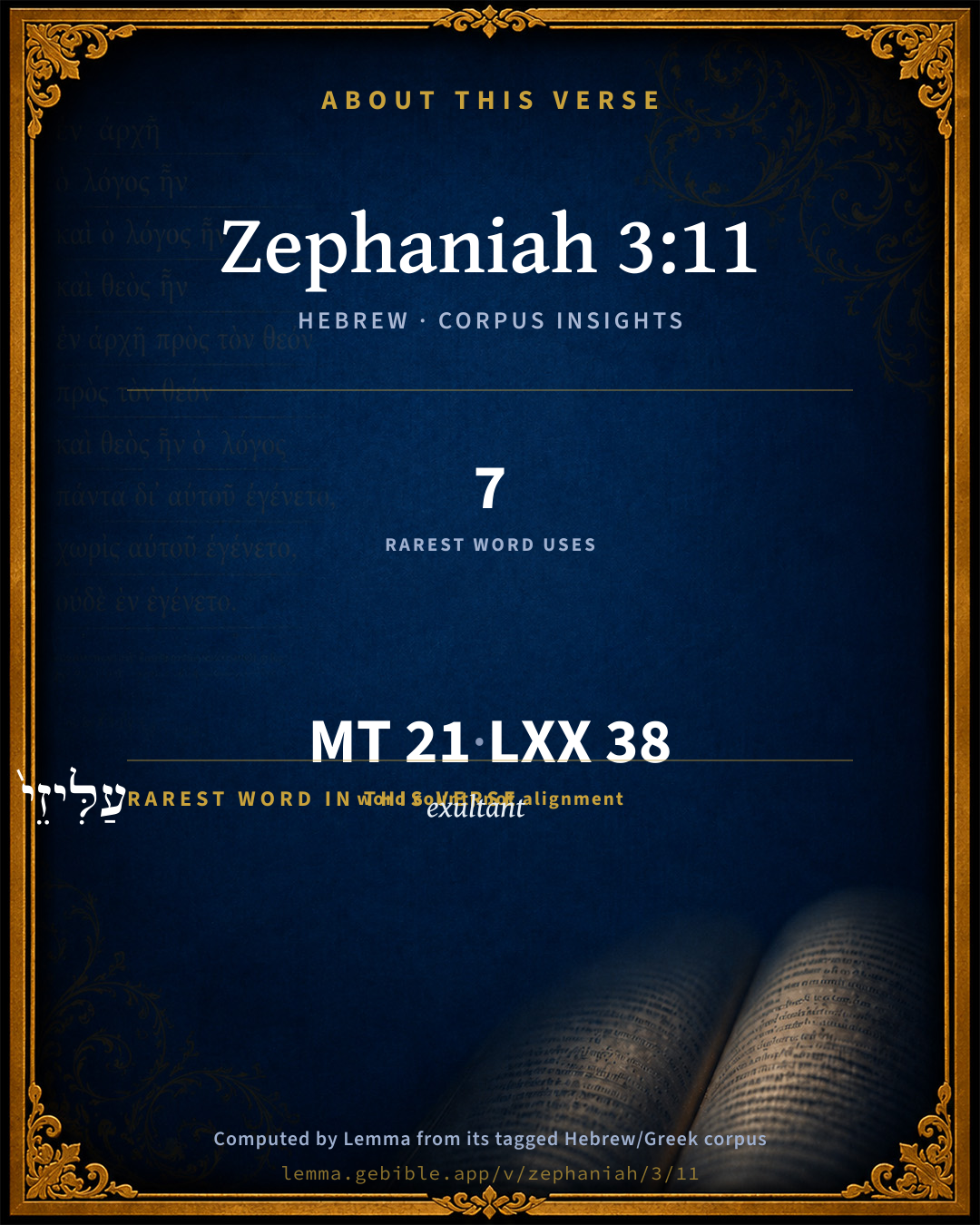
The rarest word here is עַלִּיזֵי֙ exultant H5947 — appearing just 7 times in the whole Hebrew Bible.

Shared distinctive vocabulary

עַלִּיזֵי֙ exultant H5947 occurs in 7 verses of the Hebrew Bible. Also found in:

Grammatical profile

  • 5 verbs
  • 7 nouns
  • 1 adjective
  • 1 pronoun
  • 1 preposition
  • 1 conjunction
  • 2 adverbs
  • 3 particles

Verb forms

  • תֵב֨וֹשִׁי֙ Qal · Imperfect
  • פָּשַׁ֖עַתְּ Qal · Perfect
  • אָסִ֣יר Hiphil · Imperfect
  • תוֹסִ֧פִי Hiphil · Imperfect
  • לְגָבְהָ֛ה Qal · Infinitive Construct

Repetition

A word recurs within this verse — often emphatic in Hebrew:

Hebrew & Septuagint length

In English translation the verse runs 46 words from the Hebrew and 40 from the Septuagint (LXX English) — closely comparable.

A rough comparison of the two English renderings, which tokenize alike — not a word-level alignment.

Word counts can differ between the Hebrew and the Greek without any difference in meaning — e.g. the Hebrew direct-object marker אֵת has no separate Greek word, and Greek often adds the article ὁ.

In the original languages it is 21 Hebrew tokens and 38 Greek tokens — but the two are counted differently (Hebrew bundles its prefixes and suffixes into one token; the Greek is in lemma form), so that isn’t a like-for-like length.

Cross-references

22

Topical passages linked to Zephaniah 3:11 in the Treasury of Scripture Knowledge — connected by theme and wording, ordered by reader-vote popularity; previews shown in the World English Bible.

  • Isaiah 54:4 Don't be afraid; for you shall not be ashamed: neither be confounded; for you shall not be disappointed: for you shall forget the shame of your youth; and the reproach of your widowhood shall you remember no more.
  • Isaiah 11:9 They shall not hurt nor destroy in all my holy mountain; for the earth shall be full of the knowledge of Yahweh, as the waters cover the sea.
  • Joel 2:26–27 You will have plenty to eat, and be satisfied, And will praise the name of Yahweh, your God, Who has dealt wondrously with you; And my people will never again be disappointed.
  • Isaiah 61:7 Instead of your shame [you shall have] double; and instead of dishonor they shall rejoice in their portion: therefore in their land they shall possess double; everlasting joy shall be to them.
  • Isaiah 45:17 [But] Israel shall be saved by Yahweh with an everlasting salvation: you shall not be disappointed nor confounded world without end.
  • Jeremiah 7:4 Don't you trust in lying words, saying, The temple of Yahweh, the temple of Yahweh, the temple of Yahweh, are these.
  • Daniel 9:16 Lord, according to all your righteousness, let your anger and please let your wrath be turned away from your city Jerusalem, your holy mountain; because for our sins, and for the iniquities of our fathers, Jerusalem and your people are become a reproach to all who are round about us.
  • Matthew 3:9 Don't think to yourselves, 'We have Abraham for our father,' for I tell you that God is able to raise up children to Abraham from these stones.
  • Romans 9:33 even as it is written, "Behold, I lay in Zion a stumbling stone and a rock of offense; And no one who believes in him will be disappointed."
  • 1 Peter 2:6 Because it is contained in Scripture, "Behold, I lay in Zion a chief cornerstone, chosen, and precious: He who believes in him will not be disappointed."
  • Numbers 16:3 and they assembled themselves together against Moses and against Aaron, and said to them, You take too much on you, seeing all the congregation are holy, everyone of them, and Yahweh is among them: why then lift yourselves up above the assembly of Yahweh?
  • Psalms 49:5 Why should I fear in the days of evil, When iniquity at my heels surrounds me?
  • Psalms 87:1–2 His foundation is in the holy mountains.
  • Isaiah 48:1–2 Hear you this, house of Jacob, who are called by the name of Israel, and are come forth out of the waters of Judah; who swear by the name of Yahweh, and make mention of the God of Israel, but not in truth, nor in righteousness
  • Isaiah 65:13–14 Therefore thus says the Lord Yahweh, Behold, my servants shall eat, but you shall be hungry; behold, my servants shall drink, but you shall be thirsty; behold, my servants shall rejoice, but you shall be disappointed;
  • Jeremiah 7:9–12 Will you steal, murder, and commit adultery, and swear falsely, and burn incense to Baal, and walk after other gods that you have not known,
  • Ezekiel 7:20–24 As for the beauty of his ornament, he set it in majesty; but they made the images of their abominations [and] their detestable things therein: therefore have I made it to them as an unclean thing.
  • Ezekiel 24:21 Speak to the house of Israel, Thus says the Lord Yahweh: Behold, I will profane my sanctuary, the pride of your power, the desire of your eyes, and that which your soul pities; and your sons and your daughters whom you have left behind shall fall by the sword.
  • Daniel 9:20 While I was speaking, and praying, and confessing my sin and the sin of my people Israel, and presenting my supplication before Yahweh my God for the holy mountain of my God;
  • Micah 3:11 Her leaders judge for bribes, And her priests teach for a price, And her prophets of it tell forturnes for money: Yet they lean on Yahweh, and say, Isn't Yahweh in the midst of us? No disaster will come on us.
  • Zephaniah 3:19–20 Behold, at that time I will deal with all those who afflict you, and I will save those who are lame, and gather those who were driven away. I will give them praise and honor, whose shame has been in all the earth.
  • Romans 2:17 Indeed you bear the name of a Jew, and rest on the law, and glory in God,

Cross-references courtesy of OpenBible.info (CC BY 4.0).

Hebrew and Greek witnesses Masoretic Hebrew ↔ Greek Septuagint

The same verse in the two great witnesses to the Old Testament, shown verse-for-verse.

These are two independent witnesses, not word-aligned to each other, and the Septuagint is shown in lemma (dictionary) form.

Hebrew Zephaniah 3:11 Masoretic · Westminster Leningrad Codex

בַּיּ֣וֹם הַה֗וּא לֹ֤א תֵב֨וֹשִׁי֙ מִכֹּ֣ל עֲלִילֹתַ֔יִךְ אֲשֶׁ֥ר פָּשַׁ֖עַתְּ בִּ֑י כִּי אָ֣ז אָסִ֣יר מִקִּרְבֵּ֗ךְ עַלִּיזֵי֙ גַּאֲוָתֵ֔ךְ וְלֹֽא תוֹסִ֧פִי לְגָבְהָ֛ה ע֖וֹד בְּהַ֥ר קָדְשִֽׁי

In that day you will not be disappointed for all your doings, in which you have transgressed against me; for then I will take away out of the midst of you your proudly exulting ones, and you will no more be haughty in my holy mountain.

World English Bible · Public Domain

Greek LXX Zephaniah 3:11 Septuagint · lemma form

ἐν ὁ ἡμέρα ἐκεῖνος οὐ μή κατααἰσχύνω ἐκ πᾶς ὁ ἐπιτήδευμα σύ ὅς ἀσεβέω εἰς ἐγώ ὅτι τότε περιαἱρέω ἀπό σύ ὁ φαύλισμα ὁ ὕβρις σύ καί οὐκέτι μή προςτίθημι ὁ μεγαλαυχέω ἐπί ὁ ὄρος ὁ ἅγιος ἐγώ

In that day you shall not be ashamed of all your practices, wherein you have transgressed against me: for then will I take away from you your disdainful pride, and you shall no more magnify yourself upon my holy mountain.

LXX2012 (modern English Septuagint) · Public Domain

Hebrew: Westminster Leningrad Codex (CC BY 4.0). Greek: Septuagint (public domain); English from LXX2012 (modern English Septuagint) (Public Domain). How the Septuagint differs from the Hebrew →

Targum (Aramaic paraphrase)

1

The Targum is the ancient Jewish Aramaic paraphrase of the Hebrew Scriptures — an interpretive translation, not the Hebrew text itself. Onkelos (literal) and Pseudo-Jonathan (expansive) render the Torah, and Jonathan the Prophets. Coverage is partial: where no permissively-licensed English translation exists for a verse, only the Aramaic is shown. This is verse-level text, not a word-by-word alignment to the Hebrew.

  1. Targum Jonathan Prophets (Joshua–Malachi)
    בְּעִדָנָא הַהִיא לָא תִבְהֲתוּן מִכָּל עוֹבָדַיִךְ בִּישַׁיָא דִי מָרַדְתָּ בְּמֵימְרִי אֲרֵי בְכֵן אֲגַלֵי מִגַוֵיךְ תַּקִיפֵי תוּשְׁבַּחְתֵּךְ וְלָא תוֹסִיפוּן לְאִתְרַבְרָבָא עוֹד בְּטוּרָא דְקוּדְשִׁי:

    (no public-domain English translation for this verse)

    Targum Jonathan — Aramaic: “Mikraot Gedolot” (public domain). English: “Sefaria Community Translation” (CC0 1.0 (public-domain dedication)); “London "Chaldee Paraphrase," 1871” (public domain). Text via Sefaria.

Commentary

Notes on Zephaniah 3:11 from classic Christian and Jewish commentators (each source and its license shown beneath its notes). The classic Christian expositions comment on the surrounding passage and are grouped to its opening verse, so a note may address several verses; the Jewish commentaries on the Tanakh (Rashi and others) are per-verse, so they appear only where the commentator wrote on this verse.

Lemma curates 59 commentaries, every one of them public domain or Creative Commons licensed, each selected and text-cleaned for this edition rather than reprinted as found. About our sources →

Jamieson, Fausset & Brown

Robert Jamieson, A. R. Fausset & David Brown

shalt thou not be ashamed--Thou shalt then have no cause to be ashamed; for I will then take away out of the midst of thee those who by their sins gave thee cause for shame (Zep 3:7).

them that rejoice in thy pride--those priding themselves on that which thou boastest of, thy temple ("My holy mountain"), thy election as God's people, &c., in the Pharisaic spirit (Jer 7:4; Mic 3:11; Mat 3:9). Compare Jer 13:17, "mine eyes shall weep for your pride." The converted remnant shall be of a humble spirit (Zep 3:12; Isa 66:2, Isa 66:10).

Jamieson, Fausset & Brown — Commentary Critical and Explanatory on the Whole Bible (1871) — public domain (CC PDM 1.0). Text via the HelloAO Bible API.

Trapp's Complete Commentary

John Trapp

Zep 3:11 In that day shalt thou not be ashamed for all thy doings, wherein thou hast transgressed against me: for then I will take away out of the midst of thee them that rejoice in thy pride, and thou shalt no more be haughty because of my holy mountain.

Ver. 11. In that day shalt thou not be ashamed] There is a holy shame for sin, such as was that of Ezra, Ezr 9:6, of the penitent publican, Luk 18:13, and of those good souls in Ezekiel, who blushing and bleeding loathed themselves for their abominations, Eze 16:52. To be ashamed on this sort is no shame, but a sign of that godly sorrow that worketh repentance never to be repented of; and not to know shame, to be frontless and impudent, is the note of a naughty man, Eze 16:52. But that which God promiseth here is that he will cover their sins, not impute them, Psa 32:1-2, and that he will by his grace preserve them from scandalous and reproachful practices that might render them ignominious and despicable, see Psa 18:39; shining upon them himself, and giving them honour in the hearts of others, as he did Solomon.

Them that rejoice in thy pride] Or, in thine excellence, as Psa 68:35, that is, in thine external privileges, wherein thou hast hitherto so prided thyself as the only people of God, holy and beloved.

And thou shalt no more be haughty] Stand upon thy tip-toes, upon thy sandles, as if there were none such.

Because of mine holy mountain] Jer 7:4. The temple of the Lord, the temple of the Lord, cried they aloud that nothing cared for the Lord of the temple. So the Jesuits and their Romish crew cry, the Church, the Church, the Catholic Church, ad ravem usque, until hoarse like so many oyster-wives: but this is not the guise of God’s people. He will purge his Church of such formalists.

John Trapp, A Commentary or Exposition upon All the Books of the Old and New Testament (1647–1656) — public domain. Text from a community e-Sword module.

The Biblical Illustrator

Joseph S. Exell

Zep_3:11-13

In that day shalt thou not be ashamed for all thy doings.

A sketch of a morally regenerated city

I. The utter absence of bad. There is an absence of--

1. Painful memories. In that day shalt thou not be ashamed for all thy doings. Thou wilt not need to be ashamed of all thy iniquities--

(1) Because they are all forgiven,

(2) Because they will occur no more.

2. Wicked citizens. I will take away out of the midst of thee them that rejoice in thy pride.

3. All crimes. The remnant of Israel shall not do of the city cleared of such moral impurities.

II. The blessed presence of the good. I will also leave in the midst of thee an afflicted and poor people, and they shall trust in the name of the Lord. Who will be the citizens?

1. Men of humility. Delitzsch translates the word afflicted, bowed down; and Henderson, humble. Humility is evidently the idea. There will be men who are poor in spirit. Moral humility is moral nobility. The humbler a man is, the nobler and the happier too. Blessed are the poor in spirit.

2. Men of piety They shall trust in the name of the Lord. Their chief confidence will be placed, not in their strength, their wealth, or their wisdom, but in God. They will centre their trust, not in the creature, but in the Creator.

3. Men of concord. They shall feed and lie down, and none shall make them afraid. There will be amongst them no acrimonious disputations, no commercial rivalries, no social jealousies or envyings, no painful divisions of any kind. (Homilist.)

The Biblical Illustrator, edited by Joseph S. Exell (c. 1880s–1900s) — public domain. Text from a community e-Sword module.

Joseph Benson's Commentary

Zep 3:11. In that day — Or, after that time; shalt thou not be ashamed for all thy doings — Thy guilt and thy punishment shall cease: thou shalt be pardoned and reformed. For then will I take away them that rejoice in thy pride — Or, greatness: or, as some render it, that exult in their pride. And thou shalt no more be haughty because of my holy mountain — That is, because of mount Zion, my temple, the sacrifices offered there, and the ordinances of my worship. I will purge out from thee those hypocrites who continue in their sins, unconcerned and unreformed, and yet rely on outward privileges, ordinances, and forms of worship. Thus Jeremiah represents them as exclaiming, The temple of the Lord! the temple of the Lord! while they little regarded the Lord of the temple. Thus the Popish clergy cry out, The church, the church, the Catholic Church! while in the mean time they neither enter into the true church themselves, nor permit those to enter that are so inclined.

Joseph Benson's Commentary on the Old and New Testaments (1811–1818) — public domain. Text from a community e-Sword module.

Keil & Delitzsch

C. F. Keil & F. Delitzsch

"In that day wilt thou not be ashamed of all thy doings, wherewith thou hast transgressed against me; for then will I remove from the midst of thee those that rejoice in thy pride, and thou wilt no more pride thyself upon my holy mountain. Zep 3:12. And I leave in the midst of thee a people bowed down and poor, and they trust in the name of Jehovah. Zep 3:13. The remnant of Israel will not do wrong, and not speak lies, and there will not be found in their mouth a tongue of deceit; for they will feed and rest, and no one will terrify them." The congregation, being restored to favour, will be cleansed and sanctified by the Lord from every sinful thing. The words of Zep 3:11 are addressed to the Israel gathered together from the dispersion, as the daughter of Zion (cf. Zep 3:14). "In that day" refers to the time of judgment mentioned before, viz., to the day when Jehovah rises up for prey (Zep 3:8). לא תבושׁי, thou wilt not need to be ashamed of all thine iniquities; because, as the explanatory clauses which follow clearly show, they occur no more. This is the meaning of the words, and not, as Ewald imagines, that Jerusalem will no more be bowed down by the recollection of them. The perfect אשׁר פּשׁעתּ does indeed point to the sins of former times; not to the recollection of them, however, but to the commission of them. For the proud and sinners will then be exterminated from the congregation. עלּיזי גאוה is taken from Isa 13:3, where it denotes the heroes called by Jehovah, who exult with pride caused by the intoxication of victory; whereas here the reference is to the haughty judges, priests, and prophets (Zep 3:3 and Zep 3:4), who exult in their sinful ways. גּבהה a feminine form of the infinitive, like moshchâh in Exo 29:29, etc. (cf. Ges. 45, 1, b, and Ewald, 236, a). גּבהּ, to be haughty, as in Isa 3:16. The prophet mentions pride as the root of all sins. The holy mountain is not Canaan as a mountainous country, but the temple mountain, as in the parallel passage, Isa 11:9. The people left by the Lord, i.e., spared in the judgment, and gathered together again out of the dispersion, will be ‛ânı̄ and dal. The two words are often connected together as synonyms, e.g., Isa 26:6 and Job 34:28. עני is not to be confounded with ענו, gentle or meek, but signifies bowed down, oppressed with the feeling of impotence for what is good, and the knowledge that deliverance is due to the compassionate grace of God alone; it is therefore the opposite of proud, which trusts in its own strength, and boasts of its own virtue. The leading characteristic of those who are bowed down will be trust in the Lord, the spiritual stamp of genuine piety. This remnant of Israel, the ἐκλογή of the people of God, will neither commit injustice, nor practise wickedness and deceit with word and tongue, will therefore be a holy nation, answering to its divine calling (Exo 19:6), just as God does not wrong (Zep 3:5), and the servant of Jehovah has no deceit in his mouth (Isa 53:9). What is stated here can, of course, not refer to those who were brought back from Babylon, as Calvin supposes, taking the words comparatively, because there were many hypocrites among the exiles, and adding, "because the Lord will thus wipe away all stains from His people, that the holiness may then appear all the purer." The prophetic announcement refers to the time of perfection, which commenced with the coming of Christ, and will be completely realized at His return to judgment. Strauss very appropriately compares the words of John, "Whatsoever is born of God doth not commit sin" (Jo1 3:9). Zephaniah explains what he says, by adding the assurance of the blessing which is promised in the law as the reward of faithful walk in the commandments of the Lord. This reason rests upon the assumption that they only rejoice in the promised blessing who walk in the commandments of God. In this respect the enjoyment of the blessing yields a practical proof that wrong and wickedness occur no more. The words ירעוּ ורבצוּ may be explained from the comparison of the remnant of Israel to a flock both in Mic 7:14 and Luk 12:32 ("little flock;" for the fact itself, compare Mic 4:4). This blessing is still further developed in what follows, first of all by a reference to the removal of the judgments of God (Zep 3:14-17), and secondly by the promise of God that all the obstacles which prevent the enjoyment of the blessing are to be cleared away (Zep 3:18-20).

Keil & Delitzsch — Biblical Commentary on the Old Testament (1861–1891) — public domain (CC PDM 1.0). Text via the HelloAO Bible API. (Old Testament only.)

Geneva Bible (1599)

Geneva Bible translators

For they shall have full remission of their sins, and the hypocrites which boasted of the Temple, which was also thy pride in times past, shall be taken from thee.

Geneva Bible (1599) marginal notes — public domain. Text via Bolls.life.

Adam Clarke's Commentary

Verse 11. Shalt thou not be ashamed] Thy punishment shall cease, for God shall pardon thy sin.

For then I will take away out of the midst of thee] The wicked Jewish priests and scribes who blasphemed Christ, and would not come under his yoke.

Because of my holy mountain.] Thou wilt no more boast in my temple, but become meek and lowly in following him who is meek and lowly in heart, that ye may obtain rest to your souls.

Adam Clarke's Commentary on the Bible (1810–1826) — public domain. Text from a community e-Sword/MySword module.

John Calvin's Commentaries

Here the Prophet teaches us, that the Church would be different, when God removed the dross and gathered to himself a pure and chosen people: and the Prophet stated this, that the faithful might not think it hard that God so diminished his Church that hardly the tenth part remained; for it was a sad and a bitter thing, that of a vast multitude a very few only remained. It could not then be, but that the ruin of their brethren greatly affected the Jews, though they knew them to be reprobate. We indeed see how Paul felt a sympathy, when he saw that his own nation were alienated from God. Romans 9:6-8. So it was necessary that some consolation should be given to the faithful, that they might patiently bear the diminution of the Church, which had been previously predicted. Hence the Prophet, that he might moderate their grief, says, that this would be for their good; for in this manner the reproaches were to be removed, by which the Jewish name had been polluted, and rendered abominable.

Thou shalt not be ashamed, he says, for the sins by which I have been offended. Why? For thou shalt be cleansed; for it is God’s purpose to reserve a few, by whom he will be purely worshipped. Some think that he does not speak here of the remission of sins, but on the contrary, of a pure and holy life, which follows regeneration; as though he had said, "There will be no reason any more for thee to be ashamed of thy life; for when I shall chasten you, ye will then fear me, and your correction will be conducive to a newness of life: since then your life will not be the same as formerly, and since my glory shall shine forth among you, there will be no cause why ye should be ashamed.” But this is a strained view, and cannot be accommodated to the words of the Prophet; for he says, Thou shalt no more be ashamed of the sins by which thou hast transgressed against me. We hence see that this cannot be otherwise applied than to the remission of sins. But the last clause has led interpreters astray, for the Prophet adds, For I will take away from the midst of thee those who exult: but the Prophet’s design, as I have stated, was different from what they have supposed; for he shows that there was no reason for the Jews to lament and deplore the diminution of the Church because the best compensation was offered to them, which was, that by this small number God would be purely served. For when the body of the people was complete, it was, we know, a mass of iniquity. How then could Israel glory in its vast number, since they were all like the giants carrying on war against God? When now God collects a few only, these few would at length acknowledge that they had been preserved in a wonderful manner, in order that religion and the true worship of God should not be extinguished in the earth.

We now perceive the Prophet’s design; but I will endeavor to render this clearer by a comparison: Suppose that in a city licentiousness of life so prevails that the people may seem to be irreclaimable; when it happens that the city itself falls away from its power and pristine state, or is in some other way reformed, not without loss, and is thus led to improve its morals, this would be a compensation to the good, and would give courage to the godly and ease their grief, so that they would patiently submit, though the city had not the same abundance, nor the same wealth and enjoyments. How so? because they who remained would form a body of people free from reproach and disgrace. When disease is removed from the human body, the body itself is necessarily weakened; and it is sometimes necessary to amputate a member, that the whole body may be preserved. In this case there is a grievous diminution, but as there is no other way of preserving the body, the remedy ought to be patiently sustained. In a similar manner does the Prophet now speak of the city Jerusalem: Thou shalt not be ashamed of the sins by which thou hast transgressed against me. How so? Because they were to be separated from the profane and gross despisers of God; for as long as the good and the evil were mixed together, it was a reproach common to all. Jerusalem was then a den of robbers; it was, as it were, a hell on earth; and all were alike exposed to the same infamy, for the pure part could not be distinguished, as a mass of evil prevailed everywhere. The Prophet now says, Thou shalt not be ashamed of thy former infamy. Why? “Because God will separate the chaff from the wheat, and will gather the wheat; ye shall be, as it were, in the storehouse of God; the chosen seed shall alone remain; there will be such purity, that the glory of the Lord shall shine forth among you: ye shall not therefore be ashamed of the disgraceful deeds by which ye are now contaminated.”

We now apprehend the meaning of the words. But it may seem strange that the Prophet should say, that sins should be covered by oblivion, which the Jews ought indeed to have thought of often and almost at all times, according to what Ezekiel says,

‘Thou wilt then remember thy ways, and be ashamed,’ (Ezekiel 16:61)

that is, when God shall be pacified. Ezekiel says, that the fruit of repentance would be, that the faithful, covered with shame, would condemn themselves. Why so? Because the reprobate proceed in their wicked courses, as it were, with closed eyes, and as it has been previously said, they know no shame: though God charges them with their sins, they yet despise and reject every warning with a shameless front; yea, they kick against the goads. Since it is so, justly does Ezekiel say, that shame would be the fruit of true repentance, according to what Paul also says in the sixth chapter to the Romans (Romans 6:21), “Of which ye are now ashamed.” He intimates, that when they were sunk in their unbelief, they were so given to shameful deeds, that they perceived not their abomination. They began therefore to be ashamed, when they became illuminated. The Prophet seems now to cut off this fruit from repentance: but what he says ought to be otherwise understood, that is, that the Church would be then free from reproach; for the reprobate would be separated, all the filth would be taken away, when God gathered only the remnant for himself; for in this manner, as it has been said, the wheat would be separated from the chaff. Thou shalt not then be ashamed in that day of evil deeds; for I will take away from the midst of thee those who exult. He shows how necessary the diminution would be; for all must have perished, had not God cut off the putrid members. How severe soever then and full of pain the remedy would be, it ought yet to be deemed tolerable; for the Church, that is the body, could not otherwise be preserved.

But it may be again objected—That the Church is cleansed from all spots, inasmuch as the reprobate are taken away; for he says, Thou shalt not be ashamed of the evil deeds by which thou hast sinned, literally, against me, that is, by which thou hast transgressed against me. God here addresses, it may be said, the faithful themselves: He then does not speak of the evil deeds of those whom the Lord had rejected. But the answer is easy: When he says, that the Church had sinned, he refers to that mixture, by which no distinction is made between the wheat and the chaff. We may say that a city is impious and wicked, when the majority so much exceeds in number the good, that they do not appear. When therefore among ten thousand men there are only thirty or even a smaller number who are anxious for a better state of things, the whole number will be generally counted wicked on account of the larger portion, for the others are hid, and, as it were, covered over and buried. Justly then and correctly does Zephaniah declare, that the Jews had transgressed against God; for in that mixed multitude the elect could not have been distinguished from the reprobate. But he now promises that there would be a distinction, when God took away the proud, who exulted in vain boasting. For he says, I will take away from the midst of thee those who exult in thy pride

Some render the word in the abstract, the exultations of thy pride: but the term עליזים, found here, is never in construction rendered exultations. It is therefore no doubt to be understood of men. He then names the pride of the people; and yet he addresses the elect, who were afterwards to be gathered. What does this mean? even what we have already stated, that before the Church was cleansed from her pollution and filth, there was a common exultation and insolence against God; for these words were everywhere heard—

“We are God’s holy people, we are a chosen race, we are a royal priesthood, we are a holy inheritance.” Exodous 19:6.

Since, then, these boastings were in the mouth of them all, the Prophet says, that it was the pride of the whole people. I will then take away, he says, from the midst of thee those who exult in thy pride

He afterwards adds, Thou shalt no more add to take pride in my holy mountain. Here the Prophet points out the main spring of the evil, because the Jews had hardened themselves in a perverse self-confidence, as they thought that all things were lawful for them, inasmuch as they were God’s chosen people. Jeremiah also in a similar manner represents their boasting as false, when they pretended to be the temple of God. Jeremiah 7:4. So our Prophet condemns this pride, because they concealed their sins under the shadow of the temple, and thought it a sufficient defense, that God dwelt on Mount Sion. To show, then, that the people were unhealable, without being cleansed from this pride, the Prophet says, I will take away those who exult —How did they exult? in thy pride: and what was this pride? that they inhabited the holy mount of God, besides which there was no other sanctuary of God on earth. As then they imagined that God was thus bound to them, they insolently despised all admonitions, as though they were exempt from every law and restraint. Thou shalt not then add to take pride in my holy mountain

We now then see how careful we ought to be, lest the favors of God, which ought by their brightness to guide us to heaven, should darken our minds. But as we are extremely prone to arrogance and pride, we ought carefully to seek to conduct ourselves in a meek and humble manner, when favored with God’s singular benefits; for when we begin falsely to glory in God’s name, and to put on an empty mask to cover our sins, it is all over with us; inasmuch as to our wickedness, to our contempt of God, and to other evil lusts and passions, there is added perverseness, for we persevere in our course, as it were, with an iron and inflexible neck. Thus, indeed, it happens to all hypocrites, who elate themselves through false pretenses as to their connection with God. It follows—

John Calvin's Commentaries (1540-1563) — public domain. Text from the Calvin Translation Society English edition (1840s-50s) via the Christian Classics Ethereal Library (ccel.org). Calvin's coverage is partial (roughly two-thirds of the Bible); uncommented books and verses are honest gaps, never fabricated. The 19th-century editor's footnotes and remarks are omitted so the notes are faithfully Calvin's own voice.

Ellicott's Commentary for English Readers

(11) No more be haughty . . .—His very privileges—the adoption and the Shechinah, and the covenants, and the giving of the law, and the Temple service—had hitherto been used by the Jew as a pretext for obduracy. “We have Abraham for our father,” “The temple of the Lord are these:” such was their response to the preaching of repentance. The reinstated nation shall be purged of this spiritual pride.

(11-13) Jerusalem shall then have no occasion to blush for obdurate iniquity (Zep_3:5), for she shall be inhabited by a remnant who have learnt meekness and righteousness in the school of adversity.

A Bible Commentary for English Readers, edited by Charles John Ellicott (1878–1897) — public domain. Text from a community e-Sword module.

The Cambridge Bible for Schools and Colleges

gen. ed. J. J. S. Perowne

11. In that day shalt thou not be ashamed] The common expression “in that day” refers to the general period spoken of in the context, here the period after the judgment, when the people of God is saved and restored. To be ashamed might mean either to feel shame for, or to bear the shame of, former doings. The first sense is the more expressive. The former things have so completely passed away that they are forgotten, and no recollection of them calls up a blush of shame (Isa_54:4; Isa_65:16). Cf. Eze_39:26.

them that rejoice in thy pride] R.V. thy proudly exulting ones. In Isa_13:3 the phrase is used of Jehovah’s warriors, the Medes, filled with martial pride and exulting in battle; here it has a less dignified sense, being used of the self-confident and arrogant classes in Israel, whether prophets (Zep_3:4) or politicians, the people of whom Amo_6:13 speaks: “which rejoice in a thing of nought, which say, Have we not taken to us horns by our own strength?” In the prophets religion is trust in Jehovah, and irreligion or sin is insensibility to His majesty and rule, and consequent pride and self-exaltation.

thou shalt no more be haughty] Isa_3:16, “Because the daughters of Zion are haughty and walk with stretched forth necks.” Jer_13:15.

because of my holy mountain] on my, &c.

The Cambridge Bible for Schools and Colleges (gen. ed. J. J. S. Perowne; Cambridge University Press, 1878–1918) — public domain. Text from a community e-Sword module.

John Gill's Exposition

In that day shall thou not be ashamed for all thy doings, wherein thou hast transgressed against me Because these shall not be continued in, but repented of, and forsaken; and, besides, shall be forgiven, blotted out, covered, and remembered no more; so that they shall not be charged with them, condemned for them, or be confounded before God, angels, and men, on account of them; not but that shame always arises from a true sense of sin; and the more, as it is beheld in the glass of pardoning love, which is a branch of true evangelical repentance, at least a fruit and evidence of it, ( Ezekiel 16:63 ) but then such are not ashamed to appear before God; but can with a holy confidence stand in his sight, their sins being pardoned, and their persons justified. This respects the Christian church or churches in Judea, the few that believed in Christ, called in a following verse the remnant of Israel ( Zephaniah 3:13 ) , at the time when the generality of the people of the Jews rejected the Messiah, and their city and temple were destroyed, and the Lord turned the pure language of the Gospel to the Gentiles: for then I will take away out of the midst of thee them that rejoice in thy pride; the Scribes and Pharisees, and those that adhered to them of the Jewish nation, who rejoiced in those things which that people generally prided themselves in and boasted of; their descent from Abraham; their observance of the rites and ceremonies of the law, and the traditions of their elders, and their external legal righteousness; and they rejoiced in their boastings of these things, which rejoicing was evil; and they, in the pride of their hearts, despised Christ and his righteousness, his Gospel, ordinances, and people, which were the things in which they transgressed against the Lord, and for which they were taken away by the sword, famine, and pestilence, at the destruction of Jerusalem: this is further explained by the next clause: and thou shall no more be haughty because of mine holy mountain: the temple; or, "in" F13 it; since it should now be destroyed: the Jews gloried in the temple, and behaved proudly and haughtily on the account of it; reckoned themselves secure, because of that; and trusted and gloried in the sacrifices there offered up, and the services there performed; see ( Jeremiah 7:4 ) . FOOTNOTES: F13 (yvdq rhb) "in monte sancto meo", V. L. Vatablus, Cocceius; "in monte sanctitatis meae", Pagninus, Montanus, Junius & Tremellius, Calvin, Burkius.

John Gill's Exposition of the Whole Bible (1746–1763) — public domain (CC PDM 1.0). Text via the HelloAO Bible API.

Albert Barnes' Notes on the Bible

In that day shalt thou not be ashamed for all thy doings - Because God, forgiving them, will blot them out and no more remember them. This was first fulfilled in the Gospel. Cyril: “No one can doubt that when Christ came in the flesh, there was an amnesty and remission to all who believed. ‘For we are justified not by works of righteousness which we have done, but according to His great mercy.’ But we have been released from shame. For ‘He’ hath restored us to freedom of access to God, Who for our sakes arose from the dead, and for us ascended to heaven in the presence of the Father. ‘For Christ, our Forerunner, hath ascended for us now to appear in the presence of God.’ So then He took away the guilt of all and freed believers from failures and shame.” Peter, even in heaven, must remember his denial of our Lord, yet not so as to be ashamed or pained anymore, since the exceeding love of God will remove all shame or pain.

Rup.: “Mighty promise, mighty consolation. Now, before that Day comes, the Day of My Resurrection, thou wilt be ashamed and not without reason, since thou ownest by a true confession, ‘all our righteousnesses are as filthy rags’ Isa 64:6. But at that Day it will not be so, especially when that shall be which I promise thee in the prophets and the Psalms, ‘There shall be a Fountain opened for sin and for uncleanness’ Zec 13:1; whence David also, exulting in good hope of the Holy Spirit, saith, ‘Thou shalt wash me and I shall be whiter than snow’ Psa 51:7. For though he elsewhere saith, ‘they looked unto Him and were lightened, and their faces were not ashamed’ Psa 34:5, yet in this mortal life, when the Day of My Resurrection doth not fully shine upon thee, thou art after some sort ashamed; as it is written, ‘What fruit had ye then in those things whereof ye are now ashamed?’ Rom 6:21, but that shame will bring glory, and, when that glory cometh in its place, will wholly pass away. But when the fullness of that day shall come, the fullness of My Resurrection, when the members shall rise, as the Head hath risen, will the memory of past foulness bring any confusion? Yea the very memory of the miseries will be the richest subject of singing, according to that, ‘My song shall be alway of the loving-kindness of the Lord’ Psa 89:1.” For how shall the redeemed forget the mercies of their redemption, or yet how feel a painful shame even of the very miseries, out of which they were redeemed by the fullness of the overstreaming Love of God?

For then will I take away out of the midst of thee them that rejoice in thy pride - (Those of thee who exult in pride.) All confusion shall (cease, because all pride shall cease, the parent of sin and confusion. The very gift of God becomes to the carnal a source of pride. Pride was to the Jew also the great hindrance to the reception of the Gospel. He made his “boast of the law,” yea, in God Himself, that he “knew His will,” and was a “guide of others” Rom 2:17-20, Rom 2:23, and so was the more indignant, that the pagan was made equal to him, and that he too was called to repentance and faith in Christ. So, “going about to establish his own righteousness, he did not submit himself to the righteousness of God,” but shut himself out from the faith and grace and salvation of Christ, and rejected Himself. So (Rup.), “thy pride” may be the pride in being the people of God, and having Abraham for their father. “And thou shalt no more be haughty in My holy mountain,” “but thou shalt stand in the great and everlasting abiding-place of humility, knowing perfectly, that thou now ‘knowest in part’ only, and confessest truly that no one ever could or can by his own works be justified in the sight of God. ‘For all have sinned and come short of the glory of God’ Rom 3:23.” Pride which is ever offensive to God, is yet more hideous in a holy place or a holy office, “in” Mount Sion where the temple was or in the Christian priesthood.

Albert Barnes' Notes on the Bible (1834–1885) — public domain. Text from a community e-Sword/MySword module.

Haydock's Catholic Bible Commentary

Doings. Literally, "inventions," of religion of thy own choice. (Haydock) --- Thy past offenses shall be obliterated, and thou shalt commit nothing of the kind any more. Those proud spirits who caused thee to dislike my law, and who set up idols in my temple shall disappear. --- Mountain. The temple shall be destroyed, that all may know that I am attached to virtue alone, (Calmet) and not to any edifice or place. (Haydock) --- They trusted too much to the temple, Jeremias vii. 4. (Menochius)

George Leo Haydock (1774–1849), Haydock's Catholic Family Bible and Commentary, 1859 edition — public domain. Excludes Psalms (Douay-Rheims chapter numbering differs from Protestant) and Deuterocanonical books (Catholic canon only).

Matthew Poole's English Annotations

In that day; when pardoned captives and dispersed ones shall return and serve the Lord with one consent, mourning for their sins, and seeking the Lord.

Not be ashamed, with a shame of reproach and confusion: when sin is pardoned, and sinful hearts are purified, reproachful shame may well cease, Isa 54:4,5.

Thy doings; which are expounded in the following words: the prophet speaks of the sins they formerly committed against the Lord.

Them that rejoice in thy pride; hypocrites, proud formalists, that placed all religion in the gaudy outside; these removed, and those that worship the Lord doing it in sincerity gathered together, the Lord will accept and beautify them.

Thou shalt no more be haughty; thou, O nation of the Jews, formerly full of haughty thoughts of yourselves, your sacrifices, and your privileges; but you shall no more boast, or glory, or vaunt yourselves herein.

Because of my holy mount; either the city, or rather the temple, on which proud hypocrites did bear themselves high formerly, when they lived in notorious sins, and yet cried,

The temple of the Lord, & c., Jer 7:4, with Jer 7:9,10.

Matthew Poole's English Annotations on the Holy Bible (1683–1685) — public domain. Text from a community e-Sword/MySword module.

The Pulpit Commentary

Vers. 11-13. Israel, restored to Gods favour, shall be cleansed and sanctified.

In that day. When the Lord rises to seize the prey (ver. 8), when the Gentiles are converted, and Judah returns to her obedience. Shalt thou not be ashamed for all thy doings. God addresses Israel repentant and converted, and assures her that she shall not have to reproach herself any more, or to blush for her iniquities, because God blots them out, or because she sins no more as she has done. And the great help to this improvement is the abolition of the cause and incitement to sin. I will take away out of the midst of thee them that rejoice in thy pride, (thy proud triumphers, Isa_13:3) God will cut off all those who gloried in their temporal prosperity without thought of God, who in the pride of their heart walked as they pleased, deeming themselves accountable to no one, subject to no law. Such shall no longer be found in the holy nation. Haughty because of (in) my holy mountain; i.e. in the temple. (Isa_11:9) They shall no longer exult in the exclusiveness of their privileges, or feel a vain glorious confidence in their own election, or the sanctity of their temple or its provision of worship. The Gentiles should be admitted to the covenant, and share in their privileges. Here we see adumbrated the nature of the Christian Church, an organized body no longer local, insulated, but Catholic a spiritual temple open to all believers.

Vers. 11-17. Pictorial representation of the Church of God in the latter age.

Dark days were in store for his people when this prophet prophesied. The Captivity was in prospect, and there would soon be occasion for them, by "the rivers of Babylon," to "weep as they remembered Zion." Still, he would have them remember that it would not be ever thus, but that the time should come in which the ransomed of the Lord should return to Zion with songs and with gladness. In these verses he draws a beautiful picture of the Church of the future. How far his description has been realized in the past in the experience of the Hebrew Church in connection with the return from captivity, it would be impossible for us to indicate; certain, however, is it that, for the full realization of this, we must turn to the future, to the Church of God in the latter age. We do well to unite with the good of all past times in looking on by faith to that bright day of God which shall yet dawn upon the world sin has darkened and sorrow blighted, and to anticipate, with expectant hearts, its glorious appearing. Concerning the Church of the future, we are reminded here of

I HER PERFECTED CHARACTER. Her members are represented as:

1. Purified. So pure indeed should they be as that "they should not be ashamed for all their doings wherein they had transgressed against God" (ver. 11); i.e. they should have "no more conscience of sin". (Heb_10:2) So completely should they be delivered from the old life of sin that even the remembrance of the sinful past should all be obliterated, and should no more rise before them to disturb and distress.

2. Humble. No longer puffed up with spiritual pride, boasting of themselves as being the favoured of Heaven, and glorying in their special advantages of ancestry and country, "they should no more be haughty because of God"s holy mountain" (ver. 11), but should be lowly in heart, and clothed with that humility and meekness which is in the sight of God of great price

3. Trustful. Resting wholly in "the Name of the Lord, which is a strong tower". (Pro_18:10) "And they shall trust in the Name of the Lord" (ver. 11).

4. Sincere. They should reach unto the heights of holy obedience, and which is, indeed, the climax. "The remnant of Israel shall not do iniquity, or speak lies, neither shall a deceitful tongue be found in their mouth" (ver. 13).

II HER HIGH PRIVILEGES.

1. Deliverance from all sorrow. "Thou shalt not see evil any more" (ver.15).

2. Enrichment with peace and tranquillity. "For they shall feed and lie down, and none shall make them afraid" (ver. 13).

3. Safety under God"s protecting care. "The King of Israel, even the Lord, is in the midst of thee;" "Fear thou not" (vers. 15, 16).

III HER DIVINE RESOURCES. In the seventeenth verse the love of God towards his servants is declared in words of exquisite beauty and tenderness. "The prophet speaks of the eternal love and joy of God towards his people as an exuberant joy, one which boundeth within the inmost self, and again is wholly silent in his love, as the deepest, tenderest, most yearning love broods over the object of its love, yet is held still in silence by the very depth of its love, and then again breaks forth in outward motion, and leaps for joy, and uttereth what it cannot form in words; for truly the love of God in its unspeakable love and joy is past belief, past utterance, past thought" (Pusey). And since he who thus loves is "mighty," the objects of this Divine love need not fear nor grow faint hearted ever, for their resources are infinite and eternal.

IV HER RAPTUROUS JOY. "Sing, O daughter of Zion; shout, O Israel," etc. (ver. 14). The joy of the redeemed eventually shall be full and all-sufficing, and, in anticipation of entering into this experience at length, all God"s servants, even in the dark days, may well lift up their heads, and "in the darkness raise their carols of high praise.

Vers. 11-13. A sketch of a morally regenerated city.

"In that day shalt thou not be ashamed for all thy doings, wherein thou hast transgressed against me: for then I will take away out of the midst of thee them that rejoice in thy pride, and thou shalt no more be haughty because of my holy mountain," etc. "These verses," says Henderson, "contain a description of restored and regenerated Israel. The being not ashamed of their sinful practices does not mean their not feeling a compunctious sense of their intrinsic odiousness and demerits, but is expressive of the great change that should take place in the outward condition of the Jews. That condition, into which they have been brought by their obstinate rebellion against Jehovah and his Messiah, is one of disgrace. When recovered out of it, all the marks of shame and infamy shall be removed. The Pharisaic spirit of pride, and the vain confidence in the temple and the temple worship, which proved the ruin of the nation, shall be taken away. The converted residue shall be a people humble and poor in spirit, (Mat_5:3 Mat_11:5) and of a truly righteous and upright character; and, having fled for refuge to the hope set before them in the gospel, they shall be safe under the protecting care of their heavenly Father." These verses may be regarded as giving a sketch of a morally regenerated city. It is marked by

I THE UTTER ABSENCE OF THE BAD. There is an absence of:

1. Painful memories. "In that day shalt thou not be ashamed for all thy doings." Thou wilt not need to be ashamed of all thy iniquities,

(1) because they are all forgiven;

(2) because they will occur no more.

Whilst regenerated souls will perhaps ever remember their past iniquities, the memories will not be associated with pain, they will awaken no moral shame. So flooded will the soul be with new loves, hopes, and purposes, that everything painful in connection with the past will be buried in comparative forgetfulness. Departed saints cannot but remember their old sins, but, in view of pardon and purification, the remembrance of them is associated with pleasure, not pain.

1. Wicked citizens. "I will take away out of the midst of thee them that rejoice in thy pride," or, "thy proud triumphers." In a thoroughly regenerated city there will be no proud vaunters, no blustering pretenders, no arrogant worldlings. The voices of such men will not be heard; they will not be seen in the streets, in the marts of commerce, the chambers of legislation, or the scenes of recreation.

2. All crimes. "The remnant of Israel shall not do iniquity, nor speak lies; neither shall a deceitful tongue be found in their mouth." No wrong committed, no lies spoken, no deceit practised. The whole atmosphere of the city cleared of such moral impurities.

II THE BLESSED PRESENCE OF THE GOOD. "I will also leave in the midst of thee an afflicted and poor people, and they shall trust in the Name of the Lord." Who will be the citizens?

1. Men of humility. Delitzsch translates the word "afflicted," "bowed down;" and Henderson, "humble." Humility is evidently the idea. There will be men who are "poor in spirit." Moral humility is moral nobility. The humbler a man is, the nobler and the happier too. "Blessed are the poor in spirit.

2. Men of piety. "They shall trust in the Name of the Lord." Their chief confidence will be placed, not in their strength, their wealth, or their wisdom, but in God. They will centre their trust, not in the creature, but in the Creator.

3. Men of concord. "They shall feed and lie down, and none shall make them afraid." There will be amongst them no acrimonious disputations, no commercial rivalries, no social jealousies or envyings, no painful divisions of any kind. They will be united as brethren, one in leading thoughts, loves, and aims.

CONCLUSION. This is indeed a model city. What a city this! When shall such a city appear on this earth? Ah! when? It is in the distant future, but it has been gradually rearing from the dawn of the Christian era to this hour. It will, I believe, be one day completed, the "topstone" will be put on with shoutings of triumph. D.T.

The Pulpit Commentary (1880–1919), ed. H.D.M. Spence-Jones & Joseph S. Exell — public domain. Text from a community e-Sword module.

John Wesley's Explanatory Notes

Thy doings - Thy sins formerly committed. In thy pride - Proud formalists. No more be haughty - Ye shall no more boast, because of the city, or the temple.

John Wesley, Explanatory Notes Upon the Whole Bible (1754–1765) — public domain. Text via the GEBible commentary corpus.

Rashi

Rabbi Shlomo Yitzchaki (Rashi)

you shall not be ashamed of all your deeds Because you have already suffered, and your iniquity has been expiated.

Rashi on the Tanakh — English translations: “The Judaica Press complete Tanach with Rashi, translated by A. J. Rosenberg” (CC BY 4.0); “Pentateuch with Rashi's commentary by M. Rosenbaum and A.M. Silbermann, 1929-1934” (public domain); “The Metsudah Tanach series, Lakewood, N.J” (CC BY 4.0); and “The Book of Joshua, Metsudah Publications, 1997” (CC BY 4.0). Text via Sefaria.

Lesson kit

Teaching starters — assembled from the data on this page, not authored interpretation. Every prompt links to the verse data it draws on. Edit before teaching.

Zephaniah, in the Prophets, opens this verse with 21 words (19 distinct Hebrew lemmas). Its most distinctive word is ʻallîyz (“exultant”). A historical commentator’s framing appears above. Read the whole chapter for the surrounding context.

Discussion questions

  1. What does “exultant” (ʻallîyz) contribute to the verse as a whole?
  2. How does Isaiah 13:3, which shares the word «exultant», read alongside this verse?
  3. What does the repetition of “not” (2× in this one verse) do in this verse?
  4. The translations on this page render this verse differently — a whole-verse word diff, not a word-by-word alignment. What might account for the different wordings?
  5. «תֵב֨וֹשִׁי֙» is a Qal Imperfect verb. How does that grammatical form shape the action described?
  6. Compare how Jamieson, Fausset & Brown and Trapp's Complete Commentary read this verse. Where do they agree or differ?

Things to notice

Reading settings

Reading text

Shown beneath each verse's original-language words.

Old Testament
Old Testament edition

Read the OT as the Masoretic Hebrew (MT) or the Greek Septuagint (LXX).

English shown for the Greek Septuagint (in the Hebrew ↔ Greek comparison).

Comparing translations? Open the Compare panel on any verse page to stack up to four side by side.