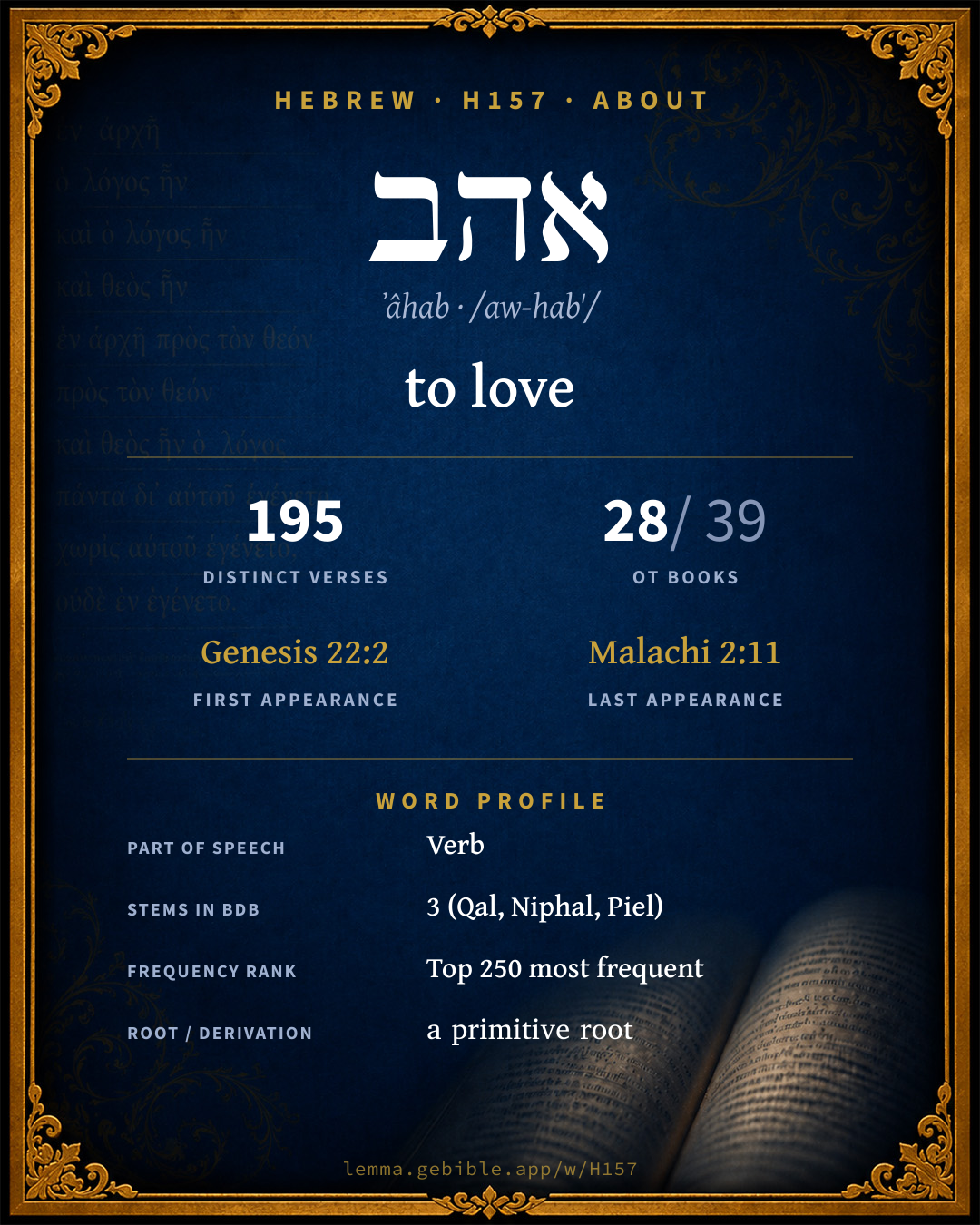
אָהֵב
to love
‘to love’ is one of 2 main senses fuller range ↓
Full lexicon entry — Brown-Driver-Briggs (BDB)
From Brown-Driver-Briggs (BDB)
Where this word appears
See every Qal verb in the Hebrew Bible →
Grammar key — what these labels mean
Part of speech
- Verb
- An action or state-of-being word.
Noun type
- Common
- A common noun — a general class of person, place, or thing (“king,” “city,” “water”), not a specific name.
Stem
- Qal
- The basic, simple active stem — the plain form of the verb (“he wrote”). Here: ‘human love to human object’
- Piel
- An intensive or resultative active stem. Here: ‘pl. sf.’
- Niphal
- Usually the simple passive or reflexive of the Qal (“he was written”). Here: ‘pl.’
Form
- Participle Active
- A verbal adjective expressing ongoing or characteristic action (“writing / one who writes”).
- Perfect
- A completed action or state — Hebrew marks aspect (completeness) more than strict tense (“he wrote”).
- Infinitive Construct
- A bound verbal noun, frequently with prepositions (“to write / in writing”).
- Sequential Imperfect
- An imperfect with prefixed waw — the standard past-narrative form (waw-consecutive imperfect).
- Sequential Perfect
- A perfect with prefixed waw continuing a preceding imperfect or command (waw-consecutive perfect).
- Imperfect
- An incomplete, ongoing, or future action (“he will / would write”).
- Imperative
- A direct command (“write!”).
- Participle Passive
- A verbal adjective expressing action received (“written”).
- Jussive
- A third- or second-person volitional form expressing wish or command (“let him write”).
State
- Absolute
- The independent form of a noun, not bound to a following word.
- Construct
- A noun bound to a following noun in a possessive / “of” relationship (the construct chain).
Person
- 1st Person
- The speaker (“I / we”).
- 3rd Person
- The one spoken about (“he / she / it / they”).
- 2nd Person
- The one addressed (“you”).
Gender
- Masculine
- Grammatically masculine.
- Common
- Either gender — not distinguished for this form.
- Feminine
- Grammatically feminine.
Number
- Singular
- One.
- Plural
- More than one (in Hebrew, generally three or more).
Grammatical forms 34 distinct
- Verb, Qal, Participle Active, Masculine, Plural, Construct 32 times (15%)
- Verb, Qal, Participle Active, Masculine, Singular, Absolute 27 times (13%)
- Verb, Qal, Perfect, 3rd Person, Masculine, Singular 21 times (10%)
- Verb, Qal, Perfect, 1st Person, Common, Singular 18 times (9%)
- Verb, Piel, Participle Active, Masculine, Plural, Construct 16 times (8%)
- Verb, Qal, Infinitive Construct 14 times (7%)
- Verb, Qal, Sequential Imperfect, 3rd Person, Masculine, Singular 14 times (7%)
- Verb, Qal, Perfect, 2nd Person, Masculine, Singular 8 times (4%)
+26 more forms (61 occurrences)
Parsed forms decoded from the imported morphology (morphhb / Westminster Leningrad Codex — WLC text public domain, morphhb tagging CC BY 4.0), counted across 211 parsed occurrences — not distinct verses.
Every verse where H157 appears — 195 distinct verses across 28 books. Click any verse to open its interlinear word-by-word view. Verse text shown in the World English Bible for context — . Each verse’s Hebrew form is shown with its reference; the English is not keyword-highlighted, since the data carries no word-level English alignment. Use “Compare translations” on any verse to read it across multiple English versions. This concordance covers the Hebrew Bible; Septuagint (Greek Old Testament) occurrences are not indexed here.
Genesis 14 verses
- Genesis 22:2 אָהַ֨בְתָּ֙ Qal pf 2ms He said, "Now take your son, your only son, whom you love, even Isaac, and go into the land of Moriah. Offer him there for a burnt offering on one of the mountains which I will tell you of."
- Genesis 24:67 וַ/יֶּאֱהָבֶ֑/הָ conj + Qal wimpf 3ms + sfx pers 3fs Isaac brought her into his mother Sarah's tent, and took Rebekah, and she became his wife. He loved her. Isaac was comforted after his mother's death.
- Genesis 25:28 וַ/יֶּאֱהַ֥ב אֹהֶ֥בֶת conj + Qal wimpf 3ms Qal ptcp.act fs Now Isaac loved Esau, because he ate his venison. Rebekah loved Jacob.
- Genesis 27:4 אָהַ֛בְתִּי Qal pf 1cs Make me savory food, such as I love, and bring it to me, that I may eat, and that my soul may bless you before I die."
- Genesis 27:9 אָהֵֽב Qal pf 3ms Go now to the flock, and get me from there two good kids of the goats. I will make them savory food for your father, such as he loves.
- Genesis 27:14 אָהֵ֥ב Qal pf 3ms He went, and got them, and brought them to his mother. His mother made savory food, such as his father loved.
- Genesis 29:18 וַ/יֶּאֱהַ֥ב conj + Qal wimpf 3ms Jacob loved Rachel. He said, "I will serve you seven years for Rachel, your younger daughter."
- Genesis 29:20 בְּ/אַהֲבָת֖/וֹ prep + n c fs cs + sfx pers 3ms Jacob served seven years for Rachel. They seemed to him but a few days, for the love he had for her.
- Genesis 29:30 וַ/יֶּאֱהַ֥ב conj + Qal wimpf 3ms He went in also to Rachel, and he loved also Rachel more than Leah, and served with him yet seven other years.
- Genesis 29:32 יֶאֱהָבַ֥/נִי Qal impf 3ms + sfx pers 1cs Leah conceived, and bore a son, and she named him Reuben. For she said, "Because Yahweh has looked at my affliction. For now my husband will love me."
- Genesis 34:3 וַ/יֶּֽאֱהַב֙ conj + Qal wimpf 3ms His soul joined to Dinah, the daughter of Jacob, and he loved the young lady, and spoke kindly to the young lady.
- Genesis 37:3 אָהַ֤ב Qal pf 3ms Now Israel loved Joseph more than all his children, because he was the son of his old age, and he made him a coat of many colors.
- Genesis 37:4 אָהַ֤ב Qal pf 3ms His brothers saw that their father loved him more than all his brothers, and they hated him, and couldn't speak peaceably to him.
- Genesis 44:20 אֲהֵבֽ/וֹ Qal pf 3ms + sfx pers 3ms We said to my lord, 'We have a father, an old man, and a child of his old age, a little one; and his brother is dead, and he alone is left of his mother; and his father loves him.'
Exodus 2 verses
Leviticus 2 verses
- Leviticus 19:18 וְ/אָֽהַבְתָּ֥ conj + Qal wpf 2ms You shall not take vengeance, nor bear any grudge against the children of your people; but you shall love your neighbor as yourself. I am Yahweh.
- Leviticus 19:34 וְ/אָהַבְתָּ֥ conj + Qal wpf 2ms The stranger who lives as a foreigner with you shall be to you as the native-born among you, and you shall love him as yourself; for you lived as foreigners in the land of Egypt. I am Yahweh your God.
Deuteronomy 21 verses
- Deuteronomy 4:37 אָהַב֙ Qal pf 3ms Because he loved your fathers, therefore he chose their seed after them, and brought you out with his presence, with his great power, out of Egypt;
- Deuteronomy 5:10 לְ/אֹהֲבַ֖/י prep + Qal ptcp.act mp cs + sfx pers 1cs and showing loving kindness to thousands of those who love me and keep my commandments.
- Deuteronomy 6:5 וְ/אָ֣הַבְתָּ֔ conj + Qal wpf 2ms and you shall love Yahweh your God with all your heart, and with all your soul, and with all your might.
- Deuteronomy 7:9 לְ/אֹהֲבָ֛י/ו prep + Qal ptcp.act mp cs + sfx pers 3ms Know therefore that Yahweh your God, he is God, the faithful God, who keeps covenant and loving kindness with them who love him and keep his commandments to a thousand generations,
- Deuteronomy 7:13 וַ/אֲהֵ֣בְ/ךָ֔ conj + Qal wpf 3ms + sfx pers 2ms and he will love you, and bless you, and multiply you; he will also bless the fruit of your body and the fruit of your ground, your grain and your new wine and your oil, the increase of your cattle and the young of your flock, in the land which he swore to your fathers to give you.
- Deuteronomy 10:12 וּ/לְ/אַהֲבָ֣ה conj + prep + Qal inf.cs Now, Israel, what does Yahweh your God require of you, but to fear Yahweh your God, to walk in all his ways, and to love him, and to serve Yahweh your God with all your heart and with all your soul,
- Deuteronomy 10:15 לְ/אַהֲבָ֣ה prep + Qal inf.cs Only Yahweh had a delight in your fathers to love them, and he chose their seed after them, even you above all peoples, as at this day.
- Deuteronomy 10:18 וְ/אֹהֵ֣ב conj + Qal ptcp.act ms He does execute justice for the fatherless and widow, and loves the foreigner, in giving him food and clothing.
- Deuteronomy 10:19 וַ/אֲהַבְתֶּ֖ם conj + Qal wpf 2mp Therefore love the foreigner; for you were foreigners in the land of Egypt.
- Deuteronomy 11:1 וְ/אָ֣הַבְתָּ֔ conj + Qal wpf 2ms Therefore you shall love Yahweh your God, and keep his charge, and his statutes, and his ordinances, and his commandments, always.
- Deuteronomy 11:13 לְ/אַהֲבָ֞ה prep + Qal inf.cs It shall happen, if you shall listen diligently to my commandments which I command you this day, to love Yahweh your God, and to serve him with all your heart and with all your soul,
- Deuteronomy 11:22 לְ/אַהֲבָ֞ה prep + Qal inf.cs For if you shall diligently keep all this commandment which I command you, to do it, to love Yahweh your God, to walk in all his ways, and to cleave to him;
- Deuteronomy 13:3 אֹֽהֲבִים֙ Qal ptcp.act mp you shall not listen to the words of that prophet, or to that dreamer of dreams: for Yahweh your God proves you, to know whether you love Yahweh your God with all your heart and with all your soul.
- Deuteronomy 15:16 אֲהֵֽבְ/ךָ֙ Qal pf 3ms + sfx pers 2ms It shall be, if he tell you, I will not go out from you; because he loves you and your house, because he is well with you;
- Deuteronomy 19:9 לְ/אַהֲבָ֞ה prep + Qal inf.cs if you shall keep all this commandment to do it, which I command you this day, to love Yahweh your God, and to walk ever in his ways; then shall you add three cities more for you, besides these three:
- Deuteronomy 21:15 אֲהוּבָה֙ הָ/אֲהוּבָ֖ה Qal ptcp.pass fs ptcl def.art + Qal ptcp.pass fs If a man have two wives, the one beloved, and the other hated, and they have borne him children, both the beloved and the hated; and if the firstborn son be hers who was hated;
- Deuteronomy 21:16 הָ֣/אֲהוּבָ֔ה ptcl def.art + Qal ptcp.pass fs then it shall be, in the day that he causes his sons to inherit that which he has, that he may not make the son of the beloved the firstborn before the son of the hated, who is the firstborn:
- Deuteronomy 23:5 אֲהֵֽבְ/ךָ֖ Qal pf 3ms + sfx pers 2ms Nevertheless Yahweh your God wouldn't listen to Balaam; but Yahweh your God turned the curse into a blessing to you, because Yahweh your God loved you.
- Deuteronomy 30:6 לְ/אַהֲבָ֞ה prep + Qal inf.cs Yahweh your God will circumcise your heart, and the heart of your seed, to love Yahweh your God with all your heart, and with all your soul, that you may live.
- Deuteronomy 30:16 לְ/אַהֲבָ֞ה prep + Qal inf.cs in that I command you this day to love Yahweh your God, to walk in his ways, and to keep his commandments and his statutes and his ordinances, that you may live and multiply, and that Yahweh your God may bless you in the land where you go in to possess it.
- Deuteronomy 30:20 לְ/אַֽהֲבָה֙ prep + Qal inf.cs to love Yahweh your God, to obey his voice, and to cleave to him; for he is your life, and the length of your days; that you may dwell in the land which Yahweh swore to your fathers, to Abraham, to Isaac, and to Jacob, to give them.
Joshua 2 verses
- Joshua 22:5 לְ֠/אַהֲבָה prep + Qal inf.cs Only take diligent heed to do the commandment and the law which Moses the servant of Yahweh commanded you, to love Yahweh your God, and to walk in all his ways, and to keep his commandments, and to cleave to him, and to serve him with all your heart and with all your soul.
- Joshua 23:11 לְ/אַהֲבָ֖ה prep + Qal inf.cs Take good heed therefore to yourselves, that you love Yahweh your God.
Judges 4 verses
- Judges 5:31 וְ/אֹ֣הֲבָ֔י/ו conj + Qal ptcp.act mp cs + sfx pers 3ms So let all your enemies perish, Yahweh: But let those who love him be as the sun when he goes forth in his might. The land had rest forty years.
- Judges 14:16 אֲהַבְתָּ֔/נִי Qal pf 2ms + sfx pers 1cs Samson's wife wept before him, and said, You do but hate me, and don't love me: you have put forth a riddle to the children of my people, and haven't told it me. He said to her, Behold, I haven't told it my father nor my mother, and shall I tell you?
- Judges 16:4 וַ/יֶּאֱהַ֥ב conj + Qal wimpf 3ms It came to pass afterward, that he loved a woman in the valley of Sorek, whose name was Delilah.
- Judges 16:15 אֲהַבְתִּ֔י/ךְ Qal pf 1cs + sfx pers 2fs She said to him, How can you say, I love you, when your heart is not with me? you have mocked me these three times, and have not told me in which your great strength lies.
Ruth 1 verse
1 Samuel 8 verses
- 1 Samuel 1:5 אָהֵ֔ב Qal pf 3ms but to Hannah he gave a double portion; for he loved Hannah, but Yahweh had shut up her womb.
- 1 Samuel 16:21 וַ/יֶּאֱהָבֵ֣/הֽוּ conj + Qal wimpf 3ms + sfx pers 3ms David came to Saul, and stood before him: and he loved him greatly; and he became his armor bearer.
- 1 Samuel 18:1 ו/יאהבו וַ/יֶּאֱהָבֵ֥/הוּ conj + Qal wimpf 3ms conj + Qal wimpf 3ms + sfx pers 3ms It happened, when he had made an end of speaking to Saul, that the soul of Jonathan was knit with the soul of David, and Jonathan loved him as his own soul.
- 1 Samuel 18:16 אֹהֵ֖ב Qal ptcp.act ms But all Israel and Judah loved David; for he went out and came in before them.
- 1 Samuel 18:20 וַ/תֶּאֱהַ֛ב conj + Qal wimpf 3fs Michal, Saul's daughter, loved David: and they told Saul, and the thing pleased him.
- 1 Samuel 18:22 אֲהֵב֑וּ/ךָ Qal pf 3cp + sfx pers 2ms Saul commanded his servants, [saying], Commune with David secretly, and say, Behold, the king has delight in you, and all his servants love you: now therefore be the king's son-in-law.
- 1 Samuel 18:28 אֲהֵבַֽתְ/הוּ Qal pf 3fs + sfx pers 3ms Saul saw and knew that Yahweh was with David; and Michal, Saul's daughter, loved him.
- 1 Samuel 20:17 אֲהֵבֽ/וֹ Qal pf 3ms + sfx pers 3ms Jonathan caused David to swear again, for the love that he had to him; for he loved him as he loved his own soul.
2 Samuel 6 verses
- 2 Samuel 1:23 הַ/נֶּאֱהָבִ֤ים ptcl def.art + Niphal ptcp.act mp Saul and Jonathan were lovely and pleasant in their lives, In their death they were not divided: They were swifter than eagles, They were stronger than lions.
- 2 Samuel 12:24 אֲהֵבֽ/וֹ Qal pf 3ms + sfx pers 3ms David comforted Bathsheba his wife, and went in to her, and lay with her: and she bore a son, and he called his name Solomon. Yahweh loved him;
- 2 Samuel 13:1 וַ/יֶּאֱהָבֶ֖/הָ conj + Qal wimpf 3ms + sfx pers 3fs It happened after this, that Absalom the son of David had a beautiful sister, whose name was Tamar; and Amnon the son of David loved her.
- 2 Samuel 13:4 אֹהֵֽב Qal ptcp.act ms He said to him, Why, son of the king, are you thus lean from day to day? Won't you tell me? Amnon said to him, I love Tamar, my brother Absalom's sister.
- 2 Samuel 13:15 אֲהֵבָ֑/הּ Qal pf 3ms + sfx pers 3fs Then Amnon hated her with exceeding great hatred; for the hatred with which he hated her was greater than the love with which he had loved her. Amnon said to her, Arise, be gone.
- 2 Samuel 19:6 לְ/אַֽהֲבָה֙ אֹהֲבֶ֑י/ךָ prep + Qal inf.cs Qal ptcp.act mp cs + sfx pers 2ms in that you love those who hate you, and hate those who love you. For you have declared this day, that princes and servants are nothing to you: for this day I perceive that if Absalom had lived, and all we had died this day, then it had pleased you well.
1 Kings 3 verses
- 1 Kings 3:3 וַ/יֶּאֱהַ֤ב conj + Qal wimpf 3ms Solomon loved Yahweh, walking in the statutes of David his father: only he sacrificed and burnt incense in the high places.
- 1 Kings 5:1 אֹהֵ֗ב Qal ptcp.act ms Hiram king of Tyre sent his servants to Solomon; for he had heard that they had anointed him king in the room of his father: for Hiram was ever a lover of David.
- 1 Kings 11:1 אָהַ֞ב Qal pf 3ms Now king Solomon loved many foreign women, together with the daughter of Pharaoh, women of the Moabites, Ammonites, Edomites, Sidonians, and Hittites;
2 Chronicles 4 verses
- 2 Chronicles 11:21 וַ/יֶּאֱהַ֨ב conj + Qal wimpf 3ms Rehoboam loved Maacah the daughter of Absalom above all his wives and his concubines: (for he took eighteen wives, and sixty concubines, and became the father of twenty-eight sons and sixty daughters.)
- 2 Chronicles 19:2 תֶּאֱהָ֑ב Qal impf 2ms Jehu the son of Hanani the seer went out to meet him, and said to king Jehoshaphat, Should you help the wicked, and love those who hate Yahweh? for this thing wrath is on you from before Yahweh.
- 2 Chronicles 20:7 אֹֽהַבְ/ךָ֖ Qal ptcp.act ms cs + sfx pers 2ms Did not you, our God, drive out the inhabitants of this land before your people Israel, and give it to the seed of Abraham your friend forever?
- 2 Chronicles 26:10 אֹהֵ֥ב Qal ptcp.act ms He built towers in the wilderness, and hewed out many cisterns, for he had much cattle; in the lowland also, and in the plain: [and he had] farmers and vineyard keepers in the mountains and in the fruitful fields; for he loved farming.
Nehemiah 2 verses
- Nehemiah 1:5 לְ/אֹהֲבָ֖י/ו prep + Qal ptcp.act mp cs + sfx pers 3ms and said, I beg you, Yahweh, the God of heaven, the great and awesome God, who keeps covenant and loving kindness with those who love him and keep his commandments:
- Nehemiah 13:26 וְ/אָה֤וּב conj + Qal ptcp.pass ms Did not Solomon king of Israel sin by these things? yet among many nations was there no king like him, and he was beloved of his God, and God made him king over all Israel: nevertheless even him did foreign women cause to sin.
Esther 4 verses
- Esther 2:17 וַ/יֶּאֱהַ֨ב conj + Qal wimpf 3ms The king loved Esther above all the women, and she obtained favor and kindness in his sight more than all the virgins; so that he set the royal crown on her head, and made her queen instead of Vashti.
- Esther 5:10 אֹהֲבָ֖י/ו Qal ptcp.act mp cs + sfx pers 3ms Nevertheless Haman refrained himself, and went home; and he sent and fetched his friends and Zeresh his wife.
- Esther 5:14 אֹֽהֲבָ֗י/ו Qal ptcp.act mp cs + sfx pers 3ms Then said Zeresh his wife and all his friends to him, Let a gallows be made fifty cubits high, and in the morning speak you to the king that Mordecai may be hanged thereon: then go you in merrily with the king to the banquet. The thing pleased Haman; and he caused the gallows to be made.
- Esther 6:13 אֹ֣הֲבָ֔י/ו Qal ptcp.act mp cs + sfx pers 3ms Haman recounted to Zeresh his wife and all his friends everything that had happened to him. Then his wise men and Zeresh his wife said to him, If Mordecai, before whom you have begun to fall, be of the seed of the Jews, you shall not prevail against him, but shall surely fall before him.
Job 1 verse
Psalms 39 verses
- Psalms 4:2 תֶּאֱהָב֣וּ/ן Qal impf 2mp + sfx n You sons of men, how long shall my glory be turned into dishonor? Will you love vanity, and seek after falsehood? Selah.
- Psalms 5:11 אֹהֲבֵ֥י Qal ptcp.act mp cs But let all those who take refuge in you rejoice, Let them always shout for joy, because you defend them. Let them also who love your name be joyful in you.
- Psalms 11:5 וְ/אֹהֵ֣ב conj + Qal ptcp.act ms cs Yahweh examines the righteous, But the wicked and him who loves violence his soul hates.
- Psalms 11:7 אָהֵ֑ב Qal pf 3ms For Yahweh is righteous. He loves righteousness. The upright shall see his face.
- Psalms 26:8 אָ֭הַבְתִּי Qal pf 1cs Yahweh, I love the habitation of your house, The place where your glory dwells.
- Psalms 31:23 אֶֽהֱב֥וּ Qal impv 2mp Oh love Yahweh, all you his saints! Yahweh preserves the faithful, And pays back him who deals proudly in full.
- Psalms 33:5 אֹ֭הֵב Qal ptcp.act ms He loves righteousness and justice. The earth is full of the loving kindness of Yahweh.
- Psalms 34:12 אֹהֵ֥ב Qal ptcp.act ms Who is someone who desires life, And loves many days, that he may see good?
- Psalms 37:28 אֹ֘הֵ֤ב Qal ptcp.act ms For Yahweh loves justice, And doesn't forsake his saints. They are preserved forever, But the children of the wicked shall be cut off.
- Psalms 38:11 אֹֽהֲבַ֨/י Qal ptcp.act mp cs + sfx pers 1cs My lovers and my friends stand aloof from my plague. My kinsmen stand far away.
- Psalms 40:16 אֹֽ֝הֲבֵ֗י Qal ptcp.act mp cs Let all those who seek you rejoice and be glad in you. Let such as love your salvation say continually, "Let Yahweh be exalted!"
- Psalms 45:7 אָהַ֣בְתָּ Qal pf 2ms You have loved righteousness, and hated wickedness. Therefore God, your God, has anointed you with the oil of gladness above your fellows.
- Psalms 47:4 אָהֵ֣ב Qal pf 3ms He chooses our inheritance for us, The glory of Jacob whom he loved. Selah.
- Psalms 52:3 אָהַ֣בְתָּ Qal pf 2ms You love evil more than good, Lying rather than speaking the truth. Selah.
- Psalms 52:4 אָהַ֥בְתָּ Qal pf 2ms You love all devouring words, You deceitful tongue.
- Psalms 69:36 וְ/אֹהֲבֵ֥י conj + Qal ptcp.act mp cs The children also of his servants shall inherit it. Those who love his name shall dwell therein.
- Psalms 70:4 אֹ֝הֲבֵ֗י Qal ptcp.act mp cs Let all those who seek you rejoice and be glad in you. Let those who love your salvation continually say, "Let God be exalted!"
- Psalms 78:68 אָהֵֽב Qal pf 3ms But chose the tribe of Judah, Mount Zion which he loved.
- Psalms 87:2 אֹהֵ֣ב Qal ptcp.act ms Yahweh loves the gates of Zion more than all the dwellings of Jacob.
- Psalms 88:18 אֹהֵ֣ב Qal ptcp.act ms You have put lover and friend far from me, And my friends into darkness.
- Psalms 97:10 אֹהֲבֵ֥י Qal ptcp.act mp cs You who love Yahweh, hate evil. He preserves the souls of his saints. He delivers them out of the hand of the wicked.
- Psalms 99:4 אָ֫הֵ֥ב Qal pf 3ms The King's strength also loves justice. You do establish equity. You execute justice and righteousness in Jacob.
- Psalms 109:17 וַ/יֶּאֱהַ֣ב conj + Qal wimpf 3ms Yes, he loved cursing, and it came to him. He didn't delight in blessing, and it was far from him.
- Psalms 116:1 אָ֭הַבְתִּי Qal pf 1cs I love Yahweh, because he listens to my voice, And my cries for mercy.
- Psalms 119:47 אָהָֽבְתִּי Qal pf 1cs I will delight myself in your commandments, Because I love them.
- Psalms 119:48 אָהָ֗בְתִּי Qal pf 1cs I reach out my hands for your commandments, which I love. I will meditate on your statutes.
- Psalms 119:97 אָהַ֥בְתִּי Qal pf 1cs How love I your law! It is my meditation all day.
- Psalms 119:113 אָהָֽבְתִּי Qal pf 1cs I hate double-minded men, But I love your law.
- Psalms 119:119 אָהַ֥בְתִּי Qal pf 1cs You put away all the wicked of the earth like dross. Therefore I love your testimonies.
- Psalms 119:127 אָהַ֣בְתִּי Qal pf 1cs Therefore I love your commandments more than gold, Yes, more than pure gold.
- Psalms 119:132 לְ/אֹהֲבֵ֥י prep + Qal ptcp.act mp cs Turn to me, and have mercy on me, As you always do to those who love your name.
- Psalms 119:140 אֲהֵבָֽ/הּ Qal pf 3ms + sfx pers 3fs Your promises have been thoroughly tested, And your servant loves them.
- Psalms 119:159 אָהָ֑בְתִּי Qal pf 1cs Consider how I love your precepts. Revive me, Yahweh, according to your loving kindness.
- Psalms 119:163 אָהָֽבְתִּי Qal pf 1cs I hate and abhor falsehood. I love your law.
- Psalms 119:165 לְ/אֹהֲבֵ֣י prep + Qal ptcp.act mp cs Those who love your law have great peace. Nothing causes them to stumble.
- Psalms 119:167 וָ/אֹהֲבֵ֥/ם conj + Qal wimpf 1cs + sfx pers 3mp My soul has observed your testimonies. I love them exceedingly.
- Psalms 122:6 אֹהֲבָֽיִ/ךְ Qal ptcp.act mp cs + sfx pers 2fs Pray for the peace of Jerusalem. Those who love you will prosper.
- Psalms 145:20 אֹהֲבָ֑י/ו Qal ptcp.act mp cs + sfx pers 3ms Yahweh preserves all those who love him, But all the wicked he will destroy.
- Psalms 146:8 אֹהֵ֥ב Qal ptcp.act ms Yahweh opens the eyes of the blind. Yahweh raises up those who are bowed down. Yahweh loves the righteous.
Proverbs 23 verses
- Proverbs 1:22 תְּֽאֵהֲב֫וּ Qal impf 2mp "How long, you simple ones, will you love simplicity? How long will mockers delight themselves in mockery, And fools hate knowledge?
- Proverbs 3:12 יֶאֱהַ֣ב Qal impf 3ms For whom Yahweh loves, he reproves; Even as a father reproves the son in whom he delights.
- Proverbs 4:6 אֱהָבֶ֥/הָ Qal impv 2ms + sfx pers 3fs Don't forsake her, and she will preserve you. Love her, and she will keep you.
- Proverbs 8:17 אהבי/ה אֹהֲבַ֣/י אֵהָ֑ב Qal ptcp.act mp cs + sfx pers 3fs Qal ptcp.act mp cs + sfx pers 1cs Qal impf 1cs I love those who love me. Those who seek me diligently will find me.
- Proverbs 8:21 אֹהֲבַ֥/י Qal ptcp.act mp cs + sfx pers 1cs That I may give wealth to those who love me. I fill their treasuries.
- Proverbs 8:36 אָ֣הֲבוּ Qal pf 3cp But he who sins against me wrongs his own soul. All those who hate me love death."
- Proverbs 9:8 וְ/יֶאֱהָבֶֽ/ךָּ conj + Qal impf 3ms + sfx pers 2ms Don't reprove a scoffer, lest he hate you. Reprove a wise man, and he will love you.
- Proverbs 12:1 אֹהֵ֣ב אֹ֣הֵֽב Qal ptcp.act ms Qal ptcp.act ms Whoever loves correction loves knowledge, But he who hates reproof is stupid.
- Proverbs 13:24 וְ֝/אֹהֲב֗/וֹ conj + Qal ptcp.act ms cs + sfx pers 3ms One who spares the rod hates his son, But one who loves him is careful to discipline him.
- Proverbs 14:20 וְ/אֹהֲבֵ֖י conj + Qal ptcp.act mp cs The poor person is shunned even by his own neighbor, But the rich person has many friends.
- Proverbs 15:9 יֶאֱהָֽב Qal impf 3ms The way of the wicked is an abomination to Yahweh, But he loves him who follows after righteousness.
- Proverbs 15:12 יֶאֱהַב Qal impf 3ms A scoffer doesn't love to be reproved; He will not go to the wise.
- Proverbs 16:13 יֶאֱהָֽב Qal impf 3ms Righteous lips are the delight of kings. They value one who speaks the truth.
- Proverbs 17:17 אֹהֵ֣ב Qal ptcp.act ms A friend loves at all times; And a brother is born for adversity.
- Proverbs 17:19 אֹ֣הֵֽב אֹהֵ֣ב Qal ptcp.act ms Qal ptcp.act ms He who loves disobedience loves strife. One who builds a high gate seeks destruction.
- Proverbs 18:21 וְ֝/אֹהֲבֶ֗י/הָ conj + Qal ptcp.act mp cs + sfx pers 3fs Death and life are in the power of the tongue; Those who love it will eat its fruit.
- Proverbs 18:24 אֹ֝הֵ֗ב Qal ptcp.act ms A man of many companions may be ruined, But there is a friend who sticks closer than a brother.
- Proverbs 19:8 אֹהֵ֣ב Qal ptcp.act ms He who gets wisdom loves his own soul. He who keeps understanding shall find good.
- Proverbs 20:13 תֶּֽאֱהַ֣ב Qal juss 2ms Don't love sleep, lest you come to poverty; Open your eyes, and you shall be satisfied with bread.
- Proverbs 21:17 אֹהֵ֣ב אֹהֵ֥ב Qal ptcp.act ms Qal ptcp.act ms He who loves pleasure shall be a poor man: He who loves wine and oil shall not be rich.
- Proverbs 22:11 אֹהֵ֥ב Qal ptcp.act ms He who loves purity of heart and speaks gracefully Is the king's friend.
- Proverbs 27:6 אוֹהֵ֑ב Qal ptcp.act ms Faithful are the wounds of a friend; Although the kisses of an enemy are profuse.
- Proverbs 29:3 אֹהֵ֣ב Qal ptcp.act ms Whoever loves wisdom brings joy to his father; But a companion of prostitutes squanders his wealth.
Ecclesiastes 3 verses
- Ecclesiastes 3:8 לֶֽ/אֱהֹב֙ prep + Qal inf.cs A time to love, And a time to hate; A time for war, And a time for peace.
- Ecclesiastes 5:10 אֹהֵ֥ב אֹהֵ֥ב Qal ptcp.act ms Qal ptcp.act ms He who loves silver shall not be satisfied with silver; nor he who loves abundance, with increase: this also is vanity.
- Ecclesiastes 9:9 אָהַ֗בְתָּ Qal pf 2ms Live joyfully with the wife whom you love all the days of your life of vanity, which he has given you under the sun, all your days of vanity: for that is your portion in life, and in your labor in which you labor under the sun.
Song of Solomon 7 verses
- Song of Solomon 1:3 אֲהֵבֽוּ/ךָ Qal pf 3cp + sfx pers 2ms Your oils have a pleasing fragrance. Your name is oil poured forth, Therefore the virgins love you.
- Song of Solomon 1:4 אֲהֵבֽוּ/ךָ Qal pf 3cp + sfx pers 2ms Take me away with you. Let us hurry. The king has brought me into his chambers. Friends We will be glad and rejoice in you. We will praise your love more than wine! Beloved They are right to love you.
- Song of Solomon 1:7 שֶׁ֤/אָהֲבָה֙ ptcl rel + Qal pf 3fs Tell me, you whom my soul loves, Where you graze your flock, Where you rest them at noon; For why should I be as one who is veiled Beside the flocks of your companions? Lover
- Song of Solomon 3:1 שֶׁ/אָהֲבָ֖ה ptcl rel + Qal pf 3fs By night on my bed, I sought him whom my soul loves. I sought him, but I didn't find him.
- Song of Solomon 3:2 שֶׁ/אָהֲבָ֖ה ptcl rel + Qal pf 3fs I will get up now, and go about the city; In the streets and in the squares I will seek him whom my soul loves. I sought him, but I didn't find him.
- Song of Solomon 3:3 שֶׁ/אָהֲבָ֥ה ptcl rel + Qal pf 3fs The watchmen who go about the city found me; "Have you seen him whom my soul loves?"
- Song of Solomon 3:4 שֶׁ/אָהֲבָ֖ה ptcl rel + Qal pf 3fs I had scarcely passed from them, When I found him whom my soul loves. I held him, and would not let him go, Until I had brought him into my mother's house, Into the chamber of her who conceived me.
Isaiah 9 verses
- Isaiah 1:23 אֹהֵ֣ב Qal ptcp.act ms Your princes are rebellious, and companions of thieves. Everyone loves bribes, and follows after rewards. They don't judge the fatherless, Neither does the cause of the widow come to them.
- Isaiah 41:8 אֹהֲבִֽ/י Qal ptcp.act ms cs + sfx pers 1cs But you, Israel, my servant, Jacob whom I have chosen, the seed of Abraham my friend,
- Isaiah 43:4 אֲהַבְתִּ֑י/ךָ Qal pf 1cs + sfx pers 2ms Since you have been precious in my sight, [and] honorable, and I have loved you; therefore will I give men in your place, and peoples instead of your life.
- Isaiah 48:14 אֲהֵב֔/וֹ Qal pf 3ms + sfx pers 3ms Assemble yourselves, all you, and hear; who among them has declared these things? He whom Yahweh loves shall perform his pleasure on Babylon, and his arm [shall be on] the Chaldeans.
- Isaiah 56:6 וּֽ/לְ/אַהֲבָה֙ conj + prep + Qal inf.cs Also the foreigners who join themselves to Yahweh, to minister to him, and to love the name of Yahweh, to be his servants, everyone who keeps the Sabbath from profaning it, and holds fast my covenant;
- Isaiah 56:10 אֹהֲבֵ֖י Qal ptcp.act mp cs His watchmen are blind, they are all without knowledge; they are all mute dogs, they can't bark; dreaming, lying down, loving to slumber.
- Isaiah 57:8 אָהַ֥בְתְּ Qal pf 2fs Behind the doors and the posts have you set up your memorial: for you have uncovered [yourself] to another than me, and are gone up; you have enlarged your bed, and made you a covenant with them: you loved their bed where you saw it.
- Isaiah 61:8 אֹהֵ֣ב Qal ptcp.act ms For I, Yahweh, love justice, I hate robbery with iniquity; and I will give them their recompense in truth, and I will make an everlasting covenant with them.
- Isaiah 66:10 אֹהֲבֶ֑י/הָ Qal ptcp.act mp cs + sfx pers 3fs Rejoice you with Jerusalem, and be glad for her, all you who love her: rejoice for joy with her, all you who mourn over her;
Jeremiah 10 verses
- Jeremiah 2:25 אָהַ֥בְתִּי Qal pf 1cs Withhold your foot from being unshod, and your throat from thirst: but you said, It is in vain; no, for I have loved strangers, and after them will I go.
- Jeremiah 5:31 אָ֣הֲבוּ Qal pf 3cp the prophets prophesy falsely, and the priests bear rule by their means; and my people love to have it so: and what will you do in the end of it?
- Jeremiah 8:2 אֲהֵב֜וּ/ם Qal pf 3cp + sfx pers 3mp and they shall spread them before the sun, and the moon, and all the host of the sky, which they have loved, and which they have served, and after which they have walked, and which they have sought, and which they have worshiped: they shall not be gathered, nor be buried, they shall be for dung on the surface of the earth.
- Jeremiah 14:10 אָֽהֲבוּ֙ Qal pf 3cp Thus says Yahweh to this people, Even so have they loved to wander; they have not refrained their feet: therefore Yahweh does not accept them; now will he remember their iniquity, and visit their sins.
- Jeremiah 20:4 אֹהֲבֶ֗י/ךָ Qal ptcp.act mp cs + sfx pers 2ms For thus says Yahweh, Behold, I will make you a terror to yourself, and to all your friends; and they shall fall by the sword of their enemies, and your eyes shall see it; and I will give all Judah into the hand of the king of Babylon, and he shall carry them captive to Babylon, and shall kill them with the sword.
- Jeremiah 20:6 אֹ֣הֲבֶ֔י/ךָ Qal ptcp.act mp cs + sfx pers 2ms You, Pashhur, and all who dwell in your house shall go into captivity; and you shall come to Babylon, and there you shall die, and there shall you be buried, you, and all your friends, to whom you have prophesied falsely.
- Jeremiah 22:20 מְאַהֲבָֽיִ/ךְ Piel ptcp.act mp cs + sfx pers 2fs Go up to Lebanon, and cry; and lift up your voice in Bashan, and cry from Abarim; for all your lovers are destroyed.
- Jeremiah 22:22 וּֽ/מְאַהֲבַ֖יִ/ךְ conj + Piel ptcp.act mp cs + sfx pers 2fs The wind shall feed all your shepherds, and your lovers shall go into captivity: surely then shall you be ashamed and confounded for all your wickedness.
- Jeremiah 30:14 מְאַהֲבַ֣יִ/ךְ Piel ptcp.act mp cs + sfx pers 2fs All your lovers have forgotten you; they don't seek you: for I have wounded you with the wound of an enemy, with the chastisement of a cruel one, for the greatness of your iniquity, because your sins were increased.
- Jeremiah 31:3 אֲהַבְתִּ֔י/ךְ Qal pf 1cs + sfx pers 2fs Yahweh appeared of old to me, [saying], Yes, I have loved you with an everlasting love: therefore with loving kindness have I drawn you.
Lamentations 2 verses
- Lamentations 1:2 אֹהֲבֶ֑י/הָ Qal ptcp.act mp cs + sfx pers 3fs She weeps sore in the night, and her tears are on her cheeks; Among all her lovers she has none to comfort her: All her friends have dealt treacherously with her; they are become her enemies.
- Lamentations 1:19 לַֽ/מְאַהֲבַ/י֙ prep det + Piel ptcp.act mp cs + sfx pers 1cs I called for my lovers, [but] they deceived me: My priests and my elders gave up the spirit in the city, While they sought them food to refresh their souls.
Ezekiel 6 verses
- Ezekiel 16:33 מְאַֽהֲבַ֔יִ/ךְ Piel ptcp.act mp cs + sfx pers 2fs They give gifts to all prostitutes; but you give your gifts to all your lovers, and bribe them, that they may come to you on every side for your prostitution.
- Ezekiel 16:36 מְאַהֲבָ֑יִ/ךְ Piel ptcp.act mp cs + sfx pers 2fs Thus says the Lord Yahweh, Because your filthiness was poured out, and your nakedness uncovered through your prostitution with your lovers; and because of all the idols of your abominations, and for the blood of your children, that you gave to them;
- Ezekiel 16:37 מְאַהֲבַ֨יִ/ךְ֙ אָהַ֔בְתְּ Piel ptcp.act mp cs + sfx pers 2fs Qal pf 2fs therefore see, I will gather all your lovers, with whom you have taken pleasure, and all those who you have loved, with all those who you have hated; I will even gather them against you on every side, and will uncover your nakedness to them, that they may see all your nakedness.
- Ezekiel 23:5 מְאַהֲבֶ֔י/הָ Piel ptcp.act mp cs + sfx pers 3fs Oholah played the prostitute when she was mine; and she doted on her lovers, on the Assyrians [her] neighbors,
- Ezekiel 23:9 מְאַֽהֲבֶ֑י/הָ Piel ptcp.act mp cs + sfx pers 3fs Therefore I delivered her into the hand of her lovers, into the hand of the Assyrians, on whom she doted.
- Ezekiel 23:22 מְאַהֲבַ֨יִ/ךְ֙ Piel ptcp.act mp cs + sfx pers 2fs Therefore, Oholibah, thus says the Lord Yahweh: Behold, I will raise up your lovers against you, from whom your soul is alienated, and I will bring them against you on every side:
Daniel 1 verse
Hosea 13 verses
- Hosea 2:5 מְאַהֲבַ/י֙ Piel ptcp.act mp cs + sfx pers 1cs For their mother has played the prostitute. She who conceived them has done shamefully; For she said, 'I will go after my lovers, Who give me my bread and my water, My wool and my flax, My oil and my drink.'
- Hosea 2:7 מְאַהֲבֶ֨י/הָ֙ Piel ptcp.act mp cs + sfx pers 3fs She will follow after her lovers, But she won't overtake them; And she will seek them, But won't find them. Then she will say, 'I will go and return to my first husband; For then was it better with me than now.'
- Hosea 2:10 מְאַהֲבֶ֑י/הָ Piel ptcp.act mp cs + sfx pers 3fs Now I will uncover her lewdness in the sight of her lovers, And no one will deliver her out of my hand.
- Hosea 2:12 מְאַֽהֲבָ֑/י Piel ptcp.act mp cs + sfx pers 1cs I will lay waste her vines and her fig trees, About which she has said, 'These are my wages that my lovers have given me; And I will make them a forest,' And the animals of the field shall eat them.
- Hosea 2:13 מְאַהֲבֶ֑י/הָ Piel ptcp.act mp cs + sfx pers 3fs I will visit on her the days of the Baals, To which she burned incense, When she decked herself with her earrings and her jewels, And went after her lovers, And forgot me," says Yahweh.
- Hosea 3:1 אֱֽהַב אֲהֻ֥בַת וְ/אֹהֲבֵ֖י Qal impv 2ms Qal ptcp.pass fs cs conj + Qal ptcp.act mp cs Yahweh said to me, "Go again, love a woman loved by another, and an adulteress, even as Yahweh loves the children of Israel, though they turn to other gods, and love cakes of raisins."
- Hosea 4:18 אָהֲב֥וּ הֵב֛וּ Qal pf 3cp Qal impv 2mp Their drink has become sour. They play the prostitute continually. Her rulers dearly love their shameful way.
- Hosea 9:1 אָהַ֣בְתָּ Qal pf 2ms Don't rejoice, Israel, to jubilation like the nations; For you were unfaithful to your God. You love the wages of a prostitute at every grain threshing floor.
- Hosea 9:10 כְּ/אָהֳבָֽ/ם prep + Qal inf.cs + sfx pers 3mp I found Israel like grapes in the wilderness. I saw your fathers as the first ripe in the fig tree at its first season; But they came to Baal Peor, and consecrated themselves to the shameful thing, And became abominable like that which they loved.
- Hosea 10:11 אֹהַ֣בְתִּי Qal ptcp.act fs cs Ephraim is a trained heifer that loves to thresh; So I will put a yoke on her beautiful neck. I will set a rider on Ephraim. Judah will plow. Jacob will break his clods.
- Hosea 11:1 וָ/אֹהֲבֵ֑/הוּ conj + Qal wimpf 1cs + sfx pers 3ms "When Israel was a child, then I loved him, And called my son out of Egypt.
- Hosea 12:7 אָהֵֽב Qal pf 3ms A merchant has dishonest scales in his hand. He loves to defraud.
- Hosea 14:4 אֹהֲבֵ֖/ם Qal impf 1cs + sfx pers 3mp "I will heal their waywardness. I will love them freely; For my anger is turned away from him.
Amos 2 verses
- Amos 4:5 אֲהַבְתֶּם֙ Qal pf 2mp Offer a sacrifice of thanksgiving of that which is leavened, And proclaim free will offerings and brag about them: For this pleases you, you children of Israel," says the Lord Yahweh.
- Amos 5:15 וְ/אֶ֣הֱבוּ conj + Qal impv 2mp Hate evil, love good, And establish justice in the courts. It may be that Yahweh, the God of hosts, will be gracious to the remnant of Joseph."
Micah 1 verse
Zechariah 3 verses
- Zechariah 8:17 תֶּאֱהָ֑בוּ Qal juss 2mp and let none of you devise evil in your hearts against his neighbor, and love no false oath: for all these are things that I hate," says Yahweh.
- Zechariah 8:19 אֱהָֽבוּ Qal impv 2mp Thus says Yahweh of Hosts: "The fasts of the fourth fifth, seventh, and tenth months shall be for the house of Judah joy and gladness, and cheerful feasts. Therefore love truth and peace."
- Zechariah 13:6 מְאַהֲבָֽ/י Piel ptcp.act mp cs + sfx pers 1cs One will say to him, 'What are these wounds between your arms?' Then he will answer, 'Those with which I was wounded in the house of my friends.'
Malachi 2 verses
- Malachi 1:2 אָהַ֤בְתִּי אֲהַבְתָּ֑/נוּ וָ/אֹהַ֖ב Qal pf 1cs Qal pf 2ms + sfx pers 1cp conj + Qal wimpf 1cs "I have loved you," says Yahweh. Yet you say, "How have you loved us?" "Wasn't Esau Jacob's brother?" says Yahweh, "Yet I loved Jacob;
- Malachi 2:11 אָהֵ֔ב Qal pf 3ms Judah has dealt treacherously, and an abomination is committed in Israel and in Jerusalem; for Judah has profaned the holiness of Yahweh which he loves, and has married the daughter of a foreign god.
About this entry
At a glance — auto-summarized from this page’s data, not written by a person. Every figure links to its source below. This summary describes the numbers; it doesn’t interpret them.
אהב — transliterated ʼâhab — is a Hebrew verb carrying the sense “to love.” “loveth” is the historic King James Version rendering; modern versions use “love.” See the renderings breakdown. The Hebrew Bible uses it across 195 verses — common. Debuting at Genesis 22:2, it then recurs through the corpus. The verb spans 3 stems, from Qal to Niphal. Each statement above links to its evidence; the full detail follows below.
Gloss history
Strong's 1890 vs modern scholarship
About this word
Strong's H157 catalogs a Hebrew word from the Hebrew Old Testament.
These counts are not copied from any lexicon or concordance. They are computed here, from the morphology-tagged Hebrew Old Testament. What Lemma adds →
- 195
- distinct verses
- The word appears in 195 distinct verses.
- 28 / 39
- OT books
- The word appears in 28 of 39 Old Testament books.
- #229
- by frequency
- Top 250 most frequent Hebrew words (rank 229 of 8,640 Hebrew words by occurrence).
View all 195 occurrences in the concordance →
Most concentrated in
- Psalms 39 verses 20%
- Proverbs 23 verses 12%
- Deuteronomy 21 verses 11%
By section of the Old Testament
By traditional corpus
Conventional, traditional groupings — biblical authorship is debated, so this is a traditional corpus grouping, not an authorship claim. Each share is this word’s portion of its verses in that division of the Hebrew canon. Each figure is a share of the word’s 195 distinct verses.
- Writings (Ketuvim) 87 verses · 45%
- Prophets (Nevi'im) 69 verses · 35%
- Torah (Pentateuch) 39 verses · 20%
How translations render this word
Counts come from each version’s own published word-to-Strong’s tagging or interlinear alignment — an approximate guide to how each version renders this word, not a word-level alignment the data otherwise carries. Because each total is that version’s own tagged count, the per-version totals vary from one another and need not match the appearance or distinct-verse counts above. These counts may also differ from a printed concordance because Lemma counts each distinctly tagged rendering and does not collapse phrase taggings into a single head-word total. This is a fixed set of word-tagged versions (KJV, ASV, BSB, ULT) and does not change with the reading translation you choose elsewhere. Each version’s license is shown beside its name below (and on Sources).
- King James Version: Love 33×, Loveth 24×, Loved 17×
- American Standard Version: Love 26×, Loveth 19×, Loved 13×
- Berean Standard Bible: Love 34×, Loved 17×, Lovers 16×
- unfoldingWord Literal Text: Love 22×, Loved 15×, Lovers 15×
King James Version Public Domain
Renders H157 across 208 tagged occurrences — most commonly:
Plus other, less common renderings. Plus 49 renderings that appear only once — usually multi-word phrases or single function words the recovered tagging swept in, not distinct renderings.
American Standard Version Public Domain
Renders H157 across 205 tagged occurrences — most commonly:
Plus other, less common renderings. Plus 62 renderings that appear only once — usually multi-word phrases or single function words the recovered tagging swept in, not distinct renderings.
Berean Standard Bible Public Domain
Renders H157 across 210 tagged occurrences — most commonly:
Plus other, less common renderings. Plus 44 renderings that appear only once — usually multi-word phrases or single function words the recovered tagging swept in, not distinct renderings. Not rendered by a distinct English word in 1 further occurrence.
unfoldingWord Literal Text CC BY-SA 4.0
Renders H157 across 238 tagged occurrences — most commonly:
Plus other, less common renderings. Plus 48 renderings that appear only once — usually multi-word phrases or single function words the recovered tagging swept in, not distinct renderings.
10 senses and sub-senses in the full BDB
Hebrew verbs can shift meaning by stem (binyan): Qal is the basic action, Niphal is often passive or reflexive, Piel often intensifies or makes it factitive, and Hiphil is typically causative. The senses below are grouped under the stem BDB assigns to each.
What do BDB’s symbols mean?
BDB uses these scholarly abbreviations:
| Symbol | Meaning |
|---|---|
| 𝔊 | the Septuagint (the ancient Greek translation, LXX) |
| 𝔙 | the Vulgate (the Latin translation) |
| 𝔖 | the Syriac version (the Peshitta) |
| 𝔗 | the Targum (the Aramaic translation) |
| ψ | the Psalms |
| √ | root (the underlying root or stem) |
| ‖ | parallel passage (a synonymous or contrasted parallel) |
| † | the dagger: every passage where the word occurs is cited |
The 10 senses and sub-senses the full Brown-Driver-Briggs lexicon distinguishes for this word, in lexicon order (not ranked by frequency), with BDB’s own verbatim wording and sub-sense lettering. Shown in Hebrew script with BDB’s own scholarly abbreviations. The condensed entry is in the Lexicon Entry tab. See also the Forms in the corpus table below.
Qal
- Pf. אָהֵ֑ב Gn 27:9 + 7times; אָהֵ֥ב Gn 27:14; אָהַב Gn 37:3 + 3 times; אֲהֵֽבְךָ Dt 15:16; 3 fs. אָֽהֲבָה Ct 1:7 +, etc.; impf. יֶאֱהַב (־הָ֑ב) Pr 3:12 +; 1 s. אֵהָ֑ב Pr 8:17 (cf. Ew§ 192 d Ges§ 68.1); וָֽאֹהַ֖ב Mal 1:2; וָאֹהֲבֵהוּ Ho 11:1; אֹהֲבֵם Ho 14:5; וָאֹהֲבֵם ψ 119:167; 2 mpl. תְּאֵהֲבוּ Pr 1:22 (cf. KöI p. 394 Ges§ 63 R. 2); תֶּאֱהָ֑בוּ Zc 8:17; תֶּאֱהָבוּן ψ 4:3; Imv. אֱהַב־ Ho 3:1; אֱהָבֶהָ Pr 4:6; אֶהֱבוּ ψ 31:24 Am 5:15; אֱהָ֑בוּ Zc 8:19; inf. cstr. אֱהֹב Ec 3:8; אַהֲבָה Dt 10:12 +; אֲהֲבַת Mi 6:8 + etc.; cf. also sub n. אהבה infr.; Pt. אֹהֵב (אוֹהֵב) Dt 10:18 + 26 times; f. cstr. אֲהֻבַת Ho 3:1 is prob. active cf. BaNB 174 ff; sf. אֹהֲבִי Is 41:8 etc.; f. אֹהֶ֫בֶת Gn 25:28; אֹהַ֫בְתִּי Ho 10:11 etc.; Pt. pass. אָהוּב Ne 13:26; אֲהוּבָה Dt 21:15(×2), 16.—love (mostly c. acc., sq. לִ + obj. Lv 19:18, 34 2 Ch 19:2 (late), sq. בְּ Ec 5:9; abs. Ec 3:8 & v. infr.), (affection both pure & impure, divine & human);— e.g. Genesis 27:9
- 1. human love to human object; abs., opp. hate שָׂנֵא Ec 3:8; of love to son Gn 22:2; 25:28; 37:3, 4; 44:20 (JE) Pr 13:24; so also 2 S 13:21 𝔊 Ew Th We, cf. Dr, of Dvd’s loving Amnon; never to parent, but mother-in-law Ru 4:15; of man’s love to woman; wife Gn 24:67; 29:20, 30 (cf. v 18) 32 (JE), also Dt 21:15(×2), 16 Ju 14:16 1 S 1:5 2 Ch 11:21 Est 2:17 Ho 3:1 Ec 9:9; but also Gn 34:3 (J) Ju 16:4, 15 2 S 13:1, 4, 15 (where of carnal desire) 1 K 11:1 cf. v 2 Ho 3:1; א׳ רֵעַ loving a paramour, v. BaNB 176; woman’s love to man 1 S 18:20 (so v 28 MT, but read וְכִי כָל־יִשְׂרָאֵל אֹהֵב אֹתוֹ 𝔊 We Dr) Ct 1:3, 4, 7; 3:1, 2, 3, 4 (5 times subj. נַפְשִׁי; cf. also fig. of adulterous Judah Je 2:25 Is 57:8 Ez 16:37; of love of slave to master Ex 21:5 (JE) Dt 15:16; inferior to superior 1 S 18:22 cf. v 16; love to neighbour Lv 19:18 (וְאָהַבְתָּ לְרֵעְךָ כָּמוֹ֑ךָ), partic. to stranger Lv 19:34 (both P), Dt 10:18, 19; love of friend to friend 1 S 16:21; 18:1, 3; 20:17(×2) Jb 19:19 Pr 17:17 cf. 2 S 19:7(×2) 2 Ch 19:2; v. also Pr 9:8; 16:13 cf. 15:12; v. especially Pt. infr. e.g. Ecclesiastes 3:8
- 2. less often of appetite, obj. food, Gn 27:4, 9, 14 (JE) Ho 3:1; drink Pr 21:17; husbandry 2 Ch 26:10; cf. fig. of Ephraim Ho 10:11 sq. inf.; length of life ψ 34:13; of cupidity Ho 9:1 Is 1:23 Ec 5:9(×2); of love of sleep Pr 20:13 cf. fig. of sluggish watchmen (sq. inf.)Is 56:10; also c. obj. abstr. wisdom (personif.), knowledge, righteousness, etc. Pr 4:6; 8:17, 21; 12:1; 22:11; 29:3 Am 5:15 Mi 6:8 (inf. ‖ infinitives) Zc 8:19 cf. Pr. 19:8 קֹנֶה לֵב אֹהֵב נַפְשׁוֹ; obj. folly, evil, etc., Mi 3:2 ψ 4:3; 11:5; 52:5, 6; 109:17 Pr 1:22; 8:36 17:19(×2), cf. 18:21 Zc 8:17, w. כֵּן Je 5:3 Am 4:5†, sq. inf. Ho 12:8 Je 14:10, especially of idolatry Ho 4:18 (where del. הֵבוּ cf. KöI, p. 395) Je 8:2. e.g. Genesis 27:4
- 3. love to God Ex 20:6 (JE) elsewhere Hex only Dt 5:10; 6:5; 7:9 + 9 times Dt + Jos 22:5; 23:11; also Ju 5:31 1 K 3:3 Ne 1:5 Dn 9:4 especially in (late) ψ 31:24; 97:10; 116:1; 145:20, but usually sq. name, law, etc. of י׳ ψ 5:12; 26:8; 40:17; 69:37; 70:5; 119:47 + 11 times ψ 119; cf. Is 56:6; cf. also of love to Jerusalem Is 66:10 ψ 122:6. e.g. Exodus 20:6
- 4. especially Pt. אֹהֵב = (a) lover, La 1:2 (fig. of Jerus.); (b) friend Hiram of David 1 K 5:15, cf. Je 20:4, 6 Est 5:10, 14; 6:13 ψ 38:12 (‖ רֵעַ) so 88:19, & Pr 14:20; also 18:24; 27:6 Abr. of God Is 41:8 2 Ch 20:7. e.g. Lamentations 1:2
- 5. of divine love (a) to individual men Dt 4:37 2 S 12:24 Pr 3:12; 15:9 ψ 146:8 Ne 13:26; (b) to people Israel, etc. Dt 7:8, 13; 23:6 Ho 3:1; 9:15 11:1; 14:5 1 K 10:9 2 Ch 2:10; 9:8 Is 43:4; 48:14 Je 31:3 Mal 1:2(×3) ψ 47:5; to Jerusalem ψ 78:68; 87:2; (c) to righteousness, etc. ψ 11:7; 33:5; 37:28; 45:8; 99:4 Is 61:8 Mal 2:11. e.g. Deuteronomy 4:37
Niphal
- Pt. pl. הַנֶּאֱהָבִים 2 S 1:23 lovely, loveable of Saul & Jonath. (‖ הַנְּעִימִם). e.g. 2 Samuel 1:23
Piel
- Pt. pl. sf. מְאַהֲבַי (־בָ֑י) Ho 2:7 + 3 times; מְאַהֲבַיִךְ (־בָ֑יִךְ) Je 22:20 + 6 times; מְאַהֲבֶיהָ Ho 2:9 + 4 times e.g. Hosea 2:7
- 1. friends Zc 13:6; e.g. Zechariah 13:6
- 2. lovers in fig. of adulter. Isr. Ho 2:7, 9, 12, 14, 15 Ez 23:5, 9; Judah Je 22:20, 22; 30:14 La 1:19 Ez 16:33, 36, 37; 23:22. e.g. Hosea 2:7
Senses from the full Brown-Driver-Briggs lexicon (Brown, Driver, Briggs; Oxford 1906 — public domain), digitized via Sefaria, supplemented by the OpenScriptures HebrewLexicon (CC BY 4.0). Full attribution on Sources.
Word origin
Origin: a primitive root
Jastrow Dictionary
A second Hebrew/Aramaic lexicon for comparison, covering Aramaic and post-biblical (Talmudic, Targumic, Midrashic) usage that the biblical-Hebrew BDB does not. Matched by lemma rather than by Strong’s number, so a lemma may carry more than one Jastrow headword (shown separately below), and the entries cover usage well beyond the Bible.
אָהַב
- to love. Y. Ab. Zar. II beg. 40ᶜ אוֹהֲבָהּ her lover; a. fr. אוהב את הבריות philanthropist. Aboth I, 12; a. fr.—Part. pass. אָהוּב, f. אֲהוּבָה. Yeb. 23ᵃ א׳ בנשואיה beloved (worth loving) for her well chosen marriage. [Y. Ab. Zar. l. c. איהבתו read אוֹהַבְתֹּו.]
- , Hithpa. הִתְאָהֵב to be beloved, popular. Lev. R. s. 32, beg., these blows (of persecution) had the effect להֵאָהֵב וכ׳ to make me beloved of my Father in heaven. Yoma 86ᵃ שיהא ש"ש מִתְאָהֵב וכ׳ that the Divine Name may be beloved through thee (that thy doings may favorably reflect on thy religion).—
- to make beloved, popular. Tan. d’be El. I, 28 תהא מְאָהֵב ש"ש וכ׳ make the Divine Name &c. (v. supra).—Part. Pu. מְאוּהָב popular. Yalk. Deut. 837.—Cant. R. to I, 1 להַאֲהִיבָן (לאָהֲבָן) לקרבן וכ׳ to make them beloved (of God), draw them nigh (to God) &c. Ib. to V, 1.—Yalk. Cant. 981 הֶאֱהַבְנוּ לך עלמות הרבה we have made many maiden beloved of thee (converted them).
A Dictionary of the Targumim, the Talmud Babli and Yerushalmi, and the Midrashic Literature (Marcus Jastrow; London, Luzac, 1903) — Public Domain. Digitized via Sefaria. Digitized via Sefaria. Full attribution on Sources.
Forms in the corpus
The 158 distinct written forms H157 takes in the Hebrew Bible, most frequent first — each parse links to that stem’s occurrences in the concordance. Hebrew forms include their vowel points and cantillation, so a single lemma takes many written forms.
The 60 most common forms are shown; 98 rarer forms follow in the full concordance.
Same root — word family
Other BDB entries built from the same root as H157, grouped by Strong’s listed origin. These share a root / origin per the lexicon — not necessarily a shared meaning. Each links to that word’s own entry.
Derived from this word
Compare all same-root words → They share a root, not necessarily a meaning.
Septuagint verse parallels
This word appears in 167 verses that also exist in the Greek Old Testament (Septuagint), out of the 195 Hebrew verses it occurs in. You can read those verses in Greek by switching the Old Testament edition to the Septuagint.
Read these verses in the Septuagint
- Genesis 22:2
- Exodus 20:6
- Leviticus 19:18
- Deuteronomy 4:37
- Joshua 22:5
- Judges 5:31
- Ruth 4:15
- 1 Samuel 1:5
- 2 Samuel 1:23
- 1 Kings 3:3
- 2 Chronicles 11:21
- Esther 2:17
This is a verse-level parallel only — the same verses exist in both the Hebrew and Greek Old Testaments. No word-level Hebrew↔Greek correspondence is claimed: the data carries no such alignment, so no Greek word is shown as this Hebrew word’s translation. Coverage is not total — the Septuagint omits the deuterocanon and renumbers the Psalms, so some Hebrew verses have no direct Greek parallel.