
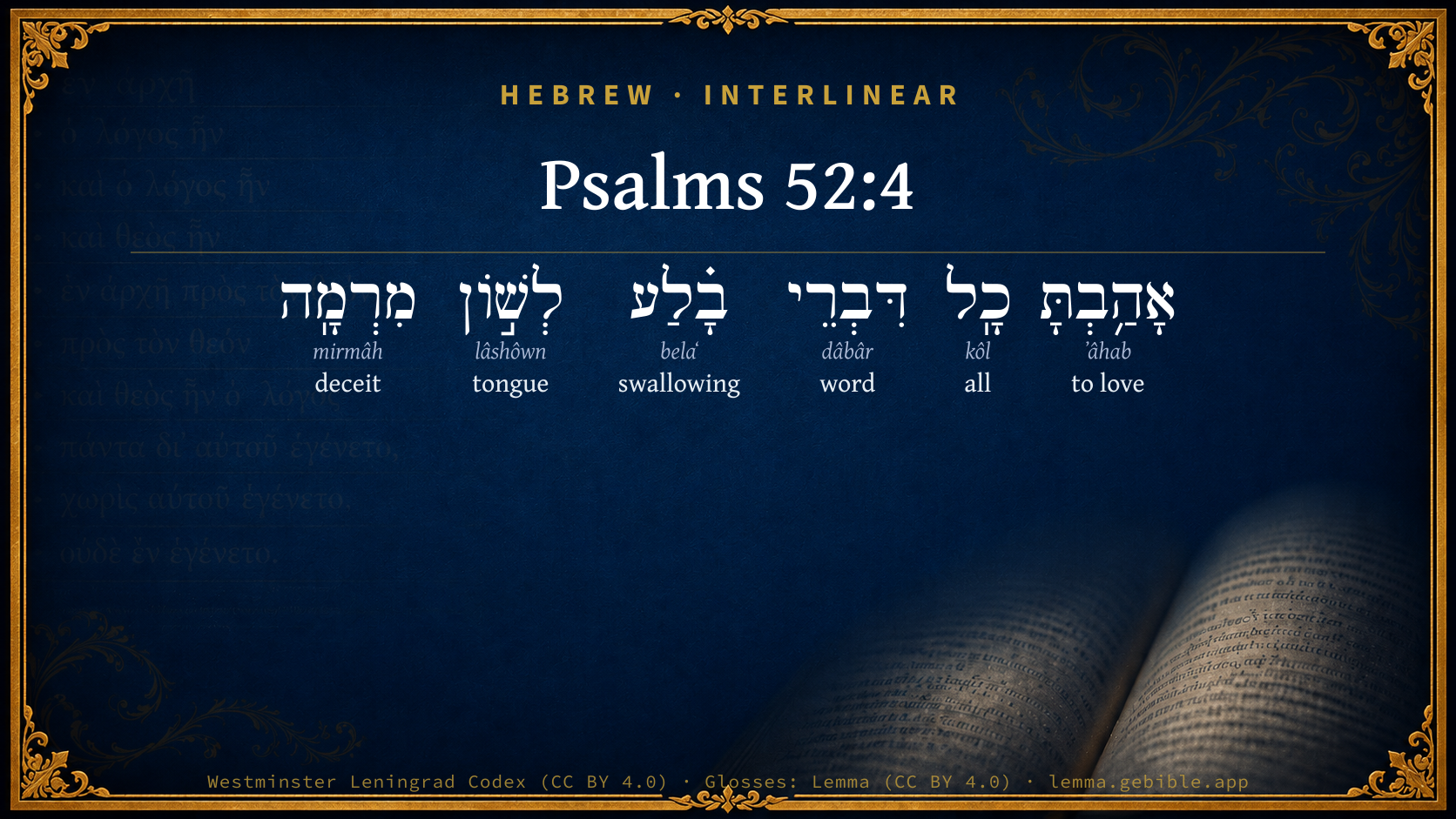
Psalms 52:4

Hebrew (Westminster Leningrad Codex) Psalms 52:4 appears in the Hebrew Old Testament. The text above is from the Westminster Leningrad Codex. Each word links to its Strong’s number, a concise gloss, and parsing drawn from the Open Scriptures Hebrew Bible morphology. Click any word for its full Brown-Driver-Briggs (BDB) entry.
Download image
Cite this verse

Psalms 52:4 (World English Bible). Public Domain. Lemma interlinear Bible study tool, https://lemma.gebible.app/v/psalms/52/4.

Show BibTeX & RIS
BibTeX
RIS
English Translation
You love all devouring words, You deceitful tongue.
World English Bible · Public Domain
Highlights
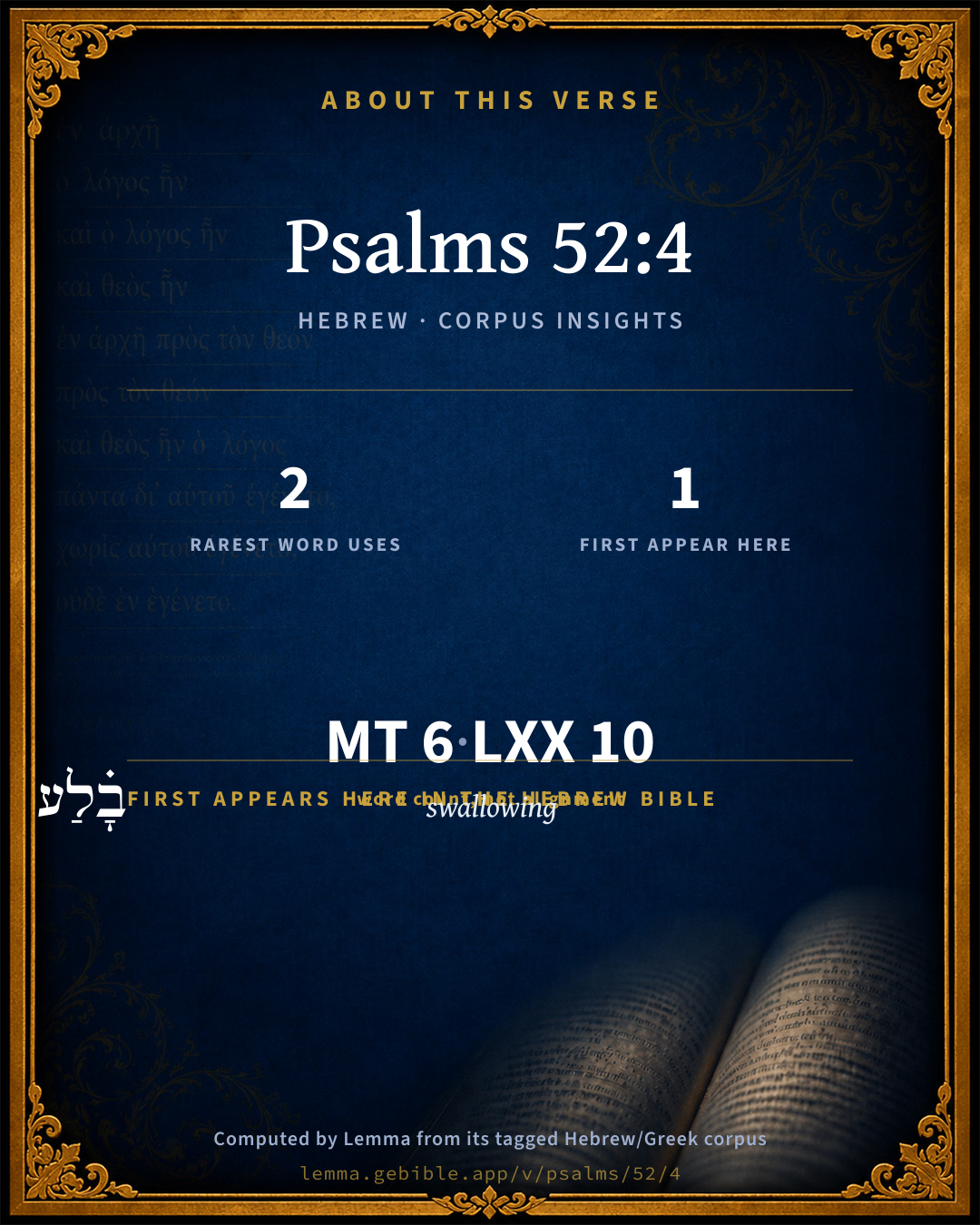
  • 1 first appearance in the Hebrew Bible
Full analysis ↓
Download a study sheet

One document with this verse’s original text, its word-by-word gloss line, the meaning frame, cross-references with their text, attributed commentary, and full source and license credits — printable, and it pastes into notes with its structure intact.

This verse Autodidact and up

Study sheet (.html) Plain text (.txt)

A passage Seminary Student

Up to 50 verses in one chapter. A passage sheet keeps up to 6 commentary sources and 12 cross-references per verse, in the order this page ranks them, and says so on the sheet whenever that leaves anything out. Ask for a single verse and you get the Autodidact verse sheet above.

Everything on this page stays free to read, with no account — the sheet is a download of what is already on screen, not access to it.

Want to remove ads? Support Godless Engineer
Compare translations 3

The same verse in 3 English versions, stacked beneath the original-language interlinear above. Click any original word for its lexicon entry.

Each is an independent rendering of the whole verse — the interlinear is not word-aligned to these translations.

Highlighted words mark where these versions differ — a whole-verse word diff, not a word-by-word alignment.

  • World English Bible Public Domain
    You love all devouring words, You deceitful tongue.
  • King James Version Public Domain
    Thou lovest all devouring words, O thou deceitful tongue.
  • unfoldingWord Literal Text CC BY-SA 4.0
    You love all words of destruction, tongue of betrayal!

unfoldingWord Literal Text — © unfoldingWord, licensed CC BY-SA 4.0. Word-aligned USFM3 via Door43 (git.door43.org/unfoldingWord/en_ult).

Versions to compare (up to 4)

3 of 4 selected

Show all 18 translations

Every available English version of this verse, each an independent rendering of the whole verse.

  • World English Bible Public Domain
    You love all devouring words, You deceitful tongue.
  • Berean Standard Bible Public Domain
    You love every word that devours, O deceitful tongue.
  • Majority Standard Bible Public Domain
    You love every word that devours, O deceitful tongue.
  • King James Version Public Domain
    Thou lovest all devouring words, O thou deceitful tongue.
  • American Standard Version (1901) Public Domain
    Thou lovest all devouring words, thou deceitful tongue.
  • Revised Version (1885) Public Domain
    Thou lovest all devouring words, O thou deceitful tongue.
  • Geneva Bible (1599) Public Domain
    Thou louest all wordes that may destroye, O deceitfull tongue!
  • Douay-Rheims (1899) Public Domain
    All the day long thy tongue hath devised injustice: as a sharp razor, thou hast wrought deceit.
  • Young's Literal Translation Public Domain
    Thou hast loved all devouring words, O thou deceitful tongue.
  • Literal Standard Version CC BY-SA 4.0
    You have loved all devouring words, || O you deceitful tongue.
  • Unlocked Literal Bible CC BY-SA 4.0
    You love all words that devour others, you deceitful tongue.
  • unfoldingWord Literal Text CC BY-SA 4.0
    You love all words of destruction, tongue of betrayal!
  • Darby Bible Public Domain
    Thou hast loved all devouring words, O deceitful tongue!
  • World Messianic Bible Public Domain
    You love all devouring words, you deceitful tongue.
  • Webster's Bible Public Domain
    \\52:2\\Thy tongue deviseth mischiefs; like a sharp razor, working deceitfully.
  • Free Bible Version CC BY-SA 4.0
    You love slanderous words that destroy others, you liar!
  • Bible in Basic English Public Domain
    Destruction is in all your words, O false tongue.
  • JPS Tanakh (1917) Public Domain
    (52-6) Thou lovest all devouring words, the deceitful tongue.

Literal Standard Version (2020), Covenant Press — licensed CC BY-SA 4.0. Text via the HelloAO Bible API (eBible.org). Unlocked Literal Bible (unfoldingWord) — licensed CC BY-SA 4.0. Text via the HelloAO Bible API (eBible.org). unfoldingWord Literal Text — © unfoldingWord, licensed CC BY-SA 4.0. Word-aligned USFM3 via Door43 (git.door43.org/unfoldingWord/en_ult). Free Bible Version, Dr. Jonathan Gallagher — licensed CC BY-SA 4.0. Text via the HelloAO Bible API (eBible.org).

Word by word

More ways to search: Search by grammar → Find every occurrence → Compare this word →

Practice this passage: Drill this verse → Learn its vocabulary →

About this verse

These counts appear in no published source. They are computed here, from the morphology-tagged text and Lemma’s own curated glosses. What Lemma adds →

6
words
6
distinct lemmas
Wisdom
section

Notable vocabulary

The rarest word here is בָ֗לַע swallowing H1105 — appearing just 2 times in the whole Hebrew Bible.

First appearance in Scripture

This word makes its first canonical appearance in the Hebrew Bible here:

  • בָ֗לַע swallowing H1105

Shared distinctive vocabulary

בָ֗לַע swallowing H1105 occurs in 2 verses of the Hebrew Bible. Also found in:

Grammatical profile

  • 1 verb
  • 5 nouns

Verb forms

  • אָהַ֥בְתָּ Qal · Perfect

Hebrew & Septuagint length

In English translation the verse runs 8 words from the Hebrew and 11 from the Septuagint (LXX English) — closely comparable.

A rough comparison of the two English renderings, which tokenize alike — not a word-level alignment.

Word counts can differ between the Hebrew and the Greek without any difference in meaning — e.g. the Hebrew direct-object marker אֵת has no separate Greek word, and Greek often adds the article ὁ.

In the original languages it is 6 Hebrew tokens and 10 Greek tokens — but the two are counted differently (Hebrew bundles its prefixes and suffixes into one token; the Greek is in lemma form), so that isn’t a like-for-like length.

Cross-references

3

Topical passages linked to Psalms 52:4 in the Treasury of Scripture Knowledge — connected by theme and wording, ordered by reader-vote popularity; previews shown in the World English Bible.

  • Psalms 120:3 What will be given to you, and what will be done more to you, You deceitful tongue?
  • James 3:6–9 And the tongue is a fire. The world of iniquity among our members is the tongue, which defiles the whole body, and sets on fire the course of nature, and is set on fire by Gehenna.
  • 1 Samuel 22:18–19 The king said to Doeg, Turn you, and fall on the priests. Doeg the Edomite turned, and he fell on the priests, and he killed on that day eighty-five persons who wore a linen ephod.

Cross-references courtesy of OpenBible.info (CC BY 4.0).

Hebrew and Greek witnesses Masoretic Hebrew ↔ Greek Septuagint

The same verse in the two great witnesses to the Old Testament, shown verse-for-verse.

You’re reading Greek Psalm 51 (Hebrew Psalm 52). The Septuagint counts the superscription, so verse numbers can differ from the Hebrew — chapter-level alignment, not verse-by-verse. Numbering follows Rahlfs.

These are two independent witnesses, not word-aligned to each other, and the Septuagint is shown in lemma (dictionary) form.

Hebrew Psalms 52:4 Masoretic · Westminster Leningrad Codex

אָהַ֥בְתָּ כָֽל דִּבְרֵי בָ֗לַע לְשׁ֣וֹן מִרְמָֽה

You love all devouring words, You deceitful tongue.

World English Bible · Public Domain

Greek LXX Greek Psalm 51:4 Septuagint · lemma form

ἀδικία λογίζομαι ὁ γλῶσσα σύ ὡσεί ξυρόν ἀκονάω ποιέω δόλος

You have loved all words of destruction, and a deceitful tongue.

LXX2012 (modern English Septuagint) · Public Domain

Hebrew: Westminster Leningrad Codex (CC BY 4.0). Greek: Septuagint (public domain); English from LXX2012 (modern English Septuagint) (Public Domain). How the Septuagint differs from the Hebrew →

Commentary

Notes on Psalms 52:4 from classic Christian and Jewish commentators (each source and its license shown beneath its notes). The classic Christian expositions comment on the surrounding passage and are grouped to its opening verse, so a note may address several verses; the Jewish commentaries on the Tanakh (Rashi and others) are per-verse, so they appear only where the commentator wrote on this verse.

Lemma curates 59 commentaries, every one of them public domain or Creative Commons licensed, each selected and text-cleaned for this edition rather than reprinted as found. About our sources →

Trapp's Complete Commentary

John Trapp

Psa 52:4 Thou lovest all devouring words, O [thou] deceitful tongue.

Ver. 4. Thou lovest all devouring words] Verba devoratoria ; the Greek hath it, καταποντισμου, that devour and swallow up, so as the sea doth things cast into it. So elsewhere, their throat is an open sepulchre, which devoureth all bodies, but rendereth none without a miracle. Some render it, Verba voraginis, the words of a whirlpool, which first turns men around, and then sucks them in. Others, Verba absorptionis, in reference to that use of the tongue, which is to sup up dish meats; Sic lingua attrahit homines ita ut absorbeantur, saith Vatablus. The Vulgate hath it, Verba praecipitationis, words that hurl one down headlong, Ex editis aedium vel rupium, as Hilary hath it, from the top of houses, or high rocks.

O thou deceitful tongue] Because, although it were for most part truth that he spake, yet he did it maliciously, and by dissimulation passed over that which might have made for Ahimelech, viz. that he relieved David in the simplicity of his heart, as thinking him to be high in the king’s favour, and employed by him. Hegesippus saith of Pilate, that he was Vir nequam, et parvi faciens mendacium, a naughty man, and one that made no bones of a lie: such another was Doeg (De excid. Jerus. l. 2. c. 5).

John Trapp, A Commentary or Exposition upon All the Books of the Old and New Testament (1647–1656) — public domain. Text from a community e-Sword module.

Joseph Benson's Commentary

Psa 52:4-5. Thou lovest all devouring words — Hebrew, דברי בלע, dibree balang, all the words of devouring, or destruction; that is, such calumnies as are the most pernicious in their nature, and as may most effectually involve others in utter destruction: such as might swallow up and destroy a whole family at once. God shall likewise destroy thee for ever — That is, totally and unavoidably, as thou didst destroy the priests. He shall pluck thee — Violently, irresistibly, and suddenly remove thee, as the word יסחךְ, jissachacha, signifies; out of thy dwelling-place — From thy house and lands, and all the wages of thy unrighteousness. Or, out of his, that is, the Lord’s tabernacle, from which thou didst cut off the Lord’s priests. Therefore God shall excommunicate thee from his presence, and from the society of the faithful. And though thou seemest to have taken very deep root, and to be more firmly settled in this barbarous cruelty; yet God shall root thee out of the land of the living, out of this world; shall pluck thee up by the very roots, and destroy thee, both root and branch. Which must have been very terrible to him who had his whole portion in this life.

Joseph Benson's Commentary on the Old and New Testaments (1811–1818) — public domain. Text from a community e-Sword module.

J. A. Alexander on Psalms

Joseph Addison Alexander

6. (Psa 52:4). Thou hast loved all devouring words, tongue of fraud. This is not so much a continuation of the foregoing discourse, as a resumption or recapitulation for the purpose of drawing a conclusion from it. In periodic style, the connection of the ideas might be thus exhibited: "Since then thou lovest, etc., therefore God will," etc. Devouring words, literally words of swallowing or deglutition. The second noun occurs only here; but the verb to swallow up is continually used in Hebrew to express the idea of complete destruction. See above, on Psa 21:10 (9), Psa 35:25. Tongue of deceit or deceitful tongue. This phrase may be governed by the verb, thou past loved all devouring words (and or even) a deceitful tongue. But it adds to the strength of the expression, and agrees better with the form of the context, to make it an apostrophe or direct, address to the deceitful tongue itself.

Joseph Addison Alexander, The Psalms Translated and Explained (1850) — public domain. Text from a community e-Sword module.

Jamieson, Fausset & Brown

Robert Jamieson, A. R. Fausset & David Brown

all-devouring--literally, "swallowing," which utterly destroy (compare Psa 21:9; Psa 35:25).

Jamieson, Fausset & Brown — Commentary Critical and Explanatory on the Whole Bible (1871) — public domain (CC PDM 1.0). Text via the HelloAO Bible API.

John Calvin's Commentaries

The term בלע, balang, in verse fourth, which has been translated destruction, I prefer understanding in the sense of hiding or concealment. He seems to allude to the drawing back of the tongue when we swallow; and under this figure, to describe the deceitfulness of Doeg’s words, by which he devoured the unsuspecting and the innocent. The great design of David, as I have already remarked in the preceding verses, is to encourage himself in the hope of deliverance by dwelling upon the extreme character of that wickedness which his enemy had displayed.

John Calvin's Commentaries (1540-1563) — public domain. Text from the Calvin Translation Society English edition (1840s-50s) via the Christian Classics Ethereal Library (ccel.org). Calvin's coverage is partial (roughly two-thirds of the Bible); uncommented books and verses are honest gaps, never fabricated. The 19th-century editor's footnotes and remarks are omitted so the notes are faithfully Calvin's own voice.

Ellicott's Commentary for English Readers

(4) Devouring words.—Literally, words of swallowing, such as swallow down (comp. Psa_5:9, where the throat is called “an open sepulchre”) a neighbour’s life, honour, and goods.

A Bible Commentary for English Readers, edited by Charles John Ellicott (1878–1897) — public domain. Text from a community e-Sword module.

The Cambridge Bible for Schools and Colleges

gen. ed. J. J. S. Perowne

4. devouring words] Lit., words of swallowing up. Cp. the use of the verb in Psa_35:25, “We have swallowed him up”: and Psa_53:4.

O thou deceitful tongue] This rendering is certainly preferable to that of the margin, ‘and the deceitful tongue.’ The bold identification of the offender with the offending member is far more vigorous, and perfectly legitimate. Cp. Psa_120:2-3; Psa_12:3; 1Ki_19:18.

The Cambridge Bible for Schools and Colleges (gen. ed. J. J. S. Perowne; Cambridge University Press, 1878–1918) — public domain. Text from a community e-Sword module.

John Gill's Exposition

Thou lovest all devouring words,.... Or "words of swallowing up" (y); such as lies, calumnies, and detractions are, which devour the characters and reputations of men, and are the cause sometimes of their utter ruin and destruction; of the devouring and blasphemous words of antichrist see Rev 13:5;

O thou deceitful tongue; See Gill on Psa 52:2.

(y) "verba absorptionis", Vatablus, Gejerus, Schmidt.

John Gill's Exposition of the Whole Bible (1746–1763) — public domain (CC PDM 1.0). Text via the HelloAO Bible API.

Albert Barnes' Notes on the Bible

Thou lovest all devouring words - All words that tend to devour or “swallow up” reputation and happiness. Luther, “Thou speakest gladly all things (anything) that will serve to destruction.” Anything, everything, that will serve to ruin people. The word rendered “devouring” - בלע bela‛ - occurs only here and in Jer 51:44, though the verb from which it is derived occurs frequently: Isa 28:4; Exo 7:12; Jon 2:1 Jon 1:17; Gen 41:7, Gen 41:24, et al. The verb means to swallow; and then, to consume or destroy.

O thou deceitful tongue - Margin, “and the deceitful tongue.” The sense is best expressed in the text. It is an address to the tongue as loving deceit or fraud.

Albert Barnes' Notes on the Bible (1834–1885) — public domain. Text from a community e-Sword/MySword module.

Matthew Poole's English Annotations

Devouring words, such as might swallow up and destroy a whole family at once.

Matthew Poole's English Annotations on the Holy Bible (1683–1685) — public domain. Text from a community e-Sword/MySword module.

The Treasury of David

Charles H. Spurgeon

Ver. 4. Thou lovest. Thou hast a taste, a gusto for evil language. All devouring words. There are words that, like boa constrictors, swallow men whole, or like lions, rend men to pieces; these words evil minds are fond of. Their oratory is evermore furious and bloody. That which will most readily provoke the lowest passions they are sure to employ, and they think such pandering to the madness of the wicked to be eloquence of a high order. O thou deceitful tongue. Men can manage to say a great many furious things, and yet cover all over with the pretext of justice. They claim that they are jealous for the right, but the truth is they are determined to put down truth and holiness, and craftily go about it under this transparent pretence.

Ver. 4. Thou lovest all devouring words, O thou deceitful tongue. He was all tongue; a man of words; and these the most deceitful and injurious. Adam Clarke.

None.

Psalms 52:5*

Charles H. Spurgeon's The Treasury of David (1869–1885) — public domain. Psalms only. Text from a community e-Sword/MySword module.

Whedon's Commentary on the Bible

Daniel D. Whedon

4. All devouring words—Literally, all words that gulp down. Words which swallow a man, as a voracious animal gulps his food without mastication. All such words of falsehood this “hero” in crime and perfidy loved, and none others. It is evident that Doeg was a man of marked ability, and of artful, insinuating address.

Daniel D. Whedon (gen. ed.), Commentary on the Old and New Testaments (1874–1909) — public domain. Text from a community e-Sword module.

The Pulpit Commentary

Thou lovest all devouring words. "Devouring words" are words that cause ruin and destruction. O thou deceitful tongue! or (as in the margin), and the deceitful tongue.

The Pulpit Commentary (1880–1919), ed. H.D.M. Spence-Jones & Joseph S. Exell — public domain. Text from a community e-Sword module.

unfoldingWord translationNotes

Door43 World Missions Community

words that devour others

Here words that harm others are spoken of as if they were animals that devour people. AT: "words that harm others" (See: Metaphor)

you deceitful tongue

This refers to the person the author is speaking to. AT: "you speaker of deceit" or "you liar" (See: Synecdoche)

take you up ... pluck you ... root you

All three of these phrases are different ways of saying "remove you" (See: Parallelism)

root you out of the land of the living

Being alive on earth is spoken of as if people are plants with roots in the ground. God killing someone is spoken of as digging up the plant's roots and taking it out of the ground. AT: "he will take you out the land of the living" or "He will kill you so that you will no longer be on earth with living people" (See: Metaphor)

Selah

This may be a musical term that tells people how to sing or play their instruments here. Some translations write the Hebrew word, and some translations do not include it. (See: Copy or Borrow Words)

translationWords

word

devour

deceive

eternity

tent

life

selah

unfoldingWord translationNotes — © Distant Shores Media and the Door43 World Missions Community, licensed CC BY-SA 4.0. Source: git.door43.org/Door43/en_tn.

Rashi

Rabbi Shlomo Yitzchaki (Rashi)

sharpened Heb. מְלֻטֳשּׁ.

working deceit Cutting the flesh with the hair.

Rashi on the Tanakh — English translations: “The Judaica Press complete Tanach with Rashi, translated by A. J. Rosenberg” (CC BY 4.0); “Pentateuch with Rashi's commentary by M. Rosenbaum and A.M. Silbermann, 1929-1934” (public domain); “The Metsudah Tanach series, Lakewood, N.J” (CC BY 4.0); and “The Book of Joshua, Metsudah Publications, 1997” (CC BY 4.0). Text via Sefaria.

Lesson kit

Teaching starters — assembled from the data on this page, not authored interpretation. Every prompt links to the verse data it draws on. Edit before teaching.

Psalms, in the Wisdom, opens this verse with 6 words (6 distinct Hebrew lemmas). Its most distinctive word is belaʻ (“swallowing”). A historical commentator’s framing appears above. Read the whole chapter for the surrounding context.

Discussion questions

  1. How does “swallowing” (belaʻ) shape what this verse is saying?
  2. This is the first place “swallowing” appears in Scripture (first appears here). What does its debut here establish?
  3. How does Jeremiah 51:44, which shares the word «swallowing», read alongside this verse?
  4. The translations on this page render this verse differently — a whole-verse word diff, not a word-by-word alignment. What might account for the different wordings?
  5. «אָהַ֥בְתָּ» is a Qal Perfect verb. How does that grammatical form shape the action described?
  6. Compare how Trapp's Complete Commentary and Joseph Benson's Commentary read this verse. Where do they agree or differ?

Things to notice

Reading settings

Reading text

Shown beneath each verse's original-language words.

Old Testament
Old Testament edition

Read the OT as the Masoretic Hebrew (MT) or the Greek Septuagint (LXX).

English shown for the Greek Septuagint (in the Hebrew ↔ Greek comparison).

Comparing translations? Open the Compare panel on any verse page to stack up to four side by side.