
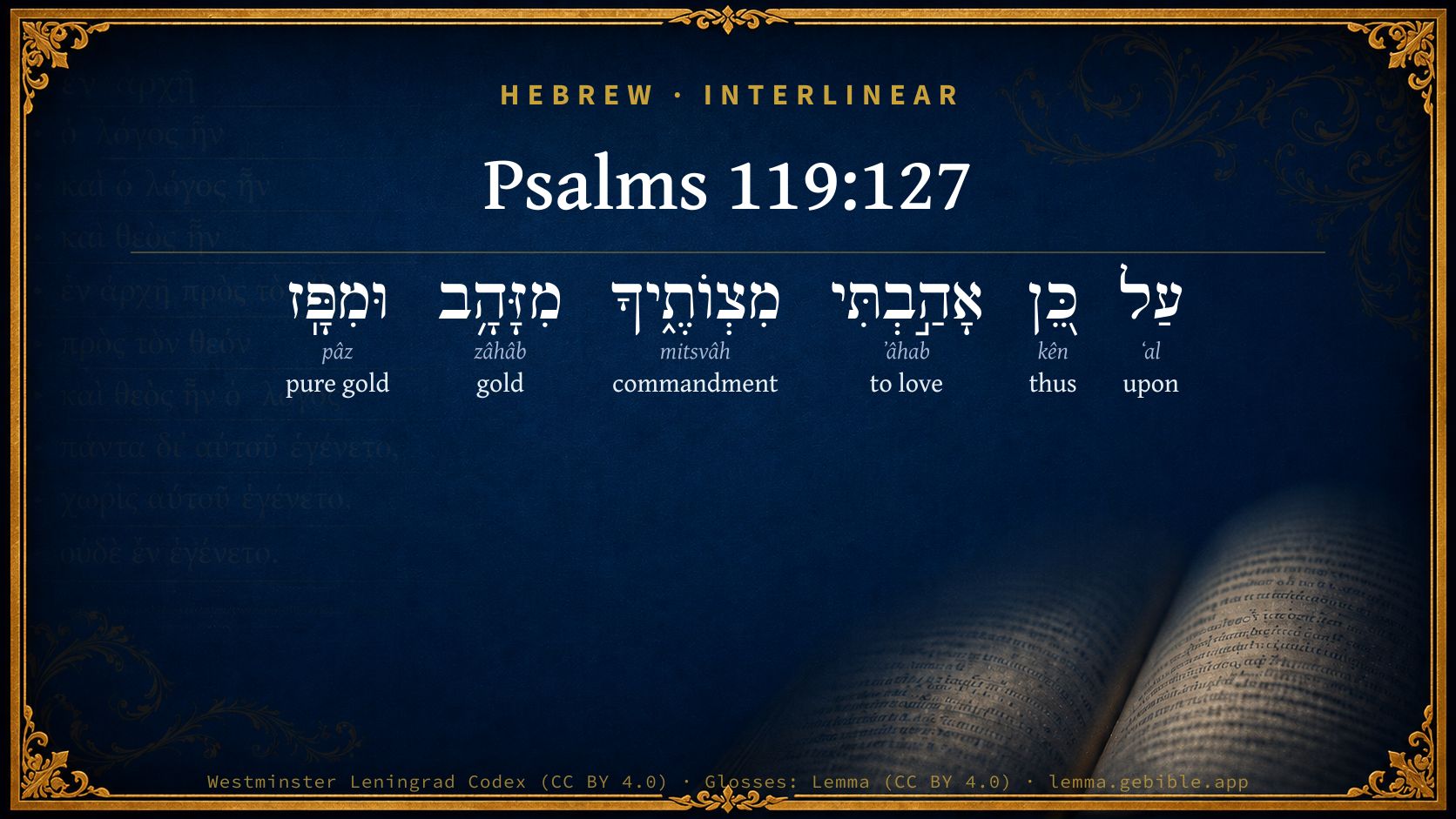
Psalms 119:127

Hebrew (Westminster Leningrad Codex) Psalms 119:127 appears in the Hebrew Old Testament. The text above is from the Westminster Leningrad Codex. Each word links to its Strong’s number, a concise gloss, and parsing drawn from the Open Scriptures Hebrew Bible morphology. Click any word for its full Brown-Driver-Briggs (BDB) entry.
Download image
Cite this verse

Psalms 119:127 (World English Bible). Public Domain. Lemma interlinear Bible study tool, https://lemma.gebible.app/v/psalms/119/127.

Show BibTeX & RIS
BibTeX
RIS
English Translation
Therefore I love your commandments more than gold, Yes, more than pure gold.
World English Bible · Public Domain
Download a study sheet

One document with this verse’s original text, its word-by-word gloss line, the meaning frame, cross-references with their text, attributed commentary, and full source and license credits — printable, and it pastes into notes with its structure intact.

This verse Autodidact and up

Study sheet (.html) Plain text (.txt)

A passage Seminary Student

Up to 50 verses in one chapter. A passage sheet keeps up to 6 commentary sources and 12 cross-references per verse, in the order this page ranks them, and says so on the sheet whenever that leaves anything out. Ask for a single verse and you get the Autodidact verse sheet above.

Everything on this page stays free to read, with no account — the sheet is a download of what is already on screen, not access to it.

Want to remove ads? Support Godless Engineer
Compare translations 3

The same verse in 3 English versions, stacked beneath the original-language interlinear above. Click any original word for its lexicon entry.

Each is an independent rendering of the whole verse — the interlinear is not word-aligned to these translations.

Highlighted words mark where these versions differ — a whole-verse word diff, not a word-by-word alignment.

  • World English Bible Public Domain
    Therefore I love your commandments more than gold, Yes, more than pure gold.
  • King James Version Public Domain
    Therefore I love thy commandments above gold; yea, above fine gold.
  • unfoldingWord Literal Text CC BY-SA 4.0
    Therefore, I love your commandments more than gold and more than fine gold.

unfoldingWord Literal Text — © unfoldingWord, licensed CC BY-SA 4.0. Word-aligned USFM3 via Door43 (git.door43.org/unfoldingWord/en_ult).

Versions to compare (up to 4)

3 of 4 selected

Show all 17 translations

Every available English version of this verse, each an independent rendering of the whole verse.

  • World English Bible Public Domain
    Therefore I love your commandments more than gold, Yes, more than pure gold.
  • Berean Standard Bible Public Domain
    Therefore I love Your commandments more than gold, even the purest gold.
  • Majority Standard Bible Public Domain
    Therefore I love Your commandments more than gold, even the purest gold.
  • King James Version Public Domain
    Therefore I love thy commandments above gold; yea, above fine gold.
  • American Standard Version (1901) Public Domain
    Therefore I love thy commandments Above gold, yea, above fine gold.
  • Revised Version (1885) Public Domain
    Therefore I love thy commandments above gold, yea, above fine gold.
  • Geneva Bible (1599) Public Domain
    Therefore loue I thy commandements aboue golde, yea, aboue most fine golde.
  • Young's Literal Translation Public Domain
    Therefore I have loved Thy commands Above gold -- even fine gold.
  • Literal Standard Version CC BY-SA 4.0
    Therefore I have loved Your commands || Above gold—even fine gold.
  • Unlocked Literal Bible CC BY-SA 4.0
    Truly I love your commandments more than gold, more than fine gold.
  • unfoldingWord Literal Text CC BY-SA 4.0
    Therefore, I love your commandments more than gold and more than fine gold.
  • Darby Bible Public Domain
    Therefore I love thy commandments above gold, yea, above fine gold.
  • World Messianic Bible Public Domain
    Therefore I love your commandments more than gold, yes, more than pure gold.
  • Webster's Bible Public Domain
    Therefore I love thy commandments above gold; yes, above fine gold.
  • Free Bible Version CC BY-SA 4.0
    This is why I love your commandments more than gold, more than the finest gold.
  • Bible in Basic English Public Domain
    For this reason I have greater love far your teachings than for gold, even for shining gold.
  • JPS Tanakh (1917) Public Domain
    Therefore I love Thy commandments above gold, yea, above fine gold.

Literal Standard Version (2020), Covenant Press — licensed CC BY-SA 4.0. Text via the HelloAO Bible API (eBible.org). Unlocked Literal Bible (unfoldingWord) — licensed CC BY-SA 4.0. Text via the HelloAO Bible API (eBible.org). unfoldingWord Literal Text — © unfoldingWord, licensed CC BY-SA 4.0. Word-aligned USFM3 via Door43 (git.door43.org/unfoldingWord/en_ult). Free Bible Version, Dr. Jonathan Gallagher — licensed CC BY-SA 4.0. Text via the HelloAO Bible API (eBible.org).

Word by word

More ways to search: Search by grammar → Find every occurrence → Compare this word →

Practice this passage: Drill this verse → Learn its vocabulary →

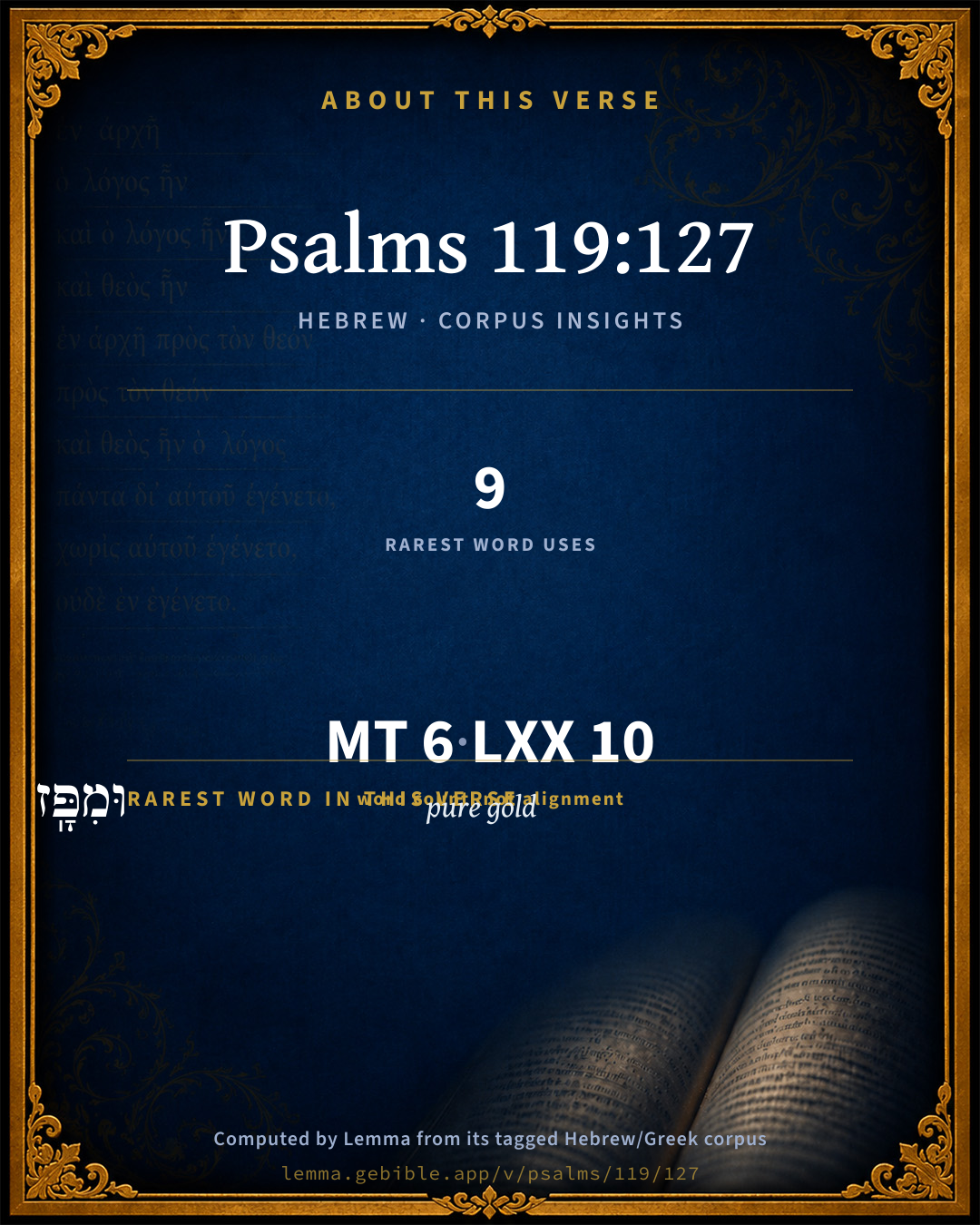
About this verse

These counts appear in no published source. They are computed here, from the morphology-tagged text and Lemma’s own curated glosses. What Lemma adds →

6
words
6
distinct lemmas
Wisdom
section

Notable vocabulary

The rarest word here is וּמִפָּֽז pure gold H6337 — appearing just 9 times in the whole Hebrew Bible.

Shared distinctive vocabulary

וּמִפָּֽז pure gold H6337 occurs in 9 verses of the Hebrew Bible. Also found in:

Grammatical profile

  • 1 verb
  • 3 nouns
  • 1 preposition
  • 1 particle

Verb forms

  • אָהַ֣בְתִּי Qal · Perfect

Hebrew & Septuagint length

In English translation the verse runs 13 words from the Hebrew and 12 from the Septuagint (LXX English) — closely comparable.

A rough comparison of the two English renderings, which tokenize alike — not a word-level alignment.

Word counts can differ between the Hebrew and the Greek without any difference in meaning — e.g. the Hebrew direct-object marker אֵת has no separate Greek word, and Greek often adds the article ὁ.

In the original languages it is 6 Hebrew tokens and 10 Greek tokens — but the two are counted differently (Hebrew bundles its prefixes and suffixes into one token; the Greek is in lemma form), so that isn’t a like-for-like length.

Cross-references

7

Topical passages linked to Psalms 119:127 in the Treasury of Scripture Knowledge — connected by theme and wording, ordered by reader-vote popularity; previews shown in the World English Bible.

  • Psalms 19:10 More to be desired are they than gold, yes, than much fine gold; Sweeter also than honey and the extract of the honeycomb.
  • Matthew 13:45–46 "Again, the Kingdom of Heaven is like a man who is a merchant seeking fine pearls,
  • Proverbs 3:13–18 Happy is the man who finds wisdom, The man who gets understanding.
  • Proverbs 8:11 For wisdom is better than rubies. All the things that may be desired can't be compared to it.
  • Proverbs 16:16 How much better it is to get wisdom than gold! Yes, to get understanding is to be chosen rather than silver.
  • Psalms 119:72 The law of your mouth is better to me than thousands of pieces of gold and silver.
  • Ephesians 3:8 To me, the very least of all saints, was this grace given, to preach to the Gentiles the unsearchable riches of Christ,

Cross-references courtesy of OpenBible.info (CC BY 4.0).

Hebrew and Greek witnesses Masoretic Hebrew ↔ Greek Septuagint

The same verse in the two great witnesses to the Old Testament, shown verse-for-verse.

You’re reading Greek Psalm 118 (Hebrew Psalm 119). The Septuagint counts the superscription, so verse numbers can differ from the Hebrew — chapter-level alignment, not verse-by-verse. Numbering follows Rahlfs.

These are two independent witnesses, not word-aligned to each other, and the Septuagint is shown in lemma (dictionary) form.

Hebrew Psalms 119:127 Masoretic · Westminster Leningrad Codex

עַל כֵּ֭ן אָהַ֣בְתִּי מִצְוֺתֶ֑יךָ מִזָּהָ֥ב וּמִפָּֽז

Therefore I love your commandments more than gold, Yes, more than pure gold.

World English Bible · Public Domain

Greek LXX Greek Psalm 118:127 Septuagint · lemma form

διά οὗτος ἀγαπάω ὁ ἐντολή σύ ὑπέρ χρυσίον καί τοπάζιον

Therefore have I loved your commandments more than gold, or the topaz.

LXX2012 (modern English Septuagint) · Public Domain

On this verse, The Cambridge Bible for Schools and Colleges discusses the Septuagint’s reading. Read the note in Commentary ↓

Hebrew: Westminster Leningrad Codex (CC BY 4.0). Greek: Septuagint (public domain); English from LXX2012 (modern English Septuagint) (Public Domain). How the Septuagint differs from the Hebrew →

Commentary

Notes on Psalms 119:127 from classic Christian and Jewish commentators (each source and its license shown beneath its notes). The classic Christian expositions comment on the surrounding passage and are grouped to its opening verse, so a note may address several verses; the Jewish commentaries on the Tanakh (Rashi and others) are per-verse, so they appear only where the commentator wrote on this verse.

Lemma curates 59 commentaries, every one of them public domain or Creative Commons licensed, each selected and text-cleaned for this edition rather than reprinted as found. About our sources →

Trapp's Complete Commentary

John Trapp

Psa 119:127 Therefore I love thy commandments above gold; yea, above fine gold.

Ver. 127. Therefore I love thy commandments] I like them the better because they slight them, and prize that way the more they persecute. I kindle myself from their coldness, and while they greedily grasp after gold, and fine gold, I lay hold upon eternal life, 1Ti 6:10-12.

John Trapp, A Commentary or Exposition upon All the Books of the Old and New Testament (1647–1656) — public domain. Text from a community e-Sword module.

The Biblical Illustrator

Joseph S. Exell

Psa_119:127-131

Therefore I love Thy commandments above gold.

Gods Word

Gods Word is here revealed in several aspects--

I. As a prize. It is above gold.

1. It is intrinsically more valuable than gold. It contains the mind of God.

2. It is relatively more valuable than gold. It procures greater blessings.

II. As a law, All Thy precepts. As a law--

1. It is to be righteous--Concerning all things, to be righteous.

2. It is to be practical, I hate every false way.

III. As a revelation. As a revelation it is--

1. Wonderful, Thy testimonies are wonderful.

2. Spiritually enlightening. The entrance of Thy Word giveth light. It lights up the soul.

IV. As a necessity (verse 131). It is the air without which you cannot breathe, food without which you cannot live. (Homilist.)

The Biblical Illustrator, edited by Joseph S. Exell (c. 1880s–1900s) — public domain. Text from a community e-Sword module.

J. A. Alexander on Psalms

Joseph Addison Alexander

127. (Psa 119:127) Therefore I love thy commandments (more) than gold and (more) than fine gold. The first word refers not to the immediately preceding verse but to the whole previous description of the excellence of God's commandments. The comparison in the last clause, like that in Psa 119:103, is borrowed from Psa 19:10.

Joseph Addison Alexander, The Psalms Translated and Explained (1850) — public domain. Text from a community e-Sword module.

Matthew Henry's Commentary

David here, as often in this psalm, professes the great love he had to the word and law of God; and, to evidence the sincerity of it, observe, 1. The degree of his love. He loved his Bible better than he loved his money - above gold, yea, above fine gold. Gold, fine gold, is what most men set their hearts upon; nothing charms them and dazzles their eyes so much as gold does. It is fine gold, a fine thing in their eyes; they will venture their souls, their God, their all, to get and keep it. But David saw that the word of God answers all purposes better than money does, for it enriches the soul towards God; and therefore he loved it better than gold, for it had done that for him which gold could not do, and would stand him in stead when the wealth of the world would fail him. 2. The ground of his love. He loved all God's commandments because he esteemed them to be right, all reasonable and just, and suited to the end for which they were made. They are all as they should be, and no fault can be found with them; and we must love them because they bear God's image and are the revelations of his will. If we thus consent to the law that it is good, we shall delight in it after the inner man. 3. The fruit and evidence of this love: He hated every false way. The way of sin being directly contrary to God's precepts, which are right, is a false way, and therefore those that have a love and esteem for God's law hate it and will not be reconciled to it.

Matthew Henry's Commentary on the Whole Bible (1708–1710) — public domain (CC PDM 1.0). Text via the HelloAO Bible API.

Adam Clarke's Commentary

Verse 127. Therefore I love thy commandments] I see thou wilt do all things well. I will trust in thee.

Above gold] מזהב mizzahab, more than resplendent gold; gold without any stain or rust.

Yea, above fine gold.] ומפז umippaz, above solid gold; gold separated from the dross, perfectly refined.

Adam Clarke's Commentary on the Bible (1810–1826) — public domain. Text from a community e-Sword/MySword module.

John Calvin's Commentaries

127. And therefore I have loved thy statutes above gold. This verse, I have no doubt, is connected with the preceding; for otherwise the illative particle therefore would be without meaning. Viewing it in this connection, I understand the Psalmist as intimating, that the reason why he esteemed God’s law as more valuable than gold and precious stones, was because he had fixed in his mind a thorough persuasion of the truth, that although God may connive for a time at wickedness, the making havoc of all uprightness and equity will not always remain unpunished. Yea, the more he saw the wicked outrageously breaking forth into wickedness, the more was he incited by a holy indignation burning in his heart, to love the law. This is a passage deserving of special attention, for the baneful influence of evil example is well known, every man thinking that he may lawfully do whatever is commonly practiced around him. Whence it comes to pass, that evil company carries us away like a tempest. The more diligently then ought we to meditate on this doctrine, That when the wicked claim to themselves an unbridled liberty, it behoves us to contemplate with the eyes of faith the judgments of God, in order to our being thereby quickened to the observance of the divine law. If attention to this doctrine has been needful from the beginning, at the present day it is necessary to exert ourselves, that we may not be involved in violating the law of God with the wicked conspiracy which almost the whole world have formed to violate it. The more outrageously the wicked vaunt themselves, let our veneration for and our love of the divine law proportionally increase.

John Calvin's Commentaries (1540-1563) — public domain. Text from the Calvin Translation Society English edition (1840s-50s) via the Christian Classics Ethereal Library (ccel.org). Calvin's coverage is partial (roughly two-thirds of the Bible); uncommented books and verses are honest gaps, never fabricated. The 19th-century editor's footnotes and remarks are omitted so the notes are faithfully Calvin's own voice.

The Cambridge Bible for Schools and Colleges

gen. ed. J. J. S. Perowne

127. Therefore] The more men break God’s commandments, the more the Psalmist will love them. Cp. Psa_19:10. P.B.V. precious stone comes through the Vulg. from the LXX.

The Cambridge Bible for Schools and Colleges (gen. ed. J. J. S. Perowne; Cambridge University Press, 1878–1918) — public domain. Text from a community e-Sword module.

John Gill's Exposition

I opened my mouth, and panted,.... As a person out of breath does, through walking or running; he stops and pants, and opens his mouth, to draw in air to his relief: or as hungry and thirsty persons pant for food and drink, and open their mouths to receive it, before it can well be brought to them. So the psalmist panted after God, and communion with him; desired the sincere milk of the word; longed for the breasts of ordinances, and even fainted for the courts of the Lord, Psa 42:1;

for I longed for thy commandments; for an opportunity of waiting upon God in the way of his duty; to hear his word, and attend his worship.

John Gill's Exposition of the Whole Bible (1746–1763) — public domain (CC PDM 1.0). Text via the HelloAO Bible API.

Albert Barnes' Notes on the Bible

Therefore I love thy commandments ... - The more people break them Psa 119:126, the more I see their value; the more precious they are to me. The fact that they make thy law void, and that evil consequences result from their conduct, only impresses my mind the more with a sense of the value of the law, and makes my heart cling to it the more. There is almost nothing that will so impress upon our minds the importance of law as the sight of the effects which follow when it is disregarded.

Above gold ... - See the notes at Psa 119:72. Compare Psa 19:10.

Albert Barnes' Notes on the Bible (1834–1885) — public domain. Text from a community e-Sword/MySword module.

Matthew Poole's English Annotations

Partly, because it is one evidence of their excellency, that they are disliked by the vilest of men; partly, out of a just indignation and opposition against my sworn enemies; and partly, because the great and general apostacy of others makes this duty more necessary to prevent their own and other men’s relapses.

Matthew Poole's English Annotations on the Holy Bible (1683–1685) — public domain. Text from a community e-Sword/MySword module.

The Treasury of David

Charles H. Spurgeon

Ver. 127. Therefore I love thy commandments above gold; yea, above fine gold. As it was God's time to work so it was David's time to love. So far from being swayed by the example of evil men, so as to join them in slighting the Scriptures, he was the rather led into a more vehement love of them. As he saw the commandments slighted by the ungodly, his heart was in sympathy with God, and he felt a burning affection for his holy precepts. It is the mark of a true believer that he does not depend upon others for his religion, but drinks water out of his own well, which springs up even when the cisterns of earth are all dried. Our holy poet amid a general depreciation of the law felt his own esteem of it rising so high that gold and silver sank in comparison. Wealth brings with it so many conveniences that men naturally esteem it, and gold as the symbol of it is much set by; and yet, in the judgment of the wise, God's laws are more enriching, and bring with them more comfort than all the choicest treasures. The Psalmist could not boast that he always kept the commands; but he could declare that he loved them; he was perfect in heart, and would fain have been perfect in life. He judged God's holy commands to be better than the best earthly thing, yea, better than the best sort of the best earthly thing; and this esteem was confirmed and forced into expression by those very oppositions of the world which drive hypocrites to forsake the Lord and his ways.

"The dearer, for their rage,

Thy words I love and own,

A wealthier heritage

Than gold and precious stone."

Ver. 127. Therefore I love thy commandments above gold, etc. Partly, because it is one evidence of their excellency, that they are disliked by the vilest of men. Partly, out of a just indignation and opposition against my sworn enemies; and partly, because the great and general apostasy of others makes this duty more necessary to prevent their own and other men's relapses. Matthew Pool.

Ver. 127. I love thy commandments above gold; yea, above fine gold. The image employed brings before us the picture of the miser; his heart and his treasure are in his gold. With what delight he counts it! with what watchfulness he keeps it! hiding it in safe custody, lest he should be despoiled of that which is dearer to him than life. Such should Christians be, spiritual misers, counting their treasure which is "above fine gold"; and "hiding it in their hearts, " in safe keeping, where the great despoiler shall not be able to reach it. Oh, Christians! how much more is your portion to you than the miser's treasure! Hide it; watch it; retain it. You need not be afraid of covetousness in spiritual things: rather "covet earnestly" to increase your store; and by living upon it and living in it, it will grow richer in extent, and more precious in value. Charles Bridges.

Ver. 127. I love thy commandments. He professes not that he fulfilled them, but that he loved them; and truly it is a great progress in godliness, if we be come thus far, as from our heart,to love them. The natural man hates the commandments of God; they are so contrary to his corruption; but the regenerate man, as he hates his own corruption, so he loves the word, because according to it he desires to be reformed. And here is our comfort, that, albeit we cannot do what is commanded, yet if we love to do it, it is an argument of grace received. "Above gold" etc. It is lawful to love those creatures which God hath appointed for our use; with these conditions: the one is, that the first seat in our affection of love be reserved to God; and any other thing we love, that we love it in him and for him, and give it only the second room. Thus David, being a natural man, loved his natural food; but he protests he loved the law of the Lord more than his appointed food; and here he loves the commandments of God above all gold. William Cowper.

Ver. 127. The world's assault upon the truth a reason for our loving it.

Ver. 127.

1. The object of love: "Thy commandments."

2. The degree of love: "above gold, "etc.

3. The reason of this love: "therefore, "etc., because its object must ultimately prevail. G.R.

Ver. 127. God's will versus the golden idol.

1. God's commandments are better than gold.

2. The love of them is proportionably nobler.

3. The unmeasurable superiority of character they produce. W.B.H.

Psalms 119:128*

Charles H. Spurgeon's The Treasury of David (1869–1885) — public domain. Psalms only. Text from a community e-Sword/MySword module.

The Pulpit Commentary

Therefore I love thy commandments. Because the wicked "make void" thy commandments and cast them aside, "therefore" I all the more "love" them. Above gold; yea, above fine gold (comp. ver. 72).

The Pulpit Commentary (1880–1919), ed. H.D.M. Spence-Jones & Joseph S. Exell — public domain. Text from a community e-Sword module.

John Wesley's Explanatory Notes

Therefore - Because the general apostacy of others makes this duty more necessary.

John Wesley, Explanatory Notes Upon the Whole Bible (1754–1765) — public domain. Text via the GEBible commentary corpus.

unfoldingWord translationNotes

Door43 World Missions Community

I carefully follow all your instructions

A person carefully obeying all of God's instructions is spoken of as if as if the instructions were leading a person and that person follows behind. AT: I carefully obey all of your instructions" (See: Metaphor)

every path of falsehood

People doing what is evil is spoken of as if they are walking on the wrong path. AT: "all the bad ways some people live" (See: Metaphor)

translationWords

love

command

gold

instruct

unfoldingWord translationNotes — © Distant Shores Media and the Door43 World Missions Community, licensed CC BY-SA 4.0. Source: git.door43.org/Door43/en_tn.

Rashi

Rabbi Shlomo Yitzchaki (Rashi)

Because I loved Heb. על-כן. Because I loved Your commandments, it is fitting that You teach me a time of good will, and what I should do for You that You should accept me. There are many [instances of] על-כן that are to be interpreted as “because”; e.g., (Gen. 33:10): “because (כי על-כן) I have seen your face”; (Num. 10:33). “because (כי על-כן) you know our encampment”; (Isa. 15: 7), “Because of (כי על-כן) the many things they did.”

Rashi on the Tanakh — English translations: “The Judaica Press complete Tanach with Rashi, translated by A. J. Rosenberg” (CC BY 4.0); “Pentateuch with Rashi's commentary by M. Rosenbaum and A.M. Silbermann, 1929-1934” (public domain); “The Metsudah Tanach series, Lakewood, N.J” (CC BY 4.0); and “The Book of Joshua, Metsudah Publications, 1997” (CC BY 4.0). Text via Sefaria.

Lesson kit

Teaching starters — assembled from the data on this page, not authored interpretation. Every prompt links to the verse data it draws on. Edit before teaching.

Psalms, in the Wisdom, opens this verse with 6 words (6 distinct Hebrew lemmas). Its most distinctive word is pâz (“pure gold”). A historical commentator’s framing appears above. Read the whole chapter for the surrounding context.

Discussion questions

  1. The word pâz carries the sense “pure gold.” How does it shape the verse?
  2. How does Job 28:17, which shares the word «pure gold», read alongside this verse?
  3. These translations render this verse differently. What is at stake in choosing one wording over another?
  4. «אָהַ֣בְתִּי» is a Qal Perfect verb. How does that grammatical form shape the action described?
  5. Compare how Trapp's Complete Commentary and The Biblical Illustrator read this verse. Where do they agree or differ?

Things to notice

Reading settings

Reading text

Shown beneath each verse's original-language words.

Old Testament
Old Testament edition

Read the OT as the Masoretic Hebrew (MT) or the Greek Septuagint (LXX).

English shown for the Greek Septuagint (in the Hebrew ↔ Greek comparison).

Comparing translations? Open the Compare panel on any verse page to stack up to four side by side.