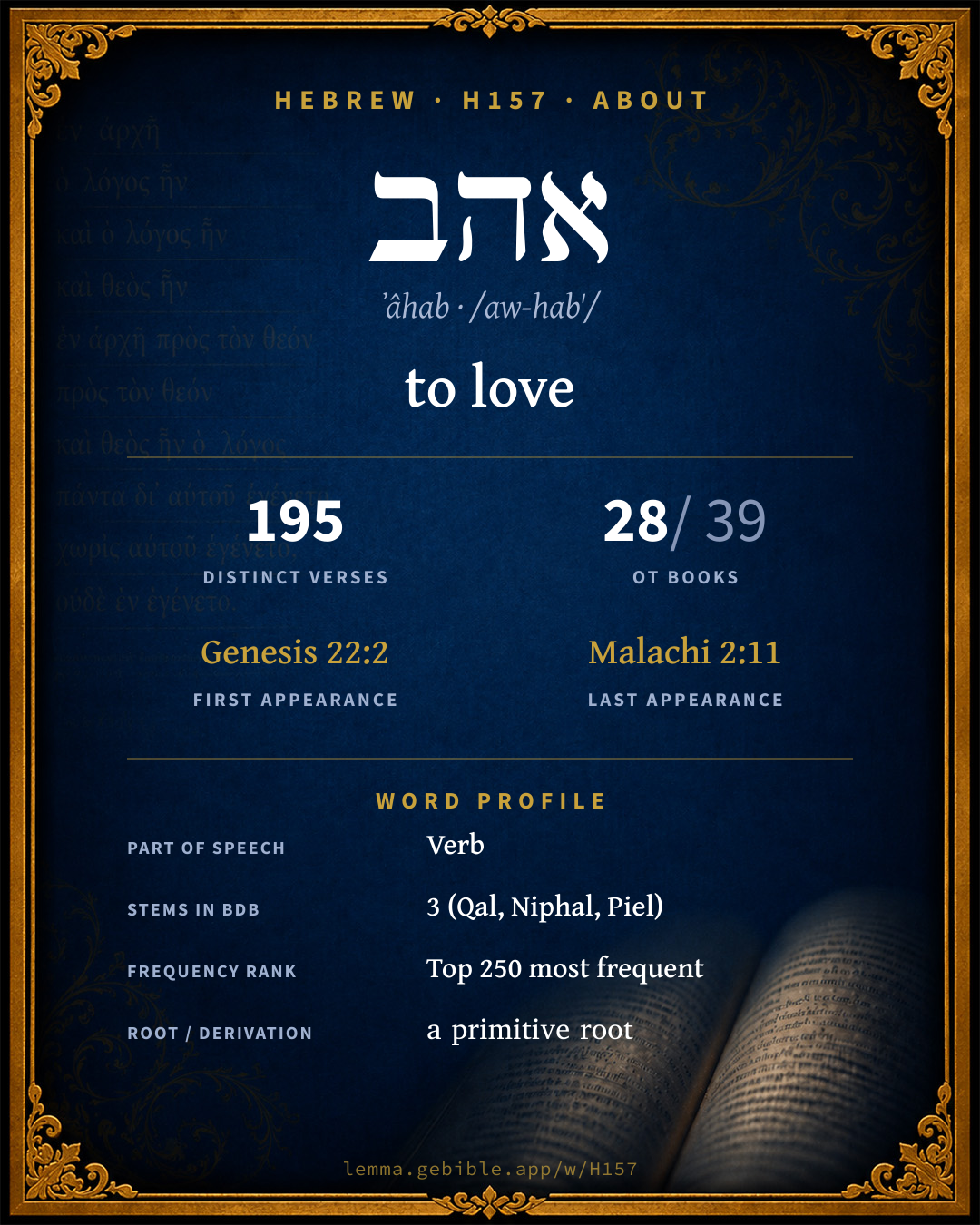
אָהֵב
to love
‘to love’ is one of 2 main senses fuller range ↓
Full lexicon entry — Brown-Driver-Briggs (BDB)
From Brown-Driver-Briggs (BDB)
Where this word appears
Grammar key — what these labels mean
Part of speech
- Verb
- An action or state-of-being word.
Noun type
- Common
- A common noun — a general class of person, place, or thing (“king,” “city,” “water”), not a specific name.
Stem
- Qal
- The basic, simple active stem — the plain form of the verb (“he wrote”). Here: ‘human love to human object’
- Piel
- An intensive or resultative active stem. Here: ‘pl. sf.’
- Niphal
- Usually the simple passive or reflexive of the Qal (“he was written”). Here: ‘pl.’
Form
- Participle Active
- A verbal adjective expressing ongoing or characteristic action (“writing / one who writes”).
- Perfect
- A completed action or state — Hebrew marks aspect (completeness) more than strict tense (“he wrote”).
- Infinitive Construct
- A bound verbal noun, frequently with prepositions (“to write / in writing”).
- Sequential Imperfect
- An imperfect with prefixed waw — the standard past-narrative form (waw-consecutive imperfect).
- Sequential Perfect
- A perfect with prefixed waw continuing a preceding imperfect or command (waw-consecutive perfect).
- Imperfect
- An incomplete, ongoing, or future action (“he will / would write”).
- Imperative
- A direct command (“write!”).
- Participle Passive
- A verbal adjective expressing action received (“written”).
- Jussive
- A third- or second-person volitional form expressing wish or command (“let him write”).
State
- Absolute
- The independent form of a noun, not bound to a following word.
- Construct
- A noun bound to a following noun in a possessive / “of” relationship (the construct chain).
Person
- 1st Person
- The speaker (“I / we”).
- 3rd Person
- The one spoken about (“he / she / it / they”).
- 2nd Person
- The one addressed (“you”).
Gender
- Masculine
- Grammatically masculine.
- Common
- Either gender — not distinguished for this form.
- Feminine
- Grammatically feminine.
Number
- Singular
- One.
- Plural
- More than one (in Hebrew, generally three or more).
Every verse where H157 appears in the Book of Proverbs — 23 distinct verses. Click any verse to open its interlinear word-by-word view. Verse text shown in the World English Bible for context — . Each verse’s Hebrew form is shown with its reference; the English is not keyword-highlighted, since the data carries no word-level English alignment. Use “Compare translations” on any verse to read it across multiple English versions. This concordance covers the Hebrew Bible; Septuagint (Greek Old Testament) occurrences are not indexed here.
Proverbs
- Proverbs 1:22 תְּֽאֵהֲב֫וּ Qal impf 2mp "How long, you simple ones, will you love simplicity? How long will mockers delight themselves in mockery, And fools hate knowledge?
- Proverbs 3:12 יֶאֱהַ֣ב Qal impf 3ms For whom Yahweh loves, he reproves; Even as a father reproves the son in whom he delights.
- Proverbs 4:6 אֱהָבֶ֥/הָ Qal impv 2ms + sfx pers 3fs Don't forsake her, and she will preserve you. Love her, and she will keep you.
- Proverbs 8:17 אהבי/ה אֹהֲבַ֣/י אֵהָ֑ב Qal ptcp.act mp cs + sfx pers 3fs Qal ptcp.act mp cs + sfx pers 1cs Qal impf 1cs I love those who love me. Those who seek me diligently will find me.
- Proverbs 8:21 אֹהֲבַ֥/י Qal ptcp.act mp cs + sfx pers 1cs That I may give wealth to those who love me. I fill their treasuries.
- Proverbs 8:36 אָ֣הֲבוּ Qal pf 3cp But he who sins against me wrongs his own soul. All those who hate me love death."
- Proverbs 9:8 וְ/יֶאֱהָבֶֽ/ךָּ conj + Qal impf 3ms + sfx pers 2ms Don't reprove a scoffer, lest he hate you. Reprove a wise man, and he will love you.
- Proverbs 12:1 אֹהֵ֣ב אֹ֣הֵֽב Qal ptcp.act ms Qal ptcp.act ms Whoever loves correction loves knowledge, But he who hates reproof is stupid.
- Proverbs 13:24 וְ֝/אֹהֲב֗/וֹ conj + Qal ptcp.act ms cs + sfx pers 3ms One who spares the rod hates his son, But one who loves him is careful to discipline him.
- Proverbs 14:20 וְ/אֹהֲבֵ֖י conj + Qal ptcp.act mp cs The poor person is shunned even by his own neighbor, But the rich person has many friends.
- Proverbs 15:9 יֶאֱהָֽב Qal impf 3ms The way of the wicked is an abomination to Yahweh, But he loves him who follows after righteousness.
- Proverbs 15:12 יֶאֱהַב Qal impf 3ms A scoffer doesn't love to be reproved; He will not go to the wise.
- Proverbs 16:13 יֶאֱהָֽב Qal impf 3ms Righteous lips are the delight of kings. They value one who speaks the truth.
- Proverbs 17:17 אֹהֵ֣ב Qal ptcp.act ms A friend loves at all times; And a brother is born for adversity.
- Proverbs 17:19 אֹ֣הֵֽב אֹהֵ֣ב Qal ptcp.act ms Qal ptcp.act ms He who loves disobedience loves strife. One who builds a high gate seeks destruction.
- Proverbs 18:21 וְ֝/אֹהֲבֶ֗י/הָ conj + Qal ptcp.act mp cs + sfx pers 3fs Death and life are in the power of the tongue; Those who love it will eat its fruit.
- Proverbs 18:24 אֹ֝הֵ֗ב Qal ptcp.act ms A man of many companions may be ruined, But there is a friend who sticks closer than a brother.
- Proverbs 19:8 אֹהֵ֣ב Qal ptcp.act ms He who gets wisdom loves his own soul. He who keeps understanding shall find good.
- Proverbs 20:13 תֶּֽאֱהַ֣ב Qal juss 2ms Don't love sleep, lest you come to poverty; Open your eyes, and you shall be satisfied with bread.
- Proverbs 21:17 אֹהֵ֣ב אֹהֵ֥ב Qal ptcp.act ms Qal ptcp.act ms He who loves pleasure shall be a poor man: He who loves wine and oil shall not be rich.
- Proverbs 22:11 אֹהֵ֥ב Qal ptcp.act ms He who loves purity of heart and speaks gracefully Is the king's friend.
- Proverbs 27:6 אוֹהֵ֑ב Qal ptcp.act ms Faithful are the wounds of a friend; Although the kisses of an enemy are profuse.
- Proverbs 29:3 אֹהֵ֣ב Qal ptcp.act ms Whoever loves wisdom brings joy to his father; But a companion of prostitutes squanders his wealth.
About this entry
At a glance — auto-summarized from this page’s data, not written by a person. Every figure links to its source below. This summary describes the numbers; it doesn’t interpret them.
אהב — transliterated ʼâhab — is a Hebrew verb carrying the sense “to love.” “loveth” is the historic King James Version rendering; modern versions use “love.” See the renderings breakdown. The Hebrew Bible uses it across 195 verses — common. Debuting at Genesis 22:2, it then recurs through the corpus. The verb spans 3 stems, from Qal to Niphal. Each statement above links to its evidence; the full detail follows below.
Gloss history
Strong's 1890 vs modern scholarship
About this word
Strong's H157 catalogs a Hebrew word from the Hebrew Old Testament.
These counts are not copied from any lexicon or concordance. They are computed here, from the morphology-tagged Hebrew Old Testament. What Lemma adds →
- 195
- distinct verses
- The word appears in 195 distinct verses.
- 28 / 39
- OT books
- The word appears in 28 of 39 Old Testament books.
- #229
- by frequency
- Top 250 most frequent Hebrew words (rank 229 of 8,640 Hebrew words by occurrence).
View all 195 occurrences in the concordance →
Most concentrated in
- Psalms 39 verses 20%
- Proverbs 23 verses 12%
- Deuteronomy 21 verses 11%
By section of the Old Testament
By traditional corpus
Conventional, traditional groupings — biblical authorship is debated, so this is a traditional corpus grouping, not an authorship claim. Each share is this word’s portion of its verses in that division of the Hebrew canon. Each figure is a share of the word’s 195 distinct verses.
- Writings (Ketuvim) 87 verses · 45%
- Prophets (Nevi'im) 69 verses · 35%
- Torah (Pentateuch) 39 verses · 20%
How translations render this word
Counts come from each version’s own published word-to-Strong’s tagging or interlinear alignment — an approximate guide to how each version renders this word, not a word-level alignment the data otherwise carries. Because each total is that version’s own tagged count, the per-version totals vary from one another and need not match the appearance or distinct-verse counts above. These counts may also differ from a printed concordance because Lemma counts each distinctly tagged rendering and does not collapse phrase taggings into a single head-word total. This is a fixed set of word-tagged versions (KJV, ASV, BSB, ULT) and does not change with the reading translation you choose elsewhere. Each version’s license is shown beside its name below (and on Sources).
- King James Version: Love 33×, Loveth 24×, Loved 17×
- American Standard Version: Love 26×, Loveth 19×, Loved 13×
- Berean Standard Bible: Love 34×, Loved 17×, Lovers 16×
- unfoldingWord Literal Text: Love 22×, Loved 15×, Lovers 15×
King James Version Public Domain
Renders H157 across 208 tagged occurrences — most commonly:
Plus other, less common renderings. Plus 49 renderings that appear only once — usually multi-word phrases or single function words the recovered tagging swept in, not distinct renderings.
American Standard Version Public Domain
Renders H157 across 205 tagged occurrences — most commonly:
Plus other, less common renderings. Plus 62 renderings that appear only once — usually multi-word phrases or single function words the recovered tagging swept in, not distinct renderings.
Berean Standard Bible Public Domain
Renders H157 across 210 tagged occurrences — most commonly:
Plus other, less common renderings. Plus 44 renderings that appear only once — usually multi-word phrases or single function words the recovered tagging swept in, not distinct renderings. Not rendered by a distinct English word in 1 further occurrence.
unfoldingWord Literal Text CC BY-SA 4.0
Renders H157 across 238 tagged occurrences — most commonly:
Plus other, less common renderings. Plus 48 renderings that appear only once — usually multi-word phrases or single function words the recovered tagging swept in, not distinct renderings.
10 senses and sub-senses in the full BDB
Hebrew verbs can shift meaning by stem (binyan): Qal is the basic action, Niphal is often passive or reflexive, Piel often intensifies or makes it factitive, and Hiphil is typically causative. The senses below are grouped under the stem BDB assigns to each.
What do BDB’s symbols mean?
BDB uses these scholarly abbreviations:
| Symbol | Meaning |
|---|---|
| 𝔊 | the Septuagint (the ancient Greek translation, LXX) |
| 𝔙 | the Vulgate (the Latin translation) |
| 𝔖 | the Syriac version (the Peshitta) |
| 𝔗 | the Targum (the Aramaic translation) |
| ψ | the Psalms |
| √ | root (the underlying root or stem) |
| ‖ | parallel passage (a synonymous or contrasted parallel) |
| † | the dagger: every passage where the word occurs is cited |
The 10 senses and sub-senses the full Brown-Driver-Briggs lexicon distinguishes for this word, in lexicon order (not ranked by frequency), with BDB’s own verbatim wording and sub-sense lettering. Shown in Hebrew script with BDB’s own scholarly abbreviations. The condensed entry is in the Lexicon Entry tab. See also the Forms in the corpus table below.
Qal
- Pf. אָהֵ֑ב Gn 27:9 + 7times; אָהֵ֥ב Gn 27:14; אָהַב Gn 37:3 + 3 times; אֲהֵֽבְךָ Dt 15:16; 3 fs. אָֽהֲבָה Ct 1:7 +, etc.; impf. יֶאֱהַב (־הָ֑ב) Pr 3:12 +; 1 s. אֵהָ֑ב Pr 8:17 (cf. Ew§ 192 d Ges§ 68.1); וָֽאֹהַ֖ב Mal 1:2; וָאֹהֲבֵהוּ Ho 11:1; אֹהֲבֵם Ho 14:5; וָאֹהֲבֵם ψ 119:167; 2 mpl. תְּאֵהֲבוּ Pr 1:22 (cf. KöI p. 394 Ges§ 63 R. 2); תֶּאֱהָ֑בוּ Zc 8:17; תֶּאֱהָבוּן ψ 4:3; Imv. אֱהַב־ Ho 3:1; אֱהָבֶהָ Pr 4:6; אֶהֱבוּ ψ 31:24 Am 5:15; אֱהָ֑בוּ Zc 8:19; inf. cstr. אֱהֹב Ec 3:8; אַהֲבָה Dt 10:12 +; אֲהֲבַת Mi 6:8 + etc.; cf. also sub n. אהבה infr.; Pt. אֹהֵב (אוֹהֵב) Dt 10:18 + 26 times; f. cstr. אֲהֻבַת Ho 3:1 is prob. active cf. BaNB 174 ff; sf. אֹהֲבִי Is 41:8 etc.; f. אֹהֶ֫בֶת Gn 25:28; אֹהַ֫בְתִּי Ho 10:11 etc.; Pt. pass. אָהוּב Ne 13:26; אֲהוּבָה Dt 21:15(×2), 16.—love (mostly c. acc., sq. לִ + obj. Lv 19:18, 34 2 Ch 19:2 (late), sq. בְּ Ec 5:9; abs. Ec 3:8 & v. infr.), (affection both pure & impure, divine & human);— e.g. Genesis 27:9
- 1. human love to human object; abs., opp. hate שָׂנֵא Ec 3:8; of love to son Gn 22:2; 25:28; 37:3, 4; 44:20 (JE) Pr 13:24; so also 2 S 13:21 𝔊 Ew Th We, cf. Dr, of Dvd’s loving Amnon; never to parent, but mother-in-law Ru 4:15; of man’s love to woman; wife Gn 24:67; 29:20, 30 (cf. v 18) 32 (JE), also Dt 21:15(×2), 16 Ju 14:16 1 S 1:5 2 Ch 11:21 Est 2:17 Ho 3:1 Ec 9:9; but also Gn 34:3 (J) Ju 16:4, 15 2 S 13:1, 4, 15 (where of carnal desire) 1 K 11:1 cf. v 2 Ho 3:1; א׳ רֵעַ loving a paramour, v. BaNB 176; woman’s love to man 1 S 18:20 (so v 28 MT, but read וְכִי כָל־יִשְׂרָאֵל אֹהֵב אֹתוֹ 𝔊 We Dr) Ct 1:3, 4, 7; 3:1, 2, 3, 4 (5 times subj. נַפְשִׁי; cf. also fig. of adulterous Judah Je 2:25 Is 57:8 Ez 16:37; of love of slave to master Ex 21:5 (JE) Dt 15:16; inferior to superior 1 S 18:22 cf. v 16; love to neighbour Lv 19:18 (וְאָהַבְתָּ לְרֵעְךָ כָּמוֹ֑ךָ), partic. to stranger Lv 19:34 (both P), Dt 10:18, 19; love of friend to friend 1 S 16:21; 18:1, 3; 20:17(×2) Jb 19:19 Pr 17:17 cf. 2 S 19:7(×2) 2 Ch 19:2; v. also Pr 9:8; 16:13 cf. 15:12; v. especially Pt. infr. e.g. Ecclesiastes 3:8
- 2. less often of appetite, obj. food, Gn 27:4, 9, 14 (JE) Ho 3:1; drink Pr 21:17; husbandry 2 Ch 26:10; cf. fig. of Ephraim Ho 10:11 sq. inf.; length of life ψ 34:13; of cupidity Ho 9:1 Is 1:23 Ec 5:9(×2); of love of sleep Pr 20:13 cf. fig. of sluggish watchmen (sq. inf.)Is 56:10; also c. obj. abstr. wisdom (personif.), knowledge, righteousness, etc. Pr 4:6; 8:17, 21; 12:1; 22:11; 29:3 Am 5:15 Mi 6:8 (inf. ‖ infinitives) Zc 8:19 cf. Pr. 19:8 קֹנֶה לֵב אֹהֵב נַפְשׁוֹ; obj. folly, evil, etc., Mi 3:2 ψ 4:3; 11:5; 52:5, 6; 109:17 Pr 1:22; 8:36 17:19(×2), cf. 18:21 Zc 8:17, w. כֵּן Je 5:3 Am 4:5†, sq. inf. Ho 12:8 Je 14:10, especially of idolatry Ho 4:18 (where del. הֵבוּ cf. KöI, p. 395) Je 8:2. e.g. Genesis 27:4
- 3. love to God Ex 20:6 (JE) elsewhere Hex only Dt 5:10; 6:5; 7:9 + 9 times Dt + Jos 22:5; 23:11; also Ju 5:31 1 K 3:3 Ne 1:5 Dn 9:4 especially in (late) ψ 31:24; 97:10; 116:1; 145:20, but usually sq. name, law, etc. of י׳ ψ 5:12; 26:8; 40:17; 69:37; 70:5; 119:47 + 11 times ψ 119; cf. Is 56:6; cf. also of love to Jerusalem Is 66:10 ψ 122:6. e.g. Exodus 20:6
- 4. especially Pt. אֹהֵב = (a) lover, La 1:2 (fig. of Jerus.); (b) friend Hiram of David 1 K 5:15, cf. Je 20:4, 6 Est 5:10, 14; 6:13 ψ 38:12 (‖ רֵעַ) so 88:19, & Pr 14:20; also 18:24; 27:6 Abr. of God Is 41:8 2 Ch 20:7. e.g. Lamentations 1:2
- 5. of divine love (a) to individual men Dt 4:37 2 S 12:24 Pr 3:12; 15:9 ψ 146:8 Ne 13:26; (b) to people Israel, etc. Dt 7:8, 13; 23:6 Ho 3:1; 9:15 11:1; 14:5 1 K 10:9 2 Ch 2:10; 9:8 Is 43:4; 48:14 Je 31:3 Mal 1:2(×3) ψ 47:5; to Jerusalem ψ 78:68; 87:2; (c) to righteousness, etc. ψ 11:7; 33:5; 37:28; 45:8; 99:4 Is 61:8 Mal 2:11. e.g. Deuteronomy 4:37
Niphal
- Pt. pl. הַנֶּאֱהָבִים 2 S 1:23 lovely, loveable of Saul & Jonath. (‖ הַנְּעִימִם). e.g. 2 Samuel 1:23
Piel
- Pt. pl. sf. מְאַהֲבַי (־בָ֑י) Ho 2:7 + 3 times; מְאַהֲבַיִךְ (־בָ֑יִךְ) Je 22:20 + 6 times; מְאַהֲבֶיהָ Ho 2:9 + 4 times e.g. Hosea 2:7
- 1. friends Zc 13:6; e.g. Zechariah 13:6
- 2. lovers in fig. of adulter. Isr. Ho 2:7, 9, 12, 14, 15 Ez 23:5, 9; Judah Je 22:20, 22; 30:14 La 1:19 Ez 16:33, 36, 37; 23:22. e.g. Hosea 2:7
Senses from the full Brown-Driver-Briggs lexicon (Brown, Driver, Briggs; Oxford 1906 — public domain), digitized via Sefaria, supplemented by the OpenScriptures HebrewLexicon (CC BY 4.0). Full attribution on Sources.
Word origin
Origin: a primitive root
Jastrow Dictionary
A second Hebrew/Aramaic lexicon for comparison, covering Aramaic and post-biblical (Talmudic, Targumic, Midrashic) usage that the biblical-Hebrew BDB does not. Matched by lemma rather than by Strong’s number, so a lemma may carry more than one Jastrow headword (shown separately below), and the entries cover usage well beyond the Bible.
אָהַב
- to love. Y. Ab. Zar. II beg. 40ᶜ אוֹהֲבָהּ her lover; a. fr. אוהב את הבריות philanthropist. Aboth I, 12; a. fr.—Part. pass. אָהוּב, f. אֲהוּבָה. Yeb. 23ᵃ א׳ בנשואיה beloved (worth loving) for her well chosen marriage. [Y. Ab. Zar. l. c. איהבתו read אוֹהַבְתֹּו.]
- , Hithpa. הִתְאָהֵב to be beloved, popular. Lev. R. s. 32, beg., these blows (of persecution) had the effect להֵאָהֵב וכ׳ to make me beloved of my Father in heaven. Yoma 86ᵃ שיהא ש"ש מִתְאָהֵב וכ׳ that the Divine Name may be beloved through thee (that thy doings may favorably reflect on thy religion).—
- to make beloved, popular. Tan. d’be El. I, 28 תהא מְאָהֵב ש"ש וכ׳ make the Divine Name &c. (v. supra).—Part. Pu. מְאוּהָב popular. Yalk. Deut. 837.—Cant. R. to I, 1 להַאֲהִיבָן (לאָהֲבָן) לקרבן וכ׳ to make them beloved (of God), draw them nigh (to God) &c. Ib. to V, 1.—Yalk. Cant. 981 הֶאֱהַבְנוּ לך עלמות הרבה we have made many maiden beloved of thee (converted them).
A Dictionary of the Targumim, the Talmud Babli and Yerushalmi, and the Midrashic Literature (Marcus Jastrow; London, Luzac, 1903) — Public Domain. Digitized via Sefaria. Digitized via Sefaria. Full attribution on Sources.
Forms in the corpus
The 158 distinct written forms H157 takes in the Hebrew Bible, most frequent first — each parse links to that stem’s occurrences in the concordance. Hebrew forms include their vowel points and cantillation, so a single lemma takes many written forms.
The 60 most common forms are shown; 98 rarer forms follow in the full concordance.
Same root — word family
Other BDB entries built from the same root as H157, grouped by Strong’s listed origin. These share a root / origin per the lexicon — not necessarily a shared meaning. Each links to that word’s own entry.
Derived from this word
Compare all same-root words → They share a root, not necessarily a meaning.
Septuagint verse parallels
This word appears in 167 verses that also exist in the Greek Old Testament (Septuagint), out of the 195 Hebrew verses it occurs in. You can read those verses in Greek by switching the Old Testament edition to the Septuagint.
Read these verses in the Septuagint
- Genesis 22:2
- Exodus 20:6
- Leviticus 19:18
- Deuteronomy 4:37
- Joshua 22:5
- Judges 5:31
- Ruth 4:15
- 1 Samuel 1:5
- 2 Samuel 1:23
- 1 Kings 3:3
- 2 Chronicles 11:21
- Esther 2:17
This is a verse-level parallel only — the same verses exist in both the Hebrew and Greek Old Testaments. No word-level Hebrew↔Greek correspondence is claimed: the data carries no such alignment, so no Greek word is shown as this Hebrew word’s translation. Coverage is not total — the Septuagint omits the deuterocanon and renumbers the Psalms, so some Hebrew verses have no direct Greek parallel.