
Psalms 146:8

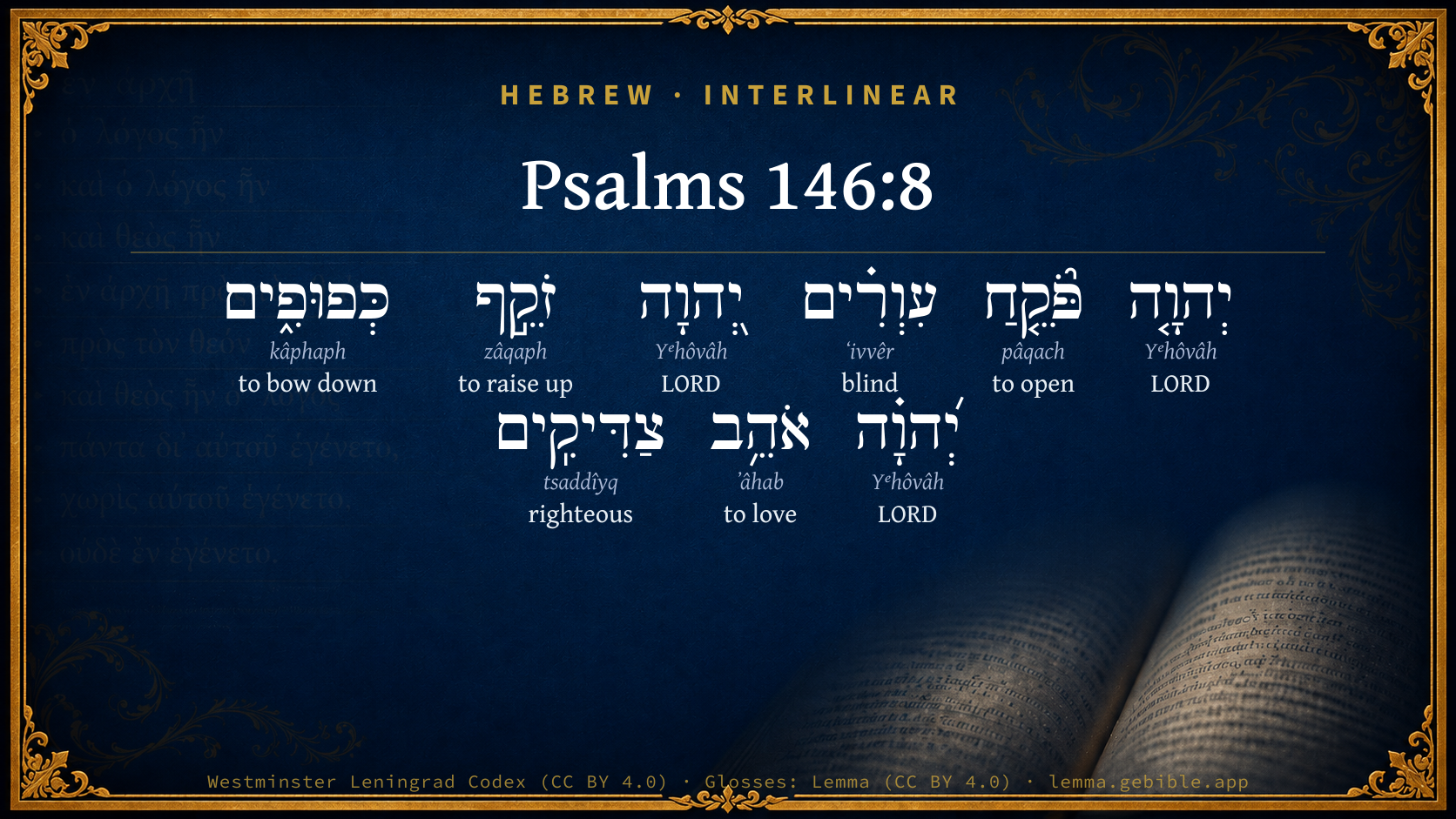
Hebrew (Westminster Leningrad Codex) Psalms 146:8 appears in the Hebrew Old Testament. The text above is from the Westminster Leningrad Codex. Each word links to its Strong’s number, a concise gloss, and parsing drawn from the Open Scriptures Hebrew Bible morphology. Click any word for its full Brown-Driver-Briggs (BDB) entry.
Download image
Cite this verse

Psalms 146:8 (World English Bible). Public Domain. Lemma interlinear Bible study tool, https://lemma.gebible.app/v/psalms/146/8.

Show BibTeX & RIS
BibTeX
RIS
English Translation
Yahweh opens the eyes of the blind. Yahweh raises up those who are bowed down. Yahweh loves the righteous.
World English Bible · Public Domain
Download a study sheet

One document with this verse’s original text, its word-by-word gloss line, the meaning frame, cross-references with their text, attributed commentary, and full source and license credits — printable, and it pastes into notes with its structure intact.

This verse Autodidact and up

Study sheet (.html) Plain text (.txt)

A passage Seminary Student

Up to 50 verses in one chapter. A passage sheet keeps up to 6 commentary sources and 12 cross-references per verse, in the order this page ranks them, and says so on the sheet whenever that leaves anything out. Ask for a single verse and you get the Autodidact verse sheet above.

Everything on this page stays free to read, with no account — the sheet is a download of what is already on screen, not access to it.

Want to remove ads? Support Godless Engineer
Compare translations 3

The same verse in 3 English versions, stacked beneath the original-language interlinear above. Click any original word for its lexicon entry.

Each is an independent rendering of the whole verse — the interlinear is not word-aligned to these translations.

Highlighted words mark where these versions differ — a whole-verse word diff, not a word-by-word alignment.

  • World English Bible Public Domain
    Yahweh opens the eyes of the blind. Yahweh raises up those who are bowed down. Yahweh loves the righteous.
  • King James Version Public Domain
    The LORD openeth the eyes of the blind: the LORD raiseth them that are bowed down: the LORD loveth the righteous:
  • unfoldingWord Literal Text CC BY-SA 4.0
    Yahweh is opening the blind; Yahweh is raising up the one bowed down; Yahweh is loving the righteous.

unfoldingWord Literal Text — © unfoldingWord, licensed CC BY-SA 4.0. Word-aligned USFM3 via Door43 (git.door43.org/unfoldingWord/en_ult).

Versions to compare (up to 4)

3 of 4 selected

Show all 18 translations

Every available English version of this verse, each an independent rendering of the whole verse.

  • World English Bible Public Domain
    Yahweh opens the eyes of the blind. Yahweh raises up those who are bowed down. Yahweh loves the righteous.
  • Berean Standard Bible Public Domain
    the LORD opens the eyes of the blind, the LORD lifts those who are weighed down, the LORD loves the righteous.
  • Majority Standard Bible Public Domain
    the LORD opens the eyes of the blind, the LORD lifts those who are weighed down, the LORD loves the righteous.
  • King James Version Public Domain
    The LORD openeth the eyes of the blind: the LORD raiseth them that are bowed down: the LORD loveth the righteous:
  • American Standard Version (1901) Public Domain
    Jehovah openeth `the eyes of' the blind; Jehovah raiseth up them that are bowed down; Jehovah loveth the righteous;
  • Revised Version (1885) Public Domain
    The LORD openeth the eyes of the blind; the LORD raiseth up them that are bowed down; the LORD loveth the righteous;
  • Geneva Bible (1599) Public Domain
    The Lord giueth sight to the blinde: the Lord rayseth vp the crooked: the Lord loueth the righteous.
  • Douay-Rheims (1899) Public Domain
    The Lord is gracious and merciful: patient and plenteous in mercy.
  • Young's Literal Translation Public Domain
    Jehovah is loosing the prisoners, Jehovah is opening (the eyes of) the blind, Jehovah is raising the bowed down, Jehovah is loving the righteous,
  • Literal Standard Version CC BY-SA 4.0
    YHWH is loosing the prisoners, || YHWH is opening (the eyes of) the blind, || YHWH is raising the bowed down, || YHWH is loving the righteous,
  • Unlocked Literal Bible CC BY-SA 4.0
    Yahweh opens the eyes of the blind; Yahweh raises up those who are bowed down; Yahweh loves the righteous people.
  • unfoldingWord Literal Text CC BY-SA 4.0
    Yahweh is opening the blind; Yahweh is raising up the one bowed down; Yahweh is loving the righteous.
  • Darby Bible Public Domain
    Jehovah openeth [the eyes of] the blind; Jehovah raiseth up them that are bowed down; Jehovah loveth the righteous;
  • World Messianic Bible Public Domain
    The LORD opens the eyes of the blind. The LORD raises up those who are bowed down. The LORD loves the righteous.
  • Webster's Bible Public Domain
    The LORD openeth the eyes of the blind: the LORD raiseth them that are bowed down: the LORD loveth the righteous:
  • Free Bible Version CC BY-SA 4.0
    The Lord makes the blind see. The Lord lifts up those who are bowed down. The Lord loves those who do what's right.
  • Bible in Basic English Public Domain
    The Lord makes open the eyes of the blind; the Lord is the lifter up of those who are bent down; the Lord is a lover of the upright;
  • JPS Tanakh (1917) Public Domain
    The LORD openeth the eyes of the blind; the LORD raiseth up them that are bowed down; the LORD loveth the righteous;

Literal Standard Version (2020), Covenant Press — licensed CC BY-SA 4.0. Text via the HelloAO Bible API (eBible.org). Unlocked Literal Bible (unfoldingWord) — licensed CC BY-SA 4.0. Text via the HelloAO Bible API (eBible.org). unfoldingWord Literal Text — © unfoldingWord, licensed CC BY-SA 4.0. Word-aligned USFM3 via Door43 (git.door43.org/unfoldingWord/en_ult). Free Bible Version, Dr. Jonathan Gallagher — licensed CC BY-SA 4.0. Text via the HelloAO Bible API (eBible.org).

Word by word

More ways to search: Search by grammar → Find every occurrence → Compare this word →

Practice this passage: Drill this verse → Learn its vocabulary →

About this verse

These counts appear in no published source. They are computed here, from the morphology-tagged text and Lemma’s own curated glosses. What Lemma adds →

9
words
7
distinct lemmas
Wisdom
section

Notable vocabulary

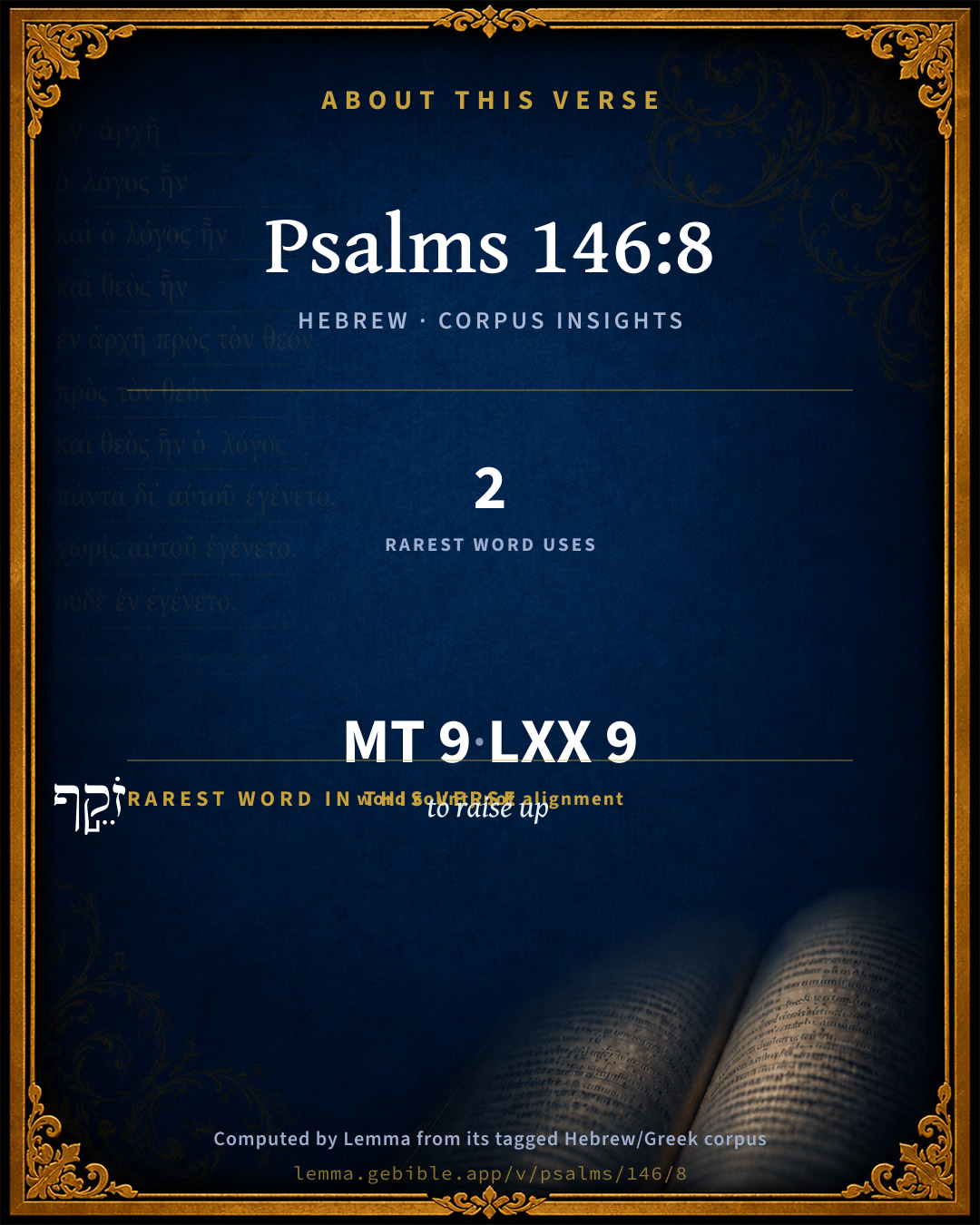
The rarest word here is זֹקֵ֣ף to raise up H2210 — appearing just 2 times in the whole Hebrew Bible.

Shared distinctive vocabulary

זֹקֵ֣ף to raise up H2210 occurs in 2 verses of the Hebrew Bible. Also found in:

Grammatical profile

  • 4 verbs
  • 3 nouns
  • 2 adjectives

Verb forms

  • פֹּ֘קֵ֤חַ Qal · Participle Active
  • זֹקֵ֣ף Qal · Participle Active
  • כְּפוּפִ֑ים Qal · Participle Passive
  • אֹהֵ֥ב Qal · Participle Active

Repetition

A word recurs within this verse — often emphatic in Hebrew:

  • יְהוָ֤ה LORD H3068 ×3

Hebrew & Septuagint length

In English translation the verse runs 19 words from the Hebrew and 24 from the Septuagint (LXX English) — closely comparable.

A rough comparison of the two English renderings, which tokenize alike — not a word-level alignment.

Word counts can differ between the Hebrew and the Greek without any difference in meaning — e.g. the Hebrew direct-object marker אֵת has no separate Greek word, and Greek often adds the article ὁ.

In the original languages it is 9 Hebrew tokens and 9 Greek tokens — but the two are counted differently (Hebrew bundles its prefixes and suffixes into one token; the Greek is in lemma form), so that isn’t a like-for-like length.

Cross-references

18

Topical passages linked to Psalms 146:8 in the Treasury of Scripture Knowledge — connected by theme and wording, ordered by reader-vote popularity; previews shown in the World English Bible.

  • Psalms 11:7 For Yahweh is righteous. He loves righteousness. The upright shall see his face.
  • Psalms 145:14 Yahweh upholds all who fall, And raises up all those who are bowed down.
  • Matthew 9:30 Their eyes were opened. Jesus strictly charged them, saying, "See that no one knows about this."
  • Acts 26:18 to open their eyes, that they may turn from darkness to light and from the power of Satan to God, that they may receive remission of sins and an inheritance among those who are sanctified by faith in me.'
  • Isaiah 35:5 Then the eyes of the blind shall be opened, and the ears of the deaf shall be unstopped.
  • Ephesians 1:18 having the eyes of your hearts enlightened, that you may know what is the hope of his calling, and what are the riches of the glory of his inheritance in the saints,
  • Matthew 11:5 the blind receive their sight, the lame walk, the lepers are cleansed, the deaf hear, the dead are raised up, and the poor have good news preached to them.
  • Luke 13:11–13 Behold, there was a woman who had a spirit of infirmity eighteen years, and she was bent over, and could in no way straighten herself up.
  • John 16:27 for the Father himself loves you, because you have loved me, and have believed that I came forth from God.
  • 2 Corinthians 7:6 Nevertheless, he who comforts the lowly, God, comforted us by the coming of Titus;
  • Psalms 147:6 Yahweh upholds the humble. He brings the wicked down to the ground.
  • Isaiah 42:16 I will bring the blind by a way that they don't know; in paths that they don't know will I lead them; I will make darkness light before them, and crooked places straight. These things will I do, and I will not forsake them.
  • 1 Peter 2:9 But you are a chosen race, a royal priesthood, a holy nation, a people for God's own possession, that you may show forth the excellencies of him who called you out of darkness into his marvelous light:
  • Deuteronomy 33:3 Yes, he loves the people; All his saints are in your hand: They sat down at your feet; [Everyone] shall receive of your words.
  • John 14:21–23 One who has my commandments, and keeps them, that person is one who loves me. One who loves me will be loved by my Father, and I will love him, and will reveal myself to him."
  • Isaiah 42:18 Hear, you deaf; and look, you blind, that you may see.
  • John 9:7–33 and said to him, "Go, wash in the pool of Siloam" (which means "Sent"). So he went away, washed, and came back seeing.
  • Luke 18:41–42 "What do you want me to do?" He said, "Lord, that I may see again."

Cross-references courtesy of OpenBible.info (CC BY 4.0).

Hebrew and Greek witnesses Masoretic Hebrew ↔ Greek Septuagint

The same verse in the two great witnesses to the Old Testament, shown verse-for-verse.

You’re reading Greek Psalm 145 (Hebrew Psalm 146). The Septuagint counts the superscription, so verse numbers can differ from the Hebrew — chapter-level alignment, not verse-by-verse. Numbering follows Rahlfs.

These are two independent witnesses, not word-aligned to each other, and the Septuagint is shown in lemma (dictionary) form.

Hebrew Psalms 146:8 Masoretic · Westminster Leningrad Codex

יְהוָ֤ה פֹּ֘קֵ֤חַ עִוְרִ֗ים יְ֭הוָה זֹקֵ֣ף כְּפוּפִ֑ים יְ֝הוָ֗ה אֹהֵ֥ב צַדִּיקִֽים

Yahweh opens the eyes of the blind. Yahweh raises up those who are bowed down. Yahweh loves the righteous.

World English Bible · Public Domain

Greek LXX Greek Psalm 145:8 Septuagint · lemma form

κύριος ἀναὀρθόω καταῥήγνυμι κύριος σοφός τυφλός κύριος ἀγαπάω δίκαιος

the Lord gives wisdom to the blind: The Lord sets up the broken down: the Lord loves the righteous: the Lord preserves the strangers;

LXX2012 (modern English Septuagint) · Public Domain

Hebrew: Westminster Leningrad Codex (CC BY 4.0). Greek: Septuagint (public domain); English from LXX2012 (modern English Septuagint) (Public Domain). How the Septuagint differs from the Hebrew →

Commentary

Notes on Psalms 146:8 from classic Christian and Jewish commentators (each source and its license shown beneath its notes). The classic Christian expositions comment on the surrounding passage and are grouped to its opening verse, so a note may address several verses; the Jewish commentaries on the Tanakh (Rashi and others) are per-verse, so they appear only where the commentator wrote on this verse.

Lemma curates 59 commentaries, every one of them public domain or Creative Commons licensed, each selected and text-cleaned for this edition rather than reprinted as found. About our sources →

Trapp's Complete Commentary

John Trapp

Psa 146:8 The LORD openeth [the eyes of] the blind: the LORD raiseth them that are bowed down: the LORD loveth the righteous:

Ver. 8. The Lord openeth the eyes] Both of body and mind, as in the Gospel. As for those miracles, which Tacitus and Suetonius attribute to Vespasian (as that he made a blind man see with spittle, healed another that was lame, and another that had a dry hand, by treading upon it), they are the miracles of Christ, which those profane authors would cast upon their emperor. Tacitus writeth that the blind man said to Vespasian that the god Serapis sent him to him. Now, the Paynims did think that the Christians did worship Serapis, as appeareth by the Epistle of Adrian, the emperor, to Severianus, the consul, that in the town of Alexandria they that worshipped Serapis were Christians, &c.

The Lord raiseth, &c.] As he did that daughter of Abraham in the Gospel, whom Satan had bound and bowed down twelve years, Luk 13:16, and as he doth still, Isa 61:1.

The Lord loveth the righteous] And this is more than all the rest. God dispenseth outward blessings, but not always in love.

John Trapp, A Commentary or Exposition upon All the Books of the Old and New Testament (1647–1656) — public domain. Text from a community e-Sword module.

J. A. Alexander on Psalms

Joseph Addison Alexander

8. (Psa 146:8) Jehovah opens (the eyes of) the blind; Jehovah raises up the bowed down; Jehovah loves the righteous. The ellipsis in the first clause is not so harsh in Hebrew as in English, because the verb is almost confined, in usage, to the eyes, and would at once suggest them to a Hebrew reader. All the verbs are of the participial form, opening, raising, loving, i. e. continually doing so. The first clause is applicable both to bodily and mental blindness. Compare Deu 28:29, Isa 59:10, Job 12:25. The second clause is borrowed from Psa 145:14.

Joseph Addison Alexander, The Psalms Translated and Explained (1850) — public domain. Text from a community e-Sword module.

Tyndale Open Study Notes

Tyndale Open Resources

146:8-9 The fourfold repetition of the name of the Lord emphasizes that only he heals, unburdens, loves, and protects.

Tyndale Open Study Notes — © Tyndale Open Resources, licensed CC BY-SA 4.0. Text via the HelloAO Bible API.

Geneva Bible (1599)

Geneva Bible translators

Though he visit them by affliction, hunger, imprisonment and such like, yet his fatherly love and pity never faileth them, yea, rather to his these are signs of his love.

Geneva Bible (1599) marginal notes — public domain. Text via Bolls.life.

Adam Clarke's Commentary

Verse 8. Openeth the eyes of the blind] He brings us out of our prison-house, from the shadow of death, and opens our eyes that we may behold the free light of the day. And it is the Lord only that can open the eyes of any son of Adam, and give him to see his wretchedness, and where help and salvation may be found.

Raiseth them that are bowed down] Through a sense of their guilt and sinfulness.

The Lord loveth the righteous] These he makes partakers of a Divine nature; and he loves those who bear his own image.

Adam Clarke's Commentary on the Bible (1810–1826) — public domain. Text from a community e-Sword/MySword module.

Ellicott's Commentary for English Readers

(8) Openeth.—Here, and through the verse, the verbs are participles. The elliptical “open the blind” is easily understood.

Blindness is sometimes figurative of distress and helplessness (Deu_28:29; Isa_59:9, &c), sometimes of want of mental or spiritual discernment, as Isa_29:18; Isa_42:7, &c. Here, most probably, the former.

Raiseth.—See Psa_145:14.

A Bible Commentary for English Readers, edited by Charles John Ellicott (1878–1897) — public domain. Text from a community e-Sword module.

The Cambridge Bible for Schools and Colleges

gen. ed. J. J. S. Perowne

8. Blindness is a figure for moral and spiritual ignorance and insensibility, and helplessness in general. Cp. Isa_29:18; Isa_35:5; Deu_28:19; Job_12:25; Isa_59:9-10.

raiseth up them that are bowed down] As Psa_145:14.

loveth] And therefore, as P.B.V., careth for them. But is not this an accidental mistake, introduced into the Great Bible of 1540? Coverdale (1535) and the Great Bible of 1539 have loveth.

The Cambridge Bible for Schools and Colleges (gen. ed. J. J. S. Perowne; Cambridge University Press, 1878–1918) — public domain. Text from a community e-Sword module.

John Gill's Exposition

The Lord openeth the eyes of the blind,.... Who are corporeally blind; the eyes of many such were opened by Christ when here on earth, and one who was born blind; and such who are spiritually blind as to any knowledge of divine things, of God in Christ, of the way of life and salvation by Christ, of the Spirit and his operations, of their state and condition by nature, or of the things of the Gospel; the eyes of many such he opens so as to see their sin and danger, their want of righteousness, and need of Christ, and salvation by him; this is usually done by means of the ministry of the word, which is as an eye salve; but the work is Christ's, and a work of almighty power it is; see Isa 35:4;

the Lord raiseth them that are bowed down; as he did in a literal sense the poor woman that was bowed together, Luk 13:11, and as he does in a spiritual sense such as are heavy laden with sin, and pressed with the burden of it; that are depressed with Satan's temptations, and labour under sore afflictions and exercises; all which he supports his people under, and delivers them out of; and cheers and refreshes their souls with discoveries of his love and grace unto them; see Psa 145:14;

the Lord loveth the righteous; not self-righteous persons; these are not loved by God the Father, who preferred a publican to one of them; nor by Christ, who came not to call them to repentance; nor by the Spirit, who reproves and convinces men of self-righteousness; nor by angels, who rejoice at one sinner that repents more than over ninety and nine just persons who in their own opinion need no repentance: but such who are righteous through Christ's righteousness imputed to them, and there are none righteous in any other way; and these Christ loves, not for any righteousness in them, or done by them; nor does his love flow from his own righteousness upon them, for he loved them from all eternity; and his engaging and undertaking to work out a righteousness for them, and the bringing in of that righteousness, were the fruits and effects of his love to them, and evidences of it; he suffered for them when they were in themselves unjust; he died for them when sinners, ungodly, and enemies; nevertheless, as they are clothed with his perfect righteousness, and are introduced unto him and presented before him in this raiment of needle work, this clothing of wrought gold, this fine linen clean and white; he takes delight and pleasure in them, and they appear a glorious church, without spot or wrinkle, or any such thing.

John Gill's Exposition of the Whole Bible (1746–1763) — public domain (CC PDM 1.0). Text via the HelloAO Bible API.

Albert Barnes' Notes on the Bible

The Lord openeth the eyes of the blind - This is the sixth reason for what is stated as to the blessedness of those who put their trust in the Lord. The language here would be applicable to bodily or to mental blindness. Compare the notes at Psa 119:18 : “Open thou mine eyes, that I may behold wondrous things out of thy law.” See also the notes at Isa 35:5 : “Then the eyes of the blind shall be opened.”

The Lord raiseth them that are bowed down - This is the seventh reason why they are happy who trust in the Lord. It is that those who are crushed and bowed down under the weight of care, trouble, and calamity, are raised up by him, or are sustained and comforted. See the notes at Psa 145:14 : “The Lord upholdeth all that fall, and raiseth up all those that be bowed down.”

The Lord loveth the righteous - This is the eighth reason why those who trust in the Lord are happy. It is a characteristic of God, and a foundation for praise, that he loves those who obey law; who do that which is right.

Albert Barnes' Notes on the Bible (1834–1885) — public domain. Text from a community e-Sword/MySword module.

Matthew Poole's English Annotations

The eyes of the blind; either,

1. The eyes of their mind, which he enlightens and directs in doubtful and difficult causes; or,

2. Their bodily eyes, which he did abundantly by his Son Jesus Christ.

Loveth the righteous, even when he doth afflict them, which also he doth out of love, Heb 12:6.

Matthew Poole's English Annotations on the Holy Bible (1683–1685) — public domain. Text from a community e-Sword/MySword module.

The Treasury of David

Charles H. Spurgeon

Ver. 8. The LORD openeth the eyes of the blind. Jesus did this very frequently, and hereby proved himself to be Jehovah. He who made the eye can open it, and when he does so it is to his glory. How often is the mental eye closed in moral night! And who can remove this dreary effect of the fall but the Almighty God This miracle of grace he has performed in myriads of cases, and it is in each case a theme for loftiest praise.

The Lord raiseth them that are bowed down. This also Jesus did literally, thus doing the work peculiar to God. Jehovah consoles the bereaved, cheers the defeated, solaces the despondent, comforts the despairing. Let those who are bowed to the ground appeal to him, and he will speedily upraise them.

The LORD loveth the righteous. He gives to them the love of complacency, communion, and reward. Bad kings affect the licentious, but Jehovah makes the upright to be his favoured ones. This is greatly to his glory. Let those who enjoy the inestimable privilege of his love magnify his name with enthusiastic delight. Loved ones, you must never be absent from the choir! You must never pause from his praise whose infinite love has made you what you are.

Ver. 8. Openeth the eyes of the blind. Literally, "openeth the blind" i.e., maketh them to see. The expression may be used figuratively, as a remedy applied either to physical helplessness, as De 28:29 Isa 59:9-10 Job 12:25 or to spiritual want of discernment, as Isa 29:18 42:7, 18 43:8. Here the context favours the former. J.J. Stewart Perowne.

Ver. 8. The LORD openeth the eyes of the blind. The Hebrew does not mention the eyes of the blind. Hilary renders it sapientificat. The Arabic version follows the same. Jehovah by his wisdom illumines dark minds. It is mental blindness which is the common affliction of men. John Lorinus.

Ver. 8. The blind. The large number of blind persons to be seen feeling their way along the streets in Cairo and Alexandria has been noticed by Volney. "Walking in the streets of Cairo", he says, "out of a hundred persons whom I met, there were often twenty blind, eighteen one eyed, and twenty others with eyes red, purulent, or spotted. Almost every one wears bandages, indicating that they either have or are recovering from ophthalmia." Ophthalmia is, in fact, one of the scourges of Egypt, as all physicians know. Its prevalence must be attributed in a great degree to the sand which the wind blows into the eyes; but one can understand how in Oriental countries in general the excessive heat of the sun must make blindness much commoner than it is with us.

It is not therefore surprising to any one who knows the East to find the blind so often mentioned in the gospel history, and to meet in Scripture with so many allusions to this infirmity. Of the twelve maledictions of the Levites there is one against him "who maketh the blind to go out of the way": De 27:18. "The spirit of God hath anointed me", said Jesus, quoting from Isaiah, "to preach the gospel to the poor, and recovery of sight to the blind": Lu 4:19. "The Lord", says David, "setteth at liberty them that are bound; the Lord giveth sight to the blind." Felix Bovet (1824), in "Egypt, Palestine, and Phoenicia",

1882.

Ver. 8. (first clause). Spiritual blindness, its curse, cause, and cure.

Ver. 8. (second clause). Who are the people? Who raises them? How he does it. And what then?

Ver. 8. (third clause). God's love to the righteous.

1. He made them righteous.

2. They are like him.

3. They love him.

4. Their purposes are one with his own.

Psalms 146:9*

Charles H. Spurgeon's The Treasury of David (1869–1885) — public domain. Psalms only. Text from a community e-Sword/MySword module.

The Pulpit Commentary

The Lord openeth the eyes of the blind. (comp. Isa_35:5) The spiritually blind would seem to be meant, rather than the physically blind, since there is no record of any restoration of physical sight in the Old Testament. The Lord raiseth them that are bowed down. (see Psa_145:14) "Bowed down," i.e., under the hand of oppressors. The Lord loveth the righteous. This lies at the root of all, and shows that the various deliverances spoken of in vers. 7-9 are to be understood as deliverances of the righteous out of their troubles.

The Pulpit Commentary (1880–1919), ed. H.D.M. Spence-Jones & Joseph S. Exell — public domain. Text from a community e-Sword module.

Ibn Ezra

Rabbi Abraham ibn Ezra

"God" - See here that the meaning is [that] it is not appropriate that a man lean on another man and if a man is to be strengthened from him, [it should be that] he leans on him in his prayer to God(i.e. the man is a conduit for salvation which is requested in prayer to God), and so too if he is hungry or he is imprisoned [he will be saved], and so too if he gets an affliction of the eyes, or he was continually forced to stay in bed [because of sickness], he should not lean on a doctor.

And the meaning of "God loves the righteous" is that he will guard them and they will not be oppressed or hungry or bound or blind or coerced.

Ibn Ezra on the Tanakh — English translations: “Sefaria Community Translation” (CC0 1.0 (public-domain dedication)); “Yalkut, Sifsei Chachomim Chumash, Metsudah Publications, 2009” (CC BY 4.0); and “Commentary of Ibn Ezra on Isaiah - trans. by M. Friedlander, 1873” (public domain). Text via Sefaria.

Lesson kit

Teaching starters — assembled from the data on this page, not authored interpretation. Every prompt links to the verse data it draws on. Edit before teaching.

Psalms, in the Wisdom, opens this verse with 9 words (7 distinct Hebrew lemmas). Its most distinctive word is zâqaph (“to raise up”). A historical commentator’s framing appears above. Read the whole chapter for the surrounding context.

Discussion questions

  1. The word zâqaph carries the sense “to raise up.” How does it shape the verse?
  2. How does Psalms 145:14, which shares the word «to raise up», read alongside this verse?
  3. What does the repetition of “LORD” (3× in this one verse) do in this verse?
  4. These translations render this verse differently. What is at stake in choosing one wording over another?
  5. «פֹּ֘קֵ֤חַ» is a Qal Participle Active verb. How does that grammatical form shape the action described?
  6. Compare how Trapp's Complete Commentary and J. A. Alexander on Psalms read this verse. Where do they agree or differ?

Things to notice

Reading settings

Reading text

Shown beneath each verse's original-language words.

Old Testament
Old Testament edition

Read the OT as the Masoretic Hebrew (MT) or the Greek Septuagint (LXX).

English shown for the Greek Septuagint (in the Hebrew ↔ Greek comparison).

Comparing translations? Open the Compare panel on any verse page to stack up to four side by side.