
Hosea 2:13

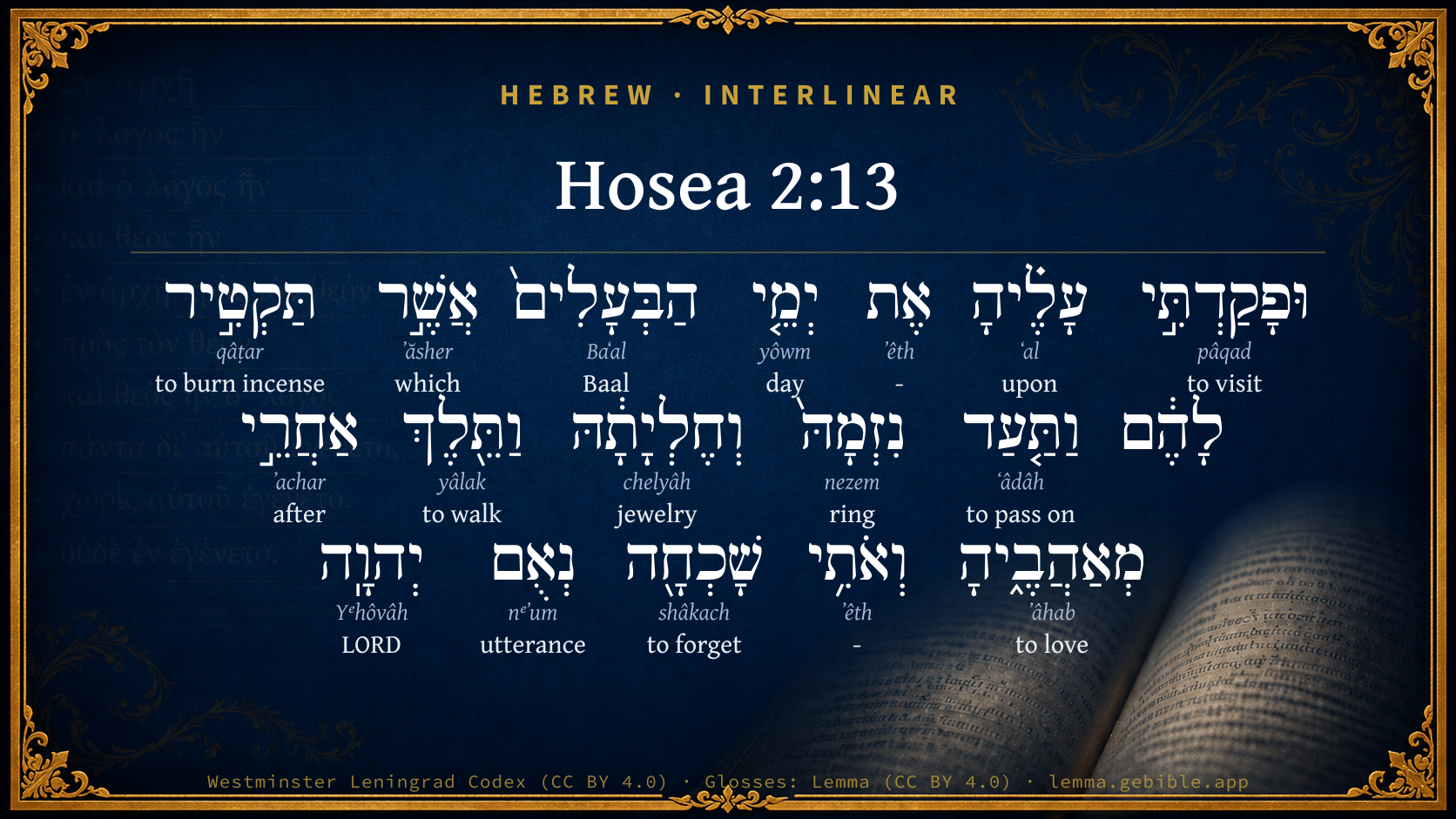
Hebrew (Westminster Leningrad Codex) Hosea 2:13 appears in the Hebrew Old Testament. The text above is from the Westminster Leningrad Codex. Each word links to its Strong’s number, a concise gloss, and parsing drawn from the Open Scriptures Hebrew Bible morphology. Click any word for its full Brown-Driver-Briggs (BDB) entry.
Download image
Cite this verse

Hosea 2:13 (World English Bible). Public Domain. Lemma interlinear Bible study tool, https://lemma.gebible.app/v/hosea/2/13.

Show BibTeX & RIS
BibTeX
RIS
English Translation
I will visit on her the days of the Baals, To which she burned incense, When she decked herself with her earrings and her jewels, And went after her lovers, And forgot me," says Yahweh.
World English Bible · Public Domain
Highlights
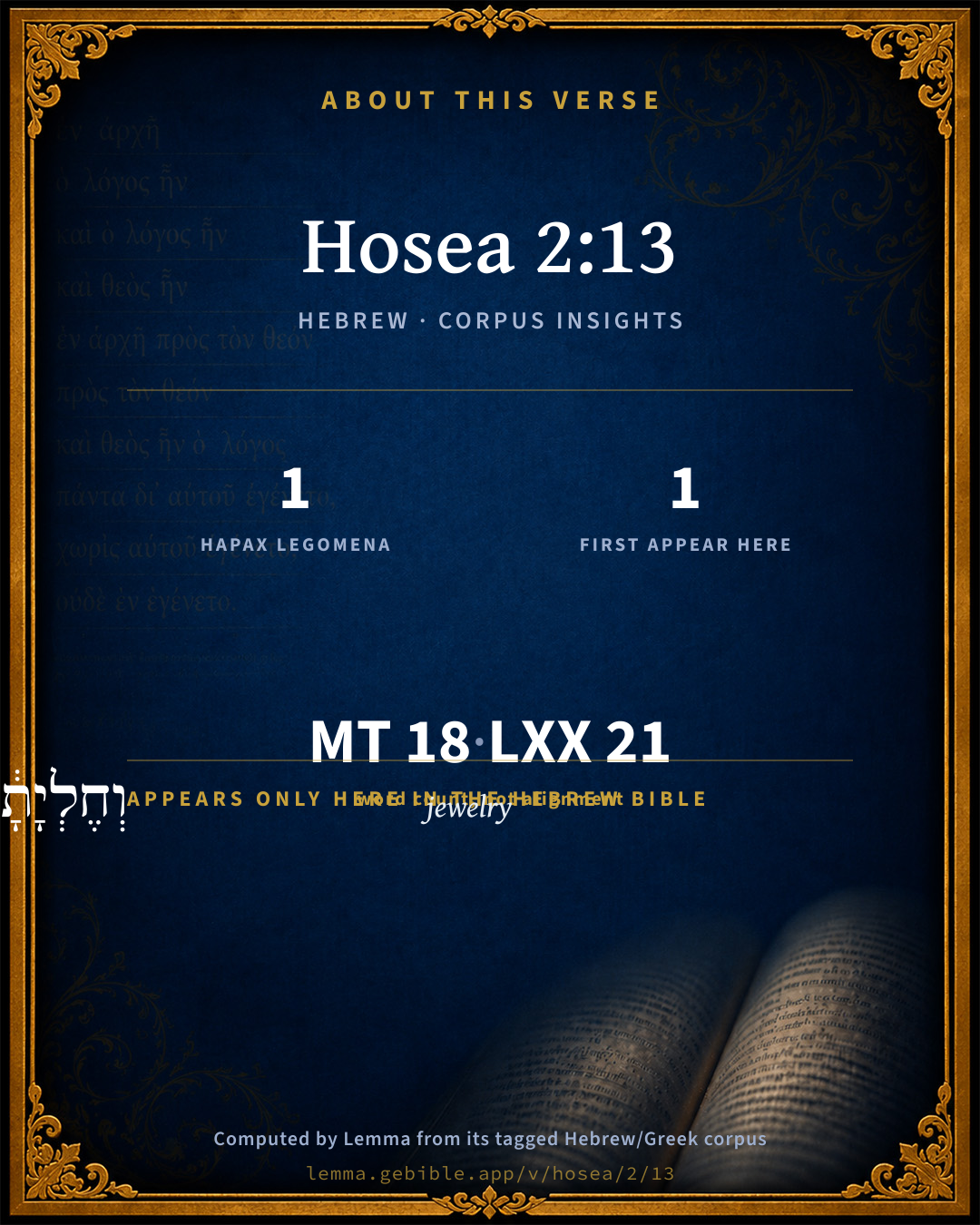
  • 1 hapax legomenon — only here in the Hebrew Bible
  • 1 first appearance in the Hebrew Bible
Full analysis ↓
Download a study sheet

One document with this verse’s original text, its word-by-word gloss line, the meaning frame, cross-references with their text, attributed commentary, and full source and license credits — printable, and it pastes into notes with its structure intact.

This verse Autodidact and up

Study sheet (.html) Plain text (.txt)

A passage Seminary Student

Up to 50 verses in one chapter. A passage sheet keeps up to 6 commentary sources and 12 cross-references per verse, in the order this page ranks them, and says so on the sheet whenever that leaves anything out. Ask for a single verse and you get the Autodidact verse sheet above.

Everything on this page stays free to read, with no account — the sheet is a download of what is already on screen, not access to it.

Want to remove ads? Support Godless Engineer
Compare translations 3

The same verse in 3 English versions, stacked beneath the original-language interlinear above. Click any original word for its lexicon entry.

Each is an independent rendering of the whole verse — the interlinear is not word-aligned to these translations.

Highlighted words mark where these versions differ — a whole-verse word diff, not a word-by-word alignment.

  • World English Bible Public Domain
    I will visit on her the days of the Baals, To which she burned incense, When she decked herself with her earrings and her jewels, And went after her lovers, And forgot me," says Yahweh.
  • King James Version Public Domain
    And I will visit upon her the days of Baalim, wherein she burned incense to them, and she decked herself with her earrings and her jewels, and she went after her lovers, and forgat me, saith the LORD.
  • unfoldingWord Literal Text CC BY-SA 4.0
    And I will visit on her the days of the Baals, in which she burned to them, and she put on her ring and her jewelry, and she went after her lovers, but me she forgot. —the declaration of Yahweh.

unfoldingWord Literal Text — © unfoldingWord, licensed CC BY-SA 4.0. Word-aligned USFM3 via Door43 (git.door43.org/unfoldingWord/en_ult).

Versions to compare (up to 4)

3 of 4 selected

Show all 18 translations

Every available English version of this verse, each an independent rendering of the whole verse.

  • World English Bible Public Domain
    I will visit on her the days of the Baals, To which she burned incense, When she decked herself with her earrings and her jewels, And went after her lovers, And forgot me," says Yahweh.
  • Berean Standard Bible Public Domain
    I will punish her for the days of the Baals when she burned incense to them, when she decked herself with rings and jewelry, and went after her lovers. But Me she forgot,” declares the LORD.
  • Majority Standard Bible Public Domain
    I will punish her for the days of the Baals when she burned incense to them, when she adorned herself with rings and jewelry, and went after her lovers. But Me she forgot,” declares the LORD.
  • King James Version Public Domain
    And I will visit upon her the days of Baalim, wherein she burned incense to them, and she decked herself with her earrings and her jewels, and she went after her lovers, and forgat me, saith the LORD.
  • American Standard Version (1901) Public Domain
    And I will visit upon her the days of the Baalim, unto which she burned incense, when she decked herself with her earrings and her jewels, and went after her lovers, and forgat me, saith Jehovah.
  • Revised Version (1885) Public Domain
    And I will visit upon her the days of the Baalim, unto which she burned incense; when she decked herself with her earrings and her jewels, and went after her lovers, and forgat me, saith the LORD.
  • Geneva Bible (1599) Public Domain
    And I wil visit vpon her the daies of Baalim, wherein shee burnt incense to them: and shee decked her selfe with her earings and her iewels, and shee folowed her louers, and forgate me, saith the Lord.
  • Douay-Rheims (1899) Public Domain
    And I will visit upon her the days of Baalim, to whom she burnt incense, and decked herself out with her earrings, and with her jewels, and went after her lovers, and forgot me, saith the Lord.
  • Young's Literal Translation Public Domain
    And I have charged on her the days of the Baalim, To whom she maketh perfume, And putteth on her ring and her ornament, And goeth after her lovers, And Me forgat -- an affirmation of Jehovah.
  • Literal Standard Version CC BY-SA 4.0
    And I have charged on her the days of the Ba‘alim, || To whom she makes incense, || And puts on her ring and her ornament, || And goes after her lovers, || And forgot Me,” a declaration of YHWH.
  • Unlocked Literal Bible CC BY-SA 4.0
    I will punish her for the feast days of the Baals, when she burned incense to them, when she adorned herself with her rings and jewelry, and she went after her lovers and forgot me— this is Yahweh's declaration.”
  • unfoldingWord Literal Text CC BY-SA 4.0
    And I will visit on her the days of the Baals, in which she burned to them, and she put on her ring and her jewelry, and she went after her lovers, but me she forgot. —the declaration of Yahweh.
  • Darby Bible Public Domain
    And I will visit upon her the days of the Baals, wherein she burned incense to them, and decked herself with her rings and jewels, and went after her lovers, and forgot me, saith Jehovah.
  • World Messianic Bible Public Domain
    I will visit on her the days of the Baals, to which she burned incense when she decked herself with her earrings and her jewels, and went after her lovers and forgot me,” says the LORD.
  • Webster's Bible Public Domain
    And I will visit upon her the days of Baalim, in which she burned incense to them, and she decked herself with her ear-rings and her jewels, and she went after her lovers, and forgot me, saith the LORD.
  • Free Bible Version CC BY-SA 4.0
    I will punish her for all the times she offered incense to Baal, dressing herself up, putting on rings and jewelry, going after her lovers, but forgetting about me, declares the Lord.
  • Bible in Basic English Public Domain
    And I will give her punishment for the days of the Baals, to whom she has been burning perfumes, when she made herself fair with her nose-rings and her jewels, and went after her lovers, giving no thought to me, says the Lord.
  • JPS Tanakh (1917) Public Domain
    (2-15) And I will visit upon her the days of the Baalim, wherein she offered unto them, and decked herself with her ear-rings and her jewels, and went after her lovers, and forgot Me, saith the LORD.

Literal Standard Version (2020), Covenant Press — licensed CC BY-SA 4.0. Text via the HelloAO Bible API (eBible.org). Unlocked Literal Bible (unfoldingWord) — licensed CC BY-SA 4.0. Text via the HelloAO Bible API (eBible.org). unfoldingWord Literal Text — © unfoldingWord, licensed CC BY-SA 4.0. Word-aligned USFM3 via Door43 (git.door43.org/unfoldingWord/en_ult). Free Bible Version, Dr. Jonathan Gallagher — licensed CC BY-SA 4.0. Text via the HelloAO Bible API (eBible.org).

Word by word

More ways to search: Search by grammar → Find every occurrence → Compare this word →

Practice this passage: Drill this verse → Learn its vocabulary →

וְחֶלְיָתָ֔הּ
chelyâh
H2484
“and · jewelry · her”
Conjunction + Noun, Common, Feminine, Singular, Construct + Suffix, Personal, 3rd Person, Feminine, Singular
Part of Speech
Conjunction + Noun
Type
Common
Gender
Feminine
Number
Singular
State
Construct
Full BDB Definition

Origin: from H2481

TWOT: 657b

jewels, jewelry
  1. וּפָקַדְתִּ֣י pâqad H6485 “and · to visit” Conjunction + Verb, Qal, Sequential Perfect, 1st Person, Common, Singular
  2. עָלֶ֗יהָ ʻal H5921 “upon · her” Preposition + Suffix, Personal, 3rd Person, Feminine, Singular
  3. אֶת ʼêth H853 “-” Particle, Direct Object
  4. יְמֵ֤י yôwm H3117 “days of” Noun, Common, Masculine, Plural, Construct
  5. הַבְּעָלִים֙ Baʻal H1168 “the · Baal” Particle, Definite Article + Noun, Proper
  6. אֲשֶׁ֣ר ʼăsher H834 “which” Particle, Relative
  7. תַּקְטִ֣יר qâṭar H6999 “to burn incense” Verb, Hiphil, Imperfect, 3rd Person, Feminine, Singular
  8. וַתַּ֤עַד ʻâdâh H5710 “and · to pass on” Conjunction + Verb, Qal, Sequential Imperfect, 3rd Person, Feminine, Singular
  9. נִזְמָהּ֙ nezem H5141 “ring · her” Noun, Common, Masculine, Singular, Construct + Suffix, Personal, 3rd Person, Feminine, Singular
  10. וַתֵּ֖לֶךְ yâlak H3212 “and · to walk” Conjunction + Verb, Qal, Sequential Imperfect, 3rd Person, Feminine, Singular
  11. אַחֲרֵ֣י ʼachar H310 “after” Preposition
  12. מְאַהֲבֶ֑יהָ ʼâhab H157 “loving · her” Verb, Piel, Participle Active, Masculine, Plural, Construct + Suffix, Personal, 3rd Person, Feminine, Singular
  13. וְאֹתִ֥י ʼêth H853 “and · - · me” Conjunction + Particle, Direct Object + Suffix, Personal, 1st Person, Common, Singular
  14. שָׁכְחָ֖ה shâkach H7911 “to forget” Verb, Qal, Perfect, 3rd Person, Feminine, Singular
  15. נְאֻם nᵉʼum H5002 “utterance of” Noun, Common, Masculine, Singular, Construct
  16. יְהוָֽה Yᵉhôvâh H3068 “LORD” Noun, Proper

About this verse

These counts appear in no published source. They are computed here, from the morphology-tagged text and Lemma’s own curated glosses. What Lemma adds →

18
words
16
distinct lemmas
Prophets
section

Notable vocabulary

1 hapax legomenon — a word that appears only here in the entire Hebrew Bible:

  • וְחֶלְיָתָ֔הּ jewelry H2484

First appearance in Scripture

This word makes its first canonical appearance in the Hebrew Bible here:

  • וְחֶלְיָתָ֔הּ jewelry H2484

Shared distinctive vocabulary

וַתַּ֤עַד to pass on H5710 occurs in 10 verses of the Hebrew Bible. Also found in:

Grammatical profile

  • 6 verbs
  • 6 nouns
  • 3 prepositions
  • 3 particles

Verb forms

  • וּפָקַדְתִּ֣י Qal · Sequential Perfect
  • תַּקְטִ֣יר Hiphil · Imperfect
  • וַתַּ֤עַד Qal · Sequential Imperfect
  • וַתֵּ֖לֶךְ Qal · Sequential Imperfect
  • מְאַהֲבֶ֑יהָ Piel · Participle Active
  • שָׁכְחָ֖ה Qal · Perfect

Hebrew & Septuagint length

In English translation the verse runs 35 words from the Hebrew and 34 from the Septuagint (LXX English) — closely comparable.

A rough comparison of the two English renderings, which tokenize alike — not a word-level alignment.

Word counts can differ between the Hebrew and the Greek without any difference in meaning — e.g. the Hebrew direct-object marker אֵת has no separate Greek word, and Greek often adds the article ὁ.

In the original languages it is 18 Hebrew tokens and 21 Greek tokens — but the two are counted differently (Hebrew bundles its prefixes and suffixes into one token; the Greek is in lemma form), so that isn’t a like-for-like length.

Cross-references

38

Topical passages linked to Hosea 2:13 in the Treasury of Scripture Knowledge — connected by theme and wording, ordered by reader-vote popularity; previews shown in the World English Bible.

  • Judges 3:7 The children of Israel did that which was evil in the sight of Yahweh, and forgot Yahweh their God, and served the Baals and the Asheroth.
  • Hosea 13:6 According to their pasture, so were they filled; They were filled, and their heart was exalted. Therefore they have forgotten me.
  • Hosea 11:2 They called to them, so they went from them. They sacrificed to the Baals, And burned incense to engraved images.
  • Hosea 13:1 When Ephraim spoke, there was trembling. He exalted himself in Israel, But when he became guilty in Baal, he died.
  • Jeremiah 7:9 Will you steal, murder, and commit adultery, and swear falsely, and burn incense to Baal, and walk after other gods that you have not known,
  • Hosea 4:6 My people are destroyed for lack of knowledge. Because you have rejected knowledge, I will also reject you, That you may be no priest to me. Because you have your God's law, I will also forget your children.
  • Hosea 8:14 For Israel has forgotten his Maker and built palaces; And Judah has multiplied fortified cities; But I will send a fire on his cities, And it will devour its fortresses."
  • Hosea 9:7 The days of visitation have come. The days of reckoning have come. Israel will consider the prophet to be a fool, And the man who is inspired to be insane, Because of the abundance of your sins, And because your hostility is great.
  • Hosea 9:9–10 They have deeply corrupted themselves, As in the days of Gibeah. He will remember their iniquity. He will punish them for their sins.
  • Exodus 32:34 Now go, lead the people to the place of which I have spoken to you. Behold, my angel shall go before you. Nevertheless in the day when I punish, I will punish them for their sin."
  • Deuteronomy 6:12 then beware lest you forget Yahweh, who brought you forth out of the land of Egypt, out of the house of bondage.
  • Deuteronomy 8:11–14 Beware lest you forget Yahweh your God, in not keeping his commandments, and his ordinances, and his statutes, which I command you this day:
  • Deuteronomy 32:18 Of the Rock that became your father, you are unmindful, Have forgotten God who gave you birth.
  • Judges 2:11–13 The children of Israel did that which was evil in the sight of Yahweh, and served the Baals;
  • Judges 10:6 The children of Israel again did that which was evil in the sight of Yahweh, and served the Baals, and the Ashtaroth, and the gods of Syria, and the gods of Sidon, and the gods of Moab, and the gods of the children of Ammon, and the gods of the Philistines; and they forsook Yahweh, and didn't serve him.
  • 1 Samuel 12:9 But they forgot Yahweh their God; and he sold them into the hand of Sisera, captain of the host of Hazor, and into the hand of the Philistines, and into the hand of the king of Moab; and they fought against them.
  • 1 Kings 16:31–32 It happened, as if it had been a light thing for him to walk in the sins of Jeroboam the son of Nebat, that he took as wife Jezebel the daughter of Ethbaal king of the Sidonians, and went and served Baal, and worshiped him.
  • 1 Kings 18:18–40 He answered, I have not troubled Israel; but you, and your father's house, in that you have forsaken the commandments of Yahweh, and you have followed the Baals.
  • 2 Kings 1:2 Ahaziah fell down through the lattice in his upper chamber that was in Samaria, and was sick: and he sent messengers, and said to them, Go, inquire of Baal Zebub, the god of Ekron, whether I shall recover of this sickness.
  • 2 Kings 10:28 Thus Jehu destroyed Baal out of Israel.
  • 2 Kings 21:3 For he built again the high places which Hezekiah his father had destroyed; and he reared up altars for Baal, and made an Asherah, as did Ahab king of Israel, and worshiped all the host of the sky, and served them.
  • Job 8:13 So are the paths of all who forget God. The hope of the godless man shall perish,
  • Psalms 78:11 They forgot his doings, His wondrous works that he had shown them.
  • Psalms 106:13 They soon forgot his works. They didn't wait for his counsel,
  • Psalms 106:21 They forgot God, their Savior, Who had done great things in Egypt,
  • Isaiah 17:10 For you have forgotten the God of your salvation, and have not been mindful of the rock of your strength; therefore you plant pleasant plants, and set it with strange slips.
  • Jeremiah 2:23–25 How can you say, I am not defiled, I have not gone after the Baals? see your way in the valley, know what you have done: [you are] a swift dromedary traversing her ways;
  • Jeremiah 2:32 Can a virgin forget her ornaments, or a bride her attire? yet my people have forgotten me days without number.
  • Jeremiah 11:13 For according to the number of your cities are your gods, Judah; and according to the number of the streets of Jerusalem have you set up altars to the shameful thing, even altars to burn incense to Baal.
  • Jeremiah 18:15 For my people have forgotten me, they have burned incense to false [gods]; and they have been made to stumble in their ways, in the ancient paths, to walk in byways, in a way not built up;
  • Jeremiah 23:2 Therefore thus says Yahweh, the God of Israel, against the shepherds who feed my people: You have scattered my flock, and driven them away, and have not visited them; behold, I will visit on you the evil of your doings, says Yahweh.
  • Ezekiel 16:17 You also took your beautiful jewels of my gold and of my silver, which I had given you, and made for yourself images of men, and played the prostitute with them;
  • Ezekiel 22:12 In you have they taken bribes to shed blood; you have taken interest and increase, and you have greedily gained of your neighbors by oppression, and have forgotten me, says the Lord Yahweh.
  • Ezekiel 23:35 Therefore thus says the Lord Yahweh: Because you have forgotten me, and cast me behind your back, therefore bear you also your lewdness and your prostitution.
  • Ezekiel 23:40–42 Furthermore you have sent for men who come from far, to whom a messenger was sent, and, behold, they came; for whom you did wash yourself, paint your eyes, and deck yourself with ornaments,
  • Hosea 2:5 For their mother has played the prostitute. She who conceived them has done shamefully; For she said, 'I will go after my lovers, Who give me my bread and my water, My wool and my flax, My oil and my drink.'
  • Hosea 2:7 She will follow after her lovers, But she won't overtake them; And she will seek them, But won't find them. Then she will say, 'I will go and return to my first husband; For then was it better with me than now.'
  • Hosea 4:13 They sacrifice on the tops of the mountains, And burn incense on the hills, under oaks and poplars and terebinths, Because its shade is good. Therefore your daughters play the prostitute, And your brides commit adultery.

Cross-references courtesy of OpenBible.info (CC BY 4.0).

Hebrew and Greek witnesses Masoretic Hebrew ↔ Greek Septuagint

The same verse in the two great witnesses to the Old Testament, shown verse-for-verse.

These are two independent witnesses, not word-aligned to each other, and the Septuagint is shown in lemma (dictionary) form.

Hebrew Hosea 2:13 Masoretic · Westminster Leningrad Codex

וּפָקַדְתִּ֣י עָלֶ֗יהָ אֶת יְמֵ֤י הַבְּעָלִים֙ אֲשֶׁ֣ר תַּקְטִ֣יר לָהֶ֔ם וַתַּ֤עַד נִזְמָהּ֙ וְחֶלְיָתָ֔הּ וַתֵּ֖לֶךְ אַחֲרֵ֣י מְאַהֲבֶ֑יהָ וְאֹתִ֥י שָׁכְחָ֖ה נְאֻם יְהוָֽה

I will visit on her the days of the Baals, To which she burned incense, When she decked herself with her earrings and her jewels, And went after her lovers, And forgot me," says Yahweh.

World English Bible · Public Domain

Greek LXX Hosea 2:13 Septuagint · lemma form

καί ἀποστρέφω πᾶς ὁ εὐφροσύνη αὐτός ἑορτή αὐτός καί ὁ νεομηνία αὐτός καί ὁ σάββατον αὐτός καί πᾶς ὁ πανήγυρις αὐτός

And I will recompense on her the days of Baalim, wherein she sacrificed to them, and put on her ear-rings, and her necklaces, and went after her lovers, and forgot me, says the Lord.

LXX2012 (modern English Septuagint) · Public Domain

Hebrew: Westminster Leningrad Codex (CC BY 4.0). Greek: Septuagint (public domain); English from LXX2012 (modern English Septuagint) (Public Domain). How the Septuagint differs from the Hebrew →

Targum (Aramaic paraphrase)

1

The Targum is the ancient Jewish Aramaic paraphrase of the Hebrew Scriptures — an interpretive translation, not the Hebrew text itself. Onkelos (literal) and Pseudo-Jonathan (expansive) render the Torah, and Jonathan the Prophets. Coverage is partial: where no permissively-licensed English translation exists for a verse, only the Aramaic is shown. This is verse-level text, not a word-by-word alignment to the Hebrew.

  1. Targum Jonathan Prophets (Joshua–Malachi)
    וַאֲבַטֵל כָּל חֶדְוָתָהָא חֲגָהָא יַרְחָהָא וְשַׁבַּתָּהָא וְכָל מוֹעֲדָהָא:

    (no public-domain English translation for this verse)

    Targum Jonathan — Aramaic: “Mikraot Gedolot” (public domain). English: “Sefaria Community Translation” (CC0 1.0 (public-domain dedication)); “London "Chaldee Paraphrase," 1871” (public domain). Text via Sefaria.

Commentary

Notes on Hosea 2:13 from classic Christian and Jewish commentators (each source and its license shown beneath its notes). The classic Christian expositions comment on the surrounding passage and are grouped to its opening verse, so a note may address several verses; the Jewish commentaries on the Tanakh (Rashi and others) are per-verse, so they appear only where the commentator wrote on this verse.

Lemma curates 59 commentaries, every one of them public domain or Creative Commons licensed, each selected and text-cleaned for this edition rather than reprinted as found. About our sources →

Trapp's Complete Commentary

John Trapp

Hos 2:13 And I will visit upon her the days of Baalim, wherein she burned incense to them, and she decked herself with her earrings and her jewels, and she went after her lovers, and forgat me, saith the LORD.

Ver. 13. And I will visit upon her the days of Baalim] That is, I will punish the sins committed in those days wherein they went after those multitudes of heathenish gods: 30,000 of them Hesiod reckons up in his days. And Servius upon Virgil tells us, that for fear of offending any of them they used to close up their petitions with Diique Deaeque omnes, All ye gods and goddesses. Some of the Hebrews by Baalim understand Dominos domuum, the lords of the houses: for the planets are said to have their houses. Oecolampadius understands it to be those idols which they worshipped under the name of the stars, called elsewhere the queen of heaven, or the heavenly constellations. Others by Baal conceive to be meant their chief god; called also by them Baal-samen, or the lord of heaven: by Baalim their undergods, medioxuma numina inter mortales caelicolasque vectores. This was Plato’s Demonology. (See the note above, upon Hos 2:8 of this chapter.) St Paul is thought to have been well read in Plato’s writings (his αναζωπυρειν, 2Ti 1:6, is verbum Platonicum), and to have alluded to him in that passage, 1Co 8:5-6 : "Though there be that are called gods" (Baalim signifieth lords), "whether in heaven or in earth (as there be gods many and lords many), but to us there is but one God, the Father, and one Lord Jesus Christ," that is, but one Mediator between God and man, the man Christ Jesus, who indeed in regard of his human nature is inferior to the Father, but yet such a Lord by whom are all things, and we by him. The Papists acknowledge but one God, but they have many Baalims, many lords and mediators, both of intercession and of redemption too. But this is a heathenish opinion, as indeed many of theirs are: whence they are called Gentiles, in opposition to the holy city, the Church, Rev 11:2.

Wherein she burnt incense to them] Which typified prayer, both in the sweet savour and ascending property; elationibus fumi, with pillars of smoke, Son 3:6. This should have been done to God alone, He is the proper object of prayer, as being omnipresent, omniscient, and omnipotent; and besides in covenant with his people: he never said to the seed of Jacob, "Seek ye me in vain." No: he scorns that, and leaves that to the heathen idols to do, Isa 45:18-19. "Our Rock is not as their rock, our enemies themselves being judges," Deu 32:31. He is not like Baal, that, pursuing his enemies, could not hear his friends. Nor like Jupiter of Crete, that was carved without ears, and could not be at leisure to attend small matters, no, nor greater neither, unless it were at certain times when he was pleased to look down through certain chinks in heaven, as Lucian feigneth. He is not as Diana, who, being present at Alexander’s birth, could not at the same time preserve her Ephesian temple from the fire. "O thou that hearest prayer" (saith David: that is one of his titles of honour, Psa 65:2), "unto thee shall all flesh come." Whither else should I go? Basil makes prayer a chain tied to God’s ear and man’s mouth. Jamblichus saith it is copula qua homines cum Deo coniunguntur, a tie wherewith men are knit unto God. Damascen saith it is an ascent of the heart to heaven, αναβασις του νου. The Church is said to ascend out of the world by these pillars of incense, Son 3:6. And as the angel that appeared to Manoah, by ascending up in the flame of the altar, is said to do wondrously, Jdg 13:19-20, so do the saints by their daily devotions coming up (as Cornelius’s prayers and alms did) for a memorial before God, Act 10:4, and being a precious incense, Psa 141:2, far beyond that of Baal priests or chimney chaplains, who were called Chemarims, or black ones, ab incensione thuris, from their much offering up of incense, with the smoke whereof they were blacked and sooted, as some hold, Zep 1:4.

And she decked herself with her earrings and her jewels] Harlot-like: matrons adorn not themselves so pompously. Whence Cicero compares the Latin tongue to a grave matron; the Greek to a sumptuous harlot in all her bravery. This draws the senses, and is therefore much in use among adulterers and idolaters: as Papists, for instance, with their excessive gaiety in God’s service; their palls, copes, and other mass vestments of as great price, some of them, as Demetrius’, king of Macedon, robe was: which none of his successors would wear, propter invidiosam impendii magnificentiam, for the richness thereof. God likes no such doings today in his service. The high priest indeed of old was sumptuously attired from head to foot. Os humerosque Deo similis, as representing the person of God, that he might dazzle the eyes of the beholders, and breed reverence in them by such an appearance. But now it is far otherwise. Cor aureum requirit Deus, non vestem. God looks not for gorgeous array, but gracious hearts: faith and love within, modesty and humility without: these are things of great price in the sight of God, 1Pe 3:4; these beautify the soul better than Isaac’s jewels did Rebecca’s body. It was therefore excellent counsel that Tertullian gave the young women of his time, and may be useful to us all: Vestite vos serico pietatis, byssino sanctitatis. Clothe yourselves, saith he, with the silk of piety, with the satin of sanctity, with the purple of modesty (Lib. de Cult. Femin.), so shall you have God himself to be your suitor: Christ will make love to you, and greatly desire your beauty, Psa 45:11. "The king’s daughter is all glorious within: her clothing is of wrought gold," Hos 2:13. She is like that Spartan woman mentioned by Plutarch, who, when her neighbours were showing their apparel and jewels, she brought out her children, virtuous and well taught, and said, These are my ornaments and jewels.

And she went after her lovers] This is oft objected to her as a foul business indeed: this was the sin that disjointed God’s soul from her, to the making of her desolate, a land not inhabited, Jer 6:8. We must take special care that no creature creep into the bridal bed between Christ and the soul: or if any do, complain to him betime, and he will play Phineas’s part, as Master Bradford phraseth it.

And forget me, saith the Lord] This is reserved to the last, as the foot and root of all the forementioned evils, both of sin and punishment. See the lack of God’s holy fear: Rom 3:18, "There is no fear of God before their eyes." And thence it is, that their throat is a gaping grave, their mouth full of gall and guile, that destruction and misery are in their ways. Fearlessness and forgetfulness of God go always together, Jer 5:22-23; these that remember him and his presence cannot but bear an awful respect to him. It is a problem in Aristotle, why are men credited more than other creatures. His answer is, οτι Yεους νομιζουσι, μονον, because they believe a deity. Man alone remembereth, and therefore reverenceth God. Those therefore that so forget him, after long experience, especially of his gracious care to protect them and to provide for them, as a husband doth for the wife of his bosom, these are strange creatures, and must look to be visited and reminded of him from whom they have so deeply revolted: for of all things God cannot abide to be forgotten. See Isa 17:10 Deu 8:11.

John Trapp, A Commentary or Exposition upon All the Books of the Old and New Testament (1647–1656) — public domain. Text from a community e-Sword module.

Keil & Delitzsch

C. F. Keil & F. Delitzsch

In this way will the Lord take away from the people their festivals of joy. Hos 2:13. "And I visit upon her the days of the Baals, to which she burned incense, and adorned herself with her ring and her jewels, and went after her lovers; and she hath forgotten me, is the word of Jehovah." The days of the Baals are the sacred days and festive seasons mentioned in Hos 2:13, which Israel ought to have sanctified and kept to the Lord its God, but which it celebrated in honour of the Baals, through its fall into idolatry. There is no ground for thinking of special feast-days dedicated to Baal, in addition to the feasts of Jehovah prescribed by the law. Just as Israel had changed Jehovah into Baal, so had it also turned the feast-days of Jehovah into festive days of the Baals, and on those days had burned incense, i.e., offered sacrifice to the Baals (cf. Hos 4:13; Kg2 17:11). In Hos 2:8 we find only הבעל mentioned, but here בּעלים in the plural, because Baal was worshipped under different modifications, from which Beâlı̄m came to be used in the general sense of the various idols of the Canaanites (cf. Jdg 2:11; Kg1 18:18, etc.). In the second hemistich this spiritual coquetry with the idols is depicted under the figure of the outward coquetry of a woman, who resorts to all kinds of outward ornaments in order to excite the admiration of her lovers (as in Jer 4:30 and Ezek. 22:40ff.). There is no ground for thinking of the wearing of nose-rings and ornaments in honour of the idols. The antithesis to this adorning of themselves is "forgetting Jehovah," in which the sin is brought out in its true shape. On נאם יהוה, see Delitzsch on Isa 1:24.

Keil & Delitzsch — Biblical Commentary on the Old Testament (1861–1891) — public domain (CC PDM 1.0). Text via the HelloAO Bible API. (Old Testament only.)

Tyndale Open Study Notes

Tyndale Open Resources

2:13 While the Israelites were worshiping Canaanite gods, they forgot the Lord. For Hosea, to forget is not a lapse of memory, but the opposite of knowing the Lord (see 8:14; 13:6; Job 8:12-13). Had Israel truly known the Lord, they would never have indulged in Baal worship.

Tyndale Open Study Notes — © Tyndale Open Resources, licensed CC BY-SA 4.0. Text via the HelloAO Bible API.

Geneva Bible (1599)

Geneva Bible translators

I will punish her for her idolatry.

By showing how harlots trim themselves to please others, he declareth how that superstitious idolaters set a great part of their religion, in decking themselves on their holy days.

Geneva Bible (1599) marginal notes — public domain. Text via Bolls.life.

Jamieson, Fausset & Brown

Robert Jamieson, A. R. Fausset & David Brown

days of Baalim--the days consecrated to the Baals, or various images of Baal in different cities, whence the names Baal-gad, Baal-hermon, &c.

decked herself with . . . earrings--rather, "nose-rings" (Isa 3:21; Eze 16:12, Margin), with which harlots decked themselves to attract admirers: answering to the ornaments in which the Israelites decked themselves on the idols' feasts.

forgat me--worse than the nations which had never known God. Israel wilfully apostatized from Jehovah, whom she had known.

Jamieson, Fausset & Brown — Commentary Critical and Explanatory on the Whole Bible (1871) — public domain (CC PDM 1.0). Text via the HelloAO Bible API.

Adam Clarke's Commentary

Verse 13. Days of Baalim] To visit signifies to inflict punishment; the days are taken for the acts of idolatrous worship committed on them; and Baalim means the multitude of false gods worshipped by them. Baal was a general name for a male idol, as Astarte was for a female. Baalim includes all the male idols, as Ashtaroth all those that were female. But the species of idol was often designated by some adjunct; as Baal-Zebub, Baal-Peor, Baal-Zephon, Baal-Berith, &c.

Her earrings] נזמה nizmah, signifies rather a nose jewel. These are worn by females in the East to the present day, in great abundance.

And her jewels] וחליתה vechelyatah, rings, armlets, bracelets, ankle-rings, and ornaments of this kind.

Adam Clarke's Commentary on the Bible (1810–1826) — public domain. Text from a community e-Sword/MySword module.

John Calvin's Commentaries

He confirms what he taught last. We have said before, that this admonition is very necessary, that whenever God deals severely with men, he thus visits their sins, and inflicts a just punishment. For though men may consider themselves to be chastised by the Lord, they yet do not thoroughly search and examine themselves as they ought. Hence the Prophet repeats what we have before met with, and that is, that this chastisement would be just; and at the same time, he shows us as by the finger what chiefly displeased God in the Israelites, which was, that religion was corrupted by them: for there is nothing more necessary to be known than that in order that men may ever habituate themselves to worship God in a pure manner, this should be testified to them, that all superstitions are such an abomination to God that he cannot bear them.

He therefore says, I will visit upon her the days of Baalim; that is, when the Israelites shall find themselves to be without a temple, deprived of sacrifices and new-moons, and having no more any external form of worship, let them know that they are thus punished, because they worshipped Baalim instead of the only true God. The Prophet, at the same time, alludes again to harlots, who more finely adorn themselves and with greater care, when they look for their lovers, that they may captivate them with their charms. She decked herself, he says, with her ear-ring and her jewel This the superstitious usually do, when they celebrate their fast-days; for they think that a great part of holiness consists in the splendour of vestments; and we see that this stupidity prevails at this day among those under the Papacy: for they would think themselves to be doing great dishonour to God, or rather to their idols, were they not to adorn themselves when going to perform sacred duties. This, no doubt, was then a common error and custom. But in order to show more clearly that God abominated each gross superstitions, the Prophet says that they were like harlots. For as a strumpet, in order to allure men, paints herself, and also dresses splendidly, puts on her ornaments, and decks herself with jewels and gold; even so, he says, the Israelites did; they played the wanton, and bore the tokens of their lewdness. This then is the allusion, when the Prophet says, that she decked herself with jewels and an ear-ring, and went after her lovers.

But most grievous is what he adds at the end of the verse, Me, he says, has she forgotten God here complains that the fellowship of marriage availed nothing: though he had lived with the people a long time, and treated them bountifully and kindly, yet the memory of this was buried, Me, he says, has she forgotten. There is then here an implied comparison between the Israelites whom God had joined to himself, and other nations who had known nothing of true religion, nor understood who the true God was. It was indeed no wonder for the Gentiles to be deceived by the impostures of Satan: but it was a monstrous ingratitude for the Israelites, who had been rightly taught and long habituated to the pure worship of God, to cast away the recollection of him. It was like the bestial depravity of a wife, who, having for a time lived with her husband, and having been kindly treated by him, afterwards prostitutes herself to adulterers, and no more cherishes or retains in her heart any love for her husband. We now see for what end it was added, that the Israelites had forgotten God. It was indeed a grave and severe reproof to say, that they, after having long worshipped the true God, had been led away into such madness as to worship false gods, the figments of their own brains: for they had before learnt who the true and the only God was.

The Prophet, in a word, confirms in this verse (as I have before reminded you) the truth, that the punishment which God was about to inflict on this ungodly people would not only be just, but also necessary; and he proves at the same time, how basely they had violated their marriage-vow, since the recollection of God did not prevail among them, after they had become the followers of idols, and of the figments of their own hearts. Let us now go on —

John Calvin's Commentaries (1540-1563) — public domain. Text from the Calvin Translation Society English edition (1840s-50s) via the Christian Classics Ethereal Library (ccel.org). Calvin's coverage is partial (roughly two-thirds of the Bible); uncommented books and verses are honest gaps, never fabricated. The 19th-century editor's footnotes and remarks are omitted so the notes are faithfully Calvin's own voice.

Ellicott's Commentary for English Readers

(13) The days of Baalim.—The plural Baalim refers to the worship of the same deity in different places, with distinguishing local characteristics. Thus there was a Baal-Zephon, a Baal-Hermon, a Baal-Gad, &c. (See W. R. Smith, Old Testament in the Jewish Church, p. 229.) “The days of Baalim” mean the whole period during which Baal has been worshipped by the faithless Israel.

A Bible Commentary for English Readers, edited by Charles John Ellicott (1878–1897) — public domain. Text from a community e-Sword module.

The Cambridge Bible for Schools and Colleges

gen. ed. J. J. S. Perowne

13. I will visit upon her the days of Baalim] To ‘visit’ is to examine or take notice of, whether in a favourable sense or the reverse. ‘Baalim’ should rather be the Baalim (the various local Baals). Hosea has referred to the holydays of Jehovah (Hos_2:11); now he complains of the holydays of the Baalim, which, there is reason to think, are, in name at least, the same holydays as those of the more spiritual worshippers of Jehovah (new moons, sabbaths, and festal assemblies), but differing from these in the total absence of a spiritual element. They are in fact nothing better than sensual merry-makings and displays of finery such as the heathen loved at the turning-points of the agricultural year. But what does Hosea mean by ‘the Baalim’? Certainly not, as some have supposed, statues of a god distinct from Jehovah called Baal—a view which is opposed by Hos_2:19, ‘I will take away the names (not, the name) of the Baalim out of thy mouth’. The comparison of another Semitic religious vocabulary will here, as so often, facilitate our exegesis. With the Phœnicians the word Baal, ‘lord’, was an appellative term for a god, and was used as well for any local as for the national deity. It occurs in the phrase ‘Melkart, Baal of Tyre’ in the bilingual inscription on two candelabra known as Melitensis prima; and if we only had Canaanitish and Israelitish inscriptions we should doubtless find that the Canaanitish and popular Israelitish usage was identical with that of the Phœnicians. What Hosea does mean by ‘the Baalim’ is the varieties of the one national deity specially worshipped in different Israelitish localities, such as Baal-Hamon, Baal-Hazor, Baal-Shalisha, Baal-Tamar, &c. In spite of the name Baal (see on Hos_2:16) it was Jehovah who was worshipped at the ‘high places,’ just as in Mohammedan Syria it is Allah who, in name at least, receives the adoration of the fellâhîn. But the worship was, from Hosea’s point of view, a purely nominal one, just as the worship of Allah by the fellâhîn is mixed up with many most un-Mohammedan elements. The Israelites of the north looked upon the Baalim as the givers of their bread and their water, their oil and their ‘drinks’; in short, as in no essential respect different from the heathen Baalim of the Canaanites. This was, no doubt, a backsliding from the spiritual truths which seem to be involved in the revelation of Sinai. But it was a backsliding which can be accounted for; it is not to be traced, as the older writers on the Old Testament naïvely traced it, to a peculiar wickedness in the primitive Israelites. A fusion of the religion brought by the Israelites from Sinai with the religion found by them in Canaan, was, humanly speaking, inevitable; partly because from prehistoric times the Hebrews, equally with the Canaanites had used the term Baal, ‘lord’, as an appellative for a deity, and partly because, like the Cuthæan colonists of the cities of Samaria, they thought it essential to learn ‘the manner (rather, religion) of the god of the land’ (2Ki_17:26), since the national prosperity seemed to depend on the favour of the territorial deities.

burned incense] The word will also cover the burning of sacrifices upon the altar, as Lev_1:9; Lev_1:17, &c. Comp. Psa_66:15 ‘incense [or, the sweet smoke] of rams.’

her earrings and her jewels] Rather, her nose-ring (as only one ring is mentioned, and there is no evidence that Hebrew ladies had a store of these articles), as Gen_24:47, and her necklace (as Pro_25:12). Popular religious ideas required such ornaments for holy days. See Exo_3:21-22 (comp. Hos_2:18), and Korán, Sura xx. 61 ‘on the day of ornament’ (i.e. at the festival).

The Cambridge Bible for Schools and Colleges (gen. ed. J. J. S. Perowne; Cambridge University Press, 1878–1918) — public domain. Text from a community e-Sword module.

John Gill's Exposition

And I will give her vineyards from thence,.... Either from the wilderness into which she is brought; or from the time of her being brought there, allured and spoke comfortably to; which are put for all temporal blessings, and as emblems of spiritual ones: and so from the time that the Lord deals thus graciously, as before expressed, he gives more grace, larger measures, and continual supplies of it, and withholds nothing good, comfortable, and useful to them: the Vulgate Latin version renders it, "her vinedressers"; and the Targum, her governors:

and the valley of Achor for a door of hope; this valley was so named from Achan, who was stoned in it in the days of Joshua; who is by Josephus (s), Theodoret (t), and others, called Achar, and so in Ch1 2:7 and the signification of its name is the valley of trouble, because that he both troubled Israel by his evil actions, which brought them into distress; and because he was here troubled himself, being here punished for his sin, Jos 7:24. Jerome (u) says it lies to the north of Jericho, and is still called by its old name by the inhabitants of it. Some take it to be the same with the valley of Engedi, which it is certain was near Jericho. Now as the valley of Achor was at the entrance of the Israelites into the land of Canaan, and gave them hope of possessing the whole land; so what the people of God enjoy at first conversion lays a foundation for hope of eternal glory and happiness; as the Lord's being given them as their portion, Christ as their Saviour, and all things freely with him; the Spirit and his grace as the earnest and pledge of the eternal inheritance: grace and glory are so strictly connected, that the one is a door of hope to the other.

And she shall sing there; either in the wilderness, where the Lord speaks comfortably to her; or in the vineyards she has from thence; alluding to the songs of joy at the time of vintage, or pressing of the grapes: or in the valley of Achor, there rejoicing in hope of the glory of God, singing the songs of electing, redeeming, pardoning, and justifying grace:

as in the days of her youth, as in the day when she came up out of the land of Egypt: as when the people of Israel were first brought into their civil and ecclesiastic state, which were the days of their youth as a people; and that was when they came out of Egypt, and had passed the Red sea, at the shore of which they sung; and to which is the allusion here; see Exo 15:1 this passage is applied to the times of the Messiah in the Talmud (w).

(s) Antiqu. l. 5. c. 1. sect. 10, 14. (t) Comment. in loc. (u) De locis Hebr. fol. 88. B. tom. 3. (w) T. Bab. Sanhedrin, fol. 111. 1.

John Gill's Exposition of the Whole Bible (1746–1763) — public domain (CC PDM 1.0). Text via the HelloAO Bible API.

Albert Barnes' Notes on the Bible

I will visit upon her the days of Baalim, or Baals - When men leave the one true God, they make to themselves many idols. They act, as if they could make up a god piece-meal out of the many attributes of the One God, and create their Creator. His power of production becomes one God; His power of destroying, another; His providence, a third; and so on, down to the very least acts. So they had many Baals or Lords; a “Baal-berith Jdg 8:33, Lord of covenants,” who was to guard the sanctity of oaths; “Baal-zebub 2Ki 1:2, Lord of flies,” who was to keep off the plague of flies, and “Baal-Peor” Num 25:3, who presided over sin. All these their various idolatries, and all the time of their idolatries, God threatens to visit upon them at once. “The days of punishment shall equal the days of the wanderings, in which she burnt incense to Baal.” God spares long. But when persevering impenitence draws down His anger, He punishes not for the last sin only, but for all. Even to the penitent, God mostly makes the chastisement bear some proportion to the length and greatness of the sin.

Wherein she burnt incence unto them - Incense was that part of sacrifice, which especially denoted thanksgiving and prayer ascending to God.

And she decked herself with her earrings and her jewels - Christ says to the bride, “Thy cheeks are comely with rows of jewels, thy neck with chains of gold” Son 1:10. But what He gave her, she threw away upon another, and “cast her pearls before swine.” She “decked herself,” i. e., made God’s ornaments her own, used them not as He gave them, but artificially as an adulteress. And what else is it, to use wit or beauty or any gift of God, for any end out of God? : “The ornament of souls which choose to serve idols, is to fulfill those things which seem good to the unclean spirits. Very beautiful to devils must be the sin-loving soul, which chooses to think and to do whatsoever is sweet to, and loved by them.” Sins of the flesh being a part of the worship of Baal, this garish trickery and pains to attract had an immediate offensiveness, besides its belonging to idols. He still pictures her as seeking, not sought by her lovers. “She went after her lovers, and forgat Me.” The original has great emphasis. “She went after her lovers, and Me she fogat, saith the Lord.” She went after vanities, and God, her All, she forgat. Such is the character of all engrossing passion, such is the course of sin, to which the soul gives way, in avarice, ambition, worldliness, sensual sin, godless science. The soul, at last, does not rebel against God; it “forgets” Him. It is taken up with other things, with itself, with the objects of its thoughts, the objects of its affections, and it has no time for God, because it has no love for Him. So God complains of Judah by Jeremiah, “their fathers have forgotten My name for Baal (Jer 23:27; add Jdg 3:7; 1Sa 12:9-10; Jer 2:32; Jer 3:20; Jer 13:25; Jer 18:15; Eze 22:12; Eze 23:35; Isa 17:10; Psa 9:17; Psa 50:22; Psa 78:11; Psa 106:13, Psa 106:21).

Albert Barnes' Notes on the Bible (1834–1885) — public domain. Text from a community e-Sword/MySword module.

Haydock's Catholic Bible Commentary

Ear. Hebrew, "nose-ring," or ornaments hanging from the nose. (Calmet)

George Leo Haydock (1774–1849), Haydock's Catholic Family Bible and Commentary, 1859 edition — public domain. Excludes Psalms (Douay-Rheims chapter numbering differs from Protestant) and Deuterocanonical books (Catholic canon only).

Matthew Poole's English Annotations

I will visit; punish, for the prophet threatens them with this visitation, by which it evidently appears to be a visiting in wrath.

Upon her; the kingdom of Israel.

The days; the sins of those days past.

Of Baalim: Baal was the great idol of the ten tribes, the chief of their idols, their lord (as the word signifieth) and patron; here it is plural, Baalim, either to denote the multitude of idols which they worshipped, all called by this one name, or perhaps because of the multitude of his statues or images, and of his altars and temples, erected to Baal in all places of the land.

Burnt incense to them; sacrificed and worshipped, for this one kind of religious observance is put for all the rest.

She decked herself with her earrings and her jewels; to put the greater honour upon the idol, they put on their richest and best attire, or it may be they blindly thought this rich habit would make them the more acceptable to their senseless idol.

And she went after her lovers; decked thus, strumpet like, she went on by her spiritual adultery to provoke me.

And forgat me; and slighted me, if she did at all think of me, adulteress like.

Matthew Poole's English Annotations on the Holy Bible (1683–1685) — public domain. Text from a community e-Sword/MySword module.

Whedon's Commentary on the Bible

Daniel D. Whedon

13. The conclusion of this section of the prophecy. All the judgments threatened are the result of Israel’s faithlessness.

I will visit — As frequently in the Old Testament, equivalent to punish. Days of [“the”] Baalim — Not special religious feast days celebrated in honor of the Baalim, but the feast days enumerated in Hos_2:11. Nominally the Israelites continued to worship Jehovah; in reality he had been displaced from his pre-eminence and placed on a level with the Canaanitish deities. A worship permeated with Canaanitish elements could not be acceptable to Jehovah; therefore the feast days were not sacred to Jehovah, but to the Baalim, and might properly be called days of the Baalim.

Wherein [“unto which”] she burned incense — A.V. is to be preferred; the days on which she burned incense to them. The verb is used in the later period in the narrower sense of burn incense; here, as in Hos_4:13; Hos_11:2; Amo_4:5, it means offer sacrifice in general.

Earrings — Or, nose ring; since the noun is in the singular, preferably the latter.

Jewels — The reference is not to special decorations to attract the paramours, but to the common custom of attiring one’s self in the best garments and decorating one’s self with all kinds of ornaments on holy days. Compare the expression in the Koran, “In the day of ornament,” that is, the festival, and the Arabic saying, “When the feast with its noise is past everyone puts on his own rags again.”

She… forgat me — The Baalim alone were in her mind (Hos_2:8). Had the Israelites thought of Jehovah at all they would have seen the absurdity of attempting to harmonize the worship of Jehovah with that of the Baalim.

Daniel D. Whedon (gen. ed.), Commentary on the Old and New Testaments (1874–1909) — public domain. Text from a community e-Sword module.

The Pulpit Commentary

And I will visit upon her the days of Baalim, wherein she burned incense to them, and she decked herself with her ear-rings and her jewels, and she went after her lovers, and forget me, saith the Lord. The name of Baalim, that is, Baals in the plural, has respect to the various forms of the Baal-idolatry,or modification of the Baal-worship; for example, Baal-peor, Baal-be-rith, Baal-zebub, Baal-perazim, Baal-zephon, Baal-zamar, Baal-shalishu. The name of Baal came to be used generally as the designation of any idol or false god. The days of the Baals were the days consecrated to Baal, and on which the worship of the true God was transferred to that idol. It matters little whether we render "wherein" or "to whom," referring to ymy, in which case, however, we should expect though the latter answers better to the meaning of the preposition le in After mentioning the object of their idolatrous worship, he specifies the manner of it, which was the burning of incense, the part of the process being employed by synecdoche for the whole. Every mincha, or meat offering, which was presented by itself as a free-will offering was accompanied with frankincense; every day, morning and evening, incense was burnt in the holy place; while on the great Day of Atone-meat the high priest carried a censer of coals from the golden altar into the holiest of all and there burnt incense before the mercy-seat. But the word has often a wider sense than that of burning incense, and is applied to the offering of any sacrifice whatever. Just as the festivals of Jehovah were transferred to Baal, so his service was turned into that of Baal. Titus Israel prostituted herself and acted the part of a spiritual adulteress by her worship of idols. The same unsavory figure is resumed; and her assiduous efforts to worship the idol acceptably and propitiate his favor is presented under the figure of a whorish woman decking herself with meretricious ornaments nose-rings and jewels, thus making up by artificial means for the lack of natural beauty to attract the attention and gain the admiration of her lovers. Thus Aben Ezra: "The meaning of dtw is metaphorical in allusion to a whorish woman who puts a nose-ring in her nose and a necklace on her neck to make herself beautiful, in order to find favor in the eves of the adulterer." The word d has for its verbal root hd, to overstep the boundary, transgress, plunder, draw to one"s self, put on; while hylj, (masculine yilj) is from hlj, to rub, polish, be smooth. But when all fails to draw lovers unto her, she casts aside the last remaining fragment of female delicacy, and goes in pursuit of lovers. Thus did Israel. She put Baal or other idols in place of Jehovah; she made a transfer of Jehovah"s festivals to Baal; she burnt incense or offered sacrifice to her idol instead of the true God; she went to great pains to secure the acceptance of her false deities; "and me," says Jehovah very emphatically," she forgat;" that is, me the true God, her bountiful Benefactor, her gracious Lord. and loving Husband, she forgot. The visitation expressed by dqp with accusative of the thing, and l before the person, is commented by Kimchi as follows: "For the transgressions of her (Israel"s) iniquity in the exile I will visit upon her the time that she served Baalim; and I will let them remain long in exile for punishment, because they have left my service and served other gods. And even upon children"s children shall come this punishment, although they do not serve strange gods in exile; thus is the sentence literally, "judgment"] of their punishment, because their children"s children shall not be perfect in the service of God and in his commandments in exile, therefore thus shall the iniquity of their fathers who served strange gods unite with their own punishment."

The Pulpit Commentary (1880–1919), ed. H.D.M. Spence-Jones & Joseph S. Exell — public domain. Text from a community e-Sword module.

John Wesley's Explanatory Notes

Visit - Punish. The days - The sins of those days. Of Baalim - Baal was the great idol of the ten tribes; here it is plural Baalim, to denote the multitude of idols which they worshipped, all called by this one name. Decked herself - To put the greater honour on the idol.

John Wesley, Explanatory Notes Upon the Whole Bible (1754–1765) — public domain. Text via the GEBible commentary corpus.

Lesson kit

Teaching starters — assembled from the data on this page, not authored interpretation. Every prompt links to the verse data it draws on. Edit before teaching.

Hosea, in the Prophets, opens this verse with 18 words (16 distinct Hebrew lemmas). Its most distinctive word is chelyâh (“jewelry”). A historical commentator’s framing appears above. Read the whole chapter for the surrounding context.

Discussion questions

  1. The word chelyâh carries the sense “jewelry.” How does it shape the verse?
  2. This verse holds 1 word here found nowhere else in the Hebrew Bible. What might the rare word draw attention to?
  3. The word “jewelry” first appears here in Scripture. What is being introduced at this debut?
  4. Job 28:8 shares the word «to pass on» with this verse. How do the two illuminate each other?
  5. These translations render this verse differently. What is at stake in choosing one wording over another?
  6. The verb «וּפָקַדְתִּ֣י» is Qal Sequential Perfect. How does its form color the action?
  7. Reading how Trapp's Complete Commentary and Keil & Delitzsch read this verse, where do the two commentators agree and where do they part?

Things to notice

Reading settings

Reading text

Shown beneath each verse's original-language words.

Old Testament
Old Testament edition

Read the OT as the Masoretic Hebrew (MT) or the Greek Septuagint (LXX).

English shown for the Greek Septuagint (in the Hebrew ↔ Greek comparison).

Comparing translations? Open the Compare panel on any verse page to stack up to four side by side.