
2 Samuel 1:23

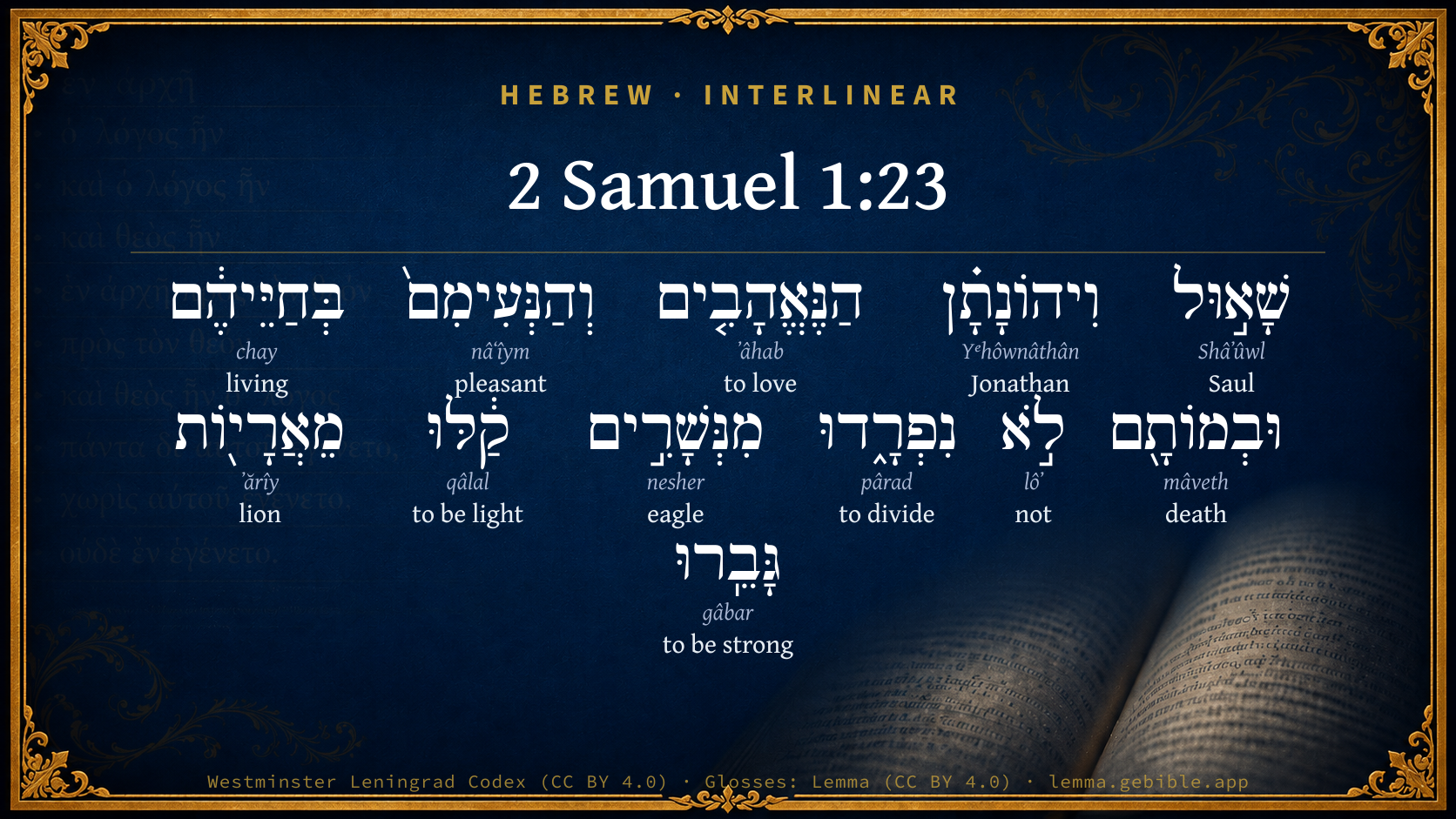
Hebrew (Westminster Leningrad Codex) 2 Samuel 1:23 appears in the Hebrew Old Testament. The text above is from the Westminster Leningrad Codex. Each word links to its Strong’s number, a concise gloss, and parsing drawn from the Open Scriptures Hebrew Bible morphology. Click any word for its full Brown-Driver-Briggs (BDB) entry.
Download image
Cite this verse

2 Samuel 1:23 (World English Bible). Public Domain. Lemma interlinear Bible study tool, https://lemma.gebible.app/v/2-samuel/1/23.

Show BibTeX & RIS
BibTeX
RIS
English Translation
Saul and Jonathan were lovely and pleasant in their lives, In their death they were not divided: They were swifter than eagles, They were stronger than lions.
World English Bible · Public Domain
Highlights
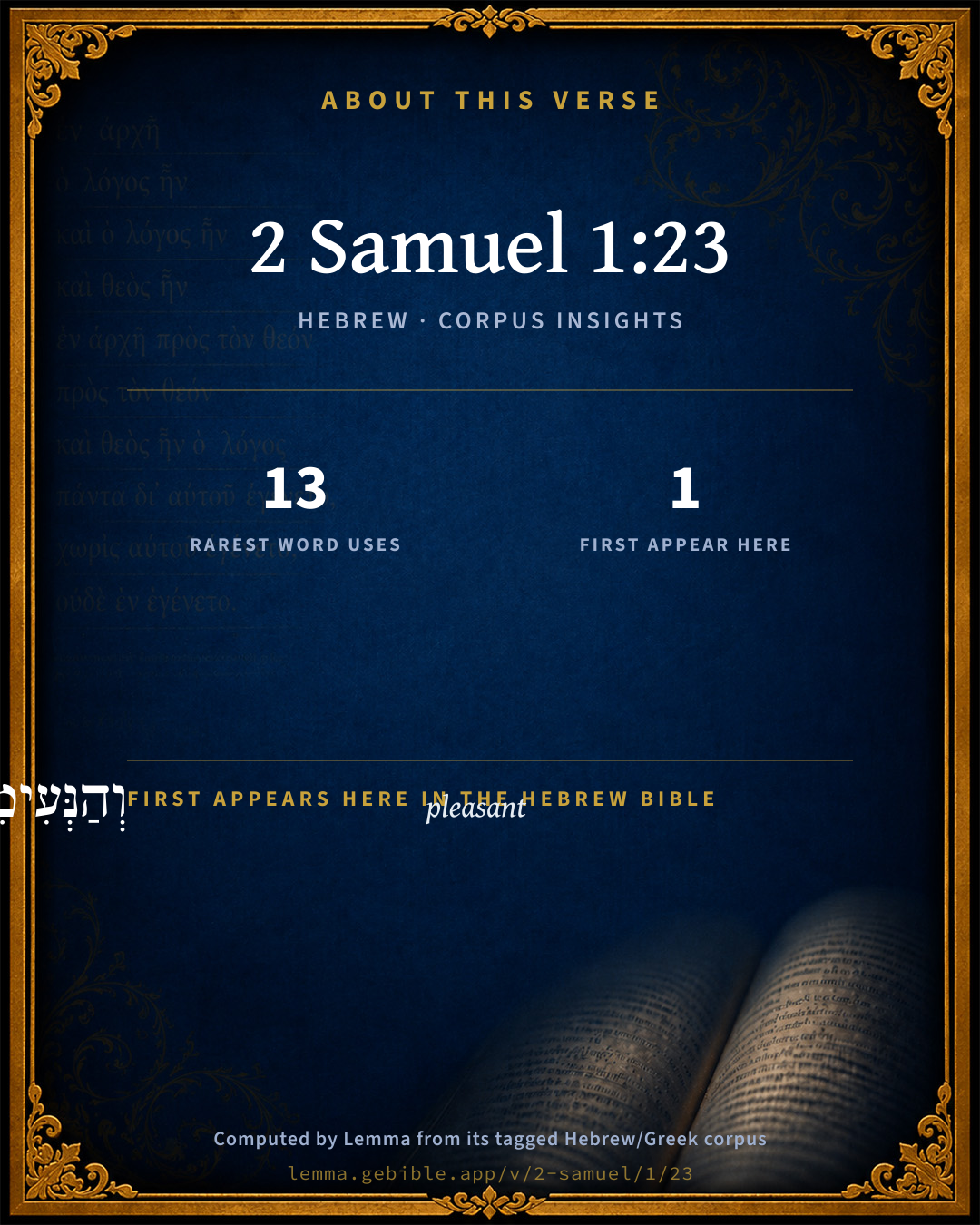
  • 1 first appearance in the Hebrew Bible
Full analysis ↓
Download a study sheet

One document with this verse’s original text, its word-by-word gloss line, the meaning frame, cross-references with their text, attributed commentary, and full source and license credits — printable, and it pastes into notes with its structure intact.

This verse Autodidact and up

Study sheet (.html) Plain text (.txt)

A passage Seminary Student

Up to 50 verses in one chapter. A passage sheet keeps up to 6 commentary sources and 12 cross-references per verse, in the order this page ranks them, and says so on the sheet whenever that leaves anything out. Ask for a single verse and you get the Autodidact verse sheet above.

Everything on this page stays free to read, with no account — the sheet is a download of what is already on screen, not access to it.

Want to remove ads? Support Godless Engineer
Compare translations 3

The same verse in 3 English versions, stacked beneath the original-language interlinear above. Click any original word for its lexicon entry.

Each is an independent rendering of the whole verse — the interlinear is not word-aligned to these translations.

Highlighted words mark where these versions differ — a whole-verse word diff, not a word-by-word alignment.

  • World English Bible Public Domain
    Saul and Jonathan were lovely and pleasant in their lives, In their death they were not divided: They were swifter than eagles, They were stronger than lions.
  • King James Version Public Domain
    Saul and Jonathan were lovely and pleasant in their lives, and in their death they were not divided: they were swifter than eagles, they were stronger than lions.
  • unfoldingWord Literal Text CC BY-SA 4.0
    Saul and Jonathan being loved and delightful in their lives, and in their death they were not separated. They were swifter than eagles, they were mightier than lions.

unfoldingWord Literal Text — © unfoldingWord, licensed CC BY-SA 4.0. Word-aligned USFM3 via Door43 (git.door43.org/unfoldingWord/en_ult).

Versions to compare (up to 4)

3 of 4 selected

Show all 18 translations

Every available English version of this verse, each an independent rendering of the whole verse.

  • World English Bible Public Domain
    Saul and Jonathan were lovely and pleasant in their lives, In their death they were not divided: They were swifter than eagles, They were stronger than lions.
  • Berean Standard Bible Public Domain
    Saul and Jonathan, beloved and delightful in life, were not divided in death. They were swifter than eagles, they were stronger than lions.
  • Majority Standard Bible Public Domain
    Saul and Jonathan, beloved and delightful in life, were not divided in death. They were swifter than eagles; they were stronger than lions.
  • King James Version Public Domain
    Saul and Jonathan were lovely and pleasant in their lives, and in their death they were not divided: they were swifter than eagles, they were stronger than lions.
  • American Standard Version (1901) Public Domain
    Saul and Jonathan were lovely and pleasant in their lives, And in their death they were not divided: They were swifter than eagles, They were stronger than lions.
  • Revised Version (1885) Public Domain
    Saul and Jonathan were lovely and pleasant in their lives, and in their death they were not divided; they were swifter than eagles, they were stronger than lions.
  • Geneva Bible (1599) Public Domain
    Saul and Ionathan were louely and pleasant in their liues, and in their deaths they were not deuided: they were swifter then eagles, they were stronger then lions.
  • Douay-Rheims (1899) Public Domain
    Saul and Jonathan, lovely, and comely in their life, even in death they were not divided: they were swifter than eagles, stronger than lions.
  • Young's Literal Translation Public Domain
    Saul and Jonathan! They are loved and pleasant in their lives, And in their death they have not been parted. Than eagles they have been lighter, Than lions they have been mightier!
  • Literal Standard Version CC BY-SA 4.0
    Saul and Jonathan! They are loved and pleasant in their lives, || And in their death they have not been parted. They have been lighter than eagles, || They have been mightier than lions!
  • Unlocked Literal Bible CC BY-SA 4.0
    Saul and Jonathan were loved and gracious in life, and in their death they were not separated. They were swifter than eagles, they were stronger than lions.
  • unfoldingWord Literal Text CC BY-SA 4.0
    Saul and Jonathan being loved and delightful in their lives, and in their death they were not separated. They were swifter than eagles, they were mightier than lions.
  • Darby Bible Public Domain
    Saul and Jonathan, beloved and pleasant in their lives, Even in their death were not divided; They were swifter than eagles, they were stronger than lions.
  • World Messianic Bible Public Domain
    Saul and Jonathan were lovely and pleasant in their lives. In their death, they were not divided. They were swifter than eagles. They were stronger than lions.
  • Webster's Bible Public Domain
    Saul and Jonathan were lovely and pleasant in their lives, and in their death they were not divided: they were swifter than eagles, they were stronger than lions.
  • Free Bible Version CC BY-SA 4.0
    During their lives, Saul and Jonathan were much loved and very pleasant, and death did not divide them. They were faster than eagles, stronger than lions.
  • Bible in Basic English Public Domain
    Saul and Jonathan were loved and pleasing; in their lives and in their death they were not parted; they went more quickly than eagles, they were stronger than lions.
  • JPS Tanakh (1917) Public Domain
    Saul and Jonathan, the lovely and the pleasant in their lives, even in their death they were not divided; they were swifter than eagles, they were stronger than lions.

Literal Standard Version (2020), Covenant Press — licensed CC BY-SA 4.0. Text via the HelloAO Bible API (eBible.org). Unlocked Literal Bible (unfoldingWord) — licensed CC BY-SA 4.0. Text via the HelloAO Bible API (eBible.org). unfoldingWord Literal Text — © unfoldingWord, licensed CC BY-SA 4.0. Word-aligned USFM3 via Door43 (git.door43.org/unfoldingWord/en_ult). Free Bible Version, Dr. Jonathan Gallagher — licensed CC BY-SA 4.0. Text via the HelloAO Bible API (eBible.org).

Word by word

More ways to search: Search by grammar → Find every occurrence → Compare this word →

Practice this passage: Drill this verse → Learn its vocabulary →

וְהַנְּעִימִם֙
nâʻîym
H5273
“and · the · pleasant”
Conjunction + Particle, Definite Article + Adjective, Adjective, Masculine, Plural, Absolute
Part of Speech
Conjunction + Particle + Adjective
Type
Adjective
Gender
Masculine
Number
Plural
State
Absolute
Full BDB Definition

Origin: from H5276

TWOT: 1384b , 1385a

pleasant, delightful, sweet, lovely, agreeable - delightful - lovely, beautiful (physical) - singing, sweetly sounding, musical
  1. שָׁא֣וּל Shâʼûwl H7586 “Saul” Noun, Proper
  2. וִיהוֹנָתָ֗ן Yᵉhôwnâthân H3083 “and · Jonathan” Conjunction + Noun, Proper
  3. הַנֶּאֱהָבִ֤ים ʼâhab H157 “the · loving” Particle, Definite Article + Verb, Niphal, Participle Active, Masculine, Plural, Absolute
  4. בְּחַיֵּיהֶ֔ם chay H2416 “in/at · living things · their” Preposition + Noun, Common, Masculine, Plural, Construct + Suffix, Personal, 3rd Person, Masculine, Plural
  5. וּבְמוֹתָ֖ם mâveth H4194 “and · in/at · death · their” Conjunction + Preposition + Noun, Common, Masculine, Singular, Construct + Suffix, Personal, 3rd Person, Masculine, Plural
  6. לֹ֣א lôʼ H3808 “not” Particle, Negative
  7. נִפְרָ֑דוּ pârad H6504 “to divide” Verb, Niphal, Perfect, 3rd Person, Common, Plural
  8. מִנְּשָׁרִ֣ים nesher H5404 “from · eagles” Preposition + Noun, Common, Masculine, Plural, Absolute
  9. קַ֔לּוּ qâlal H7043 “to be light” Verb, Qal, Perfect, 3rd Person, Common, Plural
  10. מֵאֲרָי֖וֹת ʼărîy H738 “from · lions” Preposition + Noun, Common, Masculine, Plural, Absolute
  11. גָּבֵֽרוּ gâbar H1396 “to be strong” Verb, Qal, Perfect, 3rd Person, Common, Plural

About this verse

These counts appear in no published source. They are computed here, from the morphology-tagged text and Lemma’s own curated glosses. What Lemma adds →

12
words
12
distinct lemmas
Historical
section

Notable vocabulary

The rarest word here is וְהַנְּעִימִם֙ pleasant H5273 — appearing just 13 times in the whole Hebrew Bible.

First appearance in Scripture

This word makes its first canonical appearance in the Hebrew Bible here:

  • וְהַנְּעִימִם֙ pleasant H5273

Shared distinctive vocabulary

וְהַנְּעִימִם֙ pleasant H5273 occurs in 13 verses of the Hebrew Bible. Also found in:

Grammatical profile

  • 4 verbs
  • 6 nouns
  • 1 adjective
  • 1 particle

Verb forms

  • הַנֶּאֱהָבִ֤ים Niphal · Participle Active
  • נִפְרָ֑דוּ Niphal · Perfect
  • קַ֔לּוּ Qal · Perfect
  • גָּבֵֽרוּ Qal · Perfect

Hebrew & Septuagint length

In English translation the verse runs 27 words from the Hebrew and 36 from the Septuagint (LXX English) — closely comparable.

A rough comparison of the two English renderings, which tokenize alike — not a word-level alignment.

Word counts can differ between the Hebrew and the Greek without any difference in meaning — e.g. the Hebrew direct-object marker אֵת has no separate Greek word, and Greek often adds the article ὁ.

Cross-references

12

Topical passages linked to 2 Samuel 1:23 in the Treasury of Scripture Knowledge — connected by theme and wording, ordered by reader-vote popularity; previews shown in the World English Bible.

  • Jeremiah 4:13 Behold, he shall come up as clouds, and his chariots [shall be] as the whirlwind: his horses are swifter than eagles. Woe to us! for we are ruined.
  • Judges 14:18 The men of the city said to him on the seventh day before the sun went down, What is sweeter than honey? and what is stronger than a lion? He said to them, If you hadn't plowed with my heifer, You wouldn't have found out my riddle.
  • Deuteronomy 28:49 Yahweh will bring a nation against you from far, from the end of the earth, as the eagle flies; a nation whose language you shall not understand;
  • Job 9:26 They have passed away as the swift ships, As the eagle that swoops on the prey.
  • Proverbs 30:30 The lion, which is mightiest among animals, And doesn't turn away for any;
  • Lamentations 4:19 Our pursuers were swifter than the eagles of the sky: They chased us on the mountains, they laid wait for us in the wilderness.
  • 1 Samuel 18:1 It happened, when he had made an end of speaking to Saul, that the soul of Jonathan was knit with the soul of David, and Jonathan loved him as his own soul.
  • 1 Samuel 20:2 He said to him, "Far from it; you shall not die: behold, my father does nothing either great or small, but that he discloses it to me; and why should my father hide this thing from me? It is not so."
  • 1 Samuel 31:1–5 Now the Philistines fought against Israel: and the men of Israel fled from before the Philistines, and fell down slain on Mount Gilboa.
  • 2 Samuel 23:20 Benaiah the son of Jehoiada, the son of a valiant man of Kabzeel, who had done mighty deeds, he killed the two [sons of] Ariel of Moab: he went down also and killed a lion in the midst of a pit in time of snow.
  • 1 Chronicles 12:8 Of the Gadites there separated themselves to David to the stronghold in the wilderness, mighty men of valor, men trained for war, that could handle shield and spear; whose faces were like the faces of lions, and they were as swift as the roes on the mountains;
  • 2 Samuel 2:18 The three sons of Zeruiah were there, Joab, and Abishai, and Asahel: and Asahel was as light of foot as a wild gazelle.

Cross-references courtesy of OpenBible.info (CC BY 4.0).

Hebrew and Greek witnesses Masoretic Hebrew ↔ Greek Septuagint

The same verse in the two great witnesses to the Old Testament, shown verse-for-verse.

These are two independent witnesses, not word-aligned to each other, and the Septuagint is shown in lemma (dictionary) form.

Hebrew 2 Samuel 1:23 Masoretic · Westminster Leningrad Codex

שָׁא֣וּל וִיהוֹנָתָ֗ן הַנֶּאֱהָבִ֤ים וְהַנְּעִימִם֙ בְּחַיֵּיהֶ֔ם וּבְמוֹתָ֖ם לֹ֣א נִפְרָ֑דוּ מִנְּשָׁרִ֣ים קַ֔לּוּ מֵאֲרָי֖וֹת גָּבֵֽרוּ

Saul and Jonathan were lovely and pleasant in their lives, In their death they were not divided: They were swifter than eagles, They were stronger than lions.

World English Bible · Public Domain

Greek LXX 2 Samuel 1:23 Septuagint · lemma form

σαούλ καί ιωναθαν ὁ ἀγαπάω καί ὡραῖος οὐ διαχωρίζω εὐπρεπής ἐν ὁ ζωή αὐτός καί ἐν ὁ θάνατος αὐτός οὐ διαχωρίζω ὑπέρ ἀετός κοῦφος καί ὑπέρ λέων κραταιόω

Saul and Jonathan, the beloved and the beautiful, were not divided: comely were they in their life, and in their death they were not divided: they were swifter than eagles, and they were stronger than lions.

LXX2012 (modern English Septuagint) · Public Domain

Hebrew: Westminster Leningrad Codex (CC BY 4.0). Greek: Septuagint (public domain); English from LXX2012 (modern English Septuagint) (Public Domain). How the Septuagint differs from the Hebrew →

Targum (Aramaic paraphrase)

1

The Targum is the ancient Jewish Aramaic paraphrase of the Hebrew Scriptures — an interpretive translation, not the Hebrew text itself. Onkelos (literal) and Pseudo-Jonathan (expansive) render the Torah, and Jonathan the Prophets. Coverage is partial: where no permissively-licensed English translation exists for a verse, only the Aramaic is shown. This is verse-level text, not a word-by-word alignment to the Hebrew.

  1. Targum Jonathan Prophets (Joshua–Malachi)
    שָׁאוּל וִיהוֹנָתָן דִרְחִימִין וַחֲבִיבִין בְּחַיֵיהוֹן וּבְמוֹתְהוֹן לָא אִתְפָּרָשׁוּ מֵעִמְהוֹן מִנִשְׁרַיָא קַלִילִין מֵאַרְיְוָתָא גִבָּרִין:

    (no public-domain English translation for this verse)

    Targum Jonathan — Aramaic: “Mikraot Gedolot” (public domain). English: “Sefaria Community Translation” (CC0 1.0 (public-domain dedication)); “London "Chaldee Paraphrase," 1871” (public domain). Text via Sefaria.

Commentary

Notes on 2 Samuel 1:23 from classic Christian and Jewish commentators (each source and its license shown beneath its notes). The classic Christian expositions comment on the surrounding passage and are grouped to its opening verse, so a note may address several verses; the Jewish commentaries on the Tanakh (Rashi and others) are per-verse, so they appear only where the commentator wrote on this verse.

Lemma curates 59 commentaries, every one of them public domain or Creative Commons licensed, each selected and text-cleaned for this edition rather than reprinted as found. About our sources →

Trapp's Complete Commentary

John Trapp

2Sa 1:23 Saul and Jonathan [were] lovely and pleasant in their lives, and in their death they were not divided: they were swifter than eagles, they were stronger than lions.

Ver. 23. Lovely and pleasant in their lives.] Both to others and betwixt themselves: they loved one another dearly.

And in their death they were not divided.] A worthy pattern of true and perfect friendship; on the outside of whose garment was anciently written, Mors et Vita, {a} death and life; in her forehead, summer and winter, &c. Such fast friends were the Sacra cohors sacred cohorts among the Thebans: {b} the Soldurii the elite corps among the old French: the sworn brethren among the Irish, &c.

{a} Athen., lib. iii.

{b} Caes., De Bel. Gal., lib. iii.

John Trapp, A Commentary or Exposition upon All the Books of the Old and New Testament (1647–1656) — public domain. Text from a community e-Sword module.

The Biblical Illustrator

Joseph S. Exell

2Sa_1:23

Lovely and pleasant in their lives.

The Master and the disciple

The words from the elegy of David far Saul and Jonathan, describe their character and relations in both life and death.

1. Great value is always to be attached to inspiring personal influence. None of us can fully compute the benefits which arise from it. The Eternal God has put it within the power of each one of us to affect others for good or harm. We communicate our intellectual interests, our moral tone, our spiritual bias to those with whom we come into contact. Not more surely is the infection of disease given off than the infection of character. Some men are very mighty in this respect. There is about them a strange contagion. They cannot have intercourse with others without in some degree affecting them. These are men of character: they leave their stamp Upon whomsoever they meet. There is about them, always and everywhere, a distinct, distinguishing manner and style of influence, which it is nearly impossible to resist; and equally so to lose, once it has laid hold upon you.

2. We recognise the importance of the earnest reception of inspiring personal influence. The mightiest inspiration fails to affect some people. They do not receive it. They are like blocks of marble or granite kissed by the sunshine, or sprinkled with the soft sweet rain of heaven. If, in this world, and in our strange human life, when we come near to a good and great man, we open all the doors and windows of our nature to him, He will shine into it, and give to it the warmth and comfort that it needs. When such good people are near, we should see to it that they do not pass away without leaving a blessing upon us. I will indicate a few of the points in which the Master and the disciple strikingly resembled one another:--

I. Breadth of view in regarding important matters. The Christian Church has many eminent men occupying positions of prominence in its ministry or its membership, whose power of intellect, and intensity 'of nature, are related to the circumstance that they look and walk along straight lines, and confine themselves to a defined field of observation. They never change their point of view. It is the one with which they are most familiar, and from which they fancy they can see most. From that point they have been looking for ten, twenty, thirty, fifty years. It is easier thus to limit one's field of vision.

II. Great refinement was manifest in the characters of these two friends. It is wonderful how it ever came to pass that a vulgar person could gain credit for being a Christian; for Christianity is the most refining of influences. It sheds a beautifying, chaste, and hallowing effect upon human life. It is the everlasting foe of everything that is vulgar. The coarse, and the harsh, and the hard elements of character have no recognition from it.

III. Courtesy. Some might ask if this is a Christian virtue. Indeed it is. But, like so many Christian virtues, it has been invariably relegated to the domain of cultured, graceful paganism. (W. Dorling.)

The Biblical Illustrator, edited by Joseph S. Exell (c. 1880s–1900s) — public domain. Text from a community e-Sword module.

Joseph Benson's Commentary

2Sa 1:23. Saul and Jonathan were lovely — Hebrew, הנאהבים, hanneehabim, were loved, namely, by each other, and by the people. And pleasant in their lives — Amiable and obliging in their carriage and conversation, both toward one another and toward others: for, as for Saul’s fierce behaviour toward Jonathan, it was only a sudden passion, by which his ordinary temper was not to be measured; and as for his carriage toward David, it proceeded from that jealousy, and those reasons of state, which too often engage even well-natured princes in similar hostilities. And in their death they were not divided — They were united in life and death; in life by the same common affection; in death by the same common fate. This is just what David intends to express. He does not, by any means, appear to design a commendation of their lives in any other respect. Nor does he speak, a word of Saul’s piety; he only commends him for those qualities which he really possessed; a fit pattern for all preachers in their funeral commendations. Dr. Lowth has beautifully expressed David’s meaning: —

“Nobile par, quos junxit, amor, quos gloria junxit, Una nunc fato jungit acerba dies.”

We will not attempt to give our readers a translation of this elegant couplet, but we will present them below with a paraphrase not inferior, perhaps, in elegance or spirit, on this and two or three of the other stanzas of this elegy, from a poetical version of it by Thomas Roberts, Esq., late of Bristol, with which he has kindly favoured us, and in which both the beauty and force of the original seem to be well imitated. We wish the narrow limits of our work would admit of our inserting the whole.

They were swifter than eagles — In pursuing their enemies, and executing their designs: which is a great commendation in a prince, and a requisite quality in a warrior. They were stronger than lions — Or, rather, more courageous than lions. According to Agur’s observation, Pro 30:30, the lion never betakes himself to flight, but faces his foe to the last. Courage then seems the most remarkable property of the lion. And since David uses the same word here in speaking of Saul and Jonathan which Agur uses in speaking of this property of the lion, he evidently means to celebrate the courage of his heroes rather than their strength; and to say that, in facing the enemy and braving of danger, they were undaunted as lions.

Joseph Benson's Commentary on the Old and New Testaments (1811–1818) — public domain. Text from a community e-Sword module.

Tyndale Open Study Notes

Tyndale Open Resources

1:23 beloved and gracious . . . together in life and in death: Although the relationship between Saul and Jonathan was strained, especially due to Saul’s treatment of David (see 1 Sam 20:30-33), Jonathan nevertheless fought and died alongside his father while defending Israel against the Philistine menace.

Tyndale Open Study Notes — © Tyndale Open Resources, licensed CC BY-SA 4.0. Text via the HelloAO Bible API.

Geneva Bible (1599)

Geneva Bible translators

They died both together in Gilboa.

Geneva Bible (1599) marginal notes — public domain. Text via Bolls.life.

Ellicott's Commentary for English Readers

(23) Lovely and pleasant.—This applies peculiarly to Jonathan, but also in a good degree to Saul in his earlier years and his better moments, which David chose at this moment to recall. It also applies truthfully to them both in their relations to each other.

A Bible Commentary for English Readers, edited by Charles John Ellicott (1878–1897) — public domain. Text from a community e-Sword module.

The Cambridge Bible for Schools and Colleges

gen. ed. J. J. S. Perowne

23. lovely and pleasant] Perhaps rather, loving and kindly. The words express the mutual affection which existed between father and son. Jonathan remained faithful to his filial duty even when his father was persecuting his closest friend, and Saul, in spite of temporary outbursts of passion, loved his son to the last. Some commentators would render “in their lives and in their death they were not divided,” but the E. V. preserves the balance of the clauses better.

swifter than eagles] Cp. Jer_4:13; Hab_1:8.

stronger than lions] Cp. ch. 2Sa_17:10; Jdg_14:18.

The Cambridge Bible for Schools and Colleges (gen. ed. J. J. S. Perowne; Cambridge University Press, 1878–1918) — public domain. Text from a community e-Sword module.

John Gill's Exposition

Saul and Jonathan were lovely and pleasant in their lives,.... To one another, had no quarrel or difference with each other, only on the account of David; otherwise they agreed together in the court, and in the camp, in their councils, and in their conduct:

and in their death they were not divided; neither from the people, nor from one another; Jonathan stuck close by his father to the last; which is observed to clear him from any imputation of conspiracy against him:

they were swifter than eagles; in the quick dispatch of business, in hasting to the relief of the distressed, as Saul to the men of Jabeshgilead, and in the pursuit of their enemies, as of the Philistines, more than once:

they were stronger than lions; fighting with their enemies, who became an case prey to them; and what is stronger than a lion among beasts? Jdg 14:18; or swifter than an eagle among birds, which is said to cut the air with its wings (x)?

(x) Aelian. Hist. Animal. l. 15. c. 22. Vid. Ciceron. de Divinatione, l. 2. prope finem.

John Gill's Exposition of the Whole Bible (1746–1763) — public domain (CC PDM 1.0). Text via the HelloAO Bible API.

Haydock's Catholic Bible Commentary

Lovely, or united. Jonathan always behaved with due respect towards his father, though he could not enter into his unjust animosity against David. (Calmet) --- The latter passes over in silence all that Saul had done against himself, and seems wholly occupied with the thought of the valour and great achievements of the deceased. (Haydock) --- Sanchez believes that these epithets were introduced of course into funeral canticles, like Alas! my noble one, (Jeremias xxii. 18.; Menochius) as Saul could have no pretensions to be styled lovely, or friendly, towards the latter part of his reign; since he treated the priests, David, and even his son Jonathan, with contumely, and even with unrelenting fury. But all this David would willingly bury in oblivion. He will not even notice how different was the end of the two heroes. Jonathan died like a virtuous soldier in his country’s cause; Saul was wounded, but impiously accelerated his own death, through dread of torments and of insult. Though they died, therefore, on the same field of battle, their end was as different as that of the saint and of the impenitent sinner. (Haydock)

George Leo Haydock (1774–1849), Haydock's Catholic Family Bible and Commentary, 1859 edition — public domain. Excludes Psalms (Douay-Rheims chapter numbering differs from Protestant) and Deuterocanonical books (Catholic canon only).

Matthew Poole's English Annotations

Pleasant; amiable and obliging in their carriage and conversation, both towards one another, and towards their people; for as for Saul’s fierce behaviour towards Jonathan, 1Sa 20:30,33, it was only a sudden passion, by which his ordinary temper was not to be measured; and for his carriage towards David, that was from that jealousy and reason of state which usually engageth even good-natured and well-nurtured princes to the same hostilities in like cases. But it is observable, that David speaks not a word here of his piety and other virtues; but only commends him for those things which were truly in him; a fit pattern for all preachers in their funeral commendations.

In their lives; Jonathan was not false to his father, as was reported; but stuck close to him.

In their death they were not divided; and as he lived, so he died with him, at the same time, and in the same common and good cause.

Swifter than eagles; expeditious and nimble in pursuing their enemies, and executing their designs; which is a great commendation in a prince and in a soldier.

Stronger than lions, in regard of their bodily strength and the courage of their minds.

Matthew Poole's English Annotations on the Holy Bible (1683–1685) — public domain. Text from a community e-Sword/MySword module.

Whedon's Commentary on the Bible

Daniel D. Whedon

23. Beloved and pleasant in their lives — Jonathan was eminently so, and though Saul in his madness had even threatened his son’s life, (1Sa_20:33,) and sought for successive years to destroy David, yet David’s tender heart seems to forget all the injuries of the past, and celebrates only the virtues of his fallen enemy. Saul’s love for his son Jonathan was exceedingly strong, as may be seen from such passages as 1Sa_14:39; 1Sa_19:6; 1Sa_20:2; and while Jonathan’s love for David was wonderful, it was so much stronger for his father that he cast in his lot with the sinking fortunes of the latter, rather than with the growing greatness of his friend David.

Swifter than eagles — Fleetness of foot was an admired qualification of a warrior. 2Sa_2:8. The mightiest hero of Greece was the “swift-footed Achilles.”

Daniel D. Whedon (gen. ed.), Commentary on the Old and New Testaments (1874–1909) — public domain. Text from a community e-Sword module.

The Pulpit Commentary

Lovely and pleasant. The words of the Authorized Version contain a beautiful antithesis, which, however, does not exist in the Hebrew, which celebrates the close union of father and son in life as well as in death.

Saul and Jonathan, the lovely and pleasant, Neither in their lives nor in their death were they divided.

Notwithstanding Saul"s rash vow, Jonathan had ever been his father"s faithful friend and companion, nor had his affection for David made him untrue to the ties of natural affection. And David generously commends his friend for thus acting.

The Pulpit Commentary (1880–1919), ed. H.D.M. Spence-Jones & Joseph S. Exell — public domain. Text from a community e-Sword module.

John Wesley's Explanatory Notes

Lovely - Amiable, and obliging in their carriage and conversation, both towards one another, and towards their people: for, as for Saul's fierce behaviour towards Jonathan, it was only a sudden passion, by which his ordinary temper was not to be measured; and for his carriage towards David, that was from that jealousy and reason of state which usually engageth even well- natured princes, to the same hostilities. But it is observable, that David speaks not a word here of his piety; but only commends him for those things which were truly in him. A fit pattern for all preachers in their funeral commendations. Swifter, &c. - Expeditious in pursuing their enemies, and executing their designs; which is a great commendation in a prince, and in a soldier. Stronger, &c. - In regard of their bodily strength, and the courage of their mind.

John Wesley, Explanatory Notes Upon the Whole Bible (1754–1765) — public domain. Text via the GEBible commentary corpus.

Keil & Delitzsch

C. F. Keil & F. Delitzsch

In death as in life, the two heroes were not divided, for they were alike in bravery and courage. Notwithstanding their difference of character, and the very opposite attitude which they assumed towards David, the noble Jonathan did not forsake his father, although his fierce hatred towards the friend whom Jonathan loved as his own soul might have undermined his attachment to his father. The two predicates, נאהב, loved and amiable, and נעים, affectionate or kind, apply chiefly to Jonathan; but they were also suitable to Saul in the earliest years of his reign, when he manifested the virtues of an able ruler, which secured for him the lasting affection and attachment of the people. In his mourning over the death of the fallen hero, David forgets all the injury that Saul has inflicted upon him, so that he only brings out and celebrates the more amiable aspects of his character. The light motion or swiftness of an eagle (cf. Hab 1:8), and the strength of a lion (vid., Sa2 17:10), were the leading characteristics of the great heroes of antiquity. - Lastly, in Sa2 1:24, David commemorates the rich booty which Saul had brought to the nation, for the purpose of celebrating his heroic greatness in this respect as well. שׁני was the scarlet purple (see at Exo 25:4). "With delights," or with lovelinesses, i.e., in a lovely manner.

Keil & Delitzsch — Biblical Commentary on the Old Testament (1861–1891) — public domain (CC PDM 1.0). Text via the HelloAO Bible API. (Old Testament only.)

unfoldingWord translationNotes

Door43 World Missions Community

in their death they were not separated

The phrase "were not separated" is used to emphasize that they were always together. AT: "even in death they were together"

They were swifter than eagles, they were stronger than lions.

Saul and Jonathan were spoken of as if they were faster than eagles and stronger than lions. (See: Metaphor)

who clothed you in scarlet as well as jewels, and who put ornaments of gold on your clothing

"who provided you nice clothes and jewelry." These two phrases share similar meanings that describe providing the women with expensive, attractive clothing. (See: Parallelism)

translationWords

Saul (OT)

Jonathan

love

grace

life

die

eagle

lions

clothe

gold

unfoldingWord translationNotes — © Distant Shores Media and the Door43 World Missions Community, licensed CC BY-SA 4.0. Source: git.door43.org/Door43/en_tn.

Rashi

Rabbi Shlomo Yitzchaki (Rashi)

They were lighter then eagles. To do the will of their Creator.

Rashi on the Tanakh — English translations: “The Judaica Press complete Tanach with Rashi, translated by A. J. Rosenberg” (CC BY 4.0); “Pentateuch with Rashi's commentary by M. Rosenbaum and A.M. Silbermann, 1929-1934” (public domain); “The Metsudah Tanach series, Lakewood, N.J” (CC BY 4.0); and “The Book of Joshua, Metsudah Publications, 1997” (CC BY 4.0). Text via Sefaria.

Lesson kit

Teaching starters — assembled from the data on this page, not authored interpretation. Every prompt links to the verse data it draws on. Edit before teaching.

2 Samuel, in the Historical, opens this verse with 12 words (12 distinct Hebrew lemmas). Its most distinctive word is nâʻîym (“pleasant”). A historical commentator’s framing appears above. Read the whole chapter for the surrounding context.

Discussion questions

  1. How does “pleasant” (nâʻîym) shape what this verse is saying?
  2. This is the first place “pleasant” appears in Scripture (first appears here). What does its debut here establish?
  3. How does 2 Samuel 23:1, which shares the word «pleasant», read alongside this verse?
  4. These translations render this verse differently; the difference is in the English rendering, not the original. What questions does that raise?
  5. «הַנֶּאֱהָבִ֤ים» is a Niphal Participle Active verb. How does that grammatical form shape the action described?
  6. Compare how Trapp's Complete Commentary and The Biblical Illustrator read this verse. Where do they agree or differ?

Things to notice

  • 1 word makes its first canonical appearance in Scripture here.
  • These translations choose different wording for 9 words in this verse.
  • 12 distinct Hebrew lemmas span 12 words in this verse.

Reading settings

Reading text

Shown beneath each verse's original-language words.

Old Testament
Old Testament edition

Read the OT as the Masoretic Hebrew (MT) or the Greek Septuagint (LXX).

English shown for the Greek Septuagint (in the Hebrew ↔ Greek comparison).

Comparing translations? Open the Compare panel on any verse page to stack up to four side by side.