Psalms 5:11

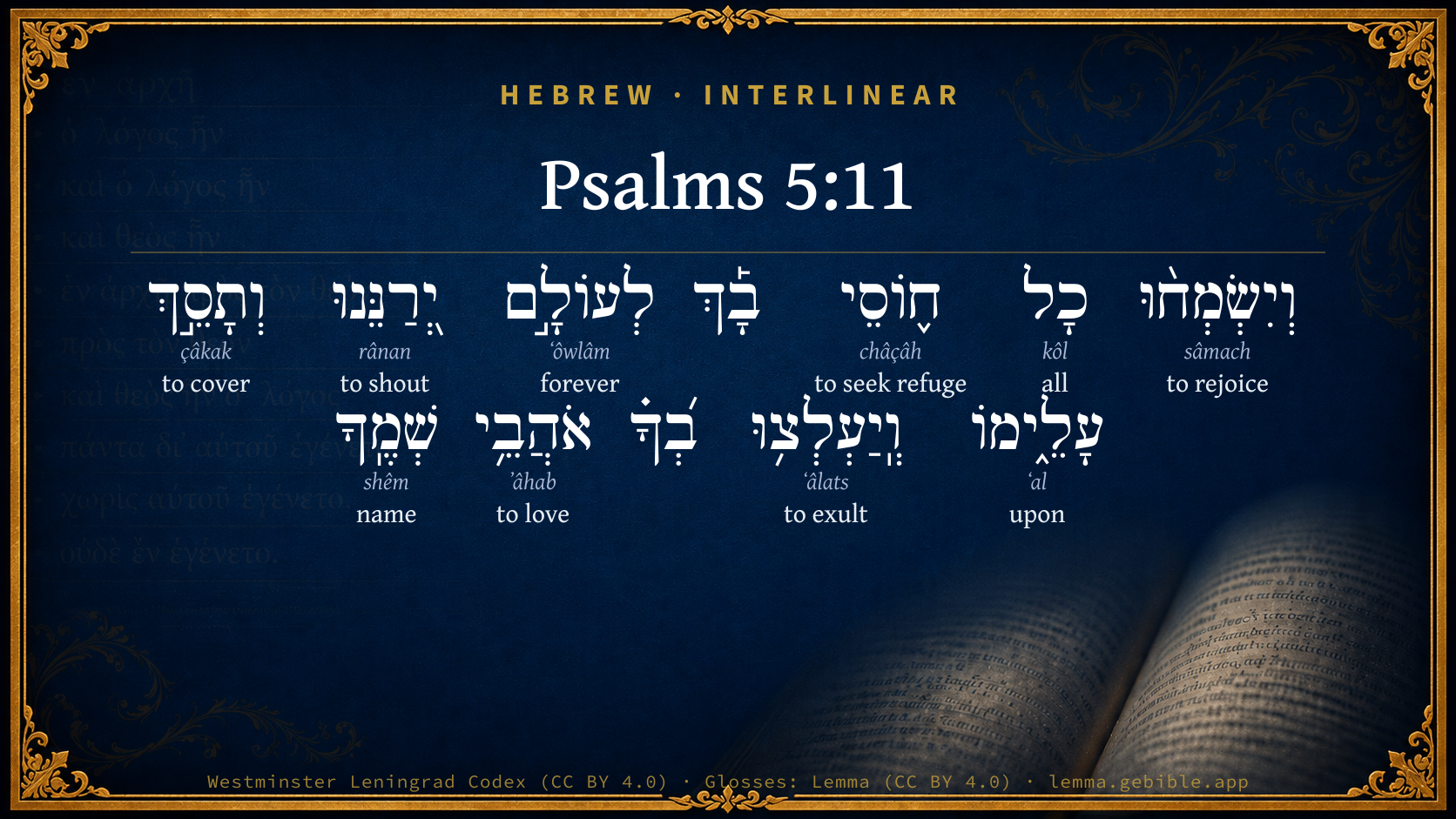
Hebrew (Westminster Leningrad Codex) Psalms 5:11 appears in the Hebrew Old Testament. The text above is from the Westminster Leningrad Codex. Each word links to its Strong’s number, a concise gloss, and parsing drawn from the Open Scriptures Hebrew Bible morphology. Click any word for its full Brown-Driver-Briggs (BDB) entry.
Download image
Cite this verse

Psalms 5:11 (World English Bible). Public Domain. Lemma interlinear Bible study tool, https://lemma.gebible.app/v/psalms/5/11.

Show BibTeX & RIS
BibTeX
RIS
English Translation
But let all those who take refuge in you rejoice, Let them always shout for joy, because you defend them. Let them also who love your name be joyful in you.
World English Bible · Public Domain
Download a study sheet

One document with this verse’s original text, its word-by-word gloss line, the meaning frame, cross-references with their text, attributed commentary, and full source and license credits — printable, and it pastes into notes with its structure intact.

This verse Autodidact and up

Study sheet (.html) Plain text (.txt)

A passage Seminary Student

Up to 50 verses in one chapter. A passage sheet keeps up to 6 commentary sources and 12 cross-references per verse, in the order this page ranks them, and says so on the sheet whenever that leaves anything out. Ask for a single verse and you get the Autodidact verse sheet above.

Everything on this page stays free to read, with no account — the sheet is a download of what is already on screen, not access to it.

Want to remove ads? Support Godless Engineer
Compare translations 3

The same verse in 3 English versions, stacked beneath the original-language interlinear above. Click any original word for its lexicon entry.

Each is an independent rendering of the whole verse — the interlinear is not word-aligned to these translations.

Highlighted words mark where these versions differ — a whole-verse word diff, not a word-by-word alignment.

  • World English Bible Public Domain
    But let all those who take refuge in you rejoice, Let them always shout for joy, because you defend them. Let them also who love your name be joyful in you.
  • King James Version Public Domain
    But let all those that put their trust in thee rejoice: let them ever shout for joy, because thou defendest them: let them also that love thy name be joyful in thee.
  • unfoldingWord Literal Text CC BY-SA 4.0
    But may all refuge seekers in you rejoice; may they shout joyfully to eternity, and may you cover over them, and may lovers of your name exult in you. ts\*

unfoldingWord Literal Text — © unfoldingWord, licensed CC BY-SA 4.0. Word-aligned USFM3 via Door43 (git.door43.org/unfoldingWord/en_ult).

Versions to compare (up to 4)

3 of 4 selected

Show all 18 translations

Every available English version of this verse, each an independent rendering of the whole verse.

  • World English Bible Public Domain
    But let all those who take refuge in you rejoice, Let them always shout for joy, because you defend them. Let them also who love your name be joyful in you.
  • Berean Standard Bible Public Domain
    But let all who take refuge in You rejoice; let them ever shout for joy. May You shelter them, that those who love Your name may rejoice in You.
  • Majority Standard Bible Public Domain
    But let all who take refuge in You rejoice; let them ever shout for joy. May You shelter them, that those who love Your name may rejoice in You.
  • King James Version Public Domain
    But let all those that put their trust in thee rejoice: let them ever shout for joy, because thou defendest them: let them also that love thy name be joyful in thee.
  • American Standard Version (1901) Public Domain
    But let all those that take refuge in thee rejoice, Let them ever shout for joy, because thou defendest them: Let them also that love thy name be joyful in thee.
  • Revised Version (1885) Public Domain
    But let all those that put their trust in thee rejoice, let them ever shout for joy, because thou defendest them: let them also that love thy name be joyful in thee.
  • Geneva Bible (1599) Public Domain
    And let all them that trust in thee, reioyce and triumph for euer, and couer thou them: and let them, that loue thy Name, reioyce in thee.
  • Douay-Rheims (1899) Public Domain
    Their throat is an open sepulchre: they dealt deceitfully with their tongues: judge them, O God. Let them fall from their devices: according to the multitude of their wickedness cast them out: for they have provoked thee, O Lord.
  • Young's Literal Translation Public Domain
    And rejoice do all trusting in Thee, To the age they sing, and Thou coverest them over, And those loving Thy name exult in Thee.
  • Literal Standard Version CC BY-SA 4.0
    And all trusting in You rejoice, || They sing for all time, and You cover them over, || And those loving Your Name exult in You.
  • Unlocked Literal Bible CC BY-SA 4.0
    But may all those who take refuge in you rejoice; let them always shout for joy because you defend them; let them be joyful in you, those who love your name.
  • unfoldingWord Literal Text CC BY-SA 4.0
    But may all refuge seekers in you rejoice; may they shout joyfully to eternity, and may you cover over them, and may lovers of your name exult in you. ts\*
  • Darby Bible Public Domain
    And all that trust in thee shall rejoice: for ever shall they shout joyously, and thou wilt protect them; and they that love thy name shall exult in thee.
  • World Messianic Bible Public Domain
    But let all those who take refuge in you rejoice. Let them always shout for joy, because you defend them. Let them also who love your name be joyful in you.
  • Webster's Bible Public Domain
    \\5:10\\Destroy thou them, O God; let them fall by their own counsels; cast them out in the multitude of their transgressions; for they have rebelled against thee.
  • Free Bible Version CC BY-SA 4.0
    But may all those who trust in you be happy—may they sing for joy forever. May you spread your protection over them so that everyone who loves your character may celebrate.
  • Bible in Basic English Public Domain
    But let all those who put their faith in you be glad with cries of joy at all times, and let all the lovers of your name be glad in you.
  • JPS Tanakh (1917) Public Domain
    (5-12) So shall all those that take refuge in Thee rejoice, they shall ever shout for joy, and Thou shalt shelter them; let them also that love Thy name exult in Thee.

Literal Standard Version (2020), Covenant Press — licensed CC BY-SA 4.0. Text via the HelloAO Bible API (eBible.org). Unlocked Literal Bible (unfoldingWord) — licensed CC BY-SA 4.0. Text via the HelloAO Bible API (eBible.org). unfoldingWord Literal Text — © unfoldingWord, licensed CC BY-SA 4.0. Word-aligned USFM3 via Door43 (git.door43.org/unfoldingWord/en_ult). Free Bible Version, Dr. Jonathan Gallagher — licensed CC BY-SA 4.0. Text via the HelloAO Bible API (eBible.org).

Word by word

More ways to search: Search by grammar → Find every occurrence → Compare this word →

Practice this passage: Drill this verse → Learn its vocabulary →

וְֽיַעְלְצ֥וּ
ʻâlats
H5970
“and · to exult”
Conjunction + Verb, Qal, Imperfect, 3rd Person, Masculine, Plural
Part of Speech
Conjunction + Verb
Stem
Qal
Form
Imperfect
Person
3rd Person
Gender
Masculine
Number
Plural
Full BDB Definition

Origin: a primitive root

TWOT: 1635

to rejoice, exult - (Qal) to exult
  1. וְיִשְׂמְח֨וּ sâmach H8055 “and · to rejoice” Conjunction + Verb, Qal, Imperfect, 3rd Person, Masculine, Plural
  2. כָל kôl H3605 “all of” Noun, Common, Masculine, Singular, Construct
  3. ח֪וֹסֵי châçâh H2620 “seeking refuge” Verb, Qal, Participle Active, Masculine, Plural, Construct
  4. לְעוֹלָ֣ם ʻôwlâm H5769 “to/for · forever” Preposition + Noun, Common, Masculine, Singular, Absolute
  5. יְ֭רַנֵּנוּ rânan H7442 “to shout” Verb, Piel, Imperfect, 3rd Person, Masculine, Plural
  6. וְתָסֵ֣ךְ çâkak H5526 “and · to cover” Conjunction + Verb, Hiphil, Imperfect, 2nd Person, Masculine, Singular
  7. עָלֵ֑ימוֹ ʻal H5921 “upon · them” Preposition + Suffix, Personal, 3rd Person, Masculine, Plural
  8. אֹהֲבֵ֥י ʼâhab H157 “loving” Verb, Qal, Participle Active, Masculine, Plural, Construct
  9. שְׁמֶֽךָ shêm H8034 “name · your” Noun, Common, Masculine, Singular, Construct + Suffix, Personal, 2nd Person, Masculine, Singular

About this verse

These counts appear in no published source. They are computed here, from the morphology-tagged text and Lemma’s own curated glosses. What Lemma adds →

12
words
10
distinct lemmas
Wisdom
section

Notable vocabulary

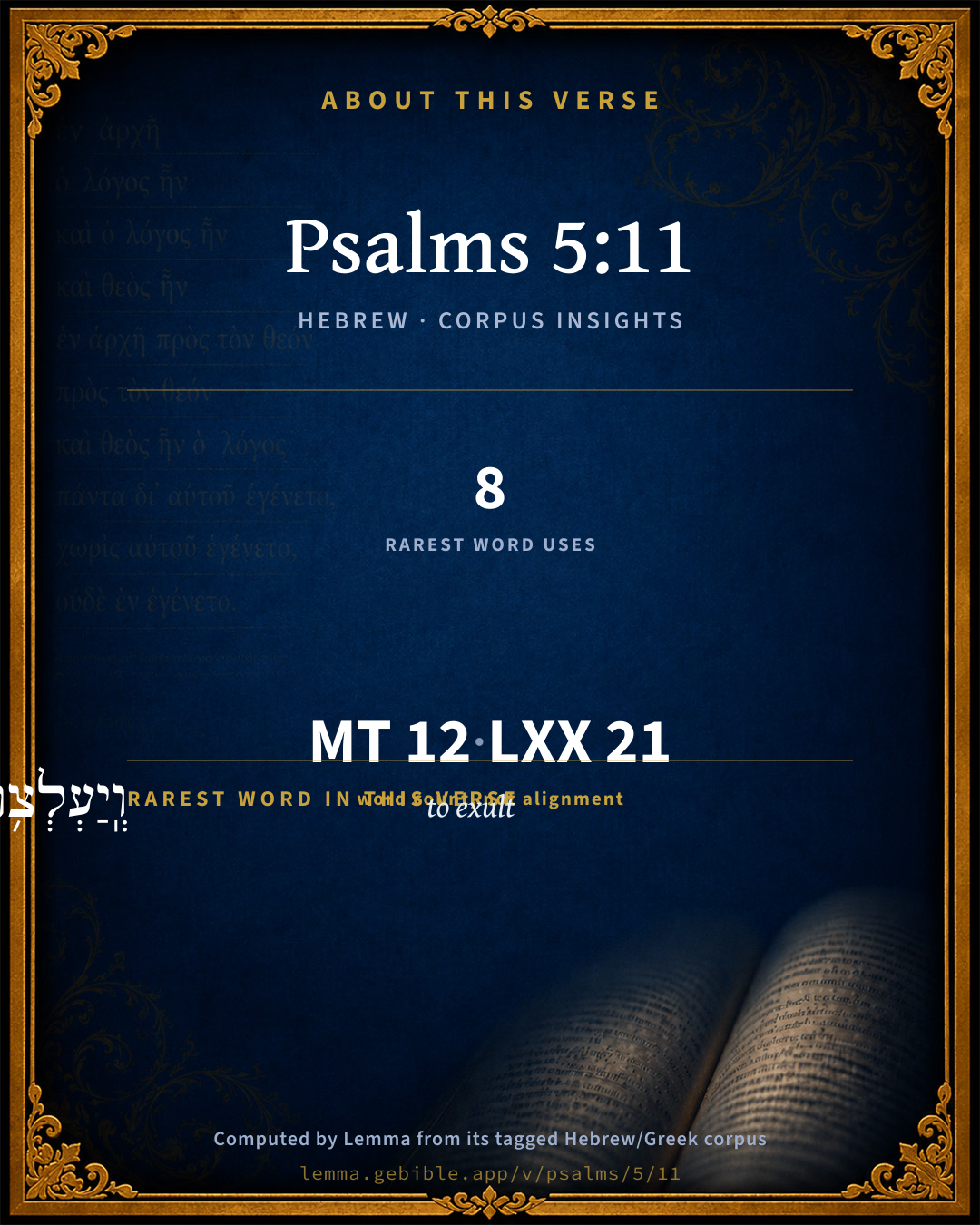
The rarest word here is וְֽיַעְלְצ֥וּ to exult H5970 — appearing just 8 times in the whole Hebrew Bible.

Shared distinctive vocabulary

וְֽיַעְלְצ֥וּ to exult H5970 occurs in 8 verses of the Hebrew Bible. Also found in:

Grammatical profile

  • 6 verbs
  • 3 nouns
  • 3 prepositions

Verb forms

  • וְיִשְׂמְח֨וּ Qal · Imperfect
  • ח֪וֹסֵי Qal · Participle Active
  • יְ֭רַנֵּנוּ Piel · Imperfect
  • וְתָסֵ֣ךְ Hiphil · Imperfect
  • וְֽיַעְלְצ֥וּ Qal · Imperfect
  • אֹהֲבֵ֥י Qal · Participle Active

Hebrew & Septuagint length

In English translation the verse runs 31 words from the Hebrew and 32 from the Septuagint (LXX English) — closely comparable.

A rough comparison of the two English renderings, which tokenize alike — not a word-level alignment.

Word counts can differ between the Hebrew and the Greek without any difference in meaning — e.g. the Hebrew direct-object marker אֵת has no separate Greek word, and Greek often adds the article ὁ.

In the original languages it is 12 Hebrew tokens and 21 Greek tokens — but the two are counted differently (Hebrew bundles its prefixes and suffixes into one token; the Greek is in lemma form), so that isn’t a like-for-like length.

Cross-references

18

Topical passages linked to Psalms 5:11 in the Treasury of Scripture Knowledge — connected by theme and wording, ordered by reader-vote popularity; previews shown in the World English Bible.

  • Romans 8:28 We know that all things work together for good for those who love God, to those who are called according to his purpose.
  • Revelation 19:1–7 After these things I heard something like a loud voice of a great multitude in heaven, saying, "Hallelujah! Salvation, power, and glory belong to our God:
  • Psalms 68:3 But let the righteous be glad. Let them rejoice before God. Yes, let them rejoice with gladness.
  • Psalms 40:16 Let all those who seek you rejoice and be glad in you. Let such as love your salvation say continually, "Let Yahweh be exalted!"
  • 1 Corinthians 2:9 But as it is written, "Things which an eye didn't see, and an ear didn't hear, Which didn't enter into the heart of man, These God has prepared for those who love him."
  • James 1:12 Blessed is the man who endures temptation, for when he has been approved, he will receive the crown of life, which the Lord promised to those who love him.
  • Revelation 18:20 Rejoice over her, O heaven, you saints, apostles, and prophets; for God has judged your judgment on her."
  • James 2:5 Listen, my beloved brothers. Didn't God choose those who are poor in this world to be rich in faith, and heirs of the Kingdom which he promised to those who love him?
  • Psalms 2:12 Kiss the son, lest he be angry, and you perish in the way, For his wrath will soon be kindled. Blessed are all those who take refuge in him.
  • Zechariah 9:9 Rejoice greatly, daughter of Zion! Shout, daughter of Jerusalem! Behold, your king comes to you! He is righteous, and having salvation; Lowly, and riding on a donkey, Even on a colt, the foal of a donkey.
  • Psalms 35:27 Let them shout for joy and be glad, who favor my righteous cause. Yes, let them say continually, "Yahweh be magnified, Who has pleasure in the prosperity of his servant!"
  • Psalms 65:13 The pastures are covered with flocks. The valleys also are clothed with grain. They shout for joy! They also sing.
  • Psalms 69:36–70:4 The children also of his servants shall inherit it. Those who love his name shall dwell therein.
  • Job 38:7 When the morning stars sang together, And all the sons of God shouted for joy?
  • Psalms 58:10 The righteous shall rejoice when he sees the vengeance. He shall wash his feet in the blood of the wicked;
  • Judges 5:31 So let all your enemies perish, Yahweh: But let those who love him be as the sun when he goes forth in his might. The land had rest forty years.
  • Psalms 47:1–5 Oh clap your hands, all you nations. Shout to God with the voice of triumph!
  • Isaiah 65:13–16 Therefore thus says the Lord Yahweh, Behold, my servants shall eat, but you shall be hungry; behold, my servants shall drink, but you shall be thirsty; behold, my servants shall rejoice, but you shall be disappointed;

Cross-references courtesy of OpenBible.info (CC BY 4.0).

Hebrew and Greek witnesses Masoretic Hebrew ↔ Greek Septuagint

The same verse in the two great witnesses to the Old Testament, shown verse-for-verse.

You’re reading Greek Psalm 5 (Hebrew Psalm 5). The Septuagint counts the superscription, so verse numbers can differ from the Hebrew — chapter-level alignment, not verse-by-verse. Numbering follows Rahlfs.

These are two independent witnesses, not word-aligned to each other, and the Septuagint is shown in lemma (dictionary) form.

Hebrew Psalms 5:11 Masoretic · Westminster Leningrad Codex

וְיִשְׂמְח֨וּ כָל ח֪וֹסֵי בָ֡ךְ לְעוֹלָ֣ם יְ֭רַנֵּנוּ וְתָסֵ֣ךְ עָלֵ֑ימוֹ וְֽיַעְלְצ֥וּ בְ֝ךָ֗ אֹהֲבֵ֥י שְׁמֶֽךָ

But let all those who take refuge in you rejoice, Let them always shout for joy, because you defend them. Let them also who love your name be joyful in you.

World English Bible · Public Domain

Greek LXX Greek Psalm 5:11 Septuagint · lemma form

κρίνω αὐτός ὁ θεός ἀποπίπτω ἀπό ὁ διαβουλία αὐτός κατά ὁ πλῆθος ὁ ἀσέβεια αὐτός ἐκὠθέω αὐτός ὅτι παραπικραίνω σύ κύριος

But let all that trust on you be glad in you: they shall exult for ever, and you shall dwell among them; and all that love your name shall rejoice in you.

LXX2012 (modern English Septuagint) · Public Domain

Hebrew: Westminster Leningrad Codex (CC BY 4.0). Greek: Septuagint (public domain); English from LXX2012 (modern English Septuagint) (Public Domain). How the Septuagint differs from the Hebrew →

Commentary

Notes on Psalms 5:11 from classic Christian and Jewish commentators (each source and its license shown beneath its notes). The classic Christian expositions comment on the surrounding passage and are grouped to its opening verse, so a note may address several verses; the Jewish commentaries on the Tanakh (Rashi and others) are per-verse, so they appear only where the commentator wrote on this verse.

Lemma curates 59 commentaries, every one of them public domain or Creative Commons licensed, each selected and text-cleaned for this edition rather than reprinted as found. About our sources →

Trapp's Complete Commentary

John Trapp

Psa 5:11 But let all those that put their trust in thee rejoice: let them ever shout for joy, because thou defendest them: let them also that love thy name be joyful in thee.

Ver. 11. But let all those that put their trust in thee rejoice] Joy is the just man’s portion, et contra, Hos 9:1 Isa 65:13-14; and, according to the measure of his faith, so is his joy, 1Pe 1:8.

Let them ever shout] Or, shrill out, set up their note, as a peacock doth, which hath his name in Hebrew from this root.

Because thou defendest them] Heb. Thou over coverest them with thy sure defence, for upon all the glory shall be a defence. "And there shall be a tabernacle for a shadow in the day time from the heat, and for a place of refuge, and for a covert from storm and from rain," Isa 4:5-6, Velut piis tabernaculum (R. David). The ram skins covering the ark from the violence of wind and weather figured out Christ’s protecting his people.

Let them also that love thy name] As all the virgins do who have smelt Christ’s name as an ointment poured out, Son 1:3; {See Trapp on "Son 1:3"}

Be joyful in thee] Heb. Exult, and leap for joy, as if they were dancing levaltos. Thus Dr Taylor, the martyr, fetched a frisk and danced when he was near unto the place where he should be burnt. Rabbi Zaddi Ben Levi repeated this verse when he was at the point of death (Mid. Tillin, in Psa 5:1-12). Another, that in Psa 32:6, "For this shall every one that is godly pray unto thee." A third, that in Psa 84:10, "One day in thy courts is better," &c. A fourth, that in Psa 31:19, "O how great is thy goodness," &c.

John Trapp, A Commentary or Exposition upon All the Books of the Old and New Testament (1647–1656) — public domain. Text from a community e-Sword module.

The Biblical Illustrator

Joseph S. Exell

Psa_5:11

Because Thou defendest them.

Our Protector

I. The Lord is our good protector.

1. A sympathising Protector. He that toucheth you toucheth the apple of His eye.

2. A sure Protector. He will save us with His right hand.

3. A personal Protector. He does not deal with the mass, but with the individual.

4. An everlasting Protector. Underneath us are the everlasting arms.

5. A loving Protector. The most endearing images are used in the Bible to tell us of the love of our God.

II. The condition required. They who would be protected must trust themselves in His care and be guided by His wishes. Is it not easy to trust in Him when we remember His almighty power, His perfect wisdom, and that He is our loving Father?

III. The protection He affords to His trusting people. He protects us--

1. From the slavery of sin.

2. From the penalty of transgression.

3. From the penalty which our sin leaves on us.

4. From the despair of failure. (W. Birch.)

Trust and joy in God

At an early period of his life Mozart, the composer, gave his heart to God. When he was twenty-one years of age he wrote, I have God always before me. Whatever is according to His will is according to mine, therefore I cannot fail to be happy and contented..

Psa_6:1-10

The Biblical Illustrator, edited by Joseph S. Exell (c. 1880s–1900s) — public domain. Text from a community e-Sword module.

Joseph Benson's Commentary

Psa 5:11-12. But let those that put their trust in thee — That dare rely on thy word and promise when all human hopes and refuges fail; rejoice —

Let them have cause of great joy from thy love and care of them; because thou defendest them — As it follows. Let them also that love thy name — That is, thy majesty and glory, thy word and worship, all which is called God’s name, in Scripture; be joyful — Hebrew, יעלצו, jangletzu, exult in thee. Thus David does not confine his prayer to his party, but prays for, and predicts the happiness of all good men, though some of them, through their own mistakes, or other men’s artifices, might now be in a state of opposition to him. And so, as the preceding verse foretold the perdition of the ungodly, this describes the happiness of the saints. For thou, Lord, wilt bless the righteous — Thou hast engaged thyself by promise and covenant, and art resolved to bless them, and therefore my prayer for them is agreeable to thy will; with favour — With thy love and gracious providence; wilt thou compass him as with a shield — That is, keep him safe on every side.

Joseph Benson's Commentary on the Old and New Testaments (1811–1818) — public domain. Text from a community e-Sword module.

MacLaren's Expositions of Holy Scripture

Alexander MacLaren

Psalms

A STAIRCASE OF THREE STEPS

Psa 5:11 - Psa 5:12.

I have ventured to isolate these three clauses from their context, because, if taken in their sequence, they are very significant of the true path by which men draw nigh to God and become righteous. They are all three designations of the same people, but regarded under different aspects and at different stages. There is a distinct order in them, and whether the Psalmist was fully conscious of it or not, he was anticipating and stating, with wonderful distinctness, the Christian sequence-faith, love, righteousness.

These three are the three flights of stairs, as it were, which lead men up to God and to perfection, or if you like to take another metaphor, meaning the same thing, they are respectively the root, the stalk, and the fruit of religion. ‘They that put their trust in Thee . . . them also that love Thy Name . . . the righteous.’

I. So, then, the first thought here is that the foundation of all is trust.

Now, the word that is employed here is very significant. In its literal force it really means to ‘flee to a refuge.’ And that the literal signification has not altogether been lost in the spiritual and metaphorical use of it, as a term expressive of religious experience, is quite plain from many of the cases in which it occurs. Let me just repeat one of them to you. ‘Be merciful unto me, O God, be merciful to me, for my soul trusteth in Thee; yea, in the shadow of Thy wings will I make my refuge.’ There the picture that is in the words is distinctly before the Psalmist’s mind, and he is thinking not only of the act of mind and heart by which he casts himself in confidence upon God, but upon that which represents it in symbol, the act by which a man flees into some hiding-place. The psalm is said in the superscription to have been written when David hid in a cave from his persecutor. Though no weight be given to that statement, it suggests the impression made by the psalm. In imagination we can see the rough sides of the cavern that sheltered him arching over the fugitive, like the wings of some great bird, and just as he has fled thither with eager feet and is safely hidden from his pursuers there, so he has betaken himself to the everlasting Rock, in the cleft of which he is at rest and secure. To trust in God is neither more nor less than to flee to Him for refuge, and there to be at peace. The same presence of the original metaphor, colouring the same religious thought, is found in the beautiful words with which Boaz welcomes Ruth, when he prays for her that the God of Israel may reward her, ‘under the shadow of whose wings thou hast come to trust.’

So, as a man in peril runs into a hiding-place or fortress, as the chickens beneath the outspread wing of the mother bird nestle close in the warm feathers and are safe and well, the soul that trusts takes its flight straight to God, and in Him reposes and is secure.

Now, it seems to me that such a figure as that is worth tons of theological lectures about the true nature of faith, and that it tells us, by means of a picture that says a great deal more than many a treatise, that faith is something very different from a cold-blooded act of believing in the truth of certain propositions; that it is the flight of the soul-knowing itself to be in peril, and naked, and unarmed-into the strong Fortress.

What is it that keeps a man safe when he thus has around him the walls of some citadel? Is it himself, is it the act by which he took refuge, or is it the battlements behind which he crouches? So in faith-which is more than a process of a man’s understanding, and is not merely the saying, ‘Yes, I believe all that is in the Bible is true; at any rate, it is not for me to contradict it,’ but is the running of the man, when he knows himself to be in danger, into the very arms of God-it is not the running that makes him safe, but it is the arms to which he runs.

If we would only lay to heart that the very essence of religion lies in this ‘flight of the lonely soul to the only God,’ we should understand better than we do what He asks from us in order that He may defend us, and how blessed and certain His defence is. So let us clear our minds from the thought that anything is worth calling trust which is not thus taking refuge in God Himself.

Now, I need not remind you, I suppose, that all this is just as true about us as it was about David, and that the emotion or the act of his will and heart which he expresses in these words of my text is neither more nor less than the Christian act of faith. There is no difference except a difference of development; there is no difference between the road to God marked out in the Psalms, and the road to God laid down in the Gospels. The Psalmist who said, ‘Trust ye in the Lord for ever,’ and the Apostle who said, ‘Believe on the Lord Jesus Christ, and thou shalt be saved,’ were preaching identically the same doctrine. One of them could speak more fully than the other could of the Person on whom trust was to be rested, but the trust itself was the same, and the Person on whom it rested was the same, though His Name of old was Jehovah, and His Name to-day is ‘Immanuel, God with us.’

Nor need I do more than point out how the context of the words that I have ventured to detach from their surroundings is instructive: ‘Let all those that put their trust in Thee rejoice because Thou defendest them.’ The word for defending there continues the metaphor that lies in the word for ‘trust,’ for it means literally to cover over and so to protect. Thus, when a man runs to God for His refuge, God

‘Covers his defenceless head With the shadow of His wings.’

And the joy of trust is, first, that it brings round me the whole omnipotence of God for my defence, and the whole tenderness of God for my consolation, and next, that in the very exercise of trust in such defence, so fortified and vindicated by experience, there is great reward. All who thus flee into the refuge shall find refuge whither they flee, and shall be glad.

II. Then the next thought of my texts, which I do not force into them, but which results, as it seems to me, distinctly from the order in which they occur in the context, is that love follows trust.

‘All those that put their trust in Thee-they also that love Thee.’ If I am to love God, I must be quite sure that God loves me. My love can never be anything else than an answer to His. It can only be secondary and derived, or I would rather say reflected and flashed back from His. And so, very significantly, the Psalmist says, ‘Those that love Thy Name,’ meaning by ‘Name,’ as is always meant by it, the revealed character of God. If I am to love God, He must not hide in the darkness behind His infinity, but must come out and give me something about Him that I know. The three letters G O D mean nothing, and there is no power in them to stir a man’s heart. It must be the knowledge of the acts of God that brings men to love Him. And there is no way of getting that knowledge but through the faith which, as I said, must precede love. For faith realises the fact that God loves. ‘We have known and believed the love that God hath to us.’ The first step is to grasp the great truth of the loving God, and through that truth to grasp the God that loves. And then, and not till then, does there spring up in a man’s heart love towards Him. But it is only the faith that is set on Him who hath declared the Father unto us that gives us for our very own the grasp of the facts, which facts are the only possible fuel that can kindle love in a human heart. ‘We love Him because He first loved us,’ and we shall never know that He loves us unless we come to the knowledge through the road of faith. So John himself tells us when he says, in the words that I have already quoted, ‘We have known and believed.’ He puts the foundation last, ‘We have known,’ because ‘we have believed’ ‘the love that God hath to us.’

And so faith is the only possible means by which any of us can ever experience, as well as realise, the love that kindles ours. It is the possession of the fact of redemption for my very own and of the blessings which accompany it, and that alone, that binds a man to God in the bonds of love that cannot be broken, and that subdues and unites all vagrant emotions, affections, and desires in the mighty tide of a love that ever sets towards Him. As surely as the silvery moon in the sky draws after it the heaped waters of the ocean all round the world, so God’s love draws ours. They that believe contemplate, and they that believe experience the effects of that divine love, which must be experienced ere our answering love can be flashed back to heaven.

Students of acoustics tell us that if you have two stringed instruments in adjacent apartments, tuned to the same pitch, a note sounded on one of them will be feebly vibrated upon the other as soon as the waves of sound have reached the sensitive string. In like manner a man’s heart gives off a faint, but musical, little tinkle of answering love to God when the deep note of God’s love to him, struck on the chords of heaven up yonder, reaches his poor heart.

Love follows trust. So, brethren, if we desire to be warmed, let us get into the sunshine and abide there. If we desire to have our hearts filled with love to God, do not let us waste our time in trying to pump up artificial emotions or to persuade ourselves that we love Him better than we do, but let us fix our thoughts and fasten our refuge-seeking trust on Him, and then that shall kindle ours.

III. Lastly, righteousness follows trust and love.

The last description here of the man who begins as a believer and then advances to being a lover is righteous. That is the evangelical order. That is the great blessing and beauty of Christianity, that it goes an altogether different way to work to make men good from that which any other system has ever dreamed of. It says, first of all, trust, and that will create love and that will ensure obedience. Faith leads to righteousness because, in the very act of trusting God, I come out of myself, and going out of myself and ceasing from all self-admiration and self-dependence and self-centred life is the beginning of all good and has in it the germ of all righteousness, even as to live for self is the mother tincture out of which we can make all sins.

And faith leads to righteousness in another way. Open the heart and Christ comes in. Trust Him and He fills our poor nature with ‘the law of the Spirit of life that was in Christ Jesus,’ and that ‘makes me free from the law of sin and death.’ Righteousness, meaning thereby just what irreligious men mean by it-viz. good living, plain obedience to the ordinary recognised dictates of morality, going straight-that is most surely attained when we cease from our own works and say to Jesus Christ, ‘Lord, I cannot walk in the narrow path. Do Thou Thyself come to me and fill my heart and keep my feet.’ They that trust and love are ‘found in Him, not having their own righteousness, but that which is of God by faith.’

And love leads to righteousness because it brings the one motive into play in our hearts which turns duty into delight, toil into joy, and makes us love better to do what will please our beloved Lover than anything besides. Why did Jesus Christ say, ‘My yoke is easy and My burden is light’? Was it because He diminished the weight of duties or laid down an easier slipshod morality than had been enjoined before? No! He intensified it all, and His Commandment is far harder to flesh and blood than any commandments that were ever given. But for all that, the yoke that He lays upon our necks is, if I may so say, padded with velvet; and the burden that we have to draw behind us is laid upon wheels that will turn so easily that the load is diminished, inasmuch as for Duty He substitutes Himself and says to us, ‘If ye love Me, keep My Commandments.’

So, dear brethren! here is a very easily applied, and a very far-reaching test for us who call ourselves Christians: Does our love and does our trust culminate in practical righteousness? We are all tempted to make too much of the emotions of the religious life, and too little of its persistent, dogged obedience. We are all too apt to think that a Christian is a man that believes in Jesus Christ. ‘Justification by faith alone without the works of the law’ used to be the watchword of the Evangelical Church. It might be so held as to be either a blessed truth or a great error, and many of us make it an error instead of a blessing.

On the other hand, there is only one way by which righteousness can be attained, and that is: first by faith and then by love. Here are three steps: ‘we have known and believed the love that God hath to us’; that is the broad, bottom step. And above it ‘we love Him because He first loved us,’ that is the central one. And on the top of all, ‘herein is our love made perfect that we keep His Commandments.’ They that trust are they also who love Thy Name, and they who trust through love are, and only they are, the righteous.

Alexander MacLaren, Expositions of Holy Scripture (1904–1910) — public domain. Text from a community e-Sword module.

Tyndale Open Study Notes

Tyndale Open Resources

5:11 A blessing rests on all who take refuge in God (see 18:30). • Joy and praise make good companions. The godly rejoice when they see evidence of God’s rescue. They sing joyful praises as a new song (see 33:3). When the Lord restores peace to this world, puts down evil, and rewards the righteous, they will have lasting joy (9:2-4; 53:6; 90:14-15; 118:24). • The children of God, who find refuge in him, love his name. To love his name is to love his very character.

Tyndale Open Study Notes — © Tyndale Open Resources, licensed CC BY-SA 4.0. Text via the HelloAO Bible API.

Geneva Bible (1599)

Geneva Bible translators

Thy favor toward me shall confirm the faith of all others.

Geneva Bible (1599) marginal notes — public domain. Text via Bolls.life.

Jamieson, Fausset & Brown

Robert Jamieson, A. R. Fausset & David Brown

defendest--(compare Margin).

love thy name--Thy manifested perfections (Psa 9:10).

Jamieson, Fausset & Brown — Commentary Critical and Explanatory on the Whole Bible (1871) — public domain (CC PDM 1.0). Text via the HelloAO Bible API.

Adam Clarke's Commentary

Verse 11. Let all those that put their trust in thee rejoice] Such expressions as these should be translated in the same way, declaratively and prophetically: "All those who put their trust in thee SHALL rejoice,-SHALL ever shout for joy."

Adam Clarke's Commentary on the Bible (1810–1826) — public domain. Text from a community e-Sword/MySword module.

John Calvin's Commentaries

11. And let all rejoice, etc It makes little difference as to the sense, whether we read these words in the future tense, All shall rejoice, etc., or in the optative mood, Let all rejoice, etc.; for in both ways the meaning of the prophet will be the same; namely, that if God deliver him, the fruit of this deliverance will be common to all the godly; as if he had said Lord, if thou succourest me, the goodness which thou conferrest upon me will not rest on me alone, but will extend to all thy servants: for this will serve the more to confirm their faith, and make them praise thy name the more. In order, therefore, to induce God to grant him deliverance, he employs as an argument the end or effect which it would produce, inasmuch as it would stir up all the godly to exercise greater trust in God, and encourage them to give praise and thanks to him. This passage teaches us, that we are ungrateful to God if we do not take encouragement and comfort from whatever blessings he confers upon our neighbours, since by these he testifies that he will always be ready to bestow his goodness upon all the godly in common. Accordingly the reason of this joy is added, because the Lord will cover or protect them. As often as God bestows any blessings upon any of the faithful, the rest, as I have said before, ought to conclude that he will show himself beneficent towards them. Again, this passage teaches us, that true joy proceeds from no other source than from the protection of God. We may be exposed to a thousand deaths, but this one consideration ought abundantly to suffice us, that we are covered and defended by the hand of God. And this will be the case, if the vain shadows of this world do not so beguile us as to excite us to take shelter under them. We ought also particularly to notice the statement, that those who trust in the Lord love his name. The remembrance of God must be sweet to us, and fill our hearts with joy, or rather ravish us with love to him, after he has caused us to taste of his goodness; as, on the other hand, all unbelievers wish the name of God to be buried, and shun the remembrance of him with horror.

John Calvin's Commentaries (1540-1563) — public domain. Text from the Calvin Translation Society English edition (1840s-50s) via the Christian Classics Ethereal Library (ccel.org). Calvin's coverage is partial (roughly two-thirds of the Bible); uncommented books and verses are honest gaps, never fabricated. The 19th-century editor's footnotes and remarks are omitted so the notes are faithfully Calvin's own voice.

Ellicott's Commentary for English Readers

(11) Rejoice.—From root meaning primarily bright. Pro_13:9 : “The light of the righteous rejoiceth.”

Shield.—Heb., tsinnah. The long large shield fit for a giant (1Sa_17:7; 1Sa_17:41), which could protect the whole body.

Luther, when asked at Augsburg where he should find shelter if his patron, the Elector of Saxony, should desert him, replied, “under the shield of heaven.” The image is finely elaborated in Browning’s Instans Tyrannus:—

“When sudden—How think ye the end?

Did I say without friend?

Say, rather, from marge to blue marge,

The whole sky grew his targe

With the sun’s self for visible boss;

While an arm ran across

Which the earth heaved beneath like a breast

Where the wretch was safe pressed.

Do you see? Just my vengeance complete.

The man sprang to his feet.

Stood erect, caught at God’s skirts, and prayed—

So I was afraid.”

A Bible Commentary for English Readers, edited by Charles John Ellicott (1878–1897) — public domain. Text from a community e-Sword module.

The Cambridge Bible for Schools and Colleges

gen. ed. J. J. S. Perowne

11. We may render more exactly:

So shall all those that take refuge in thee rejoice,

They shall ever shout for joy while thou protectest them,

And they that love thy name shall exult in thee.

The punishment of the wicked according to their deeds is an occasion for the universal rejoicing of the godly. Not only do they sympathise with their fellow-saint in his deliverance, but they see in it a vindication of Jehovah’s righteous government, and an assurance that those who have put themselves under His protection will not find their confidence misplaced.

that love thy name] Cp. Psa_69:36, Psa_119:132. ‘The Name of Jehovah’ is the compendious expression for His character and attributes as He has revealed them to men. See Oehler’s O.T. Theology, § 56. Needs must those who love Him as He has revealed Himself rejoice when He proves Himself true to His promises.

defendest them] Protectest, or shelterest them; in Thy secret pavilion (Psa_27:5, Psa_31:20); or, under Thy outspread wings (Psa_91:4).

The Cambridge Bible for Schools and Colleges (gen. ed. J. J. S. Perowne; Cambridge University Press, 1878–1918) — public domain. Text from a community e-Sword module.

John Gill's Exposition

But let all those that put their trust in thee rejoice,.... Who trust not in themselves, in their own hearts, in their righteousness, or riches, or strength; but in the name, righteousness, and strength of the Lord: who betake themselves to him, and put all their confidence in him: let them rejoice in the salvation of the Lord, and in hope of eternal glory and happiness;

let them even shout for joy: not only rejoice inwardly, but express their joy externally, with their voices, and in the loudest manner; and that always, the matter and foundation of a believer's joy always continues; and so does the grace itself: though it is not always in exercise, yet it is an everlasting joy; and with it the redeemed of the Lord will come to Zion, and no man will be able to take away their joy. Which distinguishes it from the triumphing of the wicked, and the joy of the hypocrite, which is but for a moment;

because thou defendest them, or "coverest them" (w); with the feathers of divine protection, under the shadow of his wings, and with the hollow of his hand: so God preserves his people, keeps them by his power, as the apple of his eye, and is a wall of fire round about them. Which is a good reason why they should rejoice, and shout for joy;

let them also that love thy name; as all that put their trust in the, Lord do; they love the Lord himself, because of the perfections of his nature, and the works of his hands, and for what he has done for them: they love all they know of him; they love him in all his persons, Father, Son, and Spirit; and every name of his, by which he has made himself known. They love, admire, and adore all his attributes and perfections, as they are displayed in the works of creation and providence; and especially in redemption by Jesus Christ, where they all gloriously meet together; and in whom God has proclaimed his name gracious and merciful. They love his word, his Gospel, by which he is made known; and they love his people, on whom his name is called, and who call upon his name. And let such, says the psalmist,

be joyful in thee: not rejoice in their boasting of their wisdom, strength, riches, and righteousness; all such rejoicing is evil: but in the Lord, in his grace, righteousness, and salvation. He is the only true proper object of spiritual joy; and there is good reason for it, from what follows.

(w) "et operies super eos", Vatablus; "operies et proteges eos", Michaelis.

John Gill's Exposition of the Whole Bible (1746–1763) — public domain (CC PDM 1.0). Text via the HelloAO Bible API.

Albert Barnes' Notes on the Bible

But let all those that put their trust in thee rejoice - Compare the notes at Psa 2:12. That is, they have occasion to rejoice in thee and in thy protection. The wicked have everything to dread, for they must be cut off; but the righteous have every reason to be happy, for they shall partake of the favor of God. This is, at the same time, the earnest expression of a desire that they might rejoice, and that the dealings of God with them might be such that they would ever “have occasion” for joy.

Let them even shout for joy - Internal joy or happiness is often expressed by shouting, or singing, as the word used here frequently signifies. The meaning is, that they should give every proper expression to their feeling of joy. This may be done by singing, or by grateful ascriptions of praise and gratitude.

Because thou defendest them - While the wicked are cut off Psa 5:10. The psalmist, in this expression, doubtless had a primary reference to himself and to those who adhered to him in his righteous cause; but, as is common in the Psalms, he gives to the sentiment a general form, that it might be useful to all who fear and love God.

Let them also that love thy name - That love thee - the name being often put for the person. This is but another form of designating the righteous, for it is one of their characteristics that they love the name of God.

Be joyful in thee - Rejoice in thee - in thine existence, thy perfections, thy government, thy law, thy dealings, thy service; in all that thou hast revealed of thyself, and in all that thou doest. Compare Phi 3:1, note; Phi 4:4, note. It is one of the characteristics of the truly pious that they do find their happiness in God. They rejoice that there is a God, and that he is just such a being as he is; and they take delight in contemplating his perfections, in the evidences of his favor and friendship, in communion with him, in doing his will.

Albert Barnes' Notes on the Bible (1834–1885) — public domain. Text from a community e-Sword/MySword module.

Matthew Poole's English Annotations

Those that put their trust in thee; that dare rely upon thy word and promise when all human hopes and refuges fail; which was oft the case of David and his followers.

Rejoice; let them have cause of great joy from thy love and care of them, and because thou defendest them, as it follows.

Thy name, i.e. thy majesty, thy word, and worship, and glory; all which is called God’s name in Scripture. David doth not confine his prayer to his party, but prays for all good men, though by their own mistakes, Or other men’s artifices, some of them might now be in a state of opposition against him.

Matthew Poole's English Annotations on the Holy Bible (1683–1685) — public domain. Text from a community e-Sword/MySword module.

The Treasury of David

Charles H. Spurgeon

Ver. 11.

1. The character of the righteous: faith and love.

2. The privileges of the righteous. (1) Joy great, pure, satisfying, triumphant, (shout) constant (ever). (2) Defence by power, providence, angels, grace, etc.

Ver. 11. Joy in the Lord both a duty and a privilege.

Ver. 12. Jehovah has ordained his people the heirs of blessedness, and nothing shall rob them of their inheritance. With all the fulness of his power he will bless them, and all his attributes shall unite to satiate them with divine contentment. Nor is this merely for the present, but the blessing reaches into the long and unknown future.

Thou, Lord, wilt bless the righteous. This is a promise of infinite length, of unbounded breadth, and of unutterable preciousness.

As for the defence which the believer needs in this land of battles, it is here promised to him in the fullest measure. There were vast shields used by the ancients as extensive as a man's whole person, which would surround him entirely. So says David,

With favour wilt thou compass him as with a shield. According to Ainsworth there is here also the idea of being crowned, so that we wear a royal helmet, which is at once our glory and defence. O Lord, ever give to us this gracious coronation!

Ver. 12. When the strong man armed comes against us, when he darts his fiery darts, what can hurt us, if God compass us about with his lovingkindness as with a shield? He can disarm the tempter and restrain his malice, and tread him under our feet. If God be not with us, if he do not give us sufficient grace, so subtle, so powerful, so politic an enemy, will be too hard for us. How surely are we foiled, and get the worse, when we pretend to grapple with him in our own strength! How many falls, and how many bruises by those falls have we got, by relying too much on our own skill? How often have we had the help of God when we have humbly asked it! And how sure are we to get the victory, if Christ pray for us that we do not fail! #Lu 22:31. Where can we go for shelter but unto God our Maker! When this lion of the forest does begin to roar, how will he terrify and vex us, till he that permits him for awhile to trouble us, be pleased to chain him up again! Timothy Rogers, 1691.

Charles H. Spurgeon's The Treasury of David (1869–1885) — public domain. Psalms only. Text from a community e-Sword/MySword module.

Whedon's Commentary on the Bible

Daniel D. Whedon

11. But let all… rejoice—In this and the following verse the opposite character and treatment of the righteous are set forth, so that both the protection of the righteous and the punishment of the wicked—which latter, under the moral government of God, is equally necessary for the vindication of the divine character and the salvation of those who trust in him—shall be cause of eternal joy to all holy beings.

Daniel D. Whedon (gen. ed.), Commentary on the Old and New Testaments (1874–1909) — public domain. Text from a community e-Sword module.

The Pulpit Commentary

But let all those that put their trust in thee rejoice. David is fond of contrasts. Here he sots the lot of the righteous over against that of the wicked. While the wicked "fall," and are "cast out," or "thrust down" to hell, the righteous "rejoice nay, ever shout for joy, displaying their feelings in the true Oriental manner. Because thou defendest them. There is no "because" in the original. The passage runs on without any change of construction, "Let all those that put their trust in thee rejoice; let them ever shout for joy, and do thou defend them; and let them that love thy Name be joyful in thee.

The joy of faith.

"Let all those... rejoice," etc. People who look on Bible religion as gloomy and joyless would do well to study the Book of Psalms. It is worth note that in this one book of Scripture the words "joy," "joyful," "glad," "gladness," "rejoice," occur more than ninety times. Truly the "river that maketh glad the city of God" is a full, pure, deep-flowing stream. Idle mirth, empty-headed and hollow-hearted gaiety, (Ecc_7:6) you do not, indeed, find characterizing the psalmists or prophets. But for full-hearted, clear-voiced joy the joy that sings on its pilgrim-way because it sees the rainbow in the cloud, and hears the Saviour"s voice in the storm there is no joy like that which the text speaks ofthe joy of faith.

I IT IS A GREAT JOY TO TRUST GOD. Trust is an indispensable element of a happy life. A suspicious, distrustful soul is like one walking in a fog, chilling, perplexing, distorting. One of a trustful nature who has no one to trust is like a lonely traveller, bunny and homeless. Mutual confidence is essential to love or friendship worthy the name. But the most faithful, loving friend may disappoint trust through weakness, ignorance, calamity, forgetfulness. Only the all-wise, all-loving, almighty, unchangeably faithful God is worthy of absolute trust the perfect rest of the soul. (Isa_26:3)

II TRUST IN GOD IS FULL OF JOYFUL EXPECTATION. It lights up the future (else dim and dark) with the sunshine of certain hope. "We know," etc. (Rom_8:28) Care is the heaviest burden of life; tomorrow weighs heavier to most men than to-day; and this burden faith rolls off on to God. (1Pe_5:7 Isa_43:2)

III TRUST IN GOD IS FULL OF JOYFUL EXPERIENCE. If it is joy to trust God, it is double joy to find by experience that he accepts the trust he invites; rewards the faith that lays hold on his promise." Joshua"s experience is the. experience, of faith in all ages. (Jos_24:14) St. Paul could say at the end of his course, I know whom I have believed," etc. (2Ti_1:12 2Ti_4:7, 2Ti_4:8)

IV THE GOSPEL HAS OPENED A NEW AND FULLER FOUNTAIN OF JOY, by supplying a firmer foundation of faith, and clearer knowledge of God, in the Person of Jesus Christ. (1Pe_1:8)

CONCLUSION. If you have no joy in God, it must be because you do not know him; and this is because you do not believe him as speaking to you in his Son. Yet let no Christian despond if his joy in God be not what he desires, what he hears or reads of, what it reasonably should be. If we have not sunshine, let us be thankful for daylight. If even daylight, for a while, fail, let us remember Isa_50:10, and "watch for the morning". (Psa_130:6)

The Pulpit Commentary (1880–1919), ed. H.D.M. Spence-Jones & Joseph S. Exell — public domain. Text from a community e-Sword module.

J. A. Alexander on Psalms

Joseph Addison Alexander

11. Condemn them (Psa 5:10) literally make them guilty, i. e. recognise and treat them as such, O God! They shall fall, i. e. they must, they cannot but fall, a common figure for destruction (Psa 36:12, Psa 141:10), from their plans, i. e., before they can accomplish them, or in consequence, by means of them. (Compare Hos 11:6). In the fulness, or abundance, of their sins, thrust them forth, cast them out from thy presence, and down from their present exaltation. For they have rebelled against thee, not me, or against me only as thy instrument and representative. Or the opposition may be between rebelling against God and simply sinning against man. The imperative and future forms, in this verse, both express the certainty of the event, with an implication of approving acquiescence. Such expressions, in the Psalms, have never really excited or encouraged a spirit of revenge in any reader, and are no more fitted to have that effect than the act of a judge who condemns a criminal to death, or of the officer who executes the sentence. The objections often urged against such passages are not natural, but spring from over-refinement and a false view of the Psalms as expressions of mere personal feeling. See below, on Psa 7:13.

Joseph Addison Alexander, The Psalms Translated and Explained (1850) — public domain. Text from a community e-Sword module.

Scofield Reference Notes

C. I. Scofield

trust

(See Scofield "Psa 2:12")

The Scofield Reference Bible (1917 edition), notes by C. I. Scofield — public domain. Text from a community e-Sword module.

unfoldingWord translationNotes

Door43 World Missions Community

may all those who take refuge in you rejoice

God is spoken of as if he were a refuge, a place where people can be protected. AT: "May all those who go to you for protection rejoice" (See: Metaphor)

those who take refuge in you rejoice ... shout for joy because you defend them

These two clauses express similar thoughts. (See: Parallelism)

take refuge in you

Going to Yahweh for protection is spoken of as taking refuge in him. AT: "go to you for protection" (See: Metaphor)

those who love your name

God's name represents him. At: "those who love you" (See: Metonymy)

you will surround them with favor as with a shield

God's favor is spoken of as if it were a shield. AT: "you will favor them and protect them as a soldier protects himself with his shield" or "because you are kind to them, you will protect them (See: Simile)

translationWords

refuge

joy

joy

love

name

bless

righteous

favor

shield

unfoldingWord translationNotes — © Distant Shores Media and the Door43 World Missions Community, licensed CC BY-SA 4.0. Source: git.door43.org/Door43/en_tn.

Rashi

Rabbi Shlomo Yitzchaki (Rashi)

by their own counsels which they formulate against Israel. Then all who take shelter in You shall rejoice.

Rashi on the Tanakh — English translations: “The Judaica Press complete Tanach with Rashi, translated by A. J. Rosenberg” (CC BY 4.0); “Pentateuch with Rashi's commentary by M. Rosenbaum and A.M. Silbermann, 1929-1934” (public domain); “The Metsudah Tanach series, Lakewood, N.J” (CC BY 4.0); and “The Book of Joshua, Metsudah Publications, 1997” (CC BY 4.0). Text via Sefaria.

Radak

Rabbi David Kimhi (Radak)

Make them miss the mark (האשימם), O God: – There are some who interpret this from the meaning of שממה (“desolation”), and (make) אשׁם and שמם of one meaning. But it is admissible to explain it in the (primary) sense of אשׁם; and its interpretation (will then be): Make them miss the mark in their counsel, meaning, Let not what they purposed to do against me be possible or happen. And it occurs (here) in the sense of אשם taken as equivalent to הטא, as in יחטא ולא (“And would not miss the mark,” Judges 20:16). And this is what (he means when) he says:

Let them fall from their counsels: In the multitude of their transgressions thrust them out, for they have rebelled against Thee – in that they hate me, and Thou hast commissioned me to be king, and they have rebelled against Thy words. (The word) מרו (they have rebelled) is here used in the same sense as in “Ye have rebelled (מריתם) against My word” (Num. 27:14).

Radak on the Tanakh — English translations: “Sefaria Community Translation” (CC0 1.0 (public-domain dedication)); “Eliyahu Munk, HaChut Hameshulash” (CC BY 4.0); “Rabbi Mike Feuer, Jerusalem Anthology” (CC BY 4.0); and “R. David Kimhi on the first book of Psalms, Translated by R.G. Finch, London, 1919” (public domain). Text via Sefaria.

Lesson kit

Teaching starters — assembled from the data on this page, not authored interpretation. Every prompt links to the verse data it draws on. Edit before teaching.

Psalms, in the Wisdom, opens this verse with 12 words (10 distinct Hebrew lemmas). Its most distinctive word is ʻâlats (“to exult”). A historical commentator’s framing appears above. Read the whole chapter for the surrounding context.

Discussion questions

  1. How does “to exult” (ʻâlats) shape what this verse is saying?
  2. How does 1 Samuel 2:1, which shares the word «to exult», read alongside this verse?
  3. These translations render this verse differently. What is at stake in choosing one wording over another?
  4. «וְיִשְׂמְח֨וּ» is a Qal Imperfect verb. How does that grammatical form shape the action described?
  5. Compare how Trapp's Complete Commentary and The Biblical Illustrator read this verse. Where do they agree or differ?

Things to notice

Reading settings

Reading text

Shown beneath each verse's original-language words.

Old Testament
Old Testament edition

Read the OT as the Masoretic Hebrew (MT) or the Greek Septuagint (LXX).

English shown for the Greek Septuagint (in the Hebrew ↔ Greek comparison).

Comparing translations? Open the Compare panel on any verse page to stack up to four side by side.