
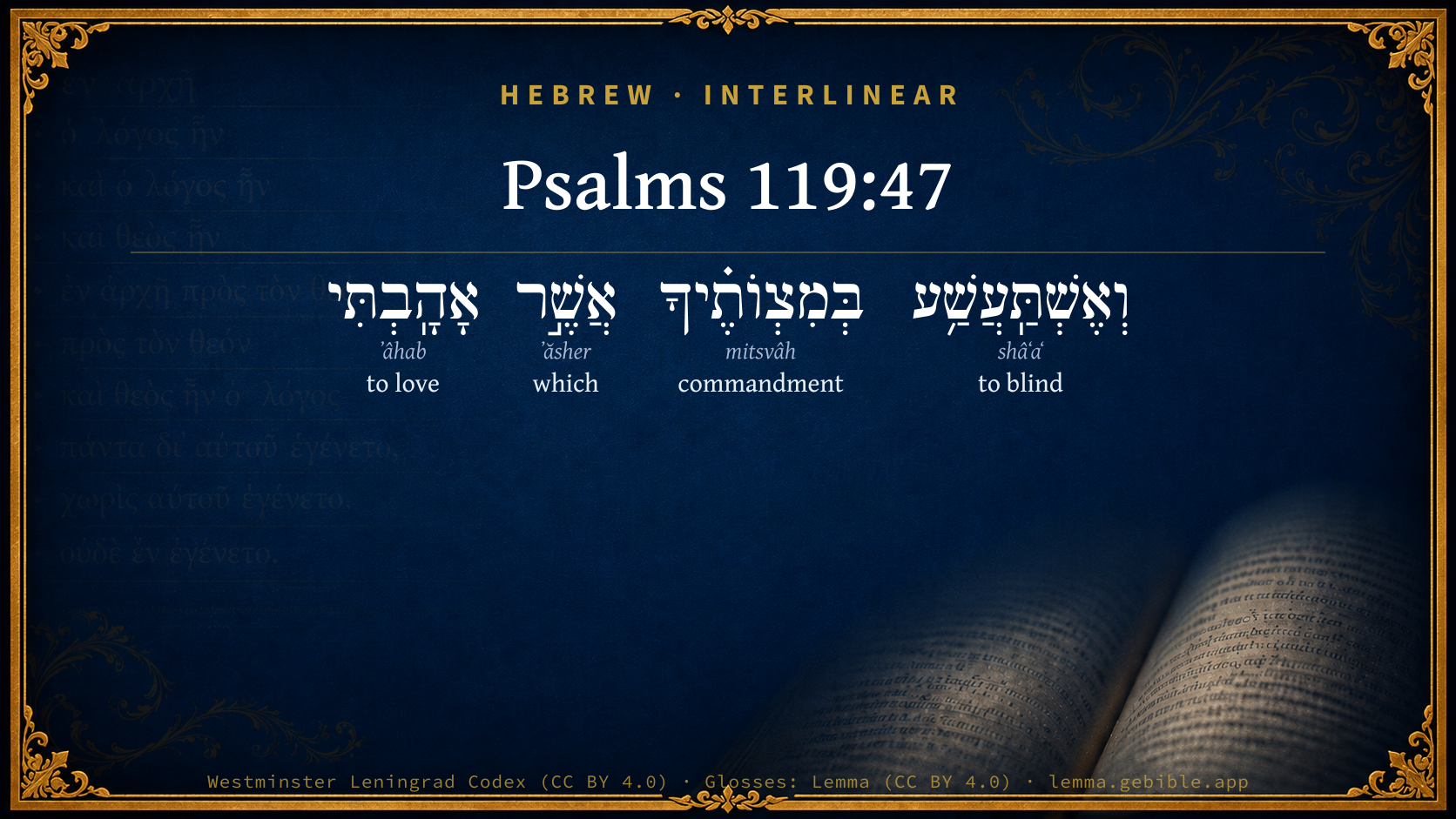
Psalms 119:47

Hebrew (Westminster Leningrad Codex) Psalms 119:47 appears in the Hebrew Old Testament. The text above is from the Westminster Leningrad Codex. Each word links to its Strong’s number, a concise gloss, and parsing drawn from the Open Scriptures Hebrew Bible morphology. Click any word for its full Brown-Driver-Briggs (BDB) entry.
Download image
Cite this verse

Psalms 119:47 (World English Bible). Public Domain. Lemma interlinear Bible study tool, https://lemma.gebible.app/v/psalms/119/47.

Show BibTeX & RIS
BibTeX
RIS
English Translation
I will delight myself in your commandments, Because I love them.
World English Bible · Public Domain
Download a study sheet

One document with this verse’s original text, its word-by-word gloss line, the meaning frame, cross-references with their text, attributed commentary, and full source and license credits — printable, and it pastes into notes with its structure intact.

This verse Autodidact and up

Study sheet (.html) Plain text (.txt)

A passage Seminary Student

Up to 50 verses in one chapter. A passage sheet keeps up to 6 commentary sources and 12 cross-references per verse, in the order this page ranks them, and says so on the sheet whenever that leaves anything out. Ask for a single verse and you get the Autodidact verse sheet above.

Everything on this page stays free to read, with no account — the sheet is a download of what is already on screen, not access to it.

Want to remove ads? Support Godless Engineer
Compare translations 3

The same verse in 3 English versions, stacked beneath the original-language interlinear above. Click any original word for its lexicon entry.

Each is an independent rendering of the whole verse — the interlinear is not word-aligned to these translations.

Highlighted words mark where these versions differ — a whole-verse word diff, not a word-by-word alignment.

  • World English Bible Public Domain
    I will delight myself in your commandments, Because I love them.
  • King James Version Public Domain
    And I will delight myself in thy commandments, which I have loved.
  • unfoldingWord Literal Text CC BY-SA 4.0
    And I delight in your commandments, which I love.

unfoldingWord Literal Text — © unfoldingWord, licensed CC BY-SA 4.0. Word-aligned USFM3 via Door43 (git.door43.org/unfoldingWord/en_ult).

Versions to compare (up to 4)

3 of 4 selected

Show all 17 translations

Every available English version of this verse, each an independent rendering of the whole verse.

  • World English Bible Public Domain
    I will delight myself in your commandments, Because I love them.
  • Berean Standard Bible Public Domain
    I delight in Your commandments because I love them.
  • Majority Standard Bible Public Domain
    I delight in Your commandments because I love them.
  • King James Version Public Domain
    And I will delight myself in thy commandments, which I have loved.
  • American Standard Version (1901) Public Domain
    And I will delight myself in thy commandments, Which I have loved.
  • Revised Version (1885) Public Domain
    And I will delight myself in thy commandments, which I have loved.
  • Geneva Bible (1599) Public Domain
    And my delite shalbe in thy commandements, which I haue loued.
  • Young's Literal Translation Public Domain
    And I delight myself in Thy commands, That I have loved,
  • Literal Standard Version CC BY-SA 4.0
    And I delight myself in Your commands, || That I have loved,
  • Unlocked Literal Bible CC BY-SA 4.0
    I delight in your commandments, which I love dearly.
  • unfoldingWord Literal Text CC BY-SA 4.0
    And I delight in your commandments, which I love.
  • Darby Bible Public Domain
    And I will delight myself in thy commandments, which I have loved;
  • World Messianic Bible Public Domain
    I will delight myself in your commandments, because I love them.
  • Webster's Bible Public Domain
    And I will delight myself in thy commandments, which I have loved.
  • Free Bible Version CC BY-SA 4.0
    I'm so happy for your instructions. I love them!
  • Bible in Basic English Public Domain
    And so that I may take delight in your teachings, to which I have given my love.
  • JPS Tanakh (1917) Public Domain
    And I will delight myself in Thy commandments, which I have loved.

Literal Standard Version (2020), Covenant Press — licensed CC BY-SA 4.0. Text via the HelloAO Bible API (eBible.org). Unlocked Literal Bible (unfoldingWord) — licensed CC BY-SA 4.0. Text via the HelloAO Bible API (eBible.org). unfoldingWord Literal Text — © unfoldingWord, licensed CC BY-SA 4.0. Word-aligned USFM3 via Door43 (git.door43.org/unfoldingWord/en_ult). Free Bible Version, Dr. Jonathan Gallagher — licensed CC BY-SA 4.0. Text via the HelloAO Bible API (eBible.org).

Word by word

More ways to search: Search by grammar → Find every occurrence → Compare this word →

Practice this passage: Drill this verse → Learn its vocabulary →

וְאֶשְׁתַּֽעֲשַׁ֥ע
shâʻaʻ
H8173
“and · to blind”
Conjunction + Verb, Hithpalpel, Imperfect, 1st Person, Common, Singular
Part of Speech
Conjunction + Verb
Stem
Hithpalpel
Form
Imperfect
Person
1st Person
Gender
Common
Number
Singular
Full BDB Definition

Origin: a primitive root

TWOT: 2435 , 2436

to stroke, be smeared over, be blinded - (Qal) - to be smeared over, be blinded - to smear eyes shut - (Hiphil) to besmear (of eyes), smear over eyes - (Hithpalpel) to blind oneself, be blinded - to sport, take delight in - (Pilpel) to sport, delight in, take delight in, delight oneself - (Palpal) to be fondled - (Hithpalpel) to delight oneself
  1. בְּמִצְוֺתֶ֗יךָ mitsvâh H4687 “in/at · commandments · your” Preposition + Noun, Common, Feminine, Plural, Construct + Suffix, Personal, 2nd Person, Masculine, Singular
  2. אֲשֶׁ֣ר ʼăsher H834 “which” Particle, Relative
  3. אָהָֽבְתִּי ʼâhab H157 “to love” Verb, Qal, Perfect, 1st Person, Common, Singular

About this verse

These counts appear in no published source. They are computed here, from the morphology-tagged text and Lemma’s own curated glosses. What Lemma adds →

4
words
4
distinct lemmas
Wisdom
section

Notable vocabulary

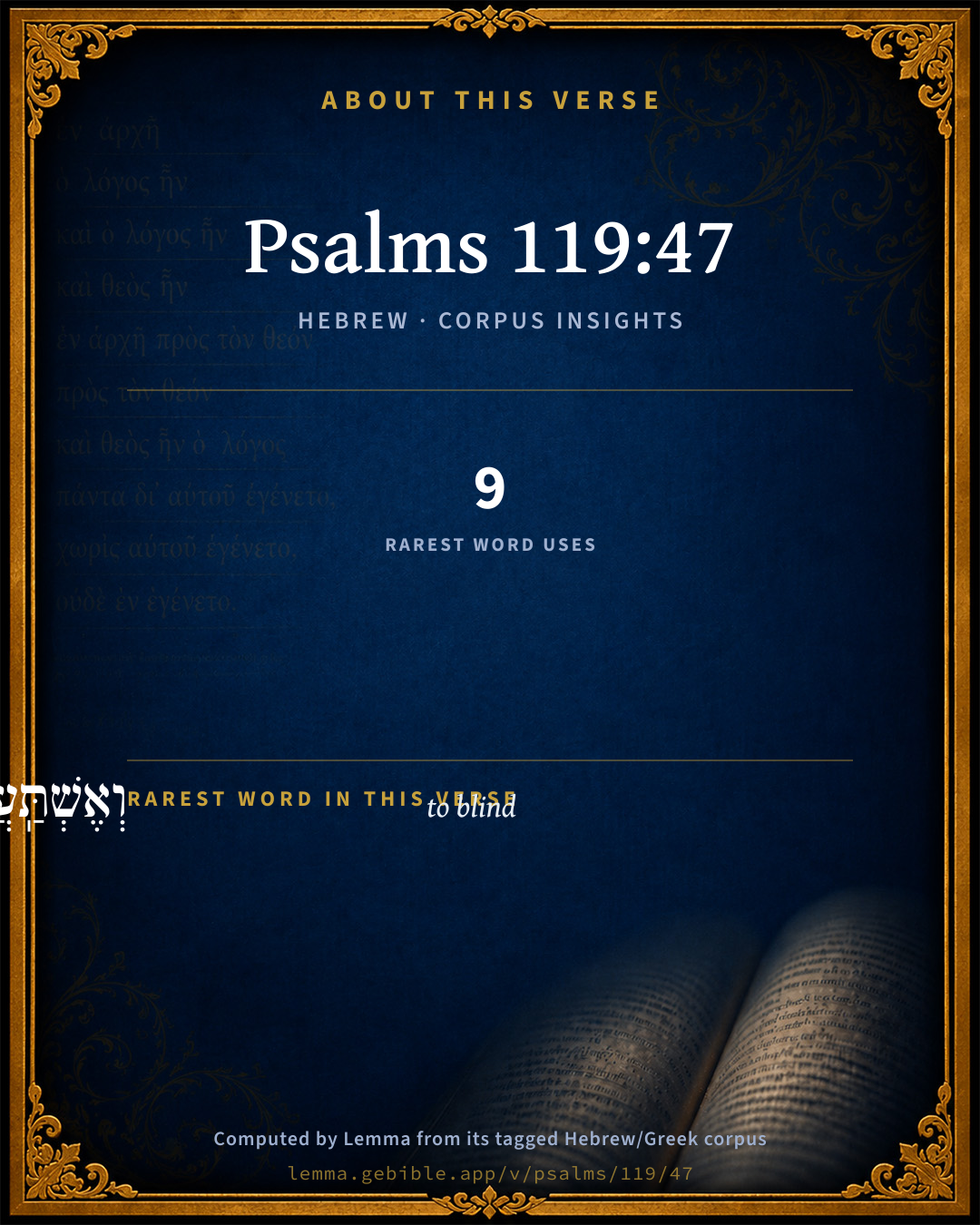
The rarest word here is וְאֶשְׁתַּֽעֲשַׁ֥ע to blind H8173 — appearing just 9 times in the whole Hebrew Bible.

Shared distinctive vocabulary

וְאֶשְׁתַּֽעֲשַׁ֥ע to blind H8173 occurs in 8 verses of the Hebrew Bible. Also found in:

Grammatical profile

  • 2 verbs
  • 1 noun
  • 1 particle

Verb forms

  • וְאֶשְׁתַּֽעֲשַׁ֥ע Hithpalpel · Imperfect
  • אָהָֽבְתִּי Qal · Perfect

Hebrew & Septuagint length

In English translation the verse runs 11 words from the Hebrew and 10 from the Septuagint (LXX English) — closely comparable.

A rough comparison of the two English renderings, which tokenize alike — not a word-level alignment.

Word counts can differ between the Hebrew and the Greek without any difference in meaning — e.g. the Hebrew direct-object marker אֵת has no separate Greek word, and Greek often adds the article ὁ.

Cross-references

17

Topical passages linked to Psalms 119:47 in the Treasury of Scripture Knowledge — connected by theme and wording, ordered by reader-vote popularity; previews shown in the World English Bible.

  • Psalms 119:48 I reach out my hands for your commandments, which I love. I will meditate on your statutes.
  • Psalms 119:97 How love I your law! It is my meditation all day.
  • Psalms 119:127 Therefore I love your commandments more than gold, Yes, more than pure gold.
  • Psalms 19:7–10 Yahweh's law is perfect, restoring the soul. Yahweh's testimony is sure, making wise the simple.
  • Psalms 119:16 I will delight myself in your statutes. I will not forget your word.
  • John 4:34 Jesus said to them, "My food is to do the will of him who sent me, and to accomplish his work.
  • Psalms 119:174 I have longed for your salvation, Yahweh. Your law is my delight.
  • Job 23:11–12 My foot has held fast to his steps. His way have I kept, and not turned aside.
  • Psalms 112:1 Praise Yah! Blessed is the man who fears Yahweh, Who delights greatly in his commandments.
  • Psalms 119:140 Your promises have been thoroughly tested, And your servant loves them.
  • Psalms 119:167 My soul has observed your testimonies. I love them exceedingly.
  • Romans 7:22 For I delight in God's law after the inward man,
  • Psalms 119:24 Indeed your statutes are my delight, And my counselors.
  • Romans 7:12 Therefore the law indeed is holy, and the commandment holy, and righteous, and good.
  • 1 Peter 2:21 For to this you were called, because Christ also suffered for us, leaving you an example, that you should follow his steps,
  • Romans 7:16 But if what I don't desire, that I do, I consent to the law that it is good.

Cross-references courtesy of OpenBible.info (CC BY 4.0).

Hebrew and Greek witnesses Masoretic Hebrew ↔ Greek Septuagint

The same verse in the two great witnesses to the Old Testament, shown verse-for-verse.

You’re reading Greek Psalm 118 (Hebrew Psalm 119). The Septuagint counts the superscription, so verse numbers can differ from the Hebrew — chapter-level alignment, not verse-by-verse. Numbering follows Rahlfs.

These are two independent witnesses, not word-aligned to each other, and the Septuagint is shown in lemma (dictionary) form.

Hebrew Psalms 119:47 Masoretic · Westminster Leningrad Codex

וְאֶשְׁתַּֽעֲשַׁ֥ע בְּמִצְוֺתֶ֗יךָ אֲשֶׁ֣ר אָהָֽבְתִּי

I will delight myself in your commandments, Because I love them.

World English Bible · Public Domain

Greek LXX Greek Psalm 118:47 Septuagint · lemma form

καί μελετάω ἐν ὁ ἐντολή σύ ὅς ἀγαπάω σφόδρα

And I meditated on your commandments, which I loved exceedingly.

LXX2012 (modern English Septuagint) · Public Domain

Hebrew: Westminster Leningrad Codex (CC BY 4.0). Greek: Septuagint (public domain); English from LXX2012 (modern English Septuagint) (Public Domain). How the Septuagint differs from the Hebrew →

Commentary

Notes on Psalms 119:47 from classic Christian and Jewish commentators (each source and its license shown beneath its notes). The classic Christian expositions comment on the surrounding passage and are grouped to its opening verse, so a note may address several verses; the Jewish commentaries on the Tanakh (Rashi and others) are per-verse, so they appear only where the commentator wrote on this verse.

Lemma curates 59 commentaries, every one of them public domain or Creative Commons licensed, each selected and text-cleaned for this edition rather than reprinted as found. About our sources →

Trapp's Complete Commentary

John Trapp

Psa 119:47 And I will delight myself in thy commandments, which I have loved.

Ver. 47. And I will delight myself] sc. In contemplation of thy word. Aristotle telleth us that the principal pleasure is to be found in contemplation (Ethic. lib. 10).

John Trapp, A Commentary or Exposition upon All the Books of the Old and New Testament (1647–1656) — public domain. Text from a community e-Sword module.

The Biblical Illustrator

Joseph S. Exell

Psa_119:47

And I will delight myself in Thy commandments, which I have loved.

God s commandments to be loved

The love of Gods laws is certainly to be distinguished from the mere outward observance of them. As in the law of Moses, so far more in the Gospel of Christ, religion is that of the heart, in the spirit, and not in the letter. As to the reason of the thing, it is plain that in proportion as we have a regard for any person, we always take pleasure in doing what will please him; and that, if we are indifferent and careless about this, it is the strongest of all proofs that our regard for that person is little or none. In the same manner it is plain that there is no proof so decisive of our love or neglect of Almighty God, as whether we love or neglect His commandments. Scripture also solemnly confirms this most reasonable opinion. If ye love Me, keep My commandments. He that hath My commandments, and keepeth them, he it is that loveth Me. If a man love Me, he will keep My Word. And the same kind of warning is to be found in the writings of the apostles, particularly in the Epistles of St. John. And what we particularly observe in it is that, as Christians, we are called to put in practice, not some vague, undetermined, fanciful notions of goodness or virtue, but the plain will and pleasure of our best, I ought to say, our only Friend. The Christian, then, who loves Christ Jesus must of necessity also love His commandments. This being certainly true, it seems no less than necessary for us slit to the best of our ability, to see whether or not we really, as we ought, love what our God commands, and, as the prophet says, delight ourselves in it. For in this respect, as in others, no doubt we may deceive ourselves with false confidence. Yet still there is the utmost necessity that, at the very best, we should bear in mind the solemn caution of the apostle, Re not high-minded, be not too confident of your growth in spiritual grace, of your willingness to endure anything for your Redeemers sake; but fear. (Plain Sermons by Contributors to the Tracts for the Times. )

Delight in Gods commandments

It is not a small progress in godliness to delight in the commandments of God. Our corrupt nature counts them burdenable: but the grace of Christ makes us find His yoke easy, and His burden light. And, indeed, so do His children esteem of it, who have found by experience there is more solid joy in the obedience of Gods commandments than in the perishing pleasures of sin. And would to God they who of a long time have proved the pleasures of transgression would turn them, and prove by experience, on the other hand, what comfort there is in mourning for sin; what is the joy of a good conscience, and the sweet inward pleasures of a godly conversation; they should then easily perceive that the delights of the one do by infinite degrees surmount the pleasures of the other. Natural men do some external works of Gods worship, but not with an inward delight; this is no acceptable service to God. They assemble themselves on the Sabbath with the godly to hear the Word; but what the one doth of delight, the other doth of custom, or compulsion. The Lord looks to the affection more than to the action; and we should not only consider what we do, but how we do it; so to come to the temple, that we come with Simeon, by motion of the Spirit; so to hear the Word, that it be with spiritual joy and delight, as David did. And this also condemns those of our age to whom the Word of the Lord is a reproach and weariness. (Bishop Cowper.)

The Biblical Illustrator, edited by Joseph S. Exell (c. 1880s–1900s) — public domain. Text from a community e-Sword module.

The Treasury of David

Charles H. Spurgeon

Ver. 47. And I will delight myself in thy commandments, which I have loved. Next to liberty and courage comes delight. When we have done our duty, we find a great reward in it. If David had not spoken for his Master before kings, he would have been afraid to think of the law which he had neglected; but after speaking up for his Lord he feels a sweet serenity of heart when musing upon the word. Obey the command, and you will love it; carry the yoke, and it will be easy, and rest will come by it. After speaking of the law the Psalmist was not wearied of his theme, but he retired to meditate upon it; he discoursed and then he delighted, he preached and then repaired to his study to renew his strength by feeding yet again upon the precious truth. Whether he delighted others or not when he was speaking, he never failed to delight himself when he was musing on the word of the Lord. He declares that he loved the Lord's commands, and by this avowal he unveils the reason for his delight in them: where our love is, there is our delight. David did not delight in the courts of kings, for there he found places of temptation to shame, but in the Scriptures he found himself at home; his heart was in them, and they yielded him supreme pleasure. No wonder that he spoke of keeping the law, which he loved; Jesus says, "If a man love me, he will keep my words." No wonder that he spoke of walking at liberty, and speaking boldly, for true love is ever free and fearless. Love is the fulfilling of the law; where love to the law of God reigns in the heart the life must be full of blessedness. Lord, let thy mercies come to us that we may love thy word and way, and find our whole delight therein.

The verse is in the future, and hence it sets forth, not only what David had done, but what he would do; he would in time to come delight in his Lord's command. He knew that they would neither alter, nor fail to yield him joy. He knew also that grace would keep him in the same condition of heart towards the precepts of the Lord, so that he should throughout his whole life take a supreme delight in holiness. His heart was so fixed in love to God's will that he was sure that grace would always hold him under its delightful influence.

All the Psalm is fragrant with love to the word, but here for the first time love is expressly spoken of. It is here coupled with delight, and in Ps 119:165 with "great peace." All the verses in which love declares itself in so many words are worthy of note. See Ps 119:47, 97, 113, 119, 127, 140, 159, 163, 165, 167.

Ver. 47. I will delight myself in thy commandments. It is but poor comfort to the believer to be able to talk well to others upon the ways of God, and even to "bear the reproach" of his people, when his own heart is cold, insensible, and dull. He longs for "delight" in these ways; and he shall delight in them. Charles Bridges.

Ver. 47. He who would preach boldly to others must himself "delight" in the practice of what he preacheth. If there be in us a new nature, it will "love the commandments of God" as being congenial to it; on that which we love we shall continually be "meditating, "and our meditation will end in action; we shall "lift up the hands which hang down" (Heb 12:12), that they may "work the works of God whilst it is day, because the night cometh when no man can work" (Joh 9:4). George Horne.

Ver. 47. Thy commandments, which I have loved. On the word "loved, "the Carmelite quotes two sayings of ancient philosophers, which he commends to the acceptance of those who have learnt the truer philosophy of the Gospel. The first is Aristotle's answer to the question of what profit he had derived from philosophy: "I have learnt to do without constraint that which others do from fear of the law." The second is a very similar saying of Aristippus: "If the laws were lost, all of us would live as we do now that they are in force." And for us the whole verse is summed up in the words of a greater Teacher than they: "If a man love me, he will keep my words": Joh 14:23. Neale and Littledale.

Ver. 47-48. What is in the word a law of precept, is in the heart a law of love; what is in the one a law of command, is in the other a law of liberty "Love is the fulfilling of the law, "Ga 5:14. The law of love in the heart, is the fulfilling the law of God in the Spirit. It may well be said to be written in the heart, when a man doth love it. As we say, a beloved thing is in our hearts, not physically, but morally, as Calais was said to be in Queen Mary's heart. They might have looked long enough before they could have found there the map of the town; but grief for the loss of it killed her. It is a love that is inexpressible. David delights to mention it in two verses together: I will delight myself in thy commandments, which I have loved. My hands also will I lift up unto thy commandments, which I have loved, and often in the Psalm resumes the assertion. Before the new creation, there was no affection to the law: it was not only a dead letter, but a devilish letter in the esteem of a man: he wished it razed out of the world, and another more pleasing to the flesh enacted. He would be a law unto himself; but when this is written within him, he is so pleased with the inscription, that he would not for all the world be without that law, and the love of it; whereas what obedience he paid to it before was out of fear, now out of affection; not only because of the authority of the lawgiver, but of the purity of the law itself. He would maintain it with all his might against the power of sin within, and the powers of darkness without him. He loves to view this law; regards every lineament of it, and dwells upon every feature with delightful ravishments. If his eye be off, or his foot go away, how doth he dissolve in tears, mourn and groan, till his former affection hath recovered breath, and stands upon its feet! Stephen Charnock.

Psalms 119:48*

Charles H. Spurgeon's The Treasury of David (1869–1885) — public domain. Psalms only. Text from a community e-Sword/MySword module.

J. A. Alexander on Psalms

Joseph Addison Alexander

47. (Psa 119:47) And I will delight myself in thy commandments which I love. I will not obey them merely from a selfish dread of punishment or painful sense of obligation, but because I love them and derive my highest happiness from doing them. See above, on Psa 19:11. The first verb has the same sense as in Psa 119:16. The past tense of the last verb (I have loved) represents his love to God's commandments as no new-born and capricious passion, but a settled habit and affection of his soul.

Joseph Addison Alexander, The Psalms Translated and Explained (1850) — public domain. Text from a community e-Sword module.

Tyndale Open Study Notes

Tyndale Open Resources

119:47-48 The psalmist finds delight in God’s word in spite of pain (119:92, 143).

Tyndale Open Study Notes — © Tyndale Open Resources, licensed CC BY-SA 4.0. Text via the HelloAO Bible API.

Adam Clarke's Commentary

Verse 47. Thy commandments, which I have loved.] O shame to Christians who feel so little affection to the Gospel of Christ, when we see such cordial, conscientious, and inviolate attachment in a Jew to the laws and ordinances of Moses, that did not afford a thousandth part of the privileges!

Adam Clarke's Commentary on the Bible (1810–1826) — public domain. Text from a community e-Sword/MySword module.

John Calvin's Commentaries

47. And I will delight myself The sentiment contained in this verse is similar to that which he had previously mentioned. The amount is, he held the commandments of God in such high esteem, that he experienced nothing more pleasant to him than the making of them his constant theme of meditation. By the term delight, he expresses the intensity of his love. The phrase I will lift up my hands, refers, to the same thing. It is a sure indication that we eagerly desire a thing when we stretch out the hands to grasp and enjoy it. This simile, therefor denotes the ardor of his desire. If a man, by his mien and gait pretend any such affection for the law of God, and yet pay no regard to it in the affairs of life, he would be justly chargeable with the basest hypocrisy. Again, he affirms, that that affection, so earnest and so ardent, springs from the sweetness of the law of God having knit our hearts to it. Finally, he says, he would meditate on God’s testimonies. Along with the majority of commentators, I have no doubt that the word שוח shuach, denotes that silent and secret musing in which the children of God exercise themselves.

John Calvin's Commentaries (1540-1563) — public domain. Text from the Calvin Translation Society English edition (1840s-50s) via the Christian Classics Ethereal Library (ccel.org). Calvin's coverage is partial (roughly two-thirds of the Bible); uncommented books and verses are honest gaps, never fabricated. The 19th-century editor's footnotes and remarks are omitted so the notes are faithfully Calvin's own voice.

The Cambridge Bible for Schools and Colleges

gen. ed. J. J. S. Perowne

47. Cp. Psa_119:16; Psa_119:70.

which I love] Cp. vv. [48], 97, 113, 119, 127, 140, 159, 163; and see above, p. 705.

The Cambridge Bible for Schools and Colleges (gen. ed. J. J. S. Perowne; Cambridge University Press, 1878–1918) — public domain. Text from a community e-Sword module.

John Gill's Exposition

ZAIN.--The Seventh Part.

ZAIN. Remember the word unto thy servant,.... The word of promise made unto him, concerning establishing his house and kingdom for ever; which he desires God would show himself mindful of in fulfilling it, and renew and confirm his faith in it, and give him some fresh assurance of the performance of it, Sa2 7:16. Not that God ever forgets his promise, or is unmindful of his word; but so it seems when he delays the accomplishment of it; and when unbelief prevails and doubts arise, and faith is not in lively exercise; and he has not so clear a view of the promise, and comfortable assurance of its being performed;

upon which thou hast caused me to hope; which, when first made, he received in faith, and hoped and waited for the accomplishment of. A word of promise is a good ground of hope, let it be on what account it will; whether it relates to interest in God, as a covenant God and Father; or to pardon of sin; or to salvation by Christ; or to fresh supplies of grace and strength from him; or to eternal life through him: and the hope which is exercised on the promise is not of a man's self; it is the gift of God, a good hope through grace; which the Lord, by his Spirit and power, produces, and causes to abound in, or to exercise in a comfortable manner.

John Gill's Exposition of the Whole Bible (1746–1763) — public domain (CC PDM 1.0). Text via the HelloAO Bible API.

Albert Barnes' Notes on the Bible

And I will delight myself ... - See the notes at Psa 119:16.

Albert Barnes' Notes on the Bible (1834–1885) — public domain. Text from a community e-Sword/MySword module.

Matthew Poole's English Annotations

Whereas other princes place their delight in the glories and vanities of this world, and the study and practice of religion is generally irksome and loathsome to them, thy law shall be my chief delight and recreation.

Matthew Poole's English Annotations on the Holy Bible (1683–1685) — public domain. Text from a community e-Sword/MySword module.

The Pulpit Commentary

And I will delight myself in thy commandments (comp. vers. 14, 16, 24, 35, 77, etc.). Which I have loved (see below, vers. 48, 97, 113, 119, 127, 159, 163, 167).

The joy of obedience.

"And I will delight myself in thy commandments." It may be urged, and indeed it is sometimes urged, that "obedience is obedience by whomsoever it is done, in whatsoever circumstances and in whatsoever spirit. If a master or a king issues a command, he gets all he can expect to get if what he wishes to be done is done. It cannot matter to him whether it is done with a grumble or with a smile. And it must be the same with God. We may reasonably expect him to be satisfied if what he wishes to have done is done." It is easy to answer that formal obedience involves no personal relationship; but as soon as that is recognized, the moral quality of the obedience becomes the true ground of acceptance. What is really accepted is the man in the obedience, and not the mere act of obedience. The best figures of the Divine relations with men are taken from family life. A master may be satisfied with formal obedience, and so may a king (though the deeper truth is that both want to find willing love-service in the obedience), but a father never is. He wants his child to obey; but he never can rest content until his child loves to obey, and is manifestly happy in his obedience.

I AN OBEDIENCE WHICH CAUSES STRAIN.

1. There is the strain which follows upon the feeling that we must. A power is compelling us a power which we fear; a power which can punish, "casting body and soul into hell." Much of the obedience of life has no higher range than this. Men obey, but there is neither credit nor joy in their obedience, for in their hearts they say, We would not, if we dared not." Neither God nor man cares for such obedience as that.

2. There is the strain which follows upon the feeling that we ought. This is altogether higher and nobler. Duty is one of the most exalted inspirations. And yet it may keep the strain, and a man may but force himself to meet his duty. If man may be satisfied with that, God cannot. The true obedience is out of the range of strain. God"s acceptance waits until heart and hand go well together, and we love what we do.

II THE OBEDIENCE WHICH KNOWS NO STRAIN. It is no trouble to do what we wish to do. There is no sense of strain when we love and choose and persist in finding our pleasure in what we do. The soul moves freely in its delights. Make a joy of your obedience, and the result is that obedience becomes your joy. R.T.

The Pulpit Commentary (1880–1919), ed. H.D.M. Spence-Jones & Joseph S. Exell — public domain. Text from a community e-Sword module.

unfoldingWord translationNotes

Door43 World Missions Community

I delight in your commandments

Possible meanings are 1) "I find delight in studying your commandments" or 2) "I am delighted that I have the opportunity to study your commandments."

lift up my hands to

This is an idiom which means to honor, cherish or respect God's commandments. (See: Idiom)

translationWords

love

hand

statute

unfoldingWord translationNotes — © Distant Shores Media and the Door43 World Missions Community, licensed CC BY-SA 4.0. Source: git.door43.org/Door43/en_tn.

Lesson kit

Teaching starters — assembled from the data on this page, not authored interpretation. Every prompt links to the verse data it draws on. Edit before teaching.

Psalms, in the Wisdom, opens this verse with 4 words (4 distinct Hebrew lemmas). Its most distinctive word is shâʻaʻ (“to blind”). A historical commentator’s framing appears above. Read the whole chapter for the surrounding context.

Discussion questions

  1. How does “to blind” (shâʻaʻ) shape what this verse is saying?
  2. Psalms 94:19 shares the word «to blind» with this verse. How do the two illuminate each other?
  3. The translations on this page render this verse differently — a whole-verse word diff, not a word-by-word alignment. What might account for the different wordings?
  4. The verb «וְאֶשְׁתַּֽעֲשַׁ֥ע» is Hithpalpel Imperfect. How does its form color the action?
  5. Reading how Trapp's Complete Commentary and The Biblical Illustrator read this verse, where do the two commentators agree and where do they part?

Things to notice

Reading settings

Reading text

Shown beneath each verse's original-language words.

Old Testament
Old Testament edition

Read the OT as the Masoretic Hebrew (MT) or the Greek Septuagint (LXX).

English shown for the Greek Septuagint (in the Hebrew ↔ Greek comparison).

Comparing translations? Open the Compare panel on any verse page to stack up to four side by side.