
Deuteronomy 30:6

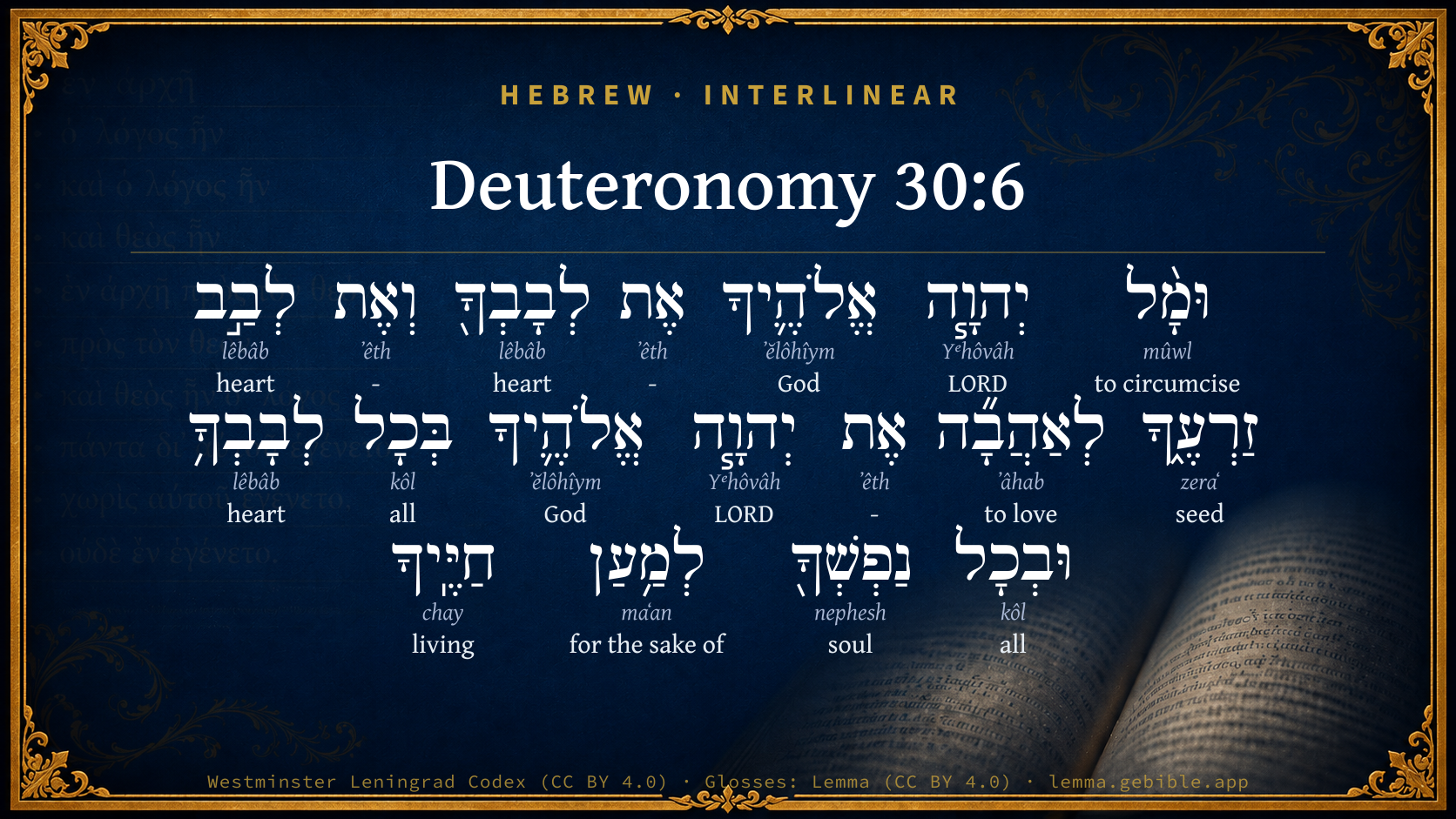
Hebrew (Westminster Leningrad Codex) Deuteronomy 30:6 appears in the Hebrew Old Testament. The text above is from the Westminster Leningrad Codex. Each word links to its Strong’s number, a concise gloss, and parsing drawn from the Open Scriptures Hebrew Bible morphology. Click any word for its full Brown-Driver-Briggs (BDB) entry.
Download image
Cite this verse

Deuteronomy 30:6 (World English Bible). Public Domain. Lemma interlinear Bible study tool, https://lemma.gebible.app/v/deuteronomy/30/6.

Show BibTeX & RIS
BibTeX
RIS
English Translation
Yahweh your God will circumcise your heart, and the heart of your seed, to love Yahweh your God with all your heart, and with all your soul, that you may live.
World English Bible · Public Domain
Download a study sheet

One document with this verse’s original text, its word-by-word gloss line, the meaning frame, cross-references with their text, attributed commentary, and full source and license credits — printable, and it pastes into notes with its structure intact.

This verse Autodidact and up

Study sheet (.html) Plain text (.txt)

A passage Seminary Student

Up to 50 verses in one chapter. A passage sheet keeps up to 6 commentary sources and 12 cross-references per verse, in the order this page ranks them, and says so on the sheet whenever that leaves anything out. Ask for a single verse and you get the Autodidact verse sheet above.

Everything on this page stays free to read, with no account — the sheet is a download of what is already on screen, not access to it.

Want to remove ads? Support Godless Engineer
Compare translations 3

The same verse in 3 English versions, stacked beneath the original-language interlinear above. Click any original word for its lexicon entry.

Each is an independent rendering of the whole verse — the interlinear is not word-aligned to these translations.

Highlighted words mark where these versions differ — a whole-verse word diff, not a word-by-word alignment.

  • World English Bible Public Domain
    Yahweh your God will circumcise your heart, and the heart of your seed, to love Yahweh your God with all your heart, and with all your soul, that you may live.
  • King James Version Public Domain
    And the LORD thy God will circumcise thine heart, and the heart of thy seed, to love the LORD thy God with all thine heart, and with all thy soul, that thou mayest live.
  • unfoldingWord Literal Text CC BY-SA 4.0
    And Yahweh your God will circumcise your heart and the heart of your seed, to the love of Yahweh your God with all your heart and with all your soul, so that you may live.

unfoldingWord Literal Text — © unfoldingWord, licensed CC BY-SA 4.0. Word-aligned USFM3 via Door43 (git.door43.org/unfoldingWord/en_ult).

Versions to compare (up to 4)

3 of 4 selected

Show all 18 translations

Every available English version of this verse, each an independent rendering of the whole verse.

  • World English Bible Public Domain
    Yahweh your God will circumcise your heart, and the heart of your seed, to love Yahweh your God with all your heart, and with all your soul, that you may live.
  • Berean Standard Bible Public Domain
    The LORD your God will circumcise your hearts and the hearts of your descendants, and you will love Him with all your heart and with all your soul, so that you may live.
  • Majority Standard Bible Public Domain
    The LORD your God will circumcise your hearts and the hearts of your descendants, and you will love Him with all your heart and with all your soul, so that you may live.
  • King James Version Public Domain
    And the LORD thy God will circumcise thine heart, and the heart of thy seed, to love the LORD thy God with all thine heart, and with all thy soul, that thou mayest live.
  • American Standard Version (1901) Public Domain
    And Jehovah thy God will circumcise thy heart, and the heart of thy seed, to love Jehovah thy God with all thy heart, and with all thy soul, that thou mayest live.
  • Revised Version (1885) Public Domain
    And the LORD thy God will circumcise thine heart, and the heart of thy seed, to love the LORD thy God with all thine heart, and with all thy soul, that thou mayest live.
  • Geneva Bible (1599) Public Domain
    And the Lord thy God will circumcise thine heart, and the heart of thy seede, that thou mayest loue the Lord thy God with all thine heart, and with al thy soule, that thou maiest liue.
  • Douay-Rheims (1899) Public Domain
    The Lord thy God will circumcise thy heart, and the heart of thy seed: that then mayst love the Lord thy God with all thy heart and with all thy soul, that thou mayst live.
  • Young's Literal Translation Public Domain
    `And Jehovah thy God hath circumcised thy heart, and the heart of thy seed, to love Jehovah thy God with all thy heart, and with all thy soul, for the sake of thy life;
  • Literal Standard Version CC BY-SA 4.0
    And your God YHWH has circumcised your heart and the heart of your seed, to love your God YHWH with all your heart and with all your soul, for the sake of your life;
  • Unlocked Literal Bible CC BY-SA 4.0
    Yahweh your God will circumcise your heart and the heart of your descendants, so you will love Yahweh your God with all your heart and with all your soul, so that you may live.
  • unfoldingWord Literal Text CC BY-SA 4.0
    And Yahweh your God will circumcise your heart and the heart of your seed, to the love of Yahweh your God with all your heart and with all your soul, so that you may live.
  • Darby Bible Public Domain
    And Jehovah thy God will circumcise thy heart, and the heart of thy seed, to love Jehovah thy God with all thy heart and with all thy soul, that thou mayest live.
  • World Messianic Bible Public Domain
    The LORD your God will circumcise your heart, and the heart of your offspring, to love the LORD your God with all your heart and with all your soul, that you may live.
  • Webster's Bible Public Domain
    And the LORD thy God will circumcise thy heart, and the heart of thy seed, to love the LORD thy God with all thy heart, and with all thy soul, that thou mayest live.
  • Free Bible Version CC BY-SA 4.0
    The Lord your God will make you and your descendants his again, and you will love him with all your mind and with all your being, so that you'll live.
  • Bible in Basic English Public Domain
    And the Lord your God will give to you and to your seed a circumcision of the heart, so that, loving him with all your heart and all your soul, you may have life.
  • JPS Tanakh (1917) Public Domain
    And the LORD thy God will circumcise thy heart, and the heart of thy seed, to love the LORD thy God with all thy heart, and with all thy soul, that thou mayest live.

Literal Standard Version (2020), Covenant Press — licensed CC BY-SA 4.0. Text via the HelloAO Bible API (eBible.org). Unlocked Literal Bible (unfoldingWord) — licensed CC BY-SA 4.0. Text via the HelloAO Bible API (eBible.org). unfoldingWord Literal Text — © unfoldingWord, licensed CC BY-SA 4.0. Word-aligned USFM3 via Door43 (git.door43.org/unfoldingWord/en_ult). Free Bible Version, Dr. Jonathan Gallagher — licensed CC BY-SA 4.0. Text via the HelloAO Bible API (eBible.org).

Word by word

More ways to search: Search by grammar → Find every occurrence → Compare this word →

Practice this passage: Drill this verse → Learn its vocabulary →

וּמָ֨ל
mûwl
H4135
“and · to circumcise”
Conjunction + Verb, Qal, Sequential Perfect, 3rd Person, Masculine, Singular
Part of Speech
Conjunction + Verb
Stem
Qal
Form
Sequential Perfect
Person
3rd Person
Gender
Masculine
Number
Singular
Full BDB Definition

Origin: a primitive root

TWOT: 1161

to circumcise, let oneself be circumcised, cut, be cut off - (Qal) to circumcise - (Niphal) to be circumcised, circumcise oneself - (Hiphil) to cause to be circumcised - of destruction (figuratively) - (Hithpolel) to be cut off - (Polel) cut down
  1. יְהוָ֧ה Yᵉhôvâh H3068 “LORD” Noun, Proper
  2. אֱלֹהֶ֛יךָ ʼĕlôhîym H430 “God(s) · your” Noun, Common, Masculine, Plural, Construct + Suffix, Personal, 2nd Person, Masculine, Singular
  3. אֶת ʼêth H853 “-” Particle, Direct Object
  4. לְבָבְךָ֖ lêbâb H3824 “heart · your” Noun, Common, Masculine, Singular, Construct + Suffix, Personal, 2nd Person, Masculine, Singular
  5. וְאֶת ʼêth H853 “and · -” Conjunction + Particle, Direct Object
  6. לְבַ֣ב lêbâb H3824 “heart of” Noun, Common, Masculine, Singular, Construct
  7. זַרְעֶ֑ךָ zeraʻ H2233 “seed · your” Noun, Common, Masculine, Singular, Construct + Suffix, Personal, 2nd Person, Masculine, Singular
  8. לְאַהֲבָ֞ה ʼâhab H157 “to love” Preposition + Verb, Qal, Infinitive Construct
  9. אֶת ʼêth H853 “-” Particle, Direct Object
  10. יְהוָ֧ה Yᵉhôvâh H3068 “LORD” Noun, Proper
  11. אֱלֹהֶ֛יךָ ʼĕlôhîym H430 “God(s) · your” Noun, Common, Masculine, Plural, Construct + Suffix, Personal, 2nd Person, Masculine, Singular
  12. בְּכָל kôl H3605 “in/at · all of” Preposition + Noun, Common, Masculine, Singular, Construct
  13. לְבָבְךָ֥ lêbâb H3824 “heart · your” Noun, Common, Masculine, Singular, Construct + Suffix, Personal, 2nd Person, Masculine, Singular
  14. וּבְכָל kôl H3605 “and · in/at · all of” Conjunction + Preposition + Noun, Common, Masculine, Singular, Construct
  15. נַפְשְׁךָ֖ nephesh H5315 “soul · your” Noun, Common, Both, Singular, Construct + Suffix, Personal, 2nd Person, Masculine, Singular
  16. לְמַ֥עַן maʻan H4616 “for the sake of” Preposition
  17. חַיֶּֽיךָ chay H2416 “living things · your” Noun, Common, Masculine, Plural, Construct + Suffix, Personal, 2nd Person, Masculine, Singular

About this verse

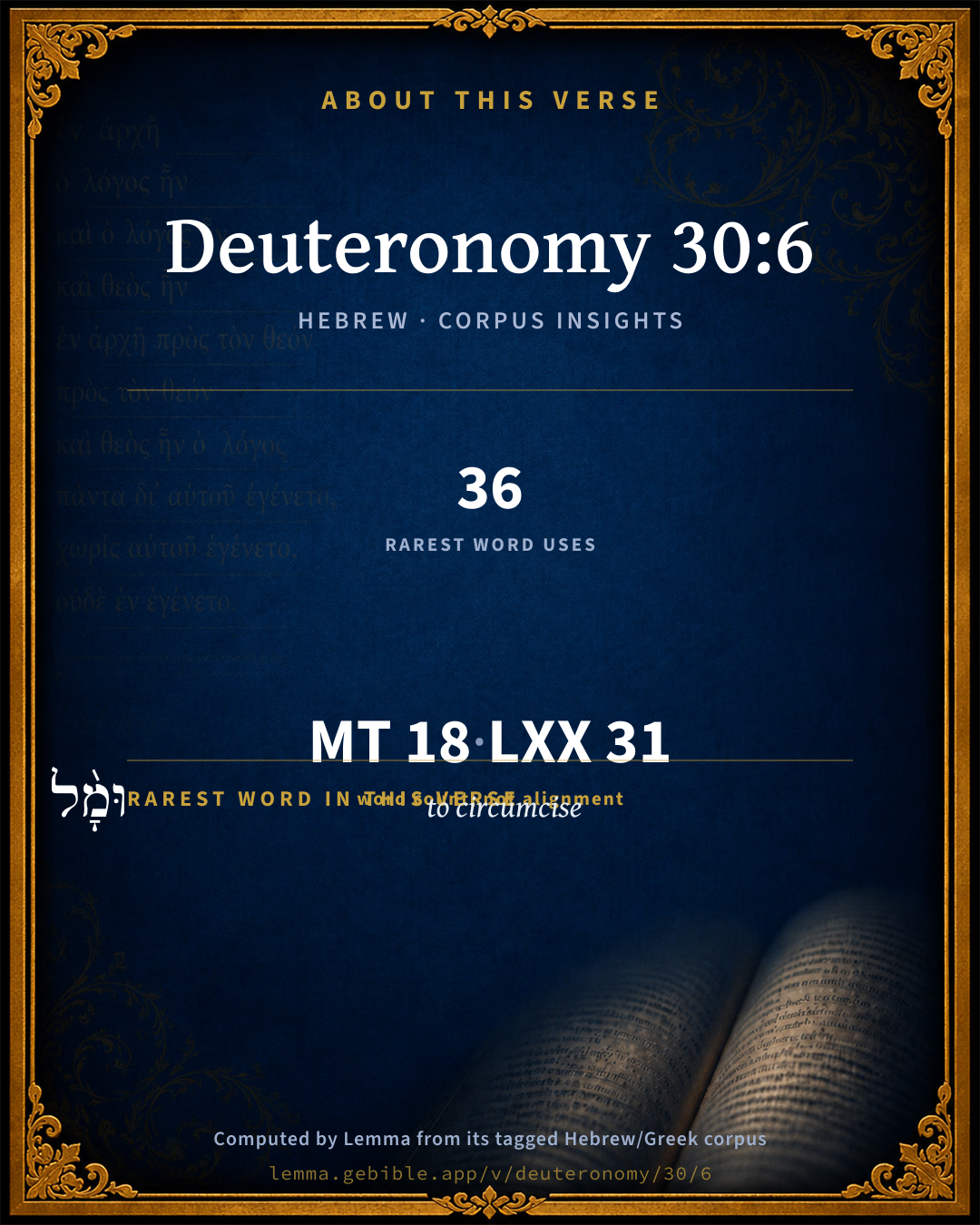
These counts appear in no published source. They are computed here, from the morphology-tagged text and Lemma’s own curated glosses. What Lemma adds →

18
words
11
distinct lemmas
Pentateuch
section

Shared distinctive vocabulary

וּמָ֨ל to circumcise H4135 occurs in 32 verses of the Hebrew Bible. Also found in:

Grammatical profile

  • 2 verbs
  • 12 nouns
  • 1 preposition
  • 3 particles

Verb forms

  • וּמָ֨ל Qal · Sequential Perfect
  • לְאַהֲבָ֞ה Qal · Infinitive Construct

Repetition

Words recur within this verse — often emphatic in Hebrew:

  • לְבָבְךָ֖ heart H3824 ×3
  • יְהוָ֧ה LORD H3068 ×2
  • אֱלֹהֶ֛יךָ God H430 ×2
  • בְּכָל all H3605 ×2

Hebrew & Septuagint length

In English translation the verse runs 31 words from the Hebrew and 32 from the Septuagint (LXX English) — closely comparable.

A rough comparison of the two English renderings, which tokenize alike — not a word-level alignment.

Word counts can differ between the Hebrew and the Greek without any difference in meaning — e.g. the Hebrew direct-object marker אֵת has no separate Greek word, and Greek often adds the article ὁ.

In the original languages it is 18 Hebrew tokens and 31 Greek tokens — but the two are counted differently (Hebrew bundles its prefixes and suffixes into one token; the Greek is in lemma form), so that isn’t a like-for-like length.

Cross-references

21

Topical passages linked to Deuteronomy 30:6 in the Treasury of Scripture Knowledge — connected by theme and wording, ordered by reader-vote popularity; previews shown in the World English Bible.

  • Deuteronomy 10:16 Circumcise therefore the foreskin of your heart, and be no more stiff-necked.
  • Ezekiel 36:26–27 A new heart also will I give you, and a new spirit will I put within you; and I will take away the stony heart out of your flesh, and I will give you a heart of flesh.
  • Jeremiah 32:39 and I will give them one heart and one way, that they may fear me forever, for the good of them, and of their children after them:
  • Ezekiel 11:19–20 I will give them one heart, and I will put a new spirit within you; and I will take the stony heart out of their flesh, and will give them a heart of flesh;
  • Romans 2:28–29 For he is not a Jew who is one outwardly, neither is that circumcision which is outward in the flesh;
  • Colossians 2:11 in whom you were also circumcised with a circumcision not made with hands, in the putting off of the body of the sins of the flesh, in the circumcision of Christ;
  • Jeremiah 4:4 Circumcise yourselves to Yahweh, and take away the foreskins of your heart, you men of Judah and inhabitants of Jerusalem; lest my wrath go forth like fire, and burn so that none can quench it, because of the evil of your doings.
  • Deuteronomy 6:5 and you shall love Yahweh your God with all your heart, and with all your soul, and with all your might.
  • 1 John 5:3–4 For this is the love of God, that we keep his commandments. His commandments are not grievous.
  • Matthew 22:37 Jesus said to him, "'You shall love the Lord your God with all your heart, and with all your soul, and with all your mind.'
  • 2 Corinthians 5:17 Therefore if anyone is in Christ, he is a new creation. The old things have passed away. Behold, all things have become new.
  • 1 John 4:7 Beloved, let us love one another, for love is of God; and everyone who loves is born of God, and knows God.
  • Romans 11:26 and so all Israel will be saved. Even as it is written, "There will come out of Zion the Deliverer, And he will turn away ungodliness from Jacob.
  • 1 Corinthians 8:3 But if anyone loves God, the same is known by him.
  • James 1:12 Blessed is the man who endures temptation, for when he has been approved, he will receive the crown of life, which the Lord promised to those who love him.
  • 1 John 4:16–19 We know and have believed the love which God has for us. God is love, and he who remains in love remains in God, and God remains in him.
  • Exodus 20:6 and showing loving kindness to thousands of those who love me and keep my commandments.
  • Romans 8:28 We know that all things work together for good for those who love God, to those who are called according to his purpose.
  • Jeremiah 9:26 Egypt, and Judah, and Edom, and the children of Ammon, and Moab, and all that have the corners [of their hair] cut off, who dwell in the wilderness; for all the nations are uncircumcised, and all the house of Israel are uncircumcised in heart.
  • John 3:3–7 Jesus answered him, "Most assuredly, I tell you, unless one is born anew, he can't see the Kingdom of God."
  • James 2:5 Listen, my beloved brothers. Didn't God choose those who are poor in this world to be rich in faith, and heirs of the Kingdom which he promised to those who love him?

Cross-references courtesy of OpenBible.info (CC BY 4.0).

Hebrew and Greek witnesses Masoretic Hebrew ↔ Greek Septuagint

The same verse in the two great witnesses to the Old Testament, shown verse-for-verse.

These are two independent witnesses, not word-aligned to each other, and the Septuagint is shown in lemma (dictionary) form.

Hebrew Deuteronomy 30:6 Masoretic · Westminster Leningrad Codex

וּמָ֨ל יְהוָ֧ה אֱלֹהֶ֛יךָ אֶת לְבָבְךָ֖ וְאֶת לְבַ֣ב זַרְעֶ֑ךָ לְאַהֲבָ֞ה אֶת יְהוָ֧ה אֱלֹהֶ֛יךָ בְּכָל לְבָבְךָ֥ וּבְכָל נַפְשְׁךָ֖ לְמַ֥עַן חַיֶּֽיךָ

Yahweh your God will circumcise your heart, and the heart of your seed, to love Yahweh your God with all your heart, and with all your soul, that you may live.

World English Bible · Public Domain

Greek LXX Deuteronomy 30:6 Septuagint · lemma form

καί περικαθαρίζω κύριος ὁ καρδία σύ καί ὁ καρδία ὁ σπέρμα σύ ἀγαπάω κύριος ὁ θεός σύ ἐκ ὅλος ὁ καρδία σύ καί ἐκ ὅλος ὁ ψυχή σύ ἵνα ζάω σύ

And the Lord shall purge your heart, and the heart of your seed, to love the Lord your God with all your heart, and with all your soul, that you may live.

LXX2012 (modern English Septuagint) · Public Domain

On this verse, Haydock's Catholic Bible Commentary discusses the Septuagint’s reading. Read the note in Commentary ↓

Hebrew: Westminster Leningrad Codex (CC BY 4.0). Greek: Septuagint (public domain); English from LXX2012 (modern English Septuagint) (Public Domain). How the Septuagint differs from the Hebrew →

Targum (Aramaic paraphrase)

2

The Targum is the ancient Jewish Aramaic paraphrase of the Hebrew Scriptures — an interpretive translation, not the Hebrew text itself. Onkelos (literal) and Pseudo-Jonathan (expansive) render the Torah, and Jonathan the Prophets. Coverage is partial: where no permissively-licensed English translation exists for a verse, only the Aramaic is shown. This is verse-level text, not a word-by-word alignment to the Hebrew.

  1. Targum Onkelos Torah (Genesis–Deuteronomy)
    וְיֶעְדֵי יְיָ אֱלָהָךְ יָת טַפְשׁוּת לִבָּךְ וְיָת טַּפְשׁוּת לִבָּא דִבְנָיךְ לְמִרְחַם יָת יְיָ אֱלָהָךְ בְּכָל לִבָּךְ וּבְכָל נַפְשָׁךְ בְּדִיל חַיָיךְ

    (no public-domain English translation for this verse)

    Targum Onkelos — Aramaic: “Onkelos Genesis” (public domain); “Onkelos Exodus” (public domain); “Onkelos Leviticus” (public domain); “Onkelos Numbers” (public domain); “Onkelos Deuteronomy” (public domain). English: “Sefaria Community Translation” (CC0 1.0 (public-domain dedication)); “J.W. Etheridge. The Targums of Onkelos and Jonathan Ben Uzziel on the Pentateuch. London: Longmans, Green, 1862” (public domain). Text via Sefaria.

  2. Targum Pseudo-Jonathan Torah (Genesis–Deuteronomy)
    וְיַעֲדֵי יְיָ אֱלָהָכוֹן יַת טִפְּשׁוּת לִבְּכוֹן וְיַת טִפְּשׁוּת לִבָּא דִבְנֵיכוֹן אֲרוּם יְבַטֵל יִצְרָא בִּישָׁא מִן עַלְמָא וְיִבְרֵי יִצְרָא טָבָא דִי יַמְלְכִינְכוֹן לְמִירְחַם יַת יְיָ אֱלָהָכוֹן בְּכָל לִבְּכוֹן וּבְכָל נַפְשְׁכוֹן מִן בִּגְלַל דְיוֹגְדוּן חַיֵיכוֹן עַד עַלְמִין

    And the Lord your God will take away the foolishness of your heart, and of your children’s heart; for He will abolish evil desire from the world, and create good desire, which will give you the dictate to love the Lord your God with all your heart and soul, that your lives may flow on for evermore.

    Targum Pseudo-Jonathan — Aramaic: “Targum Jonathan on Genesis” (public domain); “Targum Jonathan on Exodus” (public domain); “Targum Jonathan on Leviticus” (public domain); “Targum Jonathan on Numbers” (public domain); “Targum Jonathan on Deuteronomy” (public domain). English: “The Targum of Jonathan ben Uzziel, trans. J. W. Etheridge, London, 1862” (public domain). Text via Sefaria.

Commentary

Notes on Deuteronomy 30:6 from classic Christian and Jewish commentators (each source and its license shown beneath its notes). The classic Christian expositions comment on the surrounding passage and are grouped to its opening verse, so a note may address several verses; the Jewish commentaries on the Tanakh (Rashi and others) are per-verse, so they appear only where the commentator wrote on this verse.

Lemma curates 59 commentaries, every one of them public domain or Creative Commons licensed, each selected and text-cleaned for this edition rather than reprinted as found. About our sources →

Trapp's Complete Commentary

John Trapp

Deu 30:6 And the LORD thy God will circumcise thine heart, and the heart of thy seed, to love the LORD thy God with all thine heart, and with all thy soul, that thou mayest live.

Ver. 6. And the Lord thy God.] See Deu 10:16.

John Trapp, A Commentary or Exposition upon All the Books of the Old and New Testament (1647–1656) — public domain. Text from a community e-Sword module.

The Biblical Illustrator

Joseph S. Exell

Deu_30:6

Circumcise thine heart.

Circumcision

Circumcision was the sign of the covenant God made with Abraham, mention of which we have in Gen_17:1-27, and which the first martyr, St. Stephen, quoted in that remarkable address in Act_7:8, where he said, And He gave him the Covenant of Circumcision: and so Abraham begat Isaac, and circumcised him the eighth day. And St. Paul in writing to the Rom_4:11, speaking of Abraham, says, And he received the sign of circumcision, a seal of the righteousness of the faith which he had yet being uncircumcised: that he might be the father of all them that believe, though they be not circumcised; that righteousness might be imputed unto them also. This sign was also made with Abrahams seed--that is, Christ--as St. Paul tells us in Gal_3:16. This was then the Covenant of Grace, the Gospel which preceded the law. To Israel this covenant was an outward sign that God would give them rest in Canaan; and to all of us it is a sign continued in Christian baptism, and a seal that God is not ashamed to be called their God, for He hath prepared for them a city. This rite of circumcision was performed by the cutting off of the flesh of the foreskin; this was cut off and cast away, to show that the body of the sins of the flesh must be put off; a list of what some of these are we have in Col_3:5. On this account we are told in Deu_10:16, Circumcise the foreskin of your hearts, and in the text, Circumcise thine heart. Ishmael was circumcised although the covenant was made with Abraham and Isaac, for the children of believing parents must be sealed with its seal for the reasons given by St. Paul in 1Co_7:14. The act of circumcising the male child was a painful ceremony, and was full of meaning, suggesting then what the New Testament teaches now, Your body is the temple of the Holy Ghost. This rite of circumcision was administered to a child who could know nothing except pain. What good was it? How unreasonable! and how cruel--we would be prompted to ask. Following our own reason, no child would have received the rite; but we should remember what Locke says, Whatever is Divine revelation ought to overrule all our opinions, prejudices, and interests, and hath a right to be received with full assent. Such a submission as this of our reason to faith, takes not away the landmarks of knowledge, this shakes not the foundations of reason, but leaves us that use of our faculties for which they were given us. But Gods commands upon this subject far outstrip mans reason and mans feelings upon the subject. For there was a penalty attached to disobedience; the child not circumcised was to be cut off from his people, he was to die. In Col_2:11-12, we are told this of baptism, which now answers to the rite of circumcision, In whom also ye are circumcised with the circumcision made without hands in putting off the body of the sins of the flesh by the circumcision of Christ. Buried with Him in baptism, wherein also ye are risen with Him, through the faith of the operation of God, who hath raised Him from the dead. This rite of baptism is equally for babes as well as for those of mature years, even for those only a few weeks old. Parents ought to see that their children receive it. I shall now endeavour to show you in what two points circumcision differs from baptism.

1. Baptism in its literal sense, taken as an outward rite, is of universal and continual obligation, that is, as long as this dispensation (the dispensation of the Spirit) lasts, though it is only in the first of these that it differs from circumcision.

2. Taken in its literal sense, circumcision was the initiatory rite of the old covenant, as baptism is of the new; both are placed at the threshold of church privileges. In circumcision a man was pledged to keep the whole law (Gal_5:3), whereas in baptism a man is pledged to put on Christ. The case of the Ethiopian eunuch.

As there are two points of difference between circumcision and baptism, there are on the other hand three points of resemblance.

1. In a spiritual sense both have the same signification, both point to the renewal of the heart, which is required of all.

2. Neither circumcision, nor baptism, are of value as mere rites, unaccompanied, by the spiritual grace which they typify; For in Christ Jesus, neither circumcision availeth anything, nor uncircumcision, but faith which worketh by love.

3. Baptism doth also save us (not the putting away of the filth of the flesh, but the answer of a good conscience towards God) by the resurrection of Jesus Christ. Above all, the Spirit of God is all essential. The truths which circumcision teach us, and the blessings of which it was the pledge, are the birthright of every real child of God. It taught what baptism now teaches us, the total depravity of the human nature, its inability to please God, and its unfitness to partake of His mercy. Circumcision was also like our initiatory sacrament baptism--a sign and pledge of the remedy which infinite love has devised for the depravity of the heart. A new heart will I give you, and a new spirit will I put within you. I will be their God, and they shall be My people. All these blessings are now communicated to every genuine member of the Christian Church. Our blessed Lord therefore submitted to the rite of circumcision. It was right that He should bear the evidence of being a descendant of Abraham according to the flesh. Although He had no personal pollution to put off, yet His submitting to circumcision was an essential part of His humiliation, and of the obedience by which He fulfilled all righteousness. It was also one of those sacred actions in which He sustained the character of the representative of His people. Now, what are we to learn from all this, and more especially those that are parents and guardians? As circumcision was originally an admission unto covenant relationship with God, Jesus, the Son of the Highest, submitted to it the eighth day, when Joseph exercised his parental right over Jesus, as man, in giving. Him His name, and by His baptism by St. John, He fulfilled the law by obedience. From the manger at Bethlehem to the Cross on Calvary, He did the will of God till it was finished. What an example for us all to follow in His blessed steps. In order to do so, we must see that our hearts are circumcised. In like manner baptism as the covenant of grace, of which it is the symbol, is higher than that of the law, with greater privileges and blessings. How shall we escape if we neglect so great salvation? The last act of grace is, as the promise under our consideration implies, ensured by the first act of grace. The primary change of heart effected by the operation of the Holy Spirit, is the pledge of the final accomplishment of the purposes of sovereign love. The Lord thy God will circumcise thy heart that thou mayest live. (C. T. Buchanan.)

The circumcision of the heart: a description of true religion

I. The purity of its character: The Lord thy God will circumcise thine heart, etc. Circumcision was originally instituted to ratify the covenant which the Lord made with Abraham His faithful servant (Gen_17:10-11). It subsequently became a distinguishing and standing rite in the Jewish Church. It was an outward and typical sign of an internal and spiritual grace. Hence we read of the circumcision of the flesh made with hands, and also of the heart made without hands, by Jesus Christ. Circumcision, therefore, of the heart implies--

1. The renovation of its moral powers. Human nature is totally depraved, and every mans heart is desperately wicked. Hence we must be spiritually circumcised and made holy, or we cannot enter into the kingdom of heaven (Heb_12:14). This inward circumcision includes a deliverance from the power and pollution of sin, and an actual participation of the Divine nature.

2. The special result of Divine operation. The Lord thy God will, etc., and the heart of the seed, who shall believe in His name. He only is able to achieve this great and glorious change.

II. The excellency of its principle: To love the Lord thy God, etc. Purity of heart is invariably accompanied with the principle of Divine love. When grace becomes predominant, it sways the whole empire of the soul, and reigns through righteousness unto eternal life. The object which the believers love embraces, The Lord thy God.

1. His essential character demands our love. He is the Lord--the uncreated, infinite, and eternal Jehovah.

2. His relative character also demands our love. He is thy God--not only Creator, Legislator, Benefactor, but also Redeemer, Saviour, Portion. Thine by innumerable obligations, relations, and endearments: by right, by purchase, by covenant, by adoption, by enjoyment, by profession, and by anticipation.

3. The degree to which the believers love extends. With all thy heart, and with all thy soul.

(1) It must be sincere, and not in word and tongue only, but in deed and in truth.

(2) Intense, not a lukewarm and languishing desire, but a vigorous and hallowing flame, ever burning on the altar of the heart.

(3) Supreme, admitting no rival, but refining and regulating all subordinate attachments to inferior objects.

(4) Entire in its character, casting out all tormenting fear, reaching to all the faculties of the soul, and engaging all the powers and energies of the mind.

(5) Progressive, abounding yet more and more in knowledge, and in all judgment, being rooted and grounded in love, and filled with all the fulness of God (Eph_3:17-19).

III. The felicity of its subjects. That thou mayest live. This assertion affords both instruction and encouragement. It plainly intimates the destructive tendency of sin, and the quickening and saving efficacy of Divine grace.

1. The misery of the impenitent is fairly implied. Lifes opposite is death: and those who lose the former must endure the latter. The wicked are already legally dead by the condemning sentence of the law, are spiritually dead in trespasses and sins; and except they speedily repent, they will eternally perish.

2. The reward of the righteous is Divinely promised: That thou mayest live. This gracious promise is very comprehensive. It not merely includes a negative deliverance from a death of sin, but is also expressive of the peculiar excellency and perpetuity of religion as a principle of spiritual and eternal life.

We may conclude by observing--

1. The necessity of personal purity, without which the external ordinances of Christianity are insufficient and unprofitable. And--

2. The exalted character and blessedness of the pious, as participants of saving grace, and heirs of the glorious inheritance of the saints in light. (Sketches of Four Hundred Sermons.)

Circumcision of heart

I. The blessing to be bestowed--circumcision of heart.

1. The truths which circumcision taught, and the blessings of which it was the pledge, are the birthright of every real child of God.

2. All these blessings are communicated to every genuine member of the Christian Church through Christ. A circumcised Saviour affords a pledge of--

(1) A perfect obedience on behalf of His people.

(2) The putting away of the guilt of sin.

(3) The personal and internal circumcision which distinguishes all the real children of God.

3. God, as sovereign, retains to Himself the application of these blessings.

4. Their extension to the seed of those who partake of this spiritual circumcision is a further illustration of Gods sovereignty and benignity towards His people.

II. Its immediate result: love to God.

1. The source of this love: God Himself.

2. The ground on which He lays claim to it--

(1) His absolute excellencies.

(2) His particular relations.

3. Its extent and intensity. We must love God with all our heart.

III. Its ultimate issue; everlasting life. A life of--

1. Enjoyment.

2. Activity.

3. Growth.

4. Permanency.

Learn--

1. The due distinction between the symbolical and spiritual.

2. The blessed character of true religion. (J. Hill, M. A.)

The true circumcision

I. The author of it. The Lord thy God. He alone can deal effectively with our heart, and take away its carnality and pollution.

II. Where it is wrought. It is not of the flesh, but of the spirit. It is the essential mark of the covenant of grace.

III. The result. That thou mayest live. To be carnally minded is death. In the overcoming of the flesh we find life and peace. (C. H. Spurgeon.)

The Biblical Illustrator, edited by Joseph S. Exell (c. 1880s–1900s) — public domain. Text from a community e-Sword module.

Joseph Benson's Commentary

Deu 30:6. And the Lord — Or, For the Lord; will circumcise thy heart — Will by his word and Spirit change and purge thy heart from all thy idolatry and wickedness, and incline thy heart to love him. God will first convert and sanctify thee, the fruit whereof shall be, that thou shalt return and obey God’s commandments, (Deu 30:8,) and then shalt prosper in all things, Deu 30:9. This promise principally respects the times of the gospel, and still remains to be accomplished, at least in the full sense; for, though after the Babylonish captivity they never returned to idolatry, yet they degenerated into endless superstitions and corruptions of heart, resting merely in the outward ceremonies of religion, without any sincere love to God and substantial piety. Hence they rejected the Son of God, preaching conversion of heart, regeneration, spiritual worship, and a kingdom not of this world.

Joseph Benson's Commentary on the Old and New Testaments (1811–1818) — public domain. Text from a community e-Sword module.

The Pulpit Commentary

The Lord will circumcise thine heart; "when thou wilt become better, God will help thereto" (cf. Deu_10:16) (Herxheimer). When Israel should return to the Lord, he would take away from them the evil heart of unbelief, and give them the new heart and the right spirit. "Qui pravis affectibus renunciat is circumcisus corde dicitur". (Rosenm Cf. Jer_31:33 Jer_32:39; Eze_11:19, etc.; Rom_2:29; Col_2:11) comp. with Jer 30 Jer 31 Jer 34, and Heb_8:6.

The old and new covenants.

It may not be uninstructive at this stage of homiletic teaching upon this book, to place on record the points of comparison and of contrast between the old and new covenants; i.e. between the covenant made through Moses and that propounded and sealed through the Lord Jesus Christ.

I LET US NOTE THE POINTS OF COMPARISON.

1. Both are made with a people formed for God. (Isa_43:21; 1Pe_2:9)

2. Both make God all in all. (Deu_14:2; 1Co_6:20)

3. Both inculcate holiness. (Deu_7:6 1Pe_1:15)

4. Both of them are based on sacrifice. (Heb_9:22, Heb_9:23)

5. Both teach a mediatorial administration. (Le 16; Heb_8:6)

6. Both set before the people a future inheritance. (Deu_12:1)

7. Both urge to duty by the impulse of gratitude. (Deu_5:6; Heb_4:9)

8. Both appeal to fear as well as to hope. (Deu_11:16; Heb_4:1)

II THERE ARE ALSO POINTS OF CONTRAST.

1. In the form of the covenants.

(1) They differ as to the extent of their compass. One includes a nation, the other men of every nation.

(2) The spirituality of its genius, and paucity of definite rules and ritual is another mark of the New Testament covenant (cf. Rom_14:17)

(3) The new covenant has clearer revelations:

(a) Of the law of sacrifice (comp. Leviticus with Hebrews).

(b) Of the Divine character. (Heb 1)

(c) Of the destiny of mankind. (Heb_10:25-31)

(d) Of the tenderness of the Divine concern for man as man. (Lu 15)

2. In their promissory grounds they differ quite as widely.

(1) The old covenant ensures objective good, if there is a subjective fitness for it; the new covenant promises subjective fitness that objective good may be secured. The one says, "Do this, and thou shalt live." The other, "Live, and you will do this". (Deu_30:6)

(2) The security for the fulfillment of God"s promises to us is far more strikingly seen in Christ than it could possibly be under Moses. (2Co_1:20)

(3) The certainty of the fulfillment of the conditions of the covenant by those who are included in it, is provided for under "grace," as it was not under "Law." This covenant is "ordered in all things and sure," and is in no way contingent on the fickleness of human will. It is a "better covenant," and is "established upon better promises." And the reason of the difference is found in the fact that the first covenant was intended to serve an educational purpose, and so to prepare the way for the Lord Jesus Christ to bring in a greater and larger one, under which regeneration unto salvation should be certainly secured. (Joh_6:37-40)

The Pulpit Commentary (1880–1919), ed. H.D.M. Spence-Jones & Joseph S. Exell — public domain. Text from a community e-Sword module.

Tyndale Open Study Notes

Tyndale Open Resources

30:6 change your heart: This work of God, initiated by his grace, would result in Israel’s regeneration and identify the nation as the Lord’s true people (see 10:16; Jer 4:4; Rom 4:1-12).

Tyndale Open Study Notes — © Tyndale Open Resources, licensed CC BY-SA 4.0. Text via the HelloAO Bible API.

Geneva Bible (1599)

Geneva Bible translators

God will purge all thy wicked affections, which thing is not in thine own power to do.

Geneva Bible (1599) marginal notes — public domain. Text via Bolls.life.

Adam Clarke's Commentary

Verse 6. God will circumcise thine heart] This promise remains yet to be fulfilled. Their heart, as a people, has never yet been circumcised; nor have the various promises in this chapter been ever yet fulfilled. There remaineth, therefore, a rest for this people of God. Now, as the law, properly speaking, made no provision for the circumcision of the heart, which implies the remission of sins, and purification of the soul from all unrighteousness; and as circumcision itself was only a sign of spiritual good, consequently the promise here refers to the days of the Messiah, and to this all the prophets and all the apostles give witness: "for circumcision is that of the heart, in the spirit, and not in the letter," Ro 2:29; and the genuine followers of God are circumcised with the circumcision made without hands - by the circumcision of Christ," Col 2:11-12. Hence we see these promises cannot be fulfilled to the Jews but in their embracing the Gospel of Christ. To look, therefore, for their restoration is idle and nugatory, while their obstinacy and unbelief remain.

Adam Clarke's Commentary on the Bible (1810–1826) — public domain. Text from a community e-Sword/MySword module.

The Cambridge Bible for Schools and Colleges

gen. ed. J. J. S. Perowne

6. will circumcise thine heart] See on Deu_10:16, and in contrast Deu_29:4; and cp. Jer_31:33.

to love, etc.] See on Deu_6:5.

that thou mayest live] lit. for the sake of thy life, Deu_30:16; Deu_30:19, Deu_16:20, all Son_4:1 (see note), Deu_5:33, Deu_8:1, all Pl.

The Cambridge Bible for Schools and Colleges (gen. ed. J. J. S. Perowne; Cambridge University Press, 1878–1918) — public domain. Text from a community e-Sword module.

John Gill's Exposition

And the Lord thy God will circumcise thine heart, and the heart of thy seed,.... No mention is made of circumcision of the flesh, which will now be out of use with the Jews; they being fully convinced of the abrogation of the ceremonial law by the Messiah, whom they will now receive. It is spiritual circumcision only that is here spoken of, with which the Jews will be circumcised, when they shall be pricked and cut to the heart, and be thoroughly convinced of sin; when the iniquity of their hearts will be laid open to them, and they put to pain, and filled with shame and loathing for it; when the hardness of their hearts will be removed, and the foolishness of them will be exposed and taken away, and they will be made willing to part with their sins, and with their own righteousness; when the graces of the Spirit will be implanted in them, and the blood of Christ applied to them for pardon and cleansing. This is the circumcision made without hands, which is not of men, but of God; what he calls for, and exhorts unto, as being necessary, Deu 10:16; he here promises to do; and deed none but himself can do it; for he only can come at the hearts of men, to take anything out of them, or put anything into them; it is he that opens the heart, softens, quickens, enlightens, and purifies it: Baal Hatturim says this respects the times of the Messiah:

to love the Lord thy God with all thine heart, and with all thy soul; which, though the duty of every man, is performed by none but those that have the grace of God; there is no love to God in the heart before this inward and spiritual circumcision of it: it is a fruit of the Spirit in conversion when the affections are taken off of other things, and set on Christ; when a man sees his sin and his Saviour, and the one is odious, and the other precious; when the blessings of grace are applied, and the love of God is shed abroad in the heart, which cause love to God and Christ again:

that thou mayest live; spiritually and eternally; for there is no spiritual life in the soul till the heart is circumcised, or, in other words, regenerated and renewed; then it is quickened; then a man lives a life of faith on Christ, of holiness from him, communion with him, and has both an open right unto, and meetness for, eternal life.

John Gill's Exposition of the Whole Bible (1746–1763) — public domain (CC PDM 1.0). Text via the HelloAO Bible API.

Haydock's Catholic Bible Commentary

Circumcise. Septuagint, "purify." Chaldean, "take away the folly from." After the captivity, idolatry was never very prevalent among the Jews. (Haydock) --- But this prediction will not be fulfilled till the Jews acknowledge the Messias. (Calmet) --- Those whose hearts are circumcised, as God here promises, are enabled to love him above all things; and no doubt he will fulfil what he has thus engaged to do, with regard to some. (Worthington) (St. Augustine, q. 53.)

George Leo Haydock (1774–1849), Haydock's Catholic Family Bible and Commentary, 1859 edition — public domain. Excludes Psalms (Douay-Rheims chapter numbering differs from Protestant) and Deuterocanonical books (Catholic canon only).

Matthew Poole's English Annotations

The Lord will circumcise thine heart, or, for the Lord will circumcise thine heart, i.e. will by his word and Spirit change and purge thy heart from all thine idolatry, and superstition, and wickedness, and incline thy heart to love him, as it here follows. See Deu 10:16. And so this is produced to show why and how those great things should be accomplished; God would first convert and sanctify them, the fruit whereof should be this, that they should return and obey God’s commandments, Deu 30:8, and they should pros per in all things, Deu 30:9. The Hebrew vau is oft rendered for, and notes the reason of a thing, as 1Ki 1:21; 18:3,4; Psa 1:3; 5:12; Isa 16:2; 64:5. And this promise principally respects the times of the gospel, and the grace which was to be then imparted to all God’s Israel by Christ, by whom alone this circumcision is obtained, Col 2:11. And so having fully described to them the law of God, the rule of their obedience, here and in foregoing chapters, and considering their great instability in the performance of their obedience to it, he now seasonably adds a glorious gospel promise, and directs their faith to the Messias by whom alone they could expect or receive the establishment of their hearts in the ways of God against apostacy.

Matthew Poole's English Annotations on the Holy Bible (1683–1685) — public domain. Text from a community e-Sword/MySword module.

Whedon's Commentary on the Bible

Daniel D. Whedon

6. The Lord thy God will circumcise thine heart — Comp. Deu_10:16; also Heb_8:10.

Daniel D. Whedon (gen. ed.), Commentary on the Old and New Testaments (1874–1909) — public domain. Text from a community e-Sword module.

John Wesley's Explanatory Notes

And the Lord - Or, For the Lord will circumcise thine heart, will by his word and spirit change and purge thy heart from all thine idolatry and wickedness, and incline thy heart to love him. God will first convert and sanctify them, the fruit whereof shall be, that they shall return and obey God's commandments, ver. 8, and then shall prosper in all things, ver. 9. This promise principally respects the times of the gospel, and the grace which was to be then imparted to all Israel by Christ.

John Wesley, Explanatory Notes Upon the Whole Bible (1754–1765) — public domain. Text via the GEBible commentary corpus.

unfoldingWord translationNotes

Door43 World Missions Community

General Information:

Moses speaks to the Israelites as if they were one man, so the words "you" and "your" here are singular. (See: Forms of You)

circumcise your heart

This is not a literal removal of flesh. It means God will remove their sin and enable them to love and obey him. (See: Metaphor)

with all your heart and with all your soul

Here "heart" and "soul" are metonyms for a person's inner being. These two phrases are used together to mean "completely" or "earnestly." See how you translated this in Deuteronomy 4:29. (See: Metonymy and Doublet)

obey the voice of Yahweh

Here "voice" means what Yahweh says. AT: "obey what Yahweh says" (See: Metonymy)

will put all these curses on your enemies

Moses speaks of curses as though they were a load or a cover that someone could physically put on top of a person. AT: "will cause your enemies to suffer from these curses" (See: Metaphor)

translationWords

circumcise

heart

descend

love

soul

life

curse

adversary

persecute

obey

voice

command

unfoldingWord translationNotes — © Distant Shores Media and the Door43 World Missions Community, licensed CC BY-SA 4.0. Source: git.door43.org/Door43/en_tn.

Ramban (Nachmanides)

Rabbi Moshe ben Nachman (Ramban / Nachmanides)

AND THE ETERNAL THY G-D WILL CIRCUMCISE THY HEART. It is this which the Rabbis have said, “If someone comes to purify himself, they assist him” [from on High]. The verse assures you that you will return to Him with all your heart and He will help you.This following subject is very apparent from Scripture: Since the time of Creation, man has had the power to do as he pleased, to be righteous or wicked. This [grant of free will] applies likewise to the entire Torah-period, so that people can gain merit upon choosing the good and punishment for preferring evil. But in the days of the Messiah, the choice of their [genuine] good will be natural; the heart will not desire the improper and it will have no craving whatever for it. This is the “circumcision” mentioned here, for lust and desire are the “foreskin” of the heart, and circumcision of the heart means that it will not covet or desire evil. Man will return at that time to what he was before the sin of Adam, when by his nature he did what should properly be done, and there were no conflicting desires in his will, as I have explained in Seder Bereshith. It is this which Scripture states in [the Book of] Jeremiah, Behold, the days come, saith the Eternal, that I will make a new covenant with the house of Israel, and with the house of Judah; not according to the covenant that I made with their fathers etc. But this is the covenant that I will make with the house of Israel after those days, saith the Eternal, I will put my Law in their inward parts, and in their heart will I write it. This is a reference to the annulment of the evil instinct and to the natural performance by the heart of its proper function. Therefore Jeremiah said further, and I will be their G-d, and they shall be My people; and they shall teach no more every man his neighbor, and every man his brother, saying: ‘Know the Eternal;’ for they shall all know Me, from the least of them unto the greatest of them., Verses 32-33. Now, it is known that the imagination of man’s heart is evil from his youth and it is necessary to instruct them, but at that time it will not be necessary to instruct them [to avoid evil] for their evil instinct will then be completely abolished. And so it is declared by Ezekiel, A new heart will I also give you, and a new spirit will I put within you; and I will cause you to walk in My statutes., Verse 27. The new heart alludes to man’s nature, and the [new] spirit to the desire and will. It is this which our Rabbis have said: “And the years draw nigh, when thou shalt say: ‘I have no pleasure in them’ — these are the days of the Messiah, as they will offer opportunity neither for merit nor for guilt,” for in the days of the Messiah there will be no [evil] desire in man but he will naturally perform the proper deeds and therefore there will be neither merit nor guilt in them, for merit and guilt are dependent upon desire.

Ramban (Nachmanides) on the Tanakh — English translation: “Commentary on the Torah by Ramban (Nachmanides). Translated and annotated by Charles B. Chavel. New York, Shilo Pub. House, 1971-1976” (CC BY 4.0). Text via Sefaria.

Lesson kit

Teaching starters — assembled from the data on this page, not authored interpretation. Every prompt links to the verse data it draws on. Edit before teaching.

Deuteronomy, in the Pentateuch, opens this verse with 18 words (11 distinct Hebrew lemmas). Its most distinctive word is mûwl (“to circumcise”). A historical commentator’s framing appears above. Read the whole chapter for the surrounding context.

Discussion questions

  1. What does “to circumcise” (mûwl) contribute to the verse as a whole?
  2. Genesis 17:10 shares the word «to circumcise» with this verse. How do the two illuminate each other?
  3. “heart” occurs 3× in this one verse. What is the effect of the repetition?
  4. The translations on this page render this verse differently — a whole-verse word diff, not a word-by-word alignment. What might account for the different wordings?
  5. The verb «וּמָ֨ל» is Qal Sequential Perfect. How does its form color the action?
  6. Reading how Trapp's Complete Commentary and The Biblical Illustrator read this verse, where do the two commentators agree and where do they part?

Things to notice

Reading settings

Reading text

Shown beneath each verse's original-language words.

Old Testament
Old Testament edition

Read the OT as the Masoretic Hebrew (MT) or the Greek Septuagint (LXX).

English shown for the Greek Septuagint (in the Hebrew ↔ Greek comparison).

Comparing translations? Open the Compare panel on any verse page to stack up to four side by side.