

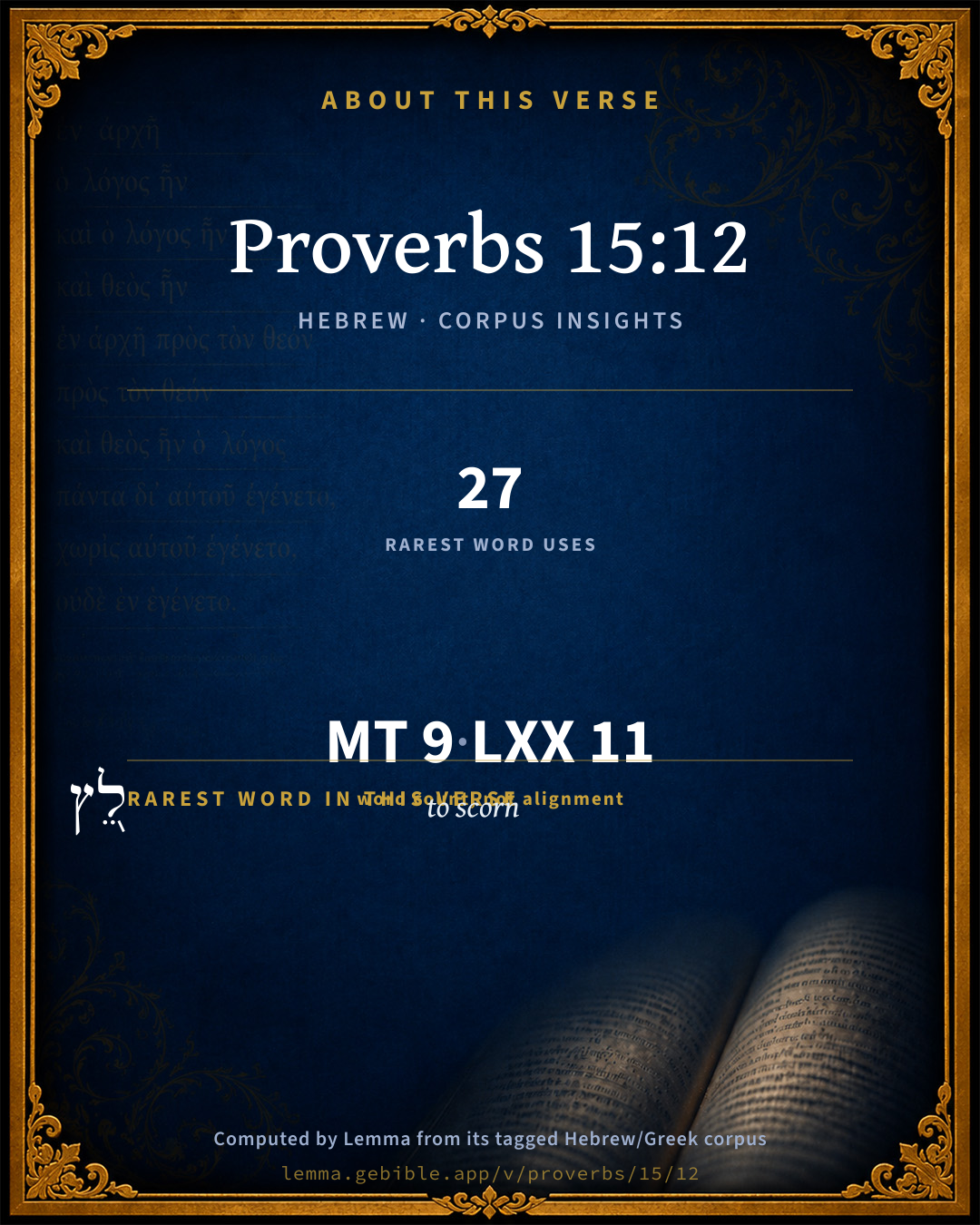
Proverbs 15:12

Hebrew (Westminster Leningrad Codex) Proverbs 15:12 appears in the Hebrew Old Testament. The text above is from the Westminster Leningrad Codex. Each word links to its Strong’s number, a concise gloss, and parsing drawn from the Open Scriptures Hebrew Bible morphology. Click any word for its full Brown-Driver-Briggs (BDB) entry.
Download image
Cite this verse

Proverbs 15:12 (World English Bible). Public Domain. Lemma interlinear Bible study tool, https://lemma.gebible.app/v/proverbs/15/12.

Show BibTeX & RIS
BibTeX
RIS
English Translation
A scoffer doesn't love to be reproved; He will not go to the wise.
World English Bible · Public Domain
Download a study sheet

One document with this verse’s original text, its word-by-word gloss line, the meaning frame, cross-references with their text, attributed commentary, and full source and license credits — printable, and it pastes into notes with its structure intact.

This verse Autodidact and up

Study sheet (.html) Plain text (.txt)

A passage Seminary Student

Up to 50 verses in one chapter. A passage sheet keeps up to 6 commentary sources and 12 cross-references per verse, in the order this page ranks them, and says so on the sheet whenever that leaves anything out. Ask for a single verse and you get the Autodidact verse sheet above.

Everything on this page stays free to read, with no account — the sheet is a download of what is already on screen, not access to it.

Want to remove ads? Support Godless Engineer
Compare translations 3

The same verse in 3 English versions, stacked beneath the original-language interlinear above. Click any original word for its lexicon entry.

Each is an independent rendering of the whole verse — the interlinear is not word-aligned to these translations.

Highlighted words mark where these versions differ — a whole-verse word diff, not a word-by-word alignment.

  • World English Bible Public Domain
    A scoffer doesn't love to be reproved; He will not go to the wise.
  • King James Version Public Domain
    A scorner loveth not one that reproveth him: neither will he go unto the wise.
  • unfoldingWord Literal Text CC BY-SA 4.0
    A mocker does not love one who rebukes him; to the wise, he will not go.

unfoldingWord Literal Text — © unfoldingWord, licensed CC BY-SA 4.0. Word-aligned USFM3 via Door43 (git.door43.org/unfoldingWord/en_ult).

Versions to compare (up to 4)

3 of 4 selected

Show all 18 translations

Every available English version of this verse, each an independent rendering of the whole verse.

  • World English Bible Public Domain
    A scoffer doesn't love to be reproved; He will not go to the wise.
  • Berean Standard Bible Public Domain
    A mocker does not love to be reproved, nor will he consult the wise.
  • Majority Standard Bible Public Domain
    A mocker does not love to be reproved, nor will he consult the wise.
  • King James Version Public Domain
    A scorner loveth not one that reproveth him: neither will he go unto the wise.
  • American Standard Version (1901) Public Domain
    A scoffer loveth not to be reproved; He will not go unto the wise.
  • Revised Version (1885) Public Domain
    A scorner loveth not to be reproved: he will not go unto the wise.
  • Geneva Bible (1599) Public Domain
    A scorner loueth not him that rebuketh him, neither will he goe vnto the wise.
  • Douay-Rheims (1899) Public Domain
    A corrupt man loveth not one that reproveth him: nor will he go to the wise.
  • Young's Literal Translation Public Domain
    A scorner loveth not his reprover, Unto the wise he goeth not.
  • Literal Standard Version CC BY-SA 4.0
    A scorner does not love his reprover, || He does not go to the wise.
  • Unlocked Literal Bible CC BY-SA 4.0
    The mocker resents correction; he will not go to the wise.
  • unfoldingWord Literal Text CC BY-SA 4.0
    A mocker does not love one who rebukes him; to the wise, he will not go.
  • Darby Bible Public Domain
    A scorner loveth not one that reproveth him; he will not go unto the wise.
  • World Messianic Bible Public Domain
    A scoffer doesn’t love to be reproved; he will not go to the wise.
  • Webster's Bible Public Domain
    A scorner loveth not one that reproveth him: neither will he go to the wise.
  • Free Bible Version CC BY-SA 4.0
    Scoffers don't like to be corrected, so they don't go to the wise for advice.
  • Bible in Basic English Public Domain
    The hater of authority has no love for teaching: he will not go to the wise.
  • JPS Tanakh (1917) Public Domain
    A scorner loveth not to be reproved; he will not go unto the wise.

Literal Standard Version (2020), Covenant Press — licensed CC BY-SA 4.0. Text via the HelloAO Bible API (eBible.org). Unlocked Literal Bible (unfoldingWord) — licensed CC BY-SA 4.0. Text via the HelloAO Bible API (eBible.org). unfoldingWord Literal Text — © unfoldingWord, licensed CC BY-SA 4.0. Word-aligned USFM3 via Door43 (git.door43.org/unfoldingWord/en_ult). Free Bible Version, Dr. Jonathan Gallagher — licensed CC BY-SA 4.0. Text via the HelloAO Bible API (eBible.org).

Word by word

More ways to search: Search by grammar → Find every occurrence → Compare this word →

Practice this passage: Drill this verse → Learn its vocabulary →

לֵ֭ץ
lûwts
H3887
“scoffer”
Adjective, Adjective, Masculine, Singular, Absolute
Part of Speech
Adjective
Type
Adjective
Gender
Masculine
Number
Singular
State
Absolute
Full BDB Definition

Origin: a primitive root

TWOT: 1113

to scorn, make mouths at, talk arrogantly - (Qal) - to boast - to scorn - (Hiphil) - to mock, deride - to interpret (language) - interpreter (participle) - ambassador (figuratively) - (Hithpalpel) to be inflated, scoff, act as a scorner, show oneself a mocker
  1. לֹ֣א lôʼ H3808 “not” Particle, Negative
  2. יֶאֱהַב ʼâhab H157 “to love” Verb, Qal, Imperfect, 3rd Person, Masculine, Singular
  3. הוֹכֵ֣חַֽ yâkach H3198 “to reprove” Verb, Hiphil, Infinitive Absolute
  4. אֶל ʼêl H413 “to” Preposition
  5. חֲ֝כָמִ֗ים châkâm H2450 “wise” Adjective, Adjective, Masculine, Plural, Absolute
  6. לֹ֣א lôʼ H3808 “not” Particle, Negative
  7. יֵלֵֽךְ yâlak H3212 “to walk” Verb, Qal, Imperfect, 3rd Person, Masculine, Singular

About this verse

These counts appear in no published source. They are computed here, from the morphology-tagged text and Lemma’s own curated glosses. What Lemma adds →

9
words
7
distinct lemmas
Wisdom
section

Shared distinctive vocabulary

לֵ֭ץ to scorn H3887 occurs in 26 verses of the Hebrew Bible. Also found in:

Grammatical profile

  • 3 verbs
  • 2 adjectives
  • 2 prepositions
  • 2 particles

Verb forms

  • יֶאֱהַב Qal · Imperfect
  • הוֹכֵ֣חַֽ Hiphil · Infinitive Absolute
  • יֵלֵֽךְ Qal · Imperfect

Repetition

A word recurs within this verse — often emphatic in Hebrew:

Hebrew & Septuagint length

In English translation the verse runs 14 words from the Hebrew and 17 from the Septuagint (LXX English) — closely comparable.

A rough comparison of the two English renderings, which tokenize alike — not a word-level alignment.

Word counts can differ between the Hebrew and the Greek without any difference in meaning — e.g. the Hebrew direct-object marker אֵת has no separate Greek word, and Greek often adds the article ὁ.

In the original languages it is 9 Hebrew tokens and 11 Greek tokens — but the two are counted differently (Hebrew bundles its prefixes and suffixes into one token; the Greek is in lemma form), so that isn’t a like-for-like length.

Cross-references

8

Topical passages linked to Proverbs 15:12 in the Treasury of Scripture Knowledge — connected by theme and wording, ordered by reader-vote popularity; previews shown in the World English Bible.

  • Amos 5:10 They hate him who reproves in the gate, And they abhor him who speaks blamelessly.
  • Job 21:14 They tell God, 'Depart from us, For we don't want to know about your ways.
  • Proverbs 9:7–8 He who corrects a mocker invites insult. He who reproves a wicked man invites abuse.
  • 2 Timothy 4:3 For the time will come when they will not listen to the sound doctrine, but, having itching ears, will heap up for themselves teachers after their own lusts;
  • John 7:7 The world can't hate you, but it hates me, because I testify about it, that its works are evil.
  • 2 Chronicles 18:7 The king of Israel said to Jehoshaphat, There is yet one man by whom we may inquire of Yahweh: but I hate him; for he never prophesies good concerning me, but always evil: the same is Micaiah the son of Imla. Jehoshaphat said, Don't let the king say so.
  • Proverbs 15:10 There is stern discipline for one who forsakes the way: Whoever hates reproof shall die.
  • John 3:18–21 He who believes in him is not judged. He who doesn't believe has been judged already, because he has not believed in the name of the one and only Son of God.

Cross-references courtesy of OpenBible.info (CC BY 4.0).

Hebrew and Greek witnesses Masoretic Hebrew ↔ Greek Septuagint

The same verse in the two great witnesses to the Old Testament, shown verse-for-verse.

These are two independent witnesses, not word-aligned to each other, and the Septuagint is shown in lemma (dictionary) form.

Hebrew Proverbs 15:12 Masoretic · Westminster Leningrad Codex

לֹ֣א יֶאֱהַב לֵ֭ץ הוֹכֵ֣חַֽ ל֑וֹ אֶל חֲ֝כָמִ֗ים לֹ֣א יֵלֵֽךְ

A scoffer doesn't love to be reproved; He will not go to the wise.

World English Bible · Public Domain

Greek LXX Proverbs 15:12 Septuagint · lemma form

οὐ ἀγαπάω ἀπαίδευτος ὁ ἐλέγχω αὐτός μετά δέ σοφός οὐ ὁμιλέω

An uninstructed person will not love those that reprove him; neither will he associate with the wise.

LXX2012 (modern English Septuagint) · Public Domain

On this verse, The Pulpit Commentary discusses the Septuagint’s reading. Read the note in Commentary ↓

Hebrew: Westminster Leningrad Codex (CC BY 4.0). Greek: Septuagint (public domain); English from LXX2012 (modern English Septuagint) (Public Domain). How the Septuagint differs from the Hebrew →

Commentary

Notes on Proverbs 15:12 from classic Christian and Jewish commentators (each source and its license shown beneath its notes). The classic Christian expositions comment on the surrounding passage and are grouped to its opening verse, so a note may address several verses; the Jewish commentaries on the Tanakh (Rashi and others) are per-verse, so they appear only where the commentator wrote on this verse.

Lemma curates 59 commentaries, every one of them public domain or Creative Commons licensed, each selected and text-cleaned for this edition rather than reprinted as found. About our sources →

Trapp's Complete Commentary

John Trapp

Pro 15:12 A scorner loveth not one that reproveth him: neither will he go unto the wise.

Ver. 12. A scorner loveth not one that reproveth him.] Nay, he "hateth those that reprove him in the gate," {Amo 5:10} as Ahab did Micaiah; Herodias, John Baptist; the Pharisees, our Saviour. Bishop Ridley, lamenting, a little before his death, the state of England, even of the greatest magistrates, some, the king’s highness excepted, evermore unkindly and urgently against those that went about most busily and wholesomely to cure their sore backs, spurned privily, and would not spare to speak evil of them, even to the prince himself; and yet would they toward the same preachers outwardly bear a jolly countenance, and fair face. As for Latimer, Lever, Bradford, and Knox, their tongues were so sharp, they ripped so deep in their galled backs to have purged them, no doubt, of their filthy matter that was festered in their hearts, of unsatiable covetousness, of filthy carnality and voluptuousness, of intolerable ambition and pride, of ungodly loathsomeness to hear poor men’s causes, and to hear God’s word. And these men of all others, these magistrates then could never abide, &c. Thus that godly martyr, and much more to the same purpose. {a}

Neither will he go unto the wise.] Men should "run to and fro to increase knowledge." {Dan 12:4} The Shunammite rode ordinarily to the prophet on the Sabbaths, and other holy days. {2Ki 4:23} Those good souls in Psa 84:7, passed on "from strength to strength," setting the best foot forwards for like purpose; yea, those that were weak and unfit for travel would be brought to the ordinances upon "horses, in chariots, and in litters." {Isa 66:20} But now the scorner holds it not worth while to put himself to this pains; and is ready to say with Jeroboam, "It is too much for men to go up to Jerusalem," to go up "to the mountain of the Lord, to learn his ways." {Isa 2:3} Yea, he set watchers to observe who would go from him to Judah to worship, that he might shame them at least, if not slay them. {Hos 5:1} He would never have gone to the prophet to be reproved, and when the prophet came to him he stretched forth his hand to apprehend him. So Herod had a desire to see Christ, but could never find a heart to go to hear him; and yet our Saviour looked that men should have come as far to him, as the queen of Sheba came to Solomon. {Mat 12:42}

{a} Acts and Mon., 1616.

John Trapp, A Commentary or Exposition upon All the Books of the Old and New Testament (1647–1656) — public domain. Text from a community e-Sword module.

The Preacher's Complete Homiletical Commentary

Joseph S. Exell (gen. ed.)

MAIN HOMILETICS OF Pro_15:12

SELF-DESTROYED

I. That a scorner is in hopeless ignorance. “Neither will he go unto the wise.” If a thirsty man will not go to the river to which he has free and easy access, there is no hope of his thirst being quenched. If he will not apply to the only source whence his need can be supplied, he must remain in his needy condition. If a man who is sick will not apply to him who is able to cure his malady, the probability is that he will remain under the influence of disease, and die of his malady. If a man who is ignorant of the revelation of God, and of the healing power of Divine truth, refuses to go where wisdom is to be found—viz., among those who have been enlightened by Divine wisdom, there is no hope of his ever emerging from his state of ignorance. God uses one divinely enlightened man to turn another from darkness to light. This is the method of His procedure in His kingdom, and if the scorner rejects this means, he must remain in darkness. He may “go unto the wise” by listening to the voice of the living man, by observing the life of the morally wise, or by reading their thoughts, especially those of the divinely-inspired writers of the Scriptures. Men have begun to learn wisdom by each one of these methods; generally there is the combined influence of the three.

II. The true source of the scorner’s dislike to the company of the wise. He “hates reproof.” As reproof is knowledge (see page 323) so an increase of knowledge, if it is not used, is reproof. The words of the wise and the lives of the wise reprove the scorner by increasing his light, and thus adding to his guilt. He therefore “cometh not to the light lest his deeds should be reproved” (Joh_3:20). He is like a man who is conscious that he is suffering from a dangerous disease, but who will not submit to the examination of the physician because he knows he would prescribe treatment which, though it would cure, would be painful. No men love reproof any more than they love the surgeon’s knife; but wise men submit to the one and the other for the sake of the health to soul and to body which will follow. But the scorner hates the keen-edged weapon of reproof because he does not value the good that would result from patiently bearing the incision.

III. Every scorner, therefore, is a self-destroyer. A man commits suicide if, when he is sick, he refuses to use the means by which he might be healed. If he die, he takes away his life as truly as if he thrust a sword through his body. He is not accountable for his disease, but he is responsible and blameworthy for neglecting means of cure within his reach. So with men in relation to spiritual knowledge. Ignorance is a crime only when the means of enlightenment are within reach. He who scorns to avail himself of those means, he who will not submit to reproof, he who rejects the invitation and despises the threatenings of Divine Wisdom (see chap. Pro_1:22-32) is a moral suicide. (See also on chap. Pro_14:6, page 346.)

OUTLINES AND SUGGESTIVE COMMENTS

Men should “run to and fro to increase knowledge” (Dan_12:4). The Shunamite rode ordinarily to the prophet on the Sabbaths and other holy days (2Ki_4:23). Those good souls in Psa_84:7 passed on “from strength to strength,” setting the best foot forwards for like purpose; yea, those that were weak and unfit for travel would be brought to the ordinances upon “horses, in chariots, and in litters” (Isa_66:20). But now the scorner holds it not worth while to put himself to this pains, and is ready to say with Jeroboam, “It is too much for men to go up to Jerusalem,” to go up “to the mountain of the Lord, to learn His ways” (Isa_2:3). Yea, he set watches to observe who would go from him to Judah to worship, that he might shame them at least, if not slay them (Hos_5:1). He would never have gone to the prophet to be reproved, and when the prophet came to him, he stretched out his hand to apprehend him. So Herod had a desire to see Christ, but could never find a heart to go to hear him; and yet our Saviour looked that men should have come as far to Him as the Queen of Sheba came to Solomon.—Trapp.

Here is instruction for all men, to observe the state of their own souls, and the better, when occasion is offered, to inform themselves of others by the company which they most delight to frequent. He that delighteth to associate himself with good men, is never to be deemed a friend to evil ways, and he that embraceth the fellowship of sinful persons, must needs be judged an enemy to godly behaviour. When David would clear himself to be none of the wicked, he made it fully manifest by this, that he went not with vain persons, neither kept company with dissemblers: that he hated the assembly of the evil, and companioned not with the wicked. When he would prove himself to be one of the righteous, he evidently confirmed it by this, that he was a companion of all them that feared the Lord and kept His precepts.—Dod.

There is none that loveth more truly, that loveth more profitably, than he that lovingly reproveth what he seeth amiss. And yet there is none that a scorner loveth less. But what marvel if he loveth not another, that loveth not himself! Where scorning is, there can be no love, that was never love’s disposition. Let no one that reproveth a scorner look for love from him.… But let the wise reprove him notwithstanding, and as St. Cyprian speaketh, if they cannot persuade him, to make him to please Christ, let themselves perform to Christ that which is their part, and let them please Christ by keeping his commandments.—Jermin.

The Preacher's Complete Homiletical Commentary (gen. ed. Joseph S. Exell; Funk & Wagnalls, c. 1892) — public domain (pre-1929). A full-Bible homiletical/sermon-outline anthology covering 65 of 66 books (2 John is absent from the source module). Text from a community e-Sword module.

Tyndale Open Study Notes

Tyndale Open Resources

15:12 Mockers cannot become wise because they keep criticism at a distance (cp. 10:17; 13:1, 10).

Tyndale Open Study Notes — © Tyndale Open Resources, licensed CC BY-SA 4.0. Text via the HelloAO Bible API.

Matthew Henry's Commentary

A scorner is one that not only makes a jest of God and religion, but bids defiance to the methods employed for his conviction and reformation, and, as an evidence of that, 1. He cannot endure the checks of his own conscience, nor will he suffer it to deal plainly with him: He loves not to reprove him (so some read it); he cannot endure to retire into his own heart and commune seriously with that, will not admit of any free thought or fair reasoning with himself, nor let his own heart smite him, if he can help it. That man's case is sad who is afraid of being acquainted and of arguing with himself. 2. He cannot endure the advice and admonitions of his friends: He will not go unto the wise, lest they should give him wise counsel. We ought not only to bid the wise welcome when they come to us, but to go to them, as beggars to the rich man's door for an alms; but this the scorner will not do, for fear of being told of his faults and prevailed upon to reform.

Matthew Henry's Commentary on the Whole Bible (1708–1710) — public domain (CC PDM 1.0). Text via the HelloAO Bible API.

Jamieson, Fausset & Brown

Robert Jamieson, A. R. Fausset & David Brown

(Compare Pro 9:8).

go unto the wise--to be instructed.

Jamieson, Fausset & Brown — Commentary Critical and Explanatory on the Whole Bible (1871) — public domain (CC PDM 1.0). Text via the HelloAO Bible API.

Ellicott's Commentary for English Readers

(12) A scorner.—See above on Pro_1:22.

A Bible Commentary for English Readers, edited by Charles John Ellicott (1878–1897) — public domain. Text from a community e-Sword module.

The Cambridge Bible for Schools and Colleges

gen. ed. J. J. S. Perowne

12. one that reproveth him] Rather, to be reproved, R.V.

The Cambridge Bible for Schools and Colleges (gen. ed. J. J. S. Perowne; Cambridge University Press, 1878–1918) — public domain. Text from a community e-Sword module.

John Gill's Exposition

A scorner loveth not one that reproveth him,.... He that makes a jest of religion; scoffs at godliness and godly men; treats the Gospel and the ministers of it with contempt; makes a mock at good men, and all that is good; a pestilent fellow, as the Vulgate Latin version: such an one not only does not love, for more is intended than is expressed; but hates him that reproves him, and especially if publicly, Amo 5:10; he thinks ill of him; bears him a grudge, and abhors him; and speaks evil of him, and reproaches him; and does all he can to the injury of his person and name; hence the advice of the wise man, Pro 9:7. Some render it, he "loves not reproving himself", or "to reprove himself" (b); he does not care to look into his own heart and ways, or to call himself to an account for what he does; nor to check himself in the pursuit of sin, nor argue with and reprove himself for it;

neither will he go unto the wise; to the private houses of wise and good men; nor to the house of wisdom, or place of public instruction, where wise dispensers of the word give good advice and counsel; scorners do not choose to go to either, lest they should be reproved for their evil ways, and be advised leave them; neither of which is agreeable to them; see Joh 3:20.

(b) "corripere", Gejerus.

John Gill's Exposition of the Whole Bible (1746–1763) — public domain (CC PDM 1.0). Text via the HelloAO Bible API.

Matthew Poole's English Annotations

Loveth not, i.e. hateth and avoideth it; for more is here understood than is expressed, as it is Pro 11:21; 12:3, and elsewhere.

Neither will he go unto, seek their company and conversation, as his duty and interest obligeth him, the wise, i.e. the godly, because he knows they who are so indeed will make conscience of reproving him.

Matthew Poole's English Annotations on the Holy Bible (1683–1685) — public domain. Text from a community e-Sword/MySword module.

Whedon's Commentary on the Bible

Daniel D. Whedon

12. A scorner — Our term, a profane man, one who scoffs at sacred things. Such a one avoids the company of the wise and virtuous lest they should administer reproof to him. Indeed, their whole life and character should be a perpetual reproof. Comp. Pro_13:1; Pro_13:20.

Daniel D. Whedon (gen. ed.), Commentary on the Old and New Testaments (1874–1909) — public domain. Text from a community e-Sword module.

The Pulpit Commentary

A scorner loveth not one that reproveth him. (Pro_9:8 Amo_5:10) For "scorner" the Vulgate has pestilens, and the Septuagint apaideutov , "undisciplined." "Scorners" are spoken of elsewhere, as Pro_1:22 (where see note); they are conceited, arrogant persons, free-thinkers, indifferent to or sceptical of religion, and too self-opinionated to be open to advice or reproof. Neither will he go unto the wise, who would correct and teach him. (Pro_13:20) Septuagint, "He will not converse (omilhsei ) with the wise." He does not believe the maxim Sofou par andro sofon ti manyanein . "From a wise man you must some wisdom learn.

A Latin adage runs"Argue consultum, te diliget: argue stultum Avertet vultum, nec te dimittet iuultum.

Vers. 12-15Sullen folly and cheerful wisdom.

I DISLIKE OF CRITICISM. (Ver. 12) Often seen in those who are most critical themselves. The jiber is easily galled by a telling retort. The satirical man least loves satire upon himself. But one of the lessons we learn from truly great minds is that of willingness to turn a jest against one"s self, and to find positive pleasure in a criticism of one"s own character that hits the mark, provided it be good natured. But with ill nature no one can be pleased. Most necessary it is for the health of the soul to be often with those who know more than we do.

II THE APPEARANCE THE MIRROR OF THE MAN. The placid, serene, smiling, winning visage reflects the soul; and so with the downcast brow and dejected mien. It may surprise us that so commonplace an observation should be thought worth recording; but there was a time when such flashed upon man as a new discovery. Perhaps it may be a discovery to many that they may do much by assuming a cheerful manner to regulate and calm the heart.

III BUT APPEARANCES ARE NOTHING WITHOUT REALITY. (Ver. 14) To be truly wise is not to know a great deal, but to be always on the track and pursuit of knowledge; and to be utterly foolish it is only necessary to give the reins to vanity, to yield to idleness, to follow every passing pleasure. The countenance of the fool is expressive of what? Of the want of impressions, of vacancy and vanity.

IV THE FOLLY OF GLOOM AND THE WISDOM OF CHEERFULNESS. (Ver. 15) In what sense can we ever say that our days are evil, except that we have made them so? And how more readily can we make them so than by yielding to the dark and gloomy mood, and ever looking on the dark side of things? The side of things on which we see the reflection of our narrow selves is ever dark; that on which we see God"s attributes mirrored the beauty of his nature, the wisdom of his providence is bright and inspiring. It is, indeed, a feast to the soul to have found God; for thought, for feeling, for every practical need, he is present, he alone "shall supply all our need." Our Lord thus speaks of his body and his blood, of which to eat is life. J.

The Pulpit Commentary (1880–1919), ed. H.D.M. Spence-Jones & Joseph S. Exell — public domain. Text from a community e-Sword module.

Bridges on Proverbs

Charles Bridges

How different from David’s spirit, thankful for the "kind smiting of the righteous" (Psa 141:5 ); and from the lovely humility of an Apostle, who shewed before the Church his honour and love to his reprover! (Gal 2:11-14, with 2Pe 3:15 .) Yet he had need to be wise with "the wisdom that is from above" to give reproof aright. So closely does the mixture of our own spirit cleave to every Christian exercise! Not less grace and wisdom does it require, instead of revolting from our reprover, to go unto him, and ask the continuance of his faithful offices. That most sensitive, delicate, and unvarying of all feelings, self-love — has been wounded, and the wound is not easily healed. The scorner has been his own flatterer so long, that he cannot bear to be brought down to his proper level. The truth-telling friend therefore he counts as his enemy. (Gal 4:15-16 .) He loveth not — yea — he hateth — one that reproveth him,†1 though before he might have reverenced him. (Mar 6:17-20 .) "The Pharisee derided" our Lord with external scorn, when he struck at the right eye, and reproved their hypocrisy.†2 "Every one that doeth evil hateth the light; neither cometh to the light, lest his deeds should be reproved." (Joh 3:20 .)

Footnotes:

†1 Pro 9:8. 1Ki 21:20 ; 1Ki 22:8 . Amo 5:10 ; Amo 7:10-13 .

†2 Luk 16:13-14. exemukthrizon, from mukthr, nostril — contempt shewn by the nostrils — mussw, to blow the nose — ’They blowed their nose at him.’ See Leigh’s Critica Sacra, and Parkhurst on mukthrizw. ().

Charles Bridges, An Exposition of the Book of Proverbs (1846) — public domain. Text from a community e-Sword module.

Kretzmann's Popular Commentary

Paul E. Kretzmann

v. 12. A scorner, one who makes it a point to mock at everything that is holy, loveth not one that reproveth him, for his foolish pride resents correction; neither will he go unto the wise, because there he must expect censure; so he prefers the company of those who applaud his folly.

Paul E. Kretzmann, Popular Commentary of the Bible (1921–1924) — public domain. Text from a community e-Sword module.

Lesson kit

Teaching starters — assembled from the data on this page, not authored interpretation. Every prompt links to the verse data it draws on. Edit before teaching.

Proverbs, in the Wisdom, opens this verse with 9 words (7 distinct Hebrew lemmas). Its most distinctive word is lûwts (“to scorn”). A historical commentator’s framing appears above. Read the whole chapter for the surrounding context.

Discussion questions

  1. How does “to scorn” (lûwts) shape what this verse is saying?
  2. Genesis 42:23 shares the word «to scorn» with this verse. How do the two illuminate each other?
  3. “not” occurs 2× in this one verse. What is the effect of the repetition?
  4. These translations render this verse differently; the difference is in the English rendering, not the original. What questions does that raise?
  5. The verb «יֶאֱהַב» is Qal Imperfect. How does its form color the action?
  6. Reading how Trapp's Complete Commentary and The Preacher's Complete Homiletical Commentary read this verse, where do the two commentators agree and where do they part?

Things to notice

Reading settings

Reading text

Shown beneath each verse's original-language words.

Old Testament
Old Testament edition

Read the OT as the Masoretic Hebrew (MT) or the Greek Septuagint (LXX).

English shown for the Greek Septuagint (in the Hebrew ↔ Greek comparison).

Comparing translations? Open the Compare panel on any verse page to stack up to four side by side.