Ecclesiastes 5:10

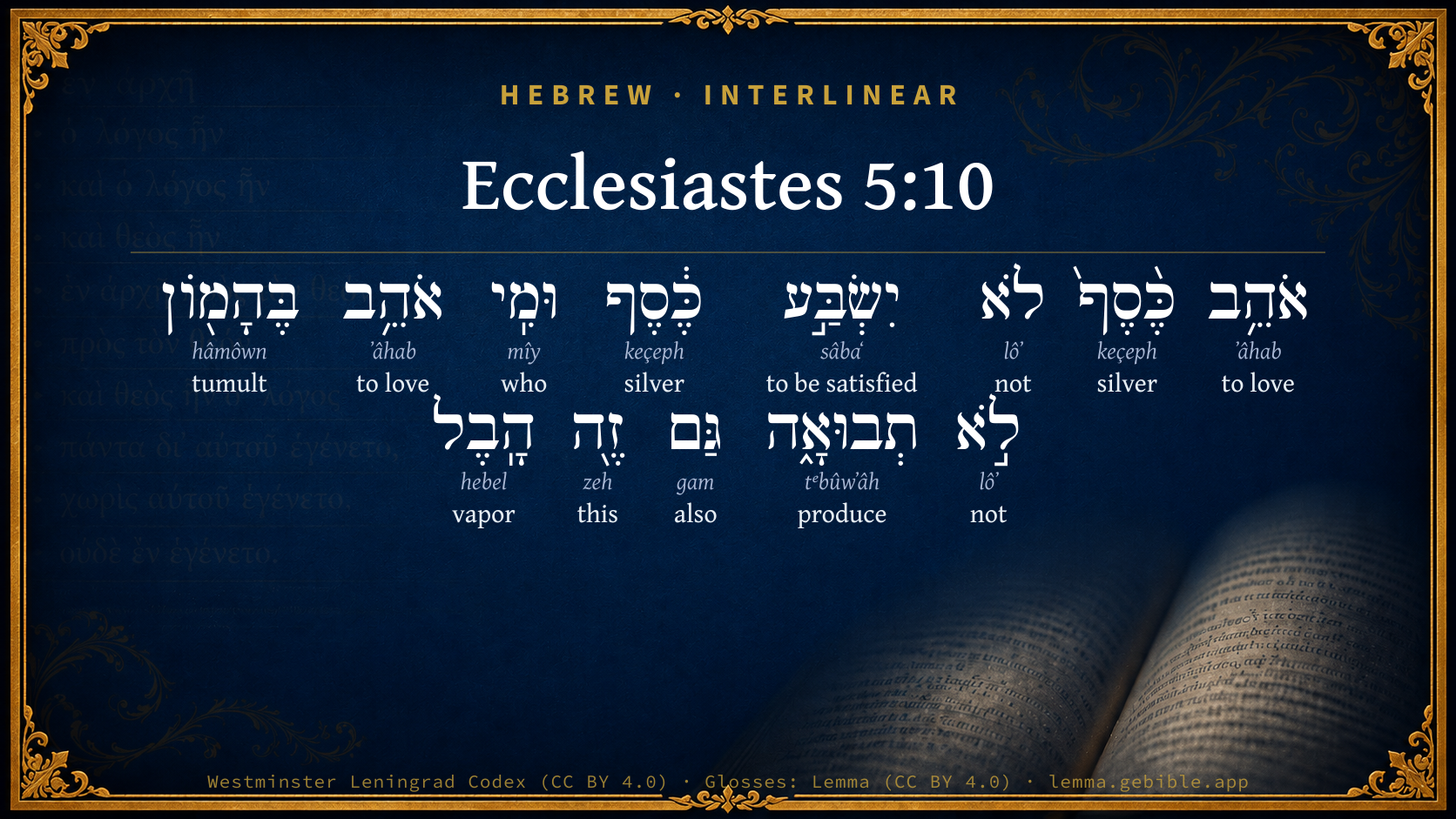
Hebrew (Westminster Leningrad Codex) Ecclesiastes 5:10 appears in the Hebrew Old Testament. The text above is from the Westminster Leningrad Codex. Each word links to its Strong’s number, a concise gloss, and parsing drawn from the Open Scriptures Hebrew Bible morphology. Click any word for its full Brown-Driver-Briggs (BDB) entry.
Download image
Cite this verse

Ecclesiastes 5:10 (World English Bible). Public Domain. Lemma interlinear Bible study tool, https://lemma.gebible.app/v/ecclesiastes/5/10.

Show BibTeX & RIS
BibTeX
RIS
English Translation
He who loves silver shall not be satisfied with silver; nor he who loves abundance, with increase: this also is vanity.
World English Bible · Public Domain
Download a study sheet

One document with this verse’s original text, its word-by-word gloss line, the meaning frame, cross-references with their text, attributed commentary, and full source and license credits — printable, and it pastes into notes with its structure intact.

This verse Autodidact and up

Study sheet (.html) Plain text (.txt)

A passage Seminary Student

Up to 50 verses in one chapter. A passage sheet keeps up to 6 commentary sources and 12 cross-references per verse, in the order this page ranks them, and says so on the sheet whenever that leaves anything out. Ask for a single verse and you get the Autodidact verse sheet above.

Everything on this page stays free to read, with no account — the sheet is a download of what is already on screen, not access to it.

Want to remove ads? Support Godless Engineer
Compare translations 3

The same verse in 3 English versions, stacked beneath the original-language interlinear above. Click any original word for its lexicon entry.

Each is an independent rendering of the whole verse — the interlinear is not word-aligned to these translations.

Highlighted words mark where these versions differ — a whole-verse word diff, not a word-by-word alignment.

  • World English Bible Public Domain
    He who loves silver shall not be satisfied with silver; nor he who loves abundance, with increase: this also is vanity.
  • King James Version Public Domain
    He that loveth silver shall not be satisfied with silver; nor he that loveth abundance with increase: this is also vanity.
  • unfoldingWord Literal Text CC BY-SA 4.0
    A lover of silver will not be satisfied silver, and whoever loves increase, not income. Also this vapor.

unfoldingWord Literal Text — © unfoldingWord, licensed CC BY-SA 4.0. Word-aligned USFM3 via Door43 (git.door43.org/unfoldingWord/en_ult).

Versions to compare (up to 4)

3 of 4 selected

Show all 18 translations

Every available English version of this verse, each an independent rendering of the whole verse.

  • World English Bible Public Domain
    He who loves silver shall not be satisfied with silver; nor he who loves abundance, with increase: this also is vanity.
  • Berean Standard Bible Public Domain
    He who loves money is never satisfied by money, and he who loves wealth is never satisfied by income. This too is futile.
  • Majority Standard Bible Public Domain
    He who loves money is never satisfied by money, and he who loves wealth is never satisfied by income. This too is futile.
  • King James Version Public Domain
    He that loveth silver shall not be satisfied with silver; nor he that loveth abundance with increase: this is also vanity.
  • American Standard Version (1901) Public Domain
    He that loveth silver shall not be satisfied with silver; nor he that loveth abundance, with increase: this also is vanity.
  • Revised Version (1885) Public Domain
    He that loveth silver shall not be satisfied with silver; nor he that loveth abundance with increase: this also is vanity.
  • Geneva Bible (1599) Public Domain
    When goods increase, they are increased that eate them: and what good commeth to the owners thereof, but the beholding thereof with their eyes?
  • Douay-Rheims (1899) Public Domain
    Where there are great riches, there are also many to eat them. And what doth it profit the owner, but that he seeth the riches with his eyes?
  • Young's Literal Translation Public Domain
    Whoso is loving silver is not satisfied `with' silver, nor he who is in love with stores `with' increase. Even this `is' vanity.
  • Literal Standard Version CC BY-SA 4.0
    Whoever is loving silver is not satisfied [with] silver, nor he who is in love with stores [with] increase. Even this [is] vanity.
  • Unlocked Literal Bible CC BY-SA 4.0
    Anyone who loves silver will not be satisfied with silver, and anyone who loves wealth always wants more. This, too, is vapor.
  • unfoldingWord Literal Text CC BY-SA 4.0
    A lover of silver will not be satisfied silver, and whoever loves increase, not income. Also this vapor.
  • Darby Bible Public Domain
    He that loveth silver shall not be satisfied with silver, nor he that loveth abundance with increase. This also is vanity.
  • World Messianic Bible Public Domain
    He who loves silver shall not be satisfied with silver, nor he who loves abundance, with increase. This also is vanity.
  • Webster's Bible Public Domain
    \\5:11\\When goods increase, they are increased that eat them: and what good is there to the owners of them, saving the beholding of them with their eyes?
  • Free Bible Version CC BY-SA 4.0
    People who love money never have enough money; those who love wealth never have enough income. This too is so temporary and makes little sense.
  • Bible in Basic English Public Domain
    When goods are increased, the number of those who take of them is increased; and what profit has the owner but to see them?
  • JPS Tanakh (1917) Public Domain
    (5-9) He that loveth silver shall not be satisfied with silver; nor he that loveth abundance, with increase; this also is vanity.

Literal Standard Version (2020), Covenant Press — licensed CC BY-SA 4.0. Text via the HelloAO Bible API (eBible.org). Unlocked Literal Bible (unfoldingWord) — licensed CC BY-SA 4.0. Text via the HelloAO Bible API (eBible.org). unfoldingWord Literal Text — © unfoldingWord, licensed CC BY-SA 4.0. Word-aligned USFM3 via Door43 (git.door43.org/unfoldingWord/en_ult). Free Bible Version, Dr. Jonathan Gallagher — licensed CC BY-SA 4.0. Text via the HelloAO Bible API (eBible.org).

Word by word

More ways to search: Search by grammar → Find every occurrence → Compare this word →

Practice this passage: Drill this verse → Learn its vocabulary →

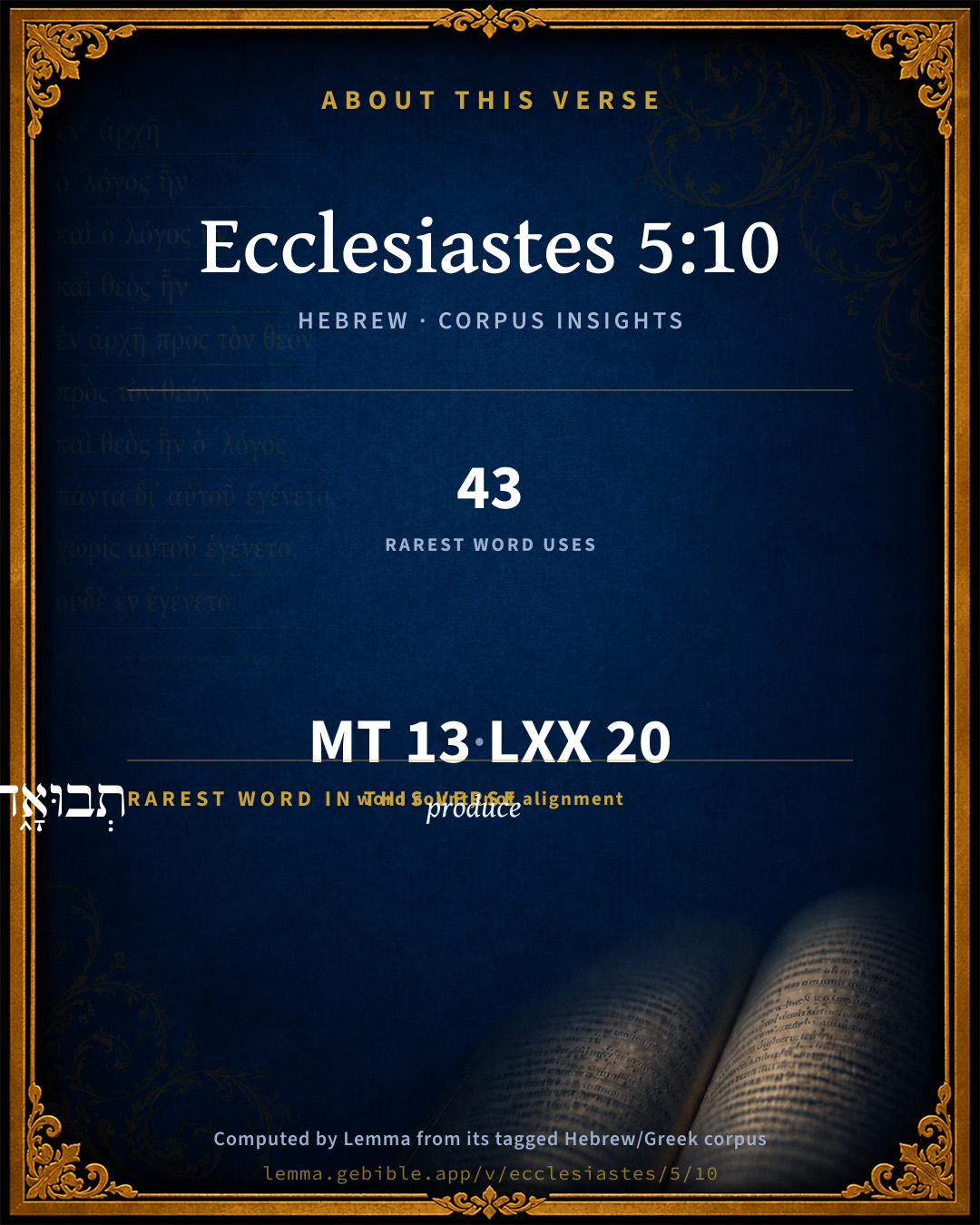
תְבוּאָ֑ה
tᵉbûwʼâh
H8393
“produce”
Noun, Common, Feminine, Singular, Absolute
Part of Speech
Noun
Type
Common
Gender
Feminine
Number
Singular
State
Absolute
Full BDB Definition

Origin: from H935

TWOT: 212c

produce, product, revenue - product, yield, crops (of the earth usually) - income, revenue - gain (of wisdom) (figuratively) - product of lips (figuratively)
  1. אֹהֵ֥ב ʼâhab H157 “loving” Verb, Qal, Participle Active, Masculine, Singular, Absolute
  2. כֶּ֨סֶף֙ keçeph H3701 “silver” Noun, Common, Masculine, Singular, Absolute
  3. לֹא lôʼ H3808 “not” Particle, Negative
  4. יִשְׂבַּ֣ע sâbaʻ H7646 “to be satisfied” Verb, Qal, Imperfect, 3rd Person, Masculine, Singular
  5. כֶּ֔סֶף keçeph H3701 “silver” Noun, Common, Masculine, Singular, Absolute
  6. וּמִֽי mîy H4310 “and · who” Conjunction + Particle, Interrogative
  7. אֹהֵ֥ב ʼâhab H157 “loving” Verb, Qal, Participle Active, Masculine, Singular, Absolute
  8. בֶּהָמ֖וֹן hâmôwn H1995 “in/at the · tumult” Preposition, Determined + Noun, Common, Masculine, Singular, Absolute
  9. לֹ֣א lôʼ H3808 “not” Particle, Negative
  10. גַּם gam H1571 “also” Particle, Accusative
  11. זֶ֖ה zeh H2088 “this” Pronoun, Demonstrative, Masculine, Singular
  12. הָֽבֶל hebel H1892 “vapor” Noun, Common, Masculine, Singular, Absolute

About this verse

These counts appear in no published source. They are computed here, from the morphology-tagged text and Lemma’s own curated glosses. What Lemma adds →

13
words
10
distinct lemmas
Wisdom
section

Shared distinctive vocabulary

תְבוּאָ֑ה produce H8393 occurs in 40 verses of the Hebrew Bible. Also found in:

Grammatical profile

  • 3 verbs
  • 5 nouns
  • 1 pronoun
  • 4 particles

Verb forms

  • אֹהֵ֥ב Qal · Participle Active
  • יִשְׂבַּ֣ע Qal · Imperfect
  • אֹהֵ֥ב Qal · Participle Active

Repetition

Words recur within this verse — often emphatic in Hebrew:

  • אֹהֵ֥ב to love H157 ×2
  • כֶּ֨סֶף֙ silver H3701 ×2
  • לֹא not H3808 ×2

Hebrew & Septuagint length

In English translation the verse runs 21 words from the Hebrew and 26 from the Septuagint (LXX English) — closely comparable.

A rough comparison of the two English renderings, which tokenize alike — not a word-level alignment.

Word counts can differ between the Hebrew and the Greek without any difference in meaning — e.g. the Hebrew direct-object marker אֵת has no separate Greek word, and Greek often adds the article ὁ.

In the original languages it is 13 Hebrew tokens and 20 Greek tokens — but the two are counted differently (Hebrew bundles its prefixes and suffixes into one token; the Greek is in lemma form), so that isn’t a like-for-like length.

Cross-references

18

Topical passages linked to Ecclesiastes 5:10 in the Treasury of Scripture Knowledge — connected by theme and wording, ordered by reader-vote popularity; previews shown in the World English Bible.

  • 1 Timothy 6:10 For the love of money is a root of all kinds of evil. Some have been led astray from the faith in their greed, and have pierced themselves through with many sorrows.
  • Matthew 6:24 "No one can serve two masters, for either he will hate the one and love the other; or else he will be devoted to one and despise the other. You can't serve both God and Mammon.
  • Luke 12:15 He said to them, "Beware! Keep yourselves from covetousness, for a man's life doesn't consist of the abundance of the things which he possesses."
  • Matthew 6:19 "Don't lay up treasures for yourselves on the earth, where moth and rust consume, and where thieves break through and steal;
  • Ecclesiastes 4:8 There is one who is alone, and he has neither son nor brother. There is no end to all of his labor, neither are his eyes satisfied with wealth. For whom then, do I labor, and deprive my soul of enjoyment? This also is vanity, yes, it is a miserable business.
  • Ecclesiastes 4:4 Then I saw all the labor and achievement that is the envy of a man's neighbor. This also is vanity and a striving after wind.
  • Psalms 62:10 Don't trust in oppression. Don't become vain in robbery. If riches increase, Don't set your heart on them.
  • Ecclesiastes 2:26 For to the man who pleases him, God gives wisdom, knowledge, and joy; but to the sinner he gives travail, to gather and to heap up, that he may give to him who pleases God. This also is vanity and a chasing after wind.
  • Psalms 52:7 "Behold, this is the man who didn't make God his strength, But trusted in the abundance of his riches, And strengthened himself in his wickedness."
  • Habakkuk 2:5–7 Yes, moreover, wine is treacherous. A haughty man who doesn't stay at home, who enlarges his desire as Sheol, and he is like death, and can't be satisfied, but gathers to himself all nations, and heaps to himself all peoples.
  • Ecclesiastes 2:11 Then I looked at all the works that my hands had worked, and at the labor that I had labored to do; and, behold, all was vanity and a chasing after wind, and there was no profit under the sun.
  • Proverbs 30:15–16 "The leach has two daughters: 'Give, give.' "There are three things that are never satisfied; Four that don't say, 'Enough:'
  • Ecclesiastes 3:19 For that which happens to the sons of men happens to animals. Even one thing happens to them. As the one dies, so the other dies. Yes, they have all one breath; and man has no advantage over the animals: for all is vanity.
  • Ecclesiastes 4:16 There was no end of all the people, even of all them over whom he was--yet those who come after shall not rejoice in him. Surely this also is vanity and a chasing after wind.
  • Ecclesiastes 1:17 I applied my heart to know wisdom, and to know madness and folly. I perceived that this also was a chasing after wind.
  • Ecclesiastes 2:17–18 So I hated life, because the work that is worked under the sun was grievous to me; for all is vanity and a chasing after wind.
  • Ecclesiastes 6:7 All the labor of man is for his mouth, and yet the appetite is not filled.
  • Psalms 52:1 Why do you boast of mischief, mighty man? God's loving kindness endures continually.

Cross-references courtesy of OpenBible.info (CC BY 4.0).

Hebrew and Greek witnesses Masoretic Hebrew ↔ Greek Septuagint

The same verse in the two great witnesses to the Old Testament, shown verse-for-verse.

These are two independent witnesses, not word-aligned to each other, and the Septuagint is shown in lemma (dictionary) form.

Hebrew Ecclesiastes 5:10 Masoretic · Westminster Leningrad Codex

אֹהֵ֥ב כֶּ֨סֶף֙ לֹא יִשְׂבַּ֣ע כֶּ֔סֶף וּמִֽי אֹהֵ֥ב בֶּהָמ֖וֹן לֹ֣א תְבוּאָ֑ה גַּם זֶ֖ה הָֽבֶל

He who loves silver shall not be satisfied with silver; nor he who loves abundance, with increase: this also is vanity.

World English Bible · Public Domain

Greek LXX Ecclesiastes 5:10 Septuagint · lemma form

ἐν πλῆθος ὁ ἀγαθωσύνη πληθύνω ἐσθίω αὐτός καί τίς ἀνδρεῖος ὁ παρά αὐτός ὅτι ἀλλά ἤ ὁ ὁράω ὀφθαλμός αὐτός

In the multitude of good they are increased that eat it: and what virtue has the owner, but the right of beholding it with his eyes?

LXX2012 (modern English Septuagint) · Public Domain

On this verse, The Pulpit Commentary discusses the Septuagint’s reading. Read the note in Commentary ↓

Hebrew: Westminster Leningrad Codex (CC BY 4.0). Greek: Septuagint (public domain); English from LXX2012 (modern English Septuagint) (Public Domain). How the Septuagint differs from the Hebrew →

Commentary

Notes on Ecclesiastes 5:10 from classic Christian and Jewish commentators (each source and its license shown beneath its notes). The classic Christian expositions comment on the surrounding passage and are grouped to its opening verse, so a note may address several verses; the Jewish commentaries on the Tanakh (Rashi and others) are per-verse, so they appear only where the commentator wrote on this verse.

Lemma curates 59 commentaries, every one of them public domain or Creative Commons licensed, each selected and text-cleaned for this edition rather than reprinted as found. About our sources →

Trapp's Complete Commentary

John Trapp

Ecc 5:10 He that loveth silver shall not be satisfied with silver; nor he that loveth abundance with increase: this [is] also vanity.

Ver. 10. He that loveth silver shall not be satisfied with silver.] As he cannot fill his belly, nor clothe his back with it, so neither can he satisfy his inordinate appetite and desire after it, though he had heaped and hoarded it up, as the great Caliph of Babylon had - that covetous wretch, starved to death by Haalon, brother to Mango, the great Cham of Cataia, in the midst of his gold, silver, and precious stones, whereof, till then, he could never have enough. {a} Auri nempe fames parto fit maior ab auro, {b} A man may as soon fill a chest with grace as a heart with wealth. As a circle cannot fill a triangle, so neither can the whole world, if it could be compassed, possibly fill the heart of man. Anima rationalis caeteris omnibus occupari potest, impleri non potest: {c} The reasonable soul may be busied about other things, but it cannot be filled with them. Non plus satiatur cor auro, quam corpus aura, As air fills not the body, so neither doth money the mind. It cannot, therefore, be man’s chiefest good, as mammonists make it, since it doth not terminate his appetite, but that although he hath never so much of it, yet is he as hungry after more as if he were not worth a halfpenny. Theoeritus brings in the covetous person first wishing -

“ Mille meis errent in montibus agni; ”

that he had a thousand sheep in his flock. And this when he had gotten, then, Pauperis est namerare pecus. He would have cattle without number. The Greeks derive their word for desire {d} from a root that signifieth to burn, Now, if one should heap never so much fuel upon a fire, it would not quench it, but kindle it the more. So here. Surely, as a ship may be overladen with silver, even unto sinking, and yet have compass and sides enough to hold ten times more, so a covetous wretch, though he hath enough to sink him, yet never hath he enough to satisfy him. Cataline was ever alieni appetens, sui profusus, {e} not more prodigal of his own than desirous after other men’s estates.

{a} Turk. Hist.

{b} Prudentius.

{c} Bernard.

{d} επιθυμια; θυμειν, ardere. Hinc ardens appetitus.

{e} Salust.

John Trapp, A Commentary or Exposition upon All the Books of the Old and New Testament (1647–1656) — public domain. Text from a community e-Sword module.

The Biblical Illustrator

Joseph S. Exell

Ecc_5:10-11

He that loveth silver shall not be satisfied with silver.

The unsatisfactoriness of material wealth

I. That as goods increase, desire increases. This is not the case universally. There are men whose property is daily increasing, but whose desires are not increasing. The answer, as to who these men are, is suggested by the text. They are those who have not set their affections upon money. Love of silver leads to dissatisfaction with silver. Love of abundance leads to dissatisfaction with increase. He who loves silver wants gold. He who loves gold wants land. Man never is, but always to be blessed, if he look for blessedness only to earth. As bodily hunger cannot be satisfied by fine scenery which appeals to the eye; as thirst cannot be quenched by the strains of even the sweetest music; and as what ministers to mental growth will not, directly at least, tend to physical development; so neither can the soul thrive upon food other than its own. God made man for Himself, and away from God, there is for man no abiding, no solid satisfaction.

II. That expenditure keeps pace with income. Wants are born of goods. These increase and so do those who eat them. Further, wealth has its duties as well as its advantages; and in its possessor be a Christian he will recognize those duties. The practical recognition of them proves this, that when goods are increased they are increased that eat them.

III. That the love of wealth is vanity. This also is vanity. To love wealth is vanity: because love of wealth makes men cold, unsympathetic, and morally unmanly, causes them to live from circumference to centre, instead of from centre to circumference. On the contrary he who lives for others lives a radiating life, realizes that all are brethren. To love wealth is vanity, because whilst there is an excitement in the pursuit of wealth there is no true enjoyment in its possession. A soul centred upon worldly wealth, like the daughter of the horse-leech, cries, Give! give! We cannot serve God and mammon (J. S. Swan.)

The vanity of riches

This passage describes the vanity of riches. With the enjoyments Of frugal industry it contrasts the woes of wealth. Looking up from that condition on which Solomon looked down, it may help to reconcile us to our lot, if we remember how the most opulent of princes envied it.

1. In all grades of society human subsistence is very much the same. Even princes are not fed with ambrosia, nor do poets subsist on asphodel. Bread and water, the produce of the flocks and the herds, and a few homely vegetables, form the staple of his food who can lay the globe under tribute; and these essentials of healthful existence are within the attainment of ordinary industry.

2. When a man begins to amass money, he begins to feed an appetite which nothing can appease, and which its proper food will only render fiercer. He that loveth silver shall not be satisfied with silver. To greed there may be increase, but no increase can ever be abundance. Therefore, happy they who have never got enough to awaken the accumulating passion, and who, feeling that food and raiment are the utmost to which they can aspire, are therewith content.

3. It should reconcile us to the want of wealth, that, as abundance grows, so grow the consumers, and of riches less perishable, the proprietor enjoys no more than the mere spectator. A rich man buys a picture or a statue, and he is proud to think that his mansion is adorned with such a famous masterpiece. But a poor man comes and looks at it, and, because he has the aesthetic insight, in a few minutes he is conscious of more astonishment and pleasure than the dull proprietor has experienced in half a century. Or, a rich man lays out a park or a garden, and, except the diversion of planning and remodelling, he has derived from it little enjoyment; but some bright morning a holiday student or a town-pent tourist comes, and when he leaves he carries with him a freight of life-long recollections.

4. Amongst the pleasures of obscurity, or rather of occupation, the next noticed is sound slumber. Sometimes the wealthy would be the better for a taste of poverty; it would reveal to them their privileges. But if the poor could get a taste of opulence, it would reveal to them strange luxuries in lowliness. Fevered with late hours and false excitement, or scared by visions the righteous recompense of gluttonous excess, or with breath suppressed and palpitating heart listing the fancied footsteps of the robber, grandeur often pays a nightly penance for the triumph of the day.

5. Wealth is often the ruin of its possessor. It is kept for the owner to his hurt. Like that King of Cyprus who made himself so rich that he became a tempting spoil, and who, rather than lose his treasures, embarked them in perforated ships; but, wanting courage to draw the plugs, ventured back to land and lost both his money and his life: so a fortune is a great perplexity to its owner, and is no defence in times of danger. And very often, by enabling him to procure all that heart can wish, it pierces him through with many sorrows. Ministering to.the lust of the eye, the lust of the flesh, and the pride of life, misdirected opulence has ruined many both in soul and body.

6. Nor is it a small vexation to have accumulated a fortune, and when expecting to transmit it to some favourite child, to find it suddenly swept away (Ecc_5:14-16). There is now the son, but where is the sumptuous mansion? Here is the heir, but where is the vaunted heritage?

7. Last of all, are the infirmity and fretfulness which are the frequent companions of wealth. You pass a stately mansion, and as the powdered menials are closing the shutters of the brilliant room, and you see the sumptuous table spread and the fire-light flashing on vessels of gold and vessels of silver, perhaps no pang of envy pricks your bosom, but a glow of gratulation for a moment fills it: Happy people who tread carpets so soft, and who swim through halls so splendid! But, some future day, when the candles are lighted and the curtains drawn in that selfsame apartment, it is your lot to be within; and as the invalid owner is wheeled to his place at the table, and as dainties are handed round of which he dare not taste, and as the guests interchange cold courtesy, and all is so stiff and so commonplace, and so heartlessly grand, your fancy cannot help flying of[ to some humbler spot with which you are mere familiar, and where quiet with contentment makes her home. (J. Hamilton, D. D.)

Silver and satisfaction

This is true of all earthly things. No man is satisfied with any human idol.

I. Corrupt affection. All worldly love is corrupt. There is nothing good in silver. It has only present beauty and usefulness.

II. The glamour of time. How bright is the tinsel of an illuminated theatre! Such is the spell cast over the things of time and sense, until the Spirit of God causes the sunshine to beam in our hearts.

III. The disappointment of ambition. Like a mirage the object sought eludes the grasp. No acquisition is final. The more we get the more we want. (Homilist.)

The Biblical Illustrator, edited by Joseph S. Exell (c. 1880s–1900s) — public domain. Text from a community e-Sword module.

Joseph Benson's Commentary

Ecc 5:10-11. He that loveth silver shall not, &c. — The greatest treasures of silver do not satisfy the covetous possessor of it, both because his mind is insatiable, his desires being increased by and with his gains, and because silver of itself cannot satisfy his natural desires and necessities, as the fruits of the field can do, and the miserable creature grudges to part with his silver, though it be to purchase things needful and convenient for him. When goods increase, they are increased that eat them — As the rich man’s estate increases, the greater family and retinue, if he will live like himself, he must maintain; and these have a larger share than himself in the daily provision that is made by his expenses, and enjoy the same comforts which he doth in partaking of it, without his cares, fears, and troubles. And as for the rest, that is not expended, which he calls peculiarly his, he hath no other benefit from it, but only that it feeds and entertains his eyes.

Joseph Benson's Commentary on the Old and New Testaments (1811–1818) — public domain. Text from a community e-Sword module.

The Preacher's Complete Homiletical Commentary

Joseph S. Exell (gen. ed.)

MAIN HOMILETICS OF THE PARAGRAPH.—Ecc_5:10-12

THE IMPOTENCE OF WEALTH

Wealth, though it confers great social influence and power, has yet some elements of weakness, and fails when the severest tests are applied.

I. Wealth cannot Satisfy the Desire it Raises. Wealth stimulates desire, and when attained feeds that desire; but not to satisfaction. (Ecc_5:10.) The appetite only increases by what it feeds on. The fever of gain only rages the more with the increase of possessions. This insatiable desire of wealth is,

1. Irrational. Reason would teach us that as our wants are satisfied, desire ought to abate. When we have abundance, there should be the repose of contentment. Yet those who have gained great wealth desire more, not because it is wanted, but only to satisfy a restless craving. The undue pursuit of wealth is an infatuation—an untamed passion which has broken away from the control of reason.

2. It shows that the soul is on some wrong track of happiness. That which is a real good to man gives him a pure and a permanent joy. But when the pursuit of an object ends in an unsatisfying result and the rage of tortured desire, the soul has missed the path of true happiness. Riches do not satisfy, and cannot therefore be our chief good.

3. It shows that man is greater than wealth. He may yield himself to the absorbing passion, and worship the assumed majesty of wealth; yet in the lucid intervals of his better reason, he feels that the greatness of his nature refuses thus to be satisfied. And whether he understands the eternal truths of the soul or not, they have nevertheless their operation. He cannot go against the great facts of man’s essential life.

II. Wealth has Certain Evils Inseparable from it. (Ecc_5:11.)

1. As it increases, fresh channels are opened for its dispersion. The rich man surrounds himself with a numerous train of attendants; who, though they minister to his comfort and ease, multiply his cares and eat up his stores. There are always plenty to spend the most carefully hoarded treasures.

2. Increasing wealth creates artificial wants. Luxury attaches new burdens to a man. He comes more and more under the tyranny of habit. The increased comforts and luxuries that riches procure become at last a necessity of nature. He who lords it over many thus becomes himself a slave. The artificial wants that are created have the force and impetuosity of nature.

3. Wealth, however great, cannot be incorporated with the human soul. A man cannot make his treasures the garniture of his soul. They are altogether outside of him. The owner of great riches, and of all that riches procure, can enjoy no superior advantage than the beholding of them with his eyes. (Ecc_5:11.) A man really has only what is within him; all else is uncertain and transitory.

III. Wealth is often gained at the Expense of Real Comfort. The rich man frequently but purchases his state and grandeur by the loss of solid comforts. The many cares of his great riches deprive him of the full benefit of some of nature’s most important gifts.

1. He is often deprived of the blessing of sound slumber. (Ecc_5:12.) The multitude of cares, with which increased riches fill him, make his mind uneasy and banish sleep. All his riches cannot purchase this blessed gift.

2. He has reason to envy his poorer neighbour. Though he has power to multiply comforts, yet there are simple but important gifts of nature which are beyond his reach. These are often bestowed in abundance upon his humbler brethren. Relieved from complicated cares and anxieties, and prepared by the fatigue of labour, the poor man enjoys sweet sleep. His diet may be precarious; now a liberal, and again a scanty fare, yet his severe duty in the battle of life brings him repose. He may well be envied by pampered wealth seeking refreshing slumber in vain. The blest enjoyment of life is greater than any earthly treasure, and he who depends upon wealth for true happiness must miserably fail.

SUGGESTIVE COMMENTS ON THE VERSES

Ecc_5:10. When a man begins to amass money, he begins to feed an appetite which nothing can appease, and which his proper food will only render fiercer. To greed there may be “increase,” but no increase can ever be “abundance.” … Could you transmute the solid earth into a single lump of gold, and drop it into the gaping mouth of Mammon, it would only be a crumb of transient comfort, a restorative enabling him to cry a little louder, Give, give [Dr. J. Hamilton].

The love that burns in holy souls delights to rest in its object in calm and contented repose. But the base love of gain is a torturing passion, for ever uneasy and unsatisfied.

The feverish thirst for gain only rages the more its demand is answered; but all healthful desires are easily satisfied, and give repose and enjoyment to life.

The toils of covetousness know no Sabbath—no healthful relaxation of the strain of life. They hurry their victim onward to some illusive goal which recedes, as they approach it, into a land of vain shadows.

The soul has a capacity altogether infinite, and refuses to be satisfied with the vanishing good of this life.

What is a miser but a poor, tortured, uneasy soul and heart that is always looking after that which it does not possess; it is therefore vanity and wretchedness. If now God gives thee riches, use thy share as thou usest thy share of water, and let the rest flow by thee; if thou dost not do so, thy gathering will be all in vain [Luther].

Ecc_5:11. The strongest chain, if it has sufficient length, will snap under the pressure of its own weight. Great riches may become so unwieldy as to ruin the happiness of their possessor.

The menial service and attendance which are at the command of wealth, introduce many complexities into life, and increase the burden of care and vexation.

It is wisely ordered that rank and wealth cannot be entirely selfish. They give employment and the means of subsistence to others.

The river that flows through the estate of the wealthy man cannot be pent up there, but must flow on to enrich other districts.

Great riches and multiplied sources of pleasure do not necessarily give increased capacity for enjoyment. If their owner lacks exquisite taste, and an answering mind, their effective power to raise his happiness is but small.

The spectator of the outward signs of grandeur often derives more real enjoyment than the possessor.

Let a man consider how little he is bettered by prosperity as to those perfections which are chiefly valuable. All the wealth of both the Indies cannot add one cubit to the stature, either of his body or his mind. It can neither better his health, advance his intellectuals, or refine his morals. We see those languish and die, who command the physic and physicians of a whole kingdom. And some are dunces in the midst of libraries, dull and sottish in the very bosom of Athens; and far from wisdom, though they lord it over the wise [South].

A rich man buys a picture or a statue, and he is proud to think that his mansion is adorned with such a famous masterpiece. But a poor man comes and looks at it, and, because he has the æsthetic insight, in a few minutes he is conscious of more astonishment and pleasure than the dull proprietor has experienced in half a century. Or, a rich man lays out a park or a garden, and, except the diversion of planning and remodelling, he has derived from it little enjoyment, but some bright morning a holiday student or a town-pent tourist comes, and when he leaves, he carries with him a freight of life-long recollections.… Such sight-seers, though they leave the canvas on the walls, and the marble in the gallery—though they leave the flowers in the vases, and the trees in the forest; they have carried off the glory and the gladness; their bibulous eyes have drunk a delectation, and all their senses have absorbed a joy for which the owner vainly pays his heavy annual ransom [Dr. J. Hamilton].

Ecc_5:12. The refreshing repose which labour brings is often denied to the children of soft indulgence. Hence learn,

1. The limited power of wealth. It cannot purchase what is of the highest value.

2. The humbler conditions of life have some counterbalancing advantages. To the poor man is given that healthy refreshment and repose which his rich neighbour often seeks in vain.

3. How little does our true happiness depend upon the outward!

The walls of gold that keep out famine cannot bar the passage of the tormenting spirits of restlessness and anxious care.

The unequal distribution of human happiness is more apparent than real. The humblest plodder in the obscurest condition of life has his special advantages and consolations. Providence has wonderful compensations.

If the poor could get a taste of opulence, it would reveal to them strange luxuries in lowliness. Fevered with late hours and false excitement, or scared by visions, the righteous recompense of gluttonous excess, or with breath suppressed and palpitating heart listing the fancied footsteps of the robber, grandeur often pays a nightly penance for the triumph of the day [Dr. J. Hamilton].

The most precious things of life are beyond the power of wealth to purchase. Like wisdom, sleep is the gift of God.

The worshippers of Mammon must submit to a most heartless tyranny—worn down by severe and restless service, and no solid reward to crown the end.

He who takes a thoughtful and sober view of human life will strengthen his sense of contentment, and abate the fires of envy.

The Preacher's Complete Homiletical Commentary (gen. ed. Joseph S. Exell; Funk & Wagnalls, c. 1892) — public domain (pre-1929). A full-Bible homiletical/sermon-outline anthology covering 65 of 66 books (2 John is absent from the source module). Text from a community e-Sword module.

Tyndale Open Study Notes

Tyndale Open Resources

5:10 Because we are created as spiritual and not just physical beings, possessions and wealth can never completely satisfy us.

Tyndale Open Study Notes — © Tyndale Open Resources, licensed CC BY-SA 4.0. Text via the HelloAO Bible API.

Jamieson, Fausset & Brown

Robert Jamieson, A. R. Fausset & David Brown

Not only will God punish at last, but meanwhile the oppressive gainers of "silver" find no solid "satisfaction" in it.

shall not be satisfied--so the oppressor "eateth his own flesh" (see on Ecc 4:1 and Ecc 4:5).

with increase--is not satisfied with the gain that he makes.

Jamieson, Fausset & Brown — Commentary Critical and Explanatory on the Whole Bible (1871) — public domain (CC PDM 1.0). Text via the HelloAO Bible API.

Adam Clarke's Commentary

Verse 10. He that loveth silver shall not be satisfied with silver] The more he gets, the more he would get; for the saying is true: -

Crescit amor nummi, quantum ipsa pecunia crescit.

"The love of money increases, in proportion as money itself

increases."

Adam Clarke's Commentary on the Bible (1810–1826) — public domain. Text from a community e-Sword/MySword module.

The Cambridge Bible for Schools and Colleges

gen. ed. J. J. S. Perowne

10. He that loveth silver] The sequence of thought led the Debater from the evils of the love of money as seen in mis-government to those which are seen in the life of the individual man. The conspicuous fact was the insatiableness of that passion for money;

“Semper avarus eget; hunc nulla pecunia replet.”

“The miser still is poor, no money fills his purse.”

Juven. Sat. xiv. 139.

The second clause may be taken either as in the A. V. as a maxim He who clings to wealth (the word implies the luxury that accompanies wealth as in Psa_37:16; 1Ch_29:16; Isa_60:5), there is no fruit thereof, or as a question, Who clings to wealth? There is no fruit thereof, i. e. no real revenue or return for the labour of acquiring it. In this the Teacher found another illustration of his text that “all is vanity.”

The Cambridge Bible for Schools and Colleges (gen. ed. J. J. S. Perowne; Cambridge University Press, 1878–1918) — public domain. Text from a community e-Sword module.

John Gill's Exposition

He that loveth silver shall not be satisfied with silver,.... The tillage of the earth is necessary, a very laudable and useful employment, and men do well to busy themselves in it; without this, neither the common people nor the greatest personages can be supplied with the necessaries of life; but then an immoderate love of money is criminal, which is here meant by loving silver, one kind of money, which when loved beyond measure is the root of all evil; and besides, when a man has got ever so much of it, he is not satisfied, he still wants more, like the horse leech at the vein cries Give, give; or he cannot eat silver, so Jarchi; or be "fed with money", as Mr. Broughton renders it; and herein the fruits of the earth, for which the husbandman labours, have the preference to silver; for these he can eat, and be filled and satisfied with them, but he cannot eat his bags of gold and silver;

nor he that loveth abundance with increase; that is, he that coveteth a great deal of this world's things shall not be satisfied with the increase of them, let that be what it will; or, he shall have "no increase" (f), be ever the better for his abundance, or enjoy the comfort and benefit of it: or, "he that loveth abundance from whence there is no increase" (g); that loves to have a multitude of people about him, as manservants and maidservants; a large equipage, as Aben Ezra suggests, which are of very little use and service, or none at all;

this is also vanity: the immoderate love of money, coveting large estates and possessions, and to have a train of servants. Jarchi allegorically interprets silver and abundance, of the commands, and the multitude of them.

(f) "non erit proventus illi", Vatablus, Mercerus, Gejerus; "nullum fructum percipit", Tigurine version. (g) "Qui amat copiam, sc. multitudinem ex qua non est sperandus profectus", Schmidt, so Gussetius.

John Gill's Exposition of the Whole Bible (1746–1763) — public domain (CC PDM 1.0). Text via the HelloAO Bible API.

Haydock's Catholic Bible Commentary

Them. He shews the vanity of the great.

George Leo Haydock (1774–1849), Haydock's Catholic Family Bible and Commentary, 1859 edition — public domain. Excludes Psalms (Douay-Rheims chapter numbering differs from Protestant) and Deuterocanonical books (Catholic canon only).

Matthew Poole's English Annotations

The greatest treasures of silver do not satisfy the covetous possessor of it; partly because his mind is insatiable, and his desires are increased by and with gains; partly because silver of itself cannot satisfy his natural desires and necessities as the fruits of the field can do, and the miserable wretch grudgeth to part with his silver, though it be to purchase things needful and convenient for him.

That loveth abundance; or, that loveth it (to wit, silver) in abundance; that desires and lays up great treasures.

Matthew Poole's English Annotations on the Holy Bible (1683–1685) — public domain. Text from a community e-Sword/MySword module.

Whedon's Commentary on the Bible

Daniel D. Whedon

10. Loveth silver — In several languages “silver” is the general term for money. The first money spoken of in Scripture — coined silver — is called “lambs,” each piece being the value of a lamb. Numa, who first coined money at Rome, made pieces of “silver” equal in value to a sheep, and bearing the figure of a sheep, pecus, whence our word “pecuniary.”

Not be satisfied — The insatiable nature of avarice is the frequent theme of the moralist in all ages. This “dropsy of the soul” grows ever more thirsty.

“The pale and servile drudge “twixt man and man,” has in itself little value, but it can represent many values, and for that, is desirable. The perpetration of any crime can be procured with money, as some one can always be found who can be hired, and so “the love of money” becomes the root of any evil. The perpetual annoyance of the wealthy man is in the fact that so many, caring little for him, are greedy for his money. Little can he know who, if any, are his true and disinterested friends. Thus, a great estate, if it is to be kept such, demands care and labour that only its owner can perform, while, for himself, he can take but such good of food, clothing, and pleasure as one little body and soul can appropriate. The rest, beyond the gratification of seeing it, is all for others. The inward consciousness of this often makes the rich the more jealous, proud, and peevish.

Daniel D. Whedon (gen. ed.), Commentary on the Old and New Testaments (1874–1909) — public domain. Text from a community e-Sword module.

The Pulpit Commentary

Vers. 10-17. The thought of the acts of injustice and oppression noticed above, all of which spring from the craving for money, leads the bard to dwell upon the evils that accompany this pursuit and possession of wealth, which is thus seen to give no real satisfaction. Avarice has already been noticed; (Ecc_4:7-12) the covetous man now reprobated is one who desires wealth only for the enjoyment he can get from it, or the display which it enables him to make, not, like the miser, who gloats over its mere possession. Various instances are given in which riches are unprofitable and vain.

He that loveth silver shall not be satisfied with silver. "Silver," the generic name for money, as Greek ajrgurion and French argent. The insatiableness of the passion for money is a common theme of poets, moralists, and satirists, and is found in the proverbs of all nations. Thus Horace ("Ep.," 1:2. 56): "Semper avarus eget;" to which St Jerome alludes ("Epist.," 53), "Antiquum dictum est, Avaro tam deest, quod habet, quam quod non habet." Comp. Juvenal, "Sat.," 14:139

Interea pleno quum forget sacculus ere, Crescit amor nummi, quantum ipsa pecnnia crevit.

For as thy strutting bags with money rise, The love of gain is of an equal size. (Dryden. )

There is much more of similar import in Horace. See "Carm.," 2:2. 13, sqq.; 3:16. 17, 28; "Ep.," 2:2, 147; an, 1 Ovid, Fast.," 1:211

Creverunt etopes et opum furiosa cupido,

Et, quum possideant plura, plura volunt.

As wealth increases grows the frenzied thirst For wealth; the more they have, the more they want.

Nor he that loveth abundance with increase. The Authorized Version scarcely presents the sense of the passage, which is not tautological, but rather that given by the Vulgate, Et qui amat divitias fructum non capiet exeis, "He who loveth abundance of wealth hath no fruit therefrom;" he derives no real profit or enjoyment from the luxury which it enables him to procure; rather it brings added trouble. And so the old conclusion is again reached, this is also vanity. Hitzig takes the sentence as interrogative, "Who hath pleasure in abundance which brings nothing in?" But such questions are hardly in the style of Kohelcth, and the notion of capital without interest is not a thought which would have been then understood. The Septuagint, however, reads the clause interrogatively, Kaiv hjgaphsen ejn plhqei aujtwn (aujtou, al.) gennhma; "And who has loved or, has been content with gain in its fullness?" But ymi is not necessarily interrogative, but here indefinite, equivalent to "whosoever.

Vers. 10-17.

The unsatisfying nature of riches.

To love wealth for its own sake is ridiculous. To desire it for the sake of the advantages it may secure is natural, and (within limits) is not blamable. To set the heart upon it for such purposes, to long for it above higher good, to be absorbed in its quest, is sinful. The wise man points out the insufficiency of material possessions to satisfy the nature of man. The reflections here recorded are the result of wide observation and of personal experience.

I RICHES CANNOT AFFORD SATISFACTION TO THOSE WHO SET THEIR AFFECTION UPON THEM. A man who uses his property for lawful ends, and regards it in the true light as a provision made by God"s wisdom and bounty for his wants, need know nothing of the experience recorded in ver. 10. But he who loves i.e., desires with ardent desire, and as the chief good of life silver and abundance, shall not be satisfied with wealth when it is attained. It is not in the nature of earthly good to quench the deep desires of man"s immoral spirit.

II RICHES ARE CONSUMED BY THOSE WHO ARE DEPENDENT UPON THEM. A large family, a circle of dependents, needy relatives, are the cause of the disappearance even of large revenues. This is no trouble to a man who judges justly; but to a foolish man whose one desire is to accumulate, it is a distress to witness the necessary expenditure involved in family and social claims.

III RICHES ARE a SOURCE OF ANXIETY TO THE POSSESSOR. The laboring man, who earns and eats his daily bread, and depends for to-morrow"s supply upon to-morrow"s toil, sleeps sweetly; whilst the capitalist and investor are wakeful by reason of many anxieties. A ship richly freighted may be wrecked, and the cargo lost; a company in which large sums have been invested may fail; a mine of precious metal upon which money has been spent, and from which much is hoped, may cease to be productive. An estate may no longer be profitable; thieves may break through and steal jewels and bullion. As surely as a man owns more than is needed for the supply of his daily wants, so surely is he liable to solicitude and care.

IV RICHES MAY EVEN PROVE INJURIOUS TO THEIR OWNER. In some states of society the possession of wealth is likely to bring down upon the rich the envy and cupidity of a despotic ruler, who ill treats the wealthy in order to secure his riches for himself. And in all states of society there is danger lest wealth should be the occasion of moral injury, by enkindling evil passions, envy on the part of the poor, and in return hatred and suspicion on the part of the wealthy; or by leading to flattery, which in turn produces vanity and contemptuousness.

V RICHES ARE OF NO AVAIL BEYOND THIS LIFE. They thus add, in the case of the avaricious, another sting to death; for clutch and grasp them as he may, they must be left behind. A man spends his whole life, and exhausts all his energies, in gathering together a "fortune;" no sooner has he succeeded than he is summoned to return naked to the earth, carrying nothing in his hand, poor as he came into the scene of his toils, his success, his disappointments. The king of terrors cannot be bribed. A mine of wealth cannot buy a day of life.

VI RICHES MAY BE WASTED BY THE RICH MAN"S HEIRS. This was a misfortune of which the writer of Ecclesiastes seems to have been well aware from his prolonged observation of human life. One may gather; but who shall scatter? He to whom wealth is everything has no security that his property shall not, after his death, come into the hands of those who shall squander it in dissipation, or waste it in reckless speculations. This also is vanity.

APPLICATION. These things being so, the moral is obvious. The poor man may rest contented with his lot, for he knows not whether increase of possessions would bring him increase of happiness. The prosperous man may well give heed to the admonition, "If riches increase, set not your heart upon them. T.

Vers. 10-20.

The drawbacks upon wealth.

The series of aphorisms which begins in ver. 10 is not unconnected with what precedes it. It is for wealth generally that the unjust judge and oppressive ruler barters his peace of mind, sells his very soul. As the means for procuring sensual gratification, for surrounding one"s self with ostentatious luxury, and for carrying out ambitious schemes, riches have great fascination. The Preacher, however, records at length the drawbacks connected with them, which are calculated to diminish the envy with which the poor very often regard those who possess them. Probably the bulk of mankind would say that they are willing to put up with the drawbacks if only they could possess the riches. But surely those who read the Word of God reverently and with a docile spirit are disposed to profit by the wise counsels and warning it contains. The gross and presumptuous frame of mind, which would lead any to laugh at the drawbacks upon wealth as imaginary, when compared with the happiness they think it must secure, deserves severe censure. Both rich and poor may draw appropriate lessons from the Preacher"s words: the rich may learn humility; the poor, contentment.

I INSATIABLENESS OF AVARICE. (Ver. 10.) Those who begin to amass money cultivate an appetite which can never be satisfied, which only grows in fierceness as it is supplied with food. Those who love silver will never count themselves rich enough; they will always hunger for more, and the amount that would once have seemed abundance to them will be spurned as paltry, as their ideas and desires are enlarged. Dissatisfaction with what they have, and greed to acquire more, poison their pleasure in all that they have accumulated. Happy are those who have learned to be content with little, whose wants are few and moderate, who, having food and raiment, desire no more they are really rich.

II Another thought calculated to diminish envy of the rich is that, AS WEALTH INCREASES, THOSE THAT CONSUME IT INCREASE ALSO. (Ver. 11.) Along with the more abundant possessions, there is generally a larger retinue of servants and dependants. So that, with more to provide for, the wealthy man may be poorer than he was in earlier days when his means were smaller. Fresh demands are made upon him; the outward display he is forced to make becomes a daily increasing burden; he has to labor for the supply of others rather than for himself. A striking passage in Xenophon quoted by Plumptre expresses the same thought. "Do you think that I live with more pleasure the more I possess? By having this abundance I gain merely this, that I have to guard more, to distribute more to others, and to have the trouble of taking care of more; for a great many domestics now demand of me their food, their drink, and their clothes .... Whosoever, therefore, is greatly pleased with the possession of riches will, be assured, feel much annoyed at the expenditure of them" ("Cyrop.," 8:3). The only compensation that the rich man may have is that of being able to look on his treasures and say, "These are mine." Is it, after all, a sufficient reward for his toils and cares?

III Another boon which the poor may always enjoy, but which the rich may often sigh for in vain, is SWEET SLEEP. (Ver. 12.) The laborer enjoys refreshing sleep, whether his food be abundant or not; the toils of the day ensure sound slumber at night. While the very abundance of the rich will not suffer him to sleep; all kinds of cares, projects, and anxieties rise within his mind, and will not suffer him to be at rest. The dread of losing his riches may make him wakeful, feverish excitement may result from his luxurious mode of living, and rob him of the power to compose himself to slumber, and, like the ambitious king, he may envy the ship-boy rocked and lulled by the tossing of "the rude, imperious surge" (Shakespeare, "Henry IV," Part ii,ac 3. sc. 1).

IV RICHES MAY INJURE ITS POSSESSOR. (Ver. 13.) It may mark him out as a suitable victim for spoliation by a lawless tyrant or a revolutionary mob. Or it may furnish him with the means of indulging vicious appetites, and increase greatly the risks and temptations that make it difficult to live a sober, righteous, and godly life, and ruin him body and soul. As says the apostle, "They that desire to be rich fall into a temptation and a snare, and many foolish and hurtful lusts, such as drown men in destruction and perdition". (1Ti_6:9, 1Ti_6:10)

V Another evil attendant on wealth is THE DANGER OF SUDDEN AND IRRETRIEVABLE LOSS. (Ver. 14.) "Not only do riches fail to give any satisfying joy, but the man who reckoned on founding a family, and leaving his heaped-up treasures to his son, gains nothing but anxieties and cares, he may lose his wealth by some unfortunate chance, and leave his son a pauper." The case of Job would seem to be in the writer"s mind as an example of this sudden downfall from prosperity and wealth. In any case, death robs the rich man of all his possessions; in the twinkling of an eye he is stripped of his wealth, as a traveler who has fallen in with a troop of banditti, and is forced to depart from life as poor in goals as when he entered it (vers. 15, 16).

VI Lastly, come THE INFIRMITY AND PEEVISHNESS WHICH ARE OFTEN THE COMPANIONS OF WEALTH. (Ver: 17.) Riches cannot cure disease, or ward off the day of death, or compensate for the sorrows and disappointments of life, and may only tend to aggravate them; a deeper dissatisfaction with self, and with the providential government of the world, a more intense feeling of misanthropy and embitterment are likely to be the portion of the godless rich than of those who have had all through life to labor for their bread, and have never risen much above the position in which they first found themselves. As a practical conclusion, the Preacher reiterates for the fourth time his old advice (vers. 18-20): "It" you have little, be content with it. If you have much, enjoy it without excess, and without seeking more. God gives life and earthly blessings, and the power to enjoy them." And in words that are less clear than we could wish, he seems to intimate that in this pious disposition of mind and heart will be found the secret of a serene and happy life, which no changes or disappointments will be able wholly to overcast. "For he shall not much remember the days of his life; because God answereth him in the joy of his heart words which seem to imply, "The man who has learned the secret of enjoyment is not anxious about the days of his life; does not brood even over its transitoriness, but takes each day tranquilly as it comes, as God"s gift to him; and God himself corresponds to his joy, is felt to approve it, as harmonizing, in its calm evenness, with his own blessedness. The tranquility of the wise man mirrors the tranquility of God" (Plumptre). J.W.

The Pulpit Commentary (1880–1919), ed. H.D.M. Spence-Jones & Joseph S. Exell — public domain. Text from a community e-Sword module.

Keil & Delitzsch

C. F. Keil & F. Delitzsch

"He who loveth silver is not satisfied with silver; and he whose love cleaveth to abundance, hath nothing of it: also this is vain." The transition in this series of proverbs is not unmediated; for the injustice which, according to Ecc 5:7, prevails in the state as it now is becomes subservient to covetousness, in the very nature of which there lies insatiableness: semper avarus eget, hunc nulla pecunia replet. That the author speaks of the "sacra fames argenti" (not auri) arises from this, that not זהב, but כסף, is the specific word for coin.

(Note: A Jewish fancy supposes that כסף is chosen because it consists of letters rising in value (20, 60, 80); while, on the contrary, זהב consists of letters decreasing in value (7, 5, 2).)

Mendelssohn-Friedlnder also explains: "He who loveth silver is not satisfied with silver," i.e., it does not make him full; that might perhaps be linguistically possible (cf. e.g., Pro 12:11), although the author would in that case probably have written the words מן־הכּסף, after Ecc 6:3; but "to be not full of money" is, after Ecc 1:8, and especially Ecc 4:8, Hab 2:5, cf. Pro 27:20 = never to have enough of money, but always to desire more.

That which follows, Ecc 5:9, is, according to Hitz., a question: And who hath joy in abundance, which bringeth nothing in? But such questions, with the answer to be supplied, are not in Koheleth's style; and what would then be understood by capital without interest? Others, as Zφckler, supply ישׂבּע: and he that loveth abundance of possessions (is) not (full) of income; but that which is gained by these hard ellipses is only a tautology. With right, the Targ., Syr., Jerome, the Venet., and Luther take lo tevuah as the answer or conclusion; and who clings to abundance of possessions with his love? - he has no fruit thereof; or, with a weakening of the interrog. pronoun into the relative (as at Ecc 1:9; cf. under Psa 34:13): he who ... clings has nothing of it. Hamon signifies a tumult, a noisy multitude, particularly of earthly goods, as at Psa 37:16; Ch1 29:16; Isa 60:5. The connection of אהב with ב, occurring only here, follows the analogy of חפץ בּ and the like. The conclusion is synon. with levilti ho'il; e.g., Isa 44:10; Jer 7:8. All the Codd. read לא; לו in this sense would be meaningless.

(Note: In Maccoth 10a, לו is read three times in succession; the Midrash Wajikra, c. 22, reads לא, and thus it is always found without Kerı̂ and without variation.)

The designation of advantage by tevuah, the farmer enjoys the fruit of his labour; but he who hangs his heart on the continual tumult, noise, pomp of more numerous and greater possessions is possible, to him all real profit - i.e., all pleasant, peaceful enjoyment - is lost. With the increase of the possessions there is an increase also of unrest, and the possessor has in reality nothing but the sight of them.

Keil & Delitzsch — Biblical Commentary on the Old Testament (1861–1891) — public domain (CC PDM 1.0). Text via the HelloAO Bible API. (Old Testament only.)

unfoldingWord translationNotes

Door43 World Missions Community

vapor

The author speaks of useless and meaningless things as if they were mist. See how you translated this in Ecclesiastes 1:14. AT: "as useless as vapor" or "meaningless" (See: Metaphor)

As prosperity increases

The word "prosperity" may be expressed as an adjective. AT: "As a person becomes more prosperous" (See: Abstract Nouns)

so also do the people who consume it

Possible meanings are 1) "so also the person spends more money" or 2) "so also there will be more people who use his wealth."

who consume it

This speaks of people spending wealth as if they were "eating" it. AT: "who use it" (See: Metaphor)

What advantage in wealth is there to the owner except to watch it with his eyes?

The author uses this rhetorical question to emphasize that the wealthy do not benefit from their wealth. This question can be written as a statement. AT: "The only benefit that the owner has from wealth is that he can look at it" (See: Rhetorical Question)

translationWords

love

silver

consume

watch

unfoldingWord translationNotes — © Distant Shores Media and the Door43 World Missions Community, licensed CC BY-SA 4.0. Source: git.door43.org/Door43/en_tn.

Rashi

Rabbi Shlomo Yitzchaki (Rashi)

With the increase of good when the Israelites improve their deeds.

its eaters increase the giving of the reward for the commandments.

and what is the advantage to its Master to the Holy One, blessed be He, with all the improvement of their deeds.

except seeing [with] His eyes that He sees that they are subservient to Him, and He has satisfaction [from the fact] that He commanded [lit. He said] and His will was done, and so [it is] concerning the sacrifices.

With the increase of good its eaters increase When they bring many freewill offerings, the priests who eat it increase.

and what is the advantage to its Master to the Holy One, blessed be He.

except what He sees [with] His eyes that He commanded, and His will was done.

Rashi on the Tanakh — English translations: “The Judaica Press complete Tanach with Rashi, translated by A. J. Rosenberg” (CC BY 4.0); “Pentateuch with Rashi's commentary by M. Rosenbaum and A.M. Silbermann, 1929-1934” (public domain); “The Metsudah Tanach series, Lakewood, N.J” (CC BY 4.0); and “The Book of Joshua, Metsudah Publications, 1997” (CC BY 4.0). Text via Sefaria.

Lesson kit

Teaching starters — assembled from the data on this page, not authored interpretation. Every prompt links to the verse data it draws on. Edit before teaching.

Ecclesiastes, in the Wisdom, opens this verse with 13 words (10 distinct Hebrew lemmas). Its most distinctive word is tᵉbûwʼâh (“produce”). A historical commentator’s framing appears above. Read the whole chapter for the surrounding context.

Discussion questions

  1. How does “produce” (tᵉbûwʼâh) shape what this verse is saying?
  2. Genesis 47:24 shares the word «produce» with this verse. How do the two illuminate each other?
  3. “to love” occurs 2× in this one verse. What is the effect of the repetition?
  4. The translations on this page render this verse differently — a whole-verse word diff, not a word-by-word alignment. What might account for the different wordings?
  5. The verb «אֹהֵ֥ב» is Qal Participle Active. How does its form color the action?
  6. Reading how Trapp's Complete Commentary and The Biblical Illustrator read this verse, where do the two commentators agree and where do they part?

Things to notice

Reading settings

Reading text

Shown beneath each verse's original-language words.

Old Testament
Old Testament edition

Read the OT as the Masoretic Hebrew (MT) or the Greek Septuagint (LXX).

English shown for the Greek Septuagint (in the Hebrew ↔ Greek comparison).

Comparing translations? Open the Compare panel on any verse page to stack up to four side by side.