
Proverbs 20:13

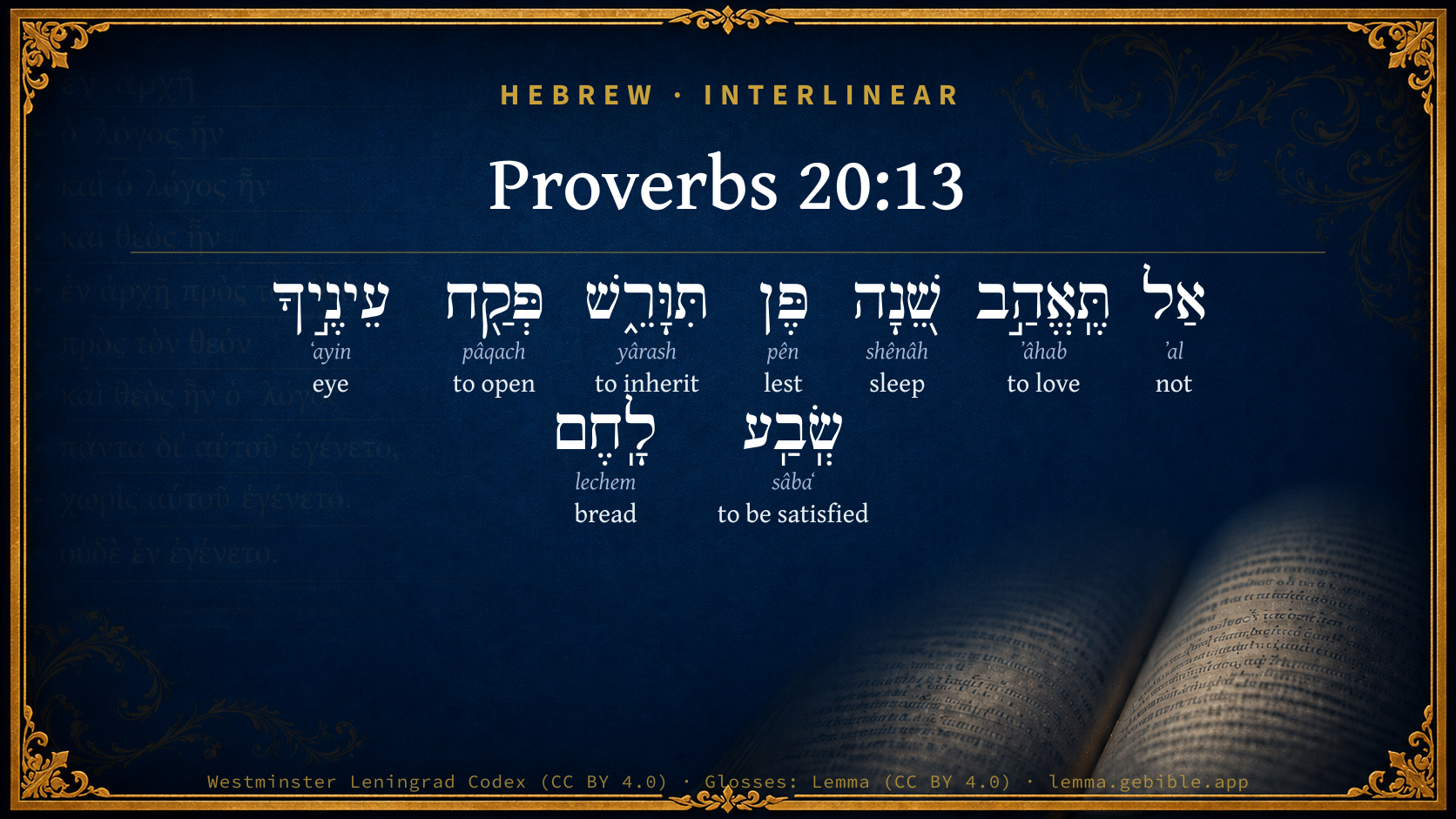
Hebrew (Westminster Leningrad Codex) Proverbs 20:13 appears in the Hebrew Old Testament. The text above is from the Westminster Leningrad Codex. Each word links to its Strong’s number, a concise gloss, and parsing drawn from the Open Scriptures Hebrew Bible morphology. Click any word for its full Brown-Driver-Briggs (BDB) entry.
Download image
Cite this verse

Proverbs 20:13 (World English Bible). Public Domain. Lemma interlinear Bible study tool, https://lemma.gebible.app/v/proverbs/20/13.

Show BibTeX & RIS
BibTeX
RIS
English Translation
Don't love sleep, lest you come to poverty; Open your eyes, and you shall be satisfied with bread.
World English Bible · Public Domain
Download a study sheet

One document with this verse’s original text, its word-by-word gloss line, the meaning frame, cross-references with their text, attributed commentary, and full source and license credits — printable, and it pastes into notes with its structure intact.

This verse Autodidact and up

Study sheet (.html) Plain text (.txt)

A passage Seminary Student

Up to 50 verses in one chapter. A passage sheet keeps up to 6 commentary sources and 12 cross-references per verse, in the order this page ranks them, and says so on the sheet whenever that leaves anything out. Ask for a single verse and you get the Autodidact verse sheet above.

Everything on this page stays free to read, with no account — the sheet is a download of what is already on screen, not access to it.

Want to remove ads? Support Godless Engineer
Compare translations 3

The same verse in 3 English versions, stacked beneath the original-language interlinear above. Click any original word for its lexicon entry.

Each is an independent rendering of the whole verse — the interlinear is not word-aligned to these translations.

Highlighted words mark where these versions differ — a whole-verse word diff, not a word-by-word alignment.

  • World English Bible Public Domain
    Don't love sleep, lest you come to poverty; Open your eyes, and you shall be satisfied with bread.
  • King James Version Public Domain
    Love not sleep, lest thou come to poverty; open thine eyes, and thou shalt be satisfied with bread.
  • unfoldingWord Literal Text CC BY-SA 4.0
    Do not love sleep lest you become impoverished. Open your eyes; be satisfied bread.

unfoldingWord Literal Text — © unfoldingWord, licensed CC BY-SA 4.0. Word-aligned USFM3 via Door43 (git.door43.org/unfoldingWord/en_ult).

Versions to compare (up to 4)

3 of 4 selected

Show all 18 translations

Every available English version of this verse, each an independent rendering of the whole verse.

  • World English Bible Public Domain
    Don't love sleep, lest you come to poverty; Open your eyes, and you shall be satisfied with bread.
  • Berean Standard Bible Public Domain
    Do not love sleep, or you will grow poor; open your eyes, and you will have plenty of food.
  • Majority Standard Bible Public Domain
    Do not love sleep, or you will grow poor; open your eyes, and you will have plenty of food.
  • King James Version Public Domain
    Love not sleep, lest thou come to poverty; open thine eyes, and thou shalt be satisfied with bread.
  • American Standard Version (1901) Public Domain
    Love not sleep, let thou come to poverty; Open thine eyes, `and' thou shalt be satisfied with bread.
  • Revised Version (1885) Public Domain
    Love not sleep, lest thou come to poverty; open thine eyes, and thou shalt be satisfied with bread.
  • Geneva Bible (1599) Public Domain
    Loue not sleepe least thou come vnto pouertie: open thine eyes, and thou shalt be satisfied with bread.
  • Douay-Rheims (1899) Public Domain
    Love not sleep, lest poverty oppress thee: open thy eyes, and be filled with bread.
  • Young's Literal Translation Public Domain
    Love not sleep, lest thou become poor, Open thine eyes -- be satisfied `with' bread.
  • Literal Standard Version CC BY-SA 4.0
    Do not love sleep, lest you become poor, || Open your eyes—be satisfied [with] bread.
  • Unlocked Literal Bible CC BY-SA 4.0
    Do not love sleep or you will come to poverty; open your eyes and you will have plenty to eat.
  • unfoldingWord Literal Text CC BY-SA 4.0
    Do not love sleep lest you become impoverished. Open your eyes; be satisfied bread.
  • Darby Bible Public Domain
    Love not sleep, lest thou come to poverty; open thine eyes, [and] thou shalt be satisfied with bread.
  • World Messianic Bible Public Domain
    Don’t love sleep, lest you come to poverty. Open your eyes, and you shall be satisfied with bread.
  • Webster's Bible Public Domain
    Love not sleep, lest thou come to poverty; open thy eyes, and thou shalt be satisfied with bread.
  • Free Bible Version CC BY-SA 4.0
    If you love sleeping you'll become poor. Wake up and get busy, and you'll have plenty to eat.
  • Bible in Basic English Public Domain
    Do not be a lover of sleep, or you will become poor: keep your eyes open, and you will have bread enough.
  • JPS Tanakh (1917) Public Domain
    Love not sleep, lest thou come to poverty; open thine eyes, and thou shalt have bread in plenty.

Literal Standard Version (2020), Covenant Press — licensed CC BY-SA 4.0. Text via the HelloAO Bible API (eBible.org). Unlocked Literal Bible (unfoldingWord) — licensed CC BY-SA 4.0. Text via the HelloAO Bible API (eBible.org). unfoldingWord Literal Text — © unfoldingWord, licensed CC BY-SA 4.0. Word-aligned USFM3 via Door43 (git.door43.org/unfoldingWord/en_ult). Free Bible Version, Dr. Jonathan Gallagher — licensed CC BY-SA 4.0. Text via the HelloAO Bible API (eBible.org).

Word by word

More ways to search: Search by grammar → Find every occurrence → Compare this word →

Practice this passage: Drill this verse → Learn its vocabulary →

About this verse

These counts appear in no published source. They are computed here, from the morphology-tagged text and Lemma’s own curated glosses. What Lemma adds →

9
words
9
distinct lemmas
Wisdom
section

Notable vocabulary

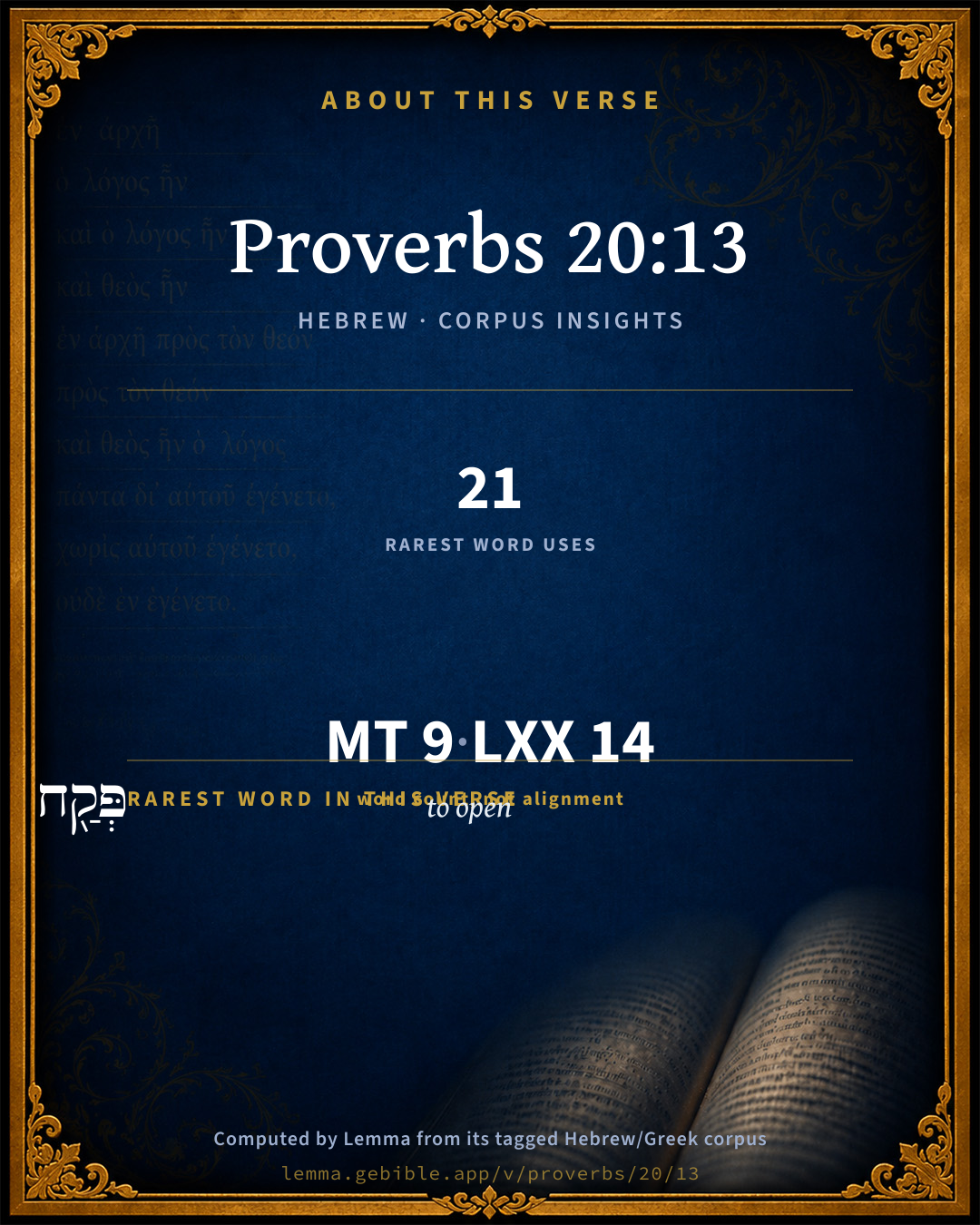
The rarest word here is פְּקַ֖ח to open H6491 — appearing just 21 times in the whole Hebrew Bible.

Shared distinctive vocabulary

פְּקַ֖ח to open H6491 occurs in 18 verses of the Hebrew Bible. Also found in:

Grammatical profile

  • 4 verbs
  • 3 nouns
  • 1 conjunction
  • 1 particle

Verb forms

  • תֶּֽאֱהַ֣ב Qal · Jussive
  • תִּוָּרֵ֑שׁ Niphal · Imperfect
  • פְּקַ֖ח Qal · Imperative
  • שְֽׂבַֽע Qal · Imperative

Hebrew & Septuagint length

In English translation the verse runs 18 words from the Hebrew and 18 from the Septuagint (LXX English) — the same length.

A rough comparison of the two English renderings, which tokenize alike — not a word-level alignment.

Word counts can differ between the Hebrew and the Greek without any difference in meaning — e.g. the Hebrew direct-object marker אֵת has no separate Greek word, and Greek often adds the article ὁ.

In the original languages it is 9 Hebrew tokens and 14 Greek tokens — but the two are counted differently (Hebrew bundles its prefixes and suffixes into one token; the Greek is in lemma form), so that isn’t a like-for-like length.

Cross-references

12

Topical passages linked to Proverbs 20:13 in the Treasury of Scripture Knowledge — connected by theme and wording, ordered by reader-vote popularity; previews shown in the World English Bible.

  • Proverbs 19:15 Slothfulness casts into a deep sleep. The idle soul shall suffer hunger.
  • Romans 12:11 not lagging in diligence; fervent in spirit; serving the Lord;
  • Proverbs 10:4 He becomes poor who works with a lazy hand, But the hand of the diligent brings wealth.
  • Proverbs 12:11 He who tills his land shall have plenty of bread, But he who chases fantasies is void of understanding.
  • Romans 13:11 Do this, knowing the time, that it is already time for you to awaken out of sleep, for salvation is now nearer to us than when we first believed.
  • Proverbs 6:9–11 How long will you sleep, sluggard? When will you arise out of your sleep?
  • Proverbs 13:4 The soul of the sluggard desires, and has nothing, But the desire of the diligent shall be fully satisfied.
  • Jonah 1:6 So the shipmaster came to him, and said to him, "What do you mean, sleeper? Arise, call on your gods! Maybe the gods will notice us, so that we won't perish."
  • Ephesians 5:14 Therefore he says, "Awake, you who sleep, and arise from the dead, and Christ will shine on you."
  • 2 Thessalonians 3:10 For even when we were with you, we commanded you this: "If anyone will not work, neither let him eat."
  • Proverbs 24:30–34 I went by the field of the sluggard, By the vineyard of the man void of understanding;
  • 1 Corinthians 15:34 Wake up righteously, and don't sin, for some have no knowledge of God. I say this to your shame.

Cross-references courtesy of OpenBible.info (CC BY 4.0).

Hebrew and Greek witnesses Masoretic Hebrew ↔ Greek Septuagint

The same verse in the two great witnesses to the Old Testament, shown verse-for-verse.

These are two independent witnesses, not word-aligned to each other, and the Septuagint is shown in lemma (dictionary) form.

Hebrew Proverbs 20:13 Masoretic · Westminster Leningrad Codex

אַל תֶּֽאֱהַ֣ב שֵׁ֭נָה פֶּן תִּוָּרֵ֑שׁ פְּקַ֖ח עֵינֶ֣יךָ שְֽׂבַֽע לָֽחֶם

Don't love sleep, lest you come to poverty; Open your eyes, and you shall be satisfied with bread.

World English Bible · Public Domain

Greek LXX Proverbs 20:13 Septuagint · lemma form

μή ἀγαπάω καταλαλέω ἵνα μή ἐκαἴρω δια ἀναοἴγω ὁ ὀφθαλμός σύ καί ἐνπίμπλημι ἄρτος

Love not to speak ill, lest you be cut off: open your eyes, and be filled with bread.

LXX2012 (modern English Septuagint) · Public Domain

On this verse, Haydock's Catholic Bible Commentary discusses the Septuagint’s reading. Read the note in Commentary ↓

Hebrew: Westminster Leningrad Codex (CC BY 4.0). Greek: Septuagint (public domain); English from LXX2012 (modern English Septuagint) (Public Domain). How the Septuagint differs from the Hebrew →

Commentary

Notes on Proverbs 20:13 from classic Christian and Jewish commentators (each source and its license shown beneath its notes). The classic Christian expositions comment on the surrounding passage and are grouped to its opening verse, so a note may address several verses; the Jewish commentaries on the Tanakh (Rashi and others) are per-verse, so they appear only where the commentator wrote on this verse.

Lemma curates 59 commentaries, every one of them public domain or Creative Commons licensed, each selected and text-cleaned for this edition rather than reprinted as found. About our sources →

Trapp's Complete Commentary

John Trapp

Pro 20:13 Love not sleep, lest thou come to poverty; open thine eyes, [and] thou shalt be satisfied with bread.

Ver. 13. Love not sleep, lest thou come to poverty.] In sleep there is no use either of sight or hearing, or any other sense. And as little is there of the spiritual senses in the sleep of sin. It fared with the good prophet {Zec 4:1} as with a drowsy person, who though awake and set to work, yet was ready to sleep at it; and Peter, James, and John, if the spirit hold not up their eyes, may be in danger to fall asleep at their prayers, {Mat 26:37-45} and so fall into spiritual poverty: for if prayer stands still, the whole trade of godliness stands still. And a powerless prayer, proceeding from a spirit of sloth, joined with presumption, makes the best men liable to punishment for profaning God’s name, so that he may justly let them fall into some sin, which shall awaken them with smart enough. {Pro 19:15} {See Trapp on "Pro 19:15"}

John Trapp, A Commentary or Exposition upon All the Books of the Old and New Testament (1647–1656) — public domain. Text from a community e-Sword module.

Joseph Benson's Commentary

Pro 20:13. Love not sleep — That is, immoderate sleep, nor sloth, or idleness. Take sleep because necessity requires it, not from any love to it; lest thou come to poverty — Lest thou reduce thyself to beggary. Persons that indulge themselves in sleep to excess, not only lose the time which they spend therein, but contract a listless, indolent disposition and habit, and are generally half asleep, or never well awake, and therefore, of course, come to poverty. Open thine eyes — Awake out of sleep, shake off sloth, and betake thyself to thy employment with diligence and vigour. Thou shalt be satisfied with bread — If thou do not grow rich, yet thou shalt have what is sufficient for the supply of thy own wants, and the wants of those dependant upon thee.

Joseph Benson's Commentary on the Old and New Testaments (1811–1818) — public domain. Text from a community e-Sword module.

Tyndale Open Study Notes

Tyndale Open Resources

20:13 Laziness generally leads to poverty (see 10:4-6, 26; 12:11; 13:4; 14:4; 15:19; 18:9; 19:15, 24; 20:4).

Tyndale Open Study Notes — © Tyndale Open Resources, licensed CC BY-SA 4.0. Text via the HelloAO Bible API.

Matthew Henry's Commentary

Note, 1. Those that indulge themselves in their ease may expect to want necessaries, which should have been gotten by honest labour. "Therefore, though thou must sleep (nature requires it), yet love not sleep, as those do that hate business. Love not sleep for its own sake, but only as it fits for further work. Love not much sleep, but rather grudge the time that is spent in it, and wish thou couldst live without it, that thou mightest always be employed in some good exercise." We must allow it to our bodies as men allow it to their servants, because they cannot help it and otherwise they shall have no good of them. Those that love sleep are likely to come to poverty, not only because they lose the time they spend in excess of sleep, but because they contract a listless careless disposition, and are still half asleep, never well awake. 2. Those that stir up themselves to their business may expect to have conveniences: "Open thy eyes, awake and shake off sleep, see how far in the day it is, how thy work wants thee, and how busy others are about thee! And, when thou art awake, look up, look to thy advantages, and do not let slip thy opportunities; apply thy mind closely to thy business and be in care about it. It is the easy condition of a great advantage: Open thy eyes and thou shalt be satisfied with bread; if thou dost not grow rich, yet though shalt have enough, and that is as good as a feast."

Matthew Henry's Commentary on the Whole Bible (1708–1710) — public domain (CC PDM 1.0). Text via the HelloAO Bible API.

Jamieson, Fausset & Brown

Robert Jamieson, A. R. Fausset & David Brown

Activity and diligence contrasted with sloth (Pro 6:9; Pro 10:11).

lest . . . poverty--literally, "be deprived of inheritance."

Jamieson, Fausset & Brown — Commentary Critical and Explanatory on the Whole Bible (1871) — public domain (CC PDM 1.0). Text via the HelloAO Bible API.

Adam Clarke's Commentary

Verse 13. Love not sleep, lest thou come to poverty] Sleep, indescribable in its nature, is an indescribable blessing; but how often is it turned into a curse! It is like food; a certain measure of it restores and invigorates exhausted nature; more than that oppresses and destroys life. A lover of sleep is a paltry, insignificant character.

Adam Clarke's Commentary on the Bible (1810–1826) — public domain. Text from a community e-Sword/MySword module.

Ellicott's Commentary for English Readers

(13) Open thine eyes.—Be up and stirring.

A Bible Commentary for English Readers, edited by Charles John Ellicott (1878–1897) — public domain. Text from a community e-Sword module.

The Cambridge Bible for Schools and Colleges

gen. ed. J. J. S. Perowne

13. Comp. Pro_6:9-11; Pro_19:15.

The Cambridge Bible for Schools and Colleges (gen. ed. J. J. S. Perowne; Cambridge University Press, 1878–1918) — public domain. Text from a community e-Sword module.

John Gill's Exposition

Love not sleep, lest thou come to poverty,.... Sleep is a very great natural blessing; it is a gift of God, what nature requires, and is desirable; it is to be loved, though not immoderately; it is sweet to a man, and what he should be thankful for; yet should not indulge himself in to the neglect of the proper business of life; nor to be used but at the proper time for it; for the eye is made for sight, and not for sleep only, as Aben Ezra observes, connecting the words with the preceding; and therefore should not be kept shut and inattentive to business, which must necessarily end in poverty and want; see Pro 6:9; and so spiritual sleep and slothfulness bring on a spiritual poverty in the souls of men, both as to the exercise of grace and the performance of duty;

open thine eyes, and thou shall be satisfied with bread; that is, open thine eyes from sleep, awake and keep so, and be sedulous and industrious in the business of thy calling; so shalt thou have a sufficiency of food for thyself and family; see Pro 12:11. It may be applied to awaking out of sleep in a spiritual sense, and to a diligent attendance to duty and the use of means, whereby the souls of men come to be satisfied with the goodness of the Lord, and the fatness of his house; see Eph 5:14.

John Gill's Exposition of the Whole Bible (1746–1763) — public domain (CC PDM 1.0). Text via the HelloAO Bible API.

Albert Barnes' Notes on the Bible

Open thine eyes - Be vigilant and active. That is the secret of prosperity.

Albert Barnes' Notes on the Bible (1834–1885) — public domain. Text from a community e-Sword/MySword module.

Haydock's Catholic Bible Commentary

Sleep. Septuagint, "back-biting, that thou mayst not be taken off." (Haydock)

George Leo Haydock (1774–1849), Haydock's Catholic Family Bible and Commentary, 1859 edition — public domain. Excludes Psalms (Douay-Rheims chapter numbering differs from Protestant) and Deuterocanonical books (Catholic canon only).

Matthew Poole's English Annotations

Love not sleep, i.e. immoderate sleep, or sloth, or idleness. Take sleep because necessity requires it, not from any love to it.

Open thine eyes; awake out of sleep, shake off sloth, and betake thyself to thy employment with diligence and rigour.

Matthew Poole's English Annotations on the Holy Bible (1683–1685) — public domain. Text from a community e-Sword/MySword module.

Whedon's Commentary on the Bible

Daniel D. Whedon

13. Love not sleep — Love it not for itself — its ease and indulgence — but use it only for the refreshment of nature.

Open thine eyes — Be wide awake and diligent.

Thou shalt be satisfied — Literally, be satisfied. The imperative is frequently used for the indicative future. Sleep is a great blessing, and needful to health, vigour, and activity; but one may contract the habit of sleeping more than is needful. Some men work with body or mind when they ought to be sleeping. Others sleep when they ought to be working. Judgment, prudence, and self-denial are necessary in this as in other matters. Instead of “Love not sleep,” the Septuagint has, “Love not to speak ill,” etc. Compare Pro_12:11; Pro_19:15.

Daniel D. Whedon (gen. ed.), Commentary on the Old and New Testaments (1874–1909) — public domain. Text from a community e-Sword module.

The Pulpit Commentary

Love not sleep lest thou come to poverty. (see Pro_6:9, etc.) The fate of the sluggard is handled again in Pro_23:21, as often before; e.g. Pro_12:11 Pro_19:15. The LXX, taking hnve (shenah), "sleep," as perhaps connected with the verb hnv (shanah), translate, "Love not to rail, that thou be not exalted (ina mh exarwhv )," i.e. probably, "Do not calumniate others in order to raise yourself;" others translate, "lest thou be cut off." Open thine eyes, and thou shalt be satired with bread. These words seem to connect this clause with ver. 12. God gives the faculty, but man must make due use thereof. The gnomist urges, "Do not slumber at your post, or sit downwardly waiting; but be up and doing, be wakeful and diligent, and then you shall prosper."

The Pulpit Commentary (1880–1919), ed. H.D.M. Spence-Jones & Joseph S. Exell — public domain. Text from a community e-Sword module.

John Wesley's Explanatory Notes

Open - Shake off sloth and betake thyself to thy employment with diligence and vigour.

John Wesley, Explanatory Notes Upon the Whole Bible (1754–1765) — public domain. Text via the GEBible commentary corpus.

Keil & Delitzsch

C. F. Keil & F. Delitzsch

13 Love not sleep, lest thou become poor;

Open thine eyes, and have enough to eat.

What is comprehended in the first line here is presented in detail in Pro 6:9-11. The fut. Niph. of רוּשׁ, to become poor (cf. Pro 10:4), is formed metaplastically from ירשׁ, Pro 23:21; Pro 30:9, as at Sa1 2:7; Hitzig compares (Arab.) ryth, which, however, means to loiter or delay, not to come back or down. The R. רש signifies either to be slack without support (cf. דּל), or to desire (cf. אבון, Arab. fkyr, properly hiscens, R. פק, as in פקח, to open widely, which here follows). Regarding the second imper. 13b, vid., Pro 3:4 : it has the force of a consequence, Las deine augen wacker sein, So wirstu brots gnug haben (Luth.) [Let thine eyes be open, so shalt thou have bread enough]. With these two proverbs of the eyes, the group beginning with Pro 20:8 rounds itself off.

Keil & Delitzsch — Biblical Commentary on the Old Testament (1861–1891) — public domain (CC PDM 1.0). Text via the HelloAO Bible API. (Old Testament only.)

Bridges on Proverbs

Charles Bridges

Use ’sleep, as tired nature’s sweet restorer.’†1 So man requires it. So God graciously gives it. (Psa 3:5 ; Psa 4:8 ; Psa 127:2 .) Without it "man" could not "go forth to his work and to his labor." (Psa 104:23 .) Thus recruited for the active diligence of the day, he opens his eyes, "in the sweat of his brow he eats his bread (Gen 3:19 ), and is satisfied with it." But love not sleep for its own sake. ’Let your sleep be necessary and healthful, not idle and expensive of time beyond the needs and conveniences of nature.’†2 Otherwise may it become a baneful and ruinous habit, by which the man of talent, who has much responsibility upon his hand, and no heart to act up to it — cometh to poverty. Valuable opportunities for improvements are let slip, and "the strong man armed" readily takes possession of his prey. (Pro 5:9-11 .) Strange inconsistency and delusion! Man wishes for a long life, and yet willfully shortens the life given to him, by dozing it away in sleep!†3 The time given for eternity is wasted. The talent entrusted for trading is hid in a napkin. Nothing is done for God, for the soul, for his fellow-creatures, or for heaven. Justly is he cast out as a wicked, because a slothful, servant. (Mat 25:14-30 .)

Unquestionably the Christian degrades himself from his proper level by needless indulgence; choosing a state common to him with the brutes, before that which elevates him to fellowship with angels. Nor can he set his heavenly privilege of communion with God at a very high estimate, if he be not willing to sacrifice fleshly pleasure for the enjoyment of it. The evil however does not end with the present indulgence. The habits of the day are enervated. The mind is — at least partially — asleep, during the routine of occupation. What is idle, or calling for little effort, is alone agreeable. Every exercise of self-denial is revolting. It is sufficiently obvious that this spirit has little sympathy with the genuine spirit of religion — life and spirit, and joy and energy. It sinks far below the step and obligation of those, whose profession is — "temples of the Holy Ghost,"†4 "children of the light and of the day,"†5 "virgins with their lamps trimmed"†6 for the bridegroom’s coming, animated candidates for an incorruptible and eternal crown.†7

Specially should those of us, who are of a drowsy habit of body, listen to the call — Love not sleep. Here perhaps may be the Christian conflict, often most painful in the house of God. But in this solemn assembly — the gate of heaven — may we not hear the gentle rebuke, "What! could ye not watch with me one hour? Watch and pray, that ye enter not into temptation." (Mat 26:40-41 .) When resisted, it is an infirmity; when allowed, or only feebly opposed, it is sin. At all events, in the service of God it is safer to consider it, not as a weariness to be encouraged, but as an indulgence to be mortified, and that with vigorous energy of conflict. Else, whilst the self-denying Christian will open his eyes, and be filled with bread, the power of the flesh may impoverish the spirit by the indulgence of a lifeless habit of prayer, hearing, and meditation.

Footnotes:

†1 Young.

†2 Bishop Taylor’s Holy Living, Chapter I. Sect. i.

†3 Pro 19:15. Dr. Doddridge’s life, though far from reaching the age of man (Psa 90:10 ), was yet, by the resistance of this besetting temptation, virtually extended to the ordinary bounds. By his successful energy in redeeming time from sleep he accomplished his invalable work in the midst of multiplied engagements. See Family Expositor on Rom 12:13 . ’I take it for granted, that every Christian, who is in health, is up early in the morning. For it is much more reasonable to suppose a person up early, because he is a Christian, than because he is a laborer, or a tradesman, or a servant, or has business that wants him.’ — Law’s Serious Call.

†4 1Co 6:19 .

†5 1Th 5:5-6 .

†6 Mat 25:7.

†7 1Co 9:24-25 .

Charles Bridges, An Exposition of the Book of Proverbs (1846) — public domain. Text from a community e-Sword module.

Kretzmann's Popular Commentary

Paul E. Kretzmann

v. 13. Love not sleep, that associated with slothfulness, lest thou come to poverty, that being the result of sloth; open thine eyes, with the proper energy, industry, and vigor, and thou shalt be satisfied with bread, for so is diligent activity rewarded.

Paul E. Kretzmann, Popular Commentary of the Bible (1921–1924) — public domain. Text from a community e-Sword module.

unfoldingWord translationNotes

Door43 World Missions Community

come to poverty

The phrase "come to" here means to transition into a new situation; to become. AT: "become poor" (See: Idiom)

open your eyes

Here "opening one's eyes" is spoken of as "being awake." AT: "stay awake" or "be alert" (See: Metonymy)

"Bad! Bad!" says the buyer, but when he goes away he boasts

Here a buyer is criticizing what someone is selling to get a low price from him. After he buys he boasts about the good price that he pursuaded the seller to give him. The full meaning of this can be made clear. AT: "'Bad! Bad!' says the buyer criticizing the seller's wares, but after he buys he goes away he boasting about the low price that he paid" (See: Assumed Knowledge and Implicit Information)

translationWords

love

boast

unfoldingWord translationNotes — © Distant Shores Media and the Door43 World Missions Community, licensed CC BY-SA 4.0. Source: git.door43.org/Door43/en_tn.

Rashi

Rabbi Shlomo Yitzchaki (Rashi)

lest you become poor Heb. תורש you become poor (רש).

Rashi on the Tanakh — English translations: “The Judaica Press complete Tanach with Rashi, translated by A. J. Rosenberg” (CC BY 4.0); “Pentateuch with Rashi's commentary by M. Rosenbaum and A.M. Silbermann, 1929-1934” (public domain); “The Metsudah Tanach series, Lakewood, N.J” (CC BY 4.0); and “The Book of Joshua, Metsudah Publications, 1997” (CC BY 4.0). Text via Sefaria.

Lesson kit

Teaching starters — assembled from the data on this page, not authored interpretation. Every prompt links to the verse data it draws on. Edit before teaching.

Proverbs, in the Wisdom, opens this verse with 9 words (9 distinct Hebrew lemmas). Its most distinctive word is pâqach (“to open”). A historical commentator’s framing appears above. Read the whole chapter for the surrounding context.

Discussion questions

  1. The word pâqach carries the sense “to open.” How does it shape the verse?
  2. How does Genesis 3:5, which shares the word «to open», read alongside this verse?
  3. The translations on this page render this verse differently — a whole-verse word diff, not a word-by-word alignment. What might account for the different wordings?
  4. «תֶּֽאֱהַ֣ב» is a Qal Jussive verb. How does that grammatical form shape the action described?
  5. Compare how Trapp's Complete Commentary and Joseph Benson's Commentary read this verse. Where do they agree or differ?

Things to notice

Reading settings

Reading text

Shown beneath each verse's original-language words.

Old Testament
Old Testament edition

Read the OT as the Masoretic Hebrew (MT) or the Greek Septuagint (LXX).

English shown for the Greek Septuagint (in the Hebrew ↔ Greek comparison).

Comparing translations? Open the Compare panel on any verse page to stack up to four side by side.