
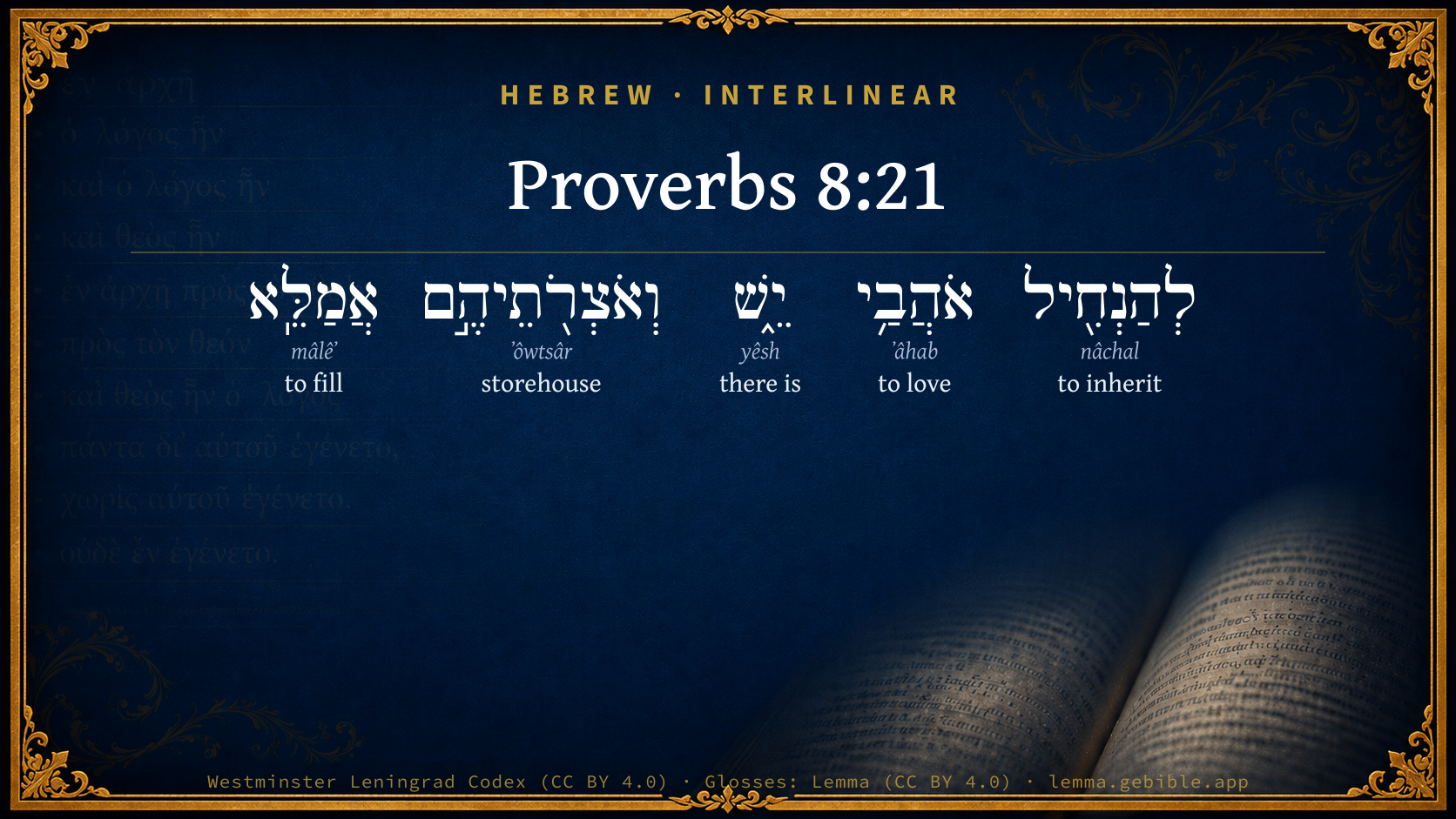
Proverbs 8:21

Hebrew (Westminster Leningrad Codex) Proverbs 8:21 appears in the Hebrew Old Testament. The text above is from the Westminster Leningrad Codex. Each word links to its Strong’s number, a concise gloss, and parsing drawn from the Open Scriptures Hebrew Bible morphology. Click any word for its full Brown-Driver-Briggs (BDB) entry.
Download image
Cite this verse

Proverbs 8:21 (World English Bible). Public Domain. Lemma interlinear Bible study tool, https://lemma.gebible.app/v/proverbs/8/21.

Show BibTeX & RIS
BibTeX
RIS
English Translation
That I may give wealth to those who love me. I fill their treasuries.
World English Bible · Public Domain
Download a study sheet

One document with this verse’s original text, its word-by-word gloss line, the meaning frame, cross-references with their text, attributed commentary, and full source and license credits — printable, and it pastes into notes with its structure intact.

This verse Autodidact and up

Study sheet (.html) Plain text (.txt)

A passage Seminary Student

Up to 50 verses in one chapter. A passage sheet keeps up to 6 commentary sources and 12 cross-references per verse, in the order this page ranks them, and says so on the sheet whenever that leaves anything out. Ask for a single verse and you get the Autodidact verse sheet above.

Everything on this page stays free to read, with no account — the sheet is a download of what is already on screen, not access to it.

Want to remove ads? Support Godless Engineer
Compare translations 3

The same verse in 3 English versions, stacked beneath the original-language interlinear above. Click any original word for its lexicon entry.

Each is an independent rendering of the whole verse — the interlinear is not word-aligned to these translations.

Highlighted words mark where these versions differ — a whole-verse word diff, not a word-by-word alignment.

  • World English Bible Public Domain
    That I may give wealth to those who love me. I fill their treasuries.
  • King James Version Public Domain
    That I may cause those that love me to inherit substance; and I will fill their treasures.
  • unfoldingWord Literal Text CC BY-SA 4.0
    to cause those who love me to inherit substance; and their treasuries, I will fill.

unfoldingWord Literal Text — © unfoldingWord, licensed CC BY-SA 4.0. Word-aligned USFM3 via Door43 (git.door43.org/unfoldingWord/en_ult).

Versions to compare (up to 4)

3 of 4 selected

Show all 18 translations

Every available English version of this verse, each an independent rendering of the whole verse.

  • World English Bible Public Domain
    That I may give wealth to those who love me. I fill their treasuries.
  • Berean Standard Bible Public Domain
    bestowing wealth on those who love me and making their treasuries full.
  • Majority Standard Bible Public Domain
    bestowing wealth on those who love me and making their treasuries full.
  • King James Version Public Domain
    That I may cause those that love me to inherit substance; and I will fill their treasures.
  • American Standard Version (1901) Public Domain
    That I may cause those that love me to inherit substance, And that I may fill their treasuries.
  • Revised Version (1885) Public Domain
    That I may cause those that love me to inherit substance, and that I may fill their treasuries.
  • Geneva Bible (1599) Public Domain
    That I may cause them that loue me, to inherite substance, and I will fill their treasures.
  • Douay-Rheims (1899) Public Domain
    That I may enrich them that love me, and may fill their treasures.
  • Young's Literal Translation Public Domain
    To cause my lovers to inherit substance, Yea, their treasures I fill.
  • Literal Standard Version CC BY-SA 4.0
    To cause my lovers to inherit substance, || Indeed, I fill their treasures.
  • Unlocked Literal Bible CC BY-SA 4.0
    As a result, I make those who love me inherit wealth; I fill up their treasuries.
  • unfoldingWord Literal Text CC BY-SA 4.0
    to cause those who love me to inherit substance; and their treasuries, I will fill.
  • Darby Bible Public Domain
    that I may cause those that love me to inherit substance; and I will fill their treasuries.
  • World Messianic Bible Public Domain
    that I may give wealth to those who love me. I fill their treasuries.
  • Webster's Bible Public Domain
    That I may cause those that love me to inherit substance; and I will fill their treasures.
  • Free Bible Version CC BY-SA 4.0
    I grant wealth to those who love me; I fill their treasure storehouses.
  • Bible in Basic English Public Domain
    So that I may give my lovers wealth for their heritage, making their store-houses full.
  • JPS Tanakh (1917) Public Domain
    That I may cause those that love me to inherit substance, and that I may fill their treasuries.

Literal Standard Version (2020), Covenant Press — licensed CC BY-SA 4.0. Text via the HelloAO Bible API (eBible.org). Unlocked Literal Bible (unfoldingWord) — licensed CC BY-SA 4.0. Text via the HelloAO Bible API (eBible.org). unfoldingWord Literal Text — © unfoldingWord, licensed CC BY-SA 4.0. Word-aligned USFM3 via Door43 (git.door43.org/unfoldingWord/en_ult). Free Bible Version, Dr. Jonathan Gallagher — licensed CC BY-SA 4.0. Text via the HelloAO Bible API (eBible.org).

Word by word

More ways to search: Search by grammar → Find every occurrence → Compare this word →

Practice this passage: Drill this verse → Learn its vocabulary →

לְהַנְחִ֖יל
nâchal
H5157
“to inherit”
Preposition + Verb, Hiphil, Infinitive Construct
Part of Speech
Preposition + Verb
Stem
Hiphil
Form
Infinitive Construct
Full BDB Definition

Origin: a primitive root

TWOT: 1342

to get as a possession, acquire, inherit, possess - (Qal) - to take possession, inherit - to have or get as a possession or property (figuratively) - to divide the land for a possession - to acquire (testimonies) (figuratively) - (Piel) to divide for a possession - (Hithpael) to possess oneself of - (Hiphil) - to give as a possession - to cause to inherit, give as an inheritance - (Hophal) to be allotted, be made to possess
  1. אֹהֲבַ֥י ʼâhab H157 “loving · me” Verb, Qal, Participle Active, Masculine, Plural, Construct + Suffix, Personal, 1st Person, Common, Singular
  2. יֵ֑שׁ yêsh H3426 “there is” Particle, Demonstrative
  3. וְאֹצְרֹ֖תֵיהֶ֣ם ʼôwtsâr H214 “and · storehouses · their” Conjunction + Noun, Common, Masculine, Plural, Construct + Suffix, Personal, 3rd Person, Masculine, Plural
  4. אֲמַלֵּֽא mâlêʼ H4390 “to fill” Verb, Piel, Imperfect, 1st Person, Common, Singular

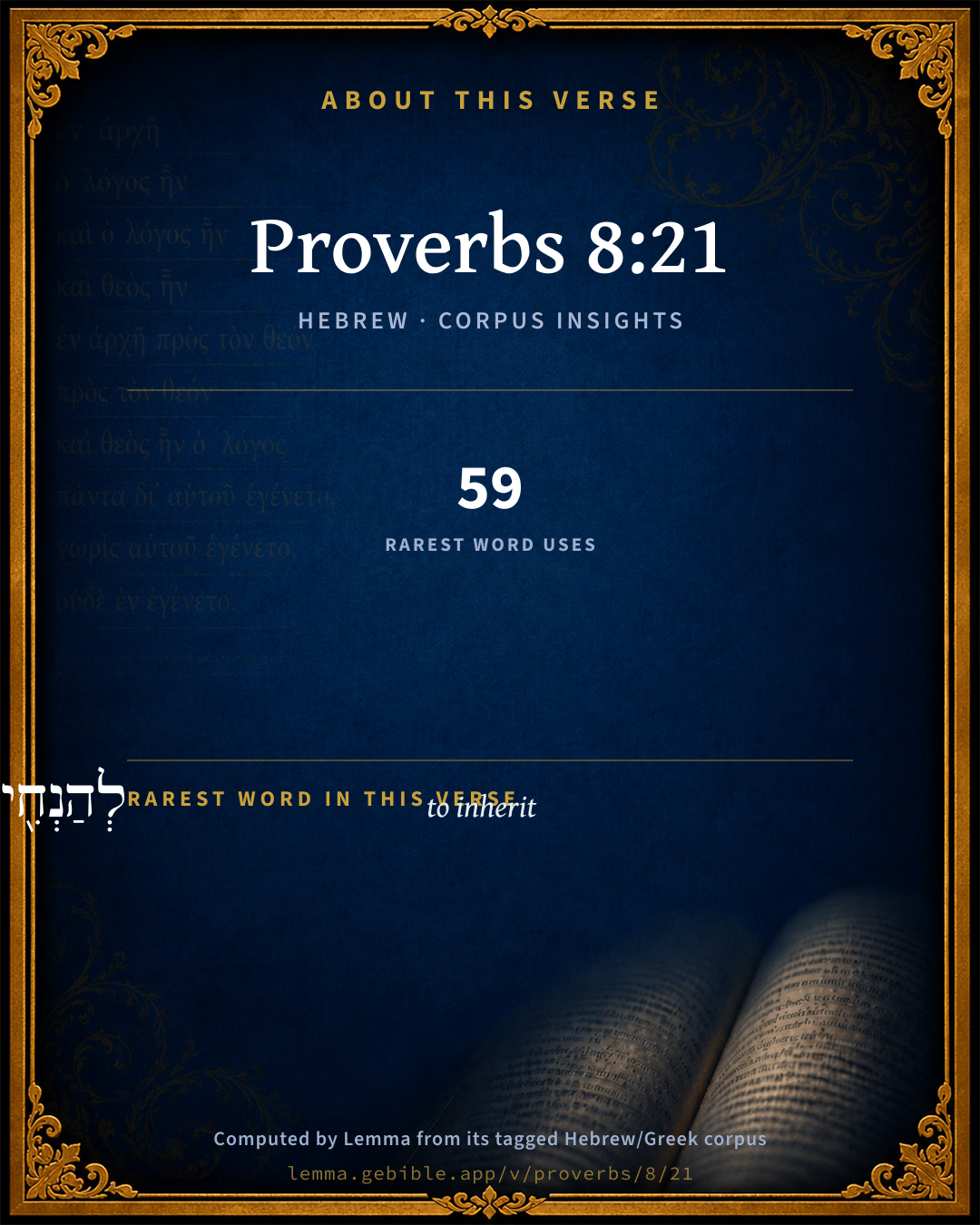
About this verse

These counts appear in no published source. They are computed here, from the morphology-tagged text and Lemma’s own curated glosses. What Lemma adds →

5
words
5
distinct lemmas
Wisdom
section

Shared distinctive vocabulary

לְהַנְחִ֖יל to inherit H5157 occurs in 57 verses of the Hebrew Bible. Also found in:

Grammatical profile

  • 3 verbs
  • 1 noun
  • 1 particle

Verb forms

  • לְהַנְחִ֖יל Hiphil · Infinitive Construct
  • אֹהֲבַ֥י Qal · Participle Active
  • אֲמַלֵּֽא Piel · Imperfect

Hebrew & Septuagint length

In English translation the verse runs 14 words from the Hebrew and 38 from the Septuagint (LXX English) — the Septuagint runs noticeably longer here. See the side-by-side →

A rough comparison of the two English renderings, which tokenize alike — not a word-level alignment.

Word counts can differ between the Hebrew and the Greek without any difference in meaning — e.g. the Hebrew direct-object marker אֵת has no separate Greek word, and Greek often adds the article ὁ.

Cross-references

14

Topical passages linked to Proverbs 8:21 in the Treasury of Scripture Knowledge — connected by theme and wording, ordered by reader-vote popularity; previews shown in the World English Bible.

  • Proverbs 24:4 By knowledge the rooms are filled With all rare and beautiful treasure.
  • 1 Peter 1:4 to an incorruptible and undefiled inheritance that doesn't fade away, reserved in heaven for you,
  • Genesis 15:14 I will also judge that nation, whom they will serve. Afterward they will come out with great substance.
  • Matthew 25:46 These will go away into eternal punishment, but the righteous into eternal life."
  • 1 Samuel 2:8 He raises up the poor out of the dust, He lifts up the needy from the dunghill, To make them sit with princes, Inherit the throne of glory: For the pillars of the earth are Yahweh's, He has set the world on them.
  • Psalms 16:11 You will show me the path of life. In your presence is fullness of joy. In your right hand there are pleasures forevermore.
  • Proverbs 1:13 We'll find all valuable wealth. We'll fill our houses with spoil.
  • Hebrews 10:34 For you both had compassion on me in my chains, and joyfully accepted the plundering of your possessions, knowing that you have for yourselves a better possession and an enduring one in the heavens.
  • Proverbs 6:31 But if he is found, he shall restore seven times. He shall give all the wealth of his house.
  • Proverbs 8:18 With me are riches, honor, Enduring wealth, and prosperity.
  • John 1:1–18 In the beginning was the Word, and the Word was with God, and the Word was God.
  • Revelation 21:7 He who overcomes, I will give him these things. I will be his God, and he will be my son.
  • Romans 8:17 and if children, then heirs; heirs of God, and joint-heirs with Christ; if indeed we suffer with him, that we may also be glorified with him.
  • Ephesians 3:19–20 and to know Christ's love which surpasses knowledge, that you may be filled with all the fullness of God.

Cross-references courtesy of OpenBible.info (CC BY 4.0).

Hebrew and Greek witnesses Masoretic Hebrew ↔ Greek Septuagint

The same verse in the two great witnesses to the Old Testament, shown verse-for-verse.

Here the Septuagint runs noticeably longer than the Hebrew — LXX2012 (modern English Septuagint) 38 words vs World English Bible 14. A rough length comparison of the two English translations, not a word-level alignment — read both below.

These are two independent witnesses, not word-aligned to each other, and the Septuagint is shown in lemma (dictionary) form.

Hebrew Proverbs 8:21 Masoretic · Westminster Leningrad Codex

לְהַנְחִ֖יל אֹהֲבַ֥י יֵ֑שׁ וְאֹצְרֹ֖תֵיהֶ֣ם אֲמַלֵּֽא

That I may give wealth to those who love me. I fill their treasuries.

World English Bible · Public Domain

Greek LXX Proverbs 8:21 Septuagint · lemma form

ἵνα μερίζω ὁ ἐγώ ἀγαπάω ὕπαρξιν καί ὁ θησαυρός αὐτός ἐνπίμπλημι ἀγαθός ἐάν ἀναἀγγέλλω σύ ὁ κατά ἡμέρα γίγνομαι μνημονεύω ὁ ἐκ αἰών ἀριθμέω

that I may divide substance to them that love me, and may fill their treasures with good things. If I declare to you the things that daily happen, I will remember also to recount the things of old.

LXX2012 (modern English Septuagint) · Public Domain

On this verse, The Cambridge Bible for Schools and Colleges discusses the Septuagint’s reading. Read the note in Commentary ↓

Hebrew: Westminster Leningrad Codex (CC BY 4.0). Greek: Septuagint (public domain); English from LXX2012 (modern English Septuagint) (Public Domain). How the Septuagint differs from the Hebrew →

Commentary

Notes on Proverbs 8:21 from classic Christian and Jewish commentators (each source and its license shown beneath its notes). The classic Christian expositions comment on the surrounding passage and are grouped to its opening verse, so a note may address several verses; the Jewish commentaries on the Tanakh (Rashi and others) are per-verse, so they appear only where the commentator wrote on this verse.

Lemma curates 59 commentaries, every one of them public domain or Creative Commons licensed, each selected and text-cleaned for this edition rather than reprinted as found. About our sources →

Trapp's Complete Commentary

John Trapp

Pro 8:21 That I may cause those that love me to inherit substance; and I will fill their treasures.

Ver. 21. To inherit substance.] Heb., That which is; that which hath some tack or substance in it, some firmity, or solid consistency. "Wilt thou set thine eyes upon that which is not?" Outward things are not, but only in opinion, in imagination; in semblance, not in substance. The pomp of this world is but a fancy, {Act 25:23} the glory of it a conceit, {Mat 4:8} the whole fashion of it a mere notion. {1Co 7:31} Riches get them great eagles’ "wings, they fly away," {Pro 23:5} without once taking leave of the owner, leaving nothing but the print of their talons in his heart to torment him. When we grasp them most greedily, we embrace nothing but smoke, which wrings tears from our eyes, and vanisheth into nothing. Only true grace is "durable substance"; the "things above" outlast the days of heaven, and run parallel with the life of God, and line of eternity.

John Trapp, A Commentary or Exposition upon All the Books of the Old and New Testament (1647–1656) — public domain. Text from a community e-Sword module.

The Biblical Illustrator

Joseph S. Exell

Pro_8:21

That I may cause them that love Me to inherit substance.

Mans enrichment by God

I. Love--the love of God as the source of every blessing.

II. The love of created being is excited by some good, real or imaginary, in the object beloved.

III. Mans individual sins, wants, and necessities.

IV. Observe the way in which man is to become rich. God gives Himself--involving every good.

V. God himself is to be the wealth of His family for evermore. (W. Howels.)

Real substance in spiritual things

This is among the golden sayings of the book. In the text is an encouragement to religion drawn from the incomparable benefit of it. They that love Me shall not be losers by Me. The Hebrew word for substance means that which is: that which hath a firm and solid consistency.

1. By substance may be meant Christ. He must needs be substance who gives being and substance to everything.

2. By substance is meant the grace of the Spirit. That must needs be substance which partakes of the fulness of God.

3. By substance is meant salvation, expressly called substance (Heb_10:34).

I. The qualification of the persons. Those that love Me.

1. The affection: Love. Love doth mellow and perfume holy duties. Love is that which the Lord is most delighted with.

2. The object of love: Christ. Did men know Christ, it were impossible to keep them off from loving Him.

II. The specification of the privilege. Why is grace called substance?

1. For its preciousness.

2. For its suitableness.

3. For its needfulness.

4. For its satisfyingness.

5. For its certainty.

6. For its durableness.

Substance signifies something that runs parallel with eternity. That spiritual things must needs have a real being and substance in them appears by two convincing arguments.

(1) Because God, who is the original pattern of truth, hath asserted it.

(2) This is most consistent with the rational nature.

Learn--

1. The incomparable excellence of grace.

2. See the difference between the things of God and the things of the world.

3. See the egregious folly of those who mind things of less moment, but do not look after substance (Isa_4:2).

Why do not men labour more after spiritual substance? Answer:

1. Ignorance.

2. Presumption.

If we have this spiritual substance, we can remember a time when we wanted it. We know how we came by it. We highly prize it. (T. Watson.)

The Biblical Illustrator, edited by Joseph S. Exell (c. 1880s–1900s) — public domain. Text from a community e-Sword module.

MacLaren's Expositions of Holy Scripture

Alexander MacLaren

Proverbs

WISDOM’S GIFT

Pro 8:21.

The word here rendered ‘substance’ is peculiar. Indeed, it is used in a unique construction in this passage. It means ‘being’ or ‘existence,’ and seems to have been laid hold of by the Hebrew thinkers, from whom the books commonly called ‘the Wisdom Books’ come, as one of their almost technical expressions. ‘Substance’ may be used in our translation in its philosophical meaning as the supposed reality underlying appearances, but if we observe that in the parallel following clause we find ‘treasures,’ it seems more likely that in the text, it is to be taken in its secondary, and much debased meaning of wealth, material possessions. But the prize held out here to the lovers of heavenly wisdom is much more than worldly good. In deepest truth, the being which is theirs is God Himself. They who love and seek the wisdom of this book possess Him, and in possessing Him become possessed of their own true being. They are owners and lords of themselves, and have in their hearts a fountain of life, because they have God dwelling with and in them.

I. The quest which always finds.

‘Those who love wisdom’ might be a Hebrew translation of ‘philosopher,’ and possibly the Jewish teachers of wisdom were influenced by Greece, but their conception of wisdom has a deeper source than the Greek had, and what they meant by loving it was a widely different attitude of mind and heart from that of the Greek philosopher. It could never be said of the disciples of a Plato that their quest was sure to end in finding what they sought. Many a man then, and many a man since, and many a man to-day, has ‘followed knowledge, like a sinking star,’ and has only caught a glimmer of a far-off and dubious light. There is only one search which is certain always to find what it seeks, and that is the search which knows where the object of it is, and seeks not as for something the locality of which is unknown, but as for that which the place of which is certain. The manifold voices of human aims cry, ‘Who will show us any good?’ The seeker who is sure to find is he who prays, ‘Lord, lift Thou up the light of Thy countenance upon us.’ The heart that truly and supremely affects God is never condemned to seek in vain. The Wisdom of this book herself is presented as proclaiming, ‘They that seek me earnestly shall find me,’ and humble souls in every age since then have set to their seal that the word is true to their experience. For there are two seekers in every such case, God and man. ‘The Father seeketh such to worship Him,’ and His love goes through the world, yearning and searching for hearts that will turn to Him. The shepherd seeks for the lost sheep, and lays it on his shoulders to bear it back to the fold. Jesus Christ is the incarnation of the seeking love of God. And the human seeker finds God, or rather is found by God, for no aspiration after Him is vain, no longing unresponded to, no effort to find Him unresponded to. We have as much of God as we wish, as much as our desires have fitted us to receive. The all-penetrating atmosphere enters every chink open to it, and no seeking soul has ever had to say, ‘I sought Him but found Him not.’

Is there any other quest of which the same can be said? Are not all paths of human effort strewed with the skeletons of men who have fretted and toiled away their lives in vain attempts to grasp aims that have eluded their grip? Do we not all know the sickness of disappointed effort, or the sadder sickness of successful effort, which has secured the apparent good and found it not so good after all? The Christian life is, amid all the failures of human effort, the only life in which the seeking after good is but a little less blessed than the finding of it is, and in which it is always true that ‘he that seeketh findeth.’ Nor does such finding deaden the spirit of seeking, for in every finding there is a fresh discovery of new depths in God, and a consequent quickening of desire to press further into the abyss of His Being, so that aspiration and fruition ever beget each other, and the upward, Godward progress of the soul is eternal.

II. The finding that is always blessed.

We have seen that being is the gift promised to the lovers of wisdom, and that the promise may either be referred to the possession of God, who is the fountain of all being, or to the true possession of ourselves, which is a consequence of our possession of Him. In either aspect, that possession is blessedness. If we have God, we have real life. We truly own ourselves when we have God. We really live when God lives in us, the life of our lives. We are ourselves, when we have ceased to be ourselves, and have taken God to be the Self of ourselves.

Such a life, God-possessing, brings the one good which corresponds to our whole nature. All other good is fragmentary, and being fragmentary is inadequate, as men’s restless search after various forms of good but too sadly proves. Why does the merchantman wander over sea and land seeking for many goodly pearls? Because he has not found one of great price, but tries to make up by their number for the insufficiency of each. But the soul is made, not to find its wealth in the manifold but in the one, and no aggregation of incompletenesses will make up completeness, nor any number of partial satisfactions of this and the other appetite or desire make a man feel that he has enough and more than enough. We must have all good in one Person, if we are ever to know the rest of full satisfaction. It will be fatal to our blessedness if we have to resort to a hundred different sources for different supplies. The true blessedness is simple and yet infinitely complex, for it comes from possessing the one Person in whom dwell for us all forms of good, whether good be understood as intellectual or moral or emotional. That which cannot be everything to the soul that seeks is scarcely worth the seeking, and certainly is not wisely proposed as the object of a life’s search, for such a life will be a failure if it fails to find its object, and scarcely less tragically, though perhaps less conspicuously, a failure if it finds it. All other good is but apparent; God is the one real object that meets all man’s desires and needs, and makes him blessed with real blessedness, and fills the cup of life with the draught that slakes thirst and satisfies the thirstiest.

III. The blessedness that always lasts.

He who finds God, as every one of us may find Him, in Christ, has found a Good that cannot change, pass, or grow stale. His blessedness will always last, as long as he keeps fast hold of that which he has, and lets no man take his crown.

For the Christian’s good is the only one that does not intend to grow old and pall. We can never exhaust God. We need never grow weary of Him. Possession robs other wealth of its glamour, and other pleasures of their poignant sweetness. We grow weary of most good things, and those which we have long had, we generally find get somewhat faded and stale. Habit is a fatal enemy to enjoyment. But it only adds to the joy which springs from the possession of God in Christ. Swedenborg said that the oldest angels look the youngest, and they who have longest experience of the joy of fellowship with God are they who enjoy each instance of it most. We can never drink the chalice of His love to the dregs, and it will be fresh and sparkling as long as we have lips that can absorb it. He keeps the good wine till the last.

The Christian’s good is the only good which cannot be taken away. Loss and change beggars the millionaire sometimes, and the possibility of loss shadows all earthly good with pale foreboding. Everything that is outside the substance of the soul can be withdrawn, but the possession of God in Christ is so intimate and inward, so interwoven with the very deepest roots of the Christian’s personal being, that it cannot be taken out from these by any shocks of time or change. There is but one hand that can end that possession and that is his own. He can withdraw himself from God, by giving himself over to sin and the world. He can empty the shrine and compel the indwelling deity to say, as the legend told was heard in the Temple the night before Roman soldiers desecrated the Holy of Holies: Let us depart. But besides himself, ‘neither things present, nor things to come, nor height nor depth, nor any other creature’ has power to take away that faithful God to whom a poor soul clings, and in whom whoso thus clings finds its unchangeable good.

The Christian’s good is the only one from which we cannot be taken. A grim psalm paints for us the life and end of men ‘who trust in the multitude of their possessions,’ and whose ‘inward thought is that they have founded families that will last.’ It tells how ‘this their way is folly,’ and yet is approved with acclamations by the crowd. It lets us see the founder of a family, the possessor of broad acres, going down to the grave, carrying nothing away, stripped of his glory and with Death for his shepherd, who has driven his flock from pleasant pastures here into the dreariness of Sheol. But that shepherd has a double office. Some he separates from all their possessions, hopes, and joys. Some he, stern though his aspect and harsh though his guidance, leads up to the green pastures of God, and as the last messenger of the love of God in Christ, unites the souls that found God amid the distractions of earth with the God whom they will know better and possess more fully and blessedly, amid the unending felicities and progressive blessednesses of Heaven.

Alexander MacLaren, Expositions of Holy Scripture (1904–1910) — public domain. Text from a community e-Sword module.

Ellicott's Commentary for English Readers

(21) That I may cause those that love me to inherit substance.—The work which each one by my help shall do will be stored up for him in heaven (Mat_6:20), it will be as “gold tried in the fire” (Rev_3:18), which will abide the trial of “the day” (1Co_3:13).

A Bible Commentary for English Readers, edited by Charles John Ellicott (1878–1897) — public domain. Text from a community e-Sword module.

The Cambridge Bible for Schools and Colleges

gen. ed. J. J. S. Perowne

21. I will fill their treasures] or, that I may fill their treasuries. R.V. The LXX. add to this verse:

“If I announce to you the things that are daily coming to pass,

I will be mindful to take count of the things which are from everlasting.”

The Cambridge Bible for Schools and Colleges (gen. ed. J. J. S. Perowne; Cambridge University Press, 1878–1918) — public domain. Text from a community e-Sword module.

John Gill's Exposition

That I may cause those that love me to inherit substance,.... Substantial blessings, blessings indeed, as all spiritual ones are; and substantial grace, as every grace is; and substantial communion with God and Christ, which is a real thing, and had in the way of righteousness; also substantial happiness hereafter, as eternal life is; which being expressed by "substance", or "that which is" (g), as the word used signifies, denotes the reality of it; it being not only actually promised, prepared, and laid up for the saints, but is what is known by them now, and of which they have the earnest and pledge; as also the solidity of it, being opposed to the vain and shadowy things of this life; as well as the riches, valuableness, and continuance of it; it is enduring substance, which cannot be wasted nor taken away; which is in its own nature incorruptible, and the saints will always continue to enjoy it. God himself may be meant, who is most eminently that which is, a self-existent Being, and the Being of beings, essence itself, and of whom the saints are heirs, and who will be their portion now and for ever, Rom 8:17; and such that shall enjoy this inheritance are those that "love" Christ; to them it is promised, for them it is prepared, and to them it will be given, Jam 1:12, Co1 2:9, not that their love to Christ is the meritorious cause of so valuable a blessing; but this describes the persons that shall have it, and points out a proper disposition for it, without which none would be fit to enjoy it; and besides there is a connection between grace and glory; to which may be added, that this shows that Christ does not love in word only, saying, "I love them that love me", Pro 8:17; but in deed also; and how much he esteems the love of his people; and it is designed to encourage the faith and hope of weak believers, who, though they do not so strongly believe in Christ, yet truly love him. And be it further observed, that this substance is enjoyed by way of inheritance; it is not purchased, nor acquired, but bequeathed and given to the children of God by their heavenly Father, and comes to them through the death of Christ the testator, and is for ever, as inheritances are; and so Aben Ezra observes, that it signifies an eternal possession;

and I will fill their treasures; the treasures of their hearts, Mat 12:35; Christ now fills their understandings with spiritual knowledge, their souls with grace, their minds with peace and joy, and their hearts with food and gladness; and hereafter he will fill them to full satisfaction with knowledge, holiness, and joy, and will be all in all to them.

(g) "quod est", Junius & Tremellius; "rem solido vereque subsistentem", Gejerus; "solidum illud", Schultens.

John Gill's Exposition of the Whole Bible (1746–1763) — public domain (CC PDM 1.0). Text via the HelloAO Bible API.

Haydock's Catholic Bible Commentary

Enrich. Hebrew, "grant what is (real goods) an inheritance to them," &c. --- Treasures. Septuagint add, "with goods. If I announce to you daily occurrences, I will admonish you to number the things of the world," (Haydock) and all past events. (Calmet)

George Leo Haydock (1774–1849), Haydock's Catholic Family Bible and Commentary, 1859 edition — public domain. Excludes Psalms (Douay-Rheims chapter numbering differs from Protestant) and Deuterocanonical books (Catholic canon only).

Matthew Poole's English Annotations

Substance; substantial, and true, and satisfying happiness; which is here opposed to all worldly enjoyments which are said not to be, Pro 23:5; which are but mere shadows and dreams of felicity.

Matthew Poole's English Annotations on the Holy Bible (1683–1685) — public domain. Text from a community e-Sword/MySword module.

The Pulpit Commentary

That I may cause those that love me to inherit substance; vye (yesh), uparxiv , "real, valuable possessions." Those who love Wisdom will walk in her path, follow her leading, and therefore, doing God"s will, will be blessed with success. Such will lay up treasure in heaven, will provide bags which wax not old, will be preparing for "an inheritance incorruptible, and undefiled, and that fadeth not away". (Mat_6:20 Luk_12:33 1Pe_1:4) The LXX here inserts a paragraph as a kind of introduction to the important section which follows: "If I declare unto you the things which daily befall, I will remember to recount the things of eternity;" i.e. thus far I have spoken of the advantages derived from Wisdom in daily circumstances; now I proceed to narrate her origin and her doings from all eternity. But the addition appears awkward, and is probably not now in its original position.

The Pulpit Commentary (1880–1919), ed. H.D.M. Spence-Jones & Joseph S. Exell — public domain. Text from a community e-Sword module.

John Wesley's Explanatory Notes

Substance - Substantial happiness: opposed to all worldly enjoyments, which are but mere shadows.

John Wesley, Explanatory Notes Upon the Whole Bible (1754–1765) — public domain. Text via the GEBible commentary corpus.

Rashi

Rabbi Shlomo Yitzchaki (Rashi)

There is substance to give inheritance Heb. יש, lit. there is. There is with me a great inheritance.

Rashi on the Tanakh — English translations: “The Judaica Press complete Tanach with Rashi, translated by A. J. Rosenberg” (CC BY 4.0); “Pentateuch with Rashi's commentary by M. Rosenbaum and A.M. Silbermann, 1929-1934” (public domain); “The Metsudah Tanach series, Lakewood, N.J” (CC BY 4.0); and “The Book of Joshua, Metsudah Publications, 1997” (CC BY 4.0). Text via Sefaria.

Lesson kit

Teaching starters — assembled from the data on this page, not authored interpretation. Every prompt links to the verse data it draws on. Edit before teaching.

Proverbs, in the Wisdom, opens this verse with 5 words (5 distinct Hebrew lemmas). Its most distinctive word is nâchal (“to inherit”). The Greek Septuagint runs longer here. A historical commentator’s framing appears above. Read the whole chapter for the surrounding context.

Discussion questions

  1. What does “to inherit” (nâchal) contribute to the verse as a whole?
  2. Exodus 23:30 shares the word «to inherit» with this verse. How do the two illuminate each other?
  3. Compared with the Hebrew, the Septuagint runs longer here. What questions does that raise?
  4. These translations render this verse differently; the difference is in the English rendering, not the original. What questions does that raise?
  5. The verb «לְהַנְחִ֖יל» is Hiphil Infinitive Construct. How does its form color the action?
  6. Reading how Trapp's Complete Commentary and The Biblical Illustrator read this verse, where do the two commentators agree and where do they part?

Things to notice

Reading settings

Reading text

Shown beneath each verse's original-language words.

Old Testament
Old Testament edition

Read the OT as the Masoretic Hebrew (MT) or the Greek Septuagint (LXX).

English shown for the Greek Septuagint (in the Hebrew ↔ Greek comparison).

Comparing translations? Open the Compare panel on any verse page to stack up to four side by side.