
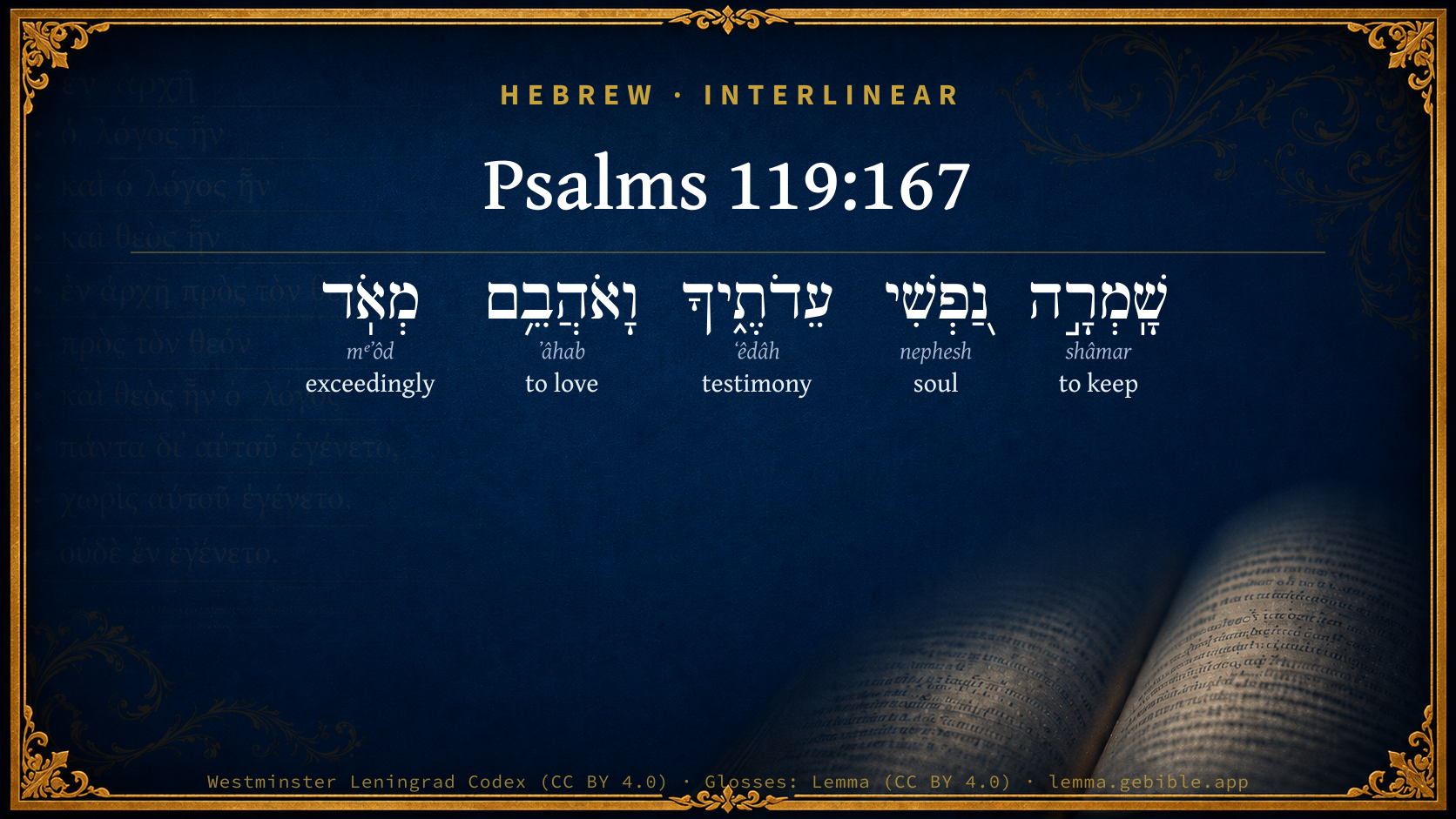
Psalms 119:167

Hebrew (Westminster Leningrad Codex) Psalms 119:167 appears in the Hebrew Old Testament. The text above is from the Westminster Leningrad Codex. Each word links to its Strong’s number, a concise gloss, and parsing drawn from the Open Scriptures Hebrew Bible morphology. Click any word for its full Brown-Driver-Briggs (BDB) entry.
Download image
Cite this verse

Psalms 119:167 (World English Bible). Public Domain. Lemma interlinear Bible study tool, https://lemma.gebible.app/v/psalms/119/167.

Show BibTeX & RIS
BibTeX
RIS
English Translation
My soul has observed your testimonies. I love them exceedingly.
World English Bible · Public Domain
Download a study sheet

One document with this verse’s original text, its word-by-word gloss line, the meaning frame, cross-references with their text, attributed commentary, and full source and license credits — printable, and it pastes into notes with its structure intact.

This verse Autodidact and up

Study sheet (.html) Plain text (.txt)

A passage Seminary Student

Up to 50 verses in one chapter. A passage sheet keeps up to 6 commentary sources and 12 cross-references per verse, in the order this page ranks them, and says so on the sheet whenever that leaves anything out. Ask for a single verse and you get the Autodidact verse sheet above.

Everything on this page stays free to read, with no account — the sheet is a download of what is already on screen, not access to it.

Want to remove ads? Support Godless Engineer
Compare translations 3

The same verse in 3 English versions, stacked beneath the original-language interlinear above. Click any original word for its lexicon entry.

Each is an independent rendering of the whole verse — the interlinear is not word-aligned to these translations.

Highlighted words mark where these versions differ — a whole-verse word diff, not a word-by-word alignment.

  • World English Bible Public Domain
    My soul has observed your testimonies. I love them exceedingly.
  • King James Version Public Domain
    My soul hath kept thy testimonies; and I love them exceedingly.
  • unfoldingWord Literal Text CC BY-SA 4.0
    My soul keeps your testimonies, and I love them exceedingly.

unfoldingWord Literal Text — © unfoldingWord, licensed CC BY-SA 4.0. Word-aligned USFM3 via Door43 (git.door43.org/unfoldingWord/en_ult).

Versions to compare (up to 4)

3 of 4 selected

Show all 17 translations

Every available English version of this verse, each an independent rendering of the whole verse.

  • World English Bible Public Domain
    My soul has observed your testimonies. I love them exceedingly.
  • Berean Standard Bible Public Domain
    I obey Your testimonies and love them greatly.
  • Majority Standard Bible Public Domain
    I obey Your testimonies and love them greatly.
  • King James Version Public Domain
    My soul hath kept thy testimonies; and I love them exceedingly.
  • American Standard Version (1901) Public Domain
    My soul hath observed thy testimonies; And I love them exceedingly.
  • Revised Version (1885) Public Domain
    My soul hath observed thy testimonies; and I love them exceedingly.
  • Geneva Bible (1599) Public Domain
    My soule hath kept thy testimonies: for I loue them exceedingly.
  • Young's Literal Translation Public Domain
    Kept hath my soul Thy testimonies, And I do love them exceedingly.
  • Literal Standard Version CC BY-SA 4.0
    My soul has kept Your testimonies, || And I love them exceedingly.
  • Unlocked Literal Bible CC BY-SA 4.0
    I observe your solemn commands, and I love them greatly.
  • unfoldingWord Literal Text CC BY-SA 4.0
    My soul keeps your testimonies, and I love them exceedingly.
  • Darby Bible Public Domain
    My soul hath kept thy testimonies, and I love them exceedingly.
  • World Messianic Bible Public Domain
    My soul has observed your testimonies. I love them exceedingly.
  • Webster's Bible Public Domain
    My soul hath kept thy testimonies; and I love them exceedingly.
  • Free Bible Version CC BY-SA 4.0
    I obey your laws and love them very much.
  • Bible in Basic English Public Domain
    My soul has kept your unchanging word; great is my love for it.
  • JPS Tanakh (1917) Public Domain
    My soul hath observed Thy testimonies; and I love them exceedingly.

Literal Standard Version (2020), Covenant Press — licensed CC BY-SA 4.0. Text via the HelloAO Bible API (eBible.org). Unlocked Literal Bible (unfoldingWord) — licensed CC BY-SA 4.0. Text via the HelloAO Bible API (eBible.org). unfoldingWord Literal Text — © unfoldingWord, licensed CC BY-SA 4.0. Word-aligned USFM3 via Door43 (git.door43.org/unfoldingWord/en_ult). Free Bible Version, Dr. Jonathan Gallagher — licensed CC BY-SA 4.0. Text via the HelloAO Bible API (eBible.org).

Word by word

More ways to search: Search by grammar → Find every occurrence → Compare this word →

Practice this passage: Drill this verse → Learn its vocabulary →

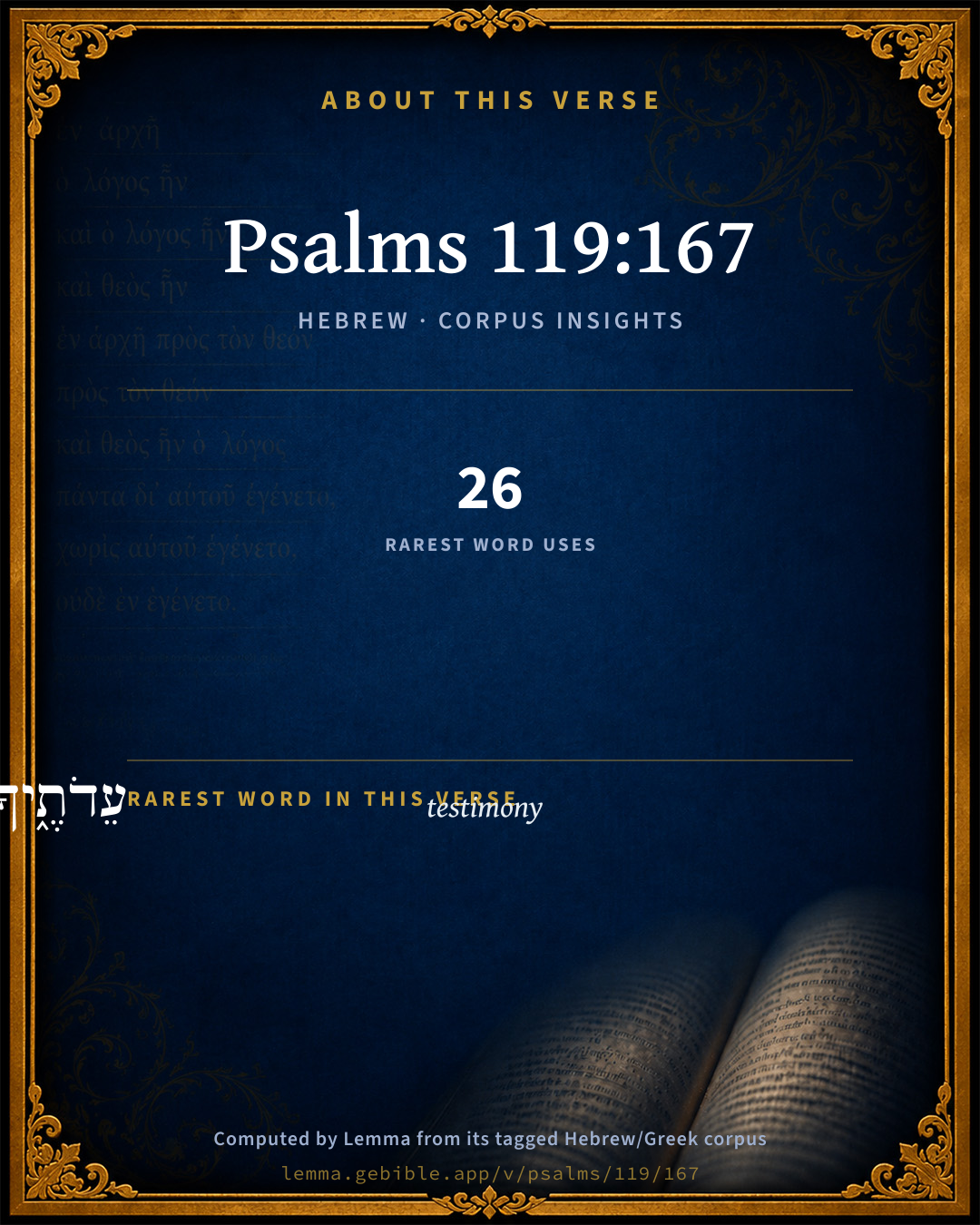
About this verse

These counts appear in no published source. They are computed here, from the morphology-tagged text and Lemma’s own curated glosses. What Lemma adds →

5
words
5
distinct lemmas
Wisdom
section

Shared distinctive vocabulary

עֵדֹתֶ֑יךָ testimony H5713 occurs in 25 verses of the Hebrew Bible. Also found in:

Grammatical profile

  • 2 verbs
  • 2 nouns
  • 1 adverb

Verb forms

  • שָֽׁמְרָ֣ה Qal · Perfect
  • וָאֹהֲבֵ֥ם Qal · Sequential Imperfect

Hebrew & Septuagint length

In English translation the verse runs 10 words from the Hebrew and 10 from the Septuagint (LXX English) — the same length.

A rough comparison of the two English renderings, which tokenize alike — not a word-level alignment.

Word counts can differ between the Hebrew and the Greek without any difference in meaning — e.g. the Hebrew direct-object marker אֵת has no separate Greek word, and Greek often adds the article ὁ.

Cross-references

9

Topical passages linked to Psalms 119:167 in the Treasury of Scripture Knowledge — connected by theme and wording, ordered by reader-vote popularity; previews shown in the World English Bible.

  • Psalms 40:8 I delight to do your will, my God. Yes, your law is within my heart."
  • Romans 7:22 For I delight in God's law after the inward man,
  • Hebrews 10:16 "This is the covenant that I will make with them: 'After those days,' says the Lord, 'I will put my laws on their heart, I will also write them on their mind;'" then he says,
  • John 14:21–24 One who has my commandments, and keeps them, that person is one who loves me. One who loves me will be loved by my Father, and I will love him, and will reveal myself to him."
  • Psalms 119:97 How love I your law! It is my meditation all day.
  • Psalms 119:111 I have taken your testimonies as a heritage forever, For they are the joy of my heart.
  • Psalms 119:159 Consider how I love your precepts. Revive me, Yahweh, according to your loving kindness.
  • John 15:9–10 Even as the Father has loved me, I also have loved you. Remain in my love.
  • Psalms 119:6–8 Then I wouldn't be disappointed, When I consider all of your commandments.

Cross-references courtesy of OpenBible.info (CC BY 4.0).

Hebrew and Greek witnesses Masoretic Hebrew ↔ Greek Septuagint

The same verse in the two great witnesses to the Old Testament, shown verse-for-verse.

You’re reading Greek Psalm 118 (Hebrew Psalm 119). The Septuagint counts the superscription, so verse numbers can differ from the Hebrew — chapter-level alignment, not verse-by-verse. Numbering follows Rahlfs.

These are two independent witnesses, not word-aligned to each other, and the Septuagint is shown in lemma (dictionary) form.

Hebrew Psalms 119:167 Masoretic · Westminster Leningrad Codex

שָֽׁמְרָ֣ה נַ֭פְשִׁי עֵדֹתֶ֑יךָ וָאֹהֲבֵ֥ם מְאֹֽד

My soul has observed your testimonies. I love them exceedingly.

World English Bible · Public Domain

Greek LXX Greek Psalm 118:167 Septuagint · lemma form

φυλάσσω ὁ ψυχή ἐγώ ὁ μαρτύριον σύ καί ἀγαπάω αὐτός σφόδρα

My soul has kept your testimonies, and loved them exceedingly.

LXX2012 (modern English Septuagint) · Public Domain

Hebrew: Westminster Leningrad Codex (CC BY 4.0). Greek: Septuagint (public domain); English from LXX2012 (modern English Septuagint) (Public Domain). How the Septuagint differs from the Hebrew →

Commentary

Notes on Psalms 119:167 from classic Christian and Jewish commentators (each source and its license shown beneath its notes). The classic Christian expositions comment on the surrounding passage and are grouped to its opening verse, so a note may address several verses; the Jewish commentaries on the Tanakh (Rashi and others) are per-verse, so they appear only where the commentator wrote on this verse.

Lemma curates 59 commentaries, every one of them public domain or Creative Commons licensed, each selected and text-cleaned for this edition rather than reprinted as found. About our sources →

Trapp's Complete Commentary

John Trapp

Psa 119:167 My soul hath kept thy testimonies; and I love them exceedingly.

Ver. 167. My soul hath kept thy testimonies] sc. As well as mortality will afford.

And I love them exceedingly] "I delight in the law of God after the inward man," Rom 7:22. "I trust I have a good conscience, in all things willing to live honestly," Heb 13:18.

John Trapp, A Commentary or Exposition upon All the Books of the Old and New Testament (1647–1656) — public domain. Text from a community e-Sword module.

Joseph Benson's Commentary

Psa 119:167-168. My soul hath kept thy testimonies — I have not only obeyed thy commands outwardly, which a hypocrite may do for worldly ends, but I have done it from my very soul, and from a hearty love to them. For all my ways are before thee — I knew I was always in thy presence, and that all my tempers, words, and works were observed by thee. For this clause seems to be added as a principal reason or motive of his obedience, which was the consideration of God’s omnipresence and omniscience, and his desire to approve himself and his ways to God.

Joseph Benson's Commentary on the Old and New Testaments (1811–1818) — public domain. Text from a community e-Sword module.

J. A. Alexander on Psalms

Joseph Addison Alexander

167. (Psa 119:167) My soul observes thy testimonies, and I love them greatly (or exceedingly). I observe them, pay particular regard to them, in regulating my behaviour, not with a mere external conformity, but from or with my soul, because I love them greatly.

Joseph Addison Alexander, The Psalms Translated and Explained (1850) — public domain. Text from a community e-Sword module.

Matthew Henry's Commentary

David's conscience here witnesses for him,

I. That his practices were good. 1. He loved God's testimonies, he loved them exceedingly. Our love to the word of God must be a superlative love (we must love it better than the wealth and pleasure of this world), and it must be a victorious love, such as will subdue and mortify our lusts and extirpate carnal affections. 2. He kept them, his soul kept them. Bodily exercise profits little in religion; we must make heart-work of it or we make nothing of it. The soul must be sanctified and renewed, and delivered into the mould of the word; the soul must be employed in glorifying God, for he will be worshipped in the spirit. We must keep both the precepts and the testimonies, the commands of God by our obedience to them and his promises by our reliance on them.

II. That he was governed herein by a good principle: "Therefore I have kept thy precepts, because by faith I have seen thy eye always upon me; all my ways are before thee; thou knowest every step I take and strictly observest all I say and do. Thou dost see and accept all that I say and do well; thou dost see and art displeased with all I say and do amiss." Note, The consideration of this, that God's eye is upon us at all times, should make us very careful in every thing to keep his commandments, Gen 17:1.

Matthew Henry's Commentary on the Whole Bible (1708–1710) — public domain (CC PDM 1.0). Text via the HelloAO Bible API.

Adam Clarke's Commentary

Verse 167. My soul hath kept] I have not attended to the latter merely, but my spirit has entered into the spirit and design of thy testimonies.

Adam Clarke's Commentary on the Bible (1810–1826) — public domain. Text from a community e-Sword/MySword module.

John Gill's Exposition

My tongue shall speak of thy word,.... Of the word of God in general; of the truth of it, which he knew by certain experience; of the purity of it, tending to promote holiness of heart and life; of the power and efficacy of it, enlightening his mind, and working effectually in him; of the profit of it, to his learning, to his instruction, comfort, and refreshment; of the preciousness of it, being of more worth than thousands of gold and silver; and of the pleasantness of it, being sweeter than the honey or honeycomb, and more to be esteemed than one's necessary food; and of the promises of it in particular, of the worth and value of them, of their suitableness and use, and of the faithful fulfilment of them; and of the doctrines of the word, especially those which relate to the grace of God, and salvation by the Messiah; and also of the precepts of the word, as follows:

for all thy commandments are righteousness; not only righteous, but righteousness itself, being strictly just and equitable in the highest sense; and not only some of them, but all of them; see Psa 119:128. Aben Ezra's paraphrase of the words is,

"I will teach the children of men thy word, that they may know that thy commandments are righteousness;''

which is not amiss: and to the same sense is Kimchi's note, who observes, that author of the Masorah interprets it of praise; as if he had said, My tongue shall praise thy word, because all of it is righteousness.

John Gill's Exposition of the Whole Bible (1746–1763) — public domain (CC PDM 1.0). Text via the HelloAO Bible API.

Albert Barnes' Notes on the Bible

My soul hath kept thy testimonies, and I love them exeeedingly - I am conscious of loving them; I feel an inward assurance that I do love them.

Albert Barnes' Notes on the Bible (1834–1885) — public domain. Text from a community e-Sword/MySword module.

Matthew Poole's English Annotations

I have not only obeyed thy commands, which a hypocrite may sometimes and in part do for worldly ends, but I have done it with my very soul, and from a hearty love to them.

Matthew Poole's English Annotations on the Holy Bible (1683–1685) — public domain. Text from a community e-Sword/MySword module.

The Treasury of David

Charles H. Spurgeon

Ver. 167. My soul hath kept thy testimonies. My outward life has kept thy precepts, and my inward life my soul, has kept thy testimonies. God has borne testimony to many sacred truths, and these we hold fast as for life itself. The gracious man stores up the truth of God within his heart as a treasure exceedingly dear and precious he keeps it. His secret soul, his inmost self, becomes the guardian of these divine teachings which are his sole authority in soul matters.

And I love them exceedingly. This was why he kept them, and having kept them this was the result of the keeping. He did not merely store up revealed truth by way of duty, but because of a deep, unutterable affection for it. He felt that he could sooner die than give up any part of the revelation of God. The more we store our minds with heavenly truth, the more deeply shall we be in love with it: the more we see the exceeding riches of the Bible the more will our love exceed measure, and exceed expression.

Ver. 167. My soul hath kept thy testimonies; and I love them exceedingly. Should he not have said, first, I have loved thy commandments, and so have kept them? Doubtless he did so; but he ran here in a holy and most heavenly circle, I have kept them and loved them, and loved them and kept them. If we love Christ, we shall also live the life of love in our measure, and his commandments will be most dear when himself is most precious. Thomas Shepard, in "The Sound Believer", 1671.

Ver. 167. My soul. It is a usual phrase among the Hebrews, when they would express their vehement affection to anything, to say, "My soul": as Ps 103:1 104:1, "My soul, praise thou the Lord, "and Luke 1. "My soul doth magnify the Lord." Richard Greenham.

Ver. 167. I love them exceedingly. It is only a reasonable return to God; for the Father loved me so exceedingly as not to spare his own Son, but to give him up for me; and the Son loved me so exceedingly that he gave himself to me, and gave me back to myself when I was lost in my sins, original and actual. Gerhohus (1093-1169), in Neale and Littledale.

Ver. 167,168. Let not our consciousness of daily failures make us shrink from this strong expression of confidence. It is alleged as an evidence of grace, not as a claim of merit, and therefore the most humble believer need not hesitate to adopt it as the expression of Christian sincerity before God. David aspired to no higher character than that of a poor sinner: but he was conscious of spirituality of obedience, "exceeding love" to the divine word, and an habitual walk under the eye of his God the evidences of a heart (often mentioned in the Old Testament)" perfect with him." Charles Bridges.

Ver. 167. Past and present.

Ver. 167.

1. The more we keep God's testimonies the more we shall love them.

2. The more we love them the more we shall keep them.

G.R.

Ver. 167.

1. The jewels: "Thy testimonies."

(a) Rare; none like them.

(b) Rich; surpassing valuation.

(c) Beautifying those who wear them.

(d) Glittering with an internal and essential splendour, in

the darkness of this world.

(e) Realising in truth the old superstitions regarding

precious stones having medicinal and magic virtues.

2. The cabinet: "My soul."

(a) Exactly made to receive the jewels.

(b) A wonderful piece of divine workmanship; but all ruined

and marred unless applied to the use designed.

(c) The only receptacle out of which the genuine beauty of

God's testimonies can so shine as to excite the admiration

of beholders.

3. The lock that keeps all safe: "I love them exceedingly."

(a) Love is the strongest hold fast in the universe.

(b) It is needed, for ten thousand thieves prowl around to

steal from us the treasure.

(c) A love "exceedingly" is a heavenly patent; no ingenuity

can pick it; it is fire proof and burglar proof against

hell itself.

J.F.

Psalms 119:168*

Charles H. Spurgeon's The Treasury of David (1869–1885) — public domain. Psalms only. Text from a community e-Sword/MySword module.

The Pulpit Commentary

My soul hath kept thy testimonies. In will and intention I have always been faithful unto thee; I have striven to keep all thy commandments. And I love them exceedingly (comp. vers. 97, 127, 159, etc.).

The Pulpit Commentary (1880–1919), ed. H.D.M. Spence-Jones & Joseph S. Exell — public domain. Text from a community e-Sword module.

unfoldingWord translationNotes

Door43 World Missions Community

I observe your solemn commands

"I obey your solemn commands"

solemn commands

Other possible meanings are "testimonies" or "laws." See how you translated this in Psalms 119:2.

I keep your instructions

"I obey your instructions"

translationWords

command

unfoldingWord translationNotes — © Distant Shores Media and the Door43 World Missions Community, licensed CC BY-SA 4.0. Source: git.door43.org/Door43/en_tn.

Lesson kit

Teaching starters — assembled from the data on this page, not authored interpretation. Every prompt links to the verse data it draws on. Edit before teaching.

Psalms, in the Wisdom, opens this verse with 5 words (5 distinct Hebrew lemmas). Its most distinctive word is ʻêdâh (“testimony”). A historical commentator’s framing appears above. Read the whole chapter for the surrounding context.

Discussion questions

  1. What does “testimony” (ʻêdâh) contribute to the verse as a whole?
  2. How does Genesis 21:30, which shares the word «testimony», read alongside this verse?
  3. These translations render this verse differently; the difference is in the English rendering, not the original. What questions does that raise?
  4. «שָֽׁמְרָ֣ה» is a Qal Perfect verb. How does that grammatical form shape the action described?
  5. Compare how Trapp's Complete Commentary and Joseph Benson's Commentary read this verse. Where do they agree or differ?

Things to notice

Reading settings

Reading text

Shown beneath each verse's original-language words.

Old Testament
Old Testament edition

Read the OT as the Masoretic Hebrew (MT) or the Greek Septuagint (LXX).

English shown for the Greek Septuagint (in the Hebrew ↔ Greek comparison).

Comparing translations? Open the Compare panel on any verse page to stack up to four side by side.