
Proverbs 27:6

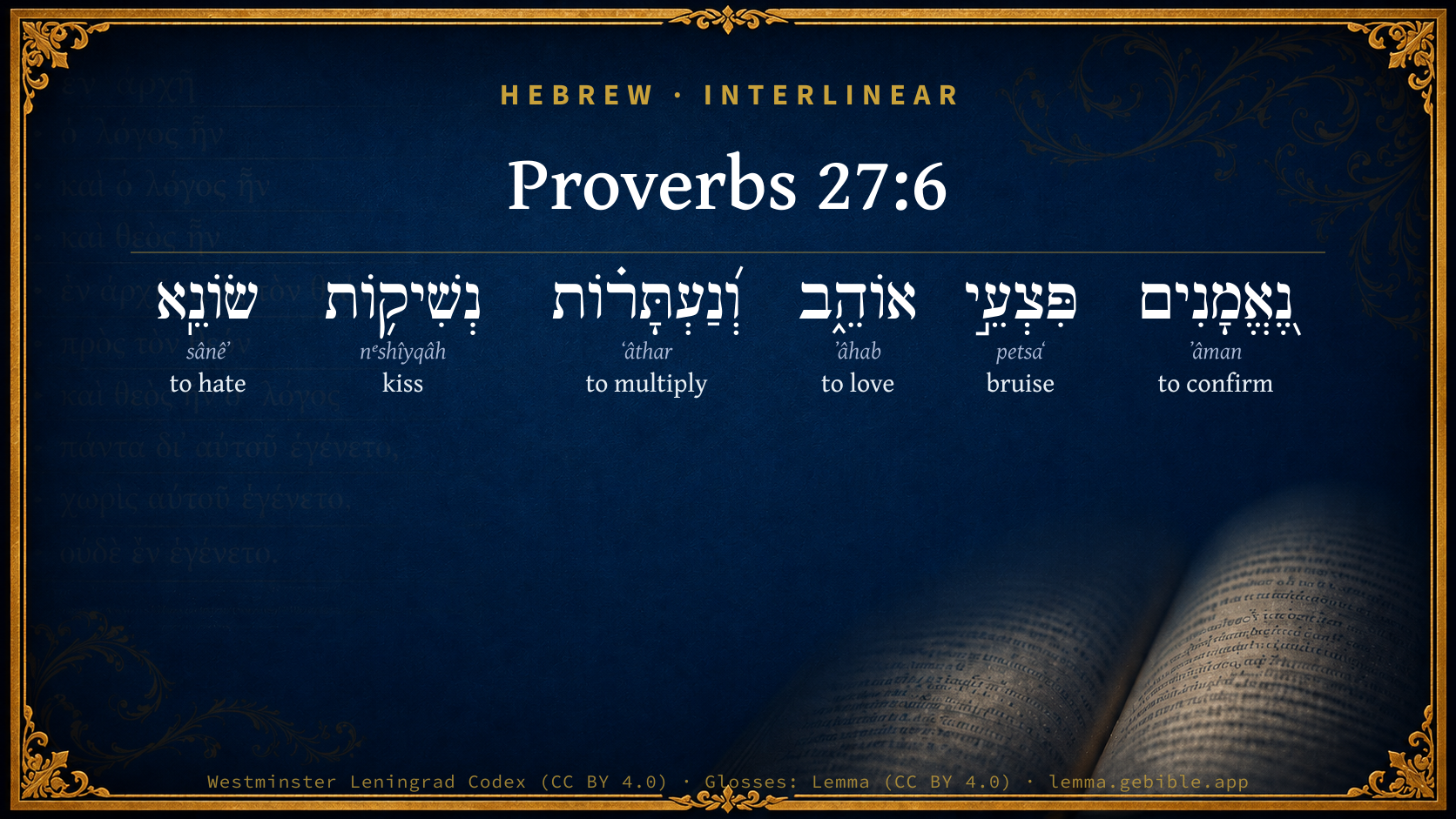
Hebrew (Westminster Leningrad Codex) Proverbs 27:6 appears in the Hebrew Old Testament. The text above is from the Westminster Leningrad Codex. Each word links to its Strong’s number, a concise gloss, and parsing drawn from the Open Scriptures Hebrew Bible morphology. Click any word for its full Brown-Driver-Briggs (BDB) entry.
Download image
Cite this verse

Proverbs 27:6 (World English Bible). Public Domain. Lemma interlinear Bible study tool, https://lemma.gebible.app/v/proverbs/27/6.

Show BibTeX & RIS
BibTeX
RIS
English Translation
Faithful are the wounds of a friend; Although the kisses of an enemy are profuse.
World English Bible · Public Domain
Highlights
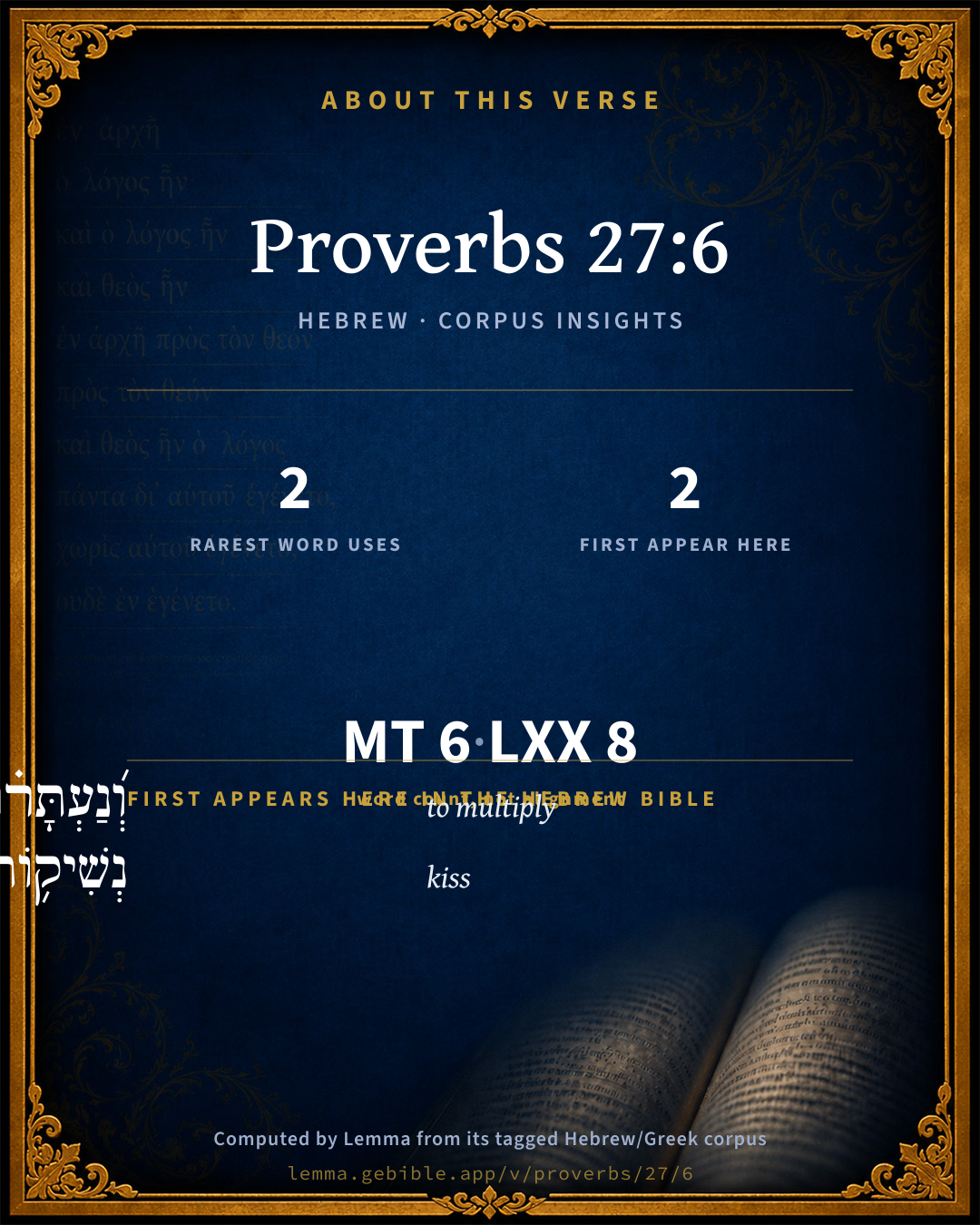
  • 2 first appearances in the Hebrew Bible
Full analysis ↓
Download a study sheet

One document with this verse’s original text, its word-by-word gloss line, the meaning frame, cross-references with their text, attributed commentary, and full source and license credits — printable, and it pastes into notes with its structure intact.

This verse Autodidact and up

Study sheet (.html) Plain text (.txt)

A passage Seminary Student

Up to 50 verses in one chapter. A passage sheet keeps up to 6 commentary sources and 12 cross-references per verse, in the order this page ranks them, and says so on the sheet whenever that leaves anything out. Ask for a single verse and you get the Autodidact verse sheet above.

Everything on this page stays free to read, with no account — the sheet is a download of what is already on screen, not access to it.

Want to remove ads? Support Godless Engineer
Compare translations 3

The same verse in 3 English versions, stacked beneath the original-language interlinear above. Click any original word for its lexicon entry.

Each is an independent rendering of the whole verse — the interlinear is not word-aligned to these translations.

Highlighted words mark where these versions differ — a whole-verse word diff, not a word-by-word alignment.

  • World English Bible Public Domain
    Faithful are the wounds of a friend; Although the kisses of an enemy are profuse.
  • King James Version Public Domain
    Faithful are the wounds of a friend; but the kisses of an enemy are deceitful.
  • unfoldingWord Literal Text CC BY-SA 4.0
    Faithful the wounds of one loving, but deceptive the kisses of one hating.

unfoldingWord Literal Text — © unfoldingWord, licensed CC BY-SA 4.0. Word-aligned USFM3 via Door43 (git.door43.org/unfoldingWord/en_ult).

Versions to compare (up to 4)

3 of 4 selected

Show all 18 translations

Every available English version of this verse, each an independent rendering of the whole verse.

  • World English Bible Public Domain
    Faithful are the wounds of a friend; Although the kisses of an enemy are profuse.
  • Berean Standard Bible Public Domain
    The wounds of a friend are faithful, but the kisses of an enemy are deceitful.
  • Majority Standard Bible Public Domain
    The wounds of a friend are faithful, but the kisses of an enemy are deceitful.
  • King James Version Public Domain
    Faithful are the wounds of a friend; but the kisses of an enemy are deceitful.
  • American Standard Version (1901) Public Domain
    Faithful are the wounds of a friend; But the kisses of an enemy are profuse.
  • Revised Version (1885) Public Domain
    Faithful are the wounds of a friend: but the kisses of an enemy are profuse.
  • Geneva Bible (1599) Public Domain
    The wounds of a louer are faithful, and the kisses of an enemie are pleasant.
  • Douay-Rheims (1899) Public Domain
    Better are the wounds of a friend, than the deceitful kisses of an enemy.
  • Young's Literal Translation Public Domain
    Faithful are the wounds of a lover, And abundant the kisses of an enemy.
  • Literal Standard Version CC BY-SA 4.0
    The wounds of a lover are faithful, || And the kisses of an enemy [are] abundant.
  • Unlocked Literal Bible CC BY-SA 4.0
    Faithful are the wounds caused by a friend, but an enemy may kiss you profusely.
  • unfoldingWord Literal Text CC BY-SA 4.0
    Faithful the wounds of one loving, but deceptive the kisses of one hating.
  • Darby Bible Public Domain
    Faithful are the wounds of a friend; but the kisses of an enemy are profuse.
  • World Messianic Bible Public Domain
    The wounds of a friend are faithful, although the kisses of an enemy are profuse.
  • Webster's Bible Public Domain
    Faithful are the wounds of a friend; but the kisses of an enemy are deceitful.
  • Free Bible Version CC BY-SA 4.0
    A friend's honest comments may hurt you, but an enemy's kisses are over the top.
  • Bible in Basic English Public Domain
    The wounds of a friend are given in good faith, but the kisses of a hater are false.
  • JPS Tanakh (1917) Public Domain
    Faithful are the wounds of a friend; but the kisses of an enemy are importunate.

Literal Standard Version (2020), Covenant Press — licensed CC BY-SA 4.0. Text via the HelloAO Bible API (eBible.org). Unlocked Literal Bible (unfoldingWord) — licensed CC BY-SA 4.0. Text via the HelloAO Bible API (eBible.org). unfoldingWord Literal Text — © unfoldingWord, licensed CC BY-SA 4.0. Word-aligned USFM3 via Door43 (git.door43.org/unfoldingWord/en_ult). Free Bible Version, Dr. Jonathan Gallagher — licensed CC BY-SA 4.0. Text via the HelloAO Bible API (eBible.org).

Word by word

More ways to search: Search by grammar → Find every occurrence → Compare this word →

Practice this passage: Drill this verse → Learn its vocabulary →

About this verse

These counts appear in no published source. They are computed here, from the morphology-tagged text and Lemma’s own curated glosses. What Lemma adds →

6
words
6
distinct lemmas
Wisdom
section

Notable vocabulary

The rarest word here is וְ֝נַעְתָּר֗וֹת to multiply H6280 — appearing just 2 times in the whole Hebrew Bible.

First appearance in Scripture

These words make their first canonical appearance in the Hebrew Bible here:

  • וְ֝נַעְתָּר֗וֹת to multiply H6280
  • נְשִׁיק֥וֹת kiss H5390

Shared distinctive vocabulary

וְ֝נַעְתָּר֗וֹת to multiply H6280 occurs in 2 verses of the Hebrew Bible. Also found in:

Grammatical profile

  • 4 verbs
  • 2 nouns

Verb forms

  • נֶ֭אֱמָנִים Niphal · Participle Active
  • אוֹהֵ֑ב Qal · Participle Active
  • וְ֝נַעְתָּר֗וֹת Niphal · Participle Passive
  • שׂוֹנֵֽא Qal · Participle Active

Hebrew & Septuagint length

In English translation the verse runs 15 words from the Hebrew and 17 from the Septuagint (LXX English) — closely comparable.

A rough comparison of the two English renderings, which tokenize alike — not a word-level alignment.

Word counts can differ between the Hebrew and the Greek without any difference in meaning — e.g. the Hebrew direct-object marker אֵת has no separate Greek word, and Greek often adds the article ὁ.

In the original languages it is 6 Hebrew tokens and 8 Greek tokens — but the two are counted differently (Hebrew bundles its prefixes and suffixes into one token; the Greek is in lemma form), so that isn’t a like-for-like length.

Cross-references

9

Topical passages linked to Proverbs 27:6 in the Treasury of Scripture Knowledge — connected by theme and wording, ordered by reader-vote popularity; previews shown in the World English Bible.

  • Psalms 141:5 Let the righteous strike me, it is kindness; Let him reprove me, it is like oil on the head; Don't let my head refuse it; Yet my prayer is always against evil deeds.
  • Revelation 3:19 As many as I love, I reprove and chasten. Be zealous therefore, and repent.
  • Job 5:17–18 "Behold, happy is the man whom God corrects: Therefore do not despise the chastening of the Almighty.
  • Proverbs 26:23–26 Like silver dross on an earthen vessel Are the lips of a fervent one with an evil heart.
  • 2 Samuel 12:7–15 Nathan said to David, "You are the man. This is what Yahweh, the God of Israel, says: 'I anointed you king over Israel, and I delivered you out of the hand of Saul.
  • Hebrews 12:10 For they indeed, for a few days, punished us as seemed good to them; but he for our profit, that we may be partakers of his holiness.
  • 2 Samuel 20:9–10 Joab said to Amasa, Is it well with you, my brother? Joab took Amasa by the beard with his right hand to kiss him.
  • Proverbs 10:18 He who hides hatred has lying lips. He who utters a slander is a fool.
  • Matthew 26:48–50 Now he who betrayed him gave them a sign, saying, "Whoever I kiss, he is the one. Seize him."

Cross-references courtesy of OpenBible.info (CC BY 4.0).

Hebrew and Greek witnesses Masoretic Hebrew ↔ Greek Septuagint

The same verse in the two great witnesses to the Old Testament, shown verse-for-verse.

These are two independent witnesses, not word-aligned to each other, and the Septuagint is shown in lemma (dictionary) form.

Hebrew Proverbs 27:6 Masoretic · Westminster Leningrad Codex

נֶ֭אֱמָנִים פִּצְעֵ֣י אוֹהֵ֑ב וְ֝נַעְתָּר֗וֹת נְשִׁיק֥וֹת שׂוֹנֵֽא

Faithful are the wounds of a friend; Although the kisses of an enemy are profuse.

World English Bible · Public Domain

Greek LXX Proverbs 27:6 Septuagint · lemma form

ἀξιόπιστος εἰμί τραῦμα φίλος ἤ ἑκούσιος φίλημα ἐχθρός

The wounds of a friend are more to be trusted than the spontaneous kisses of an enemy.

LXX2012 (modern English Septuagint) · Public Domain

On this verse, Trapp's Complete Commentary discusses the Septuagint’s reading. Read the note in Commentary ↓

Hebrew: Westminster Leningrad Codex (CC BY 4.0). Greek: Septuagint (public domain); English from LXX2012 (modern English Septuagint) (Public Domain). How the Septuagint differs from the Hebrew →

Commentary

Notes on Proverbs 27:6 from classic Christian and Jewish commentators (each source and its license shown beneath its notes). The classic Christian expositions comment on the surrounding passage and are grouped to its opening verse, so a note may address several verses; the Jewish commentaries on the Tanakh (Rashi and others) are per-verse, so they appear only where the commentator wrote on this verse.

Lemma curates 59 commentaries, every one of them public domain or Creative Commons licensed, each selected and text-cleaned for this edition rather than reprinted as found. About our sources →

Trapp's Complete Commentary

John Trapp

Pro 27:6 Faithful [are] the wounds of a friend; but the kisses of an enemy [are] deceitful.

Ver. 6. Faithful are the wounds of a friend.] And are therefore to be prayed for; "but the kisses of an enemy are deceitful," or to be detested, and therefore prayed against: so some read the words, and make the opposition. See this done by David. {Psa 141:5} Knocks from "a righteous man" he would take for "kindnesses"; but the precious oils of the wicked - answerable to their kisses here - he would cry out of, as the "breaking of his head"; for so Mercer, Ainsworth, and others read that text, and the Septuagint accordeth, saying, Let not the oil of the sinner supple my head; by oil meaning flattering words, as Psa 55:21. Reproofs and corrections, though sharp and unpleasant, yet if looked upon as issuing from that love that lies hid in the heart, they are faithful - that is, fair and pleasant, as the Chaldee interprets it.

But the kisses of an enemy are deceitful,] i.e., His glossing and closing with us for a further mischief; such as were the kisses of Joab, Judas, Absalom, and Ahithophel are not to be fancied, but deprecated and detested. {See Trapp on "Pro 26:23"} Theophrastus {a} hath in his character drawn out these kissing cut-throats, who can be affable to their enemies, and disguise their hatred in commendation, while they privately lay their snares: men Italianated, that can salute with mortal embracements, and clasp you in those arms which they mean to imbrue in your dearest blood. These treacherous kissers are of kin to that mad Haeket, hanged in Queen Elizabeth’s days, who bit off his honest schoolmaster’s nose as he embraced him, under colour of renewing their love, and ate it down before the poor man’s face. {b} So, and no better, are the kisses, that is, the fawnings and flatteries, of perfidious persons.

{a} Cap. περι ειρηνειας.

{b} Camden’s Elizabeth, Anno 1592.

John Trapp, A Commentary or Exposition upon All the Books of the Old and New Testament (1647–1656) — public domain. Text from a community e-Sword module.

The Biblical Illustrator

Joseph S. Exell

Pro_27:6

Faithful are the wounds of a friend; but the kisses of an enemy are deceitful.

Gods friendship and Satans enmity

True friends are scarce. The old cynic who went about in broad daylight with a lighted lantern in search of a man would have had like difficulty in finding a true friend. True friendship often assumes a rough garb; enmity may clothe itself in the stolen dress of love. Men like flattery better than the rebuke of the faithful friend. The truth-speaker often inflicts pain.

I. Gods friendship ever brings sorrow with it. Out of the depths of His loving heart, God summonses the prodigal sinner to return. If he returns he must expect a weary journey. It is a toilsome path, that rugged one of repentance.

II. Satans enmity is often disguised by means of deceitful offers of joy. An enemy, he deals in pretences of love, and deceives with a kiss. When Satan tempted Christ, he came as it were with kisses--that is, with bribes. Is it not ever so? Sin wears the garb of friendship without its reality, and men are slaves to appearances. The truly wise man best shows his wisdom by detecting the embraces of an enemy, the false promise, the lying lips. (Homilist.)

The Biblical Illustrator, edited by Joseph S. Exell (c. 1880s–1900s) — public domain. Text from a community e-Sword module.

Tyndale Open Study Notes

Tyndale Open Resources

27:6 Wounds from a . . . friend are from a loving rebuke (27:5). They are better than flattery (many kisses) from an enemy who intends to harm rather than help.

Tyndale Open Study Notes — © Tyndale Open Resources, licensed CC BY-SA 4.0. Text via the HelloAO Bible API.

Geneva Bible (1599)

Geneva Bible translators

They are flattering, and seem friendful.

Geneva Bible (1599) marginal notes — public domain. Text via Bolls.life.

Ellicott's Commentary for English Readers

(6) Faithful are the wounds of a friend—i.e., the “open rebuke” of the previous verse, the “smiting” and “reproof” of Psa_142:5.

The kisses of an enemy are deceitful.—Rather, plentiful, showered upon one, but all meaningless.

A Bible Commentary for English Readers, edited by Charles John Ellicott (1878–1897) — public domain. Text from a community e-Sword module.

The Cambridge Bible for Schools and Colleges

gen. ed. J. J. S. Perowne

6. deceitful] This rendering follows the fraudulenta of the Vulgate; whereas earnest (A.V. marg.) may be due to the ἑκούσια of the LXX. The alternative rendering of A.V. marg., frequent, or, as it is happily given in R.V., profuse, is to be preferred. He overdoes his part.

The Cambridge Bible for Schools and Colleges (gen. ed. J. J. S. Perowne; Cambridge University Press, 1878–1918) — public domain. Text from a community e-Sword module.

John Gill's Exposition

The full soul loatheth an honeycomb,.... Or "tramples upon" it (a), as the word signifies, and most versions render it, expressive of contempt and abhorrence; and suits will the situation of the honeycomb, which was usually in trees and rocks in Palestine: and so might drop from thence, and be trampled upon by passengers; and especially such as are here described, whose appetites have been sated with dainties, and their stomachs heave at the most delicious food. Jarchi interprets this of one that has no desire after the doctrines of the law; and so the senses of it are not esteemed by him; whereas he that has a desire for it, even the things which come to him with bitterness and labour are sweet to him. But it may be better applied to a self-sufficient man, that is full of himself: of his own wisdom and knowledge in divine things; of his strength, and the power of his free will; of his purity, holiness, goodness, and righteousness; who loathes the Gospel, comparable to the honeycomb for its sweetness; see Pro 16:24; it being disagreeable to his taste, and as insipid as the white of an egg to him; and as being against him, which makes him out an arrant fool, blows a blast on all his goodness and goodliness, strips the creature of his righteousness, and excludes boasting;

but to the hungry soul every bitter thing is sweet; that is in want of provision, has an appetite for it; anything, though ever so mean and disrelishing to others, is sweet to such an one; as was barley bread to Artaxerxes king of Persia, and country bread made of bran to Ptolemy Lagus king of Egypt, when in great distress for food (b): Seneca says (c), hunger will make bad bread fine food. And so is the Gospel, and every doctrine of it, to a sensible sinner; that is in want, and knows its wants, and has desires after spiritual things created in it; hungers and thirsts after the word and ordinances; after Christ, the bread of life; after the blessings of grace in him; particularly after the pardon of sin, and justifying righteousness and salvation by him; and after more knowledge of him, and communion with him. Now, though, here is nothing bitter in the Gospel, properly speaking, as in the law; yet, that which is bitter to others, and had been bitter to the above persons, is now sweet, and which are disagreeable to the flesh; as the denial of sinful, civil, and righteous self, which the Gospel teaches; and even that which is the most contemptible to men; as the preaching of the cross, or the doctrine of salvation by a crucified Christ; the doctrines of electing grace, imputed righteousness, the satisfaction of Christ, &c. How sweet are these to the taste of a hungry soul! and even though they are attended with bitter afflictions, the reproaches, revilings, and persecutions of men; as the paschal lamb, a type of Christ, was eaten with bitter herbs. This may also be applied to the hearing of the word; where and when there is plenty of means, men grow weary of the word, sick of it, and surfeit upon it and loath it; or, however, are very curious and nice, and cannot take up with plain preaching, but must have something suited to their palate, dressed up in a very elegant manner: but when the word of the Lord is precious or rare, and where there are few opportunities of hearing it, sensible souls, that have spiritual appetites, are glad of it; and it is sweet unto them, though not so nicely dressed and though brought to them in a homely manner.

(a) "calcabit", Pagninus, Montanus; "caleat", Vatablus, Junius & Tremellius, Piscator, Mercerus, Gejerus; "conculcat", Cocceius; "proculcat", Michaelis, Schultens. (b) "Jejunus stomachus raro vulgaria temnit", Horat. Sermon. l. 2. Sat. 2. (c) Epist. 123.

John Gill's Exposition of the Whole Bible (1746–1763) — public domain (CC PDM 1.0). Text via the HelloAO Bible API.

Albert Barnes' Notes on the Bible

Deceitful - Better, abundant. Very lavish is the enemy of the kisses that cover perfidy, but lavish of them only. His courtesy goes no deeper.

Albert Barnes' Notes on the Bible (1834–1885) — public domain. Text from a community e-Sword/MySword module.

Haydock's Catholic Bible Commentary

Enemy. Joab slew Amasa, while he kissed him, 2 Kings xx. 9., and Matthew xxvi. 48. True friendship is not attentive to outward appearances.

George Leo Haydock (1774–1849), Haydock's Catholic Family Bible and Commentary, 1859 edition — public domain. Excludes Psalms (Douay-Rheims chapter numbering differs from Protestant) and Deuterocanonical books (Catholic canon only).

Matthew Poole's English Annotations

Faithful are the wounds; they proceed from an upright, and truly loving, and faithful soul, and really promote the good of the person reproved. The wounds; the sharpest reproofs, which for the present wound his spirit and reputation.

The kisses; all the fair speeches and outward professions of friendship.

Are deceitful; or, are to be deprecated; are perfidious and pernicious, and such things as one may pray to God to be delivered from them. Or, are forced, like things which are procured with great difficulty, and many entreaties.

Matthew Poole's English Annotations on the Holy Bible (1683–1685) — public domain. Text from a community e-Sword/MySword module.

Whedon's Commentary on the Bible

Daniel D. Whedon

6. The wounds — Cutting rebukes from faithful friends are, from the nature of the case, few. They are never given except when necessity demands them. On the contrary, the honied compliments of a deceitful enemy have no similar restriction, and are multiplied for the purpose of covering up enmity and more effectually carrying out evil purposes.

Deceitful — The critics generally prefer plentiful, profuse, or multiplied. See Eze_35:13. The antithesis, as is often the case, lies between things implied and readily supplied by the mind. Zockler and others however give the sense “deceitful,” following the Vulgate fraudulentia. Compare Pro_26:23; Psa_141:5.

Daniel D. Whedon (gen. ed.), Commentary on the Old and New Testaments (1874–1909) — public domain. Text from a community e-Sword module.

The Pulpit Commentary

Faithful are the wounds of friend. This and the next verse afford examples of the antithetic form of proverb, where the second line gives, as it were, the reverse side of the picture presented by the first. The wounds which a real friend inflicts by his just rebukes are directed by truth and discriminating affection. (see Psa_141:5) But the kisses of an enemy are deceitful. So St. Jerome, Fraudulenta oscula odientis. But the verb here used (rt) has the meaning, among others, "to be abundant or frequent;" hence it is better to take it in this sense here, as "plentiful, profuse." An enemy is lavish with his Judas kisses to hide his perfidy and hatred. Septuagint, "More to be trusted are the wounds of a friend than the spontaneous (ekousia ) kisses of an enemy." "Non omnis qui parcia," wrote St. Augustine ("Ep.," 48, "ad Vincent."), "amicus est, neque omnis qui verberat, inimicus.

"The wounds of a friend.

The principle implied in this verse is apparent at a glance. It is better that one who loves and truly considers the interests of another should wound him for his good than that a superficial flatterer should refrain from doing so for the sake of pleasing and winning continuous favour. The only difficulties lie in the practical application of the principle.

I TRUE FRIENDSHIP WILL DARE TO WOUND. It is painful and difficult to do that which we know will grieve one who is greatly loved. Therefore if it is ready necessary it will put the love to the test.

1. True friendship considers the welfare of another. The chief thought is not on behalf of agreeable companionship, but as to what will really benefit one"s friend.

2. The welfare of another may require a painful treatment. There are so called "candid friends," who secretly delight in saying unpleasant things. With such people there is no merit in giving pain, nor is it likely that much advantage will result from their rough conduct. But it may be possible to point out a friend"s mistakes, to warn him against temptation, to gravely deprecate his wrongful conduct, to make him feel his deterioration of character. Then, though the process must be keenly painful on both sides, love will attempt it.

II THE WOUNDS OF TRUE FRIENDSHIP SHOULD BE PATIENTLY RECEIVED.

1. The cost of thorn should be considered. If they do indeed come from a friend they show his genuine regard, his unselfish devotion. They also indicate how thorough is his confidence; for they show that he expects to be rightly understood, and that his painful action will not be resented. He risks a breach of the friendship for the sake of benefiting his friend. This is a generous action, and it should be generously accepted. But it needs magnanimity both to give and to take the wounds of friendship.

2. The value of them should be appreciated. The first impulse is to feel aggrieved, to resent the intrusion, to treat the well-meant rebuke as an insult, to justify, one"s self, perhaps even to overwhelm the friend who wounds with rage and revenge. This is as foolish as it is ungrateful. If we only knew it, we should confess that we have no better friends than those who dare to wound us. It is just from such friends that we can learn wisdom. Flattery kisses and slays; friendship wounds and saves.

III THE DIVINE FRIENDSHIP WOUNDS TO SAVE. The world flatters and promises only pleasant things to its slaves when it first enthralls them. God treats us in the opposite way, warning us of danger, rebuking our sins, even chastising us with heavy blows. But "whom the Lord loveth he chasteneth.

1. God proves himself to be our Friend by wounding us. He might have left us alone to rot in our own wretched ruin. But in his great love he has interfered to save, though his advances are met with insult and anger. God loves enough to give pain.

2. It would be wise to receive Gods wounding as that of a Friend. It is for our good; then the best course is to take it accordingly, to endeavour to profit by it. Christ lays a cross on his disciples, and saves them by leading them to follow in his Via Dolorosa, and to be crucified with him. (Gal_2:20)

The Pulpit Commentary (1880–1919), ed. H.D.M. Spence-Jones & Joseph S. Exell — public domain. Text from a community e-Sword module.

John Wesley's Explanatory Notes

Wounds - The sharpest reproofs. Kisses - All the outward profession of friendship.

John Wesley, Explanatory Notes Upon the Whole Bible (1754–1765) — public domain. Text via the GEBible commentary corpus.

Keil & Delitzsch

C. F. Keil & F. Delitzsch

6 Faithful are the wounds of a friend,

And overloaded [plentiful] the kisses of an enemy.

The contrast to נאמנים, true, i.e., honourable and good (with the transference of the character of the person to his act), would be fraudulenta (Jerome), or נהפכות, i.e., false (Ralbag); Ewald seeks this idea from עתר, to stumble, make a false step;

(Note: Thus also Schultens in the Animadversiones, which later he fancied was derived from עתר, nidor, from the meaning nidorosa, and thence virulenta.)

Hitzig, from עתר = (Arab.) dadhr, whence dâdhir, perfidus, to gain from; but (1) the comparison does not lie near, since usually the Arab. t corresponds to the Heb. שׁ, and the Arab. d to the Heb. ז; (2) the Heb. עתר has already three meanings, and it is not advisable to load it with yet another meaning assumed for this passage, and elsewhere not found. The three meanings are the following: (a) to smoke, Aram. עטר, whence עתר, vapour, Eze 8:11, according to which the Venet., with Kimchi's and Parchon's Lex., translates: the kisses of an enemy συνωμίχλωνται, i.e., are fog; (b) to sacrifice, to worship, Arab. atar; according to which Aquila: ἱκετικά (as, with Grabe, it is probably to be read for ἑκούσια of the lxx); and agreeably to the Niph., but too artificially, Arama: obtained by entreaties = constrained; (c) to heap up, whence Hiph. העתיר, Eze 35:13, cf. Jer 33:6, according to which Rashi, Meri, Gesenius, Fleischer, Bertheau, and most explain, cogn. with עשׁר, whose Aram. form is עתר, for עשׁר is properly a heap of goods or treasures.

(Note: Vid., regarding this word, Schlottmann in Deutsch.-Morgenl. Zeitschrift, xxiv. 665, 668.)

This third meaning gives to the kisses of an enemy a natural adjective: they are too abundant, so much the more plentiful to veil over the hatred, like the kisses by means of which Judas betrayed his Lord, not merely denoted by φιλεῖν, but by καταφιλεῖν, Mat 26:49. This, then, is the contrast, that the strokes inflicted by one who truly loves us, although they tear into our flesh (פּצע, from פּצע, to split, to tear open), yet are faithful (cf. Psa 141:5); on the contrary, the enemy covers over with kisses him to whom he wishes all evil. Thus also נעתרות forms an indirect contrast to נאמנים.

Keil & Delitzsch — Biblical Commentary on the Old Testament (1861–1891) — public domain (CC PDM 1.0). Text via the HelloAO Bible API. (Old Testament only.)

Rashi

Rabbi Shlomo Yitzchaki (Rashi)

are burdensome Heb. נעתרות, an expression of largeness, as in (Ezek. 35: 13): “You have multiplied (נעתרות) against Me.”

Rashi on the Tanakh — English translations: “The Judaica Press complete Tanach with Rashi, translated by A. J. Rosenberg” (CC BY 4.0); “Pentateuch with Rashi's commentary by M. Rosenbaum and A.M. Silbermann, 1929-1934” (public domain); “The Metsudah Tanach series, Lakewood, N.J” (CC BY 4.0); and “The Book of Joshua, Metsudah Publications, 1997” (CC BY 4.0). Text via Sefaria.

Lesson kit

Teaching starters — assembled from the data on this page, not authored interpretation. Every prompt links to the verse data it draws on. Edit before teaching.

Proverbs, in the Wisdom, opens this verse with 6 words (6 distinct Hebrew lemmas). Its most distinctive word is ʻâthar (“to multiply”). A historical commentator’s framing appears above. Read the whole chapter for the surrounding context.

Discussion questions

  1. The word ʻâthar carries the sense “to multiply.” How does it shape the verse?
  2. 2 words here appear for the first time in Scripture. What is being introduced at this debut?
  3. Ezekiel 35:13 shares the word «to multiply» with this verse. How do the two illuminate each other?
  4. These translations render this verse differently; the difference is in the English rendering, not the original. What questions does that raise?
  5. The verb «נֶ֭אֱמָנִים» is Niphal Participle Active. How does its form color the action?
  6. Reading how Trapp's Complete Commentary and The Biblical Illustrator read this verse, where do the two commentators agree and where do they part?

Things to notice

Reading settings

Reading text

Shown beneath each verse's original-language words.

Old Testament
Old Testament edition

Read the OT as the Masoretic Hebrew (MT) or the Greek Septuagint (LXX).

English shown for the Greek Septuagint (in the Hebrew ↔ Greek comparison).

Comparing translations? Open the Compare panel on any verse page to stack up to four side by side.