

Proverbs 22:11

Hebrew (Westminster Leningrad Codex) Proverbs 22:11 appears in the Hebrew Old Testament. The text above is from the Westminster Leningrad Codex. Each word links to its Strong’s number, a concise gloss, and parsing drawn from the Open Scriptures Hebrew Bible morphology. Click any word for its full Brown-Driver-Briggs (BDB) entry.
Download image
Cite this verse

Proverbs 22:11 (World English Bible). Public Domain. Lemma interlinear Bible study tool, https://lemma.gebible.app/v/proverbs/22/11.

Show BibTeX & RIS
BibTeX
RIS
English Translation
He who loves purity of heart and speaks gracefully Is the king's friend.
World English Bible · Public Domain
Download a study sheet

One document with this verse’s original text, its word-by-word gloss line, the meaning frame, cross-references with their text, attributed commentary, and full source and license credits — printable, and it pastes into notes with its structure intact.

This verse Autodidact and up

Study sheet (.html) Plain text (.txt)

A passage Seminary Student

Up to 50 verses in one chapter. A passage sheet keeps up to 6 commentary sources and 12 cross-references per verse, in the order this page ranks them, and says so on the sheet whenever that leaves anything out. Ask for a single verse and you get the Autodidact verse sheet above.

Everything on this page stays free to read, with no account — the sheet is a download of what is already on screen, not access to it.

Want to remove ads? Support Godless Engineer
Compare translations 3

The same verse in 3 English versions, stacked beneath the original-language interlinear above. Click any original word for its lexicon entry.

Each is an independent rendering of the whole verse — the interlinear is not word-aligned to these translations.

Highlighted words mark where these versions differ — a whole-verse word diff, not a word-by-word alignment.

  • World English Bible Public Domain
    He who loves purity of heart and speaks gracefully Is the king's friend.
  • King James Version Public Domain
    He that loveth pureness of heart, for the grace of his lips the king shall be his friend.
  • unfoldingWord Literal Text CC BY-SA 4.0
    One who loves a pure heart, his lips gracious, the king his friend.

unfoldingWord Literal Text — © unfoldingWord, licensed CC BY-SA 4.0. Word-aligned USFM3 via Door43 (git.door43.org/unfoldingWord/en_ult).

Versions to compare (up to 4)

3 of 4 selected

Show all 18 translations

Every available English version of this verse, each an independent rendering of the whole verse.

  • World English Bible Public Domain
    He who loves purity of heart and speaks gracefully Is the king's friend.
  • Berean Standard Bible Public Domain
    He who loves a pure heart and gracious lips will have the king for a friend.
  • Majority Standard Bible Public Domain
    He who loves a pure heart and gracious lips will have the king for a friend.
  • King James Version Public Domain
    He that loveth pureness of heart, for the grace of his lips the king shall be his friend.
  • American Standard Version (1901) Public Domain
    He that loveth pureness of heart, `For' the grace of his lips the king will be his friend.
  • Revised Version (1885) Public Domain
    He that loveth pureness of heart, for the grace of his lips the king shall be his friend.
  • Geneva Bible (1599) Public Domain
    Hee that loueth purenesse of heart for the grace of his lippes, the King shalbe his friend.
  • Douay-Rheims (1899) Public Domain
    He that loveth cleanness of heart, for the grace of his lips shall have the king for his friend.
  • Young's Literal Translation Public Domain
    Whoso is loving cleanness of heart, Grace `are' his lips, a king `is' his friend.
  • Literal Standard Version CC BY-SA 4.0
    Whoever is loving cleanness of heart, || His lips [are] grace, || A king [is] his friend.
  • Unlocked Literal Bible CC BY-SA 4.0
    The one who loves a pure heart and whose speech is gracious, he will have the king for his friend.
  • unfoldingWord Literal Text CC BY-SA 4.0
    One who loves a pure heart, his lips gracious, the king his friend.
  • Darby Bible Public Domain
    He that loveth pureness of heart, upon whose lips is grace, the king is his friend.
  • World Messianic Bible Public Domain
    He who loves purity of heart and speaks gracefully is the king’s friend.
  • Webster's Bible Public Domain
    He that loveth pureness of heart, for the grace of his lips the king shall be his friend.
  • Free Bible Version CC BY-SA 4.0
    Anyone who loves sincerity and a gracious way of speaking will have the king as their friend.
  • Bible in Basic English Public Domain
    He whose heart is clean is dear to the Lord; for the grace of his lips the king will be his friend.
  • JPS Tanakh (1917) Public Domain
    He that loveth pureness of heart, that hath grace in his lips, the king shall be his friend.

Literal Standard Version (2020), Covenant Press — licensed CC BY-SA 4.0. Text via the HelloAO Bible API (eBible.org). Unlocked Literal Bible (unfoldingWord) — licensed CC BY-SA 4.0. Text via the HelloAO Bible API (eBible.org). unfoldingWord Literal Text — © unfoldingWord, licensed CC BY-SA 4.0. Word-aligned USFM3 via Door43 (git.door43.org/unfoldingWord/en_ult). Free Bible Version, Dr. Jonathan Gallagher — licensed CC BY-SA 4.0. Text via the HelloAO Bible API (eBible.org).

Word by word

More ways to search: Search by grammar → Find every occurrence → Compare this word →

Practice this passage: Drill this verse → Learn its vocabulary →

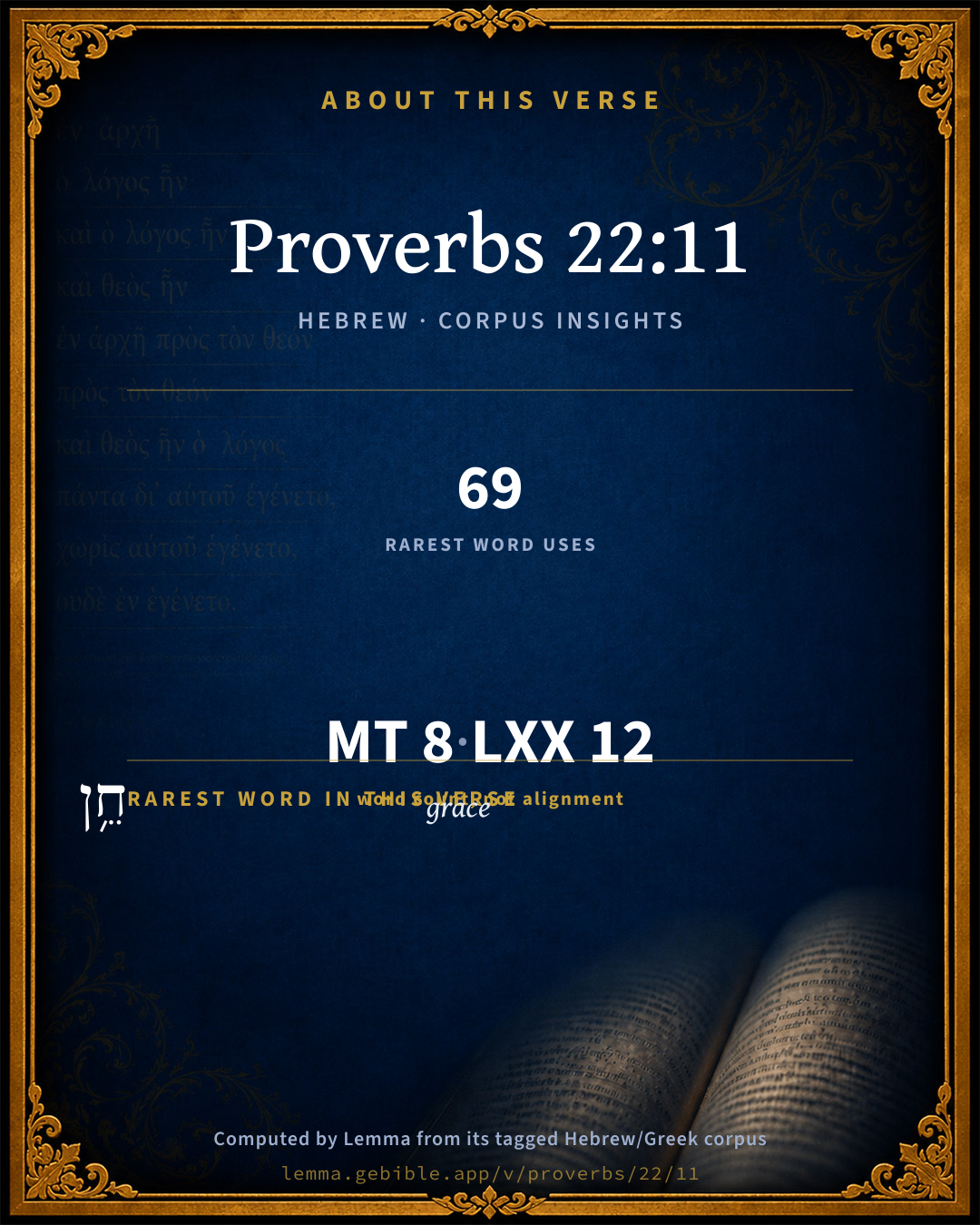
About this verse

These counts appear in no published source. They are computed here, from the morphology-tagged text and Lemma’s own curated glosses. What Lemma adds →

8
words
7
distinct lemmas
Wisdom
section

Grammatical profile

  • 1 verb
  • 5 nouns
  • 2 adjectives

Verb forms

  • אֹהֵ֥ב Qal · Participle Active

Repetition

A word recurs within this verse — often emphatic in Hebrew:

  • טהור pure H2889 ×2

Hebrew & Septuagint length

In English translation the verse runs 13 words from the Hebrew and 19 from the Septuagint (LXX English) — the Septuagint runs noticeably longer here. See the side-by-side →

A rough comparison of the two English renderings, which tokenize alike — not a word-level alignment.

Word counts can differ between the Hebrew and the Greek without any difference in meaning — e.g. the Hebrew direct-object marker אֵת has no separate Greek word, and Greek often adds the article ὁ.

In the original languages it is 8 Hebrew tokens and 12 Greek tokens — but the two are counted differently (Hebrew bundles its prefixes and suffixes into one token; the Greek is in lemma form), so that isn’t a like-for-like length.

Cross-references

13

Topical passages linked to Proverbs 22:11 in the Treasury of Scripture Knowledge — connected by theme and wording, ordered by reader-vote popularity; previews shown in the World English Bible.

  • Proverbs 16:13 Righteous lips are the delight of kings. They value one who speaks the truth.
  • Matthew 5:8 Blessed are the pure in heart, For they shall see God.
  • Psalms 101:6 My eyes will be on the faithful of the land, That they may dwell with me. He who walks in a perfect way, He will serve me.
  • Proverbs 14:35 The king's favor is toward a servant who deals wisely, But his wrath is toward one who causes shame.
  • Psalms 45:2 You are the most excellent of the sons of men. Grace has anointed your lips, Therefore God has blessed you forever.
  • Ezra 7:6–11 this Ezra went up from Babylon: and he was a ready scribe in the law of Moses, which Yahweh, the God of Israel, had given; and the king granted him all his request, according to the hand of Yahweh his God on him.
  • Daniel 6:20–23 When he came near to the den to Daniel, he cried with a lamentable voice; the king spoke and said to Daniel, Daniel, servant of the living God, is your God, whom you serve continually, able to deliver you from the lions?
  • Genesis 41:39–57 Pharaoh said to Joseph, "Because God has shown you all of this, there is none so discreet and wise as you.
  • Nehemiah 2:4–6 Then the king said to me, For what do you make request? So I prayed to the God of heaven.
  • Esther 10:3 For Mordecai the Jew was next to king Ahasuerus, and great among the Jews, and accepted of the multitude of his brothers, seeking the good of his people, and speaking peace to all his seed.
  • Daniel 2:46–49 Then the king Nebuchadnezzar fell on his face, and worshiped Daniel, and commanded that they should offer an offering and sweet odors to him.
  • Daniel 3:30 Then the king promoted Shadrach, Meshach, and Abednego in the province of Babylon.
  • Luke 4:22 All testified about him, and wondered at the gracious words which proceeded out of his mouth, and they said, "Isn't this Joseph's son?"

Cross-references courtesy of OpenBible.info (CC BY 4.0).

Hebrew and Greek witnesses Masoretic Hebrew ↔ Greek Septuagint

The same verse in the two great witnesses to the Old Testament, shown verse-for-verse.

Here the Septuagint runs noticeably longer than the Hebrew — LXX2012 (modern English Septuagint) 19 words vs World English Bible 13. A rough length comparison of the two English translations, not a word-level alignment — read both below.

These are two independent witnesses, not word-aligned to each other, and the Septuagint is shown in lemma (dictionary) form.

Hebrew Proverbs 22:11 Masoretic · Westminster Leningrad Codex

אֹהֵ֥ב טהור טְהָר לֵ֑ב חֵ֥ן שְׂ֝פָתָ֗יו רֵעֵ֥הוּ מֶֽלֶךְ

He who loves purity of heart and speaks gracefully Is the king's friend.

World English Bible · Public Domain

Greek LXX Proverbs 22:11 Septuagint · lemma form

ἀγαπάω κύριος ὅσιος καρδία δεκτός δέ αὐτός πᾶς ἄμωμος χεῖλος ποιμαίνω βασιλεύς

The Lord loves holy hearts, and all blameless persons are acceptable with him: a king rules with his lips.

LXX2012 (modern English Septuagint) · Public Domain

On this verse, John Gill's Exposition discusses the Septuagint’s reading. Read the note in Commentary ↓

Hebrew: Westminster Leningrad Codex (CC BY 4.0). Greek: Septuagint (public domain); English from LXX2012 (modern English Septuagint) (Public Domain). How the Septuagint differs from the Hebrew →

Commentary

Notes on Proverbs 22:11 from classic Christian and Jewish commentators (each source and its license shown beneath its notes). The classic Christian expositions comment on the surrounding passage and are grouped to its opening verse, so a note may address several verses; the Jewish commentaries on the Tanakh (Rashi and others) are per-verse, so they appear only where the commentator wrote on this verse.

Lemma curates 59 commentaries, every one of them public domain or Creative Commons licensed, each selected and text-cleaned for this edition rather than reprinted as found. About our sources →

Trapp's Complete Commentary

John Trapp

Pro 22:11 He that loveth pureness of heart, [for] the grace of his lips the king [shall be] his friend.

Ver. 11. He that loveth pureness of heart.] That is vexed at his inward pollutions, and affecteth (what he can never fully effect) to be pure as God is pure. {1Jn 3:3} He that hath gotten that pure lip, {Zep 3:9} called here the grace of his lips, and elsewhere the "law of grace," {Pro 31:26} he that can skill of those good words that do ingratiate with God and man (Gen 49:21, compared with Deu 33:23), he is fit to make a courtier, a favourite, such as was Joseph, Mordecai, Daniel, who though he used not always verbis byssinis, soft and silken words, but delivered heavy messages from God to Nebuchadnezzar and Belshazzar, yet God so wrought their hearts, though tyrants, that they greatly honoured him and highly preferred him. And when, out of his love to pureness of heart, he chose rather affliction than sin, to be cast to the lions than to bear a lion in his own bosom by offending his conscience, God made the king’s heart yearn towards him; so that this plain dealing "Daniel prospered in the reign of Darius, and in the reign of Cyrus the Persian." {Dan 6:28}

John Trapp, A Commentary or Exposition upon All the Books of the Old and New Testament (1647–1656) — public domain. Text from a community e-Sword module.

The Biblical Illustrator

Joseph S. Exell

Pro_22:11

He that loveth pureness of heart, for the grace of his lips the king shall be his friend.

Purity

What is purity--this bright and blessed strength of human life? The foundation of all purity must rest upon the body. Without bodily purity no other form of purity is possible. On this must rise the structure of mental and spiritual purity. Our thoughts and words must be not less pure than our actions. Action is ripened thought, and thought is germinating action. No man suddenly falls. The thoughts have grown accustomed to dwell on impurity long before the deed of impurity is committed. In pureness of mind lies our best defence. And purity of mind is essential to clearness of spiritual vision and lofty exaltation of soul. The vision of the Invisible is impossible to the impure. And the beatific vision of God should be mans noblest ambition. Practical suggestions:

1. Cleanliness is a strong defence of bodily purity, and with this must go good moral habits.

2. Wholesome environment and occupation are strong aids to purity. When the surroundings of life are not wholesome, it is a struggle to keep life pure.

3. Go not into the way of temptation, and avoid the companionship of the impure.

4. Reverence your body. Our bodies are the temples of the Holy Ghost; let us not defile them with impurity. And whatever else you leave undone, yet believe in pure and sacred love. Love that is not pure is not love. The love of home is a splendid defence against impurity. (Canon Diggle.)

The grace of the lips

I. Pure-heartedness. The moral beauty, the moral affluence of it; what it is and what comes out of it; what is a purehearted man, and how does his pure-heartedness stand related to his life? The proverb speaks of love for pure-heartedness, a recognition of it, and a joy in it, as the greatest and best of possessions.

II. The outcome of pure-heartedness. A pure-hearted man will be pure in speech; his conversation will be seasoned with the salt of his pure feeling. Speech is the blossom of a mans life, and is fair or foul, fragrant or offensive, according to the character of the tree.

1. Conversation is the grace of the lips. Not mere religious talk; not prudery--the over-conscientiousness that detects wrong where no wrong is. Over-sensitiveness is not delicacy.

2. Prayer is a grace of the lips that springs from pure-heartedness.

3. The preaching of a pure-hearted man is a grace of the lips. Because of this grace of the lips which springs from purity of heart, special favours shall be won. The king shall be his friend. Good men win social confidence wherever they are, and the favour of the King of kings. (Henry Allon.)

The good man

This passage leads us to consider the heart, the speech, the influence, and the blessedness of a good man.

I. The heart of the good man. He loveth pureness of heart. Not merely does he love the pure in language, in manners and habits, in outward deportment, but the pure in heart. Pureness of heart in mans case implies--

1. A moral renewal.

2. An urgent necessity. Without pureness of heart there is no true knowledge of God, or fellowship with Him.

II. The speech of the good man. For the grace of his lips the king shall be his friend. By the grace of his lips we are to understand something more than grammatic accuracy, or elegant diction--something more than logical correctness or strict veracity. It means speech that is morally pure--pure in sentiment, pure in aim. It is said of Christ that the people wondered at the gracious words which proceeded out of His mouth. The man of a pure heart will have lips of grace. If the tree is made good, the fruit will be good.

III. The influence of the good man. The king shall be his friend. Solomon here speaks probably of his own determination. He meant to say that he would give his friendship to such men. This, says Mr. Bridges, had been his fathers resolution (Psa_51:6; Psa_119:63). This character smoothed the way to royal favour for Joseph (Gen_41:37-45), for Ezra (Ezr_7:21-25), and Daniel (Dan_6:1-3; Dan_6:28). Nay, we find godly Obadiah in the confidence of wicked Ahab (1Ki_18:3; 1Ki_18:12; 2Ki_13:14). So powerful is the voice of conscience, even when God and holiness are hated! Such alone the great King marks as His friends. Such He embraces with His fatherly love (Pro_15:9). Such He welcomes into His heavenly kingdom (Psa_15:1-2; Psa_24:3-4).

IV. The blessedness of a good man The eyes of the Lord preserve knowledge. Three different interpretations have been given to the expression.

1. That the Lord vigilantly watches over His truth in the world. This is a truth, although we are not disposed to accept it as an interpretation of the passage.

2. That what the eyes of the Lord see He remembers for ever. The eyes of the Lord preserve knowledge. He retains His knowledge. We do not preserve our knowledge. We forget far more than we retain. But we are not disposed to accept this as the idea of the passage.

3. That the Lord exercises a protecting superintendence over those who possess His knowledge. That it means, in fact, the same as the expression elsewhere. The eyes of the Lord are upon the righteous. This we accept as the true idea. Whilst the Lord keeps the good man, He overthroweth the words of the transgressor. (D. Thomas, D.D.)

The Biblical Illustrator, edited by Joseph S. Exell (c. 1880s–1900s) — public domain. Text from a community e-Sword module.

Joseph Benson's Commentary

Pro 22:11. He that loveth pureness of heart — Who is plain-hearted or sincere, and abhors dissimulation; whose heart is so free from guile that he places his pleasure in the integrity of his mind, and the purity of his conscience; for the grace of his lips — For those gracious speeches which naturally and commonly flow from a pure heart, or whose discourse is gracious and sincere; the king shall be his friend — The greatest men will, or should, desire, and highly prize the acquaintance and advice of such persons, rather than of dissemblers and flatterers, with whom they are too generally surrounded.

Joseph Benson's Commentary on the Old and New Testaments (1811–1818) — public domain. Text from a community e-Sword module.

The Preacher's Complete Homiletical Commentary

Joseph S. Exell (gen. ed.)

MAIN HOMILETICS OF Pro_22:11

A ROAD TO ROYAL FRIENDSHIP

I. The pure in heart deserve to be honoured with the friendship of the king. Where there is purity of heart, the springs of moral life are healthy—the whole man is an embodiment of truth and goodness. Such a man is worthy of the honour and confidence of those who stand in the highest positions, inasmuch as purity of heart belongs to the man himself, and is a possession that is counted precious by the best beings in the universe, whereas power and rank are often but accidents of birth, and in themselves alone are valueless in the sight of God, and in the eyes of the greatest and noblest of His creatures.

II. The king consults his own interest when he shows favour to such men. A man of pure heart is a great blessing to any community. His very life is in itself a light which scatters moral darkness—a well which makes a fertile spot wherever it springs forth. And it is in proportion to the number of such men in a kingdom that the realm enjoys peace and prosperity. If we could find any earthly commonwealth composed entirely of such citizens, we should find a place where the kingdom of God had “come”—a heaven upon earth. But where there is purity of heart there is grace of lips—there is active effort to spread truth and righteousness. The well does not confine itself to the spot where it first issues from the earth, but sends forth health-giving streams far and near. Seeing, then, that such men are the real pillars of a state, he only is a wise king who seeks them out and delights to do them honour.

III. Some kings have recognised their obligations and interest in this matter. Pharaoh discerned the purity of Joseph’s heart by the grace of his lips, and made him the second ruler in his kingdom, and Darius promoted Daniel to the highest office in his realm. David’s resolution was—“Mine eyes shall be upon the faithful of the land, that they may dwell with me; he that walketh in a perfect way, he shall serve me.” (Psa_101:6.)

OUTLINES AND SUGGESTIVE COMMENTS

Pureness of heart describes not the natural, but the renewed man. It is no external varnish, no affectation of holiness; but sincerity, humility, shrinking from sin, conformity to the image of God. He who hath fully attained this pureness is before the throne of God. He who loveth it is the child of God on earth. His perfection is desire, constant progress, pressing towards the mark. (Philip. Pro_3:12-15).—Bridges.

What Solomon says is rather an encouragement to love and cultivate “pureness of heart,” than a motive to be directly regarded, and allowed to influence us to this duty. It is only one of those indirect results which may be enjoyed as a testimony of the higher approbation of God.… While we thank God for the favour He may give us in the sight of men,—we must see that we seek no friendships, whether among the greatest or the least, the highest or the lowest, by any other means whatever than the “pureness of heart,” and the consistency of life here recommended.—Wardlaw.

Grace in the lips is necessary to recommend pureness of heart. We ought always to speak the words of truth, but we ought to speak it in the most pleasing manner possible, that we may not render it unacceptable by our manner of representing it. Daniel showed his integrity and politeness at once, by the manner of his address to Nebuchadnezzar, when he was called to give him very disagreeable information.—Lawson.

He that hath pureness of heart cannot choose but love it, such is the exceeding beauty and amiableness of it; and he that loveth pureness of heart cannot choose but have it, for that it is which purifieth and cleanseth the heart. Many there be who love a cleanness, and neatness, and pureness of apparel; many there are who love a clearness and pureness of countenance and complexion. No washing or purifying is thought to be enough to make this appear, so that often the heart is defiled by it. And with such puritans the courts of princes are much attended, wooing with this bravery the favour of the court and prince. But it is to the pure in heart that God inclineth in favour the heart of the king. And because the heart is not discernible by the king, God therefore giveth grace unto the lips, in which the purity of the heart shining, tieth the heart of the king as a friend unto him.—Jermin.

The Preacher's Complete Homiletical Commentary (gen. ed. Joseph S. Exell; Funk & Wagnalls, c. 1892) — public domain (pre-1929). A full-Bible homiletical/sermon-outline anthology covering 65 of 66 books (2 John is absent from the source module). Text from a community e-Sword module.

Tyndale Open Study Notes

Tyndale Open Resources

22:11 Even a wicked ruler wants advisers who have a pure heart—i.e., who are completely loyal—and who can communicate with gracious speech.

Tyndale Open Study Notes — © Tyndale Open Resources, licensed CC BY-SA 4.0. Text via the HelloAO Bible API.

Geneva Bible (1599)

Geneva Bible translators

He showeth that princes should use their familiarity, whose conscience is good, and their talk wise and godly.

Geneva Bible (1599) marginal notes — public domain. Text via Bolls.life.

Matthew Henry's Commentary

Here is, 1. The qualification of an accomplished, a complete gentleman, that is fit to be employed in public business. He must be an honest man, a man that loves pureness of heart and hates all impurity, not only pure from all fleshly lusts, but from all deceit and dissimulation, from all selfishness and sinister designs, that takes care to approve himself a man of sincerity, is just and fair from principle, and delights in nothing more than in keeping his own conscience clean and void of offence. He must also be able to speak with a good grace, not to daub and flatter, but to deliver his sentiments decently and ingeniously, in language clean and smooth as his spirit. 2. The preferment such a man stands fair for: The king, if he be wise and good, and understand his own and his people's interest, will be his friend, will make him of his cabinet-council, as there was one in David's court, and another in Solomon's, that was called the king's friend; or, in any business that he has, the king will befriend him. Some understand it of the King of kings. A man in whose spirit there is no guile, and whose speech is always with grace, God will be his friend, Messiah, the Prince, will be his friend. This honour have all the saints.

Matthew Henry's Commentary on the Whole Bible (1708–1710) — public domain (CC PDM 1.0). Text via the HelloAO Bible API.

Jamieson, Fausset & Brown

Robert Jamieson, A. R. Fausset & David Brown

(Compare Margin).

pureness of heart--and gentle, kind words win favor, even from kings.

Jamieson, Fausset & Brown — Commentary Critical and Explanatory on the Whole Bible (1871) — public domain (CC PDM 1.0). Text via the HelloAO Bible API.

Adam Clarke's Commentary

Verse 11. He that loveth pureness of heart] Who aims to be what God would have him to be - the King of kings shall be his Friend. There is no class of men that value uprightness more than kings; as none stand so much in need of it in their servants.

Adam Clarke's Commentary on the Bible (1810–1826) — public domain. Text from a community e-Sword/MySword module.

Ellicott's Commentary for English Readers

(11) For the grace of his lips.—Rather, who has grace of lips; one who loves the truth and can speak it pleasantly.

A Bible Commentary for English Readers, edited by Charles John Ellicott (1878–1897) — public domain. Text from a community e-Sword module.

The Cambridge Bible for Schools and Colleges

gen. ed. J. J. S. Perowne

11. for the grace of] If this rendering be retained, with both A.V. and R.V. text, it will mean that purity of heart, honest and good motives, will produce such winning speech as, by contrast with the empty and hollow flattery of the courtier, will conciliate the favour of the king. Comp. Pro_16:13, and Ecc_10:12 : “the words of the wise are gracious.”

We may render, however, with R.V. marg., “that hath grace in his lips,” and then the meaning will be that if he who has pure motives (loveth pureness of heart) has also a happy gift of expressing himself (grace in his lips), he will be sure to make the king his friend.

The Cambridge Bible for Schools and Colleges (gen. ed. J. J. S. Perowne; Cambridge University Press, 1878–1918) — public domain. Text from a community e-Sword module.

John Gill's Exposition

He that loveth pureness of heart,.... Though man's heart is naturally impure, and all that is in it, the thoughts, affections, mind, conscience, understanding, and will; yet there is such a thing as pureness of heart; as where the grace of God is; where there it pure love to God, Christ, and to holy and heavenly things and persons; where there is pure and unfeigned faith in Christ, and a purifying hope of eternal life by him; where the Holy Spirit dwells as a sanctifier, and Christ dwells by faith; where there is sincerity and integrity; and where the heart is sprinkled by the blood of Christ from an evil conscience: and, though none are entirely free from impurity of flesh and spirit, yet every good man hates the impurity that is in him, and loves purity, and is desirous of it, and makes use of all means for it; and he loves a man of a pure heart, as Aben Ezra interprets it; he loves pureness of heart in himself and others. Some versions understand this of God: the Septuagint and Arabic versions are, "God loveth holy hearts"; and so the Targum,

"God loveth the pure in heart:''

the Syriac version differs,

"he loves God that is pure in heart;''

but all wrong; the sense is as before given;

for the grace of his lips; or, "grace is in his lips"; or, "his lips are grace" (z), or gracious; as the lips of Christ, though in a greater measure and degree, Psa 45:2; as is a man's heart, so are his lips, A man of a pure heart will speak a pure language; a good man will talk of good things; a wise man of wisdom, and a gracious man of the grace of God; of the doctrines of grace he has received; of the blessings of grace bestowed on him; of the promises of grace applied unto him; of the experiences of grace he has been favoured with; of things grateful and acceptable to others, which minister grace, and are to the use of edifying;

the king shall be his friend; carry himself friendly to him, admit him to familiarity with him, take him into his court, and make him of his privy council; this is what a king should do, and what a wise and good king will do, and it is his interest so to do: a man of an upright heart, and of a graceful speech, is or should be regarded by princes; as Hushai the Archite by David; and Daniel even by Nebuchadnezzar, a Heathen king. Jarchi's note is,

"the holy blessed God loves and embraces him;''

and this sense may very well be received: the Lord loves purity of heart; he is good to them that are of a clean heart; he loves graceful lips, or lips speaking grace, in prayer, praise, or Christian conversation: he is a friend to such; to the pure he shows himself pure; the pure in heart shall see him, and ever dwell with him: Christ, who is King of kings and Lord of lords, loves purity and righteousness, and hates iniquity; the lips of his people are pleasing to him, they are like a thread of scarlet; he loves to hear their voice, especially speaking of his own grace; he is a friend unto them, one that loves at all times, and sticks closer than a brother.

(z) "gratia sunt labia ejus", De Dieu, Cocceius, Michaelis, Schultens; "cujus labia sunt grata", i.e. "gratiosa", Mercerus; "gratia in labiis ejus est", some in Vatablus.

John Gill's Exposition of the Whole Bible (1746–1763) — public domain (CC PDM 1.0). Text via the HelloAO Bible API.

Albert Barnes' Notes on the Bible

More literally, “He that loveth pureness of heart, his lips are gracious, the king is his friend.”

Albert Barnes' Notes on the Bible (1834–1885) — public domain. Text from a community e-Sword/MySword module.

Haydock's Catholic Bible Commentary

He. Septuagint, "the Lord loveth pious hearts. All the irreproachable are acceptable to him. The king feeds with lips," by his just ordinances. (Haydock) --- Kings hate duplicity; but require that the truth should be disclosed to them in a suitable manner.

George Leo Haydock (1774–1849), Haydock's Catholic Family Bible and Commentary, 1859 edition — public domain. Excludes Psalms (Douay-Rheims chapter numbering differs from Protestant) and Deuterocanonical books (Catholic canon only).

Matthew Poole's English Annotations

That loveth pureness of heart; who is plain-hearted or sincere, and abhors dissimulation. For the grace of his lips; for those gracious speeches which naturally and commonly flow from a pure heart. Or, and (understand, loveth, out of the former clause) grace of his lips; whose discourse is gracious and sincere.

The king shall be his friend; the greatest men will, or should, desire and highly prize the acquaintance and advice of such persons, rather than of dissemblers and flatterers, wherewith they are most commonly pestered.

Matthew Poole's English Annotations on the Holy Bible (1683–1685) — public domain. Text from a community e-Sword/MySword module.

Whedon's Commentary on the Bible

Daniel D. Whedon

11. Loveth pureness of heart — He that loves purity and sincerity.

For the grace of his lips — The sincerity and truthfulness of his speech and life, the king (is) his friend. The verse is obscure. It probably means: He that loves sincerity above all things, and is able to deliver his mind in acceptable language, is a fit companion for a king. On the expression “grace of his lips,” comp. Ecc_10:12. Zockler renders: “He that loveth with a pure heart, whose lips are gracious, the king shall be his friend.” The Septuagint thus: “The Lord loves holy hearts, and all blameless persons are acceptable with him: a king rules with his lips.” Compare Pro_16:13.

Daniel D. Whedon (gen. ed.), Commentary on the Old and New Testaments (1874–1909) — public domain. Text from a community e-Sword module.

The Pulpit Commentary

He that loveth pureness of heart; he who strives to be pure m heart, (Mat_5:8) free from guile, lust, cupidity, vice of every kind. The next clause carries on the description of the perfect character, and is best translated. And hath grace of lips, the king is his friend. He who is not only virtuous and upright, but has the gift of graciousness of speech, winning manner in conversation, such a man wilt attach the king to him by the closest bonds of friendship. We have had something very similar at Pro_16:13. Some of the versions consider that by the king God is meant. Thus the Septuagint, "The Lord loveth holy hearts, and all blameless persons are acceptable with him." The rest of the clause is connected by the LXX with the following verse, "A king guides his flock (poimainei ) with his lips; but the eyes of the Lord," etc.

The Pulpit Commentary (1880–1919), ed. H.D.M. Spence-Jones & Joseph S. Exell — public domain. Text from a community e-Sword module.

Keil & Delitzsch

C. F. Keil & F. Delitzsch

11 He that loveth heart-purity,

Whose is grace of lips, the king is his friend.

Thus with Hitzig, it is to be translated not: he who loveth with a pure heart - we may interpret טהור־לב syntactically in the sense of puritate cordis or purus corde (Ralbag, Ewald, after Pro 20:7), for that which follows אהב and is its supplement has to stand where possible as the accus. of the object; thus not: qui amat puritatem cordis, gratiosa erunt labia ejus (de Dieu, Geier, Schultens, C. B. Michaelis, Fleischer), for between heart-purity and graciousness of speech there exists a moral relation, but yet no necessary connection of sequence; also not: he who loves purity of heart, and grace on his lips (Aben Ezra, Schelling, Bertheau), for "to love the grace of one's own lips" is an awkward expression, which sounds more like reprehensible self-complacency than a praiseworthy endeavour after gracious speech. Excellently Luther:

"He who has a true heart and amiable speech,

The king is his friend."

טהור־לב is not adjectival, but substantival; טהר־ is thus not the constr. of the mas. טהור, as Job 17:10, but of the segolate טהר, or (since the ground-form of גּבהּ, Sa1 16:7, may be גּבהּ as well as גּבהּ) of the neut. טהור, like קדשׁ, Psa 46:5; Psa 65:5 : that which is pure, the being pure = purity (Schultens). הן שׂפתיו (gracefulness of his lips) is the second subject with the force of a relative clause, although not exactly thus thought of, but: one loving heart-purity, gracefulness on his lips - the king is his friend. Ewald otherwise: "he will be the king's friend," after the scheme Pro 13:4; but here unnecessarily refined. A counsellor and associate who is governed by a pure intention, and connects therewith a gentle and amiable manner of speech and conversation, attaches the king to himself; the king is the רעה (רע), the friend of such an one, and he also is "the friend of the king," Kg1 4:5. It is a Solomonic proverb, the same in idea as Pro 16:13. The lxx, Syr., and Targ. introduce after אהב the name of God; but 11b does not syntactically admit of this addition. But it is worth while to take notice of an interpretation which is proposed by Jewish interpreters: the friend of such an one is a king, i.e., he can royally rejoice in him and boast of him. The thought is beautiful; but, as the comparison of other proverbs speaking of the king shows, is not intended.

Keil & Delitzsch — Biblical Commentary on the Old Testament (1861–1891) — public domain (CC PDM 1.0). Text via the HelloAO Bible API. (Old Testament only.)

Bridges on Proverbs

Charles Bridges

Pureness of heart describes not the natural, but the renewed, man. It is no external varnish, no affectation of holiness; but sincerity, humility, shrinking from sin, conformity to the image of God. He who hath fully attained this pureness is before the throne of God. He who loveth it is the child of God on earth. His perfection is desire, constant progress, pressing towards the mark. (Php 3:12-15 .) When the fountain is cleansed, it sendeth forth sweet waters. When "the tree is made good, the fruit will be good." "Of the abundance of the heart the mouth speaketh." (Mat 12:33-34 .)

Pureness of heart sheds such refinement over the whole character, and pours such grace upon the lips, as attracts the admiration of those, who do not understand its source, and cannot appreciate its principle. (Pro 31:10, Pro 31:26 .) Such was the grace upon the lips of the holy Savior, that "the multitude hung upon them, wondering at the gracious words which proceeded out of his mouth."†1 The moral influence also of this purity of character is to put impurity to shame.

Solomon doubtless spoke his own determination, that the king should be the friend of the gracious servant. This had been his father’s resolution.†2 This character smoothed the way to royal favor for Joseph,†3 for Ezra,†4 and Daniel.†5 Nay — we find godly Obadiah in the confidence of wicked Ahab.†6 So powerful is the voice of conscience, even when God and holiness are hated! Yet this choice of the gracious lips is to often rather what ought to be, than what is.†7 Well is it for the kingdom, when the sovereign’s choice is according to this rule.†8 Such alone the great King marks as his friends. Such he embraces with his fatherly love.†9 Such he welcomes into his heavenly kingdom.†10 "Blessed are the pure in heart, for they shall see God." (Mat 5:8 .)

Footnotes:

†1 Psa 19:2, Psa 19:7 . Luk 19:48 ; Luk 4:22 .

†2 Psa 101:6; Psa 119:63 .

†3 Gen 41:37-45.

†4 Ezr 7:6, Ezr 7:21-25 .

†5 Dan 6:1-3, Dan 6:28 .

†6 1Ki 18:3, 1Ki 18:12 . 2Ki 13:14 .

†7 Pro 16:12-13.

†8 Pro 28:2; Pro 25:5 .

†9 Pro 15:9.

†10 Psa 15:1-2; Psa 24:3-4 .

Charles Bridges, An Exposition of the Book of Proverbs (1846) — public domain. Text from a community e-Sword module.

Kretzmann's Popular Commentary

Paul E. Kretzmann

v. 11. He that loveth pureness of heart, for the grace of his lips the king shall be his friend, literally, "He who loves purity, integrity, of heart, and to whom is grace of lips, the king is his friend," he will stand high in the counsels of the mighty of the earth.

Paul E. Kretzmann, Popular Commentary of the Bible (1921–1924) — public domain. Text from a community e-Sword module.

unfoldingWord translationNotes

Door43 World Missions Community

loves a pure heart

It is his own heart that the person wants to be pure. The heart is a synecdoche for the person. AT: "loves having a pure heart" or "wants to be pure" (See: Synecdoche)

is gracious

"is kind"

The eyes of Yahweh keep watch over

The eyes are a synecdoche for the person. The writer speaks as if Yahweh had physical eyes like a person. AT: "Yahweh keeps watch over" or "Yahweh guards knowledge" (See: Synecdoche and Personification)

keep watch over knowledge

Keeping watch is s metonym for protecting. AT: "protect knowledge" (See: Metonymy)

he overthrows

"he destroys"

the treacherous

The nominal adjective treacherous can be translated as a noun phrase. Translate "treacherous" as in Proverbs 11:3. AT: "a treacherous person" (See: Nominal Adjectives)

translationWords

pure

heart

grace

king

Yahweh

know

word

unfoldingWord translationNotes — © Distant Shores Media and the Door43 World Missions Community, licensed CC BY-SA 4.0. Source: git.door43.org/Door43/en_tn.

Rashi

Rabbi Shlomo Yitzchaki (Rashi)

He who loves one pure of heart with charm on his lips One whose lips have grace.

the King is his friend The Holy One, blessed be He, loves him and endears him.

Rashi on the Tanakh — English translations: “The Judaica Press complete Tanach with Rashi, translated by A. J. Rosenberg” (CC BY 4.0); “Pentateuch with Rashi's commentary by M. Rosenbaum and A.M. Silbermann, 1929-1934” (public domain); “The Metsudah Tanach series, Lakewood, N.J” (CC BY 4.0); and “The Book of Joshua, Metsudah Publications, 1997” (CC BY 4.0). Text via Sefaria.

Lesson kit

Teaching starters — assembled from the data on this page, not authored interpretation. Every prompt links to the verse data it draws on. Edit before teaching.

Proverbs, in the Wisdom, opens this verse with 8 words (7 distinct Hebrew lemmas). Its most distinctive word is chên (“grace”). The Greek Septuagint runs longer here. A historical commentator’s framing appears above. Read the whole chapter for the surrounding context.

Discussion questions

  1. The word chên carries the sense “grace.” How does it shape the verse?
  2. How does Proverbs 16:13, which shares this passage’s theme, read alongside this verse?
  3. What does the repetition of “pure” (2× in this one verse) do in this verse?
  4. The Septuagint runs longer here than the Hebrew. What might account for the difference?
  5. These translations render this verse differently. What is at stake in choosing one wording over another?
  6. «אֹהֵ֥ב» is a Qal Participle Active verb. How does that grammatical form shape the action described?
  7. Compare how Trapp's Complete Commentary and The Biblical Illustrator read this verse. Where do they agree or differ?

Things to notice

Reading settings

Reading text

Shown beneath each verse's original-language words.

Old Testament
Old Testament edition

Read the OT as the Masoretic Hebrew (MT) or the Greek Septuagint (LXX).

English shown for the Greek Septuagint (in the Hebrew ↔ Greek comparison).

Comparing translations? Open the Compare panel on any verse page to stack up to four side by side.