
Psalms 69:36

Hebrew (Westminster Leningrad Codex) Psalms 69:36 appears in the Hebrew Old Testament. The text above is from the Westminster Leningrad Codex. Each word links to its Strong’s number, a concise gloss, and parsing drawn from the Open Scriptures Hebrew Bible morphology. Click any word for its full Brown-Driver-Briggs (BDB) entry.
Download image
Cite this verse

Psalms 69:36 (World English Bible). Public Domain. Lemma interlinear Bible study tool, https://lemma.gebible.app/v/psalms/69/36.

Show BibTeX & RIS
BibTeX
RIS
English Translation
The children also of his servants shall inherit it. Those who love his name shall dwell therein.
World English Bible · Public Domain
Download a study sheet

One document with this verse’s original text, its word-by-word gloss line, the meaning frame, cross-references with their text, attributed commentary, and full source and license credits — printable, and it pastes into notes with its structure intact.

This verse Autodidact and up

Study sheet (.html) Plain text (.txt)

A passage Seminary Student

Up to 50 verses in one chapter. A passage sheet keeps up to 6 commentary sources and 12 cross-references per verse, in the order this page ranks them, and says so on the sheet whenever that leaves anything out. Ask for a single verse and you get the Autodidact verse sheet above.

Everything on this page stays free to read, with no account — the sheet is a download of what is already on screen, not access to it.

Want to remove ads? Support Godless Engineer
Compare translations 3

The same verse in 3 English versions, stacked beneath the original-language interlinear above. Click any original word for its lexicon entry.

Each is an independent rendering of the whole verse — the interlinear is not word-aligned to these translations.

Highlighted words mark where these versions differ — a whole-verse word diff, not a word-by-word alignment.

  • World English Bible Public Domain
    The children also of his servants shall inherit it. Those who love his name shall dwell therein.
  • King James Version Public Domain
    The seed also of his servants shall inherit it: and they that love his name shall dwell therein.
  • unfoldingWord Literal Text CC BY-SA 4.0
    And the seed of his servants will inherit it, and the ones loving his name will dwell in it.

unfoldingWord Literal Text — © unfoldingWord, licensed CC BY-SA 4.0. Word-aligned USFM3 via Door43 (git.door43.org/unfoldingWord/en_ult).

Versions to compare (up to 4)

3 of 4 selected

Show all 18 translations

Every available English version of this verse, each an independent rendering of the whole verse.

  • World English Bible Public Domain
    The children also of his servants shall inherit it. Those who love his name shall dwell therein.
  • Berean Standard Bible Public Domain
    The descendants of His servants will inherit it, and those who love His name will settle in it.
  • Majority Standard Bible Public Domain
    The descendants of His servants will inherit it, and those who love His name will settle in it.
  • King James Version Public Domain
    The seed also of his servants shall inherit it: and they that love his name shall dwell therein.
  • American Standard Version (1901) Public Domain
    The seed also of his servants shall inherit it; And they that love his name shall dwell therein. Psalm 70 For the Chief Musician. `A Psalm' of David; to bring to remembrance.
  • Revised Version (1885) Public Domain
    The seed also of his servants shall inherit it; and they that love his name shall dwell therein.
  • Geneva Bible (1599) Public Domain
    The seede also of his seruants shall inherit it: and they that loue his name, shall dwel therein.
  • Douay-Rheims (1899) Public Domain
    For God will save Sion, and the cities of Juda shall be built up. And they shall dwell there, and acquire it by inheritance.
  • Young's Literal Translation Public Domain
    And the seed of His servants inherit it, And those loving His name dwell in it!
  • Literal Standard Version CC BY-SA 4.0
    And the seed of His servants inherit it, || And those loving His Name dwell in it!
  • Unlocked Literal Bible CC BY-SA 4.0
    His servants' descendants will inherit it; and those who love his name will live there.
  • unfoldingWord Literal Text CC BY-SA 4.0
    And the seed of his servants will inherit it, and the ones loving his name will dwell in it.
  • Darby Bible Public Domain
    And the seed of his servants shall inherit it, and they that love his name shall dwell therein.
  • World Messianic Bible Public Domain
    The children also of his servants shall inherit it. Those who love his name shall dwell therein.
  • Webster's Bible Public Domain
    \\69:35\\For God will save Zion, and will build the cities of Judah: that they may dwell there, and have it in possession.
  • Free Bible Version CC BY-SA 4.0
    The descendants of those who follow him will inherit the land, and those who love him will live there.
  • Bible in Basic English Public Domain
    The seed of his servants will have their part in it, and there the lovers of his name will have rest.
  • JPS Tanakh (1917) Public Domain
    (69-37) The seed also of His servants shall inherit it; and they that love His name shall dwell therein.

Literal Standard Version (2020), Covenant Press — licensed CC BY-SA 4.0. Text via the HelloAO Bible API (eBible.org). Unlocked Literal Bible (unfoldingWord) — licensed CC BY-SA 4.0. Text via the HelloAO Bible API (eBible.org). unfoldingWord Literal Text — © unfoldingWord, licensed CC BY-SA 4.0. Word-aligned USFM3 via Door43 (git.door43.org/unfoldingWord/en_ult). Free Bible Version, Dr. Jonathan Gallagher — licensed CC BY-SA 4.0. Text via the HelloAO Bible API (eBible.org).

Word by word

More ways to search: Search by grammar → Find every occurrence → Compare this word →

Practice this passage: Drill this verse → Learn its vocabulary →

יִנְחָל֑וּהָ
nâchal
H5157
“to inherit · her”
Verb, Qal, Imperfect, 3rd Person, Masculine, Plural + Suffix, Personal, 3rd Person, Feminine, Singular
Part of Speech
Verb
Stem
Qal
Form
Imperfect
Person
3rd Person
Gender
Masculine
Number
Plural
Full BDB Definition

Origin: a primitive root

TWOT: 1342

to get as a possession, acquire, inherit, possess - (Qal) - to take possession, inherit - to have or get as a possession or property (figuratively) - to divide the land for a possession - to acquire (testimonies) (figuratively) - (Piel) to divide for a possession - (Hithpael) to possess oneself of - (Hiphil) - to give as a possession - to cause to inherit, give as an inheritance - (Hophal) to be allotted, be made to possess
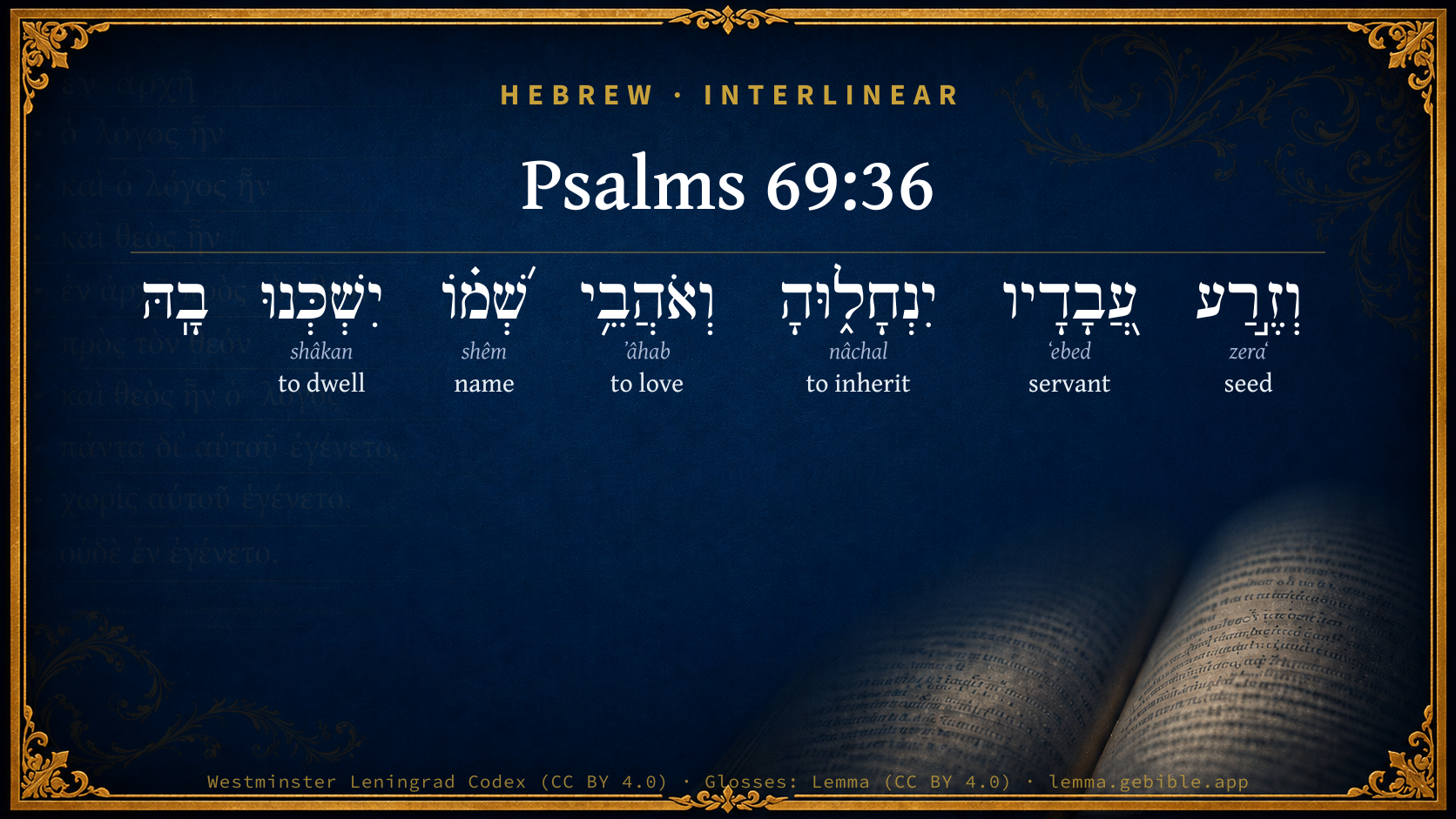
  1. וְזֶ֣רַע zeraʻ H2233 “and · seed of” Conjunction + Noun, Common, Masculine, Singular, Construct
  2. עֲ֭בָדָיו ʻebed H5650 “servants · his” Noun, Common, Masculine, Plural, Construct + Suffix, Personal, 3rd Person, Masculine, Singular
  3. וְאֹהֲבֵ֥י ʼâhab H157 “and · loving” Conjunction + Verb, Qal, Participle Active, Masculine, Plural, Construct
  4. שְׁ֝מ֗וֹ shêm H8034 “name · his” Noun, Common, Masculine, Singular, Construct + Suffix, Personal, 3rd Person, Masculine, Singular
  5. יִשְׁכְּנוּ shâkan H7931 “to dwell” Verb, Qal, Imperfect, 3rd Person, Masculine, Plural

About this verse

These counts appear in no published source. They are computed here, from the morphology-tagged text and Lemma’s own curated glosses. What Lemma adds →

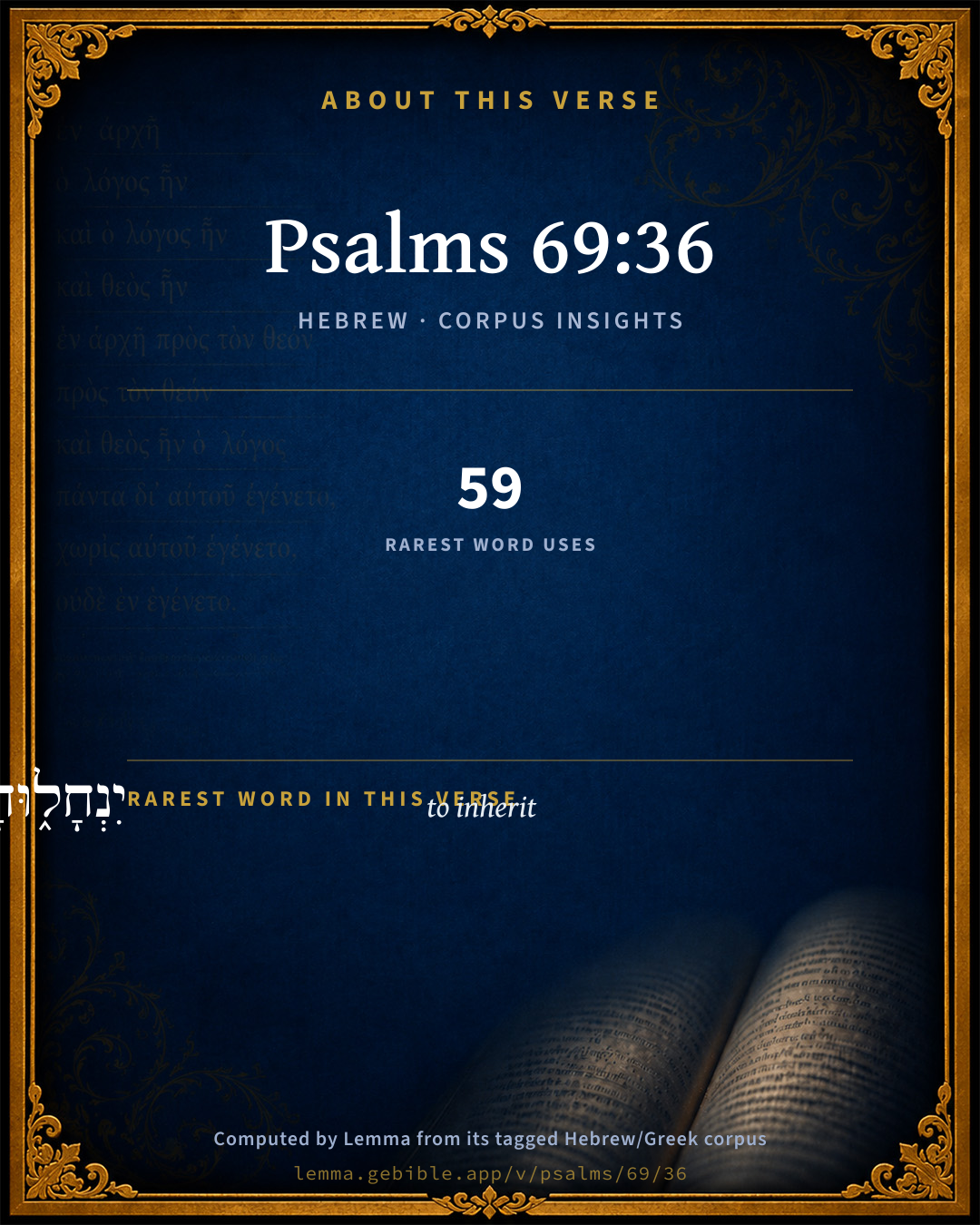
7
words
6
distinct lemmas
Wisdom
section

Shared distinctive vocabulary

יִנְחָל֑וּהָ to inherit H5157 occurs in 57 verses of the Hebrew Bible. Also found in:

Grammatical profile

  • 3 verbs
  • 3 nouns
  • 1 preposition

Verb forms

  • יִנְחָל֑וּהָ Qal · Imperfect
  • וְאֹהֲבֵ֥י Qal · Participle Active
  • יִשְׁכְּנוּ Qal · Imperfect

Hebrew & Septuagint length

In English translation the verse runs 17 words from the Hebrew and 18 from the Septuagint (LXX English) — closely comparable.

A rough comparison of the two English renderings, which tokenize alike — not a word-level alignment.

Word counts can differ between the Hebrew and the Greek without any difference in meaning — e.g. the Hebrew direct-object marker אֵת has no separate Greek word, and Greek often adds the article ὁ.

Cross-references

12

Topical passages linked to Psalms 69:36 in the Treasury of Scripture Knowledge — connected by theme and wording, ordered by reader-vote popularity; previews shown in the World English Bible.

  • Psalms 102:28 The children of your servants will continue. Their seed will be established before you."
  • Psalms 37:29 The righteous shall inherit the land, And live in it forever.
  • Acts 2:39 For to you is the promise, and to your children, and to all who are far off, even as many as the Lord our God will call to himself."
  • James 1:12 Blessed is the man who endures temptation, for when he has been approved, he will receive the crown of life, which the Lord promised to those who love him.
  • Isaiah 61:9 Their seed shall be known among the nations, and their offspring among the peoples; all who see them shall acknowledge them, that they are the seed which Yahweh has blessed.
  • John 14:23 Jesus answered him, "If a man loves me, he will keep my word. My Father will love him, and we will come to him, and make our home with him.
  • Psalms 91:14 "Because he has set his love on me, therefore I will deliver him. I will set him on high, because he has known my name.
  • Romans 8:28 We know that all things work together for good for those who love God, to those who are called according to his purpose.
  • James 2:5 Listen, my beloved brothers. Didn't God choose those who are poor in this world to be rich in faith, and heirs of the Kingdom which he promised to those who love him?
  • Isaiah 44:3–4 For I will pour water on him who is thirsty, and streams on the dry ground; I will pour my Spirit on your seed, and my blessing on your offspring:
  • Revelation 21:27 There will in no way enter into it anything profane, or one who causes an abomination or a lie, but only those who are written in the Lamb's book of life.
  • Psalms 90:16–17 Let your work appear to your servants; Your glory to their children.

Cross-references courtesy of OpenBible.info (CC BY 4.0).

Hebrew and Greek witnesses Masoretic Hebrew ↔ Greek Septuagint

The same verse in the two great witnesses to the Old Testament, shown verse-for-verse.

You’re reading Greek Psalm 68 (Hebrew Psalm 69). The Septuagint counts the superscription, so verse numbers can differ from the Hebrew — chapter-level alignment, not verse-by-verse. Numbering follows Rahlfs.

These are two independent witnesses, not word-aligned to each other, and the Septuagint is shown in lemma (dictionary) form.

Hebrew Psalms 69:36 Masoretic · Westminster Leningrad Codex

וְזֶ֣רַע עֲ֭בָדָיו יִנְחָל֑וּהָ וְאֹהֲבֵ֥י שְׁ֝מ֗וֹ יִשְׁכְּנוּ בָֽהּ

The children also of his servants shall inherit it. Those who love his name shall dwell therein.

World English Bible · Public Domain

Greek LXX Greek Psalm 68:36 Septuagint · lemma form

ὅτι ὁ θεός σώζω ὁ σιων καί οἰκοδομέω ὁ πόλις ὁ ἰουδαία καί καταοἰκέω ἐκεῖ καί κληρονομέω αὐτός

And the seed of his servants shall possess it, and they that love his name shall dwell therein.

LXX2012 (modern English Septuagint) · Public Domain

Hebrew: Westminster Leningrad Codex (CC BY 4.0). Greek: Septuagint (public domain); English from LXX2012 (modern English Septuagint) (Public Domain). How the Septuagint differs from the Hebrew →

Commentary

Notes on Psalms 69:36 from classic Christian and Jewish commentators (each source and its license shown beneath its notes). The classic Christian expositions comment on the surrounding passage and are grouped to its opening verse, so a note may address several verses; the Jewish commentaries on the Tanakh (Rashi and others) are per-verse, so they appear only where the commentator wrote on this verse.

Lemma curates 59 commentaries, every one of them public domain or Creative Commons licensed, each selected and text-cleaned for this edition rather than reprinted as found. About our sources →

Trapp's Complete Commentary

John Trapp

Psa 69:36 The seed also of his servants shall inherit it: and they that love his name shall dwell therein.

Ver. 36. The seed also of his servants shall inherit] The faithful and their posterity after them shall be incorporated into the Church, and partake of all good things to all perpetuity.

John Trapp, A Commentary or Exposition upon All the Books of the Old and New Testament (1647–1656) — public domain. Text from a community e-Sword module.

J. A. Alexander on Psalms

Joseph Addison Alexander

37. (Psa 69:36). And the seed of his servants shall inherit it, i.e. Judah or the land of promise, and the lovers of his name, of his revealed perfections, shall dwell (quietly and safely) in it. The foregoing promises are not restricted to a single generation, but extend to the remotest posterity. Inherit it, possess it by hereditary right from generation to generation. As temporal and spiritual blessings were inseparably blended in the old dispensation, the promise of perpetual possession and abode in Palestine is merely the costume in which that of everlasting favour to the church is clothed in the Old Testament.

Joseph Addison Alexander, The Psalms Translated and Explained (1850) — public domain. Text from a community e-Sword module.

Tyndale Open Study Notes

Tyndale Open Resources

69:36 God’s people will inherit the land because the wicked will perish (see 37:8-9).

Tyndale Open Study Notes — © Tyndale Open Resources, licensed CC BY-SA 4.0. Text via the HelloAO Bible API.

Geneva Bible (1599)

Geneva Bible translators

Under the temporal promise of the land of Canaan, he comprehendeth the promise of life everlasting to the faithful and their posterity.

Geneva Bible (1599) marginal notes — public domain. Text via Bolls.life.

John Calvin's Commentaries

36. And the seed of his servants shall inherit it. In this verse he declares that the blessing now mentioned would extend through a continued succession of ages — that, the fathers would transmit to their children the possession which they had received, as from hand to hand, and the children to their children; and the enduring possession of all good things depends upon Christ, of whom David was a type. Yet the Psalmist at the same time briefly intimates, that such only as are the legitimate children of Abraham shall inherit the land: They who love his name shall dwell in it. It was needful to take away all grounds for self-gloriation from hypocrites, who, looking to and depending solely upon the circumstances connected with the origin of their race, foolishly boasted that the land belonged to them by right of inheritance, notwithstanding of their having apostatised from the faith of their ancestors. Although that land was given to the chosen people to be possessed until the advent of Christ, we should remember that it was a type of the heavenly inheritance, and that, therefore, what is here written concerning the protection of the Church, has received a more true and substantial fulfillment in our own day. There is no reason to fear that the building of the spiritual temple, in which the celestial power of God has been manifested, will ever fall into ruins.

John Calvin's Commentaries (1540-1563) — public domain. Text from the Calvin Translation Society English edition (1840s-50s) via the Christian Classics Ethereal Library (ccel.org). Calvin's coverage is partial (roughly two-thirds of the Bible); uncommented books and verses are honest gaps, never fabricated. The 19th-century editor's footnotes and remarks are omitted so the notes are faithfully Calvin's own voice.

The Cambridge Bible for Schools and Colleges

gen. ed. J. J. S. Perowne

36. Cp. Isa_65:9; Isa_65:23.

they that love his name] Cp. Psa_5:11; Psa_119:132. The citizens of Zion will all be true Israelites, faithfully observing the first and great commandment of the law (Deu_6:4-5; Deu_6:13).

The Cambridge Bible for Schools and Colleges (gen. ed. J. J. S. Perowne; Cambridge University Press, 1878–1918) — public domain. Text from a community e-Sword module.

John Gill's Exposition

The seed also of his servants shall inherit it,.... Not their natural, but spiritual seed, or a succession of converts in the churches; see Psa 45:16; who are born not of blood, nor of the will of the flesh, nor of the will of man, but of God; not of corruptible, but incorruptible seed, by the word of God, which lives and abides for ever, Joh 1:13; these are the proper and rightful inheritors of the Gospel church state, and all its privileges, in all successive generations, quite down to the New Jerusalem church state, wherein will dwell only righteous persons, and whose names are in the Lamb's book of life. Aben Ezra's note upon it is,

"they shall inherit it, they and their children, in the days of David, or in the days of the Messiah;''

and they that love his name shall dwell therein; that love the person, Gospel, truths and ordinances of Christ; see Sol 1:3; these shall have an abiding place in Zion, the church of God; in the cities of Judah, particular congregational churches; and in the city of the New Jerusalem, where will be the tabernacle of God among men, and he shall dwell among them, and they with him.

Next: Psalms Chapter 70

John Gill's Exposition of the Whole Bible (1746–1763) — public domain (CC PDM 1.0). Text via the HelloAO Bible API.

Albert Barnes' Notes on the Bible

The seed also of his servants - The children or the descendants of his people.

Shall inherit it - Shall continue to dwell in it.

And they that love his name - They that love him; they that are his true friends.

Shall dwell therein - They shall be safe there; they shall find there a home. This indicates the confident belief of the author of the psalm that the favor of God would be shown to the land. Whatever might be the present troubles, his faith was unwavering - his confidence unshaken - in regard to the faithfulness of God. Palestine - the promised land - would still be the inheritance of those who loved God, and the interests of those who dwelt there would be secure. As applied to the church of God now, the idea is, that it is safe; that it will always be under the divine protection; and that it will be the loved and the secure abode of all that “love the name” of their God and Saviour.

Albert Barnes' Notes on the Bible (1834–1885) — public domain. Text from a community e-Sword/MySword module.

Matthew Poole's English Annotations

Their posterity shall flourish after them, and partake of the same happiness with them.

Matthew Poole's English Annotations on the Holy Bible (1683–1685) — public domain. Text from a community e-Sword/MySword module.

The Treasury of David

Charles H. Spurgeon

Ver. 36. The seed also of his servants shall inherit it. Under this image, which, however, we dare not regard as a mere simile, but as having in itself a literal significance, we have set forth to us the enrichment of the saints, consequent upon the sorrow of their Lord. The termination of this Psalm strongly recalls in us that of the twenty-second. The seed lie near the Saviour's heart, and their enjoyment of all promised good is the great concern of his disinterested soul. Because they are his Father's servants, therefore he rejoices in their welfare.

And they that love his name shall dwell therein. He has an eye to the Father's glory, for it is to his praise that those who love him should attain, and for ever enjoy, the utmost happiness. Thus a Psalm, which began in the deep waters, ends in the city which hath foundations. How gracious is the change. Hallelujah.

None.

Ver. 36.

I. The sure evidence of grace: "love his name."

II. The blessing given.

III. The enduring character of it: "shall dwell."

Ver. 36.

I. The inheritance: "Inherit it; "we reign with Christ on

earth, then in heaven.

II. The title.

1. Legal: "Seed of his servants" --Abraham, Jacob, David--David's Lord and Son.

2. Moral: "They that love his name." G. R.

Charles H. Spurgeon's The Treasury of David (1869–1885) — public domain. Psalms only. Text from a community e-Sword/MySword module.

Whedon's Commentary on the Bible

Daniel D. Whedon

36. Seed also of his servants shall inherit it—This is the result to which faith has struggled up, and where it now calmly rests. Jerusalem and the cities of Judah shall be fortified, not destroyed; the kingdom of David shall be established, the misrule of the wicked shall end, and God’s servants and such as love his name shall dwell therein. This was God’s will and his answer to David’s prayer; and by the light of this, the ultimate object sought, must all the imprecatory petitions be construed; that is, they sought and contemplated only this end, and were conditioned on their necessity in order to effect it.

Daniel D. Whedon (gen. ed.), Commentary on the Old and New Testaments (1874–1909) — public domain. Text from a community e-Sword module.

The Pulpit Commentary

The seed also of his servants shall inherit it. Nor shall the city alone the mere walls and buildings continue to exist. "The seed of God"s servants his people Israel shall continue to inhabit it. And they that love his Name shall dwell therein. When the earthly Zion fell away and forfeited the promises, they passed to the heavenly Zion (Heb_12:22) the Church of God, the true Israel.

The Pulpit Commentary (1880–1919), ed. H.D.M. Spence-Jones & Joseph S. Exell — public domain. Text from a community e-Sword module.

Lesson kit

Teaching starters — assembled from the data on this page, not authored interpretation. Every prompt links to the verse data it draws on. Edit before teaching.

Psalms, in the Wisdom, opens this verse with 7 words (6 distinct Hebrew lemmas). Its most distinctive word is nâchal (“to inherit”). A historical commentator’s framing appears above. Read the whole chapter for the surrounding context.

Discussion questions

  1. What does “to inherit” (nâchal) contribute to the verse as a whole?
  2. Exodus 23:30 shares the word «to inherit» with this verse. How do the two illuminate each other?
  3. These translations render this verse differently; the difference is in the English rendering, not the original. What questions does that raise?
  4. The verb «יִנְחָל֑וּהָ» is Qal Imperfect. How does its form color the action?
  5. Reading how Trapp's Complete Commentary and J. A. Alexander on Psalms read this verse, where do the two commentators agree and where do they part?

Things to notice

Reading settings

Reading text

Shown beneath each verse's original-language words.

Old Testament
Old Testament edition

Read the OT as the Masoretic Hebrew (MT) or the Greek Septuagint (LXX).

English shown for the Greek Septuagint (in the Hebrew ↔ Greek comparison).

Comparing translations? Open the Compare panel on any verse page to stack up to four side by side.