
Jeremiah 20:4

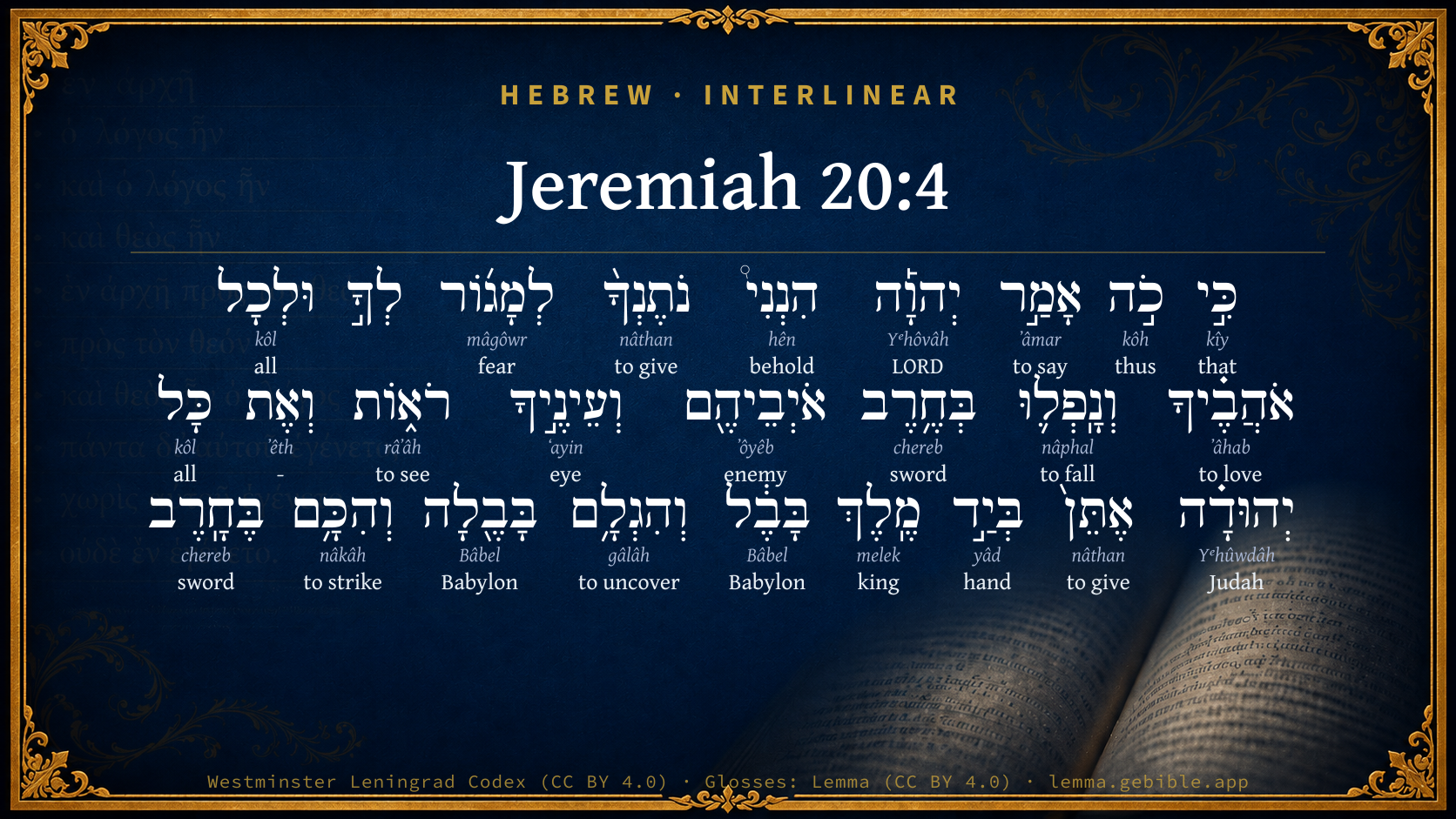
Hebrew (Westminster Leningrad Codex) Jeremiah 20:4 appears in the Hebrew Old Testament. The text above is from the Westminster Leningrad Codex. Each word links to its Strong’s number, a concise gloss, and parsing drawn from the Open Scriptures Hebrew Bible morphology. Click any word for its full Brown-Driver-Briggs (BDB) entry.
Download image
Cite this verse

Jeremiah 20:4 (World English Bible). Public Domain. Lemma interlinear Bible study tool, https://lemma.gebible.app/v/jeremiah/20/4.

Show BibTeX & RIS
BibTeX
RIS
English Translation
For thus says Yahweh, Behold, I will make you a terror to yourself, and to all your friends; and they shall fall by the sword of their enemies, and your eyes shall see it; and I will give all Judah into the hand of the king of Babylon, and he shall carry them captive to Babylon, and shall kill them with the sword.
World English Bible · Public Domain
Download a study sheet

One document with this verse’s original text, its word-by-word gloss line, the meaning frame, cross-references with their text, attributed commentary, and full source and license credits — printable, and it pastes into notes with its structure intact.

This verse Autodidact and up

Study sheet (.html) Plain text (.txt)

A passage Seminary Student

Up to 50 verses in one chapter. A passage sheet keeps up to 6 commentary sources and 12 cross-references per verse, in the order this page ranks them, and says so on the sheet whenever that leaves anything out. Ask for a single verse and you get the Autodidact verse sheet above.

Everything on this page stays free to read, with no account — the sheet is a download of what is already on screen, not access to it.

Want to remove ads? Support Godless Engineer
Compare translations 3

The same verse in 3 English versions, stacked beneath the original-language interlinear above. Click any original word for its lexicon entry.

Each is an independent rendering of the whole verse — the interlinear is not word-aligned to these translations.

Highlighted words mark where these versions differ — a whole-verse word diff, not a word-by-word alignment.

  • World English Bible Public Domain
    For thus says Yahweh, Behold, I will make you a terror to yourself, and to all your friends; and they shall fall by the sword of their enemies, and your eyes shall see it; and I will give all Judah into the hand of the king of Babylon, and he shall carry them captive to Babylon, and shall kill them with the sword.
  • King James Version Public Domain
    For thus saith the LORD, Behold, I will make thee a terror to thyself, and to all thy friends: and they shall fall by the sword of their enemies, and thine eyes shall behold it: and I will give all Judah into the hand of the king of Babylon, and he shall carry them captive into Babylon, and shall slay them with the sword.
  • unfoldingWord Literal Text CC BY-SA 4.0
    For thus says Yahweh: ‘Behold, I am making you as a terror to yourself and to all your lovers, and they will fall by the sword of their enemies, and your eyes will be seeing. And I will give all of Judah into the hand of the king of Babylon, and he will exile them to Babylon, and he will strike them with the sword.

unfoldingWord Literal Text — © unfoldingWord, licensed CC BY-SA 4.0. Word-aligned USFM3 via Door43 (git.door43.org/unfoldingWord/en_ult).

Versions to compare (up to 4)

3 of 4 selected

Show all 18 translations

Every available English version of this verse, each an independent rendering of the whole verse.

  • World English Bible Public Domain
    For thus says Yahweh, Behold, I will make you a terror to yourself, and to all your friends; and they shall fall by the sword of their enemies, and your eyes shall see it; and I will give all Judah into the hand of the king of Babylon, and he shall carry them captive to Babylon, and shall kill them with the sword.
  • Berean Standard Bible Public Domain
    For this is what the LORD says: ‘I will make you a terror to yourself and to all your friends. They will fall by the sword of their enemies before your very eyes. And I will hand Judah over to the king of Babylon, and he will carry them away to Babylon and put them to the sword.
  • Majority Standard Bible Public Domain
    For this is what the LORD says: ‘I will make you a terror to yourself and to all your friends. They will fall by the sword of their enemies before your very eyes. And I will hand Judah over to the king of Babylon, and he will carry them away to Babylon and put them to the sword.
  • King James Version Public Domain
    For thus saith the LORD, Behold, I will make thee a terror to thyself, and to all thy friends: and they shall fall by the sword of their enemies, and thine eyes shall behold it: and I will give all Judah into the hand of the king of Babylon, and he shall carry them captive into Babylon, and shall slay them with the sword.
  • American Standard Version (1901) Public Domain
    For thus saith Jehovah, Behold, I will make thee a terror to thyself, and to all thy friends; and they shall fall by the sword of their enemies, and thine eyes shall behold it; and I will give all Judah into the hand of the king of Babylon, and he shall carry them captive to Babylon, and shall slay them with the sword.
  • Revised Version (1885) Public Domain
    For thus saith the LORD, Behold, I will make thee a terror to thyself, and to all thy friends: and they shall fall by the sword of their enemies, and thine eyes shall behold it: and I will give all Judah into the hand of the king of Babylon, and he shall carry them captive to Babylon, and shall slay them with the sword.
  • Geneva Bible (1599) Public Domain
    For thus saith the Lord, Behold, I will make thee to be a terrour to thy self, and to al thy friends, and they shall fall by the sword of their enemies, and thine eyes shall beholde it, and I will giue all Iudah into the hande of the King of Babel, and he shall cary them captiue into Babel, and shall slay them with the sworde.
  • Douay-Rheims (1899) Public Domain
    For thus saith the Lord: Behold I will deliver thee up to fear, thee and all thy friends: and they shall fall by the sword of their enemies, and thy eyes shall see it, and I will give all Juda into the hand of the king of Babylon: and he shall strike them with the sword.
  • Young's Literal Translation Public Domain
    For thus said Jehovah: Lo, I am making thee for a fear to thyself, And to all loving thee, And they have fallen by the sword of their enemies, and thine eyes are beholding, And all Judah I give into the hand of the king of Babylon, And he hath removed them to Babylon, And he hath smitten them with the sword.
  • Literal Standard Version CC BY-SA 4.0
    For thus said YHWH: Behold, I am making you for a fear to yourself, || And to all loving you, || And they have fallen by the sword of their enemies, and your eyes are beholding, || And all Judah I give into the hand of the king of Babylon, || And he has removed them to Babylon, || And he has struck them with the sword.
  • Unlocked Literal Bible CC BY-SA 4.0
    For Yahweh says this, 'Look, I will make you an object of horror, you and all of your loved ones, for they will fall by the sword of their enemies and your eyes will see it. I will give all of Judah into the hand of the king of Babylon. He will make them captives in Babylon or attack them with the sword.
  • unfoldingWord Literal Text CC BY-SA 4.0
    For thus says Yahweh: ‘Behold, I am making you as a terror to yourself and to all your lovers, and they will fall by the sword of their enemies, and your eyes will be seeing. And I will give all of Judah into the hand of the king of Babylon, and he will exile them to Babylon, and he will strike them with the sword.
  • Darby Bible Public Domain
    For thus saith Jehovah: Behold, I make thee a terror to thyself, and to all thy friends; and they shall fall by the sword of their enemies, and thine eyes shall see [it]; and I will give all Judah into the hand of the king of Babylon, and he shall carry them captive into Babylon, and shall smite them with the sword.
  • World Messianic Bible Public Domain
    For the LORD says, ‘Behold, I will make you a terror to yourself and to all your friends. They will fall by the sword of their enemies, and your eyes will see it. I will give all Judah into the hand of the king of Babylon, and he will carry them captive to Babylon, and will kill them with the sword.
  • Webster's Bible Public Domain
    For thus saith the LORD, Behold, I will make thee a terror to thyself, and to all thy friends: and they shall fall by the sword of their enemies, and thy eyes shall behold it: and I will give all Judah into the hand of the king of Babylon, and he shall carry them captive into Babylon, and shall slay them with the sword.
  • Free Bible Version CC BY-SA 4.0
    For this is what the Lord says: I'm going to make you terrified—you and all those you love. Enemies will kill them as you watch. I will hand Judah over to the king of Babylon. He will kill some, and the rest he will take away into exile in Babylon.
  • Bible in Basic English Public Domain
    For the Lord has said, See, I will make you a cause of fear to yourself and to all your friends: they will come to their death by the sword of their haters, and your eyes will see it: and I will give all Judah into the hands of the king of Babylon, and he will take them away prisoners into Babylon and put them to the sword.
  • JPS Tanakh (1917) Public Domain
    For thus saith the LORD: Behold, I will make thee a terror to thyself, and to all thy friends; and they shall fall by the sword of their enemies, and thine eyes shall behold it; and I will give all Judah into the hand of the king of Babylon, and he shall carry them captive to Babylon, and shall slay them with the sword.

Literal Standard Version (2020), Covenant Press — licensed CC BY-SA 4.0. Text via the HelloAO Bible API (eBible.org). Unlocked Literal Bible (unfoldingWord) — licensed CC BY-SA 4.0. Text via the HelloAO Bible API (eBible.org). unfoldingWord Literal Text — © unfoldingWord, licensed CC BY-SA 4.0. Word-aligned USFM3 via Door43 (git.door43.org/unfoldingWord/en_ult). Free Bible Version, Dr. Jonathan Gallagher — licensed CC BY-SA 4.0. Text via the HelloAO Bible API (eBible.org).

Word by word

More ways to search: Search by grammar → Find every occurrence → Compare this word →

Practice this passage: Drill this verse → Learn its vocabulary →

לְמָג֜וֹר
mâgôwr
H4032
“to/for · fear”
Preposition + Noun, Common, Masculine, Singular, Absolute
Part of Speech
Preposition + Noun
Type
Common
Gender
Masculine
Number
Singular
State
Absolute
Full BDB Definition

Origin: from H1481 in the sense of fearing

TWOT: 332a

fear, terror
  1. כִּ֣י kîy H3588 “that” Conjunction
  2. כֹ֣ה kôh H3541 “thus” Adverb
  3. אָמַ֣ר ʼâmar H559 “to say” Verb, Qal, Perfect, 3rd Person, Masculine, Singular
  4. יְהוָ֡ה Yᵉhôvâh H3068 “LORD” Noun, Proper
  5. הִנְנִי֩ hên H2005 “behold · me” Particle, Demonstrative + Suffix, Personal, 1st Person, Common, Singular
  6. נֹתֶנְךָ֨ nâthan H5414 “giving · you” Verb, Qal, Participle Active, Masculine, Singular, Construct + Suffix, Personal, 2nd Person, Masculine, Singular
  7. וּלְכָל kôl H3605 “and · to/for · all of” Conjunction + Preposition + Noun, Common, Masculine, Singular, Construct
  8. אֹהֲבֶ֗יךָ ʼâhab H157 “loving · you” Verb, Qal, Participle Active, Masculine, Plural, Construct + Suffix, Personal, 2nd Person, Masculine, Singular
  9. וְנָֽפְל֛וּ nâphal H5307 “and · to fall” Conjunction + Verb, Qal, Sequential Perfect, 3rd Person, Common, Plural
  10. בְּחֶ֥רֶב chereb H2719 “in/at · sword of” Preposition + Noun, Common, Feminine, Singular, Construct
  11. אֹיְבֵיהֶ֖ם ʼôyêb H341 “enemy · them” Verb, Qal, Participle Active, Masculine, Plural, Construct + Suffix, Personal, 3rd Person, Masculine, Plural
  12. וְעֵינֶ֣יךָ ʻayin H5869 “and · eyes · your” Conjunction + Noun, Common, Both, Dual, Construct + Suffix, Personal, 2nd Person, Masculine, Singular
  13. רֹא֑וֹת râʼâh H7200 “seeing” Verb, Qal, Participle Active, Feminine, Plural, Absolute
  14. וְאֶת ʼêth H853 “and · -” Conjunction + Particle, Direct Object
  15. כָּל kôl H3605 “all of” Noun, Common, Masculine, Singular, Construct
  16. יְהוּדָ֗ה Yᵉhûwdâh H3063 “Judah” Noun, Proper
  17. אֶתֵּן֙ nâthan H5414 “to give” Verb, Qal, Imperfect, 1st Person, Common, Singular
  18. בְּיַ֣ד yâd H3027 “in/at · hand of” Preposition + Noun, Common, Both, Singular, Construct
  19. מֶֽלֶךְ melek H4428 “king of” Noun, Common, Masculine, Singular, Construct
  20. בָּבֶ֔ל Bâbel H894 “Babylon” Noun, Proper
  21. וְהִגְלָ֥ם gâlâh H1540 “and · to uncover · them” Conjunction + Verb, Hiphil, Sequential Perfect, 3rd Person, Masculine, Singular + Suffix, Personal, 3rd Person, Masculine, Plural
  22. בָּבֶ֖לָה Bâbel H894 “Babylon · toward” Noun, Proper + Suffix, Demonstrative
  23. וְהִכָּ֥ם nâkâh H5221 “and · to strike · them” Conjunction + Verb, Hiphil, Sequential Perfect, 3rd Person, Masculine, Singular + Suffix, Personal, 3rd Person, Masculine, Plural
  24. בֶּחָֽרֶב chereb H2719 “in/at the · sword” Preposition, Determined + Noun, Common, Feminine, Singular, Absolute

About this verse

These counts appear in no published source. They are computed here, from the morphology-tagged text and Lemma’s own curated glosses. What Lemma adds →

26
words
21
distinct lemmas
Prophets
section

Notable vocabulary

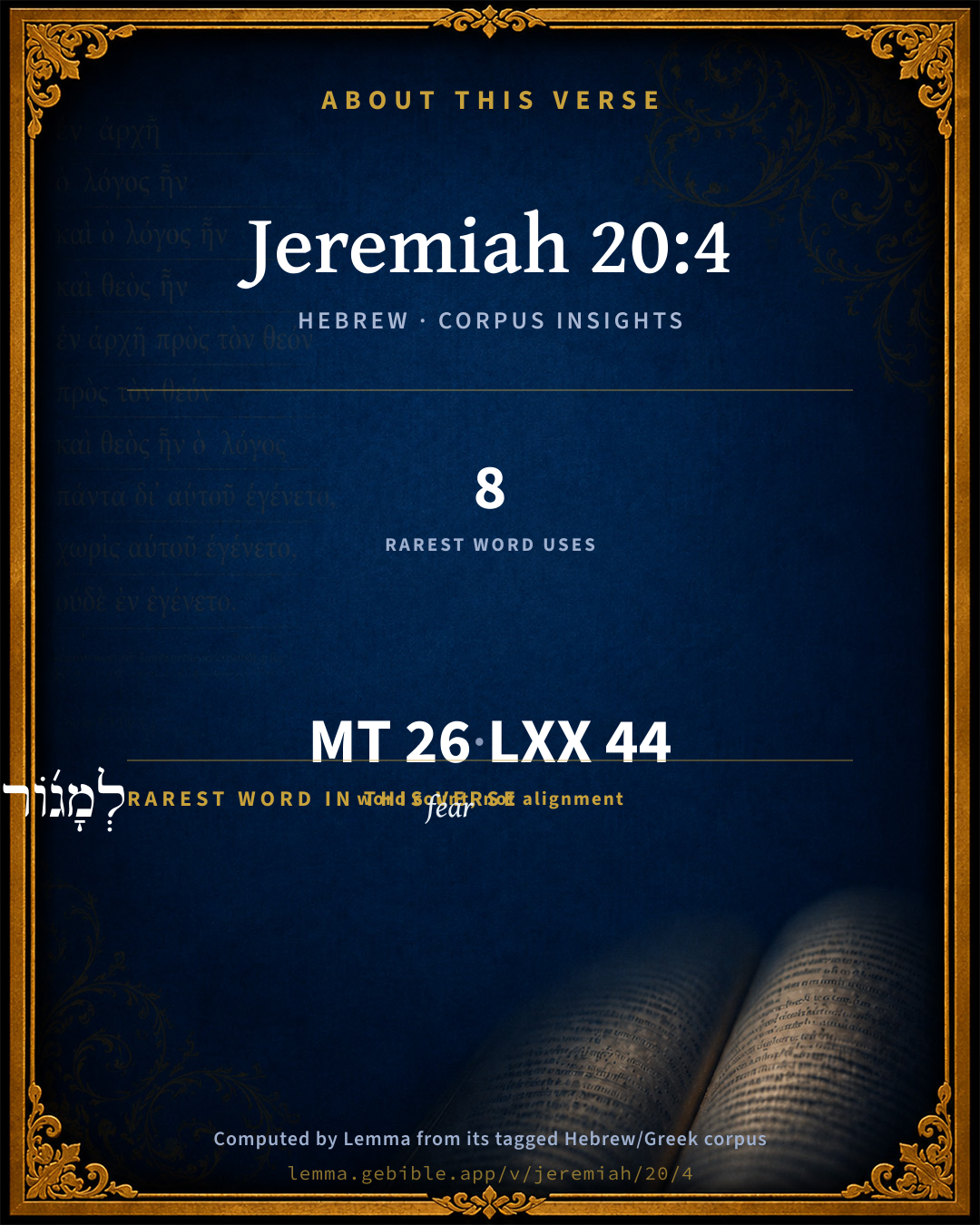
The rarest word here is לְמָג֜וֹר fear H4032 — appearing just 8 times in the whole Hebrew Bible.

Shared distinctive vocabulary

לְמָג֜וֹר fear H4032 occurs in 8 verses of the Hebrew Bible. Also found in:

Grammatical profile

  • 9 verbs
  • 12 nouns
  • 1 preposition
  • 1 conjunction
  • 1 adverb
  • 2 particles

Verb forms

  • אָמַ֣ר Qal · Perfect
  • נֹתֶנְךָ֨ Qal · Participle Active
  • אֹהֲבֶ֗יךָ Qal · Participle Active
  • וְנָֽפְל֛וּ Qal · Sequential Perfect
  • אֹיְבֵיהֶ֖ם Qal · Participle Active
  • רֹא֑וֹת Qal · Participle Active
  • אֶתֵּן֙ Qal · Imperfect
  • וְהִגְלָ֥ם Hiphil · Sequential Perfect
  • וְהִכָּ֥ם Hiphil · Sequential Perfect

Repetition

Words recur within this verse — often emphatic in Hebrew:

  • נֹתֶנְךָ֨ to give H5414 ×2
  • וּלְכָל all H3605 ×2
  • בְּחֶ֥רֶב sword H2719 ×2
  • בָּבֶ֔ל Babylon H894 ×2

Hebrew & Septuagint length

In the original languages it is 26 Hebrew tokens and 44 Greek tokens — but the two are counted differently (Hebrew bundles its prefixes and suffixes into one token; the Greek is in lemma form), so that isn’t a like-for-like length.

Cross-references

17

Topical passages linked to Jeremiah 20:4 in the Treasury of Scripture Knowledge — connected by theme and wording, ordered by reader-vote popularity; previews shown in the World English Bible.

  • Jeremiah 29:21 Thus says Yahweh of Hosts, the God of Israel, concerning Ahab the son of Kolaiah, and concerning Zedekiah the son of Maaseiah, who prophesy a lie to you in my name: Behold, I will deliver them into the hand of Nebuchadrezzar king of Babylon; and he shall kill them before your eyes;
  • Jeremiah 25:9 behold, I will send and take all the families of the north, says Yahweh, and [I will send] to Nebuchadrezzar the king of Babylon, my servant, and will bring them against this land, and against the inhabitants of it, and against all these nations round about; and I will utterly destroy them, and make them an astonishment, and a hissing, and perpetual desolations.
  • Jeremiah 21:4–10 Thus says Yahweh, the God of Israel, Behold, I will turn back the weapons of war that are in your hands, with which you fight against the king of Babylon, and against the Chaldeans who besiege you, without the walls; and I will gather them into the midst of this city.
  • Jeremiah 32:27–31 Behold, I am Yahweh, the God of all flesh: is there anything too hard for me?
  • Jeremiah 39:6–7 Then the king of Babylon killed the sons of Zedekiah in Riblah before his eyes: also the king of Babylon killed all the nobles of Judah.
  • Deuteronomy 28:32–34 Your sons and your daughters shall be given to another people; and your eyes shall look, and fail with longing for them all the day: and there shall be nothing in the power of your hand.
  • Deuteronomy 28:65–67 Among these nations shall you find no ease, and there shall be no rest for the sole of your foot: but Yahweh will give you there a trembling heart, and failing of eyes, and pining of soul;
  • 2 Kings 25:7 They killed the sons of Zedekiah before his eyes, and put out the eyes of Zedekiah, and bound him in fetters, and carried him to Babylon.
  • Job 18:11–21 Terrors shall make him afraid on every side, And shall chase him at his heels.
  • 1 Samuel 2:33 The man of yours, [whom] I shall not cut off from my altar, [shall be] to consume your eyes, and to grieve your heart; and all the increase of your house shall die in the flower of their age.
  • Job 20:23–26 When he is about to fill his belly, God will cast the fierceness of his wrath on him. It will rain on him while he is eating.
  • Psalms 73:19 How they are suddenly destroyed! They are completely swept away with terrors.
  • Jeremiah 6:25 Don't go forth into the field, nor walk by the way; for the sword of the enemy, [and] terror, are on every side.
  • Jeremiah 19:15 Thus says Yahweh of Hosts, the God of Israel, Behold, I will bring on this city and on all its towns all the evil that I have pronounced against it; because they have made their neck stiff, that they may not hear my words.
  • Jeremiah 52:27 The king of Babylon struck them, and put them to death at Riblah in the land of Hamath. So Judah was carried away captive out of his land.
  • Ezekiel 26:17–21 They shall take up a lamentation over you, and tell you, How are you destroyed, who were inhabited by seafaring men, the renowned city, who was strong in the sea, she and her inhabitants, who caused their terror to be on all who lived there!
  • Matthew 27:4–5 saying, "I have sinned in that I betrayed innocent blood." But they said, "What is that to us? You see to it."

Cross-references courtesy of OpenBible.info (CC BY 4.0).

Hebrew and Greek witnesses Masoretic Hebrew ↔ Greek Septuagint

The same verse in the two great witnesses to the Old Testament, shown verse-for-verse.

These are two independent witnesses, not word-aligned to each other, and the Septuagint is shown in lemma (dictionary) form.

Hebrew Jeremiah 20:4 Masoretic · Westminster Leningrad Codex

כִּ֣י כֹ֣ה אָמַ֣ר יְהוָ֡ה הִנְנִי֩ נֹתֶנְךָ֨ לְמָג֜וֹר לְךָ֣ וּלְכָל אֹהֲבֶ֗יךָ וְנָֽפְל֛וּ בְּחֶ֥רֶב אֹיְבֵיהֶ֖ם וְעֵינֶ֣יךָ רֹא֑וֹת וְאֶת כָּל יְהוּדָ֗ה אֶתֵּן֙ בְּיַ֣ד מֶֽלֶךְ בָּבֶ֔ל וְהִגְלָ֥ם בָּבֶ֖לָה וְהִכָּ֥ם בֶּחָֽרֶב

For thus says Yahweh, Behold, I will make you a terror to yourself, and to all your friends; and they shall fall by the sword of their enemies, and your eyes shall see it; and I will give all Judah into the hand of the king of Babylon, and he shall carry them captive to Babylon, and shall kill them with the sword.

World English Bible · Public Domain

Greek LXX Structure differs

In the Septuagint, Jeremiah is about an eighth shorter than the Hebrew and arranges its material differently — the Oracles Against the Nations (Hebrew chapters 46–51) appear in the middle of the Greek book, after 25:13. Because the chapter and verse boundaries do not line up, a verse-for-verse comparison with the Hebrew is not shown.

A verse-for-verse comparison isn’t shown here because the chapters and verses don’t line up. Switch to the LXX edition with the MT / LXX toggle above to read the Greek directly.

Hebrew: Westminster Leningrad Codex (CC BY 4.0). Greek: Septuagint (public domain); English from a public-domain English Septuagint. How the Septuagint differs from the Hebrew →

Targum (Aramaic paraphrase)

1

The Targum is the ancient Jewish Aramaic paraphrase of the Hebrew Scriptures — an interpretive translation, not the Hebrew text itself. Onkelos (literal) and Pseudo-Jonathan (expansive) render the Torah, and Jonathan the Prophets. Coverage is partial: where no permissively-licensed English translation exists for a verse, only the Aramaic is shown. This is verse-level text, not a word-by-word alignment to the Hebrew.

  1. Targum Jonathan Prophets (Joshua–Malachi)
    אֲרֵי כִדְנַן אֲמַר יְיָ הָא אֲנָא מְסַר לָךְ לִתְּבַר לָךְ וּלְכָל רַחֲמָךְ וְיִתְקַטְלוּן בַּחֲרַב בַּעֲלֵי דְבָבֵיהוֹן וְעֵינָךְ חַזְיָן וְיַת כָּל דְבֵית יְהוּדָה אֶמְסַר בְּיַד מַלְכָּא דְבָבֶל וְאַגְלִינוּן לְבָבֶל וְיַמְחִינוּן בְּחַרְבָּא:

    (no public-domain English translation for this verse)

    Targum Jonathan — Aramaic: “Mikraot Gedolot” (public domain). English: “Sefaria Community Translation” (CC0 1.0 (public-domain dedication)); “London "Chaldee Paraphrase," 1871” (public domain). Text via Sefaria.

Commentary

Notes on Jeremiah 20:4 from classic Christian and Jewish commentators (each source and its license shown beneath its notes). The classic Christian expositions comment on the surrounding passage and are grouped to its opening verse, so a note may address several verses; the Jewish commentaries on the Tanakh (Rashi and others) are per-verse, so they appear only where the commentator wrote on this verse.

Lemma curates 59 commentaries, every one of them public domain or Creative Commons licensed, each selected and text-cleaned for this edition rather than reprinted as found. About our sources →

Trapp's Complete Commentary

John Trapp

Jer 20:4 For thus saith the LORD, Behold, I will make thee a terror to thyself, and to all thy friends: and they shall fall by the sword of their enemies, and thine eyes shall behold [it]: and I will give all Judah into the hand of the king of Babylon, and he shall carry them captive into Babylon, and shall slay them with the sword.

Ver. 4. I will make thee a terror.] Heb., I will give thee unto a terror - i.e., I will frighten thy conscience, and then turn it loose upon thee, so that thou shalt be a corde tuo fugitivus, and thy friends shall have small joy of thee, or thou help by them. See on Jer 20:3.

John Trapp, A Commentary or Exposition upon All the Books of the Old and New Testament (1647–1656) — public domain. Text from a community e-Sword module.

Keil & Delitzsch

C. F. Keil & F. Delitzsch

Jer 20:1-3

When the chief overseer of the temple, Pashur, heard this prophecy, he had the prophet beaten, and put him over-night in the stocks at the upper gate of Benjamin in the temple. Pashur is by the appellation: son of Immer, distinguished from other priests of this name, e.g., Pashur, son of Malchijah, Ch1 9:12. It cannot be determined whether Immer is here the name of the 16th class of priests (Ch1 24:14) or of one of the greater priestly clans (Ezr 2:37; Neh 7:40). Pashur held the office of פּקיד נגיד, chief overseer in the house of God. נגיד is an official name attached to פּקיד to explain it. In the latter word lies the idea of overseeing, while the former denotes the official standing or rank of the overseer. The position of נגיד was a high one, as may be seen from the fact that the priest Zephaniah, who, according to Jer 29:26, held this post, is quoted in Jer 52:24 (Kg2 25:18) as next to the high priest. The compound expression without article implies that there were several נגידים of the temple. In Ch2 35:8 there are three mentioned under Josiah; which is not contradicted by Ch2 31:13; Ch1 9:11; Neh 11:11, where particular persons are called 'נגיד. As chief overseer of the temple, Pashur conceived it to be his duty to take summary magisterial steps against Jeremiah, for his public appearance in the temple. To put this procedure of the priest and temple-warden in its proper light, Jeremiah is designated by the name of his office, הנּביא.

(Note: As this official designation of Jeremiah is not found in Jer 1-19, but occurs frequently in the succeeding chapters, recent critics have taken it to be an idle addition of the editor of the later prophecies, and have laid stress on the fact as a proof of the later composition, or at least later editing, of these pieces; cf. Graf, S. xxxix. Ng., etc. This assumption is totally erroneous. The designation of Jeremiah as הנּביא occurs only where the mention of the man's official character was of importance. It is used partly in contradistinction to the false prophets, Jer 28:5-6, Jer 28:10-12, Jer 28:15, to the elders, priests, and false prophets, Jer 29:1, Jer 29:29; Jer 37:3, Jer 37:6,Jer 37:13; Jer 42:2, Jer 42:4, to the king, Jer 32:2; Jer 34:6; Jer 37:2, and partly to distinguish from persons of other conditions in life, Jer 43:6; Jer 45:1; Jer 51:59. We never find the title in the headings of the prophecies save in Jer 25:2, with reference to the fact that here, Jer 20:4, he upbraids the people for not regarding the sayings of all the prophets of the Lord; and in the oracles against foreign peoples, Jer 46:1, Jer 46:13; Jer 47:1; Jer 49:34, and Jer 50:1, where the name of his calling gave him credentials for these prophecies. - There is no further use of the name in the entire book.)

Keil & Delitzsch — Biblical Commentary on the Old Testament (1861–1891) — public domain (CC PDM 1.0). Text via the HelloAO Bible API. (Old Testament only.)

Tyndale Open Study Notes

Tyndale Open Resources

20:4-5 This is the first instance in which Jeremiah names Babylon as the country whose armies would invade Judah and take the people into exile. The invaders would take the precious jewels and gold and silver, leaving Judah without resources.

Tyndale Open Study Notes — © Tyndale Open Resources, licensed CC BY-SA 4.0. Text via the HelloAO Bible API.

Jamieson, Fausset & Brown

Robert Jamieson, A. R. Fausset & David Brown

terror . . . to all thy friends--who have believed thy false promises (Jer 20:6). The sense must be in order to accord with "fear round about" (Jer 20:3). I will bring terror on thee and on all thy friends, that terror arising from thyself, namely, thy false prophecies. Thou and thy prophecies will be seen, to the dismay both of thee and thy dupes, to have caused their ruin and thine. MAURER'S translation is therefore not needed, "I will give up thee and all thy friends to terror."

Jamieson, Fausset & Brown — Commentary Critical and Explanatory on the Whole Bible (1871) — public domain (CC PDM 1.0). Text via the HelloAO Bible API.

John Calvin's Commentaries

Here Jeremiah explains more at large why he said that Pashur would be terror on every side, even because he and his friends would be in fear; for he would find himself overwhelmed by God’s vengeance, and would become a spectacle to all others. In short, Jeremiah means, that such would be God’s vengeance as would fill Pashur and all others with fear; for Pashur himself would be constrained to acknowledge God’s hand without being able to escape, and all others would also perceive the same. He then became a spectacle to himself and to others, because he could not, however hardened he might have been, do otherwise than feel God’s vengeance; and this became also apparent to all others.

Behold, he says, I will make thee a terror to thyself and to all thy friends; and fall shall they by the sword of their enemies, thine eyes seeing it; and all Judah will I deliver into the hand, etc. He repeats what he had said; for Pashur wished to be deemed the patron of the whole land, and especially of the city Jerusalem. As, then, he had undertaken the cause of the people, as though he was the patron and defender of them all, Jeremiah says, that all the Jews would be taken captives, and not only so, but that something more grievous was nigh at hand, for when the king of Babylon led them into exile, he would also smite them with the sword, not indeed all; but we know that he severely punished the king, his children, and the chief men, so that the lower orders on account of their obscurity alone escaped; and those of this class who did escape, because they were not noble nor renowned, were indebted to their own humble condition. It follows, —

John Calvin's Commentaries (1540-1563) — public domain. Text from the Calvin Translation Society English edition (1840s-50s) via the Christian Classics Ethereal Library (ccel.org). Calvin's coverage is partial (roughly two-thirds of the Bible); uncommented books and verses are honest gaps, never fabricated. The 19th-century editor's footnotes and remarks are omitted so the notes are faithfully Calvin's own voice.

Ellicott's Commentary for English Readers

(4) I will make thee a terror to thyself, and to all thy friends.—We should have looked for a different explanation, indicating that terrors from without should gather round the cruel and relentless persecutor, but the prophet’s words go deeper. He should be an object of self-loathing, outer fears intensifying his inward terror and acting through him on others. He is the centre from which terrors radiate as well as that to which they converge.

A Bible Commentary for English Readers, edited by Charles John Ellicott (1878–1897) — public domain. Text from a community e-Sword module.

John Gill's Exposition

For thus saith the, Lord, behold, I will make thee a terror to thyself, and to all thy friends,.... This is an interpretation of the name given, "Magormissabib": and shows that it was not a mere name he had, but that he should be in fact what that signifies; his conscience should be filled with terror at the judgments of God coming upon him for his sins; and which could not be concealed in his own breast from others, but he should be seized with such tremblings and shakings, and be such a spectacle of horror, that his own familiar friends, instead of delighting in his company, would shun it, and run away from him: unless this terror is to be understood of the Chaldean army, which should not only terrify him, but his friends, in whom he placed his confidence; these would be thrown into such a consternation, as not to be able to help him or themselves; to which the following words agree:

and they shall fall by the sword of their enemies, and thine eyes shall behold it; which would be an aggravation of the calamity, that not only he should be deprived of their assistance, but that they should fall into and by the hands of the Babylonians, and in his sight also:

and I will give all Judah into the hand of the king of Babylon; the whole land, and the inhabitants of it:

and he shall carry them captive into Babylon, and shall slay them with the sword; being in his hands, he shall do as he pleases with them, either carry them captive, or slay them; and some he will dispose of one way, and some another.

John Gill's Exposition of the Whole Bible (1746–1763) — public domain (CC PDM 1.0). Text via the HelloAO Bible API.

Albert Barnes' Notes on the Bible

A terror to thyself, and to all thy friends - Jeremiah plays upon the meaning of Magormissabib saying that Pusbur would be a terror to all around. It is remarkable that he prophesies no evil of Pashur Jer 20:6. His was to be the milder fate of being carried into captivity with Jehoiachin, and dying peaceably at Babylon Jer 20:6, whereas his successor Zephaniah was put to death at Riblah Jer 52:24, Jer 52:27. His punishment probably consisted in this. He had prophesied “lies.” When then he saw the dreadful slaughter of his countrymen, Jehoiakim put to death, his young son dragged into captivity, and the land stripped of all that was best, his conscience so condemned him as the guilty cause of such great misery that in the agonies of remorse he became a terror to himself and his friends.

Albert Barnes' Notes on the Bible (1834–1885) — public domain. Text from a community e-Sword/MySword module.

Matthew Poole's English Annotations

God now expoundeth the name of Magor-missabib, threatening to fill this wicked priest with terrors, that he and all his friends should be affrighted, reflecting upon his most miserable state and condition; and his friends, from whom he might possibly expect some relief, should be as miserable as he; and it should be an addition to his misery, that his eyes should see it, and see his whole country ruined, some being slain by the sword of the king of Babylon, others by him carried into captivity.

Matthew Poole's English Annotations on the Holy Bible (1683–1685) — public domain. Text from a community e-Sword/MySword module.

Lesson kit

Teaching starters — assembled from the data on this page, not authored interpretation. Every prompt links to the verse data it draws on. Edit before teaching.

Jeremiah, in the Prophets, opens this verse with 26 words (21 distinct Hebrew lemmas). Its most distinctive word is mâgôwr (“fear”). A historical commentator’s framing appears above. Read the whole chapter for the surrounding context.

Discussion questions

  1. How does “fear” (mâgôwr) shape what this verse is saying?
  2. How does Psalms 31:13, which shares the word «fear», read alongside this verse?
  3. What does the repetition of “to give” (2× in this one verse) do in this verse?
  4. These translations render this verse differently. What is at stake in choosing one wording over another?
  5. «אָמַ֣ר» is a Qal Perfect verb. How does that grammatical form shape the action described?
  6. Compare how Trapp's Complete Commentary and Keil & Delitzsch read this verse. Where do they agree or differ?

Things to notice

Reading settings

Reading text

Shown beneath each verse's original-language words.

Old Testament
Old Testament edition

Read the OT as the Masoretic Hebrew (MT) or the Greek Septuagint (LXX).

English shown for the Greek Septuagint (in the Hebrew ↔ Greek comparison).

Comparing translations? Open the Compare panel on any verse page to stack up to four side by side.