
Zechariah 8:17

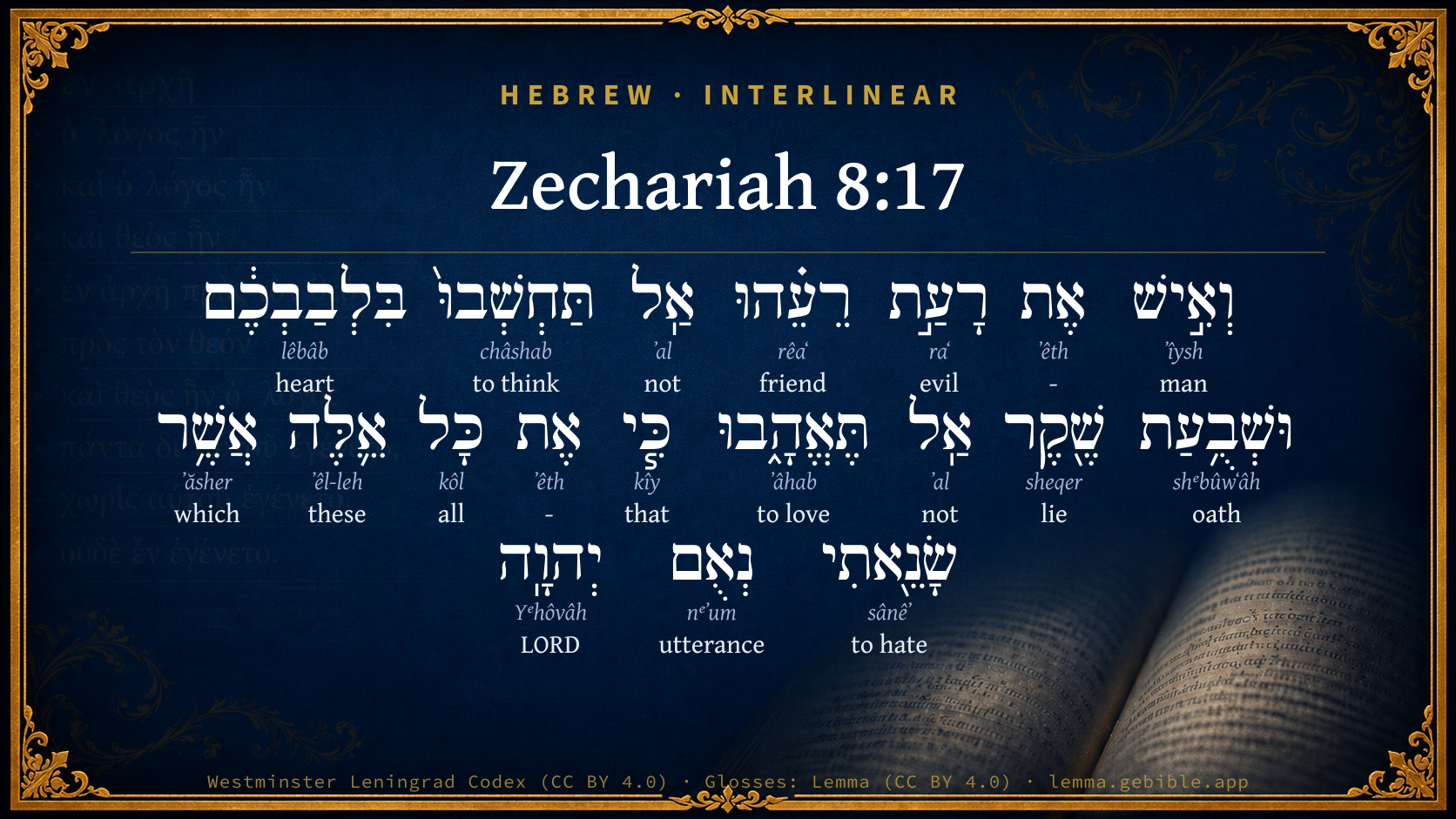
Hebrew (Westminster Leningrad Codex) Zechariah 8:17 appears in the Hebrew Old Testament. The text above is from the Westminster Leningrad Codex. Each word links to its Strong’s number, a concise gloss, and parsing drawn from the Open Scriptures Hebrew Bible morphology. Click any word for its full Brown-Driver-Briggs (BDB) entry.
Download image
Cite this verse

Zechariah 8:17 (World English Bible). Public Domain. Lemma interlinear Bible study tool, https://lemma.gebible.app/v/zechariah/8/17.

Show BibTeX & RIS
BibTeX
RIS
English Translation
and let none of you devise evil in your hearts against his neighbor, and love no false oath: for all these are things that I hate," says Yahweh.
World English Bible · Public Domain
Download a study sheet

One document with this verse’s original text, its word-by-word gloss line, the meaning frame, cross-references with their text, attributed commentary, and full source and license credits — printable, and it pastes into notes with its structure intact.

This verse Autodidact and up

Study sheet (.html) Plain text (.txt)

A passage Seminary Student

Up to 50 verses in one chapter. A passage sheet keeps up to 6 commentary sources and 12 cross-references per verse, in the order this page ranks them, and says so on the sheet whenever that leaves anything out. Ask for a single verse and you get the Autodidact verse sheet above.

Everything on this page stays free to read, with no account — the sheet is a download of what is already on screen, not access to it.

Want to remove ads? Support Godless Engineer
Compare translations 3

The same verse in 3 English versions, stacked beneath the original-language interlinear above. Click any original word for its lexicon entry.

Each is an independent rendering of the whole verse — the interlinear is not word-aligned to these translations.

Highlighted words mark where these versions differ — a whole-verse word diff, not a word-by-word alignment.

  • World English Bible Public Domain
    and let none of you devise evil in your hearts against his neighbor, and love no false oath: for all these are things that I hate," says Yahweh.
  • King James Version Public Domain
    And let none of you imagine evil in your hearts against his neighbour; and love no false oath: for all these are things that I hate, saith the LORD.
  • unfoldingWord Literal Text CC BY-SA 4.0
    Do not plan to do evil within your heart against one another, and do not love false oaths—for these are the things I hate!—this is Yahweh’s declaration.”

unfoldingWord Literal Text — © unfoldingWord, licensed CC BY-SA 4.0. Word-aligned USFM3 via Door43 (git.door43.org/unfoldingWord/en_ult).

Versions to compare (up to 4)

3 of 4 selected

Show all 18 translations

Every available English version of this verse, each an independent rendering of the whole verse.

  • World English Bible Public Domain
    and let none of you devise evil in your hearts against his neighbor, and love no false oath: for all these are things that I hate," says Yahweh.
  • Berean Standard Bible Public Domain
    do not plot evil in your hearts against your neighbor, and do not love to swear falsely, for I hate all these things,” declares the LORD.
  • Majority Standard Bible Public Domain
    do not plot evil in your hearts against your neighbor, and do not love to swear falsely, for I hate all these things,” declares the LORD.
  • King James Version Public Domain
    And let none of you imagine evil in your hearts against his neighbour; and love no false oath: for all these are things that I hate, saith the LORD.
  • American Standard Version (1901) Public Domain
    and let none of you devise evil in your hearts against his neighbor; and love no false oath: for all these are things that I hate, saith Jehovah.
  • Revised Version (1885) Public Domain
    and let none of you imagine evil in your hearts against his neighbour; and love no false oath: for all these are things that I hate, saith the LORD.
  • Geneva Bible (1599) Public Domain
    And let none of you imagine euill in your hearts against his neighbour, and loue no false othe: for all these are the things that I hate, saith the Lord.
  • Douay-Rheims (1899) Public Domain
    And let none of you imagine evil in your hearts against his friend: and love not a false oath: for all these are the things that I hate, saith the Lord.
  • Young's Literal Translation Public Domain
    And each the evil of his neighbour ye do not devise in your heart, And a false oath ye do not love, For all these `are' things that I have hated, An affirmation of Jehovah.'
  • Literal Standard Version CC BY-SA 4.0
    And do not devise the evil of his neighbor in your heart, || And do not love a false oath, || For all these [are] things that I have hated, || A declaration of YHWH.”
  • Unlocked Literal Bible CC BY-SA 4.0
    Do not plan to do evil within your heart against one another, and do not love false oaths—for these are the things I hate!—this is Yahweh's declaration.”
  • unfoldingWord Literal Text CC BY-SA 4.0
    Do not plan to do evil within your heart against one another, and do not love false oaths—for these are the things I hate!—this is Yahweh’s declaration.”
  • Darby Bible Public Domain
    and let none of you imagine evil in your hearts against his neighbour; and love no false oath: for all these are [things] that I hate, saith Jehovah.
  • World Messianic Bible Public Domain
    and let none of you devise evil in your hearts against his neighbor, and love no false oath; for all these are things that I hate,” says the LORD.
  • Webster's Bible Public Domain
    And let none of you imagine evil in your hearts against his neighbor; and love no false oath: for all these are things that I hate, saith the LORD.
  • Free Bible Version CC BY-SA 4.0
    Don't think up evil schemes against one another. Stop your love of lies. I hate all this, declares the Lord.
  • Bible in Basic English Public Domain
    Let no one have any evil thought in his heart against his neighbour; and have no love for false oaths: for all these things are hated by me, says the Lord.
  • JPS Tanakh (1917) Public Domain
    and let none of you devise evil in your hearts against his neighbour; and love no false oath; for all these are things that I hate, saith the LORD.'

Literal Standard Version (2020), Covenant Press — licensed CC BY-SA 4.0. Text via the HelloAO Bible API (eBible.org). Unlocked Literal Bible (unfoldingWord) — licensed CC BY-SA 4.0. Text via the HelloAO Bible API (eBible.org). unfoldingWord Literal Text — © unfoldingWord, licensed CC BY-SA 4.0. Word-aligned USFM3 via Door43 (git.door43.org/unfoldingWord/en_ult). Free Bible Version, Dr. Jonathan Gallagher — licensed CC BY-SA 4.0. Text via the HelloAO Bible API (eBible.org).

Word by word

More ways to search: Search by grammar → Find every occurrence → Compare this word →

Practice this passage: Drill this verse → Learn its vocabulary →

וּשְׁבֻ֥עַת
shᵉbûwʻâh
H7621
“and · oath of”
Conjunction + Noun, Common, Feminine, Singular, Construct
Part of Speech
Conjunction + Noun
Type
Common
Gender
Feminine
Number
Singular
State
Construct
Full BDB Definition

Origin: pass part of H7650

TWOT: 2319a

oath, curse - oath - attesting of innocence - curse - oath (of Jehovah)
  1. וְאִ֣ישׁ ʼîysh H376 “and · man” Conjunction + Noun, Common, Masculine, Singular, Absolute
  2. אֶת ʼêth H853 “-” Particle, Direct Object
  3. רָעַ֣ת raʻ H7451 “evil of” Noun, Common, Feminine, Singular, Construct
  4. רֵעֵ֗הוּ rêaʻ H7453 “friend · his” Noun, Common, Masculine, Singular, Construct + Suffix, Personal, 3rd Person, Masculine, Singular
  5. אַֽל ʼal H408 “not” Particle, Negative
  6. תַּחְשְׁבוּ֙ châshab H2803 “to think” Verb, Qal, Jussive, 2nd Person, Masculine, Plural
  7. בִּלְבַבְכֶ֔ם lêbâb H3824 “in/at · heart · your” Preposition + Noun, Common, Masculine, Singular, Construct + Suffix, Personal, 2nd Person, Masculine, Plural
  8. שֶׁ֖קֶר sheqer H8267 “lie” Noun, Common, Masculine, Singular, Absolute
  9. אַֽל ʼal H408 “not” Particle, Negative
  10. תֶּאֱהָ֑בוּ ʼâhab H157 “to love” Verb, Qal, Jussive, 2nd Person, Masculine, Plural
  11. כִּ֧י kîy H3588 “that” Conjunction
  12. אֶת ʼêth H853 “-” Particle, Direct Object
  13. כָּל kôl H3605 “all of” Noun, Common, Masculine, Singular, Construct
  14. אֵ֛לֶּה ʼêl-leh H428 “these” Pronoun, Demonstrative, Common, Plural
  15. אֲשֶׁ֥ר ʼăsher H834 “which” Particle, Relative
  16. שָׂנֵ֖אתִי sânêʼ H8130 “to hate” Verb, Qal, Perfect, 1st Person, Common, Singular
  17. נְאֻם nᵉʼum H5002 “utterance of” Noun, Common, Masculine, Singular, Construct
  18. יְהוָֽה Yᵉhôvâh H3068 “LORD” Noun, Proper

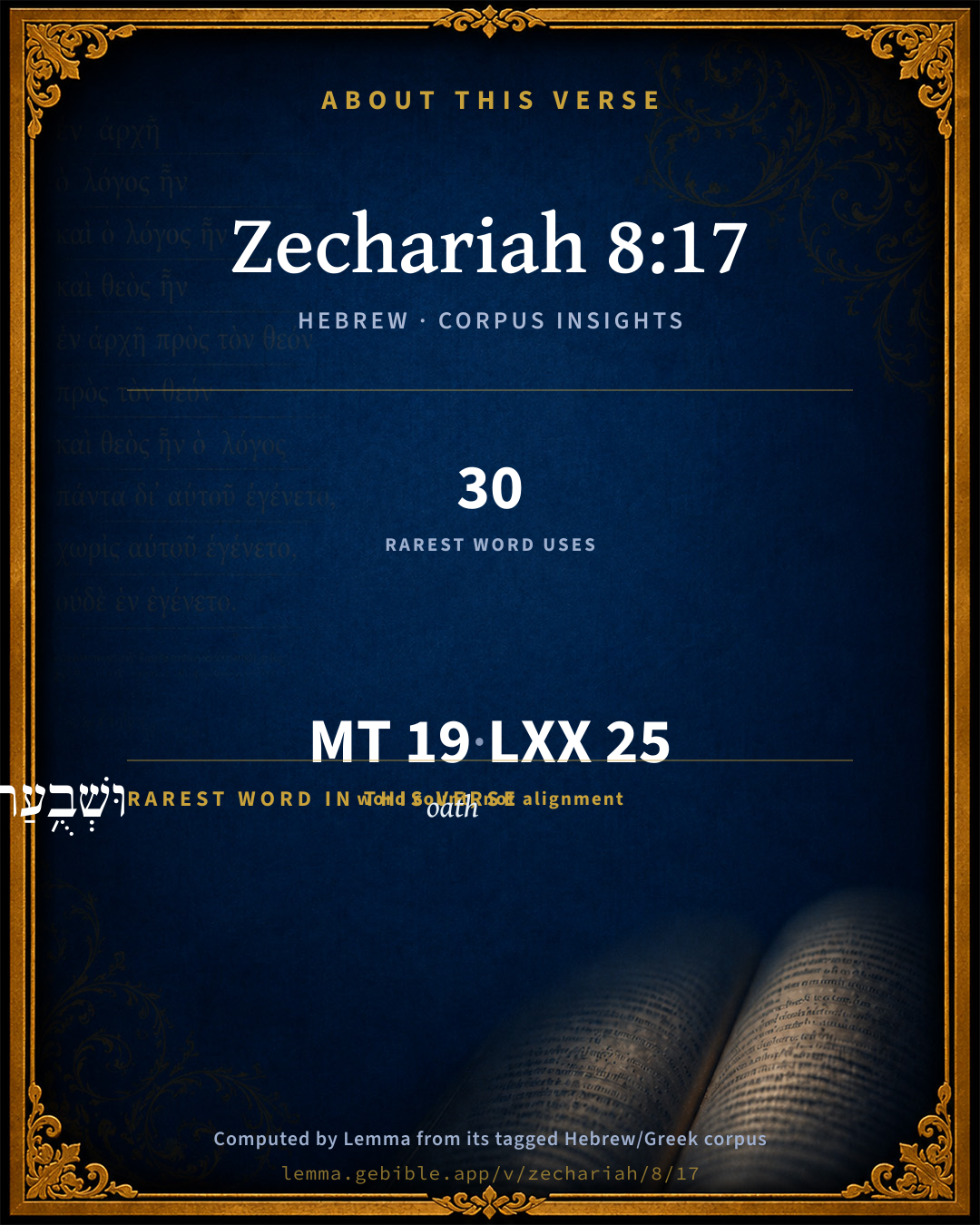
About this verse

These counts appear in no published source. They are computed here, from the morphology-tagged text and Lemma’s own curated glosses. What Lemma adds →

19
words
17
distinct lemmas
Prophets
section

Shared distinctive vocabulary

וּשְׁבֻ֥עַת oath H7621 occurs in 29 verses of the Hebrew Bible. Also found in:

Grammatical profile

  • 3 verbs
  • 9 nouns
  • 1 pronoun
  • 1 conjunction
  • 5 particles

Verb forms

  • תַּחְשְׁבוּ֙ Qal · Jussive
  • תֶּאֱהָ֑בוּ Qal · Jussive
  • שָׂנֵ֖אתִי Qal · Perfect

Repetition

A word recurs within this verse — often emphatic in Hebrew:

  • אַֽל not H408 ×2

Hebrew & Septuagint length

In English translation the verse runs 28 words from the Hebrew and 29 from the Septuagint (LXX English) — closely comparable.

A rough comparison of the two English renderings, which tokenize alike — not a word-level alignment.

Word counts can differ between the Hebrew and the Greek without any difference in meaning — e.g. the Hebrew direct-object marker אֵת has no separate Greek word, and Greek often adds the article ὁ.

In the original languages it is 19 Hebrew tokens and 25 Greek tokens — but the two are counted differently (Hebrew bundles its prefixes and suffixes into one token; the Greek is in lemma form), so that isn’t a like-for-like length.

Cross-references

17

Topical passages linked to Zechariah 8:17 in the Treasury of Scripture Knowledge — connected by theme and wording, ordered by reader-vote popularity; previews shown in the World English Bible.

  • Proverbs 6:16–19 There are six things which Yahweh hates; Yes, seven which are an abomination to him:
  • Psalms 5:5–6 The arrogant shall not stand in your sight. You hate all workers of iniquity.
  • Psalms 10:3 For the wicked boasts of his heart's cravings, He blesses the greedy, and condemns Yahweh.
  • Proverbs 3:29 Don't devise evil against your neighbor, Seeing he dwells securely by you.
  • Jeremiah 4:14 Jerusalem, wash your heart from wickedness, that you may be saved. How long shall your evil thoughts lodge within you?
  • Jeremiah 44:4 However I sent to you all my servants the prophets, rising up early and sending them, saying, Oh, don't do this abominable thing that I hate.
  • Micah 2:1–3 Woe to those who devise iniquity And work evil on their beds! When the morning is light, they practice it, Because it is in the power of their hand.
  • Habakkuk 1:13 You who have purer eyes than to see evil, and who cannot look on perversity, why do you tolerate those who deal treacherously, and keep silent when the wicked swallows up the man who is more righteous than he,
  • Malachi 3:5 I will come near to you to judgment; and I will be a swift witness against the sorcerers, and against the adulterers, and against the perjurers, and against those who oppress the hireling in his wages, the widow, and the fatherless, and who deprive the foreigner of justice, and don't fear me," says Yahweh of Hosts.
  • Proverbs 6:14 In whose heart is perverseness, Who devises evil continually, Who always sows discord.
  • Proverbs 8:13 The fear of Yahweh is to hate evil. I hate pride, arrogance, the evil way, and the perverse mouth.
  • Jeremiah 4:2 and you shall swear, As Yahweh lives, in truth, in justice, and in righteousness; and the nations shall bless themselves in him, and in him shall they glory.
  • Zechariah 5:3–4 Then he said to me, "This is the curse that goes out over the surface of the whole land; for everyone who steals shall be cut off according to it on the one side; and everyone who swears falsely shall be cut off according to it on the other side.
  • Zechariah 7:10 Don't oppress the widow, nor the fatherless, the foreigner, nor the poor; and let none of you devise evil against his brother in your heart.'
  • Matthew 5:28 but I tell you that everyone who gazes at a woman to lust after her has committed adultery with her already in his heart.
  • Matthew 12:35 The good man out of his good treasure brings out good things, and the evil man out of his evil treasure brings out evil things.
  • Matthew 15:19 For out of the heart come forth evil thoughts, murders, adulteries, sexual sins, thefts, false testimony, and blasphemies.

Cross-references courtesy of OpenBible.info (CC BY 4.0).

Hebrew and Greek witnesses Masoretic Hebrew ↔ Greek Septuagint

The same verse in the two great witnesses to the Old Testament, shown verse-for-verse.

These are two independent witnesses, not word-aligned to each other, and the Septuagint is shown in lemma (dictionary) form.

Hebrew Zechariah 8:17 Masoretic · Westminster Leningrad Codex

וְאִ֣ישׁ אֶת רָעַ֣ת רֵעֵ֗הוּ אַֽל תַּחְשְׁבוּ֙ בִּלְבַבְכֶ֔ם וּשְׁבֻ֥עַת שֶׁ֖קֶר אַֽל תֶּאֱהָ֑בוּ כִּ֧י אֶת כָּל אֵ֛לֶּה אֲשֶׁ֥ר שָׂנֵ֖אתִי נְאֻם יְהוָֽה

and let none of you devise evil in your hearts against his neighbor, and love no false oath: for all these are things that I hate," says Yahweh.

World English Bible · Public Domain

Greek LXX Zechariah 8:17 Septuagint · lemma form

καί ἕκαστος ὁ κακία ὁ πλησίον αὐτός μή λογίζομαι ἐν ὁ καρδία σύ καί ὅρκος ψευδής μή ἀγαπάω διότι οὗτος πᾶς μισέω λέγω κύριος παντοκράτωρ

and let none of you devise evil in his heart against his neighbor; and love not a false oath: for all these things I hate, says the Lord Almighty.

LXX2012 (modern English Septuagint) · Public Domain

Hebrew: Westminster Leningrad Codex (CC BY 4.0). Greek: Septuagint (public domain); English from LXX2012 (modern English Septuagint) (Public Domain). How the Septuagint differs from the Hebrew →

Targum (Aramaic paraphrase)

1

The Targum is the ancient Jewish Aramaic paraphrase of the Hebrew Scriptures — an interpretive translation, not the Hebrew text itself. Onkelos (literal) and Pseudo-Jonathan (expansive) render the Torah, and Jonathan the Prophets. Coverage is partial: where no permissively-licensed English translation exists for a verse, only the Aramaic is shown. This is verse-level text, not a word-by-word alignment to the Hebrew.

  1. Targum Jonathan Prophets (Joshua–Malachi)
    וּגְבַר יַת בִּישַׁת חַבְרֵיהּ לָא תַחְשְׁבוּן בְּלִבְּכוֹן וּשְׁבוּעָתָא דְשִׁקְרָא לָא תְרַחֲמוּן אֲרֵי יַת כָּל אִלֵין דִי רְחִיקַת אֲמַר יְיָ:

    (no public-domain English translation for this verse)

    Targum Jonathan — Aramaic: “Mikraot Gedolot” (public domain). English: “Sefaria Community Translation” (CC0 1.0 (public-domain dedication)); “London "Chaldee Paraphrase," 1871” (public domain). Text via Sefaria.

Commentary

Notes on Zechariah 8:17 from classic Christian and Jewish commentators (each source and its license shown beneath its notes). The classic Christian expositions comment on the surrounding passage and are grouped to its opening verse, so a note may address several verses; the Jewish commentaries on the Tanakh (Rashi and others) are per-verse, so they appear only where the commentator wrote on this verse.

Lemma curates 59 commentaries, every one of them public domain or Creative Commons licensed, each selected and text-cleaned for this edition rather than reprinted as found. About our sources →

Trapp's Complete Commentary

John Trapp

Zec 8:17 And let none of you imagine evil in your hearts against his neighbour; and love no false oath: for all these [are things] that I hate, saith the LORD.

Ver. 17. And let none of you imagine evil in your hearts] {See Trapp on "Zec 7:10"} Take notice here, that as conversing with evil imaginations and inward lusts proves one to be carnal, Eph 2:3, so the law is spiritual, Rom 7:14, and takes hold of the root of bitterness, Deu 29:18, lie it never so low and close covered. There is something in it, that men are here forbidden to imagine evil (in their hearts). This particle, in their hearts, may seem superfluous; but it holds forth, that for the most secret sins that lie couched in the bottom of the heart, in the hidden man of the heart, and never show themselves to the world, men shall be accountable: see Heb 4:12 Ecc 12:14 Jer 6:19 Rev 2:23. The very want of good thoughts is a sin against that first and great commandment, Mar 12:30, and concupiscence, even before it come to consent, is a sin against the last commandment, Rom 7:7. But evil thoughts allowed and wallowed in is a fiat breach of every commandment; so vain is their plea that say, Thought is free, and do thereupon lay the reins on the neck, and run riot in vain and vile imaginations. O Jerusalem, wash thy heart from wickedness, if thou meanest to be saved, Jer 4:14. How many, alas, have we that profess large hopes of heaven, whose hearts are no better than dens of darkness, dungeons of filthiness, cages of unclean birds, brothel houses, slaughter houses, pesthouses of malicious motions, devilish deceits, atheistical, proud, covetous, malicious, and fraudulent projects, which they are continually hammering, and wherewith their wretched hearts are day and night haunted and pestered! Contrariwise, a godly man is said to have right thoughts, Pro 12:5, holy imaginations, Pro 12:20, and that his desires are only good, Pro 11:23; or, if worse crowd in (as they will), he rids them out again, and will not let them lodge there, Jer 4:14, he boils out that filthy scum, Eze 24:6, and purifieth himself of all pollutions of flesh and spirit, 2Co 7:1; he both hateth them, Psa 119:113, and forsaketh them, Isa 55:7.

And love no false oath] As not only he that maketh a lie is shut out of heaven, but he that loves it (though made by another), takes it up and divulgeth it, Rev 22:15. So not only he that taketh a false oath, but he that persuadeth another to it, or that abhorreth it not in whomsoever (for here is a meiosis, less is spoken, and more understood), is the object of God’s just hatred.

For all these are things that I hate, saith the Lord] And as the next effect of hatred is revenge, he will not fail to punish such sinners against their own souls.

John Trapp, A Commentary or Exposition upon All the Books of the Old and New Testament (1647–1656) — public domain. Text from a community e-Sword module.

Tyndale Open Study Notes

Tyndale Open Resources

8:17 In Zechariah’s time, the people of Judah were guilty of the same sins that brought about the Babylonian exile. Such behavior put God’s plans for restoration in jeopardy (see 7:8-10; 8:16). • I hate all these things: God’s hatred of evil (Ps 5:5; Prov 6:16-19) stems from his absolute holiness (Pss 5:4; 15:1; 24:3).

Tyndale Open Study Notes — © Tyndale Open Resources, licensed CC BY-SA 4.0. Text via the HelloAO Bible API.

Jamieson, Fausset & Brown

Robert Jamieson, A. R. Fausset & David Brown

all these . . . I hate--therefore ye too ought to hate them. Religion consists in conformity to God's nature, that we should love what God loves and hate what God hates.

Jamieson, Fausset & Brown — Commentary Critical and Explanatory on the Whole Bible (1871) — public domain (CC PDM 1.0). Text via the HelloAO Bible API.

John Calvin's Commentaries

He afterwards adds, And think not evil every one against his friend. Here the Prophet not only condemns open wrongs, but also the hidden purposes of evil. We hence learn, that the law was not only given to restrain men as it were by a bridle, and that it not only contains a rule of life as to outward duties, but that it also rules their hearts before God and angels. The law is indeed really spiritual; and extremely gross and foolish are they who think that they satisfy the law of Moses, when they abstain from murder and theft and other evil deeds; for we see that the Prophets everywhere required a right feeling in the hearts as Zechariah does in this place, who reminds the Jews, that they were not to devise evil against their friends, no, not in their hearts. He might have omitted the last words; but he meant to condemn those frauds which were wont to be covered by many and various disguises. Though then men may not bring forth their wickedness, yet Zechariah shows that God will punish it; for whatever dwells within, however concealed it may be from the eyes of men, however hidden it may be in the depth of the heart, it must yet come to an account before God.

He adds another kind of evil, even perjury, And love not the oath of falsehood. He might have said, swear not to the injury of thy neighbor; but there is to be observed here a contrast between the perverted love of men and the hatred of God. As then God hates a false oath as all other frauds and falsehoods, so he forbids us to desire it: for if we wish to please God, we must see what he requires from us, inasmuch as we designedly provoke his wrath when we desire or covet what he declares that he hates. In a word, Zechariah shows that God would be propitious and kind to the Jews, provided they truly and from the heart repented, and attended to what was right and just — not only to build the temple, to offer sacrifices, and to observe other rites, but also to form their life according to what integrity required; to labor not only by external acts to discharge their duties towards their neighbors; but also to cleanse their hearts from all hatred, all cruelty, and all depraved affections. It now follows —

John Calvin's Commentaries (1540-1563) — public domain. Text from the Calvin Translation Society English edition (1840s-50s) via the Christian Classics Ethereal Library (ccel.org). Calvin's coverage is partial (roughly two-thirds of the Bible); uncommented books and verses are honest gaps, never fabricated. The 19th-century editor's footnotes and remarks are omitted so the notes are faithfully Calvin's own voice.

John Gill's Exposition

And the word of the Lord of hosts came unto me, saying. The word of prophecy, as the Targum paraphrases it: here begins a new prophecy, respecting the abrogation of Jewish fasts, and the calling of the Gentiles.

And the word of the Lord of hosts came unto me, saying. The word of prophecy, as the Targum paraphrases it: here begins a new prophecy, respecting the abrogation of Jewish fasts, and the calling of the Gentiles.

Zechariah 8:19

zac 8:19

zac 8:19

zac 8:19Thus saith the Lord of hosts,.... What follows is a full answer to the question in Zac 7:3,

The fast of the fourth month; the month Tammuz, which answers to June: this fast was kept on the ninth day of the month, on account of the city of Jerusalem being broken up on that day (o), as it is said, Kg2 25:3 though Kimchi says this was on the seventeenth day of that month, as also says the Misna (p); on which day a fast was kept likewise, for the breaking of the two tables of the law on that day: the reconciliation of this with the above Scriptures is attempted in the Talmud (q) by observing, that the Scripture speaks of the first temple, the Misna of the second temple:

and the fast of the fifth; the month Ab, which answers to July, on the tenth of which the city was burnt, Jer 52:12 but the fast on account of it was kept on the ninth day; See Gill on Zac 7:3 on which day the Jews say that both the first and second temple were destroyed, Bither was taken, and the city ploughed (r):

and the fast of the seventh; the month Tisri, which answers to September; on the third of this month a fast was kept on account of the murder of Gedaliah; see Zac 7:5 and on the tenth day of the same was the day of atonement, which was the grand fast; see Act 27:9,

and the fast of the tenth; the month Tebet; which answers to December, on the tenth day of which the city of Jerusalem was besieged by Nebuchadnezzar; and this fast was kept on that account, Jer 52:4 now of all these fasts the Lord by the prophet says, they

shall be to the house of Judah joy and gladness, and cheerful feasts; that is, there shall be no occasion for them; but, on the contrary, such plenty of good things, both temporal and spiritual, shall be had, that, instead of them, rather festivals should be kept with the greatest cheerfulness, joy, and gladness. So Maimonides (s) says, that all these fasts shall cease in the times of the Messiah, with all others, which will be times of joy and gladness.

Therefore love the truth and peace; love to speak truth, and execute the judgment of peace, Zac 8:16 or express by words and deeds love to Christ, who is the way, the truth, and the life; and also is our Peace, the Peacemaker, and Peace giver; and on these accounts, as well as on others, is greatly to be loved: likewise the Gospel, which is the word of truth, and the Gospel of peace; which contains nothing but truth, and is the ministry of reconciliation, and is to be loved on that account; and even peace with men is no further to be loved and sought after than as it is consistent with truth; and these being the principal things under the Gospel dispensation, these, and not fasts, or any other ceremonial observances, are to be attended to.

(o) T. Bab. Roshhashanah, fol. 18. 2. (p) Taanith, c. 4. sect. 7. (q) T. Bab. Taanith, fol. 28. 2. (r) Roshhashanah, ut supra. (fol. 18. 2.) (s) Hilchot Taanioth, c. 5. sect. 19.

John Gill's Exposition of the Whole Bible (1746–1763) — public domain (CC PDM 1.0). Text via the HelloAO Bible API.

Albert Barnes' Notes on the Bible

For all these things do I hate - Literally, emphatic, “For they are all these things which I hate.” This is the sum of what I hate; for they comprise in brief the breaches of the two tables, the love of God and of man.

Albert Barnes' Notes on the Bible (1834–1885) — public domain. Text from a community e-Sword/MySword module.

Haydock's Catholic Bible Commentary

Friend means every neighbour, or all mankind, Luke x. 27, 36. Even thoughts must be guarded. (Calmet)

George Leo Haydock (1774–1849), Haydock's Catholic Family Bible and Commentary, 1859 edition — public domain. Excludes Psalms (Douay-Rheims chapter numbering differs from Protestant) and Deuterocanonical books (Catholic canon only).

Matthew Poole's English Annotations

Let none of you imagine evil in your hearts against his neighbour: see Zec 7:10.

Love no false oath: see Zec 5:4; you that must not lie to a man, must not swear to a lie before God, Psa 15:4; Eze 17:18,19.

For all these are things that I hate; so that I cannot be reconciled to them; so that I must not, will not let them go unpunished. If your will be blest as I promise, look you do as I prescribe. This is reason enough why you should not do them.

Matthew Poole's English Annotations on the Holy Bible (1683–1685) — public domain. Text from a community e-Sword/MySword module.

The Pulpit Commentary

Let none of you imagine. (see note on Zec_7:10, where these words occur) Love no false oath. The prevalent sins at this time were not idolatry, but cheating and lying and injustice, vices learned in the land of exile, where they had turned their energies to traffic and commerce. (see Zec_5:2-4, and note on ver. 3 there)

The Pulpit Commentary (1880–1919), ed. H.D.M. Spence-Jones & Joseph S. Exell — public domain. Text from a community e-Sword module.

Rashi

Rabbi Shlomo Yitzchaki (Rashi)

And let no one think evil of his neighbors He warned them concerning hatred without cause, which brought about the destruction of the Second Temple.

Rashi on the Tanakh — English translations: “The Judaica Press complete Tanach with Rashi, translated by A. J. Rosenberg” (CC BY 4.0); “Pentateuch with Rashi's commentary by M. Rosenbaum and A.M. Silbermann, 1929-1934” (public domain); “The Metsudah Tanach series, Lakewood, N.J” (CC BY 4.0); and “The Book of Joshua, Metsudah Publications, 1997” (CC BY 4.0). Text via Sefaria.

Lesson kit

Teaching starters — assembled from the data on this page, not authored interpretation. Every prompt links to the verse data it draws on. Edit before teaching.

Zechariah, in the Prophets, opens this verse with 19 words (17 distinct Hebrew lemmas). Its most distinctive word is shᵉbûwʻâh (“oath”). A historical commentator’s framing appears above. Read the whole chapter for the surrounding context.

Discussion questions

  1. The word shᵉbûwʻâh carries the sense “oath.” How does it shape the verse?
  2. How does Genesis 24:8, which shares the word «oath», read alongside this verse?
  3. What does the repetition of “not” (2× in this one verse) do in this verse?
  4. These translations render this verse differently; the difference is in the English rendering, not the original. What questions does that raise?
  5. «תַּחְשְׁבוּ֙» is a Qal Jussive verb. How does that grammatical form shape the action described?
  6. Compare how Trapp's Complete Commentary and Tyndale Open Study Notes read this verse. Where do they agree or differ?

Things to notice

Reading settings

Reading text

Shown beneath each verse's original-language words.

Old Testament
Old Testament edition

Read the OT as the Masoretic Hebrew (MT) or the Greek Septuagint (LXX).

English shown for the Greek Septuagint (in the Hebrew ↔ Greek comparison).

Comparing translations? Open the Compare panel on any verse page to stack up to four side by side.