

Psalms 109:17

Hebrew (Westminster Leningrad Codex) Psalms 109:17 appears in the Hebrew Old Testament. The text above is from the Westminster Leningrad Codex. Each word links to its Strong’s number, a concise gloss, and parsing drawn from the Open Scriptures Hebrew Bible morphology. Click any word for its full Brown-Driver-Briggs (BDB) entry.
Download image
Cite this verse

Psalms 109:17 (World English Bible). Public Domain. Lemma interlinear Bible study tool, https://lemma.gebible.app/v/psalms/109/17.

Show BibTeX & RIS
BibTeX
RIS
English Translation
Yes, he loved cursing, and it came to him. He didn't delight in blessing, and it was far from him.
World English Bible · Public Domain
Download a study sheet

One document with this verse’s original text, its word-by-word gloss line, the meaning frame, cross-references with their text, attributed commentary, and full source and license credits — printable, and it pastes into notes with its structure intact.

This verse Autodidact and up

Study sheet (.html) Plain text (.txt)

A passage Seminary Student

Up to 50 verses in one chapter. A passage sheet keeps up to 6 commentary sources and 12 cross-references per verse, in the order this page ranks them, and says so on the sheet whenever that leaves anything out. Ask for a single verse and you get the Autodidact verse sheet above.

Everything on this page stays free to read, with no account — the sheet is a download of what is already on screen, not access to it.

Want to remove ads? Support Godless Engineer
Compare translations 3

The same verse in 3 English versions, stacked beneath the original-language interlinear above. Click any original word for its lexicon entry.

Each is an independent rendering of the whole verse — the interlinear is not word-aligned to these translations.

Highlighted words mark where these versions differ — a whole-verse word diff, not a word-by-word alignment.

  • World English Bible Public Domain
    Yes, he loved cursing, and it came to him. He didn't delight in blessing, and it was far from him.
  • King James Version Public Domain
    As he loved cursing, so let it come unto him: as he delighted not in blessing, so let it be far from him.
  • unfoldingWord Literal Text CC BY-SA 4.0
    And he loved cursing, and it came to him, and he did not delight in blessing, and it was far from him.

unfoldingWord Literal Text — © unfoldingWord, licensed CC BY-SA 4.0. Word-aligned USFM3 via Door43 (git.door43.org/unfoldingWord/en_ult).

Versions to compare (up to 4)

3 of 4 selected

Show all 18 translations

Every available English version of this verse, each an independent rendering of the whole verse.

  • World English Bible Public Domain
    Yes, he loved cursing, and it came to him. He didn't delight in blessing, and it was far from him.
  • Berean Standard Bible Public Domain
    The cursing that he loved, may it fall on him; the blessing in which he refused to delight, may it be far from him.
  • Majority Standard Bible Public Domain
    The cursing that he loved, may it fall on him; the blessing in which he refused to delight, may it be far from him.
  • King James Version Public Domain
    As he loved cursing, so let it come unto him: as he delighted not in blessing, so let it be far from him.
  • American Standard Version (1901) Public Domain
    Yea, he loved cursing, and it came unto him; And he delighted not in blessing, and it was far from him.
  • Revised Version (1885) Public Domain
    Yea, he loved cursing, and it came unto him; and he delighted not in blessing, and it was far from him.
  • Geneva Bible (1599) Public Domain
    As he loued cursing, so shall it come vnto him, and as he loued not blessing, so shall it be farre from him.
  • Douay-Rheims (1899) Public Domain
    But persecuted the poor man and the beggar; and the broken in heart, to put him to death.
  • Young's Literal Translation Public Domain
    And he loveth reviling, and it meeteth him, And he hath not delighted in blessing, And it is far from him.
  • Literal Standard Version CC BY-SA 4.0
    And he loves reviling, and it meets him, || And he has not delighted in blessing, || And it is far from him.
  • Unlocked Literal Bible CC BY-SA 4.0
    He loved cursing; may it come back upon him. He hated blessing; may no blessing come to him.
  • unfoldingWord Literal Text CC BY-SA 4.0
    And he loved cursing, and it came to him, and he did not delight in blessing, and it was far from him.
  • Darby Bible Public Domain
    And he loved cursing; so let it come unto him. And he delighted not in blessing; and let it be far from him.
  • World Messianic Bible Public Domain
    Yes, he loved cursing, and it came to him. He didn’t delight in blessing, and it was far from him.
  • Webster's Bible Public Domain
    As he loved cursing, so let it come to him: as he delighted not in blessing, so let it be far from him.
  • Free Bible Version CC BY-SA 4.0
    He loved to put a curse on others—let it come back on him. He had no time for blessings—so may he never receive any.
  • Bible in Basic English Public Domain
    As he took pleasure in cursing, so let it come on him; and as he had no delight in blessing, let it be far from him.
  • JPS Tanakh (1917) Public Domain
    Yea, he loved cursing, and it came unto him; and he delighted not in blessing, and it is far from him.

Literal Standard Version (2020), Covenant Press — licensed CC BY-SA 4.0. Text via the HelloAO Bible API (eBible.org). Unlocked Literal Bible (unfoldingWord) — licensed CC BY-SA 4.0. Text via the HelloAO Bible API (eBible.org). unfoldingWord Literal Text — © unfoldingWord, licensed CC BY-SA 4.0. Word-aligned USFM3 via Door43 (git.door43.org/unfoldingWord/en_ult). Free Bible Version, Dr. Jonathan Gallagher — licensed CC BY-SA 4.0. Text via the HelloAO Bible API (eBible.org).

Word by word

More ways to search: Search by grammar → Find every occurrence → Compare this word →

Practice this passage: Drill this verse → Learn its vocabulary →

About this verse

These counts appear in no published source. They are computed here, from the morphology-tagged text and Lemma’s own curated glosses. What Lemma adds →

8
words
8
distinct lemmas
Wisdom
section

Shared distinctive vocabulary

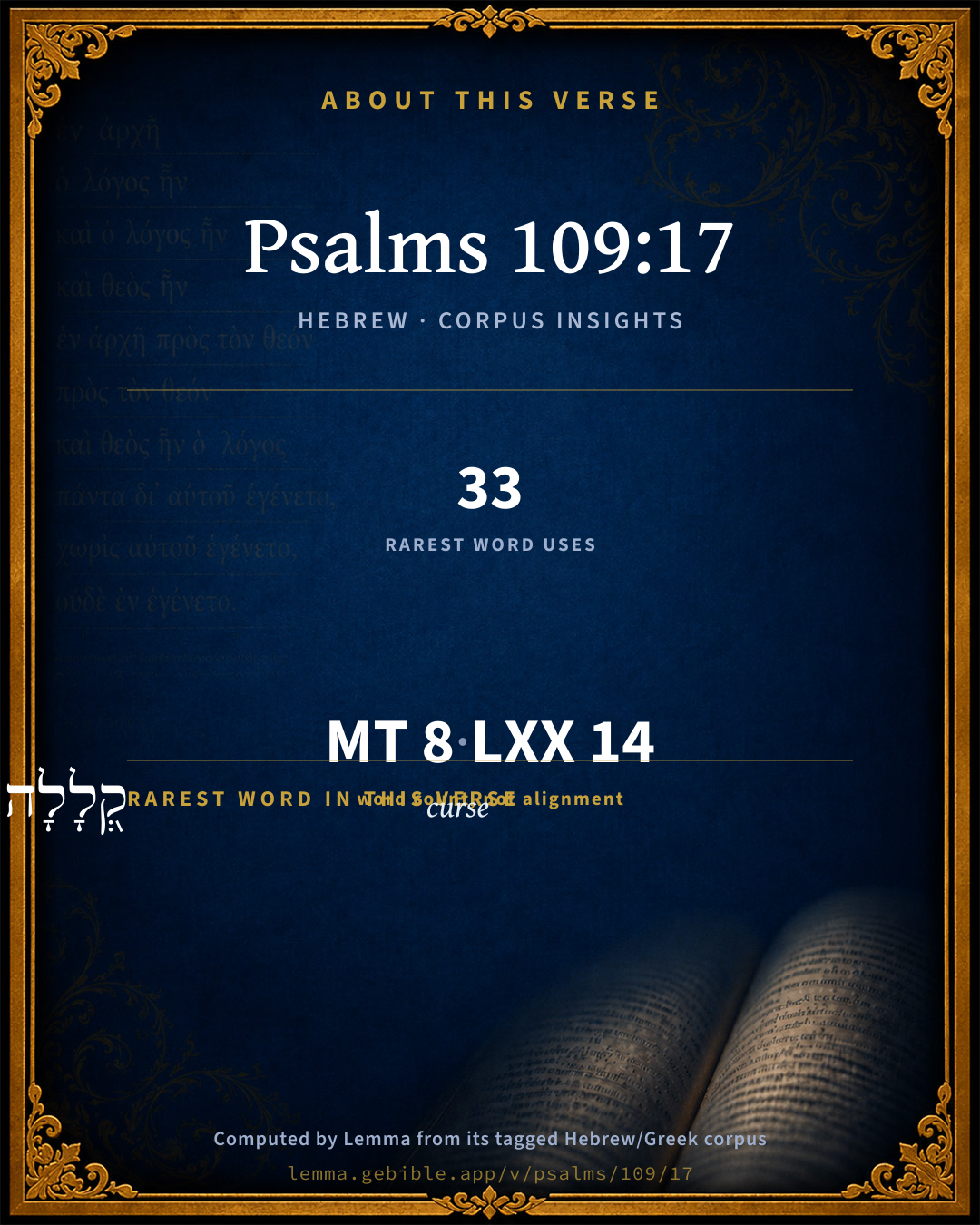
קְ֭לָלָה curse H7045 occurs in 33 verses of the Hebrew Bible. Also found in:

Grammatical profile

  • 4 verbs
  • 2 nouns
  • 1 preposition
  • 1 particle

Verb forms

  • וַיֶּאֱהַ֣ב Qal · Sequential Imperfect
  • וַתְּבוֹאֵ֑הוּ Qal · Sequential Imperfect
  • חָפֵ֥ץ Qal · Perfect
  • וַתִּרְחַ֥ק Qal · Sequential Imperfect

Hebrew & Septuagint length

In English translation the verse runs 20 words from the Hebrew and 25 from the Septuagint (LXX English) — closely comparable.

A rough comparison of the two English renderings, which tokenize alike — not a word-level alignment.

Word counts can differ between the Hebrew and the Greek without any difference in meaning — e.g. the Hebrew direct-object marker אֵת has no separate Greek word, and Greek often adds the article ὁ.

In the original languages it is 8 Hebrew tokens and 14 Greek tokens — but the two are counted differently (Hebrew bundles its prefixes and suffixes into one token; the Greek is in lemma form), so that isn’t a like-for-like length.

Cross-references

7

Topical passages linked to Psalms 109:17 in the Treasury of Scripture Knowledge — connected by theme and wording, ordered by reader-vote popularity; previews shown in the World English Bible.

  • Matthew 7:2 For with whatever judgment you judge, you will be judged; and with whatever measure you measure, it will be measured to you.
  • Proverbs 14:14 The unfaithful will be repaid for his own ways; Likewise a good man will be rewarded for his ways.
  • Psalms 52:4–5 You love all devouring words, You deceitful tongue.
  • Psalms 59:12–13 For the sin of their mouth, and the words of their lips, Let them be caught in their pride, For the curses and lies which they utter.
  • Ezekiel 35:6 therefore, as I live, says the Lord Yahweh, I will prepare you to blood, and blood shall pursue you: since you have not hated blood, therefore blood shall pursue you.
  • 2 Thessalonians 2:10–11 and with all deception of wickedness for those who are being lost, because they didn't receive the love of the truth, that they might be saved.
  • Revelation 16:6 For they poured out the blood of the saints and the prophets, and you have given them blood to drink. They deserve this."

Cross-references courtesy of OpenBible.info (CC BY 4.0).

Hebrew and Greek witnesses Masoretic Hebrew ↔ Greek Septuagint

The same verse in the two great witnesses to the Old Testament, shown verse-for-verse.

You’re reading Greek Psalm 108 (Hebrew Psalm 109). The Septuagint counts the superscription, so verse numbers can differ from the Hebrew — chapter-level alignment, not verse-by-verse. Numbering follows Rahlfs.

These are two independent witnesses, not word-aligned to each other, and the Septuagint is shown in lemma (dictionary) form.

Hebrew Psalms 109:17 Masoretic · Westminster Leningrad Codex

וַיֶּאֱהַ֣ב קְ֭לָלָה וַתְּבוֹאֵ֑הוּ וְֽלֹא חָפֵ֥ץ בִּ֝בְרָכָ֗ה וַתִּרְחַ֥ק מִמֶּֽנּוּ

Yes, he loved cursing, and it came to him. He didn't delight in blessing, and it was far from him.

World English Bible · Public Domain

Greek LXX Greek Psalm 108:17 Septuagint · lemma form

καί ἀγαπάω κατάρα καί ἥκω αὐτός καί οὐ θέλω εὐλογία καί μακρύνω ἀπό αὐτός

He loved cursing also, and it shall come upon him; and he took not pleasure in blessing, so it shall be removed far from him.

LXX2012 (modern English Septuagint) · Public Domain

On this verse, The Pulpit Commentary discusses the Septuagint’s reading. Read the note in Commentary ↓

Hebrew: Westminster Leningrad Codex (CC BY 4.0). Greek: Septuagint (public domain); English from LXX2012 (modern English Septuagint) (Public Domain). How the Septuagint differs from the Hebrew →

Commentary

Notes on Psalms 109:17 from classic Christian and Jewish commentators (each source and its license shown beneath its notes). The classic Christian expositions comment on the surrounding passage and are grouped to its opening verse, so a note may address several verses; the Jewish commentaries on the Tanakh (Rashi and others) are per-verse, so they appear only where the commentator wrote on this verse.

Lemma curates 59 commentaries, every one of them public domain or Creative Commons licensed, each selected and text-cleaned for this edition rather than reprinted as found. About our sources →

Trapp's Complete Commentary

John Trapp

Psa 109:17 As he loved cursing, so let it come unto him: as he delighted not in blessing, so let it be far from him.

Ver. 17. As he loved cursing, &c.] "The backslidcr in heart shall be filled with his own ways," Pro 14:14. Cursing men are cursed men, as were easy to instance in sundry, as Hacker, hanged in Queen Elizabeth’s reign, and Sir Jervase Elloways, lieutenant of the Tower in King James’s days, according to their own wishes. See Mr. Clark’s Mirror, p. 210, &c. The Jews are still great cursers of Christians, they shut up their daily prayers with Maledic Domine Nazaraeis, and how it cometh home to them who knoweth not, even wrath to the utmost? 1Th 2:16.

John Trapp, A Commentary or Exposition upon All the Books of the Old and New Testament (1647–1656) — public domain. Text from a community e-Sword module.

The Treasury of David

Charles H. Spurgeon

Ver. 17. As he loved cursing, so let it come unto him. Deep down in every man's soul the justice of the lex talionis is established. Retaliation, not for private revenge, but as a measure of public justice, is demanded by the psalmist and deserved by the crime. Surely the malicious man cannot complain if he is judged by his own rule, and has his corn measured with his own bushel. Let him have what he loved. They are his own chickens, and they ought to come home to roost. He made the bed, let him lie on it himself. As he brewed, so let him drink. So all men say as a matter of justice, and though the higher law of love overrides all personal anger, yet as against the base characters here described even Christian love would not wish to see the sentence mitigated.

As he delighted not in blessing, so let it be far from him. He felt no joy in any man's good, nor would he lift a hand to do another a service, rather did he frown and fret when another prospered or mirth was heard under his window; what, then, can we wish him? Blessing was wasted on him, he hated those who gently sought to lead him to a better mind; even the blessings of providence he received with murmurs and repinings, he wished for famine to raise the price of his corn, and for war to increase his trade. Evil was good to him, and good he counted evil. If he could have blasted every field of corn in the world he would have done so if he could have turned a penny by it, or if he could thereby have injured the good man whom he hated from his very soul.

What can we wish for him? He hunts after evil, he hates good; he lays himself out to ruin the godly whom God has blessed, he is the devil's friend, and as fiendish as his patron; should things go well with such a being? Shall we "wish him good luck in the name of the Lord?" To invoke blessings on such a man would be to participate in his wickedness, therefore let blessing be far from him, so long as he continues what he now is.

Ver. 17. Cursing is both good and bad. For we read in the Scriptures that holy men have often cursed. Indeed none can offer the Lord's Prayer rightly without cursing. For when he prays, "Hallowed be thy name, thy kingdom come, thy will be done", etc., he must include in the same outpouring of his desires all that is opposed to these, and say, cursed and execrated and dishonoured must all other names be, and all kingdoms which are opposed to thee must be destroyed and rent in pieces, and all devices and purposes formed against thee fall to the ground. Martin Luther.

Ver. 17. As he delighted not in blessing, so let it be far from him.

He was a wolf in clothing of the lamb,

That stole into the fold of God, and on

The blood of souls, which he did sell to death,

Grew fat; and yet, when any would have turned

Him out, he cried, "Touch not the priest of God."

And that he was anointed, fools believed;

But knew, that day, he was the devil's priest,

Anointed by the hands of Sin and Death,

And set peculiarly apart to ill

While on him smoked the vials of perdition,

Poured measureless. Ah, me! What cursing then

Was heaped upon his head by ruined souls,

That charged him with their murder, as he stood

With eye, of all the unredeemed, most sad,

Waiting the coming of the Son of Man! Robert Pollok.

Ver. 17-19. Possibly Ps 109:17-18 describe as fact what Ps 109:19 amplifies in a wish, or prayer. "He loved cursing, and it loved him in return, and came to him: he delighted not in blessing, and it was far from him. He clothed himself with cursing as with a garment, and, it permeated his inmost parts as water, as the refreshing oil with which the body is anointed finds a way into marrow and bones." The images are familiar; the daily dress, the water that permeates daily every part of the body, the oil used daily for nourishment (Ps 104:15) and gladness (Ps 23:5). In the wish that follows (Ps 109:19), the mantle, or garment, which is always worn, and the girdle or belt with which the accursed one is always girded, are substituted, apparently, for more general terms. Speakers Commentary.

Ver. 17-19. As the loss of the soul is a loss peculiar to itself, and a loss double, so it is a loss most fearful, because it is attended with the most heavy curse of God. This curse lieth in a deprivation of all good, and in a being swallowed up of all the most fearful miseries that a holy and just and eternal God can righteously inflict, or lay upon the soul of a sinful man. Now let reason here come in and exercise itself in the most exquisite manner; yea, let him now count up all, and all manner of curses and torments that a reasonable and an immortal soul is, or can be made capable of, and able to suffer, and when he has done, he shall come infinitely short of this great anathema, this master curse which God has reserved amongst his treasuries, and intends to bring out in that day of battle and war, which he proposes to make upon damned souls in that day. And this God will do, partly as a retaliation, as the former, and partly by way of revenge. 1. By way of retaliation: As he loved cursing, so let it come unto him: as he delighted not in blessing, so let it be far from him. Again, "As he clothed himself with cursing like as with his garment, so let it come into his bowels like water, and like oil it, to his bones. Let it be unto him as the garment which covereth him, and for a girdle wherewith he is girded continually." "Let this", saith Christ, "be the reward of wine adversaries from the Lord", etc. 2. As this curse comes by way of retaliation, so it cometh by way of revenge. God will right the wrongs that sinners have done him, will repay vengeance for the despite and reproach wherewith they have affronted him, and will revenge the quarrel of his covenant. As the beginnings of revenges are terrible (De 32:41-42); what, then, will the whole execution be, when he shall come in flaming fire, taking vengeance on them that know not God, and that obey not the gospel of Jesus Christ? And, therefore, this curse is executed in wrath, in jealousy, in anger, in fury; yea, the heavens and the earth shall be burned up with the fire of that jealousy in which the great God will come when he cometh to curse the souls of sinners, and when he cometh to defy the ungodly, 2Th 1:7-9. John Bunyan.

Psalms 109:18*

Charles H. Spurgeon's The Treasury of David (1869–1885) — public domain. Psalms only. Text from a community e-Sword/MySword module.

Joseph Benson's Commentary

Psa 109:17-20. As he loved cursing — To curse others, as appears from the blessing here opposed to it, and from the next verse; to wish and to procure mischief to others; so let it come unto him — Hebrew, תבואהו, teboeehu, it shall come unto him; the mischief in which he delighted, and which he both wished and designed to others, shall fall upon himself. As he delighted not in blessing — In desiring and promoting the welfare of others; so let it be, &c. — Hebrew, תרחק, tirchak, it shall be far from him — He shall never meet with the blessing of those righteous courses which he always hated and avoided. As he clothed himself with cursing — As his very business was to slander others everywhere, taking a pride in the mischievous effects of his wretched lies; so let it come — Hebrew, ותבא, vatabo, it shall come, into his bowels, like water — He shall feel the miserable fruit of his wickedness spreading itself, like the water he drinks, to every artery and vein; and sticking as close to him as oil unto the bones. As the garment which covereth him — It shall compass him on every side as a garment; he shall be involved in perpetual misfortunes and miseries, and never be able to shake them off. And as a girdle wherewith he is girded continually — He shall be surrounded with, and entangled in, straits and difficulties, without any possibility of being extricated from them. Observe, reader, “They who reject Christ, reject the fountain of blessing, and choose a curse for their portion; and this portion, when they have finally made their choice, will certainly be given to them in full measure.” We see here that “the curse which lighted on the Jewish nation is resembled, for its universality and adhesion, to a garment which covereth the whole man, and is girded close about his loins; for its diffusive and penetrating nature, to water, which, from the stomach passeth into the bowels, and is dispersed through all the vessels of the frame; and to oil, which imperceptibly insinuates itself into the very bones. When that unhappy people pronounced the words, His blood be on us, and on our children, then did they put on the envenomed garment which has stuck to and tormented the nation ever since; then did they eagerly swallow down that dreadful draught, the effects whereof have been the infatuation and misery of upward of seventeen hundred years! Now, if such, in this world, be the reward of Christ’s adversaries, and of those who speak evil against him, what will hereafter be the vengeance inflicted on those who crucify him afresh, and put him again to open shame? Heb 6:6. And what will be the operation of the sentence, Go, ye cursed, upon the bodies and souls of the wicked? How will it at once affect all the senses of the former, and all the faculties of the latter, with pain, anguish, sorrow, and despair! Think on these things, O sinner! tremble and repent.” — Horne.

Joseph Benson's Commentary on the Old and New Testaments (1811–1818) — public domain. Text from a community e-Sword module.

J. A. Alexander on Psalms

Joseph Addison Alexander

17. (Psa 109:17) And he loved a curse, and it has come (upon) him; and he delighted not in blessing, and it has removed far from him. This verse contemplates the event as actually past. The optative meaning, given to the verbs in the English Bible, is as inconsistent with the form of the original as the future meaning given in the Prayer Book and the ancient versions.

Joseph Addison Alexander, The Psalms Translated and Explained (1850) — public domain. Text from a community e-Sword module.

Geneva Bible (1599)

Geneva Bible translators

Thus giveth the Lord to every man the thing wherein he delighteth, that the reprobate cannot accuse God of wrong, when they are given up to their lusts and reprobate minds.

Geneva Bible (1599) marginal notes — public domain. Text via Bolls.life.

Adam Clarke's Commentary

Verse 17. As he loved cursing, so let it come unto him] The Jews said, when crucifying our Lord, His blood be upon us and our children! Never was an imprecation more dreadfully fulfilled.

Adam Clarke's Commentary on the Bible (1810–1826) — public domain. Text from a community e-Sword/MySword module.

John Calvin's Commentaries

17 As he loved cursing David still continues to enumerate the sins of his adversaries, and is thus severe in his treatment of them, in order to render it more apparent, that he is strictly conforming to the judgment of God. For as often as we draw near to the tribunal of God, we must take care that the equity of our cause may be so sure and evident as to secure for it and us a favorable reception from him. Fortified by the testimony of an approving conscience, David here declares his readiness to commit the matter between him and his enemies to the judgment of God. The words, which are expressive of cursing and blessing, are in the past tense, cursing came upon him, and blessing was far from him, but it is necessary to translate them as expressive of a wish or desire; for David continues to pray that his enemy may be visited with the same unparalleled ills which he had inflicted upon others. A stranger to every act of kindness, and taking pleasure in doing evil, it is the wish of the Psalmist that he may now be subjected to every species of calamity. Some take malediction to mean cursing and imprecation, thereby intimating that this man was so addicted to execration, that mischief and malevolence were constantly in his heart, and proceeding from his lips. While I do not reject this opinion, I am yet disposed to take a more extended view of the passage, That by injury and abuse, he aimed at the suppression and abolition of every mark of kindness, and that he took delight in the calamities which he beheld coming upon the unsuspecting and the good.

John Calvin's Commentaries (1540-1563) — public domain. Text from the Calvin Translation Society English edition (1840s-50s) via the Christian Classics Ethereal Library (ccel.org). Calvin's coverage is partial (roughly two-thirds of the Bible); uncommented books and verses are honest gaps, never fabricated. The 19th-century editor's footnotes and remarks are omitted so the notes are faithfully Calvin's own voice.

Ellicott's Commentary for English Readers

(17, 18) Let.—The optatives in the English are wrong. These verses express facts, and the imprecation follows in Psa_109:19. Render—

He loved cursing; and it comes;

He delighted not in blessing; and it departs;

Yea, he clothed himself in cursing as with his cloak,

And it came like water into his bowels,

And like oil into his bones;

May it be, &c.

Comp. the proverb, “Curses, like chickens, always come home to roost.”

The fabled shirt of Nessus, which ate into the mighty form of Hercules, has suggested itself to commentators in illustration of this image. In a good sense the same figure is a favourite one with the Hebrews. (See Isa_11:5.)

Psa_109:19 has struck most commentators as an anticlimax, and the quotation theory is supported by this fact. But imprecations show their impotence in this way; the angry soul can never be quite “unpacked with curses;” the language of passion exhausts itself too soon, and a violent speech often dies away in unintelligible mutterings or even gestures of rage.

A Bible Commentary for English Readers, edited by Charles John Ellicott (1878–1897) — public domain. Text from a community e-Sword module.

The Cambridge Bible for Schools and Colleges

gen. ed. J. J. S. Perowne

17. And he loved cursing, and it came to him;

And delighted not in blessing, and it was far from him:

The Cambridge Bible for Schools and Colleges (gen. ed. J. J. S. Perowne; Cambridge University Press, 1878–1918) — public domain. Text from a community e-Sword module.

John Gill's Exposition

As he clothed himself with cursing like as with his garment,.... He was full of it; his mouth was full of cursing and bitterness; it was visible in him, easy to be discerned; he took pride as well as pleasure in it, it was in his esteem an ornament to him, as his clothes were. The Syriac version renders it, "as armour"; as if it was a protection to him, or he thought it to be so.

So let it come into his bowels like water; the meaning is, let the wrath of God and the curse of the law come into his conscience, and make sad work there, and fill him with dread and terror, and that in great abundance, and with great force; like a flood of waters that carry all before it; or like the waters of jealousy which made the belly to swell and the thigh to rot; or the flying roll of the curse, which entering into the house of the sinner destroyed it, and all in it, Num 5:22.

And like oil into his bones; which is more piercing and penetrating than water; and signifies the inward and quick sense he should have of his sins, and of the wrath of God for them; see Job 20:11.

John Gill's Exposition of the Whole Bible (1746–1763) — public domain (CC PDM 1.0). Text via the HelloAO Bible API.

Albert Barnes' Notes on the Bible

As he loved cursing ... - As he loved to curse others; as he seemed to have a pleasure alike in the act of cursing and in the feeling which prompts to cursing, let him see what it is; let it come upon him in its fullness. He has chosen this as his portion; let it be his. This, in the original, is in the indicative mood, and not, as in our version, in the optative form: “He loved cursing, and it has come upon him; he did not delight in blessing, and it is far from him.” Still, the connection would rather seem to require that we should understand this as a prayer, and not as an affirmation, for the object of the whole seems not to be to state what had come upon him, but what the psalmist wished might come upon him.

As he delighted not in blessing ... - As he had no pleasure in wishing that others might be happy, or in any measures which would tend to promote their happiness, so let everything that could be regarded as a blessing be put far from him; let him know nothing of it.

Albert Barnes' Notes on the Bible (1834–1885) — public domain. Text from a community e-Sword/MySword module.

Matthew Poole's English Annotations

Cursing; either,

1. Cursed or sinful courses. Or rather,

2. To curse others, as appears from the blessing here opposed to it, and from the next verse; to wish and to procure to others, and especially to me.

In blessing; in and promoting the welfare of others, which indeed an eye-sore and torment to him.

Matthew Poole's English Annotations on the Holy Bible (1683–1685) — public domain. Text from a community e-Sword/MySword module.

Whedon's Commentary on the Bible

Daniel D. Whedon

17. As he loved cursing, so let it come unto him—Hebrew, And he loved cursing, and it came to him; and so the second member, “and he delighted not in blessing, and it was far from him.” He not only cursed—devoted to destruction—the object of his hatred, but he “loved cursing,” “clothed himself with it.” In the unerring judgments of God his anathemas returned upon his own head. Psa_7:15-16

Daniel D. Whedon (gen. ed.), Commentary on the Old and New Testaments (1874–1909) — public domain. Text from a community e-Sword module.

The Pulpit Commentary

As he loved cursing, so let it come unto him; rather, so it came upon him (Revised Version), or so it shall come upon him (LXX, Cheyne). The one of David"s enemies who "loved cursing" most was Shimei. (2Sa_16:5-12) As he de lighted not in blessing, so let it be far from him; rather, so it was, or so it will be, far from him.

Suffering that which we make others suffer.

"As he loved cursing, so let it come to him." We have a popular sentence which illustrates. When a man suffers what he planned to make others suffer, he is said to be "hoist with his own petard;" and human nature, in every age, is specially pleased with cases of retributive justice, such as that of Haman, who was hanged on the gallows which he had prepared for Mordecai. "The psalmist felt that he was praying in accordance with the Divine will, when he prayed that the ungodly might fall into their own nets together, while he ever escaped them. So again with his prayer that the mischief of their own lips might fall upon the heads of them that compassed him about. For it was a matter at once of faith and of experience with the psalmist, that the evil-deviser and evil-doer, travailing with mischief, conceiving sorrow, and bringing forth ungodliness, who had graven and digged up a pit, was apt to fall himself into the destruction he made for other. "For his travail shall come upon his own head, and his wickedness shall fall on his own pate.

I A MAN"S PUNISHMENT DOES OFTEN COME IS THIS WAY. See the punishment of those who arranged the den of lions for Daniel. "Owen Feltham delights to recall, from the stores of ancient and mediaeval story, how Bagoas, a Persian nobleman, having poisoned Artaxerxes and Artamenes, was detected by Darius, and forced to drink poison himself; how Diomedes, for the beasts he had fed on human flesh, was by Hercules made food; and how Pope Alexander VI, having designed the poisoning of his friend Cardinal Adrian, by his cup-bearer"s mistake of the bottle, took the draught himself, and so died by the same engine which he himself had appointed to kill another." Many other illustrations may be found.

II STRONG IMPRESSIONS OF A MAN"S SIN ARE MADE BY THIS FORM OF PUNISHMENT. There is something striking and arresting in it; it takes public attention. There is often the element of humor in such judgments. But a sin which would otherwise have been passed over, is shown up in all its baseness when the wrongdoer suffers his own designed wrong. He feels the wrong; and others see it. R.T.

The Pulpit Commentary (1880–1919), ed. H.D.M. Spence-Jones & Joseph S. Exell — public domain. Text from a community e-Sword module.

John Wesley's Explanatory Notes

Delighted not - In desiring and promoting the welfare of others.

John Wesley, Explanatory Notes Upon the Whole Bible (1754–1765) — public domain. Text via the GEBible commentary corpus.

unfoldingWord translationNotes

Door43 World Missions Community

may it come back upon him

"may his curses come upon him"

He clothed himself with cursing as his garment

David speaks of the wicked person's behavior as if it were his clothing. AT: "He cursed other people as often as he wore clothing" or "He cursed people all the time" (See: Metaphor)

as his garment

"as if they were his clothing"

his curse came into his inner being like water, like oil into his bones

Possible meanings are: 1) He spoke curses so often that they became a part of his identity. "the curses that he speaks are part of who he is" or 2) the curse that he spoke happened to him. "his whole being was cursed by the curse he spoke" (See: Metaphor)

like water

This refers to how a person drinks water. AT: "like water a person drinks" (See: Assumed Knowledge and Implicit Information)

like oil into his bones

This refers to how oil soaks into bones when rubbed on the skin. AT: "like olive oil soaks into a person's bones when it is rubbed on his skin" (See: Assumed Knowledge and Implicit Information)

translationWords

curse

bless

clothe

oil

unfoldingWord translationNotes — © Distant Shores Media and the Door43 World Missions Community, licensed CC BY-SA 4.0. Source: git.door43.org/Door43/en_tn.

Rashi

Rabbi Shlomo Yitzchaki (Rashi)

And he loved a curse [Esau loved] the curse of the Holy One, blessed be He, Whose existence he denied.

Rashi on the Tanakh — English translations: “The Judaica Press complete Tanach with Rashi, translated by A. J. Rosenberg” (CC BY 4.0); “Pentateuch with Rashi's commentary by M. Rosenbaum and A.M. Silbermann, 1929-1934” (public domain); “The Metsudah Tanach series, Lakewood, N.J” (CC BY 4.0); and “The Book of Joshua, Metsudah Publications, 1997” (CC BY 4.0). Text via Sefaria.

Lesson kit

Teaching starters — assembled from the data on this page, not authored interpretation. Every prompt links to the verse data it draws on. Edit before teaching.

Psalms, in the Wisdom, opens this verse with 8 words (8 distinct Hebrew lemmas). Its most distinctive word is qᵉlâlâh (“curse”). A historical commentator’s framing appears above. Read the whole chapter for the surrounding context.

Discussion questions

  1. How does “curse” (qᵉlâlâh) shape what this verse is saying?
  2. Genesis 27:12 shares the word «curse» with this verse. How do the two illuminate each other?
  3. These translations render this verse differently. What is at stake in choosing one wording over another?
  4. The verb «וַיֶּאֱהַ֣ב» is Qal Sequential Imperfect. How does its form color the action?
  5. Reading how Trapp's Complete Commentary and The Treasury of David read this verse, where do the two commentators agree and where do they part?

Things to notice

Reading settings

Reading text

Shown beneath each verse's original-language words.

Old Testament
Old Testament edition

Read the OT as the Masoretic Hebrew (MT) or the Greek Septuagint (LXX).

English shown for the Greek Septuagint (in the Hebrew ↔ Greek comparison).

Comparing translations? Open the Compare panel on any verse page to stack up to four side by side.