
Proverbs 8:17

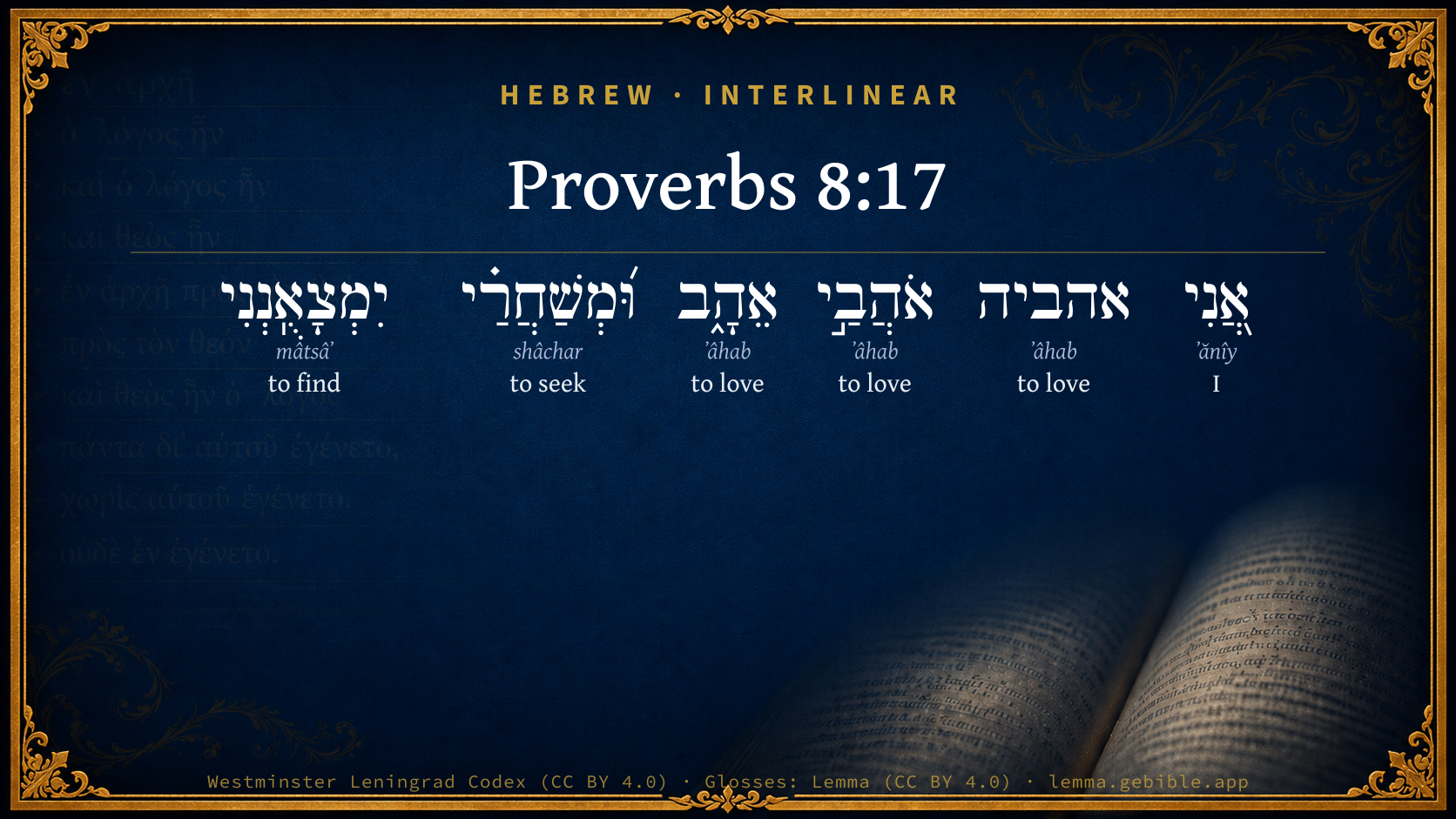
Hebrew (Westminster Leningrad Codex) Proverbs 8:17 appears in the Hebrew Old Testament. The text above is from the Westminster Leningrad Codex. Each word links to its Strong’s number, a concise gloss, and parsing drawn from the Open Scriptures Hebrew Bible morphology. Click any word for its full Brown-Driver-Briggs (BDB) entry.
Download image
Cite this verse

Proverbs 8:17 (World English Bible). Public Domain. Lemma interlinear Bible study tool, https://lemma.gebible.app/v/proverbs/8/17.

Show BibTeX & RIS
BibTeX
RIS
English Translation
I love those who love me. Those who seek me diligently will find me.
World English Bible · Public Domain
Download a study sheet

One document with this verse’s original text, its word-by-word gloss line, the meaning frame, cross-references with their text, attributed commentary, and full source and license credits — printable, and it pastes into notes with its structure intact.

This verse Autodidact and up

Study sheet (.html) Plain text (.txt)

A passage Seminary Student

Up to 50 verses in one chapter. A passage sheet keeps up to 6 commentary sources and 12 cross-references per verse, in the order this page ranks them, and says so on the sheet whenever that leaves anything out. Ask for a single verse and you get the Autodidact verse sheet above.

Everything on this page stays free to read, with no account — the sheet is a download of what is already on screen, not access to it.

Want to remove ads? Support Godless Engineer
Compare translations 3

The same verse in 3 English versions, stacked beneath the original-language interlinear above. Click any original word for its lexicon entry.

Each is an independent rendering of the whole verse — the interlinear is not word-aligned to these translations.

Highlighted words mark where these versions differ — a whole-verse word diff, not a word-by-word alignment.

  • World English Bible Public Domain
    I love those who love me. Those who seek me diligently will find me.
  • King James Version Public Domain
    I love them that love me; and those that seek me early shall find me.
  • unfoldingWord Literal Text CC BY-SA 4.0
    I myself love those who love me, and those who diligently seek me will find me.

unfoldingWord Literal Text — © unfoldingWord, licensed CC BY-SA 4.0. Word-aligned USFM3 via Door43 (git.door43.org/unfoldingWord/en_ult).

Versions to compare (up to 4)

3 of 4 selected

Show all 18 translations

Every available English version of this verse, each an independent rendering of the whole verse.

  • World English Bible Public Domain
    I love those who love me. Those who seek me diligently will find me.
  • Berean Standard Bible Public Domain
    I love those who love me, and those who seek me early shall find me.
  • Majority Standard Bible Public Domain
    I love those who love me, and those who seek me early shall find me.
  • King James Version Public Domain
    I love them that love me; and those that seek me early shall find me.
  • American Standard Version (1901) Public Domain
    I love them that love me; And those that seek me diligently shall find me.
  • Revised Version (1885) Public Domain
    I love them that love me; and those that seek me diligently shall find me.
  • Geneva Bible (1599) Public Domain
    I loue them that loue me: and they that seeke me earely, shall finde me.
  • Douay-Rheims (1899) Public Domain
    I love them that love me: and they that in the morning early watch for me, shall find me.
  • Young's Literal Translation Public Domain
    I love those loving me, And those seeking me earnestly do find me.
  • Literal Standard Version CC BY-SA 4.0
    I love those loving me, || And those seeking me earnestly find me.
  • Unlocked Literal Bible CC BY-SA 4.0
    I love those who love me, and those who diligently seek me, find me.
  • unfoldingWord Literal Text CC BY-SA 4.0
    I myself love those who love me, and those who diligently seek me will find me.
  • Darby Bible Public Domain
    I love those that love me; and they that seek me early shall find me.
  • World Messianic Bible Public Domain
    I love those who love me. Those who seek me diligently will find me.
  • Webster's Bible Public Domain
    I love them that love me; and those that seek me early shall find me.
  • Free Bible Version CC BY-SA 4.0
    I love those who love me, and those who really look for me will find me.
  • Bible in Basic English Public Domain
    Those who have given me their love are loved by me, and those who make search for me with care will get me.
  • JPS Tanakh (1917) Public Domain
    I love them that love me, and those that seek me earnestly shall find me.

Literal Standard Version (2020), Covenant Press — licensed CC BY-SA 4.0. Text via the HelloAO Bible API (eBible.org). Unlocked Literal Bible (unfoldingWord) — licensed CC BY-SA 4.0. Text via the HelloAO Bible API (eBible.org). unfoldingWord Literal Text — © unfoldingWord, licensed CC BY-SA 4.0. Word-aligned USFM3 via Door43 (git.door43.org/unfoldingWord/en_ult). Free Bible Version, Dr. Jonathan Gallagher — licensed CC BY-SA 4.0. Text via the HelloAO Bible API (eBible.org).

Word by word

More ways to search: Search by grammar → Find every occurrence → Compare this word →

Practice this passage: Drill this verse → Learn its vocabulary →

וּ֝מְשַׁחֲרַ֗י
shâchar
H7836
“and · seeking · me”
Conjunction + Verb, Piel, Participle Active, Masculine, Plural, Construct + Suffix, Personal, 1st Person, Common, Singular
Part of Speech
Conjunction + Verb
Stem
Piel
Form
Participle Active
Gender
Masculine
Number
Plural
State
Construct
Full BDB Definition

Origin: a primitive root

TWOT: 2369

to seek, seek early or earnestly, look early or diligently for - (Qal) to look for diligently, seek - (Piel) to seek, seek early
  1. אֲ֭נִי ʼănîy H589 “I” Pronoun, Personal, 1st Person, Common, Singular
  2. אהביה ʼâhab H157 “loving · her” Verb, Qal, Participle Active, Masculine, Plural, Construct + Suffix, Personal, 3rd Person, Feminine, Singular
  3. אֹהֲבַ֣י ʼâhab H157 “loving · me” Verb, Qal, Participle Active, Masculine, Plural, Construct + Suffix, Personal, 1st Person, Common, Singular
  4. אֵהָ֑ב ʼâhab H157 “to love” Verb, Qal, Imperfect, 1st Person, Common, Singular
  5. יִמְצָאֻֽנְנִי mâtsâʼ H4672 “to find · me” Verb, Qal, Imperfect, 3rd Person, Masculine, Plural + Suffix, Personal, 1st Person, Common, Singular

About this verse

These counts appear in no published source. They are computed here, from the morphology-tagged text and Lemma’s own curated glosses. What Lemma adds →

6
words
4
distinct lemmas
Wisdom
section

Notable vocabulary

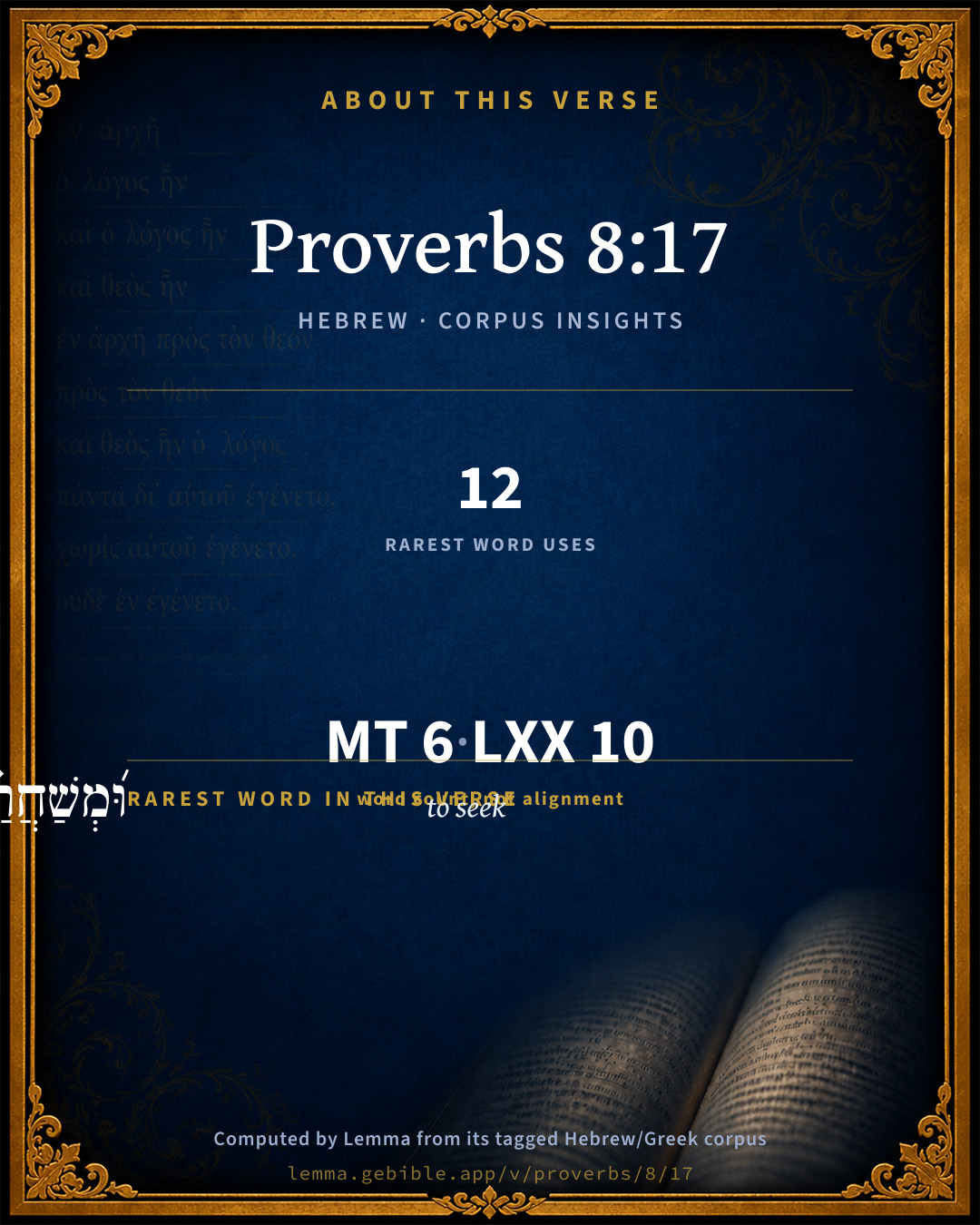
The rarest word here is וּ֝מְשַׁחֲרַ֗י to seek H7836 — appearing just 12 times in the whole Hebrew Bible.

Shared distinctive vocabulary

וּ֝מְשַׁחֲרַ֗י to seek H7836 occurs in 12 verses of the Hebrew Bible. Also found in:

Grammatical profile

  • 5 verbs
  • 1 pronoun

Verb forms

  • אהביה Qal · Participle Active
  • אֹהֲבַ֣י Qal · Participle Active
  • אֵהָ֑ב Qal · Imperfect
  • וּ֝מְשַׁחֲרַ֗י Piel · Participle Active
  • יִמְצָאֻֽנְנִי Qal · Imperfect

Repetition

A word recurs within this verse — often emphatic in Hebrew:

  • אהביה to love H157 ×3

Hebrew & Septuagint length

In English translation the verse runs 14 words from the Hebrew and 14 from the Septuagint (LXX English) — the same length.

A rough comparison of the two English renderings, which tokenize alike — not a word-level alignment.

Word counts can differ between the Hebrew and the Greek without any difference in meaning — e.g. the Hebrew direct-object marker אֵת has no separate Greek word, and Greek often adds the article ὁ.

In the original languages it is 6 Hebrew tokens and 10 Greek tokens — but the two are counted differently (Hebrew bundles its prefixes and suffixes into one token; the Greek is in lemma form), so that isn’t a like-for-like length.

Cross-references

14

Topical passages linked to Proverbs 8:17 in the Treasury of Scripture Knowledge — connected by theme and wording, ordered by reader-vote popularity; previews shown in the World English Bible.

  • John 14:23 Jesus answered him, "If a man loves me, he will keep my word. My Father will love him, and we will come to him, and make our home with him.
  • John 14:21 One who has my commandments, and keeps them, that person is one who loves me. One who loves me will be loved by my Father, and I will love him, and will reveal myself to him."
  • Psalms 91:14 "Because he has set his love on me, therefore I will deliver him. I will set him on high, because he has known my name.
  • Isaiah 55:6 Seek you Yahweh while he may be found; call you on him while he is near:
  • 1 John 4:19 We love Him, because he first loved us.
  • 1 Samuel 2:30 Therefore Yahweh, the God of Israel, says, I said indeed that your house, and the house of your father, should walk before me forever: but now Yahweh says, Be it far from me; for those who honor me I will honor, and those who despise me shall be lightly esteemed.
  • Matthew 7:7–8 "Ask, and it will be given you. Seek, and you will find. Knock, and it will be opened for you.
  • Matthew 6:33 But seek first God's Kingdom, and his righteousness; and all these things will be given to you as well.
  • Isaiah 45:19 I have not spoken in secret, in a place of the land of darkness; I didn't say to the seed of Jacob, Seek you me in vain: I, Yahweh, speak righteousness, I declare things that are right.
  • James 1:5 But if any of you lacks wisdom, let him ask of God, who gives to all liberally and without reproach; and it will be given to him.
  • John 16:27 for the Father himself loves you, because you have loved me, and have believed that I came forth from God.
  • Proverbs 1:28 Then will they call on me, but I will not answer. They will seek me diligently, but they will not find me;
  • Ecclesiastes 12:1 Remember also your Creator in the days of your youth, Before the evil days come, and the years draw near, When you will say, "I have no pleasure in them;"
  • Mark 10:14 But when Jesus saw it, he was moved with indignation, and said to them, "Allow the little children to come to me! Don't forbid them, for the Kingdom of God belongs to such as these.

Cross-references courtesy of OpenBible.info (CC BY 4.0).

Hebrew and Greek witnesses Masoretic Hebrew ↔ Greek Septuagint

The same verse in the two great witnesses to the Old Testament, shown verse-for-verse.

These are two independent witnesses, not word-aligned to each other, and the Septuagint is shown in lemma (dictionary) form.

Hebrew Proverbs 8:17 Masoretic · Westminster Leningrad Codex

אֲ֭נִי אהביה אֹהֲבַ֣י אֵהָ֑ב וּ֝מְשַׁחֲרַ֗י יִמְצָאֻֽנְנִי

I love those who love me. Those who seek me diligently will find me.

World English Bible · Public Domain

Greek LXX Proverbs 8:17 Septuagint · lemma form

ἐγώ ὁ ἐγώ φιλέω ἀγαπάω ὁ δέ ἐγώ ζητέω εὑρίσκω

I love those that love me; and they that seek me shall find me.

LXX2012 (modern English Septuagint) · Public Domain

On this verse, The Pulpit Commentary discusses the Septuagint’s reading. Read the note in Commentary ↓

Hebrew: Westminster Leningrad Codex (CC BY 4.0). Greek: Septuagint (public domain); English from LXX2012 (modern English Septuagint) (Public Domain). How the Septuagint differs from the Hebrew →

Commentary

Notes on Proverbs 8:17 from classic Christian and Jewish commentators (each source and its license shown beneath its notes). The classic Christian expositions comment on the surrounding passage and are grouped to its opening verse, so a note may address several verses; the Jewish commentaries on the Tanakh (Rashi and others) are per-verse, so they appear only where the commentator wrote on this verse.

Lemma curates 59 commentaries, every one of them public domain or Creative Commons licensed, each selected and text-cleaned for this edition rather than reprinted as found. About our sources →

Trapp's Complete Commentary

John Trapp

Pro 8:17 I love them that love me; and those that seek me early shall find me.

Ver. 17. I love them that love me.] The philosopher could say, that if moral virtue could be seen with mortal eyes, she would stir up wonderful loves of herself in the hearts of the beholders. How much more, then, would the "wisdom of God in a mystery!," {1Co 2:7} that essential wisdom of God especially, the Lord Jesus, who is totus desiderabilis, "altogether lovely," {Son 5:16} "the desire of all nations," {Hag 2:7} whom whosoever loveth not deserves to be doubly accursed. {1Co 15:22} My love was crucified, {a} said Ignatius, who "loved not his life unto the death." {Rev 12:11} Neither was there any love lost, or can be, for "I love them that love me." "And if any man love me, my Father will love him, and I will love him, and will manifest myself unto him, and we will come unto him, and make our abode with him." {Joh 14:21; Joh 14:23} Men do not always reciprocate, nor return love for love. "For my love they are mine adversaries; yea, they have rewarded me hatred for my love." {Psa 109:4-5} David lost his love upon Absalom; Paul upon the Corinthians; old Andronicus, the Greek emperor, upon his graceless nephew of the same name. But here is no such danger. It shall not be easy for any man to outlove wisdom. For,

(Objection.) Whereas some one might reply, You are so taken up with states, and have such great suitors, kings, princes, nobles, judges, {as Pro 8:15-16} that it is not for mean men to look for any love from you; -

(Solution.) Not so, saith wisdom, for "I love them that love me," be they never so much below me. "Grace be with all them that love the Lord Jesus in sincerity." {Eph 6:23} Tantum velis, et Deus tibi praeoccurret, saith Nazianzen. Ambulas, si amas: non enim passibus ad Deum, sed affectibus curritur, saith Augustine. Thou walkest if thou lovest; thou actest if thou affectest.

They that seek me early.] As students sit close to it in the morning. Aurora rnusis amica.

{a} O ερως μου εσταυρωται.

John Trapp, A Commentary or Exposition upon All the Books of the Old and New Testament (1647–1656) — public domain. Text from a community e-Sword module.

Joseph Benson's Commentary

Pro 8:17-18. I love them that love me — I do not despise their love, though it be but a small and inconsiderable thing to me, but I kindly accept it, and will recompense it with my love and favour; and those that seek me early — That is, with sincere affection, and great diligence, and above all other persons or things in the world; shall find me — Shall not seek in vain, but shall obtain that wisdom which they so highly prize. Observe well, reader, in order that we may seek for wisdom with the earnestness she merits, we must know her value, and love her. We do not desire, much less do we earnestly seek that, the excellence and utility of which we do not know. We must therefore sincerely and importunately ask of God this knowledge, that, understanding the worth and necessity of wisdom, we may fervently desire and love her; and then, in proportion as this love increases, wisdom will more abundantly communicate herself to us: and “the more early in life we begin this search, the more shall we engage the love, and consequently the encouragement of this divine and blessed monitor.” — Dodd. Riches and honour are with me — To bestow on those that love me, who shall have as much of them as infinite wisdom sees will be for their good: see on Pro 3:16; Pro 4:7-9. Yea, durable riches and righteousness — Riches honestly gotten, not by fraud and oppression, but in the way of justice and fair dealing; and riches charitably used, for alms are called righteousness. Those that have their wealth from God’s blessing on their industry, and that have a heart to do good with it, have riches and righteousness, and such riches will be durable. “Wealth gotten by vanity,” says Henry, “will soon be diminished, but that which is well got will wear well, and will be left to children’s children; and that which is spent in works of piety and charity is put out to the best interest, and so will be durable; for the friends made by the mammon of unrighteousness, when we fail, will receive us into everlasting habitations, Luk 16:9.”

Joseph Benson's Commentary on the Old and New Testaments (1811–1818) — public domain. Text from a community e-Sword module.

The Preacher's Complete Homiletical Commentary

Joseph S. Exell (gen. ed.)

CRITICAL NOTES.—

Pro_8:17. Early, i.e., “earnestly” (see on ch. Pro_1:28).

Pro_8:18. Durable. Zöckler thinks this rather signifies “growing.”

Pro_8:21. Inherit substance, “abundance.”

MAIN HOMILETICS OF THE PARAGRAPH.—Pro_8:17-21

THE REWARD OF EARNEST SEEKERS

I. The mutual love which exists between Wisdom and her children. There is always a mutual love between a true teacher and a diligent, receptive pupil, and the love on each side has a reflex influence on both master and pupil, and renders it more pleasant to teach, and more easy to learn. When a child loves his parent, and the parent is teaching the child, love oils the wheels of the intellectual powers, and furnishes a motive power to conquer the lesson. And when the parent feels that he is loved by his child and pupil, the love is a present reward. There is such a love between Christ and His disciples. Peter appealed to Christ’s consciousness of being loved by him when he said, “Lord, Thou knowest all things; Thou knowest that I love Thee” (Joh_21:17). And Christ loves His pupils. “Greater love hath no man than this, that a man lay down his life for his friends.” “As the Father hath loved me, so have I loved you” (Joh_15:9; Joh_15:13). This mutual love imparts patience on the one side and perseverance on the other. It was Christ’s “first love to us” that gave Him patience to “endure the cross and despise the shame” (Heb_12:2). And it is the responsive love of the disciple that enables Him to endure unto the end. It is the love that is born of the consciousness of being loved that stirs up to the diligent seeking of the latter clause of the verse, which expresses—

II. A certain success to the seekers of wisdom. In Holy Scripture earnest seeking and finding are complements of each other. The one does not exist without the other. Seeking ensures finding. Finding implies seeking. “If any man lack wisdom, let him ask of God, who giveth to all men liberally, and upbraideth not” (Jas_1:5). God’s promise is absolute. It can only fail on one of three suppositions.

1. That when God made the promise He had no intention of keeping it, or—

2. That unforseen circumstances have since arisen which render Him unable to fulfil His word, or—

3. That the conditions have not been fulfilled on the part of the seeker. We know that God’s holiness and omnipotence render the first two impossible, and therefore, whenever there is no finding, we are certain that there has been no real, earnest seeking. For the promise is limited by the condition, “they that seek me early, or earnestly.” If a traveller has a long journey to perform and many difficulties to overcome in the way, he shows his determination to arrive safely at his destination by setting out at early dawn. Those who are anxious to make a name, or a fortune, show their anxiety by rising early and sitting up late. There are degress of earnestness in seekers after Divine wisdom as in all other seekers. But those whose seeking is the most earnest will receive the most abundant reward. The Syro-Phœnician woman who besought Christ to heal her daughter was a type of earnest seekers. She redoubled her efforts as the apparent difficulties increased. She asked, she sought, she knocked. And she received not only what she sought, but a commendation from the Lord for her earnest seeking (Mat_25:28).

III. What those find who find God. The reward promised to those who seek God is God Himself. In finding Him they find

(1.) The lasting riches of righteousness (Pro_8:18-19). This a wealth which will last. However great the satisfaction, however many the blessings which may flow from the riches of earth, “passing away” is written upon all. Yea, long before the end of life the riches may “make themselves wings” (chap. Pro_23:5). Among many other qualities that make moral wealth incomparably superior to material wealth, not the least is its durability. (See on Pro_8:11-12; also chap. Pro_3:15-16).

2. Guidance, Pro_8:20. (See on chap. Pro_3:6, etc.)

3. Reality in opposition to shadow, Pro_8:21. The hungry man who dreams that he is feasting experiences a kind of pleasure. But the feast is only in vision. There is no power in it to appease his hunger, or nourish his frame. But, if on awaking, he finds a table really spread with food, he then has the substance of that of which in his dream he had only the shadow. Worldly men walk, the Psalmist tells us, in a “vain show,” i.e., in an “image,” an “unreality” (Psa_39:6). “They walk,” says Spurgeon on this verse, “as if the mocking images were substantial, like travellers in a mirage, soon to be filled with disappointment and despair.” There are many who dream that they are being satisfied while they are morally asleep. But by and by they awake and find that they have been feeding on visions of the night, that they have been spending their money for “that which was not bread, and their labour for that which satisfieth not” (Isa_55:2). To all who are conscious of this soul-hunger, eternal wisdom here offers substantial heart satisfaction, “a well of water springing up into everlasting life.”

OUTLINES AND SUGGESTIVE COMMENTS

Pro_8:17. The philosopher could say, that if moral virtue could be seen with mortal eyes, she would stir up wonderful loves of herself in the hearts of the beholders. How much more, then, would “the wisdom of God in a mystery!” (1Co_2:7,) that essential wisdom of God especially, the Lord Jesus, who is “altogether lovely,” “the desire of all nations.” “My love was crucified,” said Ignatius, who “loved not His life unto the death” (Rev_12:11). Neither was there any love lost, or can be, for “I love them that love me.” Men do not always reciprocate, or return love for love. David lost his love upon Absalom; Paul upon the Corinthians; but here is no such danger.—Trapp.

The characters whom Christ loves. Christ loves those who love Him.

(1) Because He has done and suffered so much for their salvation. We naturally prize any object in proportion to the labour and expense which it cost us to obtain it. How highly, then, must Christ prize, how ineffably must He love His people. For this, among other reasons, His love for them must be greater in degree, and of a different kind from that which He entertains for the angels of light.

(2) Because they are united to Him by strong and indissoluble ties. The expressions used to describe this union are the strongest that language can afford. The people of Christ are not only His brethren, His sisters, His bride, but His members, His body, and He consequently loves them as we love our members, as our souls love our bodies.

(3) Because they possess His spirit, and bear His image. Similarity of character tends to produce affection, and hence every being in the universe loves his own image when he discovers it. Especially does Christ love His own image in His creatures, because it essentially consists in holiness, which is of all things most pleasing to His Father and Himself.

(4) Because they rejoice in and return His affection. It is the natural tendency of love to produce and increase love. Even those whom we have long loved become incomparably more dear when they begin to prize our love and to return it. If Christ so loved His people before they existed, and even while they were His enemies, as to lay down His life for their redemption, how inexpressibly dear must they be to Him after they become His friends.—Payson.

Seeking wisdom early implies

(1) that it engages our first concern and endeavour, while matters of an inferior consideration are postponed.

2. The constant use of the proper means to obtain it. If we see one continually practising any art, we judge that it is his intention to be master of it.

3. The using them with spirit and vigour. The superficial and spiritless performance of duty is as faulty as the total omission.—Abernethy.

All fancy that they love God. But those who either do not seek God at all, or seek Him coldly, whilst they eagerly seek the vanities of the world, make it plain that they are led by the love of the world more than by the love of God.—Fausset.

It is His love to us that makes us to love Him; and, doubtless, He that loves us so as to make us to love Him, cannot but love us when we do love Him.—Jermin.

Seek early, as the Israelites went early in the morning to seek for manna (Exo_16:21), and as students rise early in the morning and sit close to it to get knowledge. To seek the Lord early is to seek the Lord

(1) firstly;

(2) opportunely. There is a season wherein God may be found (Isa_55:6), and if you let this season slip, you may seek and miss Him.

(3) Affectionately, earnestly (Isa_26:9). That prayer that sets the whole man a-work will work wonders in Heaven, in the heart, and in the earth. Earnest prayer, like Saul’s sword and Jonathan’s bow, never returns empty.—Brooks.

Pro_8:18. Spiritual riches are durable.

1. Because they are gotten without wronging any man. Temporal riches are often gotten by fraud and violence, and, therefore, are not lasting. The parties wronged use all means to recover their own, and God punishes unjust persons. Spiritual riches no man can challenge from us.

2. They are everlasting riches, and therefore durable. That must needs last long which lasts ever. These are true, not transitory riches, which often change their masters. They will swim out of the sea of this world with us, out of the shipwreck of death. Neither fire nor sword can take them from us.—Francis Taylor.

In the matters of rank and riches, the two strong cords by which the ambitious are led, the two reciprocally supporting rails on which the train of ambition ever runs,—even in these matters, that seem the peculiar province of an earthly crown, the Prince of Peace comes forth with loud challenge and conspicuous rivalry. Titles of honour! their real glory depends on the height and purity of the fountain whence they flow. They have often been the gift of profligate princes, and the rewards of successful crime. At the best the fountain is low and muddy: the streams, if looked at in the light of day, are tinged and sluggish. Thus saith the Lord, “Honour is with me.” He who saith it is the King of Glory. To be adopted into the family of God,—to be the son or daughter of the Lord Almighty,—this is honour. High born! We are all low-born until we are born again, and then we are the children of a King.—Arnot.

Pro_8:20. Christ guides infallibly by—

1. His word. It is all truth.

2. His spirit. Men mistake and think they are guided by God’s spirit when they are guided by their own, or by a worse spirit. But certainly whom Christ’s spirit guides He guides aright.

3. His example. All other men have their failings, and must be followed no further than they follow Christ. He is the original copy; others are but blurred abstracts.—Francis Taylor.

“I lead in the way of righteousness,” which is to say, I got not my wealth by right and wrong, by wrench and wiles. My riches are not the riches of unrighteousness, the “mammon of iniquity” (Luk_16:9); but are honestly come by, and are therefore like to be “durable” (Pro_8:18). St. Jerome somewhere saith, that most rich men are either themselves bad men or are heirs of those that have been bad. It is reported of Nevessan, the lawyer, that he should say, “He that will not venture his body shall never be valiant; he that will not venture his soul never rich.” But Wisdom’s walk lies not any such way. God forbid, saith she, that I, or any of mine, should take of Satan, “from a thread even to a shoelatchet, lest he should say, I have made you rich” (Gen_14:23).—Trapp.

Pro_8:21. The great “I AM” (Exo_3:14) is the only substantial reality to satisfy the disciples of Wisdom.—Fausset.

The followers of Christ shall be no losers by Him. They shall not inherit the wind, nor possess for their portion those unsubstantial things, of which it is said, they are not (chap. Pro_23:5), because they are not the true riches. It is not for want of riches to bestow, nor for want of love to His people, that He does not bestow upon every one of them crowns of gold and mines of precious metals.—Lawson.

Here is no yawning vacuum, but a grand object to give interest to life, to fill up every vacancy in the heart—perfect happiness. All that we could add from the world would only make us poorer, by diminishing that enjoyment of God for the loss of which there is no compensation. There is one point—only one—in the universe where we can look up and cry with the saintly Martyn, “With Thee there is no disappointment.”—Bridges.

“I will fill their treasures.” This is a great promise. It is made in a kingly style. There is no limit. It will take much to fill these treasures, for the capacity of the human spirit is very large. God moulded man after His own image, and when the creature is empty, nothing short of His Maker will fill him again. Although a man should gain the whole world, his appetite would not be perceptibly diminished, The void would be as great and the craving as keen as ever. Handfuls are gotten on the ground, but a soulful is not to be had except in Christ. “In Him dwelleth all the fulness of the Godhead bodily, and ye are complete (i.e., full) in Him.”—Arnot.

The Preacher's Complete Homiletical Commentary (gen. ed. Joseph S. Exell; Funk & Wagnalls, c. 1892) — public domain (pre-1929). A full-Bible homiletical/sermon-outline anthology covering 65 of 66 books (2 John is absent from the source module). Text from a community e-Sword module.

Geneva Bible (1599)

Geneva Bible translators

That is, study the word of God diligently, and with a desire to profit.

Geneva Bible (1599) marginal notes — public domain. Text via Bolls.life.

Jamieson, Fausset & Brown

Robert Jamieson, A. R. Fausset & David Brown

early--or, "diligently," which may include the usual sense of early in life.

Jamieson, Fausset & Brown — Commentary Critical and Explanatory on the Whole Bible (1871) — public domain (CC PDM 1.0). Text via the HelloAO Bible API.

Adam Clarke's Commentary

Verse 17. I love them that love me] Wisdom shows itself; teaches man the knowledge of himself; shows him also the will of God concerning him; manifests the snares and dangers of life, the allurements and unsatisfactory nature of all sensual and sinful pleasures, the blessedness of true religion, and the solid happiness which an upright soul derives from the peace and approbation of its Maker. If, then, the heart embraces this wisdom, follows this Divine teaching, and gives itself to God, his love will be shed abroad in it by the influence of the Holy Spirit. Thus we love God because he hath first loved us and the more we love him, the more we shall feel of his love, which will enable us to love him yet more and more; and thus we may go on increasing to eternity. Blessed be God!

And those that seek me early shall find me.] Not merely betimes in the morning, though he who does so shall find it greatly to his advantage; (see on Ps 4:1-8;) but early in life - in youth, and as near as possible to the first dawn of reason. To the young this gracious promise is particularly made: if they seek, they shall find. Others, who are old, may seek and find; but never to such advantage as they would have done, had they sought early. Youth is the time of advantage in every respect: it is the time of learning, the time of discipline; the time of improvement, the time of acquiring useful, solid, and gracious habits. As the first-fruits always belong to God, it is God's time; the time in which he is peculiarly gracious; and in which, to sincere youthful seekers, he pours out his benefits with great profusion. "They that seek me early shall find me."

Hear, ye young, and ye little ones! God offers himself now to you, with all his treasures of grace and glory. Thank him for his ineffable mercy, and embrace it without delay.

Adam Clarke's Commentary on the Bible (1810–1826) — public domain. Text from a community e-Sword/MySword module.

Ellicott's Commentary for English Readers

(17) I love them that love me.—Comp. Joh_14:21 : he that loveth me. . . . I will love him.

A Bible Commentary for English Readers, edited by Charles John Ellicott (1878–1897) — public domain. Text from a community e-Sword module.

The Cambridge Bible for Schools and Colleges

gen. ed. J. J. S. Perowne

17. early] Rather diligently, R.V. text, though R.V. marg. retains, early. See Pro_1:28, note. Wisdom is as accessible as she is desirable.

The Cambridge Bible for Schools and Colleges (gen. ed. J. J. S. Perowne; Cambridge University Press, 1878–1918) — public domain. Text from a community e-Sword module.

John Gill's Exposition

I love them that love me,.... Those that love Christ are such who are born again, and have a spiritual and experimental knowledge of him; that believe in him, have seen his loveliness, have had his love shed abroad in their hearts, and a view of his fulness and suitableness; some comfortable apprehensions of their relation to him, and interest in him, and are indulged with communion with him: the love with which such souls love Christ springs from their very hearts, is cordial and sincere; it gives him the preference to all objects, to all creatures, angels or men, and to all creature enjoyments; it is drawn out to all of Christ, and to all that belong to him, or are his; and though it may be lost, become remiss and abate in its fervency, it cannot be lost; and is what is very acceptable to Christ, and highly esteemed of by him: it shows itself by a high veneration for the truths and doctrines of his Gospel; by a strict regard to his commands and ordinances; by a hearty affection for his people; by parting with and bearing all for his sake; a carefulness of offending him, and losing his company; by an earnest desire after his presence, and delight in it, and by a concern at his absence; by a diligent inquiry after him in the use of means until he is found, and by the joy expressed at finding of him: now such Christ loves; not that he begins to love his people when they begin to love him, for he loved them from everlasting; as appears by his espousing their persons, undertaking their cause, and taking the care and charge of their persons, grace, and glory, so early; and by his assumption of their nature in time, and by his suffering and dying for them; all which were before they had any love to him: but this points out and describes the persons, who may be assured of the love of Christ to them, since their love to him springs from his to them; besides, it designs some fresh manifestations of his love, and the continuance of it; as well as suggests that he has future blessings to bestow on such, as fresh marks of his affection, and instances of his love to them; such as granting them his gracious presence, giving them more grace; causing all things, even afflictions, to work together for their good; preserving and keeping them from falling, and at last giving them eternal glory and happiness; see Joh 14:21;

and those that seek me early shall find me: and they are such who see their need of Christ, and know the worth of him; and those seek to him in the use of means, the word and ordinances, and as assisted by his Spirit and grace, for pardon, righteousness, life, and salvation, which are only to be had in him: and they may be said to "seek him early", or "morning him" (f), who seek him in the morning of youth, or in the first place, above all things else, and that with the greatest eagerness and earnestness, diligence and importunity; and such always are successful; they "find" Christ, and life, righteousness, and salvation in him, and every blessing, and therefore are happy; see Gill on Pro 3:13.

(f) "quaerentes diluculo me", Montanus; "qui me mane quaerunt", Tigurine version, Michaelis.

John Gill's Exposition of the Whole Bible (1746–1763) — public domain (CC PDM 1.0). Text via the HelloAO Bible API.

Matthew Poole's English Annotations

I love them that love me; I do not despise their love though it be but a small and inconsiderable thing to me but I kindly accept it, and will recompense it with my love and favour.

That seek me early, i.e. with sincere affection, and great diligence, and above all other persons or things in the world; which he mentions as the effect and evidence of their love; for otherwise all men pretend to love God.

Matthew Poole's English Annotations on the Holy Bible (1683–1685) — public domain. Text from a community e-Sword/MySword module.

Whedon's Commentary on the Bible

Daniel D. Whedon

17. I love, etc. — This and the following verses to 21, are probably a continuation of the train of thought begun at Pro_8:13.

Seek me early — Or, speedily, earnestly. As though Wisdom had said, Seeing that my favour and guidance are essential to real success, especially to those in high places, this one thing is necessary the obtaining them, namely, to love me, to seek me, speedily and earnestly. If they love me they will thus seek me, and if they thus seek me they shall find me. For illustrations see 1Ki_3:5-14; Jas_1:5.

Daniel D. Whedon (gen. ed.), Commentary on the Old and New Testaments (1874–1909) — public domain. Text from a community e-Sword module.

The Pulpit Commentary

I love them that love me. So Christ says, (Joh_14:21) "He that loveth me shall be loved of my Father, and I will love him, and will manifest myself unto him" Love attracts love. "Magues amoris est amor." They who love virtue and wisdom are regarded with favour by God. whoso inspiration they have obeyed, obtaining grace for grace. So Ben Sira says, "Them that love her the Lord doth love "(Ecc_4:14); so RAPC Wis 7:28, "God loveth none but him that dwelleth with Wisdom." The Septuagint changes the verbs in this clause, though they are parts of the same word in the Hebrew: Egw tou filountav agapw . This reminds one of the passage in the last chapter of St. John. (Joh_21:15-17) where a similar interchange is made. Those that seek me early shall find me. (see the contrast in Pro_1:28) "Early" may mean from tender years; but more probably it is equivalent to "earnestly," "strenuously," as people deeply interested in any pursuit rise betimes to set about the necessary work. (comp. Isa_26:9 Hos_5:15) The Septuagint, "They who seek (zhtountev ) me shall find." So the Lord says, (Mat_7:7) "Seek (zhteite ), and ye shall find;" Ecc_4:12, "He that loveth her loveth life; and they that seek to her early (oi oryrizontev pron ) shall be filled with joy". (comp. Luk_21:38)

The blessedness of loving and seeking Christ.

Wisdom is here personified. This is only the beginning of a process that is to grow through subsequent ages, manifesting itself in the Books of Wisdom and Ecclesiasticus, and finally developing into the doctrine of the "Logos" and the great revelation of Christ as the incarnate Word of God. We must not pretend to see the perfected thought in its earliest germ. The first personification of wisdom is little more than a figure of speech, an instance of the rich imaginative habits of Oriental thinking. Nevertheless, we know Christ to be the full, living embodiment of God"s wisdom. What is true of that wisdom is true of him. And, therefore, though the writer of the words before us had no thought of Jesus Christ the Son of God and Son of man, his teaching concerning Divine wisdom may be most useful when we connect it with the one perfect revelation of wisdom in our Saviour.

I LOVE FOR LOVE.

1. Love to Christ must precede a deep knowledge of Christ. We love before we seek and find. Of course, we must know something of him to arouse our love; but when this initial knowledge is attained, Love must have her perfect work before knowledge can ripen.

2. Love to Christ must be based on what is lovable in him. Wisdom is beautiful and attractive, and can excite love. How much more, then, should the incarnation of Wisdom in our brother man do this! The contemplation of the beautiful life of Christ and the study of his perfect character urge us to love him; but surely what he has done for us, his sacrifice of himself, his death on our behalf, must be our chief grounds for loving him.

3. This love to Christ will be met by his love in return. It is true that his love precedes ours, nay, that it is the great source of our love. But

(1) it is not felt and enjoyed till it is returned, so that then it seems to come afresh as an answer to our love; and

(2) there must be a stronger, more tender, more intimate love to those who appreciate it than can be given to others. Christ loved all men, hut not as he loved St. John. Christians loving Christ enjoy his peculiar love.

4. To be loved by Christ is the best reward of loving him. True love is satisfied with nothing less than a return of love, but it is satisfied with this. If we have nothing else we have a pearl of great price in the love of Christ. Then we can afford to lose all earthly good things, can count them but dung, that we may win Christ.

II FINDING FOR SEEKING.

1. We must seek Christ if we would possess him. He offers himself to all as a Saviour and a Master. But he must be followed and found. Our love to him will be the great attraction ever drawing us nearer to him.

2. The search for Christ must be earnest if it is to be successful. He will not answer a halfhearted call. Till we seek him with determination, reality, persistence, we shall meet no response. We must seek him before all things, must make Christ the chief end of life.

3. This earnest seeking will be rewarded by the receiving of Christ. Wisdom comes to him who seeks laboriously and patiently; much more will Wisdom incarnate, Wisdom with a heart to sympathize. Such a response will be the best reward of seeking. Better than anything that Christ could send us will be his own coming to dwell in our hearts. This will be the satisfaction of anxious inquiry in a full response, the blessing of love with love and close communion.

The responsiveness of Christ.

Adapting these words to him who became, and forever will be, the Wisdom of God, they may speak to us of

I CHRIST"S INITIATIVE LOVE. It is quite true that "we love him because he first loved us." We should first consider "the great love wherewith he loved us, even when we were dead in sins". (Eph_2:4, Eph_2:5) All our love to Christ springs from, has its source in, his spontaneous love toward us, unexcited by our affection, flowing from his own exceeding grace.

II HIS RESPONSIVE LOVE. This involves much,

1. His special interest in those who are inquiring at his feet. "Jesus beholding him, loved him, and said into him, One thing thou lackest". (Mar_10:21) Zacchaeus. (Lu 19)

2. His Divine favour accorded to those who have accepted him as their Lord. "I love them that love me". (see Joh_11:5) These are his friends and his guests. (Joh_14:23 Joh_15:14-15 Rev_3:20)

3. Spiritual blessings which he will impart. He will dwell with us by his Spirit, and the fruits of the Spirit will abound in us. If, then, our interest in Christ, and the yielding of our hearts to him, result in his close friendship and in those highest impartations which flow therefrom, how wise must be

III EARLY DISCIPLESHIP TO HIM! For if we would make sure of finding him and possessing his friendship, we should seek him without delay. Delay is always dangerous. There may intervene between ourselves and him:

1. Other objects which may fascinate our souls and lead us away from him.

2. The growth of the deadly spirit of procrastination.

3. A sudden close of our present life. But early discipleship, the coming in faith to his feet, to his cross, to his kingdom, to his vineyard, means the certainty of holiness and usefulness below and the assurance of blessedness above. C.

The Pulpit Commentary (1880–1919), ed. H.D.M. Spence-Jones & Joseph S. Exell — public domain. Text from a community e-Sword module.

John Wesley's Explanatory Notes

I love - I do not despise their love, but kindly accept it and recompence it with my love and favour. Early - With sincere affection and diligence, which he mentions as the evidence of their love.

John Wesley, Explanatory Notes Upon the Whole Bible (1754–1765) — public domain. Text via the GEBible commentary corpus.

Keil & Delitzsch

C. F. Keil & F. Delitzsch

The discourse of Wisdom makes a fresh departure, as at Pro 8:13 : she tells how, to those who love her, she repays this love:

17 "I love them that love me,

And they that seek me early find me.

18 Riches and honour are with me,

Durable riches and righteousness.

19 Better is my fruit than pure and fine gold,

And my revenue (better) than choice silver.

20 In the way of righteousness do I walk,

In the midst of the paths of justice.

21 To give an inheritance to them that love me

And I fill their treasuries."

The Chethı̂b אהביה (ego hos qui eam amant redamo), Gesenius, Lehrgeb. 196, 5, regards as a possible synallage (eam = me), but one would rather think that it ought to be read (יהוה =) 'אהבי ה. The ancients all have the reading אהבי. אהב (= אאהב, with the change of the éě into ê, and the compression of the radical א; cf. אמר, תּבא, Pro 1:10) is the form of the fut. Kal, which is inflected תּאהבוּ, Pro 1:22. Regarding שׁחר (the Graec. Venet. well: οἱ ὀρθρίζοντές μοι), vid., Pro 1:28, where the same epenthet. fut. form is found.

Pro 8:18

In this verse part of Pro 3:16 is repeated, after which אתּי is meant of possession (mecum and penes me). Regarding הון, vid., Pro 1:13; instead of the adjective יקר there, we have here עתק. The verb עתק brev signifies promoveri, to move forwards, whence are derived the meanings old (cf. aetas provecta, advanced age), venerable for age, and noble, free (cf. עתּיק, Isa 28:9, and Arab. 'atyḳ, manumissus), unbound, the bold. Used of clothing, עריק (Isa 23:18) expresses the idea of venerable for age. עתק used of possessions and goods, like the Arab. 'âtak, denotes such goods as increase during long possession as an inheritance from father to son, and remain firm, and are not for the first time gained, but only need to be inherited, opes perennes et firmae (Schultens, Gesenius' Thesaur., Fleischer), although it may be also explained (which is, however, less probable with the form עתק) of the idea of the venerable from opes superbae (Jerome), splendid opulence. צדקה is here also a good which is distributed, but properly the distributing goodness itself, as the Arab. ṣadaḳat, influenced by the later use of the Hebrew צדקה (δικαιοσύνη = ἐλεημοσύνη), denotes all that which God of His goodness causes to flow to men, or which men bestow upon men (Fl.). Righteousness is partly a recompensative goodness, which rewards, according to the law of requital, like with like; partly communicative, which, according to the law of love without merit, and even in opposition to it, bestows all that is good, and above all, itself; but giving itself to man, it assimilates him to itself (vid., Psa 24:7), so that he becomes צדיק, and is regarded as such before God and men, Pro 8:19.

The fruit and product of wisdom (the former a figure taken from the trees, Pro 3:18; the latter from the sowing of seed, Pro 3:9) is the gain and profit which it yields. With חרוּץ, Pro 8:10; Pro 3:14, פּז is here named as the place of fine gold, briefly for זהב מוּפז, solid gold, gold separated from the place of ore which contains it, or generally separated gold, from פּזז, violently to separate metals from base mixtures; Targ. דּהבא אובריזין, gold which has stood the fire-test, obrussa, of the crucible, Greek ὄβρυζον, Pers. ebrı̂z, Arab. ibrı̂z. In the last clause of this verse, as also in 10b, נבחר is to be interpreted as pred. to תבוּאתי, but the balance of the meaning demands as a side-piece to the מחרוץ ומפז (19a) something more than the mere כּסף. In 20f. the reciprocal love is placed as the answer of love under the point of view of the requiting righteousness. But recompensative and communicative righteousness are here combined, where therefore the subject is the requital of worthy pure love and loving conduct, like with like. Such love requires reciprocal love, not merely cordial love, but that which expresses itself outwardly.

Pro 8:20-21

In this sense, Wisdom says that she acts strictly according to justice and rectitude, and adds (21) wherein this her conduct manifests itself. The Piel הלּך expresses firm, constant action; and בּתוך means that she turns from this line of conduct on no side. להנחיל is distinguished from בּהנחיל, as ut possidendam tribuam from possidendam tribuendo; the former denotes the direction of the activity, the latter its nature and manner; both combine if we translate ita ut....

(Note: Biesenthal combines the etymologically obscure הנחיל with נחל: to make to flow into, so that נחל denotes inheritance in contradistinction to acquisition; while נחלה, in contradistinction to ירשּׁה, denotes the inheritance rather of many than of the individual.)

Regarding the origin of ישׁ, vid., at Pro 2:7; it denotes the being founded, thus substantia, and appears here, like the word in mediaeval Latin and Romanic (Ital. sustanza, Span. substancia), and like οὐσία and ὕπαρξις (τὰ ὑπάρχοντα) in classic Greek, to denote possessions and goods. But since this use of the word does not elsewhere occur (therefore Hitzig explains ישׁ = ישׁ לי, I have it = presto est), and here, where Wisdom speaks, ישׁ connects itself in thought with תּוּשׁיּה, it will at least denote real possession (as we also are wont to call not every kind of property, but only landed property, real possession), such possession as has real worth, and that not according to commercial exchange and price, but according to sound judgment, which applies a higher than the common worldly standard of worth. The Pasek between אהבי and ישׁ is designed to separate the two Jods from each other, and has, as a consequence, for להנחיל אהבי the accentuation with Tarcha and Mercha (vid., Accentssystem, vi. 4; cf. Torath Emeth, p. 17, 3). The carrying forward of the inf. with the finite, 21b, is as Pro 1:27; Pro 2:2, and quite usual.

Keil & Delitzsch — Biblical Commentary on the Old Testament (1861–1891) — public domain (CC PDM 1.0). Text via the HelloAO Bible API. (Old Testament only.)

Bridges on Proverbs

Charles Bridges

Now behold the grace of this Divine Person to his loving children. None by nature are interested in it. (Rom 8:7 .) But his free grace first implants love in their hearts, and then cheers them with the assurance of his own love. (1Jn 4:19 . Joh 14:21 .) The first kindling of the flame is of him. We love, because we are drawn. (Jer 31:3 .) We seek, not by the impulse from within, but by the grace from above (Pro 16:1 . Psa 119:32 ); and seeking, we find. (Isa 45:19 . Jer 29:13 . Mat 7:7-8 .) But it must be early seeking — the first desire and choice of the heart. (Pro 23:26 . Psa 63:1 . Hos 5:15 . Mat 6:33 .) It must be early in the day (Psa 5:3 ; Psa 119:147 . Isa 26:9 . Mar 1:35 ), the first-fruits of our time. Consecrate the whole to him. Take care that God is the first person we speak to; that we see his face first before any other; else will our lamp be untrimmed, our soul estranged from his presence, our heart unready for his service. Let it be the early breaking in of the day of grace (Job 8:5-7 . Isa 55:6 . 2Co 6:2 ) — the improvement of the first — who knows that they be not the only — opportunities of salvation? (Pro 27:1 . Heb 4:7 .) Every present opportunity for the soul is worth worlds. Mercy is in it — grace and eternity are in it. But remember — the door of grace, that is opened to-day, may be shut to-morrow — for ever.

Again — this early seeking. Oh! let it be the early spring and morning of life (1Ki 18:12 . 2Ch 34:3 .) — when the eye is full of life, and the heart of gladness. Let it be "the kindness of youth" (Jer 2:2 ) ""the first love:" before it has been devoted to the world; before the hardening habits of sin have been formed and fixed. Is he not the greatest — the most desirable — the most satisfying good? Therefore, let him be to us — as he deserves to be — the first of the first — the best of the best.

Children! Here is a special encouragement for you, added to the general one. It can never be too early for you. Even now it is too late. God has claimed you from the moment that you passed from unconscious infancy to the dignity of a responsible being. The time spent, so long estranged from God, has been all too long. Early devotedness saves from many follies and mistakes, retracing of steps, and the after misery of being "made to possess the iniquities of our youth." (Job 13:26 .) Early satisfaction — the pure fruit of early seeking — (for they that thus seek shall find) will be the joy of your whole life (Psa 90:14, with Pro 8:34-35 ) — the dawn of your blessed eternity. Remember — the bud and bloom of life is specially acceptable to God (Hos 11:1-4 ); specially honoured by him. (1Sa 2:18 ; 1Sa 3:19 . Psa 92:12-15 .) But is it reasonable — nay — is it not a most abasing thought — to offer the flower of youth to Satan; and, when you have well worn yourself out in his service, to reserve only the dregs and sweepings of life for your Savior? (Mal 1:8 .) Every day you lose a world of happiness; you bind a chain of sin; you take a step to hell. Come, then, and answer the call that is drawing you to Him, who is worthy of all. (1Sa 3:9 . Psa 32:8 . Jer 3:4 .) Never will you regret that you have come too soon. But many have been the sorrowing cries — Lord, ’I have loved thee too late!’ (Mat 25:6-12 . Luk 13:24-25 .) Come, then, by his help, and in dependence on his grace make him your first , your present choice. Lay claim by faith to this promise to early seekers, and you shall find.

Charles Bridges, An Exposition of the Book of Proverbs (1846) — public domain. Text from a community e-Sword module.

unfoldingWord translationNotes

Door43 World Missions Community

love

This refers to brotherly love or love for a friend or family member. This is natural human love between friends or relatives.

diligently

with careful and continued effort

With me are riches and honor

"I have riches and honor"

lasting wealth and righteousness

This explains what is meant by "riches and honor." This can be made clear with the connecting statement "therefore." AT: "therefore, I will give lasting wealth and righteousness to those who find me" (See: Connecting Words)

righteousness

"the ability to live in a right way"

translationWords

love

honor

righteous

unfoldingWord translationNotes — © Distant Shores Media and the Door43 World Missions Community, licensed CC BY-SA 4.0. Source: git.door43.org/Door43/en_tn.

Rashi

Rabbi Shlomo Yitzchaki (Rashi)

I will love those who love me Heb. אהבי. [This is the reading.] The text is written: אוהביה, those who love her. Said the Holy One, blessed be He: “I will love those who love the Torah.” I heard this from Rabbi Aaron in the name of Rabbi Nathan.

I will love Heb. אהב, like אאהב.

will find me Heb. ימצאנני. There is an extra “nun,” denoting fifty. I will allow him to find the fifty gates of understanding.

Rashi on the Tanakh — English translations: “The Judaica Press complete Tanach with Rashi, translated by A. J. Rosenberg” (CC BY 4.0); “Pentateuch with Rashi's commentary by M. Rosenbaum and A.M. Silbermann, 1929-1934” (public domain); “The Metsudah Tanach series, Lakewood, N.J” (CC BY 4.0); and “The Book of Joshua, Metsudah Publications, 1997” (CC BY 4.0). Text via Sefaria.

Lesson kit

Teaching starters — assembled from the data on this page, not authored interpretation. Every prompt links to the verse data it draws on. Edit before teaching.

Proverbs, in the Wisdom, opens this verse with 6 words (4 distinct Hebrew lemmas). Its most distinctive word is shâchar (“to seek”). A historical commentator’s framing appears above. Read the whole chapter for the surrounding context.

Discussion questions

  1. The word shâchar carries the sense “to seek.” How does it shape the verse?
  2. How does Job 7:21, which shares the word «to seek», read alongside this verse?
  3. What does the repetition of “to love” (3× in this one verse) do in this verse?
  4. The translations on this page render this verse differently — a whole-verse word diff, not a word-by-word alignment. What might account for the different wordings?
  5. «אהביה» is a Qal Participle Active verb. How does that grammatical form shape the action described?
  6. Compare how Trapp's Complete Commentary and Joseph Benson's Commentary read this verse. Where do they agree or differ?

Things to notice

Reading settings

Reading text

Shown beneath each verse's original-language words.

Old Testament
Old Testament edition

Read the OT as the Masoretic Hebrew (MT) or the Greek Septuagint (LXX).

English shown for the Greek Septuagint (in the Hebrew ↔ Greek comparison).

Comparing translations? Open the Compare panel on any verse page to stack up to four side by side.