

Deuteronomy 10:19

Hebrew (Westminster Leningrad Codex) Deuteronomy 10:19 appears in the Hebrew Old Testament. The text above is from the Westminster Leningrad Codex. Each word links to its Strong’s number, a concise gloss, and parsing drawn from the Open Scriptures Hebrew Bible morphology. Click any word for its full Brown-Driver-Briggs (BDB) entry.
Download image
Cite this verse

Deuteronomy 10:19 (World English Bible). Public Domain. Lemma interlinear Bible study tool, https://lemma.gebible.app/v/deuteronomy/10/19.

Show BibTeX & RIS
BibTeX
RIS
English Translation
Therefore love the foreigner; for you were foreigners in the land of Egypt.
World English Bible · Public Domain
Download a study sheet

One document with this verse’s original text, its word-by-word gloss line, the meaning frame, cross-references with their text, attributed commentary, and full source and license credits — printable, and it pastes into notes with its structure intact.

This verse Autodidact and up

Study sheet (.html) Plain text (.txt)

A passage Seminary Student

Up to 50 verses in one chapter. A passage sheet keeps up to 6 commentary sources and 12 cross-references per verse, in the order this page ranks them, and says so on the sheet whenever that leaves anything out. Ask for a single verse and you get the Autodidact verse sheet above.

Everything on this page stays free to read, with no account — the sheet is a download of what is already on screen, not access to it.

Want to remove ads? Support Godless Engineer
Compare translations 3

The same verse in 3 English versions, stacked beneath the original-language interlinear above. Click any original word for its lexicon entry.

Each is an independent rendering of the whole verse — the interlinear is not word-aligned to these translations.

Highlighted words mark where these versions differ — a whole-verse word diff, not a word-by-word alignment.

  • World English Bible Public Domain
    Therefore love the foreigner; for you were foreigners in the land of Egypt.
  • King James Version Public Domain
    Love ye therefore the stranger: for ye were strangers in the land of Egypt.
  • unfoldingWord Literal Text CC BY-SA 4.0
    And you shall love the foreigner, for you were foreigners in the land of Egypt.

unfoldingWord Literal Text — © unfoldingWord, licensed CC BY-SA 4.0. Word-aligned USFM3 via Door43 (git.door43.org/unfoldingWord/en_ult).

Versions to compare (up to 4)

3 of 4 selected

Show all 18 translations

Every available English version of this verse, each an independent rendering of the whole verse.

  • World English Bible Public Domain
    Therefore love the foreigner; for you were foreigners in the land of Egypt.
  • Berean Standard Bible Public Domain
    So you also must love the foreigner, since you yourselves were foreigners in the land of Egypt.
  • Majority Standard Bible Public Domain
    So you also must love the foreigner, since you yourselves were foreigners in the land of Egypt.
  • King James Version Public Domain
    Love ye therefore the stranger: for ye were strangers in the land of Egypt.
  • American Standard Version (1901) Public Domain
    Love ye therefore the sojourner; for ye were sojourners in the land of Egypt.
  • Revised Version (1885) Public Domain
    Love ye therefore the stranger: for ye were strangers in the land of Egypt.
  • Geneva Bible (1599) Public Domain
    Loue ye therefore the stranger: for ye were strangers in the land of Egypt.
  • Douay-Rheims (1899) Public Domain
    And do you therefore love strangers, because you also were strangers in the land of Egypt.
  • Young's Literal Translation Public Domain
    `And ye have loved the sojourner, for sojourners ye were in the land of Egypt.
  • Literal Standard Version CC BY-SA 4.0
    And you have loved the sojourner, for you were sojourners in the land of Egypt.
  • Unlocked Literal Bible CC BY-SA 4.0
    Therefore love the foreigner; for you were foreigners in the land of Egypt.
  • unfoldingWord Literal Text CC BY-SA 4.0
    And you shall love the foreigner, for you were foreigners in the land of Egypt.
  • Darby Bible Public Domain
    And ye shall love the stranger; for ye have been strangers in the land of Egypt.
  • World Messianic Bible Public Domain
    Therefore love the foreigner, for you were foreigners in the land of Egypt.
  • Webster's Bible Public Domain
    Love ye therefore the stranger: for ye were strangers in the land of Egypt.
  • Free Bible Version CC BY-SA 4.0
    You too must love the foreigner because you yourselves were once foreigners in Egypt.
  • Bible in Basic English Public Domain
    So be kind to the man from a strange country who is living among you, for you yourselves were living in a strange country in the land of Egypt.
  • JPS Tanakh (1917) Public Domain
    Love ye therefore the stranger; for ye were strangers in the land of Egypt.

Literal Standard Version (2020), Covenant Press — licensed CC BY-SA 4.0. Text via the HelloAO Bible API (eBible.org). Unlocked Literal Bible (unfoldingWord) — licensed CC BY-SA 4.0. Text via the HelloAO Bible API (eBible.org). unfoldingWord Literal Text — © unfoldingWord, licensed CC BY-SA 4.0. Word-aligned USFM3 via Door43 (git.door43.org/unfoldingWord/en_ult). Free Bible Version, Dr. Jonathan Gallagher — licensed CC BY-SA 4.0. Text via the HelloAO Bible API (eBible.org).

Word by word

More ways to search: Search by grammar → Find every occurrence → Compare this word →

Practice this passage: Drill this verse → Learn its vocabulary →

About this verse

These counts appear in no published source. They are computed here, from the morphology-tagged text and Lemma’s own curated glosses. What Lemma adds →

8
words
7
distinct lemmas
Pentateuch
section

Grammatical profile

  • 2 verbs
  • 4 nouns
  • 1 conjunction
  • 1 particle

Verb forms

  • וַאֲהַבְתֶּ֖ם Qal · Sequential Perfect
  • הֱיִיתֶ֖ם Qal · Perfect

Repetition

A word recurs within this verse — often emphatic in Hebrew:

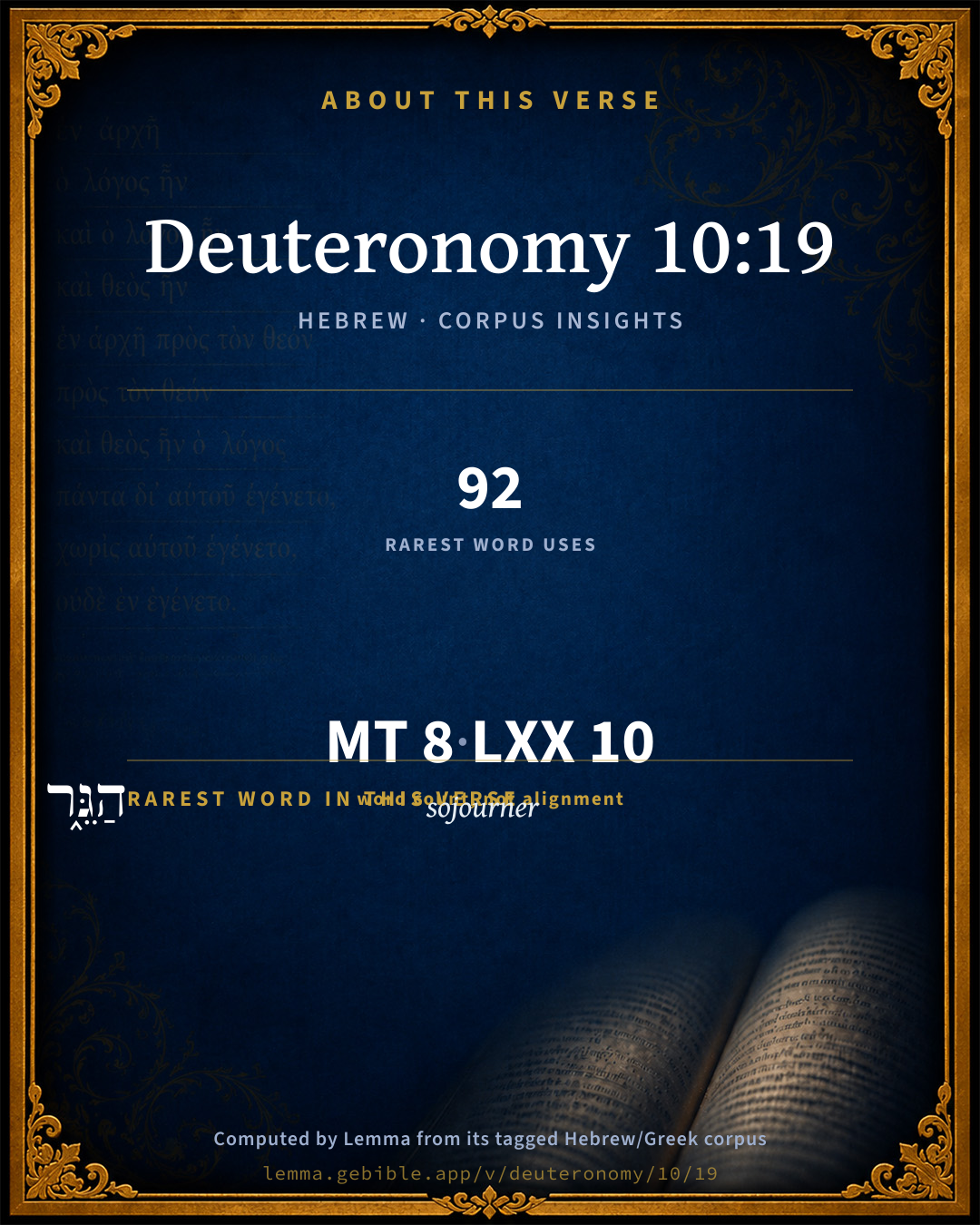
  • הַגֵּ֑ר sojourner H1616 ×2

Hebrew & Septuagint length

In English translation the verse runs 13 words from the Hebrew and 15 from the Septuagint (LXX English) — closely comparable.

A rough comparison of the two English renderings, which tokenize alike — not a word-level alignment.

Word counts can differ between the Hebrew and the Greek without any difference in meaning — e.g. the Hebrew direct-object marker אֵת has no separate Greek word, and Greek often adds the article ὁ.

In the original languages it is 8 Hebrew tokens and 10 Greek tokens — but the two are counted differently (Hebrew bundles its prefixes and suffixes into one token; the Greek is in lemma form), so that isn’t a like-for-like length.

Cross-references

8

Topical passages linked to Deuteronomy 10:19 in the Treasury of Scripture Knowledge — connected by theme and wording, ordered by reader-vote popularity; previews shown in the World English Bible.

  • Exodus 22:21 "You shall not wrong an alien, neither shall you oppress him, for you were aliens in the land of Egypt.
  • Leviticus 19:33–34 "'If a stranger lives as a foreigner with you in your land, you shall not do him wrong.
  • Luke 17:18 Were there none found who returned to give glory to God, except this stranger?"
  • Galatians 6:10 So then, as we have opportunity, let's do what is good toward all men, and especially toward those who are of the household of the faith.
  • James 2:15–16 And if a brother or sister is naked and in lack of daily food,
  • 1 John 3:17–18 But whoever has the world's goods, and sees his brother in need, and closes his heart of compassion against him, how does the love of God remain in him?
  • Luke 6:35 But love your enemies, and do good, and lend, expecting nothing back; and your reward will be great, and you will be children of the Most High; for he is kind toward the unthankful and evil.
  • Luke 10:28–37 He said to him, "You have answered correctly. Do this, and you will live."

Cross-references courtesy of OpenBible.info (CC BY 4.0).

Hebrew and Greek witnesses Masoretic Hebrew ↔ Greek Septuagint

The same verse in the two great witnesses to the Old Testament, shown verse-for-verse.

These are two independent witnesses, not word-aligned to each other, and the Septuagint is shown in lemma (dictionary) form.

Hebrew Deuteronomy 10:19 Masoretic · Westminster Leningrad Codex

וַאֲהַבְתֶּ֖ם אֶת הַגֵּ֑ר כִּֽי גֵרִ֥ים הֱיִיתֶ֖ם בְּאֶ֥רֶץ מִצְרָֽיִם

Therefore love the foreigner; for you were foreigners in the land of Egypt.

World English Bible · Public Domain

Greek LXX Deuteronomy 10:19 Septuagint · lemma form

καί ἀγαπάω ὁ προσήλυτος προσήλυτος γάρ εἰμί ἐν γῆ αἴγυπτος

And you⌃ shall love the stranger; for you⌃ were strangers in the land of Egypt.

LXX2012 (modern English Septuagint) · Public Domain

Hebrew: Westminster Leningrad Codex (CC BY 4.0). Greek: Septuagint (public domain); English from LXX2012 (modern English Septuagint) (Public Domain). How the Septuagint differs from the Hebrew →

Targum (Aramaic paraphrase)

2

The Targum is the ancient Jewish Aramaic paraphrase of the Hebrew Scriptures — an interpretive translation, not the Hebrew text itself. Onkelos (literal) and Pseudo-Jonathan (expansive) render the Torah, and Jonathan the Prophets. Coverage is partial: where no permissively-licensed English translation exists for a verse, only the Aramaic is shown. This is verse-level text, not a word-by-word alignment to the Hebrew.

  1. Targum Onkelos Torah (Genesis–Deuteronomy)
    וְתִרְחֲמוּן יָת גִיוֹרָא אֲרֵי דַיָרִין הֲוֵיתוּן בְּאַרְעָא דְמִצְרָיִם

    (no public-domain English translation for this verse)

    Targum Onkelos — Aramaic: “Onkelos Genesis” (public domain); “Onkelos Exodus” (public domain); “Onkelos Leviticus” (public domain); “Onkelos Numbers” (public domain); “Onkelos Deuteronomy” (public domain). English: “Sefaria Community Translation” (CC0 1.0 (public-domain dedication)); “J.W. Etheridge. The Targums of Onkelos and Jonathan Ben Uzziel on the Pentateuch. London: Longmans, Green, 1862” (public domain). Text via Sefaria.

  2. Targum Pseudo-Jonathan Torah (Genesis–Deuteronomy)
    וּתְרַחֲמוּן יַת גִּיּוֹרָא אֲרוּם גִּיוֹרִין הֲוֵיתוּן בְּאַרְעָא דְמִצְרָיִם

    Have pity then (yourselves) upon the stranger, for you were strangers in the land of Mizraim.

    Targum Pseudo-Jonathan — Aramaic: “Targum Jonathan on Genesis” (public domain); “Targum Jonathan on Exodus” (public domain); “Targum Jonathan on Leviticus” (public domain); “Targum Jonathan on Numbers” (public domain); “Targum Jonathan on Deuteronomy” (public domain). English: “The Targum of Jonathan ben Uzziel, trans. J. W. Etheridge, London, 1862” (public domain). Text via Sefaria.

Commentary

Notes on Deuteronomy 10:19 from classic Christian and Jewish commentators (each source and its license shown beneath its notes). The classic Christian expositions comment on the surrounding passage and are grouped to its opening verse, so a note may address several verses; the Jewish commentaries on the Tanakh (Rashi and others) are per-verse, so they appear only where the commentator wrote on this verse.

Lemma curates 59 commentaries, every one of them public domain or Creative Commons licensed, each selected and text-cleaned for this edition rather than reprinted as found. About our sources →

Trapp's Complete Commentary

John Trapp

Deu 10:19 Love ye therefore the stranger: for ye were strangers in the land of Egypt.

Ver. 19. Love ye therefore the stranger.] And to show yourselves the friends of God. For idem velle et idem nolle, ea demum vera amictia est. {a} Friends are like-minded.

{a} Cicero.

John Trapp, A Commentary or Exposition upon All the Books of the Old and New Testament (1647–1656) — public domain. Text from a community e-Sword module.

The Biblical Illustrator

Joseph S. Exell

Deu_10:19

Ye were strangers.

The strangers claim

In both Jewish and Christian economy special kindness was to be shown to the stranger.

I. The strangers claim does not rest upon any doctrine of abstract right, but upon the disadvantage of his position. He can hardly be said to have any right at all. He is a foreigner. He comes uninvited. He seeks only his own advantage. Why should I befriend him? He is seeking only to make his own way, and to secure a footing, probably at my cost, or that of my neighbour. Besides, it is impossible to befriend him without risk. Nothing is known of his history or his character. Why did he leave the place where he was known? If he couldnt succeed there, why should he expect to succeed here? The very fact that he had to come among strangers and start life afresh is a reason for caution and reserve. All this is true. Why should you trouble about him? Yet you must trouble. And the simple reason is, that his strangeness places him at a terrible disadvantage. In the Old Testament he is always classed with the widow and the orphan. They are the defenceless class. And because they are an easy prey of cunning and wickedness, God makes special provision for them. He comes into a community ignorant of all the well-established order of its life. The common places of their life are novelties to him. What an object for fleecing! The sailor on shore, and Young Evergreen on the turf, are striking examples of the readiness with which the simple-minded stranger falls a victim to wily and wicked men. The same thing happens in business and society. Most people regard it as quite the proper thing to make the stranger pay for his experience, and do not scruple to take advantage of his ignorance. The glory of our Jehovah is that He is the Defence and Champion of the helpless and oppressed. The world bullies the widow, exploits the poor, and considers the stranger fair game for plunder. But God says, My people shall protect the weak, provide for the poor, and show kindness to the stranger. One reason why they were to show kindness to the stranger was because he is especially sensitive to first impressions. His loneliness and comparative helplessness lay him open to the first influences that come upon him. He is ready to enter any door that opens. How much depends upon those first influences! He will form his estimate of the new community from the people who first get hold of him. The strangers first impressions of Israel would be gathered from his first experiences among them. First impressions last. God was jealous for His name among the heathen and the stranger. The stranger is nervous, uncertain, apprehensive. He is easily offended, and apt to see slights where they do not exist. But he is just as easily pleased, and responds readily to kind and sympathetic interest. I am persuaded our churches have suffered great loss in our towns and cities through their neglect of the stranger. It would be safe to affirm that no church prospers that is not mindful of the stranger. Forget not to show love unto the stranger. He is altogether a pathetic figure. Often behind him is a history full of tragedy; his heart is sore, sometimes even unto breaking; always he is in need of kindly and helpful sympathy.

II. Our duty to the stranger. Our duty runs along the line of his need. The Old Testament law protects him against oppression, wrong, and vexation. No advantage was to be taken against him. But they were not to stand aloof, and let him severely alone. They must deal hospitably with him. He with the poor was to have the gleanings of the field, that he might secure his daily bread. In the New Testament the hospitality is extended. To care for the stranger was one of the marks of Christian character (Rom_12:13; 1Ti_5:10). He was to be treated both in the Old and New Covenant as home-born, and admitted to the privileges of national and social life (Lev_19:33-34). The reason for such generous treatment was three fold.

1. The strangers need. That in itself ought to be sufficient. The Good Samaritan does not stop to inquire into the merits of the man naked and bleeding on the roadside. His need is a sufficient passport to sympathy. Philanthropy in the guise of a detective is a very poor thing. The large-hearted pity of Jesus did not wait for a certificate of merit and respectability before it healed the sufferer or fed the hungry. The strangers hunger is for brotherliness, rather than bread. Feed him, then, out of the fulness of your heart.

2. Ye know the heart of a stranger. One would think such would need no exhortation to be considerate to strangers. The remembrance of a fellow feeling ought to make them kind. But it does not. The cruellest slave driver is the man who has been a slave. Suffering unsanctified by grace does not soften and sweeten; it hardens and sours. But the law ought to hold good. If suffering does not make us appreciate the troubles of those who may afterwards be passing through the same experience, what can we appreciate? We are comforted of God, that we in turn may comfort others in like affliction. We have all been strangers, for we began life as the little stranger. Recall your experiences, and when you see a stranger, do unto him as you would that others should have done unto you.

3. God loves the stranger. The Lord your God is God of gods, the Lord of lords, a great God,. . .and loveth the stranger. Love ye therefore the stranger (Deu_10:17-19). The love of God overflows the boundaries of the elect. It compasses the heathen as well as the Israelite. Be ye imitators of God. Because God loves him, you must love him for God sake. This motive is greatly strengthened in Jesus Christ. For His sake we are debtors unto all men. For His sake we must take up our cross and crucify the flesh with its narrow affections and selfish lust. In the stranger you may find an angel. Not that every stranger is an angel. Some are sharks. You are not asked to abandon the ordinary rules of prudence and common sense. There is all the difference in the world between being kind to a stranger and making him your bosom friend straight off. But in the stranger there are great possibilities. When God gave His great promise unto Israel, we are told they were few men in number, yea, very few, and strangers in the land (Psa_105:11-12). Only a few feeble strangers, but heirs of a great promise. Angels have a trick of dwelling in unsuspected places; they delight to travel in disguise, and be entertained unawares. In the stranger you may find appreciation and gratitude. St. Luke tells us that when Jesus healed ten lepers none returned to express their thanks, save only he who was a Samaritan and a stranger (Luk_17:18). In the stranger you may find more than an angel. You may find in him your Lord. At the last day you will be surprised to find you have been ministering not unto a needy brother, but to the Lord Jesus Christ. I was a stranger, and ye took me in. (S. Chadwick.)

Experience a stimulus to generosity

Diderot rose on Shrove Tuesday morning and groping in his pocket found nothing wherewith to keep that day, which he spent wandering about Paris and its precincts. He was ill when he got back to his quarters, went to bed and was treated by his landlady to a little toast and wine. That day, he told a friend in after life, I swore that if ever I came to have anything, I would never in my life refuse a poor man help, never condemn a fellow creature to a day so painful. (Francis Jacox.)

Kindness to a stranger

A Pittsburgh pastor writes: It was at the close of the evening service last Sunday that, according to my wont, I stepped down from the pulpit and moved towards the door to greet old friends and welcome strangers. Presently there stood before me a shy, intelligent-looking lad, who grasped my hand with so much cordiality that, looking him in the face, I said, What is your name? Do you live somewhere near by? My name, said he, with a charming accent, is John Silas. I do not live here, I work at the K-- Hotel. How did you find your way here? I looked for you many days, responded the boy; I come from Germany one year ago--no father, no mother. I meet you one night, you preached at W-- (one of our suburbs); you shook hands with me, and said you were glad to see me, and Ive been looking for your church ever since. The incident deeply touched several who were standing by, and hospitality to strangers will seem to us all more valuable than ever before.

The Biblical Illustrator, edited by Joseph S. Exell (c. 1880s–1900s) — public domain. Text from a community e-Sword module.

Joseph Benson's Commentary

Deu 10:19. Love ye, therefore, the stranger — Be kind and just even to Gentile strangers, as to fellow-creatures of the same frame with yourselves, in honour to your common Creator, and in imitation of that tender care which he exercises over the sons of men.

Joseph Benson's Commentary on the Old and New Testaments (1811–1818) — public domain. Text from a community e-Sword module.

Ellicott's Commentary for English Readers

(19) For ye were strangers.—“The blemish which is upon thyself thou shalt not notice in thy neighbour” (Rashi). The provision made for the stranger throughout the Old Testament Scriptures has another cause besides: “For I was a stranger, and ye gathered me in.” (See a Sermon on “The Stranger” in Silver Sockets, and other Shadows of Redemption.)

A Bible Commentary for English Readers, edited by Charles John Ellicott (1878–1897) — public domain. Text from a community e-Sword module.

The Cambridge Bible for Schools and Colleges

gen. ed. J. J. S. Perowne

19. Love ye the stranger] This carries the principle further than it is expressed in Exo_22:21, and even almost as far as Christ carried it. Cp. P, Lev_19:33.

for ye were strangers] So Exo_22:21 (editorial) and frequently in D.

20–11:1. Resumption of the Sg. address in possible, but not necessary, continuation of Deu_10:14-15. Deu_10:20 naturally suggests the opening of Deu_10:21, and is therefore not to be taken as a later intrusion because it repeats Deu_6:13 (Steuern.).

The Cambridge Bible for Schools and Colleges (gen. ed. J. J. S. Perowne; Cambridge University Press, 1878–1918) — public domain. Text from a community e-Sword module.

John Gill's Exposition

Love ye therefore the stranger,.... Because the Lord loves him; and another reason follows, particularly binding on the Israelites:

for ye were strangers in the land of Egypt; and therefore should sympathize with such, and show them compassion, relieve them in distress, and afford them whatever they want, and is in the power of their hands to communicate to them; remembering their own condition in Egypt, and how welcome such a treatment would have been to them then, as well as the kind and careful providence of God towards them at that time.

John Gill's Exposition of the Whole Bible (1746–1763) — public domain (CC PDM 1.0). Text via the HelloAO Bible API.

The Pulpit Commentary

Love the stranger.

The precept has numerous applications

I TO LITERAL STRANGERS. Persons from foreign countries, or from distant parts of our own country, settling in our midst. Why should these be treated so often as intruders, "incomers," persons to be jealously watched and suspected, instead of being taken by the hand and welcomed?

II TO THE UNFRIENDED AND HELPLESS. To all whose hearts are lonely, and their lives destitute of the cheer given by the love and sympathy of friends. To the fatherless and the widow strangers in a very true sense m a world where selfish interests so hugely predominate.

III TO YOUNG MAN IS GREAT CITIES. Often lost for lack of some one to take a kindly interest in them.

IV TO STRANGERS TURNING UP IN CHURCHES. Coldness here repels many who might otherwise be won to interest in religion, and secured for Christ. Brotherly and friendly attention, a kind word, the warm shake of a hand, the courteous offer of a pew, how far will they often go? They are, like "good words," worth much, and cost little.

Show kindness to strangers:

1. Because they peculiarly need it. "The heart of a stranger.

2. Because God loves them. He will avenge their wrongs. He will reward kindness shown to them. (Mat_25:35)

3. We may be placed in similar circumstances. Changes in fortune. J.O. (Rth_1:19-22)

The Pulpit Commentary (1880–1919), ed. H.D.M. Spence-Jones & Joseph S. Exell — public domain. Text from a community e-Sword module.

Rashi

Rabbi Shlomo Yitzchaki (Rashi)

כי גרים הייתם [LOVE THE STRANGER] FOR YE WERE STRANGERS — Do not reproach thy fellow man for a fault which is also thine (cf. Rashi on Exodus 22:20; Bava Metzia 59b).

Rashi on the Tanakh — English translations: “The Judaica Press complete Tanach with Rashi, translated by A. J. Rosenberg” (CC BY 4.0); “Pentateuch with Rashi's commentary by M. Rosenbaum and A.M. Silbermann, 1929-1934” (public domain); “The Metsudah Tanach series, Lakewood, N.J” (CC BY 4.0); and “The Book of Joshua, Metsudah Publications, 1997” (CC BY 4.0). Text via Sefaria.

Ramban (Nachmanides)

Rabbi Moshe ben Nachman (Ramban / Nachmanides)

FOR YE WERE STRANGERS IN THE LAND OF EGYPT. “Do not reproach your fellow man with a fault which is also in you.” This is Rashi’s language. I have already explained it in the section And these are the ordinances.

Ramban (Nachmanides) on the Tanakh — English translation: “Commentary on the Torah by Ramban (Nachmanides). Translated and annotated by Charles B. Chavel. New York, Shilo Pub. House, 1971-1976” (CC BY 4.0). Text via Sefaria.

Lesson kit

Teaching starters — assembled from the data on this page, not authored interpretation. Every prompt links to the verse data it draws on. Edit before teaching.

Deuteronomy, in the Pentateuch, opens this verse with 8 words (7 distinct Hebrew lemmas). Its most distinctive word is gêr (“sojourner”). A historical commentator’s framing appears above. Read the whole chapter for the surrounding context.

Discussion questions

  1. What does “sojourner” (gêr) contribute to the verse as a whole?
  2. Exodus 22:21 shares this passage’s theme. How do the two illuminate each other?
  3. “sojourner” occurs 2× in this one verse. What is the effect of the repetition?
  4. These translations render this verse differently. What is at stake in choosing one wording over another?
  5. The verb «וַאֲהַבְתֶּ֖ם» is Qal Sequential Perfect. How does its form color the action?
  6. Reading how Trapp's Complete Commentary and The Biblical Illustrator read this verse, where do the two commentators agree and where do they part?

Things to notice

Reading settings

Reading text

Shown beneath each verse's original-language words.

Old Testament
Old Testament edition

Read the OT as the Masoretic Hebrew (MT) or the Greek Septuagint (LXX).

English shown for the Greek Septuagint (in the Hebrew ↔ Greek comparison).

Comparing translations? Open the Compare panel on any verse page to stack up to four side by side.