
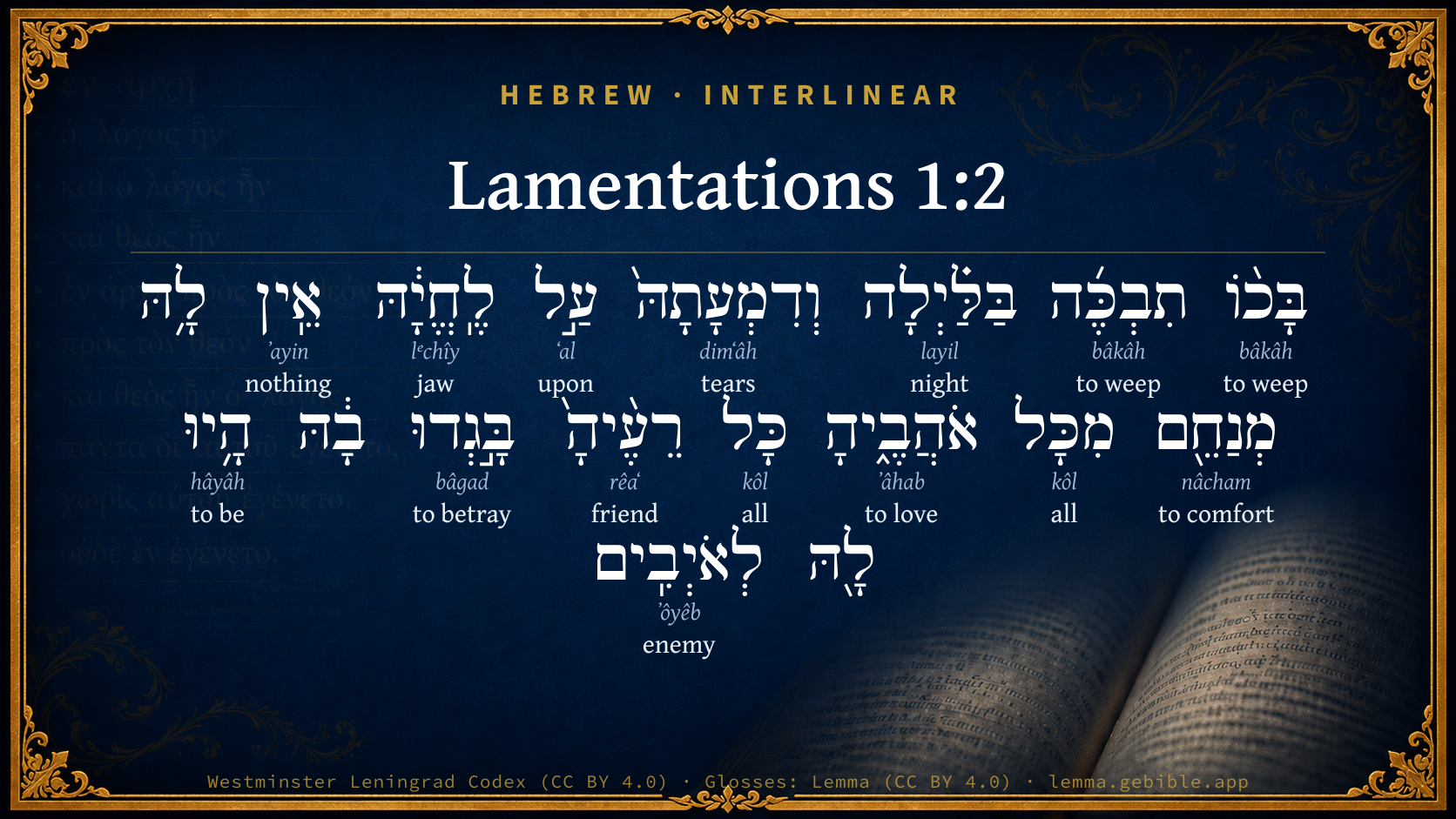
Lamentations 1:2

Hebrew (Westminster Leningrad Codex) Lamentations 1:2 appears in the Hebrew Old Testament. The text above is from the Westminster Leningrad Codex. Each word links to its Strong’s number, a concise gloss, and parsing drawn from the Open Scriptures Hebrew Bible morphology. Click any word for its full Brown-Driver-Briggs (BDB) entry.
Download image
Cite this verse

Lamentations 1:2 (World English Bible). Public Domain. Lemma interlinear Bible study tool, https://lemma.gebible.app/v/lamentations/1/2.

Show BibTeX & RIS
BibTeX
RIS
English Translation
She weeps sore in the night, and her tears are on her cheeks; Among all her lovers she has none to comfort her: All her friends have dealt treacherously with her; they are become her enemies.
World English Bible · Public Domain
Download a study sheet

One document with this verse’s original text, its word-by-word gloss line, the meaning frame, cross-references with their text, attributed commentary, and full source and license credits — printable, and it pastes into notes with its structure intact.

This verse Autodidact and up

Study sheet (.html) Plain text (.txt)

A passage Seminary Student

Up to 50 verses in one chapter. A passage sheet keeps up to 6 commentary sources and 12 cross-references per verse, in the order this page ranks them, and says so on the sheet whenever that leaves anything out. Ask for a single verse and you get the Autodidact verse sheet above.

Everything on this page stays free to read, with no account — the sheet is a download of what is already on screen, not access to it.

Want to remove ads? Support Godless Engineer
Compare translations 3

The same verse in 3 English versions, stacked beneath the original-language interlinear above. Click any original word for its lexicon entry.

Each is an independent rendering of the whole verse — the interlinear is not word-aligned to these translations.

Highlighted words mark where these versions differ — a whole-verse word diff, not a word-by-word alignment.

  • World English Bible Public Domain
    She weeps sore in the night, and her tears are on her cheeks; Among all her lovers she has none to comfort her: All her friends have dealt treacherously with her; they are become her enemies.
  • King James Version Public Domain
    She weepeth sore in the night, and her tears are on her cheeks: among all her lovers she hath none to comfort her: all her friends have dealt treacherously with her, they are become her enemies.
  • unfoldingWord Literal Text CC BY-SA 4.0
    She weeps bitterly in the night, and her tears are on her cheeks. She has no comforter from all those who love her. All her companions have betrayed her; they have become enemies to her. GIMEL

unfoldingWord Literal Text — © unfoldingWord, licensed CC BY-SA 4.0. Word-aligned USFM3 via Door43 (git.door43.org/unfoldingWord/en_ult).

Versions to compare (up to 4)

3 of 4 selected

Show all 18 translations

Every available English version of this verse, each an independent rendering of the whole verse.

  • World English Bible Public Domain
    She weeps sore in the night, and her tears are on her cheeks; Among all her lovers she has none to comfort her: All her friends have dealt treacherously with her; they are become her enemies.
  • Berean Standard Bible Public Domain
    She weeps aloud in the night, with tears upon her cheeks. Among all her lovers there is no one to comfort her. All her friends have betrayed her; they have become her enemies.
  • Majority Standard Bible Public Domain
    She weeps aloud in the night, with tears upon her cheeks. Among all her lovers there is no one to comfort her. All her friends have betrayed her; they have become her enemies.
  • King James Version Public Domain
    She weepeth sore in the night, and her tears are on her cheeks: among all her lovers she hath none to comfort her: all her friends have dealt treacherously with her, they are become her enemies.
  • American Standard Version (1901) Public Domain
    She weepeth sore in the night, and her tears are on her cheeks; Among all her lovers she hath none to comfort her: All her friends have dealt treacherously with her; they are become her enemies.
  • Revised Version (1885) Public Domain
    She weepeth sore in the night, and her tears are on her cheeks; among all her lovers she hath none to comfort her: all her friends have dealt treacherously with her, they are become her enemies.
  • Geneva Bible (1599) Public Domain
    She weepeth continually in the night, and her teares runne downe by her cheekes: among all her louers, she hath none to comfort her: all her friendes haue delt vnfaithfully with her, and are her enemies.
  • Douay-Rheims (1899) Public Domain
    Beth. Weeping she hath wept in the night, and her tears are on her cheeks: there is none to comfort her among all them that were dear to her: all her friends have despised her, and are become her enemies.
  • Young's Literal Translation Public Domain
    She weepeth sore in the night, And her tear `is' on her cheeks, There is no comforter for her out of all her lovers, All her friends dealt treacherously by her, They have been to her for enemies.
  • Literal Standard Version CC BY-SA 4.0
    She weeps severely in the night, || And her tear [is] on her cheeks, || There is no comforter for her out of all her lovers, || All her friends dealt treacherously by her, || They have been to her for enemies.
  • Unlocked Literal Bible CC BY-SA 4.0
    She weeps and wails in the night, and her tears cover her cheeks. None of her lovers comfort her. All her friends have betrayed her. They have become her enemies.
  • unfoldingWord Literal Text CC BY-SA 4.0
    She weeps bitterly in the night, and her tears are on her cheeks. She has no comforter from all those who love her. All her companions have betrayed her; they have become enemies to her. GIMEL
  • Darby Bible Public Domain
    She weepeth sore in the night, and her tears are on her cheeks; among all her lovers she hath no comforter; all her friends have dealt treacherously with her, they are become her enemies.
  • World Messianic Bible Public Domain
    She weeps bitterly in the night. Her tears are on her cheeks. Among all her lovers she has no one to comfort her. All her friends have dealt treacherously with her. They have become her enemies.
  • Webster's Bible Public Domain
    She weepeth bitterly in the night, and her tears are on her cheeks: among all her lovers she hath none to comfort her: all her friends have dealt treacherously with her, they are become her enemies.
  • Free Bible Version CC BY-SA 4.0
    She cries bitterly through the night, tears rolling down her cheeks. Despite all her many lovers, no one comes to comfort her. Betrayed by all her friends, they are now her enemies.
  • Bible in Basic English Public Domain
    She is sorrowing bitterly in the night, and her face is wet with weeping; among all her lovers she has no comforter: all her friends have been false to her, they have become her haters.
  • JPS Tanakh (1917) Public Domain
    She weepeth sore in the night, and her tears are on her cheeks; she hath none to comfort her among all her lovers; all her friends have dealt treacherously with her, they are become her enemies.

Literal Standard Version (2020), Covenant Press — licensed CC BY-SA 4.0. Text via the HelloAO Bible API (eBible.org). Unlocked Literal Bible (unfoldingWord) — licensed CC BY-SA 4.0. Text via the HelloAO Bible API (eBible.org). unfoldingWord Literal Text — © unfoldingWord, licensed CC BY-SA 4.0. Word-aligned USFM3 via Door43 (git.door43.org/unfoldingWord/en_ult). Free Bible Version, Dr. Jonathan Gallagher — licensed CC BY-SA 4.0. Text via the HelloAO Bible API (eBible.org).

Word by word

More ways to search: Search by grammar → Find every occurrence → Compare this word →

Practice this passage: Drill this verse → Learn its vocabulary →

לֶֽחֱיָ֔הּ
lᵉchîy
H3895
“jaw · her”
Noun, Common, Both, Singular, Construct + Suffix, Personal, 3rd Person, Feminine, Singular
Part of Speech
Noun
Type
Common
Gender
Both
Number
Singular
State
Construct
Full BDB Definition

Origin: from an unused root meaning to be soft

TWOT: 1101a

jaw, cheek - jaw, jawbone (of animal) - cheek (of man)
  1. בָּכ֨וֹ bâkâh H1058 “to weep” Verb, Qal, Infinitive Absolute
  2. תִבְכֶּ֜ה bâkâh H1058 “to weep” Verb, Qal, Imperfect, 3rd Person, Feminine, Singular
  3. בַּלַּ֗יְלָה layil H3915 “in/at the · night” Preposition, Determined + Noun, Common, Masculine, Singular, Absolute
  4. וְדִמְעָתָהּ֙ dimʻâh H1832 “and · tears · her” Conjunction + Noun, Common, Feminine, Singular, Construct + Suffix, Personal, 3rd Person, Feminine, Singular
  5. עַ֣ל ʻal H5921 “upon” Preposition
  6. אֵֽין ʼayin H369 “nothing” Particle, Negative
  7. מְנַחֵ֖ם nâcham H5162 “comforting” Verb, Piel, Participle Active, Masculine, Singular, Absolute
  8. מִכָּל kôl H3605 “from · all of” Preposition + Noun, Common, Masculine, Singular, Construct
  9. אֹהֲבֶ֑יהָ ʼâhab H157 “loving · her” Verb, Qal, Participle Active, Masculine, Plural, Construct + Suffix, Personal, 3rd Person, Feminine, Singular
  10. כָּל kôl H3605 “all of” Noun, Common, Masculine, Singular, Construct
  11. רֵעֶ֨יהָ֙ rêaʻ H7453 “friends · her” Noun, Common, Masculine, Plural, Construct + Suffix, Personal, 3rd Person, Feminine, Singular
  12. בָּ֣גְדוּ bâgad H898 “to betray” Verb, Qal, Perfect, 3rd Person, Common, Plural
  13. הָ֥יוּ hâyâh H1961 “to be” Verb, Qal, Perfect, 3rd Person, Common, Plural
  14. לְאֹיְבִֽים ʼôyêb H341 “to/for · enemy” Preposition + Verb, Qal, Participle Active, Masculine, Plural, Absolute

About this verse

These counts appear in no published source. They are computed here, from the morphology-tagged text and Lemma’s own curated glosses. What Lemma adds →

18
words
13
distinct lemmas
Prophets
section

Notable vocabulary

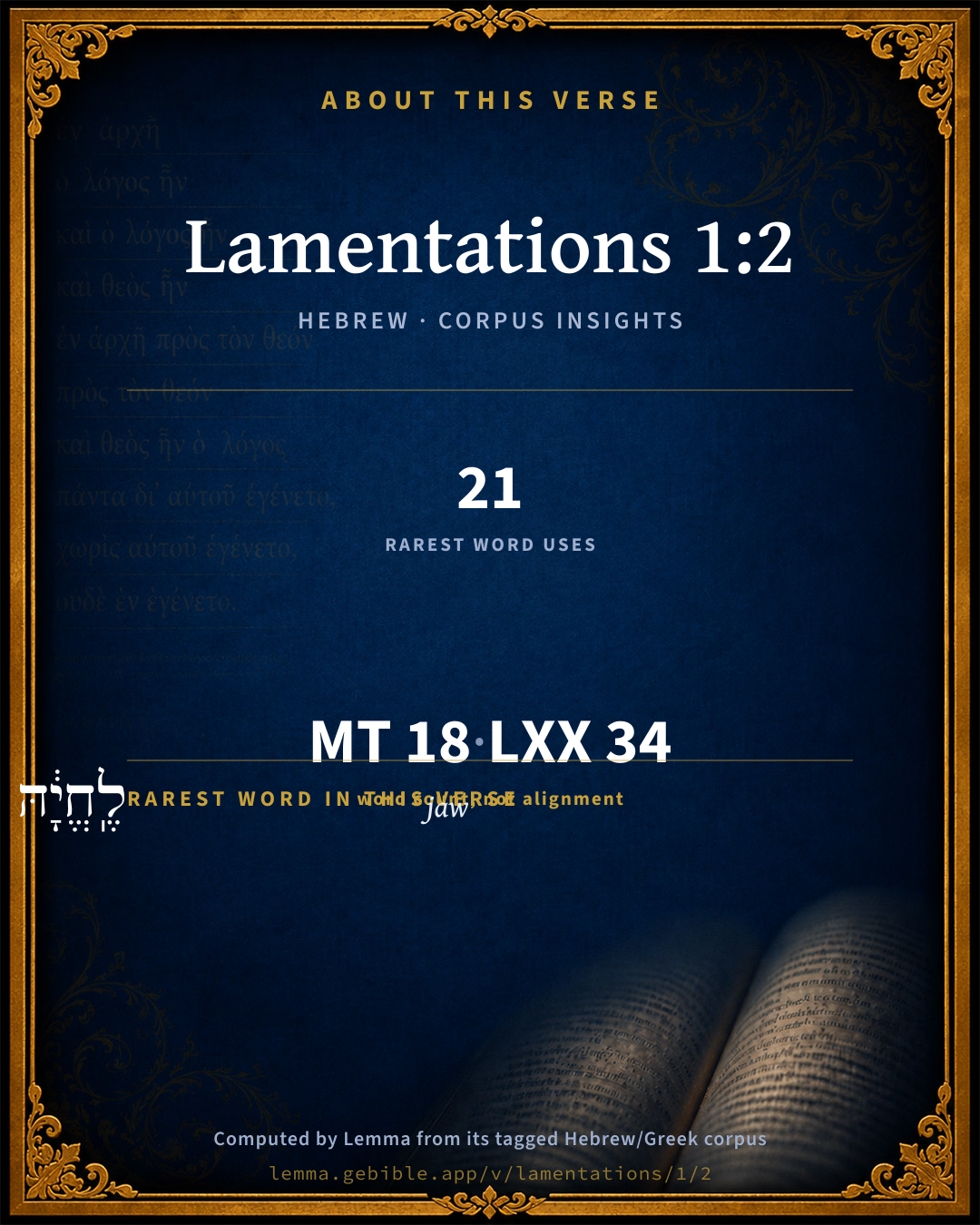
The rarest word here is לֶֽחֱיָ֔הּ jaw H3895 — appearing just 21 times in the whole Hebrew Bible.

Shared distinctive vocabulary

לֶֽחֱיָ֔הּ jaw H3895 occurs in 20 verses of the Hebrew Bible. Also found in:

Grammatical profile

  • 7 verbs
  • 6 nouns
  • 4 prepositions
  • 1 particle

Verb forms

  • בָּכ֨וֹ Qal · Infinitive Absolute
  • תִבְכֶּ֜ה Qal · Imperfect
  • מְנַחֵ֖ם Piel · Participle Active
  • אֹהֲבֶ֑יהָ Qal · Participle Active
  • בָּ֣גְדוּ Qal · Perfect
  • הָ֥יוּ Qal · Perfect
  • לְאֹיְבִֽים Qal · Participle Active

Repetition

Words recur within this verse — often emphatic in Hebrew:

  • בָּכ֨וֹ to weep H1058 ×2
  • מִכָּל all H3605 ×2

Hebrew & Septuagint length

In English translation the verse runs 36 words from the Hebrew and 40 from the Septuagint (LXX English) — closely comparable.

A rough comparison of the two English renderings, which tokenize alike — not a word-level alignment.

Word counts can differ between the Hebrew and the Greek without any difference in meaning — e.g. the Hebrew direct-object marker אֵת has no separate Greek word, and Greek often adds the article ὁ.

In the original languages it is 18 Hebrew tokens and 34 Greek tokens — but the two are counted differently (Hebrew bundles its prefixes and suffixes into one token; the Greek is in lemma form), so that isn’t a like-for-like length.

Cross-references

27

Topical passages linked to Lamentations 1:2 in the Treasury of Scripture Knowledge — connected by theme and wording, ordered by reader-vote popularity; previews shown in the World English Bible.

  • Psalms 6:6 I am weary with my groaning; Every night I flood my bed; I drench my couch with my tears.
  • Micah 7:5 Don't trust in a neighbor. Don't put confidence in a friend. With the woman lying in your embrace, Be careful of the words of your mouth!
  • Job 19:13–14 "He has put my brothers far from me. My acquaintances are wholly estranged from me.
  • Psalms 31:11 Because of all my adversaries I have become utterly contemptible to my neighbors, A fear to my acquaintances. Those who saw me on the street fled from me.
  • Psalms 77:2–6 In the day of my trouble I sought the Lord. My hand was stretched out in the night, and didn't get tired. My soul refused to be comforted.
  • Jeremiah 4:30 You, when you are made desolate, what will you do? Though you clothe yourself with scarlet, though you deck you with ornaments of gold, though you enlarge your eyes with paint, in vain do you make yourself beautiful; [your] lovers despise you, they seek your life.
  • Jeremiah 9:1 Oh that my head were waters, and my eyes a spring of tears, that I might weep day and night for the slain of the daughter of my people!
  • Jeremiah 13:17 But if you will not hear it, my soul shall weep in secret for [your] pride; and my eye shall weep sore, and run down with tears, because Yahweh's flock is taken captive.
  • Jeremiah 22:20–22 Go up to Lebanon, and cry; and lift up your voice in Bashan, and cry from Abarim; for all your lovers are destroyed.
  • Jeremiah 30:14 All your lovers have forgotten you; they don't seek you: for I have wounded you with the wound of an enemy, with the chastisement of a cruel one, for the greatness of your iniquity, because your sins were increased.
  • Lamentations 1:9 Her filthiness was in her skirts; she didn't remember her latter end; Therefore is she come down wonderfully; she has no comforter: See, Yahweh, my affliction; for the enemy has magnified himself.
  • Lamentations 1:16–17 For these things I weep; my eye, my eye runs down with water; Because the comforter who should refresh my soul is far from me: My children are desolate, because the enemy has prevailed.
  • Lamentations 1:19 I called for my lovers, [but] they deceived me: My priests and my elders gave up the spirit in the city, While they sought them food to refresh their souls.
  • Lamentations 1:21 They have heard that I sigh; there is none to comfort me; All my enemies have heard of my trouble; they are glad that you have done it: You will bring the day that you have proclaimed, and they shall be like me.
  • Ezekiel 23:22–25 Therefore, Oholibah, thus says the Lord Yahweh: Behold, I will raise up your lovers against you, from whom your soul is alienated, and I will bring them against you on every side:
  • Job 6:15 My brothers have dealt deceitfully as a brook, As the channel of brooks that pass away;
  • Job 7:3 So am I made to possess months of misery, Wearisome nights are appointed to me.
  • Proverbs 19:7 All the relatives of the poor shun him: How much more do his friends avoid him! He pursues them with pleas, but they are gone.
  • Isaiah 51:18–19 There is none to guide her among all the sons whom she has brought forth; neither is there any who takes her by the hand among all the sons who she has brought up.
  • Jeremiah 3:1 They say, If a man put away his wife, and she go from him, and become another man's, will he return to her again? Won't that land be greatly polluted? But you have played the prostitute with many lovers; yet return again to me, says Yahweh.
  • Jeremiah 9:17–19 Thus says Yahweh of Hosts, Consider you, and call for the mourning women, that they may come; and send for the skillful women, that they may come:
  • Lamentations 2:11 My eyes do fail with tears, my heart is troubled; My liver is poured on the earth, because of the destruction of the daughter of my people, Because the young children and the infants swoon in the streets of the city.
  • Lamentations 2:18–19 Their heart cried to the Lord: wall of the daughter of Zion, let tears run down like a river day and night; Give yourself no respite; don't let the apple of your eye cease.
  • Ezekiel 16:37 therefore see, I will gather all your lovers, with whom you have taken pleasure, and all those who you have loved, with all those who you have hated; I will even gather them against you on every side, and will uncover your nakedness to them, that they may see all your nakedness.
  • Hosea 2:7 She will follow after her lovers, But she won't overtake them; And she will seek them, But won't find them. Then she will say, 'I will go and return to my first husband; For then was it better with me than now.'
  • Revelation 17:13 These have one mind, and they give their power and authority to the beast.
  • Revelation 17:16 The ten horns which you saw, and the beast, these will hate the prostitute, and will make her desolate, and will make her naked, and will eat her flesh, and will burn her utterly with fire.

Cross-references courtesy of OpenBible.info (CC BY 4.0).

Hebrew and Greek witnesses Masoretic Hebrew ↔ Greek Septuagint

The same verse in the two great witnesses to the Old Testament, shown verse-for-verse.

These are two independent witnesses, not word-aligned to each other, and the Septuagint is shown in lemma (dictionary) form.

Hebrew Lamentations 1:2 Masoretic · Westminster Leningrad Codex

בָּכ֨וֹ תִבְכֶּ֜ה בַּלַּ֗יְלָה וְדִמְעָתָהּ֙ עַ֣ל לֶֽחֱיָ֔הּ אֵֽין לָ֥הּ מְנַחֵ֖ם מִכָּל אֹהֲבֶ֑יהָ כָּל רֵעֶ֨יהָ֙ בָּ֣גְדוּ בָ֔הּ הָ֥יוּ לָ֖הּ לְאֹיְבִֽים

She weeps sore in the night, and her tears are on her cheeks; Among all her lovers she has none to comfort her: All her friends have dealt treacherously with her; they are become her enemies.

World English Bible · Public Domain

Greek LXX Lamentations 1:2 Septuagint · lemma form

κλαίω κλαίω ἐν νύξ καί ὁ δάκρυ αὐτός ἐπί ὁ σιαγών αὐτός καί οὐ ὑποἄρχω ὁ παρακαλέω αὐτός ἀπό πᾶς ὁ ἀγαπάω αὐτός πᾶς ὁ φιλέω αὐτός ἀθετέω ἐν αὐτός γίγνομαι αὐτός εἰς ἐχθρός

BETH. She weeps sore in the night, and her tears are on her cheeks; and there is none of all her lovers to comfort her: all that were her friends have dealt deceitfully with her, they are become her enemies.

LXX2012 (modern English Septuagint) · Public Domain

Hebrew: Westminster Leningrad Codex (CC BY 4.0). Greek: Septuagint (public domain); English from LXX2012 (modern English Septuagint) (Public Domain). How the Septuagint differs from the Hebrew →

Commentary

Notes on Lamentations 1:2 from classic Christian and Jewish commentators (each source and its license shown beneath its notes). The classic Christian expositions comment on the surrounding passage and are grouped to its opening verse, so a note may address several verses; the Jewish commentaries on the Tanakh (Rashi and others) are per-verse, so they appear only where the commentator wrote on this verse.

Lemma curates 59 commentaries, every one of them public domain or Creative Commons licensed, each selected and text-cleaned for this edition rather than reprinted as found. About our sources →

Trapp's Complete Commentary

John Trapp

Lam 1:2 She weepeth sore in the night, and her tears [are] on her cheeks: among all her lovers she hath none to comfort [her]: all her friends have dealt treacherously with her, they are become her enemies.

Ver. 2. She weepeth sore.] Heb., Weeping she weepeth - i.e., sadly and soakingly, or as we say, savourly, seeking that way to ease her sorrow, which is so deep and downright.

“ Expletur lachrymis, egeriturque dolore. ”

In the night.] When grief may have its full forth, and when widows are most sensible of their solitary and forlorn condition. She weeps when she should sleep.

“ Iam iacet in viduo squallida facta toro. ”

And her tears are on her cheeks.] Haerent et perennant, seldom or never are they off. As hinds by calving, so she by weeping, cast out her sorrows. {Job 39:3}

Among all her lovers she hath none to comfort her.] Optimum solarium sodalitium, saith one; and Affert solarium lugentibus suspiriorum societas, saith another father. It was no small aggravation of Jerusalem’s misery, that her confederates proved miserable comforters, and her allies kept aloof off, so that she had none to compassionate her. This is also none of the smallest torments of the damned ghosts, that they are unpitied of their best friends and nearest relations.

All her friends have dealt treacherously with her.] The Edomites and Moabites. Ishmael the son of Nethaniah, and Johanan the son of Kareah, &c. Every sinner shall one day take up this lamentation. And why? "They have forsaken the fountain of living waters, and hewed them out broken cisterns, that can hold no water." {Jer 2:13}

John Trapp, A Commentary or Exposition upon All the Books of the Old and New Testament (1647–1656) — public domain. Text from a community e-Sword module.

The Biblical Illustrator

Joseph S. Exell

Lam_1:2

She weepeth sore in the night.

Lonely sorrow

1. According to the measure of Gods correcting hand upon us, must our grief be.

(1) Because God is sure to be (at the least) so angry as His rods are heavy.

(2) Our sins do cause Him to afflict us, which we must repent of according to the measure of Gods anger against them appearing by His smiting of us. This reproves them that remain unrepentant, when the correcting hand of God is upon them. It teaches us to increase in sorrow and lamentation, seeing the trouble of the Church in general, and our own crosses in particular are daily increased.

2. Weeping for sin and its punishment is such a sign of true repentance as we must labour to show forth, especially in time of calamity.

(1) Because the heart appeareth then to be truly affected when it breaketh into tears.

(2) The godly have always been brought thereunto (Joe_2:12). This reproves our corruption, that can easily be brought to weep for a worldly loss, but hardly for our sins. We must labour against this with all diligence, carefully using all the means of grace.

3. It is a grievous plague to lack comforts in affliction; the contrary whereof is a great blessing.

(1) Because the comfortable words and deeds of others will mitigate the sense of the misery.

(2) It adds to the grief to be left alone in it.

4. It is an intolerable grief to have friends become foes.

(1) Because we put great trust in our friends, and promise ourselves much assistance by them.

(2). They having been most inward with us, may do us more harm than those whom we have always esteemed enemies. Let us take heed with what men we make friendship. Let us not be dismayed though our friends become our foes, seeing it hath been often the lot of the godly, but seek to God the more earnestly for His assistance.

5. God often leaveth His people destitute of all outward help and comfort, to teach us to rest upon Him alone at whose disposition all things are, and not upon any outward thing, seem it never so glorious to our outward eyes. (J. Udall.)

All her friends have dealt treacherously with her.

Adversity the test of friendship

We do not know our friends until we are in some extremity. Fair-weather friends are not to be implicitly trusted. You cannot know a man until you have had occasion to test him by some practical sacrifice; until you have opposed a man you do not know what his temper is; until you have disappointed a man you cannot tell the extent of his good nature; until you have seen a man in trial you know nothing whatever of his grace or his virtue. Many persons shine the more brightly because of the surrounding darkness; they have no genius for conversation, they cannot display themselves in public, they are but poorly feathered and coloured, so that they have nothing to attract and gratify the attention of curiosity: but how full of life they are when their friends are in trouble, how constant in watchfulness, how liberal in contribution, how patient under exasperation! These are the men to trust! As we should never see the stars but for the darkness, so we never should see real friendship but for our affliction and sorrow. (J. Parker, D. D.)

The Biblical Illustrator, edited by Joseph S. Exell (c. 1880s–1900s) — public domain. Text from a community e-Sword module.

Joseph Benson's Commentary

Lam 1:2. She weepeth sore in the night — In the Hebrew, according to the idiom of that language, it is, Weeping she weepeth, which our old English version renders, She weepeth continually. The expression, in the night, is interpreted by some to signify her condition was so unhappy that, though oppressed with calamities, she did not dare to utter her complaints, unless secretly in the night, for fear of irritating her enemies. Among all her lovers she hath none to comfort her — Those nations that courted her alliance in the time of her prosperity, or those allies, whose friendship she courted by sinful compliances, have forsaken her in her affliction, and joined with her enemies in insulting over her. “Several of the neighbouring princes sent their ambassadors to Zedekiah, Jer 27:3, &c., to engage him, as appears from the context, to join them in a confederacy against the power of the king of Babylon. But they not only universally failed, and deserted Judah in the time of need, but most of them turned against her, and took a malignant pleasure in aggravating her misfortunes.” See Blaney and the margin.

Joseph Benson's Commentary on the Old and New Testaments (1811–1818) — public domain. Text from a community e-Sword module.

Tyndale Open Study Notes

Tyndale Open Resources

1:2 The lovers were the fertility deities, Baal and Asherah, who were worshiped by most people in Judah. Her friends were her military allies, notably Egypt, who was no match for Babylon (Jer 37:5-11).

Tyndale Open Study Notes — © Tyndale Open Resources, licensed CC BY-SA 4.0. Text via the HelloAO Bible API.

Geneva Bible (1599)

Geneva Bible translators

So that she taketh no rest.

Meaning, the Egyptians and Assyrians, which promised help.

Geneva Bible (1599) marginal notes — public domain. Text via Bolls.life.

Jamieson, Fausset & Brown

Robert Jamieson, A. R. Fausset & David Brown

in the night--even in the night, the period of rest and oblivion of griefs (Job 7:3).

lovers . . . friends--the heathen states allied to Judah, and their idols. The idols whom she "loved" (Jer 2:20-25) could not comfort her. Her former allies would not: nay, some "treacherously" joined her enemies against her (Kg2 24:2, Kg2 24:7; Psa 137:7).

Jamieson, Fausset & Brown — Commentary Critical and Explanatory on the Whole Bible (1871) — public domain (CC PDM 1.0). Text via the HelloAO Bible API.

Adam Clarke's Commentary

Verse 2. Among all her lovers] Her allies; her friends, instead of helping her, have helped her enemies. Several who sought her friendship when she was in prosperity, in the time of David and Solomon, are now among her enemies.

Adam Clarke's Commentary on the Bible (1810–1826) — public domain. Text from a community e-Sword/MySword module.

John Calvin's Commentaries

Jeremiah still pursues the same subject, for he could not have spoken briefly and in a few words of things so bitter and mournful; and he seems to have felt deeply the ruin of his own country. And when we wish to penetrate into the hearts of those whose sorrow we desire to alleviate, it is necessary that they should understand that we sympathize with them. For when any one stronger than another seeks to mitigate another’s grief, he will be disregarded if what he adduces seems to proceed from an unfeeling barbarity. Had, then, Jeremiah spoken as it were in contempt., he could have hardly hoped for any fruit from his teaching, for the Jews would have thought him void of all human feelings. This, then, is the reason why he bewails, as one of the people, the calamity of the city. He did not, however, dissemble in any degree in the history he related; but we know that God’s servants, while they speak in earnest, do not yet forget prudence; for they regard in this respect what is useful; and their doctrine ought in a manner to be so regulated as to produce effect on the hearers.

He then says that the weeping of Jerusalem was continual; for he says first, Weeping she wept, and then, in the night; by which words he means that there was no intermission. For the night is given us for rest, and God intends some relaxation to men by the interchange of nights and days. When, therefore, the Prophet says that Jerusalem, weeping, wept in the night, he intimates that her sorrow, as I have stated, was continual. Then he adds, her tears are on her cheeks. Some render it jaws, but improperly; the word לחי, lachi, indeed means a jaw, but it is to be taken for cheeks, or cheek-bones. Then he means that tears were so profuse as to wet the whole face. It is possible in weeping to restrain tears; but when they flow over the whole face and cover the cheeks, it is an evidence of great mourning. This, then, is the reason why the Prophet says that tears were on her cheeks; for he wished to shew that tears were profusely shed.

He says further, She has no comforter. And this circumstance ought to be noticed, for nothing is more seasonable in grief than to have friends near us to shew us kindness, to be partakers of sorrow, and to apply the consolations which may be had. But when no one feels for us in our evils, our sorrow is much more increased. The Prophet then says that there was no one seeking to soothe the griefs of Jerusalem. He adds, of all thy friends. Had Jerusalem been always forsaken, she could have borne it better when no comforter was present. For we see that miserable men are not thus soft and tender when very grievous calamities happen to them; they do not look here and there for friends to come to them, and why? because they have always been disregarded. It is, then, nothing new to them, even in the greatest adversities, to have no one to shew them any tokens of kindness. But when they who have had many friends, and thought that they would be always ready to bring them aid — when they see themselves forsaken, their sorrow becomes much more grievous. This, then, is what the Prophet means in saying, that of many friends there were none to comfort Jerusalem in her miseries.

There is not yet a doubt but that he indirectly reproved Jerusalem; and by אהבים, aebim, he understood lovers, as we have seen in other places; for as they thought themselves safe by means of ungodly treaties, the prophets say that they were like harlots who everywhere prostitute themselves and make gain by their lasciviousness, and allure lovers on every side. It was, therefore, right of the Prophet to remind the Jews in this place of that wickedness, even that they had conciliated at one time the Egyptians, at another, the Assyrians, like an impudent woman, who is not satisfied with her own husband, but draws lovers from all quarters. However this may be, he no doubt understands by friends those who confederated with them; and who were these? even those with whom the Jews had connected themselves, having disregarded God; for they had been sufficiently warned by the prophets not to form connections with the heathens. But, at. the same time, Jeremiah sets forth the atrocity of the thing by saying that there was none of all her friends a comforter to Jerusalem, because all her friends had acted perfidiously. It follows, —

John Calvin's Commentaries (1540-1563) — public domain. Text from the Calvin Translation Society English edition (1840s-50s) via the Christian Classics Ethereal Library (ccel.org). Calvin's coverage is partial (roughly two-thirds of the Bible); uncommented books and verses are honest gaps, never fabricated. The 19th-century editor's footnotes and remarks are omitted so the notes are faithfully Calvin's own voice.

Ellicott's Commentary for English Readers

(2) She weepeth sore in the night.—The intensity of the sorrow is emphasised by the fact that the tears do not cease even in the time which commonly brings rest and repose to mourners. The “lovers” and the “friends” are the nations, Egypt (Jer_2:36), Edomites, Moabites, and others, with which Judah had been in alliance, and which now turned against her. (Comp. Psa_137:7; Eze_25:3-6; Jer_40:14, for instances of their hostility, and specially Lam_4:21.)

A Bible Commentary for English Readers, edited by Charles John Ellicott (1878–1897) — public domain. Text from a community e-Sword module.

The Cambridge Bible for Schools and Colleges

gen. ed. J. J. S. Perowne

2. in the night] The time of natural silence and darkness is made a part of the picture in order to heighten the effect. The absence of the distractions of the day intensifies the sense of bereavement.

her lovers (cp. Lam_1:19) … her friends] the neighbouring states, with whom in the sunshine of prosperity she was on friendly terms (cp. Jer_4:30; Jer_30:14). Such were Chaldaeans, Syrians, Moabites, Ammonites (2Ki_24:2), Edomites (Psa_137:7), Tyrians (Eze_26:3), Egyptians (Eze_17:17; Eze_29:6 ff.). For these last cp. Lam_4:17; Jer_37:5; for Edom Lam_4:21 f.; and for Ammon, Jer_40:14; Eze_25:3-7.

her friends … enemies] In the original there is a figure of paronomasia (’ohãbçha, ’oyĕbîm).

The Cambridge Bible for Schools and Colleges (gen. ed. J. J. S. Perowne; Cambridge University Press, 1878–1918) — public domain. Text from a community e-Sword module.

John Gill's Exposition

She weepeth sore in the night,.... Or, "weeping weeps" (i); two weepings, one for the first, the other for the second temples (k); and while others are taking their sleep and rest; a season fit for mourners, when they can give their grief the greater vent, without any interruption from others; and it being now a night of affliction with her, which occasioned this sore weeping. Jarchi observes, that it was in the night that the temple was burnt:

and her tears are on her cheeks; continue there, being always flowing, and never wholly dried up; which shows how great her grief was, and that her weeping was without intermission; or otherwise tears do not lie long, but are soon dried up, or wiped off:

among all her lovers she hath none to comfort her; as the Assyrians formerly were, Eze 23:5; and more lately the Egyptians her allies and confederates, in whom she trusted; but these gave her no assistance; nor yielded her any relief in her distress; nor so much as spoke one word of comfort to her:

all her friends have dealt treacherously with her, they are become her enemies; those who pretended great friendship to her, and were in strict alliance with her, acted the treacherous part, and withdrew from her, leaving her to the common enemy; and not only so, but behaved towards her in a hostile manner themselves; for "the children of Noph and Tahapanes", places in Egypt confederate with the Jews, are said to "have broken the crown of their head", Jer 2:16. The Targum interprets the "lovers" of the "idols" she loved to follow, who now could be of no use unto her by way of comfort.

(i) "plorando plorat", Vatablus; "plorando plorabit", Pagninus, Montanus. (k) T. Sanhedr. ib. col. 2.

John Gill's Exposition of the Whole Bible (1746–1763) — public domain (CC PDM 1.0). Text via the HelloAO Bible API.

Albert Barnes' Notes on the Bible

Lovers ... friends - i. e. the states in alliance with Judaea, and all human helpers.

Albert Barnes' Notes on the Bible (1834–1885) — public domain. Text from a community e-Sword/MySword module.

Haydock's Catholic Bible Commentary

Night; privately, or without ceasing. --- Friends, who had made a league with Sedecias, chap. xxvii. 3., and xlviii. 26.

George Leo Haydock (1774–1849), Haydock's Catholic Family Bible and Commentary, 1859 edition — public domain. Excludes Psalms (Douay-Rheims chapter numbering differs from Protestant) and Deuterocanonical books (Catholic canon only).

Matthew Poole's English Annotations

All her hours are hours of sadness, she doth not only mourn in the day time, but in the night also, when she should rest; her cheeks are like the grass in the morning, hanging full of drops, as if her head were a fountain of water, and her eyes rivers of tears. In her prosperity she had a great many friends that sought and courted her favour, with whom she made leagues and confederated (such were the Egyptians, Assyrians, &c.); but they were now so far from helping the Jews, that they helped their enemies, and dealt treacherously with them, becoming themselves enemies instead of assistants to them.

Matthew Poole's English Annotations on the Holy Bible (1683–1685) — public domain. Text from a community e-Sword/MySword module.

Whedon's Commentary on the Bible

Daniel D. Whedon

2. Weepeth… in the night — “Night” is mentioned, not as excluding, but rather including, day. Her grief is so poignant that her tears do not cease to flow even in the night time, which ought to be a season of rest and oblivion of grief.

Lovers — The nations friendly to the Jews; and, in general, all human comforts.

Daniel D. Whedon (gen. ed.), Commentary on the Old and New Testaments (1874–1909) — public domain. Text from a community e-Sword module.

The Pulpit Commentary

In the night. Not only by day, but even in the season of rest and unconsciousness. Her lovers... her friends; i.e. the neighbouring peoples, with which Judah had formed alliances, such as Egypt, (Jer_2:36) Edom, Moab, Ammon, Tyre and Sidon. (Jer_27:3) This is a favourite phrase of Jeremiah"s, (comp. Jer_3:1 Jer_4:30 Jer_22:20, 22 30:14) but also of Hosea (Hos_2:5, Hos_2:7, Hos_2:10, Hos_2:12, 13 8:9) and Ezekiel. (Eze_16:33, Eze_16:36, 37 23:5, 9, 22) The national God was conceived of as the Husband of the nation; and the prophets retained this idea and elevated it, just as they did circumcision and many other Eastern traditions.

Comfortless.

In her distress Jerusalem looks for comfort to those neighbouring nations which flattered her during her prosperity and behaved then as "lovers;" but she is disappointed in finding that they all desert her in the hour of her need.

I IT IS NATURAL TO SEEK FOR COMFORT IN ADVERSITY FROM THE FRIENDSHIPS OF PROSPERITY. Jerusalem had her "lovers." This fact throws a significant light on the statement that she had "become as a widow" (ver. 1). What shame that she, the wife of the Eternal, should have to be spoken to of "lovers"! But having them she must find her comfort in them. She dare not look to her husband for comfort. In plainer language, the Jews had adopted the idolatry of neighbouring nations as well as renounced the exclusive and retiring position which had been required of them by their God. It was fitting that they should find their consolation from the Babylonian invasion in these foreign connections and religions. If we let our business, our pleasure, our ambition, or any other earthly thing usurp the place of God in our hearts, the time will come when we shall have to try what help we can get in trouble from our idol.

II UNWORTHY CONNECTIONS WILL AFFORD NO COMFORT IN TIMES OF TROUBLE. The lovers are for pleasure; adversity dismisses them. How bitter is the disappointment! how mortifying is the revelation! The true husband could have been depended on, but the bad lovers for whom he was forsaken coldly turn from the piteous pleading of the sufferer. Thus must it be with every one who forsakes the one Friend and Comforter. No other balm of Gilead will heal the broken heart. What can the pleasures of society say to one who has failed and disgraced himself? What consolation can a materialistic philosophy whisper in the ears of the mourner by the grave? How will the science of the history of religion smooth the pillow of the dying man?

III THE LAST DROP OF THE BITTER CUP IS TO BE COMFORTLESS. Mere formal consoling is a weariness when it is not an insult to grief. But the comfort of sympathy, the soothing of love, and the cheering of congenial companionship are Divine remedies for sorrow. They are lights in the gloom, though they do not bring the day; gentle hands to wipe away the tears, the flowing of which they may not be able to stanch.

The most desolate picture is that of one like Jerusalem in this elegy, weeping sore in the night, with no friendly ray to break the darkness, and no one to remove the tears that fall upon the cheeks unheeded and neglected, crying for comfort only to the pitiless silence.

1. Let us learn to dwell in faithfulness with God, that we may enjoy his unfailing sympathy.

2. Let us extend hands of brotherly compassion to the sorrowing, that, whatever be the grief, its last anguish may be spared; and then, through human comfort, we may lead up to the Divine consolations.

Nights of weeping explained.

Nights of weeping and constant tears upon the cheeks. Thus the metaphor is kept up with which this first song of lamentation begins. The sensitiveness of the woman nature helps to bring out the prostration of Jerusalem. It is not only that her condition is lamentable, but she herself, in all the feelings of her heart, is a prey to the keenest anguish. People do not always see their own sad state as others see it. There is either a shallowness of nature or something has happened to deaden the sensibilities. But in this verse we have both the mention of tears and of most sufficient causes for tears.

I FIRST CAUSE: WANT OF SYMPATHY AND SOLACE. Jerusalem has no comforters. Not even Job"s comforters. For, though Job"s comforters were sufficiently irritating and mistook blisters for salves, yet comfort was their errand. Bad as Job"s state was, it would have been worse still if in his time of sore trouble he had been left quite alone, especially if professed friends had not come near him. But here the widowed Jerusalem has no comforter; and yet she had had many lovers, many who had been drawn irresistibly by the charm of her attractions. Jerusalem was proud of these attractions, and yet they did not belong to the essence of her existence. The attractions perished, and with the perishing of them the lovers whom they drew became cold. The attractions perished, but Jerusalem herself remained with all her needs, and yet with none to minister. Where do we mean to look for comforters when our hour of deepest trouble comes? Many to whom we may look will be able to do nothing for us; some to whom we may look will not try to do anything: happy then shall we be if we have reason to say, "In the multitude of my thoughts within me, thy comforts delight my soul". (Psa_94:19)

II SECOND CAUSE: FRIENDS HAVE BECOME ENEMIES. When the attractions of Jerusalem faded away, not only did the lovers depart, but they had to seek new satisfactions elsewhere, and for many selfish reasons they would act in sympathy with the conquerors of Jerusalem. When she was a strong city, it suited surrounding peoples to be friendly; but when she became desolate and the whole land was lost, then it seemed the interest of these peoples to be hostile to Jerusalem. Indeed, their connection with Jerusalem was really hostile even when they meant friendship. Their open and strenuous hostility from the first would have been a better thing. Professed friends, without meaning it, may so mislead as to do more harm than the bitterest enemy could ever do. The real friend is he who, for the sake of truth and of the highest interests, is not afraid to be reckoned for the time an enemy. Y.

The Pulpit Commentary (1880–1919), ed. H.D.M. Spence-Jones & Joseph S. Exell — public domain. Text from a community e-Sword module.

Keil & Delitzsch

C. F. Keil & F. Delitzsch

In this sorrow of hers she has not a single comforter, since all her friends from whom she could expect consolation have become faithless to her, and turned enemies. בּכו תבכּה, "weeping she weeps," i.e., she weeps very much, or bitterly, not continually (Meier); the inf. abs. before the verb does not express the continuation, but the intensity of the action Gesenius, 131, 3, a; Ewald, 312]. בּלּילה, "in the night," not "on into the night" (Ewald). The weeping by night does not exclude, but includes, weeping by day; cf. Lam 2:18. Night is mentioned as the time when grief and sorrow are wont to give place to sleep. When tears do not cease to flow even during the night, the sorrow must be overwhelming. The following clause, "and her tears are upon her cheek," serves merely to intensify, and must not be placed (with Thenius) in antithesis to what precedes: "while her sorrow shows itself most violently during the loneliness of the night, her cheeks are yet always wet with tears (even during the day)." But the greatness of this sorrow of heart is due to the fact that she has no comforter, - a thought which is repeated in Lam 1:9, Lam 1:16, Lam 1:17, and Lam 1:21. For her friends are faithless, and have become enemies. "Lovers" and "friends" are the nations with which Jerusalem made alliances, especially Egypt (cf. Jer 2:36.); then the smaller nations round about, - Edomites, Moabites, Ammonites, and Phoenicians, with which Zedekiah had conspired against the king of Babylon, Jer 27:3. Testimony is given in Psa 137:7 to the hostile dealing on the part of the Edomites against Judah at the destruction of Jerusalem; and Ezekiel (Eze 25:3, Eze 25:6) charges the Ammonite and Tyrians with having shown malicious delight over the fall of Jerusalem; but the hostility of the Moabites is evident from the inimical behaviour of their King Baalis towards Judah, mentioned in Jer 40:14.

Keil & Delitzsch — Biblical Commentary on the Old Testament (1861–1891) — public domain (CC PDM 1.0). Text via the HelloAO Bible API. (Old Testament only.)

Rashi

Rabbi Shlomo Yitzchaki (Rashi)

She weeps, yea, she weeps weeping twice over the two destructions.

in the night for the Temple was burned at night, as the master said (Ta’an. 29a): “At eventide, they ignited the fire upon it.” Another explanation: because of the night—the night of the weeping of the Spies on the ninth of Av caused it to happen to them (Lam. Rabbah ms. 1:178, Targum, Sanh. 104b, Ta’an. 29a). Another explanation: in the night—for whoever weeps at night, the one who hears his voice weeps along with him (Lam. Rabbah 1:24, Sanh. ad loc.).

and her tears are on her cheek since she weeps constantly.

all her friends those who love her.

Rashi on the Tanakh — English translations: “The Judaica Press complete Tanach with Rashi, translated by A. J. Rosenberg” (CC BY 4.0); “Pentateuch with Rashi's commentary by M. Rosenbaum and A.M. Silbermann, 1929-1934” (public domain); “The Metsudah Tanach series, Lakewood, N.J” (CC BY 4.0); and “The Book of Joshua, Metsudah Publications, 1997” (CC BY 4.0). Text via Sefaria.

Ibn Ezra

Rabbi Abraham ibn Ezra

The letter "Vav" replaces the letter "Aleph" in the word "Bekho" (בכו), as the letters Aleph, Hey, Vav, Yud can be interchanged. For example, in the phrase "Hiskalta Esav" (הסכלת עשו), where the original word is "Hiskalta" with the letter "Hey" but can be transformed to "Bekhelta" with the letter "Vav".

Ibn Ezra on the Tanakh — English translations: “Sefaria Community Translation” (CC0 1.0 (public-domain dedication)); “Yalkut, Sifsei Chachomim Chumash, Metsudah Publications, 2009” (CC BY 4.0); and “Commentary of Ibn Ezra on Isaiah - trans. by M. Friedlander, 1873” (public domain). Text via Sefaria.

Lesson kit

Teaching starters — assembled from the data on this page, not authored interpretation. Every prompt links to the verse data it draws on. Edit before teaching.

Lamentations, in the Prophets, opens this verse with 18 words (13 distinct Hebrew lemmas). Its most distinctive word is lᵉchîy (“jaw”). A historical commentator’s framing appears above. Read the whole chapter for the surrounding context.

Discussion questions

  1. What does “jaw” (lᵉchîy) contribute to the verse as a whole?
  2. Deuteronomy 18:3 shares the word «jaw» with this verse. How do the two illuminate each other?
  3. “to weep” occurs 2× in this one verse. What is the effect of the repetition?
  4. The translations on this page render this verse differently — a whole-verse word diff, not a word-by-word alignment. What might account for the different wordings?
  5. The verb «בָּכ֨וֹ» is Qal Infinitive Absolute. How does its form color the action?
  6. Reading how Trapp's Complete Commentary and The Biblical Illustrator read this verse, where do the two commentators agree and where do they part?

Things to notice

Reading settings

Reading text

Shown beneath each verse's original-language words.

Old Testament
Old Testament edition

Read the OT as the Masoretic Hebrew (MT) or the Greek Septuagint (LXX).

English shown for the Greek Septuagint (in the Hebrew ↔ Greek comparison).

Comparing translations? Open the Compare panel on any verse page to stack up to four side by side.