Psalms 31:23

Hebrew (Westminster Leningrad Codex) Psalms 31:23 appears in the Hebrew Old Testament. The text above is from the Westminster Leningrad Codex. Each word links to its Strong’s number, a concise gloss, and parsing drawn from the Open Scriptures Hebrew Bible morphology. Click any word for its full Brown-Driver-Briggs (BDB) entry.
Download image
Cite this verse

Psalms 31:23 (World English Bible). Public Domain. Lemma interlinear Bible study tool, https://lemma.gebible.app/v/psalms/31/23.

Show BibTeX & RIS
BibTeX
RIS
English Translation
Oh love Yahweh, all you his saints! Yahweh preserves the faithful, And pays back him who deals proudly in full.
World English Bible · Public Domain
Download a study sheet

One document with this verse’s original text, its word-by-word gloss line, the meaning frame, cross-references with their text, attributed commentary, and full source and license credits — printable, and it pastes into notes with its structure intact.

This verse Autodidact and up

Study sheet (.html) Plain text (.txt)

A passage Seminary Student

Up to 50 verses in one chapter. A passage sheet keeps up to 6 commentary sources and 12 cross-references per verse, in the order this page ranks them, and says so on the sheet whenever that leaves anything out. Ask for a single verse and you get the Autodidact verse sheet above.

Everything on this page stays free to read, with no account — the sheet is a download of what is already on screen, not access to it.

Want to remove ads? Support Godless Engineer
Compare translations 3

The same verse in 3 English versions, stacked beneath the original-language interlinear above. Click any original word for its lexicon entry.

Each is an independent rendering of the whole verse — the interlinear is not word-aligned to these translations.

Highlighted words mark where these versions differ — a whole-verse word diff, not a word-by-word alignment.

  • World English Bible Public Domain
    Oh love Yahweh, all you his saints! Yahweh preserves the faithful, And pays back him who deals proudly in full.
  • King James Version Public Domain
    O love the LORD, all ye his saints: for the LORD preserveth the faithful, and plentifully rewardeth the proud doer.
  • unfoldingWord Literal Text CC BY-SA 4.0
    Love Yahweh, all faithful ones! Yahweh preserves the faithful, but he pays back fully the proud person.

unfoldingWord Literal Text — © unfoldingWord, licensed CC BY-SA 4.0. Word-aligned USFM3 via Door43 (git.door43.org/unfoldingWord/en_ult).

Versions to compare (up to 4)

3 of 4 selected

Show all 18 translations

Every available English version of this verse, each an independent rendering of the whole verse.

  • World English Bible Public Domain
    Oh love Yahweh, all you his saints! Yahweh preserves the faithful, And pays back him who deals proudly in full.
  • Berean Standard Bible Public Domain
    Love the LORD, all His saints. The LORD preserves the faithful, but fully repays the arrogant.
  • Majority Standard Bible Public Domain
    Love the LORD, all His saints. The LORD preserves the faithful, but fully repays the arrogant.
  • King James Version Public Domain
    O love the LORD, all ye his saints: for the LORD preserveth the faithful, and plentifully rewardeth the proud doer.
  • American Standard Version (1901) Public Domain
    Oh love Jehovah, all ye his saints: Jehovah preserveth the faithful, And plentifully rewardeth him that dealeth proudly.
  • Revised Version (1885) Public Domain
    O love the LORD, all ye his saints: the LORD preserveth the faithful, and plentifully rewardeth the proud doer.
  • Geneva Bible (1599) Public Domain
    Loue ye the Lord all his Saintes: for the Lord preserueth the faithfull, and rewardeth abundantly the proud doer.
  • Douay-Rheims (1899) Public Domain
    But I said in the excess of my mind: I am cast away from before thy eyes. Therefore thou hast heard the voice of my prayer, when I cried to thee.
  • Young's Literal Translation Public Domain
    Love Jehovah, all ye His saints, Jehovah is keeping the faithful, And recompensing abundantly a proud doer.
  • Literal Standard Version CC BY-SA 4.0
    Love YHWH, all you His saints, || YHWH is keeping the faithful, || And repaying a proud doer abundantly.
  • Unlocked Literal Bible CC BY-SA 4.0
    Oh, love Yahweh, all you faithful followers. Yahweh protects the faithful, but he pays back the arrogant in full.
  • unfoldingWord Literal Text CC BY-SA 4.0
    Love Yahweh, all faithful ones! Yahweh preserves the faithful, but he pays back fully the proud person.
  • Darby Bible Public Domain
    Love Jehovah, all ye his saints. Jehovah preserveth the faithful, and plentifully requiteth the proud doer.
  • World Messianic Bible Public Domain
    Oh love the LORD, all you his holy ones! The LORD preserves the faithful, and fully recompenses him who behaves arrogantly.
  • Webster's Bible Public Domain
    \\31:22\\For I said in my haste, I am cut off from before thy eyes: nevertheless thou heardest the voice of my supplications when I cried to thee.
  • Free Bible Version CC BY-SA 4.0
    Love the Lord, all you who trust in him! The Lord takes care of those who trust him, but he pays back in full those who are arrogant.
  • Bible in Basic English Public Domain
    O have love for the Lord, all you his saints; for the Lord keeps safe from danger all those who are true to him, and gives the workers of pride their right reward.
  • JPS Tanakh (1917) Public Domain
    (31-24) O love the LORD, all ye His godly ones; the LORD preserveth the faithful, and plentifully repayeth him that acteth haughtily.

Literal Standard Version (2020), Covenant Press — licensed CC BY-SA 4.0. Text via the HelloAO Bible API (eBible.org). Unlocked Literal Bible (unfoldingWord) — licensed CC BY-SA 4.0. Text via the HelloAO Bible API (eBible.org). unfoldingWord Literal Text — © unfoldingWord, licensed CC BY-SA 4.0. Word-aligned USFM3 via Door43 (git.door43.org/unfoldingWord/en_ult). Free Bible Version, Dr. Jonathan Gallagher — licensed CC BY-SA 4.0. Text via the HelloAO Bible API (eBible.org).

Word by word

More ways to search: Search by grammar → Find every occurrence → Compare this word →

Practice this passage: Drill this verse → Learn its vocabulary →

גַאֲוָֽה
gaʼăvâh
H1346
“pride”
Noun, Common, Feminine, Singular, Absolute
Part of Speech
Noun
Type
Common
Gender
Feminine
Number
Singular
State
Absolute
Full BDB Definition

Origin: from H1342

TWOT: 299d

pride, majesty, a rising up - a rising up, swelling (of the sea) - majesty (of Israel) - pride, haughtiness
  1. אֶֽהֱב֥וּ ʼâhab H157 “love” Verb, Qal, Imperative, 2nd Person, Masculine, Plural
  2. אֶת ʼêth H853 “-” Particle, Direct Object
  3. יְהוָ֗ה Yᵉhôvâh H3068 “LORD” Noun, Proper
  4. כָּֽל kôl H3605 “all of” Noun, Common, Masculine, Singular, Construct
  5. חֲסִ֫ידָ֥יו châçîyd H2623 “faithful one · his” Adjective, Adjective, Masculine, Plural, Construct + Suffix, Personal, 3rd Person, Masculine, Singular
  6. אֱ֭מוּנִים ʼâman H539 “faithful” Adjective, Adjective, Masculine, Plural, Absolute
  7. נֹצֵ֣ר nâtsar H5341 “guarding” Verb, Qal, Participle Active, Masculine, Singular, Absolute
  8. יְהוָ֑ה Yᵉhôvâh H3068 “LORD” Noun, Proper
  9. וּמְשַׁלֵּ֥ם shâlam H7999 “and · being at peace” Conjunction + Verb, Piel, Participle Active, Masculine, Singular, Absolute
  10. עַל ʻal H5921 “upon” Preposition
  11. יֶ֝֗תֶר yether H3499 “remainder” Noun, Common, Masculine, Singular, Absolute
  12. עֹשֵׂ֥ה ʻâsâh H6213 “doing” Verb, Qal, Participle Active, Masculine, Singular, Construct

About this verse

These counts appear in no published source. They are computed here, from the morphology-tagged text and Lemma’s own curated glosses. What Lemma adds →

13
words
12
distinct lemmas
Wisdom
section

Notable vocabulary

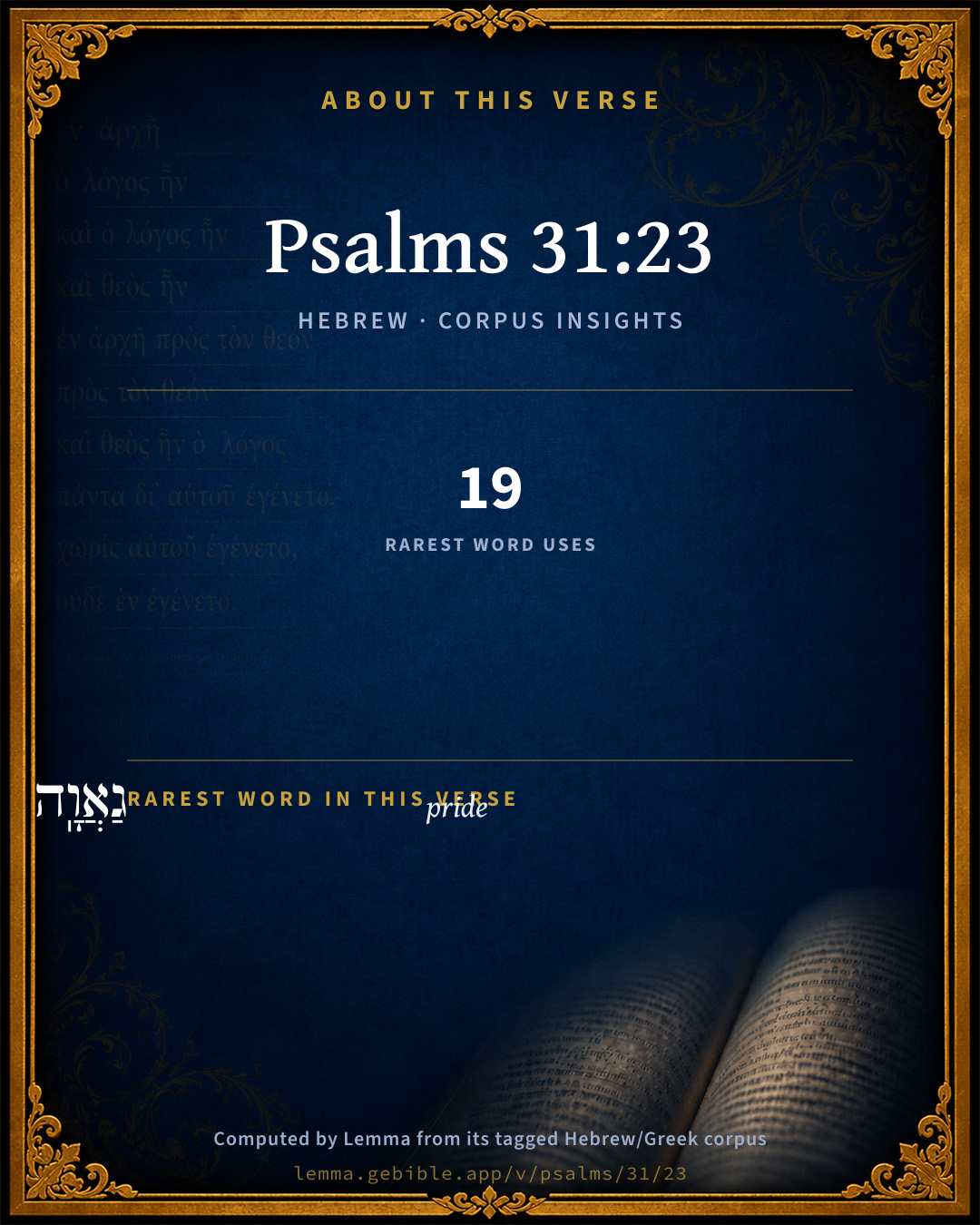
The rarest word here is גַאֲוָֽה pride H1346 — appearing just 19 times in the whole Hebrew Bible.

Shared distinctive vocabulary

גַאֲוָֽה pride H1346 occurs in 19 verses of the Hebrew Bible. Also found in:

Grammatical profile

  • 4 verbs
  • 5 nouns
  • 2 adjectives
  • 1 preposition
  • 1 particle

Verb forms

  • אֶֽהֱב֥וּ Qal · Imperative
  • נֹצֵ֣ר Qal · Participle Active
  • וּמְשַׁלֵּ֥ם Piel · Participle Active
  • עֹשֵׂ֥ה Qal · Participle Active

Repetition

A word recurs within this verse — often emphatic in Hebrew:

  • יְהוָ֗ה LORD H3068 ×2

Hebrew & Septuagint length

In English translation the verse runs 20 words from the Hebrew and 23 from the Septuagint (LXX English) — closely comparable.

A rough comparison of the two English renderings, which tokenize alike — not a word-level alignment.

Word counts can differ between the Hebrew and the Greek without any difference in meaning — e.g. the Hebrew direct-object marker אֵת has no separate Greek word, and Greek often adds the article ὁ.

Cross-references

20

Topical passages linked to Psalms 31:23 in the Treasury of Scripture Knowledge — connected by theme and wording, ordered by reader-vote popularity; previews shown in the World English Bible.

  • Psalms 97:10 You who love Yahweh, hate evil. He preserves the souls of his saints. He delivers them out of the hand of the wicked.
  • Psalms 94:2 Rise up, you judge of the earth. Pay back the proud what they deserve.
  • Psalms 145:20 Yahweh preserves all those who love him, But all the wicked he will destroy.
  • John 10:27–30 My sheep hear my voice, and I know them, and they follow me.
  • Psalms 30:4 Sing praise to Yahweh, you saints of his. Give thanks to his holy name.
  • Psalms 34:9 Oh fear Yahweh, you his saints, For there is no lack with those who fear him.
  • Deuteronomy 33:3 Yes, he loves the people; All his saints are in your hand: They sat down at your feet; [Everyone] shall receive of your words.
  • 1 Samuel 2:9 He will keep the feet of his holy ones; But the wicked shall be put to silence in darkness; For by strength shall no man prevail.
  • 1 Thessalonians 4:1 Finally then, brothers, we beg and exhort you in the Lord Jesus, that as you received from us how you ought to walk and to please God, that you abound more and more.
  • Deuteronomy 10:12 Now, Israel, what does Yahweh your God require of you, but to fear Yahweh your God, to walk in all his ways, and to love him, and to serve Yahweh your God with all your heart and with all your soul,
  • Deuteronomy 32:41 If I whet my glittering sword, My hand take hold on judgment; I will render vengeance to my adversaries, Will recompense those who hate me.
  • Psalms 54:5 He will repay the evil to my enemies. Destroy them in your truth.
  • Psalms 89:7 A very awesome God in the council of the holy ones, To be feared above all those who are around him?
  • Mark 12:23 In the resurrection, when they rise, whose wife will she be of them? For the seven had her as a wife."
  • Revelation 18:6 Return to her just as she returned, and repay her double as she did, and according to her works. In the cup which she mixed, mix to her double.
  • Psalms 145:10 All your works will give thanks to you, Yahweh. Your saints will extol you.
  • Jude 1:1 Jude, a servant of Jesus Christ, and brother of James, to those who are called, sanctified by God the Father, and kept for Jesus Christ:
  • Deuteronomy 30:16 in that I command you this day to love Yahweh your God, to walk in his ways, and to keep his commandments and his statutes and his ordinances, that you may live and multiply, and that Yahweh your God may bless you in the land where you go in to possess it.
  • Isaiah 56:6 Also the foreigners who join themselves to Yahweh, to minister to him, and to love the name of Yahweh, to be his servants, everyone who keeps the Sabbath from profaning it, and holds fast my covenant;
  • Revelation 19:5–6 A voice came forth from the throne, saying, "Give praise to our God, all you his servants, you who fear him, the small and the great!"

Cross-references courtesy of OpenBible.info (CC BY 4.0).

Hebrew and Greek witnesses Masoretic Hebrew ↔ Greek Septuagint

The same verse in the two great witnesses to the Old Testament, shown verse-for-verse.

You’re reading Greek Psalm 30 (Hebrew Psalm 31). The Septuagint counts the superscription, so verse numbers can differ from the Hebrew — chapter-level alignment, not verse-by-verse. Numbering follows Rahlfs.

These are two independent witnesses, not word-aligned to each other, and the Septuagint is shown in lemma (dictionary) form.

Hebrew Psalms 31:23 Masoretic · Westminster Leningrad Codex

אֶֽהֱב֥וּ אֶת יְהוָ֗ה כָּֽל חֲסִ֫ידָ֥יו אֱ֭מוּנִים נֹצֵ֣ר יְהוָ֑ה וּמְשַׁלֵּ֥ם עַל יֶ֝֗תֶר עֹשֵׂ֥ה גַאֲוָֽה

Oh love Yahweh, all you his saints! Yahweh preserves the faithful, And pays back him who deals proudly in full.

World English Bible · Public Domain

Greek LXX Greek Psalm 30:23 Septuagint · lemma form

ἐγώ δέ εἶπον ἐν ὁ ἔκστασις ἐγώ ἀποῥίπτω ἄρα ἀπό πρόσωπον ὁ ὀφθαλμός σύ διά οὗτος εἰςἀκούω ὁ φωνή ὁ δέησις ἐγώ ἐν ὁ κράζω ἐγώ πρός σύ

Love the Lord, all you⌃ his saints: for the Lord seeks for truth, and renders a reward to them that deal very proudly.

LXX2012 (modern English Septuagint) · Public Domain

On this verse, Ellicott's Commentary for English Readers discusses the Septuagint’s reading. Read the note in Commentary ↓

Hebrew: Westminster Leningrad Codex (CC BY 4.0). Greek: Septuagint (public domain); English from LXX2012 (modern English Septuagint) (Public Domain). How the Septuagint differs from the Hebrew →

Commentary

Notes on Psalms 31:23 from classic Christian and Jewish commentators (each source and its license shown beneath its notes). The classic Christian expositions comment on the surrounding passage and are grouped to its opening verse, so a note may address several verses; the Jewish commentaries on the Tanakh (Rashi and others) are per-verse, so they appear only where the commentator wrote on this verse.

Lemma curates 59 commentaries, every one of them public domain or Creative Commons licensed, each selected and text-cleaned for this edition rather than reprinted as found. About our sources →

Trapp's Complete Commentary

John Trapp

Psa 31:23 O love the LORD, all ye his saints: [for] the LORD preserveth the faithful, and plentifully rewardeth the proud doer.

Ver. 23. O love the Lord] Let not your hasty discontent beget in you hard thoughts of God or heavy thoughts against yourselves, as it hath done in me; but love him, trust him, and he will do you right.

And plentifully rewardeth] Heb. repayeth abundantly, or with surplus, in seipso vel in semine suo. It may be rendered, Upon the remainder, and understood of the proud man’s posterity, wherein God will be sure to meet with him.

John Trapp, A Commentary or Exposition upon All the Books of the Old and New Testament (1647–1656) — public domain. Text from a community e-Sword module.

The Biblical Illustrator

Joseph S. Exell

Psa_31:23

O love the Lord, all ye His saints.

Constraining love

Love Jehovah--so the text runs. God the Father demands your love and deserves it, yea, the warmest affection of your hearts. And so also does the Son who redeemed you; and the Holy Spirit, by whom we are born again unto eternal life. But we speak, now, only of the Lord Jesus Christ, and of Him we say, O love the Lord, all, etc.

I. This sentiment should animate every mind.

1. Love the Lord because His Father loves Him. It must always be right for us to love whom God loves.

2. The angels love Him. But shall they love Him who never redeemed them, and shall we, whom He hath redeemed with His precious blood, not love Him?

3. The saints in heaven love Him. We have many friends, very dear to us, there, and they all love Him. And with what intense love. We are cold creatures; like icebergs are our hearts, but theirs are like flames of fire. Shall we not love Him when we think how they love Him?

4. Everything that could possibly enamour our souls and constrain our love is found in Him. Does beauty attract? But what beauty can be compared to His? Wisdom--but whose like His? Perfect character--but where such as His? It were impossible to know Christ and yet not to have the heart affected by Him.

5. And chief of all, because He first loved us. Think of His Incarnation, His agony, His cross. Think how He loved you when you were going on in sin. How, after having received you, He has loved you ever since, and what ill return you have made.

II. The excellencies of loving Jesus.

1. It will make you bear suffering for Him with joyousness.

2. And your service joyous also.

3. And obedience sweet.

4. And communion.

5. Love to Christ will make trust easy. Look at the childs love for its mother, and because of it, even in the midst of danger, it has no fear. But you who have never loved Him, you must trust Him first, give up your soul into His hands. Believe and live. (C. H. Spurgeon.)

The Biblical Illustrator, edited by Joseph S. Exell (c. 1880s–1900s) — public domain. Text from a community e-Sword module.

Joseph Benson's Commentary

Psa 31:23. O love the Lord, all ye his saints — Those that have their own hearts full of love to God, cannot but desire that others also should love him: for in his love there is no need to fear a rival. It is the character of all the saints, that they love God; and yet they must still be called upon to love him; to love him more, and to give better proofs of their love. For the Lord preserveth the faithful — Who receive and walk in the truth, who are steady and constant in their attachment to God and his cause, and are faithful to every trust reposed in them by God and man. They are opposed to the proud doer mentioned in the next clause. The words, however, נצר

אמונים, may be rendered, who keepeth faithfulness, or faithfulnesses, that is, is faithful in fulfilling his promises; and plentifully rewardeth — Hebrew, על יתר, gnal jether, rewardeth with abundance, the proud doer — The enemies and persecutors of God’s faithful ones, before mentioned, are here intended. These he terms proud doers, because of their rebellion against God’s will, and their contempt of his threatenings and judgments, and their most insolent and contemptuous conduct toward his people; all which proceeded from the pride of their hearts, Psa 10:4.

Joseph Benson's Commentary on the Old and New Testaments (1811–1818) — public domain. Text from a community e-Sword module.

J. A. Alexander on Psalms

Joseph Addison Alexander

24. (Psa 31:23) Love Jehovah, ye his gracious ones (or favoured ones); faith-keeping (is) Jehovah, and repaying in plenty (the man) working pride (or acting proudly). In this and the remaining verse, he makes a further of the truth, which he had just attested from his own experience, to the case of all God's saints or gracious ones, at once the subjects and the objects of benignant dispositions, those who are merciful because they obtain mercy (Mat 5:7). See above, on Psa 4:4 (3).—The next words admit of two interpretations: keeping (preserving) the faithful, and keeping faith, literally fidelities, the plural being often used in Hebrew as an abstract. The predominant usage is in favour of this last construction. See above, on Psa 12:2 (1). Keeping faith of course means with those who are faithful to himself, so that we still have the antithesis between them and the man doing, exercising pride, a form of speech much stronger than its English equivalent, acting proudly.—Abundantly, or literally, in plenty.

Joseph Addison Alexander, The Psalms Translated and Explained (1850) — public domain. Text from a community e-Sword module.

Tyndale Open Study Notes

Tyndale Open Resources

31:23-24 Out of his own pain and renewed awareness of the Lord’s goodness, the psalmist turns to others who suffer. He holds out the promise of God’s loving care for those who persevere in hoping for the Lord.

Tyndale Open Study Notes — © Tyndale Open Resources, licensed CC BY-SA 4.0. Text via the HelloAO Bible API.

Geneva Bible (1599)

Geneva Bible translators

Or, ye that feel his mercies.

Geneva Bible (1599) marginal notes — public domain. Text via Bolls.life.

Jamieson, Fausset & Brown

Robert Jamieson, A. R. Fausset & David Brown

the Lord . . . proud doer--literally, "the Lord is keeping faith," that is, with His people, and is repaying, &c. Then let none despair, but take courage; their hopes shall not be in vain.

Next: Psalms Chapter 32

Jamieson, Fausset & Brown — Commentary Critical and Explanatory on the Whole Bible (1871) — public domain (CC PDM 1.0). Text via the HelloAO Bible API.

Adam Clarke's Commentary

Verse 23. O love the Lord, all ye his saints] It is only the saints that can love God, as they only are made partakers of the Divine nature. Holy spirits can love God, who is the fountain of their holiness; and the saints should love him.

Preserveth the faithful] Those who, being filled with the love of God, bring forth the fruits of that love - universal obedience to the will of God; for to such persons his commands are not grievous, their duty is their delight; while a man is faithful to the grace he has received, that is, uses and improves the talents with which God has intrusted him, God's service is perfect freedom.

The proud doer.] The man of the proud heart, haughty and supercilious carriage, and insulting and outrageous conduct. A proud man is peculiarly odious in the sight of God; and in the sight of reason how absurd! A sinner, a fallen spirit, an heir of wretchedness and corruption-proud! Proud of what? Of an indwelling devil! Well; such persons shall be plentifully rewarded. They shall get their due, their whole due, and nothing but their due.

Adam Clarke's Commentary on the Bible (1810–1826) — public domain. Text from a community e-Sword/MySword module.

John Calvin's Commentaries

23. O love Jehovah, all ye his meek ones! In my opinion, the Psalmist does not here exhort the saints to fear and reverence God, as many think, but encourages them to confide in him; or, in other words, to devote themselves wholly to him, to put all their hope in him, and to rely entirely upon him, without seeking to any other. Whence is it that our own fond devices delight us, but because we do not delight in God so much as we ought, and because our affections do not cleave to him? This love of God, therefore, comprehends in it all the desires of the heart. By nature, all men greatly desire to be in a prosperous or happy state; but while the greater number are fascinated by the allurements of the world, and prefer its lies and impostures, scarcely one in a hundred sets his heart on God. The reason which immediately follows confirms this interpretation; for the inspired Psalmist exhorts the meek to love God, because he preserves the faithful, which is as if he had desired them to rest satisfied with his guardianship, and to acknowledge that in it they had sufficient succor. “Et recognoistre qu’en icelle ils ont assez de secours.” — Fr.

Literally, “with plenty.”

The word גאה, gaäh, from which גאוה, gaävah, which we have rendered proudly, is derived, signifies elatus est, eminuit; and גאוה, gaävah, “is sometimes taken in a bad sense for pride or arrogance, as in Psalm 10:2; and sometimes in a good sense for splendor, magnificence, strength, excellence. In the latter sense it is used of God, Psalm 68:34, His height, or excellence and strength, are in the clouds.” — Hammond.

John Calvin's Commentaries (1540-1563) — public domain. Text from the Calvin Translation Society English edition (1840s-50s) via the Christian Classics Ethereal Library (ccel.org). Calvin's coverage is partial (roughly two-thirds of the Bible); uncommented books and verses are honest gaps, never fabricated. The 19th-century editor's footnotes and remarks are omitted so the notes are faithfully Calvin's own voice.

Ellicott's Commentary for English Readers

(23) Preserveth the faithful.—Or, perhaps, by rendering by the abstract instead of the concrete, keeps faith. The LXX. and Vulg. have “requireth truths.”

A Bible Commentary for English Readers, edited by Charles John Ellicott (1878–1897) — public domain. Text from a community e-Sword module.

The Cambridge Bible for Schools and Colleges

gen. ed. J. J. S. Perowne

23, 24. Concluding exhortation to the faithful. Cp. Psa_30:4; Psa_27:14; Psa_32:11.

preserveth the faithful] Or, keepeth faithfulness. Cf. Exo_34:7, note.

plentifully rewardeth the proud doer] The judgment of the wicked is, in the view of the O.T., the necessary complement of the triumph of the saints. See Introd. p. xci.

The Cambridge Bible for Schools and Colleges (gen. ed. J. J. S. Perowne; Cambridge University Press, 1878–1918) — public domain. Text from a community e-Sword module.

John Gill's Exposition

O love the Lord, all ye his saints,.... To whom his goodness extends; who are favoured with the blessings of his grace, as pardon, peace, and righteousness; and who particularly are sanctified by his Spirit, and have principles of grace and holiness wrought in their hearts: these, even all of them, are called upon to love the Lord, having that grace implanted in their souls; that is, to express it, not by words, but by deeds, under a sense of the love and kindness of God to them; and to join with the psalmist in an affectionate reverence of him, trust in him, and thankfulness to him, on account of his marvellous kindness showed him;

for the Lord preserveth the faithful; such as trust in him, believe in Christ, and are faithful to his word and ordinances, abide by them, and stays near his people; these he not only preserves in a providential way, but he preserves them in a way of special grace; he keeps them "from evil", as the Targum; from the evil of sin; from a total and final falling away by it; from the evil of the world, so as not to be drawn off from Christ and his ways, either by its frowns or flatteries; and from the evil one, Satan, from being destroyed by him and his temptations; and these are preserved safe to the kingdom and glory of Christ, by the mighty power of God: some render the words, "the Lord keepeth faithfulness" (i); he will never suffer his own faithfulness to fail; he is a covenant keeping God, and is always true to his word and promise;

and plentifully rewardeth the proud doer; such as all self-righteous persons are, and all that speak grievous things proudly and contemptuously against the truly righteous, Psa 31:18; who bear hard upon them, and oppress them; and such as antichrist and his party, who exalts himself above all that is called God; but in what those deal proudly, God is above them, an more than a match for them, and he sets himself against them; he resists them, and will reward them according to their works.

(i) "fidelitatem", Gejerus; or "fidelitles", Ainsworth.

John Gill's Exposition of the Whole Bible (1746–1763) — public domain (CC PDM 1.0). Text via the HelloAO Bible API.

Albert Barnes' Notes on the Bible

O love the Lord, all ye his saints - This is the “application” of all the truths suggested in the psalm. The experience of the psalmist had shown the wisdom of trusting in God in times of danger and trouble, and had laid the foundation for a proper exhortation to others to imitate his example; an argument why all the people of God should love him, and should be of good courage. The reason here assigned for their loving the Lord is, that he preserves those who are faithful to him, and “rewards the proud doer.” This is a reason for loving God, or for putting our trust in him, though the psalmist does not say that this is the only reason for doing it. The meaning here is, that the dealings of God toward the psalmist had established this truth in regard to the character of God, that he does preserve the faithful, and does punish the proud, and that this fact constitutes a reason why all his people should confide in him.

For the Lord preserveth the faithful - The faithful; those who put their trust in him; those who do not give up in despondency and despair in time of danger and trouble; those who do not forsake him even though for a time he seems to forsake them. What God looks for mainly in his people is confidence; faithfulness; trust; fidelity.

And plentifully rewardeth - “Abundantly” rewards. Literally, “in plenty.” That is, his punishment does not fall short of the desert of the wicked man. It is ample or full. He does full justice.

The proud doer - “The man working pride.” The reference is to the man who is confident in himself; who seeks to aggrandize himself, and who in doing this is regardless of the rights of others.

Albert Barnes' Notes on the Bible (1834–1885) — public domain. Text from a community e-Sword/MySword module.

Matthew Poole's English Annotations

The Lord preserveth the faithful; or, keepeth faithfulness, or faithfulnesses, i.e. is faithful in fulfilling his promises; or rather, the faithful, who is opposed to the proud doer in the next clause of the verse.

Plentifully, Heb. with (for so the Hebrew al sometimes signifies) abundance.

The proud doer; the enemies and persecutors of God’s faithful ones before mentioned, whom he calls here proud doers, because of their rebellion against God’s will, and their contempt of his threatenings and judgments, and their most insolent and contemptuous carriage towards his people; all which proceeds from the pride of their heart, Psa 10:4.

Matthew Poole's English Annotations on the Holy Bible (1683–1685) — public domain. Text from a community e-Sword/MySword module.

The Treasury of David

Charles H. Spurgeon

Ver. 23. O love the Lord, all ye his saints. A most affecting exhortation, showing clearly the deep love of the writer to his God: there is the more beauty in the expression, because it reveals love toward a smiting God, love which many waters could not quench. To bless him who gives is easy, but to cling to him who takes away is a work of grace. All the saints are benefited by the sanctified miseries of one, if they are led by earnest exhortations to love their Lord the better. If saints do not love the Lord, who will? Love is the universal debt of all the saved family: who would wish to be exonerated from its payment? Reasons for love are given, for believing love is not blind. For the Lord preserveth the faithful. They have to bide their time, but the recompense comes at last, and meanwhile all the cruel malice of their enemies cannot destroy them. And plentifully rewardeth the proud doer. This also is cause for gratitude: pride is so detestable in its acts that he who shall mete out to it its righteous due, deserves the love of all holy minds.

Ver. 23. O love the Lord, all ye his saints. The holy psalmist in the words does, with all the warmth of an affectionate zeal, incite us to the love of God, which is the incomparably noblest passion of a reasonable mind, its brightest glory and most exquisite felicity; and it is, as appears evident from the nature of the thing, and the whole train of divine revelation, the comprehensive sum of that duty which we owe to our Maker, and the very soul which animates a religious life, that we "love the Lord with all our heart, and strength, and mind." William Dunlap. A.M., 1692-1720.

Ver. 23. O love the Lord, all ye his saints, etc. Some few words are to be attended in the clearing of the sense. Saints here in the text is or may be read, ye that feel mercies. "Faithful, " the word is sometimes taken for persons, sometimes things; and so the Lord is said to preserve true men, and truths, faithful men, and faithfulnesses. He plenteously rewardeth the proud doer; or, the Lord rewardeth plenteously; the Lord, who doth wonderful things. Plenteously is either in cumulum, abunde, or in nepotes, as some would have it; but I would rather commend, than go about to amend translations: though I could wish some of my learned brethren's quarrelling hours were spent rather upon clearing the originals, and so conveying over pure Scripture to posterity, than in scratching others with their sharpened pens, and making cockpits of pulpits. Hugh Peter's "Sermon preached before both Houses of Parliament, "the Lord Mayor and Aldermen of the City of London, and the Assembly of Divines, at the last Thanksgiving Day, April 2. For the recovering of the West, and disbanding of 5,000 of the King's Horse, etc., 1645.

Ver. 23. And plentifully rewardeth the proud doer. The next query is, how God rewardeth the proud doer? in which, though the Lord's proceedings be diverse, and many times his paths in the clouds, and his judgments in the deep, and the uttermost farthing shall be paid the proud doer at the great day; yet so much of his mind he hath left unto us, that even in this life he gives out something to the proud which he calls "the day of recompense, "which he commonly manifests in these particulars: 1. By way of retaliation for Adonibezek that would be cutting off thumbs, had his thumbs cut off. Jud 1:7. So the poor Jews that cried so loud, "Crucify him, crucify him, "were so many of them crucified, that if you believe Josephus, there was not wood enough to make crosses, nor in the usual place room enough to set up the crosses when they were made. Snares are made and pits are digged by the proud for themselves commonly, to which the Scripture throughout gives abundant testimony. 2. By shameful disappointments, seldom reaping what they sow, nor eating what they catch in hunting, which is most clear in the Jewish State when Christ was amongst them. Judas betrays him to get money, and hardly lived long enough to spend it. Pilate, to please Caesar, withstands all counsels against it, and gives way to that murder, by which he ruined both himself and Caesar. The Jewish priests, to maintain that domination and honour (which they thought the son of Joseph and Mary stole from them) cried loud for his death, which proved a sepulchre to them and their glory. And the poor people that crucified him (through fear of the Romans taking their city) by his death had their gates opened to the Romans yea, Caesar himself, fearing a great change in his government by Christ living near him (which today sets all the king craft in the world to work) met such a change that shortly he had neither crown nor sceptre to boast of, if you read the story of Titus and Vespasian, all which dealings of God with the proud is most elegantly set forth unto us by the psalmist. "Behold, he travaileth with iniquity, and hath conceived mischief, and brought forth falsehood. He made a pit, and digged it, and is fallen into the ditch which he made." Hugh Peters.

Ver. 23. An exhortation to love the Lord.

1. The matter of it, love the Lord.

2. To whom addressed, all ye his saints.

3. By whom spoken.

4. With what arguments supported, for the Lord preserveth, etc.

Psalms 31:24*

Charles H. Spurgeon's The Treasury of David (1869–1885) — public domain. Psalms only. Text from a community e-Sword/MySword module.

Whedon's Commentary on the Bible

Daniel D. Whedon

23, 24. Love the Lord, all ye his saints— “After the psalmist had ended matters with God, he turns round to his brethren in the faith to set before them the lesson of the great drama which had been acted before his eyes.”—Hengstenberg.

Be of good courage, and he shall strengthen your heart—Literally, Be strong, and he shall strengthen, etc. Two kinds of strength are noted: first, the strength of firmness, resolution, which we must exercise; secondly, the strength of grace, which is the direct gift of God. The text is parallel to Psa_27:14.

Daniel D. Whedon (gen. ed.), Commentary on the Old and New Testaments (1874–1909) — public domain. Text from a community e-Sword module.

The Pulpit Commentary

O love ye the Lord, all ye his saints. The psalmist winds up with a short burst of song, in which his heart goes out to others. He calls upon all God"s saints to "love" him, on the ground of his own experience, which is that the Lord preserveth the faithful (literally, those who stand firm, Kay), and plentifully rewardeth the proud doer; i.e. visits with ample vengeance such as in their pride set themselves against him and against his people.

The Pulpit Commentary (1880–1919), ed. H.D.M. Spence-Jones & Joseph S. Exell — public domain. Text from a community e-Sword module.

unfoldingWord translationNotes

Door43 World Missions Community

the faithful

This refers to the faithful people. AT: "the people who are faithful" (See: Nominal Adjectives)

he pays back the arrogant in full

Here "pay back" is an idiom that refers to punishment. AT: "he gives the proud people all of the punishment that they deserve" (See: Idiom)

translationWords

love

faithful

arrogant

confidence

trust

unfoldingWord translationNotes — © Distant Shores Media and the Door43 World Missions Community, licensed CC BY-SA 4.0. Source: git.door43.org/Door43/en_tn.

Rashi

Rabbi Shlomo Yitzchaki (Rashi)

But I said in my haste When I left Keilah and came to the desert of Maon, I was hastening to leave because Saul and his men were surrounding me and my men, to seize us.

I said in my heart.

I have been cut off Heb. נגרזתי, I have been cut off, an expression of an ax (גרזן) which cuts the tree. Because of its cutting (גרזתו), it is called גרזן, an ax. This is how Dunash explained it (p. 57). (Menachem, however, defined it like נגרשתי, I have driven out, but it has no parallel in the Torah. (p. 59).

Rashi on the Tanakh — English translations: “The Judaica Press complete Tanach with Rashi, translated by A. J. Rosenberg” (CC BY 4.0); “Pentateuch with Rashi's commentary by M. Rosenbaum and A.M. Silbermann, 1929-1934” (public domain); “The Metsudah Tanach series, Lakewood, N.J” (CC BY 4.0); and “The Book of Joshua, Metsudah Publications, 1997” (CC BY 4.0). Text via Sefaria.

Lesson kit

Teaching starters — assembled from the data on this page, not authored interpretation. Every prompt links to the verse data it draws on. Edit before teaching.

Psalms, in the Wisdom, opens this verse with 13 words (12 distinct Hebrew lemmas). Its most distinctive word is gaʼăvâh (“pride”). A historical commentator’s framing appears above. Read the whole chapter for the surrounding context.

Discussion questions

  1. How does “pride” (gaʼăvâh) shape what this verse is saying?
  2. How does Deuteronomy 33:26, which shares the word «pride», read alongside this verse?
  3. What does the repetition of “LORD” (2× in this one verse) do in this verse?
  4. These translations render this verse differently; the difference is in the English rendering, not the original. What questions does that raise?
  5. «אֶֽהֱב֥וּ» is a Qal Imperative verb. How does that grammatical form shape the action described?
  6. Compare how Trapp's Complete Commentary and The Biblical Illustrator read this verse. Where do they agree or differ?

Things to notice

Reading settings

Reading text

Shown beneath each verse's original-language words.

Old Testament
Old Testament edition

Read the OT as the Masoretic Hebrew (MT) or the Greek Septuagint (LXX).

English shown for the Greek Septuagint (in the Hebrew ↔ Greek comparison).

Comparing translations? Open the Compare panel on any verse page to stack up to four side by side.