Jeremiah 2:25

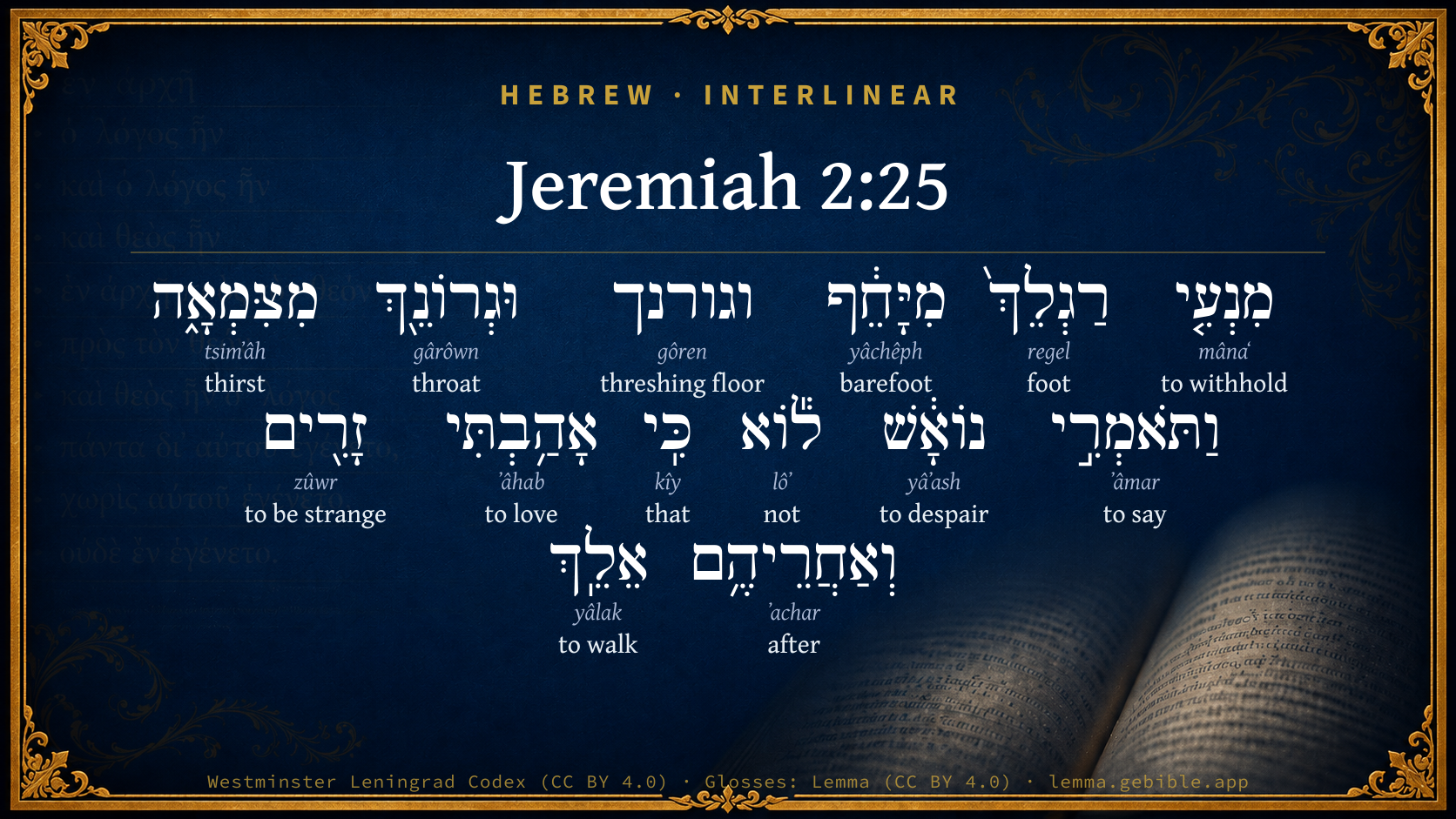
Hebrew (Westminster Leningrad Codex) Jeremiah 2:25 appears in the Hebrew Old Testament. The text above is from the Westminster Leningrad Codex. Each word links to its Strong’s number, a concise gloss, and parsing drawn from the Open Scriptures Hebrew Bible morphology. Click any word for its full Brown-Driver-Briggs (BDB) entry.
Download image
Cite this verse

Jeremiah 2:25 (World English Bible). Public Domain. Lemma interlinear Bible study tool, https://lemma.gebible.app/v/jeremiah/2/25.

Show BibTeX & RIS
BibTeX
RIS
English Translation
Withhold your foot from being unshod, and your throat from thirst: but you said, It is in vain; no, for I have loved strangers, and after them will I go.
World English Bible · Public Domain
Highlights
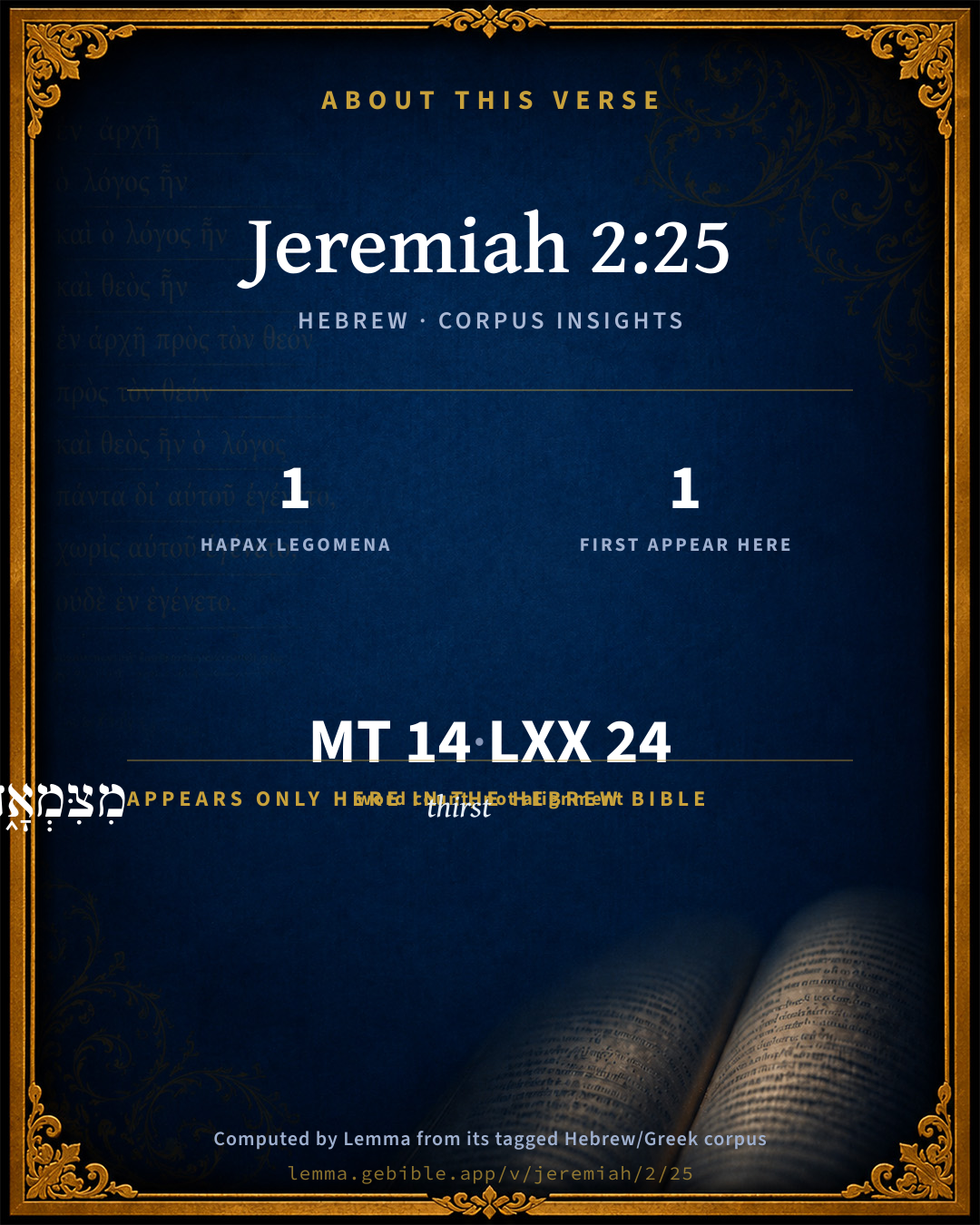
  • 1 hapax legomenon — only here in the Hebrew Bible
  • 1 first appearance in the Hebrew Bible
Full analysis ↓
Download a study sheet

One document with this verse’s original text, its word-by-word gloss line, the meaning frame, cross-references with their text, attributed commentary, and full source and license credits — printable, and it pastes into notes with its structure intact.

This verse Autodidact and up

Study sheet (.html) Plain text (.txt)

A passage Seminary Student

Up to 50 verses in one chapter. A passage sheet keeps up to 6 commentary sources and 12 cross-references per verse, in the order this page ranks them, and says so on the sheet whenever that leaves anything out. Ask for a single verse and you get the Autodidact verse sheet above.

Everything on this page stays free to read, with no account — the sheet is a download of what is already on screen, not access to it.

Want to remove ads? Support Godless Engineer
Compare translations 3

The same verse in 3 English versions, stacked beneath the original-language interlinear above. Click any original word for its lexicon entry.

Each is an independent rendering of the whole verse — the interlinear is not word-aligned to these translations.

Highlighted words mark where these versions differ — a whole-verse word diff, not a word-by-word alignment.

  • World English Bible Public Domain
    Withhold your foot from being unshod, and your throat from thirst: but you said, It is in vain; no, for I have loved strangers, and after them will I go.
  • King James Version Public Domain
    Withhold thy foot from being unshod, and thy throat from thirst: but thou saidst, There is no hope: no; for I have loved strangers, and after them will I go.
  • unfoldingWord Literal Text CC BY-SA 4.0
    Restrain your foot from bare and your throat from thirst! But you have said, ‘ hopeless! No, for I love strangers and after them I shall go!’ ts\*

unfoldingWord Literal Text — © unfoldingWord, licensed CC BY-SA 4.0. Word-aligned USFM3 via Door43 (git.door43.org/unfoldingWord/en_ult).

Versions to compare (up to 4)

3 of 4 selected

Show all 18 translations

Every available English version of this verse, each an independent rendering of the whole verse.

  • World English Bible Public Domain
    Withhold your foot from being unshod, and your throat from thirst: but you said, It is in vain; no, for I have loved strangers, and after them will I go.
  • Berean Standard Bible Public Domain
    You should have kept your feet from going bare and your throat from being thirsty. But you said, ‘It is hopeless! For I love foreign gods, and I must go after them.’
  • Majority Standard Bible Public Domain
    You should have kept your feet from going bare and your throat from being thirsty. But you said, ‘It is hopeless! For I love foreign gods, and I must go after them.’
  • King James Version Public Domain
    Withhold thy foot from being unshod, and thy throat from thirst: but thou saidst, There is no hope: no; for I have loved strangers, and after them will I go.
  • American Standard Version (1901) Public Domain
    Withhold thy foot from being unshod, and thy throat from thirst: but thou saidst, It is in vain; no, for I have loved strangers, and after them will I go.
  • Revised Version (1885) Public Domain
    Withhold thy foot from being unshod, and thy throat from thirst: but thou saidst, There is no hope: no; for I have loved strangers, and after them will I go.
  • Geneva Bible (1599) Public Domain
    Keepe thou thy feete from barenes, and thy throte from thirst: but thou saidest desperately, No, for I haue loued strangers, and them will I follow.
  • Douay-Rheims (1899) Public Domain
    Keep thy foot from being bare, and thy throat from thirst. But thou saidst: I have lost all hope, I will not do it: for I have loved strangers, and I will walk after them.
  • Young's Literal Translation Public Domain
    Withhold thy foot from being unshod, And thy throat from thirst, And thou sayest, `It is incurable, No, for I have loved strangers, and after them I go.'
  • Literal Standard Version CC BY-SA 4.0
    Withhold your foot from being unshod, || And your throat from thirst, || And you say, It is incurable, || No, for I have loved strangers, and I go after them.
  • Unlocked Literal Bible CC BY-SA 4.0
    You must restrain your feet from becoming bare and your throat from being thirsty! But you have said, 'It is hopeless! No, I love strangers and go after them!'
  • unfoldingWord Literal Text CC BY-SA 4.0
    Restrain your foot from bare and your throat from thirst! But you have said, ‘ hopeless! No, for I love strangers and after them I shall go!’ ts\*
  • Darby Bible Public Domain
    Withhold thy foot from being unshod, and thy throat from thirst. But thou saidst, There is no hope; no, for I love strangers, and after them will I go.
  • World Messianic Bible Public Domain
    “Keep your feet from being bare, and your throat from thirst. But you said, ‘It is in vain. No, for I have loved strangers, and I will go after them.’
  • Webster's Bible Public Domain
    Withhold thy foot from being unshod, and thy throat from thirst: but thou saidst, There is no hope: no; for I have loved strangers, and after them will I go.
  • Free Bible Version CC BY-SA 4.0
    You don't have to run around barefoot or have your throat go dry. But you reply, “No, it's impossible! I'm in love with foreign gods—I must go to them.”
  • Bible in Basic English Public Domain
    Do not let your foot be without shoes, or your throat dry from need of water: but you said, There is no hope: no, for I have been a lover of strange gods, and after them I will go.
  • JPS Tanakh (1917) Public Domain
    Withhold thy foot from being unshod, and thy throat from thirst; but thou saidst: 'There is no hope; no, for I have loved strangers, and after them will I go.'

Literal Standard Version (2020), Covenant Press — licensed CC BY-SA 4.0. Text via the HelloAO Bible API (eBible.org). Unlocked Literal Bible (unfoldingWord) — licensed CC BY-SA 4.0. Text via the HelloAO Bible API (eBible.org). unfoldingWord Literal Text — © unfoldingWord, licensed CC BY-SA 4.0. Word-aligned USFM3 via Door43 (git.door43.org/unfoldingWord/en_ult). Free Bible Version, Dr. Jonathan Gallagher — licensed CC BY-SA 4.0. Text via the HelloAO Bible API (eBible.org).

Word by word

More ways to search: Search by grammar → Find every occurrence → Compare this word →

Practice this passage: Drill this verse → Learn its vocabulary →

מִצִּמְאָ֑ה
tsimʼâh
H6773
“from · thirst”
Preposition + Noun, Common, Feminine, Singular, Absolute
Part of Speech
Preposition + Noun
Type
Common
Gender
Feminine
Number
Singular
State
Absolute
Full BDB Definition

Origin: from H6772

TWOT: 1926c

parched condition, thirst, dehydration
  1. מִנְעִ֤י mânaʻ H4513 “withhold” Verb, Qal, Imperative, 2nd Person, Feminine, Singular
  2. רַגְלֵךְ֙ regel H7272 “foot · your” Noun, Common, Feminine, Singular, Construct + Suffix, Personal, 2nd Person, Feminine, Singular
  3. מִיָּחֵ֔ף yâchêph H3182 “from · barefoot” Preposition + Adjective, Adjective, Masculine, Singular, Absolute
  4. וגורנך gôren H1637 “and · threshing floor · your” Conjunction + Noun, Common, Both, Singular, Construct + Suffix, Personal, 2nd Person, Feminine, Singular
  5. וּגְרוֹנֵ֖ךְ gârôwn H1627 “and · throat · your” Conjunction + Noun, Common, Masculine, Singular, Construct + Suffix, Personal, 2nd Person, Feminine, Singular
  6. וַתֹּאמְרִ֣י ʼâmar H559 “and · to say” Conjunction + Verb, Qal, Sequential Imperfect, 2nd Person, Feminine, Singular
  7. נוֹאָ֔שׁ yâʼash H2976 “despairing” Verb, Niphal, Participle Active, Masculine, Singular, Absolute
  8. ל֕וֹא lôʼ H3808 “not” Particle, Negative
  9. כִּֽי kîy H3588 “that” Conjunction
  10. אָהַ֥בְתִּי ʼâhab H157 “to love” Verb, Qal, Perfect, 1st Person, Common, Singular
  11. זָרִ֖ים zûwr H2114 “strange” Adjective, Adjective, Masculine, Plural, Absolute
  12. וְאַחֲרֵיהֶ֥ם ʼachar H310 “and · after · them” Conjunction + Preposition + Suffix, Personal, 3rd Person, Masculine, Plural
  13. אֵלֵֽךְ yâlak H3212 “to walk” Verb, Qal, Imperfect, 1st Person, Common, Singular

About this verse

These counts appear in no published source. They are computed here, from the morphology-tagged text and Lemma’s own curated glosses. What Lemma adds →

14
words
14
distinct lemmas
Prophets
section

Notable vocabulary

1 hapax legomenon — a word that appears only here in the entire Hebrew Bible:

  • מִצִּמְאָ֑ה thirst H6773

First appearance in Scripture

This word makes its first canonical appearance in the Hebrew Bible here:

  • מִצִּמְאָ֑ה thirst H6773

Shared distinctive vocabulary

מִיָּחֵ֔ף barefoot H3182 occurs in 5 verses of the Hebrew Bible. Also found in:

Grammatical profile

  • 5 verbs
  • 4 nouns
  • 2 adjectives
  • 1 preposition
  • 1 conjunction
  • 1 particle

Verb forms

  • מִנְעִ֤י Qal · Imperative
  • וַתֹּאמְרִ֣י Qal · Sequential Imperfect
  • נוֹאָ֔שׁ Niphal · Participle Active
  • אָהַ֥בְתִּי Qal · Perfect
  • אֵלֵֽךְ Qal · Imperfect

Hebrew & Septuagint length

In the original languages it is 14 Hebrew tokens and 24 Greek tokens — but the two are counted differently (Hebrew bundles its prefixes and suffixes into one token; the Greek is in lemma form), so that isn’t a like-for-like length.

Cross-references

18

Topical passages linked to Jeremiah 2:25 in the Treasury of Scripture Knowledge — connected by theme and wording, ordered by reader-vote popularity; previews shown in the World English Bible.

  • Deuteronomy 32:16 They moved him to jealousy with strange [gods]; With abominations provoked they him to anger.
  • Jeremiah 3:13 Only acknowledge your iniquity, that you have transgressed against Yahweh your God, and have scattered your ways to the strangers under every green tree, and you have not obeyed my voice, says Yahweh.
  • Jeremiah 18:12 But they say, It is in vain; for we will walk after our own devices, and we will do everyone after the stubbornness of his evil heart.
  • Romans 8:24 For we were saved in hope, but hope that is seen is not hope. For who hopes for that which he sees?
  • Deuteronomy 28:48 therefore shall you serve your enemies whom Yahweh shall send against you, in hunger, and in thirst, and in nakedness, and in want of all things: and he shall put a yoke of iron on your neck, until he have destroyed you.
  • Deuteronomy 29:19–20 and it happen, when he hears the words of this curse, that he bless himself in his heart, saying, I shall have peace, though I walk in the stubbornness of my heart, to destroy the moist with the dry.
  • 2 Chronicles 28:22 In the time of his distress did he trespass yet more against Yahweh, this same king Ahaz.
  • Isaiah 2:6 For you have forsaken your people, the house of Jacob, Because they are filled from the east, With those who practice divination like the Philistines, And they clasp hands with the children of foreigners.
  • Isaiah 20:2–4 at that time Yahweh spoke by Isaiah the son of Amoz, saying, Go, and loose the sackcloth from off your loins, and put your shoe from off your foot. He did so, walking naked and barefoot.
  • Isaiah 57:10 You were wearied with the length of your way; yet you didn't say, It is in vain: you found a reviving of your strength; therefore you weren't faint.
  • Jeremiah 13:22 If you say in your heart, Why are these things come on me? for the greatness of your iniquity are your skirts uncovered, and your heels suffer violence.
  • Jeremiah 14:10 Thus says Yahweh to this people, Even so have they loved to wander; they have not refrained their feet: therefore Yahweh does not accept them; now will he remember their iniquity, and visit their sins.
  • Lamentations 4:4 The tongue of the sucking child cleaves to the roof of his mouth for thirst: The young children ask bread, and no man breaks it to them.
  • Jeremiah 44:17 But we will certainly perform every word that is gone forth out of our mouth, to burn incense to the queen of the sky, and to pour out drink-offerings to her, as we have done, we and our fathers, our kings and our princes, in the cities of Judah, and in the streets of Jerusalem; for then had we plenty of food, and were well, and saw no evil.
  • Hosea 2:3 Lest I strip her naked, And make her bare as in the day that she was born, And make her like a wilderness, And set her like a dry land, And kill her with thirst.
  • Luke 15:22 "But the father said to his servants, 'Bring out the best robe, and put it on him. Put a ring on his hand, and shoes on his feet.
  • Luke 16:24 He cried and said, 'Father Abraham, have mercy on me, and send Lazarus, that he may dip the tip of his finger in water, and cool my tongue! For I am in anguish in this flame.'
  • Romans 2:4–5 Or do you despise the riches of his goodness, forbearance, and patience, not knowing that the goodness of God leads you to repentance?

Cross-references courtesy of OpenBible.info (CC BY 4.0).

Hebrew and Greek witnesses Masoretic Hebrew ↔ Greek Septuagint

The same verse in the two great witnesses to the Old Testament, shown verse-for-verse.

These are two independent witnesses, not word-aligned to each other, and the Septuagint is shown in lemma (dictionary) form.

Hebrew Jeremiah 2:25 Masoretic · Westminster Leningrad Codex

מִנְעִ֤י רַגְלֵךְ֙ מִיָּחֵ֔ף וגורנך וּגְרוֹנֵ֖ךְ מִצִּמְאָ֑ה וַתֹּאמְרִ֣י נוֹאָ֔שׁ ל֕וֹא כִּֽי אָהַ֥בְתִּי זָרִ֖ים וְאַחֲרֵיהֶ֥ם אֵלֵֽךְ

Withhold your foot from being unshod, and your throat from thirst: but you said, It is in vain; no, for I have loved strangers, and after them will I go.

World English Bible · Public Domain

Greek LXX Structure differs

In the Septuagint, Jeremiah is about an eighth shorter than the Hebrew and arranges its material differently — the Oracles Against the Nations (Hebrew chapters 46–51) appear in the middle of the Greek book, after 25:13. Because the chapter and verse boundaries do not line up, a verse-for-verse comparison with the Hebrew is not shown.

A verse-for-verse comparison isn’t shown here because the chapters and verses don’t line up. Switch to the LXX edition with the MT / LXX toggle above to read the Greek directly.

On this verse, John Gill's Exposition discusses the Septuagint’s reading. Read the note in Commentary ↓

Hebrew: Westminster Leningrad Codex (CC BY 4.0). Greek: Septuagint (public domain); English from a public-domain English Septuagint. How the Septuagint differs from the Hebrew →

Targum (Aramaic paraphrase)

1

The Targum is the ancient Jewish Aramaic paraphrase of the Hebrew Scriptures — an interpretive translation, not the Hebrew text itself. Onkelos (literal) and Pseudo-Jonathan (expansive) render the Torah, and Jonathan the Prophets. Coverage is partial: where no permissively-licensed English translation exists for a verse, only the Aramaic is shown. This is verse-level text, not a word-by-word alignment to the Hebrew.

  1. Targum Jonathan Prophets (Joshua–Malachi)
    מְנָעִי רִגְלִיךְ מִלְאִתְחַבָּרָא לְעַמְמַיָא וּפוּמִיךְ מִלְמִפְלַח לְטַעֲוַת פַלְחֵי כּוֹכְבַיָא וְאַמַרְתְּ תָּבֵית מִבָּתַר פּוּלְחָנָךְ לָא אֲרֵי רְחִימֵית לְאִתְחַבְּרָא לְעַמְמַיָא וּבָתַר פּוּלְחַן טַעֲוַתְהוֹן אֱהָךְ:

    (no public-domain English translation for this verse)

    Targum Jonathan — Aramaic: “Mikraot Gedolot” (public domain). English: “Sefaria Community Translation” (CC0 1.0 (public-domain dedication)); “London "Chaldee Paraphrase," 1871” (public domain). Text via Sefaria.

Commentary

Notes on Jeremiah 2:25 from classic Christian and Jewish commentators (each source and its license shown beneath its notes). The classic Christian expositions comment on the surrounding passage and are grouped to its opening verse, so a note may address several verses; the Jewish commentaries on the Tanakh (Rashi and others) are per-verse, so they appear only where the commentator wrote on this verse.

Lemma curates 59 commentaries, every one of them public domain or Creative Commons licensed, each selected and text-cleaned for this edition rather than reprinted as found. About our sources →

Trapp's Complete Commentary

John Trapp

Jer 2:25 Withhold thy foot from being unshod, and thy throat from thirst: but thou saidst, There is no hope: no; for I have loved strangers, and after them will I go.

Ver. 25. Withhold thy foot from being unshod, &c.] Cease thy vain vagaries to the wearing out of thy shoes, and exposing thyself to extreme thirst; or rather take a timely course to prevent captivity, and the miseries that attend it. {Isa 20:2; Isa 20:4; Isa 47:2}

But thou saidst, There is no hope,] viz., Of reclaiming us; we are resolved on our course, and will take our swing in sin whatsoever come of it. {Isa 28:14-15; Isa 57:10} Some grow desperately sinful, saith a reverend modern writer, {a} like those Italian senators that, despairing of their lives, when upon submission they had been promised their lives, yet being conscious of their villany made a curious banquet, and at the end thereof, every man drank up his glass of poison and killed himself; so men, feeling such horrible hard hearts, and privy to such notorious sins, they cast away souls and all for lust, and so perish woefully, because they lived desperately and so securely.

{a} Mr Shepherd’s Sincere Convert, 222.

John Trapp, A Commentary or Exposition upon All the Books of the Old and New Testament (1647–1656) — public domain. Text from a community e-Sword module.

Joseph Benson's Commentary

Jer 2:25. Withhold thy foot from being unshod, &c. — “Do not wear out thy shoes, or sandals, and expose thyself to thirst and weariness in undertaking long journeys, to make new alliances with idolaters.” Thus Lowth, and many other expositors. “But I rather take it,” says Blaney, “to be a warning to beware of the consequences of pursuing the courses they were addicted to: as if it had been said, Take care that thou dost not expose thyself, by thy wicked ways, to the wretched condition of going into captivity unshod, as the manner is represented Isa 20:4; and of serving thine enemies in hunger, and in thirst, and in want of the necessaries of life,” Deu 28:48. But thou saidst, There is no hope — The language of desperate sinners, who are resolved to continue in their wickedness, in spite of every reason that can be offered to the contrary. No; for I have loved strangers — Strange gods, idols; and after them will I go — The Jews probably did not really speak in this manner, but they acted thus: this, the prophet signifies was the language of their conduct. By their actions they professed that idolatry which they denied with their mouths.

Joseph Benson's Commentary on the Old and New Testaments (1811–1818) — public domain. Text from a community e-Sword module.

Tyndale Open Study Notes

Tyndale Open Resources

2:25 The Israelites confessed to the Baal worship that they had earlier denied (2:23), thus revealing the true state of their hearts.

Tyndale Open Study Notes — © Tyndale Open Resources, licensed CC BY-SA 4.0. Text via the HelloAO Bible API.

Geneva Bible (1599)

Geneva Bible translators

Hereby he warneth them that they should not go into strange countries to seek help: for they should but spend their labor, and hurt themselves, which is here meant by the bare foot and thirst, Isa. 57:10.

Geneva Bible (1599) marginal notes — public domain. Text via Bolls.life.

Jamieson, Fausset & Brown

Robert Jamieson, A. R. Fausset & David Brown

Withhold, &c.--that is, abstain from incontinence; figuratively for idolatry [HOUBIGANT].

unshod, &c.--do not run so violently in pursuing lovers, as to wear out thy shoes: do not "thirst" so incontinently after sexual intercourse. HITZIG thinks the reference is to penances performed barefoot to idols, and the thirst occasioned by loud and continued invocations to them.

no hope-- (Jer 18:12; Isa 57:10). "It is hopeless," that is, I am desperately resolved to go on in my own course.

strangers--that is, laying aside the metaphor, "strange gods" (Jer 3:13; Deu 32:16).

Jamieson, Fausset & Brown — Commentary Critical and Explanatory on the Whole Bible (1871) — public domain (CC PDM 1.0). Text via the HelloAO Bible API.

Adam Clarke's Commentary

Verse 25. Withhold thy foot from being unshod] When it was said to them, "Cease from discovering thy feet; prostitute thyself no more to thy idols."

And thy throat from thirst] Drink no more of their libations, nor use those potions which tend only to increase thy appetite for pollution. Thou didst say, There is no hope: it is useless to advise me thus; I am determined; I have loved these strange gods, and to them will I cleave.

Adam Clarke's Commentary on the Bible (1810–1826) — public domain. Text from a community e-Sword/MySword module.

John Calvin's Commentaries

The words of the Prophet, as they are concise, may appear at the first view obscure: but his meaning is simply this, — that the insane people could by no means be reformed, however much God might try to check that excess by which they were led away after idols and superstitions. In the first clause, God relates how he had dealt with the people. All the addresses of the prophets had this as their object — to make the people to rest contented under the protection of God. But he employs other words here, Keep thy foot, he says, from unshodding, and thy throat from thirst For whenever there was any danger they ran, now to Egypt, then to Assyria, as we have already seen. Hence God complains of their madness, because they obeyed not his wise and salutary counsels. Had God bidden them to run here and there, either to the east or to the west, they might have raised an objection, and say, that the journey would be irksome to them; but he only commanded them to remain still and quiet. How great, then, was their madness, that they would not with quietness wait for the help of God, but weary themselves, and that with no benefit? Isaiah says nearly the same thing, but in other words; for he expostulated with them, because they underwent every kind of weariness, when they might have been protected by God, and be in no way wearied.

We now, then, comprehend the design of the Prophet: for God first shews that the people had been admonished, and that in time; but that they were so taken up with their own perverse counsels, that they could not endure the words of the prophets. It was the highest ingratitude in them, that they refused to remain quiet at home, but preferred to undergo great and severe labors without any advantage, according to what is said by Isaiah in another place,

“This is your rest, but ye would not.” (Isaiah 30:15.)

There is no one who desires not rest and peace; nay, all confess that it is the chief good, which all naturally seek. The Prophet says now, that it was rejected by the people of Israel. It hence follows, that they were wholly insane, for they had lost a desire which is by nature implanted in all men. The Prophet, then, does not here simply teach, but reminds the Jews of what they had before heard from Isaiah, and also from Micah, and from all the other prophets. For God had often exhorted them to remain quiet; and the Prophet now upbraids them with ingratitude, because they gave way to their own mad folly, and rejected the singular benefit offered them by God.

Let us then know that the Prophet states here what others before him had taught, Keep back, he says, thy foot from unshodding. Some render the last word, “from nakedness,” because they wore out their shoes by long journeys; but this I think must be understood of what was commonly done, for they were wont to make journeys unshod: keep then thy foot from being unshod, and thy throat from thirst We know that thirst is very grievous to men: hence the Prophet here reproves the madness of the people, — that they were so seized with the ardor of an impious passion, that they willfully exposed themselves to thirst even by long journeys. As then God required nothing from the people but to ask his counsel, their sin was doubled by their unwillingness to obey his salutary direction. A plausible excuse, as I have already said, might have been alleged, had God dealt in a hard and severe manner with the people; but as he was ready kindly and graciously to preserve them in a complete state of quietness, no kind of excuse remained for them.

It then follows, Thou hast said, There is not a hope, no The Prophet shews here, as to the people, how perverse they were; for they obstinately rejected the kind and friendly admonitions which had been given them. They say first, There is not a hope, or, it is all over; for יאש iash, in Niphal, means to despair, or, to be out of hope. It may be rendered, “It is weariness;” and this would not be unsuitable, if taken in this sense, “I have thoughtlessly tormented myself more than enough, so that weariness itself induces me to rest.” No. The Prophet speaks concisely in order to express more strikingly the refractory conduct of the people. By saying, “There is not a hope,” it is the same as though he had said, that they spurned all exhortations; and then he adds, No. There is no verb put here; but an elliptical expression, as I have said, is more forcible to set forth the ferocity of the people.

Isaiah expostulated with them in another way, and blamed them, because they did not say, “There is not a hope.” (Isaiah 57:10.) Thus Isaiah and Jeremiah seem to be inconsistent; for our Prophet here reproves the people for saying, “There is not a hope;” and Isaiah, for not having said so. But when the Jews expressly answered, according to this passage, “There is not a hope,” they meant that the prophets spent their labor in vain, as they were determined to follow their own course to the last. Hence by this expression, “There is not a hope,” is set forth the extreme perverseness of the people; and he shews that no hope of repentance remained, since they said openly and without any evasion that it was all over. But Isaiah reproved the people for not saying, that there was not a hope, because they did not acknowledge after long experience that they were proved guilty of folly: for after having often run to Egypt and then to Assyria, and the Lord having really taught them how ill-advised they had been, they ought to have learnt from their very disappointments, that the Lord had frustrated their expectations in order to lead them to repentance. Justly then does Isaiah say, that the people were extremely besotted, because they ever went on in their blind obstinacy, and never perceived that God did set many obstacles in their way, in order to compel them to go back and to cast aside all their vain hopes, by which they deceived themselves. We hence see that there is a complete agreement between the two prophets, though their mode of speaking is different.

Jeremiah then introduces the people here as saying expressly, and thus avowing their own perverseness, There is not a hope; as though they said, “Ye prophets do not cease to stun our ears, but vain and useless is your labor; for we have once for all made up our minds, and we can never be brought to revoke our resolution.” But what does Isaiah say? He reproves the madness of the people, that having been so often deceived by the Egyptians as well as by the Assyrians, they did not understand that they ought by such trials and experiments to have been brought back to the right way, but continued obstinately to follow their own wicked counsels. As to the passage before, we perceive what the Prophet means, — that God had kindly exhorted the Jews to rest quiet and dependent on his aid; but that they were not only stiff-necked, but also insolently rejected the kindness offered to them.

It then follows, For I have loved strangers, and after them will I go Here he exaggerates the sin of the people, for they gave themselves up to strangers; and he retains the similitude which we have already observed. For as God had taken the people under his own protection, so the obligation was mutual: both parties were connected together as by a sacred bond, as the case is between a husband and his wife; as he pledges his faith to her, so she by the law of marriage is bound to him. Jeremiah here retains this similitude, and says that the people were like the basest strumpet, for they would not hear the voice of their husband, though he was willing and anxious to be reconciled to them. Now, a wife must be wholly irreclaimable when she spurns her own husband, who is ready to receive her into favor, and to forgive her all the wickedness she may have done. The Prophet then shews, that there was in the people so great and so hopeless an impiety, that they closed their ears against God who kindly exhorted them to repent; and worse still, they shamelessly boasted that they were resolved to worship idols and their own fictions, and to reject the only true God. It follows —

John Calvin's Commentaries (1540-1563) — public domain. Text from the Calvin Translation Society English edition (1840s-50s) via the Christian Classics Ethereal Library (ccel.org). Calvin's coverage is partial (roughly two-thirds of the Bible); uncommented books and verses are honest gaps, never fabricated. The 19th-century editor's footnotes and remarks are omitted so the notes are faithfully Calvin's own voice.

Ellicott's Commentary for English Readers

(25) Withhold thy foot.—From the brute types of passion the prophet passes to the human. Here he has Hosea as giving a prototype (Hos_2:5; Hos_2:7), perhaps also Isaiah (Isa_23:15-16). The picture may probably enough have been drawn from the life, but that sketched in Pro_7:10-23 may well have supplied the outline. Jehovah, as her true husband, bids the apostate wife to refrain for very shame from acting as the harlot, rushing barefoot into the streets, panting, as with a thirst that craves to be quenched, for the gratification of her desires. The “unshod” may possibly refer to one feature of the worship of Baal or Ashtaroth, men and women taking off their shoes when they entered into their temples, as being holy ground (Exo_3:5), and joining in orgiastic dances.

Thou saidst, There is no hope: no.—Here also we find a parallel to the thought and language of Hosea. There the one effectual remedy for the evil into which the apostate wife had fallen was to speak to her heart, and to open the door of hope (Hos_2:14-15). Now the malignity of the evil is shown by the loss of all hope of recovery in returning to Jehovah:—

“Small sins the heart first desecrate,

At last despair persuades to great.”

Like Gomer, she will go after her “lovers,” though they are “strangers,” as if they were her only protectors. It would seem, from the recurrence of the phrase in Jer_18:12, as if it were the formula of a despairing fatalism, like the proverb of the fathers eating sour grapes (Jer_31:29-30; Eze_18:2).

A Bible Commentary for English Readers, edited by Charles John Ellicott (1878–1897) — public domain. Text from a community e-Sword module.

The Cambridge Bible for Schools and Colleges

gen. ed. J. J. S. Perowne

25. Withhold thy foot from being unshod, and thy throat from thirst] Do not pursue thy shameless quest in recklessness and heat, till thy sandals are worn out, and thy throat parched. The words of the reply, the first part of which we might render, “Hopeless! No!” express the desperate determination to continue in sin.

strangers] i.e. foreign gods. Cp. Deu_32:16.

The Cambridge Bible for Schools and Colleges (gen. ed. J. J. S. Perowne; Cambridge University Press, 1878–1918) — public domain. Text from a community e-Sword module.

John Gill's Exposition

As the thief is ashamed when be is found,.... Taken in the fact, or convicted of it; that is, as the Targum explains it, one that has been accounted faithful, and is found a thief; for, otherwise, those who have lost their character, and are notorious for their thefts and robberies, are not ashamed when they are found out, taken, and convicted:

so is the house of Israel ashamed: of their idolatry, or ought to be; or "shall be", as the Septuagint, Syriac, and Arabic versions render it; though not now, yet hereafter, sooner or later:

they, their kings, their princes, and their priests and their prophets; all being guilty; kings setting ill examples, and the people following them; the priests being priests of Baal, and the prophets false ones.

John Gill's Exposition of the Whole Bible (1746–1763) — public domain (CC PDM 1.0). Text via the HelloAO Bible API.

Albert Barnes' Notes on the Bible

God the true husband exhorts Israel not to run barefoot, and with parched throat, like a shameless adulteress, after strangers.

There is no hope - i. e., It is in vain.

Albert Barnes' Notes on the Bible (1834–1885) — public domain. Text from a community e-Sword/MySword module.

Haydock's Catholic Bible Commentary

Foot, and the parts which modesty covers. My exhortations are slighted. (Calmet) --- Despair opens the door to every sort of impurity, Ephesians iv. 19. (Haydock)

George Leo Haydock (1774–1849), Haydock's Catholic Family Bible and Commentary, 1859 edition — public domain. Excludes Psalms (Douay-Rheims chapter numbering differs from Protestant) and Deuterocanonical books (Catholic canon only).

Matthew Poole's English Annotations

Withhold thy foot from being unshod; good counsel given them by the prophet to tarry at home; either that they do not go a gadding after their spiritual or corporal adulteries, or seek foreign aids, thereby to wear out their shoes; a metonymy of the effect, Jos 9:13; or, that thou put not off thy shoes to go into the bed of lust, or uncover thy feet; a modest Hebrew expression, as also of other languages, for

exposing thy nakedness, Eze 16:25; or, take not those courses that will reduce thee to poverty, to go bare-foot, and bare-legged, and to want wherewith to quench thy thirst, as in the next clause, Pr 6:26; Isa 20:2,4. See Isa 5:13. There is no hope: she seems to return a cross answer, the word pointing at somewhat that is desperate, Ecc 2:20. It either expresseth the desperateness of their condition: q.d. We are as bad as we can be, and there is no hope that God should receive us into favour. Or, else by way of interrogation, Is there no hope? May we not hold on still, and prosper? Must we desist from our ways? No, we will not; but we will go after other gods, and they shall defend us, Isa 57:10; Jer 18:12. Or the desperateness of their resolution upon it: q.d. We care not since there is no remedy; you lose your labour to go about to reclaim us; which agrees with the next clause. Strangers, viz. idols, or strange gods.

After them will I go, come what will of it.

Matthew Poole's English Annotations on the Holy Bible (1683–1685) — public domain. Text from a community e-Sword/MySword module.

Whedon's Commentary on the Bible

Daniel D. Whedon

25. Withhold… from being unshod — Running so eagerly after illicit love as to go with unsandalled feet and thirsty throat.

No hope — Your warning is vain and useless: we have made our election.

Daniel D. Whedon (gen. ed.), Commentary on the Old and New Testaments (1874–1909) — public domain. Text from a community e-Sword module.

The Pulpit Commentary

Withhold thy foot, etc. Hitzig, with unnecessary ingenuity, explains this with reference to the fatiguing practices of the heathen cultus, comparing 1Ki_18:26, where "vain repetitions" of "Baal, Baal," and (as he thinks) barefoot religious dances, are mentioned as parts of the worship of Baal. Umbreit"s view, however, is far more natural. "God the true husband exhorts Israel not to run barefoot, and with parched throat, like a shameless adulteress, after strangers" (Payne Smith). There is no hops; i.e. the exhortation is in vain. (so Jer_18:12)

A dread snare of the devil.

I IN WHAT IT CONSISTS. The persuading the sinner that "there is no hope.

II ITS TERRIBLE CHARACTER. It leads the sinner to excuse himself in his sin by the false belief that he is delivered to do all his abominations. It encourages him to go on in his sin (cf. ver. 25), instead of resolutely breaking away from it

III How MEN FALL INTO IT. By letting sin become the habit of their lives; the constant repetition of separate sinful acts forges the chain of habit, which it is hard indeed for any to break through.

IV How MEN MAY GET OUT OF IT.

1. By prayerful pondering of the many proofs which show that this suggestion of Satan, that there is no hope," is one of his own lies. These proofs are to be found in the plain statements, and in the many examples of the Word of God, which tell of God"s grace to the very chief of sinners. They are to be found also in the recorded biographies and observed lives of many of the people of God. And also in our own experience of God in the past.

2. By then and there committing our souls into the hands of the Lord Jesus Christ for pardon, for restoration, and for safe keeping for the future.

3. By renewing this self-surrender day by day, and especially when we are conscious that danger is near. So shall we be able to say, "My soul is escaped as a bird out of the snare of the fowler. C.

The Pulpit Commentary (1880–1919), ed. H.D.M. Spence-Jones & Joseph S. Exell — public domain. Text from a community e-Sword module.

John Wesley's Explanatory Notes

Withhold - Take not those courses that will reduce thee to poverty, to go bare foot, and to want wherewith to quench thy thirst. No hope - We care not since there is no remedy. Strangers - Idols.

John Wesley, Explanatory Notes Upon the Whole Bible (1754–1765) — public domain. Text via the GEBible commentary corpus.

Rashi

Rabbi Shlomo Yitzchaki (Rashi)

Withhold your foot from going barefoot This your habit, like the wild donkey that loves to wander. My prophets say to you, “Withhold your foot from idolatry lest you go barefoot into exile and withhold your throat from dying of thirst.” but you said concerning the words of the prophets. I despair It is of no concern. I despair of your words. נואש is (nonkalajjr in O.F.) nonchalair in modern French.

Rashi on the Tanakh — English translations: “The Judaica Press complete Tanach with Rashi, translated by A. J. Rosenberg” (CC BY 4.0); “Pentateuch with Rashi's commentary by M. Rosenbaum and A.M. Silbermann, 1929-1934” (public domain); “The Metsudah Tanach series, Lakewood, N.J” (CC BY 4.0); and “The Book of Joshua, Metsudah Publications, 1997” (CC BY 4.0). Text via Sefaria.

Lesson kit

Teaching starters — assembled from the data on this page, not authored interpretation. Every prompt links to the verse data it draws on. Edit before teaching.

Jeremiah, in the Prophets, opens this verse with 14 words (14 distinct Hebrew lemmas). Its most distinctive word is tsimʼâh (“thirst”). A historical commentator’s framing appears above. Read the whole chapter for the surrounding context.

Discussion questions

  1. How does “thirst” (tsimʼâh) shape what this verse is saying?
  2. This verse holds 1 word here found nowhere else in the Hebrew Bible. What might the rare word draw attention to?
  3. The word “thirst” first appears here in Scripture. What is being introduced at this debut?
  4. 2 Samuel 15:30 shares the word «barefoot» with this verse. How do the two illuminate each other?
  5. These translations render this verse differently. What is at stake in choosing one wording over another?
  6. The verb «מִנְעִ֤י» is Qal Imperative. How does its form color the action?
  7. Reading how Trapp's Complete Commentary and Joseph Benson's Commentary read this verse, where do the two commentators agree and where do they part?

Things to notice

Reading settings

Reading text

Shown beneath each verse's original-language words.

Old Testament
Old Testament edition

Read the OT as the Masoretic Hebrew (MT) or the Greek Septuagint (LXX).

English shown for the Greek Septuagint (in the Hebrew ↔ Greek comparison).

Comparing translations? Open the Compare panel on any verse page to stack up to four side by side.