

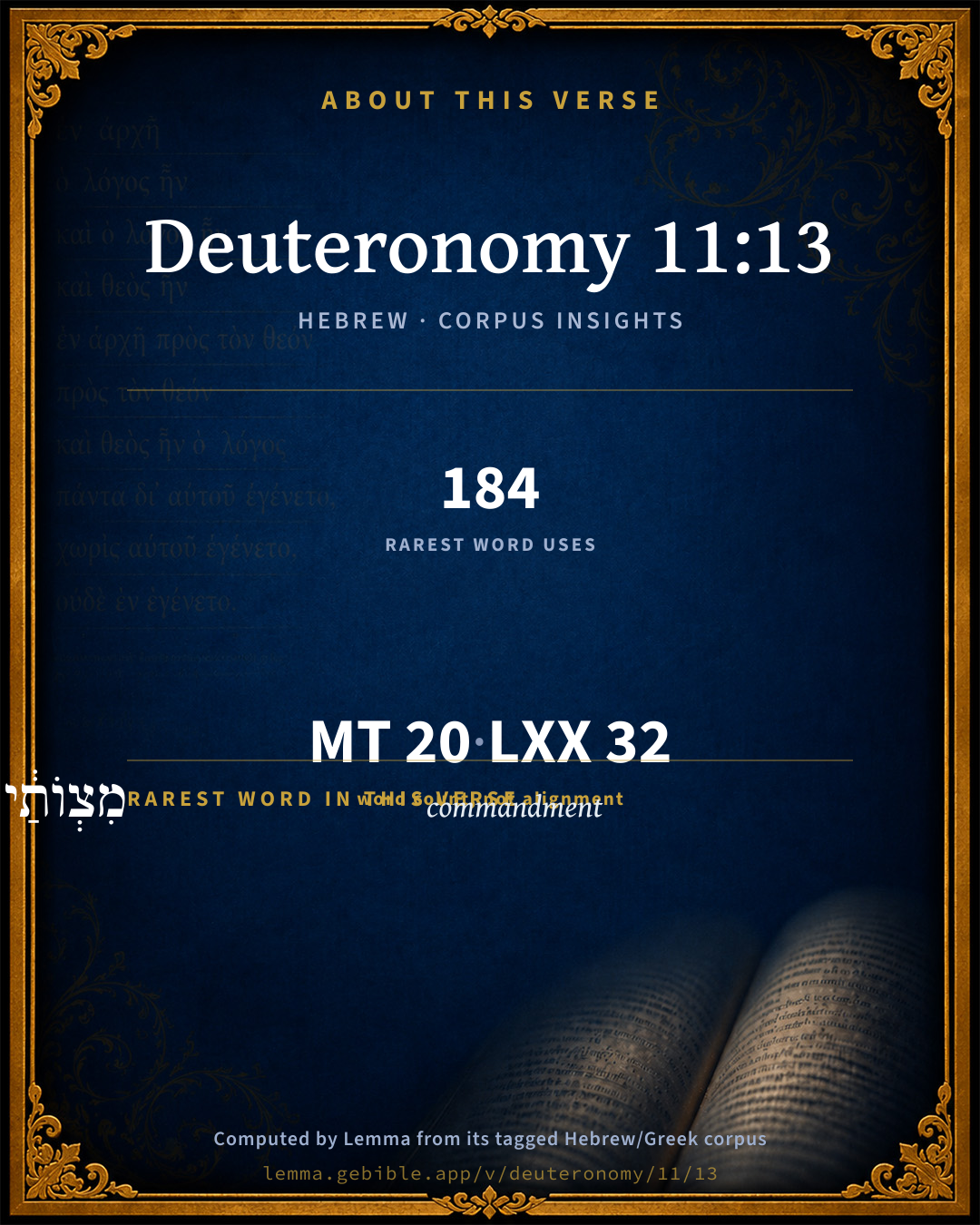
Deuteronomy 11:13

Hebrew (Westminster Leningrad Codex) Deuteronomy 11:13 appears in the Hebrew Old Testament. The text above is from the Westminster Leningrad Codex. Each word links to its Strong’s number, a concise gloss, and parsing drawn from the Open Scriptures Hebrew Bible morphology. Click any word for its full Brown-Driver-Briggs (BDB) entry.
Download image
Cite this verse

Deuteronomy 11:13 (World English Bible). Public Domain. Lemma interlinear Bible study tool, https://lemma.gebible.app/v/deuteronomy/11/13.

Show BibTeX & RIS
BibTeX
RIS
English Translation
It shall happen, if you shall listen diligently to my commandments which I command you this day, to love Yahweh your God, and to serve him with all your heart and with all your soul,
World English Bible · Public Domain
Download a study sheet

One document with this verse’s original text, its word-by-word gloss line, the meaning frame, cross-references with their text, attributed commentary, and full source and license credits — printable, and it pastes into notes with its structure intact.

This verse Autodidact and up

Study sheet (.html) Plain text (.txt)

A passage Seminary Student

Up to 50 verses in one chapter. A passage sheet keeps up to 6 commentary sources and 12 cross-references per verse, in the order this page ranks them, and says so on the sheet whenever that leaves anything out. Ask for a single verse and you get the Autodidact verse sheet above.

Everything on this page stays free to read, with no account — the sheet is a download of what is already on screen, not access to it.

Want to remove ads? Support Godless Engineer
Compare translations 3

The same verse in 3 English versions, stacked beneath the original-language interlinear above. Click any original word for its lexicon entry.

Each is an independent rendering of the whole verse — the interlinear is not word-aligned to these translations.

Highlighted words mark where these versions differ — a whole-verse word diff, not a word-by-word alignment.

  • World English Bible Public Domain
    It shall happen, if you shall listen diligently to my commandments which I command you this day, to love Yahweh your God, and to serve him with all your heart and with all your soul,
  • King James Version Public Domain
    And it shall come to pass, if ye shall hearken diligently unto my commandments which I command you this day, to love the LORD your God, and to serve him with all your heart and with all your soul,
  • unfoldingWord Literal Text CC BY-SA 4.0
    And it will happen, if listening, you will listen to my commandments that I am commanding you today, to love Yahweh your God and to serve him with all your heart and with all your soul,

unfoldingWord Literal Text — © unfoldingWord, licensed CC BY-SA 4.0. Word-aligned USFM3 via Door43 (git.door43.org/unfoldingWord/en_ult).

Versions to compare (up to 4)

3 of 4 selected

Show all 18 translations

Every available English version of this verse, each an independent rendering of the whole verse.

  • World English Bible Public Domain
    It shall happen, if you shall listen diligently to my commandments which I command you this day, to love Yahweh your God, and to serve him with all your heart and with all your soul,
  • Berean Standard Bible Public Domain
    So if you carefully obey the commandments I am giving you today, to love the LORD your God and to serve Him with all your heart and with all your soul,
  • Majority Standard Bible Public Domain
    So if you carefully obey the commandments I am giving you today, to love the LORD your God and to serve Him with all your heart and with all your soul,
  • King James Version Public Domain
    And it shall come to pass, if ye shall hearken diligently unto my commandments which I command you this day, to love the LORD your God, and to serve him with all your heart and with all your soul,
  • American Standard Version (1901) Public Domain
    And it shall come to pass, if ye shall hearken diligently unto my commandments which I command you this day, to love Jehovah your God, and to serve him with all your heart and with all your soul,
  • Revised Version (1885) Public Domain
    And it shall come to pass, if ye shall hearken diligently unto my commandments which I command you this day, to love the LORD your God, and to serve him with all your heart and with all your soul,
  • Geneva Bible (1599) Public Domain
    If yee shall hearken therefore vnto my commandements, which I commaund you this day, that yee loue the Lord your God and serue him with all your heart, and with all your soule,
  • Douay-Rheims (1899) Public Domain
    And the Lord thy God doth always visit it, and his eyes are on it from the beginning of the year unto the end thereof.
  • Young's Literal Translation Public Domain
    `And it hath been -- if thou hearken diligently unto My commands which I am commanding you to-day, to love Jehovah your God, and to serve Him with all your heart, and with all your soul --
  • Literal Standard Version CC BY-SA 4.0
    And it has been, if you listen diligently to My commands which I am commanding you today, to love your God YHWH, and to serve Him with all your heart and with all your soul,
  • Unlocked Literal Bible CC BY-SA 4.0
    It will happen, if you will listen diligently to my commandments that I command you today, to love Yahweh your God and to serve him with all your heart and with all your soul,
  • unfoldingWord Literal Text CC BY-SA 4.0
    And it will happen, if listening, you will listen to my commandments that I am commanding you today, to love Yahweh your God and to serve him with all your heart and with all your soul,
  • Darby Bible Public Domain
    And it shall come to pass, if ye hearken diligently unto my commandments which I command you this day, to love Jehovah your God, and to serve him with all your heart and with all your soul,
  • World Messianic Bible Public Domain
    It shall happen, if you shall listen diligently to my commandments which I command you today, to love the LORD your God, and to serve him with all your heart and with all your soul,
  • Webster's Bible Public Domain
    And it shall come to pass, if ye shall hearken diligently to my commandments which I command you this day, to love the LORD your God, and to serve him with all your heart and with all your soul,
  • Free Bible Version CC BY-SA 4.0
    So if you pay careful attention to keep the commandments that I'm giving to you today, if you love the Lord your God and worship him with all your mind and with all your being,
  • Bible in Basic English Public Domain
    And it will be that if you truly give ear to the orders which I put before you this day, loving the Lord your God and worshipping him with all your heart and all your soul,
  • JPS Tanakh (1917) Public Domain
    And it shall come to pass, if ye shall hearken diligently unto My commandments which I command you this day, to love the LORD your God, and to serve Him with all your heart and with all your soul,

Literal Standard Version (2020), Covenant Press — licensed CC BY-SA 4.0. Text via the HelloAO Bible API (eBible.org). Unlocked Literal Bible (unfoldingWord) — licensed CC BY-SA 4.0. Text via the HelloAO Bible API (eBible.org). unfoldingWord Literal Text — © unfoldingWord, licensed CC BY-SA 4.0. Word-aligned USFM3 via Door43 (git.door43.org/unfoldingWord/en_ult). Free Bible Version, Dr. Jonathan Gallagher — licensed CC BY-SA 4.0. Text via the HelloAO Bible API (eBible.org).

Word by word

More ways to search: Search by grammar → Find every occurrence → Compare this word →

Practice this passage: Drill this verse → Learn its vocabulary →

מִצְוֺתַ֔י
mitsvâh
H4687
“commandments · my”
Noun, Common, Feminine, Plural, Construct + Suffix, Personal, 1st Person, Common, Singular
Part of Speech
Noun
Type
Common
Gender
Feminine
Number
Plural
State
Construct
Full BDB Definition

Origin: from H6680

TWOT: 1887b

commandment - commandment (of man) - the commandment (of God) - commandment (of code of wisdom)
  1. וְהָיָ֗ה hâyâh H1961 “and · to be” Conjunction + Verb, Qal, Sequential Perfect, 3rd Person, Masculine, Singular
  2. אִם ʼim H518 “if” Conjunction
  3. שָׁמֹ֤עַ shâmaʻ H8085 “to hear” Verb, Qal, Infinitive Absolute
  4. תִּשְׁמְעוּ֙ shâmaʻ H8085 “to hear” Verb, Qal, Imperfect, 2nd Person, Masculine, Plural
  5. אֶל ʼêl H413 “to” Preposition
  6. אֲשֶׁ֧ר ʼăsher H834 “which” Particle, Relative
  7. אָנֹכִ֛י ʼânôkîy H595 “I” Pronoun, Personal, 1st Person, Common, Singular
  8. מְצַוֶּ֥ה tsâvâh H6680 “commanding” Verb, Piel, Participle Active, Masculine, Singular, Absolute
  9. אֶתְכֶ֖ם ʼêth H853 “- · you” Particle, Direct Object + Suffix, Personal, 2nd Person, Masculine, Plural
  10. הַיּ֑וֹם yôwm H3117 “the · day” Particle, Definite Article + Noun, Common, Masculine, Singular, Absolute
  11. לְאַהֲבָ֞ה ʼâhab H157 “to love” Preposition + Verb, Qal, Infinitive Construct
  12. אֶת ʼêth H853 “-” Particle, Direct Object
  13. יְהוָ֤ה Yᵉhôvâh H3068 “LORD” Noun, Proper
  14. אֱלֹֽהֵיכֶם֙ ʼĕlôhîym H430 “God(s) · your” Noun, Common, Masculine, Plural, Construct + Suffix, Personal, 2nd Person, Masculine, Plural
  15. וּלְעָבְד֔וֹ ʻâbad H5647 “and · to serve · him” Conjunction + Preposition + Verb, Qal, Infinitive Construct + Suffix, Personal, 3rd Person, Masculine, Singular
  16. בְּכָל kôl H3605 “in/at · all of” Preposition + Noun, Common, Masculine, Singular, Construct
  17. לְבַבְכֶ֖ם lêbâb H3824 “heart · your” Noun, Common, Masculine, Singular, Construct + Suffix, Personal, 2nd Person, Masculine, Plural
  18. וּבְכָל kôl H3605 “and · in/at · all of” Conjunction + Preposition + Noun, Common, Masculine, Singular, Construct
  19. נַפְשְׁכֶֽם nephesh H5315 “soul · your” Noun, Common, Both, Singular, Construct + Suffix, Personal, 2nd Person, Masculine, Plural

About this verse

These counts appear in no published source. They are computed here, from the morphology-tagged text and Lemma’s own curated glosses. What Lemma adds →

20
words
17
distinct lemmas
Pentateuch
section

Grammatical profile

  • 6 verbs
  • 8 nouns
  • 1 pronoun
  • 1 preposition
  • 1 conjunction
  • 3 particles

Verb forms

  • וְהָיָ֗ה Qal · Sequential Perfect
  • שָׁמֹ֤עַ Qal · Infinitive Absolute
  • תִּשְׁמְעוּ֙ Qal · Imperfect
  • מְצַוֶּ֥ה Piel · Participle Active
  • לְאַהֲבָ֞ה Qal · Infinitive Construct
  • וּלְעָבְד֔וֹ Qal · Infinitive Construct

Repetition

Words recur within this verse — often emphatic in Hebrew:

  • שָׁמֹ֤עַ to hear H8085 ×2
  • בְּכָל all H3605 ×2

Hebrew & Septuagint length

In English translation the verse runs 35 words from the Hebrew and 35 from the Septuagint (LXX English) — the same length.

A rough comparison of the two English renderings, which tokenize alike — not a word-level alignment.

Word counts can differ between the Hebrew and the Greek without any difference in meaning — e.g. the Hebrew direct-object marker אֵת has no separate Greek word, and Greek often adds the article ὁ.

In the original languages it is 20 Hebrew tokens and 32 Greek tokens — but the two are counted differently (Hebrew bundles its prefixes and suffixes into one token; the Greek is in lemma form), so that isn’t a like-for-like length.

Cross-references

7

Topical passages linked to Deuteronomy 11:13 in the Treasury of Scripture Knowledge — connected by theme and wording, ordered by reader-vote popularity; previews shown in the World English Bible.

  • Deuteronomy 4:29 But from there you shall seek Yahweh your God, and you shall find him, when you search after him with all your heart and with all your soul.
  • Deuteronomy 10:12 Now, Israel, what does Yahweh your God require of you, but to fear Yahweh your God, to walk in all his ways, and to love him, and to serve Yahweh your God with all your heart and with all your soul,
  • Deuteronomy 6:5–6 and you shall love Yahweh your God with all your heart, and with all your soul, and with all your might.
  • Deuteronomy 6:17 You shall diligently keep the commandments of Yahweh your God, and his testimonies, and his statutes, which he has commanded you.
  • Deuteronomy 11:8 Therefore shall you keep all the commandment which I command you this day, that you may be strong, and go in and possess the land, where you go over to possess it;
  • Psalms 119:4 You have commanded your precepts, That we should fully obey them.
  • Deuteronomy 11:22 For if you shall diligently keep all this commandment which I command you, to do it, to love Yahweh your God, to walk in all his ways, and to cleave to him;

Cross-references courtesy of OpenBible.info (CC BY 4.0).

Hebrew and Greek witnesses Masoretic Hebrew ↔ Greek Septuagint

The same verse in the two great witnesses to the Old Testament, shown verse-for-verse.

These are two independent witnesses, not word-aligned to each other, and the Septuagint is shown in lemma (dictionary) form.

Hebrew Deuteronomy 11:13 Masoretic · Westminster Leningrad Codex

וְהָיָ֗ה אִם שָׁמֹ֤עַ תִּשְׁמְעוּ֙ אֶל מִצְוֺתַ֔י אֲשֶׁ֧ר אָנֹכִ֛י מְצַוֶּ֥ה אֶתְכֶ֖ם הַיּ֑וֹם לְאַהֲבָ֞ה אֶת יְהוָ֤ה אֱלֹֽהֵיכֶם֙ וּלְעָבְד֔וֹ בְּכָל לְבַבְכֶ֖ם וּבְכָל נַפְשְׁכֶֽם

It shall happen, if you shall listen diligently to my commandments which I command you this day, to love Yahweh your God, and to serve him with all your heart and with all your soul,

World English Bible · Public Domain

Greek LXX Deuteronomy 11:13 Septuagint · lemma form

ἐάν δέ ἀκοή εἰςἀκούω πᾶς ὁ ἐντολή αὐτός ὅσος ἐγώ ἐντέλλομαι σύ σήμερον ἀγαπάω κύριος ὁ θεός σύ καί λατρεύω αὐτός ἐκ ὅλος ὁ καρδία σύ καί ἐκ ὅλος ὁ ψυχή σύ

Now if you⌃ will indeed listen to all the commands which I charge you this day, to love the Lord your God, and to serve him with all your heart, and with all your soul,

LXX2012 (modern English Septuagint) · Public Domain

Hebrew: Westminster Leningrad Codex (CC BY 4.0). Greek: Septuagint (public domain); English from LXX2012 (modern English Septuagint) (Public Domain). How the Septuagint differs from the Hebrew →

Targum (Aramaic paraphrase)

2

The Targum is the ancient Jewish Aramaic paraphrase of the Hebrew Scriptures — an interpretive translation, not the Hebrew text itself. Onkelos (literal) and Pseudo-Jonathan (expansive) render the Torah, and Jonathan the Prophets. Coverage is partial: where no permissively-licensed English translation exists for a verse, only the Aramaic is shown. This is verse-level text, not a word-by-word alignment to the Hebrew.

  1. Targum Onkelos Torah (Genesis–Deuteronomy)
    וִיהֵי אִם קַבָּלָא תְקַבְּלוּן לְפִקוּדַי דִי אֲנָא מְפַקֵד יָתְכוֹן יוֹמָא דֵין לְמִרְחַם יָת יְיָ אֱלָהֲכוֹן וּלְמִפְלַח קֳדָמוֹהִי בְּכָל לִבְּכוֹן וּבְכָל נַפְשְׁכוֹן

    And it shall be if you surely listen to my commandments that I am commanding to you today: to love YY your God, and to worship before him with all your hearts and all your souls.

    Targum Onkelos — Aramaic: “Onkelos Genesis” (public domain); “Onkelos Exodus” (public domain); “Onkelos Leviticus” (public domain); “Onkelos Numbers” (public domain); “Onkelos Deuteronomy” (public domain). English: “Sefaria Community Translation” (CC0 1.0 (public-domain dedication)); “J.W. Etheridge. The Targums of Onkelos and Jonathan Ben Uzziel on the Pentateuch. London: Longmans, Green, 1862” (public domain). Text via Sefaria.

  2. Targum Pseudo-Jonathan Torah (Genesis–Deuteronomy)
    וִיהֵי אִין קַבָּלָא תְקַבְּלוּן לְפִקוּדַי דַאֲנָא מְפַקֵּיד יַתְכוֹן יוֹמָא הָדֵין לְמִרְחַם יַת יְיָ אֱלָהָכוֹן וּלְמִפְלַח קֳדָמוֹי בְּכָל לִבְּכוֹן וּבְכָל נַפְשְׁכוֹן

    And it shall be that if you diligently obey My commandments which I command you this day, to love the Lord your God, and to serve Him with all your heart, and with all your soul,

    Targum Pseudo-Jonathan — Aramaic: “Targum Jonathan on Genesis” (public domain); “Targum Jonathan on Exodus” (public domain); “Targum Jonathan on Leviticus” (public domain); “Targum Jonathan on Numbers” (public domain); “Targum Jonathan on Deuteronomy” (public domain). English: “The Targum of Jonathan ben Uzziel, trans. J. W. Etheridge, London, 1862” (public domain). Text via Sefaria.

Commentary

Notes on Deuteronomy 11:13 from classic Christian and Jewish commentators (each source and its license shown beneath its notes). The classic Christian expositions comment on the surrounding passage and are grouped to its opening verse, so a note may address several verses; the Jewish commentaries on the Tanakh (Rashi and others) are per-verse, so they appear only where the commentator wrote on this verse.

Lemma curates 59 commentaries, every one of them public domain or Creative Commons licensed, each selected and text-cleaned for this edition rather than reprinted as found. About our sources →

Trapp's Complete Commentary

John Trapp

Deu 11:13 And it shall come to pass, if ye shall hearken diligently unto my commandments which I command you this day, to love the LORD your God, and to serve him with all your heart and with all your soul,

Ver. 13. And it shall come to pass.] This passage of Scripture following, the Jews read daily in their families, as Maimonides reporteth.

John Trapp, A Commentary or Exposition upon All the Books of the Old and New Testament (1647–1656) — public domain. Text from a community e-Sword module.

Keil & Delitzsch

C. F. Keil & F. Delitzsch

This peculiarity in the land of Canaan led Moses to close the first part of his discourse on the law, his exhortation to fear and love the Lord, with a reference to the blessing that would follow the faithful fulfilment of the law, and a threat of the curse which would attend apostasy to idolatry.

Deu 11:13-15

If Israel would serve its God in love and faithfulness, He would give the land early and latter rain in its season, and therewith a plentiful supply of food for man and beast (see Lev 26:3 and Lev 26:5; and for the further expansion of this blessing, Deu 28:1-12).

Deu 11:16-25

But if, on the other hand, their heart was foolish to turn away from the Lord and serve other gods, the wrath of the Lord would burn against them, and God would shut up the heaven, that no rain should fall and the earth should yield no produce, and they would speedily perish (cf. Lev 26:19-20, and Deu 28:23-24). Let them therefore impress the words now set before them very deeply upon themselves and their children (Deu 11:18-21, in which there is in part a verbal repetition of Deu 6:6-9). The words, "as the days of the heaven above the earth," i.e., as long as the heaven continues above the earth, - in other words, to all eternity (cf. Psa 89:30; Job. Deu 14:12), - belong to the main sentence, "that your days may be multiplied," etc. (Deu 11:21). "The promise to give the land to Israel for ever was not made unconditionally; an unconditional promise is precluded by the words, 'that your days may be multiplied'" (Schultz). (For further remarks, see at Deu 30:3-5.) For (Deu 11:22-25) if they adhered faithfully to the Lord, He would drive out before them all the nations that dwelt in the land, and would give them the land upon which they trod in all its length and breadth, and so fill the Canaanites with fear and terror before them, that no one should be able to stand against them. (On Deu 11:23, cf. Deu 7:1-2; Deu 9:1, and Deu 1:28.) The words, "every place whereon the soles of your feet shall tread shall be yours," are defined more precisely, and restricted to the land of Canaan on both sides of the Jordan by the boundaries which follow: "from the desert (of Arabia on the south), and Lebanon (on the north), and from the river Euphrates (on the east) to the hinder sea" (the Mediterranean on the west; see Num 34:6). The Euphrates is given as the eastern boundary, as in Deu 1:7, according to the promise in Gen 15:18. (On Deu 11:25, cf. Deu 7:24; Deu 2:25, and Exo 23:27.)

Deu 11:26-30

Concluding summary. "I set before you this day the blessing and the curse." The blessing, if (אשׁר, ὅτε, as in Lev 4:22) ye hearken to the commandments of your God; the curse, if ye do not give heed to them, but turn aside from the way pointed out to you, to go after other gods. To this there are added instructions in Deu 11:29 and Deu 11:30, that when they took possession of the land they should give the blessing upon Mount Gerizim and the curse upon Mount Ebal, i.e., should give utterance to them there, and as it were transfer them to the land to be apportioned to its inhabitants according to their attitude towards the Lord their God. (For further comment, see at Deu 27:14.) The two mountains mentioned were selected for this act, no doubt because they were opposite to one another, and stood, each about 2500 feet high, in the very centre of the land not only from west to east, but also from north to south. Ebal stands upon the north side, Gerizim upon the south; between the two is Sichem, the present Nabulus, in a tolerably elevated valley, fertile, attractive, and watered by many springs, which runs from the south-east to the north-west from the foot of Gerizim to that of Ebal, and is about 1600 feet in breadth. The blessing was to be uttered upon Gerizim, and the curse upon Ebal; though not, as the earlier commentators supposed, because the peculiarities of these mountains, viz., the fertility of Gerizim and the barrenness of Ebal, appeared to accord with this arrangement: for when seen from the valley between, "the sides of both these mountains are equally naked and sterile;" and "the only exception in favour of the former is a small ravine coming down, opposite the west end of the town, which is indeed full of foundations and trees" (Rob. Pal. iii. 96, 97). The reason for selecting Gerizim for the blessings was probably, as Schultz supposes, the fact that it was situated on the south, towards the region of the light. "Light and blessing are essentially one. From the light-giving face of God there come blessing and life (Psa 16:11)." - In Deu 11:30 the situation of these mountains is more clearly defined: they were "on the other side of the Jordan," i.e., in the land to the west of the Jordan, "behind the way of the sunset," i.e., on the other side of the road of the west, which runs through the land on the west of the Jordan, just as another such road runs through the land on the east (Knobel). The reference is to the main road which ran from Upper Asia through Canaan to Egypt, as was shown by the journeys of Abraham and Jacob (Gen 12:6; Gen 33:17-18). Even at the present day the main road leads from Beisan to Jerusalem round the east side of Ebal into the valley of Sichem, and then again eastwards from Gerizim through the Mukra valley on towards the south (cf. Rib. iii. 94; Ritter, Erdkunde, xvi. pp. 658-9). "In the land of the Canaanite who dwells in the Arabah." By the Arabah, Knobel understands the plain of Nabulus, which is not much less than four hours' journey long, and on an average from a half to three-quarters broad, "the largest of all upon the elevated tract of land between the western plain and the valley of the Jordan" (Rob. iii. p. 101). This is decidedly wrong, however, as it is opposed to the fixed use of the word, and irreconcilable with the character of this plain, which, Robinson says, "is cultivated throughout and covered with the rich green of millet intermingled with the yellow of the ripe corn, which the country people were just reaping" (Pal. iii. 93). The Arabah is the western portion of the Ghor (see at Deu 1:1), and is mentioned here as that portion of the land on the west of the Jordan which lay stretched out before the eyes of the Israelites who were encamped in the steppes of Moab. "Over against Gilgal," i.e., not the southern Gilgal between Jericho and the Jordan, which received its name for the first time in Jos 4:20 and Jos 5:9; but probably the Gilgal mentioned in Jos 9:6; Jos 10:6., and very frequently in the history of Samuel, Elijah, and Elisha, which is only about twelve and a half miles from Gerizim in a southern direction, and has been preserved in the large village of Jiljilia to the south-west of Sinjil, and which stands in such an elevated position, "close to the western brow of the high mountain tract," that you "have here a very extensive prospect over the great lower plain, and also over the sea, whilst the mountains of Gilead are seen in the east" (Rob. Pal. iii. 81). Judging from this description of the situation, Mount Gerizim must be visible from this Gilgal, so that Gerizim and Ebal might very well be described as over against Gilgal.

(Note: There is much less ground for the opinion of Winer, Knobel, and Schultz, that Gilgal is the Jiljule mentioned by Robinson (Pal. iii. 47; and Bibl. Researches, p. 138), which evidently corresponds to the Galgula placed by Eusebius and Jerome six Roman miles from Antipatris, and is situated to the south-east of Kefr Saba (Antipatris), on the road from Egypt to Damascus. For this place is not only farther from Gerizim and Ebal, viz., about seventeen miles, but from its position in the lowland by the sea-shore it presents no salient point for determining the situation of the mountains of Gerizim and Ebal. Still less can we agree with Knobel, who speaks of the village of Kilkilia, to the north-east of Kefr Saba, as the name itself has nothing in common with Gilgal.)

The last definition, "beside the terebinths of Moreh," is intended no doubt to call to mind the consecration of that locality even from the times of the patriarchs (Schultz: see at Gen 12:6, and Gen 35:4).

Deu 11:31-32

Deu 11:31-32 contain the reason for these instructions, founded upon the assurance that the Israelites were going over the Jordan and would take possession of the promised land, and should therefore take care to keep the commandments of the Lord (cf. Deu 4:5-6).

Keil & Delitzsch — Biblical Commentary on the Old Testament (1861–1891) — public domain (CC PDM 1.0). Text via the HelloAO Bible API. (Old Testament only.)

Ellicott's Commentary for English Readers

(13) It shall come to pass.—At this point begins the formal sanction of this charge by a declaration of rewards and punishments. Such sanctions are a characteristic feature of the Law. (Comp. Exo_23:20—end, at the close of the first code; Leviticus 26, and Deuteronomy 28; and, in the New Testament, the well-known close of the Sermon on the Mount in St. Matthew 7, and of the parallel sermon in St. Luke 6 )

To love the Lord your God.—“Not that thou shouldst say, ‘Behold, I am a disciple in order that I may become rich: in order that I may be called great: in order that I may receive reward; “but whatsoever ye do, do from love” (Rashi).

To serve him with all your heart.—The Jewish commentator says that this refers to prayer, and compares Daniel (Deu_6:16): “Thy God whom thou servest continually, He will deliver thee.” There was no religious service for Israel in Babylon except prayer. The thought seems worth preserving, though the words are obviously capable of a wider application.

A Bible Commentary for English Readers, edited by Charles John Ellicott (1878–1897) — public domain. Text from a community e-Sword module.

The Cambridge Bible for Schools and Colleges

gen. ed. J. J. S. Perowne

13. The verse is not only in the Pl. and a repetition of certain formulas, but it also changes the speaker (my commandments can only mean God’s). It is evidently inserted by an editor (so too Steuern. and Bertholet) (who also altered the opening of the next verse, q.v.) because he thought it again necessary to safeguard the promise by repeating the usual deuteronomic condition. But the condition breaks into the theme of the writer which for the moment is only the contrast between the two lands. On the contents of the v. see on Deu_10:12.

The Cambridge Bible for Schools and Colleges (gen. ed. J. J. S. Perowne; Cambridge University Press, 1878–1918) — public domain. Text from a community e-Sword module.

John Gill's Exposition

Take heed to yourselves, that your heart be not deceived,.... By observing the influence of the heavens upon the fruitfulness of the earth, and so be drawn to the worship of the host of them, the sun, moon, and stars; or by the examples of nations round about them; and by the plausible arguments they may make use of, taken from the traditions of ancestors, from antiquity, and the consent of nations, and the great numbers of worshippers, and the like:

and ye turn aside; from the true God, and the worship of him; or from the law, as Jarchi, which directs to the worship of one God, and forbids idolatry, or the worshipping of images:

and serve other gods, and worship them; other gods than the one only living and true God; gods that made not the heavens and the earth, and which cannot give rain, nor any blessing and mercy of life, nor help and deliver their worshippers when in distress.

John Gill's Exposition of the Whole Bible (1746–1763) — public domain (CC PDM 1.0). Text via the HelloAO Bible API.

Whedon's Commentary on the Bible

Daniel D. Whedon

13. Hearken — Jehovah is now speaking. The passage, 13-21, is one of the four that the Jews placed in their phylacteries.

Daniel D. Whedon (gen. ed.), Commentary on the Old and New Testaments (1874–1909) — public domain. Text from a community e-Sword module.

The Pulpit Commentary

Being thus wholly dependent on God, it behooved them to be careful to attend to his commandments and to obey them, that so his blessing might be continued to them and to the laud. If they would love and serve the Lord as they were bound to do, he would give them the rain of their land, i.e. rain for their land, such as it required (cf. "rain of thy seed,", Psa_30:2, Psa_30:3) in the proper season, the early and the latter rain, so that they should fully enjoy the benefits of the land.

The Pulpit Commentary (1880–1919), ed. H.D.M. Spence-Jones & Joseph S. Exell — public domain. Text from a community e-Sword module.

unfoldingWord translationNotes

Door43 World Missions Community

It will happen, if

This means that what Yahweh promises will happen if the Israelites obey his commands.

that I command

Here "I" refers to Moses.

with all your heart and with all your soul

The idiom "with all your heart" means "completely" and "with ... soul" means "with all your being." These two phrases have similar meanings. See how you translated this in Deuteronomy 4:29. AT: "with all your being" or "with all your energy" (See: Idiom and Doublet)

I will give the rain of your land in its season

"I will cause it to rain on your land in the proper season"

I will give

Here "I" refers to Yahweh. This can be stated in the third person. AT: "Yahweh will give" or "He will give"

the former rain and the latter rain

This refers to rain at the beginning of the sowing season and rain for maturing the crops for harvest. AT: "the autumn rain and spring rain" or "the rain in the right seasons"

translationWords

command

love

Yahweh

God

servant

heart

soul

grain

wine

oil

cow

unfoldingWord translationNotes — © Distant Shores Media and the Door43 World Missions Community, licensed CC BY-SA 4.0. Source: git.door43.org/Door43/en_tn.

Rashi

Rabbi Shlomo Yitzchaki (Rashi)

והיה אם שמע AND IT SHALL COME TO PASS IF YE WILL HEARKEN — The word והיה is to be connected with what is said above (v. 11): “it drinketh water of the rain of heaven”.

שמע תשמעו lit: AND IT WILL COME TO PASS IF HEARKENING YE WILL HEARKEN — If you hearken to the old (if you hear again what you have already learnt, i.e. if you repeatedly study the old lessons), you will hearken to the new (you will the more easily gain new knowledge) (Sukkah 46b; cf. Rashi on Exodus 19:5). Similar is the meaning of אם שכח תשכח (Deuteronomy 8:19): If you have begun to forget, your end will be that you will forget all of it. So, too, is written in a certain Scroll: If thou forgettest Me one day, I will forget thee two days (cf. Sifrei Devarim 48:8; Jerusalem Talmud end of Berakhot).

מצוה אתכם היום [MY COMMANDMENTS WHICH I] COMMAND YOU THIS DAY — This suggests that they should ever be to you as new commandments, as though you had heard them for the first time on that day (Sifrei Devarim 58).

לאהבה את ה׳ TO LOVE THE LORD — This means that you should not say: Well, I will learn, but in order that I may become rich, in order that I may obtain the title Rabbi, in order that I may receive a prize, — but whatever you do, do it out of love for God (Sifrei Devarim 41:23), and ultimately the honour which you desire will certainly come (Nedarim 62a).

ולעבדו בכל לבבכם AND TO SERVE HIM WITH ALL YOUR HEART — i.e. to serve Him with a service that is in the heart: that is prayer, for prayer is termed service (עבודה), as it is said, (Daniel 6:17) “Thy God whom thou servest continually”. But was there service (i.e. sacrificial service, the technical term for which is עבודה) in Babylon? But the term is used because he offered prayer there, as it is said, (Daniel 6:11) “Now his windows were open [in his upper chamber towards Jerusalem and he kneeled upon his knees three times a day and prayed]”. And so, too, it states in the case of David (Psalms 141:2): “Let my prayer be set forth as incense before Thee” (incense being part of the sacrificial service) (Sifrei Devarim 41:25-27).

בכל לבבכם ובכל נפשכם [TO LOVE THE LORD] WITH ALL YOUR HEART AND WITH ALL YOUR SOUL — But has it not already admonished us to love God, by the words (6:5) “[Thou shall love the Lord thy God] with all thy heart and with all thy soul”? But that was an admonition addressed to each and every individual (“with all thy heart”), whilst here it is an admonition addressed to them as a community (“with all your heart”) (Sifrei Devarim 41:29).

Rashi on the Tanakh — English translations: “The Judaica Press complete Tanach with Rashi, translated by A. J. Rosenberg” (CC BY 4.0); “Pentateuch with Rashi's commentary by M. Rosenbaum and A.M. Silbermann, 1929-1934” (public domain); “The Metsudah Tanach series, Lakewood, N.J” (CC BY 4.0); and “The Book of Joshua, Metsudah Publications, 1997” (CC BY 4.0). Text via Sefaria.

Ramban (Nachmanides)

Rabbi Moshe ben Nachman (Ramban / Nachmanides)

[AND TO SERVE HIM] WITH ALL YOUR HEART AND WITH ALL YOUR SOUL. “Has he not already mentioned with all thy heart and with all thy soul? But that warning was addressed to the individual, and this is a warning to the community.” This is Rashi’s language quoting the Sifre. 41. The explanation of the matter is as follows: G-d does not always perform miracles — every time giving the rain of the Land [in its proper season], the former rain and the latter rain, increasing the corn, wine, and oil, and providing also abundant grass in the fields for the cattle, or, on the contrary, shutting up the heaven and drying up the Land — except according to the deeds of the majority of the people. The individual, however, lives by his own merits, and he dies in his iniquity. Thus he is saying that upon their performance of all the commandments out of perfect love, He will do all these miracles with them for the good. And he further says that when they worship idols He will perform with them a sign for bad [to indicate to them the need to repent]. Know further that miracles for good or bad are performed only for perfectly righteous or utterly wicked people. For average people, however, He visits good or bad upon them in a natural manner according to their way and by their doings., 36:17.

Ramban (Nachmanides) on the Tanakh — English translation: “Commentary on the Torah by Ramban (Nachmanides). Translated and annotated by Charles B. Chavel. New York, Shilo Pub. House, 1971-1976” (CC BY 4.0). Text via Sefaria.

Lesson kit

Teaching starters — assembled from the data on this page, not authored interpretation. Every prompt links to the verse data it draws on. Edit before teaching.

Deuteronomy, in the Pentateuch, opens this verse with 20 words (17 distinct Hebrew lemmas). Its most distinctive word is mitsvâh (“commandment”). A historical commentator’s framing appears above. Read the whole chapter for the surrounding context.

Discussion questions

  1. What does “commandment” (mitsvâh) contribute to the verse as a whole?
  2. How does Deuteronomy 4:29, which shares this passage’s theme, read alongside this verse?
  3. What does the repetition of “to hear” (2× in this one verse) do in this verse?
  4. These translations render this verse differently. What is at stake in choosing one wording over another?
  5. «וְהָיָ֗ה» is a Qal Sequential Perfect verb. How does that grammatical form shape the action described?
  6. Compare how Trapp's Complete Commentary and Keil & Delitzsch read this verse. Where do they agree or differ?

Things to notice

Reading settings

Reading text

Shown beneath each verse's original-language words.

Old Testament
Old Testament edition

Read the OT as the Masoretic Hebrew (MT) or the Greek Septuagint (LXX).

English shown for the Greek Septuagint (in the Hebrew ↔ Greek comparison).

Comparing translations? Open the Compare panel on any verse page to stack up to four side by side.