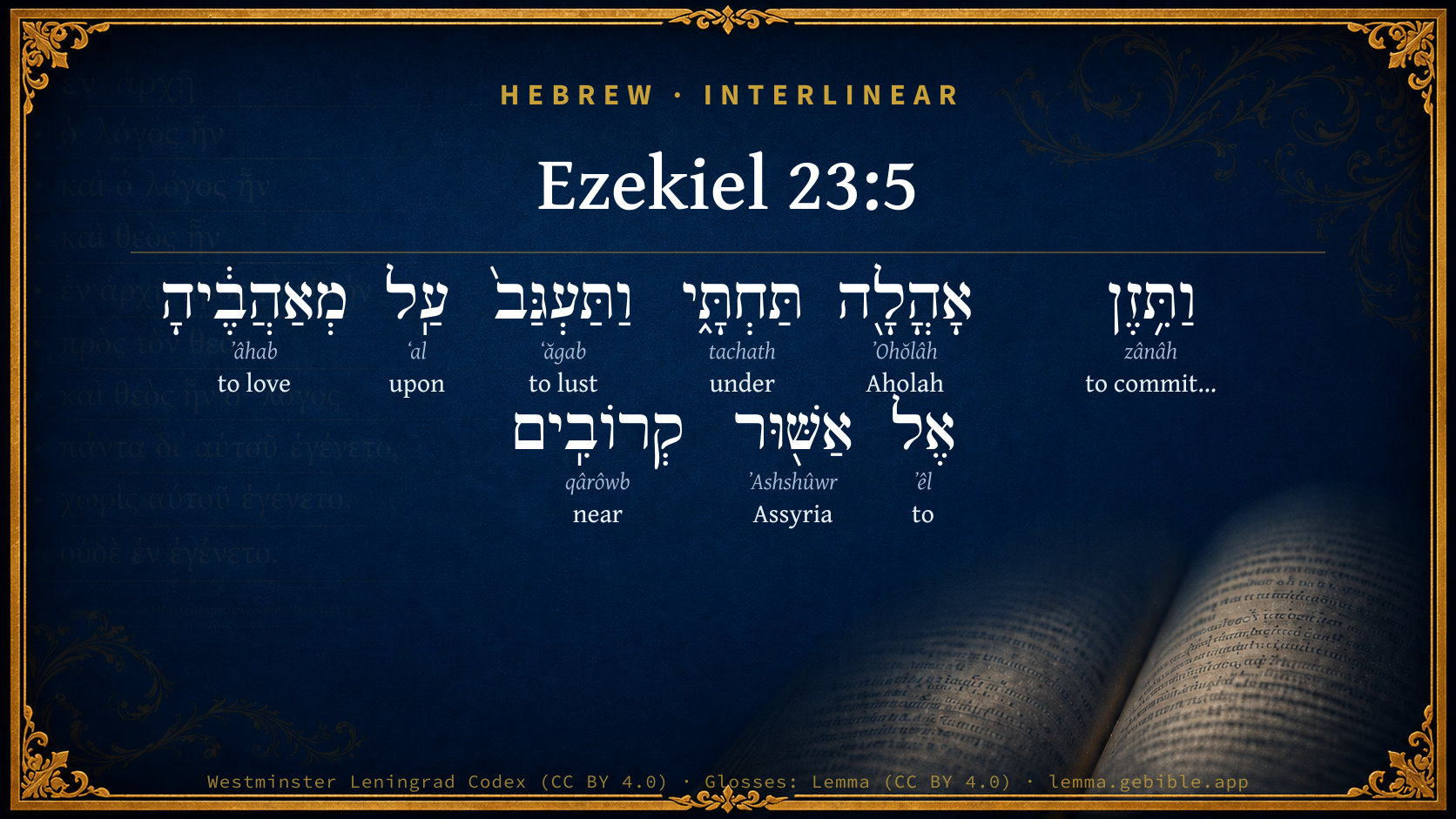
Ezekiel 23:5

Hebrew (Westminster Leningrad Codex) Ezekiel 23:5 appears in the Hebrew Old Testament. The text above is from the Westminster Leningrad Codex. Each word links to its Strong’s number, a concise gloss, and parsing drawn from the Open Scriptures Hebrew Bible morphology. Click any word for its full Brown-Driver-Briggs (BDB) entry.
Download image
Cite this verse

Ezekiel 23:5 (World English Bible). Public Domain. Lemma interlinear Bible study tool, https://lemma.gebible.app/v/ezekiel/23/5.

Show BibTeX & RIS
BibTeX
RIS
English Translation
Oholah played the prostitute when she was mine; and she doted on her lovers, on the Assyrians [her] neighbors,
World English Bible · Public Domain
Download a study sheet

One document with this verse’s original text, its word-by-word gloss line, the meaning frame, cross-references with their text, attributed commentary, and full source and license credits — printable, and it pastes into notes with its structure intact.

This verse Autodidact and up

Study sheet (.html) Plain text (.txt)

A passage Seminary Student

Up to 50 verses in one chapter. A passage sheet keeps up to 6 commentary sources and 12 cross-references per verse, in the order this page ranks them, and says so on the sheet whenever that leaves anything out. Ask for a single verse and you get the Autodidact verse sheet above.

Everything on this page stays free to read, with no account — the sheet is a download of what is already on screen, not access to it.

Want to remove ads? Support Godless Engineer
Compare translations 3

The same verse in 3 English versions, stacked beneath the original-language interlinear above. Click any original word for its lexicon entry.

Each is an independent rendering of the whole verse — the interlinear is not word-aligned to these translations.

Highlighted words mark where these versions differ — a whole-verse word diff, not a word-by-word alignment.

  • World English Bible Public Domain
    Oholah played the prostitute when she was mine; and she doted on her lovers, on the Assyrians [her] neighbors,
  • King James Version Public Domain
    And Aholah played the harlot when she was mine; and she doted on her lovers, on the Assyrians her neighbours,
  • unfoldingWord Literal Text CC BY-SA 4.0
    But Oholah acted as a prostitute even when she was mine; she lusted for her lovers, for the Assyrians who were dominant,

unfoldingWord Literal Text — © unfoldingWord, licensed CC BY-SA 4.0. Word-aligned USFM3 via Door43 (git.door43.org/unfoldingWord/en_ult).

Versions to compare (up to 4)

3 of 4 selected

Show all 18 translations

Every available English version of this verse, each an independent rendering of the whole verse.

  • World English Bible Public Domain
    Oholah played the prostitute when she was mine; and she doted on her lovers, on the Assyrians [her] neighbors,
  • Berean Standard Bible Public Domain
    Oholah prostituted herself while she was still Mine. She lusted after her lovers, the Assyrians—warriors
  • Majority Standard Bible Public Domain
    Oholah prostituted herself while she was still Mine. She lusted after her lovers, the Assyrians—warriors
  • King James Version Public Domain
    And Aholah played the harlot when she was mine; and she doted on her lovers, on the Assyrians her neighbours,
  • American Standard Version (1901) Public Domain
    And Oholah played the harlot when she was mine; and she doted on her lovers, on the Assyrians `her' neighbors,
  • Revised Version (1885) Public Domain
    And Oholah played the harlot when she was mine; and she doted on her lovers, on the Assyrians her neighbours,
  • Geneva Bible (1599) Public Domain
    And Aholah played the harlot when she was mine, and she was set on fire with her louers, to wit, with the Assyrians her neighbours,
  • Douay-Rheims (1899) Public Domain
    And Oolla committed fornication against me, and doted on her lovers, on the Assyrians that came to her,
  • Young's Literal Translation Public Domain
    And go a-whoring doth Aholah under Me, And she doteth on her lovers, On the neighbouring Assyrians,
  • Literal Standard Version CC BY-SA 4.0
    And Aholah goes whoring under Me, and she lusts on her lovers, on the neighboring Assyrians,
  • Unlocked Literal Bible CC BY-SA 4.0
    But Oholah acted as a prostitute even when she was mine; she lusted for her lovers, for the Assyrians who were dominant,
  • unfoldingWord Literal Text CC BY-SA 4.0
    But Oholah acted as a prostitute even when she was mine; she lusted for her lovers, for the Assyrians who were dominant,
  • Darby Bible Public Domain
    And Oholah played the harlot when she was mine; and she lusted after her lovers, after the Assyrians [her] neighbours,
  • World Messianic Bible Public Domain
    “Oholah played the prostitute when she was mine. She doted on her lovers, on the Assyrians her neighbors,
  • Webster's Bible Public Domain
    And Aholah played the harlot when she was mine; and she doted on her lovers, on the Assyrians her neighbors.
  • Free Bible Version CC BY-SA 4.0
    Oholah prostituted herself while she was still married to me. She wanted to have sex with her lovers, the Assyrians.
  • Bible in Basic English Public Domain
    And Oholah was untrue to me when she was mine; she was full of desire for her lovers, even for the Assyrians, her neighbours,
  • JPS Tanakh (1917) Public Domain
    And Oholah played the harlot when she was Mine; and she doted on her lovers, on the Assyrians, warriors,

Literal Standard Version (2020), Covenant Press — licensed CC BY-SA 4.0. Text via the HelloAO Bible API (eBible.org). Unlocked Literal Bible (unfoldingWord) — licensed CC BY-SA 4.0. Text via the HelloAO Bible API (eBible.org). unfoldingWord Literal Text — © unfoldingWord, licensed CC BY-SA 4.0. Word-aligned USFM3 via Door43 (git.door43.org/unfoldingWord/en_ult). Free Bible Version, Dr. Jonathan Gallagher — licensed CC BY-SA 4.0. Text via the HelloAO Bible API (eBible.org).

Word by word

More ways to search: Search by grammar → Find every occurrence → Compare this word →

Practice this passage: Drill this verse → Learn its vocabulary →

About this verse

These counts appear in no published source. They are computed here, from the morphology-tagged text and Lemma’s own curated glosses. What Lemma adds →

9
words
9
distinct lemmas
Prophets
section

Notable vocabulary

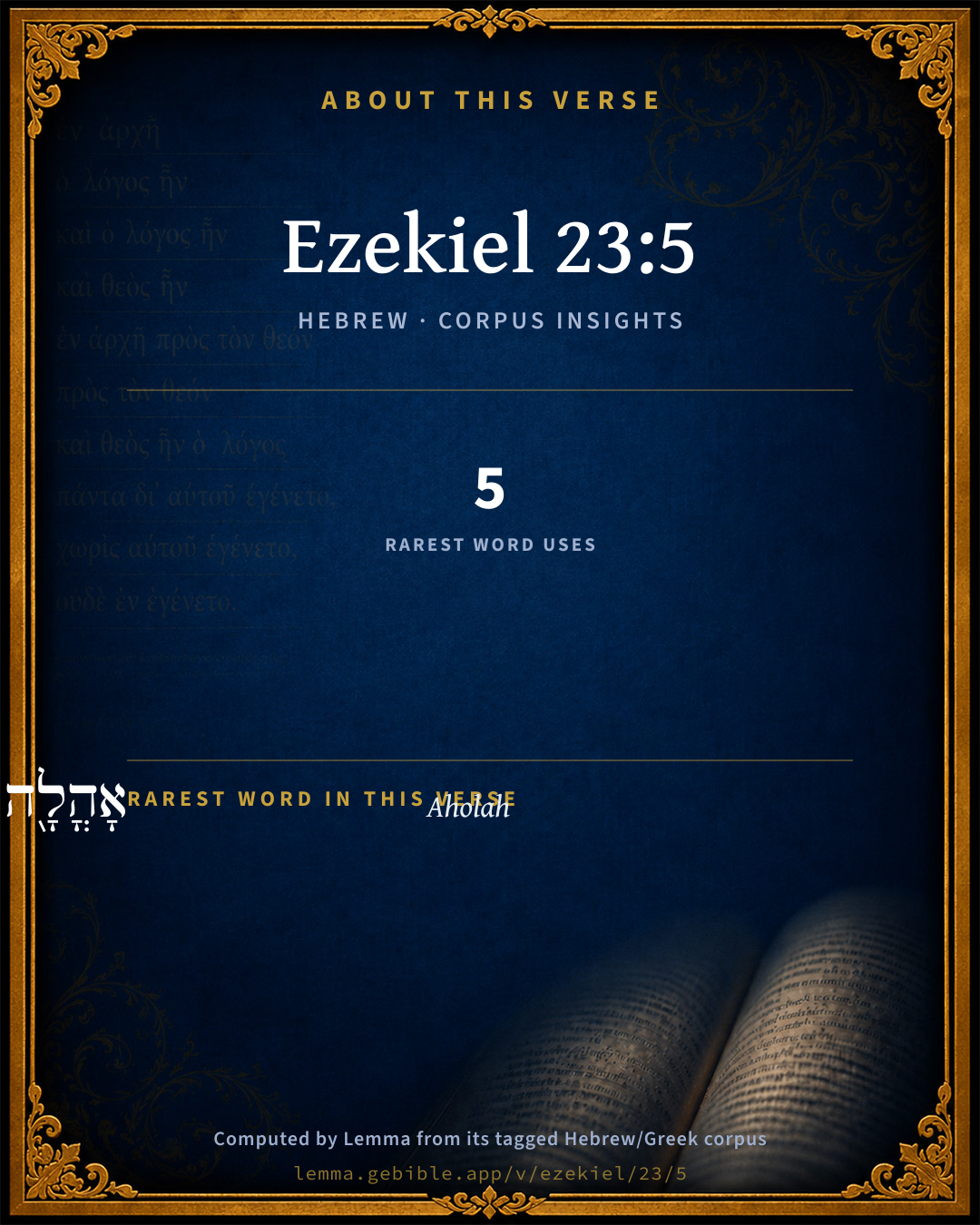
The rarest word here is אָהֳלָ֖ה Aholah H170 — appearing just 5 times in the whole Hebrew Bible.

Shared distinctive vocabulary

אָהֳלָ֖ה Aholah H170 occurs in 4 verses of the Hebrew Bible. Also found in:

Grammatical profile

  • 3 verbs
  • 2 nouns
  • 1 adjective
  • 3 prepositions

Verb forms

  • וַתִּ֥זֶן Qal · Sequential Imperfect
  • וַתַּעְגַּב֙ Qal · Sequential Imperfect
  • מְאַהֲבֶ֔יהָ Piel · Participle Active

Hebrew & Septuagint length

In English translation the verse runs 19 words from the Hebrew and 18 from the Septuagint (LXX English) — closely comparable.

A rough comparison of the two English renderings, which tokenize alike — not a word-level alignment.

Word counts can differ between the Hebrew and the Greek without any difference in meaning — e.g. the Hebrew direct-object marker אֵת has no separate Greek word, and Greek often adds the article ὁ.

Cross-references

22

Topical passages linked to Ezekiel 23:5 in the Treasury of Scripture Knowledge — connected by theme and wording, ordered by reader-vote popularity; previews shown in the World English Bible.

  • 2 Kings 15:19 There came against the land Pul the king of Assyria; and Menahem gave Pul one thousand talents of silver, that his hand might be with him to confirm the kingdom in his hand.
  • 2 Kings 16:7 So Ahaz sent messengers to Tiglath Pileser king of Assyria, saying, I am your servant and your son: come up, and save me out of the hand of the king of Syria, and out of the hand of the king of Israel, who rise up against me.
  • 2 Kings 17:3 Against him came up Shalmaneser king of Assyria; and Hoshea became his servant, and brought him tribute.
  • Hosea 5:13 When Ephraim saw his sickness, And Judah his wound, Then Ephraim went to Assyria, And sent to king Jareb: But he is not able to heal you, Neither will he cure you of your wound.
  • 2 Kings 17:7–18 It was so, because the children of Israel had sinned against Yahweh their God, who brought them up out of the land of Egypt from under the hand of Pharaoh king of Egypt, and had feared other gods,
  • Jeremiah 50:38 A drought is on her waters, and they shall be dried up; for it is a land of engraved images, and they are mad over idols.
  • Ezekiel 16:28 You have played the prostitute also with the Assyrians, because you were insatiable; yes, you have played the prostitute with them, and yet you weren't satisfied.
  • Hosea 8:9–10 For they have gone up to Assyria, Like a wild donkey wandering alone. Ephraim has hired lovers for himself.
  • 1 Kings 14:9 but have done evil above all who were before you, and have gone and made you other gods, and molten images, to provoke me to anger, and have cast me behind your back:
  • 1 Kings 14:16 He will give Israel up because of the sins of Jeroboam, which he has sinned, and with which he has made Israel to sin.
  • 1 Kings 15:26 He did that which was evil in the sight of Yahweh, and walked in the way of his father, and in his sin with which he made Israel to sin.
  • 1 Kings 15:30 for the sins of Jeroboam which he sinned, and with which he made Israel to sin, because of his provocation with which he provoked Yahweh, the God of Israel, to anger.
  • 1 Kings 16:31–32 It happened, as if it had been a light thing for him to walk in the sins of Jeroboam the son of Nebat, that he took as wife Jezebel the daughter of Ethbaal king of the Sidonians, and went and served Baal, and worshiped him.
  • 1 Kings 21:26 He did very abominably in following idols, according to all that the Amorites did, whom Yahweh cast out before the children of Israel.)
  • Ezekiel 16:37 therefore see, I will gather all your lovers, with whom you have taken pleasure, and all those who you have loved, with all those who you have hated; I will even gather them against you on every side, and will uncover your nakedness to them, that they may see all your nakedness.
  • Ezekiel 23:7 She bestowed her prostitution on them, the choicest men of Assyria all of them; and on whoever she doted, with all their idols she defiled herself.
  • Ezekiel 23:9 Therefore I delivered her into the hand of her lovers, into the hand of the Assyrians, on whom she doted.
  • Ezekiel 23:12 She doted on the Assyrians, governors and rulers, [her] neighbors, clothed most gorgeously, horsemen riding on horses, all of them desirable young men.
  • Ezekiel 23:16 As soon as she saw them she doted on them, and sent messengers to them into Chaldea.
  • Ezekiel 23:20 She doted on their paramours, whose flesh is as the flesh of donkeys, and whose issue is like the issue of horses.
  • Hosea 10:6 It also will be carried to Assyria for a present to a great king. Ephraim will receive shame, And Israel will be ashamed of his own counsel.
  • Hosea 12:1 Ephraim feeds on wind, And chases the east wind. He continually multiplies lies and desolation. They make a covenant with Assyria, And oil is carried into Egypt.

Cross-references courtesy of OpenBible.info (CC BY 4.0).

Hebrew and Greek witnesses Masoretic Hebrew ↔ Greek Septuagint

The same verse in the two great witnesses to the Old Testament, shown verse-for-verse.

These are two independent witnesses, not word-aligned to each other, and the Septuagint is shown in lemma (dictionary) form.

Hebrew Ezekiel 23:5 Masoretic · Westminster Leningrad Codex

וַתִּ֥זֶן אָהֳלָ֖ה תַּחְתָּ֑י וַתַּעְגַּב֙ עַֽל מְאַהֲבֶ֔יהָ אֶל אַשּׁ֖וּר קְרוֹבִֽים

Oholah played the prostitute when she was mine; and she doted on her lovers, on the Assyrians [her] neighbors,

World English Bible · Public Domain

Greek LXX Ezekiel 23:5 Septuagint · lemma form

καί ἐκπορνεύω ὁ οολα ἀπό ἐγώ καί ἐπιτίθημι ἐπί ὁ ἐραστής αὐτός ἐπί ὁ ἀσσύριος ὁ ἐγγίζω αὐτός

And Oola went a-whoring from me, and doted on her lovers, on the Assyrians that were her neighbors,

LXX2012 (modern English Septuagint) · Public Domain

Hebrew: Westminster Leningrad Codex (CC BY 4.0). Greek: Septuagint (public domain); English from LXX2012 (modern English Septuagint) (Public Domain). How the Septuagint differs from the Hebrew →

Targum (Aramaic paraphrase)

1

The Targum is the ancient Jewish Aramaic paraphrase of the Hebrew Scriptures — an interpretive translation, not the Hebrew text itself. Onkelos (literal) and Pseudo-Jonathan (expansive) render the Torah, and Jonathan the Prophets. Coverage is partial: where no permissively-licensed English translation exists for a verse, only the Aramaic is shown. This is verse-level text, not a word-by-word alignment to the Hebrew.

  1. Targum Jonathan Prophets (Joshua–Malachi)
    וּטְעַת אָהֳלָה מִבָּתַר פוּלְחָנִי וְאִתְרְעִיאַת לְמִטְעֵי בָתַר רְחִימָהָא בָּתַר בְּנֵי אַתּוּר קָרִיבָהָא:

    (no public-domain English translation for this verse)

    Targum Jonathan — Aramaic: “Mikraot Gedolot” (public domain). English: “Sefaria Community Translation” (CC0 1.0 (public-domain dedication)); “London "Chaldee Paraphrase," 1871” (public domain). Text via Sefaria.

Commentary

Notes on Ezekiel 23:5 from classic Christian and Jewish commentators (each source and its license shown beneath its notes). The classic Christian expositions comment on the surrounding passage and are grouped to its opening verse, so a note may address several verses; the Jewish commentaries on the Tanakh (Rashi and others) are per-verse, so they appear only where the commentator wrote on this verse.

Lemma curates 59 commentaries, every one of them public domain or Creative Commons licensed, each selected and text-cleaned for this edition rather than reprinted as found. About our sources →

Trapp's Complete Commentary

John Trapp

Eze 23:5 And Aholah played the harlot when she was mine; and she doted on her lovers, on the Assyrians [her] neighbours,

Ver. 5. And Aholah played the harlot when she was mine.] Fornicata est sub me, under colour and covert of a marriage made with me. See what a fair gloss Jeroboam set upon his foul idolatry. {1Ki 12:28}

On the Assyrians, her neighbours.] So they were now become, by the conquest of Syria.

John Trapp, A Commentary or Exposition upon All the Books of the Old and New Testament (1647–1656) — public domain. Text from a community e-Sword module.

Joseph Benson's Commentary

Eze 23:5-6. And Aholah played the harlot when she was mine — When she was under my government and protection. “After she had lived in covenant with me, and attended upon my service and worship all the time of the judges, and of David and Solomon, she fell off from my service, and was the first that established idolatry by a law, and consented to Jeroboam’s wicked device of setting up the golden calves.” In the Scripture language, the Jewish people are said to play the harlot with those whose religious ceremonies they imitated. And she doted on her lovers — That is, her foreign allies, whose idolatries she was fond of, and hoped by that means to procure their friendship and assistance: see note on Eze 16:33; Eze 16:37. On the Assyrians her neighbours — The king of Assyria was a very potent prince, and thereupon his alliance was courted both by the kings of Israel and Judah: see the margin. Which were clothed with blue, captains and rulers — “As women are apt to fall in love with comely young men, well mounted and richly clothed; so the Israelites were enamoured with the state and bravery of the Assyrians, and thought themselves secure if they could but procure their alliance and friendship, and in order to it embraced their idolatries. Horsemen riding upon horses — Horses were scarce in Judea, which made the Jews apply themselves to the neighbouring counties for troops of horse, in the time of any hostile invasion.” — Lowth.

Joseph Benson's Commentary on the Old and New Testaments (1811–1818) — public domain. Text from a community e-Sword module.

The Preacher's Complete Homiletical Commentary

Joseph S. Exell (gen. ed.)

(Eze_23:5-10)

EXEGETICAL NOTES.—The spiritual adultery of Samaria with Assyria. The instrument of her punishment is that very people which she had made the object of her impure love.

Eze_23:5. The Assyrians her neighbours. The word refers rather to kinsmen, rather than to those dwelling near. Asshur was brother to Arphaxad, Abraham’s ancestor (Gen_10:22; Gen_10:24; Gen_11:16-26).

Eze_23:6. Clothed with blue, captains and rulers, all of them desirable young men, horsemen riding upon horses. “This description given of the Assyrians contains the thought that Israel, dazzled by Assyria’s splendour, and overpowered by the might of that kingdom, had been drawn into intercourse with the Assyrians, which led her astray into idolatry. The predicate, clothed in purple, points to the splendour and glory of this imperial power; the other predicates, to the magnitude of its military force.” (Keil). We have here the ground which tempted Aholah to become unfaithful to her God. It lay in this, that the paramour Assyria came into her neighbourhood, and placed his grandeur before her. Therein lay the temptation to sue for his favour to ward off injury. The adultery has been not so much a religious as a political import. The paramour, on whose account Israel forsakes his God, is Assyria itself, not its god, though they endeavoured, no doubt from fear of the people, to make friends of its gods also.” (Hengstenberg).

Eze_23:8. “Neither left she her whoredoms brought from Egypt.” This was the Apis-worship of which Israel was guilty while in Horeb. Jeroboam instituted it, thus reviving the former iniquity of the nation. The people never wholly got rid of this source of unfaithfulness brought from Egypt. Even Jehu tolerated it (2Ki_10:31).

Eze_23:10. “These discovered her nakedness.” “This denotes the ignominious treatment which Israel must suffer from Assyria, as a punishment for her revolt to Egypt. Aholah is slain with the sword: the proper substance of the people, the men fit for service, fell in the war, while the weaker portion was carried into exile.” (Hengstenberg.) “Famous among women.” “She was rendered as notorious by her punishment as she had been by her crimes. She was made an example to which an appeal could be made by other states” Henderson.

HOMILETICS

THE SIN OF SAMARIA

I. It showed the basest ingratitude. “Played the harlot when she was Mine.” God had united her to Himself, she was in living and tender relationship with Him when she basely deserted His worship and service. She was taught the true doctrine, and the right way of duty, and was supplied with means to observe both. Yet she sinned against light and privilege.

II. It showed the dangerous power of the imagination. The military organization of Assyria dazzled their imagination. The glory of the world seduces the worldly mind. “Clothed with blue, captains and rulers, all of them desirable young men, horsemen riding upon horses.” Such was the power and grandeur of Assyria. In accordance with the figure employed, those things are named which would be likely to strike the eye of a wordly minded young woman. Israel admired the political and worldly grandeur of the Assyrians, and so were seduced into idolatry. They first worshipped the power and magnificence of the nation, and then it was an easy matter to adopt the worship of their gods. The fascinations of the world is still the standing danger to purity in doctrine and worship. In all sensuous forms of religious worship there lurks this great danger, that men through admiration of the outward are led to adopt the false doctrines of which it is the vehicle.

III. It showed how inveterate are old evils. “Brought from Egypt” (Eze_23:8). The old idolatry which they had learned in Egypt clung to the nation every now and then breaking out. The nation was never clearly delivered from it till after their captivity in Babylon.

IV. It was visited with exemplary punishment.

1. Those who had seduced her by their power and grandeur were made the very instruments of her punishment. She had doted on the Assyrians, and she was delivered into their hands (Eze_23:9).

2. She was made a warning example to all. “Famous among women.” An example to all the other nations. They would talk of her; some of her abominable wickedness, others of her miseries, previous judgments, and calamities.

1. When people embrace false worship they are violent and strong in their affections towards it. Aholah doted upon her lovers, her heart was fired with Babylonish gods, and confidences in them.

2. What evil persons have practised in their youth that they affect in their age. Aholah had loved the Egyptian idols in her minority, and after she was grown up, those idols were not out of her thoughts. Her Egyptian lovers were still in her mind, like harlots that mind their former lovers long after they are married. What corruption gets in youth, grows up and abides; an unclean, idolatrous heart in youth, will be so in age.

3. Idolatry may continue long in a nation, but shall at least be severely punished by the Lord. Aholah had been an idolatress from her youth, and when she was grown up to some greatness, then she broke out into gross, notorious idolatry (1 Kings 12); in which she continued for upwards of two hundred and sixty years, and then the Lord plagued, yea, destroyed her, her sons and daughters. It is wisdom to cleave to the Lord and His worship, not to follow or confide in other nations, or their ways.

4. God makes places and persons remarkable by the judgments He executeth upon them. Aholah was made famous among women by those judgments He brought upon her. Aholah was Samaria, which Shalmaneser besieged three years, and then took it; and afterwards burnt it (2Ki_17:5-6).—Greenhill.

The Preacher's Complete Homiletical Commentary (gen. ed. Joseph S. Exell; Funk & Wagnalls, c. 1892) — public domain (pre-1929). A full-Bible homiletical/sermon-outline anthology covering 65 of 66 books (2 John is absent from the source module). Text from a community e-Sword module.

Keil & Delitzsch

C. F. Keil & F. Delitzsch

Samaria's Whoredom and Punishment

Eze 23:5. And Oholibah played the harlot under me, and burned towards her lovers, even as far as Assyria, standing near; Eze 23:6. Clothed in purple, governors and officers, all of them choice men of good deportment, horsemen riding upon horses. Eze 23:7. And she directed her whoredom toward them, to the choice of the sons of Assyria all of them, and with all towards whom she burned, with all their idols she defiled herself. Eze 23:8. Also her whoredom from Egypt she did not give up; for they had lain with her in her youth, and they had handled her virgin bosom, and had poured out their lust upon her. Eze 23:9. Therefore I have given her into the hand of her lovers, into the hand of the sons of Assyria, towards whom she was inflamed. Eze 23:10. They uncovered her nakedness, took away her sons and her daughters, and slew her with the sword, so that she became a legend among the women, and executed judgments upon her. - Coquetting and whoring with Assyria and Egypt denote religious and political leaning towards and connection with these nations and kingdoms, including idolatry and the formation of alliances with them, as in Ezekiel 16. תּחתּי is to be interpreted in accordance with תּחת אישׁהּ (Eze 16:32). עגּב, which only occurs in Ezekiel and once in Jeremiah, denotes the eager desire kindled by passionate love towards any one. By the words אל־אשּׁוּר the lovers are more precisely defined. קרובים without an article is not an adjective, belonging to מאהביה, but in apposition, which is continued in the next verse. In these appositions the particular features, which excited the ardent passion towards the lovers, are pointed out. קרוב is not to be taken in an outward or local sense, but as signifying inward or spiritual nearness: standing near, equivalent to inwardly related, as in Psa 38:12; Job 19:14. The description given of the Assyrians in Eze 23:6 contains the thought that Israel, dazzled by Assyria's splendour, and overpowered by the might of that kingdom, had been drawn into intercourse with the Assyrians, which led her astray into idolatry. The predicate, clothed in purple, points to the splendour and glory of this imperial power; the other predicates, to the magnitude of its military force. פחות וּסגנים are rulers of higher and lower grades (cf. Jer 51:57). "Here the expression is a general one, signifying the different classes of office-bearers in the kingdom" (Hvernick). With regard to פּחה, see my comm. on Hag 1:1; and for סגן, see Delitzsch on Isa 41:25. "Riding upon horses" is added to פּרשׁים to denote the noblest horsemen, in contrast to riders upon asses and camels (cf. Isa 21:7). In Eze 23:7 בּכּל־גּלּוּליהםhem is in apposition to בּכל אשׁר־עגבה, and defines more precisely the instigation to pollution: with all towards whom she burned in love, namely, with all their (the lovers') idols. The thought is as follows: it was not merely through her intercourse with the Assyrians that Israel defiled herself, but also through their idols. At the same time, Samaria did not give up the idolatry which it had derived from Egypt. It was from Egypt that the worship of God under the image of the golden calves had been imported. The words are much too strong for us to understand them as relating simply to political intercourse, as Hitzig has done. We have already observed at Eze 20:7, that even in Egypt itself the Israelites had defiled themselves with Egyptian idolatry, as is also stated in Eze 23:8. - Eze 23:9, Eze 23:10. As a punishment for this, God gave Samaria into the power of the Assyrians, so that they executed judgment upon the harlot. In Eze 23:10 the prophecy passes from the figure to the fact. The uncovering of the nakedness consisted in the transportation of the sons and daughters, i.e., the population of Samaria, into exile by the Assyrians, who slew the woman herself with the sword; in other words, destroyed the kingdom of Samaria. Thus did Samaria become a name for women; that is to say, her name was circulated among the nations, her fate became an object of conversation and ridicule to the nations, not "a nickname for the nations," as Hvernick supposes (vid., Eze 36:3). שׁפוּטים, a later form for שׁפטים (cf. Eze 16:41).

Keil & Delitzsch — Biblical Commentary on the Old Testament (1861–1891) — public domain (CC PDM 1.0). Text via the HelloAO Bible API. (Old Testament only.)

Tyndale Open Study Notes

Tyndale Open Resources

23:5-8 Oholah: The northern kingdom, far from being converted by God’s covenant of grace, was fascinated with the power and prestige of Assyria. Alliances with Assyria were part of Israel’s political strategy from the 800s BC, but in the end, such alliances did not keep Israel safe.

Tyndale Open Study Notes — © Tyndale Open Resources, licensed CC BY-SA 4.0. Text via the HelloAO Bible API.

Geneva Bible (1599)

Geneva Bible translators

Hebrew, under me.

When the Israelites were named the people of God, they became idolaters, and forsook God, and put their trust in the Assyrians.

Geneva Bible (1599) marginal notes — public domain. Text via Bolls.life.

Jamieson, Fausset & Brown

Robert Jamieson, A. R. Fausset & David Brown

when . . . mine--literally, "under Me," that is, subject to Me as her lawful husband.

neighbours--On the northeast the kingdom of Israel bordered on that of Assyria; for the latter had occupied much of Syria. Their neighborhood in locality was emblematical of their being near in corruption of morals and worship. The alliances of Israel with Assyria, which are the chief subject of reprobation here, tended to this (Kg2 15:19; Kg2 16:7, Kg2 16:9; Kg2 17:3; Hos 8:9).

Jamieson, Fausset & Brown — Commentary Critical and Explanatory on the Whole Bible (1871) — public domain (CC PDM 1.0). Text via the HelloAO Bible API.

Adam Clarke's Commentary

Verse 5. And Aholah played the harlot] Without entering into detail here, or following the figures, they both became idolatrous, and received the impure rites of the Egyptians, Assyrians, and Chaldeans, of which connexion the prophet speaks here as he did in Eze 16:15 c., which see.

In this chapter there are many of what we would call indelicate expressions, because a parallel is run between idolatry and prostitution, and the circumstances of the latter illustrate the peculiarities of the former. In such cases, perhaps, the matter alone was given to the prophet, and he was left to use his own language, and amplify as he saw good. Ezekiel was among the Jews what Juvenal was among the Romans,-a rough reprover of the most abominable vices. They both spoke of things as they found them stripped vice naked, and scourged it publicly. The original is still more rough than the translation; and surely there is no need of a comment to explain imagery that is but too generally understood. I have said enough on Eze 16:15 c,, and to that I must refer the reader. It is true that there are a few things here in the shade that might be illustrated by anatomy and it would not be difficult to do it: but they are not necessary to salvation, and I shall not take off the covering. They were sufficiently understood by those for whose use they were originally designed.

Adam Clarke's Commentary on the Bible (1810–1826) — public domain. Text from a community e-Sword/MySword module.

Ellicott's Commentary for English Readers

(5) The Assyrians her neighbours.—Or, the Assyrians drawing near. They are described in Eze_23:40 as those who “come from far.” The nearness here spoken of is to be understood not locally, but spiritually, of sympathy in idolatry. Of the earlier connection between Israel and Assyria there is little remaining record. In 2Ki_15:19-20, it is said that Pul exacted tribute of Menahem, and the mention seems to imply a still earlier intercourse. According to the Assyrian records, Jehu was tributary to Shalmaneser; Assyria, as representing the great northern power, in contrast to Egypt on the south, is probably used here in a sense broad enough to include also Syria.

A Bible Commentary for English Readers, edited by Charles John Ellicott (1878–1897) — public domain. Text from a community e-Sword module.

The Cambridge Bible for Schools and Colleges

gen. ed. J. J. S. Perowne

5–10. The intrigues of Samaria with Assyria

5. when she was mine] though my wife, lit. under me.

Assyrians her neighbours] In Eze_16:26 the Egyptians are called Israel’s “neighbours,” but the Assyrians could hardly be so called, and indeed in Eze_23:40 are referred to as “far off.” The word may mean “warriors” (the similar word “war” or “battle” 2Sa_17:11 and often). Corn, suggests, “famous,” the term used in Eze_23:23. The verse should be connected with Eze_23:6, as appears from Eze_23:12—even on the Assyrians, warriors clothed with blue.

The Cambridge Bible for Schools and Colleges (gen. ed. J. J. S. Perowne; Cambridge University Press, 1878–1918) — public domain. Text from a community e-Sword module.

John Gill's Exposition

And Aholah played the harlot when she was mine,.... His married wife, and so ought to have cleaved to him alone: or, under me (o); under his cover, power, and protection, and therefore it was their interest to serve him only: or, "instead of me" (p); or, as the Syriac version, "besides me": they worshipped other gods in the room of the true God, or other gods besides him. The Targum is,

"and Aholah erred from my worship;''

the ten tribes fell into idolatry, when they were God's professing people:

and she doted on her lovers; whom she loved even to madness; she was mad with love, to the idols, temples, altars, and idolatrous worship of the Heathens; particularly doted "on the Assyrians her neighbours"; who were become so by the conquest of Syria; and these they treated as their neighbours, and sought to have them to be their allies and confederates; courted their help and assistance, and gave them much money for that purpose; as Menahem gave to Pul king of Assyria a thousand talents of silver, to confirm the kingdom in his hand, Kg2 15:19.

(o) "sub me", Pagninus, Montanus, Munster, Tigurine version. Piscator, Cocceius, Starckius. (p) "Exteros excipiens loco meo", Junius & Tremellius, Polanus.

John Gill's Exposition of the Whole Bible (1746–1763) — public domain (CC PDM 1.0). Text via the HelloAO Bible API.

Haydock's Catholic Bible Commentary

Assyrians. That is, the idols of the Assyrians: for all that is said in this chapter of the fornications of Israel and Juda, is to be understood in a spiritual sense of their disloyalty to the Lord, by worshipping strange gods. (Challoner) (Worthington) --- The Assyrians taught the worship of Baal, the high places, &c. The Egyptians also promoted their abominations. (Calmet)

George Leo Haydock (1774–1849), Haydock's Catholic Family Bible and Commentary, 1859 edition — public domain. Excludes Psalms (Douay-Rheims chapter numbering differs from Protestant) and Deuterocanonical books (Catholic canon only).

Matthew Poole's English Annotations

Aholah, the kingdom of Israel, or the ten tribes,

played the harlot; united in confederacy in civil concerns, and in idolatry as to religious concerns, with the Assyrians.

When she was mine; when under my government and protection, or in my presence, or before I had abdicated and cast her off.

Doted; were madly enamoured with the Assyrian idols, temples, and manner of worship.

Her lovers; whom she loved, not that I find they so much loved her.

The Assyrians; so often mentioned, nothing needs be said of them.

Her neighbours; so they were now by their seizing of Syria, and possessing it as their own 2Ki 15:19.

Matthew Poole's English Annotations on the Holy Bible (1683–1685) — public domain. Text from a community e-Sword/MySword module.

Whedon's Commentary on the Bible

Daniel D. Whedon

5. And Aholah played the harlot — The wife deserts her husband and joins herself to the handsomely uniformed Assyrians. Nahum represents Nineveh as the grand courtesan of the nations. Her palaces and glorious gardens and, above all, the military prowess which for six centuries dominated the whole earth made her brave to look upon. “In war the Assyrians astonished the people by the richness of the colors of their costumes, the flashing of their arms, and the multitude of horses and chariots, which has never been surpassed by any other people.” — Delatre. The military grandeur of these young horsemen dazzles her eyes and she accepts them and “all their idols” (Eze_23:7) instead of her true Lord. This evidently refers to Jerusalem’s political as well as her religious affiliation with Assyria. (Compare Hos_5:13; Hos_7:11; 2Ki_23:11; 2Ki_17:4.) Her neighbors (also Eze_23:12) — The nations that had formerly seemed far away (Eze_23:40) came very near to Jerusalem after Jehu began to pay tribute to Shalmaneser (Black Obelisk). It is probable, however, that this Hebrew term may mean “warriors” (Smend) or “high dignitaries” (Toy).

Daniel D. Whedon (gen. ed.), Commentary on the Old and New Testaments (1874–1909) — public domain. Text from a community e-Sword module.

The Pulpit Commentary

The history of both the sisters passes from the time of the Exodus to that of their separate existence, and starts, in fact, from their first intercourse with the great monarchies of Asia. So far it is less a survey of their successive stages of degradation, like that of Eze 16, than a retrospect of their political alliances. Aholah played the harlot. The lovers, as in Eze_16:33, are the nations with which the kings of Israel were in alliance, and of these the Assyrians are named as preeminent. The word neighbors, which in its literal sense is hardly applicable, is probably to be taken of spiritual affinity, or may be taken as "come near" is in Gen_20:4; Eze_18:6; Lev_20:16. The Assyrians were those who, in that sense, came near to the harlot city. We have in 2Ki_15:20 the fact that Menahem paid tribute to Pul. Hos_5:13 and Hos_7:11 speak generally of such alliances. The black obelisk of Shalmaneser records the fact that Jehu paid tribute to him ("Records of the Past," 5:41). In the last-named case the tribute consisted chiefly of vessels of gold, bowls, goblets, etc.

HOMILIES BY W. JONES Ver. 5a. Exalted relationship and enormous sin.

"And Aholah played the harlot when she was mine.

I A RELATIONSHIP OF THE HIGHEST PRIVILEGE. "She was mine." Aholah is intended to represent the people of Israel as distinguished from the people of Judah. The Lord here says that she was his. In common with all other peoples, Israel was his:

(1) By creation. God himself giveth to all life, and breath, and all things." He is "the Father of spirits.

(2) By sustentation. He is "the God in whose hand our breath is, and whose are all our ways." With Job, we may say to him, "Thou hast granted me life and favor, and thy visitation hath preserved my spirit." But:

(3) Israel was his by redemption. He redeemed them from their bondage in Egypt by mighty works and marvelous signs. That emancipation is an illustration of the redemption of man from sin effected by our Savior Jesus Christ. "The Lord hath anointed him to proclaim liberty to the captives,". (Isa_61:1, Isa_61:2) He "gave himself a ransom for all.

(4) Israel was his pre-eminently by covenant engagement. "I aware unto thee, and entered into a covenant with thee, saith the Lord God, and thou becamest mine". (Eze_16:8) They belonged to him as a wife belongs to her husband. This is the relationship to which the text points, and which is treated of in Ezekiel 16. It is great condescension on the part of God to authorize the prophets thus to represent his relation to his people. "Thy Maker is thy Husband; the Lord of hosts is his name". "Return, (Isa_54:5) O backsliding children, saith the Lord; for I am a Husband unto. (Jer_3:14) This relationship should be characterized by:

1. Tender affection. We may see this in the way in which St. Paul writes of the love between Christ and the Church. (Eph_5:23-32) When marriage is contracted without true mutual affection, the relation is desecrated.

2. Exalted privilege. In taking the Israelites to be his, God gave himself to them as their supreme Portion. "They shall be my people, and I will be their. (Jer_32:38) "This of God"s being our God," says Charnocke, is the quintessence of the covenant, the soul of all the promises: in this he hath promised whatsoever is infinite in him, whatsoever is the glory and ornament of his nature, for our use; not a part of him, or one single perfection, but the whole vigor and strength of all. As he is not a God without infinite wisdom, and infinite power, and infinite goodness, and infinite blessedness, etc., so he passes over, in this covenant, all that which presents him as the most adorable Being to his creatures: he will be to them as great, as wise, as powerful, as good, as he is in himself. And the assuring us, in this covenant, to be our God, imports also that he will do as much for us as we would do for ourselves, were we furnished with the same goodness, power, and wisdom: in being our God, he testifies it is all one as if we had the same perfections in our power to employ for our use; for he being possessed with them, it is as much as if we ourselves were possessed with them for our own advantage, according to the rules of wisdom, and the several conditions we pass through for his glory.

3. Scrupulous fidelity. The relationship imperatively demands this. God would not fail in one jot or tittle on his part. "If we are faithless, he abideth faithful; for he cannot deny himself." And Israel was required to be true to him in obeying his commands, and above all in worshipping him alone. "I am the Lord thy God, which brought thee out of the land of Egypt, out of the house of bondage. Thou shalt have none other gods before me," etc. (Exo_20:1, seg.) Through Jesus Christ we may each enter into this exalted relationship. Through him we may each be enabled, without presumption, to say of the great God, "He is my God and my Father.

II A SIN OF THE GREATEST HEINOUSNESS. And Aholah played the harlot when she was mine." Israel is here represented as a wife who has been unfaithful to her husband. The primary reference is to the sin of Jeroboam in setting up the golden calves at Bethel and at Dan, and calling upon the people to worship God through them. (1Ki_12:26-33) And this was but the beginning of Israel"s sin. Afterwards they worshipped Baal and Astarte. Their sin involved:

1. Positive injustice. They robbed God of his rights. He has a just claim on our obedience, our reverence, and our love. This claim is firmly based upon what he is in himself the Supremely Great and Good; and upon what he is and does in relation to us our Creator, etc. Not to comply with his claims is to defraud him o; his due.

2. Base ingratitude. How shameful were the returns which Israel made for his great kindness to them! Very strikingly is this set forth in Ezekiel 16. And their conduct has been too closely reproduced by us. For his fidelity we have returned unbelief; for his love, coldness of heart; for his beneficence, disobedience. How heinous this ingratitude is! And yet, alas, how common!

Blow, blow, thou winter wind, Thou art not so unkind As man"s ingratitude; Thy tooth is not so keen, Because thou art not seen, Although thy breath be rude.

Freeze, freeze, thou bitter sky, That dost not bite so nigh As benefits forgot: Though thou the Waters warp, Thy sting is not so sharp As friend remember"d not. (Shakspeare. )

3. Heinous infidelity. This is the aspect of Israel"s sin to which prominence is given in the text. In forsaking the Lord God for idols they committed a treacherous breach of a sacred engagement. Their conduct is an illustration of the action of those who, having avowed their allegiance to him, turn their backs upon him and upon his cause. Terrible is their guilt, and deplorable their condition. "It is a miserable thing," says Bishop Ryle, "to be a backslider. Of all unhappy things that can befall a man, I suppose it is the worst. A stranded ship, a broken-winged eagle, a garden overrun with weeds, a harp without strings, a church in ruins, all these are sad sights; but a backslider is a sadder sight still." And appalling will be their doom, even "a certain fearful expectation of judgment, and a fierceness of fire which shall devour the adversaries." Says Bunyan, "They fall deepest into hell who fall backwards into hell." Let backsliders return unto the Lord while there is yet time. "Return, thou backsliding Israel, saith the Lord; I will not look in anger upon you," etc. W.J. (Jer_3:12, Jer_3:14; Hos_14:1-4)

The Pulpit Commentary (1880–1919), ed. H.D.M. Spence-Jones & Joseph S. Exell — public domain. Text from a community e-Sword module.

John Wesley's Explanatory Notes

Played the harlot - United in idolatry, with the Assyrians. Mine - When under my government, and protection.

John Wesley, Explanatory Notes Upon the Whole Bible (1754–1765) — public domain. Text via the GEBible commentary corpus.

unfoldingWord translationNotes

Door43 World Missions Community

General Information:

Yahweh continues his metaphor in which he speaks of the cities of Jerusalem and Samaria as if they were two prostitutes. This metaphor continues through Ezekiel 23:34. (See: Metaphor)

when she was mine

This refers to when she was his wife. AT: "while she was still my wife" (See: Assumed Knowledge and Implicit Information)

who were dominant

"who ruled over her"

all the best of Assyria's men

This identifies who the word "them" refers to.

she made herself unclean with everyone she lusted for—and with all their idols

This implies that she slept with all of these men and worshiped the idols they worshiped. AT: "she made herself unclean by sleeping with everyone she lusted for and by worshiping all their idols" (See: Assumed Knowledge and Implicit Information)

unclean

A person who God considers spiritually unacceptable or defiled is spoken of as if the person were physically unclean. (See: Metaphor)

translationWords

lust

Assyria

govern

horse

clean

false god

unfoldingWord translationNotes — © Distant Shores Media and the Door43 World Missions Community, licensed CC BY-SA 4.0. Source: git.door43.org/Door43/en_tn.

Rashi

Rabbi Shlomo Yitzchaki (Rashi)

and she lusted [Heb. וַתַּעְגַּב,] and she lusted, esvayer or eswaier in Old French, to covet, to lust after. Some editions read: desirer, to desire.

for the Assyrians, who were nearby Who were her neighbors, and they sent to them [requesting that they] aid them. This is Menachem the son of Gadi (II Kings 15: 19f.), who gave tribute to Pul king of Assyria in order “that his hands might be with him to strengthen the kingdom in his hand.” The prophet likens the matter to an adulterous woman, for, had they worshipped the Holy One, blessed be He, they would not have needed the kings of Assyria.

Rashi on the Tanakh — English translations: “The Judaica Press complete Tanach with Rashi, translated by A. J. Rosenberg” (CC BY 4.0); “Pentateuch with Rashi's commentary by M. Rosenbaum and A.M. Silbermann, 1929-1934” (public domain); “The Metsudah Tanach series, Lakewood, N.J” (CC BY 4.0); and “The Book of Joshua, Metsudah Publications, 1997” (CC BY 4.0). Text via Sefaria.

Lesson kit

Teaching starters — assembled from the data on this page, not authored interpretation. Every prompt links to the verse data it draws on. Edit before teaching.

Ezekiel, in the Prophets, opens this verse with 9 words (9 distinct Hebrew lemmas). Its most distinctive word is ʼOhŏlâh (“Aholah”). A historical commentator’s framing appears above. Read the whole chapter for the surrounding context.

Discussion questions

  1. How does “Aholah” (ʼOhŏlâh) shape what this verse is saying?
  2. How does Ezekiel 23:4, which shares the word «Aholah», read alongside this verse?
  3. These translations render this verse differently. What is at stake in choosing one wording over another?
  4. «וַתִּ֥זֶן» is a Qal Sequential Imperfect verb. How does that grammatical form shape the action described?
  5. Compare how Trapp's Complete Commentary and Joseph Benson's Commentary read this verse. Where do they agree or differ?

Things to notice

Reading settings

Reading text

Shown beneath each verse's original-language words.

Old Testament
Old Testament edition

Read the OT as the Masoretic Hebrew (MT) or the Greek Septuagint (LXX).

English shown for the Greek Septuagint (in the Hebrew ↔ Greek comparison).

Comparing translations? Open the Compare panel on any verse page to stack up to four side by side.