Micah 3:2

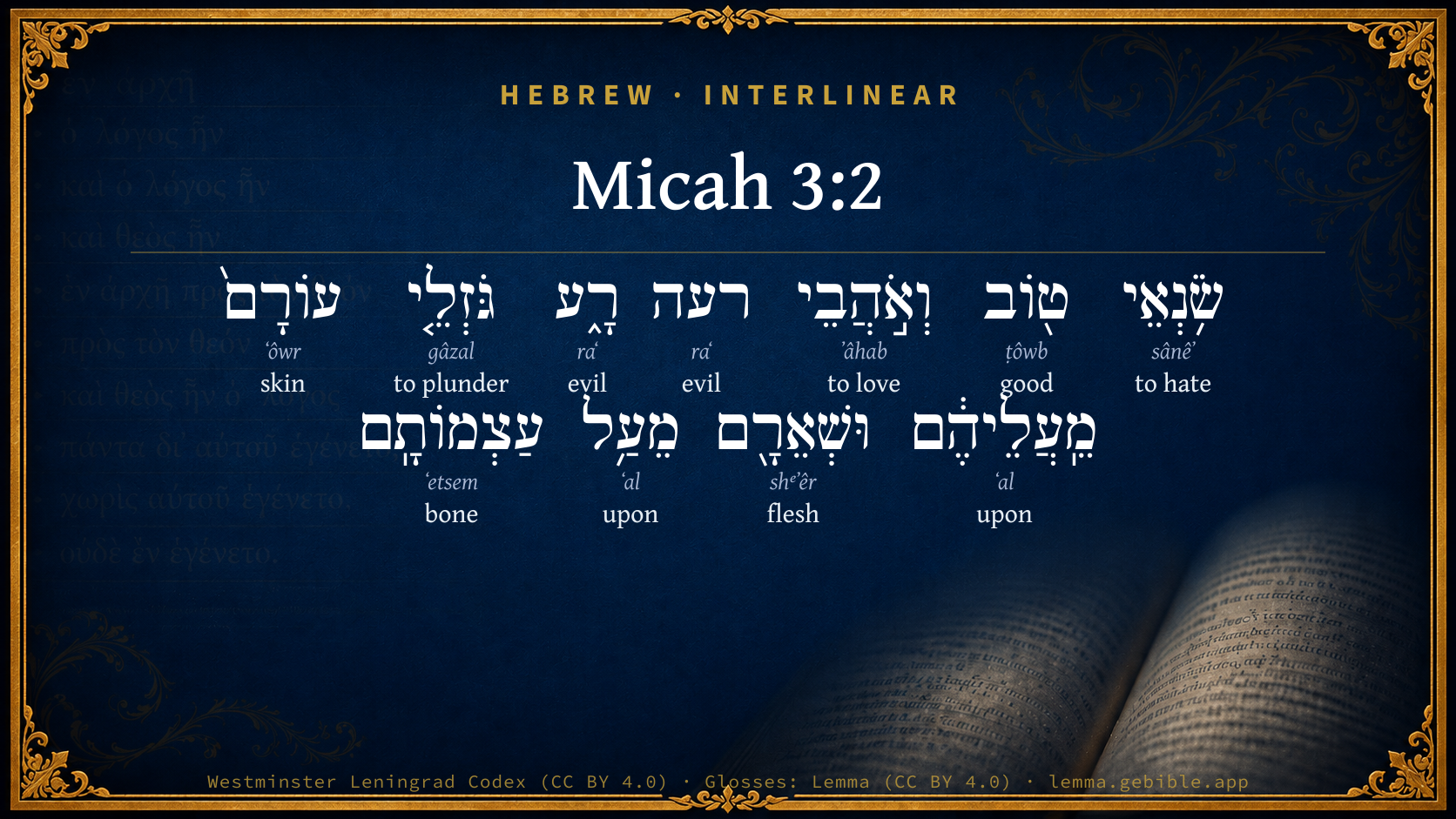
Hebrew (Westminster Leningrad Codex) Micah 3:2 appears in the Hebrew Old Testament. The text above is from the Westminster Leningrad Codex. Each word links to its Strong’s number, a concise gloss, and parsing drawn from the Open Scriptures Hebrew Bible morphology. Click any word for its full Brown-Driver-Briggs (BDB) entry.
Download image
Cite this verse

Micah 3:2 (World English Bible). Public Domain. Lemma interlinear Bible study tool, https://lemma.gebible.app/v/micah/3/2.

Show BibTeX & RIS
BibTeX
RIS
English Translation
You who hate the good, And love the evil; Who tear off their skin, And their flesh from off their bones;
World English Bible · Public Domain
Download a study sheet

One document with this verse’s original text, its word-by-word gloss line, the meaning frame, cross-references with their text, attributed commentary, and full source and license credits — printable, and it pastes into notes with its structure intact.

This verse Autodidact and up

Study sheet (.html) Plain text (.txt)

A passage Seminary Student

Up to 50 verses in one chapter. A passage sheet keeps up to 6 commentary sources and 12 cross-references per verse, in the order this page ranks them, and says so on the sheet whenever that leaves anything out. Ask for a single verse and you get the Autodidact verse sheet above.

Everything on this page stays free to read, with no account — the sheet is a download of what is already on screen, not access to it.

Want to remove ads? Support Godless Engineer
Compare translations 3

The same verse in 3 English versions, stacked beneath the original-language interlinear above. Click any original word for its lexicon entry.

Each is an independent rendering of the whole verse — the interlinear is not word-aligned to these translations.

Highlighted words mark where these versions differ — a whole-verse word diff, not a word-by-word alignment.

  • World English Bible Public Domain
    You who hate the good, And love the evil; Who tear off their skin, And their flesh from off their bones;
  • King James Version Public Domain
    Who hate the good, and love the evil; who pluck off their skin from off them, and their flesh from off their bones;
  • unfoldingWord Literal Text CC BY-SA 4.0
    Haters of good and lovers of evil, tearing their skin from upon them and their flesh from upon their bones,

unfoldingWord Literal Text — © unfoldingWord, licensed CC BY-SA 4.0. Word-aligned USFM3 via Door43 (git.door43.org/unfoldingWord/en_ult).

Versions to compare (up to 4)

3 of 4 selected

Show all 18 translations

Every available English version of this verse, each an independent rendering of the whole verse.

  • World English Bible Public Domain
    You who hate the good, And love the evil; Who tear off their skin, And their flesh from off their bones;
  • Berean Standard Bible Public Domain
    You hate good and love evil. You tear the skin from my people and strip the flesh from their bones.
  • Majority Standard Bible Public Domain
    You hate good and love evil. You tear the skin from my people and strip the flesh from their bones.
  • King James Version Public Domain
    Who hate the good, and love the evil; who pluck off their skin from off them, and their flesh from off their bones;
  • American Standard Version (1901) Public Domain
    ye who hate the good, and love the evil; who pluck off their skin from off them, and their flesh from off their bones;
  • Revised Version (1885) Public Domain
    who hate the good, and love the evil; who pluck off their skin from off them, and their flesh from off their bones;
  • Geneva Bible (1599) Public Domain
    But they hate the good, and loue the euill: they plucke off their skinnes from them, and their flesh from their bones.
  • Douay-Rheims (1899) Public Domain
    You that hate good, and love evil: that violently pluck off their skins from them, and their flesh from their bones?
  • Young's Literal Translation Public Domain
    Ye who are hating good, and loving evil, Taking violently their skin from off them, And their flesh from off their bones,
  • Literal Standard Version CC BY-SA 4.0
    You who are hating good, and loving evil, || Taking violently their skin from off them, || And their flesh from off their bones,
  • Unlocked Literal Bible CC BY-SA 4.0
    You who hate good and love evil, you who tear off their skin, their flesh from their bones—
  • unfoldingWord Literal Text CC BY-SA 4.0
    Haters of good and lovers of evil, tearing their skin from upon them and their flesh from upon their bones,
  • Darby Bible Public Domain
    Ye who hate the good, and love evil; who pluck off their skin from them, and their flesh from off their bones;
  • World Messianic Bible Public Domain
    You who hate the good, and love the evil; who tear off their skin, and their flesh from off their bones;
  • Webster's Bible Public Domain
    Who hate the good, and love the evil; who pluck off their skin from them, and their flesh from off their bones;
  • Free Bible Version CC BY-SA 4.0
    you who hate good and love evil! You tear off their skin, and rip the flesh from their bones.
  • Bible in Basic English Public Domain
    You who are haters of good and lovers of evil, pulling off their skin from them and their flesh from their bones;
  • JPS Tanakh (1917) Public Domain
    Who hate the good, and love the evil; who rob their skin from off them, and their flesh from off their bones;

Literal Standard Version (2020), Covenant Press — licensed CC BY-SA 4.0. Text via the HelloAO Bible API (eBible.org). Unlocked Literal Bible (unfoldingWord) — licensed CC BY-SA 4.0. Text via the HelloAO Bible API (eBible.org). unfoldingWord Literal Text — © unfoldingWord, licensed CC BY-SA 4.0. Word-aligned USFM3 via Door43 (git.door43.org/unfoldingWord/en_ult). Free Bible Version, Dr. Jonathan Gallagher — licensed CC BY-SA 4.0. Text via the HelloAO Bible API (eBible.org).

Word by word

More ways to search: Search by grammar → Find every occurrence → Compare this word →

Practice this passage: Drill this verse → Learn its vocabulary →

וּשְׁאֵרָ֖ם
shᵉʼêr
H7607
“and · flesh · their”
Conjunction + Noun, Common, Masculine, Singular, Construct + Suffix, Personal, 3rd Person, Masculine, Plural
Part of Speech
Conjunction + Noun
Type
Common
Gender
Masculine
Number
Singular
State
Construct
Full BDB Definition

Origin: from H7604

TWOT: 2308a

flesh, food, body, near kin, near kinswoman - flesh - as food - for physical power (figuratively) - flesh relation, blood relation - self
  1. שֹׂ֥נְאֵי sânêʼ H8130 “hating” Verb, Qal, Participle Active, Masculine, Plural, Construct
  2. ט֖וֹב ṭôwb H2896 “good” Adjective, Adjective, Masculine, Singular, Absolute
  3. וְאֹ֣הֲבֵי ʼâhab H157 “and · loving” Conjunction + Verb, Qal, Participle Active, Masculine, Plural, Construct
  4. רעה raʻ H7451 “evil” Adjective, Adjective, Feminine, Singular, Absolute
  5. רָ֑ע raʻ H7451 “evil” Adjective, Adjective, Masculine, Singular, Absolute
  6. גֹּזְלֵ֤י gâzal H1497 “plundering” Verb, Qal, Participle Active, Masculine, Plural, Construct
  7. עוֹרָם֙ ʻôwr H5785 “skin · their” Noun, Common, Masculine, Singular, Construct + Suffix, Personal, 3rd Person, Masculine, Plural
  8. מֵֽעֲלֵיהֶ֔ם ʻal H5921 “from · upon · them” Preposition + Preposition + Suffix, Personal, 3rd Person, Masculine, Plural
  9. מֵעַ֥ל ʻal H5921 “from · upon” Preposition + Preposition
  10. עַצְמוֹתָֽם ʻetsem H6106 “bones · their” Noun, Common, Feminine, Plural, Construct + Suffix, Personal, 3rd Person, Masculine, Plural

About this verse

These counts appear in no published source. They are computed here, from the morphology-tagged text and Lemma’s own curated glosses. What Lemma adds →

11
words
9
distinct lemmas
Prophets
section

Notable vocabulary

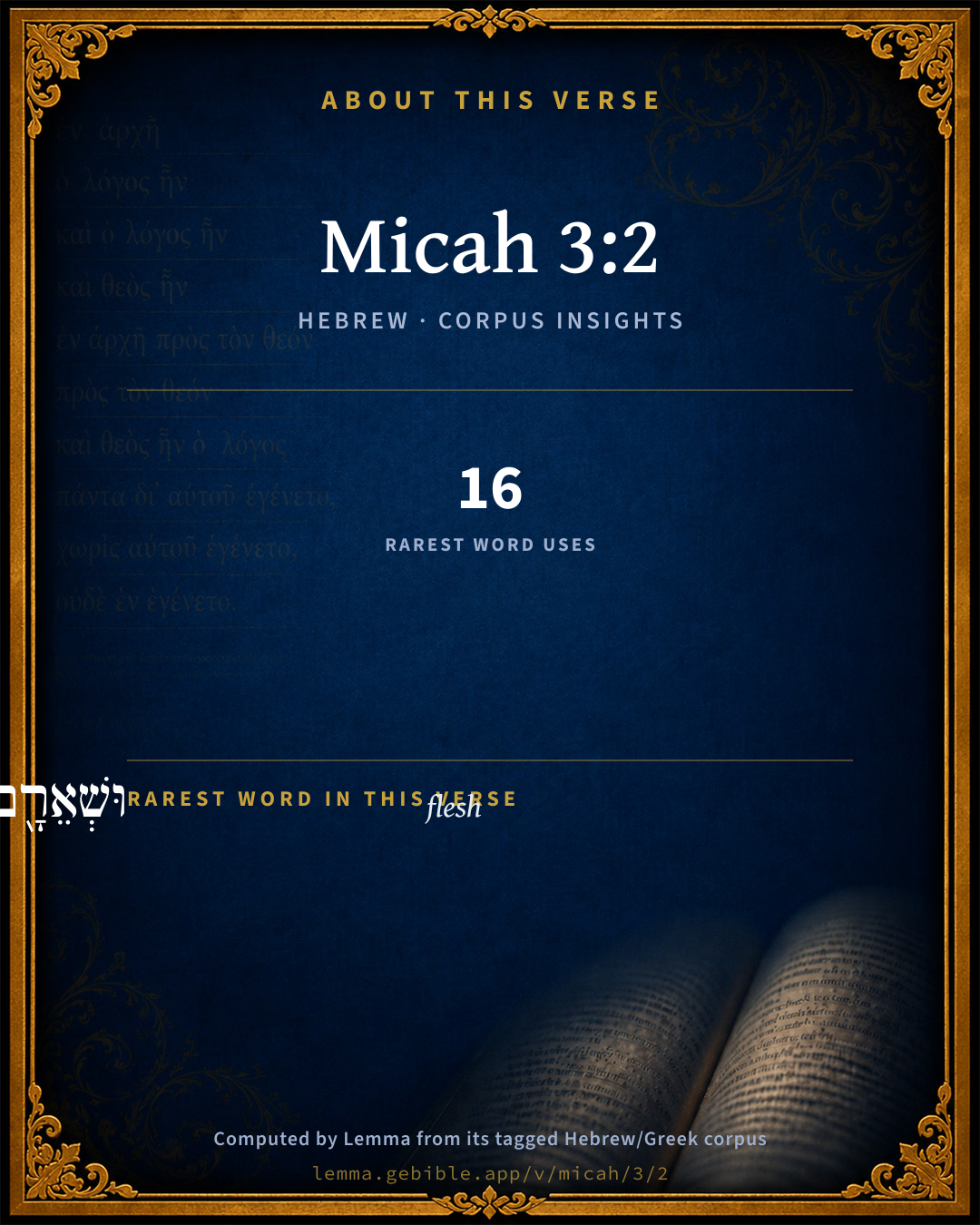
The rarest word here is וּשְׁאֵרָ֖ם flesh H7607 — appearing just 16 times in the whole Hebrew Bible.

Shared distinctive vocabulary

וּשְׁאֵרָ֖ם flesh H7607 occurs in 16 verses of the Hebrew Bible. Also found in:

Grammatical profile

  • 3 verbs
  • 3 nouns
  • 3 adjectives
  • 2 prepositions

Verb forms

  • שֹׂ֥נְאֵי Qal · Participle Active
  • וְאֹ֣הֲבֵי Qal · Participle Active
  • גֹּזְלֵ֤י Qal · Participle Active

Repetition

Words recur within this verse — often emphatic in Hebrew:

  • רעה evil H7451 ×2
  • מֵֽעֲלֵיהֶ֔ם upon H5921 ×2

Hebrew & Septuagint length

In English translation the verse runs 21 words from the Hebrew and 18 from the Septuagint (LXX English) — closely comparable.

A rough comparison of the two English renderings, which tokenize alike — not a word-level alignment.

Word counts can differ between the Hebrew and the Greek without any difference in meaning — e.g. the Hebrew direct-object marker אֵת has no separate Greek word, and Greek often adds the article ὁ.

Cross-references

23

Topical passages linked to Micah 3:2 in the Treasury of Scripture Knowledge — connected by theme and wording, ordered by reader-vote popularity; previews shown in the World English Bible.

  • Ezekiel 22:27 Her princes in the midst of it are like wolves ravening the prey, to shed blood, [and] to destroy souls, that they may get dishonest gain.
  • Psalms 53:4 Have the workers of iniquity no knowledge, Who eat up my people as they eat bread, And don't call on God?
  • Proverbs 28:4 Those who forsake the law praise the wicked; But those who keep the law contend with them.
  • 1 Kings 21:20 Ahab said to Elijah, Have you found me, my enemy? He answered, I have found you, because you have sold yourself to do that which is evil in the sight of Yahweh.
  • 1 Kings 22:6–8 Then the king of Israel gathered the prophets together, about four hundred men, and said to them, Shall I go against Ramoth-gilead to battle, or shall I forbear? They said, Go up; for the Lord will deliver it into the hand of the king.
  • 2 Chronicles 19:2 Jehu the son of Hanani the seer went out to meet him, and said to king Jehoshaphat, Should you help the wicked, and love those who hate Yahweh? for this thing wrath is on you from before Yahweh.
  • Romans 12:9 Let love be without hypocrisy. Abhor that which is evil. Cling to that which is good.
  • Acts 7:51–52 "You stiff-necked and uncircumcised in heart and ears, you always resist the Holy Spirit! As your fathers did, so you do.
  • Romans 1:32 who, knowing the ordinance of God, that those who practice such things are worthy of death, not only do the same, but also approve of those who practice them.
  • 2 Timothy 3:3 without natural affection, unforgiving, slanderers, without self-control, fierce, no lovers of good,
  • Psalms 15:4 In whose eyes a vile man is despised, But who honors those who fear Yahweh; He who keeps an oath even when it hurts, and doesn't change;
  • Psalms 139:21–22 Yahweh, don't I hate those who hate you? Am I not grieved with those who rise up against you?
  • Isaiah 3:15 What do you mean that you crush my people, And grind the face of the poor?" says the Lord, Yahweh of Hosts.
  • Ezekiel 34:3 You eat the fat, and you clothe you with the wool, you kill the fatlings; but you don't feed the sheep.
  • Amos 5:10–14 They hate him who reproves in the gate, And they abhor him who speaks blamelessly.
  • Amos 8:4–6 Hear this, you who desire to swallow up the needy, And cause the poor of the land to fail,
  • Zephaniah 3:3 Her princes in the midst of her are roaring lions. Her judges are evening wolves. They leave nothing until the next day.
  • Zechariah 11:4–5 Thus says Yahweh my God: "Feed the flock of slaughter.
  • Luke 19:14 But his citizens hated him, and sent an envoy after him, saying, 'We don't want this man to reign over us.'
  • John 7:7 The world can't hate you, but it hates me, because I testify about it, that its works are evil.
  • John 15:18–19 If the world hates you, you know that it has hated me before it hated you.
  • John 15:23–24 He who hates me, hates my Father also.
  • John 18:40 Then they all shouted again, saying, "Not this man, but Barabbas!" Now Barabbas was a robber.

Cross-references courtesy of OpenBible.info (CC BY 4.0).

Hebrew and Greek witnesses Masoretic Hebrew ↔ Greek Septuagint

The same verse in the two great witnesses to the Old Testament, shown verse-for-verse.

These are two independent witnesses, not word-aligned to each other, and the Septuagint is shown in lemma (dictionary) form.

Hebrew Micah 3:2 Masoretic · Westminster Leningrad Codex

שֹׂ֥נְאֵי ט֖וֹב וְאֹ֣הֲבֵי רעה רָ֑ע גֹּזְלֵ֤י עוֹרָם֙ מֵֽעֲלֵיהֶ֔ם וּשְׁאֵרָ֖ם מֵעַ֥ל עַצְמוֹתָֽם

You who hate the good, And love the evil; Who tear off their skin, And their flesh from off their bones;

World English Bible · Public Domain

Greek LXX Micah 3:2 Septuagint · lemma form

ὁ μισέω ὁ καλός καί ζητέω ὁ πονηρός ἁρπάζω ὁ δέρμα αὐτός ἀπό αὐτός καί ὁ σάρξ αὐτός ἀπό ὁ ὀστέον αὐτός

who hate good, and seek evil; who tear their skins off them, and their flesh off their bones:

LXX2012 (modern English Septuagint) · Public Domain

On this verse, The Pulpit Commentary discusses the Septuagint’s reading. Read the note in Commentary ↓

Hebrew: Westminster Leningrad Codex (CC BY 4.0). Greek: Septuagint (public domain); English from LXX2012 (modern English Septuagint) (Public Domain). How the Septuagint differs from the Hebrew →

Targum (Aramaic paraphrase)

1

The Targum is the ancient Jewish Aramaic paraphrase of the Hebrew Scriptures — an interpretive translation, not the Hebrew text itself. Onkelos (literal) and Pseudo-Jonathan (expansive) render the Torah, and Jonathan the Prophets. Coverage is partial: where no permissively-licensed English translation exists for a verse, only the Aramaic is shown. This is verse-level text, not a word-by-word alignment to the Hebrew.

  1. Targum Jonathan Prophets (Joshua–Malachi)
    סָנָן לְאַטָבָא וְרַחֲמִין לְאַבְאָשָׁא אַנְסִין נִכְסֵי עַמָא מִנְהוֹן וּמָמוֹן יַקִירִין מִנְהוֹן נַסְבִין:

    (no public-domain English translation for this verse)

    Targum Jonathan — Aramaic: “Mikraot Gedolot” (public domain). English: “Sefaria Community Translation” (CC0 1.0 (public-domain dedication)); “London "Chaldee Paraphrase," 1871” (public domain). Text via Sefaria.

Commentary

Notes on Micah 3:2 from classic Christian and Jewish commentators (each source and its license shown beneath its notes). The classic Christian expositions comment on the surrounding passage and are grouped to its opening verse, so a note may address several verses; the Jewish commentaries on the Tanakh (Rashi and others) are per-verse, so they appear only where the commentator wrote on this verse.

Lemma curates 59 commentaries, every one of them public domain or Creative Commons licensed, each selected and text-cleaned for this edition rather than reprinted as found. About our sources →

Trapp's Complete Commentary

John Trapp

Mic 3:2 Who hate the good, and love the evil; who pluck off their skin from off them, and their flesh from off their bones;

Ver. 2. Who hate the good, and love the evil] q.d. That you know not judgment, but are men ignorant of the truth which is according to godliness, appeareth by your wicked practices. For you stand across to what God requireth, hating what you should love, and loving where you should hate, Homo est inversus decalogus. Goodness is in itself amiable and attractive but you are perfect strangers to it, and therefore hate it and those that profess it. Evil is of the devil, and must therefore needs be loathsome; and yet you love it, allow it, and wallow in it; whereas you should "abhor that which is evil," hate it as hell, αποστυγουντες, "and cleave," or be fast glued, κολλωμενοι, "to that which is good," Rom 12:9. You are direct antipodes to the godly, Psa 15:4, and have nothing in you of the Divine nature, 2Pe 1:4, or of the spot of God’s children, but are a "perverse and crooked generation," Deu 32:3.

Who pluck off their skin from off them, and their flesh from off their bones] Like so many carnivorous cannibals or truculent wild beasts. As the ossifrage, or breakbone, pursueth the prey, tears off the flesh, breaks the bones, and sucks out the marrow: such were these griping tyrants, their furious rapacity surmounted all bounds of humanity. Such a one was Verres among the Romans, as Cicero describeth him; that tiger, Tiberius, those Romish usurers in King John’s time here, called Caursini, quasi capientes ursi (quoth Paris), devouring bears, who left not so much money in the whole kingdom as they either carried with them or sent to Rome before them. Money and lands are here called men’s skin, flesh, and bones; and a poor man’s substance is his life. See Mar 12:44 Luk 8:48. Hence oppression is called a bony sin, Amo 5:12; Amo 5:18, and oppressors, men eaters, Psa 14:4, and murderers, Hab 2:12. Cyprian cries out, Ferae parcunt Danieli, Ayes pascunt Eliam, homines saeviunt; Lions spare Daniel, ravens feed Elias, but men rage and are worse than both. Melancthon makes mention of a certain prince, some few years before his time, who, to get money out of his subjects, would send for them, and by knocking out first one tooth, and then another (threatening to leave them toothless else), would extort from them what sums soever he pleased. Our King John’s exactors received from his subjects no less sums of curses than of coin, saith the chronicler; and so did Cardinal Woisey, under Henry VIII, by his importable subsidies, which caused Suffolk to rise up in arms, making poverty their captain.

John Trapp, A Commentary or Exposition upon All the Books of the Old and New Testament (1647–1656) — public domain. Text from a community e-Sword module.

Tyndale Open Study Notes

Tyndale Open Resources

3:2-3 The leaders, like wild animals, destroyed their own people.

Tyndale Open Study Notes — © Tyndale Open Resources, licensed CC BY-SA 4.0. Text via the HelloAO Bible API.

Geneva Bible (1599)

Geneva Bible translators

The Prophet condemneth the wicked governors not only of covetousness, theft, and murder, but compareth them to wolves, lions, and most cruel beasts.

Geneva Bible (1599) marginal notes — public domain. Text via Bolls.life.

Jamieson, Fausset & Brown

Robert Jamieson, A. R. Fausset & David Brown

pluck off their skin . . . flesh--rob their fellow countrymen of all their substance (Psa 14:4; Pro 30:14).

Jamieson, Fausset & Brown — Commentary Critical and Explanatory on the Whole Bible (1871) — public domain (CC PDM 1.0). Text via the HelloAO Bible API.

John Calvin's Commentaries

He afterwards subjoins, But they hate good, and love evil, and pull off the skin from my people, the flesh from their bones; that is, they leave nothing, he says, sound and safe, their rapacity being so furious. The Prophet conveys first a general reproof, — that they not only perverted justice, but were also given to wickedness and hated good. He means then that they were openly wicked and ungodly, and also that they with a fixed purpose carried on war against every thing just and right. We hence learn how great and how abominable was the corruption of the people, when they were still the peculiar possession and heritage of God. Inasmuch then as the state of this ancient people had become so degenerated, let us learn to walk in solicitude and fear, while the Lord governs us by pious magistrates and faithful pastors: for what happened to the Jews might soon happen to us, so that wolves might bear rule over us, as indeed experience has proved even in this our city. The Prophet afterwards adds the kinds of cruelty which prevailed; of which he speaks in hyperbolical terms, though no doubt he sets before our eyes the state of things as it was. He compares the judges to wolves or to lions, or to other savage beasts. He says not that they sought the property of the people, or pillaged their houses; but he says that they devoured their flesh even to the very bones; he says that they pulled off their skin: and this he confirms in the next verse.

John Calvin's Commentaries (1540-1563) — public domain. Text from the Calvin Translation Society English edition (1840s-50s) via the Christian Classics Ethereal Library (ccel.org). Calvin's coverage is partial (roughly two-thirds of the Bible); uncommented books and verses are honest gaps, never fabricated. The 19th-century editor's footnotes and remarks are omitted so the notes are faithfully Calvin's own voice.

Ellicott's Commentary for English Readers

(2, 3) Who hate the good.—The judges, instead of fulfilling the obligations of their office, whereby they should be “for the people to God-ward,” perpetrated the most flagrant cruelty upon them. Micah compares it to the process of preparing food, in which every part of the animal, even to the bones, is utilised. So the judges robbed the people until there was nothing left to them.

A Bible Commentary for English Readers, edited by Charles John Ellicott (1878–1897) — public domain. Text from a community e-Sword module.

The Cambridge Bible for Schools and Colleges

gen. ed. J. J. S. Perowne

2. who pluck off their skin from off them] The description is figurative. We may infer that cannibalism was not unknown to the Israelites by hearsay or tradition, but not necessarily that it was practised by the ancestors of the Israelites, much less by the Israelites themselves. The meaning of the figure plainly is that the peasantry had lost their old independence, and fallen into a condition like that of the peasants of the Turkish empire. This arose from a change in the social organism. “The nobles of Israel were no longer great farmers, as Saul and Nabal had been, living among the peasantry and sharing their toil … The introduction of such a commerce, throwing the Hebrews into immediate relations with the great emporium of international traffic (Tyre), necessarily led to accumulation of wealth in a few hands, and to the corresponding impoverishment of the class without capital, as exportation raised the price of the necessaries of life” (Prof. Robertson Smith, The Old Testament in the Jewish Church, p. 347).

their skin] i.e. the skin of the house of Israel.

The Cambridge Bible for Schools and Colleges (gen. ed. J. J. S. Perowne; Cambridge University Press, 1878–1918) — public domain. Text from a community e-Sword module.

John Gill's Exposition

Who hate the good, and love the evil,.... Instead of knowing and doing what was just and right; or, directly contrary to their light and knowledge, and the duty of their office, they hated that which is good, which is agreeable to the law, nature, and will of God, and loved that which is evil, which is contrary thereunto; or they hated to do good, and loved to do evil, as the Targum; as men do who are averse to good, and prone to evil; or they hated a good man, as Aben Ezra, and loved the evil man; not only delighted in committing sin themselves, but took pleasure in those that did it; and could not endure the company and conversation of holy and good men:

who pluck off their skin from off them, and their flesh from off their bones: like wild beasts that tear off skin and flesh from the bones, and then devour them; or like cruel shepherds, that, not content to fleece their flocks, skin them, and take their flesh also, and feed themselves, and not the flock; or like butchers, that first take off the skin off a beast, and then cut up its flesh. The design of the expressions is to show what rigour, cruelty, and oppressions, these rulers exercised on the people and by their heavy taxes and levies, and exorbitant penalties and fines, pillaged and plundered them of all they had in the world, and left them quite bare, as bones stripped of their skin and flesh. So the Targum,

"seizing on their substance by violence, and their precious mammon they take away.''

John Gill's Exposition of the Whole Bible (1746–1763) — public domain (CC PDM 1.0). Text via the HelloAO Bible API.

Albert Barnes' Notes on the Bible

Who hate the good and love the evil - that is, they hate, for its own sake, that which is good, and love that which is evil. The prophet is not here speaking of their “hating good” men, or “loving evil” men, but of their hating goodness and loving wickedness . : “It is sin not to love good; what guilt to hate it! it is faulty, not to flee from evil, what ungodliness to love it!” Man, at first, loves and admires the good, even while he cloth it not; he hates the evil, even while he does it, or as soon as he has done it. But man cannot bear to he at strife with his conscience, and so he ends it, by excusing himself and telling lies to himself. And then, he hates the truth or good with a bitter hatred, because it disturbs the darkness of the false peace with which he would envelop himself. At first, men love only the pleasure connected with the evil; then they make whom they can, evil, because goodness is a reproach to them: in the end, they love evil for its own sake Rom 1:32. pagan morality too distinguished between the incontinent and the unprincipled , the man who sinned under force of temptation, and the man who had lost the sense of right and wrong Joh 3:20. “Everyone that doeth evil, hateth the light. Whoso longeth for things unlawful, hateth the righteousness which rebuketh and punisheth” .

Who pluck off their skin from off them, and their flesh from off their bones - He had described the Good Shepherd; now, in contrast, he describes those who ought to be “shepherds of the people,” to feed, guard, direct them, but who were their butchers; who did not shear them, but flayed them; who fed on them, not fed them. He heaps up their guilt, act by act. First they flay, that is, take away their outer goods; then they break their bones in pieces, the most solid parts, on which the whole frame of their body depends, to get at the very marrow of their life, and so feed themselves upon them. And not unlike, though still more fearfully, do they sin, who first remove the skin, as it were, or outward tender fences of God’s graces; (such as is modesty, in regard to inward purity; outward demeanor, of inward virtue; outward forms, of inward devotion;) and so break the strong bones of the sterner virtues, which hold the whole soul together; and with them the whole flesh, or softer graces, becomes one shapeless mass, shred to pieces and consumed. So Ezekiel says; “Woe to the shepherds of Israel that do feed themselves; should not the shepherds feed the flock? Ye eat the fat and ye clothe you, with the wool, ye kill them that are fed, ye feed not the flock. The diseased have ye not strengthened ...” (Eze 34:2-4, add Eze 34:5-10).

Albert Barnes' Notes on the Bible (1834–1885) — public domain. Text from a community e-Sword/MySword module.

Haydock's Catholic Bible Commentary

Skins. When some exhorted Tiberius to lay on more taxes, he replied: "a good shepherd must shear the flock, and not tear off the skin." (Suetorius xxxii.)

George Leo Haydock (1774–1849), Haydock's Catholic Family Bible and Commentary, 1859 edition — public domain. Excludes Psalms (Douay-Rheims chapter numbering differs from Protestant) and Deuterocanonical books (Catholic canon only).

Matthew Poole's English Annotations

Who hate the good: in practice and affection these rulers were directly contrary to what they should have been and done, they hated not only to do good, but they hated the good which was to be done, and those that did it; and what kind of men may we judge they were who hated good men, and what was good, and by consequence hated also God himself?

Love the evil; choose, embrace, encourage, delight in, and prefer both evil works and evil workers, and take pleasure to do evil yourselves: the worst character that can be given of any sort of men.

Who pluck off their skin from off them: you by office are shepherds, and should feed, guide, heal, protect, and love the flock, but you use them as cruelly as the shepherd, who, instead of shearing of the fleece, would pluck off the skin, arid flay them.

And their flesh from off their bones; another proverbial speech of the same import, and chargeth highest injustice and inhumanity upon these princes and rulers: see Eze 22:27; Zep 3:3.

Matthew Poole's English Annotations on the Holy Bible (1683–1685) — public domain. Text from a community e-Sword/MySword module.

The Pulpit Commentary

The good...the evil; i.e. goodness and wickedness. Septuagint, ta kala ta ponhra . (Amo_5:14, etc.; Joh_3:20 Rom_1:32) Who pluck off their skin from off them. They are not shepherds, but butchers. We have the same figurative expression for merciless extortion and pillage. Ezekiel makes a similar complaint. (Eze_34:2-4) Cheyne sees in this and the following verse a possible allusion to cannibalism as at least known to the Israelites by hearsay or tradition. There is a passage in Wisdom (RAPC Wis 12:5) which somewhat countenances the idea that the Canaanites were guilty of this enormity, but it is probably only a rhetorical exaggeration of the writer. In the present passage the terms seem to be simply metaphors taken from the preparation of meat for human food. Such an allusion is natural in the mouth of one who had just been speaking of Israel as a flock. (Mic_2:12)

The Pulpit Commentary (1880–1919), ed. H.D.M. Spence-Jones & Joseph S. Exell — public domain. Text from a community e-Sword module.

John Wesley's Explanatory Notes

The good - Ye who hate not only to do good, but the good which is done, and those that do it. The evil - Chuse, and delight in, both evil works and evil workers. Who pluck it off - Ye who use the flock as cruelly as the shepherd, who instead of shearing the fleece, would pluck off the skin and flesh.

John Wesley, Explanatory Notes Upon the Whole Bible (1754–1765) — public domain. Text via the GEBible commentary corpus.

Rashi

Rabbi Shlomo Yitzchaki (Rashi)

who rob their skin—[I.e., the skin] of the house of Israel, over whom they are heads and officers, as the prophet says: The heads of the house of Jacob and the officers of the house of Israel.

Rashi on the Tanakh — English translations: “The Judaica Press complete Tanach with Rashi, translated by A. J. Rosenberg” (CC BY 4.0); “Pentateuch with Rashi's commentary by M. Rosenbaum and A.M. Silbermann, 1929-1934” (public domain); “The Metsudah Tanach series, Lakewood, N.J” (CC BY 4.0); and “The Book of Joshua, Metsudah Publications, 1997” (CC BY 4.0). Text via Sefaria.

Lesson kit

Teaching starters — assembled from the data on this page, not authored interpretation. Every prompt links to the verse data it draws on. Edit before teaching.

Micah, in the Prophets, opens this verse with 11 words (9 distinct Hebrew lemmas). Its most distinctive word is shᵉʼêr (“flesh”). A historical commentator’s framing appears above. Read the whole chapter for the surrounding context.

Discussion questions

  1. The word shᵉʼêr carries the sense “flesh.” How does it shape the verse?
  2. How does Exodus 21:10, which shares the word «flesh», read alongside this verse?
  3. What does the repetition of “evil” (2× in this one verse) do in this verse?
  4. The translations on this page render this verse differently — a whole-verse word diff, not a word-by-word alignment. What might account for the different wordings?
  5. «שֹׂ֥נְאֵי» is a Qal Participle Active verb. How does that grammatical form shape the action described?
  6. Compare how Trapp's Complete Commentary and Tyndale Open Study Notes read this verse. Where do they agree or differ?

Things to notice

Reading settings

Reading text

Shown beneath each verse's original-language words.

Old Testament
Old Testament edition

Read the OT as the Masoretic Hebrew (MT) or the Greek Septuagint (LXX).

English shown for the Greek Septuagint (in the Hebrew ↔ Greek comparison).

Comparing translations? Open the Compare panel on any verse page to stack up to four side by side.