
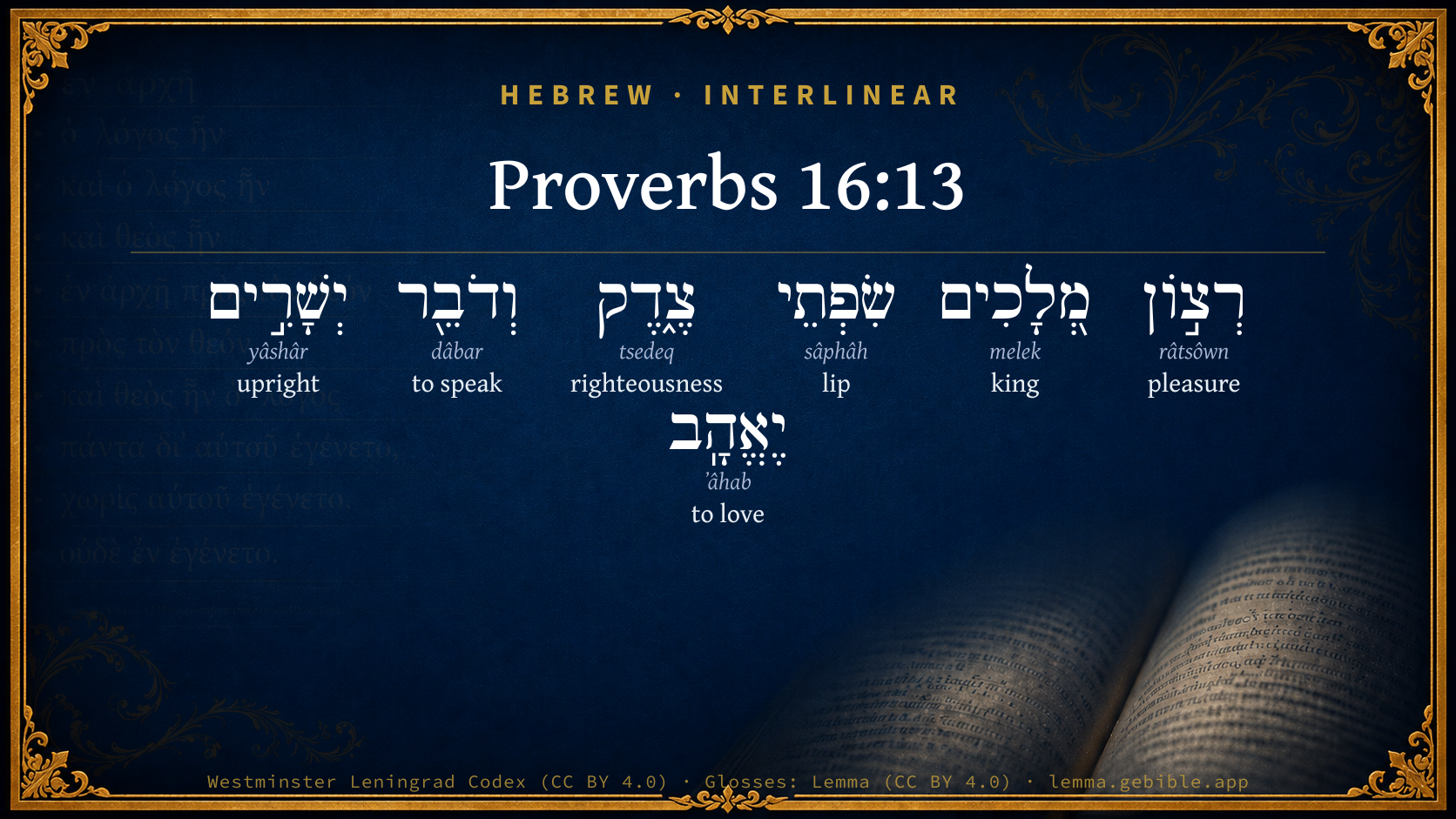
Proverbs 16:13

Hebrew (Westminster Leningrad Codex) Proverbs 16:13 appears in the Hebrew Old Testament. The text above is from the Westminster Leningrad Codex. Each word links to its Strong’s number, a concise gloss, and parsing drawn from the Open Scriptures Hebrew Bible morphology. Click any word for its full Brown-Driver-Briggs (BDB) entry.
Download image
Cite this verse

Proverbs 16:13 (World English Bible). Public Domain. Lemma interlinear Bible study tool, https://lemma.gebible.app/v/proverbs/16/13.

Show BibTeX & RIS
BibTeX
RIS
English Translation
Righteous lips are the delight of kings. They value one who speaks the truth.
World English Bible · Public Domain
Download a study sheet

One document with this verse’s original text, its word-by-word gloss line, the meaning frame, cross-references with their text, attributed commentary, and full source and license credits — printable, and it pastes into notes with its structure intact.

This verse Autodidact and up

Study sheet (.html) Plain text (.txt)

A passage Seminary Student

Up to 50 verses in one chapter. A passage sheet keeps up to 6 commentary sources and 12 cross-references per verse, in the order this page ranks them, and says so on the sheet whenever that leaves anything out. Ask for a single verse and you get the Autodidact verse sheet above.

Everything on this page stays free to read, with no account — the sheet is a download of what is already on screen, not access to it.

Want to remove ads? Support Godless Engineer
Compare translations 3

The same verse in 3 English versions, stacked beneath the original-language interlinear above. Click any original word for its lexicon entry.

Each is an independent rendering of the whole verse — the interlinear is not word-aligned to these translations.

Highlighted words mark where these versions differ — a whole-verse word diff, not a word-by-word alignment.

  • World English Bible Public Domain
    Righteous lips are the delight of kings. They value one who speaks the truth.
  • King James Version Public Domain
    Righteous lips are the delight of kings; and they love him that speaketh right.
  • unfoldingWord Literal Text CC BY-SA 4.0
    The delight of kings lips of righteousness, and he loves one who speaks upright things.

unfoldingWord Literal Text — © unfoldingWord, licensed CC BY-SA 4.0. Word-aligned USFM3 via Door43 (git.door43.org/unfoldingWord/en_ult).

Versions to compare (up to 4)

3 of 4 selected

Show all 18 translations

Every available English version of this verse, each an independent rendering of the whole verse.

  • World English Bible Public Domain
    Righteous lips are the delight of kings. They value one who speaks the truth.
  • Berean Standard Bible Public Domain
    Righteous lips are a king’s delight, and he who speaks honestly is beloved.
  • Majority Standard Bible Public Domain
    Righteous lips are a king’s delight, and he who speaks honestly is beloved.
  • King James Version Public Domain
    Righteous lips are the delight of kings; and they love him that speaketh right.
  • American Standard Version (1901) Public Domain
    Righteous lips are the delight of kings; And they love him that speaketh right.
  • Revised Version (1885) Public Domain
    Righteous lips are the delight or kings; and they love him that speaketh right.
  • Geneva Bible (1599) Public Domain
    Righteous lips are the delite of Kings, and the King loueth him that speaketh right things.
  • Douay-Rheims (1899) Public Domain
    Just lips are the delight of kings: he that speaketh right things shall be loved.
  • Young's Literal Translation Public Domain
    The delight of kings `are' righteous lips, And whoso is speaking uprightly he loveth,
  • Literal Standard Version CC BY-SA 4.0
    Righteous lips [are] the delight of kings, || And he loves whoever is speaking uprightly,
  • Unlocked Literal Bible CC BY-SA 4.0
    A king delights in lips that say what is right and he loves the one who speaks directly.
  • unfoldingWord Literal Text CC BY-SA 4.0
    The delight of kings lips of righteousness, and he loves one who speaks upright things.
  • Darby Bible Public Domain
    Righteous lips are the delight of kings, and they love him that speaketh aright.
  • World Messianic Bible Public Domain
    Righteous lips are the delight of kings. They value one who speaks the truth.
  • Webster's Bible Public Domain
    Righteous lips are the delight of kings; and they love him that speaketh right.
  • Free Bible Version CC BY-SA 4.0
    People who tell the truth please kings; they love those who say what is right.
  • Bible in Basic English Public Domain
    Lips of righteousness are the delight of kings; and he who says what is upright is dear to him.
  • JPS Tanakh (1917) Public Domain
    Righteous lips are the delight of kings; and they love him that speaketh right.

Literal Standard Version (2020), Covenant Press — licensed CC BY-SA 4.0. Text via the HelloAO Bible API (eBible.org). Unlocked Literal Bible (unfoldingWord) — licensed CC BY-SA 4.0. Text via the HelloAO Bible API (eBible.org). unfoldingWord Literal Text — © unfoldingWord, licensed CC BY-SA 4.0. Word-aligned USFM3 via Door43 (git.door43.org/unfoldingWord/en_ult). Free Bible Version, Dr. Jonathan Gallagher — licensed CC BY-SA 4.0. Text via the HelloAO Bible API (eBible.org).

Word by word

More ways to search: Search by grammar → Find every occurrence → Compare this word →

Practice this passage: Drill this verse → Learn its vocabulary →

About this verse

These counts appear in no published source. They are computed here, from the morphology-tagged text and Lemma’s own curated glosses. What Lemma adds →

7
words
7
distinct lemmas
Wisdom
section

Shared distinctive vocabulary

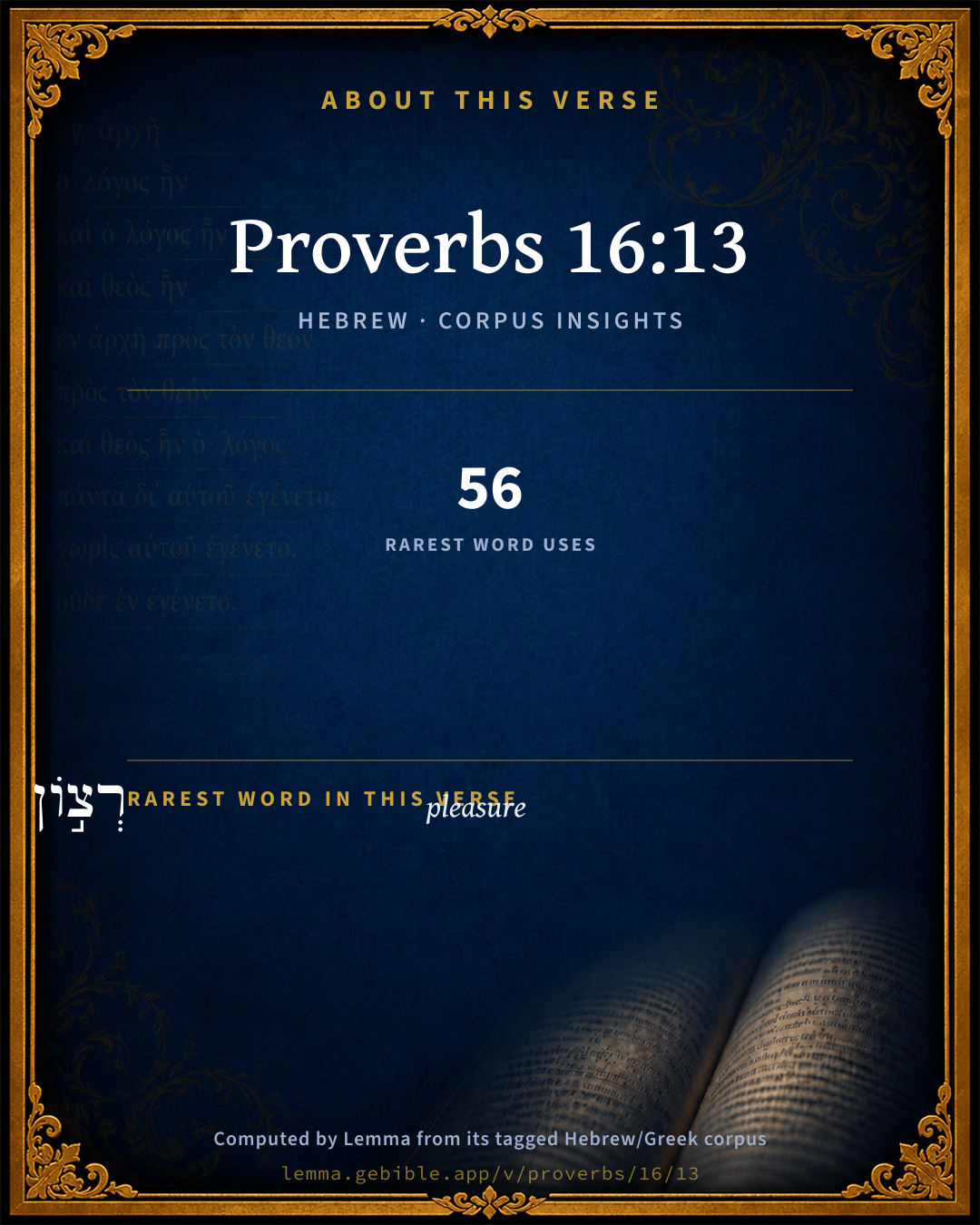
רְצ֣וֹן pleasure H7522 occurs in 56 verses of the Hebrew Bible. Also found in:

Grammatical profile

  • 2 verbs
  • 4 nouns
  • 1 adjective

Verb forms

  • וְדֹבֵ֖ר Qal · Participle Active
  • יֶאֱהָֽב Qal · Imperfect

Hebrew & Septuagint length

In English translation the verse runs 14 words from the Hebrew and 12 from the Septuagint (LXX English) — closely comparable.

A rough comparison of the two English renderings, which tokenize alike — not a word-level alignment.

Word counts can differ between the Hebrew and the Greek without any difference in meaning — e.g. the Hebrew direct-object marker אֵת has no separate Greek word, and Greek often adds the article ὁ.

Cross-references

3

Topical passages linked to Proverbs 16:13 in the Treasury of Scripture Knowledge — connected by theme and wording, ordered by reader-vote popularity; previews shown in the World English Bible.

  • Proverbs 14:35 The king's favor is toward a servant who deals wisely, But his wrath is toward one who causes shame.
  • Psalms 101:5–7 I will silence whoever secretly slanders his neighbor. I won't tolerate one who is haughty and conceited.
  • Proverbs 22:11 He who loves purity of heart and speaks gracefully Is the king's friend.

Cross-references courtesy of OpenBible.info (CC BY 4.0).

Hebrew and Greek witnesses Masoretic Hebrew ↔ Greek Septuagint

The same verse in the two great witnesses to the Old Testament, shown verse-for-verse.

These are two independent witnesses, not word-aligned to each other, and the Septuagint is shown in lemma (dictionary) form.

Hebrew Proverbs 16:13 Masoretic · Westminster Leningrad Codex

רְצ֣וֹן מְ֭לָכִים שִׂפְתֵי צֶ֑דֶק וְדֹבֵ֖ר יְשָׁרִ֣ים יֶאֱהָֽב

Righteous lips are the delight of kings. They value one who speaks the truth.

World English Bible · Public Domain

Greek LXX Proverbs 16:13 Septuagint · lemma form

τρίβος ζωή ἐκκλίνω ἀπό κακός μῆκος δέ βίος ὁδός δικαιοσύνη ὁ δέχομαι παιδεία ἐν ἀγαθός εἰμί ὁ δέ φυλάσσω ἔλεγχος σοφίζω ὅς φυλάσσω ὁ ἑαυτοῦ ὁδός τηρέω ὁ ἑαυτοῦ ψυχή ἀγαπάω δέ ζωή αὐτός φείδομαι στόμα αὐτός

Righteous lips are acceptable to a king; and he loves right words.

LXX2012 (modern English Septuagint) · Public Domain

On this verse, The Pulpit Commentary discusses the Septuagint’s reading. Read the note in Commentary ↓

Hebrew: Westminster Leningrad Codex (CC BY 4.0). Greek: Septuagint (public domain); English from LXX2012 (modern English Septuagint) (Public Domain). How the Septuagint differs from the Hebrew →

Commentary

Notes on Proverbs 16:13 from classic Christian and Jewish commentators (each source and its license shown beneath its notes). The classic Christian expositions comment on the surrounding passage and are grouped to its opening verse, so a note may address several verses; the Jewish commentaries on the Tanakh (Rashi and others) are per-verse, so they appear only where the commentator wrote on this verse.

Lemma curates 59 commentaries, every one of them public domain or Creative Commons licensed, each selected and text-cleaned for this edition rather than reprinted as found. About our sources →

Trapp's Complete Commentary

John Trapp

Pro 16:13 Righteous lips [are] the delight of kings; and they love him that speaketh right.

Ver. 13. Righteous lips are the delight of kings,] i.e., Of good kings, such as David was, who loved Nathan never the worse, but the better, for dealing plainly with him, gave him free access to his bedchamber, and named him a commissioner for the declaring of his successor. {1Ki 1:32} King Edward VI took much delight in Latimer, that faithful preacher; and Queen Elizabeth inquired much after Dearing, after she had once heard him telling her in a sermon that once it was tanquam ovis, but now velar indomita iuvenca, &c. But Dearing was without her knowledge laid up fast enough by the bishops, and kept far enough from coming near the court any more.

And they love him that speaketh right.] They should do so; but it happens somewhat otherwise ofttimes. Ahab hated Micaiah, and looked upon Elijah as a troubler of Israel. Alas! what had these righteous ones done? They taxed his sin, they foretold his judgment; they deserved it not, they inflicted it not, they were therefore "become his enemies, because they told him the truth." Truth breeds hatred, as the fair nymphs are feigned to do the ugly fawns and satyrs. Most princes are held by their parasites, who soothe them up in their sins, and smooth them up with fair words, which soak into them as oil doth into earthen vessels. David was none such; {Psa 101:3-5} he went not attended, saith one, ut nunc fit, magno agmine aionum, negonum, ganeonum, palponum, gnathonum, balatronum, with a great sort of sycophants, courtparasites, flatterers, &c., but had the best he could pick to be next his person, and loved them that spoke right.

John Trapp, A Commentary or Exposition upon All the Books of the Old and New Testament (1647–1656) — public domain. Text from a community e-Sword module.

Joseph Benson's Commentary

Pro 16:13-15. Righteous lips are the delight of kings — All wise and good kings do, and all kings should, delight in employing such counsellors, judges, and officers, under them, as are just and faithful in their counsels, sentences, and actions; because such bring great honour and advantage to them. The wrath of a king is as messengers of death — It strikes as great terror into those with whom he is offended, as if the sentence of death were pronounced against them, and officers were sent to execute it; but a wise man will pacify it — Will use all prudent and lawful means so to do. In the light of the king’s countenance is life — His reconciled and smiling countenance is most sweet and refreshing, especially to such as are under a sentence of death; and his favour as a cloud of the latter rain — As acceptable as those clouds that bring the latter rain, whereby the fruits are filled and ripened, a little before the harvest.

Joseph Benson's Commentary on the Old and New Testaments (1811–1818) — public domain. Text from a community e-Sword module.

Matthew Henry's Commentary

Here is a further character of good kings, that they love and delight in those that speak right. 1. They hate parasites and those that flatter them, and are very willing that all about them should deal faithfully with them and tell them that which is true, whether it be pleasing or displeasing, both concerning persons and things, that every thing should be set in a true light and nothing disguised, Pro 29:12. 2. They not only do righteousness themselves, but take care to employ those under them that do righteousness too, which is of great consequence to the people, who must be subject not only to the king as supreme, but to the governors sent by him, Pe1 2:14. A good king will therefore put those in power who are conscientious, and will say that which is righteous and discreet, and know how to speak aright and to the purpose.

Matthew Henry's Commentary on the Whole Bible (1708–1710) — public domain (CC PDM 1.0). Text via the HelloAO Bible API.

Jamieson, Fausset & Brown

Robert Jamieson, A. R. Fausset & David Brown

A specification of the general sentiment of Pro 16:12.

Jamieson, Fausset & Brown — Commentary Critical and Explanatory on the Whole Bible (1871) — public domain (CC PDM 1.0). Text via the HelloAO Bible API.

John Gill's Exposition

Righteous lips are the delight of kings,.... Such that speak truth and righteousness, and advise to the administration of justice and judgment, and to do that which is most for their own true honour and the people's good, are, or ought to be, highly valued and esteemed by kings: but the contrary is too often the case; kings hearken to those that speak lies, that flatter them, and gratify their pride, ambition, and love of power, to the hurt of their subjects;

and they love him that speaketh right: agreeably to right reason; which makes for the honour of kings, and the good of those over whom they rule. Christ loves and delights in those that deliver out his doctrines in the taught words of the Holy Ghost, without any mixture or corruption; that explain, inculcate, and enforce his laws and commands; and faithfully declare the whole counsel of God, both with respect to faith and practice; all which is for his glory, as King of saints, and to the profit and advantage of those who submit to the sceptre of his kingdom.

John Gill's Exposition of the Whole Bible (1746–1763) — public domain (CC PDM 1.0). Text via the HelloAO Bible API.

Haydock's Catholic Bible Commentary

Loved. Yet none are more exposed to flattery and deceit than kings. (Seneca, ep. xxi.)

George Leo Haydock (1774–1849), Haydock's Catholic Family Bible and Commentary, 1859 edition — public domain. Excludes Psalms (Douay-Rheims chapter numbering differs from Protestant) and Deuterocanonical books (Catholic canon only).

Matthew Poole's English Annotations

All wise and good kings do, and all kings should, delight in employing such counsellors, judges, and officers under them, as are just and faithful in their counsels, and sentences, and actions, because such bring great honour and advantage to them.

Matthew Poole's English Annotations on the Holy Bible (1683–1685) — public domain. Text from a community e-Sword/MySword module.

Whedon's Commentary on the Bible

Daniel D. Whedon

13. Delight of kings — All these things are said of rulers, as rulers ought to be; that is, righteous, just.

Daniel D. Whedon (gen. ed.), Commentary on the Old and New Testaments (1874–1909) — public domain. Text from a community e-Sword module.

The Pulpit Commentary

Righteous lips are the delight of kings. The ideal king takes pleasure in the truth and justice which his subjects display in their conversation. Such a one hates flattery and dissimulation, and encourages honest speaking. They (kings) love him that speaketh right; that which is just. (Pro_8:6) The two clauses are coordinate. Septuagint, "He loveth upright words". (comp. Pro_22:11)

The Pulpit Commentary (1880–1919), ed. H.D.M. Spence-Jones & Joseph S. Exell — public domain. Text from a community e-Sword module.

Keil & Delitzsch

C. F. Keil & F. Delitzsch

History is full of such warning examples, and therefore this proverb continues to hold up the mirror to princes.

Well-pleasing to kings are righteous lips,

And whoever speaketh uprightly is loved.

Rightly the lxx ἀγαπᾶ, individ. plur., instead of the plur. of genus, מלכים; on the contrary, Jerome and Luther give to the sing. the most general subject (one lives), in which case it must be distinctly said, that that preference of the king for the people who speak out the truth, and just what they think, is shared in by every one. צדק, as the property of the שׂפתי, accords with the Arab. ṣidḳ, truth as the property of the lasân (the tongue or speech). ישׁרים, from ישׁר, means recta, as נגידים, principalia, Pro 8:6, and ריקים, inania, Pro 12:11. ישׁרים, Dan 11:10, neut. So neut. וישׁר, Psa 111:8; but is rather, with Hitzig and Riehm, to be read וישׁר. What the proverb ways cannot be meant of all kings, for even the house of David had murderers of prophets, like Manasseh and Joiakim; but in general it is nevertheless true that noble candour, united with true loyalty and pure love to the king and the people, is with kings more highly prized than mean flattery, seeking only its own advantage, and that, though this (flattery) may for a time prevail, yet, at last, fidelity to duty, and respect for truth, gain the victory.

Keil & Delitzsch — Biblical Commentary on the Old Testament (1861–1891) — public domain (CC PDM 1.0). Text via the HelloAO Bible API. (Old Testament only.)

Kretzmann's Popular Commentary

Paul E. Kretzmann

v. 13. Righteous lips are the delight of kings, true sovereigns are pleased to have men among their counselors who will frankly state the truth in righteousness; and they love him that speaketh right, that is, if they themselves are God-fearing men, they will prefer to have such men among their advisers.

Paul E. Kretzmann, Popular Commentary of the Bible (1921–1924) — public domain. Text from a community e-Sword module.

unfoldingWord translationNotes

Door43 World Missions Community

lips that say what is right

Here the word "lips" represents the person who speaks. AT: "a person who speaks the truth" (See: Synecdoche)

A king's wrath is a messenger of death

The writer speaks of an angry king causing someone to die as if the king's wrath were a messenger that he sends out to kill someone. AT: "An angry king can put people to death" (See: Metaphor)

translationWords

king

love

wrath

messenger

die

wise

anger

unfoldingWord translationNotes — © Distant Shores Media and the Door43 World Missions Community, licensed CC BY-SA 4.0. Source: git.door43.org/Door43/en_tn.

Lesson kit

Teaching starters — assembled from the data on this page, not authored interpretation. Every prompt links to the verse data it draws on. Edit before teaching.

Proverbs, in the Wisdom, opens this verse with 7 words (7 distinct Hebrew lemmas). Its most distinctive word is râtsôwn (“pleasure”). A historical commentator’s framing appears above. Read the whole chapter for the surrounding context.

Discussion questions

  1. What does “pleasure” (râtsôwn) contribute to the verse as a whole?
  2. Genesis 49:6 shares the word «pleasure» with this verse. How do the two illuminate each other?
  3. These translations render this verse differently. What is at stake in choosing one wording over another?
  4. The verb «וְדֹבֵ֖ר» is Qal Participle Active. How does its form color the action?
  5. Reading how Trapp's Complete Commentary and Joseph Benson's Commentary read this verse, where do the two commentators agree and where do they part?

Things to notice

Reading settings

Reading text

Shown beneath each verse's original-language words.

Old Testament
Old Testament edition

Read the OT as the Masoretic Hebrew (MT) or the Greek Septuagint (LXX).

English shown for the Greek Septuagint (in the Hebrew ↔ Greek comparison).

Comparing translations? Open the Compare panel on any verse page to stack up to four side by side.