
Deuteronomy 23:5

Hebrew (Westminster Leningrad Codex) Deuteronomy 23:5 appears in the Hebrew Old Testament. The text above is from the Westminster Leningrad Codex. Each word links to its Strong’s number, a concise gloss, and parsing drawn from the Open Scriptures Hebrew Bible morphology. Click any word for its full Brown-Driver-Briggs (BDB) entry.
Download image
Cite this verse

Deuteronomy 23:5 (World English Bible). Public Domain. Lemma interlinear Bible study tool, https://lemma.gebible.app/v/deuteronomy/23/5.

Show BibTeX & RIS
BibTeX
RIS
English Translation
Nevertheless Yahweh your God wouldn't listen to Balaam; but Yahweh your God turned the curse into a blessing to you, because Yahweh your God loved you.
World English Bible · Public Domain
Download a study sheet

One document with this verse’s original text, its word-by-word gloss line, the meaning frame, cross-references with their text, attributed commentary, and full source and license credits — printable, and it pastes into notes with its structure intact.

This verse Autodidact and up

Study sheet (.html) Plain text (.txt)

A passage Seminary Student

Up to 50 verses in one chapter. A passage sheet keeps up to 6 commentary sources and 12 cross-references per verse, in the order this page ranks them, and says so on the sheet whenever that leaves anything out. Ask for a single verse and you get the Autodidact verse sheet above.

Everything on this page stays free to read, with no account — the sheet is a download of what is already on screen, not access to it.

Want to remove ads? Support Godless Engineer
Compare translations 3

The same verse in 3 English versions, stacked beneath the original-language interlinear above. Click any original word for its lexicon entry.

Each is an independent rendering of the whole verse — the interlinear is not word-aligned to these translations.

Highlighted words mark where these versions differ — a whole-verse word diff, not a word-by-word alignment.

  • World English Bible Public Domain
    Nevertheless Yahweh your God wouldn't listen to Balaam; but Yahweh your God turned the curse into a blessing to you, because Yahweh your God loved you.
  • King James Version Public Domain
    Nevertheless the LORD thy God would not hearken unto Balaam; but the LORD thy God turned the curse into a blessing unto thee, because the LORD thy God loved thee.
  • unfoldingWord Literal Text CC BY-SA 4.0
    But Yahweh your God was not willing to listen to Balaam, and Yahweh your God turned the curse into a blessing for you, because Yahweh your God loved you.

unfoldingWord Literal Text — © unfoldingWord, licensed CC BY-SA 4.0. Word-aligned USFM3 via Door43 (git.door43.org/unfoldingWord/en_ult).

Versions to compare (up to 4)

3 of 4 selected

Show all 18 translations

Every available English version of this verse, each an independent rendering of the whole verse.

  • World English Bible Public Domain
    Nevertheless Yahweh your God wouldn't listen to Balaam; but Yahweh your God turned the curse into a blessing to you, because Yahweh your God loved you.
  • Berean Standard Bible Public Domain
    Yet the LORD your God would not listen to Balaam, and the LORD your God turned the curse into a blessing for you, because the LORD your God loves you.
  • Majority Standard Bible Public Domain
    Yet the LORD your God would not listen to Balaam, and the LORD your God turned the curse into a blessing for you, because the LORD your God loves you.
  • King James Version Public Domain
    Nevertheless the LORD thy God would not hearken unto Balaam; but the LORD thy God turned the curse into a blessing unto thee, because the LORD thy God loved thee.
  • American Standard Version (1901) Public Domain
    Nevertheless Jehovah thy God would not hearken unto Balaam; but Jehovah thy God turned the curse into a blessing unto thee, because Jehovah thy God loved thee.
  • Revised Version (1885) Public Domain
    Nevertheless the LORD thy God would not hearken unto Balaam; but the LORD thy God turned the curse into a blessing unto thee, because the LORD thy God loved thee.
  • Geneva Bible (1599) Public Domain
    Neuerthelesse, the Lord thy God would not hearken vnto Balaam, but the Lord thy God turned the curse to a blessing vnto thee, because the Lord thy God loued thee.
  • Douay-Rheims (1899) Public Domain
    And the Lord thy God would not hear Balaam, and he turned his cursing into thy blessing, because he loved thee.
  • Young's Literal Translation Public Domain
    and Jehovah thy God hath not been willing to hearken unto Balaam, and Jehovah thy God doth turn for thee the reviling to a blessing, because Jehovah thy God hath loved thee;
  • Literal Standard Version CC BY-SA 4.0
    and your God YHWH has not been willing to listen to Balaam, and your God YHWH turns the reviling to a blessing for you, because your God YHWH has loved you;
  • Unlocked Literal Bible CC BY-SA 4.0
    But Yahweh your God would not listen to Balaam; instead, Yahweh your God turned the curse into a blessing for you, because Yahweh your God loved you.
  • unfoldingWord Literal Text CC BY-SA 4.0
    But Yahweh your God was not willing to listen to Balaam, and Yahweh your God turned the curse into a blessing for you, because Yahweh your God loved you.
  • Darby Bible Public Domain
    But Jehovah thy God would not listen to Balaam; and Jehovah thy God turned the curse into blessing unto thee, because Jehovah thy God loved thee.
  • World Messianic Bible Public Domain
    Nevertheless the LORD your God wouldn’t listen to Balaam, but the LORD your God turned the curse into a blessing to you, because the LORD your God loved you.
  • Webster's Bible Public Domain
    Nevertheless, the LORD thy God would not hearken to Balaam: but the LORD thy God turned the curse into a blessing to thee, because the LORD thy God loved thee.
  • Free Bible Version CC BY-SA 4.0
    But the Lord your God refused to listen to Balaam. The Lord your God turned what was meant to be a curse into a blessing for you because the Lord your God loves you.
  • Bible in Basic English Public Domain
    But the Lord your God would not give ear to Balaam, but let the curse be changed into a blessing to you, because of his love for you.
  • JPS Tanakh (1917) Public Domain
    (23-6) Nevertheless the LORD thy God would not hearken unto Balaam; but the LORD thy God turned the curse into a blessing unto thee, because the LORD thy God loved thee.

Literal Standard Version (2020), Covenant Press — licensed CC BY-SA 4.0. Text via the HelloAO Bible API (eBible.org). Unlocked Literal Bible (unfoldingWord) — licensed CC BY-SA 4.0. Text via the HelloAO Bible API (eBible.org). unfoldingWord Literal Text — © unfoldingWord, licensed CC BY-SA 4.0. Word-aligned USFM3 via Door43 (git.door43.org/unfoldingWord/en_ult). Free Bible Version, Dr. Jonathan Gallagher — licensed CC BY-SA 4.0. Text via the HelloAO Bible API (eBible.org).

Word by word

More ways to search: Search by grammar → Find every occurrence → Compare this word →

Practice this passage: Drill this verse → Learn its vocabulary →

הַקְּלָלָ֖ה
qᵉlâlâh
H7045
“the · curse”
Particle, Definite Article + Noun, Common, Feminine, Singular, Absolute
Part of Speech
Particle + Noun
Type
Common
Gender
Feminine
Number
Singular
State
Absolute
Full BDB Definition

Origin: from H7043

TWOT: 2028d

curse, vilification, execration
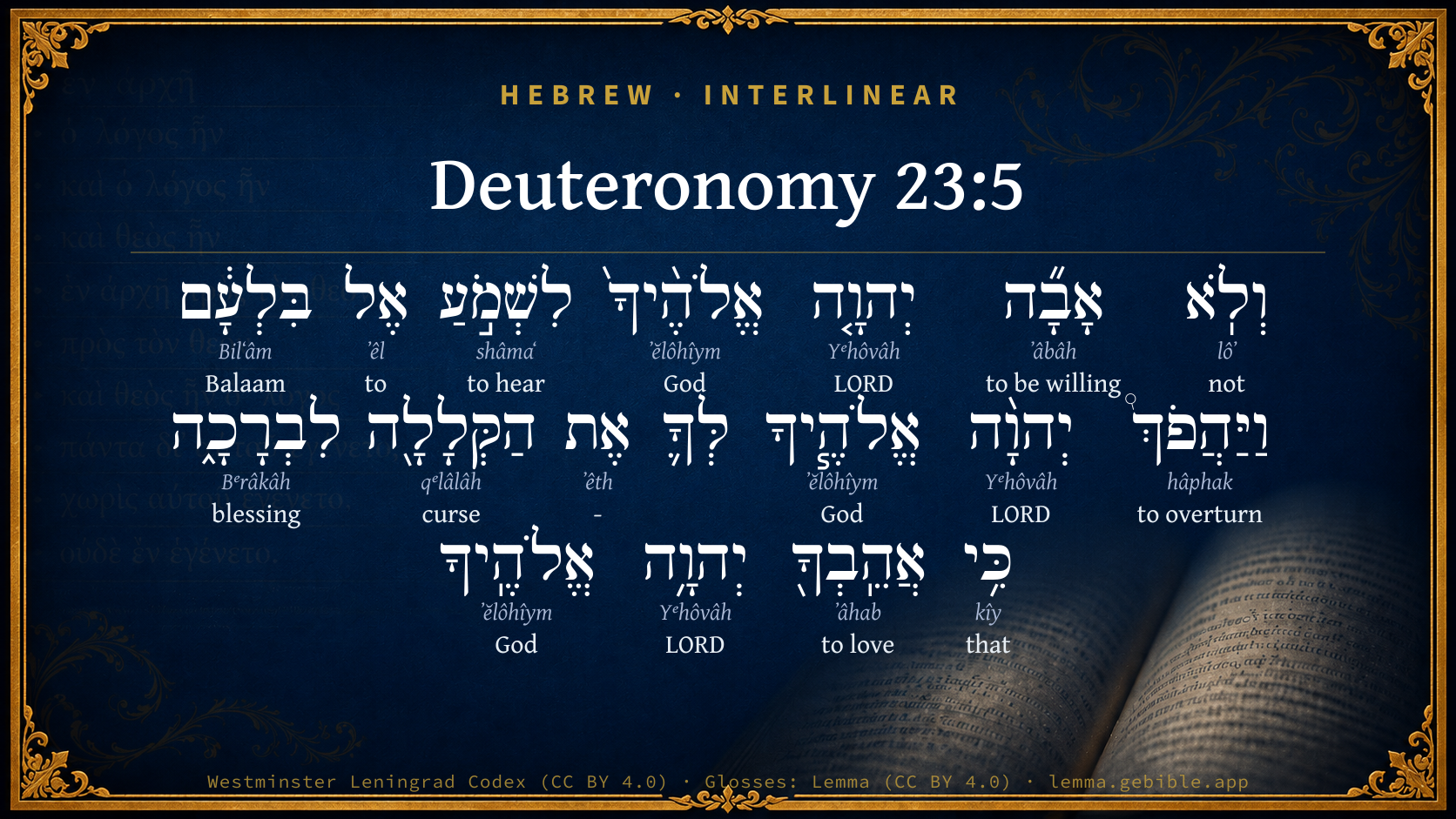
  1. וְלֹֽא lôʼ H3808 “and · not” Conjunction + Particle, Negative
  2. אָבָ֞ה ʼâbâh H14 “to be willing” Verb, Qal, Perfect, 3rd Person, Masculine, Singular
  3. יְהוָ֤ה Yᵉhôvâh H3068 “LORD” Noun, Proper
  4. אֱלֹהֶ֨יךָ֙ ʼĕlôhîym H430 “God(s) · your” Noun, Common, Masculine, Plural, Construct + Suffix, Personal, 2nd Person, Masculine, Singular
  5. לִשְׁמֹ֣עַ shâmaʻ H8085 “to hear” Preposition + Verb, Qal, Infinitive Construct
  6. אֶל ʼêl H413 “to” Preposition
  7. בִּלְעָ֔ם Bilʻâm H1109 “Balaam” Noun, Proper
  8. וַיַּהֲפֹךְ֩ hâphak H2015 “and · to overturn” Conjunction + Verb, Qal, Sequential Imperfect, 3rd Person, Masculine, Singular
  9. יְהוָ֨ה Yᵉhôvâh H3068 “LORD” Noun, Proper
  10. אֱלֹהֶ֧יךָ ʼĕlôhîym H430 “God(s) · your” Noun, Common, Masculine, Plural, Construct + Suffix, Personal, 2nd Person, Masculine, Singular
  11. אֶת ʼêth H853 “-” Particle, Direct Object
  12. לִבְרָכָ֑ה Bᵉrâkâh H1293 “to/for · blessing” Preposition + Noun, Common, Feminine, Singular, Absolute
  13. כִּ֥י kîy H3588 “that” Conjunction
  14. אֲהֵֽבְךָ֖ ʼâhab H157 “to love · you” Verb, Qal, Perfect, 3rd Person, Masculine, Singular + Suffix, Personal, 2nd Person, Masculine, Singular
  15. יְהוָ֥ה Yᵉhôvâh H3068 “LORD” Noun, Proper
  16. אֱלֹהֶֽיךָ ʼĕlôhîym H430 “God(s) · your” Noun, Common, Masculine, Plural, Construct + Suffix, Personal, 2nd Person, Masculine, Singular

About this verse

These counts appear in no published source. They are computed here, from the morphology-tagged text and Lemma’s own curated glosses. What Lemma adds →

18
words
13
distinct lemmas
Pentateuch
section

Shared distinctive vocabulary

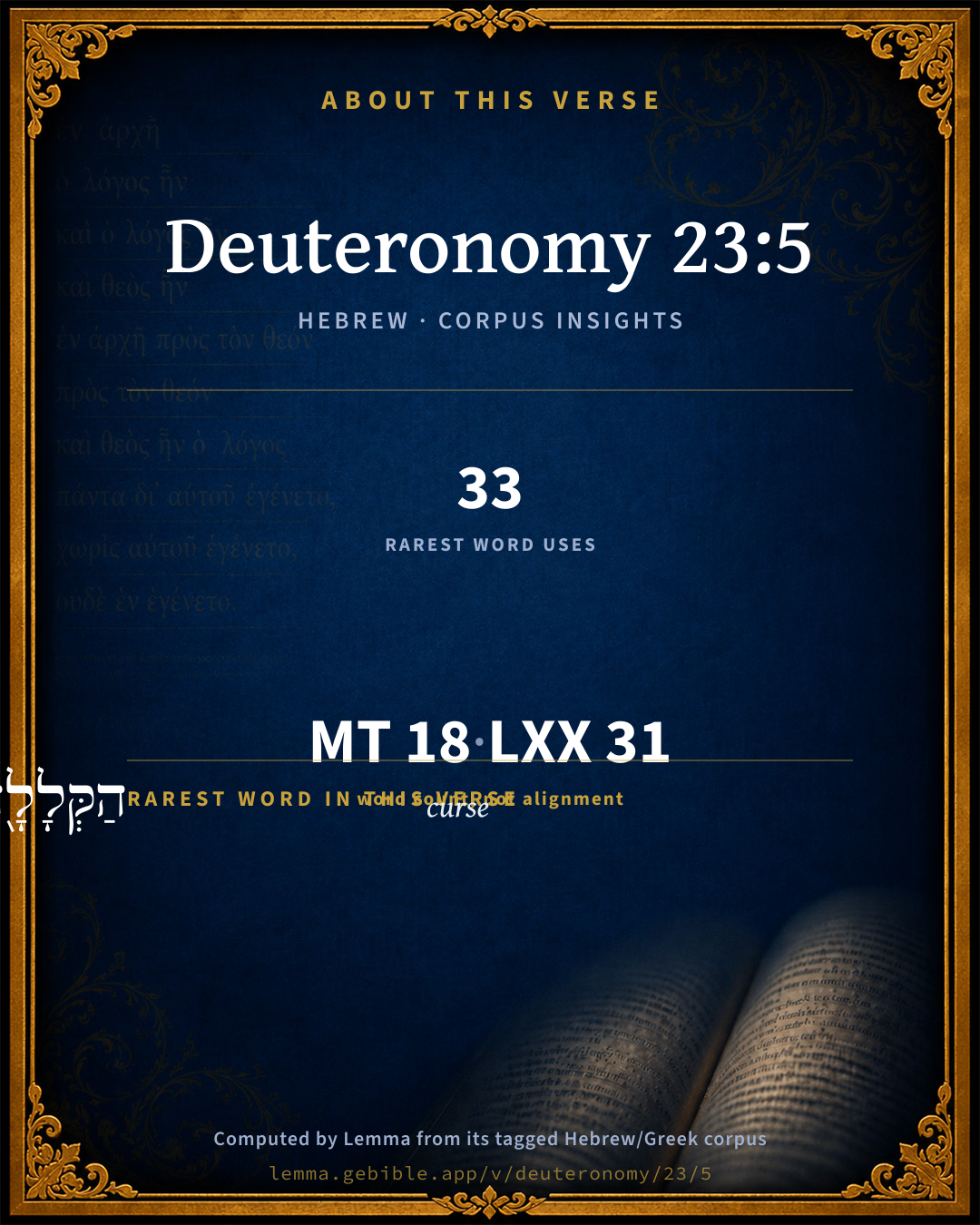
הַקְּלָלָ֖ה curse H7045 occurs in 33 verses of the Hebrew Bible. Also found in:

Grammatical profile

  • 4 verbs
  • 9 nouns
  • 2 prepositions
  • 1 conjunction
  • 2 particles

Verb forms

  • אָבָ֞ה Qal · Perfect
  • לִשְׁמֹ֣עַ Qal · Infinitive Construct
  • וַיַּהֲפֹךְ֩ Qal · Sequential Imperfect
  • אֲהֵֽבְךָ֖ Qal · Perfect

Repetition

Words recur within this verse — often emphatic in Hebrew:

  • יְהוָ֤ה LORD H3068 ×3
  • אֱלֹהֶ֨יךָ֙ God H430 ×3

Hebrew & Septuagint length

In English translation the verse runs 26 words from the Hebrew and 27 from the Septuagint (LXX English) — closely comparable.

A rough comparison of the two English renderings, which tokenize alike — not a word-level alignment.

Word counts can differ between the Hebrew and the Greek without any difference in meaning — e.g. the Hebrew direct-object marker אֵת has no separate Greek word, and Greek often adds the article ὁ.

In the original languages it is 18 Hebrew tokens and 31 Greek tokens — but the two are counted differently (Hebrew bundles its prefixes and suffixes into one token; the Greek is in lemma form), so that isn’t a like-for-like length.

Cross-references

17

Topical passages linked to Deuteronomy 23:5 in the Treasury of Scripture Knowledge — connected by theme and wording, ordered by reader-vote popularity; previews shown in the World English Bible.

  • Deuteronomy 7:7–8 Yahweh didn't set his love on you, nor choose you, because you were more in number than any people; for you were the fewest of all peoples:
  • Romans 8:31 What then shall we say about these things? If God is for us, who can be against us?
  • Numbers 24:9 He couched, he lay down as a lion, As a lioness; who shall rouse him up? Blessed be everyone who blesses you, Cursed be everyone who curses you.
  • Ephesians 2:4–5 But God, being rich in mercy, for his great love with which he loved us,
  • 2 Corinthians 4:17 For our light affliction, which is for the moment, works for us more and more exceedingly an eternal weight of glory;
  • Numbers 23:5–12 Yahweh put a word in Balaam's mouth, and said, Return to Balak, and thus you shall speak.
  • Jeremiah 31:3 Yahweh appeared of old to me, [saying], Yes, I have loved you with an everlasting love: therefore with loving kindness have I drawn you.
  • Micah 6:5 My people, remember now what Balak king of Moab devised, And what Balaam the son of Beor answered him from Shittim to Gilgal, That you may know the righteous acts of Yahweh."
  • Romans 11:28 Concerning the Gospel, they are enemies for your sake. But concerning the election, they are beloved for the fathers' sake.
  • Deuteronomy 33:3 Yes, he loves the people; All his saints are in your hand: They sat down at your feet; [Everyone] shall receive of your words.
  • Ezekiel 16:8 Now when I passed by you, and looked at you, behold, your time was the time of love; and I spread my skirt over you, and covered your nakedness: yes, I swore to you, and entered into a covenant with you, says the Lord Yahweh, and you became mine.
  • Psalms 73:1 Surely God is good to Israel, To those who are pure in heart.
  • Proverbs 26:2 Like a fluttering sparrow, Like a darting swallow, So the undeserved curse doesn't come to rest.
  • Numbers 22:35 The angel of Yahweh said to Balaam, Go with the men; but only the word that I shall speak to you, that you shall speak. So Balaam went with the princes of Balak.
  • Numbers 23:16–26 Yahweh met Balaam, and put a word in his mouth, and said, Return to Balak, and thus shall you speak.
  • Romans 9:13 Even as it is written, "Jacob I loved, but Esau I hated."
  • Malachi 1:2 "I have loved you," says Yahweh. Yet you say, "How have you loved us?" "Wasn't Esau Jacob's brother?" says Yahweh, "Yet I loved Jacob;

Cross-references courtesy of OpenBible.info (CC BY 4.0).

Hebrew and Greek witnesses Masoretic Hebrew ↔ Greek Septuagint

The same verse in the two great witnesses to the Old Testament, shown verse-for-verse.

These are two independent witnesses, not word-aligned to each other, and the Septuagint is shown in lemma (dictionary) form.

Hebrew Deuteronomy 23:5 Masoretic · Westminster Leningrad Codex

וְלֹֽא אָבָ֞ה יְהוָ֤ה אֱלֹהֶ֨יךָ֙ לִשְׁמֹ֣עַ אֶל בִּלְעָ֔ם וַיַּהֲפֹךְ֩ יְהוָ֨ה אֱלֹהֶ֧יךָ לְּךָ֛ אֶת הַקְּלָלָ֖ה לִבְרָכָ֑ה כִּ֥י אֲהֵֽבְךָ֖ יְהוָ֥ה אֱלֹהֶֽיךָ

Nevertheless Yahweh your God wouldn't listen to Balaam; but Yahweh your God turned the curse into a blessing to you, because Yahweh your God loved you.

World English Bible · Public Domain

Greek LXX Deuteronomy 23:5 Septuagint · lemma form

παρά ὁ μή συνἀντάω αὐτός σύ μετά ἄρτος καί ὕδωρ ἐν ὁ ὁδός ἐκπορεύομαι σύ ἐκ αἴγυπτος καί ὅτι μισθόω ἐπί σύ ὁ βαλααμ υἱός βεωρ ἐκ ὁ μεσοποταμία καταἀράομαι σύ

But the Lord your God would not listen to Balaam; and the Lord your God changed the curses into blessings, because the Lord your God loved you.

LXX2012 (modern English Septuagint) · Public Domain

Hebrew: Westminster Leningrad Codex (CC BY 4.0). Greek: Septuagint (public domain); English from LXX2012 (modern English Septuagint) (Public Domain). How the Septuagint differs from the Hebrew →

Targum (Aramaic paraphrase)

2

The Targum is the ancient Jewish Aramaic paraphrase of the Hebrew Scriptures — an interpretive translation, not the Hebrew text itself. Onkelos (literal) and Pseudo-Jonathan (expansive) render the Torah, and Jonathan the Prophets. Coverage is partial: where no permissively-licensed English translation exists for a verse, only the Aramaic is shown. This is verse-level text, not a word-by-word alignment to the Hebrew.

  1. Targum Onkelos Torah (Genesis–Deuteronomy)
    עַל עֵסַק דִי לָא עֲרָעוּ יָתְכוֹן בְּלַחְמָא וּבְמַיָא בְּאָרְחָא בְּמִפָּקְכוֹן מִמִצְרָיִם וְדִי אֲגַר עֲלָךְ יָת בִּלְעָם בַּר בְּעוֹר מִפְּתוֹר אֲרַם דִי עַל פְּרָת לְלַטָּיוּתָךְ

    (no public-domain English translation for this verse)

    Targum Onkelos — Aramaic: “Onkelos Genesis” (public domain); “Onkelos Exodus” (public domain); “Onkelos Leviticus” (public domain); “Onkelos Numbers” (public domain); “Onkelos Deuteronomy” (public domain). English: “Sefaria Community Translation” (CC0 1.0 (public-domain dedication)); “J.W. Etheridge. The Targums of Onkelos and Jonathan Ben Uzziel on the Pentateuch. London: Longmans, Green, 1862” (public domain). Text via Sefaria.

  2. Targum Pseudo-Jonathan Torah (Genesis–Deuteronomy)
    עַל עֵיסַק דְּלָא זְמִינוּ לְכוֹן בְּלַחֲמָא וּבְמוֹי בְּאָרְחָא בְּמִפַּקְכוֹן מִמִּצְרַיִם וּדְאוֹגַר לְכוֹן יַת בִּלְעָם בַּר בְּעוֹר מִן פְּתוֹר חֶלְמַיָא דְּמִתְבַּנְיָא בְּאַרַע אֲרַם דְּעַל פְּרָת לְמֵילַט יַתְכוֹן

    because they met you not with bread and water in the way when you came from Mizraim, but hired against you Bileam bar Beor from Petho Chelmaya, which is built in the land of Aram upon the Phrat, to curse you;

    Targum Pseudo-Jonathan — Aramaic: “Targum Jonathan on Genesis” (public domain); “Targum Jonathan on Exodus” (public domain); “Targum Jonathan on Leviticus” (public domain); “Targum Jonathan on Numbers” (public domain); “Targum Jonathan on Deuteronomy” (public domain). English: “The Targum of Jonathan ben Uzziel, trans. J. W. Etheridge, London, 1862” (public domain). Text via Sefaria.

Commentary

Notes on Deuteronomy 23:5 from classic Christian and Jewish commentators (each source and its license shown beneath its notes). The classic Christian expositions comment on the surrounding passage and are grouped to its opening verse, so a note may address several verses; the Jewish commentaries on the Tanakh (Rashi and others) are per-verse, so they appear only where the commentator wrote on this verse.

Lemma curates 59 commentaries, every one of them public domain or Creative Commons licensed, each selected and text-cleaned for this edition rather than reprinted as found. About our sources →

Trapp's Complete Commentary

John Trapp

Deu 23:5 Nevertheless the LORD thy God would not hearken unto Balaam; but the LORD thy God turned the curse into a blessing unto thee, because the LORD thy God loved thee.

Ver. 5. Nevertheless the Lord, &c., ] q.d., No thanks to the wicked Moabites, that Balaam blasted thee not; as neither to Balaam, whose tongue was merely overruled by the Almighty, and made to bless those whom he would gladly have cursed. And thus still the Lord orders the world’s disorders, turning dross into gold by a stupendous alchymy, and directing men’s evil actions to a good end. Hence it is that they fulfil - though they intend no such thing, but the satisfying of their own lusts - neither {Isa 10:5-7} more nor less than "what the hand and counsel of God hath determined." {Act 4:28; Act 13:27} Howbeit the hands that nailed Christ to the cross were "wicked hands." {Act 2:23} And Judas the traitor received strangling and shedding of bowels, as a "reward of his iniquity, for being guide to them that took Jesus." {Act 1:16-18} It was not without God that the kingdom was rent from Rehoboam, {2Ki 12:19-20} and yet he flatly renounceth it, as well he might, all the evil that was in it. {Hos 8:4}

John Trapp, A Commentary or Exposition upon All the Books of the Old and New Testament (1647–1656) — public domain. Text from a community e-Sword module.

The Biblical Illustrator

Joseph S. Exell

Deu_23:5

The Lord thy God turned the curse into a blessing.

Balaams curse turned into a blessing by God

Here a difficult question meets us. Was there any reality whatever in Balaams curse! Or was it altogether a harmless thing--in fact, nothing at all? If there was nothing in it, why should it have been averted Why should it be said that God would not hearken unto Balaam? Why not let it be pronounced? The result would have shown that there was no power or reality in it. On the other hand, it is difficult to suppose that such power could reside in a curse, especially when spoken by such a man as Balaam. One thing is certain, that God Himself never did give false prophets power to curse. Could they, then, derive it from any other quarter? Why not from Satan? No creature is absolutely independent; all are instruments in the hands of another. If through grace we have been placed in the kingdom of light, then we are instruments in the hands of God. If we are in the kingdom of darkness, we can only he instruments in the hands of Satan; a curse and not a blessing to others. Now, heathenism is one great territory of Satans power--one chief part of his kingdom of darkness. He reigns supreme there. We believe, then, that within the sphere of his kingdom of darkness Satan has power to employ false prophets as his instruments--has power to enable them to curse, and to fulfil their curse when pronounced. The conflict here, then, was not merely one between the king of Moab and Israel, but between the kingdom of light in Israel and the kingdom of darkness in Moab and Midian. Balaams curse would have been the utterance of the power of darkness; but he was obliged, however reluctantly, to confess his impotency before God. It was an act of Divine power when God turned the curse into a blessing. It showed His watchful care and love towards His people. And what is it that God is accomplishing now by the gift of His son and the power of His grace, but turning the curse into a blessing? Oh, there is a widespread curse, which has long been resting upon this guilty world, the curse pronounced on mans disobedience; and what makes it so awful is, that it is a righteous curse. Wherever we look we see its tokens--man doomed to a life of weary labour, suffering from different kinds of sickness, and at last seized with the irresistible hand of death; so that St. Paul says, The whole creation groaneth and travaileth in pain together until now. But to the children of God this three-fold curse is changed by the grace of God into a blessing. Look at the lowest element of the curse, that of labour, according to the sentence, In the sweat of thy face shalt thou eat bread. How wearisome is ceaseless toil in itself! But to the true Christian how different is toil and labour! He consecrates his powers to Him who has redeemed him with His precious blood! Or look at sickness. What is it but the visible reflection of a spiritual disease within? If the image of God had not been obliterated from the soul by sin there would have been no sickness or sorrow in the world. No miracle is exerted to exempt the Christian from this trial. But its nature is changed; there is no longer any curse in it. How many can bless God for it, painful as it may have been--can bless God for His sanctifying and sustaining power--for the near communion with Jesus which they then enjoyed--for the hallowed impressions made upon their souls; and, most of all, for the manifestations of Gods faithfulness and tenderness--of His power and gentleness. But of all the elements of the curse the most manifest and the most awful is death--so universal in its reign--so tremendous in its power--so mysterious in its nature. We can scarcely stand by a dying bed without the question pressing itself upon our thoughts--oh, why this convulsion? Why this distressing and humiliating close to our life here? One answer can only be given--It is because of sin. Death passed upon all men in that all have sinned. To the Christian its sting is drawn. It is but the rending of the veil which separates his soul from the visible presence of his Redeemer. (G. Wagner.)

The Biblical Illustrator, edited by Joseph S. Exell (c. 1880s–1900s) — public domain. Text from a community e-Sword module.

Ellicott's Commentary for English Readers

(5) Because the Lord thy God loved thee.—The contrast between what He says to Israel in this book and what He said by Balaam is very striking. (See on Deu_31:16.)

A Bible Commentary for English Readers, edited by Charles John Ellicott (1878–1897) — public domain. Text from a community e-Sword module.

John Gill's Exposition

Nevertheless, the Lord thy God would not hearken unto Balaam,.... To his solicitations, and the methods he took to prevail on the Lord to suffer him to curse Israel, which he gladly would have done for the sake of Balak's reward:

but the Lord thy God turned the curse into a blessing unto thee; in the very mouth of Balaam, as the Targum of Jonathan; for when he opened his mouth and Balak expected he would have cursed Israel, and he intended it, could he have been permitted, the Lord overruled his tongue, and put such words into his mouth, that instead of cursing Israel, he blessed him; see Num 23:11,

because the Lord thy God loved thee; and therefore would not suffer them to be cursed; for whom the Lord loves they are blessed, and shall be so in time and to eternity.

John Gill's Exposition of the Whole Bible (1746–1763) — public domain (CC PDM 1.0). Text via the HelloAO Bible API.

Matthew Poole's English Annotations

i.e. Forced Balaam to bless thee, who was hired and inclined to curse thee, if possibly he could.

Matthew Poole's English Annotations on the Holy Bible (1683–1685) — public domain. Text from a community e-Sword/MySword module.

The Pulpit Commentary

The curse turned into a blessing.

No enchantment, no curse of evil men, can prevail against the people of God. Contrariwise, God will turn the curse into a Messing. In Malachi, on the other hand, he threatens to "curse the blessings" of the wicked. (Mal_2:2) How does God turn the curse into a blessing?

1. Directly, by substituting a blessing for a curse. The curse is not merely not allowed to take effect for harm, but God puts a blessing in its stead. A Divine law of compensation comes into operation. The wicked is punished, and the object of his unrighteous hatred consoled and rewarded, by the curse being read backward, and made a reason for conferring blessing. The very curses of the wicked are thus a means of enrichment to the good. Balaam"s curses were thus changed into blessings. (Nu 23 Nu 24)

2. Providentially, by overruling the designs of evil men for their own confusion, and for his peoples good. We have examples in the histories of Joseph, (Gen_1:20) of Mordecai and the Jews (Esther 6-10.), of Daniel. (Da 6) The persecutions of the Church have thus been overruled for the extension of the gospel. (Act_11:19) The highest example is the crucifixion of Christ. (Act_3:13-19)

3. Spiritually, by turning outward afflictions into means of spiritual good.

(1) Afflictions humble, chasten, purify. (Job_42:4, Job_42:5; Psa_119:71)

(2) God can turn afflictions into sources of comfort and. joy, into occasions of higher glory to himself, into means of salvation and glory to the saint. (Act_16:25; Rom_5:3; 2Co_12:9, 2Co_12:10; Php_1:19)

(3) God can overrule even punishment of sin for our ultimate good. Levi. J.O. (Gen_49:7)

The Pulpit Commentary (1880–1919), ed. H.D.M. Spence-Jones & Joseph S. Exell — public domain. Text from a community e-Sword module.

unfoldingWord translationNotes

Door43 World Missions Community

General Information:

Moses speaks to the Israelites as if they were one man, so the words "you" and "your" here are singular. (See: Forms of You)

would not listen

This is an idiom. AT: "did not pay attention" (See: Idiom)

turned the curse into a blessing for you

"had him bless you and not curse you"

You must never seek their peace or prosperity

Possible meanings are 1) "You should never make a peace treaty with the Ammonites and the Moabites" or 2) "You must not do anything to cause things to go well for those 2 people groups to enable them to prosper" .

during all your days

This is an idiom. AT: "as long as you are a nation" (See: Idiom)

translationWords

Yahweh

God

Balaam

curse

bless

love

peace

prosper

day

unfoldingWord translationNotes — © Distant Shores Media and the Door43 World Missions Community, licensed CC BY-SA 4.0. Source: git.door43.org/Door43/en_tn.

Rashi

Rabbi Shlomo Yitzchaki (Rashi)

על דבר may be translated BECAUSE OF THE WORD — i.e. because of the advice which they gave you in order to entice you into sin (Sifrei Devarim 250:1).

בדרך IN THE WAY — when you were in a state of exhaustion (Sifrei Devarim 250:2).

Rashi on the Tanakh — English translations: “The Judaica Press complete Tanach with Rashi, translated by A. J. Rosenberg” (CC BY 4.0); “Pentateuch with Rashi's commentary by M. Rosenbaum and A.M. Silbermann, 1929-1934” (public domain); “The Metsudah Tanach series, Lakewood, N.J” (CC BY 4.0); and “The Book of Joshua, Metsudah Publications, 1997” (CC BY 4.0). Text via Sefaria.

Ramban (Nachmanides)

Rabbi Moshe ben Nachman (Ramban / Nachmanides)

BECAUSE THEY MET YOU NOT WITH BREAD AND WITH WATER. We find it stated [in Moses’ message to Sihon], Thou shalt sell me food for money, that I may eat; and give me water for money, that I may drink etc. as the children of Esau that dwell in Seir, and the Moabites that dwell in Ar did unto me. [This clearly states that the Moabites did not deprive them of bread and water, and in the verse before us it is mentioned that the Moabites did not meet them with bread and water!] Now, many scholars say that the Moabites did not meet them with bread and water, but that the Israelites bought it from them. But this is baseless, for it is adequate for a camp that they be sold [food] when they want to buy. Moreover, Israel came not within the border of Moab, and the Moabites brought them forth bread and water for money, and Scripture tells that the Moabites acted as did the children of Esau — why, then, were the Moabites forever banned [from the congregation of Israel] on account of this [for not having met them with bread and water], and of the Edomites it declared that we are not to abhor them? And Rabbi Abraham ibn Ezra stated that “the expression as the children of Esau … and the Moabites did unto me refers to the verse, Let me pass through thy land; I will go along by the highway, Verse 27. but neither [the Edomites nor the Moabites] sold them bread and water. For the Israelites passed through Mount Seir [in Edom] and Ar [in Moab]; it was only to pass through his city where he dwelled that the king of Edom did not permit them — this being the sense of the expression, Thou shalt not pass ‘through me’ [but he did allow them entry through other parts of Edom].” This interpretation [of Ibn Ezra] is also baseless, for the Israelites said to the king of Edom, “Let me pass through thy land,”, Verse 17. The language there is: Let us pass, I pray thee, through thy land. and Edom refused to give Israel passage through his border., Verse 21. Thus they did not enter the border of Edom at all! And so it is written, And they journeyed from Mount Hor by the way to the Red Sea, to compass the land of Edom, 21:4. because they had to retreat by way of the Red Sea from Mount Hor which is on the border of the land of Edom, but they did not come into the land of Edom itself at all. Jephthah said it clearly: But when they came up from Egypt, and Israel walked through the wilderness unto the Red Sea, and came to Kadesh; then Israel sent messengers unto the king of Edom, saying: Let me, I pray thee, pass through thy land; but the king of Edom hearkened not. And in like manner he sent unto the king of Moab; but he would not; and Israel abode in Kadesh. Then he walked through the wilderness, and compassed the land of Edom, and the land of Moab, and came by the east side of the land of Moab, and they pitched on the other side of Arnon, but they came not within the border of Moab. Thus it is clearly explained that they did not come into the land of Edom or the land of Moab at all. Had they come there, the Edomites and Moabites would have sold them bread and water, for it is not customary for one who allows an army to pass through a land not to sell them bread and water.It appears to me that Scripture banned these two brothers [Ammon and Moab, sons of Lot — from the congregation of Israel] because they were the beneficiaries of the lovingkindness of Abraham who saved their father and mother from the sword and captivity and, by virtue of Abraham’s merit, G-d sent them out of the midst of the overthrow [of Sodom], 19:29. — hence they were obligated to do good to Israel and instead they did them evil. One of them [the Moabites] hired Balaam the son of Beor against Israel, and one [the Ammonites] did not meet them with bread and water as they approached their territory, as it is written, Thou art this day to pass over the border of Moab, even Ar; and thou comest nigh over against the children of Ammon. Now Scripture warned the Israelites [concerning the children of Ammon] harass them not, nor contend with them., Verse 19. And yet the Ammonites did not meet them at all [with bread and water], for otherwise Scripture would have stated, “As the children of Esau, and the Moabites, ‘and the Ammonites’ did unto me,” but the verse does not mention Ammon because they did not meet them. Thus Ammon acted more wickedly than all of them, for the children of Esau and the Moabites, when they knew that the Israelites were warned against contending with them in battle, brought bread and water out of their border, but Ammon did not wish to do so. This is the meaning of the phrase, because they met you not, that they did not come forth toward them with bread and water as the others did. Therefore Scripture mentioned an Ammonite first [An Ammonite or a Moabite shall not enter into the assembly of the Eternal], and it cited his sin first, because they met you not with bread and water, and then it mentioned a Moabite and his sin [and because they hired against thee Balaam].Now our Rabbis interpreted: “An Ammonite, but not an Ammonitess [if she is converted to Judaism she may be married to an Israelite]. A Moabite, but not a Moabitess, because it is customary for a man to meet [a passing camp with bread and water] but it is not customary for a woman to meet,” to bring forth food outside of the border of the land. And so the Rabbis also mentioned in the Yerushalmi and in the Scroll of Ruth Rabbathi: “It is customary for a man to hire but it is not customary for a woman to hire.”

Ramban (Nachmanides) on the Tanakh — English translation: “Commentary on the Torah by Ramban (Nachmanides). Translated and annotated by Charles B. Chavel. New York, Shilo Pub. House, 1971-1976” (CC BY 4.0). Text via Sefaria.

Lesson kit

Teaching starters — assembled from the data on this page, not authored interpretation. Every prompt links to the verse data it draws on. Edit before teaching.

Deuteronomy, in the Pentateuch, opens this verse with 18 words (13 distinct Hebrew lemmas). Its most distinctive word is qᵉlâlâh (“curse”). A historical commentator’s framing appears above. Read the whole chapter for the surrounding context.

Discussion questions

  1. The word qᵉlâlâh carries the sense “curse.” How does it shape the verse?
  2. How does Genesis 27:12, which shares the word «curse», read alongside this verse?
  3. What does the repetition of “LORD” (3× in this one verse) do in this verse?
  4. The translations on this page render this verse differently — a whole-verse word diff, not a word-by-word alignment. What might account for the different wordings?
  5. «אָבָ֞ה» is a Qal Perfect verb. How does that grammatical form shape the action described?
  6. Compare how Trapp's Complete Commentary and The Biblical Illustrator read this verse. Where do they agree or differ?

Things to notice

Reading settings

Reading text

Shown beneath each verse's original-language words.

Old Testament
Old Testament edition

Read the OT as the Masoretic Hebrew (MT) or the Greek Septuagint (LXX).

English shown for the Greek Septuagint (in the Hebrew ↔ Greek comparison).

Comparing translations? Open the Compare panel on any verse page to stack up to four side by side.