Ezekiel 23:9

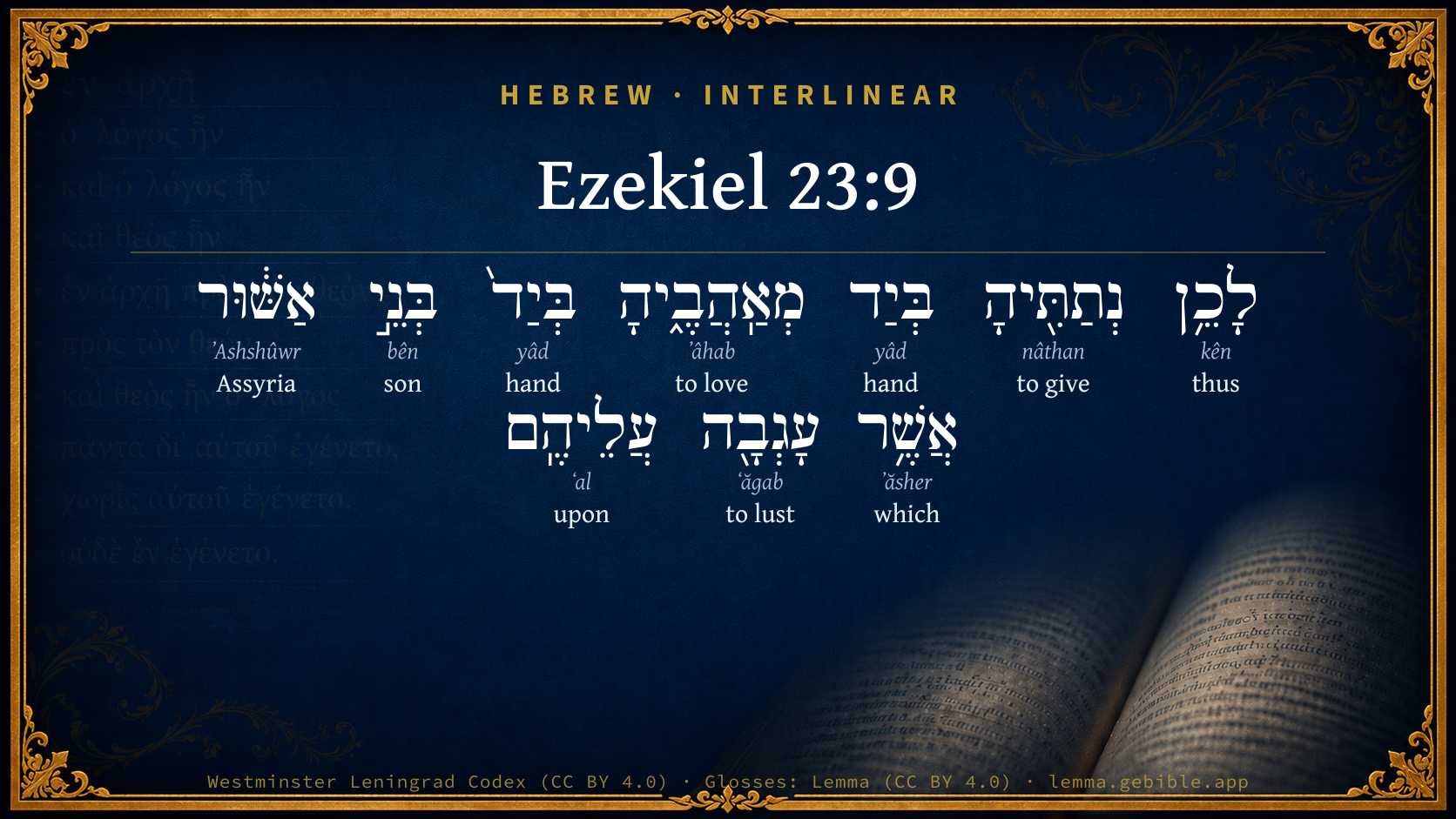
Hebrew (Westminster Leningrad Codex) Ezekiel 23:9 appears in the Hebrew Old Testament. The text above is from the Westminster Leningrad Codex. Each word links to its Strong’s number, a concise gloss, and parsing drawn from the Open Scriptures Hebrew Bible morphology. Click any word for its full Brown-Driver-Briggs (BDB) entry.
Download image
Cite this verse

Ezekiel 23:9 (World English Bible). Public Domain. Lemma interlinear Bible study tool, https://lemma.gebible.app/v/ezekiel/23/9.

Show BibTeX & RIS
BibTeX
RIS
English Translation
Therefore I delivered her into the hand of her lovers, into the hand of the Assyrians, on whom she doted.
World English Bible · Public Domain
Download a study sheet

One document with this verse’s original text, its word-by-word gloss line, the meaning frame, cross-references with their text, attributed commentary, and full source and license credits — printable, and it pastes into notes with its structure intact.

This verse Autodidact and up

Study sheet (.html) Plain text (.txt)

A passage Seminary Student

Up to 50 verses in one chapter. A passage sheet keeps up to 6 commentary sources and 12 cross-references per verse, in the order this page ranks them, and says so on the sheet whenever that leaves anything out. Ask for a single verse and you get the Autodidact verse sheet above.

Everything on this page stays free to read, with no account — the sheet is a download of what is already on screen, not access to it.

Want to remove ads? Support Godless Engineer
Compare translations 3

The same verse in 3 English versions, stacked beneath the original-language interlinear above. Click any original word for its lexicon entry.

Each is an independent rendering of the whole verse — the interlinear is not word-aligned to these translations.

Highlighted words mark where these versions differ — a whole-verse word diff, not a word-by-word alignment.

  • World English Bible Public Domain
    Therefore I delivered her into the hand of her lovers, into the hand of the Assyrians, on whom she doted.
  • King James Version Public Domain
    Wherefore I have delivered her into the hand of her lovers, into the hand of the Assyrians, upon whom she doted.
  • unfoldingWord Literal Text CC BY-SA 4.0
    Therefore I gave her into the hand of her lovers, into the hand of the Assyrians for whom she lusted.

unfoldingWord Literal Text — © unfoldingWord, licensed CC BY-SA 4.0. Word-aligned USFM3 via Door43 (git.door43.org/unfoldingWord/en_ult).

Versions to compare (up to 4)

3 of 4 selected

Show all 18 translations

Every available English version of this verse, each an independent rendering of the whole verse.

  • World English Bible Public Domain
    Therefore I delivered her into the hand of her lovers, into the hand of the Assyrians, on whom she doted.
  • Berean Standard Bible Public Domain
    Therefore I delivered her into the hands of her lovers, the Assyrians for whom she lusted.
  • Majority Standard Bible Public Domain
    Therefore I delivered her into the hands of her lovers, the Assyrians for whom she lusted.
  • King James Version Public Domain
    Wherefore I have delivered her into the hand of her lovers, into the hand of the Assyrians, upon whom she doted.
  • American Standard Version (1901) Public Domain
    Wherefore I delivered her into the hand of her lovers, into the hand of the Assyrians, upon whom she doted.
  • Revised Version (1885) Public Domain
    Wherefore I delivered her into the hand of her lovers, into the hand of the Assyrians, upon whom she doted.
  • Geneva Bible (1599) Public Domain
    Wherefore I deliuered her into the hands of her louers, euen into the hands of the Assyrians, vpon whome she doted.
  • Douay-Rheims (1899) Public Domain
    Therefore have I delivered her into the hands of her lovers, into the hands of the sons of the Assyrians, upon whose lust she doted.
  • Young's Literal Translation Public Domain
    Therefore I have given her into the hand of her lovers, Into the hand of sons of Asshur on whom she doted.
  • Literal Standard Version CC BY-SA 4.0
    Therefore I have given her into the hand of her lovers, || Into the hand of sons of Asshur on whom she lusted.
  • Unlocked Literal Bible CC BY-SA 4.0
    Therefore I gave her into the hand of her lovers, into the hand of the Assyrians for whom she lusted.
  • unfoldingWord Literal Text CC BY-SA 4.0
    Therefore I gave her into the hand of her lovers, into the hand of the Assyrians for whom she lusted.
  • Darby Bible Public Domain
    Therefore I gave her into the hand of her lovers, into the hand of the children of Asshur, after whom she lusted.
  • World Messianic Bible Public Domain
    “Therefore I delivered her into the hand of her lovers, into the hand of the Assyrians on whom she doted.
  • Webster's Bible Public Domain
    Wherefore I have delivered her into the hand of her lovers, into the hand of the Assyrians, upon whom she doted.
  • Free Bible Version CC BY-SA 4.0
    So I handed her over to her lovers, the Assyrians she wanted to have sex with.
  • Bible in Basic English Public Domain
    For this cause I gave her up into the hands of her lovers, into the hands of the Assyrians on whom her desire was fixed.
  • JPS Tanakh (1917) Public Domain
    Wherefore I delivered her into the hand of her lovers, into the hand of the Assyrians, upon whom she doted.

Literal Standard Version (2020), Covenant Press — licensed CC BY-SA 4.0. Text via the HelloAO Bible API (eBible.org). Unlocked Literal Bible (unfoldingWord) — licensed CC BY-SA 4.0. Text via the HelloAO Bible API (eBible.org). unfoldingWord Literal Text — © unfoldingWord, licensed CC BY-SA 4.0. Word-aligned USFM3 via Door43 (git.door43.org/unfoldingWord/en_ult). Free Bible Version, Dr. Jonathan Gallagher — licensed CC BY-SA 4.0. Text via the HelloAO Bible API (eBible.org).

Word by word

More ways to search: Search by grammar → Find every occurrence → Compare this word →

Practice this passage: Drill this verse → Learn its vocabulary →

עָגְבָ֖ה
ʻăgab
H5689
“to lust”
Verb, Qal, Perfect, 3rd Person, Feminine, Singular
Part of Speech
Verb
Stem
Qal
Form
Perfect
Person
3rd Person
Gender
Feminine
Number
Singular
Full BDB Definition

Origin: a primitive root

TWOT: 1559

(Qal) to have inordinate affection or lust - lust (participle) - paramours (participle as subst)
  1. לָכֵ֥ן kên H3651 “to/for · thus” Preposition + Adverb
  2. נְתַתִּ֖יהָ nâthan H5414 “to give · her” Verb, Qal, Perfect, 1st Person, Common, Singular + Suffix, Personal, 3rd Person, Feminine, Singular
  3. בְּיַד yâd H3027 “in/at · hand of” Preposition + Noun, Common, Both, Singular, Construct
  4. מְאַֽהֲבֶ֑יהָ ʼâhab H157 “loving · her” Verb, Piel, Participle Active, Masculine, Plural, Construct + Suffix, Personal, 3rd Person, Feminine, Singular
  5. בְּיַד֙ yâd H3027 “in/at · hand of” Preposition + Noun, Common, Both, Singular, Construct
  6. בְּנֵ֣י bên H1121 “sons of” Noun, Common, Masculine, Plural, Construct
  7. אַשּׁ֔וּר ʼAshshûwr H804 “Assyria” Noun, Proper
  8. אֲשֶׁ֥ר ʼăsher H834 “which” Particle, Relative
  9. עֲלֵיהֶֽם ʻal H5921 “upon · them” Preposition + Suffix, Personal, 3rd Person, Masculine, Plural

About this verse

These counts appear in no published source. They are computed here, from the morphology-tagged text and Lemma’s own curated glosses. What Lemma adds →

10
words
9
distinct lemmas
Prophets
section

Notable vocabulary

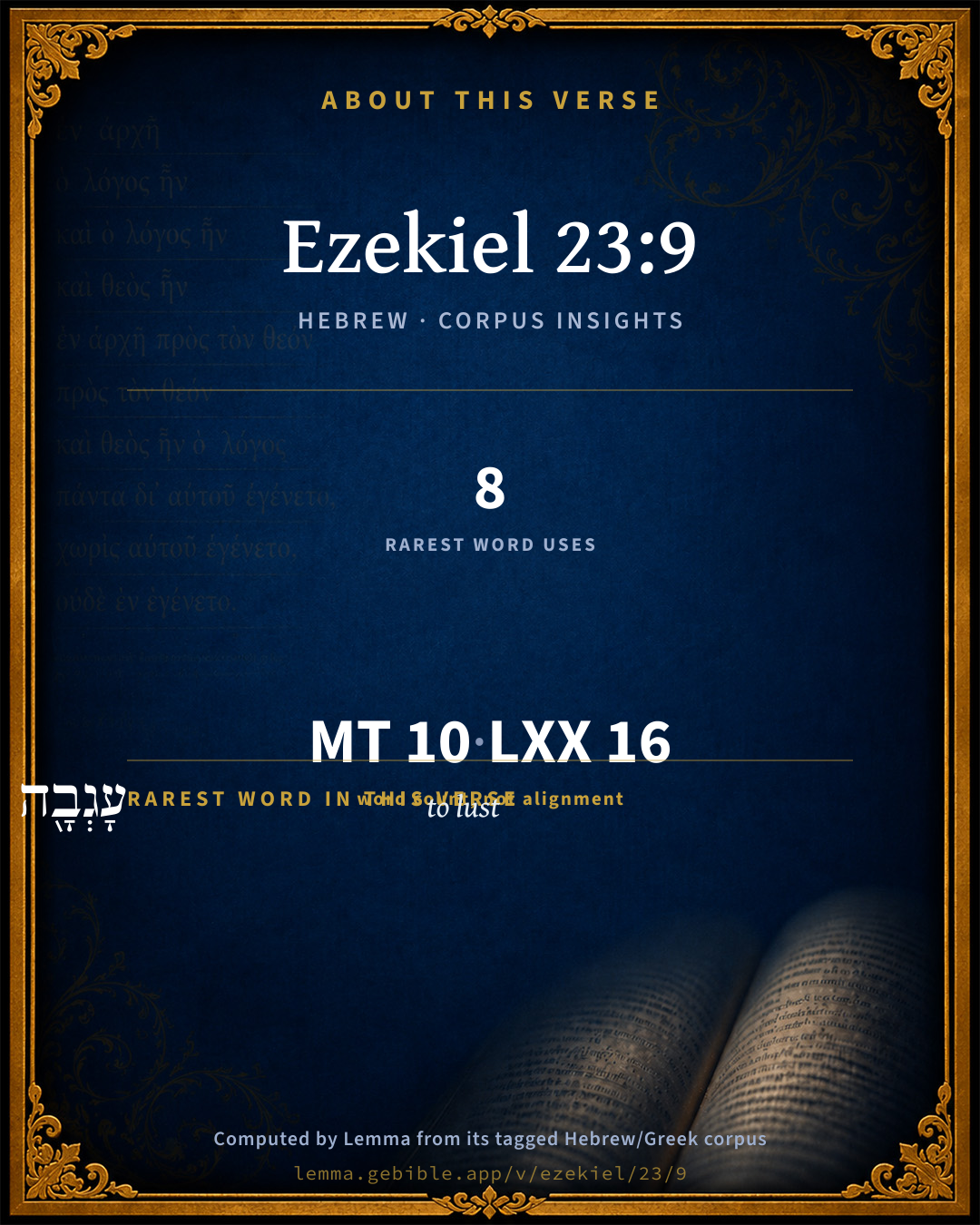
The rarest word here is עָגְבָ֖ה to lust H5689 — appearing just 8 times in the whole Hebrew Bible.

Shared distinctive vocabulary

עָגְבָ֖ה to lust H5689 occurs in 7 verses of the Hebrew Bible. Also found in:

Grammatical profile

  • 3 verbs
  • 4 nouns
  • 1 preposition
  • 1 adverb
  • 1 particle

Verb forms

  • נְתַתִּ֖יהָ Qal · Perfect
  • מְאַֽהֲבֶ֑יהָ Piel · Participle Active
  • עָגְבָ֖ה Qal · Perfect

Repetition

A word recurs within this verse — often emphatic in Hebrew:

  • בְּיַד hand H3027 ×2

Hebrew & Septuagint length

In English translation the verse runs 20 words from the Hebrew and 23 from the Septuagint (LXX English) — closely comparable.

A rough comparison of the two English renderings, which tokenize alike — not a word-level alignment.

Word counts can differ between the Hebrew and the Greek without any difference in meaning — e.g. the Hebrew direct-object marker אֵת has no separate Greek word, and Greek often adds the article ὁ.

In the original languages it is 10 Hebrew tokens and 16 Greek tokens — but the two are counted differently (Hebrew bundles its prefixes and suffixes into one token; the Greek is in lemma form), so that isn’t a like-for-like length.

Cross-references

8

Topical passages linked to Ezekiel 23:9 in the Treasury of Scripture Knowledge — connected by theme and wording, ordered by reader-vote popularity; previews shown in the World English Bible.

  • 2 Kings 15:29 In the days of Pekah king of Israel came Tiglath Pileser king of Assyria, and took Ijon, and Abel Beth Maacah, and Janoah, and Kedesh, and Hazor, and Gilead, and Galilee, all the land of Naphtali; and he carried them captive to Assyria.
  • 2 Kings 17:23 until Yahweh removed Israel out of his sight, as he spoke by all his servants the prophets. So Israel was carried away out of their own land to Assyria to this day.
  • Hosea 11:5 "They won't return into the land of Egypt; But the Assyrian will be their king, Because they refused to repent.
  • 2 Kings 17:3–6 Against him came up Shalmaneser king of Assyria; and Hoshea became his servant, and brought him tribute.
  • 2 Kings 18:9–12 It happened in the fourth year of king Hezekiah, which was the seventh year of Hoshea son of Elah king of Israel, that Shalmaneser king of Assyria came up against Samaria, and besieged it.
  • 1 Chronicles 5:26 The God of Israel stirred up the spirit of Pul king of Assyria, and the spirit of Tilgath Pilneser king of Assyria, and he carried them away, even the Reubenites, and the Gadites, and the half-tribe of Manasseh, and brought them to Halah, and Habor, and Hara, and to the river of Gozan, to this day.
  • Revelation 17:12–13 The ten horns that you saw are ten kings who have received no kingdom as yet, but they receive authority as kings, with the beast, for one hour.
  • Revelation 17:16 The ten horns which you saw, and the beast, these will hate the prostitute, and will make her desolate, and will make her naked, and will eat her flesh, and will burn her utterly with fire.

Cross-references courtesy of OpenBible.info (CC BY 4.0).

Hebrew and Greek witnesses Masoretic Hebrew ↔ Greek Septuagint

The same verse in the two great witnesses to the Old Testament, shown verse-for-verse.

These are two independent witnesses, not word-aligned to each other, and the Septuagint is shown in lemma (dictionary) form.

Hebrew Ezekiel 23:9 Masoretic · Westminster Leningrad Codex

לָכֵ֥ן נְתַתִּ֖יהָ בְּיַד מְאַֽהֲבֶ֑יהָ בְּיַד֙ בְּנֵ֣י אַשּׁ֔וּר אֲשֶׁ֥ר עָגְבָ֖ה עֲלֵיהֶֽם

Therefore I delivered her into the hand of her lovers, into the hand of the Assyrians, on whom she doted.

World English Bible · Public Domain

Greek LXX Ezekiel 23:9 Septuagint · lemma form

διά οὗτος παραδίδωμι αὐτός εἰς χείρ ὁ ἐραστής αὐτός εἰς χείρ υἱός ἀσσύριος ἐπί ὅς ἐπιτίθημι

Therefore I delivered her into the hands of her lovers, into the hands of the children of the Assyrians, on whom she doted.

LXX2012 (modern English Septuagint) · Public Domain

Hebrew: Westminster Leningrad Codex (CC BY 4.0). Greek: Septuagint (public domain); English from LXX2012 (modern English Septuagint) (Public Domain). How the Septuagint differs from the Hebrew →

Targum (Aramaic paraphrase)

1

The Targum is the ancient Jewish Aramaic paraphrase of the Hebrew Scriptures — an interpretive translation, not the Hebrew text itself. Onkelos (literal) and Pseudo-Jonathan (expansive) render the Torah, and Jonathan the Prophets. Coverage is partial: where no permissively-licensed English translation exists for a verse, only the Aramaic is shown. This is verse-level text, not a word-by-word alignment to the Hebrew.

  1. Targum Jonathan Prophets (Joshua–Malachi)
    בְּכֵן מְסַרְתִיהָא בְּיַד רְחִימָהָא בְּיַד בְּנֵי אַתּוּוּן דְאִתְרְעִיאַת לְמִטְעֵי בַתְרֵיהוֹן:

    (no public-domain English translation for this verse)

    Targum Jonathan — Aramaic: “Mikraot Gedolot” (public domain). English: “Sefaria Community Translation” (CC0 1.0 (public-domain dedication)); “London "Chaldee Paraphrase," 1871” (public domain). Text via Sefaria.

Commentary

Notes on Ezekiel 23:9 from classic Christian and Jewish commentators (each source and its license shown beneath its notes). The classic Christian expositions comment on the surrounding passage and are grouped to its opening verse, so a note may address several verses; the Jewish commentaries on the Tanakh (Rashi and others) are per-verse, so they appear only where the commentator wrote on this verse.

Lemma curates 59 commentaries, every one of them public domain or Creative Commons licensed, each selected and text-cleaned for this edition rather than reprinted as found. About our sources →

Trapp's Complete Commentary

John Trapp

Eze 23:9 Wherefore I have delivered her into the hand of her lovers, into the hand of the Assyrians, upon whom she doted.

Ver. 9. Wherefore I have delivered her.] 2Ki 17:23.

“ Per quod quis peccat, per idem punitur et ipse. ”

John Trapp, A Commentary or Exposition upon All the Books of the Old and New Testament (1647–1656) — public domain. Text from a community e-Sword module.

Tyndale Open Study Notes

Tyndale Open Resources

23:9-10 The northern kingdom was overrun by the Assyrian army in 722 BC, and its people were dispersed throughout the Assyrian Empire.

Tyndale Open Study Notes — © Tyndale Open Resources, licensed CC BY-SA 4.0. Text via the HelloAO Bible API.

Jamieson, Fausset & Brown

Robert Jamieson, A. R. Fausset & David Brown

God, in righteous retribution, turned their objects of trust into the instruments of their punishment: Pul, Tiglath-pileser, Esar-haddon, and Shalmaneser (Kg2 15:19, Kg2 15:29; Kg2 17:3, Kg2 17:6, Kg2 17:24; Ezr 4:2, Ezr 4:10). "It was their sin to have sought after such lovers, and it was to be their punishment that these lovers should become their destroyers" [FAIRBAIRN].

Jamieson, Fausset & Brown — Commentary Critical and Explanatory on the Whole Bible (1871) — public domain (CC PDM 1.0). Text via the HelloAO Bible API.

The Cambridge Bible for Schools and Colleges

gen. ed. J. J. S. Perowne

9. I have delivered] I delivered. The Assyrians overthrew Samaria in 722 b.c. Menahem was supported on the throne by Assyria (2Ki_15:19); and Hoshea, the last king, was dethroned on account of his intrigues with Egypt (2Ki_17:4).

The Cambridge Bible for Schools and Colleges (gen. ed. J. J. S. Perowne; Cambridge University Press, 1878–1918) — public domain. Text from a community e-Sword module.

John Gill's Exposition

Wherefore I have delivered her into the hand of her lovers,.... To destruction; their persons, families, riches, and kingdom itself:

into the hand of the Assyrians, on whom she doted; first into the hands of Pul, then Tiglathpileser, then Shalmaneser, all kings of Assyria, by whom they were spoiled or carried captive; by the two first in part, by the last wholly; see Kg2 15:19.

John Gill's Exposition of the Whole Bible (1746–1763) — public domain (CC PDM 1.0). Text via the HelloAO Bible API.

Albert Barnes' Notes on the Bible

For the cause which at last brought destruction on Israel, see marginal reference.

Albert Barnes' Notes on the Bible (1834–1885) — public domain. Text from a community e-Sword/MySword module.

Matthew Poole's English Annotations

Wherefore, for this boundless idolatry and lewdness

I have delivered her; long ago I have delivered the ten tribes: first, Pul put them under tribute, 2Ki 15:19,20, about two hundred years before our prophet’s time; then Tiglath-pileser, 2Ki 15:29; and finally into Shalmaneser’s hand, who destroyed the kingdom, 2Ki 17:6.

Into the hand of the Assyrians, upon whom she doted; punished them for their sins by those who were fellow sinners with her.

Matthew Poole's English Annotations on the Holy Bible (1683–1685) — public domain. Text from a community e-Sword/MySword module.

The Pulpit Commentary

Sinners left to themselves and to their sins.

I delivered her into the hand of her lovers," etc. The aspect of the sin of Israel which is most conspicuous in this chapter is not their idolatry so much as their contracting political alliances which were forbidden by God. "The imagery," as Fausset remarks, "is similar to that in Ezekiel 16.; but here the reference is not, as there, so much to the breach of the spiritual marriage-covenant with God by the people"s idolatries, as by their worldly spirit, and their trusting to alliances with the heathen for safety, rather than to God." Our text suggests two observations

I DETERMINED PERSISTENCE IN SIN LEADS GOD TO ALLOW THE SINNER TO TAKE HIS OWN COURSE. The Israelites would trust in Egypt or in Assyria rather than in the Lord their God. Remonstrances against political alliances with heathen nations, or conformity to their religious observances, with warnings of the consequences of so doing, had been addressed to them in vain. Exhortations to trust in Jehovah alone had proved fruitless. All moral means had been employed to secure their fidelity to their duty and their God, but without avail. Wherefore the Lord "delivered her into the hand of her lovers, into the hand of the Assyrians, upon whom she doted." The Israelites would have their own way, and God at length allowed them to take it. (cf. Psa_81:11, Psa_81:12) There are some today in whom we fear the same process is at work. Here is a man who makes riches the object of his supreme concern. Money is the god in which he trusts, and to which he is devoted. His great and constant efforts are made in order to acquire and retain riches. Remonstrances and rebukes for the course he is pursuing are unheeded by him. Exhortations and encouragements to cherish a different and nobler ambition, to trust a worthy object, and to live to God, are addressed to him in vain. He will go on in his own way. And at length God allows him to take his course, and live for money. The same thing takes place with others who make a god of pleasure, or who will trust supremely in their own sagacity and judgment, or whose grand ambition and ruling purpose is to attain conspicuous position or commanding power. If they are invincibly determined to follow their own course, God allows them to do so. The case is thus forcibly stated by Dr. Joseph Parker: "A man sets his mind on standing on some high place; he points to a pillar, and says that if he could ascend to its summit he would see from that lofty elevation glimpses of heaven, and he determines that he will stand upon that summit, whatever hazards he may incur. At length God grants him his request; and when the man has ascended to the eminence which he coveted, what does he find? Sand, sand, sand! Mile on mile of sand sand for mile on mile! And now he wishes to descend; but bow to get down is his great difficulty. There may be no way down but that which involves suicide. Yet the man was determined to reach that elevation; nothing could stand between him and his wish; he urged God to grant him his request; with importunate desire he besought that he might have his own way; and there is no punishment heavier than that which falls upon any man when God allows him to take his own course." God does much to lead men to forsake sin and follow holiness; he gave his own beloved Son as a sacrifice for the abolition of sin and the salvation of the sinner; he is working for these ends by many and powerful agencies; for these objects he will do everything that he can, everything that is consistent with his own holiness and with the moral constitution which he has given to man. But one thing he will not do he will not compel men to forsake their own evil ways and walk in his way of holiness. And if men were forced into righteousness of action, what would such righteousness be worth? The obedience which is not willing is mechanical, not moral. The goodness which is not hearty is in the sight of God but a dead and hypocritical form.

II THE PUNISHMENT OF SIN GENERALLY ARISES OUT OF THE SIN ITSELF. "Wherefore I delivered her up into the hand of her lovers, into the hand of the Assyrians, upon whom she doted." "The cause which at last brought destruction on Israel was that the King of Assyria found conspiracies in Hosea, who was intriguing with Egypt at the same time that he acknowledged himself a tributary to Assyria." (2Ki_17:4) Says Matthew Henry, "The neighboring nations, whose idolatries she had conformed to and whose friendship she had confided in, and in both had affronted God, are now made use of as the instruments of her destruction. The Assyrians, on whom she doted, soon spied out the nakedness of the land, discovered her blind side, on which to attack her, stripped her of all her ornaments and all her defenses, and so uncovered her, and made her naked and bare, carried her sons and daughters into captivity, slew her with the sword, and quite destroyed that kingdom and put an end to it...And that the Assyrians, whom they had been so fond of, should be employed in executing judgments upon them, was very remarkable, and shows how God, in a way of righteous judgment, often makes that a scourge to sinners which they have inordinately set their hearts upon. The devil will for ever be a tormentor to those impenitent sinners who now hearken to him and comply with him as a tempter." "God excites those against us for punishment to please whom we had sinned." Scott says truly, God commonly employs tempters to punish those who listen to them." And Shakespeare

Heaven is most just, and of our pleasant vices Makes instruments to scourge us.

In the righteous government of God punishment is not arbitrarily annexed to sin: it grows out of the sin. As Hesiod observes, "The seeds of our own punishment are sown at the same time we commit sin." "Whatsoever a man soweth, that shall he also reap," etc.. (Gal_6:7, Gal_6:8) If men will trust in riches or rank, in pleasure or power; if they will live for these things, their life will bear its appropriate fruit. These their gods will prove their ruin. Their hopes will be utterly disappointed, their lives deplorably impoverished and degraded, and their souls lost. Let us take heed to the object of our trust. "Blessed is the man that trusteth in the Lord, and whose hope the Lord is," etc.. W.J. (Jer_17:7, Jer_17:8)

The Pulpit Commentary (1880–1919), ed. H.D.M. Spence-Jones & Joseph S. Exell — public domain. Text from a community e-Sword module.

Rashi

Rabbi Shlomo Yitzchaki (Rashi)

Therefore, I delivered her, etc. For Sennacherib came and exiled them.

Rashi on the Tanakh — English translations: “The Judaica Press complete Tanach with Rashi, translated by A. J. Rosenberg” (CC BY 4.0); “Pentateuch with Rashi's commentary by M. Rosenbaum and A.M. Silbermann, 1929-1934” (public domain); “The Metsudah Tanach series, Lakewood, N.J” (CC BY 4.0); and “The Book of Joshua, Metsudah Publications, 1997” (CC BY 4.0). Text via Sefaria.

Lesson kit

Teaching starters — assembled from the data on this page, not authored interpretation. Every prompt links to the verse data it draws on. Edit before teaching.

Ezekiel, in the Prophets, opens this verse with 10 words (9 distinct Hebrew lemmas). Its most distinctive word is ʻăgab (“to lust”). A historical commentator’s framing appears above. Read the whole chapter for the surrounding context.

Discussion questions

  1. What does “to lust” (ʻăgab) contribute to the verse as a whole?
  2. How does Jeremiah 4:30, which shares the word «to lust», read alongside this verse?
  3. What does the repetition of “hand” (2× in this one verse) do in this verse?
  4. These translations render this verse differently; the difference is in the English rendering, not the original. What questions does that raise?
  5. «נְתַתִּ֖יהָ» is a Qal Perfect verb. How does that grammatical form shape the action described?
  6. Compare how Trapp's Complete Commentary and Tyndale Open Study Notes read this verse. Where do they agree or differ?

Things to notice

Reading settings

Reading text

Shown beneath each verse's original-language words.

Old Testament
Old Testament edition

Read the OT as the Masoretic Hebrew (MT) or the Greek Septuagint (LXX).

English shown for the Greek Septuagint (in the Hebrew ↔ Greek comparison).

Comparing translations? Open the Compare panel on any verse page to stack up to four side by side.