
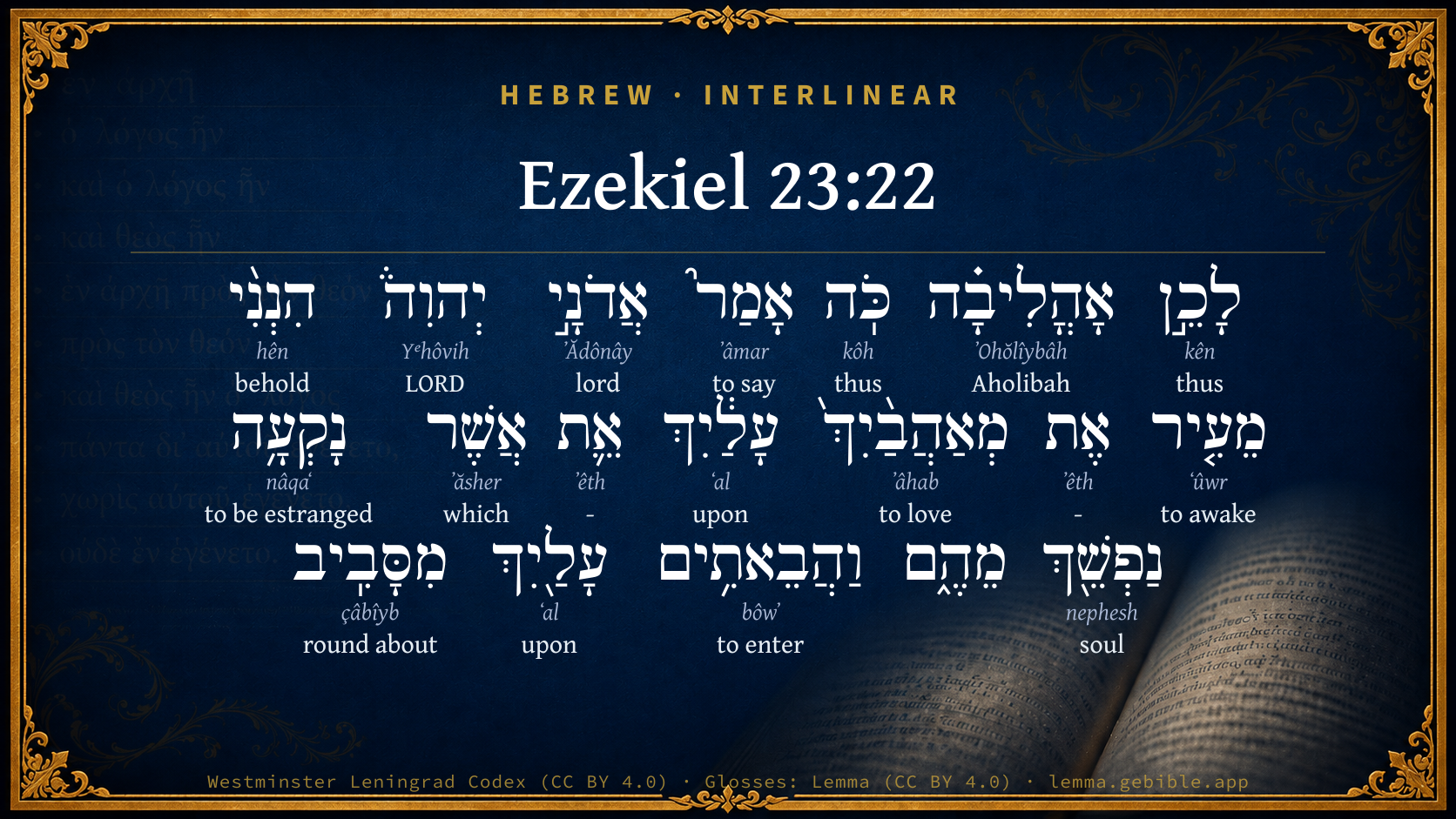
Ezekiel 23:22

Hebrew (Westminster Leningrad Codex) Ezekiel 23:22 appears in the Hebrew Old Testament. The text above is from the Westminster Leningrad Codex. Each word links to its Strong’s number, a concise gloss, and parsing drawn from the Open Scriptures Hebrew Bible morphology. Click any word for its full Brown-Driver-Briggs (BDB) entry.
Download image
Cite this verse

Ezekiel 23:22 (World English Bible). Public Domain. Lemma interlinear Bible study tool, https://lemma.gebible.app/v/ezekiel/23/22.

Show BibTeX & RIS
BibTeX
RIS
English Translation
Therefore, Oholibah, thus says the Lord Yahweh: Behold, I will raise up your lovers against you, from whom your soul is alienated, and I will bring them against you on every side:
World English Bible · Public Domain
Download a study sheet

One document with this verse’s original text, its word-by-word gloss line, the meaning frame, cross-references with their text, attributed commentary, and full source and license credits — printable, and it pastes into notes with its structure intact.

This verse Autodidact and up

Study sheet (.html) Plain text (.txt)

A passage Seminary Student

Up to 50 verses in one chapter. A passage sheet keeps up to 6 commentary sources and 12 cross-references per verse, in the order this page ranks them, and says so on the sheet whenever that leaves anything out. Ask for a single verse and you get the Autodidact verse sheet above.

Everything on this page stays free to read, with no account — the sheet is a download of what is already on screen, not access to it.

Want to remove ads? Support Godless Engineer
Compare translations 3

The same verse in 3 English versions, stacked beneath the original-language interlinear above. Click any original word for its lexicon entry.

Each is an independent rendering of the whole verse — the interlinear is not word-aligned to these translations.

Highlighted words mark where these versions differ — a whole-verse word diff, not a word-by-word alignment.

  • World English Bible Public Domain
    Therefore, Oholibah, thus says the Lord Yahweh: Behold, I will raise up your lovers against you, from whom your soul is alienated, and I will bring them against you on every side:
  • King James Version Public Domain
    Therefore, O Aholibah, thus saith the Lord GOD; Behold, I will raise up thy lovers against thee, from whom thy mind is alienated, and I will bring them against thee on every side;
  • unfoldingWord Literal Text CC BY-SA 4.0
    Therefore, Oholibah, the Lord Yahweh says this, ‘Behold! I will turn your lovers against you. Those from whom you turned away, I will bring them against you from every side:

unfoldingWord Literal Text — © unfoldingWord, licensed CC BY-SA 4.0. Word-aligned USFM3 via Door43 (git.door43.org/unfoldingWord/en_ult).

Versions to compare (up to 4)

3 of 4 selected

Show all 18 translations

Every available English version of this verse, each an independent rendering of the whole verse.

  • World English Bible Public Domain
    Therefore, Oholibah, thus says the Lord Yahweh: Behold, I will raise up your lovers against you, from whom your soul is alienated, and I will bring them against you on every side:
  • Berean Standard Bible Public Domain
    Therefore, Oholibah, this is what the Lord GOD says: ‘I will incite your lovers against you, those from whom you turned away in disgust. And I will bring them against you from every side—
  • Majority Standard Bible Public Domain
    Therefore, Oholibah, this is what the Lord GOD says: ‘I will incite your lovers against you, those from whom you turned away in disgust. And I will bring them against you from every side—
  • King James Version Public Domain
    Therefore, O Aholibah, thus saith the Lord GOD; Behold, I will raise up thy lovers against thee, from whom thy mind is alienated, and I will bring them against thee on every side;
  • American Standard Version (1901) Public Domain
    Therefore, O Oholibah, thus saith the Lord Jehovah: Behold, I will raise up thy lovers against thee, from whom thy soul is alienated, and I will bring them against thee on every side:
  • Revised Version (1885) Public Domain
    Therefore, O Oholibah, thus saith the Lord GOD: Behold, I will raise up thy lovers against thee, from whom thy soul is alienated, and I will bring them against thee on every side;
  • Geneva Bible (1599) Public Domain
    Therefore, O Aholibah, thus sayeth the Lord God, Beholde, I will raise vp thy louers against thee, from whome thine heart is departed, and I will bring them against thee on euery side,
  • Douay-Rheims (1899) Public Domain
    Therefore, Ooliba, thus saith the Lord God: Behold I will raise up against thee all thy lovers with whom thy soul hath been glutted: and I will gather them together against thee round about.
  • Young's Literal Translation Public Domain
    Therefore, O Aholibah, thus said the Lord Jehovah: Lo, I am stirring up thy lovers against thee, From whom thy soul hath been alienated, And have brought them in against thee from round about.
  • Literal Standard Version CC BY-SA 4.0
    Therefore, O Aholibah, thus said Lord YHWH: Behold, I am stirring up your lovers against you, || From whom your soul has been alienated, || And have brought them in against you from all around.
  • Unlocked Literal Bible CC BY-SA 4.0
    Therefore, Oholibah, the Lord Yahweh says this, 'Behold! I will turn your lovers against you. Those from whom you turned away, I will bring them against you from every side:
  • unfoldingWord Literal Text CC BY-SA 4.0
    Therefore, Oholibah, the Lord Yahweh says this, ‘Behold! I will turn your lovers against you. Those from whom you turned away, I will bring them against you from every side:
  • Darby Bible Public Domain
    Therefore, Oholibah, thus saith the Lord Jehovah: Behold, I will raise up thy lovers against thee, from whom thy soul is alienated, and I will bring them against thee on every side.
  • World Messianic Bible Public Domain
    “Therefore, Oholibah, the Lord GOD says: ‘Behold, I will raise up your lovers against you, from whom your soul is alienated, and I will bring them against you on every side:
  • Webster's Bible Public Domain
    Therefore, O Aholibah, thus saith the Lord GOD; Behold, I will raise up thy lovers against thee, from whom thy mind is alienated, and I will bring them against thee on every side;
  • Free Bible Version CC BY-SA 4.0
    So Oholibah, this is what the Lord God says: I'm going to encourage your lovers to attack you, those you rejected in disgust. I will bring them to attack you from every direction:
  • Bible in Basic English Public Domain
    For this cause, O Oholibah, this is what the Lord has said: See, I will make your lovers come up against you, even those from whom your soul is turned away in disgust; and I will make them come up against you on every side;
  • JPS Tanakh (1917) Public Domain
    Therefore, O Oholibah, thus saith the Lord GOD: Behold, I will raise up thy lovers against thee, from whom thy soul is alienated, and I will bring them against thee on every side:

Literal Standard Version (2020), Covenant Press — licensed CC BY-SA 4.0. Text via the HelloAO Bible API (eBible.org). Unlocked Literal Bible (unfoldingWord) — licensed CC BY-SA 4.0. Text via the HelloAO Bible API (eBible.org). unfoldingWord Literal Text — © unfoldingWord, licensed CC BY-SA 4.0. Word-aligned USFM3 via Door43 (git.door43.org/unfoldingWord/en_ult). Free Bible Version, Dr. Jonathan Gallagher — licensed CC BY-SA 4.0. Text via the HelloAO Bible API (eBible.org).

Word by word

More ways to search: Search by grammar → Find every occurrence → Compare this word →

Practice this passage: Drill this verse → Learn its vocabulary →

נָקְעָ֥ה
nâqaʻ
H5361
“to be estranged”
Verb, Qal, Perfect, 3rd Person, Feminine, Singular
Part of Speech
Verb
Stem
Qal
Form
Perfect
Person
3rd Person
Gender
Feminine
Number
Singular
Full BDB Definition

Origin: a primitive root

TWOT: 1414

(Qal) to be estranged, be alienated - to be severed (figuratively)
  1. לָכֵ֣ן kên H3651 “to/for · thus” Preposition + Adverb
  2. אָהֳלִיבָ֗ה ʼOhŏlîybâh H172 “Aholibah” Noun, Proper
  3. כֹּֽה kôh H3541 “thus” Adverb
  4. אָמַר֮ ʼâmar H559 “to say” Verb, Qal, Perfect, 3rd Person, Masculine, Singular
  5. אֲדֹנָ֣י ʼĂdônây H136 “Lord · my” Noun, Common, Masculine, Plural, Construct + Suffix, Personal, 1st Person, Common, Singular
  6. יְהוִה֒ Yᵉhôvih H3069 “LORD” Noun, Proper
  7. הִנְנִ֨י hên H2005 “behold · me” Particle, Demonstrative + Suffix, Personal, 1st Person, Common, Singular
  8. מֵעִ֤יר ʻûwr H5782 “awaking” Verb, Hiphil, Participle Active, Masculine, Singular, Absolute
  9. אֶת ʼêth H853 “-” Particle, Direct Object
  10. מְאַהֲבַ֨יִךְ֙ ʼâhab H157 “loving · you” Verb, Piel, Participle Active, Masculine, Plural, Construct + Suffix, Personal, 2nd Person, Feminine, Singular
  11. עָלַ֔יִךְ ʻal H5921 “upon · you” Preposition + Suffix, Personal, 2nd Person, Feminine, Singular
  12. אֵ֛ת ʼêth H853 “-” Particle, Direct Object
  13. אֲשֶׁר ʼăsher H834 “which” Particle, Relative
  14. נַפְשֵׁ֖ךְ nephesh H5315 “soul · your” Noun, Common, Both, Singular, Construct + Suffix, Personal, 2nd Person, Feminine, Singular
  15. וַהֲבֵאתִ֥ים bôwʼ H935 “and · to enter · them” Conjunction + Verb, Hiphil, Sequential Perfect, 1st Person, Common, Singular + Suffix, Personal, 3rd Person, Masculine, Plural
  16. עָלַ֖יִךְ ʻal H5921 “upon · you” Preposition + Suffix, Personal, 2nd Person, Feminine, Singular
  17. מִסָּבִֽיב çâbîyb H5439 “from · round about” Preposition + Noun, Common, Both, Singular, Absolute

About this verse

These counts appear in no published source. They are computed here, from the morphology-tagged text and Lemma’s own curated glosses. What Lemma adds →

19
words
16
distinct lemmas
Prophets
section

Notable vocabulary

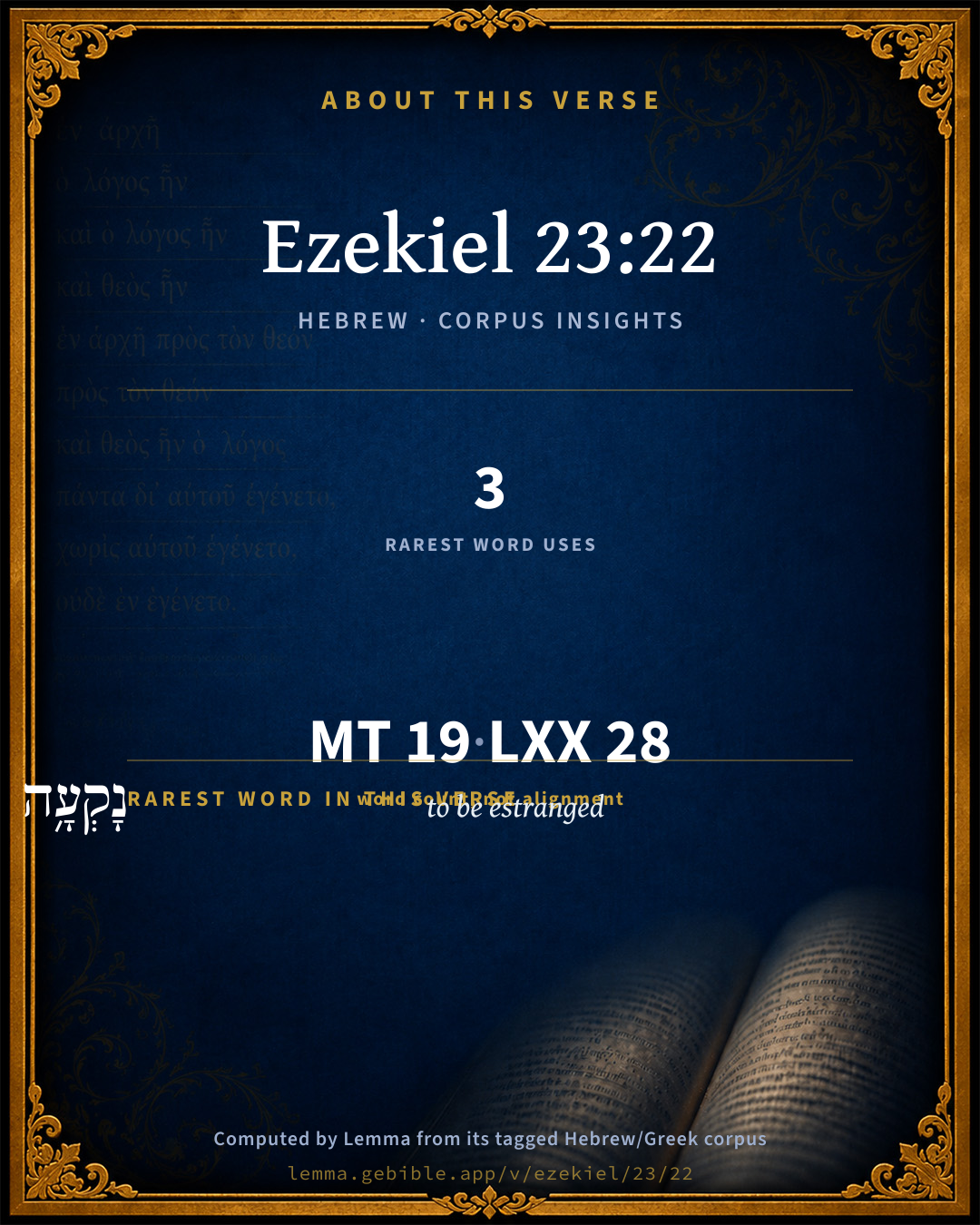
The rarest word here is נָקְעָ֥ה to be estranged H5361 — appearing just 3 times in the whole Hebrew Bible.

Shared distinctive vocabulary

נָקְעָ֥ה to be estranged H5361 occurs in 3 verses of the Hebrew Bible. Also found in:

Grammatical profile

  • 5 verbs
  • 5 nouns
  • 3 prepositions
  • 2 adverbs
  • 4 particles

Verb forms

  • אָמַר֮ Qal · Perfect
  • מֵעִ֤יר Hiphil · Participle Active
  • מְאַהֲבַ֨יִךְ֙ Piel · Participle Active
  • נָקְעָ֥ה Qal · Perfect
  • וַהֲבֵאתִ֥ים Hiphil · Sequential Perfect

Repetition

A word recurs within this verse — often emphatic in Hebrew:

  • עָלַ֔יִךְ upon H5921 ×2

Hebrew & Septuagint length

In English translation the verse runs 32 words from the Hebrew and 30 from the Septuagint (LXX English) — closely comparable.

A rough comparison of the two English renderings, which tokenize alike — not a word-level alignment.

Word counts can differ between the Hebrew and the Greek without any difference in meaning — e.g. the Hebrew direct-object marker אֵת has no separate Greek word, and Greek often adds the article ὁ.

In the original languages it is 19 Hebrew tokens and 28 Greek tokens — but the two are counted differently (Hebrew bundles its prefixes and suffixes into one token; the Greek is in lemma form), so that isn’t a like-for-like length.

Cross-references

9

Topical passages linked to Ezekiel 23:22 in the Treasury of Scripture Knowledge — connected by theme and wording, ordered by reader-vote popularity; previews shown in the World English Bible.

  • Ezekiel 16:37 therefore see, I will gather all your lovers, with whom you have taken pleasure, and all those who you have loved, with all those who you have hated; I will even gather them against you on every side, and will uncover your nakedness to them, that they may see all your nakedness.
  • Revelation 17:16 The ten horns which you saw, and the beast, these will hate the prostitute, and will make her desolate, and will make her naked, and will eat her flesh, and will burn her utterly with fire.
  • Isaiah 10:5–6 Ho Assyrian, the rod of my anger, the staff in whose hand is my indignation!
  • Isaiah 39:3–4 Then came Isaiah the prophet to king Hezekiah, and said to him, What said these men? and from whence came they to you? Hezekiah said, They are come from a far country to me, even from Babylon.
  • Jeremiah 6:22–23 Thus says Yahweh, Behold, a people comes from the north country; and a great nation shall be stirred up from the uttermost parts of the earth.
  • Jeremiah 12:9–12 Is my heritage to me as a speckled bird of prey? are the birds of prey against her round about? go you, assemble all the animals of the field, bring them to devour.
  • Ezekiel 23:9 Therefore I delivered her into the hand of her lovers, into the hand of the Assyrians, on whom she doted.
  • Ezekiel 23:28 For thus says the Lord Yahweh: Behold, I will deliver you into the hand of them whom you hate, into the hand of them from whom your soul is alienated;
  • Habakkuk 1:6–10 For, behold, I raise up the Chaldeans, that bitter and hasty nation, that march through the breadth of the earth, to possess dwelling places that are not theirs.

Cross-references courtesy of OpenBible.info (CC BY 4.0).

Hebrew and Greek witnesses Masoretic Hebrew ↔ Greek Septuagint

The same verse in the two great witnesses to the Old Testament, shown verse-for-verse.

These are two independent witnesses, not word-aligned to each other, and the Septuagint is shown in lemma (dictionary) form.

Hebrew Ezekiel 23:22 Masoretic · Westminster Leningrad Codex

לָכֵ֣ן אָהֳלִיבָ֗ה כֹּֽה אָמַר֮ אֲדֹנָ֣י יְהוִה֒ הִנְנִ֨י מֵעִ֤יר אֶת מְאַהֲבַ֨יִךְ֙ עָלַ֔יִךְ אֵ֛ת אֲשֶׁר נָקְעָ֥ה נַפְשֵׁ֖ךְ מֵהֶ֑ם וַהֲבֵאתִ֥ים עָלַ֖יִךְ מִסָּבִֽיב

Therefore, Oholibah, thus says the Lord Yahweh: Behold, I will raise up your lovers against you, from whom your soul is alienated, and I will bring them against you on every side:

World English Bible · Public Domain

Greek LXX Ezekiel 23:22 Septuagint · lemma form

διά οὗτος οολιβα ὅδε λέγω κύριος ἰδού ἐγώ ἐκἐγείρω ὁ ἐραστής σύ ἐπί σύ ἀπό ὅς ἀποἵστημι ὁ ψυχή σύ ἀπό αὐτός καί ἐπιἄγω αὐτός ἐπί σύ κυκλόθεν

Therefore, Ooliba, thus says the Lord; Behold, I will stir up your lovers against you, from whom your soul is alienated, and I will bring them upon you round about,

LXX2012 (modern English Septuagint) · Public Domain

On this verse, The Pulpit Commentary discusses the Septuagint’s reading. Read the note in Commentary ↓

Hebrew: Westminster Leningrad Codex (CC BY 4.0). Greek: Septuagint (public domain); English from LXX2012 (modern English Septuagint) (Public Domain). How the Septuagint differs from the Hebrew →

Targum (Aramaic paraphrase)

1

The Targum is the ancient Jewish Aramaic paraphrase of the Hebrew Scriptures — an interpretive translation, not the Hebrew text itself. Onkelos (literal) and Pseudo-Jonathan (expansive) render the Torah, and Jonathan the Prophets. Coverage is partial: where no permissively-licensed English translation exists for a verse, only the Aramaic is shown. This is verse-level text, not a word-by-word alignment to the Hebrew.

  1. Targum Jonathan Prophets (Joshua–Malachi)
    בְּכֵן אָהֳלִיבָה כִּדְנַן אֲמַר יְיָ אֱלֹהִים הָא אֲנָא מַיְתֵי בִּגְלֵי יַת רְחִימָךְ עֲלָךְ יַת דְקָצַת נַפְשִׁיךְ בְּהוֹן וְאַיְתִינוּן עֲלָךְ מִסְחוֹר סְחוֹר:

    (no public-domain English translation for this verse)

    Targum Jonathan — Aramaic: “Mikraot Gedolot” (public domain). English: “Sefaria Community Translation” (CC0 1.0 (public-domain dedication)); “London "Chaldee Paraphrase," 1871” (public domain). Text via Sefaria.

Commentary

Notes on Ezekiel 23:22 from classic Christian and Jewish commentators (each source and its license shown beneath its notes). The classic Christian expositions comment on the surrounding passage and are grouped to its opening verse, so a note may address several verses; the Jewish commentaries on the Tanakh (Rashi and others) are per-verse, so they appear only where the commentator wrote on this verse.

Lemma curates 59 commentaries, every one of them public domain or Creative Commons licensed, each selected and text-cleaned for this edition rather than reprinted as found. About our sources →

Matthew Henry's Commentary

Jerusalem stands indicted by the name of Aholibah, for that she, as a false traitor to her sovereign Lord the God of heaven, not having his fear before her eyes, but moved by the instigation of the devil, had revolted from her allegiance to him, had compassed and imagined to shake off his government, had kept up a correspondence had joined in confederacy with his enemies, and the pretenders to a deity, in contempt of his crown and dignity. To this indictment she has pleaded, Not guilty: I am not polluted; I have not gone after Baalim. But it is found against her by the notorious evidence of the fact, and she stands convicted of it, nor has any thing material to offer why judgment should not be given and execution awarded according to law. In these verses, therefore, we have the sentence.

I. Her old confederates must be her executioners; and those whom she had courted to be her leaders in sin are now to be employed as instruments of her punishment (Eze 23:22): "I will raise up thy lovers against thee, the Chaldeans, whom formerly thou didst so much admire and covet an acquaintance with, but from whom thy mind is since alienated and with whom thou hast perfidiously broken covenant." They are called thy lovers (Eze 23:22) and yet (Eze 23:28) those whom thou hatest. Note, It is common for sinful love soon to turn into hatred; as Amnon's to Tamar. Those of headstrong and unreasonable passions are often very hot against those persons and things that a little before they were as hot for. Fools run into extremes; nay, and wise men may see cause to change their sentiments. And therefore, as we should rejoice and weep as if we rejoiced not and wept not, so we should love and hate as if we loved not and hated not. Ita ama tanquam osurus - Love as one who may have cause to feel aversion.

II. The execution to be done upon her is very terrible.

1. Her enemies shall come against her on every side (Eze 23:22), those of the several nations that constituted the Chaldean army (Eze 23:23), all of them great lords and renowned, whose pomp, and grandeur, and splendid appearance made them look the more amiable when they came as friends to protect and patronise Jerusalem, but the more formidable when they came to chastise its treachery and aimed at no less than its ruin. (1.) They shall come with a great deal of military force (Eze 23:24), with chariots and wagons furnished with all necessary provisions for a camp, with arms and ammunition, bag and baggage, with a vast army, and well armed. (2.) They shall have justice on their side: "I will set judgment before them" (they shall have right with them as well as might; for the king of Babylon had just cause to make war upon the king of Judah, because he had broken his league with him), "and therefore they shall judge thee, not only according to God's judgments, as the instruments of his justice, to punish thee for the indignities done to him, but according to their judgments, according to the law of nations, to punish thee for thy perfidious dealings with them." (3.) They shall prosecute the war with a great deal of fury and resentment. It being a war of revenge, they shall deal with thee hatefully, Eze 23:29. This will make the execution the more severe that their swords will be dipped in poison. Thou hatest them, and they shall deal hatefully with thee; those that hate will be hated and will be hatefully dealt with. (4.) God himself will lead them on, and his anger shall be mingled with theirs (Eze 23:25): I will set my jealousy against thee; that shall kindle this fire, and then they shall deal furiously with thee. If men deal ever so hatefully, ever so furiously, with us, yet, if we have God on our side, we need not fear them; they can do us no real hurt. But if men deal furiously with us, and God set his jealousy against us too, what will become of us?

2. The particulars of the sentence here passed upon this notorious adulteress are, (1.) That all she has shall be seized on. The clothes and the fair jewels, with which she had endeavoured to recommend herself to her lovers, these she shall be stripped of, Eze 23:26. All those things that were the ornaments of their state shall be taken away: "They shall take away all thy labour, all that thou hast gotten by thy labour, and shall leave thee naked and bare," Eze 23:29. Both city and country shall be impoverished and all the wealth of both swept away. (2.) That her children shall go into captivity. "They shall take thy sons and thy daughters, and make slaves of them (Eze 23:25); for they are children of whoredoms, unworthy the dignities and privileges of Israelites," Hos 2:4. (3.) That she shall be stigmatized and deformed: "They shall take away thy nose and thy ears, shall mark thee for a harlot, and render thee for ever odious," Eze 23:25. This intimates the many cruelties of the Chaldean soldiers towards the Jews that fell into their hands, whom, it is probable, they used barbarously. Some will have this to be understood figuratively; and by the nose they think is meant the kingly dignity, and by the ears that of the priesthood. (4.) That she shall be exposed to shame: Thy lewdness and thy whoredoms shall be discovered (Eze 23:29), as, when a malefactor is punished, all his crimes are ripped up, and repeated to his disgrace; what was secret then comes to light, and what was done long since is then called to mind. (5.) That she shall be quite cut off and ruined: "The remnant of thy people that have escaped the famine and pestilence shall fall by the sword; and the residue of thy houses that have not been battered down about thy ears shall be devoured by the fire," Eze 23:25. And this shall be the end of Jerusalem.

III. Because she has trod in the steps of Samaria's sins, she must expect no other than Samaria's fate. It is common, in giving judgment, to have an eye to precedents; so has God in passing this sentence on Jerusalem (Eze 23:31, etc.): "Thou hast walked in the way of thy sister, notwithstanding the warning thou hast had given thee, by the fatal consequences of her wickedness; and therefore I will give her cup, her portion of miseries, into thy hand, the cup of the Lord's fury, which will be to thee a cup of trembling." Now, 1. This cup is said to be deep and large, and to contain much (Eze 23:32), abundance of God's wrath and abundance of miseries, the fruits of that wrath. It is such a cup as that which we read of, Jer 25:15, Jer 25:16. The cup of divine vengeance holds a great deal, and so those will find into whose hand it shall be put. 2. They shall be made to drink the very dregs of this cup, as the wicked are said to do (Psa 75:8): "Thou shalt drink it and suck it out, not because it is pleasant, but because it is forced upon thee (Eze 23:34); thou shalt break the shreds thereof, and pluck off thy own breasts, for indignation at the extreme bitterness of this cup, being full of the fury of the Lord (Isa 51:20), as men in great anguish tear their hair, and throw every thing from them. Finding there is no remedy, but it must be drank (for I have spoken it, saith the Lord God), thou shalt have no manner of patience in the drinking of it." 3. They shall be intoxicated by it, made sick, and be at their wits' end, as men in drink are, staggering, and stumbling, and ready to fall (Eze 23:33): Thou shalt be filled with drunkenness and sorrow. Note, Drunkenness has sorrow attending it, to such a degree that the utmost confusion and astonishment are here represented by it. Who would think that that which is such a force upon nature, such a scandal to it, which deprives men of their reason, disorders them to the last degree, and is therefore expressive of the greatest misery, should yet be with many a beloved sin, that they should damn their own souls to distemper their own bodies? Who has woe and sorrow like them? Pro 23:29. 4. Being so intoxicated, they shall become, as drunkards deserve to be, a laughing-stock to all about them (Eze 23:32): Thou shalt be laughed to scorn and had in derision, as acting ridiculously in every thing thou goest about. When God is about to ruin a people he makes their judges fools and pours contempt on their princes, Job 12:17, Job 12:21.

IV. In all this God will be justified, and by all this they will be reformed; and so the issue even of this will be God's glory and their good. 1. They have been bad, very bad, and that justifies God in all that is brought upon them (Eze 23:30): I will do these things unto thee because thou hast gone a whoring after the heathen, and (Eze 23:35) because thou hast forgotten me and cast me behind thy back. Note, Forgetfulness of God, and a contempt of him, of his eye upon us and authority over us, are at the bottom of all our treacherous adulterous departures from him. Therefore men wander after idols, because they forget God, and their obligations to him; nor could they look with so much desire and delight upon the baits of sin if they did not first cast God behind their back, as not worthy to be regarded. And those who put such an affront upon God, how can they think but that it should turn upon themselves at last? Therefore bear thou also thy lewdness and thy whoredoms; that is, thou shalt suffer the punishment of them, and thou alone must bear the blame. Men need no more to sink them than the weight of their own sins; and those who will not part with their lewdness and their whoredoms must bear them. 2. They shall be better, much better, and this fire, though consuming to many, shall be refining to a remnant (Eze 23:27): Thus will I make thy lewdness to cease from thee. The judgments which were brought upon them by their sins parted between them and their sins, and taught them at length to say, What have we to do any more with idols? Observe, (1.) How inveterate the disease was: Thy whoredoms were brought from the land of Egypt. Their disposition to idolatry was early and innate, their practice of it was ancient, and had gained a sort of prescription by long usage. (2.) How complete the cure was notwithstanding: "Though it has taken root, yet it shall be made to cease, so that thou shalt not so much as lift up thy eyes to the idols again, nor remember Egypt with pleasure any more." They shall avoid the occasions of this sin, for they shall not so much as look upon an idol, lest their hearts should unawares walk after their eyes. And they shall abandon all inclinations to it: "They shall not remember Egypt; they shall not retain any of that affection for idols which they had from the very infancy of their nation." They got it, through the corruption of nature, in their bondage in Egypt, and lost it, through the grace of God, in their captivity in Babylon, which this was the blessed fruit of, even the taking away of sin, of that sin; so that whereas, before the captivity, no nation (all things considered) was more impetuously bent upon idols and idolatry than they were, after that captivity no nation was more vehemently set against idols and idolatry than they were, insomuch that at this day the image-worship which is practised in the church of Rome confirms the Jews as much as any thing in their prejudices against the Christian religion.

Matthew Henry's Commentary on the Whole Bible (1708–1710) — public domain (CC PDM 1.0). Text via the HelloAO Bible API.

Trapp's Complete Commentary

John Trapp

Eze 23:22 Therefore, O Aholibah, thus saith the Lord GOD; Behold, I will raise up thy lovers against thee, from whom thy mind is alienated, and I will bring them against thee on every side;

Ver. 22. Therefore, O Aholibah.] Flagitium et flagellum sunt ut acus et filum. Sin and punishment are inseparable companions; they are tied together with chains of adamant.

John Trapp, A Commentary or Exposition upon All the Books of the Old and New Testament (1647–1656) — public domain. Text from a community e-Sword module.

Joseph Benson's Commentary

Eze 23:22-24. I will raise up thy lovers against thee, &c. — I will execute my judgments upon thee, by those very Babylonians whose alliance and idolatries thou hast been so fond of, but since hast broken the league thou madest with them, contracting a new one with Egypt, and thereby hast provoked them to revenge thy perfidiousness. Pekod, and Koa, and Shoa, and all the Assyrians with them — The inhabitants of the several provinces of the Babylonish monarchy; for most of the ancients understand these words as names of places. Pekod is mentioned as a province of Babylon, Jer 50:21. St. Jerome, however, upon the place, understands these three words, Pekod, Shoa, and Koa, in an appellative sense, to denote so many titles, or degrees of honour; as much as to say, governors, princes, and great men. In which sense the two former words, Pekod (or Pakud) and Shoa, are confessedly taken in Scripture. All of them desirable young men, &c. — As their riches and bravery made them appear amiable in your eyes when you first courted their alliance, so they shall appear in the same splendid equipage when they come to invade your country and to besiege your city; but then their gallant appearance shall strike a terror and a consternation into you. And they shall come against thee with chariots, &c. — Chariots are mentioned, both by sacred and profane writers, as of principal use in the ancient way of fighting. And I will set judgment before them, &c. — I will deliver thee into their power, as the ministers of my justice, who shall make thy punishments bear a correspondence with thy guilt.

Joseph Benson's Commentary on the Old and New Testaments (1811–1818) — public domain. Text from a community e-Sword module.

The Preacher's Complete Homiletical Commentary

Joseph S. Exell (gen. ed.)

(Eze_23:22-35.)

EXEGETICAL NOTES.—The transgression of Jerusalem is followed by her punishment.

Eze_23:23. “Pekod, and Shoa, and Koa.” “From the circumstance that these names occur in immediate connection with the Babylonians, the Chaldeans, and Assyrians, and further that Pekod is used by Jeremiah (Jer_50:21) as a descriptive name of Babylon, it may be inferred that all three are to be so interpreted in this place. No such geographical names as Shoa and Koa occur either in sacred or profane writers. The former, however, signifying wealth or opulence, and the latter, princely, noble, are aptly descriptive of the state of Babylon in the days of her prosperity, as Pekod, is of her anticipated punishment.” (Henderson).

Eze_23:24. “Buckler, and shield, and helmet.” These are all defensive armour. The Chaldeans had only to lay siege to the city and bide their time. God’s arrows would do the rest. “And they shall judge thee according to their judgments.” Israel was to be judged on the ground of natural justice. The unfaithful city was condemned by man for an offence against human law. Their judgments were brought about by God’s righteous law of retribution, though Nebuchadnezzar was the instrument raised up to administer it.

Eze_23:25. “They shall take away thy nose and thine ears.” “What nose and ears are for a woman, that for a people is their military strength, the bloom of the nation. When this is annihilated, a people has lost its beauty. That the words must refer to this is shown by those immediately adjoining, and giving the explanation, “Thy remnant shall fall by the sword.” Zion has various forms of existence, and, therefore, a manifold remnant. The first remnant refers to the fighting men, who, so to speak, shall fall by the sword to the last man—the falling of the remnant pre-supposes the falling of all the rest; the second remnant refers to Zion as a city, the houses, all of which shall be destroyed by fire” (Hengstenberg). “Punishment by cutting off the nose and ears was inflicted for adultery, not only the Chaldeans, but also among the Egyptians, Greeks, and Romans. It was, therefore, to represent that which adulterous Judah was to suffer under the image of such ignominious and cruel treatment. They were also to be stripped of what lewd females set most value upon—their rich dresses and costly jewels, by which they attract the notice of their paramours” (Eze_23:26).—Henderson.

Eze_23:27. “Thus will I make thy lewdness to cease from thee.” The punishment inflicted by the Chaldeans would be effectual in curing them of idolatry. After the captivity the Jews never fell again into this sin.

Eze_23:29. “Shall take away all thy labour.” They were to be deprived of the fruits of their labours.“The nakedness of thy whoredoms shall be discovered.” “As long as all went well this nakedness was covered. The shamefulness of her conduct did not come to the light. In that which she suffers, what she has done will be manifest to all the world.”—Hengstenberg.

Eze_23:32. “Thou shalt drink of thy sisters cup deep and large.” “This cup is the figure of the destiny. The mockery of large measure corresponds to the cup of wide compass, the greatness of the mockery to the greatness of the calamity, that called forth the mockery so much the more, the greater the pretensions of the Jews, who conducted themselves as the people to whom was secured the universal supremacy, who had always in their mouth the saying, ‘My enemies shall fall, but I shall tread on their high places.’ ”—(Hengstenberg). “By a change of metaphor the judgments to be inflicted upon Judah are represented as the contents of a cup which she was to drink. This metaphor is of frequent occurrence both in the Old and New Testaments (Psa_75:8; Jer_25:15; Rev_14:10; Rev_16:19; Rev_18:6.) The force of the metaphor lies in the idea that the ingredients were nauseous and deleterious.Judah was to be treated as Israel had been, only more severely in proportion to the greater guilt she had contracted.—(Henderson).

Eze_23:34. “And thou shalt break the sherds thereof, and pluck off thine own breasts.” This expresses most forcibly the desperation to which the Jews should be reduced, when compelled to undergo the extreme infliction of their punishment. By a bold hyperbole, not satisfied with having sucked out the last drop that was in the cup; they are represented as crunching the very sherds of it with their teeth, and tearing their breasts which they had prostituted in adultery” (Henderson). “The tearing of the breasts is placed beside the breaking of the sherds as if it were done by means of the sherd-fragments. Or it may have been done in frenzy by her own nails. We find a historical illustration of this in the treatment they gave Gedaliah, the Chaldean governor, for which they were compelled to suffer (Jeremiah 41.)” (Lange).

HOMILETICS

(Eze_23:22-35.)

THE PUNISHMENT OF JERUSALEM

I. The people are to be punished by those with whom they sinned. “Behold I will raise up thy lovers against thee” (Eze_23:22). Those with whom she had pleasurable sin, by a natural retribution become the instruments of her chastisement. Thus sinners are punished by means of other sinners. Whatever pleasures may have been found in sin when it was followed, the memory of it, at last, will bear a sting.

II. The people are to be punished in the ordinary course of human justice. “And they shall judge thee according to their judgments” (Eze_23:24). They had offended against the sense of natural justice which was found among the nations. And they are punished by men for an offence against human law. Yet, though men were the instruments, they were punished by God. The punishment of sin in human society is natural, yet it is surely the moral law of God taking effect as far as is possible in this present life. “From the natural course of things, vicious actions are, to a great degree, actually punished as mischievous to society; and besides punishment actually inflicted upon this account, there is also the fear and apprehension of it in those persons whose crimes have rendered them obnoxious to it, in case of a discovery; this state of fear itself often a very considerable punishment. The natural fear and apprehension of it, too, which restrains from such crimes, is a declaration of Nature against them. It is necessary to the very being of society, that vices destructive to it should be punished as being so; the vices of falsehood, injustice, cruelty: which punishment therefore is as natural as society; and so is an instance of a kind of moral government, naturally established, and actually taking place. And, since the certain natural course of things is the conduct of Providence or the government of God, though carried on by the instrumentality of men; the observation here made amounts to this, that mankind find themselves placed by him in such circumstances, as that they are unavoidably accountable for their behaviour, and are often punished, and sometimes rewarded under his government, in the view of their being mischievous, or eminently beneficial to society. The Author of Nature has as truly directed that vicious actions, considered as mischievous to society, should be punished, and put mankind under a necessity of thus punishing them; as He has directed and necessitated us to preserve our lives by food” (Butler’s Analogy, Part I, Chap. III). The goodness and patience of God had failed to bring Jerusalem to repentance, and the people, therefore, were given up to punishment by means of man.

III. The people are to be punished by the violent taking away of that which led them into the snares of sin. “They shall deal furiously with thee: they shall take away thy nose and thine ears” (Eze_23:25). “They shall also strip thee of thy clothes, and take away thy fair jewels” (Eze_23:26). Personal attractions, beautiful garments, adornments and jewellery make lead women attractive, and lead them into snares. God will remove from His people, even by means of the wrath of a strange nation, all those things which tempted their hearts from Him. They had left their first and lawful love, and they are to have the punishment of adulterers.

IV. The punishment was to be terrible.

1. A complete exposure of their iniquity. “The nakedness of thy whoredoms shall be discovered both thy lewdness and thy whoredoms” (Eze_23:29). Punishment exposes, Their moral loathesomeness would be laid bare before the sight of all.

2. The rich heritage of the past was to be wasted. “They shall deal with thee hatefully, and shall take away all thy labour” (Eze_23:29). All the results of their labour in the past under the guidance of God. How often, among nations, is destroyed, as in a moment, the slow work of long ages,—the precious heritage of the past! “The city where David dwelt” (Isa_29:1), and all which in their history led up to David and from him, is doomed to be destroyed.

3. They would have to drink of a bitter cup. Their cup was to be “filled with drunkeness and sorrow,” the “cup of astonishment and desolation” (Eze_23:33). And the very greatness of their sorrow, their abject humiliation would occasion derision among their enemies, “Thou shalt be laughed to scorn, and had in derision; it containeth much” (Eze_23:32). The nations would look upon them swallowing the nauseous draught, and make merriment over their sorrow. They would have to drain this cup of sorrow to the last drop, “Thou shalt even drink of it and suck it out, and thou shalt break the sherds thereof” (Eze_23:34).

4. They would be dricen to the frenzy of madness. “And pluck off thine own breasts” (Eze_23:34). Jerusalem is represented as a woman seized with madness in her great suffering, who gnaws the very sherds of the earthen cup and tears out her own breasts. Her insatiable lust, which had gone to the length of mad desire, is now met by a punishment which is furious, and which drives her to madness. How often are sinners punished in those members of the body in which they have sinned!

V. This punishment would prove an effectual remedy for their sin. “Thus will I make thy lewdness to cease from thee, and thy whoredom brought from the land of Egypt” (Eze_23:27). By the afflictions which they suffered in Babylon they were completely cured of idolatry. They never fell into that evil after the Captivity. This was an old-rooted sin, but it was entirely plucked from them. So God educates nations, and brings home to them, at last, the lessons of His providence and grace. And it is often necessary that, as with individual men, they should be educated through punishment. It took a long time to deliver Israel entirely from Egypt, their house of bondage. Their physical slavery was soon destroyed, but their spiritual slavery still held them to Egypt though many ages of their history.

1. God makes them instruments of woe and misery with whom we have sinned. The Babylonians, Chaldeans, the Assyrians, her lovers, were to be brought against her. Jerusalem had doted upon and trusted in them, and by them would God plague Jerusalem. She had often sinned by her confidence in Egypt (Isa_30:2; Isa_31:1); and God by the Egyptians scourged her (2Ch_36:3). Parents dote upon their children, and oft God makes them rods to whip them, yea, clubs to break their hearts and bones.

2. When people go from God to false worship, and put confidence in arms of flesh, God will deal severely by them. God would put Aholihah into the Babylonian hands. He would set His jealousy against her, thrust her out of doors; and what then? The Babylonian would deal furiously with her, abuse her body, destroy her children, burn her habitation, strip her of her vestments and jewels, take away all she had gotten, lay open her shame, and do hatefully by her; she should be punished with the same punishments Aholah was.

3. Judgments and afflictions are cups which the Lord gives sinners to drink of, some more some less. Sometimes God’s judgments are called a “cup of trembling” (Isa_51:22); sometimes a “cup of fury” (Jer_25:15), and sometimes “a cup of astonishment,” as here. And Aholibah had all these cups given her to drink; they were “deep, large,” containing much, and she was made to drink them all off, yea to the very dregs. As men fill up the measure of their sins, so God fills up the cups of His judgments. “Fill to her double” (Rev_18:6). Babylon’s sins were come to the full, and the cup of the Lord’s fury was full.

4. Neglect and contempt of God, and His word, causes Him to execute judgment. “Because thou hast forgotten Me, and cast Me behind thy back.” Thou hast made Me bear thy sins, and thou shalt bear My punishments. As the fear of God is the beginning of wisdom, so the forgetting of God is the beginning of folly and all evil. Then God is out of sight, behind the back; and what will not men do when no awe of God or His word is upon them? Then, like Abolibah, they will commit any lewdness. God had done much for Abolibah, dealt by her like a loving husband; but she slighted Him, went out a whoring from Him, did those things which greatly dishonoured Him, and so provoked Him to mind her that forgot Him. He fell upon her with His judgments, and destroyed her. And so will the Lord do by all that forget Him (Psa_9:17). Whatever sins the nations commit, they are comprehended in their forgetting God, that is the root of all evil.—(Greenhill).

The Preacher's Complete Homiletical Commentary (gen. ed. Joseph S. Exell; Funk & Wagnalls, c. 1892) — public domain (pre-1929). A full-Bible homiletical/sermon-outline anthology covering 65 of 66 books (2 John is absent from the source module). Text from a community e-Sword module.

Keil & Delitzsch

C. F. Keil & F. Delitzsch

Punishment of the Harlot Jerusalem

Eze 23:22. Therefore, Oholibah, thus saith the Lord Jehovah, Behold, I raise up thy lovers against thee, from whom thy soul has torn itself away, and cause them to come upon thee from every side; Eze 23:23. The sons of Babel, and all the Chaldeans, rulers, lords, and nobles, all the sons of Assyria with them: chosen men of graceful deportment, governors and officers together, knights and counsellors, all riding upon horses. Eze 23:24. And they will come upon thee with weapons, chariots, and wheels, and with a host of peoples; target and shield and helmet will they direct against thee round about: and I commit to them the judgment, that they may judge thee according to their rights. Eze 23:25. And I direct my jealousy against thee, so that they shall deal with thee in wrath: nose and ears will they cut off from thee; and thy last one shall fall by the sword: they will take thy sons and thy daughters; and thy last one will be consumed by fire. Eze 23:26. They will strip off thy clothes from thee, and take thy splendid jewellery. Eze 23:27. I will abolish thy lewdness from thee, and thy whoredom from the land of Egypt: that thou mayest no more lift thine eyes to them, and no longer remember Egypt. Eze 23:28. For thus saith the Lord Jehovah, Behold, I give thee into the hand of those whom thou hatest, into the hand of those from whom thy soul has torn itself away: Eze 23:29. And they shall deal with thee in hatred, and take all thy gain, and leave thee naked and bare; that thy whorish shame may be uncovered, and thy lewdness and thy whoredom. Eze 23:30. This shall happen to thee, because thou goest whoring after the nations, and on account of thy defiling thyself with their idols. Eze 23:31. In the way of thy sister hast thou walked; therefore I give her cup into thy hand. Eze 23:32. Thus saith the Lord Jehovah, The cup of thy sister thou shalt drink, the deep and broad one; it will be for laughter and for derision, because it contains so much. Eze 23:33. Thou wilt become full of drunkenness and misery: a cup of desolation and devastation is the cup of thy sister Samaria. Eze 23:34. Thou wilt drink it up and drain it, and gnaw its fragments, and tear thy breasts (therewith); for I have spoken it, is the saying of the Lord Jehovah. Eze 23:35. Therefore thus saith the Lord Jehovah, Because thou hast forgotten me, and hast cast me behind thy back, thou shalt also bear thy lewdness and thy whoredom. - As Jerusalem has given herself up to whoredom, like her sister Samaria, she shall also share her sister's fate. The paramours, of whom she has become tired, God will bring against her as enemies. The Chaldeans will come with all their might, and execute the judgment of destruction upon her. - For the purpose of depicting their great and powerful forces, Ezekiel enumerates in Eze 23:23 and Eze 23:24 the peoples and their military equipment: viz., the sons of Babel, i.e., the inhabitants of Babylonia, the Chaldeans - the ruling people of the empire at that time - and all the sons of Asshur, i.e., the inhabitants of the eastern portions of the empire, the former rulers of the world. There is some obscurity in the words פּקוד ושׁוע , which the older theologians have almost unanimously taken to be the names of different tribes in the Chaldean empire. Ewald also adopts this view, but it is certainly incorrect; for the words are in apposition to וכל־כּשׂדּים, as the omission of the copula ו before פּקוד is sufficient to show. This is confirmed by the fact that שׁוע is used, in Isa 32:5 and Job 34:19, in the sense of the man of high rank, distinguished for his prosperity, which is quite in harmony with the passage before us. Consequently פּקוד is not to be taken in the sense of visitation or punishment, after Jer 50:21; but the meaning is to be sought in the verb פּקד, to exercise supervision, or lead; and the abstract oversight is used for overseer, or ruler, as an equivalent to פּקיד. Lastly, according to Rabbins, the Vulgate, and others, קוע signifies princes, or nobles. The predicates in Eze 23:23 are repeated from Eze 23:6 and Eze 23:12, and קרוּאים alone is added. This is a word taken from the Pentateuch, where the heads of the tribes and families, as being members of the council of the whole congregation of Israel, are called קרוּאי or קרוּאי מועד, persons called or summoned to the meeting (Num 1:16; Num 16:2). As Michaelis has aptly observed, "he describes them sarcastically in the very same way in which he had previously described those upon whom she doted."

There is a difficulty in explaining the ἁπ. λεγ.. הצן - for which many MSS read חצן - as regards not only its meaning, but its position in the sentence. The fact that it is associated with רכב וגלגּל would seem to indicate that הצן is also either an implement of war or some kind of weapon. At the same time, the words cannot be the subject to וּבאוּ; but as the expression וּבקהל עמּים, which follows, clearly shows, they simply contain a subordinate definition of the manner in which, or the things with which, the peoples mentioned in Eze 23:23, Eze 23:24 will come, while they are governed by the verb in the freest way. The attempts which Ewald and Hitzig have made to remove the difficulty, by means of conjectures, are forced and extremely improbable. נתתּי לפּניהם, I give up to them (not, I place before them); נתן, as in Kg1 8:46, to deliver up, or give a thing into a person's hand or power. לפני is used in this sense in Gen 13:9 and Gen 24:51. - In Eze 23:25, Eze 23:26, the execution of the judgment is depicted in detail. The words, "they take away thy nose and ears," are not to be interpreted, as the earlier expositors suppose, from the custom prevalent among the Egyptians and other nations of cutting off the nose of an adulteress; but depict, by one particular example, the mutilation of prisoners captured by their enemies. אחרית: not posterity, which by no means suits the last clause of the verse, and cannot be defended from the usage of the language (see the comm. on Amo 4:2); but the last, according to the figure employed in the first clause, the trunk; or, following the second clause, the last thing remaining in Jerusalem, after the taking away of the sons and daughters, i.e., after the slaying and the deportation of the inhabitants - viz. the empty houses. For Eze 23:26, compare Eze 16:39. - In Eze 23:27, "from the land of Egypt" is not equivalent to "dating from Egypt;" for according to the parallel ממּך, from thee, this definition does not belong to זנוּתך, "thy whoredom," but to השׁבּתּי, "I cause thy whoredom to cease from Egypt" (Hitzig). - For Eze 23:28, compare Eze 16:37; for Eze 23:28, vid., Eze 23:17 above; and for Eze 23:29, see Eze 23:25 and Eze 23:26, and Eze 16:39. - Eze 23:31 looks back to Eze 23:13; and Eze 23:31 is still further expanded in Eze 23:32-34. Judah shall drink the cup of the wrathful judgment of God, as Samaria has done. For the figure of the cup, compare Isa 51:17 and Jer 25:15. This cup is described in Eze 23:32 as deep and wide, i.e., very capacious, so that whoever exhausts all its contents must be thoroughly intoxicated. תּהיה is the third person; but the subject is מרבּה, and not כּוס. The greatness or breadth of the cup will be a subject of laughter and ridicule. It is very arbitrary to supply "to thee," so as to read: will be for laughter and ridicule to thee, which does not even yield a suitable meaning, since it is not Judah but the nations who laugh at the cup. Others regard תּהיה as the second person, thou wilt become; but apart from the anomaly in the gender, as the masculine would stand for the feminine, Hitzig has adduced the forcible objection, that according to this view the words would not only anticipate the explanation give of the figure in the next verse, but would announce the consequences of the שׁכּרון ויגון mentioned there. Hitzig therefore proposes to erase the words from תּהיה to וּללעג as a gloss, and to alter מרבּה into מרבּה : which contains much, is very capacious. But there is not sufficient reason to warrant such critical violence as this. Although the form מרבּה is ἁπ λεγ.., it is not to be rejected as a nomen subst.; and if we take מרבּה להכיל, the magnitude to hold, as the subject of the sentence, it contains a still further description of the cup, which does not anticipate what follows, even though the cup will be an object of laughter and ridicule, not so much for its size, as because of its being destined to be drunk completely empty. In Eze 23:33 the figure and the fact are combined - יגון, lamentation, misery, being added to שׁכּרון, drunkenness, and the cup being designated a cup of devastation. The figure of drinking is expanded in the boldest manner in Eze 23:34 into the gnawing of the fragments of the cup, and the tearing of the breasts with the fragments. - In Eze 23:35 the picture of the judgment is closed with a repetition of the description of the nation's guilt. For Eze 23:35, compare Eze 16:52 and Eze 16:58.

Keil & Delitzsch — Biblical Commentary on the Old Testament (1861–1891) — public domain (CC PDM 1.0). Text via the HelloAO Bible API. (Old Testament only.)

Tyndale Open Study Notes

Tyndale Open Resources

23:22-24 Jerusalem’s depravity made God’s judgment inevitable. The very nations that she courted as her lovers would abuse her. Babylon would bring its allies, Pekod, Shoa, and Koa. The names of these obscure tribes sound like Hebrew words meaning “Punishment,” “War cry,” and “Shriek.” Judah’s sins were greater than her sister’s, and her judgment would also be worse.

Tyndale Open Study Notes — © Tyndale Open Resources, licensed CC BY-SA 4.0. Text via the HelloAO Bible API.

Jamieson, Fausset & Brown

Robert Jamieson, A. R. Fausset & David Brown

lovers . . . alienated-- (Eze 23:17). Illicit love, soon or late, ends in open hatred (Sa2 13:15). The Babylonians, the objects formerly of their God-forgetting love, but now, with characteristic fickleness, objects of their hatred, shall be made by God the instruments of their punishment.

Jamieson, Fausset & Brown — Commentary Critical and Explanatory on the Whole Bible (1871) — public domain (CC PDM 1.0). Text via the HelloAO Bible API.

Ellicott's Commentary for English Readers

(22) I will bring them against thee.—Here, as everywhere, the fitness of the punishment to the sin, the correlation between them, is strongly brought out. Israel had chosen the idolatries of Egypt, Assyria, and Babylon, and these had drawn down upon her the vengeance of Him in whom alone was her refuge; she had sought strength in their political alliance, and they overwhelmed her with desolation.

A Bible Commentary for English Readers, edited by Charles John Ellicott (1878–1897) — public domain. Text from a community e-Sword module.

The Cambridge Bible for Schools and Colleges

gen. ed. J. J. S. Perowne

22–35. Chastisement of the adulteress

22. thy lovers] the nations once in alliance with her, Eze_23:9; ch. Eze_16:37; Jer_30:14; Lam_1:19. In Hosea 2 the “lovers” are the Baals.

The Cambridge Bible for Schools and Colleges (gen. ed. J. J. S. Perowne; Cambridge University Press, 1878–1918) — public domain. Text from a community e-Sword module.

John Gill's Exposition

Therefore, O Aholibah, thus saith the Lord God,.... Or, ye two tribes of Benjamin and Judah, hear what the Lord says unto you:

behold, I will raise up thy lovers against thee; the Chaldeans, whom they had formerly loved, and in whose alliance they were, and whose idols they worshipped:

from whom thy mind is alienated; having broke covenant with them, and cast off their yoke, and rebelled against them:

and I will bring them against thee on every side; to besiege and encompass Jerusalem on every side with their army, as they did, so that there was no escaping.

John Gill's Exposition of the Whole Bible (1746–1763) — public domain (CC PDM 1.0). Text via the HelloAO Bible API.

Haydock's Catholic Bible Commentary

About. The Philistines, Ammonites, &c., shall join the Chaldeans, (Haydock) and Egypt shall desert the Jews in their greatest need. (Calmet)

George Leo Haydock (1774–1849), Haydock's Catholic Family Bible and Commentary, 1859 edition — public domain. Excludes Psalms (Douay-Rheims chapter numbering differs from Protestant) and Deuterocanonical books (Catholic canon only).

Matthew Poole's English Annotations

Thy lovers; thy confederates.

From whom thy mind is alienated; whom thou hast first loathed and forsaken, and thereby enraged them against thee.

Bring them against thee; be not only an exciter to stir them up against thee, but I will be a guide and conducter of them.

On every side; so no way left for thy escape.

Matthew Poole's English Annotations on the Holy Bible (1683–1685) — public domain. Text from a community e-Sword/MySword module.

The Pulpit Commentary

Vers. 22, 23The lovers from whom the mind of Judah was alienated were, as in Ver. 17, the Chaldeans. With these are joined Pekod, and Shoa, and Koa. The Authorized and Revised Versions, following the LXX take these as proper names, and Ewald Smend, and Furst find in them those of Chaldean tribes. The Vulgate, followed by Luther, gives nobiles, tyrannosque, et principes, and Keil and Hengstenberg substantially adopt this rendering, giving "rulers, lords, and nobles." "Pekod" appears as a place in Jer 1 (compare Schrader"s "Cuneiform Inscriptions," 2. pp. 32, 117, 120, where Shoa and Koa are identified with Medo-Elamite tribes east of the Tigris), but the ether names are unknown to history. On the whole, the balance seems in favor of the rendering in the text. With these are joined all the Assyrians, who, under Nebuchadnezzar, fought, of course, in his armies." Now she should see her desirable young men riding upon horses (the prophet repeats with sarcasm the phrase of Ver. 12) in another guise than she had expected.

The Pulpit Commentary (1880–1919), ed. H.D.M. Spence-Jones & Joseph S. Exell — public domain. Text from a community e-Sword module.

Kretzmann's Popular Commentary

Paul E. Kretzmann

The Lord’s Punishment upon the two Kingdoms

v. 22. Therefore, O Aholibah, thus saith the Lord God, the sovereign Ruler of the universe, Behold, I will raise up thy lovers against thee, the very allies upon whose constancy Jerusalem thought she could depend, from whom thy mind is alienated, as she turned from Assyria to Egypt, and I will bring them against thee on every side, in manifest enmity, with a desire to wreak their vengeance upon the fickle wanton:

v. 23. the Babylonians and all the Chaldeans, at that time representing the world empire, Pekod, and Shoa, and Koa, words signifying leadership or supremacy, and probably standing for the leaders of the three branches of military forces in the Chaldean army, and all the Assyrians with them, all of them desirable young men, captains and rulers, great lords and renowned, all of them riding upon horses. The latter is said in bitter irony, for the same most desirable allies upon whom Judah had doted in foolish passion now became the instruments of God’s wrath to chastise her.

v. 24. And they shall come against thee with chariots, wagons, and wheels, scythe-armed battle-chariots, the size of whose wheels made them doubly formidable, and with an assembly of people, troops of the various provinces and countries under the Babylonian dominion, which shall set against thee buckler and shield and helmet round about, using all the weapons of war to gain their ends; and I will set judgment before them, appointing them to carry out His sentence of punishment, and they shall judge thee according to their judgments, which, in agreement with their heathenish ideas, were barbarously severe.

v. 25. And I will set My jealousy against thee, which in this case took on the nature of a zeal for destruction, and they shall deal furiously with thee, with unbridled wrath; they shall take away thy nose and thine ears, an allusion to the Oriental custom of mutilating adulteresses, and thy remnant shall fall by the sword, the destruction of Judah thus being consummated; they shall take thy sons and thy daughters; and thy residue, with reference to rich dresses and costly jewels by means of which lewd women seek to attract, shall be devoured by the fire.

v. 26. They shall also strip thee out of thy clothes, instruments of luxury and lewdness as they were, and take away thy fair jewels, the gaudy ornaments with which the spiritual adulteress bedecked herself.

v. 27. Thus will I make thy lewdness to cease from thee, so that the Jews would learn to abhor idolatry, and thy whoredom brought from the land of Egypt, which had persisted through all these centuries, so that thou shalt not lift up thine eyes unto them, namely, in reverence and adoration, nor remember Egypt any more.

v. 28. For thus saith the Lord God, Behold, I will deliver thee into the hand of them whom thou, after her recent transfer of affection, hatest, into the hand of them from whom thy mind is alienated;

v. 29. and they shall deal with thee hatefully, with the hatred of those who feel themselves spurned, and shall take away all thy labor, all that she had worked so hard to accumulate, and shall leave thee naked and bare, stripped of all her possessions; and the nakedness of thy whoredoms shall be discovered, laid bare before the eyes of the whole world, both thy lewdness and thy whoredoms, so that men would speak of her spiritual adultery with loathing.

v. 30. I will do these things unto thee because thou last gone a-whoring after the heathen, becoming partaker of their idolatrous wickedness, and because thou art polluted with their idols.

v. 31. Thou hast walked in the way of thy sister, following the wicked example of Samaria; therefore will I give her cup into thine hand, namely, the cup of her punishment.

v. 32. Thus saith the Lord God, Thou shalt drink of thy sister’s cup deep and large, in full draughts; thou shalt be laughed to scorn and had in derision, an object of mockery and contempt on every hand; it containeth much, for God is not lax and lenient in His punishment upon idolaters.

v. 33. Thou shalt be filled with drunkenness and sorrow, her intoxication being caused by the Lord and followed by extreme misery, with the cup of astonishment and desolation, with the cup of thy sister Samaria, rather, "a cup of wasting and desolation is the cup of thy sister Samaria. "

v. 34. Thou shalt even drink it and suck it out, so that she would feel the full effect of its bitterness, and thou shalt break the sherds thereof, gnawing them in a sort of passion to feel the fullness of God’s anger, and pluck off thine own breasts, willfully mutilating them as the instruments of lewdness; for I have spoken it, saith the Lord God.

v. 35. therefore, thus saith the Lord God, in once more summarizing His sentence upon Judah, Because thou hast forgotten Me, the Lord and Master of her youth, and cast Me behind thy back, in the height of contempt, therefore, in just retribution, bear thou also thy lewdness and thy whoredoms, namely, in their guilt and damnableness.

v. 36. The Lord said moreover unto me, Son of man, wilt thou judge, namely, in pronouncing judgment upon, Aholah and Aholibah? Yea, declare unto them their abominations, setting forth the individual acts of wickedness with which they are charged,

v. 37. that they have committed adultery, and blood is in their hands, the blood of unlawful sacrifices; and with their idols have they committed adultery, for the spiritual adultery of idol-worship was often connected with physical adultery and immorality of the worst kind, and have also caused their sons, whom they bare unto Me, to pass for them through the fire, to devour them, in the hideous and repulsive Molech cult.

v. 38. Moreover, this they have done unto Me: they have defiled My Sanctuary in the same day, in the very day that they committed such shocking abominations, and have profaned My Sabbaths. Cf.Ezekiel 20:13.

v. 39. For when they had slain their children to their idols, sacrificing them to Molech, the abomination of the Moabites, then they came the same day, while the guilt of their wickedness was still on their hands, into My Sanctuary to profane it; and, lo, thus have they done in the midst of Mine house, without the slightest regard for the sanctity of the Lord’s Temple.

v. 40. And furthermore, another point to be urged against the Jews in their apostasy, that ye have sent for men to come from far, unto whom a messenger was sent, the Jews going to much trouble in carrying out their purpose; and, lo, they came, for whom thou, like a lewd woman, didst wash thyself, paintedst thine eyes, staining the eyelashes to make the glance of the eye more brilliant, for that is the object of women of this type, who barter their soul by such means, and deckedst thyself with ornaments, all to make herself more attractive to men,

v. 41. and satest upon a stately bed, on an elaborately cushioned couch, and a table prepared before it, whereupon thou hast set Mine incense and Mine oil, gifts of the Lord and properly made as sacrifices to Him alone.

v. 42. And a voice of a multitude being at ease was with her, a loose and boisterous crowd taking advantage of the invitation of Jerusalem; and with the men of the common sort, the members of the mobs surging through the streets, were brought Sabeans from the wilderness, drunken revelers, which put bracelets upon their hands and beautiful crowns upon their heads, both of the lewd women being thus bedecked by their wicked lovers.

v. 43. Then said I unto her that was old in adulteries, well versed in adulteries, worn out by adulteries, Will they now commit whoredoms with her and she with them? Was their sense of shame so far gone as to cause them to desecrate the very city of God’s holiness?

v. 44. Yet they went in unto her; as they go in unto a woman that playeth the harlot, so went they in unto Aholah and unto Aholibah, the lewd women. In spite of all the warnings of God they became guilty of gross idolatry, calmly ignoring the very sense of decency and shame.

v. 45. And the righteous men, in this case the Chaldeans, as the executioners of God’s sentence of judgment, they shall judge them after the manner of adulteresses and after the manner of women that shed blood, such as are guilty of murder, because they are adulteresses, and blood is in their hands, they have been found guilty of the most flagrant crimes.

v. 46. For thus saith the Lord God, I will bring up a company upon them, a council of judges to pass sentence upon the criminals, and will give them to be removed and spoiled, to be exiled and plundered.

v. 47. And the company shall stone them with stones, the usual mode of execution in the case of adulteresses, and dispatch them with their swords, as though removing them out of their misery; they shall slay their Sons and their daughters, the inhabitants of Jerusalem and Judah, and burn up their houses with fire.

v. 48. Thus will I cause lewdness, every form of idolatry, to cease out of the land, that all women, in this case all nations, may be taught not to do after your lewdness.

v. 49. And they shall recompense your lewdness upon you, paving them back in the proper coin, as they had deserved, and ye shall bear the sins of your idols, those committed with them, by means of them; and ye shall know that I am the Lord God. The very horror of the description makes the sin of Judah stand out all the more strongly, the effect intended by the Lord being that of making all men look upon similar transgressions with shuddering revulsion.

Paul E. Kretzmann, Popular Commentary of the Bible (1921–1924) — public domain. Text from a community e-Sword module.

unfoldingWord translationNotes

Door43 World Missions Community

General Information:

Yahweh continues his metaphor in which he speaks of the cities of Jerusalem and Samaria as if they were two prostitutes. This metaphor continues through Ezekiel 23:34. (See: Metaphor)

Behold!

"Listen!" The word "behold" here alerts us to pay attention to the surprising information that follows.

I will bring them against you from every side

"I will cause them to attack you from all directions"

the Babylonians and all the Chaldeans, Pekod, Shoa, and Koa, and all the Assyrians with them

This does not refer to all of the people who live in these places, but rather to soldiers from there. AT: "soldiers from Babylon and all of Chaldea, Pekod, Shoa, and Koa, and all the soldiers of Assyria with them" (See: Hyperbole and Generalization)

Pekod, Shoa, and Koa

These are the names places in Babylonia. These places represent the soldiers from these places. AT: "those from Pekod, Shoa, and Koa" (See: How to Translate Names and Metonymy)

strong, handsome men, governors and commanders ... all of them riding on horses

This is the description of the men of Assyria that Oholah had slept with who are now turning against her. This is similar to the description given in Ezekiel 23:6.

translationWords

Lord Yahweh

Babylon

Chaldea

govern

unfoldingWord translationNotes — © Distant Shores Media and the Door43 World Missions Community, licensed CC BY-SA 4.0. Source: git.door43.org/Door43/en_tn.

Rashi

Rabbi Shlomo Yitzchaki (Rashi)

your lovers The Chaldeans, who pleased Hezekiah.

those with whom your soul has become disgusted Whom Zedekiah [in a change of heart] subsequently hated and against whom he rebelled.

Rashi on the Tanakh — English translations: “The Judaica Press complete Tanach with Rashi, translated by A. J. Rosenberg” (CC BY 4.0); “Pentateuch with Rashi's commentary by M. Rosenbaum and A.M. Silbermann, 1929-1934” (public domain); “The Metsudah Tanach series, Lakewood, N.J” (CC BY 4.0); and “The Book of Joshua, Metsudah Publications, 1997” (CC BY 4.0). Text via Sefaria.

Lesson kit

Teaching starters — assembled from the data on this page, not authored interpretation. Every prompt links to the verse data it draws on. Edit before teaching.

Ezekiel, in the Prophets, opens this verse with 19 words (16 distinct Hebrew lemmas). Its most distinctive word is nâqaʻ (“to be estranged”). A historical commentator’s framing appears above. Read the whole chapter for the surrounding context.

Discussion questions

  1. The word nâqaʻ carries the sense “to be estranged.” How does it shape the verse?
  2. Ezekiel 23:18 shares the word «to be estranged» with this verse. How do the two illuminate each other?
  3. “upon” occurs 2× in this one verse. What is the effect of the repetition?
  4. The translations on this page render this verse differently — a whole-verse word diff, not a word-by-word alignment. What might account for the different wordings?
  5. The verb «אָמַר֮» is Qal Perfect. How does its form color the action?
  6. Reading how Matthew Henry's Commentary and Trapp's Complete Commentary read this verse, where do the two commentators agree and where do they part?

Things to notice

Reading settings

Reading text

Shown beneath each verse's original-language words.

Old Testament
Old Testament edition

Read the OT as the Masoretic Hebrew (MT) or the Greek Septuagint (LXX).

English shown for the Greek Septuagint (in the Hebrew ↔ Greek comparison).

Comparing translations? Open the Compare panel on any verse page to stack up to four side by side.