
Jeremiah 20:6

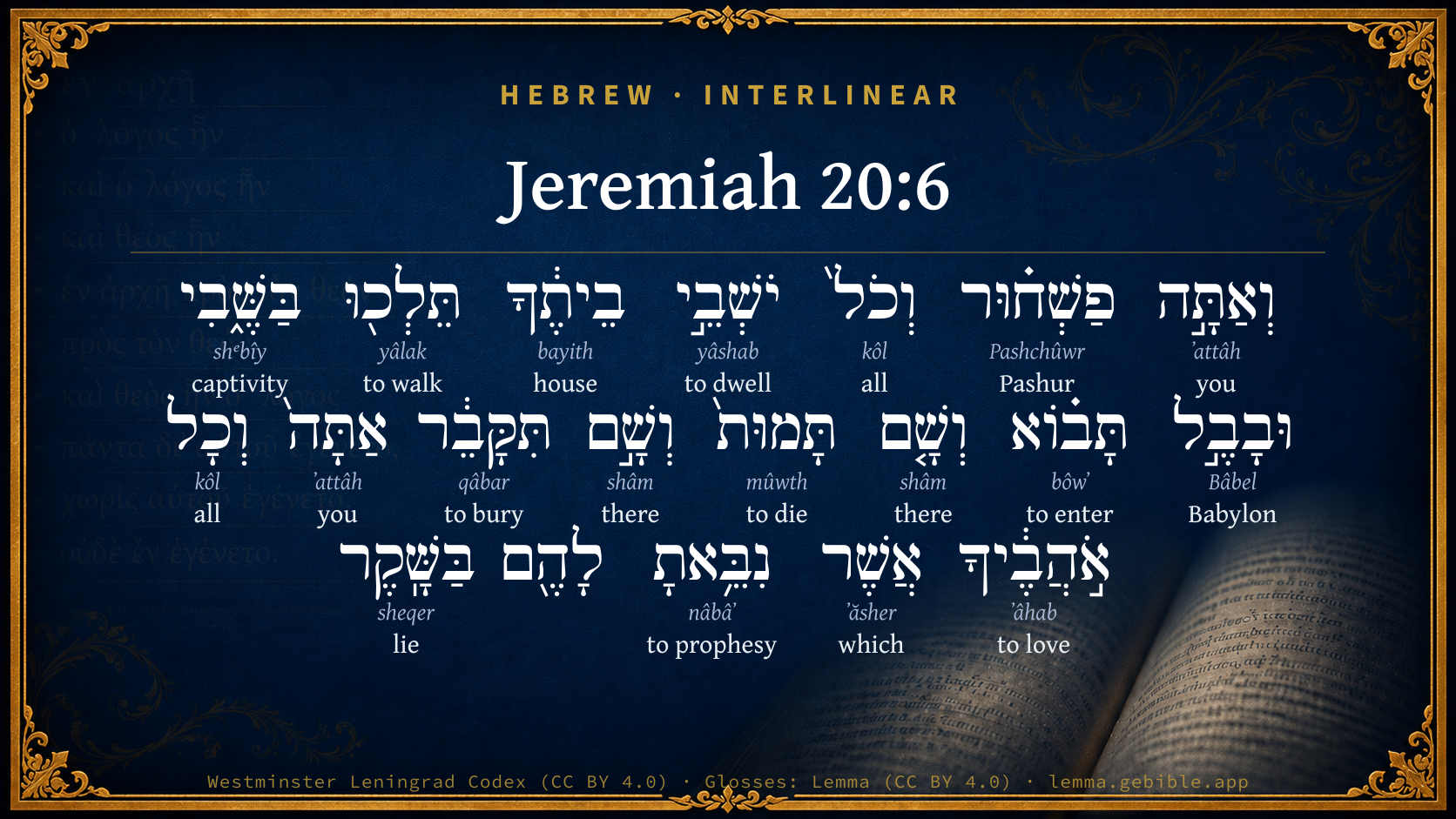
Hebrew (Westminster Leningrad Codex) Jeremiah 20:6 appears in the Hebrew Old Testament. The text above is from the Westminster Leningrad Codex. Each word links to its Strong’s number, a concise gloss, and parsing drawn from the Open Scriptures Hebrew Bible morphology. Click any word for its full Brown-Driver-Briggs (BDB) entry.
Download image
Cite this verse

Jeremiah 20:6 (World English Bible). Public Domain. Lemma interlinear Bible study tool, https://lemma.gebible.app/v/jeremiah/20/6.

Show BibTeX & RIS
BibTeX
RIS
English Translation
You, Pashhur, and all who dwell in your house shall go into captivity; and you shall come to Babylon, and there you shall die, and there shall you be buried, you, and all your friends, to whom you have prophesied falsely.
World English Bible · Public Domain
Download a study sheet

One document with this verse’s original text, its word-by-word gloss line, the meaning frame, cross-references with their text, attributed commentary, and full source and license credits — printable, and it pastes into notes with its structure intact.

This verse Autodidact and up

Study sheet (.html) Plain text (.txt)

A passage Seminary Student

Up to 50 verses in one chapter. A passage sheet keeps up to 6 commentary sources and 12 cross-references per verse, in the order this page ranks them, and says so on the sheet whenever that leaves anything out. Ask for a single verse and you get the Autodidact verse sheet above.

Everything on this page stays free to read, with no account — the sheet is a download of what is already on screen, not access to it.

Want to remove ads? Support Godless Engineer
Compare translations 3

The same verse in 3 English versions, stacked beneath the original-language interlinear above. Click any original word for its lexicon entry.

Each is an independent rendering of the whole verse — the interlinear is not word-aligned to these translations.

Highlighted words mark where these versions differ — a whole-verse word diff, not a word-by-word alignment.

  • World English Bible Public Domain
    You, Pashhur, and all who dwell in your house shall go into captivity; and you shall come to Babylon, and there you shall die, and there shall you be buried, you, and all your friends, to whom you have prophesied falsely.
  • King James Version Public Domain
    And thou, Pashur, and all that dwell in thine house shall go into captivity: and thou shalt come to Babylon, and there thou shalt die, and shalt be buried there, thou, and all thy friends, to whom thou hast prophesied lies.
  • unfoldingWord Literal Text CC BY-SA 4.0
    And you, Pashhur, and all the dwellers of your house will go into captivity. And to Babylon you will go, and there you will die, and there you will be buried, you and all your lovers to whom you prophesied in falsehood.’”

unfoldingWord Literal Text — © unfoldingWord, licensed CC BY-SA 4.0. Word-aligned USFM3 via Door43 (git.door43.org/unfoldingWord/en_ult).

Versions to compare (up to 4)

3 of 4 selected

Show all 18 translations

Every available English version of this verse, each an independent rendering of the whole verse.

  • World English Bible Public Domain
    You, Pashhur, and all who dwell in your house shall go into captivity; and you shall come to Babylon, and there you shall die, and there shall you be buried, you, and all your friends, to whom you have prophesied falsely.
  • Berean Standard Bible Public Domain
    And you, Pashhur, and all who live in your house, will go into captivity. You will go to Babylon, and there you will die and be buried—you and all your friends to whom you have prophesied these lies.’”
  • Majority Standard Bible Public Domain
    And you, Pashhur, and all who live in your house, will go into captivity. You will go to Babylon, and there you will die and be buried—you and all your friends to whom you have prophesied these lies.’”
  • King James Version Public Domain
    And thou, Pashur, and all that dwell in thine house shall go into captivity: and thou shalt come to Babylon, and there thou shalt die, and shalt be buried there, thou, and all thy friends, to whom thou hast prophesied lies.
  • American Standard Version (1901) Public Domain
    And thou, Pashhur, and all that dwell in thy house shall go into captivity; and thou shalt come to Babylon, and there thou shalt die, and there shalt thou be buried, thou, and all thy friends, to whom thou hast prophesied falsely.
  • Revised Version (1885) Public Domain
    And thou, Pashhur, and all that dwell in thine house shall go into captivity: and thou shalt come to Babylon, and there thou shalt die, and there shalt thou be buried, thou, and all thy friends, to whom thou hast prophesied falsely.
  • Geneva Bible (1599) Public Domain
    And thou Pashur, and all that dwell in thine house, shall go into captiuitie, and thou shalt come to Babel, and there thou shalt die, and shalt be buryed there, thou and all thy friendes, to whome thou hast prophecied lyes.
  • Douay-Rheims (1899) Public Domain
    But thou, Phassur, and all that dwell in thy house, shall go into captivity, and thou shalt go to Babylon, and there thou shalt die, and there thou shalt be buried, thou and all thy friends, to whom thou hast prophesied a lie.
  • Young's Literal Translation Public Domain
    And thou, Pashhur, and all dwelling in thy house, Do go into captivity. and Babylon thou dost enter, And there thou diest, and there thou art buried, Thou and all loving thee, To whom thou hast prophesied falsely.'
  • Literal Standard Version CC BY-SA 4.0
    And you, Pashhur, and all dwelling in your house, || Go into captivity. And you enter Babylon, || And there you die, and there you are buried, || You and all loving you, || To whom you have prophesied falsely.”
  • Unlocked Literal Bible CC BY-SA 4.0
    But you, Pashhur, and all the inhabitants of your house will go into captivity. You will go to Babylon and die there. You and all of your loved ones to whom you prophesied deceitful things will be buried there.'”
  • unfoldingWord Literal Text CC BY-SA 4.0
    And you, Pashhur, and all the dwellers of your house will go into captivity. And to Babylon you will go, and there you will die, and there you will be buried, you and all your lovers to whom you prophesied in falsehood.’”
  • Darby Bible Public Domain
    And thou, Pashur, and all that dwell in thy house shall go into captivity; and thou shalt come to Babylon, and there thou shalt die, and there thou shalt be buried, thou and all thy friends to whom thou hast prophesied falsehood.
  • World Messianic Bible Public Domain
    You, Pashhur, and all who dwell in your house will go into captivity. You will come to Babylon, and there you will die, and there you will be buried, you, and all your friends, to whom you have prophesied falsely.’”
  • Webster's Bible Public Domain
    And thou, Pashur, and all that dwell in thy house shall go into captivity: and thou shalt come to Babylon, and there thou shalt die, and shalt be buried there, thou, and all thy friends, to whom thou hast prophesied lies.
  • Free Bible Version CC BY-SA 4.0
    You, Pashhur, and everyone who lives with you, will go into captivity. You will go to Babylon. You will die there and be buried—you and all those you love, those to whom you prophesied lies.”
  • Bible in Basic English Public Domain
    And you, Pashhur, and all who are in your house, will go away prisoners: you will come to Babylon, and there your body will be put to rest, you and all your friends, to whom you said false words.
  • JPS Tanakh (1917) Public Domain
    And thou, Pashhur, and all that dwell in thy house shall go into captivity; and thou shalt come to Babylon, and there thou shalt die, and there shalt thou be buried, thou, and all thy friends, to whom thou hast prophesied falsely.'

Literal Standard Version (2020), Covenant Press — licensed CC BY-SA 4.0. Text via the HelloAO Bible API (eBible.org). Unlocked Literal Bible (unfoldingWord) — licensed CC BY-SA 4.0. Text via the HelloAO Bible API (eBible.org). unfoldingWord Literal Text — © unfoldingWord, licensed CC BY-SA 4.0. Word-aligned USFM3 via Door43 (git.door43.org/unfoldingWord/en_ult). Free Bible Version, Dr. Jonathan Gallagher — licensed CC BY-SA 4.0. Text via the HelloAO Bible API (eBible.org).

Word by word

More ways to search: Search by grammar → Find every occurrence → Compare this word →

Practice this passage: Drill this verse → Learn its vocabulary →

פַשְׁח֗וּר
Pashchûwr
H6583
“Pashur”
Noun, Proper
Part of Speech
Noun
Type
Proper
Full BDB Definition

Origin: probably from H6582

TWOT: None

Pashur = "freedom" - a priest, son of Malchiah and one of the chief princes in the reign of king Zedekiah of Judah - a priest, son of Immer, chief governor of the temple, and the one who struck and then put the prophet Jeremiah into the stocks in the reign of king Jehoiakim of Judah - son of Malchijah, father of Zechariah, and ancestor of Adaiah who did the work of the temple in the time of Nehemiah. Probably same as 1 - father of Gedaliah; probably the same as 1 - head of a family of returned exiles
  1. וְאַתָּ֣ה ʼattâh H859 “and · you” Conjunction + Pronoun, Personal, 2nd Person, Masculine, Singular
  2. וְכֹל֙ kôl H3605 “and · all of” Conjunction + Noun, Common, Masculine, Singular, Construct
  3. יֹשְׁבֵ֣י yâshab H3427 “dwelling” Verb, Qal, Participle Active, Masculine, Plural, Construct
  4. בֵיתֶ֔ךָ bayith H1004 “house · your” Noun, Common, Masculine, Singular, Construct + Suffix, Personal, 2nd Person, Masculine, Singular
  5. תֵּלְכ֖וּ yâlak H3212 “to walk” Verb, Qal, Imperfect, 2nd Person, Masculine, Plural
  6. בַּשֶּׁ֑בִי shᵉbîy H7628 “in/at the · captivity” Preposition, Determined + Noun, Common, Both, Singular, Absolute
  7. וּבָבֶ֣ל Bâbel H894 “and · Babylon” Conjunction + Noun, Proper
  8. תָּב֗וֹא bôwʼ H935 “to enter” Verb, Qal, Imperfect, 2nd Person, Masculine, Singular
  9. וְשָׁ֤ם shâm H8033 “and · there” Conjunction + Adverb
  10. תָּמוּת֙ mûwth H4191 “to die” Verb, Qal, Imperfect, 2nd Person, Masculine, Singular
  11. וְשָׁ֣ם shâm H8033 “and · there” Conjunction + Adverb
  12. תִּקָּבֵ֔ר qâbar H6912 “to bury” Verb, Niphal, Imperfect, 2nd Person, Masculine, Singular
  13. אַתָּה֙ ʼattâh H859 “you” Pronoun, Personal, 2nd Person, Masculine, Singular
  14. וְכָל kôl H3605 “and · all of” Conjunction + Noun, Common, Masculine, Singular, Construct
  15. אֹ֣הֲבֶ֔יךָ ʼâhab H157 “loving · you” Verb, Qal, Participle Active, Masculine, Plural, Construct + Suffix, Personal, 2nd Person, Masculine, Singular
  16. אֲשֶׁר ʼăsher H834 “which” Particle, Relative
  17. נִבֵּ֥אתָ nâbâʼ H5012 “to prophesy” Verb, Niphal, Perfect, 2nd Person, Masculine, Singular
  18. בַּשָּֽׁקֶר sheqer H8267 “in/at the · lie” Preposition, Determined + Noun, Common, Masculine, Singular, Absolute

About this verse

These counts appear in no published source. They are computed here, from the morphology-tagged text and Lemma’s own curated glosses. What Lemma adds →

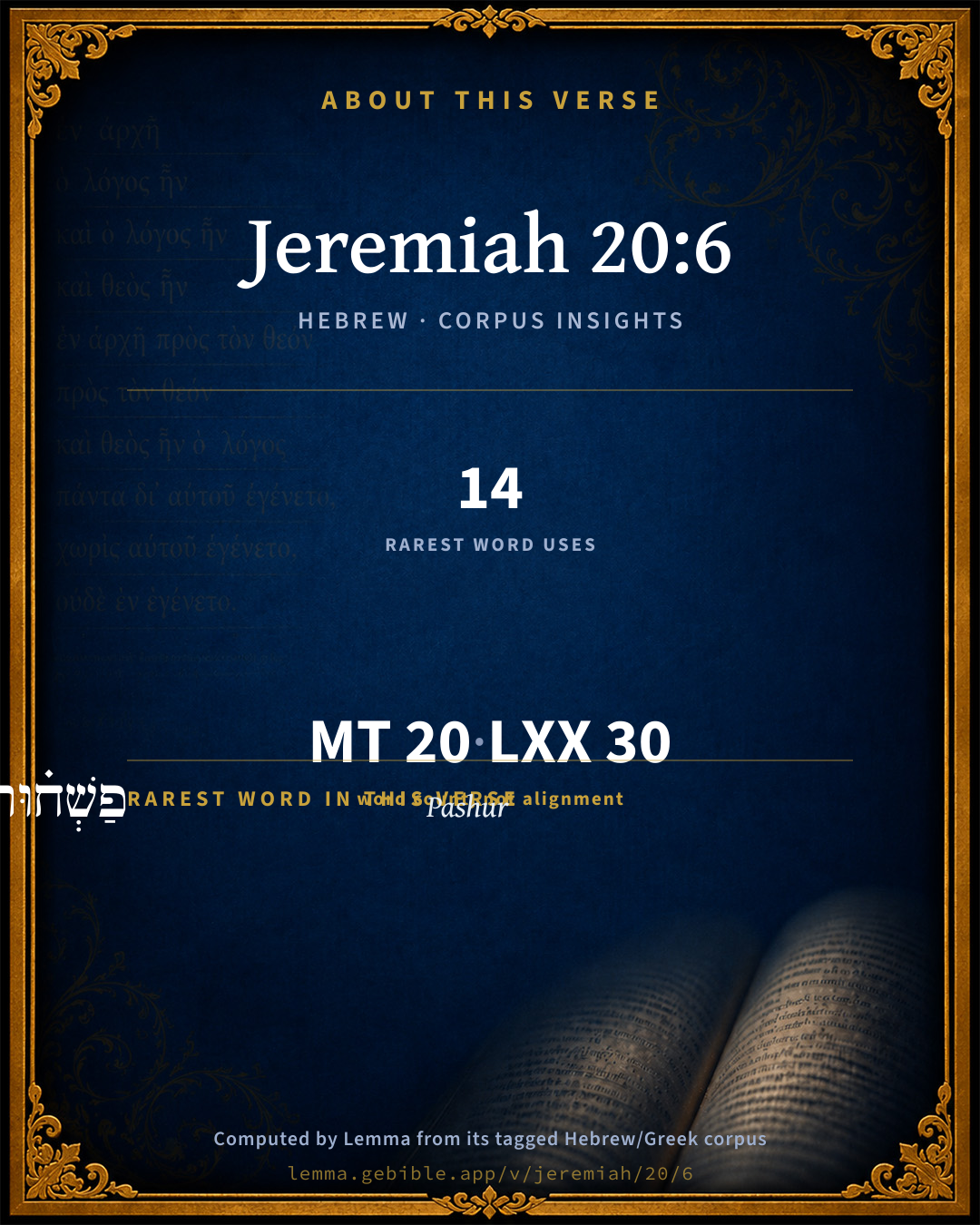
20
words
16
distinct lemmas
Prophets
section

Notable vocabulary

The rarest word here is פַשְׁח֗וּר Pashur H6583 — appearing just 14 times in the whole Hebrew Bible.

Shared distinctive vocabulary

פַשְׁח֗וּר Pashur H6583 occurs in 12 verses of the Hebrew Bible. Also found in:

Grammatical profile

  • 7 verbs
  • 7 nouns
  • 2 pronouns
  • 1 preposition
  • 2 adverbs
  • 1 particle

Verb forms

  • יֹשְׁבֵ֣י Qal · Participle Active
  • תֵּלְכ֖וּ Qal · Imperfect
  • תָּב֗וֹא Qal · Imperfect
  • תָּמוּת֙ Qal · Imperfect
  • תִּקָּבֵ֔ר Niphal · Imperfect
  • אֹ֣הֲבֶ֔יךָ Qal · Participle Active
  • נִבֵּ֥אתָ Niphal · Perfect

Repetition

Words recur within this verse — often emphatic in Hebrew:

  • וְכֹל֙ all H3605 ×2
  • וְשָׁ֤ם there H8033 ×2
  • וְאַתָּ֣ה you H859 ×2

Hebrew & Septuagint length

In the original languages it is 20 Hebrew tokens and 30 Greek tokens — but the two are counted differently (Hebrew bundles its prefixes and suffixes into one token; the Greek is in lemma form), so that isn’t a like-for-like length.

Cross-references

22

Topical passages linked to Jeremiah 20:6 in the Treasury of Scripture Knowledge — connected by theme and wording, ordered by reader-vote popularity; previews shown in the World English Bible.

  • Jeremiah 14:14–15 Then Yahweh said to me, The prophets prophesy lies in my name; I didn't send them, neither have I commanded them, neither spoke I to them: they prophesy to you a lying vision, and divination, and a thing of nothing, and the deceit of their own heart.
  • Lamentations 2:14 Your prophets have seen for you false and foolish visions; They have not uncovered your iniquity, to bring back your captivity, But have seen for you false oracles and causes of banishment.
  • Jeremiah 20:4 For thus says Yahweh, Behold, I will make you a terror to yourself, and to all your friends; and they shall fall by the sword of their enemies, and your eyes shall see it; and I will give all Judah into the hand of the king of Babylon, and he shall carry them captive to Babylon, and shall kill them with the sword.
  • Ezekiel 22:28 Her prophets have daubed for them with whitewash, seeing false visions, and divining lies to them, saying, Thus says the Lord Yahweh, when Yahweh has not spoken.
  • Leviticus 26:17 I will set my face against you, and you will be struck before your enemies. Those who hate you will rule over you; and you will flee when no one pursues you.
  • Deuteronomy 28:25 Yahweh will cause you to be struck before your enemies; you shall go out one way against them, and shall flee seven ways before them: and you shall be tossed back and forth among all the kingdoms of the earth.
  • Isaiah 9:15 The elder and the honorable man, he is the head; and the prophet who teaches lies, he is the tail.
  • Jeremiah 5:31 the prophets prophesy falsely, and the priests bear rule by their means; and my people love to have it so: and what will you do in the end of it?
  • Jeremiah 6:13–15 For from the least of them even to the greatest of them everyone is given to covetousness; and from the prophet even to the priest everyone deals falsely.
  • Jeremiah 8:10–11 Therefore will I give their wives to others, and their fields to those who shall possess them: for everyone from the least even to the greatest is given to covetousness; from the prophet even to the priest every one deals falsely.
  • Jeremiah 23:14–17 In the prophets of Jerusalem also I have seen a horrible thing: they commit adultery, and walk in lies; and they strengthen the hands of evil-doers, so that none does return from his wickedness: they are all of them become to me as Sodom, and the inhabitants of it as Gomorrah.
  • Jeremiah 23:25–26 I have heard what the prophets have said, who prophesy lies in my name, saying, I have dreamed, I have dreamed.
  • Jeremiah 23:32 Behold, I am against those who prophesy lying dreams, says Yahweh, and do tell them, and cause my people to err by their lies, and by their vain boasting: yet I didn't send them, nor commanded them; neither do they profit this people at all, says Yahweh.
  • Jeremiah 28:15–17 Then said the prophet Jeremiah to Hananiah the prophet, Hear now, Hananiah: Yahweh has not sent you; but you make this people to trust in a lie.
  • Jeremiah 29:21–22 Thus says Yahweh of Hosts, the God of Israel, concerning Ahab the son of Kolaiah, and concerning Zedekiah the son of Maaseiah, who prophesy a lie to you in my name: Behold, I will deliver them into the hand of Nebuchadrezzar king of Babylon; and he shall kill them before your eyes;
  • Jeremiah 29:32 therefore thus says Yahweh, Behold, I will punish Shemaiah the Nehelamite, and his seed; he shall not have a man to dwell among this people, neither shall he see the good that I will do to my people, says Yahweh, because he has spoken rebellion against Yahweh.
  • Ezekiel 13:4–16 Israel, your prophets have been like foxes in the waste places.
  • Ezekiel 13:22–23 Because with lies you have grieved the heart of the righteous, whom I have not made sad; and strengthened the hands of the wicked, that he should not return from his wicked way, and be saved alive:
  • Micah 2:11 If a man walking in a spirit of falsehood lies: 'I will prophesy to you of wine and of strong drink;' He would be the prophet of this people.
  • Zechariah 13:3 It will happen that, when anyone still prophesies, then his father and his mother who bore him will tell him, 'You must die, because you speak lies in the name of Yahweh;' and his father and his mother who bore him will stab him when he prophesies.
  • Acts 13:8–11 But Elymas the sorcerer (for so is his name by interpretation) withstood them, seeking to turn aside the proconsul from the faith.
  • 2 Peter 2:1–3 But there also arose false prophets among the people, as among you also there will be false teachers, who will secretly bring in destructive heresies, denying even the Master who bought them, bringing on themselves swift destruction.

Cross-references courtesy of OpenBible.info (CC BY 4.0).

Hebrew and Greek witnesses Masoretic Hebrew ↔ Greek Septuagint

The same verse in the two great witnesses to the Old Testament, shown verse-for-verse.

These are two independent witnesses, not word-aligned to each other, and the Septuagint is shown in lemma (dictionary) form.

Hebrew Jeremiah 20:6 Masoretic · Westminster Leningrad Codex

וְאַתָּ֣ה פַשְׁח֗וּר וְכֹל֙ יֹשְׁבֵ֣י בֵיתֶ֔ךָ תֵּלְכ֖וּ בַּשֶּׁ֑בִי וּבָבֶ֣ל תָּב֗וֹא וְשָׁ֤ם תָּמוּת֙ וְשָׁ֣ם תִּקָּבֵ֔ר אַתָּה֙ וְכָל אֹ֣הֲבֶ֔יךָ אֲשֶׁר נִבֵּ֥אתָ לָהֶ֖ם בַּשָּֽׁקֶר

You, Pashhur, and all who dwell in your house shall go into captivity; and you shall come to Babylon, and there you shall die, and there shall you be buried, you, and all your friends, to whom you have prophesied falsely.

World English Bible · Public Domain

Greek LXX Structure differs

In the Septuagint, Jeremiah is about an eighth shorter than the Hebrew and arranges its material differently — the Oracles Against the Nations (Hebrew chapters 46–51) appear in the middle of the Greek book, after 25:13. Because the chapter and verse boundaries do not line up, a verse-for-verse comparison with the Hebrew is not shown.

A verse-for-verse comparison isn’t shown here because the chapters and verses don’t line up. Switch to the LXX edition with the MT / LXX toggle above to read the Greek directly.

Hebrew: Westminster Leningrad Codex (CC BY 4.0). Greek: Septuagint (public domain); English from a public-domain English Septuagint. How the Septuagint differs from the Hebrew →

Targum (Aramaic paraphrase)

1

The Targum is the ancient Jewish Aramaic paraphrase of the Hebrew Scriptures — an interpretive translation, not the Hebrew text itself. Onkelos (literal) and Pseudo-Jonathan (expansive) render the Torah, and Jonathan the Prophets. Coverage is partial: where no permissively-licensed English translation exists for a verse, only the Aramaic is shown. This is verse-level text, not a word-by-word alignment to the Hebrew.

  1. Targum Jonathan Prophets (Joshua–Malachi)
    וְאַתְּ פַּשְׁחוּר וְכָל יַתְבֵי בֵיתָךְ תְּהָכוּן בְּשִׁבְיָא וּלְבָבֶל תִתּוֹבַל וְתַמָן תְּמוּת וְתַמָן תִּתְקְבֵר אַתְּ וְכָל רְחִימַיִךְ דְאִתְנַבֵּיתָא לְהוֹן בְּשִׁקְרָא:

    (no public-domain English translation for this verse)

    Targum Jonathan — Aramaic: “Mikraot Gedolot” (public domain). English: “Sefaria Community Translation” (CC0 1.0 (public-domain dedication)); “London "Chaldee Paraphrase," 1871” (public domain). Text via Sefaria.

Commentary

Notes on Jeremiah 20:6 from classic Christian and Jewish commentators (each source and its license shown beneath its notes). The classic Christian expositions comment on the surrounding passage and are grouped to its opening verse, so a note may address several verses; the Jewish commentaries on the Tanakh (Rashi and others) are per-verse, so they appear only where the commentator wrote on this verse.

Lemma curates 59 commentaries, every one of them public domain or Creative Commons licensed, each selected and text-cleaned for this edition rather than reprinted as found. About our sources →

Trapp's Complete Commentary

John Trapp

Jer 20:6 And thou, Pashur, and all that dwell in thine house shall go into captivity: and thou shalt come to Babylon, and there thou shalt die, and shalt be buried there, thou, and all thy friends, to whom thou hast prophesied lies.

Ver. 6. There shalt thou be buried.] In a dunghill perhaps, as Bishop Bonner was, and have cause enough to cry out, as that great Parisian doctor did from his bier, when brought to be buried,

“ Parcite funeribus: mihi nil prodesse valebit.

Heu infelicem cur me genuere parentes?

Ah miser aeternos vado damnatus ad ignes. ”

“Spare funeral costs: why was I born

By hell’s black fiends now to be torn?”

John Trapp, A Commentary or Exposition upon All the Books of the Old and New Testament (1647–1656) — public domain. Text from a community e-Sword module.

Tyndale Open Study Notes

Tyndale Open Resources

20:6 Pashhur would be confronted with the proof that he had been a false prophet.

Tyndale Open Study Notes — © Tyndale Open Resources, licensed CC BY-SA 4.0. Text via the HelloAO Bible API.

Geneva Bible (1599)

Geneva Bible translators

Which have suffered themselves to be abused by thy false prophecies.

Geneva Bible (1599) marginal notes — public domain. Text via Bolls.life.

Jamieson, Fausset & Brown

Robert Jamieson, A. R. Fausset & David Brown

prophesied lies--namely, that God cannot possibly leave this land without prophets, priests, and teachers ("the wise") (Jer 18:18; compare Jer 5:31).

Jamieson, Fausset & Brown — Commentary Critical and Explanatory on the Whole Bible (1871) — public domain (CC PDM 1.0). Text via the HelloAO Bible API.

Adam Clarke's Commentary

Verse 6. And thou, Pashur - shall go into captivity] Thou shalt suffer for the false prophecies which thou hast delivered, and for thy insults to my prophet.

Adam Clarke's Commentary on the Bible (1810–1826) — public domain. Text from a community e-Sword/MySword module.

John Calvin's Commentaries

Now Jeremiah declares that Pashur himself would be a proof, that he had truly foretold the destruction of the city and the desolation of the whole land. He had indeed before exposed his vanity; but he now brings the man himself before the public; for it was necessary to exhibit a remarkable instance, that all might know that God’s judgment ought to have been dreaded.

Though that impostor flattered the people, yet Jeremiah says, that he and all his domestics would be led into captivity; that is, that the whole family would be as it were a spectacle, so that all the Jews might see that Pashur would be brought to nothing. “Let all the Jews then know,” he seems to have said, “that he is a false prophet.”

But what follows might have raised a question; for Jeremiah declares as a punishment, that Pashur dying in Babylon would be buried there; but he had said before, “I will give their carcasses for meat to the birds of heaven and to the beasts of the earth;” and now it is not consistent in the Prophet to represent that as a punishment which is reckoned as one of God’s favors. In answer to this, let it be especially noticed, that God does not always punish the ungodly alike, or in the same way. He would have some to be cast away unburied, as they were unworthy of that common lot of humanity; but he would have others buried, but for a different, purpose; for there is weight in the particle there, for Babylon is put in contrast with the holy land. Whosoever were buried in the land of Canaan, had even in their death a pledge of the eternal inheritance; for as it is well known, God wished them while they lived so to enjoy the land, that they might look forward to heaven. Hence burial in the land of Canaan was as it were a visible mark or symbol of God’s adoption, as though all the children of Abraham were gathered into his bosom until they arose into a blessed and immortal life. Hence Pashur, by being buried in Babylon, became an outcast from God’s Church; for it was in a manner a repudiation, as though God would thus openly put on him a mark of infamy.

If it be objected and said, that the same thing happened to Daniel, and to some of the best servants of God, and that Jeremiah himself was buried in Egypt, which was far worse; the answer we give is this, — that temporal punishments which happen to the elect and God’s children for their good do in a manner change their nature as to them; though, indeed, it must be held, that all punishments are evidences of the wrath and curse of God. Whatever evils then happen to us in this life ought to be regarded as the fruits of sin, as though God thereby shewed himself openly to be displeased with us. This is one thing. Then, when poverty, famine, diseases, and exile, and even death itself, are viewed in themselves, we must always say that they are the curses of God, that is, when they are regarded, as I have said, in their own nature. But God consecrates these punishments as to his own children, so they turn to their benefit, and thereby cease to be curses. Whenever then God declares, “Thou shalt be unburied,” it is no wonder that this dishonor should be deemed an evidence of his wrath and a proof of his curse. And farther, whenever he formerly said thus, “Thou shalt be buried out of the holy land,” it was also an evidence of his curse, that is, with regard to the reprobate. At the same time God turned to good whatever might otherwise be a curse to his elect; and hence Paul says, that all things turn out for good and benefit to the faithful, who love God. (Romans 8:28.)

Now, then, we understand why the Prophet says, that Pashur would be buried in Babylon; nor is there a doubt but that there was more disgrace in that burial, than if his body was cast out and devoured by wild beasts; for God intended to render him conspicuous, that all might for a long time turn their eyes to him, according to what is said in Psalm 59:12,

“Slay them not, O God, for thy people may forget them.”

God then intended that the life and death of Pashur should be a memorial, in order that the minds of the people might be more impressed. At the same time, were the word burial taken in a wider sense, there would be nothing wrong, as though it was said, “There shall his carcass lie until it becomes putrified.”

Then Jeremiah adds, Thou and thy friends to whom thou hast prophesied falsely This passage teaches us that a just reward is rendered to the ungodly who wish to be deceived, when they sustain a twofold judgment from God. Behold, then, what all the wicked who seek flatterers that promise them wonderful things, gain for themselves! they thus earn for themselves a heavier vengeance. The more they strive to put afar off God’s judgment, the more, no doubt, they increase and inflame it. This is the reason why the Prophet denounces a special judgment on the friends of Pashur, to whom he had prophesied; they had wilfully laid hold on those false promises by which he had flattered them, so that they boldly despised God. Since, then, they wished of their own accord to be thus deceived, it was right that these deceptions through which they slandered the prophetic threatenings, and which they usually set up as a shield against them, should bring on them a heavier punishment. It then follows —

John Calvin's Commentaries (1540-1563) — public domain. Text from the Calvin Translation Society English edition (1840s-50s) via the Christian Classics Ethereal Library (ccel.org). Calvin's coverage is partial (roughly two-thirds of the Bible); uncommented books and verses are honest gaps, never fabricated. The 19th-century editor's footnotes and remarks are omitted so the notes are faithfully Calvin's own voice.

Ellicott's Commentary for English Readers

(6) Thou shalt come to Babylon . . .—The sons of Immer, the section of priests to which Pashur belonged, were found in large numbers at Babylon (Ezr_2:37-38), and it lies in the nature of the case that he, as a high official, would be among the captives when Nebuchadnezzar carried into exile all but the “poorer sort of the people of the land.”

To whom thou hast prophesied lies.—The special predictions in question are not recorded, but we may infer that Pashur was one of those who encouraged the people to fight against the Chaldaeans, and to despise Jeremiah’s warnings by holding out the hope that an alliance with Egypt would avert the threatened danger (Jer_14:13; Jer_23:17).

A Bible Commentary for English Readers, edited by Charles John Ellicott (1878–1897) — public domain. Text from a community e-Sword module.

The Cambridge Bible for Schools and Colleges

gen. ed. J. J. S. Perowne

6. prophesied falsely] He thus would appear to have assumed the functions of a prophet, and to have insisted that the warnings of Jeremiah were absurd. See Jer_14:13 ff.

The Cambridge Bible for Schools and Colleges (gen. ed. J. J. S. Perowne; Cambridge University Press, 1878–1918) — public domain. Text from a community e-Sword module.

John Gill's Exposition

And thou, Pashur, and all that dwell in thine house, shall go into captivity,.... Particularly he and his family should not escape; whoever did:

and thou shalt come to Babylon; being brought there, though sore against his will:

and there thou shalt die, and shalt be buried there; even in a defiled land, as all other countries were reckoned by the Jews; and to be buried in such a land, Kimchi observes, was a curse; and so it is here threatened as such:

thou, and all thy friends; that is, such as should escape the sword, Jer 20:4;

to whom thou hast prophesied lies; this shows the cause of; all this threatened destruction to him and his friends; not only because he had so ill used Jeremiah, a true prophet of the Lord; but because he was a false prophet, and his friends had hearkened to his lies, and disbelieved those prophecies that came from the Lord himself.

John Gill's Exposition of the Whole Bible (1746–1763) — public domain (CC PDM 1.0). Text via the HelloAO Bible API.

Albert Barnes' Notes on the Bible

Thou hast prophesied lies - Pushur belonged to the warlike party, whose creed it was, that Judaea by a close alliance with Egypt might resist the arms of Assyria.

Albert Barnes' Notes on the Bible (1834–1885) — public domain. Text from a community e-Sword/MySword module.

Haydock's Catholic Bible Commentary

Lie. He was therefore a false prophet, and vexed that Jeremias should contradict him. (Calmet)

George Leo Haydock (1774–1849), Haydock's Catholic Family Bible and Commentary, 1859 edition — public domain. Excludes Psalms (Douay-Rheims chapter numbering differs from Protestant) and Deuterocanonical books (Catholic canon only).

Matthew Poole's English Annotations

Those that teach others to disobey the commandments of God seldom escape that vengeance which cometh upon them who are seduced by them.

Pashur was one whose office it was to have taught others the fear of the Lord. and obedience to his will; he teacheth them what was false, and is not patient to hear the will of God. Jeremiah tells him he should feel the truth of it, for he himself should be one of those who should be carried into captivity, and should die there, out of his own country, and be buried there, and this should be the portion of all his friends, whom he had seduced by his false and lying prophecies.

Matthew Poole's English Annotations on the Holy Bible (1683–1685) — public domain. Text from a community e-Sword/MySword module.

Whedon's Commentary on the Bible

Daniel D. Whedon

6. Shall go into captivity — Apparently a milder fate than that of multitudes who, as had been before predicted, should come to fearful deaths, and should lie unburied and be devoured by beasts and birds of prey; and yet, for this very reason, terrible. Pashur will see all this, even to the end; and to him, a leading instigator of the policy which will work out this fearful ruin, the very spectacle itself will be an awful punishment.

Hast prophesied lies — Opposing his word of power to that of this obscure prophet of evil.

Daniel D. Whedon (gen. ed.), Commentary on the Old and New Testaments (1874–1909) — public domain. Text from a community e-Sword module.

The Pulpit Commentary

Comp. the prophecy against Shebna. (Isa_22:18) Since we find, in Jer_29:26, Pashur"s office occupied by another, it is probable that the prediction was fulfilled by the captivity of Pashur with Jehoiachin. To whom thou hast prophesied lies. (comp. Jer_14:13) Pashur, then, claimed to be a prophet.

The Pulpit Commentary (1880–1919), ed. H.D.M. Spence-Jones & Joseph S. Exell — public domain. Text from a community e-Sword module.

Lesson kit

Teaching starters — assembled from the data on this page, not authored interpretation. Every prompt links to the verse data it draws on. Edit before teaching.

Jeremiah, in the Prophets, opens this verse with 20 words (16 distinct Hebrew lemmas). Its most distinctive word is Pashchûwr (“Pashur”). A historical commentator’s framing appears above. Read the whole chapter for the surrounding context.

Discussion questions

  1. The word Pashchûwr carries the sense “Pashur.” How does it shape the verse?
  2. How does 1 Chronicles 9:12, which shares the word «Pashur», read alongside this verse?
  3. What does the repetition of “all” (2× in this one verse) do in this verse?
  4. These translations render this verse differently; the difference is in the English rendering, not the original. What questions does that raise?
  5. «יֹשְׁבֵ֣י» is a Qal Participle Active verb. How does that grammatical form shape the action described?
  6. Compare how Trapp's Complete Commentary and Tyndale Open Study Notes read this verse. Where do they agree or differ?

Things to notice

Reading settings

Reading text

Shown beneath each verse's original-language words.

Old Testament
Old Testament edition

Read the OT as the Masoretic Hebrew (MT) or the Greek Septuagint (LXX).

English shown for the Greek Septuagint (in the Hebrew ↔ Greek comparison).

Comparing translations? Open the Compare panel on any verse page to stack up to four side by side.