

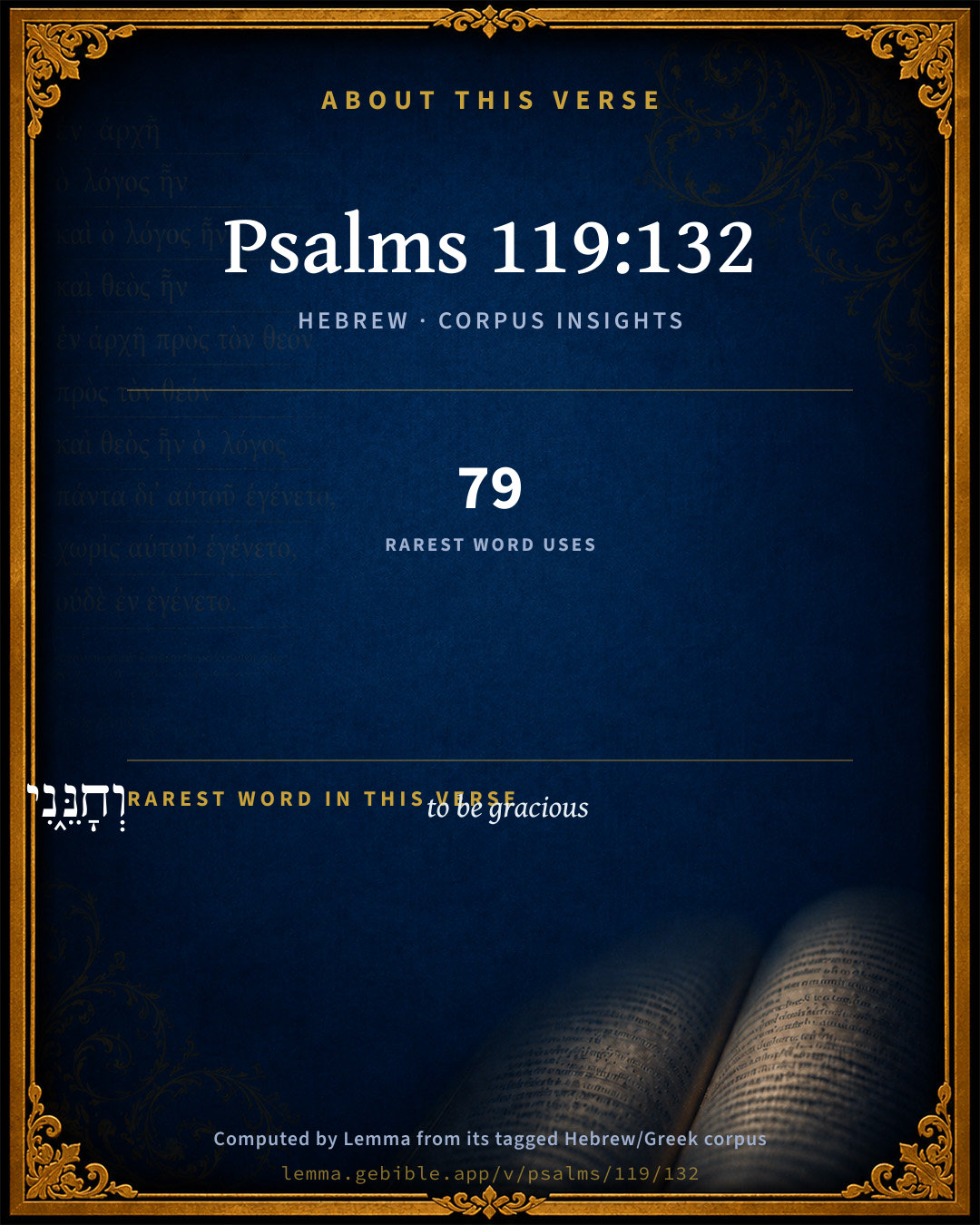
Psalms 119:132

Hebrew (Westminster Leningrad Codex) Psalms 119:132 appears in the Hebrew Old Testament. The text above is from the Westminster Leningrad Codex. Each word links to its Strong’s number, a concise gloss, and parsing drawn from the Open Scriptures Hebrew Bible morphology. Click any word for its full Brown-Driver-Briggs (BDB) entry.
Download image
Cite this verse

Psalms 119:132 (World English Bible). Public Domain. Lemma interlinear Bible study tool, https://lemma.gebible.app/v/psalms/119/132.

Show BibTeX & RIS
BibTeX
RIS
English Translation
Turn to me, and have mercy on me, As you always do to those who love your name.
World English Bible · Public Domain
Download a study sheet

One document with this verse’s original text, its word-by-word gloss line, the meaning frame, cross-references with their text, attributed commentary, and full source and license credits — printable, and it pastes into notes with its structure intact.

This verse Autodidact and up

Study sheet (.html) Plain text (.txt)

A passage Seminary Student

Up to 50 verses in one chapter. A passage sheet keeps up to 6 commentary sources and 12 cross-references per verse, in the order this page ranks them, and says so on the sheet whenever that leaves anything out. Ask for a single verse and you get the Autodidact verse sheet above.

Everything on this page stays free to read, with no account — the sheet is a download of what is already on screen, not access to it.

Want to remove ads? Support Godless Engineer
Compare translations 3

The same verse in 3 English versions, stacked beneath the original-language interlinear above. Click any original word for its lexicon entry.

Each is an independent rendering of the whole verse — the interlinear is not word-aligned to these translations.

Highlighted words mark where these versions differ — a whole-verse word diff, not a word-by-word alignment.

  • World English Bible Public Domain
    Turn to me, and have mercy on me, As you always do to those who love your name.
  • King James Version Public Domain
    Look thou upon me, and be merciful unto me, as thou usest to do unto those that love thy name.
  • unfoldingWord Literal Text CC BY-SA 4.0
    Turn to me and be gracious to me, according to the judgment for the ones loving your name.

unfoldingWord Literal Text — © unfoldingWord, licensed CC BY-SA 4.0. Word-aligned USFM3 via Door43 (git.door43.org/unfoldingWord/en_ult).

Versions to compare (up to 4)

3 of 4 selected

Show all 17 translations

Every available English version of this verse, each an independent rendering of the whole verse.

  • World English Bible Public Domain
    Turn to me, and have mercy on me, As you always do to those who love your name.
  • Berean Standard Bible Public Domain
    Turn to me and show me mercy, as You do to those who love Your name.
  • Majority Standard Bible Public Domain
    Turn to me and show me mercy, as You do to those who love Your name.
  • King James Version Public Domain
    Look thou upon me, and be merciful unto me, as thou usest to do unto those that love thy name.
  • American Standard Version (1901) Public Domain
    Turn thee unto me, and have mercy upon me, As thou usest to do unto those that love thy name.
  • Revised Version (1885) Public Domain
    Turn thee unto me, and have mercy upon me, as thou usest to do unto those that love thy name.
  • Geneva Bible (1599) Public Domain
    Looke vpon mee and bee mercifull vnto me, as thou vsest to doe vnto those that loue thy Name.
  • Young's Literal Translation Public Domain
    Look unto me, and favour me, As customary to those loving Thy name.
  • Literal Standard Version CC BY-SA 4.0
    Look to me, and favor me, || As customary to those loving Your Name.
  • Unlocked Literal Bible CC BY-SA 4.0
    Turn to me and have mercy on me, as you always do for those who love your name.
  • unfoldingWord Literal Text CC BY-SA 4.0
    Turn to me and be gracious to me, according to the judgment for the ones loving your name.
  • Darby Bible Public Domain
    Turn unto me, and be gracious unto me, as thou art wont to do unto those that love thy name.
  • World Messianic Bible Public Domain
    Turn to me, and have mercy on me, as you always do to those who love your name.
  • Webster's Bible Public Domain
    Look thou upon me, and be merciful to me, as thou usest to do to those that love thy name.
  • Free Bible Version CC BY-SA 4.0
    Please pay attention to me and be kind to me, as you are with those who love you.
  • Bible in Basic English Public Domain
    Let your eyes be turned to me, and have mercy on me, as it is right for you to do to those who are lovers of your name.
  • JPS Tanakh (1917) Public Domain
    Turn Thee towards me, and be gracious unto me, as is Thy wont to do unto those that love Thy name.

Literal Standard Version (2020), Covenant Press — licensed CC BY-SA 4.0. Text via the HelloAO Bible API (eBible.org). Unlocked Literal Bible (unfoldingWord) — licensed CC BY-SA 4.0. Text via the HelloAO Bible API (eBible.org). unfoldingWord Literal Text — © unfoldingWord, licensed CC BY-SA 4.0. Word-aligned USFM3 via Door43 (git.door43.org/unfoldingWord/en_ult). Free Bible Version, Dr. Jonathan Gallagher — licensed CC BY-SA 4.0. Text via the HelloAO Bible API (eBible.org).

Word by word

More ways to search: Search by grammar → Find every occurrence → Compare this word →

Practice this passage: Drill this verse → Learn its vocabulary →

וְחָנֵּ֑נִי
chânan
H2603
“and · be gracious · me”
Conjunction + Verb, Qal, Imperative, 2nd Person, Masculine, Singular + Suffix, Personal, 1st Person, Common, Singular
Part of Speech
Conjunction + Verb
Stem
Qal
Form
Imperative
Person
2nd Person
Gender
Masculine
Number
Singular
Full BDB Definition

Origin: a primitive root [compare H2583 ]

TWOT: 694 , 695

to be gracious, show favour, pity - (Qal) to show favour, be gracious - (Niphal) to be pitied - (Piel) to make gracious, make favourable, be gracious - (Poel) to direct favour to, have mercy on - (Hophal) to be shown favour, be shown consideration - (Hithpael) to seek favour, implore favour - to be loathsome
  1. פְּנֵה pânâh H6437 “turn” Verb, Qal, Imperative, 2nd Person, Masculine, Singular
  2. אֵלַ֥י ʼêl H413 “to · me” Preposition + Suffix, Personal, 1st Person, Common, Singular
  3. כְּ֝מִשְׁפָּ֗ט mishpâṭ H4941 “like/as · judgment” Preposition + Noun, Common, Masculine, Singular, Absolute
  4. לְאֹהֲבֵ֥י ʼâhab H157 “to/for · loving” Preposition + Verb, Qal, Participle Active, Masculine, Plural, Construct
  5. שְׁמֶֽךָ shêm H8034 “name · your” Noun, Common, Masculine, Singular, Construct + Suffix, Personal, 2nd Person, Masculine, Singular

About this verse

These counts appear in no published source. They are computed here, from the morphology-tagged text and Lemma’s own curated glosses. What Lemma adds →

6
words
6
distinct lemmas
Wisdom
section

Grammatical profile

  • 3 verbs
  • 2 nouns
  • 1 preposition

Verb forms

  • פְּנֵה Qal · Imperative
  • וְחָנֵּ֑נִי Qal · Imperative
  • לְאֹהֲבֵ֥י Qal · Participle Active

Hebrew & Septuagint length

In English translation the verse runs 18 words from the Hebrew and 17 from the Septuagint (LXX English) — closely comparable.

A rough comparison of the two English renderings, which tokenize alike — not a word-level alignment.

Word counts can differ between the Hebrew and the Greek without any difference in meaning — e.g. the Hebrew direct-object marker אֵת has no separate Greek word, and Greek often adds the article ὁ.

Cross-references

9

Topical passages linked to Psalms 119:132 in the Treasury of Scripture Knowledge — connected by theme and wording, ordered by reader-vote popularity; previews shown in the World English Bible.

  • Psalms 106:4 Remember me, Yahweh, with the favor that you show to your people. Visit me with your salvation,
  • Psalms 119:124 Deal with your servant according to your loving kindness. Teach me your statutes.
  • 1 Samuel 1:11 She vowed a vow, and said, Yahweh of hosts, if you will indeed look on the affliction of your handmaid, and remember me, and not forget your handmaid, but will give to your handmaid a man-child, then I will give him to Yahweh all the days of his life, and there shall no razor come on his head.
  • Psalms 25:16 Turn to me, and have mercy on me, For I am desolate and afflicted.
  • Psalms 25:18 Consider my affliction and my travail. Forgive all my sins.
  • Exodus 4:31 The people believed, and when they heard that Yahweh had visited the children of Israel, and that he had seen their affliction, then they bowed their heads and worshiped.
  • 2 Samuel 16:12 It may be that Yahweh will look on the wrong done to me, and that Yahweh will requite me good for [his] cursing of me this day.
  • Isaiah 63:7–9 I will make mention of the loving kindnesses of Yahweh, [and] the praises of Yahweh, according to all that Yahweh has bestowed on us, and the great goodness toward the house of Israel, which he has bestowed on them according to his mercies, and according to the multitude of his loving kindnesses.

Cross-references courtesy of OpenBible.info (CC BY 4.0).

Hebrew and Greek witnesses Masoretic Hebrew ↔ Greek Septuagint

The same verse in the two great witnesses to the Old Testament, shown verse-for-verse.

You’re reading Greek Psalm 118 (Hebrew Psalm 119). The Septuagint counts the superscription, so verse numbers can differ from the Hebrew — chapter-level alignment, not verse-by-verse. Numbering follows Rahlfs.

These are two independent witnesses, not word-aligned to each other, and the Septuagint is shown in lemma (dictionary) form.

Hebrew Psalms 119:132 Masoretic · Westminster Leningrad Codex

פְּנֵה אֵלַ֥י וְחָנֵּ֑נִי כְּ֝מִשְׁפָּ֗ט לְאֹהֲבֵ֥י שְׁמֶֽךָ

Turn to me, and have mercy on me, As you always do to those who love your name.

World English Bible · Public Domain

Greek LXX Greek Psalm 118:132 Septuagint · lemma form

ἐπιβλέπω ἐπί ἐγώ καί ἐλεέω ἐγώ κατά ὁ κρίμα ὁ ἀγαπάω ὁ ὄνομα σύ

Look upon me and have mercy upon me, after the manner of them that love your name.

LXX2012 (modern English Septuagint) · Public Domain

On this verse, John Gill's Exposition discusses the Septuagint’s reading. Read the note in Commentary ↓

Hebrew: Westminster Leningrad Codex (CC BY 4.0). Greek: Septuagint (public domain); English from LXX2012 (modern English Septuagint) (Public Domain). How the Septuagint differs from the Hebrew →

Commentary

Notes on Psalms 119:132 from classic Christian and Jewish commentators (each source and its license shown beneath its notes). The classic Christian expositions comment on the surrounding passage and are grouped to its opening verse, so a note may address several verses; the Jewish commentaries on the Tanakh (Rashi and others) are per-verse, so they appear only where the commentator wrote on this verse.

Lemma curates 59 commentaries, every one of them public domain or Creative Commons licensed, each selected and text-cleaned for this edition rather than reprinted as found. About our sources →

Trapp's Complete Commentary

John Trapp

Psa 119:132 Look thou upon me, and be merciful unto me, as thou usest to do unto those that love thy name.

Ver. 132. Look thou upon me, &c.] Face about towards me, and give me a glimpse at least of thy grace; for full fruition I expect not in this present life. Brevis hora, parva mora.

As thou usest to do unto those, &c.] Common mercies satisfy not a saint; he must have peculiar favours, spiritual blessings in heavenly things, even the sure mercies of David. He pleads for a child’s part.

John Trapp, A Commentary or Exposition upon All the Books of the Old and New Testament (1647–1656) — public domain. Text from a community e-Sword module.

The Biblical Illustrator

Joseph S. Exell

Psa_119:132-135

Look Thou upon me, and be merciful unto me.

Prayer for mercies vouchsafed to the good

I. Direction in the right way. We are all travellers on an unknown road, and we want direction. Order my footsteps.

II. Defence against our foes. The dominion of evil is the greatest curse. There is a danger of having this dominion established. God alone can prevent it.

III. Deliverance against malignant foes. Man oppresses man everywhere. Who but God can deliver from the oppression under which humanity groans?

IV. THE favour of Almighty God (verse 135). Gods approval is mans heaven. (Homilist.)

A page from a royal diary

I. Davids brief petition. Look Thou upon me.

1. His own eyes had failed him (verse 123).

2. Mans eye had misjudged him (verse 134).

3. He knew that Gods eye perceives what His servant needs.

4. He leaves all with God.

5. Gods look will be a sign of Divine favour.

6. Gods look would prepare him for future obedience.

II. Davids humble confession. Be merciful unto me.

1. His prayer grew out of this confession.

2. By this petition he evidently sought forgiveness.

3. Upon this ground alone he sought for the blessing he desired.

III. Davids tacit profession. As Thou usest to do, etc. David hardly dares to say that he does love Gods Name, but he does practically say it by praying that God will treat him as He treats those who do love His Name. Some of those who love God best are not the loudest in proclaiming their love. The true child of God does love His Lords Name. This includes--

1. The person of God.

2. The character of God.

3. Gods revelation.

4. The glory of God.

IV. Davids gracious aspiration.

1. He would be dealt with as saints have always been dealt with. Well, you know what He used to do to those who loved His Name; He used to come and visit them. For instance, there were Abraham, Isaac, and Jacob. These all had visits from the Lord, as did Moses, when God was in the burning bush. God not only used to visit those who loved His Name, but He used to instruct them What teachings they had from Him! What revelations and manifestations of Himself! Lord, teach me as Thou usest to teach those who loved Thy Name! How patient also He was with them! They had many faults and failings, and they grieved His Holy Spirit; but He forgave them, and went on teaching them; and when they fell and wandered from Him, He restored them, and brought them back again. Then you know the Lord was always faithful to those who loved His Name. When He made them a promise, He always kept it. But notice this also, the Lord used to whip them when they needed it; those who loved His Name were chastened. Asaph said, All the day long have I been plagued, and chastened every morning. Well, suppose you should have the same treatment, you can thank God that He is doing to you as He used to do to those who loved His Name.

2. I think also that, when using these words, David meant that he was quite willing that God should deal with him in His usual way, in His regular order. He did not want to have some special railway thrown up for him, in which he could ride first-class to glory; but he was willing to go the old way, the way the holy prophets went, and the saints, and martyrs, and confessors of God; that is to say, he did not want salvation without holiness, he did not want justification without sanctification, he did not want pardon without regeneration. (C. H. Spurgeon.)

Fellowship with the righteous

I. There are some who love Gods Name. His Name means His perfections, His nature, His being, Himself; and they who love His Name mean those who love Himself.

II. His mercy is the source of all the goodness they experience.

III. The Lord has been always accustomed to deal mercifully with them. He was merciful to them when He frowned, as well as when He smiled; when He denied, as well as when He indulged; when He took away, as well as when He gave. What use ought we to make of this?

IV. His mercy towards them should encourage us to implore mercy for ourselves. Beggars naturally love to go to a door where others have been successful, especially where none have ever been sent empty away. This, indeed, is never the case among men. No earthly benefactor, however disposed, can afford universal relief. But we have everything to inspire our application at a throne of grace. In what He has done through every age, we see His resources and His bounty. And we know that He is unchangeably the same.

V. We should be anxious to secure the mercy that is peculiar to them; and not be satisfied with His common kindness.

VI. We should be content if God deals with us as He has always dealt with His people. While he could not be satisfied with anything less than their portion, David asks for nothing better; he implores no singular dispensation in his favour, no deviation from the accustomed methods of His grace. (W. Jay.)

The plea of use and wont

The psalmist employs the great plea of use and wont; for, says he, As Thou usest to do unto those that love Thy Name. Use and wont generally have great weight in a court of law. A friend said to me, How will such a suit go? The case has never been before a court until now. I answered, Are you sure that what was done is according to universal and long-established custom? for, if so, though there be no law, the custom of the trade will stand. Custom among men reaching far back holds good in court; how much shall the custom of the eternally unchanging God decide His future acts? The psalmist pleads the Lords own custom; and this is a grand plea with him, because He is unchanging. If you think it a good plea, urge it at the throne. (C. H. Spurgeon.)

The Biblical Illustrator, edited by Joseph S. Exell (c. 1880s–1900s) — public domain. Text from a community e-Sword module.

Joseph Benson's Commentary

Psa 119:132-133. Look thou upon me — Favourably, as the next clause explains it; and be merciful unto me — Let me taste the sweetness, and receive the gifts of thy mercy; let me have thy smiles, and the light of thy countenance; as thou usest to do, &c. — As thou hast been wont to do unto thy people in all former ages. Do not deny me the common privilege of all the faithful. Order my steps in thy word — By thy grace direct and govern all my affections and actions in the way prescribed in thy word. Let thy Spirit accompany thy word, and ingraft it in me, so that I may be guided and ruled by it. And let not any iniquity have dominion over me: let not the law in my members, warring against the law of my mind, lead me captive to the law of sin: but, though the flesh may lust against the spirit, let the spirit oppose the desires of the flesh, and overcome and subdue them. The dominion of sin is to be dreaded and deprecated by every one of us; and if in sincerity we pray against it, we shall receive, as an answer of our prayers, the accomplishment of that promise, Rom 6:14, Sin shall not have dominion over you.

Joseph Benson's Commentary on the Old and New Testaments (1811–1818) — public domain. Text from a community e-Sword module.

J. A. Alexander on Psalms

Joseph Addison Alexander

132. (Psa 119:132) Turn to me, and be gracious to me, as (is) due to the lovers of thy name. The first verb does not mean to return or come back, but to turn round to or towards an object from which the looks have been averted. See above, on Psa 102:17. Be gracious or merciful, shew favour to or favour me. As is due to, or according to the right of, the lovers, etc. The Hebrew word has here the meaning of the Latin jus, as in Psa 81:4. For the meaning of the lovers of thy name, see above, on Psa 5:11.

Joseph Addison Alexander, The Psalms Translated and Explained (1850) — public domain. Text from a community e-Sword module.

Matthew Henry's Commentary

Here is, 1. David's request for God's favour to himself: "Look graciously upon me; let me have thy smiles, and the light of thy countenance. Take cognizance of me and my affairs, and be merciful to me; let me taste the sweetness of thy mercy and receive the gifts of thy mercy." See how humble his petition is. He asks not for the operations of God's hand, only for the smiles of his face; a good look is enough; and for that he does not plead merit, but implores mercy. 2. His acknowledgment of his favour to all his people: As thou usest to do unto those that love thy name. This is either, (1.) A plea for mercy: "Lord, I am one of those that love thy name, love thee and thy word, and thou usest to be kind to those that do so; and wilt thou be worse to me than to others of thy people?" Or, (2.) A description of the favour and mercy he desired - "that which thou usest to bestow on those that love thy name, which thou bearest to thy chosen," Psa 106:4, Psa 106:5. He desires no more, no better, than neighbour's fare, and he will take up with no less; common looks and common mercies will not serve, but such as are reserved for those that love him, which are such as eye has not seen, Co1 2:9. Note, The dealings of God with those that love him are such that a man needs not desire to be any better dealt with, for he will make them truly and eternally happy. And as long as God deals with us no otherwise than as he uses to deal with those that love him we have no reason to complain, Co1 10:13.

Matthew Henry's Commentary on the Whole Bible (1708–1710) — public domain (CC PDM 1.0). Text via the HelloAO Bible API.

Adam Clarke's Commentary

Verse 132. As thou usest to do] Treat me as thy mercy has induced thee to treat others in my circumstances. Deal with me as thou dealest with thy friends.

Adam Clarke's Commentary on the Bible (1810–1826) — public domain. Text from a community e-Sword/MySword module.

John Calvin's Commentaries

132. Look upon me, and be merciful to me. In this verse he beseeches God to have a regard to him: as he is accustomed always to look to those who are his people. The Hebrew word משפט mishpat, translated judgment, signifies in this passage, as in many others, a common rule, or ordinary usage. “According to the custom, or usual mode of acting. So Luther — as thou art accustomed to do, etc. In Genesis 40:13 — ‘Thou shalt deliver the cup, כמשפט, according to custom.’”— Phillips.

John Calvin's Commentaries (1540-1563) — public domain. Text from the Calvin Translation Society English edition (1840s-50s) via the Christian Classics Ethereal Library (ccel.org). Calvin's coverage is partial (roughly two-thirds of the Bible); uncommented books and verses are honest gaps, never fabricated. The 19th-century editor's footnotes and remarks are omitted so the notes are faithfully Calvin's own voice.

Ellicott's Commentary for English Readers

(132) As . . . name.—See margin. But the absence of the suffix is against this correction, as it is against the Authorised Version itself. Rather, according to the right of. It was not only theirs by custom, but by right of the covenant.

A Bible Commentary for English Readers, edited by Charles John Ellicott (1878–1897) — public domain. Text from a community e-Sword module.

The Cambridge Bible for Schools and Colleges

gen. ed. J. J. S. Perowne

132. Look &c.] Turn unto me and be gracious unto me. So Psa_25:16; Psa_86:16.

as thou usest to do &c.] Better, as is the right of those that love thy name. The plea is a bold one, but not too bold. The covenant gives those who love Jehovah’s revelation of Himself (Psa_5:11; Psa_69:36) the right to claim His grace. Cp. Heb_6:10. The word for right is mishpâṭ, usually rendered judgement.

The Cambridge Bible for Schools and Colleges (gen. ed. J. J. S. Perowne; Cambridge University Press, 1878–1918) — public domain. Text from a community e-Sword module.

John Gill's Exposition

Rivers of waters run down mine eyes,.... That is, "out of" them; as the Syriac version: or, "mine eyes let down rivers of waters" (t); see Lam 3:48; that is, an abundance of tears, which flowed like a river; an hyperbolical expression, setting forth the excessiveness of grief. The reason follows,

because they keep not thy law; the persons are not mentioned, but must be understood of wicked men; whose open and impudent transgression of the law in innumerable instances, and in the most flagrant manner, gave the psalmist great distress, as it does all good men; because the law of God is despised, his authority is trampled on, his name is dishonoured, and he has not the glory which is due unto him. The gloss of Arama is,

"because Adam and Eve kept not thy law;''

which transgression brought ruin on all mankind. The Septuagint and Arabic versions very wrongly read, "because I have not kept thy law": as if his grief was on account of his own sins: and so Kimchi indeed interprets it; and both he and Ben Melech by "they" understand his eyes, from whence his tears flowed in such abundance; because they were the caterers for sin, and the cause and occasion of the transgressions of the law of God by him: and this sense is made mention of by Aben Ezra.

(t) "oculi mei deduxerunt", V. L. "rivos aquarum demittunt oculi mei", Gejerus.

John Gill's Exposition of the Whole Bible (1746–1763) — public domain (CC PDM 1.0). Text via the HelloAO Bible API.

Albert Barnes' Notes on the Bible

Look thou upon me - Turn not away from me. Regard me with thy favor.

And be merciful unto me, as thou usest to do unto those that love thy name - Margin, “According to the custom toward those,” etc. The Hebrew word is “judgment:” “according to the judgment to the lovers of thy name.” The word seems here to be used in the sense of “right;” of what is due; or, of what is usually determined: that is, as God usually determines, judges, acts toward those who love him. The idea is, Treat me according to the rules which regulate the treatment of thy people. Let me be regarded as one of them, and be dealt with accordingly. On the sentiment in this passage, see the notes at Psa 106:4.

Albert Barnes' Notes on the Bible (1834–1885) — public domain. Text from a community e-Sword/MySword module.

Matthew Poole's English Annotations

Look thou upon me, to wit, favourably, as the next clause explains it, and as this phrase is commonly used; whereby also he implies that God at present did hide his face and favour from him.

As thou usest to do unto those that love thy name; as thou hast done in all former ages. Do not deny me the common privilege of all the faithful.

Matthew Poole's English Annotations on the Holy Bible (1683–1685) — public domain. Text from a community e-Sword/MySword module.

The Treasury of David

Charles H. Spurgeon

Ver. 132. Look thou upon me. A godly man cannot long be without prayer. During the previous verses he had been expressing his love to God's word, but here he is upon his knees again. This prayer is specially short, but exceedingly sententious, "Look thou upon me." While he stood with open mouth panting for the commandments, he besought the Lord to look upon him, and let his condition and his unexpressed longings plead for him. He desires to be known of God, and daily observed by him. He wishes also to be favoured with the divine smile which is included in the word "look." If a look from us to God has saving efficacy in it, what may we not expect from a look from God to us.

And be merciful unto me. Christ's look at Peter was a look of mercy, and all the looks of the heavenly Father are of the same kind. If he looked in stern justice his eyes would not endure us, but looking in mercy he spares and blesses us. If God looks and sees us panting, he will not fail to be merciful to us.

As thou usest to do unto those that love thy name. Look on me as thou lookest on those who love thee; be merciful to me as thou art accustomed to be towards those who truly serve thee. There is a use and wont which God observes towards them that love him, and David craved that he might experience it. He would not have the Lord deal either better or worse with him than he was accustomed to deal with his saints worse would not save him, better could not be. In effect he prays, "I am thy servant; treat me as you treat thy servants. I am thy child; deal with me as with a son." Especially is it clear from the context that he desired such an entering in of the word, and such a clear understanding of it as God usually gives to his own, according to the promise, "All thy children shall be taught of the Lord."

Reader, do you love the name of the Lord? Is his character most honourable in your sight? Most dear to your heart? This is a sure mark of grace, for no soul ever loved the Lord except as the result of love received from the Lord himself.

Ver. 132. Look thou upon me, and be merciful unto me, etc. "Look upon me" stripped by thieves of my virtues, and then wounded with sins, and "be merciful unto me, "showing compassion on me, taking care of me in the inn of the Church universal, that I fall not again among thieves, nor be harmed by the wolves which howl about this fold, but dare not enter in. "Look upon me, "no longer worthy to be called thy son, and "be merciful unto me, "not as the jealous elder brother would treat me, but let me join the glad song and banquet of them that love thy name. Look upon me the publican, standing afar off in thy temple the Church, and be merciful unto me, not after the Pharisee's judgment, but "as thou usest to do unto them that love thy name, " which is the gracious God. Look on me as on weeping Peter, and be merciful unto me as thou wast to him, who so loved thy name as by his triple confession of love to wash out his threefold denial, saying, "Lord, thou knowest that I love thee." "Look upon me, "as on the sinful woman, penitent and weeping, and be merciful unto me, not according to the judgment of the Pharisee who murmured at her, as Judas who was indignant at her, but forgiving me as thou didst her, "because she loved much, "telling me also, "Thy faith hath saved thee, go in peace." Neale and Littledale.

Ver. 132. Look thou upon me. Lord! since our looks to thee are often so slight, so cold, so distant, that no impression is made upon our hearts, do thou condescend continually to look upon us with mercy and with power. Vouchsafe us such a look, as may bring us to ourselves and touch us with tenderness and contrition in the remembrance of that sin, unbelief, and disobedience, which pierced the hands, the feet, the heart of our dearest Lord and Saviour. Comp. Lu 22:61. Charles Bridges.

Ver. 132. As thou usest to do, etc. David would not lose any privilege that God hath by promise settled on his children. Do with me, saith he, "as thou usest to do." This is no more than family fare, what you promise to do for all that love thee; and let me not go worse clad than the rest of my brethren. William Gurnall.

Ver. 132. As thou usest to do unto those, etc. We should be content if God deals with us as he has always dealt with his people. While he could not be satisfied with anything less than their portion, David asks for nothing better; he implores no singular dispensation in his favour, no deviation from the accustomed methods of his grace...It is always a good proof that your convictions and desires are from the operation of the Spirit when you are willing to conform to God's order. What is this order? It is to dispense his blessings connectedly. It is never to justify without sanctifying; never to give a title to heaven without a meetness for it. Now the man that is divinely wrought upon will not expect nor desire the one without the other. Therefore he will not expect the blessing of God without obedience; because it is always God's way to connect the comforts of the Holy Ghost with the fear of the Lord; and if his children transgress his laws, to visit their transgressions with a rod. Therefore he will neither expect nor desire his blessing without exertion; for it has always been God's way to crown only those that run the race that is set before them, and fight the good fight of faith. Therefore he will not expect nor desire the Divine blessing without prayer; for it has always been God's way to make his people sensible of their wants, and to give an answer to prayer. Therefore he will not expect nor desire to reach heaven without difficulties; for his people have always had to deny themselves, and take up their cross. If they have not been chosen in the furnace of affliction, they have been purified. God had one Son without sin, but he never had one without sorrow: "he scourgeth every son whom he receiveth." "Yes, " says the suppliant before us, "secure me their everlasting portion, and I am willing to drink of the cup they drank of, and to be baptized with the baptism they were baptized with. I want no new, no by path to glory. I am content to keep the King's high road. Be merciful unto me, as thou usest to do unto those that love thy name. I ask no more." William Jay, 1769-1853.

Ver. 132.

1. Look.

2. Love.

3. Use and wont.

Ver. 132. Fellowship with the righteous.

1. There are some who love God's name.

2. His mercy is the source of all the goodness they experience.

3. The Lord has been always accustomed to deal mercifully with them.

4. His mercy towards them should encourage us to implore mercy for ourselves.

5. We should be anxious to secure the mercy that is peculiar to them.

6. We should be content if God deals with us as he has always dealt with his people. W. Jay.

Ver. 132. Divine use and wont.

1. God is accustomed to look upon and be merciful toward his people.

2. We are stirred up to specially desire such merciful dealings in time of affliction.

3. Love to God qualifies us for these loving looks and merciful dealings. C.A.D.

Ver. 132. Notice,

1. The mark of true believers: "Those that love thy name."

2. God's custom of dealing with them: "Be merciful as thou usest to do."

3. Their individual and earnest solicitude: "Look thou upon me." J.F.

Psalms 119:133*

Charles H. Spurgeon's The Treasury of David (1869–1885) — public domain. Psalms only. Text from a community e-Sword/MySword module.

The Pulpit Commentary

Look thou upon me; rather, turn thee unto me, but in the sense of "turn round and look upon me." And be merciful unto me (comp. vers. 41, 58, 76, 77, etc.). As thou usest to do unto those that love thy Name ; literally, as thy rule is with those that love thy Name.

The Pulpit Commentary (1880–1919), ed. H.D.M. Spence-Jones & Joseph S. Exell — public domain. Text from a community e-Sword module.

Lesson kit

Teaching starters — assembled from the data on this page, not authored interpretation. Every prompt links to the verse data it draws on. Edit before teaching.

Psalms, in the Wisdom, opens this verse with 6 words (6 distinct Hebrew lemmas). Its most distinctive word is chânan (“to be gracious”). A historical commentator’s framing appears above. Read the whole chapter for the surrounding context.

Discussion questions

  1. How does “to be gracious” (chânan) shape what this verse is saying?
  2. How does Psalms 106:4, which shares this passage’s theme, read alongside this verse?
  3. The translations on this page render this verse differently — a whole-verse word diff, not a word-by-word alignment. What might account for the different wordings?
  4. «פְּנֵה» is a Qal Imperative verb. How does that grammatical form shape the action described?
  5. Compare how Trapp's Complete Commentary and The Biblical Illustrator read this verse. Where do they agree or differ?

Things to notice

Reading settings

Reading text

Shown beneath each verse's original-language words.

Old Testament
Old Testament edition

Read the OT as the Masoretic Hebrew (MT) or the Greek Septuagint (LXX).

English shown for the Greek Septuagint (in the Hebrew ↔ Greek comparison).

Comparing translations? Open the Compare panel on any verse page to stack up to four side by side.